• Trade
  • Markets
  • Copy
  • Contests
  • News
  • 24/7
  • Calendar
  • Q&A
  • Chats
Trending
Screeners
SYMBOL
LAST
BID
ASK
HIGH
LOW
NET CHG.
%CHG.
SPREAD
SPX
S&P 500 Index
6827.42
6827.42
6827.42
6899.86
6801.80
-73.58
-1.07%
--
DJI
Dow Jones Industrial Average
48458.04
48458.04
48458.04
48886.86
48334.10
-245.98
-0.51%
--
IXIC
NASDAQ Composite Index
23195.16
23195.16
23195.16
23554.89
23094.51
-398.69
-1.69%
--
USDX
US Dollar Index
97.990
98.070
97.990
98.070
97.920
+0.040
+ 0.04%
--
EURUSD
Euro / US Dollar
1.17340
1.17347
1.17340
1.17447
1.17283
-0.00054
-0.05%
--
GBPUSD
Pound Sterling / US Dollar
1.33576
1.33586
1.33576
1.33740
1.33549
-0.00131
-0.10%
--
XAUUSD
Gold / US Dollar
4327.39
4327.78
4327.39
4329.64
4294.68
+28.00
+ 0.65%
--
WTI
Light Sweet Crude Oil
57.536
57.573
57.536
57.601
57.194
+0.303
+ 0.53%
--

Community Accounts

Signal Accounts
--
Profit Accounts
--
Loss Accounts
--
View More

Become a signal provider

Sell trading signals to earn additional income

View More

Guide to Copy Trading

Get started with ease and confidence

View More

Signal Accounts for Members

All Signal Accounts

Best Return
  • Best Return
  • Best P/L
  • Best MDD
Past 1W
  • Past 1W
  • Past 1M
  • Past 1Y

All Contests

  • All
  • Trump Updates
  • Recommend
  • Stocks
  • Cryptocurrencies
  • Central Banks
  • Featured News
Top News Only
Share

Reuters Poll - Bank Of Thailand To Lower Key Policy Rate To 1.00% In Q1 Of 2026, Said A Majority Of Economists

Share

Reuters Poll - Bank Of Thailand To Cut Its Key Interest Rate To 1.25% On December 17, Said 26 Of 27 Economists

Share

Thai Finance Minister: Earlier Stimulus Measures To Shore Up Economy

Share

Thai Finance Minister: Strong Baht Driven By Capital Inflows

Share

Thai Finance Minister: Has Discussed With Central Bank To Handle Baht

Share

India's Nifty Bank Futures Down 0.1% In Pre-Open Trade

Share

India's Nifty 50 Futures Down 0.3% In Pre-Open Trade

Share

India's Nifty 50 Index Down 0.45% In Pre-Open Trade

Share

Indian Rupee Weakens Past 90.55 Versus USA Dollar To All-Time Low

Share

China's Fossil-Fuelled Power Generation Falls 4.2% Year-On-Year In November

Share

Indian Rupee Opens Down 0.1% At 90.5450 Per USA Dollar, Versus 90.4150 Previous Close

Share

Australia Home Minister: Father Involved In Bondi Gun Attack Came To Australia On Student Visa, Son Is An Australian-Born Citizen

Share

Australian Prime Minister Albanese: Stricter Gun Control Laws Will Include Restrictions On The Number Of Guns An Individual Can Own Or License To Use

Share

Australia's Prime Minister Albanese: We Are Considering A Review Of Gun Licenses For Some Time

Share

Australia's Prime Minister Albanese: Government Considering Tougher Gun Laws

Share

China Stats Bureau Spokesperson: Next Year, Adverse Impact Of Protectionism And Unilateralism May Continue

Share

China's Onshore Yuan Strengthens To A High Of 7.0516 Per Dollar, Strongest Level Since Oct 8, 2024

Share

Indonesia's November Refined Tin Exports At 7458.64 Metric Tons

Share

China's National Bureau Of Statistics: In The Next Stage, We Will Continue To Implement The Special Action To Boost Consumption And Focus On Stabilizing Employment And Promoting Income Growth

Share

China Stats Bureau Spokesperson: Household Consumption Capability And Confidence Needs To Be Further Improved

TIME
ACT
FCST
PREV
U.K. Trade Balance (Oct)

A:--

F: --

P: --

France HICP Final MoM (Nov)

A:--

F: --

P: --

China, Mainland Outstanding Loans Growth YoY (Nov)

A:--

F: --

P: --

China, Mainland M2 Money Supply YoY (Nov)

A:--

F: --

P: --

China, Mainland M0 Money Supply YoY (Nov)

A:--

F: --

P: --

China, Mainland M1 Money Supply YoY (Nov)

A:--

F: --

P: --

India CPI YoY (Nov)

A:--

F: --

P: --

India Deposit Gowth YoY

A:--

F: --

P: --

Brazil Services Growth YoY (Oct)

A:--

F: --

P: --

Mexico Industrial Output YoY (Oct)

A:--

F: --

P: --

Russia Trade Balance (Oct)

A:--

F: --

P: --

Philadelphia Fed President Henry Paulson delivers a speech
Canada Building Permits MoM (SA) (Oct)

A:--

F: --

P: --

Canada Wholesale Sales YoY (Oct)

A:--

F: --

P: --

Canada Wholesale Inventory MoM (Oct)

A:--

F: --

P: --

Canada Wholesale Inventory YoY (Oct)

A:--

F: --

P: --

Canada Wholesale Sales MoM (SA) (Oct)

A:--

F: --

P: --

Germany Current Account (Not SA) (Oct)

A:--

F: --

P: --

U.S. Weekly Total Rig Count

A:--

F: --

P: --

U.S. Weekly Total Oil Rig Count

A:--

F: --

P: --

Japan Tankan Small Manufacturing Outlook Index (Q4)

A:--

F: --

P: --

Japan Tankan Large Non-Manufacturing Diffusion Index (Q4)

A:--

F: --

P: --

Japan Tankan Large Non-Manufacturing Outlook Index (Q4)

A:--

F: --

P: --

Japan Tankan Large Manufacturing Outlook Index (Q4)

A:--

F: --

P: --

Japan Tankan Small Manufacturing Diffusion Index (Q4)

A:--

F: --

P: --

Japan Tankan Large Manufacturing Diffusion Index (Q4)

A:--

F: --

P: --

Japan Tankan Large-Enterprise Capital Expenditure YoY (Q4)

A:--

F: --

P: --

U.K. Rightmove House Price Index YoY (Dec)

A:--

F: --

P: --

China, Mainland Industrial Output YoY (YTD) (Nov)

A:--

F: --

P: --

China, Mainland Urban Area Unemployment Rate (Nov)

A:--

F: --

P: --

Saudi Arabia CPI YoY (Nov)

--

F: --

P: --

Euro Zone Industrial Output YoY (Oct)

--

F: --

P: --

Euro Zone Industrial Output MoM (Oct)

--

F: --

P: --

Canada Existing Home Sales MoM (Nov)

--

F: --

P: --

Euro Zone Total Reserve Assets (Nov)

--

F: --

P: --

U.K. Inflation Rate Expectations

--

F: --

P: --

Canada National Economic Confidence Index

--

F: --

P: --

Canada New Housing Starts (Nov)

--

F: --

P: --

U.S. NY Fed Manufacturing Employment Index (Dec)

--

F: --

P: --

U.S. NY Fed Manufacturing Index (Dec)

--

F: --

P: --

Canada Core CPI YoY (Nov)

--

F: --

P: --

Canada Manufacturing Unfilled Orders MoM (Oct)

--

F: --

P: --

U.S. NY Fed Manufacturing Prices Received Index (Dec)

--

F: --

P: --

U.S. NY Fed Manufacturing New Orders Index (Dec)

--

F: --

P: --

Canada Manufacturing New Orders MoM (Oct)

--

F: --

P: --

Canada Core CPI MoM (Nov)

--

F: --

P: --

Canada Trimmed CPI YoY (SA) (Nov)

--

F: --

P: --

Canada Manufacturing Inventory MoM (Oct)

--

F: --

P: --

Canada CPI YoY (Nov)

--

F: --

P: --

Canada CPI MoM (Nov)

--

F: --

P: --

Canada CPI YoY (SA) (Nov)

--

F: --

P: --

Canada Core CPI MoM (SA) (Nov)

--

F: --

P: --

Canada CPI MoM (SA) (Nov)

--

F: --

P: --

Federal Reserve Board Governor Milan delivered a speech
U.S. NAHB Housing Market Index (Dec)

--

F: --

P: --

Australia Composite PMI Prelim (Dec)

--

F: --

P: --

Australia Services PMI Prelim (Dec)

--

F: --

P: --

Australia Manufacturing PMI Prelim (Dec)

--

F: --

P: --

Japan Manufacturing PMI Prelim (SA) (Dec)

--

F: --

P: --

U.K. Unemployment Rate (Nov)

--

F: --

P: --

U.K. 3-Month ILO Unemployment Rate (Oct)

--

F: --

P: --

Q&A with Experts
    • All
    • Chatrooms
    • Groups
    • Friends
    Connecting
    .
    .
    .
    Type here...
    Add Symbol or Code

      No matching data

      All
      Trump Updates
      Recommend
      Stocks
      Cryptocurrencies
      Central Banks
      Featured News
      • All
      • Russia-Ukraine Conflict
      • Middle East Flashpoint
      • All
      • Russia-Ukraine Conflict
      • Middle East Flashpoint
      Search
      Products

      Charts Free Forever

      Chats Q&A with Experts
      Screeners Economic Calendar Data Tools
      Membership Features
      Data Warehouse Market Trends Institutional Data Policy Rates Macro

      Market Trends

      Market Sentiment Order Book Forex Correlations

      Top Indicators

      Charts Free Forever
      Markets

      News

      News Analysis 24/7 Columns Education
      From Institutions From Analysts
      Topics Columnists

      Latest Views

      Latest Views

      Trending Topics

      Top Columnists

      Latest Update

      Signals

      Copy Rankings Latest Signals Become a signal provider AI Rating
      Contests
      Brokers

      Overview Brokers Assessment Rankings Regulators News Claims
      Broker listing Forex Brokers Comparison Tool Live Spread Comparison Scam
      Q&A Complaint Scam Alert Videos Tips to Detect Scam
      More

      Business
      Events
      Careers About Us Advertising Help Center

      White Label

      Data API

      Web Plug-ins

      Affiliate Program

      Awards Institution Evaluation IB Seminar Salon Event Exhibition
      Vietnam Thailand Singapore Dubai
      Fans Party Investment Sharing Session
      FastBull Summit BrokersView Expo
      Recent Searches
        Top Searches
          Markets
          News
          Analysis
          User
          24/7
          Economic Calendar
          Education
          Data
          • Names
          • Latest
          • Prev

          View All

          No data

          Scan to Download

          Faster Charts, Chat Faster!

          Download App
          English
          • English
          • Español
          • العربية
          • Bahasa Indonesia
          • Bahasa Melayu
          • Tiếng Việt
          • ภาษาไทย
          • Français
          • Italiano
          • Türkçe
          • Русский язык
          • 简中
          • 繁中
          Open Account
          Search
          Products
          Charts Free Forever
          Markets
          News
          Signals

          Copy Rankings Latest Signals Become a signal provider AI Rating
          Contests
          Brokers

          Overview Brokers Assessment Rankings Regulators News Claims
          Broker listing Forex Brokers Comparison Tool Live Spread Comparison Scam
          Q&A Complaint Scam Alert Videos Tips to Detect Scam
          More

          Business
          Events
          Careers About Us Advertising Help Center

          White Label

          Data API

          Web Plug-ins

          Affiliate Program

          Awards Institution Evaluation IB Seminar Salon Event Exhibition
          Vietnam Thailand Singapore Dubai
          Fans Party Investment Sharing Session
          FastBull Summit BrokersView Expo

          Japan Core Price Index Slows To 3.5% In January

          Zi Cheng

          Traders' Opinions

          Economic

          Summary:

          In January, Japanese consumer inflation declined slightly less than anticipated, while core inflation persisted close to a two-year low.
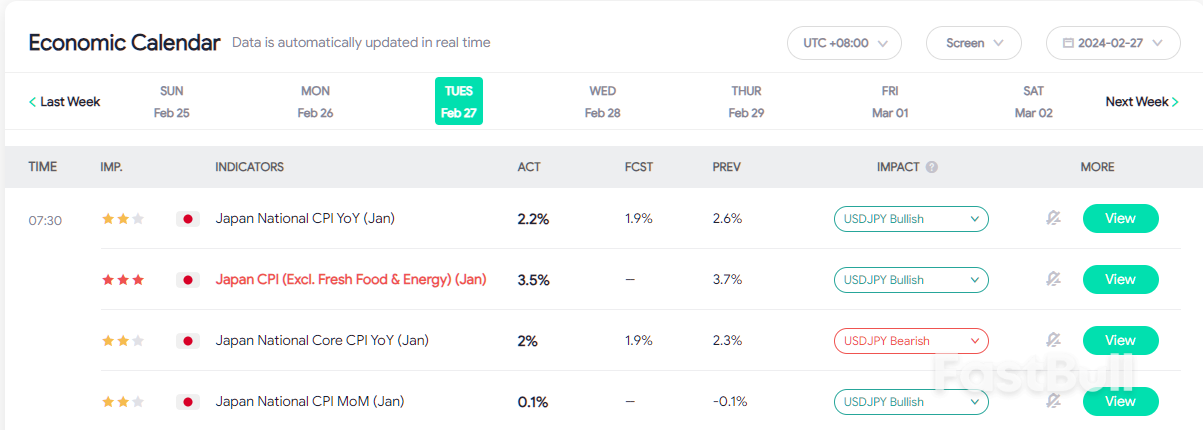
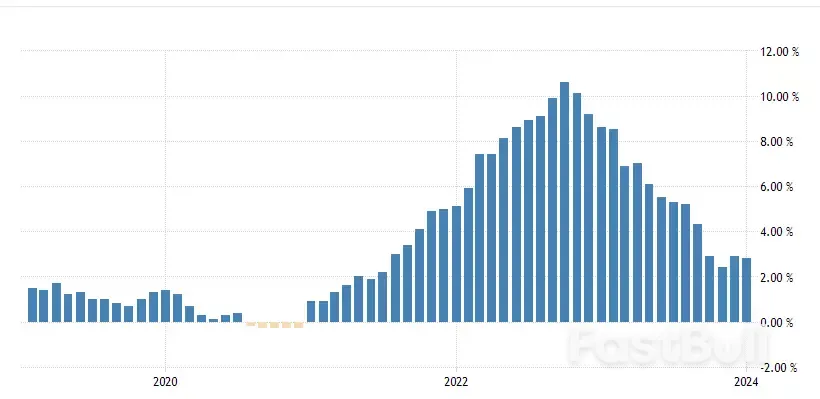
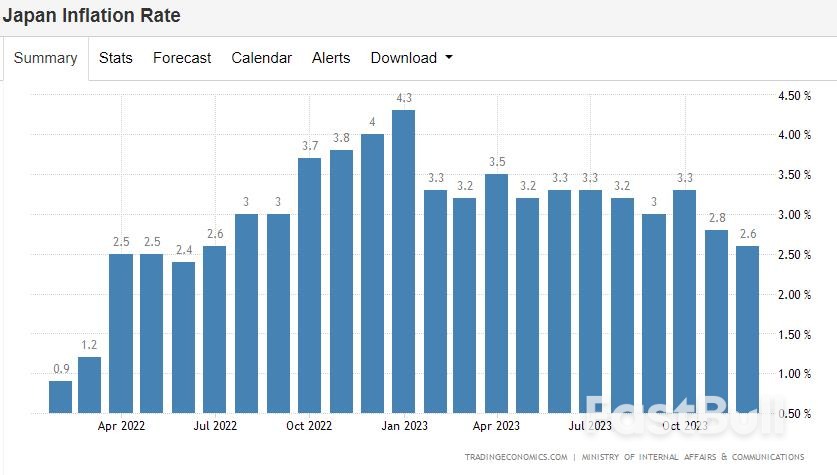
          In January, Japan's primary inflation measure surpassed expectations, providing further support for the Bank of Japan's ongoing trajectory towards ending its policy of negative interest rates.
          According to data from the internal affairs ministry released on Tuesday, consumer prices, excluding fresh food, rose by 2% compared to a year ago, exceeding the consensus estimate of 1.9% and aligning with the BOJ's inflation target. Following the release of this data, the yen saw a minimal increase of less than 0.1%.
          Japan Core Price Index Slows To 3.5% In January_1
          The stronger-than-anticipated inflation figures are likely to fuel speculation in the market that the BOJ is edging closer to its first interest rate hike since 2007, a move anticipated by a majority of BOJ observers to occur by April.
          Governor Kazuo Ueda expressed confidence in anchoring inflation above 2%, anticipating a positive economic cycle where inflation gradually rises alongside increased wages and employment opportunities.
          While February's inflation readings are expected to rebound as the impact of government price relief measures wanes, economists foresee core inflation, excluding fresh food, reaching 2.4% in the first and second quarters of 2024. Miyamae predicts the core rate could surpass 2.5% in February.
          Despite these positive indicators, the BOJ must communicate carefully if it decides to initiate interest rate hikes, given the current economic fundamentals. The recent technical recession, marked by reduced consumer and business spending, coupled with sluggish wage growth relative to inflation, poses challenges to household budgets and affects public sentiment, as evidenced by Prime Minister Fumio Kishida's declining support.
          The yen's persistent weakness against the dollar could exacerbate import-driven inflation and further strain consumption in the future. While this has bolstered Japanese stocks to record highs due to strong demand from overseas investors, it has not significantly improved sentiment within Japan, where individual investment in stocks remains comparatively subdued.
          The deceleration was partly attributed to a significant decline in energy expenses, driven by the base effect of a substantial increase last year and government subsidies aimed at mitigating gasoline and utility expenditures. This indicates a diminishing influence of cost-push pressures, which had consistently maintained core inflation at or above the BOJ's 2% target since April 2022.
          To stay updated on all economic events of today, please check out our Economic calendar
          Risk Warnings and Disclaimers
          You understand and acknowledge that there is a high degree of risk involved in trading. Following any strategies or investment methods may lead to potential losses. The content on the site is provided by our contributors and analysts for information purposes only. You are solely responsible for determining whether any trading assets, securities, strategy, or any other product is suitable for investing based on your own investment objectives and financial situation.
          Add to Favorites
          Share

          DAX Hits Fresh Record Highs Amid Nvidia's Earnings Surge: Euro Area Inflation Insight Awaited

          IG

          Central Bank

          Forex

          Riding the wave of Nvidia's impressive earnings report, European equities, including the stalwart German stock market, witnessed a surge to unprecedented highs last week.
          While the Nasdaq and the Nikkei have hogged the spotlight with their stellar performances this year, the German stock market has quietly carved its path to success. With a solid 13.4% gain in 2023, the DAX has continued its ascent, boasting a 4% increase year-to-date, even amidst the absence of notable AI players.
          As highlighted previously, the DAX's upward trajectory can be attributed to various crucial factors, such as a resurgence in manufacturing, a positive shift in sentiment towards China, and the resolution of the energy shock triggered by the Russian invasion of Ukraine.
          Equally significant has been the rapid decline in Euro Area inflation over the past sixteen months, positioning the ECB as a frontrunner among central banks expected to implement rate cuts in 2024. Insights into the timing of these potential rate adjustments will be gleaned from this week's Euro Area inflation data, as outlined below.

          What's on the horizon for Euro area inflation (Friday, 1 March 9:00pm)

          In January, headline inflation in the Euro area dipped to 2.8% YoY from December's 2.9%. Core inflation also saw a decline, settling at 3.3% YoY, marking its lowest level since March 2022. This month, expectations point to a further decrease, with headline inflation projected to drop to 2.7% YoY and core inflation anticipated to decline even further to 2.9% YoY.
          The minutes from the January ECB meeting, unveiled last week, underscored a widespread consensus that it was premature to broach the subject of rate cuts, emphasizing the fragile nature of the disinflationary process. This sentiment was reinforced by hawkish remarks from ECB Governing Council members Stournaras and President Lagarde, who echoed, "We are not there yet" regarding inflation.
          Nevertheless, the rates market is already factoring in a 25bp ECB rate cut slated for April, with a total of 88bp in cuts projected for 2024.

          DAX Hits Fresh Record Highs Amid Nvidia's Earnings Surge: Euro Area Inflation Insight Awaited_1

          EA annual headline inflation rate chart

          FTSE technical analysis

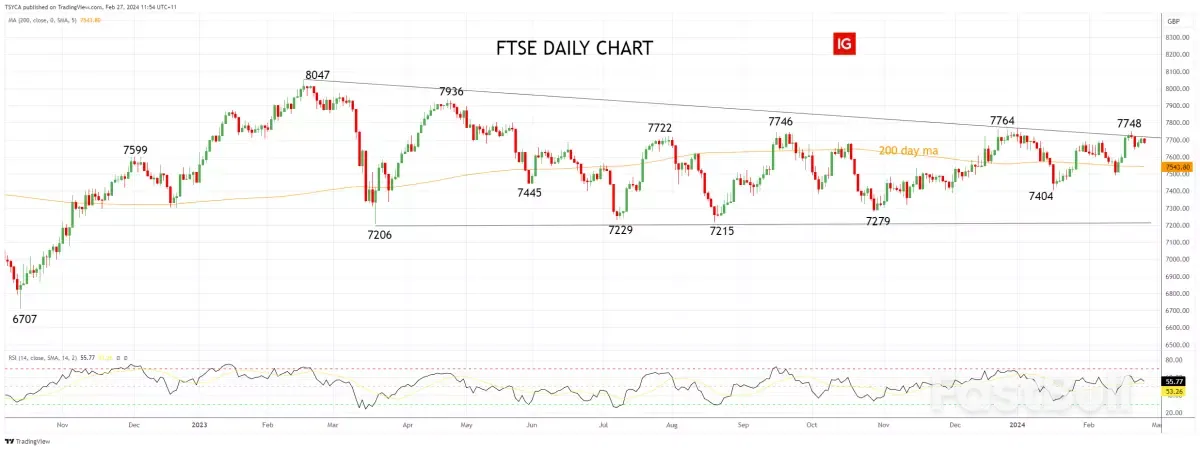
          It's the same old story for the FTSE, as it starts the new week eying resistance at 7750/65ish, which has capped for the past nine months. If the FTSE can see a sustained break above 7750/65ish, it would warrant a positive bias and open a test of the April 7936 high, with scope to the 8047 high.
          However, while the FTSE trades below resistance at 7750/60ish, there remains a high likelihood of further sideways rotating back towards the support at 7550/00, coming from the 200-day moving average and the mid-February 7492 low.DAX Hits Fresh Record Highs Amid Nvidia's Earnings Surge: Euro Area Inflation Insight Awaited_2

          FTSE daily chart

          DAX technical analysis

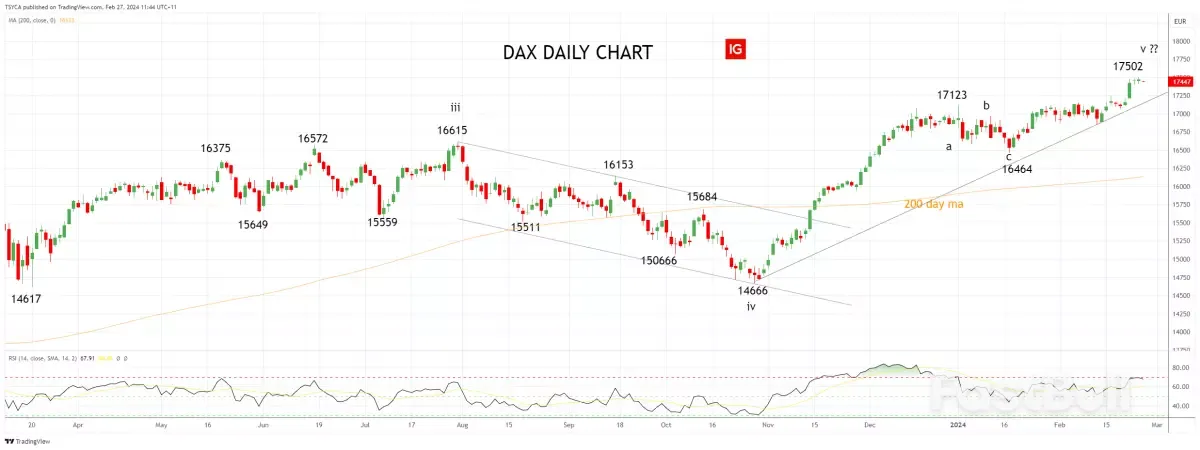
          In our updates in mid to late January, we noted that due to the nature of the three-wave decline from the early January 17,123 high to the mid-Jan 16,464 low, it was likely a correction, and the DAX would push to new highs.The Dax has since made a fresh record high at 17502, and while it remains above uptrend support at 17,200 from the October 14,666 low, the path of least resistance is for higher prices to follow.
          Aware that should the DAX fall below support at 17,200 and below a cluster of horizontal support at 17,100, it would warn that a deeper pullback towards the 200-day moving average at 16,127 is underway.DAX Hits Fresh Record Highs Amid Nvidia's Earnings Surge: Euro Area Inflation Insight Awaited_3

          DAX daily chart

          Risk Warnings and Disclaimers
          You understand and acknowledge that there is a high degree of risk involved in trading. Following any strategies or investment methods may lead to potential losses. The content on the site is provided by our contributors and analysts for information purposes only. You are solely responsible for determining whether any trading assets, securities, strategy, or any other product is suitable for investing based on your own investment objectives and financial situation.
          Add to Favorites
          Share

          Soaring Japanese Equities Offer Investors Cozy Distance From Troubled China

          Alex

          Economic

          While some investors just want to say goodbye to Japan's troubled neighbour in embracing the land of the rising sun, paradoxically, those seeking to harness the two countries' close economic ties at a cozy distance are winning handsomely.
          Nikkei heavyweights with a significant presence in China, such as chip giant Tokyo Electron 8035.T and Uniqlo parent company Fast Retailing 9983.T are soaring, having gained 126% and 63%, respectively, over the last 12 months.
          ASICS Corp 7936.T, which has subsidiaries in countries including China, is up about 91%, while Japanese restaurant chain Seizeriya 7581.T, a popular chain that has made a mark in China, has climbed 62%.
          Investors who have historically owned Chinese stocks but are now keeping a distance for fear of U.S. sanctions say owning a Japanese firm that either sells to China or is based there is becoming the more politically palatable option.
          Others are betting on China's eventual recovery, either driven by its quest for self-sufficiency or improved spending by its 1.4 billion consumers.
          Buying Japanese stocks is "less controversial in the U.S. political environment right now", said Liqian Ren, director of Modern Alpha at WisdomTree Asset Management in Philadelphia.
          "If a client owns Japan, even though the exposure is China's kind of proxy, your client is much less likely to ask you a political question if the portfolio didn't perform as well," she said.
          Japan's largest trade partner, China accounts for a fifth of trade and is also the third largest destination for Japanese investment, after the United States and Australia.
          While the countries may be intertwined economically, their financial markets could not present a greater contrast.
          China's blue-chip CSI300 index .CSI300 hit five-year lows this month, and is down 18% in about a year, pummeled by property market troubles and a lack of large-scale stimulus.
          Japanese equities .N225, on the other hand, are at record highs, and seem set to rise on the back of a brighter outlook for its economy and corporate governance reforms.
          About $6.59 billion has flowed out of China offshore funds since April 2023, while Japanese offshore funds received $6.3 billion worth of inflows last month, adding to inflows of $7.84 billion last year, according to LSEG data.
          Jamie Halse, a portfolio manager at Platinum Asset Management in Sydney, owns baby products maker Pigeon Corp 7956.T.
          The firm draws the majority of its operating profit from China, and Halse pointed to a rebound in the number of marriages on the mainland last year, which jumped 10%, following steady declines during the COVID-19 pandemic.
          "The other major area is most of the semiconductor supply chain, which is heavily exposed to Chinese demand," Halse added. "It has been very robust recently."
          Japan's chip-sector giants have helped to fuel the Nikkei's 17% gains this year, with Tokyo Electron and chip-testing equipment maker Advantest 6857.T ranking among top performers.
          "We are seeing a lot of flows in our hedge fund book globally coming out of China, and ... a lot is coming into the Japanese market," said Bruce Kirk, chief Japan equity strategist at Goldman Sachs.
          Chinese ties can serve as a major buoy or bludgeon to Japanese companies. The earnings of Shiseido4911.T, a cosmetic firm banking on China's beauty market, were battered by the slowing economy and its shares have fallen 32% in a year.
          Whether investors come to Japan seeking China proxies or complete disconnection, the shadows cast over China have given the Nikkei an undeniable boost.
          Even companies with slim links to China, such as Recruit Holdings 6098.T and Toyota Motor 7203.T, are up sharply.
          But in the end, analysts see fundamentals such as corporate governance reforms and earnings at index heavyweights as key to future inflows.
          "The China replacement trade is like extra icing on the top," said WisdomTree's Ren.

          Source:Reuters

          To stay updated on all economic events of today, please check out our Economic calendar
          Risk Warnings and Disclaimers
          You understand and acknowledge that there is a high degree of risk involved in trading. Following any strategies or investment methods may lead to potential losses. The content on the site is provided by our contributors and analysts for information purposes only. You are solely responsible for determining whether any trading assets, securities, strategy, or any other product is suitable for investing based on your own investment objectives and financial situation.
          Add to Favorites
          Share

          UK Food Inflation Near 2-year Low, BRC Data Shows

          Samantha Luan

          Economic

          UK food inflation eased to its lowest rate for almost two years in February as meat, fish and fruit prices fell, according to industry data published on Tuesday, adding to evidence of downward cost pressure in the economy.
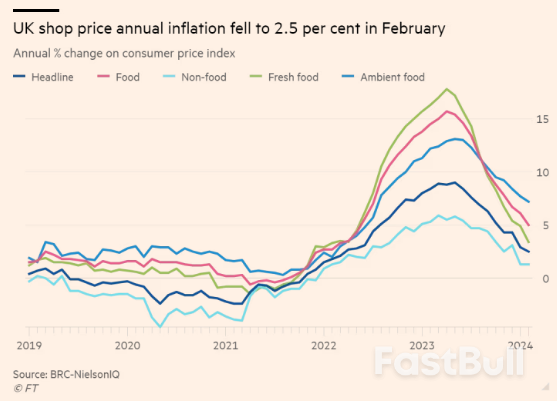
          Annual food inflation slowed to 5 per cent this month, down from 6.1 per cent in January and the lowest rate since May 2022, the British Retail Consortium data showed.
          The slowdown was driven by “easing input costs for energy and fertiliser while retailers competed fiercely to keep prices down”, said BRC chief executive Helen Dickinson.
          The data will raise hope that headline inflation, published on March 20, will continue to decline in February after remaining unchanged at 4 per cent in January.
          The BRC said food prices were down 0.1 per cent month-on-month in February, noting drops in certain fresh items including meat, fish and fruit.
          Official food price inflation fell to 6.9 per cent in January from a 45-year high of 19.1 in March 2023, when commodity costs surged after Russia’s invasion of Ukraine sent global supply chains into disarray.
          As supply chains have normalised and diversified to replace imports from Russia, the wholesale costs of energy and fertiliser have eased.UK Food Inflation Near 2-year Low, BRC Data Shows_1
          However, the BRC also reported that non-food inflation was unchanged at 1.3 per cent, the lowest rate since January 2022.
          Overall, shop prices grew at an annual rate of 2.5 per cent, the lowest since March 2022. The price of furniture, electricals as well as health and beauty products rose. But the cost of clothing continued to fall as retailers laid on post-Christmas promotions.
          “Shop price inflation has slowed and the underlying trend in prices will be downwards over the next few months,” said Mike Watkins, head of retailer and business insight at NielsenIQ, which put out the survey with BRC.
          The data followed the release of research by the ONS on Monday on the impact of price pressures on different household types.
          The report showed that while the poorest households bore the brunt of rising food costs, falling energy prices meant they no longer faced the highest overall inflation rate as was the case in the first half of 2023.
          In December, lower income households experienced price growth of 4.5 per cent, less than the 5.6 per cent of the higher income group.UK Food Inflation Near 2-year Low, BRC Data Shows_2
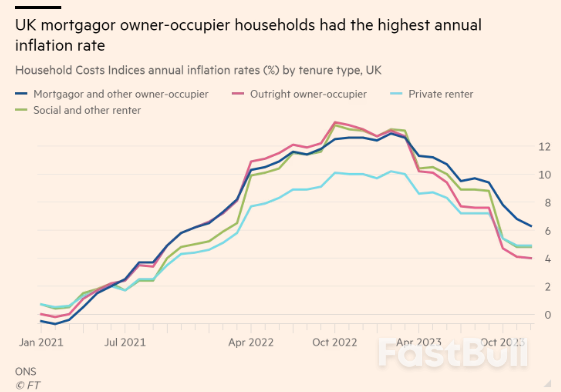
          Households with mortgages faced the highest annual inflation rate of any socio-economic group, at 6.3 per cent in December, reflecting rising mortgage interest payments.
          For private renters, the figure stood at 4.9 per cent; and at 4 per cent for outright homeowners.
          “Higher mortgage costs mean those with mortgages are now seeing the highest level of inflation, and non-retirees and those with children are being hard hit,” said Sarah Cumbers, chief executive of the Royal Statistical Society.
          “We urge policymakers to take note of these figures, so they are better able to understand inflation as actually experienced by households,” she added.
          Price growth for working households was 5.4 per cent in December, compared with 4 per cent for those who had retired. Households with children experienced price growth of 5.5 per cent, compared with 4.8 per cent for those without children.
          The second quarterly ONS household cost index is based on how much different households spend on goods and services. The headline inflation rate, by contrast, reflects price growth affecting all UK households.

          Source:Financial Times

          To stay updated on all economic events of today, please check out our Economic calendar
          Risk Warnings and Disclaimers
          You understand and acknowledge that there is a high degree of risk involved in trading. Following any strategies or investment methods may lead to potential losses. The content on the site is provided by our contributors and analysts for information purposes only. You are solely responsible for determining whether any trading assets, securities, strategy, or any other product is suitable for investing based on your own investment objectives and financial situation.
          Add to Favorites
          Share

          Facepalm! What Is the Future of JPY Bulls? 

          Winkelmann

          Central Bank

          Economic

          Forex

          Since the beginning of the year 2024, the focus in the foreign exchange market has been on the Fed's rate cut expectations. In front of strong economic data and stubborn inflation, the Fed rate cut expectations have been repeatedly delayed by the suppression. When the Fed is expected to maintain high interest rates for a longer period, at the same time, Japan, as the world's only remaining economy with negative interest rates, holds its monetary policy. As a result, a large number of investors trade the JPY for profits, resulting in eight consecutive weekly declines in JPY and dragging it down to be the worst-performing G10 currency. Besides, the USD/JPY rebounded above the 150 psychological level, and so far this year has risen by nearly 7%.
          Facepalm! What Is the Future of JPY Bulls? _1

          The BOJ's Hesitation

          Seeing the JPY in the depreciation trend, JPY bulls are exhausted while this trend seems to continue. Although the USD/JPY is close to the Japanese government's intervention cordon, many speculators further bet on shorting the JPY. According to the U.S. Commodity Futures Trading Commission (CFTC) data, leveraged funds and asset managers holding net short positions in the JPY are increasing to the highest level since mid-2022.
          Moreover, in the past two years, the famous " widow maker " (betting on the BOJ to tighten monetary policy and short Japanese bonds) has long disappeared. Do the JPY bulls have to surrender? Even if the Japanese Ministry of Finance officials made several verbal interventions, warning that appropriate action would be taken, the results were not satisfying. This action failed to stop the JPY's decline because it did not fundamentally solve the problem of Japan's interest rates staying low and monetary easing.
          Economically, Japan's GDP contracted for the second consecutive quarter in the fourth quarter, entering a technical recession, and the JPY weakened on the back of disappointing economic data. On top of that, the BOJ's choice to stay still may also take into account the fact that rising inflation has yet to stabilize. Recently, Japanese inflation has shown signs of cooling, with inflation falling for the third consecutive month to 2.6% in December, and core inflation dropping from 2.5% in November to 2.3%, the lowest level in 18 months. Although inflation is still above the 2% target level set by the BOJ, whether it can continue to stabilize is the key.
          Facepalm! What Is the Future of JPY Bulls? _2
          Japan's economy costs a lot to get out of "the lost decades", and the BOJ will not hastily tighten policy. If it is too hasty, Japan's economy may step into deflation again. After all, the economy just turned better after decades. If it returns to deterioration because of inappropriate actions, it is too much to lose. The BOJ's official attitude has been ambiguous. At the same time, Governor Ueda demonstrated previously that the normalization of monetary policy will be implemented. Meanwhile, he confirmed that even if the end of negative interest rates arrives, monetary conditions will still be loose, and the policy tightening process will be slow.

          Expectations of the JPY Bulls

          Since the beginning of the year, the JPY bulls have been losing, and USD/JPY recently stabilized above 150, tending to reach a new high soon. The only good news will be the strong resistance and hope that the Japanese government may intervene. At present, the turning point in USD/JPY requires a quick act from the BOJ as well as an immediate interest rate cut from the Fed. If the BOJ acts too slow in easing, and the U.S. postpones cutting interest rates due to the strong economy, the USD/JPY spreads will remain high, and the JPY is likely to fall to new lows.
          Although the progress is worse than expected, there are still hopes. According to the external analysis, the outcome of this spring wage negotiations is the key to guiding Japan's monetary policy in the coming months. A former executive director of the BOJ, who was responsible for setting monetary policy, has said that the outcome of the annual salary negotiations in the spring is likely to be 4% higher than last year. If wage hikes come to fruition as hoped in mid-March, inflation could pick up again, driven by costs. Then, the BOJ would be encouraged to pave the way for a real end to its negative interest rate policy, or even a rate hike as early as the end of March or April, a prospect that would inevitably support the JPY.
          Similarly, although the market expects that the Fed's first interest rate cut has been postponed to June, the damage to economic activity from persistently high interest rates cannot be ignored. Furthermore, the rally in U.S. bond yields seems to have been tepid and with limited room to maneuver. It is right to remain patient, but not excessively so, and there should be a limit to how long one can wait. Some economists believe that if the Fed doesn't cut rates until June, they could make the exact opposite policy mistake as they did in 2021 (rate hikes lagging inflation).
          As long as the market responds to these scenarios ahead of time, USD/JPY could start pulling back earlier than expected.
          To stay updated on all economic events of today, please check out our Economic calendar
          Risk Warnings and Disclaimers
          You understand and acknowledge that there is a high degree of risk involved in trading. Following any strategies or investment methods may lead to potential losses. The content on the site is provided by our contributors and analysts for information purposes only. You are solely responsible for determining whether any trading assets, securities, strategy, or any other product is suitable for investing based on your own investment objectives and financial situation.
          Add to Favorites
          Share

          U.S. Gas Glut Gets Hedge Funds Ultra Bearish: Kemp

          Cohen

          Commodity

          Hedge funds and other money managers sold the equivalent of 399 billion cubic feet (bcf) in the two major futures and options contracts linked to prices at Henry Hub in Louisiana over the seven days ending on Feb. 20.
          Fund managers have been net sellers in each of the most recent five weeks, selling 2,085 bcf since Jan. 16, according to position reports filed with the U.S. Commodity Futures Trading Commission.
          As a result, the combined position has been reduced to a net short of 1,675 bcf (3rd percentile for all weeks since 2010) down from a net long of 410 bcf (42nd percentile) in the middle of January.
          The gas market has been chronically oversupplied in recent months, with inventories 436 bcf (+21% or +1.26 standard deviations) above the prior 10-year seasonal average on Feb. 16.
          The surplus has swelled consistently since the start of the winter heating season on Oct. 1, when it was just 64 bcf (+2% or +0.24 standard deviations).
          Exceptionally strong El Niño conditions over the Pacific ensured temperatures have been mostly above average across the major population centres of the northern United States.
          Domestic gas production has continued to increase, in spite of the relatively low prices, adding to the burgeoning surplus of gas in storage.
          The rig count for gas has actually increased marginally since September 2023 as producers have been unresponsive to falling prices until the last few weeks.
          In addition, more associated gas is being produced as a co-product of drilling for oil, where prices are close to the long-term inflation-adjusted average and drilling rates are steady.
          From a purely positioning perspective, the balance of risks must lie to the upside, with real prices at multi-decade lows and lots of short positions that must eventually be repurchased.
          Short positions have only ever been greater in the first quarter of 2020, when stocks were at record levels and the economy was bracing for the arrival of the first wave of the coronavirus epidemic.
          So there is potential for a huge short-covering rally if and when the news flow becomes more positive and inventories start to erode.
          But hedge fund managers have tried and failed to identify the turning point three times in the last twelve months and been forced to retreat each time.
          Bloated gas stocks in Europe and Japan after the price spike of 2021/22 will make it hard for the market to rebalance via increased exports.
          Many analysts now expect the rebalancing to be postponed until the winter of 2024/25 with prices likely to remain suppressed until nearer then.

          PETROLEUM

          Investors continued to add to their position in petroleum-related futures and options over the seven days ending on Feb. 16, but at a slower rate than in previous weeks.
          Hedge funds and other money managers purchased the equivalent of 17 million barrels in the six most important petroleum-linked futures and options contracts.
          All the buying was concentrated in NYMEX and ICE WTI (+29 million barrels) with small sales in Brent (-4 million), European gas oil (-4 million), U.S. diesel (-4 million) and U.S. gasoline (-1 million).
          Even after the recent buying, positions in WTI remain the most bearish of any of the major oil contracts, weighed down by the continued rise in domestic oil production, even as OPEC restricts Middle East supplies.
          The net position in NYMEX and ICE WTI of 109 million barrels is still in only the 8th percentile for all weeks since 2013.
          That compares with net positions in Brent, gasoline and the distillates contracts all between the 60th and 70th percentiles.
          WTI buying seems to have been motivated by unwinding previous bearish short positions (-17 million barrels) and cautious initiation of new longs (+13 million).
          Crude inventories around the NYMEX WTI delivery point at Cushing in Oklahoma are still 14 million barrels (-32% or -1.14 standard deviations) below the prior 10-year seasonal average. Despite an extended shutdown of BP's refinery at Whiting in Indiana, Cushing stocks have increased only slightly in the last two weeks, underscoring the risk of a squeeze on deliverable supplies.
          With positioning so bearish, the balance of risks lies to the upside; some fund managers have begun to cut short positions and get long accordingly.

          Source:Reuters

          Risk Warnings and Disclaimers
          You understand and acknowledge that there is a high degree of risk involved in trading. Following any strategies or investment methods may lead to potential losses. The content on the site is provided by our contributors and analysts for information purposes only. You are solely responsible for determining whether any trading assets, securities, strategy, or any other product is suitable for investing based on your own investment objectives and financial situation.
          Add to Favorites
          Share

          February 27th Financial News

          FastBull Featured

          Daily News

          [Quick Facts]

          1. U.S. mortgage rates fall and new home sales rise year-over-year.
          2. ECB's Lagarde said more evidence is still needed that inflation will fall back to 2%.
          3. Israel's central bank suspends interest rate cut.
          4. Denmark announced to stop the investigation of the "Nord Stream" gas pipeline explosion incident.
          5. Palestinian Prime Minister announces the resignation of the Palestinian government.
          6. Hungary approves Sweden's NATO accession.

          [News Details]

          U.S. mortgage rates fall and new home sales rise year-over-year.
          On Monday, U.S. new home sales rose in January month-on-month, though less than expected, according to the data released by the U.S. Commerce Department. The median price of new home sales fell again as supply continued to climb.
          As for the data, the U.S. January new home sales annualized 661,000, expected 684,000, the previous value of 664,000 in December; January new home sales rose 1.5% month-on-month, expected to rise 3%, the previous value of 8% rise in December. January new home sales rose 1.8% year-on-year. As homebuilders and buyers to take advantage of lower mortgage rates earlier this year, January U.S. new home sales rose slightly. Falling mortgage rates have boosted homebuilder confidence and boosted sales in the market, and the U.S. real estate industry has a good start in 2024. However, mortgage rates have risen again recently as the Federal Reserve is in no hurry to cut interest rates, which could make the real estate market's growth momentum short-lived.
          ECB's Lagarde said more evidence still needed that inflation will fall back to 2%.
          Speaking at the plenary debate on the ECB's 2022 annual report on Monday, Lagarde said that eurozone inflation will continue to fall, but more evidence is needed that inflation will fall back to target levels. Payroll pressures remain strong, and payrolls are likely to be an increasingly important driver of price movements in the coming quarters. As far as the European economy is concerned, there are growing signs of a bottoming out, while some forward-looking indicators point to a rebound later this year.
          Israel's central bank suspends interest rate cut.
          Israel kept its benchmark interest rate unchanged at 4.5% on Monday, with the central bank wary of the risk of a widening of the Israeli-Hamas conflict, while an economic rebound this year has fueled inflation concerns. While mindful of the risks facing the economy after last quarter's near-record contraction, Israel's central bank also warned that the government's heavy spending in response to the conflict could be an obstacle to further easing of monetary policy, in addition to concerns about shekel volatility, geopolitics, and credit rating downgrades.
          Israel's annual inflation rate has been slowing or unchanged for 11 months of the past year, moving into the 1-3 percent target range for the first time in more than two years. But increased government spending has increased the risk of sticky inflation, especially as higher transportation costs add to the pressure amid continuing labor shortages.
          Denmark announced to stop the investigation of the "Nord Stream" gas pipeline explosion incident.
          On February 26, local time, Denmark stopped the investigation of the "Nord Stream" gas pipeline explosion. But the Danish police said the "Nord Stream" pipeline explosion was caused by human damage.
          Previously, the Swedish prosecution on the 7th of this month announced the end of the "Nord Stream" gas pipeline explosion lasted more than 16 months of investigation citing the "lack of jurisdiction in Sweden". They said that the relevant investigative materials had been transferred to Germany, but did not give a conclusion on the responsibility of the incident. So far, only Germany is continuing the relevant investigation.
          Palestinian Prime Minister announces the resignation of the Palestinian government.
          On February 26, Palestinian Prime Minister Shtayyeh announced the resignation of the Palestinian government in the West Bank city of Ramallah.
          Speaking at a government working session on the same day, Shtayyeh said that the government's decision to resign was related to the aggression suffered by the people of the Gaza Strip and the political, security, and economic problems it has caused, as well as the escalation of the situation in Jerusalem and the West Bank region.
          It follows news that Hamas, which controls the Gaza Strip, has agreed to form a technocratic government in Palestine, and that the new government will not be affiliated with any Palestinian political party. It will be run by professional independents who will take over the administration of the government during the initial transitional phase until elections are held at a later date.
          Hungary approves Sweden's NATO accession.
          On February 26, the Hungarian Parliament approved the protocol on Sweden's accession to NATO by a vote of 188 in favor and 6 against, ending an 18-month delay.
          The Russo-Ukrainian War broke out on February 24, 2022, and in May of the same year, Sweden and Finland abandoned their long-standing policy of military non-alignment and simultaneously applied for NATO membership. Finland was formally approved in April 2023 to join NATO. After Turkey ratified Sweden's accession to NATO in January this year, only Hungary among NATO member states has yet to ratify Sweden's "accession". The United States and NATO allies have recently pressured Hungary to "release" the Hungarian parliament as soon as possible.

          [Focus of the Day]

          UTC+8 21:30 US Durable Goods Orders (January)
          UTC+8 22:00 US FHFA House Price Index Monthly (December)
          UTC+8 22:00 US S&P/CS 20 Metropolitan House Price Index Y/Y (unseasonal adjusted) (December)
          UTC+8 23:00 Conference Board Consumer Confidence (February)
          Risk Warnings and Disclaimers
          You understand and acknowledge that there is a high degree of risk involved in trading. Following any strategies or investment methods may lead to potential losses. The content on the site is provided by our contributors and analysts for information purposes only. You are solely responsible for determining whether any trading assets, securities, strategy, or any other product is suitable for investing based on your own investment objectives and financial situation.
          Add to Favorites
          Share
          FastBull
          Copyright © 2025 FastBull Ltd

          728 RM B 7/F GEE LOK IND BLDG NO 34 HUNG TO RD KWUN TONG KLN HONG KONG

          TelegramInstagramTwitterfacebooklinkedin
          App Store Google Play Google Play
          Products
          Charts

          Chats

          Q&A with Experts
          Screeners
          Economic Calendar
          Data
          Tools
          Membership
          Features
          Function
          Markets
          Copy Trading
          Latest Signals
          Contests
          News
          Analysis
          24/7
          Columns
          Education
          Company
          Careers
          About Us
          Contact Us
          Advertising
          Help Center
          Feedback
          User Agreement
          Privacy Policy
          Business

          White Label

          Data API

          Web Plug-ins

          Poster Maker

          Affiliate Program

          Risk Disclosure

          The risk of loss in trading financial instruments such as stocks, FX, commodities, futures, bonds, ETFs and crypto can be substantial. You may sustain a total loss of the funds that you deposit with your broker. Therefore, you should carefully consider whether such trading is suitable for you in light of your circumstances and financial resources.

          No decision to invest should be made without thoroughly conducting due diligence by yourself or consulting with your financial advisors. Our web content might not suit you since we don't know your financial conditions and investment needs. Our financial information might have latency or contain inaccuracy, so you should be fully responsible for any of your trading and investment decisions. The company will not be responsible for your capital loss.

          Without getting permission from the website, you are not allowed to copy the website's graphics, texts, or trademarks. Intellectual property rights in the content or data incorporated into this website belong to its providers and exchange merchants.

          Not Logged In

          Log in to access more features

          FastBull Membership

          Not yet

          Purchase

          Become a signal provider
          Help Center
          Customer Service
          Dark Mode
          Price Up/Down Colors

          Log In

          Sign Up

          Position
          Layout
          Fullscreen
          Default to Chart
          The chart page opens by default when you visit fastbull.com