• Trade
  • Markets
  • Copy
  • Contests
  • News
  • 24/7
  • Calendar
  • Q&A
  • Chats
Trending
Screeners
SYMBOL
LAST
BID
ASK
HIGH
LOW
NET CHG.
%CHG.
SPREAD
SPX
S&P 500 Index
6827.42
6827.42
6827.42
6899.86
6801.80
-73.58
-1.07%
--
DJI
Dow Jones Industrial Average
48458.04
48458.04
48458.04
48886.86
48334.10
-245.98
-0.51%
--
IXIC
NASDAQ Composite Index
23195.16
23195.16
23195.16
23554.89
23094.51
-398.69
-1.69%
--
USDX
US Dollar Index
97.950
98.030
97.950
98.500
97.950
-0.370
-0.38%
--
EURUSD
Euro / US Dollar
1.17394
1.17409
1.17394
1.17496
1.17192
+0.00011
+ 0.01%
--
GBPUSD
Pound Sterling / US Dollar
1.33707
1.33732
1.33707
1.33997
1.33419
-0.00148
-0.11%
--
XAUUSD
Gold / US Dollar
4299.39
4299.39
4299.39
4353.41
4257.10
+20.10
+ 0.47%
--
WTI
Light Sweet Crude Oil
57.233
57.485
57.233
58.011
56.969
-0.408
-0.71%
--

Community Accounts

Signal Accounts
--
Profit Accounts
--
Loss Accounts
--
View More

Become a signal provider

Sell trading signals to earn additional income

View More

Guide to Copy Trading

Get started with ease and confidence

View More

Signal Accounts for Members

All Signal Accounts

Best Return
  • Best Return
  • Best P/L
  • Best MDD
Past 1W
  • Past 1W
  • Past 1M
  • Past 1Y

All Contests

  • All
  • Trump Updates
  • Recommend
  • Stocks
  • Cryptocurrencies
  • Central Banks
  • Featured News
Top News Only
Share

Trump Isn't Certain His Economic Policies Will Translate To Midterm Wins

Share

The United States And Mexico Have Reached An Agreement On How To Resolve The Water Dispute In The Rio Grande Basin (which Borders Texas). Starting December 15, Mexico Will Supply The U.S. With An Additional 20.2 Acre-feet (a Unit Of Volume For Irrigation). The Agreement Seeks To “strengthen Water Management In The Rio Grande Basin” Within The Framework Of The 1944 Water Treaty

Share

U.S. Transportation Secretary Duffy: The Engine Of United Airlines Flight 803 That Malfunctioned Caught Fire

Share

Ukraine President Zelenskiy: He Will Meet US, European Representatives About Peace

Share

UK Prime Minister Office: Prime Minister Starmer Spoke To The President Of The European Commission Ursula Von Der Leyen This Evening - Downing Street Spokesperson

Share

Trump: We Will Retaliate Against ISIS

Share

Trump Says We Mourn The Loss Of Three Great Patriots In Syria In An Ambush

Share

Syrian Interior Ministry Spokesperson Confirms Attacker Was Member Of Security Forces With Extremist Ideology

Share

Syrian Interior Ministry Says Attacker Did Not Have Leadership Role In Security Forces, Did Not Say If He Was Junior Member

Share

Man Who Attacked Syrian, US Military Was Member Of Syrian Security Forces -Three Local Syrian Officials

Share

US Envoy Coale Says Belarus President Lukashenko Agreed To Do All He Can To Stop Weather Balloons Flying Into Lithuania

Share

Ukraine Says Russian Drone Attack Hit Civilian Turkish Vessel

Share

Islamic State Attacker In Syria Was Lone Gunman, Who Was Killed -USA Central Command

Share

US Envoy John Coale Says Around 1000 Remaining Political Prisoners In Belarus Could Be Released In Coming Months

Share

US Defense Secretary Hegseth: Attacker Was Killed By Partner Forces

Share

Pentagon Says Two USA Army Soldiers And One Civilian USA Interpreter Were Killed, And Three Were Wounded In Syria

Share

Israel Says It Kills Senior Hamas Commander Raed Saed In Gaza

Share

Ukraine's Navy Says Russian Drone Attack Hit Civilian Turkish Vessel Carrying Sunflower Oil To Egypt On Saturday

Share

Israeli Military Says It Put Planned Strike On South Lebanon Site On Hold After Lebanese Army Requested Access

Share

Norwegian Nobel Committee: Calls On The Belarusian Authorities To Release All Political Prisoners

TIME
ACT
FCST
PREV
U.K. Trade Balance (Oct)

A:--

F: --

P: --

U.K. Services Index MoM

A:--

F: --

P: --

U.K. Construction Output MoM (SA) (Oct)

A:--

F: --

P: --

U.K. Industrial Output YoY (Oct)

A:--

F: --

P: --

U.K. Trade Balance (SA) (Oct)

A:--

F: --

P: --

U.K. Trade Balance EU (SA) (Oct)

A:--

F: --

P: --

U.K. Manufacturing Output YoY (Oct)

A:--

F: --

P: --

U.K. GDP MoM (Oct)

A:--

F: --

P: --

U.K. GDP YoY (SA) (Oct)

A:--

F: --

P: --

U.K. Industrial Output MoM (Oct)

A:--

F: --

P: --

U.K. Construction Output YoY (Oct)

A:--

F: --

P: --

France HICP Final MoM (Nov)

A:--

F: --

P: --

China, Mainland Outstanding Loans Growth YoY (Nov)

A:--

F: --

P: --

China, Mainland M2 Money Supply YoY (Nov)

A:--

F: --

P: --

China, Mainland M0 Money Supply YoY (Nov)

A:--

F: --

P: --

China, Mainland M1 Money Supply YoY (Nov)

A:--

F: --

P: --

India CPI YoY (Nov)

A:--

F: --

P: --

India Deposit Gowth YoY

A:--

F: --

P: --

Brazil Services Growth YoY (Oct)

A:--

F: --

P: --

Mexico Industrial Output YoY (Oct)

A:--

F: --

P: --

Russia Trade Balance (Oct)

A:--

F: --

P: --

Philadelphia Fed President Henry Paulson delivers a speech
Canada Building Permits MoM (SA) (Oct)

A:--

F: --

P: --

Canada Wholesale Sales YoY (Oct)

A:--

F: --

P: --

Canada Wholesale Inventory MoM (Oct)

A:--

F: --

P: --

Canada Wholesale Inventory YoY (Oct)

A:--

F: --

P: --

Canada Wholesale Sales MoM (SA) (Oct)

A:--

F: --

P: --

Germany Current Account (Not SA) (Oct)

A:--

F: --

P: --

U.S. Weekly Total Rig Count

A:--

F: --

P: --

U.S. Weekly Total Oil Rig Count

A:--

F: --

P: --

Japan Tankan Large Non-Manufacturing Diffusion Index (Q4)

--

F: --

P: --

Japan Tankan Small Manufacturing Outlook Index (Q4)

--

F: --

P: --

Japan Tankan Large Non-Manufacturing Outlook Index (Q4)

--

F: --

P: --

Japan Tankan Large Manufacturing Outlook Index (Q4)

--

F: --

P: --

Japan Tankan Small Manufacturing Diffusion Index (Q4)

--

F: --

P: --

Japan Tankan Large Manufacturing Diffusion Index (Q4)

--

F: --

P: --

Japan Tankan Large-Enterprise Capital Expenditure YoY (Q4)

--

F: --

P: --

U.K. Rightmove House Price Index YoY (Dec)

--

F: --

P: --

China, Mainland Industrial Output YoY (YTD) (Nov)

--

F: --

P: --

China, Mainland Urban Area Unemployment Rate (Nov)

--

F: --

P: --

Saudi Arabia CPI YoY (Nov)

--

F: --

P: --

Euro Zone Industrial Output YoY (Oct)

--

F: --

P: --

Euro Zone Industrial Output MoM (Oct)

--

F: --

P: --

Canada Existing Home Sales MoM (Nov)

--

F: --

P: --

Euro Zone Total Reserve Assets (Nov)

--

F: --

P: --

U.K. Inflation Rate Expectations

--

F: --

P: --

Canada National Economic Confidence Index

--

F: --

P: --

Canada New Housing Starts (Nov)

--

F: --

P: --

U.S. NY Fed Manufacturing Employment Index (Dec)

--

F: --

P: --

U.S. NY Fed Manufacturing Index (Dec)

--

F: --

P: --

Canada Core CPI YoY (Nov)

--

F: --

P: --

Canada Manufacturing Unfilled Orders MoM (Oct)

--

F: --

P: --

Canada Manufacturing New Orders MoM (Oct)

--

F: --

P: --

Canada Core CPI MoM (Nov)

--

F: --

P: --

Canada Manufacturing Inventory MoM (Oct)

--

F: --

P: --

Canada CPI YoY (Nov)

--

F: --

P: --

Canada CPI MoM (Nov)

--

F: --

P: --

Canada CPI YoY (SA) (Nov)

--

F: --

P: --

Canada Core CPI MoM (SA) (Nov)

--

F: --

P: --

Canada CPI MoM (SA) (Nov)

--

F: --

P: --

Q&A with Experts
    • All
    • Chatrooms
    • Groups
    • Friends
    Connecting
    .
    .
    .
    Type here...
    Add Symbol or Code

      No matching data

      All
      Trump Updates
      Recommend
      Stocks
      Cryptocurrencies
      Central Banks
      Featured News
      • All
      • Russia-Ukraine Conflict
      • Middle East Flashpoint
      • All
      • Russia-Ukraine Conflict
      • Middle East Flashpoint
      Search
      Products

      Charts Free Forever

      Chats Q&A with Experts
      Screeners Economic Calendar Data Tools
      Membership Features
      Data Warehouse Market Trends Institutional Data Policy Rates Macro

      Market Trends

      Market Sentiment Order Book Forex Correlations

      Top Indicators

      Charts Free Forever
      Markets

      News

      News Analysis 24/7 Columns Education
      From Institutions From Analysts
      Topics Columnists

      Latest Views

      Latest Views

      Trending Topics

      Top Columnists

      Latest Update

      Signals

      Copy Rankings Latest Signals Become a signal provider AI Rating
      Contests
      Brokers

      Overview Brokers Assessment Rankings Regulators News Claims
      Broker listing Forex Brokers Comparison Tool Live Spread Comparison Scam
      Q&A Complaint Scam Alert Videos Tips to Detect Scam
      More

      Business
      Events
      Careers About Us Advertising Help Center

      White Label

      Data API

      Web Plug-ins

      Affiliate Program

      Awards Institution Evaluation IB Seminar Salon Event Exhibition
      Vietnam Thailand Singapore Dubai
      Fans Party Investment Sharing Session
      FastBull Summit BrokersView Expo
      Recent Searches
        Top Searches
          Markets
          News
          Analysis
          User
          24/7
          Economic Calendar
          Education
          Data
          • Names
          • Latest
          • Prev

          View All

          No data

          Scan to Download

          Faster Charts, Chat Faster!

          Download App
          English
          • English
          • Español
          • العربية
          • Bahasa Indonesia
          • Bahasa Melayu
          • Tiếng Việt
          • ภาษาไทย
          • Français
          • Italiano
          • Türkçe
          • Русский язык
          • 简中
          • 繁中
          Open Account
          Search
          Products
          Charts Free Forever
          Markets
          News
          Signals

          Copy Rankings Latest Signals Become a signal provider AI Rating
          Contests
          Brokers

          Overview Brokers Assessment Rankings Regulators News Claims
          Broker listing Forex Brokers Comparison Tool Live Spread Comparison Scam
          Q&A Complaint Scam Alert Videos Tips to Detect Scam
          More

          Business
          Events
          Careers About Us Advertising Help Center

          White Label

          Data API

          Web Plug-ins

          Affiliate Program

          Awards Institution Evaluation IB Seminar Salon Event Exhibition
          Vietnam Thailand Singapore Dubai
          Fans Party Investment Sharing Session
          FastBull Summit BrokersView Expo

          Inflation Still Falling in Turkey Despite Recent FX Moves

          Devin
          Summary:

          Annual inflation dropped in June amid a better-than-expected monthly reading but the downtrend since October seems to be coming to an end.
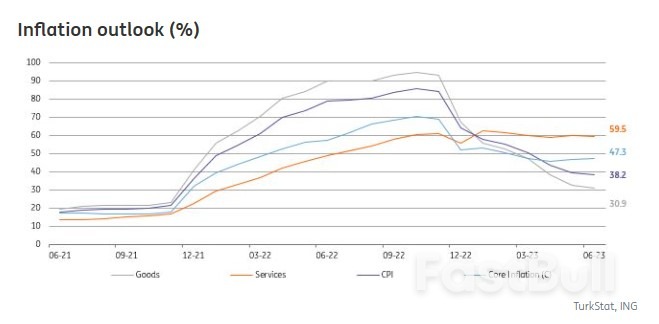
          With the better-than-expected June figure of 3.92% month-on-month (vs the consensus at 4.84%), annual inflation continued to fall, dropping to 38.2% from 39.6% a month ago. This continuation of the downtrend last month was attributable to lower price increases in non-food groups compared to last year, despite recent exchange rate developments and the continuing impact of buoyant domestic demand. With the June data, cumulative inflation in the first half of this year reached 19.8% (vs the 22.3% full-year forecast from the Central Bank of Turkey in its April inflation report). Given this backdrop, we will likely see a revision to the CBT's forecast following the release of the new inflation report at the end of this month.
          Core inflation (CPI-C) came in at 3.84% MoM or 47.3% on an annual basis. While the exchange rate and commodity price-driven improvements in core inflation indicators helped to keep a lid on inflation expectations for some time, the pass-through effect from recent currency weakness has now started to impact the inflation outlook again. In June, durable goods prices rose by 6.6% MoM, while core goods inflation accelerated to 36.7% year-on-year. Accordingly, the underlying trend (as measured by the three-month moving average, annualised percentage change, based on the seasonally-adjusted series) for the headline rate markedly increased in comparison to the previous month due to goods inflation along with continuing pressure in services, which has kept the trend in this group elevated given the continuing pressures in rent and catering services.
          After mild PPI readings in recent months, we saw an acceleration to 6.5% MoM reflecting the impact of exchange rate volatility, though annual inflation slightly dropped to 40.4% due to large base effects. The data implies that cost pressures have started to gain strength again and will likely continue in the near term given recent minimum wage adjustments and the hike in civil servant salaries.
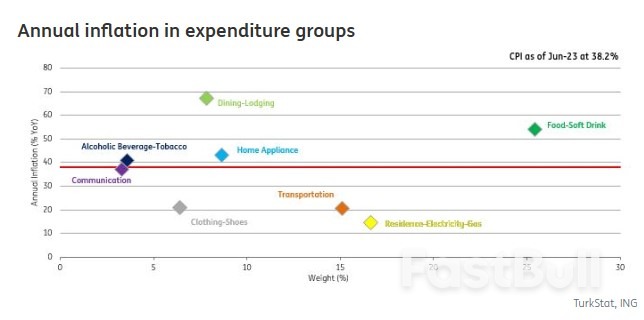
          Inflation Still Falling in Turkey Despite Recent FX Moves_1In the breakdown of the main expenditure groups, transportation was the major contributor to the headline rate, at 1.19ppt, on the back of FX-driven effects. This group was followed by food at 0.83ppt thanks to unprocessed food, particularly fresh fruit and vegetables, despite moderating inflation in processed food. Among other segments, catering (reflecting cost-related pressures), housing (sensitive to the exchange rate and domestic demand) and alcoholic beverages & tobacco (due to price hikes in cigarettes) were other drivers pulling the headline up by 35bp to 40bp.
          Despite strengthening underlying momentum, goods inflation moderated to 30.9% YoY thanks to base effects while annual inflation in services recorded a 59.45% YoY increase, close to the peak of the current inflation series as it was significantly affected by domestic demand and hence accelerated significantly due to rents, and restaurants and hotels.Inflation Still Falling in Turkey Despite Recent FX Moves_2
          In sum, the downtrend in inflation since last October seems to have come to an end. We will likely see an increase in the headline rate ahead given the FX pass-through from recent lira weakness, as well as the continuing strength in demand conditions which is allowing companies to pass on their cost increases to consumers. Potential adjustments in administered prices could also boost overall inflation. On the policy front, the equilibrium point in exchange rates and interest rates has yet to be seen given signs of a gradual policy approach which implies that a pivot to more conventional policies will take time. Going forward, market participants will be focusing on the government's new Medium-Term Program which is reported to be announced in September. In this regard, the normalisation process and related policy moves will also be closely followed in the near term.

          Source: ING

          Risk Warnings and Disclaimers
          You understand and acknowledge that there is a high degree of risk involved in trading. Following any strategies or investment methods may lead to potential losses. The content on the site is provided by our contributors and analysts for information purposes only. You are solely responsible for determining whether any trading assets, securities, strategy, or any other product is suitable for investing based on your own investment objectives and financial situation.
          Comments
          Add to Favorites
          Share

          Rice to Get Costlier as Weather, India's Farm Perks Threaten Supply

          Owen Li

          Commodity

          Global rice prices, now at their highest in 11 years, are set to rally further after India moved to boost payments to farmers, just as El Nino threatens yields in key producers and alternative staples get costlier for poor Asians and Africans.
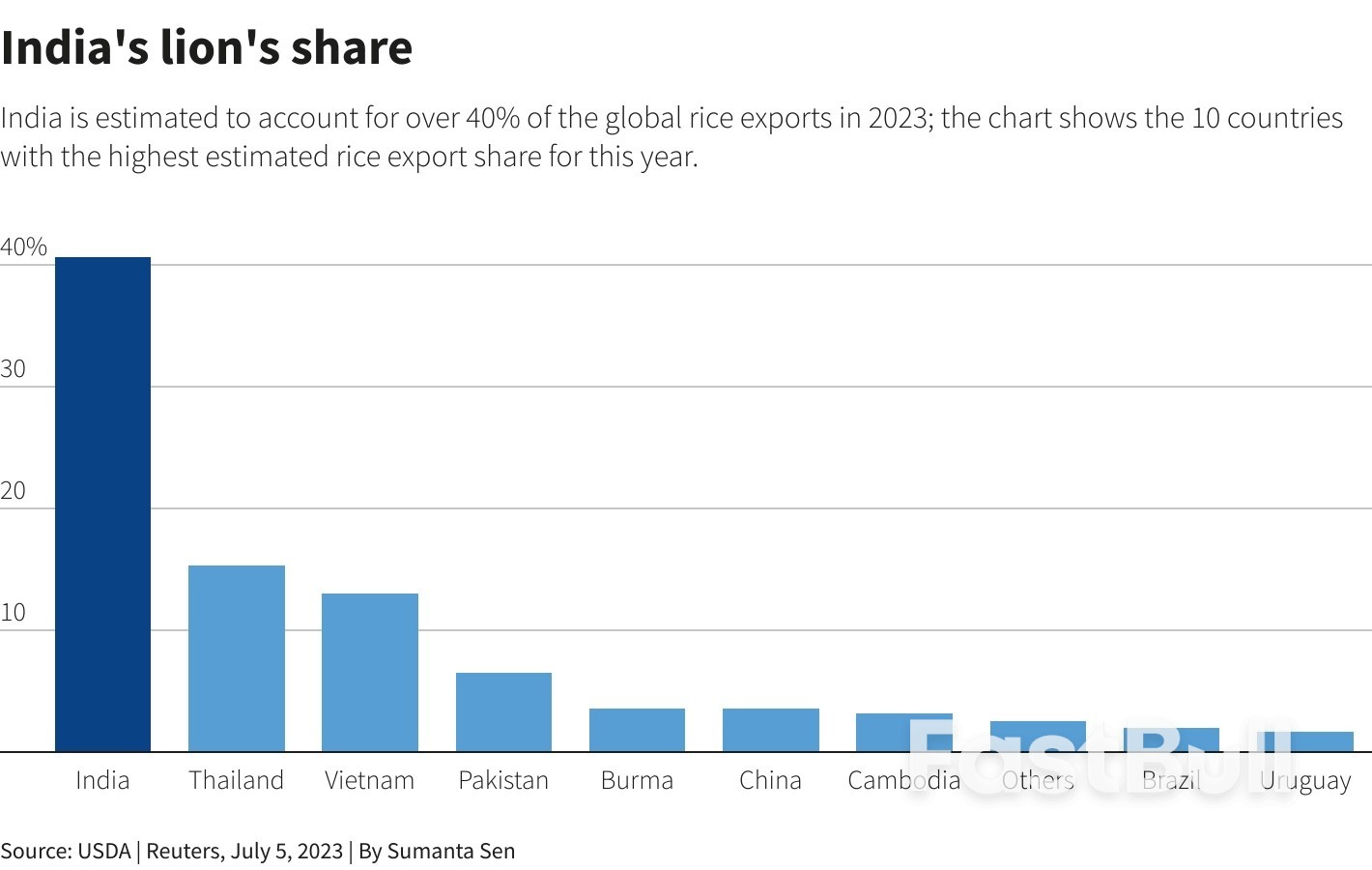
          India accounts for more than 40% of world rice exports, which were 56 million tonnes in 2022, but low inventories mean any cut in shipments will fuel food prices driven up by Russia's invasion of Ukraine last year and erratic weather.
          "India was the cheapest supplier of rice," B.V. Krishna Rao, president of the Rice Exporters Association (REA), told Reuters. "As Indian prices moved up because of the new minimum support price, other suppliers also started raising prices."
          Rice is a staple for more than 3 billion people and nearly 90% of the water-intensive crop is produced in Asia, where the El Nino weather pattern usually brings lower rainfall.
          Yet even before the weather phenomenon can disrupt production, the global rice price index of the Food and Agriculture Organization hovers above an 11-year high.
          That comes despite a forecast by the U.S. Department of Agriculture (USDA) for near-record output in all top six global producers — Bangladesh, China, India, Indonesia, Thailand and Vietnam.
          "The impact of El Nino is not restricted to any single country; it affects rice output in almost all producing countries," said Nitin Gupta, vice president of Olam India's rice business.
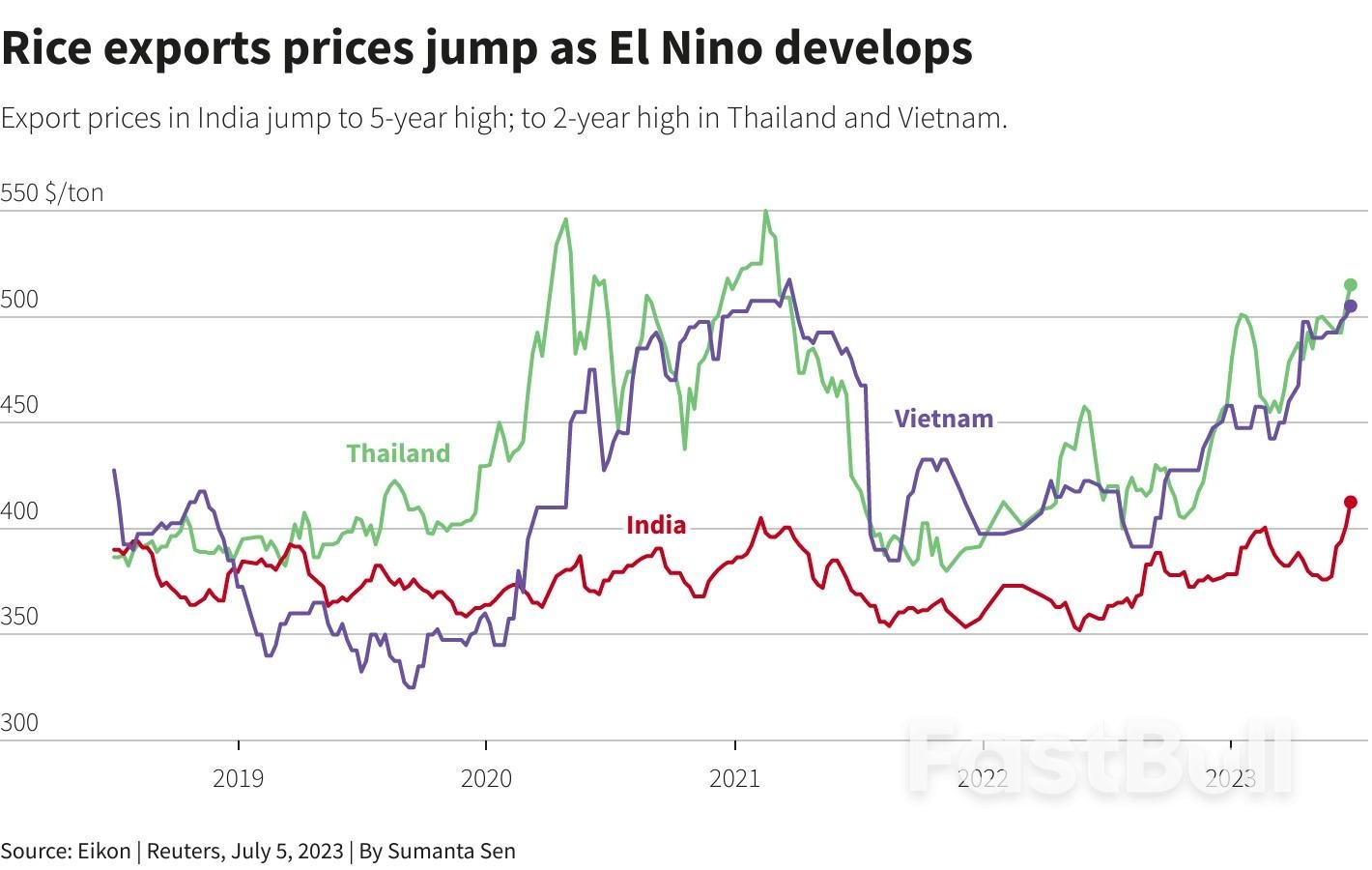
          The price of Indian rice exports has jumped 9% to a five-year high, following a hike of 7% last month in the price the government pays farmers for new-season common rice.
          Rice to Get Costlier as Weather, India's Farm Perks Threaten Supply_1Export prices in Thailand and Vietnam have risen to more than two-year highs since that incentive, aimed at luring the votes of farmers in key Indian state elections this year and a general election next year.
          In recent months, the prices of sugar, meat and eggs have jumped to multi-year highs worldwide, after producers cut exports to rein in domestic costs.
          Despite the forecast for a strong Asian crop, some global trading houses expect El Nino to crimp the output of all key rice producers.
          "Rice prices have already been rising due to limited supplies," added Olam's Gupta. "If production decreases, there will be a rally in prices."
          Global inventories of rice are set to drop to a six-year low of 170.2 million tonnes by the end of 2023/24, as stocks fall in top producers China and India, the USDA says, after the rising demand of recent years.
          Prices Could Rise by A Fifth
          Prices could rise a fifth or more if yields drop sharply, as El Nino means the second rice crop in almost all Asian nations will be lower than normal, said a New Delhi-based grains dealer with a global trading house.
          No. 2 exporter Thailand has urged farmers to plant only one rice crop after May rainfall was 26% below normal.
          In India, which plants its second crop in November, planting of summer-sown rice was down 26% from a year ago by Friday, as the monsoon brought 8% less rain than normal, government data show.
          Weather in China, the top producer of the grain, has not been conducive for the early season crop but high stockpiles will balance supply and demand, said Rosa Wang, an analyst with Shanghai JC Intelligence.
          Food inflation is always a concern for India's ruling party, which banned wheat exports last year and curbed those of rice and sugar to bring down prices.
          As elections near, the slow start of planting amid rising domestic prices is a concern for Prime Minister Narendra Modi's Bharatiya Janata Party (BJP), raising the prospect that it could further curb exports.
          "The Modi government is grappling with the task of containing the price rise in wheat, which is why it would not hesitate to impose restrictions," said the dealer based in New Delhi, the Indian capital.
          Indian curbs would leave other countries struggling to make up supplies, industry officials say.Rice to Get Costlier as Weather, India's Farm Perks Threaten Supply_2
          "The supply situation is extremely tight, and decrease in Indian exports could potentially cause global prices to surge," said a Singapore-based dealer with a global trading house.
          Taken together, Myanmar, Pakistan, Thailand and Vietnam could raise exports by 3 million to 4 million metric tons, the dealer added.
          The price surge also complicates the task of building up stockpiles.
          Demand from price-sensitive African countries has slowed, said Himanshu Agarwal, executive director at Satyam Balajee, an Indian exporter.
          But some Asian buyers, such as Indonesia and the Philippines, have been building stocks and increasing purchases from traditional supplier Vietnam.
          Last month Indonesia signed a rare pact with India to import 1 million tons if El Nino disrupts domestic supply. Indonesia usually buys rice from nearby Thailand and Vietnam.
          "Rice has been a buyers' market for the past few years, but it could become a sellers' market if El Nino cuts production," said the Singapore-based dealer.
          ($1=81.9750 Indian rupees)

          Source: The Economic Times

          Risk Warnings and Disclaimers
          You understand and acknowledge that there is a high degree of risk involved in trading. Following any strategies or investment methods may lead to potential losses. The content on the site is provided by our contributors and analysts for information purposes only. You are solely responsible for determining whether any trading assets, securities, strategy, or any other product is suitable for investing based on your own investment objectives and financial situation.
          Comments
          Add to Favorites
          Share

          July 6th Financial News

          FastBull Featured

          Daily News

          [Quick Facts]

          1. Further rate hikes would be needed this year and some officials backed a rate hike in June, Fed minutes show.
          2. Russia's oil and gas revenues shrank by more than a quarter in June.
          3. Williams says data support further rate hikes.
          4. Visco says ECB shouldn't ignore concerns about excessive increases in borrowing costs.
          5. Consumers' inflation expectations continued to fall, according to an ECB survey.

          [News Details]

          Further rate hikes would be needed this year and some officials backed a rate hike in June, Fed minutes show
          The meeting minutes of the Federal Reserve show that the pause in rate hikes agreed by officials at their June meeting is fragile, although almost all officials thought it was "appropriate or acceptable" to keep rates unchanged. Almost all officials expected more rate hikes in 2023 to continue to fight stubborn inflation.
          When discussing the outlook for monetary policy at the June FOMC meeting, all participants continued to expect that it would be appropriate to maintain a restrictive monetary policy stance on the economy in order to meet the Fed's inflation target.
          According to the minutes, nearly all participants noted that further increases in the target federal funds rate during 2023 would be appropriate in their economic projections.
          In considering the decision at last month's meeting, the minutes exposed some divisions within the Fed. Most participants supported a pause in rate hikes in June, while a few were in favor of a 25 basis point increase in June or could have supported such a proposal.
          Regarding downside risks to economic activities, the minutes show that at the June meeting, the Fed staff still expected a mild recession this year like at the previous two meetings in March and May.
          Russia's oil and gas revenues shrank by more than a quarter in June
          Russia's oil and gas revenues shrank by more than a quarter last month due to falling crude oil prices and restricted gas supplies to Europe. Budget revenues from oil and gas taxes fell 26% in June from a year earlier to about 529 billion rubles ($5.84 billion), Russia's Finance Ministry said. The decline in gas exports to Europe, once the largest market for Russian gas giants, was the biggest contributor to the drop in gas revenues. Currently, tax revenues from gas exports plummeted 86% to 30.1 billion rubles.
          Williams says data support further rate hikes
          We still have more work to do to balance supply and demand and reduce inflation, said John C. Williams, President of the Federal Reserve Bank of New York, in a speech on Wednesday. The Fed's future moves will "rely on data." Data supports the idea that the Fed may need to raise rates further at some point, Williams added.
          Inflation was still too high, which made him feel uneasy, but he also admitted that price pressures had eased. Current demand for labor remains high and the economy is responding quite well to rate hikes.
          Williams also said that the recent divergence between Fed officials' view that rates need to be raised and the market's view that the Fed is about to cut rates has eased. He declined to say whether he thought it was necessary to raise rates in July, noting that his staff had not yet begun the work that would help him decide how to act at the next monetary policy meeting.
          Visco says ECB shouldn't ignore concerns about excessive increases in borrowing costs
          I don't understand and I continue to disagree with comments which would indicate that the risk of more - rather than less tightening is preferable, European Central Bank's Governing Council member Ignazio Visco said in a speech on Wednesday. He believes it's necessary to remain very vigilant.
          He reiterated the potential threats to banks and lending. He believes it is necessary for officials to proceed with caution to avoid unwanted effects on economic activity, financial stability, and price stability in the medium term. It will be important to watch the evolution of risk perception among intermediaries. Past crises have highlighted that this is an important factor in the intensity of the contraction of credit.
          Visco is one of the dovish officials at the ECB. Earlier this year, he accused some colleagues of signaling interest rate hikes months in advance.
          Consumers' inflation expectations continued to fall, according to an ECB survey
          ECB consumer survey results show that consumer expectations for euro area inflation kept falling in May, continuing the trend of a sharp decline in the previous month. This will give ECB officials less pressure. Consumer expectations for inflation in the euro area over the next 12 months fell to 3.9% from 4.1% in April. However, inflation expectations for the next three years were maintained at 2.5%, still above the ECB's 2% target.
          Previous data show that the overall CPI rise in the euro area slowed down, mainly due to the decline in energy costs. Policymakers currently are focusing on the again accelerated core inflation. While the ECB has not yet reached the end of its tightening path, "it is not yet possible to answer the question of how much rates will be further raised," said German central bank president Joachim Nagel earlier Wednesday.

          [Focus of the Day]

          UTC+8 17:00 Eurozone Retail Sales MoM (May)
          UTC+8 20:15 U.S. ADP Employment (Jun)
          UTC+8 20:30 U.S. Weekly Initial Jobless Claims
          UTC+8 20:45 Dallas Fed Chairman Logan participates in the discussion at the 2023 annual meeting of the Central Bank Research Association (CEBRA)
          UTC+8 22:00 U.S. JOLTS Job Openings (SA) (May)
          UTC+8 01:15 The Next Day: U.S. President Joe Biden delivers a speech on "Bidenomics"
          Risk Warnings and Disclaimers
          You understand and acknowledge that there is a high degree of risk involved in trading. Following any strategies or investment methods may lead to potential losses. The content on the site is provided by our contributors and analysts for information purposes only. You are solely responsible for determining whether any trading assets, securities, strategy, or any other product is suitable for investing based on your own investment objectives and financial situation.
          Comments
          Add to Favorites
          Share

          June Rate Pause Was Right Move, but Future Hikes Still in Play

          Alex
          Federal Reserve Bank of New York President John Williams said on Wednesday (Jul 5) it was the right move for the central bank to hold rates steady three weeks ago, while hinting at some point it may have to raise rates again amid ongoing economic strength.
          "We still have more work to do" to balance supply and demand and get inflation down, Williams said at an event at his bank. He said he'll be "data dependent" in thinking about future steps for the central bank but added the data support the idea the Fed may need to raise rates further at some point.
          Williams declined to say whether he believes a July rate increase is needed and noted his staff has yet to begin the work that would help him decide what to do at the next monetary policy meeting.
          Williams said in his appearance that inflation is still too high for his comfort levels, although he also acknowledged price pressures have eased.
          "I'm not content" with where price pressures are, Williams said at an event held at his bank. He also said demand for labour remains high and the economy has dealt with rate rises "reasonably well."
          Earlier Wednesday, the Fed released minutes for the Federal Open Market Committee meeting, held over Jun 13 and 14. Then, the FOMC - Williams is its vice-chairman - held rates steady for the first time since starting an aggressive rate rise campaign aimed at cooling high levels of inflation. The minutes said almost all officials favoured holding steady while an unnamed minority were open to an increase.
          Fed rate actions have taken the federal funds rate target range from near zero in March 2022 to its current level of between 5 per cent and 5.25 per cent. Fed officials held steady on rates last month to take stock of how past increases are affecting the economy as inflation pressures have been waning.
          In recent comments, Fed Chairman Jerome Powell has reiterated his view that the central bank is unlikely to be done hiking rates, and he noted that official forecasts released at that meeting pointed to half a percentage points' further increases this year.
          A number of other Fed officials have also spoken in favor of more increases without saying when they might happen. But some, like Atlanta Fed leader Raphael Bostic, have said inflation is already declining in a way that will allow the Fed to hold steady on rates for the foreseeable future.
          The Fed's meeting minutes also showed participants viewed the economy as performing very strongly, even as central bank staffers continued to warn about the prospect of a "mild" recession later this year.
          Williams also said that recent divergences between the Fed's view more rate rises would be needed compared to market views of looming Fed rate cuts have eased, noting markets "have heard the message" from the central bank. He added that to the extent markets are pricing in rate cuts next year it may just reflect a view that inflation will fall, so that in real terms, lower market rates still imply monetary policy is having the same influence on the economy.

          Source: Reuters

          Risk Warnings and Disclaimers
          You understand and acknowledge that there is a high degree of risk involved in trading. Following any strategies or investment methods may lead to potential losses. The content on the site is provided by our contributors and analysts for information purposes only. You are solely responsible for determining whether any trading assets, securities, strategy, or any other product is suitable for investing based on your own investment objectives and financial situation.
          Comments
          Add to Favorites
          Share

          WTI Crude Futures: Fluctuations Amidst Supply Cuts and Demand Concerns

          Warren Takunda

          Traders' Opinions

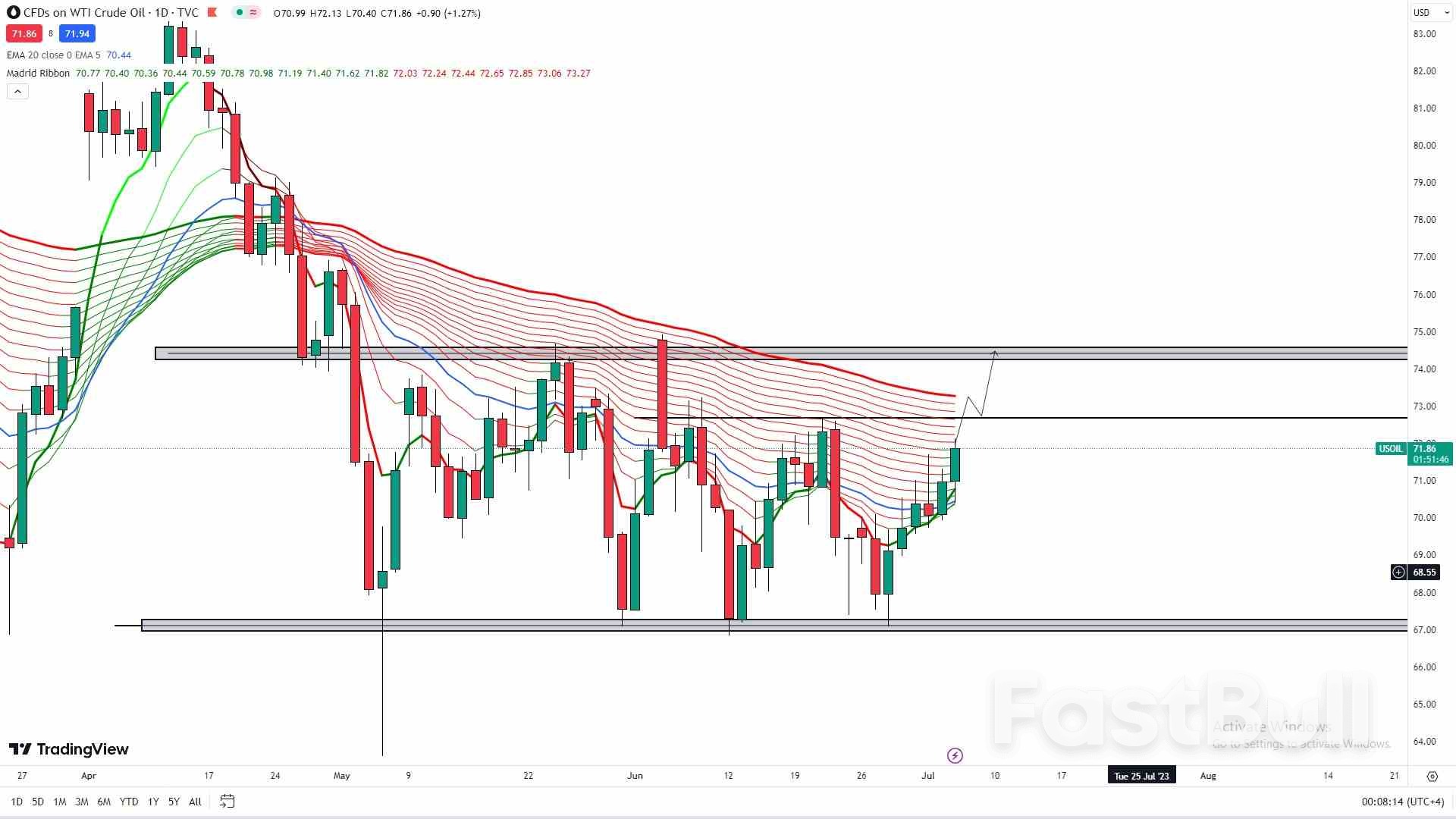
          WTI crude futures have been experiencing volatility, hovering around the $71 per barrel mark, as traders assess the impact of supply cuts and the potential slowdown in demand. The oil market is currently grappling with a series of factors that have implications for prices and market sentiment.
          On Monday, Saudi Arabia made an announcement regarding its voluntary production cut. The country intends to extend its cut of one million barrels per day (bpd) for August, with the possibility of further extensions. As a result, Saudi Arabia's daily production will be reduced to approximately 9 million barrels, marking the lowest output level in several years. Meanwhile, Russia has also indicated its plan to decrease oil exports by 500,000 bpd in August, accompanied by a corresponding drop in production. These developments highlight the efforts of major oil-producing nations to curb supply and support oil prices.
          However, challenges to the supply side have emerged from unexpected sources. Kazakhstan witnessed a significant drop in oil output, with production falling by around a fifth. Additionally, power outages resulted in a 46% decline in oil refining volumes. These disruptions in Kazakhstan's oil industry contribute to the existing concerns surrounding supply stability.
          While supply-side dynamics influence oil prices, concerns about a potential economic slowdown continue to weigh on demand prospects. Recent PMI data has revealed weak factory activity in the United States, Europe, and China. Furthermore, the services sector experienced a sharp deceleration in China and Europe. These indicators suggest a possible cooling down of economic growth, which could subsequently impact oil demand.
          The second quarter of 2023 saw oil prices decline by nearly 7%, extending the overall decrease during the first half of the year to 12%. This downward trend reflects the ongoing uncertainties surrounding global economic conditions and oil market dynamics.
          At present, WTI crude futures are fluctuating within a range bound by the price levels of $74.5 and $66.7. Despite some temporary fluctuations, a prevailing bearish trend dominates the overall outlook. However, this week is expected to bring a slew of important economic news, including the release of the non-agricultural unemployment index. Consequently, two possible scenarios emerge for WTI crude futures.
          WTI Crude Futures: Fluctuations Amidst Supply Cuts and Demand Concerns_1The first scenario suggests a potential rise in prices to the $72 .5 area, followed by a breach of this level. If this occurs, it could signal a shift in the direction to the upside, indicating a potential upward trend. On the other hand, the second scenario anticipates a failure to breach the $72.5 area, which would result in a continuation of the decline towards the $66 level.
          As market participants await further economic data and monitor supply and demand dynamics, it is important to note that the oil market remains susceptible to various factors. Geopolitical developments, global economic conditions, and policy decisions by major oil-producing nations can all impact oil prices and market sentiment.
          Investors and traders should exercise caution and stay informed about the latest developments in order to make well-informed decisions. The oil market's ongoing fluctuations present both challenges and opportunities, emphasizing the need for a comprehensive understanding of the complex factors at play.
          Risk Warnings and Disclaimers
          You understand and acknowledge that there is a high degree of risk involved in trading. Following any strategies or investment methods may lead to potential losses. The content on the site is provided by our contributors and analysts for information purposes only. You are solely responsible for determining whether any trading assets, securities, strategy, or any other product is suitable for investing based on your own investment objectives and financial situation.
          Comments
          Add to Favorites
          Share

          Yellen in China

          Damon

          Economic

          U.S. Treasury Secretary Janet Yellen touches down in Beijing on Thursday for a three-day visit just as trade tensions between the world's two superpowers ratchet up another notch, while a Malaysian interest rate decision tops the region's economic calendar.
          Australian trade data and Taiwanese inflation figures are on tap too, and equity investors will digest a mixed earnings report from Taiwan's Foxconn, a major iPhone assembler for Apple Inc.
          Yellen in China_1Asian stocks go into Thursday's session on the defensive, underperforming on Wednesday after figures showed that China's service sector activity expanded at the slowest pace in five months in June.
          Foxconn's results may help lift the gloom, after the firm on Wednesday forecast a brighter third quarter ahead of peak shopping season at the end of the year. But that is only relative to a near 14% drop in Q2 revenue year-on-year.
          China remains front and center for investors. U.S.-China trade tensions appear to be intensifying by the day - the latest flare up coming over Beijing's restrictions on exports of some metals - not the best backdrop for Yellen's visit on Thursday.
          U.S. officials says they expect "candid" discussions, and Washington has said it "firmly" opposes the new export controls on gallium and germanium, which go into producing semiconductors and other electronics.
          However well - or otherwise - Yellen's visit goes, there will be no quick fix. Former Vice Commerce Minister Wei Jianguo said the controls are "just a start".
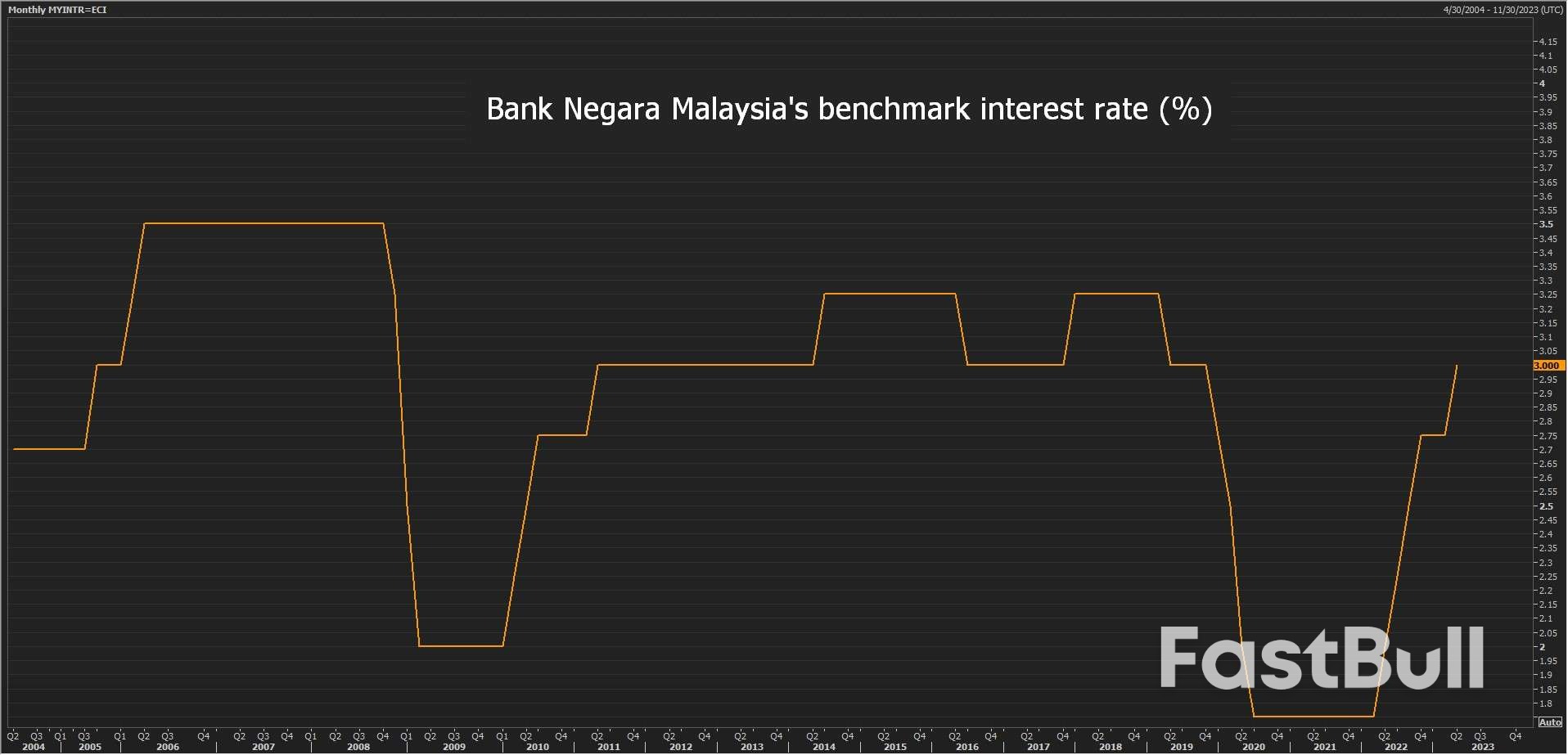
          Yellen in China_2In Malaysia, meanwhile, the central bank on Thursday is expected to leave key rates unchanged at 3.00% and keep them there for the rest of the year, putting it in line with regional peers in India, South Korea, Indonesia and New Zealand who have already ended their tightening cycles.
          Headline inflation eased to a one-year low of 2.8% in May, but core inflation moderated only a bit to 3.5%, suggesting Bank Negara Malaysia (BNM) will hold its key rate higher for longer.
          The central bank delivered a surprise hike in May. Last week, it said it would intervene in the foreign exchange market to stabilize the ringgit to counter what it said were "excessive" recent losses.
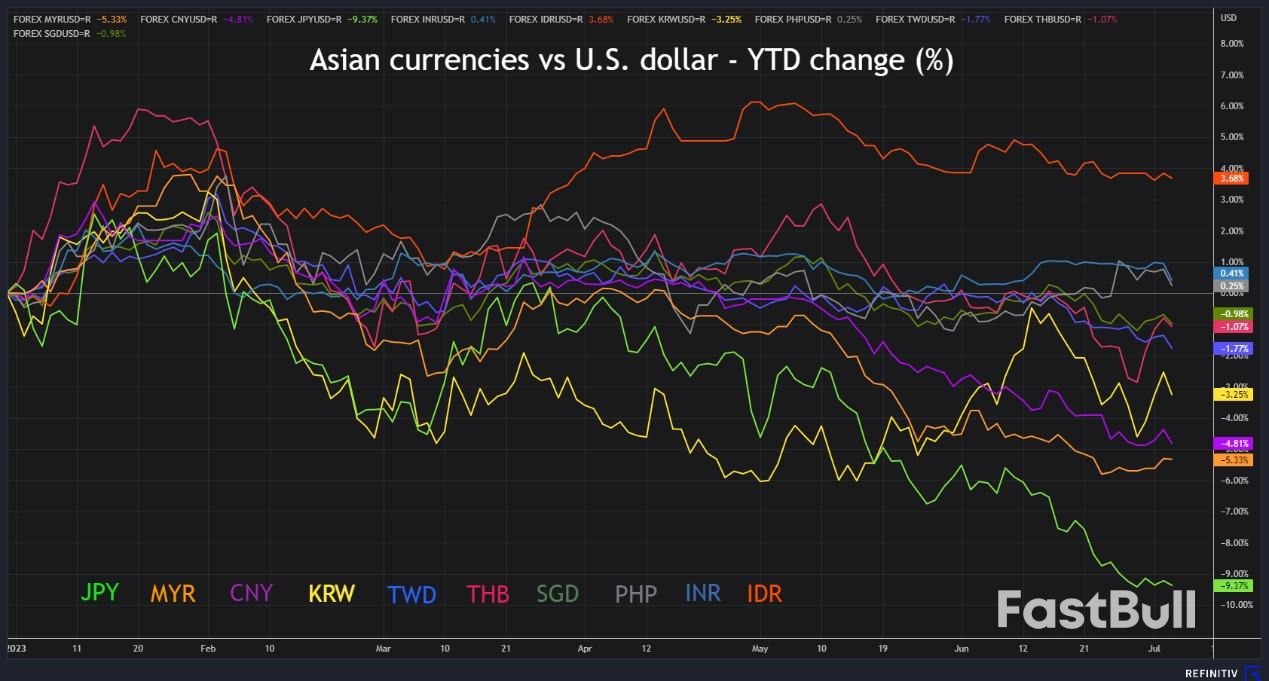
          The ringgit was one of Asia's worst-performing currencies in the first half of the year, losing almost 6% of its value against the dollar.
          Here are key developments that could provide more direction to markets on Thursday:
          - U.S. Treasury Secretary Janet Yellen visits China
          - Australia trade (May)
          - Taiwan inflation (June)

          Source: Yahoo

          To stay updated on all economic events of today, please check out our Economic calendar
          Risk Warnings and Disclaimers
          You understand and acknowledge that there is a high degree of risk involved in trading. Following any strategies or investment methods may lead to potential losses. The content on the site is provided by our contributors and analysts for information purposes only. You are solely responsible for determining whether any trading assets, securities, strategy, or any other product is suitable for investing based on your own investment objectives and financial situation.
          Comments
          Add to Favorites
          Share

          Three Cheers! Janet Yellen Goes to Beijing

          Justin

          Economic

          Political

          US Treasury Secretary Janet Yellen is taking her first pilgrimage to Beijing on 6-9 July. Perhaps little more than meeting key counterparts and a frank airing of views is achievable. Still, this trip is a positive development for the US, China and the world at large.
          In April 2021, Yellen said: ‘Our economic relationship with China, like our broader relationship with China, will be competitive where it should be, collaborative where it can be and adversarial where it must be.’ To date, President Joe Biden’s administration’s economic relationship with China, like its predecessor, has been long on ‘adversarial’ and short on ‘collaborative’. China’s relationship with the US is no different.
          China most likely sees in Yellen a non-polarising figure with a record as an academic, Federal Reserve chair and technocrat. The contrast cannot be lost on either side between today’s limited dialogue and the George W. Bush and Barack Obama eras when daily engagement with Beijing occurred at all Treasury levels. Yellen will serve to ameliorate the economic dialogue and remind both sides that the US, China and the world will suffer absent more co-operation.
          Yellen can now meet with Chinese central bank and finance ministry counterparts at G20 and International Monetary Fund gatherings, though such talks were hampered due to the pandemic. However, visiting Beijing is especially needed to meet her counterpart – Vice Premier He Lifeng – and other higher-ups influential in shaping US-China ties.
          Yet a fraught agenda faces Yellen, having said that US national security actions are not designed to gain competitive economic advantage or stifle China’s economic and technological modernisation. She’ll have a tough time convincing Beijing.
          Many US actions concerning China may be merited. But China has ample reason to perceive the US as pursuing ‘containment’. This is given the harsh rhetoric across the US political spectrum, proliferating sanctions, semiconductor chip actions, the expanding entities list, the role of the Committee on Foreign Investment in the US (which the Treasury chairs), the emphasis on ‘friend-shoring’ and suspicions that ‘de-risking’ is a euphemism for ‘decoupling’. Forthcoming outbound US investment restrictions and the blocking of Russian assets are surely on China’s radar.
          While China says it wants foreign investment on its own terms, that’s hard to square with such practices as forced technology transfer, intellectual property theft, rectification and disregard for property rights. Other areas – though difficult – offer grounds for more fruitful conversation.
          Macroeconomic dialogue is key. The US and China account for 40% of global gross domestic product. The US economy is softening, though not as much as expected, given labour market resilience amid persistently above-target inflation and Fed rate hikes. China holds US assets and US default or government shutdown threats are of clear interest.
          China’s rebound this year is not as robust as previously expected. Fiscal support is limited and the central bank is cautiously pursuing more accommodative policies, due to enormous headwinds of property sector woes, strained local government finances, high leverage and more. Given monetary policy divergences, the renminbi is weakening and the People’s Bank of China is acting to restrain depreciation pressures.
          These developments raise questions about global growth and US concerns that China might rely on increased exports to support its economy – causing intensified discord. For their own good – and the globe’s, which has a vital stake in the G2 relationship – both sides need to understand the other’s macroeconomic policy thinking.
          Low-income country debt, and that in Sri Lanka, Pakistan and Ghana, etc. will be front and centre. China wonders why it should offer deep debt relief when it is frequently the dominant creditor and prefers case-by-case debt extensions that minimise net present value losses over haircuts. The recent Zambian restructuring agreement is, at long last, a win for the G20 common framework. But it must be finalised in a memorandum of understanding and the jury is out on whether the deal will afford deep debt reduction and what it means for future cases. Meanwhile, the US has little leverage, given US-China tensions and Chinese perceptions that US officials seek to pin ‘debt trap diplomacy’ on China.
          Yellen will hopefully change the narrative, assuring the US interest is about helping distressed countries, not stigmatising China.
          Global governance and the role of the IMF and the World Bank should be raised. Both the US and China share a self-interest in promoting a central IMF that is able to foster stability when countries face stresses. Yet, China is number three in the IMF – with a woefully underrepresented 6% vote share, versus a global GDP weight well above 15%. It should be number two. Efforts to increase and realign quotas are stalled, especially as the US is unlikely able to support such action given US-China tensions and looming 2024 elections.
          The US is focused on scaling up multilateral development bank lending to help tackle climate change through expanded balance sheet leverage. China most likely has little problem with that. But tackling global climate requires trillions of dollars and many developing countries are concerned traditional lending could be diverted. Thus, China will understandably ask why the US is not supporting MDB general capital increases, especially as these would boost China’s MDB voting power.
          These are but several items on the docket. The talks will be tough. Much is at stake. But Yellen’s trip is a step forward for US-China co-operation and engagement.

          Source:Mark Sobel

          To stay updated on all economic events of today, please check out our Economic calendar
          Risk Warnings and Disclaimers
          You understand and acknowledge that there is a high degree of risk involved in trading. Following any strategies or investment methods may lead to potential losses. The content on the site is provided by our contributors and analysts for information purposes only. You are solely responsible for determining whether any trading assets, securities, strategy, or any other product is suitable for investing based on your own investment objectives and financial situation.
          Comments
          Add to Favorites
          Share
          FastBull
          Copyright © 2025 FastBull Ltd

          728 RM B 7/F GEE LOK IND BLDG NO 34 HUNG TO RD KWUN TONG KLN HONG KONG

          TelegramInstagramTwitterfacebooklinkedin
          App Store Google Play Google Play
          Products
          Charts

          Chats

          Q&A with Experts
          Screeners
          Economic Calendar
          Data
          Tools
          Membership
          Features
          Function
          Markets
          Copy Trading
          Latest Signals
          Contests
          News
          Analysis
          24/7
          Columns
          Education
          Company
          Careers
          About Us
          Contact Us
          Advertising
          Help Center
          Feedback
          User Agreement
          Privacy Policy
          Business

          White Label

          Data API

          Web Plug-ins

          Poster Maker

          Affiliate Program

          Risk Disclosure

          The risk of loss in trading financial instruments such as stocks, FX, commodities, futures, bonds, ETFs and crypto can be substantial. You may sustain a total loss of the funds that you deposit with your broker. Therefore, you should carefully consider whether such trading is suitable for you in light of your circumstances and financial resources.

          No decision to invest should be made without thoroughly conducting due diligence by yourself or consulting with your financial advisors. Our web content might not suit you since we don't know your financial conditions and investment needs. Our financial information might have latency or contain inaccuracy, so you should be fully responsible for any of your trading and investment decisions. The company will not be responsible for your capital loss.

          Without getting permission from the website, you are not allowed to copy the website's graphics, texts, or trademarks. Intellectual property rights in the content or data incorporated into this website belong to its providers and exchange merchants.

          Not Logged In

          Log in to access more features

          FastBull Membership

          Not yet

          Purchase

          Become a signal provider
          Help Center
          Customer Service
          Dark Mode
          Price Up/Down Colors

          Log In

          Sign Up

          Position
          Layout
          Fullscreen
          Default to Chart
          The chart page opens by default when you visit fastbull.com