• Trade
  • Markets
  • Copy
  • Contests
  • News
  • 24/7
  • Calendar
  • Q&A
  • Chats
Trending
Screeners
SYMBOL
LAST
BID
ASK
HIGH
LOW
NET CHG.
%CHG.
SPREAD
SPX
S&P 500 Index
6827.42
6827.42
6827.42
6899.86
6801.80
-73.58
-1.07%
--
DJI
Dow Jones Industrial Average
48458.04
48458.04
48458.04
48886.86
48334.10
-245.98
-0.51%
--
IXIC
NASDAQ Composite Index
23195.16
23195.16
23195.16
23554.89
23094.51
-398.69
-1.69%
--
USDX
US Dollar Index
97.950
98.030
97.950
98.500
97.950
-0.370
-0.38%
--
EURUSD
Euro / US Dollar
1.17394
1.17409
1.17394
1.17496
1.17192
+0.00011
+ 0.01%
--
GBPUSD
Pound Sterling / US Dollar
1.33707
1.33732
1.33707
1.33997
1.33419
-0.00148
-0.11%
--
XAUUSD
Gold / US Dollar
4299.39
4299.39
4299.39
4353.41
4257.10
+20.10
+ 0.47%
--
WTI
Light Sweet Crude Oil
57.233
57.485
57.233
58.011
56.969
-0.408
-0.71%
--

Community Accounts

Signal Accounts
--
Profit Accounts
--
Loss Accounts
--
View More

Become a signal provider

Sell trading signals to earn additional income

View More

Guide to Copy Trading

Get started with ease and confidence

View More

Signal Accounts for Members

All Signal Accounts

Best Return
  • Best Return
  • Best P/L
  • Best MDD
Past 1W
  • Past 1W
  • Past 1M
  • Past 1Y

All Contests

  • All
  • Trump Updates
  • Recommend
  • Stocks
  • Cryptocurrencies
  • Central Banks
  • Featured News
Top News Only
Share

Iranian Media Says 18 Crew Members Of Foreign Tanker Seized In Gulf Of Oman Over Carrying 'Smuggled Fuel' Detained

Share

Regional Governor: Two Killed In Ukrainian Drone Strike On Russia's Saratov

Share

Chinese Foreign Ministry - China Foreign Minister Met With United Arab Emirates Counterpart On Dec 12

Share

China's Central Financial And Economic Affairs Commission Deputy Director: Will Expand Export And Increase Import In 2026

Share

Thai Leader Anutin: Landmine Blast That Killed Thai Soldiers 'Not A Roadside Accident'

Share

Thai Leader Anutin: Thailand To Continue Military Action Until 'We Feel No More Harm'

Share

Cambodian Prime Minister Hun Manet Says He Had Phone Calls With Trump And Malaysian Leader Anwar About Ceasefire

Share

Cambodia's Hun Manet Says USA, Malaysia Should Verify 'Which Side Fired First' In Latest Conflict

Share

Cambodia's Hun Manet: Cambodia Maintains Its Stance In Seeking Peaceful Resolution Of Disputes

Share

Nasdaq Companies: Allergan, Ferrovia, Insmed, Monolithic Power Systems, Seagate Technology, And Western Digital Will Be Added To The NASDAQ 100 Index. Biogen, CdW, GlobalFoundries, Lululemon, ON Semiconductor, And Tradedesk Will Be Removed From The NASDAQ 100 Index

Share

Witkoff Headed To Berlin This Weekend To Meet With Zelenskiy, European Leaders -Wsj Reporter On X

Share

Russia Attacks Two Ukrainian Ports, Damaging Three Turkish-Owned Vessels

Share

[Historic Flooding Occurs In At Least Four Rivers In Washington State Due To Days Of Torrential Rains] Multiple Areas In Washington State Have Been Hit By Severe Flooding Due To Days Of Torrential Rains, With At Least Four Rivers Experiencing Historic Flooding. Reporters Learned On The 12th That The Floods Caused By The Torrential Rains In Washington State Have Destroyed Homes And Closed Several Highways. Experts Warn That Even More Severe Flooding May Occur In The Future. A State Of Emergency Has Been Declared In Washington State

Share

Trump Says Proposed Free Economic Zone In Donbas Would Work

Share

Trump: I Think My Voice Should Be Heard

Share

Trump Says Will Be Choosing New Fed Chair In Near Future

Share

Trump Says Proposed Free Economic Zone In Donbas Complex But Would Work

Share

Trump Says Land Strikes In Venezuela Will Start Happening

Share

US President Trump: Thailand And Cambodia Are In A Good Situation

Share

State Media: North Korean Leader Kim Hails Troops Returning From Russia Mission

TIME
ACT
FCST
PREV
U.K. Trade Balance Non-EU (SA) (Oct)

A:--

F: --

P: --

U.K. Trade Balance (Oct)

A:--

F: --

P: --

U.K. Services Index MoM

A:--

F: --

P: --

U.K. Construction Output MoM (SA) (Oct)

A:--

F: --

P: --

U.K. Industrial Output YoY (Oct)

A:--

F: --

P: --

U.K. Trade Balance (SA) (Oct)

A:--

F: --

P: --

U.K. Trade Balance EU (SA) (Oct)

A:--

F: --

P: --

U.K. Manufacturing Output YoY (Oct)

A:--

F: --

P: --

U.K. GDP MoM (Oct)

A:--

F: --

P: --

U.K. GDP YoY (SA) (Oct)

A:--

F: --

P: --

U.K. Industrial Output MoM (Oct)

A:--

F: --

P: --

U.K. Construction Output YoY (Oct)

A:--

F: --

P: --

France HICP Final MoM (Nov)

A:--

F: --

P: --

China, Mainland Outstanding Loans Growth YoY (Nov)

A:--

F: --

P: --

China, Mainland M2 Money Supply YoY (Nov)

A:--

F: --

P: --

China, Mainland M0 Money Supply YoY (Nov)

A:--

F: --

P: --

China, Mainland M1 Money Supply YoY (Nov)

A:--

F: --

P: --

India CPI YoY (Nov)

A:--

F: --

P: --

India Deposit Gowth YoY

A:--

F: --

P: --

Brazil Services Growth YoY (Oct)

A:--

F: --

P: --

Mexico Industrial Output YoY (Oct)

A:--

F: --

P: --

Russia Trade Balance (Oct)

A:--

F: --

P: --

Philadelphia Fed President Henry Paulson delivers a speech
Canada Building Permits MoM (SA) (Oct)

A:--

F: --

P: --

Canada Wholesale Sales YoY (Oct)

A:--

F: --

P: --

Canada Wholesale Inventory MoM (Oct)

A:--

F: --

P: --

Canada Wholesale Inventory YoY (Oct)

A:--

F: --

P: --

Canada Wholesale Sales MoM (SA) (Oct)

A:--

F: --

P: --

Germany Current Account (Not SA) (Oct)

A:--

F: --

P: --

U.S. Weekly Total Rig Count

A:--

F: --

P: --

U.S. Weekly Total Oil Rig Count

A:--

F: --

P: --

Japan Tankan Large Non-Manufacturing Diffusion Index (Q4)

--

F: --

P: --

Japan Tankan Small Manufacturing Outlook Index (Q4)

--

F: --

P: --

Japan Tankan Large Non-Manufacturing Outlook Index (Q4)

--

F: --

P: --

Japan Tankan Large Manufacturing Outlook Index (Q4)

--

F: --

P: --

Japan Tankan Small Manufacturing Diffusion Index (Q4)

--

F: --

P: --

Japan Tankan Large Manufacturing Diffusion Index (Q4)

--

F: --

P: --

Japan Tankan Large-Enterprise Capital Expenditure YoY (Q4)

--

F: --

P: --

U.K. Rightmove House Price Index YoY (Dec)

--

F: --

P: --

China, Mainland Industrial Output YoY (YTD) (Nov)

--

F: --

P: --

China, Mainland Urban Area Unemployment Rate (Nov)

--

F: --

P: --

Saudi Arabia CPI YoY (Nov)

--

F: --

P: --

Euro Zone Industrial Output YoY (Oct)

--

F: --

P: --

Euro Zone Industrial Output MoM (Oct)

--

F: --

P: --

Canada Existing Home Sales MoM (Nov)

--

F: --

P: --

Euro Zone Total Reserve Assets (Nov)

--

F: --

P: --

U.K. Inflation Rate Expectations

--

F: --

P: --

Canada National Economic Confidence Index

--

F: --

P: --

Canada New Housing Starts (Nov)

--

F: --

P: --

U.S. NY Fed Manufacturing Employment Index (Dec)

--

F: --

P: --

U.S. NY Fed Manufacturing Index (Dec)

--

F: --

P: --

Canada Core CPI YoY (Nov)

--

F: --

P: --

Canada Manufacturing Unfilled Orders MoM (Oct)

--

F: --

P: --

Canada Manufacturing New Orders MoM (Oct)

--

F: --

P: --

Canada Core CPI MoM (Nov)

--

F: --

P: --

Canada Manufacturing Inventory MoM (Oct)

--

F: --

P: --

Canada CPI YoY (Nov)

--

F: --

P: --

Canada CPI MoM (Nov)

--

F: --

P: --

Canada CPI YoY (SA) (Nov)

--

F: --

P: --

Canada Core CPI MoM (SA) (Nov)

--

F: --

P: --

Q&A with Experts
    • All
    • Chatrooms
    • Groups
    • Friends
    Connecting
    .
    .
    .
    Type here...
    Add Symbol or Code

      No matching data

      All
      Trump Updates
      Recommend
      Stocks
      Cryptocurrencies
      Central Banks
      Featured News
      • All
      • Russia-Ukraine Conflict
      • Middle East Flashpoint
      • All
      • Russia-Ukraine Conflict
      • Middle East Flashpoint
      Search
      Products

      Charts Free Forever

      Chats Q&A with Experts
      Screeners Economic Calendar Data Tools
      Membership Features
      Data Warehouse Market Trends Institutional Data Policy Rates Macro

      Market Trends

      Market Sentiment Order Book Forex Correlations

      Top Indicators

      Charts Free Forever
      Markets

      News

      News Analysis 24/7 Columns Education
      From Institutions From Analysts
      Topics Columnists

      Latest Views

      Latest Views

      Trending Topics

      Top Columnists

      Latest Update

      Signals

      Copy Rankings Latest Signals Become a signal provider AI Rating
      Contests
      Brokers

      Overview Brokers Assessment Rankings Regulators News Claims
      Broker listing Forex Brokers Comparison Tool Live Spread Comparison Scam
      Q&A Complaint Scam Alert Videos Tips to Detect Scam
      More

      Business
      Events
      Careers About Us Advertising Help Center

      White Label

      Data API

      Web Plug-ins

      Affiliate Program

      Awards Institution Evaluation IB Seminar Salon Event Exhibition
      Vietnam Thailand Singapore Dubai
      Fans Party Investment Sharing Session
      FastBull Summit BrokersView Expo
      Recent Searches
        Top Searches
          Markets
          News
          Analysis
          User
          24/7
          Economic Calendar
          Education
          Data
          • Names
          • Latest
          • Prev

          View All

          No data

          Scan to Download

          Faster Charts, Chat Faster!

          Download App
          English
          • English
          • Español
          • العربية
          • Bahasa Indonesia
          • Bahasa Melayu
          • Tiếng Việt
          • ภาษาไทย
          • Français
          • Italiano
          • Türkçe
          • Русский язык
          • 简中
          • 繁中
          Open Account
          Search
          Products
          Charts Free Forever
          Markets
          News
          Signals

          Copy Rankings Latest Signals Become a signal provider AI Rating
          Contests
          Brokers

          Overview Brokers Assessment Rankings Regulators News Claims
          Broker listing Forex Brokers Comparison Tool Live Spread Comparison Scam
          Q&A Complaint Scam Alert Videos Tips to Detect Scam
          More

          Business
          Events
          Careers About Us Advertising Help Center

          White Label

          Data API

          Web Plug-ins

          Affiliate Program

          Awards Institution Evaluation IB Seminar Salon Event Exhibition
          Vietnam Thailand Singapore Dubai
          Fans Party Investment Sharing Session
          FastBull Summit BrokersView Expo

          How Elections and the RBNZ Disinflation Gamble Can Steer the Kiwi Dollar

          Alex

          Central Bank

          Economic

          Political

          Forex

          Summary:

          The Reserve Bank of New Zealand is widely expected to keep rates on hold this week while awaiting new data and given the pre-election environment. The RBNZ's assumptions on disinflation are quite optimistic, and there are risks of a November hike.
          Growth and housing outlook not as bad as expected

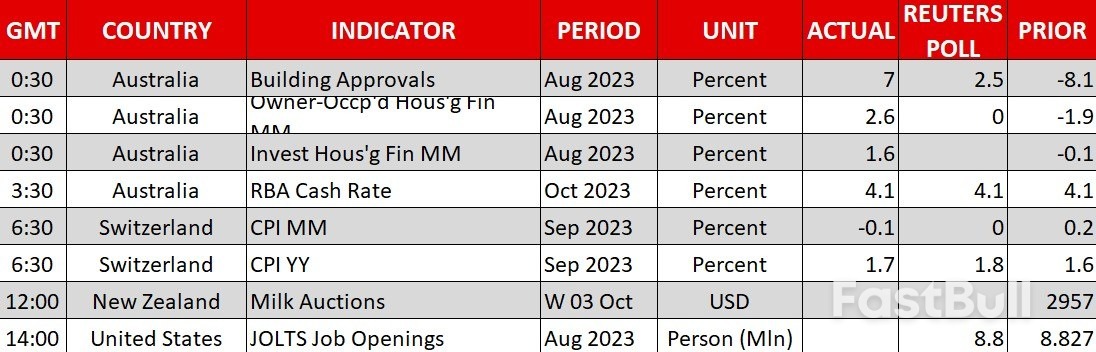
          This week's RBNZ announcement is widely expected to see another hold by New Zealand policymakers. A key reason is that the Bank still hasn't seen the third-quarter inflation and jobs data, which will be released on the 16th and 31st of October, respectively.
          The New Zealand data calendar hasn't, however, been totally quiet since the August RBNZ meeting. Growth figures were quite surprising: showing activity rebounded 0.9% quarter-on-quarter in the second quarter, more than doubling consensus expectations, and significantly above the 0.5% projected by the RBNZ. Also, a revision of first quarter figures indicated the country had not actually been in a recession into March.
          Growth should cool again in the second half of the year, but the RBNZ's projections of two negative QoQ GDP readings in the third and fourth quarters by the RBNZ may be overly pessimistic. The Treasury, which has generally been quite more upbeat than the RBNZ, currently forecasts no more negative quarterly GDP reads.
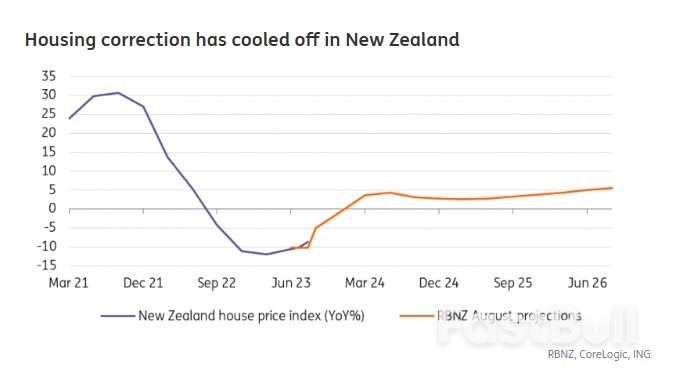
          The house price correction, which has been a major cause for concern and might have argued for less restrictive monetary policy, has eased, largely in line with the revised RBNZ August projections. Latest monthly figures showed the house price index having declined by only 0.2% MoM, and 8.7% year-on-year, reinforcing the view that the worst of the housing correction is past us.How Elections and the RBNZ Disinflation Gamble Can Steer the Kiwi Dollar_1

          RBNZ inflation forecasts still look like a gamble

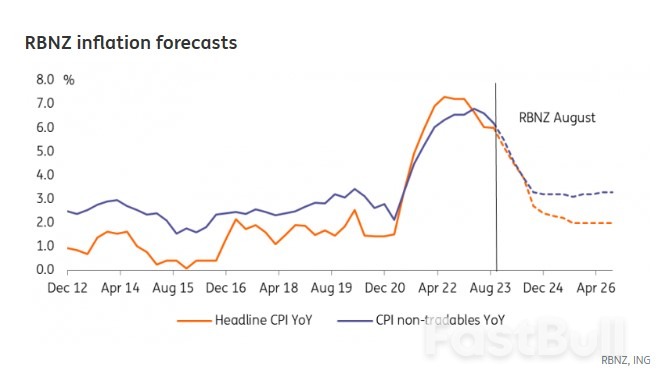
          The RBNZ's latest inflation projections – from the August Monetary Policy Statement – show an optimistic scenario for disinflation, largely based on assumptions about the impact of restrictive monetary policy and slowing domestic as well as external demand.
          Those assumptions are, however, met with the risks associated with: a) the extra spending deployed by the government from May, b) the recent spike in oil prices, c) residual supply-related inflationary effects of severe weather events, and d) the still unclear impact of booming net migration on wages and prices (easing labour supply, but raising demand for housing and other services).
          We think that the RBNZ will continue to acknowledge those risks to inflation and strike a generally hawkish tone this week, with the aim of keeping inflation expectations capped. However, a rate hike seems unlikely a week before the elections and before having seen official CPI and jobs data. Once inflation figures are out, the RBNZ may tolerate a slightly higher-than-anticipated third quarter headline CPI (the projection is for 6.0% YoY), but expect greater scrutiny on non-tradable inflation (projected at 6.2%).How Elections and the RBNZ Disinflation Gamble Can Steer the Kiwi Dollar_2

          Polls point to a National-led coalition

          Advance voting in New Zealand has already been going on for a couple of days, while physical election day will take place on Saturday 14 October, with the preliminary results starting to be released from 7PM local time.
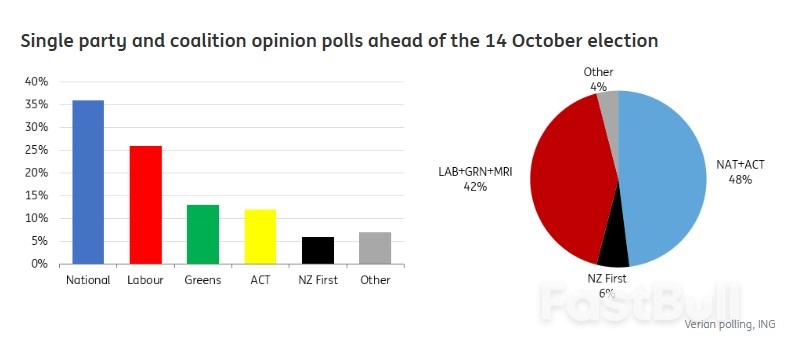
          Latest opinion polls suggest that the incumbent Labour Party (of former Prime Minister Jacinda Ardern) should lose its parliament majority to the opposition National Party. A centre-right coalition, led by the National Party and supported by the right-wing ACT New Zealand is currently projected to secure somewhere between 45% and 50% of parliament seats, possibly short of a majority. A coalition may need to include the nationalist NZ First to secure enough seats: latest polls give NZ First just above the 5% threshold required to enter parliament without winning a single-member seat.How Elections and the RBNZ Disinflation Gamble Can Steer the Kiwi Dollar_3

          The monetary policy implication of a potential shift in government

          First of all, the past few years have taught to take pre-election polls with a pinch of salt. Secondly, the impact of politics on NZD are generally quite limited.
          This time though, a change of government (assuming the polls are right and NZ First joins a National-led coalition) might have some implications for the RBNZ further down the road. The National Party recently published its pre-election fiscal plan, where it pledged more fiscal discipline compared to Labour. Specifically, National said it would spend around NZD3bn less than Labour over four years, with the aim of reducing debt at a faster pace. If the RBNZ links any rebound in CPI to additional fiscal spending, the change in government could suggest a less hawkish RBNZ in the longer run.
          Another aspect to consider is the RBNZ remit. Over the summer, the National Party Finance spokeperson Nicola Willis pledged to restore the central bank's sole focus on the inflation target. This would imply removing the RBNZ's dual mandate (maximum sustainable employment) and potentially reviewing the additional housing stability objective that were added in 2018 and in 2021 respectively.
          The first – and more impactful – effect would suggest higher RBNZ rates in the medium and long term; while removing housing affordability objective would in theory be a dovish argument, the stricter inflation target would likely overshadow any housing-related considerations.

          FX: Domestic factors can determine relative NZD performance

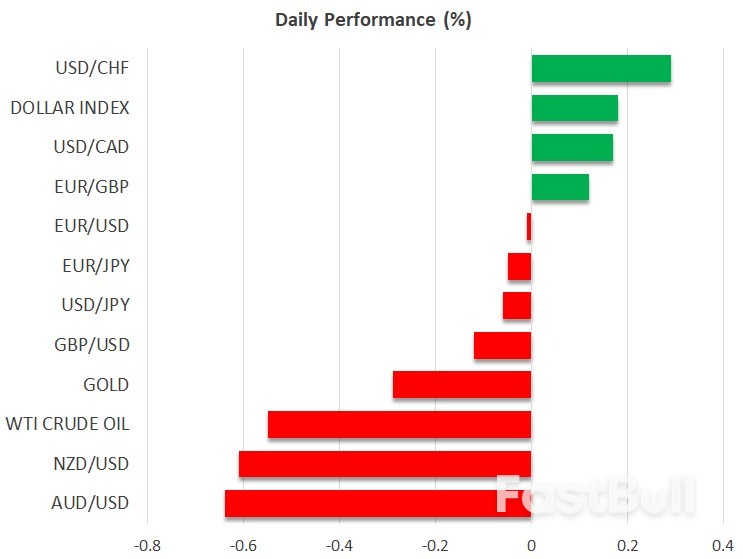
          The Kiwi dollar has resisted USD appreciation better than other commodity currencies in the past month, and we have seen AUD/NZD fall from the recent 1.0900 peak to below 1.0700 – also thanks to the Reserve Bank of Australia hold this week.
          We think that the RBNZ will continue to signal upside risks to their inflation forecasts and keep the door open to more tightening if needed this week, but it is very likely that November will be a much more eventful policy meeting for NZD, with new rate and economic projections being released and after the inflation and jobs data for the third quarter are released. Expect some significant NZD volatility around the two data releases this month: we are still of the view that inflation can surprise to the upside, so expect some positive impact on NZD. Markets are currently pricing in 15bp of tightening by November.
          When it comes to the election outcome, a hung parliament with parties failing to find a working coalition would be the worst scenario for NZD. Should either Labour or National manage to lead a government after the vote, we expect the market implications to be mostly bonded to those for the RBNZ remit (and less so to fiscal spending). So, very limited in the event of Labour staying in power, and moderately positive for NZD (negative for NZ short-dated bonds) in a win by the National Party as markets may speculate on the remit being changed to focus solely on a strict inflation target. The chances of a hike in November will, however, depend almost entirely on CPI and jobs data, not on the vote.
          Expect any meaningful swing in NZD to be mostly visible in the crosses, especially in the shape of relative performance against other commodity/high-beta currencies. A combination of National electoral win (and workable coalition) and CPI surprise could make AUD/NZD re-test the 1.0580 May low and slip to 1.0500. NZD/NOK is another interesting pair, with more room to recover after a large summer slump: a return to 6.60 is possible in the above scenario.
          When it comes to NZD/USD, the swings in USD continue to be an overwhelmingly dominant driver. With U.S. 10-year yields still moving higher and our rates team pointing at 5.0% as a potential top, we see more downside for NZD/USD in the near term. NZD-positive developments domestically would not prevent a drop to 0.5800 if U.S. bonds remain under the kind of pressure we have seen in recent weeks. In the medium run, we still expect U.S. data to turn negative and the Fed to start cutting in first quarter 2024, which should pave the way for a sustained NZD/USD recovery.

          Source: ING

          To stay updated on all economic events of today, please check out our Economic calendar
          Risk Warnings and Disclaimers
          You understand and acknowledge that there is a high degree of risk involved in trading. Following any strategies or investment methods may lead to potential losses. The content on the site is provided by our contributors and analysts for information purposes only. You are solely responsible for determining whether any trading assets, securities, strategy, or any other product is suitable for investing based on your own investment objectives and financial situation.
          Comments
          Add to Favorites
          Share

          King Dollar Returns as U.S. Yields Rip Higher

          XM

          Central Bank

          Economic

          Bond

          Forex

          King Dollar Returns as U.S. Yields Rip Higher_1Dollar shines bright

          King dollar has returned to rule over FX markets. The world's reserve currency has staged a phenomenal rally in recent months, empowered by the stunning rise in U.S. yields, solid economic fundamentals, safe haven flows, and the absence of any attractive alternatives.
          The dollar rally kicked into higher gear yesterday as yields on 10-year U.S. government bonds stormed to new cycle highs, boosted by an encouraging ISM manufacturing survey and Fed officials calling for more rate increases. Manufacturing activity seems to be picking up after a severe post-pandemic contraction, reinforcing the notion of 'higher for longer' rates.
          Reflecting the streak of encouraging U.S. data, the Fed's Bowman and Mester signaled that interest rates will likely have to be raised further. The 10-year Treasury yield hit 4.70% in the aftermath, its highest level since 2007, as hopes of economic resilience have joined forces with massive government deficits to fuel an exodus from bonds.
          Overall, the dollar offers the 'full package' at the moment - the highest real rates among the major economies, the strongest economic growth, and protection from market turbulence thanks to its safe haven qualities. With another deluge of U.S. bond supply also hitting the markets this quarter, the 'high yields, strong dollar' paradigm could remain in effect for some time.

          Gold takes another blow, but stocks resilient

          When bond yields race higher, that usually dampens demand for other assets, as investors gravitate towards the higher returns and safety the bond market offers. It is almost like a gravitational force - the higher bond yields climb, the less attractive everything else becomes.
          This dynamic helps explain why gold has been smashed lately. Since gold pays no interest to hold, it inevitably becomes less attractive in a regime where investors can lock in annual returns of 4.7% on U.S. government bonds. Direct purchases from central banks raising their gold reserves countered this negative pressure for months, but the recent price collapse suggests this marginal gold buyer has now stepped back.
          And yet, stock markets managed to defy the gravity exerted by soaring bond yields. The S&P 500 closed flat on Monday, which in itself is a victory considering the steep rise in yields. But under the hood, there was a striking rotation with high-growth stocks outperforming value shares. That's a strange tape in a rising-yield environment, perhaps driven by flows at the beginning of the new quarter.

          RBA does nothing, RBNZ decision coming up

          Over in Australia, the Reserve Bank kept its policy settings unchanged earlier today. While the central bank kept the door open to further rate increases, it also emphasized the various risks surrounding the economy, striking a relatively cautious tone. That hurt the Australian dollar, which fell to its lowest levels in 11 months, with the strength in the U.S. dollar amplifying the move.
          The central bank torch will pass to the Reserve Bank of New Zealand on Wednesday. Even though markets assign only a 10% probability for a rate increase, it could still be an exciting meeting as inflation appears to be making a comeback. An explosion in population growth coupled with record levels of labor force participation are boosting demand, while the depreciation of the New Zealand dollar and rising oil prices will also help fuel inflation.
          Hence, the question is whether the RBNZ will put another rate increase in November on the table. The economic data pulse certainly warrants it, but there's an election in two weeks, so the risk is that the RBNZ does not deliver any explicit signals to avoid interfering.
          On the data front, the JOLTS survey from the U.S. will be an important piece of the puzzle for Fed officials, and by extension, for market participants.King Dollar Returns as U.S. Yields Rip Higher_2
          To stay updated on all economic events of today, please check out our Economic calendar
          Risk Warnings and Disclaimers
          You understand and acknowledge that there is a high degree of risk involved in trading. Following any strategies or investment methods may lead to potential losses. The content on the site is provided by our contributors and analysts for information purposes only. You are solely responsible for determining whether any trading assets, securities, strategy, or any other product is suitable for investing based on your own investment objectives and financial situation.
          Comments
          Add to Favorites
          Share

          Dollar Traders Lock Gaze on US Nonfarm Payrolls

          XM

          Forex

          Central Bank

          Economic

          Hawkish Fed turbocharges the dollar

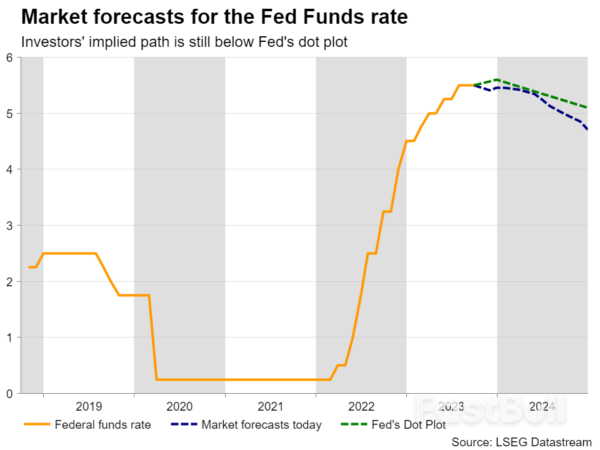
          With the US economy proving more resilient than other major ones and inflation rebounding on the back of rallying oil prices, the Fed raised its rate-path projections at its latest gathering, although it did not press the hike button. Specifically, policymakers forecasted one more quarter-point increase before the end of this year, while they saw interest rates ending 2024 at 5.1%, up from June’s projection of 4.6%.
          This allowed Treasury yields to climb higher and added more fuel to the dollar’s engines. Although the greenback pulled back at the end of last week, it staged a remarkable comeback on Monday following the better-than-expected ISM manufacturing PMI, suggesting that last week’s retreat was probably due to investors rebalancing their portfolios and hedge funds closing their books for the end of Q3, instead of changing fundamentals.

          Will job numbers allow trend continuation?

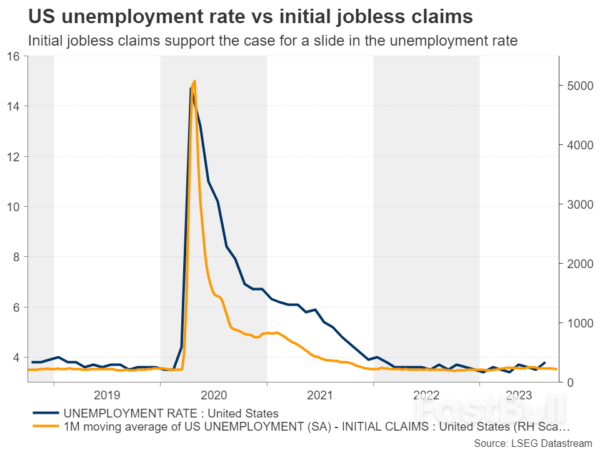
          Moving forward, whether this impulsive wave in the greenback’s uptrend will continue may depend on Friday’s employment report. Nonfarm payrolls are expected to have slowed to 163k from 187k, but the unemployment rate is forecast to have ticked back down to 3.7% from 3.8%, which is supported by the modest decline in the 4-week moving average of initial jobless claims.
          Dollar Traders Lock Gaze on US Nonfarm Payrolls_1
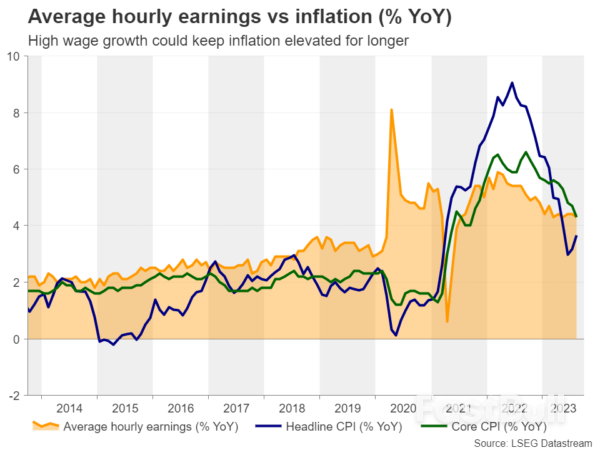
          That said, although the initial reaction in the dollar may come from any surprise in the NFPs or the unemployment rate, whether it will be a lasting one could depend on wage growth, which may provide a glimpse of where inflation may be headed in the months to come. Average hourly earnings are expected to have slightly accelerated in monthly terms, keeping the yoy rate steady at 4.3%.
          Dollar Traders Lock Gaze on US Nonfarm Payrolls_2
          Combined with the uptrend in oil prices, as well as the rebound in headline inflation and projections that the US economy likely performed much better in Q3 than in Q2, elevated wage growth may add to the risk of underlying price pressures intensifying in the months to come.
          With investors still projecting a lower rate path than the Fed, assigning only around a 50% probability for another hike and expecting rates to fall to 4.7% by the end of next year, it seems that there is ample room for upside adjustment should Friday’s jobs data come in strong, which could push yields higher and thereby encourage traders to buy more dollars.
          Dollar Traders Lock Gaze on US Nonfarm Payrolls_3
          At the same time, equities are likely to resume their slide as expectations of ‘higher for longer’ interest rates could exert downside pressure on valuations. Yes, upbeat economic data usually have a positive impact on a nation’s stock market, but the financial community is still in an environment where good news is bad news as it increases the need for additional rate hikes.

          Fed not the sole driver

          What’s more, expectations about the Fed’s future course of action are not the sole driver of the US dollar and Wall Street. There is also a strong note of uncertainty due to the economic challenges facing China, Eurozone and the UK. And with no other alternative, the only place to seek safety seems to be the US dollar. The yen has long lost its safe-haven status due to the BoJ maintaining a lid on Japanese government bond yields at a time when US rates are keep rising, while gold has fallen victim to both surging yields and a strong dollar, which has lost nearly 6% since September 25.

          Euro/dollar keeps printing lower highs and lower lows

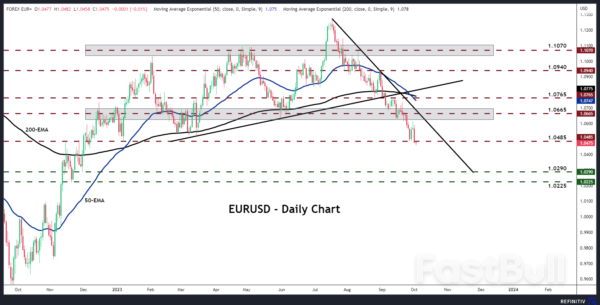
          Euro/dollar was among the pairs that rebounded decently at the end of last week due to the dollar’s pullback. The rebound happened after the price hit support at 1.0485. However, the pair surrendered those gains on Monday, staying below the downtrend line drawn from the high of July 18 and thereby confirming that the short-term outlook remains negative. The bears managed to push the action slightly below 1.0485 today, and if they are willing to stay in the driver’s seat, a dive towards the low of November 30 at 1.0290 could be possible.
          Dollar Traders Lock Gaze on US Nonfarm Payrolls_4
          For traders to allow a bigger dollar correction, Friday’s data may need to disappoint. However, even if euro/dollar climbs above 1.0665, the outlook will not turn positive, rather just neutral as the price would be back within the sideways range that contained most of the price action between January 9 and September 22.
          To stay updated on all economic events of today, please check out our Economic calendar
          Risk Warnings and Disclaimers
          You understand and acknowledge that there is a high degree of risk involved in trading. Following any strategies or investment methods may lead to potential losses. The content on the site is provided by our contributors and analysts for information purposes only. You are solely responsible for determining whether any trading assets, securities, strategy, or any other product is suitable for investing based on your own investment objectives and financial situation.
          Comments
          Add to Favorites
          Share

          Nigerian Reform Drive Falters, Threatening Africa's Biggest Economy

          Kevin Du

          Economic

          Nigerian President Bola Tinubu's lightning-fast reform push after taking office in May sparked hope that his administration would be a business-friendly antidote to mounting economic troubles facing Africa's biggest economy.
          Fast forward to more than 100 days in office, and the key planks of his economic overhaul - unshackling the naira from its rigid regime, and allowing fuel prices to rise - are coming loose.
          The naira hit a record low of 1,000 to the dollar on the black market this week, widening the gap with the official rate, which stood at 785 on Thursday.
          Petrol pump prices, meanwhile, have not budged since July - despite a more than 30% rise in oil prices.
          Some now fear Tinubu will not be able to wean Nigeria off the costly policies that have stymied investment and throttled economic growth.
          "Momentum just seems...almost in reverse," said David Omojomolo, Africa economist at research firm Capital Economics.
          Public anger is swelling as inflation spirals higher, however, and Nigeria's two biggest workers' unions are planning an indefinite strike next week to protest over a cost-of-living crisis.
          "Sentiment towards Nigeria has been continuing to sour as the initial reform momentum under President Tinubu's administration has faded," said Tellimer analyst Patrick Curran.
          Dollar Delay
          For years, Nigeria has tightly controlled the official naira rate, even amid declines in the price of oil, sales of which bring in 90% of the country's foreign currency supply.
          But providing dollars at an artificially low rate has led to a yawning gap between official and black market rates, leaving businesses and investors unable to access dollars. The central bank has also created import restrictions aimed at reducing dollar demand.
          Tinubu's decision to let the official naira rate weaken saw it briefly converge with the black market. Last week, he assured investors they could take money out, touting a "reliable, one figure exchange rate of the naira."
          But the gap has widened to nearly 30% this week, and four sources told Reuters it was virtually impossible to get dollars from the central bank on an ad hoc basis.
          The incoming central bank chief said on Tuesday that policymakers faced a nearly $7 billion backlog in foreign exchange demand; foreign airlines alone had $783 million in ticket sales trapped, the International Air Transport Association said.
          This is one major factor keeping investors from putting money to work in Nigeria.
          Another is negative real bond yields and the slow central bank response: 10-year local government bonds yield less than 15% while inflation is running above 25%.
          "What they have done so far is not enough to attract domestic debt holders or foreign investors into their domestic debt market," said Carlos de Sousa, portfolio manager at Vontobel Asset Management.
          The tattered finances left by the previous administration have also been no help.
          In August, the central bank published audited accounts for the first time since 2018, revealing that its $33 billion in FX reserves included a $19 billion commitment in derivatives - slashing the liquid amount of reserves.
          JPMorgan calculated net FX reserves stood at $3.7 billion as of the end of 2022, "significantly lower" than prior estimates.
          That news sent Nigeria's international bond tumbling.
          "Lower net FX reserves reduce the willingness to introduce a flexible exchange rate regime in the near term," said JPMorgan's Gbolahan S Taiwo.
          The central bank has also kept other restrictions that businesses say make life tough, including a ban on using central bank foreign exchange to import 43 items.
          "The government may have intended to make it a free market, but the CBN isn't allowing it to be one," said a Nigerian private equity investor who did not want to be named.
          The delay in scrapping fuel subsidies is exacerbating the dollar crunch. Last year, subsidies cost 2% of gross domestic product, according to Fitch.
          Despite being Africa's largest oil exporter, Nigeria imports nearly all its fuel as it does not refine nearly enough to meet the demand of its 200 million citizens. In recent years, it has swapped crude for fuel, depriving it again of a source of U.S. dollars.
          It is still using oil cargoes now to pay for fuel it imported previously, and a de-facto pump price limit set by state oil company NNPC LTD's sale price means it is again the sole petrol importer.
          Tellimer said Nigeria's gasoline prices would need to rise 73% to align with global prices.
          Analyst say Tinubu, elected with the narrowest margin since Nigeria returned to democracy in 1999 and facing inflation at nearly two-decade highs, lacks the social capital and mandate to push any harder.
          "There is the concern that when the going gets tough...they will walk back on the reforms," Omojomolo said.

          Source: ZAWYA

          To stay updated on all economic events of today, please check out our Economic calendar
          Risk Warnings and Disclaimers
          You understand and acknowledge that there is a high degree of risk involved in trading. Following any strategies or investment methods may lead to potential losses. The content on the site is provided by our contributors and analysts for information purposes only. You are solely responsible for determining whether any trading assets, securities, strategy, or any other product is suitable for investing based on your own investment objectives and financial situation.
          Comments
          Add to Favorites
          Share

          UK Parliament Is in Danger, But Are MPS Paying Attention?

          Devin

          Political

          Every British child loves the traditional fireworks on November 5. Across the UK, we celebrate what was a historic failure.
          The conspirator Guy "Guido" Fawkes was part of a Spanish-inspired plot supported by English Catholic rebels to blow up the parliament at Westminster and assassinate the Protestant King, James I.
          If the conspirators had managed to blow up parliament in 1605, in the ensuing chaos, it is possible that the closer union between Scotland and England in the "Union of the Crowns" would have failed. The modern British state might never have happened.
          Of course, the penalty for failure in 1605 was severe. Guy Fawkes and his comrades were tortured and executed. Yet what is striking is that the real destruction of the British parliament came 200 years later, and this significant setback for the British state came not as a result of a gunpowder plot but through complacency, carelessness and incompetence.
          In 1834, the British parliamentary authorities finally decided it was time to get rid of a load of wood that had been stored in Westminster for decades. The wood was burned in the ancient furnaces in the parliament buildings, but the blaze set alight the chimneys and the whole thing got out of hand. The resulting fire burned down much of parliament in the worst blaze since the Great Fire of London two centuries earlier.
          The Victorians – intent on conquering half the world – were shocked by their own complacency. They hadn't taken simple precautions. But then they leapt into action. They brought in the young architects who built the magnificent Palace of Westminster we know today.
          The reason this piece of history is relevant – perhaps even urgent – is that the Westminster parliament, the most memorable building at the heart of British democracy, is threatened again.
          The threat has been predicted and debated, yet little has been done to fix it. Worse, it's a double threat – from fire, but also water.
          Dr Hannah White, of the British Institute for Government, is one who has raised the fire-alarm. She suggests that the kind of blaze that destroyed Notre Dame cathedral in Paris could destroy the home of British democracy too. Those I've talked to who work at Westminster agree about the dangers.
          But what is now also being discussed is the water risk. It is a real threat, at least in the minds of those in the Bank of England who consider risk to London as a great financial capital.
          Sam Woods runs the bank's Prudential Regulation Authority. Mr Woods is reported to be planning a resilience test for "a very large climate event in the UK" and in other major financial centres. His concern goes beyond the predicted gradual changes in climate to something more like the extreme weather patterns that appear to have become more common around the world – flash floods as well as rising sea levels.
          He explained the threat that should give members of Parliament nightmares: "Imagine Westminster under water – a really extreme thing that made policy shift in a very dramatic way."
          If "terrible climate events" are happening around the world all the time, then the foreseeable danger is that something similar happens on the banks of the tidal River Thames. It could flood Westminster and have a "very sudden effect in financial markets".
          Mr Woods should be congratulated. He's at least thinking ahead. Future planning for possibly predictable yet disastrous events has been done before in Britain, but often the lessons have not been properly learned.
          There was planning of a sort for a pandemic but – as the long-running inquiry into coronavirus will undoubtedly reveal – discussing possible future scenarios did not lead to significant or effective preparations for Covid-19.
          Yet making Westminster more resilient raises two separate questions.
          Climate change is a humanitarian but also a financial and political risk. Were parliament to be flooded, MPs could be homeless for weeks or months, leading to all kinds of dislocation for the UK government.
          Second, leaving aside the likelihood of a "terrible climate event", the challenge of simply fixing what is wrong with the buildings in the Palace of Westminster has a timescale ranging upwards from 12 years and a cost put anywhere from £7 billion to £22 billion ($8.5-27 billion), according to New Civil Engineer research.
          You might understand, therefore, why delay and adopting an ostrich strategy is often the human response to intractable and costly problems. But as the Victorians found out in 1834, pretending that there isn't a problem doesn't make that problem go away. It makes it more dangerous.
          Climate change and even mundane building maintenance both demand long-term thinking. Unfortunately, it's not just the attention span of politicians worldwide that can be short. Their political lifespan is often short too.
          Many of the current crop of British MPs will no longer be in parliament after the election next year. They must be wondering why they should take inconvenient, unpopular and costly action now for a problem that, perhaps, only the next generation of their successors will actually face.
          But they should act anyway, because it's the right thing to do.

          Source: The National News

          Risk Warnings and Disclaimers
          You understand and acknowledge that there is a high degree of risk involved in trading. Following any strategies or investment methods may lead to potential losses. The content on the site is provided by our contributors and analysts for information purposes only. You are solely responsible for determining whether any trading assets, securities, strategy, or any other product is suitable for investing based on your own investment objectives and financial situation.
          Comments
          Add to Favorites
          Share

          Gold Decouples from Interest Rates, What's Next?

          XM

          Commodity

          Gold stable, despite 'bad news'

          Gold continues to trade with impressive resilience. Even though conditions in financial markets have turned against the precious metal in recent months, gold prices have not absorbed much damage, defying the negative pressure exerted by soaring interest rates and an appreciating US dollar.
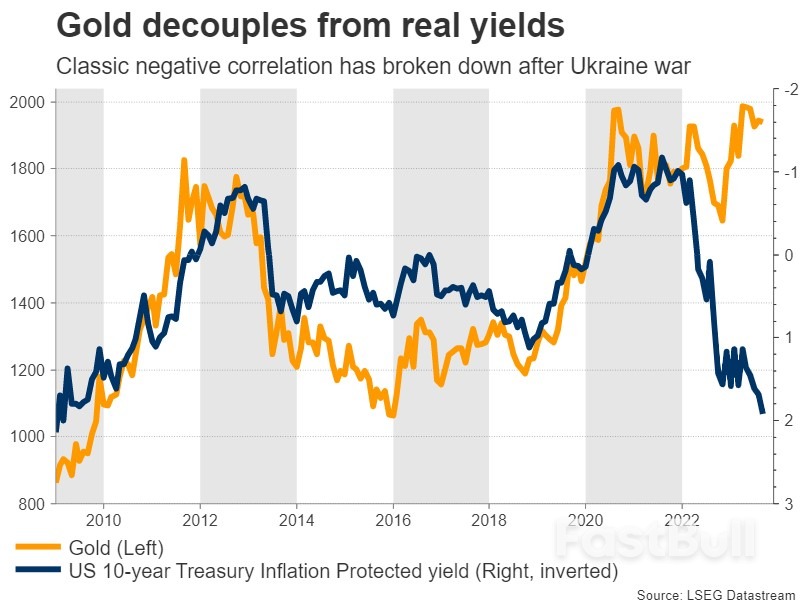
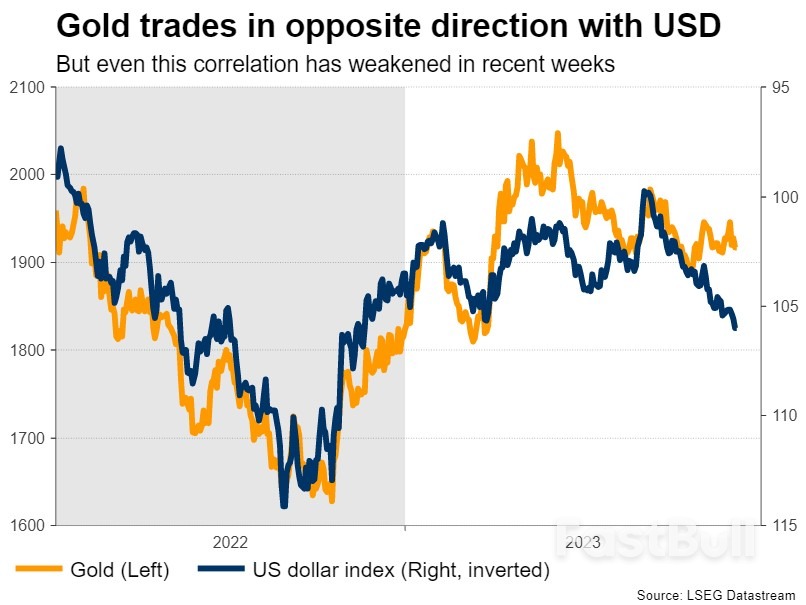
          In normal times, gold and interest rates have a negative relationship. When rates rise and yields on government bonds race higher, gold becomes less attractive, as it pays no interest to hold. If investors can buy a US government bond that pays them a yield of 4.5% per year, like they can today, they are less likely to buy the non-yielding precious metal. That's what theory suggests, at least.
          Similarly, a stronger US dollar is bad news for gold because the metal is mostly priced in US dollars. This means that when the dollar appreciates, it becomes more expensive for investors outside of the United States to buy gold, which inevitably dampens demand.
          Gold Decouples from Interest Rates, What's Next?_1But these classic correlations have broken down lately. Yields on inflation-protected bonds went through the roof in September to reach their highest levels in almost 15 years and the dollar has staged a phenomenal recovery. Going purely by the historical relationships, this combination should have smashed gold down.
          Yet, the yellow metal has remained relatively flat, and continues to trade 8% away from record highs. Therefore, some new element has come into play to change gold's trading dynamics.

          Central bank demand

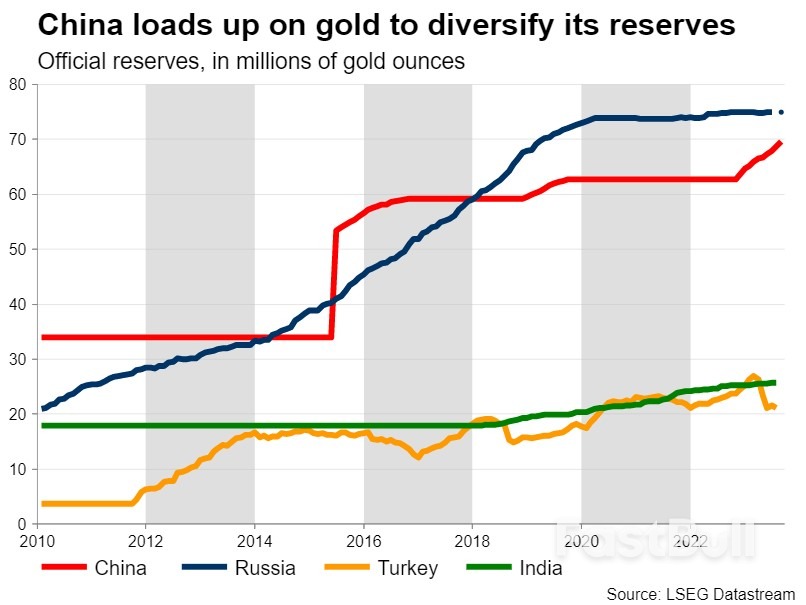
          This new element has been the direct buying of gold by central banks in an effort to raise their reserves. Central bank gold purchases reached a new record in the first half of this year, a pattern that likely persisted in the third quarter, spearheaded by China.
          Geopolitics lie behind this boom in central bank demand. The invasion of Ukraine resulted in the immediate freezing of Russia's reserves held abroad in dollars and euros - around half of the assets held by the Bank of Russia were frozen under Americans and European sanctions. That was the beginning of a paradigm shift for how central banks manage their reserves.
          The People's Bank of China started loading up on gold to diversify the nation's reserves away from dollars and euros, concerned about suffering the same fate in case diplomatic relations with the West turn colder in the future. This diversification strategy has seen China consistently buy gold for ten consecutive months through August, in what could be a multi-year trend.
          Gold Decouples from Interest Rates, What's Next?_2Sovereign purchases have fueled underlying demand for gold, almost establishing a floor under prices. When there are such massive buyer whales active in the market, which are not sensitive to prices because their motives are mostly political, it helps to prevent any massive selloffs. Hence the resilience of gold prices in the face of sky-high rates.
          The central bank buying spree has also suppressed volatility. Gold options contracts have seen their implied volatility fall to pre-pandemic levels over the summer, which essentially means investors are not hedging as much for any massive movements in gold, expecting the boost in demand to translate into smoother trading conditions moving forward.

          New record highs possible, but not imminent

          In the near term, downside risks for gold will probably continue to dominate. The negative forces of rising real yields and a roaring US dollar could continue to dampen the appeal of the precious metal, keeping a lid on any rallies.
          It is difficult to say exactly how much further the rally in the dollar and yields can go. The US economy is superior to its competitors at this stage from a growth perspective, the Fed has shifted to a stance of higher-for-longer interest rates, and the Treasury will continue to flood the markets with newly issued debt next quarter, maintaining the upward pressure on yields.
          Therefore, it seems premature to call for a trend reversal in gold. Most likely, these factors will keep the precious metal under selling interest in the coming weeks. That said, any losses could also be relatively limited considering the purchases from central banks, so gold prices might only bleed lower in a slow manner.
          Gold Decouples from Interest Rates, What's Next?_3Looking at the charts, the most crucial regions to watch on the downside are $1,900, and beyond that the August low near $1,885. If that zone is violated too, the spotlight would turn to $1,860, a level marked by the inside swing high in March.
          In the bigger picture, though, it seems quite plausible that gold can eventually rally to new records. If the highest bond yields in a generation could only knock gold 8% down from record highs, the precious metal can likely take out those highs once yields cool off again.
          For that to happen, it might require some panic event in global markets or signs of an imminent US recession that fuel speculation of Fed rate cuts. That's not on the horizon for now, but the economic cycle does seem to be in its final stages, so it might simply be a matter of time.
          Risk Warnings and Disclaimers
          You understand and acknowledge that there is a high degree of risk involved in trading. Following any strategies or investment methods may lead to potential losses. The content on the site is provided by our contributors and analysts for information purposes only. You are solely responsible for determining whether any trading assets, securities, strategy, or any other product is suitable for investing based on your own investment objectives and financial situation.
          Comments
          Add to Favorites
          Share

          Does the Past Experience Still Work?

          Peterson

          Commodity

          Energy

          Bond

          Economic

          In the past, from historical experience, the inversion of yields of the U.S. Treasury Securities is often an important signal of economic recession, but it seems to have great limitations. For example, this round of interest rate hikes by the Federal Reserve has caused the 10-year and 2-year yields of the U.S. Treasury Securities to remain inverted for 13 months since July last year, but the U.S. economy does not seem to show signs of recession. On the contrary, the market generally expects that the U.S. economy will have a "soft landing".
          In the past 43 years, there has been a statistical correlation between the inverted yields of the U.S. Treasury Securities and the economic recession. At present, the phenomenon of inversion has improved, and as long as it is based on the resilience of economic fundamentals, the long-term yield will rise sharply. This inversion improvement is more like the economic crises in 1980 and 1982, but it is different from the subsequent four economic crises, mainly because the short-term yield driven by the Fed's interest rate cut is down, and the interest rate cut generally means the Fed's confirmation of the deterioration of economic prospects, and the inversion improvement is more regarded by the market as a signal that the economy is about to fall into recession. At present, if there is a rate cut and a short-term downtrend, it will be closer to the signs of recession.
          At present, another leading indicator "copper-oil ratio" reveals the risk of recession again. As a "global economic barometer", the price of copper has fallen by nearly 10% since the end of July, while the ratio of copper to oil has been falling to around 88.0 since June, the lowest since November last year. According to historical experience, whenever the ratio of copper to oil goes down, it will warn the risk of economic recession like the index of "the yield curve of the U.S. Treasury Securities is inverted". So, has the classic "leading indicator" of the U.S. recession failed? Is it still instructive?
          We will not discuss its effectiveness for the time being, but given the current situation, it is foreseeable that with the further reflection of the lag of monetary tightening in Europe and the U.S., the economic prospects in Europe and the U.S. will cause demand-side concerns. At the same time, the "grey rhinos" such as the possible U.S. government shutdown in mid-November, the U.S. auto workers' strike that continues to grow, and the uncertainty over China's economic recovery, as well as the risks that might be masked rather than disappear, so we have to be cautious. Even if there is no so-called recession risk, the U.S. Dollar Index soars and non-US currencies depreciate sharply, and if the oil price climbs to US$100+ again, the impact on the global economy will be far greater than that of last year, which will hit the demand side hard, and it is also doomed that the oil price will not go far further. Perhaps OPEC countries will stop reducing their holdings or even increasing their production earlier.
          To stay updated on all economic events of today, please check out our Economic calendar
          Risk Warnings and Disclaimers
          You understand and acknowledge that there is a high degree of risk involved in trading. Following any strategies or investment methods may lead to potential losses. The content on the site is provided by our contributors and analysts for information purposes only. You are solely responsible for determining whether any trading assets, securities, strategy, or any other product is suitable for investing based on your own investment objectives and financial situation.
          Comments
          Add to Favorites
          Share
          FastBull
          Copyright © 2025 FastBull Ltd

          728 RM B 7/F GEE LOK IND BLDG NO 34 HUNG TO RD KWUN TONG KLN HONG KONG

          TelegramInstagramTwitterfacebooklinkedin
          App Store Google Play Google Play
          Products
          Charts

          Chats

          Q&A with Experts
          Screeners
          Economic Calendar
          Data
          Tools
          Membership
          Features
          Function
          Markets
          Copy Trading
          Latest Signals
          Contests
          News
          Analysis
          24/7
          Columns
          Education
          Company
          Careers
          About Us
          Contact Us
          Advertising
          Help Center
          Feedback
          User Agreement
          Privacy Policy
          Business

          White Label

          Data API

          Web Plug-ins

          Poster Maker

          Affiliate Program

          Risk Disclosure

          The risk of loss in trading financial instruments such as stocks, FX, commodities, futures, bonds, ETFs and crypto can be substantial. You may sustain a total loss of the funds that you deposit with your broker. Therefore, you should carefully consider whether such trading is suitable for you in light of your circumstances and financial resources.

          No decision to invest should be made without thoroughly conducting due diligence by yourself or consulting with your financial advisors. Our web content might not suit you since we don't know your financial conditions and investment needs. Our financial information might have latency or contain inaccuracy, so you should be fully responsible for any of your trading and investment decisions. The company will not be responsible for your capital loss.

          Without getting permission from the website, you are not allowed to copy the website's graphics, texts, or trademarks. Intellectual property rights in the content or data incorporated into this website belong to its providers and exchange merchants.

          Not Logged In

          Log in to access more features

          FastBull Membership

          Not yet

          Purchase

          Become a signal provider
          Help Center
          Customer Service
          Dark Mode
          Price Up/Down Colors

          Log In

          Sign Up

          Position
          Layout
          Fullscreen
          Default to Chart
          The chart page opens by default when you visit fastbull.com