• Trade
  • Markets
  • Copy
  • Contests
  • News
  • 24/7
  • Calendar
  • Q&A
  • Chats
Trending
Screeners
SYMBOL
LAST
BID
ASK
HIGH
LOW
NET CHG.
%CHG.
SPREAD
SPX
S&P 500 Index
6835.28
6835.28
6835.28
6874.90
6813.36
+38.42
+ 0.57%
--
DJI
Dow Jones Industrial Average
48821.69
48821.69
48821.69
49020.59
48546.03
+333.11
+ 0.69%
--
IXIC
NASDAQ Composite Index
23057.09
23057.09
23057.09
23260.29
22949.78
+102.78
+ 0.45%
--
USDX
US Dollar Index
98.420
98.500
98.420
98.490
98.140
+0.090
+ 0.09%
--
EURUSD
Euro / US Dollar
1.17039
1.17048
1.17039
1.17428
1.16944
-0.00221
-0.19%
--
GBPUSD
Pound Sterling / US Dollar
1.34291
1.34298
1.34291
1.34588
1.34011
-0.00121
-0.09%
--
XAUUSD
Gold / US Dollar
4833.67
4834.08
4833.67
4888.31
4757.73
+70.51
+ 1.48%
--
WTI
Light Sweet Crude Oil
60.338
60.368
60.338
60.805
59.170
+0.874
+ 1.47%
--

Community Accounts

Signal Accounts
--
Profit Accounts
--
Loss Accounts
--
View More

Become a signal provider

Sell trading signals to earn additional income

View More

Guide to Copy Trading

Get started with ease and confidence

View More

Signal Accounts for Members

All Signal Accounts

Best Return
  • Best Return
  • Best P/L
  • Best MDD
Past 1W
  • Past 1W
  • Past 1M
  • Past 1Y

All Contests

  • All
  • Trump Updates
  • Recommend
  • Stocks
  • Cryptocurrencies
  • Central Banks
  • Featured News
Top News Only
Share

Trump: That Will Not Be Necessary

Share

Trump: Military Is Not On The Table In Greenland

Share

US President Trump: Will Observe Whether Egypt And Ethiopia Can Reach An Agreement On The Nile River Dam

Share

[Bitcoin Briefly Dipped Below $89,000, With A 1.55% Hourly Drop.] January 22, According To Htx Market Data, Bitcoin Briefly Fell Below $89,000, Now Trading At $88,905, With A 1-Hour Decline Of 1.55%

Share

Denmark Rejected Trump's Request To Negotiate The Takeover Of Greenland

Share

US President Trump: We Have An Excellent Relationship With Egypt

Share

Europe's STOXX Index Up 0.03%, Euro Zone Blue Chips Index Down 0.06%

Share

France's CAC 40 Up 0.13%, Spain's IBEX Up 0.13%

Share

Europe's STOXX 600 Up 0.01%

Share

Germany's DAX 30 Index Closed Down 0.39% At 24,607.15 Points. France's Stock Index Closed Up 0.18%, Italy's Stock Index Closed Down 0.37% And Its Banking Index Fell 0.31%, And The UK Stock Index Closed Up 0.15%

Share

The EU Is Expected To Launch An Investigation Into Netflix And Its Bid For Paramount Skydance To Acquire Parallel

Share

According To Reports, The Iraqi Prime Minister Has Ordered The Construction Of A Security Barrier Along The Border With Syria, Marking The First Time Iraq Has Built Such Defensive Fortifications

Share

EU's Kallas: EU Will Move Forward On A Security And Defence Partnership With India

Share

Joint Statement: Saudi Arabia, Turkey, Egypt, Jordan, Indonesia, Pakistan, And Qatar Have Accepted The Invitation To Join US President Trump's Peace Commission; Each Country Will Sign The Accession Documents In Accordance With Its Own Legal Procedures

Share

CBOE Volatility Index Retreats As Stocks Rebound, Down 2.61 Points At 17.48

Share

US Military Says Forces Launch Mission In Syria To Transfer Islamic State Prisoners To Iraq

Share

Brazil's Real Brby Strengthens 1% Versus USA Dollar In Spot Trading

Share

UK PRA's Woods Says Regulator Considering An Automatic Indexation Tool To Determine Whether A Bank Is Systemic

Share

Noboa: Ecuador To Impose 30% Tariff On Colombia From February 1

Share

US President Donald Trump Will Meet With NATO Chief Rutte In Davos On Thursday

TIME
ACT
FCST
PREV
U.K. CPI MoM (Dec)

A:--

F: --

P: --

U.K. Input PPI MoM (Not SA) (Dec)

A:--

F: --

P: --
U.K. Core CPI MoM (Dec)

A:--

F: --

P: --

U.K. Retail Prices Index MoM (Dec)

A:--

F: --

P: --

U.K. Input PPI YoY (Not SA) (Dec)

A:--

F: --

P: --

U.K. CPI YoY (Dec)

A:--

F: --

P: --

U.K. Output PPI MoM (Not SA) (Dec)

A:--

F: --

P: --

U.K. Output PPI YoY (Not SA) (Dec)

A:--

F: --

P: --

U.K. Core Retail Prices Index YoY (Dec)

A:--

F: --

P: --

U.K. Core CPI YoY (Dec)

A:--

F: --

P: --

U.K. Retail Prices Index YoY (Dec)

A:--

F: --

P: --

Indonesia 7-Day Reverse Repo Rate

A:--

F: --

P: --

Indonesia Loan Growth YoY (Dec)

A:--

F: --

P: --

Indonesia Deposit Facility Rate (Jan)

A:--

F: --

P: --

Indonesia Lending Facility Rate (Jan)

A:--

F: --

P: --

South Africa Core CPI YoY (Dec)

A:--

F: --

P: --

South Africa CPI YoY (Dec)

A:--

F: --

P: --

IEA Oil Market Report
U.K. CBI Industrial Output Expectations (Jan)

A:--

F: --

P: --
U.K. CBI Industrial Prices Expectations (Jan)

A:--

F: --

P: --

South Africa Retail Sales YoY (Nov)

A:--

F: --

P: --

U.K. CBI Industrial Trends - Orders (Jan)

A:--

F: --

P: --

Mexico Retail Sales MoM (Nov)

A:--

F: --

P: --

U.S. MBA Mortgage Application Activity Index WoW

A:--

F: --

P: --

Canada Industrial Product Price Index YoY (Dec)

A:--

F: --

P: --
Canada Industrial Product Price Index MoM (Dec)

A:--

F: --

P: --
U.S. Weekly Redbook Index YoY

A:--

F: --

P: --

U.S. Pending Home Sales Index YoY (Dec)

A:--

F: --

P: --

U.S. Pending Home Sales Index MoM (SA) (Dec)

A:--

F: --

P: --

U.S. Construction Spending MoM (Oct)

A:--

F: --

P: --
U.S. Pending Home Sales Index (Dec)

A:--

F: --

P: --

U.S. API Weekly Refined Oil Stocks

--

F: --

P: --

U.S. API Weekly Gasoline Stocks

--

F: --

P: --

U.S. API Weekly Cushing Crude Oil Stocks

--

F: --

P: --

U.S. API Weekly Crude Oil Stocks

--

F: --

P: --

South Korea GDP Prelim YoY (SA) (Q4)

--

F: --

P: --

South Korea GDP Prelim QoQ (SA) (Q4)

--

F: --

P: --

Japan Imports YoY (Dec)

--

F: --

P: --

Japan Exports YoY (Dec)

--

F: --

P: --

Japan Goods Trade Balance (SA) (Dec)

--

F: --

P: --

Japan Trade Balance (Not SA) (Dec)

--

F: --

P: --
Australia Employment (Dec)

--

F: --

P: --

Australia Labor Force Participation Rate (SA) (Dec)

--

F: --

P: --

Australia Unemployment Rate (SA) (Dec)

--

F: --

P: --

Australia Full-time Employment (SA) (Dec)

--

F: --

P: --

Turkey Consumer Confidence Index (Jan)

--

F: --

P: --

Turkey Capacity Utilization (Jan)

--

F: --

P: --

Turkey Late Liquidity Window Rate (LON) (Jan)

--

F: --

P: --

Turkey Overnight Lending Rate (O/N) (Jan)

--

F: --

P: --

Turkey 1-Week Repo Rate

--

F: --

P: --

U.K. CBI Distributive Trades (Jan)

--

F: --

P: --

U.K. CBI Retail Sales Expectations Index (Jan)

--

F: --

P: --

U.S. Weekly Continued Jobless Claims (SA)

--

F: --

P: --

U.S. Initial Jobless Claims 4-Week Avg. (SA)

--

F: --

P: --

U.S. Real Personal Consumption Expenditures Final QoQ (Q3)

--

F: --

P: --

Canada New Housing Price Index MoM (Dec)

--

F: --

P: --

U.S. Weekly Initial Jobless Claims (SA)

--

F: --

P: --

U.S. Real GDP Annualized QoQ Final (Q3)

--

F: --

P: --

Q&A with Experts
    • All
    • Chatrooms
    • Groups
    • Friends
    3K8ZJE7E09 flag
    @john saying contest accounts can only be used during trading contest
    VQ813N1N7K flag
    Any insights on XAUUSD?
    john flag
    rawa ronte
    @rawa ronte we just trade in the moment,,we stay flexibe so that we can adopt to changing market dynamics
    Size flag
    Khawatir_
    @Khawatir_That would be crazy.
    john flag
    VQ813N1N7K
    Any insights on XAUUSD?
    @VQ813N1N7K gold bullish trend remain intact and a pullback remain an opportunity to buy gold
    Size flag
    If FastBull hosts a BTC contest, you’re definitely one of the names to watch@Khawatir_
    Jamolla flag
    price doesn’t care about speeches long term
    Size flag
    Khawatir_
    That shows solid trade management..
    john flag
    Jamolla
    price doesn’t care about speeches long term
    @Jamolla where is this coming from ?
    black Rock. flag
    Size flag
    Locking risk early and letting it work is how consistency is built.@Khawatir_
    ZK6J93JP0G flag
    john
    @johnso we are still looking to buy gold ?
    Size flag
    Speeches only affect short-term volatility.
    Jamolla flag
    john
    @johnTrump speech won't change a lot
    Size flag
    Long term, price follows liquidity, macro fundamentals, and market structure@Jamolla
    Jamolla flag
    Size
    Speeches only affect short-term volatility.
    @Size true
    3K8ZJE7E09 flag
    not getting any help here
    Jamolla flag
    UK inflation at 3.4% matters.
    Khawatir_ flag
    john
    @johnsituational. 🤝
    john flag
    3K8ZJE7E09
    not getting any help here
    @3K8ZJE7E09 I told you to share your screan with you been unable to place the trade
    Type here...
    Add Symbol or Code

      No matching data

      All
      Trump Updates
      Recommend
      Stocks
      Cryptocurrencies
      Central Banks
      Featured News
      • All
      • Russia-Ukraine Conflict
      • Middle East Flashpoint
      • All
      • Russia-Ukraine Conflict
      • Middle East Flashpoint
      Search
      Products

      Charts Free Forever

      Chats Q&A with Experts
      Screeners Economic Calendar Data Tools
      Membership Features
      Data Warehouse Market Trends Institutional Data Policy Rates Macro

      Market Trends

      Market Sentiment Order Book Forex Correlations

      Top Indicators

      Charts Free Forever
      Markets

      News

      News Analysis 24/7 Columns Education
      From Institutions From Analysts
      Topics Columnists

      Latest Views

      Latest Views

      Trending Topics

      Top Columnists

      Latest Update

      Signals

      Copy Rankings Latest Signals Become a signal provider AI Rating
      Contests
      Brokers

      Overview Brokers Assessment Rankings Regulators News Claims
      Broker listing Forex Brokers Comparison Tool Live Spread Comparison Scam
      Q&A Complaint Scam Alert Videos Tips to Detect Scam
      More

      Business
      Events
      Careers About Us Advertising Help Center

      White Label

      Data API

      Web Plug-ins

      Affiliate Program

      Awards Institution Evaluation IB Seminar Salon Event Exhibition
      Vietnam Thailand Singapore Dubai
      Fans Party Investment Sharing Session
      FastBull Summit BrokersView Expo
      Recent Searches
        Top Searches
          Markets
          News
          Analysis
          User
          24/7
          Economic Calendar
          Education
          Data
          • Names
          • Latest
          • Prev

          View All

          No data

          Scan to Download

          Faster Charts, Chat Faster!

          Download App
          English
          • English
          • Español
          • العربية
          • Bahasa Indonesia
          • Bahasa Melayu
          • Tiếng Việt
          • ภาษาไทย
          • Français
          • Italiano
          • Türkçe
          • Русский язык
          • 简中
          • 繁中
          Open Account
          Search
          Products
          Charts Free Forever
          Markets
          News
          Signals

          Copy Rankings Latest Signals Become a signal provider AI Rating
          Contests
          Brokers

          Overview Brokers Assessment Rankings Regulators News Claims
          Broker listing Forex Brokers Comparison Tool Live Spread Comparison Scam
          Q&A Complaint Scam Alert Videos Tips to Detect Scam
          More

          Business
          Events
          Careers About Us Advertising Help Center

          White Label

          Data API

          Web Plug-ins

          Affiliate Program

          Awards Institution Evaluation IB Seminar Salon Event Exhibition
          Vietnam Thailand Singapore Dubai
          Fans Party Investment Sharing Session
          FastBull Summit BrokersView Expo

          Gold Surges Past $4,800/oz To New Record High Amid Greenland Tensions

          Winkelmann

          Forex

          Commodity

          Summary:

          Spot gold jumped 1.7% to a new all-time high of $4,844.39 an ounce by 21:13 ET (02:13 GMT), extending a relentless rally that has pushed bullion to successive all-time highs this month.

          Gold prices smashed through $4,800 an ounce on Wednesday, scaling another record high as escalating tensions linked to Greenland and renewed trade frictions rattled global markets and drove investors toward safe-haven assets.

          Spot gold jumped 1.7% to a new all-time high of $4,844.39 an ounce by 21:13 ET (02:13 GMT), extending a relentless rally that has pushed bullion to successive all-time highs this month.

          U.S. Gold Futures climbed1.3% to $4,830.04.

          Gold prices have jumped more than 5% this week, including today's gains.

          The latest surge came as relations between the U.S. and Europe remained strained over Greenland's strategic importance.

          U.S. President Donald Trump has insisted there is "no going back" on Greenland, citing security concerns in the Arctic, and has threatened tariffs against European countries, unsettling markets already on edge over global trade risks.

          French President Emmanuel Macron said Europe would not bow to "bullies," stressing that respect and cooperation, not coercion, should define relations between allies.

          His remarks, delivered on the sidelines of the World Economic Forum in Davos, underscored growing unease in Europe over Washington's rhetoric and trade threats tied to the Greenland dispute.

          Trump sought to calm nerves by saying the U.S. was working on the issue and aimed for an outcome that would satisfy NATO, but investors remained cautious.

          Investor demand for gold was further boosted by weakness in the U.S. dollar, which slid about 0.8% on Tuesday to a two-week low.

          The US Dollar Index traded 0.2% lower during Asian hours on Wednesday.

          A softer dollar makes gold cheaper for holders of other currencies and typically lifts demand for the non-yielding metal.

          Among other precious metals, silver prices edged slightly lower to $93.9/oz after hitting a record high of $95.87.oz on Tuesday.

          Platinum rose to a record high of $2,519.51/oz on Wednesday but later pared gains to trade 0.6% lower at $2,450.9/oz.

          Source: Investing

          Risk Warnings and Disclaimers
          You understand and acknowledge that there is a high degree of risk involved in trading. Following any strategies or investment methods may lead to potential losses. The content on the site is provided by our contributors and analysts for information purposes only. You are solely responsible for determining whether any trading assets, securities, strategy, or any other product is suitable for investing based on your own investment objectives and financial situation.
          Add to Favorites
          Share

          South Korea's Won May Hit 1,400 vs. Dollar, President Says

          Ukadike Micheal

          Remarks of Officials

          Stocks

          Daily News

          Political

          Economic

          Forex

          President Projects Currency Stabilization in Coming Months

          South Korean President Lee Jae Myung has stated that the country's currency could strengthen and find stability around the 1,400 won per dollar mark within the next one to two months.

          Speaking at a press conference on Wednesday, Lee addressed concerns over the won's recent weakness, framing it as part of a broader global trend rather than a problem unique to South Korea. He noted that other major currencies, like the Japanese yen, have experienced even greater pressure.

          Lee pointed to the nation's economic fundamentals as a source of strength. "We have achieved a record-high $700 billion in exports, the trade balance remains in surplus, and growth is recovering, yet the exchange rate is hovering at levels seen last year," he said.

          Key Headwinds Facing the Korean Currency

          Despite the president's optimistic outlook, the won has fallen over 8% against the US dollar since the beginning of the second half of 2025. This decline has persisted despite various market interventions by policymakers.

          Several factors are contributing to the downward pressure on the currency:

          • Retail Investor Outflows: Korean retail investors have shown a strong appetite for US stocks, with their holdings reaching a new record of nearly $172 billion this month, according to data from the Korea Securities Depository. This demand for dollars weighs on the won.

          • US Investment Pledges: A commitment made last year to invest a total of $350 billion in the United States as part of a trade deal has raised concerns about financing the capital outflow. A source familiar with the matter told Bloomberg News that the government plans to delay a pledged $20 billion investment in the US this year due to the currency pressure.

          President Lee acknowledged the difficulty of the situation, stating that arresting the won's drop is hard to resolve "through our own policies alone."

          Policy Stance and Immediate Market Reaction

          President Lee defended the won's relative performance, comparing it favorably to the yen. "Compared to Japan, ours has depreciated less," he commented, adding that if the won had fallen at the same rate, the exchange rate would be closer to 1,600. In his view, the currency was "holding up relatively well."

          He reiterated the government's commitment to currency stability, promising to "explore possible means and strive to stabilize the exchange rate."

          The president's remarks triggered an immediate market response. The won, which had been lagging behind a broader trend of global dollar weakness, reversed course. It rose as much as 0.6% to 1,468.90 against the dollar in Seoul trading.

          Gyeong-Won Min, an economist at Woori Bank, explained the rally: "The won...rebounded after the president's comments, prompting demand to unwind bets on dollar strength."

          To stay updated on all economic events of today, please check out our Economic calendar
          Risk Warnings and Disclaimers
          You understand and acknowledge that there is a high degree of risk involved in trading. Following any strategies or investment methods may lead to potential losses. The content on the site is provided by our contributors and analysts for information purposes only. You are solely responsible for determining whether any trading assets, securities, strategy, or any other product is suitable for investing based on your own investment objectives and financial situation.
          Add to Favorites
          Share

          Bitcoin Slides Below $90,000 as Risk Aversion Sweeps Global Markets

          Gerik

          Economic

          Cryptocurrency

          Bitcoin Tracks Broader Market Weakness

          Bitcoin fell to its lowest level in more than a week, dropping below $90,000 for the first time since Jan. 9 as selling pressure intensified across global asset classes. After declining as much as 4% on Tuesday, the largest cryptocurrency extended losses during Asian trading hours on Wednesday, falling 0.5% to $88,894 as of 9:27 a.m. in Singapore. The decline unfolded alongside simultaneous drops in equities, long-dated U.S. Treasuries, and Japanese government bonds, underscoring how digital assets are moving in close correlation with traditional markets during periods of elevated volatility.
          The $90,000 level has held symbolic and technical significance since the beginning of the year. Market participants have repeatedly viewed it as a near-term support zone, making the latest breach an important reference point for short-term sentiment rather than a signal of structural weakness.

          Altcoins and Crypto-Linked Stocks Under Pressure

          Selling pressure was more pronounced among smaller and less liquid digital assets. Ether dropped more than 7%, while Solana declined 5.3%, reflecting a typical pattern where higher-beta tokens react more sharply during risk-off phases. This divergence illustrates a relationship of correlation rather than direct causation, as altcoins tend to amplify broader market moves rather than drive them.
          Crypto-related equities mirrored the weakness in digital assets. Coinbase Global Inc. slid 5.6%, while Strategy Inc., known for its aggressive Bitcoin accumulation strategy, fell nearly 8%. The equity selloff highlights how exposure to crypto through public markets can magnify price swings during periods of market stress.

          Geopolitics and Capital Flight Shape Market Behavior

          The downturn across crypto and traditional assets followed renewed geopolitical tension after U.S. President Donald Trump signaled a shift in the postwar global order by asserting American dominance in the Western hemisphere and reiterating his intention to take over Greenland. These statements unsettled investors by raising the likelihood of trade disruptions and diplomatic friction, particularly between the U.S. and Europe.
          In parallel, Japanese bonds sold off sharply, with yields on 30- and 40-year government securities jumping more than 25 basis points. The move came after Prime Minister Sanae Takaichi pledged food tax cuts as part of her election campaign, triggering concerns over looser fiscal policy and rising government spending. Together, these developments contributed to a broader reallocation of capital toward perceived safe havens, a shift that coincided with rallies in gold and silver and weakness in the U.S. dollar.
          The relationship between these macro developments and Bitcoin’s decline is best understood as one of correlation. Bitcoin has increasingly behaved as a risk-sensitive asset, responding to global liquidity conditions and investor sentiment rather than acting as an independent hedge.

          Institutional Buying Provides a Counterbalance

          Despite the pullback, signs of institutional demand remain visible. Strategy announced on Tuesday that it purchased nearly $2.13 billion worth of Bitcoin over the previous eight days, marking its largest acquisition since July. This move suggests that long-term investors continue to view price weakness as an opportunity to accumulate exposure, particularly through corporate balance sheets.
          Market participants also noted Bitcoin’s relative resilience compared with Ether during the session, a dynamic partly attributed to renewed interest in Bitcoin-linked equity vehicles. Since the start of the year, investors have allocated around $1.2 billion into U.S.-listed Bitcoin exchange-traded funds, flows that had previously supported prices following last year’s market downturn.
          The latest decline reinforces how closely Bitcoin remains tied to global risk sentiment during periods of macro uncertainty. While institutional inflows and strategic accumulation point to underlying demand, short-term price action continues to reflect shifts in confidence across broader financial markets. As geopolitical tensions and fiscal concerns remain unresolved, volatility is likely to persist, keeping key technical levels such as $90,000 firmly in focus for investors.

          Source: Bloomberg

          To stay updated on all economic events of today, please check out our Economic calendar
          Risk Warnings and Disclaimers
          You understand and acknowledge that there is a high degree of risk involved in trading. Following any strategies or investment methods may lead to potential losses. The content on the site is provided by our contributors and analysts for information purposes only. You are solely responsible for determining whether any trading assets, securities, strategy, or any other product is suitable for investing based on your own investment objectives and financial situation.
          Add to Favorites
          Share

          Trump Targets Wall Street Homebuyers in New Push to Ease Housing Pressure

          Gerik

          Economic

          Policy Context And Political Motivation

          The executive order comes at a time when housing affordability remains a dominant voter concern across the United States, particularly as borrowing costs stay elevated and home prices remain structurally high in many regions. By positioning the policy as a defense of individual homebuyers against Wall Street competition, the administration frames the housing shortage as partly linked to investor behavior rather than purely to construction constraints or demographic pressures. The timing also reflects heightened political incentives, as the White House faces pressure to demonstrate concrete action on cost-of-living issues before congressional elections later this year.
          The order states that large institutional investors should not acquire single-family homes that could otherwise be purchased by families seeking homeownership. To operationalize this stance, the administration has instructed relevant agencies to issue formal guidance within 60 days detailing how restrictions on such transactions would be implemented. This approach signals an intention to influence market behavior through regulatory clarification rather than immediate statutory change, leaving room for interpretation while setting a clear policy direction.

          Regulatory Review And Antitrust Focus

          Beyond prospective restrictions on future sales, the order mandates a broader review of existing rules governing institutional ownership of single-family housing. The Treasury Secretary has been directed to assess whether current regulations facilitate large-scale acquisitions and to consider revisions where appropriate. At the same time, the Justice Department and the Federal Trade Commission are tasked with scrutinizing substantial or sequential acquisitions in local housing markets for potential anti-competitive effects. Particular attention is given to coordinated vacancy management and pricing strategies, which regulators argue may contribute to higher rents and reduced availability without corresponding improvements in housing quality.
          Wall Street firms such as Blackstone, American Homes 4 Rent and Progress Residential expanded aggressively into single-family rentals following the 2008 financial crisis, when widespread foreclosures created opportunities to acquire homes at scale. According to a 2024 study by the Government Accountability Office, institutional investors owned approximately 450,000 single-family rental homes by June 2022, representing about 3 percent of the national total. While this share may appear modest, its concentration in certain metropolitan areas has amplified its perceived impact on local prices and rental dynamics.
          The executive order places the administration closer to long-standing Democratic critiques of corporate homebuying, which argue that large investors crowd out first-time buyers and push prices higher through scale advantages. Although previous legislative efforts to curb institutional ownership have failed to gain traction, the use of executive authority shifts the battleground to regulatory enforcement and antitrust oversight. For housing markets, the effectiveness of the policy will depend on how narrowly or broadly “large institutional investors” are defined and whether enforcement meaningfully alters acquisition incentives. In practice, the order may have a stronger signaling effect in the short term, shaping expectations and public debate, while its longer-term influence will hinge on implementation details and legal resilience.

          Source: Reuters

          To stay updated on all economic events of today, please check out our Economic calendar
          Risk Warnings and Disclaimers
          You understand and acknowledge that there is a high degree of risk involved in trading. Following any strategies or investment methods may lead to potential losses. The content on the site is provided by our contributors and analysts for information purposes only. You are solely responsible for determining whether any trading assets, securities, strategy, or any other product is suitable for investing based on your own investment objectives and financial situation.
          Add to Favorites
          Share

          Ethereum Price Loses Crucial Support, Is $4,000 Breakout Still Possible?

          Samantha Luan

          Forex

          Cryptocurrency

          Key Insights:

          · Ethereum price dropped below the $3,060 support, shifting short-term market sentiment.
          · Over 30% of ETH is staked, strengthening network security despite price weakness.
          · Institutional adoption continues through tokenized assets, funds, and staking products.

          Ethereum (ETH) price slipped below a closely watched support level this week, putting short-term pressure on the market.

          Still, stakeholder growth, strong network use, and steady institutional activity continue to shape the broader outlook.

          The Ethereum Price Outlook

          Ethereum (ETH) price has been under pressure after losing support around the $3,060 level. Traders had been watching this zone for weeks, as it held this price point during earlier pullbacks.

          Once it gave way, selling picked up and pushed Ethereum (ETH) lower. The move did not trigger panic, but it did shift near-term sentiment.

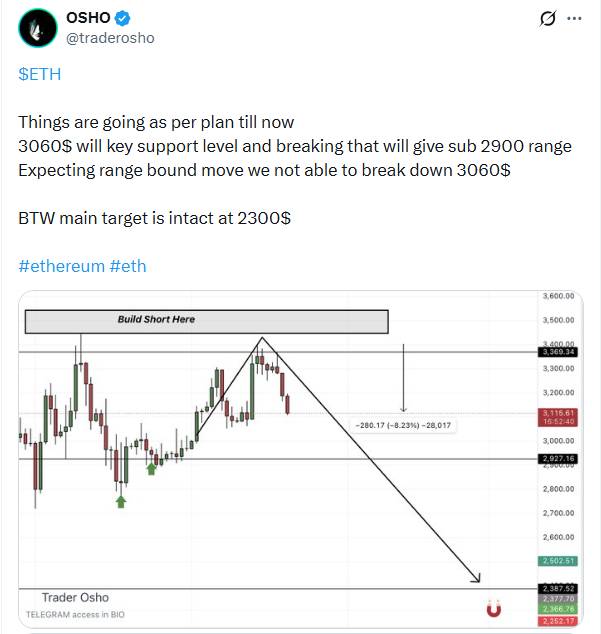
          Meanwhile, many short-term traders now see the $2,900 area as the next level to watch. This zone has acted as support before and could slow further declines.

          Ethereum Price Chart | Source: OSHO

          If that level fails, attention turns to the $2,300 range, which some market participants still view as a major downside target.

          That area lines up with earlier trading ranges where buyers were active.

          Despite the drop, Ethereum price action remains controlled. Volumes have stayed moderate, suggesting this is not a rush for the exits.

          Instead, ETH price appears stuck in a narrow range as buyers and sellers wait for direction. This kind of movement often follows long rallies, especially when markets lack fresh news.

          Still, the big question is whether Ethereum price can still push toward $4,000. For that to happen, the market would need to reclaim lost support and break through resistance near recent highs.

          That likely requires stronger demand and a clearer shift in sentiment. Until then, sideways movement remains the base case.

          The Ethereum Decentralization Outlook

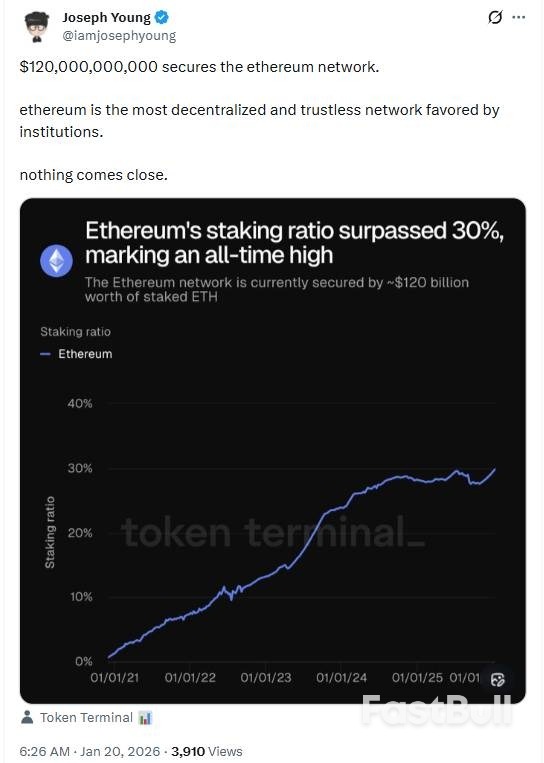
          Away from Ethereum price charts, the protocol continues to show strength at the network level. More than 30% of all ETH is now staked, marking a new record.

          At current prices, this represents roughly $120 billion securing the network. This steady rise points to growing trust in Ethereum's long-term role.

          Notably, staking removes ETH from active circulation, which can reduce sudden supply shocks. It also strengthens network security by increasing the value locked by validators.

          For many holders, staking offers a reason to hold through price swings rather than trade short-term moves.

          Still, Ethereum remains one of the most decentralized public blockchains in use, according to Joseph Young. Validators are spread across regions and operators, lowering the risk of control by a small group.

          Ethereum Decentralization Showcase | Source: Joseph Young

          This structure continues to appeal to developers, institutions, and users who value neutrality and uptime.

          The rise in staking during a period of weaker price action is notable. It suggests that many participants are focused less on short-term price and more on yield and network participation.

          This behavior supports the view that Ethereum is maturing beyond a pure trading asset.

          ETH Institutional Positioning Worth Watching

          In a separate development, institutional interest in Ethereum has continued to grow, even as the price cools.

          Large financial firms are launching real products on Ethereum and its scaling networks, not just pilot programs. Tokenized funds, stocks, and money market products are now live and in use.

          Several asset managers have moved to offer Ethereum exposure that includes staking rewards.

          This reflects comfort with Ethereum's structure and its yield model. For institutions, staking turns ETH into an income-generating asset rather than a static holding.

          Banks, payment firms, and fintech companies are also building on Ethereum to support stablecoins and settlements.

          These projects depend on network reliability, not daily price moves. Their growth adds steady demand for Ethereum block space.

          Ethereum price may struggle in the short term, but institutional behavior points to a longer positive view. Firms are committing capital and infrastructure, not chasing quick gains.

          If broader market conditions improve, this base could support another run toward $4,000. Until then, Ethereum remains in a pause, balancing price weakness against deepening adoption.

          Source: CryptoSlate

          Risk Warnings and Disclaimers
          You understand and acknowledge that there is a high degree of risk involved in trading. Following any strategies or investment methods may lead to potential losses. The content on the site is provided by our contributors and analysts for information purposes only. You are solely responsible for determining whether any trading assets, securities, strategy, or any other product is suitable for investing based on your own investment objectives and financial situation.
          Add to Favorites
          Share

          Indonesian Bond Demand Sinks To 10-Month Low As Rupiah Weakens

          Justin

          Bond

          Economic

          Demand for Indonesian bonds fell to the lowest in 10 months at an auction as a selloff in the rupiah deepened and concerns over the country's fiscal health persisted.

          Indonesia sold 36 trillion rupiah ($2.1 billion) of debt on Tuesday, an upsized amount that drew just 82.9 trillion rupiah of bids, according to the Ministry of Finance's debt management office. The bid-to-target ratio fell to 2.51, the weakest since March 18, according to data compiled by Bloomberg.

          The waning appetite for Indonesian bonds reflects a broader selloff in the global debt markets, led by declines in Japanese notes as Prime Minister Sanae Takaichi's tax plan raised fiscal fears. In the Southeast Asian country, populist spending and concerns over the central bank independence have added pressure to the rupiah, pushing the currency to a record low.

          Overseas investors submitted bids for just 3.9 trillion rupiah of debt at the auction, well below last year's average of 15.6 trillion rupiah, said Handy Yunianto, head of fixed-income research at PT Mandiri Sekuritas. "Foreign investors always look at yield spread and foreign-exchange risks and both of them are currently not favorable for Indonesian bonds."

          Source: Bloomberg Europe

          To stay updated on all economic events of today, please check out our Economic calendar
          Risk Warnings and Disclaimers
          You understand and acknowledge that there is a high degree of risk involved in trading. Following any strategies or investment methods may lead to potential losses. The content on the site is provided by our contributors and analysts for information purposes only. You are solely responsible for determining whether any trading assets, securities, strategy, or any other product is suitable for investing based on your own investment objectives and financial situation.
          Add to Favorites
          Share

          Asia Stocks Retreat as Geopolitical Rhetoric From Washington Shakes Global Risk Sentiment

          Gerik

          Economic

          Stocks

          Asian Markets Track Wall Street Weakness

          Asia-Pacific markets moved mostly lower on Wednesday, reflecting the negative momentum from U.S. equities overnight. The decline followed intensified rhetoric from U.S. President Donald Trump regarding Greenland, including threats of new tariffs targeting countries that oppose the transfer of the Danish territory to U.S. control. This political escalation coincided with a broad pullback in risk appetite that had already taken hold in New York trading hours.
          Hong Kong’s Hang Seng Index slipped 0.12%, while mainland China’s CSI 300 edged up 0.11%, showing relative resilience compared with regional peers. In Japan, the Nikkei 225 dropped 1.28% and the Topix declined 1.09%, indicating a stronger reaction in export-sensitive markets. South Korea also saw notable pressure, with the Kospi falling 1.09% and the tech-heavy Kosdaq sliding 2.2%. Australia’s S&P/ASX 200 lost 0.34%, closing at 8,788.10, down 27.80 points.
          These movements display a clear correlation between U.S. market stress and Asian equity performance, as investors reassessed global exposure following policy-related uncertainty rather than domestic macroeconomic developments.

          Tariff Threats Intensify Trade Anxiety

          Over the weekend, President Trump stated that exports from eight European countries would face tariffs of 10% starting Feb. 1, with rates increasing to 25% by June 1 if negotiations fail to result in U.S. control of Greenland, a territory he described as strategically important due to its mineral resources. He also threatened to impose 200% tariffs on French wine and champagne after reports suggested French President Emmanuel Macron declined to participate in a proposed “Board of Peace.”
          In addition, Trump criticized the United Kingdom’s plan to transfer sovereignty of the Chagos Islands to Mauritius, labeling it an act of great stupidity and using the issue to reinforce his argument that Greenland should fall under U.S. control for national security reasons. While these statements are political in nature, financial markets treated them as signals of potential policy action, which helps explain the sharp repricing of risk assets.

          Europe Considers Countermeasures

          European leaders described the latest tariff threats as unacceptable and are reportedly considering retaliatory responses. France is said to be pushing the European Union to activate its Anti-Coercion Instrument, the bloc’s most forceful economic defense mechanism. This development adds another layer of uncertainty for investors, as the prospect of reciprocal trade measures raises the likelihood of prolonged trade friction. The relationship here is one of anticipation rather than direct impact, as markets are reacting to the possibility of escalation rather than confirmed policy changes.
          U.S. stock futures rose slightly during early Asian trading, but this modest rebound followed a severe sell-off in the previous session. The Dow Jones Industrial Average plunged 870.74 points, or 1.76%, to close at 48,488.59. The S&P 500 dropped 2.06% to 6,796.86, while the Nasdaq Composite slid 2.39% to 22,954.32. All three benchmarks recorded their worst session since October.
          At the same time, U.S. Treasury yields surged and the U.S. dollar weakened, indicating a shift away from U.S. assets. This pattern reflects a cause-and-effect relationship between policy uncertainty and capital flows, as investors reduced exposure to perceived risk following the tariff threats.
          The latest market movements highlight how sensitive global equities remain to geopolitical signals from Washington. While no new tariffs have yet been implemented, the combination of explicit threats, deteriorating diplomatic tone, and the potential for retaliation has increased volatility across regions. Asian markets, in particular, appear to be responding less to local fundamentals and more to global risk sentiment shaped by developments in the United States and Europe.

          Source: Reuters

          To stay updated on all economic events of today, please check out our Economic calendar
          Risk Warnings and Disclaimers
          You understand and acknowledge that there is a high degree of risk involved in trading. Following any strategies or investment methods may lead to potential losses. The content on the site is provided by our contributors and analysts for information purposes only. You are solely responsible for determining whether any trading assets, securities, strategy, or any other product is suitable for investing based on your own investment objectives and financial situation.
          Add to Favorites
          Share
          FastBull
          Copyright © 2026 FastBull Ltd

          728 RM B 7/F GEE LOK IND BLDG NO 34 HUNG TO RD KWUN TONG KLN HONG KONG

          TelegramInstagramTwitterfacebooklinkedin
          App Store Google Play Google Play
          Products
          Charts

          Chats

          Q&A with Experts
          Screeners
          Economic Calendar
          Data
          Tools
          Membership
          Features
          Function
          Markets
          Copy Trading
          Latest Signals
          Contests
          News
          Analysis
          24/7
          Columns
          Education
          Company
          Careers
          About Us
          Contact Us
          Advertising
          Help Center
          Feedback
          User Agreement
          Privacy Policy
          Personal Information Protection Statement
          Business

          White Label

          Data API

          Web Plug-ins

          Poster Maker

          Affiliate Program

          Risk Disclosure

          The risk of loss in trading financial instruments such as stocks, FX, commodities, futures, bonds, ETFs and crypto can be substantial. You may sustain a total loss of the funds that you deposit with your broker. Therefore, you should carefully consider whether such trading is suitable for you in light of your circumstances and financial resources.

          No decision to invest should be made without thoroughly conducting due diligence by yourself or consulting with your financial advisors. Our web content might not suit you since we don't know your financial conditions and investment needs. Our financial information might have latency or contain inaccuracy, so you should be fully responsible for any of your trading and investment decisions. The company will not be responsible for your capital loss.

          Without getting permission from the website, you are not allowed to copy the website's graphics, texts, or trademarks. Intellectual property rights in the content or data incorporated into this website belong to its providers and exchange merchants.

          Not Logged In

          Log in to access more features

          FastBull Membership

          Not yet

          Purchase

          Become a signal provider
          Help Center
          Customer Service
          Dark Mode
          Price Up/Down Colors

          Log In

          Sign Up

          Position
          Layout
          Fullscreen
          Default to Chart
          The chart page opens by default when you visit fastbull.com