• Trade
  • Markets
  • Copy
  • Contests
  • News
  • 24/7
  • Calendar
  • Q&A
  • Chats
Trending
Screeners
SYMBOL
LAST
BID
ASK
HIGH
LOW
NET CHG.
%CHG.
SPREAD
SPX
S&P 500 Index
6827.42
6827.42
6827.42
6899.86
6801.80
-73.58
-1.07%
--
DJI
Dow Jones Industrial Average
48458.04
48458.04
48458.04
48886.86
48334.10
-245.98
-0.51%
--
IXIC
NASDAQ Composite Index
23195.16
23195.16
23195.16
23554.89
23094.51
-398.69
-1.69%
--
USDX
US Dollar Index
97.950
98.030
97.950
98.500
97.950
-0.370
-0.38%
--
EURUSD
Euro / US Dollar
1.17394
1.17409
1.17394
1.17496
1.17192
+0.00011
+ 0.01%
--
GBPUSD
Pound Sterling / US Dollar
1.33707
1.33732
1.33707
1.33997
1.33419
-0.00148
-0.11%
--
XAUUSD
Gold / US Dollar
4299.39
4299.39
4299.39
4353.41
4257.10
+20.10
+ 0.47%
--
WTI
Light Sweet Crude Oil
57.233
57.485
57.233
58.011
56.969
-0.408
-0.71%
--

Community Accounts

Signal Accounts
--
Profit Accounts
--
Loss Accounts
--
View More

Become a signal provider

Sell trading signals to earn additional income

View More

Guide to Copy Trading

Get started with ease and confidence

View More

Signal Accounts for Members

All Signal Accounts

Best Return
  • Best Return
  • Best P/L
  • Best MDD
Past 1W
  • Past 1W
  • Past 1M
  • Past 1Y

All Contests

  • All
  • Trump Updates
  • Recommend
  • Stocks
  • Cryptocurrencies
  • Central Banks
  • Featured News
Top News Only
Share

Norwegian Nobel Committee: Calls On The Belarusian Authorities To Release All Political Prisoners

Share

Norwegian Nobel Committee: His Freedom Is A Deeply Welcome And Long-Awaited Moment

Share

Ukraine Says It Received 114 Prisoners From Belarus

Share

USA Embassy In Lithuania: Maria Kalesnikava Is Not Going To Vilnius

Share

USA Embassy In Lithuania: Other Prisoners Are Being Sent From Belarus To Ukraine

Share

Ukraine President Zelenskiy: Five Ukrainians Released By Belarus In US-Brokered Deal

Share

USA Vilnius Embassy: USA Stands Ready For "Additional Engagement With Belarus That Advances USA Interests"

Share

USA Vilnius Embassy: Belarus, USA, Other Citizens Among The Prisoners Released Into Lithuania

Share

USA Vilnius Embassy: USA Will Continue Diplomatic Efforts To Free The Remaining Political Prisoners In Belarus

Share

USA Vilnius Embassy: Belarus Releases 123 Prisoners Following Meeting Of President Trump's Envoy Coale And Belarus President Lukashenko

Share

USA Vilnius Embassy: Masatoshi Nakanishi, Aliaksandr Syrytsa Are Among The Prisoners Released By Belarus

Share

USA Vilnius Embassy: Maria Kalesnikava And Viktor Babaryka Are Among The Prisoners Released By Belarus

Share

USA Vilnius Embassy: Nobel Peace Prize Laureate Ales Bialiatski Is Among The Prisoners Released By Belarus

Share

Belarusian Presidential Administration Telegram Channel: Lukashenko Has Pardoned 123 Prisoners As Part Of Deal With US

Share

Two Local Syrian Officials: Joint US-Syrian Military Patrol In Central Syria Came Under Fire From Unknown Assailants

Share

Israeli Military Says It Targeted 'Key Hamas Terrorist' In Gaza City

Share

Rwanda's Actions In Eastern Drc Are A Clear Violation Of Washington Accords Signed By President Trump - Secretary Of State Rubio

Share

Israeli Military Issues Evacuation Warning In Southern Lebanon Village Ahead Of Strike - Spokesperson On X

Share

Belarusian State Media Cites US Envoy Coale As Saying He Discussed Ukraine And Venezuela With Lukashenko

Share

Belarusian State Media Cites US Envoy Coale As Saying That US Removes Sanctions On Belarusian Potassium

TIME
ACT
FCST
PREV
U.K. Trade Balance Non-EU (SA) (Oct)

A:--

F: --

P: --

U.K. Trade Balance (Oct)

A:--

F: --

P: --

U.K. Services Index MoM

A:--

F: --

P: --

U.K. Construction Output MoM (SA) (Oct)

A:--

F: --

P: --

U.K. Industrial Output YoY (Oct)

A:--

F: --

P: --

U.K. Trade Balance (SA) (Oct)

A:--

F: --

P: --

U.K. Trade Balance EU (SA) (Oct)

A:--

F: --

P: --

U.K. Manufacturing Output YoY (Oct)

A:--

F: --

P: --

U.K. GDP MoM (Oct)

A:--

F: --

P: --

U.K. GDP YoY (SA) (Oct)

A:--

F: --

P: --

U.K. Industrial Output MoM (Oct)

A:--

F: --

P: --

U.K. Construction Output YoY (Oct)

A:--

F: --

P: --

France HICP Final MoM (Nov)

A:--

F: --

P: --

China, Mainland Outstanding Loans Growth YoY (Nov)

A:--

F: --

P: --

China, Mainland M2 Money Supply YoY (Nov)

A:--

F: --

P: --

China, Mainland M0 Money Supply YoY (Nov)

A:--

F: --

P: --

China, Mainland M1 Money Supply YoY (Nov)

A:--

F: --

P: --

India CPI YoY (Nov)

A:--

F: --

P: --

India Deposit Gowth YoY

A:--

F: --

P: --

Brazil Services Growth YoY (Oct)

A:--

F: --

P: --

Mexico Industrial Output YoY (Oct)

A:--

F: --

P: --

Russia Trade Balance (Oct)

A:--

F: --

P: --

Philadelphia Fed President Henry Paulson delivers a speech
Canada Building Permits MoM (SA) (Oct)

A:--

F: --

P: --

Canada Wholesale Sales YoY (Oct)

A:--

F: --

P: --

Canada Wholesale Inventory MoM (Oct)

A:--

F: --

P: --

Canada Wholesale Inventory YoY (Oct)

A:--

F: --

P: --

Canada Wholesale Sales MoM (SA) (Oct)

A:--

F: --

P: --

Germany Current Account (Not SA) (Oct)

A:--

F: --

P: --

U.S. Weekly Total Rig Count

A:--

F: --

P: --

U.S. Weekly Total Oil Rig Count

A:--

F: --

P: --

Japan Tankan Large Non-Manufacturing Diffusion Index (Q4)

--

F: --

P: --

Japan Tankan Small Manufacturing Outlook Index (Q4)

--

F: --

P: --

Japan Tankan Large Non-Manufacturing Outlook Index (Q4)

--

F: --

P: --

Japan Tankan Large Manufacturing Outlook Index (Q4)

--

F: --

P: --

Japan Tankan Small Manufacturing Diffusion Index (Q4)

--

F: --

P: --

Japan Tankan Large Manufacturing Diffusion Index (Q4)

--

F: --

P: --

Japan Tankan Large-Enterprise Capital Expenditure YoY (Q4)

--

F: --

P: --

U.K. Rightmove House Price Index YoY (Dec)

--

F: --

P: --

China, Mainland Industrial Output YoY (YTD) (Nov)

--

F: --

P: --

China, Mainland Urban Area Unemployment Rate (Nov)

--

F: --

P: --

Saudi Arabia CPI YoY (Nov)

--

F: --

P: --

Euro Zone Industrial Output YoY (Oct)

--

F: --

P: --

Euro Zone Industrial Output MoM (Oct)

--

F: --

P: --

Canada Existing Home Sales MoM (Nov)

--

F: --

P: --

Euro Zone Total Reserve Assets (Nov)

--

F: --

P: --

U.K. Inflation Rate Expectations

--

F: --

P: --

Canada National Economic Confidence Index

--

F: --

P: --

Canada New Housing Starts (Nov)

--

F: --

P: --

U.S. NY Fed Manufacturing Employment Index (Dec)

--

F: --

P: --

U.S. NY Fed Manufacturing Index (Dec)

--

F: --

P: --

Canada Core CPI YoY (Nov)

--

F: --

P: --

Canada Manufacturing Unfilled Orders MoM (Oct)

--

F: --

P: --

Canada Manufacturing New Orders MoM (Oct)

--

F: --

P: --

Canada Core CPI MoM (Nov)

--

F: --

P: --

Canada Manufacturing Inventory MoM (Oct)

--

F: --

P: --

Canada CPI YoY (Nov)

--

F: --

P: --

Canada CPI MoM (Nov)

--

F: --

P: --

Canada CPI YoY (SA) (Nov)

--

F: --

P: --

Canada Core CPI MoM (SA) (Nov)

--

F: --

P: --

Q&A with Experts
    • All
    • Chatrooms
    • Groups
    • Friends
    Connecting
    .
    .
    .
    Type here...
    Add Symbol or Code

      No matching data

      All
      Trump Updates
      Recommend
      Stocks
      Cryptocurrencies
      Central Banks
      Featured News
      • All
      • Russia-Ukraine Conflict
      • Middle East Flashpoint
      • All
      • Russia-Ukraine Conflict
      • Middle East Flashpoint
      Search
      Products

      Charts Free Forever

      Chats Q&A with Experts
      Screeners Economic Calendar Data Tools
      Membership Features
      Data Warehouse Market Trends Institutional Data Policy Rates Macro

      Market Trends

      Market Sentiment Order Book Forex Correlations

      Top Indicators

      Charts Free Forever
      Markets

      News

      News Analysis 24/7 Columns Education
      From Institutions From Analysts
      Topics Columnists

      Latest Views

      Latest Views

      Trending Topics

      Top Columnists

      Latest Update

      Signals

      Copy Rankings Latest Signals Become a signal provider AI Rating
      Contests
      Brokers

      Overview Brokers Assessment Rankings Regulators News Claims
      Broker listing Forex Brokers Comparison Tool Live Spread Comparison Scam
      Q&A Complaint Scam Alert Videos Tips to Detect Scam
      More

      Business
      Events
      Careers About Us Advertising Help Center

      White Label

      Data API

      Web Plug-ins

      Affiliate Program

      Awards Institution Evaluation IB Seminar Salon Event Exhibition
      Vietnam Thailand Singapore Dubai
      Fans Party Investment Sharing Session
      FastBull Summit BrokersView Expo
      Recent Searches
        Top Searches
          Markets
          News
          Analysis
          User
          24/7
          Economic Calendar
          Education
          Data
          • Names
          • Latest
          • Prev

          View All

          No data

          Scan to Download

          Faster Charts, Chat Faster!

          Download App
          English
          • English
          • Español
          • العربية
          • Bahasa Indonesia
          • Bahasa Melayu
          • Tiếng Việt
          • ภาษาไทย
          • Français
          • Italiano
          • Türkçe
          • Русский язык
          • 简中
          • 繁中
          Open Account
          Search
          Products
          Charts Free Forever
          Markets
          News
          Signals

          Copy Rankings Latest Signals Become a signal provider AI Rating
          Contests
          Brokers

          Overview Brokers Assessment Rankings Regulators News Claims
          Broker listing Forex Brokers Comparison Tool Live Spread Comparison Scam
          Q&A Complaint Scam Alert Videos Tips to Detect Scam
          More

          Business
          Events
          Careers About Us Advertising Help Center

          White Label

          Data API

          Web Plug-ins

          Affiliate Program

          Awards Institution Evaluation IB Seminar Salon Event Exhibition
          Vietnam Thailand Singapore Dubai
          Fans Party Investment Sharing Session
          FastBull Summit BrokersView Expo

          Gold Price Weekly Forecast: Will XAU/USD Finally Clear $2,000?

          Cohen

          Commodity

          Summary:

          Gold struggled to reclaim $2,000 in the holiday-shortened week.
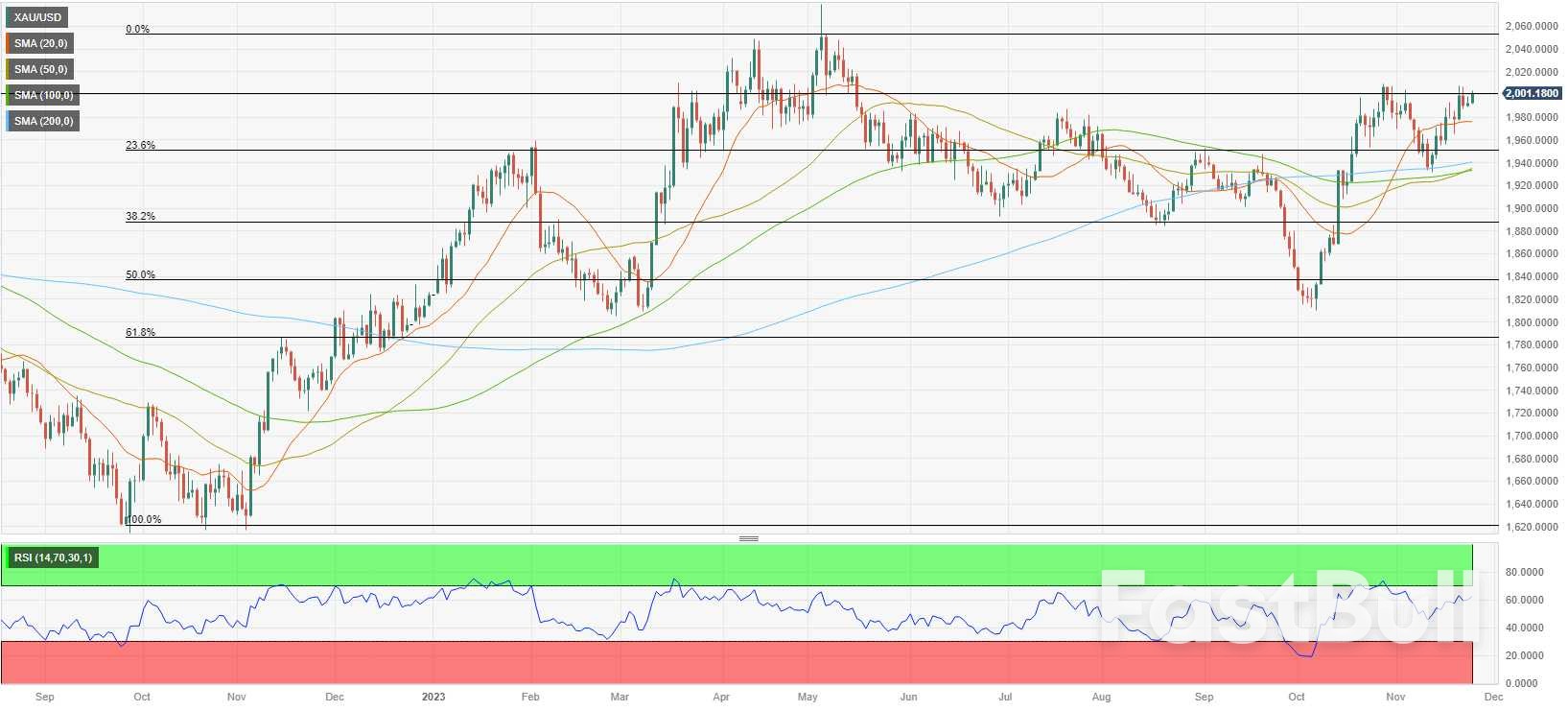
          Gold tested $2,000 for the second time this month but found it difficult to stabilize above this key level due to a lack of fundamental drivers and thin trading volumes in the second half of the week. Although next week’s economic calendar will offer high-tier data releases, XAU/USD’s stabilization above $2,000 could depend on a steady decline in the US Treasury bond yields.

          Gold price lacked direction this week

          Following Monday’s quiet trading, Gold gathered bullish momentum and climbed to its highest level since early November above $2,000 on Tuesday. Although the minutes of the Federal Reserve’s October 31-November 1 policy meeting offered some hawkish remarks, the US Dollar (USD) struggled to find demand as risk flows continued to dominate the financial markets.
          “Participants noted that further tightening of monetary policy would be appropriate if incoming information indicated that progress toward the Committee's inflation objective was insufficient,” the Fed said in its publication. Nevertheless, the market positioning regarding a Fed rate cut as soon as June next year was largely unaffected, considering that the meeting took place before the US Bureau of Labor Statistics reported a noticeable softening in Consumer Price Index (CPI) inflation in October.
          The number of first-time applications for unemployment benefits in the US declined to 209,000 in the week ending November 18 from 233,000 in the previous week, the Department of Labor reported on Wednesday. This reading helped the 10-year US Treasury bond yield stage a rebound and caused XAU/USD to retreat back below $2,000 mid-week.
          As the market action turned subdued amid thin trading conditions on the US Thanksgiving Day holiday on Thursday, Gold went into a consolidation phase and spent the second half of the week fluctuating in a narrow channel above $1,990.

          Gold price could be impacted by US data and Fed commentary next week

          The US Bureau of Economic Analysis will release the second estimate of the annualized third-quarter Gross Domestic Product (GDP) growth on Wednesday. A significant downward revision to the initial estimate of 4.9% could weigh on the USD with the immediate reaction and help XAU/USD edge higher.
          In the early Asian session on Thursday, NBS Manufacturing and Non-Manufacturing PMI from China will be watched closely by market participants. Signs of improvement in the business activity in China, the world’s biggest consumer of Gold, could support XAU/USD. Later in the day, Personal Consumption Expenditures (PCE) Price Index data will be featured in the US economic docket. Unless the monthly Core PCE Price Index rises more than 0.5% in October, the market expectation that the Federal Reserve (Fed) will start reducing the policy rate in the second half of 2024 is unlikely to change.Finally, the ISM Manufacturing PMI for November will be released on Friday. An unexpected rebound to above 50 in the headline print could provide a boost to the USD ahead of the weekend.
          Investors will continue to pay close attention to comments from Fed officials ahead of the blackout period that will start on December 2. Before the Fed’s blackout period, Chairman Jerome Powell will deliver a speech on Friday. The CME Group FedWatch Tool shows that markets are pricing in a 22% chance that the Fed’s policy rate will remain unchanged at 5.25%-5.5% by June next year. In case Fed policymakers push back against the market positioning and try to convince participants that they will not consider rate reductions for a longer period, the USD could find a foothold and make it difficult for XAU/USD to gather bullish momentum.

          Gold technical outlook

          The Relative Strength Index (RSI) indicator on the daily chart turned flat near 60, suggesting that XAU/USD is struggling to gather momentum despite keeping the bullish bias. Key resistance is located at $2,000 (psychological level, static level). Once the pair confirms it as support, technical buyers could take action. In this scenario, $2,010 (static level) and $2,040 (static level) could be set as the next bullish targets.
          On the downside, the 20-day Simple Moving Average (SMA) forms dynamic resistance at around $1,980. A daily close below this level could open the door for an extended slide toward $1,950 (Fibonacci 23.6% retracement of the latest uptrend) and $1,940-$1,935 (200-day SMA, 100-day SMA).
          Gold Price Weekly Forecast: Will XAU/USD Finally Clear $2,000?_1

          Sources: Fxstreet

          Risk Warnings and Disclaimers
          You understand and acknowledge that there is a high degree of risk involved in trading. Following any strategies or investment methods may lead to potential losses. The content on the site is provided by our contributors and analysts for information purposes only. You are solely responsible for determining whether any trading assets, securities, strategy, or any other product is suitable for investing based on your own investment objectives and financial situation.
          Comments
          Add to Favorites
          Share

          Central Banks Remain Alert to Inflation Risks

          Westpac

          Economic

          In Australia, the November RBA meeting minutes presented a detailed account of the Board's deliberations and their assessment of the risks. The Board recognised recent evidence that pointed to lingering resilience in the labour market and domestic demand, alongside the fact that the moderation in underlying inflation is tracking a slower pace than expected. These developments have renewed concerns over inflation expectations, with the Board noting "growing signs of a mindset among businesses that any cost increases could be passed onto consumers", a worrisome development given that only a "modest" increase in inflation expectations would make it "significantly" harder to return inflation to target.
          Such observations were consistent with the Board's eventual decision to raise the cash rate in November. However, they do not convincingly speak to a need to raise interest rates further. To justify another hike, further upside surprises for inflation and demand are necessary. We instead anticipate a deceleration in inflation and the labour market in Q4 and beyond, and so continue to expect the cash rate will remain at its current level until Q3 2024, when we forecast the next rate cutting cycle to begin.
          In addition to inflation and the immediate policy outlook, in her speech this week, RBA Governor Bullock also outlined a number of key developments underway at the RBA to improve the Board's engagement with staff and the RBA's communications. RBA Governor Bullock also appeared on a panel with Productivity Commission Chair Danielle Wood. Productivity was a key theme and is also the topic of Westpac Chief Economist Luci Ellis' weekly essay.
          In the US, the FOMC released the minutes of their October/ November meeting. Members noted a "further softening in labour market conditions" is necessary for the Committee to feel comfortable inflation will return to target. After the meeting, evidence of such a turn was provided by the October employment report, while the subsequent downside surprise on both headline and core inflation are additional steps in the right direction. Looking ahead, liaison reports of businesses finding it more difficult to pass on price increases to consumers point to a further softening in demand and inflation which, in time, should justify our and the market's expectations of around 100bps of US rate cuts through 2024.
          While yet to receive equal treatment, let alone priority, downside risks to activity are clearly on the Committee's radar. The cumulative impact of rate hikes are yet to be felt, and "persistent changes in financial conditions could have implications for the path of monetary policy".
          Across Europe, the UK and Canada, promising data on inflation and weak activity growth has also seen markets recently price in rate cuts from mid-2024, in effect easing financial conditions. Yet to be convinced the danger has passed, central bank authorities were therefore kept busy this week emphasising that rate cuts are currently not on their horizon.
          Of particular note, after Canadian inflation eased to 3.1%yr in October from 3.8%yr in September, Bank of Canada's Governor Macklem noted that the "excess demand in the economy that made it too easy to raise prices is now gone" – a statement that alludes to the removal of upside risks for inflation, but not enough progress to begin considering rate cuts.
          In the UK meanwhile, Bank of England Governor Bailey appeared before a Treasury Committee. Though Bailey indicated that rates were at the top of the "table mountain", the Committee are still wary of upside surprises given services inflation's momentum and strong wage growth. Communication during the session therefore contradicted market pricing at the time for a rate cut in the first half of 2024.
          To stay updated on all economic events of today, please check out our Economic calendar
          Risk Warnings and Disclaimers
          You understand and acknowledge that there is a high degree of risk involved in trading. Following any strategies or investment methods may lead to potential losses. The content on the site is provided by our contributors and analysts for information purposes only. You are solely responsible for determining whether any trading assets, securities, strategy, or any other product is suitable for investing based on your own investment objectives and financial situation.
          Comments
          Add to Favorites
          Share

          Dollar's Weak Streak Continues, Sterling and Antipodean Currencies Shine

          Owen Li

          Stocks

          Forex

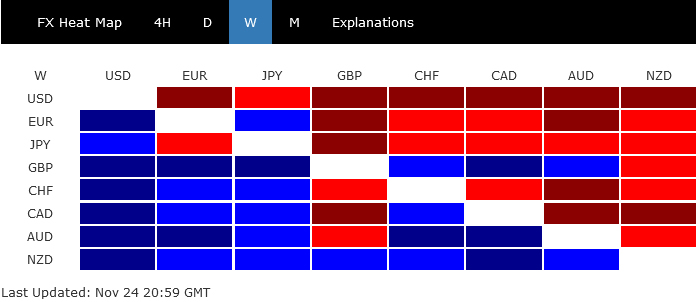
          Dollar ended as the weakest performer last week, with it poor performance aligning with broader rally in both stock and commodity markets, underpinned by growing investor sentiment favoring US economic soft-landing. Furthermore, minutes from FOMC meeting suggested a potential softening of Fed’s hawkish stance. As risk-on sentiment seems poised to continue in the near term, potentially until the next FOMC rate decision, Dollar may continue to face downward pressure.

          Japanese Yen, ranking as the second weakest currency last week, saw a reversal of some of its recent gains. The lack of fresh stimuli in the market meant there wasn’t enough impetus for Yen buyers to drive further appreciation of the currency. Euro ended up as the third weakest, struggling in its crosses despite improvements in economic data.

          Sterling emerged as one of the top performers of the week, ranking third. Its strength was driven by improved economic outlook and comments from officials at BoE. Australian Dollar stood out as the second strongest, supported by hawkish RBA minutes, as well as rallies in key commodities, particularly Iron Ore and Copper. New Zealand Dollar claimed the top spot as the strongest performer. Market participants are now eagerly awaiting RBNZ rate decision, scheduled for the coming Wednesday.
          Dollar's Weak Streak Continues, Sterling and Antipodean Currencies Shine_1

          Dollar decline deepens as DOW notches four-week winning

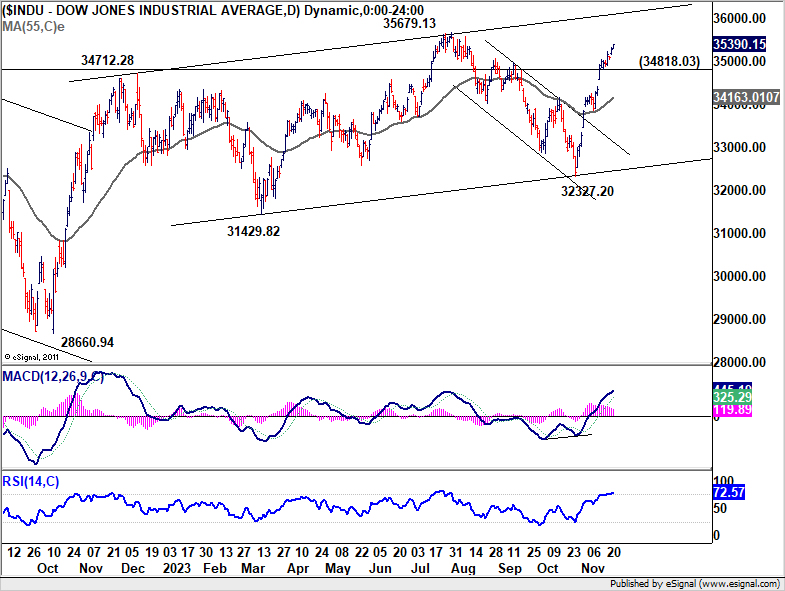
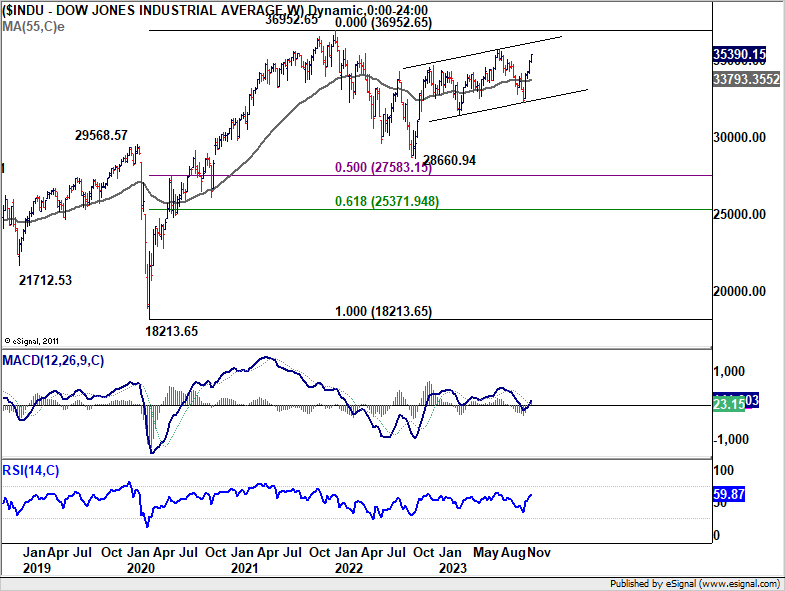
          Dollar notably ended as the weakest performer last week, continuing its near-term selloffs. This decline coincided with an extended rally in risk markets. DOW achieved a four-week winning streak, reflecting growing sentiment among investors betting on soft-landing scenario for the US economy, contrary to earlier fears of harsh economic downturn.

          Meanwhile, minutes of November FOMC meeting was rather balanced, and possibly indicate a softening hawkish stance. A notable change is that the previous stance, which suggested that “one more increase in the target federal funds rate at a future meeting would likely be appropriate,” was conspicuously absent in the latest minutes.

          The current bullish momentum in major stock indexes suggests that this positive trend has the potential to carry forward into early December. While this period features several important economic indicators including PCE inflation data and non-farm payroll figures, they’re not too likely to deter current risk-on sentiment.

          The performance of these indexes through the end of the year, including whether they reach new all-time highs, will likely hinge on the Federal Reserve’s rate decision and new economic projections set for December 13. These announcements are pivotal, as they will provide crucial information about the timing and speed of policy loosening next year.

          Technically, near term outlook in DOW will stay bullish as long as 34818.03 support holds. Current rise should extend through 35679.13 resistance. The real hurdle lies in resistance zone between top channel line (now at around 36077), and 36952.65 (2021 high).

          Rejection by 36952.65 would suggest that the long term consolidation pattern from there is still in progress, and would extend with another medium term falling leg. However, sustained break of 36952.65 will confirm up trend resumption.
          Dollar's Weak Streak Continues, Sterling and Antipodean Currencies Shine_2 Dollar's Weak Streak Continues, Sterling and Antipodean Currencies Shine_3

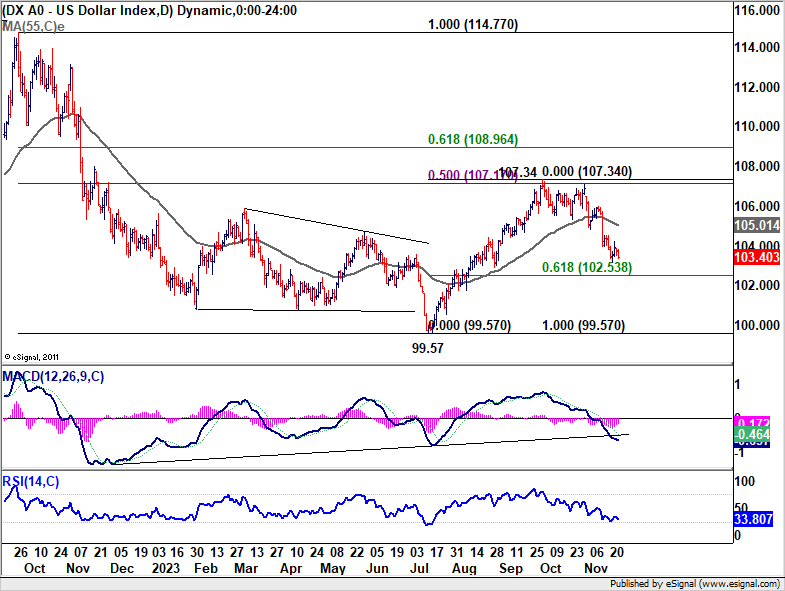
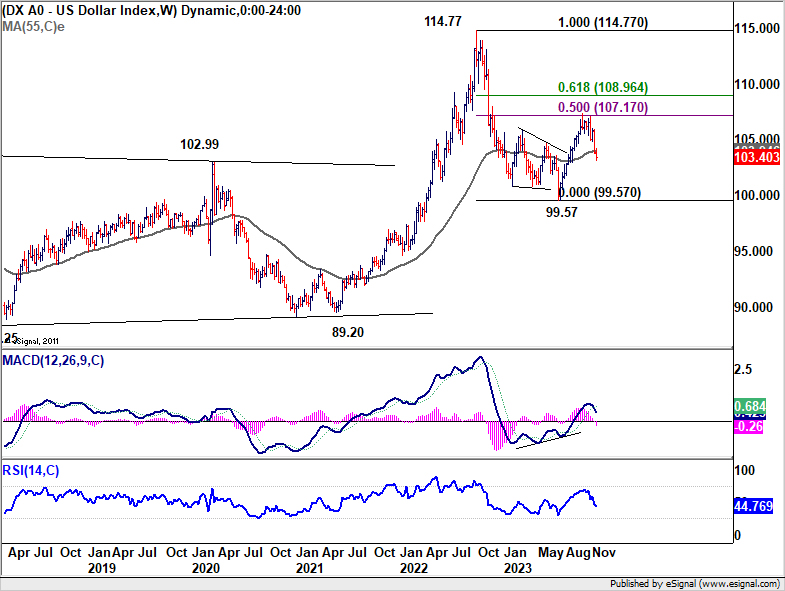
          Dollar Index’s fall from 107.34 continued last but recovered after hitting 103.17. Further decline is expected as long as 104.55 resistance holds. Next target is 61.8% retracement of 99.57 to 107.34 at 102.53.

          As noted before, it’s uncertain for now whether fall from 107.34 is a correction to rise from 99.57, the second leg of a range pattern above 99.57, or resuming the whole down trend from 114.77 (2022 high). Firm break of above mentioned 102.53 fibonacci level could tile the favor to the latter two bearish scenarios. On the other hand, strong bounce from 102.53 will favor the former case, which is still medium term bullish.
          Dollar's Weak Streak Continues, Sterling and Antipodean Currencies Shine_4

          Dollar's Weak Streak Continues, Sterling and Antipodean Currencies Shine_5

          Sterling’s robust performance driven by economic optimism

          Sterling stood out as one of the top performers, driven by improved economic outlook and significant comments from top officials at BoE. Sterling’s performance was particularly noteworthy against Dollar, where it reached a two-month high, and against Japanese Yen, where it resumed its long-term uptrend.

          The release of the UK’s preliminary PMI figures for November played a significant role in bolstering Sterling. The data revealed an unexpected expansion in the vital services sector, a key driver of the UK economy. Although the manufacturing sector’s PMI remained below the 50 threshold, signaling contraction, the extent of contraction was smaller than expected, lending further support to the Pound.

          The set of PMI data suggests that the overall pace of UK’s economic slowdown might be more moderate than initially feared. S&P Global emphasized this positive development, stating, “The UK economy found its feet again.” Nonetheless, the PMI data also pointed to resurgence in input cost pressures, which could signal ongoing inflation challenges.

          BoE Governor Andrew Bailey, speaking at a Treasury Committee hearing, warned cautioned that the markets might be “underestimating” the persistent nature of inflation and stressed that it was “far too early to be thinking about rate cuts.” This perspective indicates a continued commitment to a tighter monetary policy.

          Bailey’s sentiment was echoed by some economists, with Citigroup revising its expectations for the BoE’s first rate cut to August next year, later than its earlier prediction of May. This delay in anticipated rate cuts reflects an expectation of prolonged inflationary pressures and a sustained tight monetary policy in the UK.

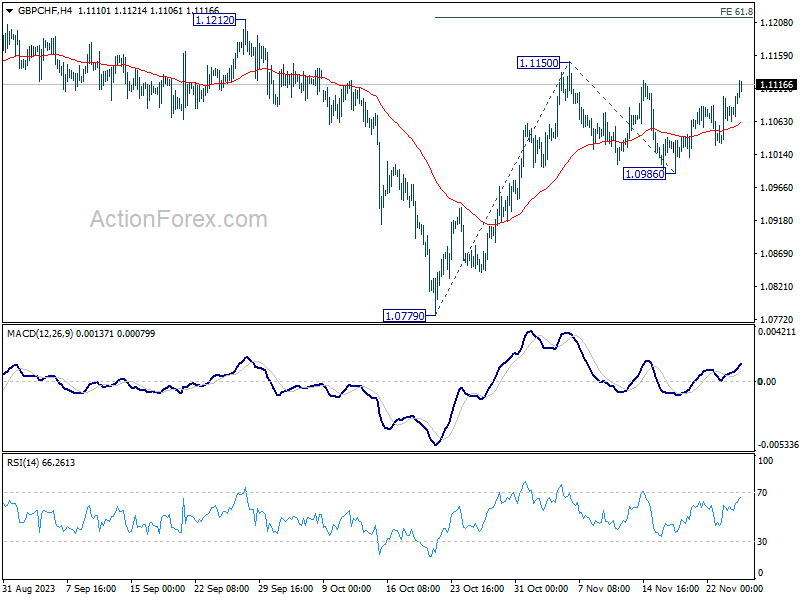
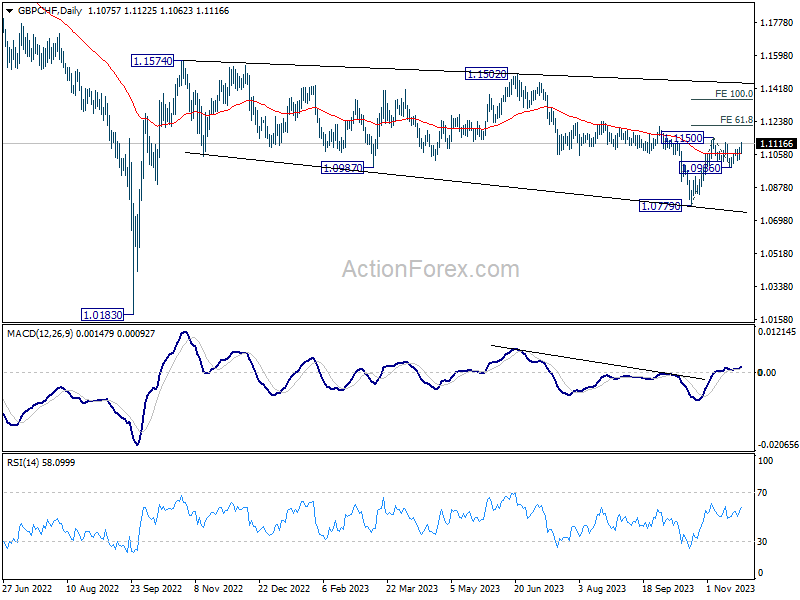
          GBP/CHF is a pair to watch in the coming days to verify underlying momentum of the Pound. Near term pullback from 1.1150 is possibly completed at 1.0986 already. Break of 1.1150 will resume the rise from 1.0779 to 61.8% projection of 1.0779 to 1.1150 from 1.0986 at 1.1215.

          Decisive break of 1.1215 will also bolster the case that whole medium term consolidation from 1.1574 (2022 high) has completed with three waves down to 1.0779. Next near term target will be 100% projection at 1.1357.
          Dollar's Weak Streak Continues, Sterling and Antipodean Currencies Shine_6 Dollar's Weak Streak Continues, Sterling and Antipodean Currencies Shine_7

          Australian Dollar’s surge fueled by hawkish RBA and rising commodity prices

          Australian Dollar was also among the top performers of the week, buoyed by a combination of hawkish monetary policy signals from RBA and the surge in commodity prices, particularly in base metals.

          RBA’s November 7 meeting minutes revealed a clear commitment to tackling inflation, reiterating the low tolerance for unexpected inflationary pressures. This firm stance was further emphasized by RBA Governor Michele Bullock, who indicated in a separate speech that the nature of inflation in Australia is increasingly becoming “homegrown and demand driven”, necessitating a stronger policy response.

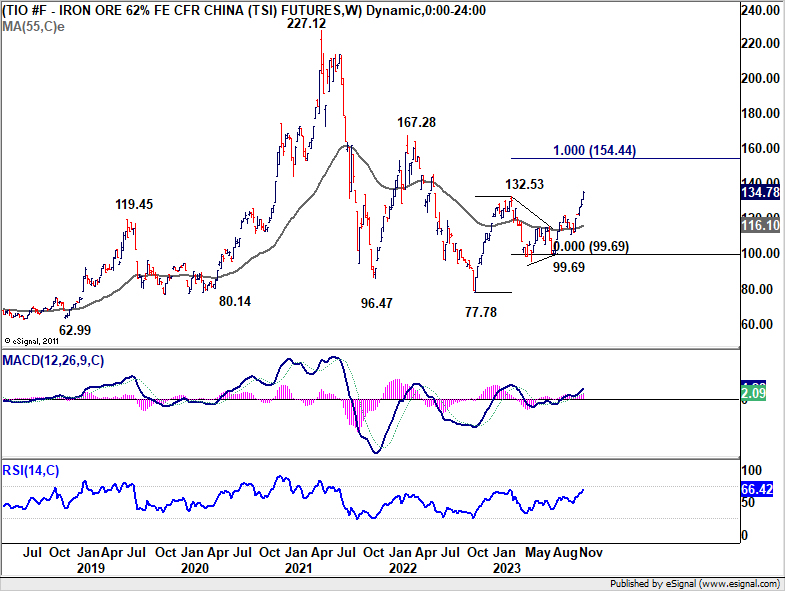
          Additionally, Aussie found support from the rally in base metal prices. Notably, the benchmark Iron Ore price on Singapore Exchange recorded its fifth consecutive week of gains. This rally was primarily driven by China’s recent measures to revitalize its debt-ridden property sector, a significant consumer of steel. There are reports that China may allow banks to offer unsecured short-term loans to qualified property developers for the first time, signaling a potential shift in policy to support the ailing sector.

          Speculation surrounding Chinese government’s plans to stimulate economic growth and bolster the property market suggests a larger and more immediate intervention than previously expected. Such measures are likely to increase demand for Australian exports, particularly metals and minerals like iron ore and copper. This expected rise in demand typically leads to higher commodity prices, which in turn supports Australian Dollar, given the country’s status as a major commodity exporter.

          As with Iron Ore, the strong break of 132.53 resistance should confirm resumption of whole up trend from 77.78 (2022 low). Next medium term target is 100% projection of 77.78 to 132.53 from 99.69 at 154.44.
          Dollar's Weak Streak Continues, Sterling and Antipodean Currencies Shine_8

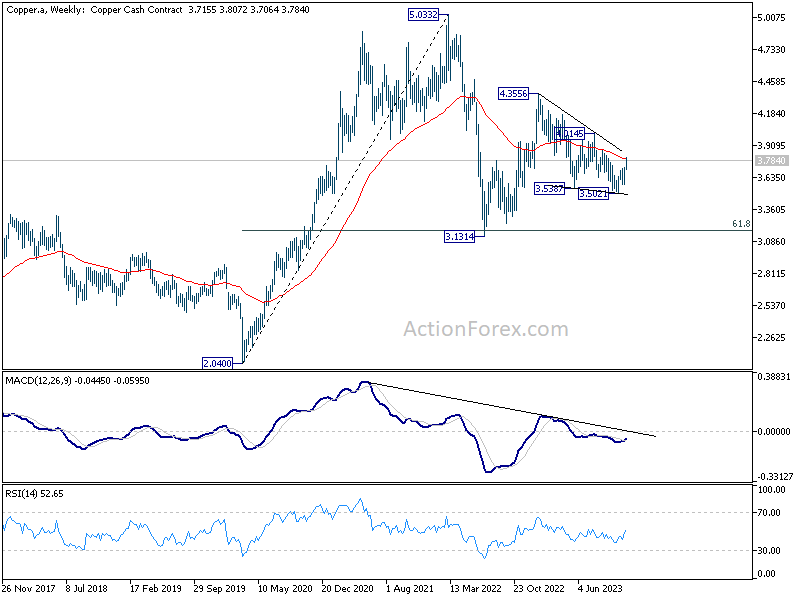
          Copper is now pressing 55 W EMA (now at 3.7966) after last week’s rise. Sustained break there will strengthen the case that correction from 4.3556 has completed at 3.5021. Further rally would then be seen to 4.0145 resistance first. Firm break there will argue that whole rise from 3.1314 (2022 low), is ready to resume through 4.3556 in the medium term.
          Dollar's Weak Streak Continues, Sterling and Antipodean Currencies Shine_9

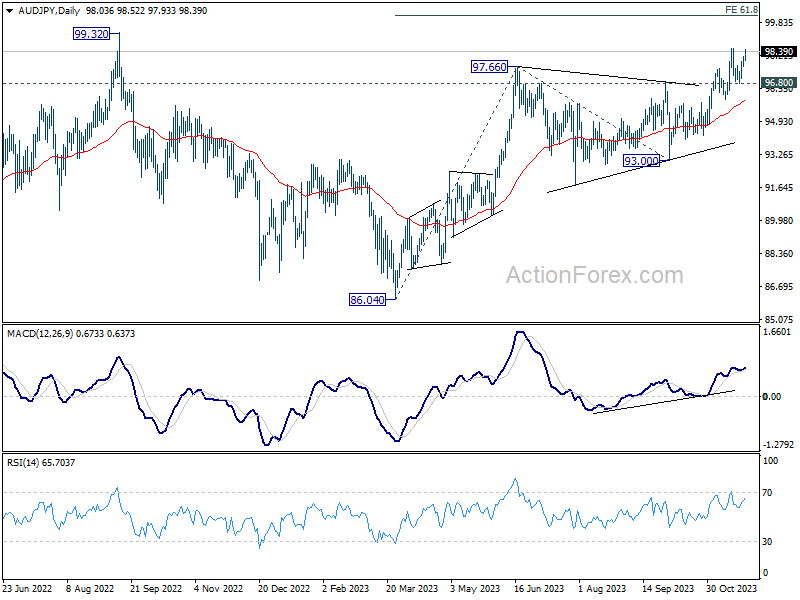
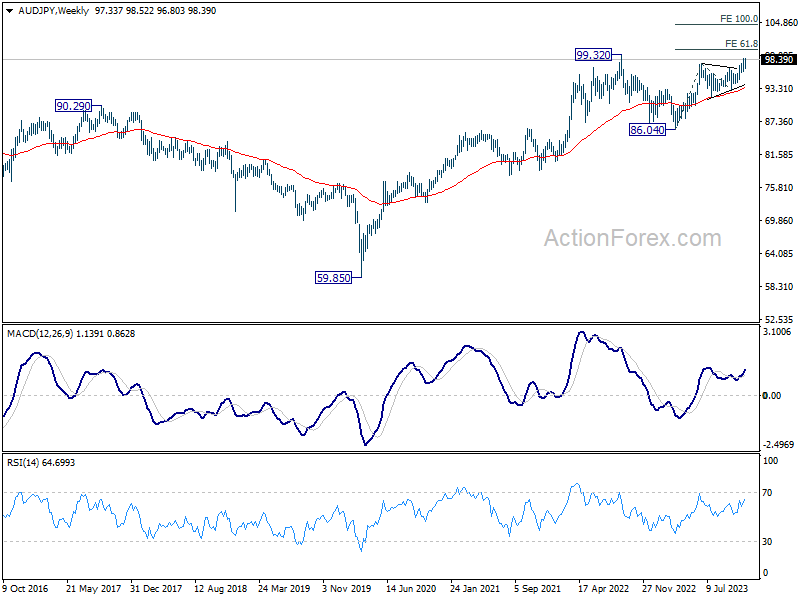
          Late rally in AUD/JPY suggests that rise from 86.04 is ready to resume and extend. Near term outlook will now stay bullish as long as 96.80 support holds. Next target is 61.8% projection of 86.04 to 97.66 from 93.00 at 100.18. If realized, that would also have 99.32 resistance taken out too, indicating resumption of whole up trend from 59.85 (2020 low).
          Dollar's Weak Streak Continues, Sterling and Antipodean Currencies Shine_10 Dollar's Weak Streak Continues, Sterling and Antipodean Currencies Shine_11

          GBP/USD Weekly Outlook

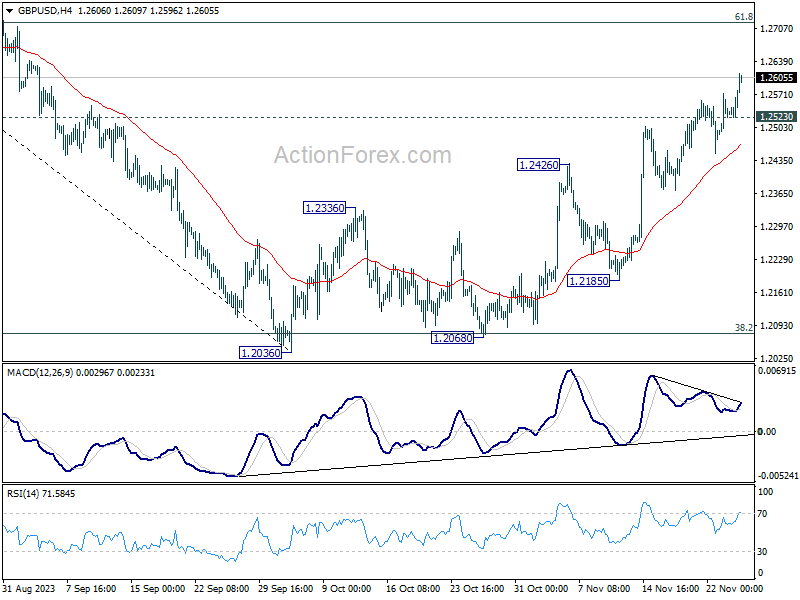
          GBP/USD’s rise from 1.2036 continued last week and hit as high as 1.2613. Initial bias stays on the upside this week for 61.8% retracement of 1.3141 to 1.2036 at 1.2716 next. On the downside, below 1.2523 minor support will turn intraday bias neutral and bring consolidations first, before staging another rally.
          Dollar's Weak Streak Continues, Sterling and Antipodean Currencies Shine_12

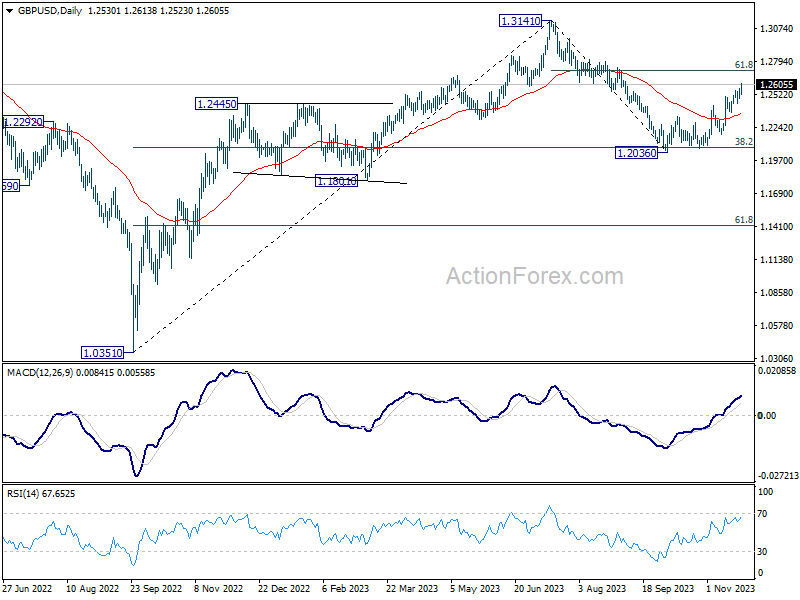
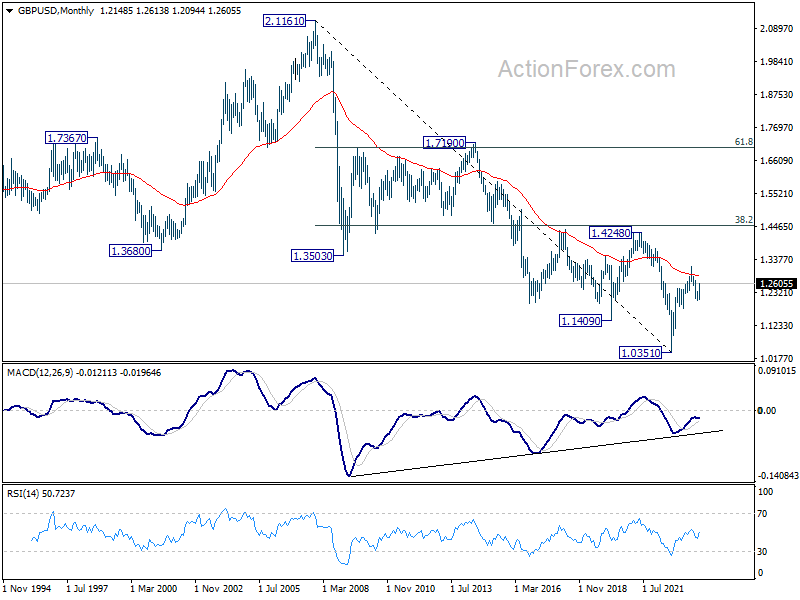
          In the bigger picture, price actions from 1.3141 are seen as a corrective pattern to rise from 1.0351 (2022 low). Strong rebound from 38.2% retracement of 1.0351 (2022 low) to 1.3141 at 1.2075 suggests that current rise from 1.2036 is already the second leg. However, while further rally could be seen, upside should be limited by 1.3141 to bring the third leg of the pattern.
          Dollar's Weak Streak Continues, Sterling and Antipodean Currencies Shine_13

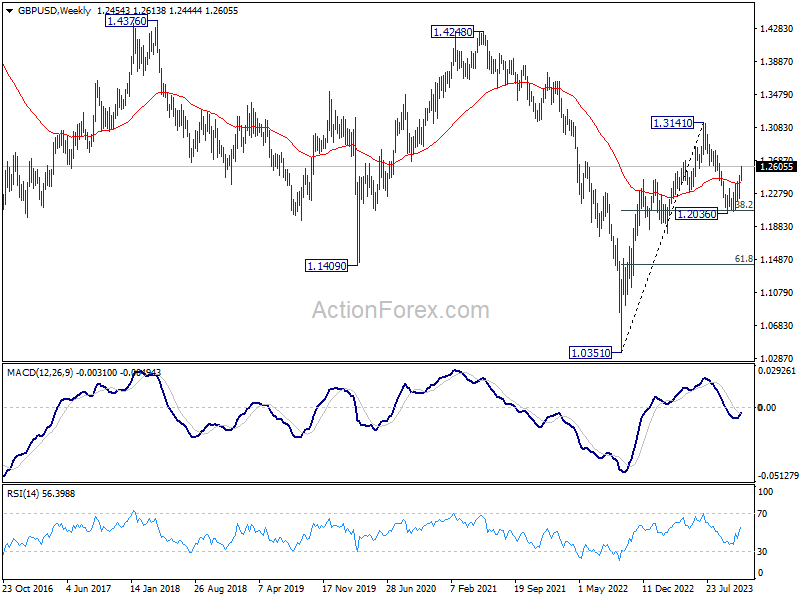
          In the long term picture, a long term bottom should be in place at 1.0351 on bullish convergence condition in M MACD. But momentum of the rebound from 1.3051 argues GBP/USD is merely in consolidation, rather than trend reversal. Range trading is likely between 1.0351/4248 for some more time.
          Dollar's Weak Streak Continues, Sterling and Antipodean Currencies Shine_14

          Dollar's Weak Streak Continues, Sterling and Antipodean Currencies Shine_15

          Article Source: ACTIONFOREX

          Risk Warnings and Disclaimers
          You understand and acknowledge that there is a high degree of risk involved in trading. Following any strategies or investment methods may lead to potential losses. The content on the site is provided by our contributors and analysts for information purposes only. You are solely responsible for determining whether any trading assets, securities, strategy, or any other product is suitable for investing based on your own investment objectives and financial situation.
          Comments
          Add to Favorites
          Share

          Forex and Cryptocurrencies Forecast

          Devin

          Cryptocurrency

          Forex

          EUR/USD: Day of Thanksgiving and Week of Contradictions

          Reminder that the American currency came under significant pressure on November 14 following the release of the Consumer Price Index (CPI) report in the USA. In October, the Consumer Price Index (CPI) decreased from 0.4% to 0% (m/m), and on an annual basis, it dropped from 3.7% to 3.2%. The Core CPI for the same period decreased from 4.1% to 4.0%: reaching the lowest level since September 2021. These figures caused a tumble in the Dollar Index (DXY) from 105.75 to 103.84. According to Bank of America, this marked the most significant dollar sell-off since the beginning of the year. Naturally, this had an impact on the dynamics of the EUR/USD pair, which marked this day with an impressive bullish candle of almost 200 pips, reaching resistance in the 1.0900 zone.

          DXY continued to consolidate near 103.80 last week, maintaining positions at the lows from the end of August to the beginning of September. Meanwhile, the EUR/USD pair, transforming 1.0900 from resistance to a pivot point, continued its movement along this line.

          Market reassurance, besides Thanksgiving Day, was also influenced by the uncertainty regarding what to expect from the Federal Reserve (FRS) and the European Central Bank (ECB). Following the release of the inflation report, the majority of investors believed in the imminent conclusion of the hawkish monetary policy of the American central bank. Expectations that the regulator would raise interest rates at its meeting on December 14 plummeted to zero. Moreover, among market participants, the opinion circulated that the FRS might shift towards easing its monetary policy not in mid-summer but already in the spring of the following year.

          However, the minutes of the latest Federal Open Market Committee (FOMC) meeting were published on November 21, and their content contradicted market expectations. The minutes indicated that the leadership of the regulator considered the possibility of additional tightening of monetary policy in case of inflation growth. Furthermore, FRS members concluded that it would be prudent to keep the rate high until inflation reaches the target.

          The content of the minutes slightly supported the American currency: EUR/USD crossed the 1.0900 horizon from top to bottom, dropping from 1.0964 to 1.0852. However, overall, the market reaction was restrained since the formulations mentioned above were quite vague and lacked specificity regarding the future monetary policy of the United States.

          If in the United States, market expectations clashed with the FRS protocols, in Europe, the ECB protocols contradicted the subsequent rhetoric of individual leaders of this regulator. In its latest protocol, the Governing Council of the European Central Bank left the door open for the resumption of the monetary restriction cycle and urged policymakers to avoid unwarranted easing of financial conditions. A similar sentiment was expressed by the ECB President, Christine Lagarde, in her speech on Friday, November 24, stating that the fight against inflation is not yet over. However, a little earlier, the head of the Bank of France, Francois Villeroy de Galhau, stated that interest rates would not be raised anymore.

          So, the question of what the future monetary policy of the ECB will be remains open. In favour of hawks, it is noted that wage growth in the Eurozone accelerated in Q3 from 4.4% to 4.7%, and purchasing managers highlighted an increase in inflationary pressure. On the other hand, the Eurozone’s economy continues to experience stagflation. Business activity (PMI) has been below the critical 50-point mark for the sixth consecutive month, indicating technical recession.

          A glimmer of light in the darkness came from macro statistics from Germany, some indicators of which gradually improved. PMI dropped to a minimum of 38.8 points in July and then began to grow slowly. Preliminary data published on Thursday, November 23rd, showed that this index rose to 47.1 (though still below 50.0). The economic sentiment index from the ZEW Institute returned to the positive territory for the first time in half a year, sharply rising from -1.1 to 9.8. According to some economists, this growth is likely linked to a noticeable decrease in inflation (CPI) in Germany over the last two months: from 6.1% to 3.8%.

          However, only desperate optimists can claim that the country’s economy has rebounded and transitioned to recovery. Germany’s recession is far from over. For the fourth consecutive quarter, GDP is not growing; worse yet, it is contracting: GDP for Q3 2023 decreased by 0.1% and compared to the same quarter of the previous year, it declined by 0.4%. According to Bloomberg, the budget crisis in Germany could lead to many infrastructure and environmental projects not receiving funding. As a result, economic growth may slow down by 0.5% next year.

          In general, the prospects for both currencies, the dollar and the euro, are shrouded in the fog of uncertainty. As economists from the Japanese MUFG Bank note, “the window for the dollar to reach the highs set in October and/or beyond may already be closed. However, the growth prospects in the Eurozone also do not indicate significant opportunities for EUR/USD.”

          For the second consecutive week, EUR/USD concluded near the 1.0900 level, specifically at 1.0938. Currently, expert opinions regarding its near future are divided as follows: 40% voted for the strengthening of the dollar, 40% sided with the euro, and 20% remained neutral. In terms of technical analysis, all trend indicators and oscillators on the D1 timeframe are in green, but one-third of the latter are in overbought territory. The nearest support for the pair is located around 1.0900, followed by 1.0830-1.0840, 1.0740, 1.0620-1.0640, 1.0480-1.0520, 1.0450, 1.0375, 1.0200-1.0255, 1.0130, and 1.0000. Bulls will encounter resistance around 1.0965-1.0985, 1.1070-1.1090, 1.1150, 1.1260-1.1275, and 1.1475.

          In the upcoming week, preliminary inflation (CPI) data for Germany and the GDP for the United States for Q3 will be released on Wednesday, November 29. The following day will reveal the CPI and retail sales volumes for the Eurozone as a whole, along with the Personal Consumption Expenditures (PCE) Index and the number of initial jobless claims in the United States. The workweek will conclude on Friday, December 1st, with the publication of the Purchasing Managers’ Index (PMI) for the manufacturing sector in the United States and a speech by the Federal Reserve Chair, Jerome Powell.

          GBP/USD: First Came the Word. But Will There Be Deeds?

          Recent macroeconomic data indicates that the UK’s economy is on the mend, contributing to the strengthening of the British pound. Business activity in the country is rebounding, with the Services PMI and Composite PMI indices showing growth, although they remain in contraction territory after three months of decline. The Manufacturing PMI is also below the threshold value of 50.0, indicating contraction/growth, but it rose from 44.8 to 46.7, surpassing forecasts of 45.0. The growth in business activity is supported by a decrease in core inflation. According to the latest CPI data, it decreased from 6.7% to 4.6%, and despite this, the economy managed to avoid a recession, with GDP remaining at 0%.

          Against this backdrop, according to several analysts, unlike the Federal Reserve (FRS) and the European Central Bank (ECB), there is a significant likelihood of another interest rate hike by the Bank of England (BoE). This conviction has been fuelled by recent hawkish comments from the regulator’s head, Andrew Bailey, who emphasized that rates should be raised for a longer period, even if it may have a negative impact on the economy.

          The Chief Economist of the BoE, Hugh Pill, also stated in an interview with the Financial Times on Friday, November 24, that the Central Bank would continue to combat inflation, and it cannot afford to weaken its tight monetary policy. According to Pill, key indicators, namely inflation in service prices and wage growth, remained persistently high throughout the summer. Therefore, even though “both of these measures have shown a slight – but welcome – sign of coming down, they remain at very high levels.”

          Such hawkish statements from Bank of England leaders contribute to bullish sentiments for the pound. However, according to economists at Commerzbank, despite Andrew Bailey’s efforts to convey a hawkish stance with his comments, it is not necessarily guaranteed that real actions, such as an interest rate hike, will follow. “Even in the case of positive surprises from the real sector of the UK economy, the market always keeps in mind the rather indecisive approach of the Bank of England. In this case, the potential for sterling to rise in the near future will be limited,” warns Commerzbank.

          Despite Thanksgiving Day in the United States, some preliminary data on the state of the American economy was still released on Friday, November 24. The S&P Global PMI for the services sector increased from 50.6 to 50.8. The composite PMI remained unchanged in November at the previous level of 50.7. However, the manufacturing sector’s PMI in the country showed a significant decline – despite the previous value of 50.0 and expectations of 49.8, the actual figure dropped to 49.4, reflecting a slowdown in growth. Against this backdrop, taking advantage of the low-liquidity market, pound bulls pushed the pair higher to a height of 1.2615.

          As for technical analysis, over the past week, GBP/USD has surpassed both the 100-day and 200-day moving averages (DMA) and even breached the resistance at 1.2589 (50% correction level from the July-October decline), marking the highest level since early September. The week concluded with the pair reaching 1.2604.

          Economists at Scotiabank believe that “in the short term, the pound will find support on minor dips (to the 1.2500 area) and looks technically poised for further gains.” Regarding the median forecast of analysts in the near future, only 20% supported Scotiabank’s projection for pound growth. The majority (60%) took the opposite position, while the remaining analysts maintained a neutral stance. All trend indicators and oscillators on the D1 timeframe point north, with 15% of the latter signalling overbought conditions. In the event of a southward movement, the pair will encounter support levels and zones at 1.2570, followed by 1.2500-1.2520, 1.2450, 1.2370, 1.2330, 1.2210, and 1.2040-1.2085. In the case of an upward movement, resistance awaits at levels such as 1.2615-1.2635, 1.2690-1.2710, 1.2785-1.2820, 1.2940, and 1.3140.

          One notable event in the upcoming week’s calendar is the scheduled speech by the Bank of England Governor Andrew Bailey on Wednesday, November 29. As of now, there are no other significant events related to the United Kingdom’s economy expected in the coming days.

          USD/JPY: The Near Future of the Yen Lies in the Hands of the Fed

          The momentum gained by USD/JPY after the release of the U.S. inflation report on November 14th proved to be so strong that it continued into the past week. On Tuesday, November 21, the pair found a local bottom at the level of 147.14. Once again, news from the other side of the Pacific, specifically the release of the Federal Reserve’s minutes, served as a signal for a northward reversal.

          As the primary catalyst for the yen revolves around speculations about changes in the Bank of Japan’s (BoJ) policy, markets awaited the release of national inflation data on Friday, November 24th. It was anticipated that the core CPI would increase by 3.0% (year-on-year) compared to the previous value of 2.8%. However, it grew less than expected, reaching 2.9%. The rise in the overall national CPI was 3.3% (year-on-year), exceeding the previous figure of 3.0% but falling short of forecasts at 3.4%. As a result, this had little to no impact on the Japanese yen’s exchange rate.

          According to economists at Commerzbank, the inflation indicators suggest that the Bank of Japan is unlikely to aim for an exit from its ultra-easy monetary policy in the foreseeable future. The dynamics of USD/JPY in the coming weeks will likely depend almost entirely on the movement of the dollar.

          This stance is probably acceptable to the Japanese central bank, reflecting the market’s low expectations regarding a tightening of its passive and dovish policy. This sentiment was reaffirmed by Japan’s Prime Minister Fumio Kishida, who addressed Parliament on Wednesday, November 22nd. Kishida stated that the BoJ’s monetary policy is not aimed at directing currency rates in a particular direction. From this, it can be inferred that the country’s leadership has entrusted the Federal Reserve of the United States with this function.

          The closing note of the week for USD/JPY settled at the level of 149.43, maintaining its position above the critical 100- and 200-day SMAs. This suggests that the broader trend still leans towards bullish sentiments, despite recent local victories for bears. Regarding the immediate prospects of the pair, only 20% of experts anticipate further strengthening of the dollar, another 20% side with the yen, while the majority (60%) refrain from making any forecasts. As for the technical analysis on the daily chart (D1), the forecast remains uncertain. Among trend indicators, the ratio is evenly split between red and green (50% each). Among oscillators, 60% favour red, 20% favour green, and 20% are neutral-grey. The nearest support level is located in the zone of 149.20, followed by 148.90, 148.10-148.40, 146.85-147.15, 145.90-146.10, 145.30, 144.45, 143.75-144.05, and 142.20. The nearest resistance is at 149.75, followed by 150.00-150.15, 151.70-151.90, then 152.80-153.15 and 156.25.

          There is no planned release of any significant statistics regarding the state of the Japanese economy next week.
          CRYPTOCURRENCIES: “Modest” Fine of $7,000,000,000

          Forex and Cryptocurrencies Forecast_1

          From the events of the past week, one stands out. It has been reported that the largest crypto exchange, Binance, reached a global settlement with the US Department of Justice, the Commodity Futures Trading Commission, the Office of Foreign Assets Control, and the Financial Crimes Enforcement Network, related to their investigations into registration issues, compliance, and violations of anti-Russian sanctions.

          As part of the agreement, on November 21, 2023, CZ (Changpeng Zhao) stepped down as the CEO of the exchange. Additionally, under the agreement, Binance will pay regulators and law enforcement substantial amounts (around $7 billion) in the form of fines and compensations to settle charges and claims against them. In addition to the financial settlement, Binance has agreed to completely withdraw from the US markets and will “comply with a set of stringent sanction requirements.” Furthermore, the exchange will be under a five-year observation by the US Treasury with open access to its accounting books, records, and systems.

          The $7 billion payouts are a substantial amount that will significantly impact the company. Can it survive this? After news of these fines, a wave of panic sentiments swept through the market. According to DeFiLlama data, Binance’s reserves decreased by $1.5 billion in two days, with an outflow of $710 million during the same period. These are substantial losses. However, looking at history, such withdrawal rates are not extraordinary. In June, after the SEC filed a lawsuit, the outflow exceeded $1 billion in a day, and in January, amid the BUSD stablecoin scandal, the outflow reached a record $4.3 billion for 2023. So, there is likely no catastrophe, and the exchange will face local difficulties.

          Representatives of Binance stated that they firmly believe in the crypto industry and the bright future of their company. Many experts view the exchange’s agreement with US authorities as a positive event, considering Binance’s leading role in the crypto industry. Confirmation of this was the bitcoin dynamics: in the first hours, BTC/USD dropped by 6%, but then rebounded: on Friday, November 24, it even broke through resistance in the $38,000 zone, reaching a high of $38,395.

          According to several experts, the fundamental indicators of the leading cryptocurrency have never looked better. For example, 70% of the existing BTC supply has not moved from one wallet to another during this year. “This is a record level in bitcoin’s history: such withdrawal rates are extraordinary for a financial asset,” summarizes a group of analysts led by Gautam Chhugani.

          Glassnode, an analytical company, also notes a consistent outflow of BTC coins from exchanges. The total supply of the leading cryptocurrency is becoming increasingly scarce, and the circulating supply is currently at an all-time low.

          In a recent Glassnode report, it is stated that 83.6% of all circulating bitcoins were acquired by current owners at a lower cost than the current value. If this figure surpasses the 90% mark, it could indicate the beginning of the euphoria stage, where almost all market participants have unrealized profits.

          According to analysts, statistical data can help determine the current market stage. For instance, when less than 58% of all BTC coins are profitable, the market is in the bottoming formation stage. Once the indicator surpasses the 58% mark, the market transitions into the recovery stage, and above 90%, it enters the euphoria stage.

          Glassnode believes that over the last ten months, the market has been in the second of these three stages, recovering from a series of negative events in 2022, such as the collapse of the Luna project and the bankruptcy of the crypto exchange FTX.

          So, the chances of entering the New Year 2024 on an upward trajectory are increasing. Positive expectations are reinforced by the upcoming halving in April. It may reduce the monthly selling pressure from miners from $1 billion to $500 million (at the current BTC rate). Additionally, the potential approval of bitcoin exchange-traded funds (ETFs) in the U.S. is a positive catalyst, easing access to cryptocurrency for major investors. According to experts at Bernstein, against this backdrop, by the beginning of 2025, the price of the first cryptocurrency could rise to $150,000.

          Can one expect a significant downward correction from bitcoin in the near future? The crypto market is known for its unpredictability and volatility. However, according to renowned analyst Willy Woo, this is unlikely. He examined blockchain data reflecting the average purchase price of BTC by investors, concluding that the primary cryptocurrency is unlikely to drop below $30,000 again.

          Woo shared a chart with readers, showing a dense grey band representing the price around which a significant portion of bitcoin’s supply fluctuated. According to the expert, this reflects “strong consensus price.” Woo claims that since the inception of bitcoin, this band has acted as a reliable price support. The chart demonstrates that such bands formed eight times throughout bitcoin’s existence, always supporting its price.

          However, it’s important to acknowledge that not everyone trusts Woo’s calculations. An analyst using the pseudonym TXMC reminded that Woo made a similar forecast in 2021, stating that bitcoin would never drop below $40,000. Yet, the next year saw exactly that happen: on November 20, 2022, BTC/USD reached a minimum in the $15,480 range.

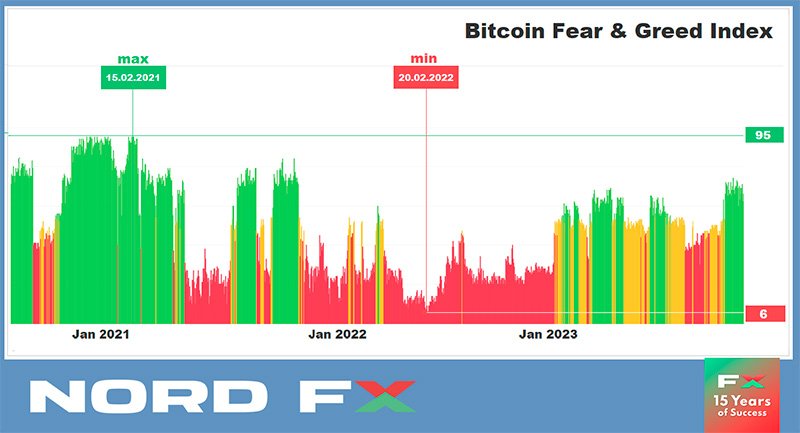
          Since that tragic date, bitcoin has appreciated by more than 2.4 times. As of the evening of Friday, November 24, BTC/USD is trading around $37,820. The total market capitalization of the crypto market is $1.44 trillion (compared to $1.38 trillion a week ago). The Crypto Fear and Greed Index has risen from 63 to 66 points and continues to be in the Greed zone.

          As for the U.S. Securities and Exchange Commission (SEC), it remains proactive. Following the resolution with Binance, it has now filed charges against the cryptocurrency trading platform Kraken. According to the SEC, the platform operated as an unregistered exchange for securities, broker, dealer, and clearing agency. The SEC lawsuit alleges that since September 2018, Kraken has earned hundreds of millions of dollars by unlawfully facilitating the buying and selling of securities in crypto assets. It remains to be seen how much it will cost Kraken to settle its issues with U.S. authorities.


          Article Source: ACTIONFOREX

          Risk Warnings and Disclaimers
          You understand and acknowledge that there is a high degree of risk involved in trading. Following any strategies or investment methods may lead to potential losses. The content on the site is provided by our contributors and analysts for information purposes only. You are solely responsible for determining whether any trading assets, securities, strategy, or any other product is suitable for investing based on your own investment objectives and financial situation.
          Comments
          Add to Favorites
          Share

          The Myanmar Military Is Losing Control

          Thomas

          Political

          2023 may be recorded as the worst year experienced by the Myanmar army since the 1960s. The army's long history of counterinsurgency suffered a blow when several ethnic armed organisations and their allies in northern Shan state launched the "Operation 1027" offensive on Oct 27.
          This operation has changed the civil war landscape and narrative in Myanmar. Within days, the ethnic armed organisations claimed control of two key trade routes to China and as many as 147 outposts. The Myanmar army's losses were reportedly massive: Hundreds of troops including a senior commanding officer were killed, while many surrendered, and weapons and ammunition were seized from each army base's fall.
          Operation 1027's lightning speed and progress, despite the involvement of many players giving rise to coordination challenges, has raised questions about the Myanmar army's ability and leadership. Since the coup, the army has had to contend with a spiralling civil war across Myanmar, the breakdown of former ceasefire arrangements with several ethnic armed organisations, low troop morale, and even less public support.
          The widespread resistance to the coup was more the catalyst than the cause of this dysfunction, however. One contributing factor is years of policy error or neglect by Myanmar's Ministry of Defence, related to declining competency requirements for career advancement and the lack of investment in equipment and skills for infantrymen.
          Ceasefire Arrangements Since 1989
          The Myanmar army, with its high (arguably inflated) historical benchmarks for troop strength, boosted its role over decades by leveraging on counterinsurgency campaigns. However, the State Law and Order Restoration Council/State Peace and Development Council military regime that seized power in the 1988 coup embarked on a series of bilateral ceasefire arrangements with various ethnic armed organisations.
          Reasons for this included the experience of the Myanmar army in defending Myanmar's then capital Rangoon in the 1950s, which was threatened by several insurgencies, and heavy fighting with various ethnic armed organisations after the 1988 coup.
          In 1989, the State Law and Order Restoration Council forged ceasefire deals with powerful and formerly communist guerrillas such as the Kokang, Wa, and Mongla on the Myanmar-China border and with the Kachin Independence Organisation and the New Mon State Party between 1994 and 1995. These deals freed up the Myanmar army to focus on fighting two major rebel groups in Kayin and Shan states (along the Myanmar-Thai border).
          The surrender of druglord Khun Sa's Mong Tai Army in the mid-1990s and negotiations with the Karen National Union in the early 2000s added to the illusion of these ceasefires' "peacetime" impact.
          This is despite the fact that ceasefire deals were broken with the Kokang (2009) and the Kachin Independence Organisation (2011), especially after the State Peace and Development Council regime's proposal that the ceasefire groups transform into Border Guard Forces under Myanmar military control, which they roundly rejected.
          A former military officer from the 20th intake (graduating in 1978) of Myanmar's elite Defence Service Academy has commented that until 1989, "the army had continuously engaged in conventional warfare with the CPB (Communist Party of Burma) and army ability was the strongest in Asia after Vietnam". He stated that "Nowadays, the commanders don't have long experience in conventional warfare".
          Soldiers With Bamboo Baskets as Backpacks
          Such observations stem from the shift in the army's requirements for career advancement. The Myanmar military gradually prioritised the civilian side of the profession after the ceasefires in the 1990s, as many officers sought administrative rather than combat experience when seeking promotions.
          Though field experience is still necessary to advance to the position of division commander, moving up the rungs now requires a graduate degree from the National Defence College and staff officer experience at the Ministry of Defence. For higher positions (such as major-general and above), added criteria even included the officer's spouse's educational status.
          Even past battlefield experience is an outdated criterion. For example, State Administration Council (SAC) chief Senior General Min Aung Hlaing's biggest and only battle success was a 2009 snap offensive overrunning the Myanmar National Democratic Alliance Army (MNDAA, now of Operation 1027 fame) against former Kokang warlord and communist leader Peng Jiasheng. Other than that, Min Aung Hlaing mostly held operational command duties, as did his deputy Vice-Senior General Soe Win.
          Changes in military expenditure in the post-2011 transition also created an imbalance among the infantry, naval and air forces. Since 2006, Myanmar's military equipment expenditures have favoured the navy and air force, though the military's main challenge is counterinsurgency (that is, handled by the army).
          The military's share of the 2011 budget (at 23.6 per cent) – approved by the State Peace and Development Council before the transfer of power – was US$2 billion. This coincided with plans to expand the air force by purchasing MiG-29s while the navy was buying submarines from Russia, India and China.
          These big-ticket acquirements came at the expense of the army: Soldiers deployed to the frontlines now are reportedly using bamboo baskets as backpacks. What's more, the army's reported 522 ground-troop battalions are understaffed.
          Tarnished Credibility
          These past policy decisions are now coming home to roost. The Myanmar army keenly feels the loss of strongholds such as Mongko and Kunlong, which previous cohorts of soldiers had wrested from the CPB in 1967-68 and 1989. Recent Facebook updates by Operation 1027 forces show ethnic armed organisation soldiers marching into a Myanmar army base at Kunlong, where abandoned tanks, truck-mounted rocket launchers, and even Howitzers are visible.
          Even if the SAC and Myanmar army recognise the root causes for the current turn of events after Operation 1027, it may be a case of too little, too late. The Myanmar army's credibility has likely been tarnished, in the eyes of its supporters and detractors.

          Source: CNA

          Risk Warnings and Disclaimers
          You understand and acknowledge that there is a high degree of risk involved in trading. Following any strategies or investment methods may lead to potential losses. The content on the site is provided by our contributors and analysts for information purposes only. You are solely responsible for determining whether any trading assets, securities, strategy, or any other product is suitable for investing based on your own investment objectives and financial situation.
          Comments
          Add to Favorites
          Share

          Latest News on the Israeli-Palestinian Conflict (November 26)

          Thomas

          Palestinian-Israeli conflict

          Latest news on the Israeli-Palestinian conflict

          0:07
          Israeli sources reported that an anti-ballistic missile air defense system was launched over the city of Eilat and explosions were heard.
          0:09
          A statement issued by Hamas's Qassam Brigades said: "The Qassam Brigades have decided to postpone the release of the second batch of prisoners until the occupation complies with the terms of the agreement regarding the entry of aid trucks into the northern Gaza Strip and reaches the agreed standards for the release of prisoners.
          There is currently no verification from any source in Israel, we will monitor and update.
          0:26
          Hamas claimed in a statement that Israel had repeatedly violated the agreement:
          1. The scope of humanitarian assistance in the northern Gaza Strip is lower than the agreed scope; 2. The prisoners released from prisons yesterday were not released according to the agreed standards; 3. There are drone movements in the southern Gaza Strip; 4. Hamas claims Israeli violations Conduct that threatens the enforcement of the agreement (Barak Ravid)
          0:28
          Israeli news: 6 explosions in Eilat so far.
          1:09
          The Israeli military threatened Hamas: If Hamas does not release the kidnapped people in accordance with the agreement, we will resume operations at midnight today and deploy all ground troops in Gaza.
          1:14
          Hamas Quds Force - Camp Jenin: Our combatants engaged in violent clashes with invading occupation forces and vehicles around the camp, accompanied by heavy gunfire.
          1:58
          Senior Hamas official Osama Hamdan said: We informed the mediators that the Israeli side was not complying with the terms of the ceasefire agreement.
          2:07
          Palestinian media reporter: Qatar and Egypt are making great efforts to prevent the ceasefire agreement from breaking down.
          2:12
          BREAKING: Shooting by Israeli occupying forces in West Bank injures 5 people.
          2:33
          A delegation of Egyptian generals has arrived at the Rafah crossing to pressure Hamas to release a second group of hostages despite Israel's ceasefire violations.
          2:26
          Qatar's Ministry of Foreign Affairs: 39 Palestinian civilians will be released tonight in exchange for the release of 13 detainees.
          2:35
          Demonstrations near Netanyahu's residence, with settlers calling for his resignation.
          2:41
          Sources said Israeli aircraft were sighted in Khan Younis and Rafah in the southern Gaza Strip and in the central Gaza Strip.
          4:02
          After delays and through Qatari-Egyptian contacts with both sides, obstacles to the release of prisoners were overcome, 39 Palestinian civilians will be released tonight, while 13 Israeli hostages will leave Gaza, in addition to seven foreigners.
          4:32
          Following widespread outcry from Americans, Senator Elizabeth Warren came out against Meta's targeting of Palestinian content. She has proposed a draft law to make tech companies more transparent.
          4:55
          Hamas claimed: We handed over 13 Israelis and 7 foreign workers to the Red Cross.
          5:15
          The Red Cross confirmed to the MDA Director General that 17 abductees had been transferred to Israel, 13 of whom were Israelis and four were foreigners.
          The abductees underwent preliminary medical examinations by the Red Cross and, according to initial reports received by Israel, they are all in good condition.
          5:53
          Hamas claims: In response to the efforts of Turkish President Recep Tayyip Erdogan, the Islamic resistance movement Hamas has completed the release of Thai detainees in the Gaza Strip.
          7:03
          Demonstrations calling for a "truce" were held in the center of the Finnish capital Helsinki, with people holding Palestinian flags in support of Gaza and condemning the Israeli Defense Forces' aggression against Gazans.
          Latest News on the Israeli-Palestinian Conflict (November 26)_1
          9:07
          Israel has received a list of abductees to be released during the third phase.
          10:11
          Even after their release, more than 8,000 Palestinians remain in Israeli detention, including more than 2,200 administrative detainees held without charge or trial.
          Latest News on the Israeli-Palestinian Conflict (November 26)_2
          11:35
          Irish President Michael D Higgins, whose role is largely ceremonial, has also been critical of Israel, accusing it of reducing international law on the protection of civilians to "tatters".
          14:07
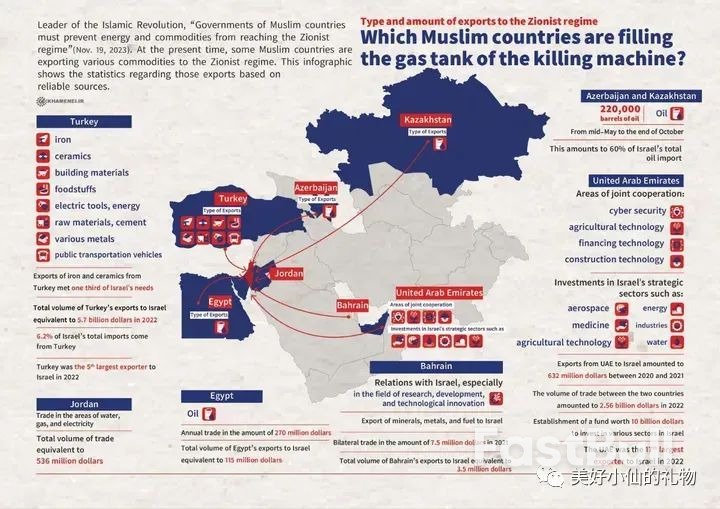
          Countries that supply oil to Israel:
          Latest News on the Israeli-Palestinian Conflict (November 26)_3
          14:19
          As the humanitarian pause enters its third day, more tragedy continues to unfold in Gaza; residents discovered that the two main schools in the southern Gaza village of Khuza'a had been flattened by Israeli airstrikes.
          15:41
          Hundreds of Palestinians queued at a gas station in Rafah, south of the Gaza Strip, as small amounts of fuel were allowed into the besieged enclave during the truce.
          Latest News on the Israeli-Palestinian Conflict (November 26)_4
          16:10
          Farmers in the occupied West Bank say they face near-daily incursions and violence from Israeli settlers to the point where they live in fear of having their homes and land stolen.
          They have also witnessed violence in nearby urban areas, such as the city of Jenin and refugee camps where Israeli forces have stepped up attacks, killing 10 people and injuring 20 others in just one week.
          17:04
          Tel Aviv official: Hamas' survival means our defeat
          Zionist regime's education minister: If Hamas stands up at the end of the war, it means we are seriously defeated.
          17:36
          Hamas's military terrorism wing confirmed:
          Ahmed Andour, commander of the northern Gaza Strip, and Ayman Siam, commander of the rocket array, were killed in an Israeli attack about a week and a half or two weeks ago.
          18:00
          Latest News on the Israeli-Palestinian Conflict (November 26)_5 In Jenin, north of the occupied West Bank, thousands of Palestinians attended the funeral of five Palestinians killed by Israeli occupying forces in the city last night.
          19:50
          The Qatari delegation, led by Qatari Assistant Foreign Minister Lorva Khater, arrived in the Gaza Strip through the Rafah crossing, the first international delegation to enter since the outbreak of Israeli aggression.
          20:17
          Former U.S. National Security Advisor John Bolton: “I must admit that Hamas has won a major victory against Israel.
          20:24
          Joe Biden's administration is concerned about the possibility of journalists exposing the extent of Israeli destruction in Gaza during a temporary humanitarian truce, US daily Politico reported.
          22:47
          Hamas: In response to President Putin’s efforts and out of appreciation for Russia’s stance in support of the Palestinian issue, we released a prisoner holding Russian citizenship.

          Article source: "The Gift of the Beautiful Fairy" WeChat public account

          Risk Warnings and Disclaimers
          You understand and acknowledge that there is a high degree of risk involved in trading. Following any strategies or investment methods may lead to potential losses. The content on the site is provided by our contributors and analysts for information purposes only. You are solely responsible for determining whether any trading assets, securities, strategy, or any other product is suitable for investing based on your own investment objectives and financial situation.
          Comments
          Add to Favorites
          Share

          Why Neither Israel nor Hamas Can Win the War and A Viable Palestinian State Is Now a Pipe Dream

          Cohen

          Economic

          Palestinian-Israeli conflict

          Initial sympathy for Israel arising from the vicious attacks by Hamas on Oct 7 has shifted decisively to criticism of it for perpetrating the mounting destruction of civilian infrastructure and deaths and suffering of Palestinians, especially children.
          Mounting international pressure has led to Israel and Hamas agreeing to a four-day humanitarian pause and a hostage-for-prisoner swap. This is only temporary.
          Fighting is expected to resume thereafter, together with efforts by key players including Qatar, Egypt, and the United States to press both sides to release all the hostages and end the war.
          Most governments and commentators have expressed the view that the Israelis have the right to self-defence under the circumstances, particularly in view of the terrorist actions perpetrated by Hamas.
          But this does not absolve the Israel Defense Forces of the responsibility to observe international codes of humanitarian behaviour designed to protect innocent civilians.
          Prospects for Victory
          Israel cannot win militarily. Even if Hamas is destroyed, other Palestinian terrorist groups, such as Palestine Islamic Jihad, will take over.
          The Palestinian threat is an existential problem for Israel that will fester beyond the current war.
          Hamas cannot win either. Although its popularity with Palestinians and Muslims all over the world has soared, it will not be allowed to rule Gaza.
          A post-war plan to replace it with the Palestinian National Authority is currently being brokered by the United States, Israel, Egypt and Saudi Arabia, among others.
          Hamas has delayed, but not derailed the emerging co-operation between the US, Israel and Saudi Arabia.
          The Gulf states see Iran's hand in the current outbreak. On the ground, Hamas has nominal support from Palestine Islamic Jihad, Hezbollah in Lebanon, the Houthis in Yemen and terrorist groups in Iraq.
          These are all Iranian proxies and opposed to the Gulf monarchies as well.
          Once the current fighting ceases and after a decent interval, the Saudis will move on to recognise Israel.
          Before that, they will work towards securing concessions from Israel and security guarantees from the US, all of which will amount to a de facto alliance.
          While there are no clear winners from the war, what is certain is that the losers are the 2 million Palestinians in Gaza.
          Likelihood of a regional war?
          The US has deployed formidable military assets, including two aircraft carrier groups and a nuclear submarine, to deter threats of a wider regional war. This has proven successful so far.
          Hezbollah and Iran's other proxies have escalated their attacks on Israel from their respective strongholds, but with limited effect for now.
          Iran itself, bogged down with its own internal problems, will not want to be involved in a major war. But Iran will continue to use its proxies to foment regional instability.
          The US remains the dominant player in the region, but it is not all-powerful.
          Washington will continue to provide financial and material support to Israel, but it will also try to curb Israel's military excesses besides focusing on getting all the hostages released and a longer humanitarian pause implemented.
          Although self-sufficient in its energy needs, the US will not allow Saudi oil reserves or Qatari natural gas deposits to fall into the hands of unfriendly governments such as Iran, Russia and militant groups.
          Consequently, Washington will not abandon its role as the security guarantor of its Gulf allies.
          What is of concern to the Saudis is whether this guarantee extends to the preservation of Al Saud rule. Hence, a Saudi understanding with Israel serves as an added insurance policy against Iran, as well as a source of much-needed technical and managerial expertise.
          China's stock in the region has grown, given its economic clout and diplomatic foray that capitalised on the rapprochement between Iran and Saudi Arabia.
          China's interests in the region are primarily energy security and economic. Its leaders are astute enough to want good relations to remain with Saudi Arabia and its allies on one side, and Iran on the other.
          They have no desire to become embroiled in the region's intractable quarrels.
          What price a permanent peace?
          A viable Palestinian state is now a pipe dream.
          The two-state solution which recognises Israel's right to exist alongside a Palestinian state does not resolve a fundamental problem of geography, that is, the Gaza Strip at one end and the West Bank on the other, with Israel in between through which a land bridge runs linking the two Palestinian entities.
          A unified Palestinian state would mean the de facto partition of Israel, which Israel will never accept. This leaves the current separation between Gaza and West Bank as the best-case reality.
          For such a divided Palestinian state to be independent and to prosper, it must build on good relations with its powerful Israeli neighbour.
          Sadly, the latest spate of fighting will only reinforce the animosity, distrust and righteous indignation between Israelis and Palestinians.
          Both sides believe they are legally and morally right with God on their side, making prospects for lasting peace in the coming years highly unlikely.
          The harsh reality is that neither Israel nor Palestine wants a two-state solution.
          Every Palestinian leader, whether it is Mahmoud Abbas, President of the Palestinian National Authority, or his successors, knows that any peace settlement will entail making compromises and accepting terms that will not fully satisfy the Palestinian people.
          Zionist extremists on the Israeli side would also be opposed to a two-state solution.
          Any Palestinian or Israeli leader who signs on to a two-state solution is likely to risk assassination by extremists.
          There is no possibility that Israel, the US and many of the Arab states will accept a return to Hamas rule in Gaza.
          Neither does Israel want to permanently occupy Gaza, which will remain a hotbed of terrorist violence, unless it can expel all the Palestinians.
          The likely outcome after the fighting has ceased is the return of the Palestinian National Authority to Gaza, supported by a multi-national force with an Arab component.
          But it will be an almost impossible task for the Palestinian National Authority to demilitarise and deradicalise the Gaza Strip.
          For now, the international community will continue to push for a two-state solution as the most acceptable diplomatic and political option to the Israel-Palestine conflict.
          There is no hope of another process to supersede the Oslo Peace Accords which delivered the two-state solution almost 30 years ago.
          At the same time, Prime Minister Benjamin Netanyahu and his right-wing partners in the present Israeli government will not condone a Palestinian state in God's promised land.
          Israeli objection to anyone else's proposal on the status of Jerusalem seems unshakeable. The prospects for progress on the two-state solution or other diplomatic initiatives are, at best, dim.

          Source: CNA

          To stay updated on all economic events of today, please check out our Economic calendar
          Risk Warnings and Disclaimers
          You understand and acknowledge that there is a high degree of risk involved in trading. Following any strategies or investment methods may lead to potential losses. The content on the site is provided by our contributors and analysts for information purposes only. You are solely responsible for determining whether any trading assets, securities, strategy, or any other product is suitable for investing based on your own investment objectives and financial situation.
          Comments
          Add to Favorites
          Share
          FastBull
          Copyright © 2025 FastBull Ltd

          728 RM B 7/F GEE LOK IND BLDG NO 34 HUNG TO RD KWUN TONG KLN HONG KONG

          TelegramInstagramTwitterfacebooklinkedin
          App Store Google Play Google Play
          Products
          Charts

          Chats

          Q&A with Experts
          Screeners
          Economic Calendar
          Data
          Tools
          Membership
          Features
          Function
          Markets
          Copy Trading
          Latest Signals
          Contests
          News
          Analysis
          24/7
          Columns
          Education
          Company
          Careers
          About Us
          Contact Us
          Advertising
          Help Center
          Feedback
          User Agreement
          Privacy Policy
          Business

          White Label

          Data API

          Web Plug-ins

          Poster Maker

          Affiliate Program

          Risk Disclosure

          The risk of loss in trading financial instruments such as stocks, FX, commodities, futures, bonds, ETFs and crypto can be substantial. You may sustain a total loss of the funds that you deposit with your broker. Therefore, you should carefully consider whether such trading is suitable for you in light of your circumstances and financial resources.

          No decision to invest should be made without thoroughly conducting due diligence by yourself or consulting with your financial advisors. Our web content might not suit you since we don't know your financial conditions and investment needs. Our financial information might have latency or contain inaccuracy, so you should be fully responsible for any of your trading and investment decisions. The company will not be responsible for your capital loss.

          Without getting permission from the website, you are not allowed to copy the website's graphics, texts, or trademarks. Intellectual property rights in the content or data incorporated into this website belong to its providers and exchange merchants.

          Not Logged In

          Log in to access more features

          FastBull Membership

          Not yet

          Purchase

          Become a signal provider
          Help Center
          Customer Service
          Dark Mode
          Price Up/Down Colors

          Log In

          Sign Up

          Position
          Layout
          Fullscreen
          Default to Chart
          The chart page opens by default when you visit fastbull.com