• Trade
  • Markets
  • Copy
  • Contests
  • News
  • 24/7
  • Calendar
  • Q&A
  • Chats
Trending
Screeners
SYMBOL
LAST
BID
ASK
HIGH
LOW
NET CHG.
%CHG.
SPREAD
SPX
S&P 500 Index
6870.39
6870.39
6870.39
6895.79
6858.28
+13.27
+ 0.19%
--
DJI
Dow Jones Industrial Average
47954.98
47954.98
47954.98
48133.54
47871.51
+104.05
+ 0.22%
--
IXIC
NASDAQ Composite Index
23578.12
23578.12
23578.12
23680.03
23506.00
+72.99
+ 0.31%
--
USDX
US Dollar Index
98.810
98.890
98.810
98.960
98.730
-0.140
-0.14%
--
EURUSD
Euro / US Dollar
1.16604
1.16611
1.16604
1.16717
1.16341
+0.00178
+ 0.15%
--
GBPUSD
Pound Sterling / US Dollar
1.33325
1.33334
1.33325
1.33462
1.33151
+0.00013
+ 0.01%
--
XAUUSD
Gold / US Dollar
4210.67
4211.10
4210.67
4218.85
4190.61
+12.76
+ 0.30%
--
WTI
Light Sweet Crude Oil
59.973
60.003
59.973
60.063
59.752
+0.164
+ 0.27%
--

Community Accounts

Signal Accounts
--
Profit Accounts
--
Loss Accounts
--
View More

Become a signal provider

Sell trading signals to earn additional income

View More

Guide to Copy Trading

Get started with ease and confidence

View More

Signal Accounts for Members

All Signal Accounts

Best Return
  • Best Return
  • Best P/L
  • Best MDD
Past 1W
  • Past 1W
  • Past 1M
  • Past 1Y

All Contests

  • All
  • Trump Updates
  • Recommend
  • Stocks
  • Cryptocurrencies
  • Central Banks
  • Featured News
Top News Only
Share

United Arab Emirates Energy Minister: We Are Working To Open Opportunities For Ai Firms To Improve Efficiency Of Electricity Andwater Grids, We Already Saved 30% Of Energy Consumption By Using Ai

Share

Switzerland's Consumer Confidence Index Fell To 34 In November, Compared With A Previous Reading Of -36.9

Share

Shares In Italy's Fincantieri Up 3.2% In Early Trade

Share

India's Nifty Smallcap 100 Index Falls 2.75%

Share

Britain's FTSE 100 Up 0.17%, France's CAC 40 Down 0.07%

Share

Europe's STOXX Index Up 0.04%, Euro Zone Blue Chips Index Up 0.02%

Share

United Arab Emirates Energy Minister: Natural Gas Is Important And We Intend To Not Only Satisfy Our Local Demand, But Also Grow Our Export Of LNG

Share

Yomiuri: Mitsubishi Ufj Bank Chief Hanzawa Likely To Become MUFG President

Share

Benin's International Bonds Slip After Attempted Coup, 2052 Maturity Down By 1.5 Euro Cents, Tradeweb Data

Share

China Vice Commerce Minister, On Nexperia: Root Cause Of Chaos In The Global Semiconductor Supply Chain Lies In The Netherlands

Share

United Arab Emirates Energy Minister: We Should Not Be Worrying About When Demand For Fossil Fuels Will Peak

Share

China Vice Commerce Minister: Urges Germany And EU Auto Association To Push EU Commission To Resolve EV Anti-Subsidy Case

Share

China Vice Commerce Minister Held Video Conferences With The President Of The German Association Of The Automotive Industry And The President Of The European Automobile Manufacturers Association, Respectively, To Exchange Views On Cooperation In The Automotive Industry And Supply Chain Between China And Germany And Between China And Europe

Share

China Vice Commerce Minister: Welcomes Eu Automakers To Continue To Invest In China

Share

China Says It Is Ready To Improve US Ties While Safeguarding Sovereignty

Share

The Chinese Foreign Ministry Stated That Japanese Prime Minister Takaichi And The Right-wing Forces Behind Him Continue To Misjudge The Situation, Refuse To Repent, Turn A Deaf Ear To Criticism Both Domestically And Internationally, Downplay Their Interference In Other Countries' Internal Affairs And Threats Of Force, Distort The Truth, Disregard Right And Wrong, And Show No Basic Respect For International Law And The Fundamental Norms Of International Relations. They Attempt To Revive Japanese Militarism By Instigating Conflict And Confrontation, Thus Breaking Through The Post-war International Order. Neighboring Asian Countries And The International Community Should Remain Highly Vigilant

Share

Indonesia Government Proposes Additional 11.5 Trillion Rupiah State Injection In 2025 For Housing, Transportation Sectors

Share

Sweden Prime Minister, In Letter Sent To European Commission And European Council President: Russia's Aggression Against Ukraine Is An Existential Threat To Europe

Share

Sweden Prime Minister, In Letter Sent To European Commission And European Council President: Must Move Ahead Quickly On Proposals To Use The Cash Balances From Russia's Immobilized Assets For A Reparations Loan To Ukraine

Share

China's Foreign Ministry Strongly Urges Japan To Immediately Cease Its Dangerous Actions That Disrupt China's Normal Military Exercises

TIME
ACT
FCST
PREV
U.S. Personal Income MoM (Sept)

A:--

F: --

P: --

U.S. PCE Price Index YoY (SA) (Sept)

A:--

F: --

P: --

U.S. PCE Price Index MoM (Sept)

A:--

F: --

P: --

U.S. Personal Outlays MoM (SA) (Sept)

A:--

F: --

P: --

U.S. Core PCE Price Index MoM (Sept)

A:--

F: --

P: --

U.S. Core PCE Price Index YoY (Sept)

A:--

F: --

P: --

U.S. UMich 5-Year-Ahead Inflation Expectations Prelim YoY (Dec)

A:--

F: --

P: --

U.S. Real Personal Consumption Expenditures MoM (Sept)

A:--

F: --

P: --

U.S. UMich Current Economic Conditions Index Prelim (Dec)

A:--

F: --

P: --

U.S. UMich 1-Year-Ahead Inflation Expectations Prelim (Dec)

A:--

F: --

P: --

U.S. UMich Consumer Expectations Index Prelim (Dec)

A:--

F: --

P: --

U.S. Weekly Total Rig Count

A:--

F: --

P: --

U.S. Weekly Total Oil Rig Count

A:--

F: --

P: --

U.S. Unit Labor Cost Prelim (SA) (Q3)

--

F: --

P: --

U.S. Consumer Credit (SA) (Oct)

A:--

F: --

P: --

China, Mainland Foreign Exchange Reserves (Nov)

A:--

F: --

P: --

Japan Wages MoM (Oct)

A:--

F: --

P: --

Japan Trade Balance (Oct)

A:--

F: --

P: --

Japan Nominal GDP Revised QoQ (Q3)

A:--

F: --

P: --

Japan Trade Balance (Customs Data) (SA) (Oct)

A:--

F: --

P: --

Japan GDP Annualized QoQ Revised (Q3)

A:--

F: --

P: --
China, Mainland Exports YoY (CNH) (Nov)

A:--

F: --

P: --

China, Mainland Trade Balance (USD) (Nov)

A:--

F: --

P: --

China, Mainland Imports YoY (CNH) (Nov)

A:--

F: --

P: --

China, Mainland Exports (Nov)

A:--

F: --

P: --

China, Mainland Imports (CNH) (Nov)

A:--

F: --

P: --

China, Mainland Trade Balance (CNH) (Nov)

A:--

F: --

P: --

China, Mainland Imports YoY (USD) (Nov)

A:--

F: --

P: --

China, Mainland Exports YoY (USD) (Nov)

A:--

F: --

P: --

Germany Industrial Output MoM (SA) (Oct)

A:--

F: --

P: --

Euro Zone Sentix Investor Confidence Index (Dec)

--

F: --

P: --

Canada Leading Index MoM (Nov)

--

F: --

P: --

Canada National Economic Confidence Index

--

F: --

P: --

China, Mainland Trade Balance (USD) (Nov)

--

F: --

P: --

U.S. 3-Year Note Auction Yield

--

F: --

P: --

U.K. BRC Overall Retail Sales YoY (Nov)

--

F: --

P: --

U.K. BRC Like-For-Like Retail Sales YoY (Nov)

--

F: --

P: --

Australia Overnight (Borrowing) Key Rate

--

F: --

P: --

RBA Rate Statement
RBA Press Conference
Germany Exports MoM (SA) (Oct)

--

F: --

P: --

U.S. NFIB Small Business Optimism Index (SA) (Nov)

--

F: --

P: --

Mexico Core CPI YoY (Nov)

--

F: --

P: --

Mexico 12-Month Inflation (CPI) (Nov)

--

F: --

P: --

Mexico PPI YoY (Nov)

--

F: --

P: --

Mexico CPI YoY (Nov)

--

F: --

P: --

U.S. Weekly Redbook Index YoY

--

F: --

P: --

U.S. JOLTS Job Openings (SA) (Oct)

--

F: --

P: --

China, Mainland M2 Money Supply YoY (Nov)

--

F: --

P: --

China, Mainland M0 Money Supply YoY (Nov)

--

F: --

P: --

China, Mainland M1 Money Supply YoY (Nov)

--

F: --

P: --

U.S. EIA Short-Term Crude Production Forecast For The Next Year (Dec)

--

F: --

P: --

U.S. EIA Short-Term Crude Production Forecast For The Year (Dec)

--

F: --

P: --

U.S. EIA Natural Gas Production Forecast For The Next Year (Dec)

--

F: --

P: --

EIA Monthly Short-Term Energy Outlook
U.S. 10-Year Note Auction Avg. Yield

--

F: --

P: --

U.S. API Weekly Cushing Crude Oil Stocks

--

F: --

P: --

U.S. API Weekly Crude Oil Stocks

--

F: --

P: --

U.S. API Weekly Refined Oil Stocks

--

F: --

P: --

U.S. API Weekly Gasoline Stocks

--

F: --

P: --

Q&A with Experts
    • All
    • Chatrooms
    • Groups
    • Friends
    Connecting
    .
    .
    .
    Type here...
    Add Symbol or Code

      No matching data

      All
      Trump Updates
      Recommend
      Stocks
      Cryptocurrencies
      Central Banks
      Featured News
      • All
      • Russia-Ukraine Conflict
      • Middle East Flashpoint
      • All
      • Russia-Ukraine Conflict
      • Middle East Flashpoint
      Search
      Products

      Charts Free Forever

      Chats Q&A with Experts
      Screeners Economic Calendar Data Tools
      Membership Features
      Data Warehouse Market Trends Institutional Data Policy Rates Macro

      Market Trends

      Market Sentiment Order Book Forex Correlations

      Top Indicators

      Charts Free Forever
      Markets

      News

      News Analysis 24/7 Columns Education
      From Institutions From Analysts
      Topics Columnists

      Latest Views

      Latest Views

      Trending Topics

      Top Columnists

      Latest Update

      Signals

      Copy Rankings Latest Signals Become a signal provider AI Rating
      Contests
      Brokers

      Overview Brokers Assessment Rankings Regulators News Claims
      Broker listing Forex Brokers Comparison Tool Live Spread Comparison Scam
      Q&A Complaint Scam Alert Videos Tips to Detect Scam
      More

      Business
      Events
      Careers About Us Advertising Help Center

      White Label

      Data API

      Web Plug-ins

      Affiliate Program

      Awards Institution Evaluation IB Seminar Salon Event Exhibition
      Vietnam Thailand Singapore Dubai
      Fans Party Investment Sharing Session
      FastBull Summit BrokersView Expo
      Recent Searches
        Top Searches
          Markets
          News
          Analysis
          User
          24/7
          Economic Calendar
          Education
          Data
          • Names
          • Latest
          • Prev

          View All

          No data

          Scan to Download

          Faster Charts, Chat Faster!

          Download App
          English
          • English
          • Español
          • العربية
          • Bahasa Indonesia
          • Bahasa Melayu
          • Tiếng Việt
          • ภาษาไทย
          • Français
          • Italiano
          • Türkçe
          • Русский язык
          • 简中
          • 繁中
          Open Account
          Search
          Products
          Charts Free Forever
          Markets
          News
          Signals

          Copy Rankings Latest Signals Become a signal provider AI Rating
          Contests
          Brokers

          Overview Brokers Assessment Rankings Regulators News Claims
          Broker listing Forex Brokers Comparison Tool Live Spread Comparison Scam
          Q&A Complaint Scam Alert Videos Tips to Detect Scam
          More

          Business
          Events
          Careers About Us Advertising Help Center

          White Label

          Data API

          Web Plug-ins

          Affiliate Program

          Awards Institution Evaluation IB Seminar Salon Event Exhibition
          Vietnam Thailand Singapore Dubai
          Fans Party Investment Sharing Session
          FastBull Summit BrokersView Expo

          Globalisation Is Not Dead, But It Is Fading: 'Glocalisation' Is Becoming the New Mantra

          Thomas

          Economic

          Summary:

          Industrial policy such as a green growth plan is no longer a dirty word as nations realise shorter supply chains and a strategic state role are necessary.

          Not bad. But not great either. That summed up the mood as the World Economic Forum ended in Davos last Friday with a panel on the state of the global economy. Not bad because most countries outperformed expectations of a year ago. Not bad because sharply rising interest rates didn't plunge the US, the eurozone and the UK into recession. Not bad because the war between Israel and Hamas has failed to send oil prices shooting above $100 a barrel.
          Not great because central banks face a balancing act between cutting interest rates too quickly and reigniting inflation, and keeping them too high and plunging their economies into recession. Not great, because the early weeks of 2024 have led to a wider Middle East conflict, with implications for one of the world's main trade routes. And not great because – as Davos showed – the global economy is deeply fractured.
          Inevitably, there is a risk that things will turn out badly in 2024. One leading global policymaker, speaking privately, said that repeated blows since 2020 meant it would be wise to be braced for the next surprise shock. Only the most incurable Davos optimist would quibble with that.
          Washington and Beijing are in a grim struggle for economic supremacy. The gap between north and south is widening, and liberal democracy is being challenged by a new breed of autocrats. The planet continues to heat up. In a week that marks the 100th anniversary of Lenin's death, there are once again competing visions of what constitutes progress and success.
          Even so, the death of globalisation has been much exaggerated. The reach of the multinational companies and the banks that continue to flock to the World Economic Forum were evidence of that. As is the rapid growth of artificial intelligence (AI), part of a tech revolution that cuts across borders and which is leaving national regulators floundering in its wake. A year ago, ChatGPT was in its infancy. This year, AI was central to the Davos debate, with those hailing its potential to help solve pressing problems – such as the climate crisis – ranged against those warning of its risks.
          So globalisation is not dead, nor even on its last legs. The same goes for the demise of western liberal democracy. To be sure, productivity has been weak and living standards have been squeezed in recent years. Germany's finance minister, Christian Lindner, raised eyebrows when he said his country was the tired man of Europe. But there are good reasons why there are no TV pictures of asylum seekers trying to get into Russia or China.
          What is true is that having been pushed on to the defensive, global capitalism is morphing into something different. Peak globalisation – along with peak Davos – happened a while ago, around the time of the global financial crisis of 2008, but it has been the repeated shocks since 2020 that have changed the dynamic.
          Everything that has happened since the arrival of the Covid pandemic has pointed to a new paradigm: some call it de-globalisation, others call it – perhaps more accurately – “glocalisation”.
          An ugly term, glocalisation is not the global free market, and it is not autarky (a nation that operates in a state of self-reliance), but something in between. It involves shorter supply chains, an emphasis on building back domestic manufacturing capacity, and a more strategic role for government. As with any form of mixed economy, the degree of glocalisation varies from country to country.
          Where once Davos lionised frictionless supply chains stretching from China to the developed countries of Europe and North America, now there is a recognition that low cost is not everything and that there is value in governments knowing that they will not run short of vaccines, protective equipment, computer chips and energy. The attacks on cargo vessels in the Red Sea, necessitating much longer journeys around the Cape of Good Hope is the latest example of how vulnerable long supply chains have become. As Christine Lagarde, the president of the European Central Bank, said at the final Davos session: “We were relying on efficiency over security a little too much.” Lagarde noted, correctly, that a bit of rebalancing was no bad thing.
          The long-term causes of glocalisation lie in the increasingly fractious relationship between the US and China – a relationship that has been deteriorating since Washington woke up to the threat posed by China's rapid growth and its clearly signalled plan to use its economic power to challenge the US's global hegemony. The US Chips Act and the Inflation Reduction Act are both examples of American determination to rebuild its industrial base through active government intervention.
          But while the shift towards onshoring previously outsourced production would have happened anyway, it has certainly been accelerated by the events of the past four years: a pandemic, then supply chain bottlenecks, a surge in inflation, and the war in Ukraine.
          The upshot is that industrial policy is no longer a dirty word, even in Davos. Indeed, there was plenty of interest at the WEF in what Labour's plans to boost the supply side of the UK amounted to.
          Nick Stern, author of the seminal report on the economics of climate change, thinks there is a potential sweet spot where the demands for stronger growth and the fight against global heating intersect. AI, he says, can act as an accelerator to help developing countries both with climate change mitigation and adaptation. He is not blind to the pushback by the fossil fuel industry against steps to combat global heating, but thinks the positives outweigh the negatives.
          Stern insists investing for good green projects would be good for growth and fiscally responsible. A green light for Labour's green growth plan, in other words. And glocalisation in action.

          Source: The Guardian

          To stay updated on all economic events of today, please check out our Economic calendar
          Risk Warnings and Disclaimers
          You understand and acknowledge that there is a high degree of risk involved in trading. Following any strategies or investment methods may lead to potential losses. The content on the site is provided by our contributors and analysts for information purposes only. You are solely responsible for determining whether any trading assets, securities, strategy, or any other product is suitable for investing based on your own investment objectives and financial situation.
          Comments
          Add to Favorites
          Share

          US Election will test Economic, Political and Institutional Resilience

          Justin

          Economic

          Political

          The New Hampshire primary vote on 23 January launched one of the longest US general election campaigns on record with the two likeliest candidates already squaring off. American voters are bracing for the grinding months ahead.
          Consider America’s political headlines from the perspective of an international investor. After decades of reliable growth and constant reinvention, the country’s unravelling political consensus and spendthrift habits have started to echo chaotic and cash-strapped Freedonia, the Marx brothers’ movie republic. Is now the time to cash out?
          Rarely have voters (or investors) been able to choose between two candidates knowing exactly what they will get. Set aside their ages, personalities and looming court cases to look at their political programmes.

          Biden versus Trump – again

          President Joe Biden promises a traditional American role that strengthens alliances in Europe and Asia to stare down China and Russia. He wants more taxes on the rich, more ‘middle class’ jobs and more subsidies for the climate transition.
          Former President Donald Trump wants to disengage from American commitments to Europe’s defence, de-couple from China and severely restrict immigration. He’d like to cut taxes again (especially for corporations), raise tariffs again (including on allies) and provide tax breaks for oil, gas and coal production.
          In some ways, this election should be as simple for US voters as Ronald Reagan’s classic 1980 question when he defeated Jimmy Carter: ‘Are you better off today than you were four years ago?’ The economic data don’t actually give a clear answer. Excluding the disruption from the pandemic, unemployment and growth have been mostly the same under both presidents.
          Real disposable incomes grew under Trump while any nominal gains under Biden have been eroded by higher inflation. Economists largely blame snarled supply chains for the higher prices. In retrospect, Biden and Federal Reserve Chair Jerome Powell bear some responsibility for large stimulus programmes and a late tightening cycle. But it’s also easy to forget the risks of a much deeper recession at the time.
          The dirty secret is that the president doesn’t have much to do with the economy, which is buffeted by long economic cycles far beyond the reach of the Oval Office. Outside of the Fed most economic policies merely plant seeds that shape investment, wages and productivity over many years.
          Whoever wins in November won’t get to plant the seeds he wants, since he is unlikely to have full control of Congress. So our global investor will have to look through the current political circus to see where America is headed under either outcome.

          Knowns and unknowns

          For all the uncertainty around the election on 5 November, the country’s trajectory is highly predictable in important ways.
          First, there will be more confrontation with China. Trump has proposed a ban on all ‘essential’ imports (including steel, electronics and pharmaceuticals) within four years. Biden’s team has restored some military and economic consultations but continues to restrict trade and investment and threatens more sanctions over Beijing’s threats to Taiwan.
          Second, the overall US market will be harder to crack amid a rising array of tariffs and subsidies. While Biden has not gone as far as Trump’s proposal for a sweeping 10% tariff on all imports, he is far more comfortable with trade restrictions and tax breaks he believes will protect American jobs.
          Third, immigration laws will tighten even after the current border crisis is resolved. While Biden has tried to keep a door open for humanitarian refugees from Afghanistan, Ukraine and Venezuela, the country’s mood has aligned behind efforts to ‘control the border’, which may have long-term implications for the country’s workforce as fertility rates drop.
          Fourth, debt will grow still further with neither candidate ready to seriously take on reform of social security and Medicare. With one party intent on cutting taxes and another still identifying areas needing more government support, the US will be borrowing much more.
          Finally, regardless of the winner, America’s institutions – its military, courts, regulators and traditions – are in for significant stress. A Trump loss will leave many voters believing in a stolen election, while a Trump victory will hand power to a candidate who has promised ‘retribution’ against political opponents.
          A more confrontational, protectionist and insular America hardly seems like a great formula to extend its record of economic vitality and creativity. But outsiders looking in will have to balance these risks with the country’s enduring attractions, including its geographic isolation and energy independence, deep capital markets and reserve currency, research universities and entrepreneurial culture.
          Americans will have to grit their teeth and vote, because there really is a clear choice on policy, style and political philosophy. Global investors will try to look past the results in 2024 or even 2028 to assess if the American institutions that have mostly managed to keep political excess in line so far will withstand the current turmoil.
          The United States of Freedonia is hardly inevitable, but neither is that durable liberal democracy we’d all like to build.

          Source:Christopher Smart

          To stay updated on all economic events of today, please check out our Economic calendar
          Risk Warnings and Disclaimers
          You understand and acknowledge that there is a high degree of risk involved in trading. Following any strategies or investment methods may lead to potential losses. The content on the site is provided by our contributors and analysts for information purposes only. You are solely responsible for determining whether any trading assets, securities, strategy, or any other product is suitable for investing based on your own investment objectives and financial situation.
          Comments
          Add to Favorites
          Share

          US Clean Electricity Momentum Stalls Slightly in 2023

          Kevin Du

          Energy

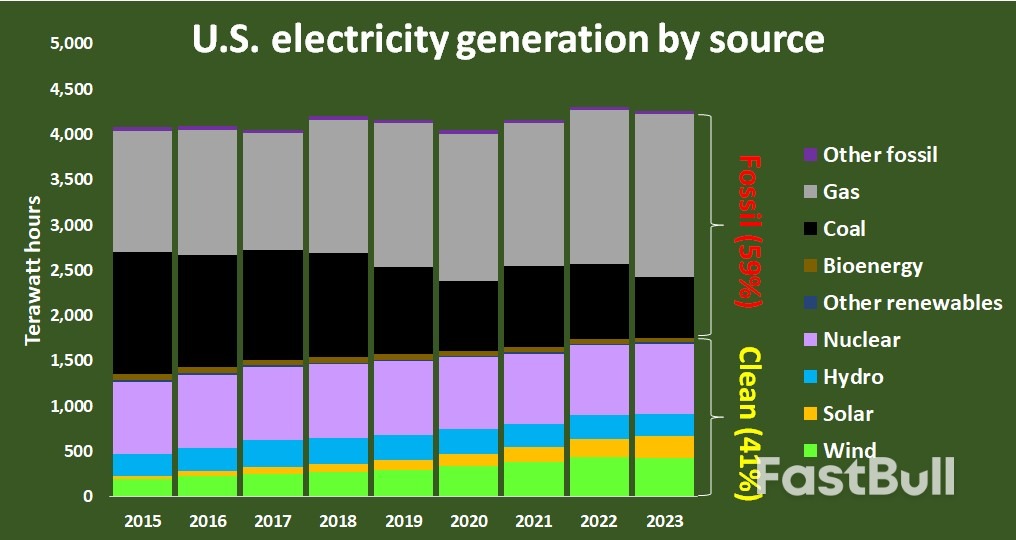
          Clean electricity generation in the United States hit new highs in 2023 but expanded by its smallest margin in more than a decade, due to below-normal wind speeds and a drop in hydro power output due to drought, data from think tank Ember shows.
          U.S. clean generation grew by just 0.4% last year, the smallest annual increase since 2012, when clean output contracted due to a drop in both hydro and nuclear output.US Clean Electricity Momentum Stalls Slightly in 2023_1
          The slow growth pace came despite additions to renewable energy supply capacity throughout the country, and resulted in the first contraction in overall electricity generation since COVID-19 lockdowns stifled total energy use in 2020.
          Wind Curbs
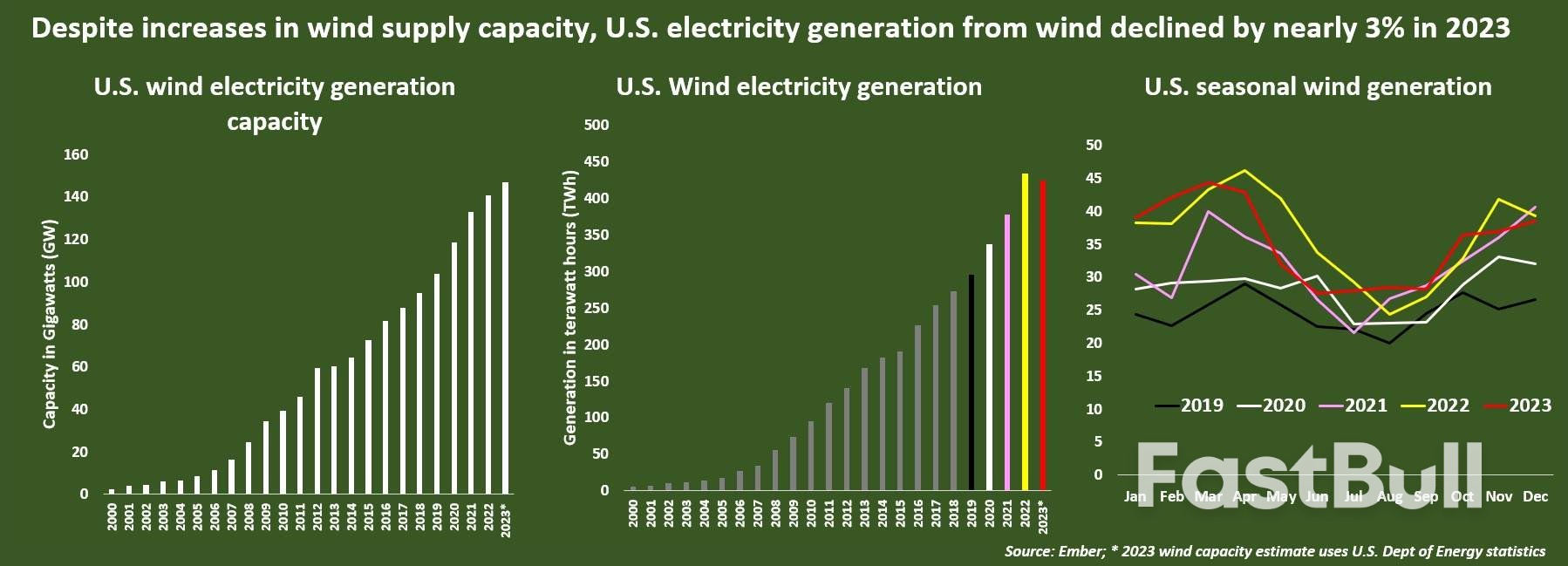
          U.S. wind supply capacity is estimated to have increased by between 7.1 gigawatts (GW) and 12 GW in 2023, according to the U.S. Department of Energy, although the exact degree of expansion is still to be confirmed.
          The average annual increase in U.S. wind capacity between 2015 and 2022 was 9.5 GW, so a further steep climb in wind capacity was expected in 2023.
          However, a mix of supply chain disruptions alongside increases in materials and labour costs caused a sharp slowdown in the momentum of wind project installations last year.
          Nonetheless, the total footprint of U.S. electricity generation from wind sites is widely assumed to have expanded in 2023 over 2022's total, and should have resulted in a commensurate increase in total wind electricity generation.US Clean Electricity Momentum Stalls Slightly in 2023_2
          However, unusually low wind speeds - especially during April, May, June and November - resulted in a nearly 3% drop in total wind electricity output last year, Ember data shows.
          Drought-Hit Hydro
          U.S. power providers were also hit by a more than 7% drop in output from hydropower sites due in 2023 to drought in key hydro generation areas, especially in western states.
          In combination, hydro and wind facilities generated around 665 terawatt hours (TWh) of electricity in 2023, compared to 695 TWh in 2022, Ember data shows.
          A roughly 19% rise in solar output to 243 TWh helped offset some of lower wind and hydro output, and alongside fairly steady nuclear output allowed power firms to boost clean electricity generation to a record of 1,750 TWh, up from 1,744 TWh in 2022.
          Fossil Cuts Sustain Energy Transition Momentum
          The share of clean power in total generation hit a new high of 41.1% in 2023 thanks in large part to continued cuts to the use of coal in national electricity production.
          Coal-fired electricity output shrank by 19% in 2023 to around 672 TWh, and the lowest total since at least 2000.
          Gas-fired electricity increased by nearly 7% from 2022's total to 1,804 TWh, but total electricity output from fossil fuels contracted by 2% last year to its lowest tally since 2020.
          Fossil fuels still accounted for around 59% of total U.S. electricity generation last year, but should see a larger decline in the generation mix going forward once output from wind sites pick up due to a recovery in wind speeds and from further expansions in grid-connected capacity.
          Alongside expansions to solar generation capacity - which the U.S. Department of Energy estimates grew from 17 GW in 2022 to 31 GW in 2023 - higher wind power looks set help U.S. clean electricity generation regain momentum in 2024, and should keep the country's energy transition goals on track.

          Source: Reuters

          Risk Warnings and Disclaimers
          You understand and acknowledge that there is a high degree of risk involved in trading. Following any strategies or investment methods may lead to potential losses. The content on the site is provided by our contributors and analysts for information purposes only. You are solely responsible for determining whether any trading assets, securities, strategy, or any other product is suitable for investing based on your own investment objectives and financial situation.
          Comments
          Add to Favorites
          Share

          Bonds on Everybody's Lips

          SAXO

          Bond

          Weakening growth, inflation, and a shaky geopolitical environment
          Markets should be ready for another bumpy ride in 2024. Although sluggish growth and declining inflation have set the grounds for lower interest rates, monetary policy uncertainty and geopolitical tensions will remain.
          As central banks started hiking policy rates aggressively, the probability of a recession increased among leading economists and bond futures priced prematurely a soon to come cutting cycle. However, central banks stuck to their “higher for longer” narrative upsetting markets throughout 2023. Fast forward, and policy rates have risen to their highest level in more than fifteen years. Despite economic woes, policymakers are not expecting to cut rates aggressively in 2024. However, a recession in the US economy could quickly change this.
          A fragile geopolitical landscape will add to market volatility. The US is facing geopolitical tensions in Ukraine, Israel, and Taiwan. With the US going to the polls in November, the political situation will likely move to a gridlock in 2024, lowering the fiscal impulse and adding to growth uncertainty.
          The above calls for caution from central banks when tightening the economy further or easing it too quickly, implying higher volatility in bond markets.
          The bond market offers attractive prospects for investors
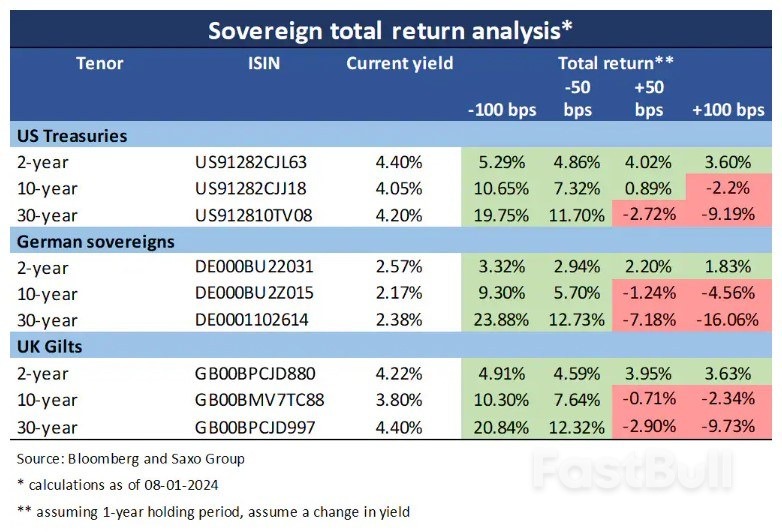
          Bond investors are presented with the opportunity to lock in one of the highest yields in more than ten years. Higher yields do not only mean higher returns, but also a lower probability of bonds posting a negative return even if yields rise slightly again.Bonds on Everybody's Lips_1
          With central banks likely cutting rates slowly, the lagged transmission of aggressive monetary policies from 2023 will continue to tighten financial conditions in the new year. This would favor extending duration and quality in the medium term.
          There are three possible scenarios for developed market sovereign bonds in 2024:
          1. Soft landing scenario: the battle against inflation is over, and a deep recession is avoided, causing central banks to cut rates slightly, but not aggressively. Yield curves would bull steepen, with 10-year yields adjusting moderately lower from where they are today.
          2. Hard landing scenario: a deep recession forces central banks to cut rates aggressively, provoking a deep bull steepening of yield curves. Rates would fall considerably across tenors.
          3. The 70s scenario: inflation reignites, forcing central banks to hike again. This would see yield curves bear flattening, with front-term yields offering a considerable pickup over long-term yields.
          Quality is king
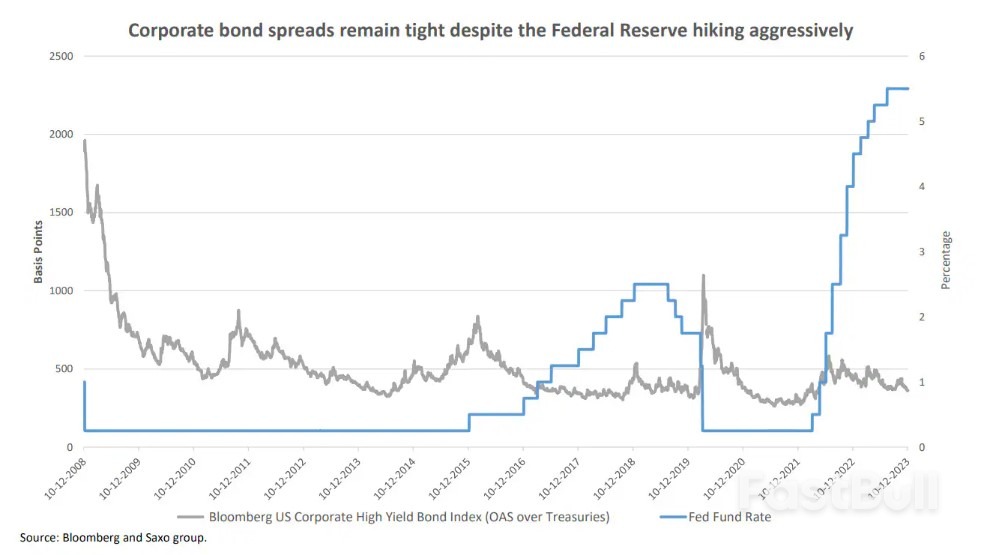
          Deteriorating economic activity and high rates do not bode well for risky assets, which could lead to higher corporate bond spreads amid slowing revenues and compressed margins.
          While yields on corporate bonds in the US and Europe have risen together with sovereign yields, the pickup that investment-grade corporate bonds offer over their benchmarks is well below the 2010-2020 average.
          When looking at junk, the picture is even more depressing. USD high yield bonds pay 260 basis points over comparable investment grade bonds, a level in line with pre-Covid valuations when the Fed was stimulating the economy through quantitative easing and interest rates were less than half what they are today. In Europe, junk pays 310 basis points over high-grade peers, reflecting a more challenging macroeconomic backdrop.
          Therefore, we see better value in developed market sovereigns, although a selective approach for corporate bonds remains compelling.Bonds on Everybody's Lips_2
          Risk Warnings and Disclaimers
          You understand and acknowledge that there is a high degree of risk involved in trading. Following any strategies or investment methods may lead to potential losses. The content on the site is provided by our contributors and analysts for information purposes only. You are solely responsible for determining whether any trading assets, securities, strategy, or any other product is suitable for investing based on your own investment objectives and financial situation.
          Comments
          Add to Favorites
          Share

          Will Weak Jobs Data Prompt RBNZ to Drop Hiking Bias

          XM

          Central Bank

          Forex

          Despite hawkish RBNZ, data drive investors to price in rate cuts

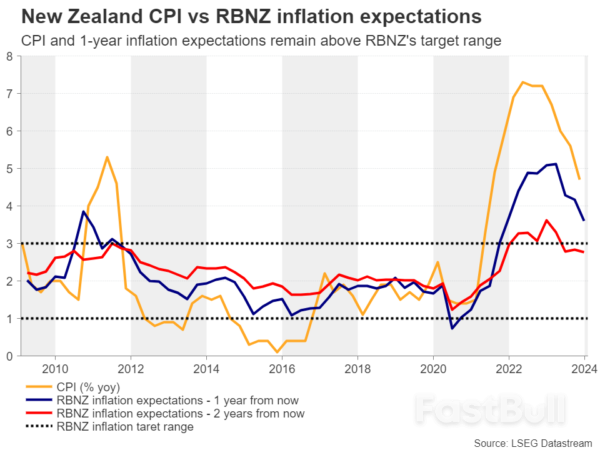
          At its November gathering, the RBNZ held its official cash rate (OCR) steady at 5.5% and noted that inflation remains too high and that if price pressures were to become stronger than anticipated, interest rates would likely need to rise further. Officials also lifted their OCR projections to signal a decent chance for another 25bps hike before this tightening crusade ends.
          Data since then revealed that New Zealand’s economy unexpectedly contracted by 0.3% q/q in Q3, while the growth rate for Q2 was revised notably down to 0.5% from 0.9%. On top of that, headline inflation slowed to 4.7% y/y in Q4 from 5.6%, with the core standardized rate also sliding to 4.7% y/y from 5.0%. One-year inflation expectations have also been coming down at a relatively fast pace.
          Will Weak Jobs Data Prompt RBNZ to Drop Hiking Bias_1
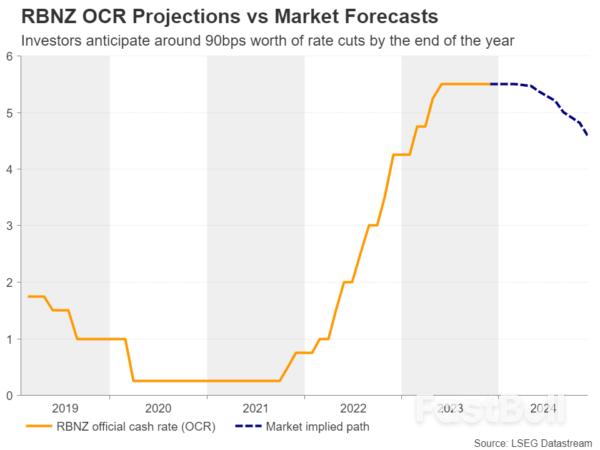
          Taking that into account, investors don’t believe that higher rates are on the table anymore. On the contrary, they are anticipating around 90bps worth of rate reductions by the end of the year, with a quarter-point cut more-than-fully priced in for July.
          Will Weak Jobs Data Prompt RBNZ to Drop Hiking Bias_2

          Governor Orr says jobs data to impact next decision

          Nearly three weeks after the GDP data were out, RBNZ Governor Andrian Orr told parliament that surprisingly weak Q3 economic data was a “complex situation,” adding that although interest rates continue to constrain spending, the Bank remains wary of inflationary surprises. He noted that the Bank was analyzing the data but other key data points before the February meeting, including employment, would also impact the decision.
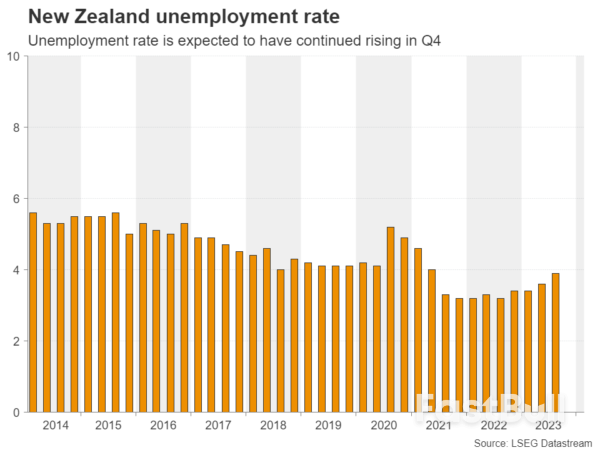
          This likely adds an extra degree of importance to next week’s jobs report for Q4 due out late on Tuesday, during the early Asian session Wednesday. The unemployment rate is forecast to have continued rising to 4.3% from 3.9%, while the labor cost index is seen slowing to 3.7% y/y from 4.1%, which could raise speculation that inflation may continue cooling.
          Will Weak Jobs Data Prompt RBNZ to Drop Hiking Bias_3
          Such numbers may confirm the market’s view that the RBNZ will be forced to lower borrowing costs at some point this year, although shifting from a hiking bias to immediately signaling rate reductions may not be the case at the February gathering.

          China also a big variable in the kiwi equation

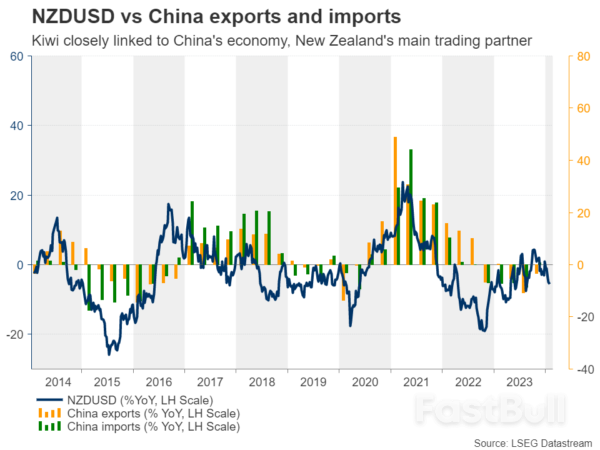
          What’s more, apart from domestic data, the kiwi seems to be sensitive to developments surrounding China, as the world’s second-largest economy is New Zealand’s main trading partner. On Friday, China’s Shanghai Composite fell further, logging its worst week in five years as concerns about the property sector after Evergrande was ordered to be liquidated overshadowed earlier optimism sparked by the nation’s announcement of measures to stabilize the market. Thus, those concerns could continue weighing on the kiwi.
          Will Weak Jobs Data Prompt RBNZ to Drop Hiking Bias_4

          Are kiwi bears waiting behind the bushes?

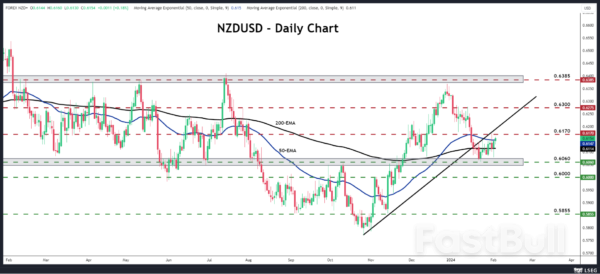
          Kiwi/dollar has staged a decent recovery lately, after hitting support at 0.6060 on January 23 and now looks to be headed towards the 0.6170 resistance zone. That said, the pair remains below the prior uptrend line drawn from the low of October 26, which means that the bears may still be willing to jump into the action.
          If they do so from near the 0.6170 barrier, they may feel confident to drive the action back down to the 0.6060 zone, the break of which would confirm a lower low and perhaps carry extensions towards the round number of 0.6000, which offered support on November 22 and resistance on November 6. For the outlook to turn positive, the pair may need to climb all the way above the 0.6275 zone, which acted as resistance between January 3 and 12.
          Will Weak Jobs Data Prompt RBNZ to Drop Hiking Bias_5

          Source:XM

          Risk Warnings and Disclaimers
          You understand and acknowledge that there is a high degree of risk involved in trading. Following any strategies or investment methods may lead to potential losses. The content on the site is provided by our contributors and analysts for information purposes only. You are solely responsible for determining whether any trading assets, securities, strategy, or any other product is suitable for investing based on your own investment objectives and financial situation.
          Comments
          Add to Favorites
          Share

          Natural Gas Appears Trapped in Prolonged Price Range

          Chandan Gupta

          Traders' Opinions

          Economic

          Commodity

          Energy

          Natural Gas has rebounded from a recent four-year low, reaching $2.04 on Thursday. This surge is attributed to the US approving military strikes in Iraq and Syria. Simultaneously, a proposed cease-fire between Israel and Hamas fell through as Hamas reneged on earlier commitments.
          The US Dollar (USD), which typically shows a negative correlation to Natural Gas, experienced a decline following troubling jobless data. Traders opted to sell the Greenback as the US Challenger Job Cuts data revealed over double the layoffs in January compared to December. Additionally, both Initial and Continuing Jobless Claims are showing an upward trend compared to the previous week.
          Despite the upbeat numbers in the US Jobs Report, countering the negative sentiment for the Greenback, the US Dollar is regaining ground and returning to elevated levels observed during the last US Federal Reserve rate decision.
          In essence, Natural Gas's rebound is tied to geopolitical factors, including the approved military strikes and the failed cease-fire. The US Dollar's decline, driven by concerning jobless data, reflects the complex interplay between economic indicators and market reactions. While positive US Jobs Report numbers are influencing the Greenback positively, challenges persist, leading to a nuanced market landscape.
          Investors are navigating through these developments, weighing the impact of geopolitical events on Natural Gas and the economic indicators affecting the US Dollar. The situation underscores the intricate relationship between global events, financial markets, and investor sentiment. As the market continues to respond to unfolding events, participants will closely monitor the dynamic interplay between geopolitical factors and economic data, shaping the trajectory of Natural Gas and the US Dollar in the coming days.Natural Gas Appears Trapped in Prolonged Price Range_1
          The natural gas market saw a modest decline in Thursday's trading, indicating an overall negative sentiment. However, it's crucial to highlight that the market currently lingers just above a significant support level, as evident on longer-term charts. This sets the stage for an anticipation that traders will likely continue engaging in back-and-forth trading within this market.
          Despite an initial attempt to rally during Thursday's session, natural gas relinquished its early gains. The $2 level holds particular importance as a significant support threshold and potentially marks the lower boundary of the prevailing consolidation range expected to persist in the longer term. It's worth noting that this market has a tendency to exhibit such behavior, so it's not surprising to witness it again in 2024.
          Historically, natural gas tends to undergo a consolidation phase for a substantial part of the year. With the winter season winding down, the likelihood of another spike in prices remains limited and, if it occurs, is expected to be of a short-term nature, mirroring recent trends. The winter period, characterized by subdued demand, has contributed to an oversupply of natural gas, posing a notable challenge.
          For short-term traders, potential opportunities may emerge through buying on price dips, although these trades are anticipated to be short-term in nature. The current fair value revolves around the $2.50 mark. A breach above this level could potentially pave the way for an ascent towards approximately $3.33, though the $3 level is likely to exert its influence.
          Conversely, a scenario where the market experiences a breakdown below the $2 level would represent a significant development. However, such an outcome appears less likely, given the historical resilience of the $2 level as a support point.
          Expectations for this market include choppy volatility and a prevailing range-bound pattern. Traders adept at using range-bound systems, such as stochastic oscillators or similar tools, may find this market suitable for their trading strategies in the coming months. Notably, the market currently leans closer to its lower boundary than its upper limit, prompting a search for buying opportunities. However, it is advisable to capitalize on profits promptly, given the market's characteristic erratic and choppy behavior.
          In conclusion, the natural gas market is navigating through a phase of consolidation, with short-term fluctuations and a prevailing negative sentiment. The $2 level serves as a crucial support point, and traders are likely to continue engaging in back-and-forth trading. As winter concludes, the prospects for a significant price spike diminish, considering the oversupply challenges faced during the season. Traders may find short-term buying opportunities, with the $2.50 mark as fair value, and potential movements towards $3.33. While a breakdown below $2 is a possibility, the market's historical resilience at this level makes it less likely. The overall outlook suggests a range-bound pattern, offering opportunities for traders using range-bound systems. Despite potential buying opportunities, it is prudent to capitalize on profits promptly due to the market's erratic and choppy behavior.Natural Gas Appears Trapped in Prolonged Price Range_2
          To stay updated on all economic events of today, please check out our Economic calendar
          Risk Warnings and Disclaimers
          You understand and acknowledge that there is a high degree of risk involved in trading. Following any strategies or investment methods may lead to potential losses. The content on the site is provided by our contributors and analysts for information purposes only. You are solely responsible for determining whether any trading assets, securities, strategy, or any other product is suitable for investing based on your own investment objectives and financial situation.
          Comments
          Add to Favorites
          Share

          Recreating European Banks' Record-Breaking $62 Billion Year Poses Challenges

          Ukadike Micheal

          Economic

          European banks experienced a remarkable year in 2023, generating record profits propelled by a swift succession of interest rate increases. However, analysts predict a challenging path ahead, anticipating a 6.3% decline in combined net income for 11 major European banks in the current year compared to the €56.5 billion ($61.5 billion) achieved in 2023. Despite the projected dip, this would still represent the second-highest on record over the past two decades.
          The robust performance in 2023, fueled by the European Central Bank's rapid interest rate hikes, allowed banks to charge more for loans while maintaining lower deposit costs. Yet, as inflation moderates and eurozone rates stabilize or decline, the tailwind that propelled their profits is expected to wane. This poses a particular challenge for banks heavily reliant on lending in their home markets.
          Notably, about 80% of ING Groep NV's income is tied to interest, a vulnerability acknowledged by its CEO, Steven van Rijswijk. The Dutch lender, facing a potential hit of about €600 million due to weaker revenue from higher rates passed on to depositors, exemplifies the broader challenge faced by European banks. The impact on profitability is further exemplified by the fact that this surpasses the anticipated €200 million from lending growth.
          While other major players such as Deutsche Bank AG and Banco Bilbao Vizcaya Argentaria SA confront similar challenges, efforts are underway to diversify geographically or explore alternative income sources. Deutsche Bank, for instance, has raised its mid-term revenue outlook, banking on a rebound in dealmaking to boost fee income. Similarly, Spain's BBVA, offsetting the slowdown in interest income with higher-than-expected revenue from fees and commissions, underscores the strategic importance of diversification.
          As banks grapple with the headwinds of changing interest rate dynamics, the need for diversification becomes increasingly apparent. ING's caution and the subsequent market reaction highlight the urgency for institutions to adapt to evolving economic conditions. This challenges banks to explore new revenue streams and strategic shifts to maintain resilience in a changing financial landscape.
          In contrast to the overall trend, French banks faced limitations in capitalizing on the interest income bonanza due to local rules making it difficult to raise rates on loans. BNP Paribas SA, adjusting revenue expectations, cited the European Central Bank's decision to stop paying interest on minimum reserves and Belgium's debt sale diverting deposits away from banks. Despite these challenges, European banks are set for a more profitable trajectory than the past decade, replacing loans issued during an era of historically low interest rates.
          While the boost from rising rates might diminish in the current year, European banks are positioned for a higher level of profitability compared to the previous decade. This positive outlook is supported by the gradual repricing of fixed-rate mortgages, offering a sustained revenue stream despite the changing interest rate environment.
          In summary, European banks face the challenge of maintaining profitability in the wake of changing interest rate dynamics. The anticipated decline in net income in 2024 marks a shift from the record-breaking year in 2023. However, the strategic efforts to diversify and explore alternative income sources illustrate a proactive approach among major banks. As the industry adapts to evolving economic conditions, the trajectory of European banks in the coming years will depend on their ability to navigate challenges, seize opportunities, and strategically position themselves in a dynamic financial landscape.

          Source: Bloomberg

          To stay updated on all economic events of today, please check out our Economic calendar
          Risk Warnings and Disclaimers
          You understand and acknowledge that there is a high degree of risk involved in trading. Following any strategies or investment methods may lead to potential losses. The content on the site is provided by our contributors and analysts for information purposes only. You are solely responsible for determining whether any trading assets, securities, strategy, or any other product is suitable for investing based on your own investment objectives and financial situation.
          Comments
          Add to Favorites
          Share
          FastBull
          Copyright © 2025 FastBull Ltd

          728 RM B 7/F GEE LOK IND BLDG NO 34 HUNG TO RD KWUN TONG KLN HONG KONG

          TelegramInstagramTwitterfacebooklinkedin
          App Store Google Play Google Play
          Products
          Charts

          Chats

          Q&A with Experts
          Screeners
          Economic Calendar
          Data
          Tools
          Membership
          Features
          Function
          Markets
          Copy Trading
          Latest Signals
          Contests
          News
          Analysis
          24/7
          Columns
          Education
          Company
          Careers
          About Us
          Contact Us
          Advertising
          Help Center
          Feedback
          User Agreement
          Privacy Policy
          Business

          White Label

          Data API

          Web Plug-ins

          Poster Maker

          Affiliate Program

          Risk Disclosure

          The risk of loss in trading financial instruments such as stocks, FX, commodities, futures, bonds, ETFs and crypto can be substantial. You may sustain a total loss of the funds that you deposit with your broker. Therefore, you should carefully consider whether such trading is suitable for you in light of your circumstances and financial resources.

          No decision to invest should be made without thoroughly conducting due diligence by yourself or consulting with your financial advisors. Our web content might not suit you since we don't know your financial conditions and investment needs. Our financial information might have latency or contain inaccuracy, so you should be fully responsible for any of your trading and investment decisions. The company will not be responsible for your capital loss.

          Without getting permission from the website, you are not allowed to copy the website's graphics, texts, or trademarks. Intellectual property rights in the content or data incorporated into this website belong to its providers and exchange merchants.

          Not Logged In

          Log in to access more features

          FastBull Membership

          Not yet

          Purchase

          Become a signal provider
          Help Center
          Customer Service
          Dark Mode
          Price Up/Down Colors

          Log In

          Sign Up
          Position
          Layout
          Fullscreen
          Default to Chart
          The chart page opens by default when you visit fastbull.com