• Trade
  • Markets
  • Copy
  • Contests
  • News
  • 24/7
  • Calendar
  • Q&A
  • Chats
Trending
Screeners
SYMBOL
LAST
BID
ASK
HIGH
LOW
NET CHG.
%CHG.
SPREAD
SPX
S&P 500 Index
6827.42
6827.42
6827.42
6899.86
6801.80
-73.58
-1.07%
--
DJI
Dow Jones Industrial Average
48458.04
48458.04
48458.04
48886.86
48334.10
-245.98
-0.51%
--
IXIC
NASDAQ Composite Index
23195.16
23195.16
23195.16
23554.89
23094.51
-398.69
-1.69%
--
USDX
US Dollar Index
97.950
98.030
97.950
98.500
97.950
-0.370
-0.38%
--
EURUSD
Euro / US Dollar
1.17394
1.17409
1.17394
1.17496
1.17192
+0.00011
+ 0.01%
--
GBPUSD
Pound Sterling / US Dollar
1.33707
1.33732
1.33707
1.33997
1.33419
-0.00148
-0.11%
--
XAUUSD
Gold / US Dollar
4299.39
4299.39
4299.39
4353.41
4257.10
+20.10
+ 0.47%
--
WTI
Light Sweet Crude Oil
57.233
57.485
57.233
58.011
56.969
-0.408
-0.71%
--

Community Accounts

Signal Accounts
--
Profit Accounts
--
Loss Accounts
--
View More

Become a signal provider

Sell trading signals to earn additional income

View More

Guide to Copy Trading

Get started with ease and confidence

View More

Signal Accounts for Members

All Signal Accounts

Best Return
  • Best Return
  • Best P/L
  • Best MDD
Past 1W
  • Past 1W
  • Past 1M
  • Past 1Y

All Contests

  • All
  • Trump Updates
  • Recommend
  • Stocks
  • Cryptocurrencies
  • Central Banks
  • Featured News
Top News Only
Share

USA Embassy In Lithuania: Maria Kalesnikava Is Not Going To Vilnius

Share

USA Embassy In Lithuania: Other Prisoners Are Being Sent From Belarus To Ukraine

Share

Ukraine President Zelenskiy: Five Ukrainians Released By Belarus In US-Brokered Deal

Share

USA Vilnius Embassy: USA Stands Ready For "Additional Engagement With Belarus That Advances USA Interests"

Share

USA Vilnius Embassy: Belarus, USA, Other Citizens Among The Prisoners Released Into Lithuania

Share

USA Vilnius Embassy: USA Will Continue Diplomatic Efforts To Free The Remaining Political Prisoners In Belarus

Share

USA Vilnius Embassy: Belarus Releases 123 Prisoners Following Meeting Of President Trump's Envoy Coale And Belarus President Lukashenko

Share

USA Vilnius Embassy: Masatoshi Nakanishi, Aliaksandr Syrytsa Are Among The Prisoners Released By Belarus

Share

USA Vilnius Embassy: Maria Kalesnikava And Viktor Babaryka Are Among The Prisoners Released By Belarus

Share

USA Vilnius Embassy: Nobel Peace Prize Laureate Ales Bialiatski Is Among The Prisoners Released By Belarus

Share

Belarusian Presidential Administration Telegram Channel: Lukashenko Has Pardoned 123 Prisoners As Part Of Deal With US

Share

Two Local Syrian Officials: Joint US-Syrian Military Patrol In Central Syria Came Under Fire From Unknown Assailants

Share

Israeli Military Says It Targeted 'Key Hamas Terrorist' In Gaza City

Share

Rwanda's Actions In Eastern Drc Are A Clear Violation Of Washington Accords Signed By President Trump - Secretary Of State Rubio

Share

Israeli Military Issues Evacuation Warning In Southern Lebanon Village Ahead Of Strike - Spokesperson On X

Share

Belarusian State Media Cites US Envoy Coale As Saying He Discussed Ukraine And Venezuela With Lukashenko

Share

Belarusian State Media Cites US Envoy Coale As Saying That US Removes Sanctions On Belarusian Potassium

Share

Thai Prime Minister: No Ceasefire Agreement With Cambodia

Share

US, Ukraine To Discuss Ceasefire In Berlin Ahead Of European Summit

Share

Incoming Czech Prime Minister Babis: Czech Republic Will Not Take On Guarantees For Ukraine Financing, European Commission Must Find Alternatives

TIME
ACT
FCST
PREV
U.K. Trade Balance Non-EU (SA) (Oct)

A:--

F: --

P: --

U.K. Trade Balance (Oct)

A:--

F: --

P: --

U.K. Services Index MoM

A:--

F: --

P: --

U.K. Construction Output MoM (SA) (Oct)

A:--

F: --

P: --

U.K. Industrial Output YoY (Oct)

A:--

F: --

P: --

U.K. Trade Balance (SA) (Oct)

A:--

F: --

P: --

U.K. Trade Balance EU (SA) (Oct)

A:--

F: --

P: --

U.K. Manufacturing Output YoY (Oct)

A:--

F: --

P: --

U.K. GDP MoM (Oct)

A:--

F: --

P: --

U.K. GDP YoY (SA) (Oct)

A:--

F: --

P: --

U.K. Industrial Output MoM (Oct)

A:--

F: --

P: --

U.K. Construction Output YoY (Oct)

A:--

F: --

P: --

France HICP Final MoM (Nov)

A:--

F: --

P: --

China, Mainland Outstanding Loans Growth YoY (Nov)

A:--

F: --

P: --

China, Mainland M2 Money Supply YoY (Nov)

A:--

F: --

P: --

China, Mainland M0 Money Supply YoY (Nov)

A:--

F: --

P: --

China, Mainland M1 Money Supply YoY (Nov)

A:--

F: --

P: --

India CPI YoY (Nov)

A:--

F: --

P: --

India Deposit Gowth YoY

A:--

F: --

P: --

Brazil Services Growth YoY (Oct)

A:--

F: --

P: --

Mexico Industrial Output YoY (Oct)

A:--

F: --

P: --

Russia Trade Balance (Oct)

A:--

F: --

P: --

Philadelphia Fed President Henry Paulson delivers a speech
Canada Building Permits MoM (SA) (Oct)

A:--

F: --

P: --

Canada Wholesale Sales YoY (Oct)

A:--

F: --

P: --

Canada Wholesale Inventory MoM (Oct)

A:--

F: --

P: --

Canada Wholesale Inventory YoY (Oct)

A:--

F: --

P: --

Canada Wholesale Sales MoM (SA) (Oct)

A:--

F: --

P: --

Germany Current Account (Not SA) (Oct)

A:--

F: --

P: --

U.S. Weekly Total Rig Count

A:--

F: --

P: --

U.S. Weekly Total Oil Rig Count

A:--

F: --

P: --

Japan Tankan Large Non-Manufacturing Diffusion Index (Q4)

--

F: --

P: --

Japan Tankan Small Manufacturing Outlook Index (Q4)

--

F: --

P: --

Japan Tankan Large Non-Manufacturing Outlook Index (Q4)

--

F: --

P: --

Japan Tankan Large Manufacturing Outlook Index (Q4)

--

F: --

P: --

Japan Tankan Small Manufacturing Diffusion Index (Q4)

--

F: --

P: --

Japan Tankan Large Manufacturing Diffusion Index (Q4)

--

F: --

P: --

Japan Tankan Large-Enterprise Capital Expenditure YoY (Q4)

--

F: --

P: --

U.K. Rightmove House Price Index YoY (Dec)

--

F: --

P: --

China, Mainland Industrial Output YoY (YTD) (Nov)

--

F: --

P: --

China, Mainland Urban Area Unemployment Rate (Nov)

--

F: --

P: --

Saudi Arabia CPI YoY (Nov)

--

F: --

P: --

Euro Zone Industrial Output YoY (Oct)

--

F: --

P: --

Euro Zone Industrial Output MoM (Oct)

--

F: --

P: --

Canada Existing Home Sales MoM (Nov)

--

F: --

P: --

Euro Zone Total Reserve Assets (Nov)

--

F: --

P: --

U.K. Inflation Rate Expectations

--

F: --

P: --

Canada National Economic Confidence Index

--

F: --

P: --

Canada New Housing Starts (Nov)

--

F: --

P: --

U.S. NY Fed Manufacturing Employment Index (Dec)

--

F: --

P: --

U.S. NY Fed Manufacturing Index (Dec)

--

F: --

P: --

Canada Core CPI YoY (Nov)

--

F: --

P: --

Canada Manufacturing Unfilled Orders MoM (Oct)

--

F: --

P: --

Canada Manufacturing New Orders MoM (Oct)

--

F: --

P: --

Canada Core CPI MoM (Nov)

--

F: --

P: --

Canada Manufacturing Inventory MoM (Oct)

--

F: --

P: --

Canada CPI YoY (Nov)

--

F: --

P: --

Canada CPI MoM (Nov)

--

F: --

P: --

Canada CPI YoY (SA) (Nov)

--

F: --

P: --

Canada Core CPI MoM (SA) (Nov)

--

F: --

P: --

Q&A with Experts
    • All
    • Chatrooms
    • Groups
    • Friends
    Connecting
    .
    .
    .
    Type here...
    Add Symbol or Code

      No matching data

      All
      Trump Updates
      Recommend
      Stocks
      Cryptocurrencies
      Central Banks
      Featured News
      • All
      • Russia-Ukraine Conflict
      • Middle East Flashpoint
      • All
      • Russia-Ukraine Conflict
      • Middle East Flashpoint
      Search
      Products

      Charts Free Forever

      Chats Q&A with Experts
      Screeners Economic Calendar Data Tools
      Membership Features
      Data Warehouse Market Trends Institutional Data Policy Rates Macro

      Market Trends

      Market Sentiment Order Book Forex Correlations

      Top Indicators

      Charts Free Forever
      Markets

      News

      News Analysis 24/7 Columns Education
      From Institutions From Analysts
      Topics Columnists

      Latest Views

      Latest Views

      Trending Topics

      Top Columnists

      Latest Update

      Signals

      Copy Rankings Latest Signals Become a signal provider AI Rating
      Contests
      Brokers

      Overview Brokers Assessment Rankings Regulators News Claims
      Broker listing Forex Brokers Comparison Tool Live Spread Comparison Scam
      Q&A Complaint Scam Alert Videos Tips to Detect Scam
      More

      Business
      Events
      Careers About Us Advertising Help Center

      White Label

      Data API

      Web Plug-ins

      Affiliate Program

      Awards Institution Evaluation IB Seminar Salon Event Exhibition
      Vietnam Thailand Singapore Dubai
      Fans Party Investment Sharing Session
      FastBull Summit BrokersView Expo
      Recent Searches
        Top Searches
          Markets
          News
          Analysis
          User
          24/7
          Economic Calendar
          Education
          Data
          • Names
          • Latest
          • Prev

          View All

          No data

          Scan to Download

          Faster Charts, Chat Faster!

          Download App
          English
          • English
          • Español
          • العربية
          • Bahasa Indonesia
          • Bahasa Melayu
          • Tiếng Việt
          • ภาษาไทย
          • Français
          • Italiano
          • Türkçe
          • Русский язык
          • 简中
          • 繁中
          Open Account
          Search
          Products
          Charts Free Forever
          Markets
          News
          Signals

          Copy Rankings Latest Signals Become a signal provider AI Rating
          Contests
          Brokers

          Overview Brokers Assessment Rankings Regulators News Claims
          Broker listing Forex Brokers Comparison Tool Live Spread Comparison Scam
          Q&A Complaint Scam Alert Videos Tips to Detect Scam
          More

          Business
          Events
          Careers About Us Advertising Help Center

          White Label

          Data API

          Web Plug-ins

          Affiliate Program

          Awards Institution Evaluation IB Seminar Salon Event Exhibition
          Vietnam Thailand Singapore Dubai
          Fans Party Investment Sharing Session
          FastBull Summit BrokersView Expo

          First Republic Bank Seized, Sold to JPMorgan Chase in 2nd-Biggest Failure in U.S. History

          Justin

          Central Bank

          Economic

          Summary:

          Regulators seized troubled First Republic Bank early Monday, making it the second-largest bank failure in U.S. history, and promptly sold all of its deposits and most of its assets to JPMorgan Chase Bank in a bid to head off further banking turmoil in the U.S.
          San Francisco-based First Republic is the third midsize bank to fail in two months. The only larger bank failure was Washington Mutual, which collapsed at the height of the 2008 financial crisis and was also taken over by JPMorgan.
          First Republic has struggled since the March collapses of Silicon Valley Bank and Signature Bank and investors and depositors had grown increasingly worried it might not survive because of a high amount of uninsured deposits and exposure to low interest rate loans.

          WATCH: Fed blames mismanagement and oversight failures for Silicon Valley Bank collapse

          The Federal Deposit Insurance Corporation said early Monday that First Republic Bank’s 84 branches in eight states will reopen as branches of JPMorgan Chase Bank and depositors will have full access to all of their deposits.
          Regulators worked through late last week and this weekend to find a way forward before U.S. stock markets opened. They solicited bids for First Republic Bank’s assets and once again turned to JPMorgan Chase, the nation’s biggest bank, with a reputation as a dealmaker during times of crisis. Treasury officials also enlisted JPMorgan last month to spearhead a $30 billion funding package for First Republic.
          “Our government invited us and others to step up, and we did,” said Jamie Dimon, chairman and CEO of JPMorgan Chase.
          As of April 13, First Republic had approximately $229 billion in total assets and $104 billion in total deposits, the FDIC said. The FDIC estimated its deposit insurance fund would take a $13 billion hit from taking First Republic into receivership. Its rescue of Silicon Valley Bank cost the fund a record $20 billion.
          Before Silicon Valley Bank failed, First Republic had a banking franchise that was the envy of most of the industry. Its clients — mostly the rich and powerful — rarely defaulted on their loans. The bank has made much of its money making low-cost loans to the wealthy, which reportedly included Meta Platforms CEO Mark Zuckerberg.
          Flush with deposits from the well-heeled, First Republic saw total assets more than double from $102 billion at the end of 2019’s first quarter, when its full-time workforce was 4,600.
          But the vast majority of its deposits, like those in Silicon Valley and Signature Bank, were uninsured — that is, above the $250,000 limit set by the FDIC. And that worried analysts and investors. If First Republic were to fail, its depositors might not get all their money back.
          Those fears were crystalized in the bank’s recent quarterly results. First Republic said customers rushed to pull out more than $100 billion in deposits following the failure of Silicon Valley and Signature Bank. Unlike bank runs throughout history, First Republic’s demise was fueled by the speed of social media and digital withdrawals that can be made in seconds from a cell phone.
          San Francisco-based First Republic said the $30 billion in funding it received in mid-March from a group of large banks helped it stanch the bleeding. To turn itself around, the bank planned to sell off unprofitable assets, including the low interest mortgages that it provided to wealthy clients. It also announced plans to lay off up to a quarter of its workforce, which totaled about 7,200 employees in late 2022.
          Investors were skeptical, and the devastating quarterly report sent them running for the exits. First Republic shares fell 75% last week and closed Friday at $3.51. Any remaining shareholders are likely to get wiped out. The shares traded at $115 on March 8, right before Silicon Valley Bank failed.
          The Federal Reserve and FDIC, which regulate the banking industry along with the Office of Comptroller of the Currency, could face renewed criticism over their handling of First Republic. Both acknowledged Friday in separate reports that lax supervision had contributed to the failures of Silicon Valley Bank and Signature Bank.
          For Dimon and JPMorgan, there may be a sense of déjà vu: Back in 2008, Dimon was the go-to banker for Washington to find private solutions for that banking crisis and JPMorgan acquired both Bear Stearns and Washington Mutual.
          In a statement, JPMorgan portrayed the First Republic deal as beneficial both to the financial system and the company. As part of the agreement, the FDIC will share losses with JPMorgan on First Republic’s loans. JPMorgan expects the addition of First Republic to add $500 million to its net income per year, although it expects to incur $2 billion in costs integrating First Republic into its operations over the next 18 months.

          Source:Associated Press

          To stay updated on all economic events of today, please check out our Economic calendar
          Risk Warnings and Disclaimers
          You understand and acknowledge that there is a high degree of risk involved in trading. Following any strategies or investment methods may lead to potential losses. The content on the site is provided by our contributors and analysts for information purposes only. You are solely responsible for determining whether any trading assets, securities, strategy, or any other product is suitable for investing based on your own investment objectives and financial situation.
          Comments
          Add to Favorites
          Share

          Labour Market Figures to be Released this Week will Likely Show Unemployment Levels Largely Unchanged, but Economists and the Reserve Bank are Still Expecting 'slack' to Start Emerging in the Labour Force as the Year Goes on

          Justin

          Economic

          Our economy is still adding jobs, as Stats NZ's latest employment indicator for March shows.
          The RBNZ is expecting that unemployment will rise very slightly to (a still very low) 3.5% for the March quarter from 3.4% (as of December) when Stats NZ releases the figures on Wednesday. But the central bank's then expected the pace of unemployment will pick up considerably as the year goes and, with it tipping the rate to be 4.8% by the end of this calendar year.
          A symptom of the hot labour market and shortages of available staff has been rising wages, with private sector ordinary time hourly wages increasing 8.1% in the year to December. The RBNZ thinks the pace of the wage rises will slow to 7.6% as at the end of the March quarter.
          Essentially, the RBNZ needs some slack to develop in the workforce to take heat out of the economy and assist its drive to get inflation back into the targeted 1% to 3% range.
          While inflation as measured by the Consumers Price Index (CPI) did ease back to an annual rate of 6.7% in the March quarter from 7.2% as of the December quarter, a rate of 6.7% is still a long way from 1% to 3%.
          The RBNZ for its part has been willingly brandishing its weapon of choice, the Official Cash Rate (OCR), having aggressively ramped it up from just 0.25% at the start of October 2021 to 5.25% as of last month, with general expectations in the market that there will be another 25 basis point rise this month, taking the OCR to a 'terminal' setting of 5.5%.
          One thing that will be starting to help the RBNZ in terms of taking pressure off the labour market is the fact that inbound migration has accelerated very quickly from the standing start of closed borders during the pandemic. These are migrants that are now filling jobs that employers have struggled to fill.
          According to the Ministry of Business Innovation and Employment (MBIE), 20,442 people arrived in NZ on work visas in March this year - which is higher than the numbers that were coming in before the borders were closed.
          In terms of what the 'market' is expecting from the labour market figures this week, BNZ senior economist Craig Ebert says "market expectations" have gravitated to average expectation of a 0.5% increase in first quarter employment (1.8% year-on-year), the 'participation' rate edging up to 71.8%, from the December quarter's record high of 71.7%, and an unemployment rate of 3.5%.
          The BNZ economists actually think the unemployment rate will stay at 3.4%, however, while they are picking first quarter employment growth of 0.4%.
          Ebert notes reports from businesses are that it’s becoming less difficult to get and retain staff, "consistent with the burgeoning inward migration data of late".
          "So, we are going to leave that at the 3.4% level we had on the board, so still steady from Q4’s 3.4% (based on a participation rate of 71.8%). We judge risks as skewed to an even higher number on Q1 employment but more two-sided with respect to the unemployment rate – could be higher but could just as easily be lower."
          ANZ's economists reckon unemployment's going to fall again - to 3.3% - while employment may grow by 0.5% in the quarter.
          Chief economist Sharon Zollner and economist Henry Russell say while signs of a slowing domestic demand "have undoubtedly emerged in recent months", they aren’t expecting to see these manifest as yet to any great degree in the labour market, which remains very tight.
          And the ANZ economists expect average ordinary time hourly wages in the private sector will have increased at an annual rate of 8.3% as of the March quarter.
          "Although we expect a solid labour market report in Q1, it may be something of a 'last hurrah'," the Zollner and Russell say.
          "With the RBNZ getting traction, we expect one further 25 [basis point] increase to the OCR [Official Cash Rate] on May 24 before a pause to 'watch, worry and wait'. Labour market tightness is a key input to the inflation outlook but the RBNZ’s decision will also be contingent on the outlook for fiscal policy released at Budget 2023 on May 18."

          Source:David Hargreaves

          To stay updated on all economic events of today, please check out our Economic calendar
          Risk Warnings and Disclaimers
          You understand and acknowledge that there is a high degree of risk involved in trading. Following any strategies or investment methods may lead to potential losses. The content on the site is provided by our contributors and analysts for information purposes only. You are solely responsible for determining whether any trading assets, securities, strategy, or any other product is suitable for investing based on your own investment objectives and financial situation.
          Comments
          Add to Favorites
          Share

          How Can the Green Jobs Boom Avoid Leaving Workers Behind?

          Kevin Du

          Economic

          When it comes to predicting the future of green jobs globally, the numbers look impressive. Tens of millions could be created this decade in clean energy and nature protection alone, as fossil fuel industries shrink and green investment grows.
          But what exactly are these new roles, where will be they be located, will they pay fairly, and what skills will be required?
          Workers themselves, especially those in polluting industries, have doubts about the optimistic outlook presented by international agencies, said Nick Pesta, a senior strategy associate at RMI, a U.S.-based energy transition think tank.
          "If we don't start answering those questions, it's going to be hard to pull off the very good and correct goals of the just transition," he said.
          And while the spotlight is on coal, oil and gas workers who need to be reskilled in renewable energy, labour experts point to a host of emerging green occupations - from recycled fashion to carbon accounting, urban gardening and electric bus mechanics - as younger generations seek more sustainable careers.
          In the energy sector, projections of future jobs vary, with a recent RMI report calculating that, on average, studies foresee a net gain of 25 million new jobs in clean energy this decade after subtracting losses from fossil fuel sectors.
          As of 2021, renewables alone had already generated 12.7 million jobs, a third of them in the solar photovoltaics industry, according to an annual review by the International Labour Organization and International Renewable Energy Agency.
          But RMI's report noted that "unfulfilled promises of prosperity have left many people sceptical about clean energy job claims", while solar and wind power hubs are often located far from fossil fuel extraction sites and electricity plants.
          "When you're a coal miner in West Virginia or an oil worker in Nigeria, you're not going to feel super-optimistic because globally 12 million jobs are being created. You want to know what's happening in your community... in your company," Pesta said.
          Efforts are being kickstarted to upgrade the skills of workers whose jobs are tied to the production and use of fossil fuels and other industries that over-consume natural resources, generate large amounts of waste or pollute the environment.
          For example, city regulation on new buildings in San Francisco is enabling fitters of gas systems to switch to installing pipes for the reuse of wastewater, helping reduce planet-heating emissions and tackle drought at the same time.
          And Australian iron-ore giant Fortescue Metals Group has converted its haul trucks to autonomous vehicles and is eliminating fossil fuel use by 2030, while retraining employees for digitalised mining operations and green energy production.
          The European Union, meanwhile, has started allocating its 19.2-billion-euro ($21.2 billion) "Just Transition Fund" for fossil fuel-dependent regions in nations from Estonia to Spain, to invest in greener businesses for alternative employment like clean technology, conservation or building renovation.
          Skills Over Jobs
          To enable workers and their communities to make a smooth transition to a low-carbon world, analysts like Pesta are urging a pivot from the conventional focus on green jobs to new skills that can help transform all sectors, from farming to transport.
          Professional networking site LinkedIn, in its "Global Green Skills Report 2022", pointed to "the hard truth" that "right now we are nowhere close to having sufficient green talent, green skills or green jobs to deliver the green transition".
          Jobs regarded as fully green accounted for only 1% of global hires in 2021, while "greening jobs" - which can be performed without green skills but typically require some - stood at 9%.
          "Not all jobs will need to be exclusively green," LinkedIn's report said. "It's not just those building solar panels - it's the sustainable fashion manufacturer, the fleet manager, the sales manager."
          One major problem, according to Matthew Shribman, a Britain-based scientist who set up AimHi Earth, a firm that offers sustainability training to companies and charities, is that green skills are poorly understood and defined.
          "We have this strange dichotomy where they are so in demand from business leaders and politicians - and yet no one knows what they are," he said.
          Most often, they are perceived as the "hard" technical skills needed for things like measuring carbon emissions, installing solar power or retrofitting building insulation - which are important but only part of the picture, he added.
          Shribman advocates for a far broader set of softer abilities - including systems thinking, crisis management, storytelling, kindness and connecting with nature - and predicts that demand for green skills will rise exponentially fast across the board.
          "What's important at this stage is that we get defining them right so that we don't end up pulling ourselves in the wrong direction as we have done by focusing far too much on (greenhouse gas) emissions over the past few decades, rather than thinking about the whole natural system," he said.
          Green Talent GAP
          Shribman also urged educational institutions to abandon their traditional approach of training people to "be machines" and "do repetitive tasks" in favour of producing innovators and problem-solvers who can break down silos and build the wider relationships needed to tackle the climate and nature crises.
          Doing that means not just adding courses on climate change, offering sustainability qualifications or setting up dedicated departments, said Rachel Kyte, dean of The Fletcher School of graduate studies for global affairs at Tufts University.
          "What we've done, and some others are doing, is teaching climate as the condition into which you are going to be graduating and working" - whether as a vet or an engineer - said Kyte, a former World Bank climate envoy and U.N. energy advisor.
          Business schools are still lagging behind, while medical and public health schools are only just beginning to make their students aware of the climate challenges they will face in their professional lives, such as more extreme weather, she said.
          Today the "binding constraint" for a low-carbon transition is not finance but a huge gap in green skills, Kyte said, blaming a lack of productive dialogue between governments and the private sector on how to develop a well-prepared workforce.
          According to LinkedIn's 2022 report, job postings requiring green skills grew at 8% annually in the previous five years, but the share of green talent lagged, rising by roughly 6% a year.
          "We always end up talking about 50,000 (coal miners) in West Virginia and not the millions of young people who need to be trained for the jobs that are going to be available to them," Kyte said, adding that it is fuelling "a huge fight for talent".
          Sustainable Supply Chains
          One career where competition is heating up fast is for experts on sustainability.
          The LinkedIn report ranked "sustainability manager" as the fastest-growing green job between 2016 and 2021, ahead of wind turbine technician, solar consultant and ecologist.
          At EcoVadis, a Paris-based firm that provides environmental and ethical ratings for companies and their global supply chains, almost a third of its expanding staff of 1,500 are sustainability analysts, who specialise in everything from carbon emissions to child labour.
          Nicole Sherwin, senior vice president for executive customer advisory and strategy - who joined EcoVadis more than 12 years ago when it was a startup - said many younger candidates want to work with firms that address climate change and human rights.
          "They know about these issues, they know why they matter - and there is an expectation specifically for companies to be doing something about it," she said.
          As awareness of the need for a greener and more ethical approach to procurement builds among managers, suppliers of goods like palm oil or clothing are having to respond by adding sustainable expertise in-house, Sherwin said.
          RMI's Pesta emphasised that making the whole of the global economy greener and fairer - while enabling it to continue growing - will require new ways of thinking about work.
          "If we do that correctly, there will be green elements to every job - every job will have some piece of it that is about reusing material, harnessing renewable power (or) remediating pollution from past activity," he added.
          ($1 = 0.9060 euros)
          Source: ETEnergyworld
          To stay updated on all economic events of today, please check out our Economic calendar
          Risk Warnings and Disclaimers
          You understand and acknowledge that there is a high degree of risk involved in trading. Following any strategies or investment methods may lead to potential losses. The content on the site is provided by our contributors and analysts for information purposes only. You are solely responsible for determining whether any trading assets, securities, strategy, or any other product is suitable for investing based on your own investment objectives and financial situation.
          Comments
          Add to Favorites
          Share

          Soft China PMI Likely to Flow Through to Uneven Commodity Demand

          Thomas

          Commodity

          The surprise contraction in China's manufacturing index in April, coming after first quarter growth exceeded expectations, underlines the uneven nature of the recovery in the world's second-biggest economy.
          This variable economic story is likely to be mirrored in China's imports of major commodities, with strength in some areas being offset by more modest demand in others.
          The official manufacturing Purchasing Managers' Index (PMI) dropped to 49.2 in April from 51.9 in March, slipping below the 50-level that demarcates expansion from contraction for the first time since December.
          The PMI was also below market expectations for a positive outcome of 51.4.
          Among the components of the PMI showing weakness were new export orders, with this sub-index declining to 47.6 in April from 50.4 in March.
          Manufacturing is one of the key pillars of China's economy from a commodity demand perspective, the others being construction and infrastructure.
          The news here is somewhat mixed, with infrastructure investment rising 8.8% year-on-year in the first quarter, outpacing a 5.1 rise in overall fixed-asset investment, while property investment fell 5.8%.
          The overall picture for the steel and copper intensive sectors is cloudy, with some areas of strength, but others still struggling to regain momentum after losing steam during China's strict zero-COVID period, which ended in December.
          If manufacturing, construction and infrastructure are uneven, what is the source of the strength in China's economy, given that first quarter growth exceeded expectations?
          Gross domestic product rose 4.5% in the first quarter, beating market forecasts for a 4.0% gain, but much of the outperformance was driven by retail spending, which isn't especially supportive of steel and copper demand.
          However, retail spending does help drive demand for energy commodities, such as transport fuels like gasoline and jet fuel, as well as coal for electricity demand as consumers buy more appliances and services.
          This can be seen in the relatively strong performance for energy imports in recent months, with crude oil imports rising 6.7% in the first quarter from the same period a year earlier.
          However, it must be noted that some of the additional crude imported was re-exported as refined fuels, with shipments of products jumping 59.8% in the first quarter as refiners took advantage of new export quotas and solid margins for diesel in regional markets.
          Coal Soars
          Coal imports are unambiguously strong, jumping 96.1% in the first quarter, albeit off a low base from the same period in 2022.
          Seaborne thermal coal prices were competitive with domestic Chinese coal, encouraging imports to meet rising power demand, which lifted by 5.1% in March year-on-year, and by 2.4% in the first quarter.
          Seaborne coal imports may have declined slightly in April, with commodity analysts Kpler estimating arrivals of 33.8 million tonnes, down from 34.2 million in March.
          However, this would actually be an increase on a per day basis, with April coming in at 1.13 million tonnes a day, up from 1.10 million in March.
          Crude oil imports are estimated at 10.77 million barrels per day (bpd) in April by Refinitiv Oil Research, down from the 34-month high of 12.37 million bpd in March, as refinery maintenance cut some demand.
          Outside of the energy commodities, the picture is more one of steady demand, with iron ore imports likely much the same in April as they were in March.
          China imported about 98.67 million tonnes of seaborne iron ore in April, according to Kpler, which would be down slightly on March's customs data of 100.23 million, but similar to coal, this would actually be a small increase on a per day basis.
          Copper imports have also been soft so far in 2023, with arrivals of the key industrial metal slipping 12.6% in the first quarter from the same period a year earlier.
          It's also worth noting that despite the lower imports, China's copper inventories in bonded warehouses stood at 142,300 tonnes in the week to April 28, up from 50,700 at the end of last year.
          The overall message from China's imports of major commodities is that they are likely to be as uneven and as uncertain as the current economic rebound.

          Source: Investing.com

          Risk Warnings and Disclaimers
          You understand and acknowledge that there is a high degree of risk involved in trading. Following any strategies or investment methods may lead to potential losses. The content on the site is provided by our contributors and analysts for information purposes only. You are solely responsible for determining whether any trading assets, securities, strategy, or any other product is suitable for investing based on your own investment objectives and financial situation.
          Comments
          Add to Favorites
          Share

          Forex and Cryptocurrency Forecast

          Samantha Luan

          Forex

          Cryptocurrency

          EUR/USD: Awaiting Fed and ECB Meetings

          The main factor determining the dynamics of the US Dollar Index (DXY) and, consequently, the EUR/USD pair last week was… silence. If recently, the speeches of Federal Reserve representatives were almost the most important market guide, then a silence regime has been in effect since April 21. Leading up to the press conference by Fed Chairman Jerome Powell following the FOMC's May meeting, all officials are instructed to maintain silence. Only a few days remain until the FOMC (Federal Open Market Committee) meeting, where a decision regarding the regulator's future monetary policy will be made, scheduled for May 2/3. Furthermore, on Thursday, May 4, there will be a meeting of the European Central Bank, where an interest rate decision will also be made. In general, the upcoming five-day period promises to be, at the very least, not dull.
          Of course, macroeconomic data and events from both sides of the Atlantic caused certain fluctuations in EUR/USD last week. However, the final result was close to zero: if on Friday, May 21, the last chord sounded at the 1.0988 mark, then on Friday, May 28, it was placed not far away: at the 1.1015 level.
          Forex and Cryptocurrency Forecast_1One event worth highlighting was the publication of the First Republic Bank (FRC) report, which ranks among the top 30 US banks by market capitalization. It was this report that led to the dollar's decline and the pair's surge by more than 100 points on Wednesday, April 26.
          It seemed that the banking crisis caused by the tightening of the Federal Reserve's monetary policy (QT) was beginning to fade… US Treasury Secretary Janet Yellen even assured the public of the resilience of the banking sector. But then… a new flare-up called First Republic Bank (FRC). To prevent its bankruptcy and support its liquidity in Q1 2023, a consortium of banks transferred $30 billion in uninsured deposits to FRC. Another $70 billion in the form of credit was provided by JPMorgan. However, this was not enough: the bank's clients began to scatter, and FRC shares collapsed by 45% in two days and by 95% since the beginning of the year. In March alone, clients withdrew $100 billion from the bank. Thus, First Republic Bank has a very high chance of becoming number 4 in the lineup of bankrupted major US banks. And if the Fed does not stop its QT cycle, there is a very high probability that numbers 5, 6, 7, and so on will appear on this list.
          However, as we have already detailed in our previous review, at the meeting on May 2/3, the key rate will be raised by only 25 basis points (FedWatch from CME estimates the probability of this at 72%). After that, the US Central bank is likely to take a pause. As stated by the President of the Federal Reserve Bank of Atlanta, Raphael Bostic, "one more increase should be enough for us to step back and see how our policy is reflected in the economy." It should be noted that the 25 bp rate hike has long been factored into market quotations. Therefore, immediately after the news about FRC and the surge to 1.1095, EUR/USD returned to a comfortable state for itself.
          At the time of writing the review, on Friday evening, April 28, analysts' opinions were divided as follows: 35% of them expect the dollar to weaken and the pair to rise, 50% expect it to strengthen, and the remaining 15% have taken a neutral position. As for technical analysis, among oscillators on D1, 85% are coloured green, 15% are neutral-grey, among trend indicators, 90% are green, and 10% have changed to red. The nearest support for the pair is located in the area of 1.0985-1.1000, followed by 1.0925-1.0955, 1.0865-1.0885, 1.0740-1.0760, 1.0675-1.0710, 1.0620, and 1.0490-1.0530. Bulls will encounter resistance in the area of 1.1050-1.1070, then 1.1110, 1.1230, 1.1280, and 1.1355-1.1390.
          In addition to the aforementioned FOMC and ECB meetings, we can expect a substantial amount of economic data next week. On Monday, May 1, the ISM Manufacturing PMI for the US will be published. The next day, the value of a similar index, but for Germany, will become known. Also, on Tuesday, May 2, we will learn about the inflation situation in the Eurozone, as the Consumer Price Index (CPI) will be released. Furthermore, on May 2, 3, 4, and 5, we will get a flurry of US labour market data. Important indicators such as the unemployment rate and the number of new non-farm jobs in the US (NFP) are among these, they will traditionally be published on the first Friday of the month, May 5.

          GBP/USD: BoE vs. Fed: Who Will Win the Battle of Interest Rates?

          The Bank of England (BoE) meeting will take place a week after the Fed's meeting, on Thursday, May 11. Most experts believe that the cycle of interest rate hikes for the pound is not yet over, which supports the British currency.
          Recent data on inflation for March contribute to these forecasts. The Consumer Price Index (CPI) in annual terms once again reached a double-digit figure, 10.1%, which is higher than the forecast of 9.8%. To bring this indicator below the psychologically important mark of 10.0%, the BoE is highly likely to continue following the Fed's example. Market participants expect the regulator to raise the interest rate by 50 basis points on May 11: from 4.25% to 4.75%. No more effective ways to curb inflation have been devised so far. And if it continues to remain so high, it will harm both the consumer market and the overall UK economy.
          Since the beginning of April, we have observed a sideways trend. However, GBP/USD finished the past five-day period at the 1.2566 mark, unexpectedly breaking the upper boundary of the channel. Perhaps the reason for the jump was the closing of trading positions at the end of the month. Currently, 75% of experts are in favor of the dollar, and only 25% side with the British pound. Among oscillators on D1, the balance of power is as follows: 85% vote in favor of the green (with a third of them being in the overbought zone), and the remaining 15% have turned neutral-grey. Trend indicators are 100% on the green side. Support levels and zones for the pair are 1.2450-1.2480, 1.2390-1.2400, 1.2330, 1.2275, 1.2200, 1.2145, 1.2075-1.2085, 1.2000-1.2025, 1.1960, 1.1900-1.1920, and 1.1800-1.1840. As the pair moves north, it will encounter resistance at the levels of 1.2510-1.2540, 1.2575-1.2610, 1.2700, 1.2820, and 1.2940.
          Regarding important statistics on the state of the UK economy for the upcoming week, on Tuesday, May 2, the Manufacturing Purchasing Managers' Index (PMI) will be published. Then, on May 4, we will learn the value of the PMI for the services sector as well as the composite business activity indicator for the UK as a whole. Traders should also be aware that there will be a bank holiday in the country on Monday, May 1.

          USD/JPY: Bank of Japan – Heading for Softer Ultra-Soft Policy

          Forecasting the interest rate of the Bank of Japan (BoJ) is quite simple and very, very boring. As a reminder, it is currently at a negative level of -0.1% and was last changed on January 29 of the distant 2016, when it was lowered by 20 basis points. This time around, at its meeting on Friday, April 28, the regulator left it unchanged at the same -0.1%.
          But that's not all. Many market participants were expecting that with the arrival of the new Central bank governor, Kazuo Ueda, the regulator would eventually change course towards tightening. However, contrary to these expectations, during his first press conference following his first meeting on April 28, Ueda stated, "We will continue to ease monetary policy without hesitation if necessary." One might wonder how much softer it could get, but it turns out that the current -0.1% is not the limit.
          The result of the BoJ governor's words can be seen on the chart: in just a few hours, USD/JPY soared from 133.30 to 136.55, weakening the yen by 325 points. Of course, it's still far from the October 2022 peak, but a rise to the 137.50 level no longer seems entirely unrealistic.
          The pair ended the past week at the level of 136.30. Regarding its near-term prospects, analysts' opinions are distributed as follows: currently, only 25% of experts vote for the pair's further growth, 65% point in the opposite direction, expecting the yen to strengthen, and 10% simply shrug. Among the oscillators on D1, 85% point upward (a third of them are in the overbought zone), while the remaining 15% remain neutral. Trend indicators show 90% looking north, and 10% pointing south. The nearest support level is in the 136.00 area. Next are the levels and zones at 135.60, 134.75-135.15, 132.80-133.00, 132.00-132.40, 131.25, 130.50-130.60, 129.65, 128.00-128.15, and 127.20. Resistance levels and zones are at 137.50 and 137.90-138.00, 139.05, and 140.60.Regarding events characterizing the state of the Japanese economy, none are expected in the coming week. Moreover, the country is looking forward to a series of holidays: May 3 is Constitution Day, May 4 – Greenery Day, and May 5 is Children's Day. As a result, the dynamics of USD/JPY will depend entirely on what is happening on the other side of the Pacific Ocean, in the United States.

          CRYPTOCURRENCIES: Awaiting the 2024 Halving

          BTC/USD continued to decline on Monday, April 24 and, after breaking the support at $27,000, fell to $26,933. Market participants were already prepared to see bitcoin go even lower at the strong support level of $26,500. However, it unexpectedly soared to $30,020 on April 26. The main cryptocurrency was saved, as it has been many times before and will be many times again, by a weakened dollar. The cause of the shock was the problems of First Republic Bank, which followed a series of bankruptcies of crypto-friendly banks, as discussed above.
          The correlation between the crypto and banking industries arises thanks to the following chain of events: 1) Tightening of the Federal Reserve's monetary policy hits banks, lowering their asset prices, reducing demand for their services, and causing customers to flee. 2) This situation creates serious difficulties for some banks and leads to the bankruptcy of others. 3) This can force the Fed to pause its cycle of raising interest rates or even lower them. Additionally, the regulator may restart the printing press to support bank liquidity. 4) Low rates and a flow of new cheap money lead to a decrease in the value of the dollar and allow investors to direct these funds into risky assets such as stocks and cryptocurrencies, which leads to an increase in their quotes. We have already seen this during the COVID-19 pandemic and may see it again in the near future.
          According to former Goldman Sachs top manager and macro-investor Raoul Pal, the Federal Reserve (Fed) is likely to have finished its saga of raising interest rates. He has also predicted an upcoming recession that will force the regulator to "change course" and support the markets by printing money. In that case, he believes that risky assets are in for an "inevitable liquidity wave." This capital influx will "enlighten" the crypto industry with new innovations, and the number of people using digital assets will increase from the current 300 million to over 1 billion.
          According to experts from the British bank Standard Chartered, bitcoin has benefited from its status as a "brand refuge" for savings at the beginning of 2023, and the current situation indicates the end of the "crypto winter". Standard Chartered believes that recent turmoil in the banking sector, stabilization of risky assets due to the end of the Fed's interest rate hike cycle, and increased profitability in the crypto mining industry will contribute to BTC's further growth. In addition, the adoption of the first EU framework for regulating crypto markets by the European Parliament could also support the leading cryptocurrency. The upcoming halving event will also impact BTC's growth, with bitcoin potentially reaching $100,000 by the end of 2024.
          It should be noted that the topic of halving is becoming more and more prevalent. The Bitcoin Archive press service reminds us that it is less than a year away, with the procedure scheduled for April 6, 2024, as of April 24, 2023. However, this date is not final and may change, as it has in the past.
          Some market participants believe that this event will be crucial for the future price of the flagship cryptocurrency. They believe that cycles for cryptocurrencies are consistent, and BTC quotes will reach new record highs a year or a year and a half after halving, as happened in previous cycles. Others argue that the market situation has changed. Bitcoin has become a mass phenomenon, and now "other laws and rules apply to the cryptocurrency", so other factors will become decisive, not just the halving of mining rewards.
          It is worth noting that the second group of specialists includes Bloomberg Intelligence analyst Jamie Coutts, who predicts that the price of bitcoin will rise to $50,000 before April 2024. "The price of bitcoin bottoms out when there are 12-18 months left until the halving. The structure of the current cycle is similar to previous ones. However, many factors have changed: the network has become significantly more resilient, and bitcoin has never experienced a prolonged economic downturn," Coutts said. If his forecast is correct, the asset will appreciate by about 220% from the low reached last November before the halving.
          The expert and trader known as Doctor Profit reminded of his previous statement that the bottom for bitcoin was reached at the level of $15,400, and it is unlikely that we will see another drop to this level. The dump in November 2022 was a complete capitulation, including for bitcoin miners, some of whom were forced to sell their coins and equipment at a loss. According to Doctor Profit, BTC is currently in an accumulation phase, neither in a bull nor in a bear market. At the same time, the specialist has advised traders to closely monitor the correlation between the Chinese stock market and bitcoin, believing that China will lift the ban on cryptocurrencies and legalize them, which will have a very positive long-term effect on their price.
          Another analyst under the nickname DonAlt also excludes a drop in BTC/USD to the lows of November 2022. At the same time, he allows for a correction down to $20,000, which, in his opinion, will be a good level to replenish the reserves of the main cryptocurrency.
          It's been a while since we quoted the popular analyst under the nickname PlanB, known for his Stock-to-Flow (S2F) model. He continues to assert that the predictions he makes based on this model continue to come true. "Before the halving, we can expect $32,000 for bitcoin, then $60,000. Then [after the halving] $100,000 will become the minimum, and the maximum rate could reach $1 million. But on average, after the next halving, the BTC rate should reach $542,000," wrote PlanB. At the same time, the analyst emphasized that the behaviour of the crypto market fully corresponds to S2F, so its critics are simply unfounded.
          It is worth noting that PlanB is not alone in his super-optimistic predictions for the price of bitcoin, which legendary Warren Buffett called "rat poison squared." Robert Kiyosaki, the author of the popular book Rich Dad Poor Dad, believes that the value of the flagship cryptocurrency will rise to $500,000 by 2025. And at Ark Invest, looking a decade ahead, they named a figure of $1 million per coin.
          As of the evening of Friday, April 28, BTC/USD is trading at $29,345. The total market capitalization of the crypto market is $1.205 trillion ($1.153 trillion a week ago). The Crypto Fear & Greed Index has increased from 50 to 64 points over the past seven days, moving from Neutral to the Greed zone.

          Source:NordFX

          Risk Warnings and Disclaimers
          You understand and acknowledge that there is a high degree of risk involved in trading. Following any strategies or investment methods may lead to potential losses. The content on the site is provided by our contributors and analysts for information purposes only. You are solely responsible for determining whether any trading assets, securities, strategy, or any other product is suitable for investing based on your own investment objectives and financial situation.
          Comments
          Add to Favorites
          Share

          Too High for Comfort: Five Questions for the ECB

          Devin

          Economic

          Central Bank

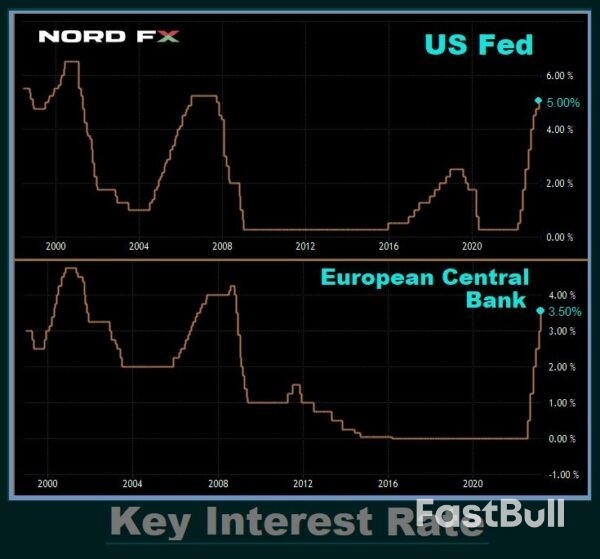
          Inflation in the euro area is too high for comfort, meaning markets expect the European Central Bank to deliver its seventh straight interest rate hike on Thursday.
          With some stability returning to banks after a March rout, hawks may feel confident pushing for a larger hike, and key inflation and bank lending data on Tuesday could sway the debate.
          "The big question is, is it going to be 25 or 50 bps?," said Gareth Hill, fund manager at Royal London Asset Management. "On balance at this stage, I'm certainly leaning more towards 25."
          Here are five key questions for markets.
          1/ How much will the ECB hike rates by on Thursday?
          Economists polled by Reuters expect a 25 bps rise to 3.25%. A recent source-based report suggested policymakers were converging on a such a move, even if other options remain on the table.
          ECB board member Isabel Schnabel reckons a 50 bps increase is not off the cards, while France's Francois Villeroy de Galhau has said further moves should be limited in size and number.
          April inflation and bank lending on Tuesday could be key. Data on Friday showed Germany's economy stagnated in the first quarter, supporting the case for a small hike.
          Too High for Comfort: Five Questions for the ECB_12/ When will the ECB be done with tightening?
          Not yet. Most analysts expect at least one more rate move after Thursday, even as the Federal Reserve looks set to pause its rate hike campaign.
          Market pricing suggests ECB rates will peak around 3.6% this year, and Belgium's central bank governor Pierre Wunsch says he wouldn't be surprised to see rates rise to 4%.
          Deutsche Bank's global head of rates Francis Yared said he saw a possible terminal rate above 4% given that underlying inflation and wages are growing faster in Europe versus the United States, while euro area fiscal policy has more scope to be expansionary.
          "If you look at it under that perspective, it's not obvious to have a more than 1% gap between the peak policy rates in the two areas," he said.
          Too High for Comfort: Five Questions for the ECB_23/ How sticky is core inflation?
          Very. Tuesday's flash inflation release should show that although headline inflation continues to ease from 2022's record highs, the underlying measure remains well above its 2% target.
          Strong growth in the bloc's services sector, making up the bulk of its economic activity, suggests core inflation and wage pressures remain elevated, complicating ECB efforts to tame inflation.
          The April flash Composite Purchasing Managers' Index, seen as a good gauge of overall economic health, jumped to an 11-month high of 54.4 in April.Too High for Comfort: Five Questions for the ECB_3
          4/ What's going on with wage pressures?
          Well, labour markets are tight and workers are demanding wage increases to keep up with higher prices.
          Germany's public sector workers just secured a deal to give 2.5 million employees a 5.5% permanent increase next year.
          That will set an important precedent for other pay talks and could threaten the ECB's forecast for wage growth to peak this year.
          "Tight labour markets are supporting worker and union bargaining power," said Patrick Saner, head of macro strategy at Swiss Re. "Whilst we view a 1970s wage-price spiral as unlikely, recent labour market developments must for sure be concerning for the ECB as it keeps the risk of a spiral simmering."
          5/ How has the banking turmoil impacting financing conditions?
          Tuesday's bank lending should offer some clues but it might be too early to gauge the full impact of the March banking crisis on financing conditions.
          Analysts suspect that the turmoil, which knocked 14% off European banks' share prices overall in March, has further tightened lending for corporations.
          "After the developments in the U.S. and Switzerland banking systems, we cut our policy terminal rate forecasts by 25 bps to 3.75% as we expect banks' loan offices to become more risk-averse," said Barclays European economist Silvia Ardagna, adding that the chances of a 50 bps rate hike in May was "very low" given easing economic growth and inflation.

          Too High for Comfort: Five Questions for the ECB_4Source:Yahoo

          To stay updated on all economic events of today, please check out our Economic calendar
          Risk Warnings and Disclaimers
          You understand and acknowledge that there is a high degree of risk involved in trading. Following any strategies or investment methods may lead to potential losses. The content on the site is provided by our contributors and analysts for information purposes only. You are solely responsible for determining whether any trading assets, securities, strategy, or any other product is suitable for investing based on your own investment objectives and financial situation.
          Comments
          Add to Favorites
          Share

          Neoliberalism's Final Stronghold

          Cohen

          Economic

          The past decade has not been kind to neoliberalism. With 40 years of deregulation, financialization, and globalization having failed to deliver prosperity for anyone but the rich, the United States and other Western liberal democracies have seemingly moved on from the neoliberal experiment and re-embraced industrial policy. But the economic paradigm that underpinned Thatcherism, Reaganomics, and the Washington Consensus is alive and well in at least one place: the pages of the Economist.
          A recent essay celebrating America's “astonishing economic record” is a case in point. After urging despondent Americans to be happy about their country's “stunning success story,” the authors double down on condescension: “The more that Americans think their economy is a problem in need of fixing, the more likely their politicians are to mess up the next 30 years.” While acknowledging that “America's openness” brought prosperity to firms and consumers, the authors also note that former President Donald Trump and current President Joe Biden “have turned to protectionism.” Subsidies, they warn, could boost investment in the short term but “entrench wasteful and distorting lobbying.” In order to address challenges like the rise of China and climate change, the U.S. must “remember what has powered its long and successful run.”
          As usual, the Economist delivers its reverence for neoliberal dogma with all the sanctimony and certitude of a true believer. Americans must sit down, shut up, and recite the catechism: “The market giveth, the market taketh away: blessed be the name of the market.” To doubt that the U.S. economy's current problems are caused by anything other than an interventionist, overbearing government is apostasy. But, as an economic historian, what took my breath away was the essay's conclusion, which attributes America's postwar prosperity to its worship of the Mammon of Unrighteousness (more commonly known as laissez-faire capitalism).
          The essay cites three “fresh challenges” facing the U.S.: the security threat posed by China, the need to rejigger the global division of labor due to China's growing economic clout, and the fight against climate change. The climate challenge, of course, is hardly “fresh,” given that the world is at least three generations late in addressing it. Moreover, our failure to act promptly means that the economic impact of global warming will likely consume most, if not all, of the world's anticipated technological dividends over the next two generations.
          From a neoliberal perspective, these challenges are considered “externalities.” The market economy cannot address them because it does not see them. After all, preventing a war in the Pacific or helping Pakistan avoid destructive floods by slowing global warming does not involve financial transactions. By the same token, the collaborative research and development efforts of engineers and innovators worldwide are the primary drivers of absolute and relative economic prosperity. But they, too, are invisible to the calculus of the market.
          Recognizing the scale and urgency of global challenges such as climate change and then denying, as the Economist does, that only governments can effectively address them amounts to something resembling intellectual malpractice. Adam Smith himself supported the Navigation Acts – which regulated trade and shipping between England, its colonies, and other countries – despite the fact that they mandated that goods be transported on British ships even if other options were cheaper. “Defense,” he wrote in The Wealth of Nations, “is of much more importance than opulence.” Denouncing desirable security policies as “protectionist” was beside the point then and now.
          Moreover, the Economist's denunciation of Biden's alleged protectionism is accompanied by the ambiguous observation that “the politics of immigration have become toxic.” In fact, there are only two options: The U.S. should either welcome more immigrants (as I believe it must), because they are highly productive and quickly integrate, or it must restrict immigration because some believe that the assimilation process is too slow. By remaining vague, the authors punt, perhaps hoping to leave readers on both sides of the issue convinced that the Economist shares their views.
          The essay's observation that subsidies could “boost investment in deprived areas in the short term” but also “entrench wasteful and distorting lobbying” in the long run is similarly equivocal. The underlying claim appears to be that while market failures caused by externalities are bad, the potential consequences of government policies aimed at correcting them are worse. Americans' safest bet is simply to keep faith with the market.
          The Economist's argument reflects a fundamental misunderstanding of U.S. history. The American economic tradition is rooted in the ideas of Alexander Hamilton, Abraham Lincoln, Teddy and Franklin Roosevelt, and Dwight Eisenhower, who recognized the need for a developmental state and the dangers of rent-seeking.
          To be sure, it has been 70 years since Eisenhower's presidency, and much of America's state capacity has been hollowed out during the long neoliberal era that began with the election of Ronald Reagan. But the laissez-faire policies that were woefully inadequate for the mass-production economy of the 1950s are an even worse fit for the biotech and IT-based economy of the future. Rather than reject Biden's industrial policies, Americans should embrace them. To quote Margaret Thatcher, there is no alternative.

          Source: ZAWYA

          To stay updated on all economic events of today, please check out our Economic calendar
          Risk Warnings and Disclaimers
          You understand and acknowledge that there is a high degree of risk involved in trading. Following any strategies or investment methods may lead to potential losses. The content on the site is provided by our contributors and analysts for information purposes only. You are solely responsible for determining whether any trading assets, securities, strategy, or any other product is suitable for investing based on your own investment objectives and financial situation.
          Comments
          Add to Favorites
          Share
          FastBull
          Copyright © 2025 FastBull Ltd

          728 RM B 7/F GEE LOK IND BLDG NO 34 HUNG TO RD KWUN TONG KLN HONG KONG

          TelegramInstagramTwitterfacebooklinkedin
          App Store Google Play Google Play
          Products
          Charts

          Chats

          Q&A with Experts
          Screeners
          Economic Calendar
          Data
          Tools
          Membership
          Features
          Function
          Markets
          Copy Trading
          Latest Signals
          Contests
          News
          Analysis
          24/7
          Columns
          Education
          Company
          Careers
          About Us
          Contact Us
          Advertising
          Help Center
          Feedback
          User Agreement
          Privacy Policy
          Business

          White Label

          Data API

          Web Plug-ins

          Poster Maker

          Affiliate Program

          Risk Disclosure

          The risk of loss in trading financial instruments such as stocks, FX, commodities, futures, bonds, ETFs and crypto can be substantial. You may sustain a total loss of the funds that you deposit with your broker. Therefore, you should carefully consider whether such trading is suitable for you in light of your circumstances and financial resources.

          No decision to invest should be made without thoroughly conducting due diligence by yourself or consulting with your financial advisors. Our web content might not suit you since we don't know your financial conditions and investment needs. Our financial information might have latency or contain inaccuracy, so you should be fully responsible for any of your trading and investment decisions. The company will not be responsible for your capital loss.

          Without getting permission from the website, you are not allowed to copy the website's graphics, texts, or trademarks. Intellectual property rights in the content or data incorporated into this website belong to its providers and exchange merchants.

          Not Logged In

          Log in to access more features

          FastBull Membership

          Not yet

          Purchase

          Become a signal provider
          Help Center
          Customer Service
          Dark Mode
          Price Up/Down Colors

          Log In

          Sign Up

          Position
          Layout
          Fullscreen
          Default to Chart
          The chart page opens by default when you visit fastbull.com
