• Trade
  • Markets
  • Copy
  • Contests
  • News
  • 24/7
  • Calendar
  • Q&A
  • Chats
Trending
Screeners
SYMBOL
LAST
BID
ASK
HIGH
LOW
NET CHG.
%CHG.
SPREAD
SPX
S&P 500 Index
6827.42
6827.42
6827.42
6899.86
6801.80
-73.58
-1.07%
--
DJI
Dow Jones Industrial Average
48458.04
48458.04
48458.04
48886.86
48334.10
-245.98
-0.51%
--
IXIC
NASDAQ Composite Index
23195.16
23195.16
23195.16
23554.89
23094.51
-398.69
-1.69%
--
USDX
US Dollar Index
97.950
98.030
97.950
98.500
97.950
-0.370
-0.38%
--
EURUSD
Euro / US Dollar
1.17394
1.17409
1.17394
1.17496
1.17192
+0.00011
+ 0.01%
--
GBPUSD
Pound Sterling / US Dollar
1.33707
1.33732
1.33707
1.33997
1.33419
-0.00148
-0.11%
--
XAUUSD
Gold / US Dollar
4299.39
4299.39
4299.39
4353.41
4257.10
+20.10
+ 0.47%
--
WTI
Light Sweet Crude Oil
57.233
57.485
57.233
58.011
56.969
-0.408
-0.71%
--

Community Accounts

Signal Accounts
--
Profit Accounts
--
Loss Accounts
--
View More

Become a signal provider

Sell trading signals to earn additional income

View More

Guide to Copy Trading

Get started with ease and confidence

View More

Signal Accounts for Members

All Signal Accounts

Best Return
  • Best Return
  • Best P/L
  • Best MDD
Past 1W
  • Past 1W
  • Past 1M
  • Past 1Y

All Contests

  • All
  • Trump Updates
  • Recommend
  • Stocks
  • Cryptocurrencies
  • Central Banks
  • Featured News
Top News Only
Share

China's Central Financial And Economic Affairs Commission Deputy Director: Will Expand Export And Increase Import In 2026

Share

Thai Leader Anutin: Landmine Blast That Killed Thai Soldiers 'Not A Roadside Accident'

Share

Thai Leader Anutin: Thailand To Continue Military Action Until 'We Feel No More Harm'

Share

Cambodian Prime Minister Hun Manet Says He Had Phone Calls With Trump And Malaysian Leader Anwar About Ceasefire

Share

Cambodia's Hun Manet Says USA, Malaysia Should Verify 'Which Side Fired First' In Latest Conflict

Share

Cambodia's Hun Manet: Cambodia Maintains Its Stance In Seeking Peaceful Resolution Of Disputes

Share

Nasdaq Companies: Allergan, Ferrovia, Insmed, Monolithic Power Systems, Seagate Technology, And Western Digital Will Be Added To The NASDAQ 100 Index. Biogen, CdW, GlobalFoundries, Lululemon, ON Semiconductor, And Tradedesk Will Be Removed From The NASDAQ 100 Index

Share

Witkoff Headed To Berlin This Weekend To Meet With Zelenskiy, European Leaders -Wsj Reporter On X

Share

Russia Attacks Two Ukrainian Ports, Damaging Three Turkish-Owned Vessels

Share

[Historic Flooding Occurs In At Least Four Rivers In Washington State Due To Days Of Torrential Rains] Multiple Areas In Washington State Have Been Hit By Severe Flooding Due To Days Of Torrential Rains, With At Least Four Rivers Experiencing Historic Flooding. Reporters Learned On The 12th That The Floods Caused By The Torrential Rains In Washington State Have Destroyed Homes And Closed Several Highways. Experts Warn That Even More Severe Flooding May Occur In The Future. A State Of Emergency Has Been Declared In Washington State

Share

Trump Says Proposed Free Economic Zone In Donbas Would Work

Share

Trump: I Think My Voice Should Be Heard

Share

Trump Says Will Be Choosing New Fed Chair In Near Future

Share

Trump Says Proposed Free Economic Zone In Donbas Complex But Would Work

Share

Trump Says Land Strikes In Venezuela Will Start Happening

Share

US President Trump: Thailand And Cambodia Are In A Good Situation

Share

State Media: North Korean Leader Kim Hails Troops Returning From Russia Mission

Share

The 10-year Treasury Yield Rose About 5 Basis Points During The "Fed Rate Cut Week," And The 2/10-year Yield Spread Widened By About 9 Basis Points. On Friday (December 12), In Late New York Trading, The Yield On The Benchmark 10-year US Treasury Note Rose 2.75 Basis Points To 4.1841%, A Cumulative Increase Of 4.90 Basis Points For The Week, Trading Within A Range Of 4.1002%-4.2074%. It Rose Steadily From Monday To Wednesday (before The Fed Announced Its Rate Cut And Treasury Bill Purchase Program), Subsequently Exhibiting A V-shaped Recovery. The 2-year Treasury Yield Fell 1.82 Basis Points To 3.5222%, A Cumulative Decrease Of 3.81 Basis Points For The Week, Trading Within A Range Of 3.6253%-3.4989%

Share

Trump: Lots Of Progress Being Made On Russia-Ukraine

Share

NOPA November US Soybean Crush Estimated At 220.285 Million Bushels

TIME
ACT
FCST
PREV
U.K. Trade Balance Non-EU (SA) (Oct)

A:--

F: --

P: --

U.K. Trade Balance (Oct)

A:--

F: --

P: --

U.K. Services Index MoM

A:--

F: --

P: --

U.K. Construction Output MoM (SA) (Oct)

A:--

F: --

P: --

U.K. Industrial Output YoY (Oct)

A:--

F: --

P: --

U.K. Trade Balance (SA) (Oct)

A:--

F: --

P: --

U.K. Trade Balance EU (SA) (Oct)

A:--

F: --

P: --

U.K. Manufacturing Output YoY (Oct)

A:--

F: --

P: --

U.K. GDP MoM (Oct)

A:--

F: --

P: --

U.K. GDP YoY (SA) (Oct)

A:--

F: --

P: --

U.K. Industrial Output MoM (Oct)

A:--

F: --

P: --

U.K. Construction Output YoY (Oct)

A:--

F: --

P: --

France HICP Final MoM (Nov)

A:--

F: --

P: --

China, Mainland Outstanding Loans Growth YoY (Nov)

A:--

F: --

P: --

China, Mainland M2 Money Supply YoY (Nov)

A:--

F: --

P: --

China, Mainland M0 Money Supply YoY (Nov)

A:--

F: --

P: --

China, Mainland M1 Money Supply YoY (Nov)

A:--

F: --

P: --

India CPI YoY (Nov)

A:--

F: --

P: --

India Deposit Gowth YoY

A:--

F: --

P: --

Brazil Services Growth YoY (Oct)

A:--

F: --

P: --

Mexico Industrial Output YoY (Oct)

A:--

F: --

P: --

Russia Trade Balance (Oct)

A:--

F: --

P: --

Philadelphia Fed President Henry Paulson delivers a speech
Canada Building Permits MoM (SA) (Oct)

A:--

F: --

P: --

Canada Wholesale Sales YoY (Oct)

A:--

F: --

P: --

Canada Wholesale Inventory MoM (Oct)

A:--

F: --

P: --

Canada Wholesale Inventory YoY (Oct)

A:--

F: --

P: --

Canada Wholesale Sales MoM (SA) (Oct)

A:--

F: --

P: --

Germany Current Account (Not SA) (Oct)

A:--

F: --

P: --

U.S. Weekly Total Rig Count

A:--

F: --

P: --

U.S. Weekly Total Oil Rig Count

A:--

F: --

P: --

Japan Tankan Large Non-Manufacturing Diffusion Index (Q4)

--

F: --

P: --

Japan Tankan Small Manufacturing Outlook Index (Q4)

--

F: --

P: --

Japan Tankan Large Non-Manufacturing Outlook Index (Q4)

--

F: --

P: --

Japan Tankan Large Manufacturing Outlook Index (Q4)

--

F: --

P: --

Japan Tankan Small Manufacturing Diffusion Index (Q4)

--

F: --

P: --

Japan Tankan Large Manufacturing Diffusion Index (Q4)

--

F: --

P: --

Japan Tankan Large-Enterprise Capital Expenditure YoY (Q4)

--

F: --

P: --

U.K. Rightmove House Price Index YoY (Dec)

--

F: --

P: --

China, Mainland Industrial Output YoY (YTD) (Nov)

--

F: --

P: --

China, Mainland Urban Area Unemployment Rate (Nov)

--

F: --

P: --

Saudi Arabia CPI YoY (Nov)

--

F: --

P: --

Euro Zone Industrial Output YoY (Oct)

--

F: --

P: --

Euro Zone Industrial Output MoM (Oct)

--

F: --

P: --

Canada Existing Home Sales MoM (Nov)

--

F: --

P: --

Euro Zone Total Reserve Assets (Nov)

--

F: --

P: --

U.K. Inflation Rate Expectations

--

F: --

P: --

Canada National Economic Confidence Index

--

F: --

P: --

Canada New Housing Starts (Nov)

--

F: --

P: --

U.S. NY Fed Manufacturing Employment Index (Dec)

--

F: --

P: --

U.S. NY Fed Manufacturing Index (Dec)

--

F: --

P: --

Canada Core CPI YoY (Nov)

--

F: --

P: --

Canada Manufacturing Unfilled Orders MoM (Oct)

--

F: --

P: --

Canada Manufacturing New Orders MoM (Oct)

--

F: --

P: --

Canada Core CPI MoM (Nov)

--

F: --

P: --

Canada Manufacturing Inventory MoM (Oct)

--

F: --

P: --

Canada CPI YoY (Nov)

--

F: --

P: --

Canada CPI MoM (Nov)

--

F: --

P: --

Canada CPI YoY (SA) (Nov)

--

F: --

P: --

Canada Core CPI MoM (SA) (Nov)

--

F: --

P: --

Q&A with Experts
    • All
    • Chatrooms
    • Groups
    • Friends
    Connecting
    .
    .
    .
    Type here...
    Add Symbol or Code

      No matching data

      All
      Trump Updates
      Recommend
      Stocks
      Cryptocurrencies
      Central Banks
      Featured News
      • All
      • Russia-Ukraine Conflict
      • Middle East Flashpoint
      • All
      • Russia-Ukraine Conflict
      • Middle East Flashpoint
      Search
      Products

      Charts Free Forever

      Chats Q&A with Experts
      Screeners Economic Calendar Data Tools
      Membership Features
      Data Warehouse Market Trends Institutional Data Policy Rates Macro

      Market Trends

      Market Sentiment Order Book Forex Correlations

      Top Indicators

      Charts Free Forever
      Markets

      News

      News Analysis 24/7 Columns Education
      From Institutions From Analysts
      Topics Columnists

      Latest Views

      Latest Views

      Trending Topics

      Top Columnists

      Latest Update

      Signals

      Copy Rankings Latest Signals Become a signal provider AI Rating
      Contests
      Brokers

      Overview Brokers Assessment Rankings Regulators News Claims
      Broker listing Forex Brokers Comparison Tool Live Spread Comparison Scam
      Q&A Complaint Scam Alert Videos Tips to Detect Scam
      More

      Business
      Events
      Careers About Us Advertising Help Center

      White Label

      Data API

      Web Plug-ins

      Affiliate Program

      Awards Institution Evaluation IB Seminar Salon Event Exhibition
      Vietnam Thailand Singapore Dubai
      Fans Party Investment Sharing Session
      FastBull Summit BrokersView Expo
      Recent Searches
        Top Searches
          Markets
          News
          Analysis
          User
          24/7
          Economic Calendar
          Education
          Data
          • Names
          • Latest
          • Prev

          View All

          No data

          Scan to Download

          Faster Charts, Chat Faster!

          Download App
          English
          • English
          • Español
          • العربية
          • Bahasa Indonesia
          • Bahasa Melayu
          • Tiếng Việt
          • ภาษาไทย
          • Français
          • Italiano
          • Türkçe
          • Русский язык
          • 简中
          • 繁中
          Open Account
          Search
          Products
          Charts Free Forever
          Markets
          News
          Signals

          Copy Rankings Latest Signals Become a signal provider AI Rating
          Contests
          Brokers

          Overview Brokers Assessment Rankings Regulators News Claims
          Broker listing Forex Brokers Comparison Tool Live Spread Comparison Scam
          Q&A Complaint Scam Alert Videos Tips to Detect Scam
          More

          Business
          Events
          Careers About Us Advertising Help Center

          White Label

          Data API

          Web Plug-ins

          Affiliate Program

          Awards Institution Evaluation IB Seminar Salon Event Exhibition
          Vietnam Thailand Singapore Dubai
          Fans Party Investment Sharing Session
          FastBull Summit BrokersView Expo

          Fed's Waller Still Sees 'No Rush' to Cut Rates amid Sticky Inflation Data

          Devin

          Economic

          Central Bank

          Summary:

          Recent disappointing inflation data affirms the case for the U.S. Federal Reserve to hold off on cutting its short-term interest rate target, Fed Governor Christopher Waller said on Wednesday, but he did not rule out trimming rates later in the year.

          "There is no rush to cut the policy rate" right now, Waller said in a speech at an Economic Club of New York gathering. Recent data "tells me that it is prudent to hold this rate at its current restrictive stance perhaps for longer than previously thought to help keep inflation on a sustainable trajectory toward 2%."
          Rate cuts are not off the table, however, Waller said, noting that further progress expected on lowering inflation "will make it appropriate" for the Fed "to begin reducing the target range for the federal funds rate this year."
          It could take a few months of easing inflation data to gain that confidence, but until then, a strong economy gives the Fed space to take stock of how the economy is performing, Waller said.
          Pushing back the start of rate cuts will likely affect how much easing happens this year, he said. "It is appropriate to reduce the overall number of rate cuts or push them further into the future in response to the recent data."
          Waller's comments were his first since last week's Fed policy meeting where officials, as expected, maintained the overnight policy rate at 5.25% to 5.5%. Policy makers also affirmed forecasts from year-end 2023 for three rate cuts this year, based on the expectation that inflation will fall back toward 2% as the year moves forward.
          However, unexpectedly strong inflation this year has called into question whether the Fed can deliver on its forecast. Fed officials are waiting to see if recent data reflects a temporary setback in the effort to reduce price pressures, and if so, this could mean dialing back rate cut expectations for the year.
          At the press conference following last week's policy meeting, Fed Chairman Jerome Powell said current policy risks are "two sided."
          "We're in a situation where if we ease too much or too soon, we could see inflation come back, and if we ease too late, we could do unnecessary harm to employment and people's working lives," he said. "We want to be careful" and the strength of the economy gives the Fed space to watch the data before deciding what to do with interest rate policy, he added.
          At the end of February, Waller signaled he was among the officials with some skepticism about any near-term rate cuts, given that the economy is showing strong growth amid a very strong labor market.
          In comments after his formal remarks on Wednesday, Waller said there is an extremely high bar to the central bank raising rates. “Something would really have to dramatically change on the inflation front to think about" pushing rates higher, he said.
          Instead, he said, the question before the Fed is when to ease rates and "it’s just a question of when you start."

          Source: Reuters

          To stay updated on all economic events of today, please check out our Economic calendar
          Risk Warnings and Disclaimers
          You understand and acknowledge that there is a high degree of risk involved in trading. Following any strategies or investment methods may lead to potential losses. The content on the site is provided by our contributors and analysts for information purposes only. You are solely responsible for determining whether any trading assets, securities, strategy, or any other product is suitable for investing based on your own investment objectives and financial situation.
          Add to Favorites
          Share

          Global Freight Acceleration Will Lift Fuel Prices

          Devin

          Commodity

          Energy

          Global trade flows have showed signs of accelerating at the start of 2024, as the major industrial economies began to pull out of the slump that started in late 2022, which should boost demand for transport fuels such as diesel.
          Short-term activity indicators have been distorted by unusual weather patterns across North America and Europe, with an exceptionally mild December followed by more normal temperatures in January.
          On balance, however, most indicators point to manufacturing and freight activity starting to accelerate around the turn of the year, in some cases quite markedly, despite relatively high interest rates.
          Seasonally-adjusted world trade volumes hit a 10-month high in January 2024, according to data compiled by the Netherlands Bureau of Economic Policy Analysis (CPB).
          Volumes in January had increased compared with the prior year for the first time since March 2023 and before that October 2022 (“World trade monitor”, CPB, March 25, 2024).
          Seasonally-adjusted global industrial production surged in December before easing back in January, which was likely to have been caused by the weather and timing of holidays.
          But for the three months from November to January, output had risen by 1.7% compared with a year earlier, the fastest increase since October 2022.
          A Mixed Picture
          London’s Heathrow airport reported the busiest start to the year for air freight since before the coronavirus pandemic.
          Air cargo handled in the first two months of the year was the highest since 2019 and up by 21% compared with last year.
          Singapore’s massive maritime terminal also reported handling a record volume of shipping containers at the start of 2024.
          Total container freight for Singapore was up by 18% in January and February compared with a year earlier, the fastest growth since 2018 and before that 2010.
          South Korea’s KOSPI-100 equity index, which tends to track global trade, given its heavy exposure to exporting firms, has been rising rapidly.
          In the United States, container freight handled by the nine largest ports was up by almost 7% in January compared with a year ago.
          Major U.S. railroads hauled almost 5% more multi-modal containers in January from a year earlier, the fastest growth since 2021 and before that 2016.
          Other indicators, such as cargo handled through Narita airport in Japan and truck loads on U.S. highways, paint a more mixed picture.
          Even there, however, freight movements were flat-lining after consistent declines in 2023 and late 2022, pointing to a trough forming.
          After The Trough
          Missile and drone attacks on container shipping in the Red Sea and Gulf of Aden have re-directed trade between Asia and Europe-North America on the longer and more expensive route round the Cape of Good Hope.
          The disruption of container flows is likely to distort freight statistics for February and March, making it harder to confirm any change in the trend.
          But the overall picture is that freight movements have started to rise even before the U.S. Federal Reserve and other major central banks cut interest rates.
          If the major central banks cut rates this year, as policymakers have indicated, to jump start spending on housing and expensive durable items, the rise in freight will accelerate.
          Most middle petroleum distillates (including diesel, gas oil and a proportion of jet fuel) are used in freight transport, manufacturing and construction.
          Renewed growth in industrial activity will therefore boost distillate consumption and likely lift fuel prices and refinery margins, especially given inventories are already below the long-term average.
          Moreover, middle distillates are the largest group of petroleum products, accounting for 29% of world oil consumption, rising to 35% if jet fuel is included.
          Heavy fuel oils account for another 7% of global consumption, and some of that is used in ocean shipping, as well as in onshore power generation and industrial furnaces.
          Higher freight volumes will therefore quickly translate into faster growth in consumption, likely lifting prices for crude oil as well as middle and heavy refined fuels.
          The apparent stabilisation of manufacturing and freight, as well as the delicate balance in the fuel market, are among factors making central banks cautious about the timing and scale of rate cuts.
          The most likely scenario is for modest rate cuts, a modest acceleration in manufacturing and freight, and moderately higher oil and fuel prices over the remainder of 2024.

          Source: MarketScreener

          Risk Warnings and Disclaimers
          You understand and acknowledge that there is a high degree of risk involved in trading. Following any strategies or investment methods may lead to potential losses. The content on the site is provided by our contributors and analysts for information purposes only. You are solely responsible for determining whether any trading assets, securities, strategy, or any other product is suitable for investing based on your own investment objectives and financial situation.
          Add to Favorites
          Share

          Treasuries Decline, Asian Stocks Fall on Japan: Markets Wrap

          Thomas

          Economic

          Stocks

          Forex

          Yields on Treasuries advanced across tenors in early trading in Asia following Fed Governor Christopher Waller’s remarks after the Wednesday close that there is no rush to lower interest rates, and he wants to see “at least a couple months of better inflation data” before cutting. Two-year Treasury yields, which are more sensitive to policy moves, rose three basis points while the dollar strengthened against all of its Group-of-10 peers.
          Shares in Japan slipped as they traded ex-dividend. The move also came after the Nikkei 225 index Wednesday advanced to near its record high. Meanwhile, Australian stocks climbed to a fresh record, while futures for benchmarks in Hong Kong pointed to gains.
          Contracts for US equities were little changed in Asian trading after the S&P 500 closed at a record, with many institutional investors potentially rebalancing their portfolios.
          In Asia, the yen will remain in focus. The currency steadied in early trading after pulling back from the lowest level since 1990. The yen had weakened to 151.97, beyond the level at which policymakers stepped in during October 2022.
          “Market perception is they have drawn a line in the sand at 152,” said Paresh Upadhyaya, director of fixed income and currency strategy at Amundi Asset Management US. “The key question is their commitment.”
          In commodities, oil climbed to head for a solid quarterly gain on expectations OPEC+ supply cuts would tighten the global market. Gold steadied Thursday after three sessions of gains.
          The US government had its credit score affirmed by S&P Global Ratings at AA+, even as the country continues to face fiscal challenges. “Bipartisan cooperation to strengthen the US fiscal profile — namely to meaningfully lower deficits and tackle budgetary rigidities — remains elusive,” S&P said in a statement.
          Meanwhile, after the S&P 500 soared about 25% since late October, many have flagged concern that positioning is stretched and stocks are more vulnerable to short-term profit taking.
          “While we expect this bull market to continue, we wouldn’t be surprised if we see a 5%-7% correction,” said Gina Bolvin, president of Bolvin Wealth Management Group.
          JPMorgan Chase & Co.’s Dubravko Lakos-Bujas warned clients on Wednesday that they could be “stuck on the wrong side” of the momentum trade when it eventually falters, and he encouraged them to consider diversifying their holdings and thinking about risk management in their portfolios. He also reiterated his warning that excessive crowding in the market’s best-performing stocks raises the risk of an imminent correction.

          Source: Bloomberg

          To stay updated on all economic events of today, please check out our Economic calendar
          Risk Warnings and Disclaimers
          You understand and acknowledge that there is a high degree of risk involved in trading. Following any strategies or investment methods may lead to potential losses. The content on the site is provided by our contributors and analysts for information purposes only. You are solely responsible for determining whether any trading assets, securities, strategy, or any other product is suitable for investing based on your own investment objectives and financial situation.
          Add to Favorites
          Share

          Why did the Baltimore Bridge Collapse and What Is the Death Toll?

          Alex

          Economic

          Divers recovered the remains of two of the six missing workers more than a day after a cargo ship smashed into Baltimore's Francis Scott Key Bridge. The bodies of two men were found in a red pickup truck submerged in the icy waters of the Patapsco River. Rescuers pulled two workers from the water alive on Tuesday, and one was hospitalized.

          When did the Baltimore bridge collapse?

          Shortly after 1 a.m. EDT (05:00 GMT), a container ship named the Dali was sailing down the Patapsco River on its way to Sri Lanka. At 1:24 a.m., it suffered a total power failure and all its lights went out.
          Three minutes later, at 1:27 a.m., the container ship struck a pylon of the bridge, crumpling almost the entire structure into the water.
          The bridge was up to code and there were no known structural issues, Maryland Governor Wes Moore said.
          Tuesday's disaster may be the worst U.S. bridge collapse since 2007, when a design error caused the I-35W bridge in Minneapolis to plunge into the Mississippi River, killing 13 people.

          What is the death toll so far?

          The two men whose bodies were recovered on Wednesday were identified as Alejandro Hernandez Fuentes, 35, of Baltimore, originally from Mexico, and Dorlian Ronial Castillo Cabrera, 26, of nearby Dundalk, originally from Guatemala.
          The six workers who are presumed dead came from Mexico, Guatemala, Honduras and El Salvador, according to a press conference.
          Authorities have suspended efforts to recover bodies in the 50-foot-deep (15 m) waters surrounding the twisted ruins due to treacherous conditions.
          At the time of the crash, a construction crew was fixing potholes on the bridge and eight people fell 185 feet (56 meters) into the river where water temperatures were 47 degrees Fahrenheit (8 degrees Celsius). Two workers were rescued, one unharmed and one injured.
          According to research for the Federal Aviation Administration, that is the upper limit of what a human could survive falling into water.
          Authorities saved lives by stopping vehicles from using the bridge after the ship sent out a mayday call, the Maryland governor said.
          The ship also dropped its anchors to slow the vessel, giving transportation authorities time to clear the bridge.

          Why did the bridge collapse?

          The metal truss-style bridge has a suspended deck, a design that contributed to its collapse, engineers say. The ship appeared to hit a main concrete pier, which rests on soil underwater and is part of the foundation.

          Who will pay for the damage and how much will the bridge cost?

          President Joe Biden promised to visit Baltimore soon and said he wanted the federal government to pay to rebuild the bridge.
          The Transportation Department can award "quick release" emergency relief funds that are typically a few million dollars. To replace the bridge, Congress would need to approve funding. After the bridge collapse in 2007 in Minnesota, Congress allocated $250 million.
          Initial estimates put the cost of rebuilding the bridge at $600 million, according to economic analysis company IMPLAN.
          Insurers could face billions of dollars in claims, analysts said, with one putting the cost at as much as $4 billion, which would make the tragedy a record shipping insurance loss.

          How long will it take to rebuild the bridge?

          Rebuilding could be a lengthy process and will depend on whether any of the remaining structure can be salvaged. It took five years to construct the original bridge from 1972-1977.
          The closure of the port for just one month would cost Maryland $28 million in lost business, according to IMPLAN.

          What ship hit the Baltimore bridge?

          The Dali was leaving Baltimore en route to Colombo, Sri Lanka.
          None of the 22 crew members were hurt, the ship's manager, Synergy Marine Group said.
          The registered owner of the Singapore-flagged ship is Grace Ocean Pte Ltd, LSEG data show. The ship measures 948 feet (289 meters) — as long as three football fields placed end to end. It was stacked high with containers but was capable of carrying twice as much cargo. Safety investigators recovered the ship's black box, which can tell them the vessel's position, speed, heading, radar, bridge audio, and radio communications as well as alarms.
          The same ship was involved in an incident in the port of Antwerp, Belgium, in 2016, when it hit a quay as it tried to exit the North Sea container terminal.
          A later inspection in June 2023 carried out in San Antonio, Chile, found the vessel had "propulsion and auxiliary machinery" deficiencies, according to data on the public Equasis website, which provides information on ships.

          What do we know about the bridge that collapsed?

          The Francis Scott Key Bridge was one of three ways to cross the Baltimore Harbor and handled 31,000 cars per day or 11.3 million vehicles a year.
          The steel structure is four lanes wide and sits 185 feet (56 m) above the river.
          It opened in 1977 and crosses the Patapsco River, where U.S. national anthem author Francis Scott Key wrote the "Star Spangled Banner" in 1814 after witnessing the British defeat at the Battle of Baltimore and the British bombing of Fort McHenry.

          Why did the Baltimore Bridge Collapse and What Is the Death Toll?_1How will the bridge collapse impact the Baltimore port?
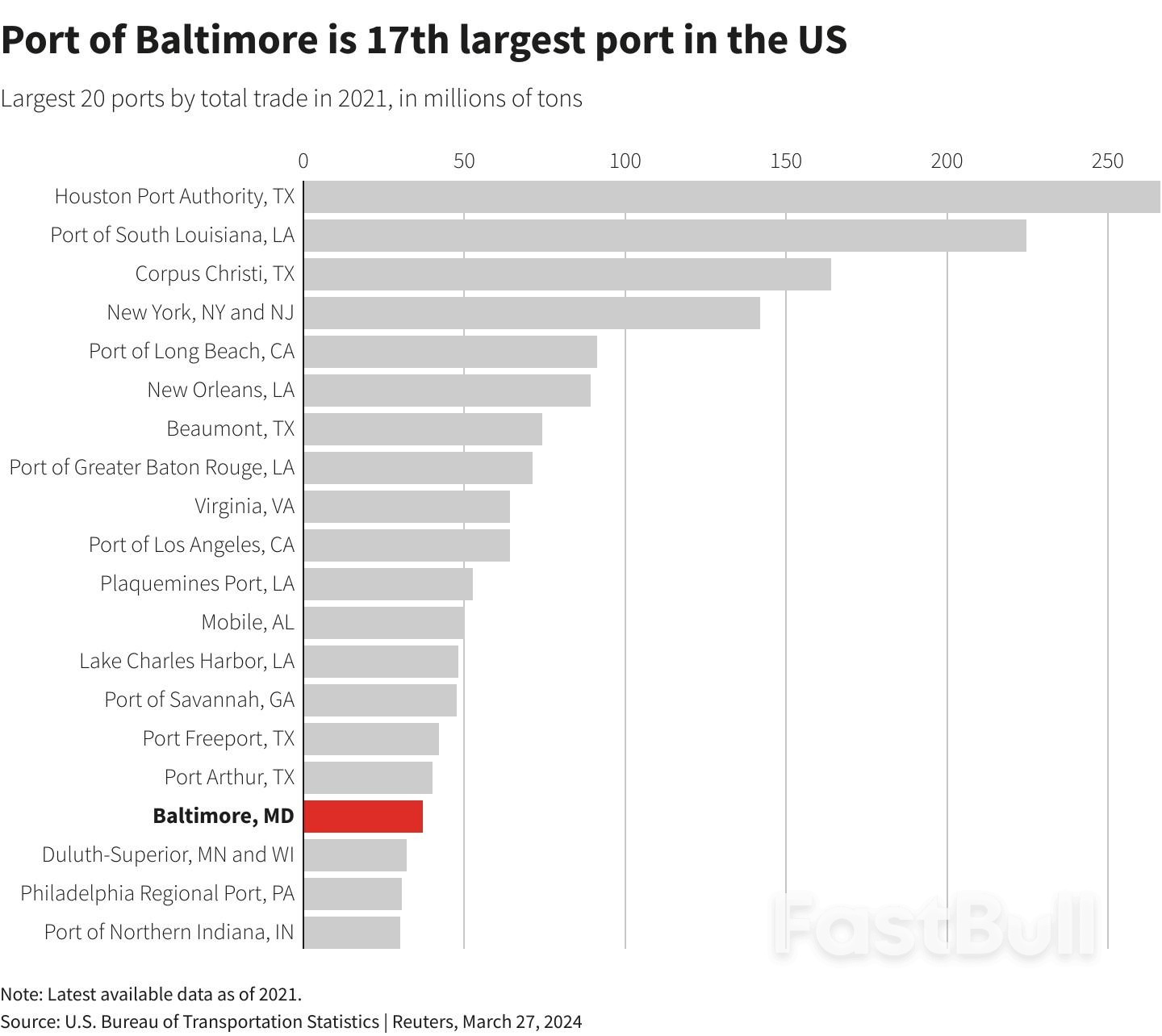
          Traffic was suspended at the port, the 17th largest in the country.
          The flow of containers to Baltimore can likely be redistributed to bigger ports. However, there could be major disruptions in shipping cars, coal and sugar.
          It is the busiest U.S. port for car shipments, handling at least 750,000 vehicles in 2023, according to data from the Maryland Port Administration.
          In 2023, the port was the second busiest for coal exports.
          It is also the largest U.S. port by volume for handling farm and construction machinery, as well as agricultural products such as sugar and salt.Why did the Baltimore Bridge Collapse and What Is the Death Toll?_2

          Source: Reuters

          To stay updated on all economic events of today, please check out our Economic calendar
          Risk Warnings and Disclaimers
          You understand and acknowledge that there is a high degree of risk involved in trading. Following any strategies or investment methods may lead to potential losses. The content on the site is provided by our contributors and analysts for information purposes only. You are solely responsible for determining whether any trading assets, securities, strategy, or any other product is suitable for investing based on your own investment objectives and financial situation.
          Add to Favorites
          Share

          Yen Dam Breached, But Not Burst

          Thomas

          Economic

          Forex

          The yen dam has been breached, but hasn't burst.
          Not yet, anyway.
          The currency's brief slide on Wednesday to a new 34-year low near 152 per dollar triggered an emergency meeting of Japan's three main monetary authorities, suggesting direct intervention in the market to stop what they consider disorderly and speculative moves is imminent.
          Asian market focus on Thursday will be on whether Tokyo backs up its increasingly loud and frequent warnings with action. Finance Minister Shunichi Suzuki said authorities could take "decisive steps" - language he hasn't used since Japan last intervened in 2022.
          The dollar has pulled back towards 151.00 yen of its own accord, a move that will extend if hedge funds and speculators start covering their substantial short yen position. Tokyo's helping hand would accelerate it further.
          But currency traders appear relaxed or skeptical about intervention. Dollar/yen volatility ticked up only slightly on Wednesday, and is still around its lowest levels in two years.
          Analysts at HSBC note the dollar is not in the 'bubble-like state' of late 2022, so the risk is any action now would yield "very limited success."
          Analysts at Morgan Stanley say there is little incentive to intervene from a fundamental perspective - Japan's terms of trade have improved, the weak exchange rate has hugely boosted exporter revenues and rate differentials are still heavily against the yen.
          Joseph Wang, a former senior trader at the New York Fed, was blunter: "Time for the authorities to put up or shut up. But honestly, my guess is intervention would be a waste and just buy a little time," he tweeted on Wednesday.Yen Dam Breached, But Not Burst_1
          Japan's officials may not fully welcome the yen's weakness, but equity investors do. The Nikkei is on the brink of new highs, up nearly 22% so far this year and on track for its best quarter since Q2 2009.
          Another 1.5% to the upside by the end of the week will seal the index's best quarterly performance on record.
          If Japanese stocks are on a roll, however, Chinese stocks are again threatening to roll over. The country's two main indexes slumped more than 1% on Wednesday, their steepest decline in a month and pushing them into the red for March.
          Authorities in Beijing may have welcomed Chinese industrial profits swinging back into positive territory, but they will not want to see stocks head back to their recent five-year lows and overseas investment dry up.
          In some respects, the keenest observers of whether Japan intervenes in the FX market are in Beijing. The yen is at its weakest level in more than 30 years against China's yuan, giving Japan a major competitive advantage over its rival.Yen Dam Breached, But Not Burst_2
          Here are key developments that could provide more direction to markets on Thursday:
          - Australia retail sales (February)
          - Thailand industrial production (February)
          - Bank of Japan summary of opinions from March 18 to 19 policy meeting

          Source: Reuters

          To stay updated on all economic events of today, please check out our Economic calendar
          Risk Warnings and Disclaimers
          You understand and acknowledge that there is a high degree of risk involved in trading. Following any strategies or investment methods may lead to potential losses. The content on the site is provided by our contributors and analysts for information purposes only. You are solely responsible for determining whether any trading assets, securities, strategy, or any other product is suitable for investing based on your own investment objectives and financial situation.
          Add to Favorites
          Share

          AUD to USD Forecast: Aussie Retail Sales and the RBA Interest Rate Path

          Samantha Luan

          Economic

          Forex

          Aussie Retail Sales Could Give the RBA More Certainty
          On Thursday, Australian retail sales figures will influence the buyer appetite for the AUD/USD. A larger-than-expected rise in retail sales could reignite speculation about an RBA interest rate hike.
          Economists forecast retail sales to increase by 0.4% in February. In January, retail sales jumped by 1.1%.
          Upward trends in consumer spending could fuel demand-driven inflationary pressures. A more hawkish RBA rate path could raise borrowing costs and reduce disposable income. Downward trends in disposable income could force consumers to curb spending, dampening demand-driven inflation.
          The retail sales figures are significant following softer-than-expected inflation numbers from Wednesday. In February, the CPI Monthly Indicator remained unchanged at 3.4%. Economists expected an inflation rate of 3.5%.
          In March, the RBA highlighted uncertainty about household spending. Household spending trends could influence the inflation outlook and the RBA rate path.

          US Economic Calendar: GDP, Jobless Claims, and Consumer Sentiment

          On Thursday, the US economy will be in the spotlight. Finalized Q4 GDP numbers, jobless claims, and finalized Michigan Consumer Sentiment figures warrant investor attention.
          The jobless claims and consumer sentiment figures will likely have more impact. Tight labor market conditions could support wage growth and consumer spending. Consumer spending may fuel demand-driven inflation and impact bets on an H1 2024 Fed rate cut.
          Significantly, tight labor market conditions also influence consumer sentiment. A positive consumer sentiment environment could drive consumer spending.
          Economists forecast initial jobless claims to increase from 210k to 215k in the week ending March 23. According to preliminary numbers, the Michigan Consumer Sentiment Index slipped from 76.9 to 76.5 in March.
          Other stats include Chicago PMI and pending home sales data. However, barring sizeable deviations from forecasts, these will likely play second fiddle to the jobless claims and sentiment numbers.
          Beyond the numbers, investors must consider FOMC member speeches. Recent Fed speeches created uncertainty about the timing of a Fed interest rate cut.

          Short-Term Forecast

          Near-term AUD/USD trends will hinge on Australian retail sales and US inflation figures. Soft Aussie retail sales figures could end bets on an RBA rate hike. Conversely, hotter-than-expected US inflation numbers could impact the number of Fed rate cuts in 2024. The net effect could be an AUD/USD drop below the $0.64500 handle.

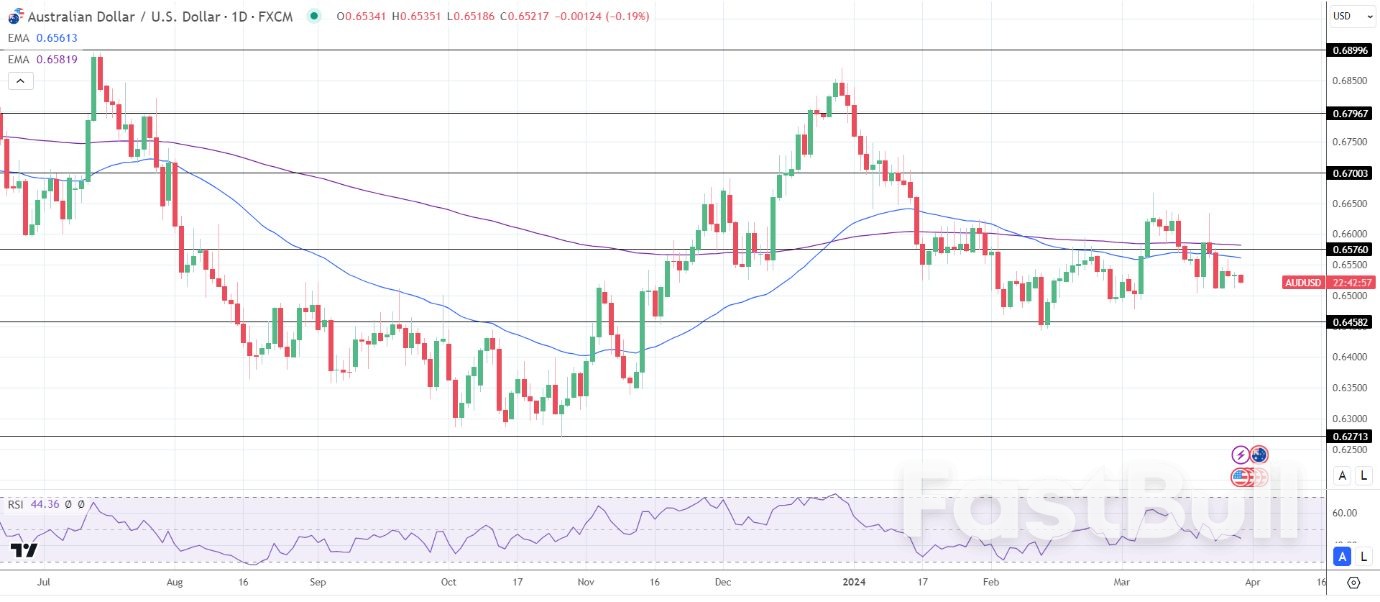
          AUD/USD Price Action

          Daily Chart
          AUD to USD Forecast: Aussie Retail Sales and the RBA Interest Rate Path_1
          The AUD/USD remained below the 50-day and 200-day EMAs, confirming the bearish price trends.
          An Aussie dollar return to the $0.65500 handle would give the bulls a run at the 50-day EMA. A breakout from the 50-day EMA could bring the $0.65760 resistance level and the 200-day EMA into play.
          Aussie retail sales and the US economic calendar need consideration.
          Conversely, an AUD/USD drop below the $0.65 handle could give the bears a run at the $0.64582 support level.
          With a 14-period Daily RSI reading of 44.36, the AUD/USD could fall through the $0.64582 support level before entering oversold territory.

          Source:FX Empire

          To stay updated on all economic events of today, please check out our Economic calendar
          Risk Warnings and Disclaimers
          You understand and acknowledge that there is a high degree of risk involved in trading. Following any strategies or investment methods may lead to potential losses. The content on the site is provided by our contributors and analysts for information purposes only. You are solely responsible for determining whether any trading assets, securities, strategy, or any other product is suitable for investing based on your own investment objectives and financial situation.
          Add to Favorites
          Share

          Monitoring Hungary: Waiting for More Clarity

          ING

          Economic

          Hungary: At a glance

          • After disappointing fourth-quarter data, the government revised its expectations for this year’s GDP growth to a range of 2-3%, which is now closer to our forecast of 2.1%.
          • Although the recent retail sales performance looks promising, industrial production has continuously disappointed, as risks are mounting in terms of the export outlook.
          • The very tight labour market has eased recently, which is likely to put downward pressure on wage growth, while the government plans to boost labour supply.
          • Although the trade balance has improved somewhat, the current account hasn’t caught up. Both are exposed to downside risks, stemming from external demand.
          • Inflation is back in the central bank’s tolerance band, however, it would be too early to declare victory as we expect two rounds of reflation this year.
          • The central bank erred on the side of caution in March and was as hawkish as expected, flagging an upcoming slowdown in the easing cycle.
          • February brought an exceptionally high monthly budget deficit, but it’s hard to put this in context, as we’re still waiting for an official update to this year’s ESA-based deficit target, moving it to 4.5% of GDP.
          • We are likely to see higher volatility in EUR/HUF in the coming months than in the first quarter, with our forecast of 405 for the end of the first half of the year.
          • We find the long end of the IRS and HGB curves attractive and believe that once things calm down, market interest will return given the levels relative to CEE peers and core rates.

          Quarterly forecasts

          Monitoring Hungary: Waiting for More Clarity_1

          Waiting for the first quarter GDP data to come in

          A few weeks ago we lowered our full-year GDP forecast for 2024 from 3.1% to 2.1% on the back of a much weaker carry-over effect. That said, the government's recent communication of 2-3% GDP growth suggests that they are getting closer to our own estimate. In the absence of new data, there is considerable uncertainty surrounding the economic outlook.
          What's more, due to a methodological update, GDP releases will be brought forward (1Q24 data are due on 30 April). This means that the information base of forecasting will shrink this year, as we'll see one less data point from both retail sales and industrial production before the new GDP print. However, what has already been visible is a structural shift in the growth structure. Last year, growth relied on net exports, while this year domestic demand looks to be the main driver.
          Real GDP (% YoY) and contributions (ppt)Monitoring Hungary: Waiting for More Clarity_2

          Disappointing order books for export-oriented companies are worrying

          Industrial production continued its downward trend in January, as production volumes fell by 1.1% month-on-month (MoM), contributing to a fall in output of 4.1% year-on-year (YoY) on a working-day basis. Volumes have contracted in the two most important sub-sectors, namely electrical and transport equipment. This isn't surprising given that external demand has become increasingly subdued, weighing on both industry and the country's trade balance.The outlook is also uncertain as the stock of both export and domestic orders fell by 16.3% and 13.4% YoY, respectively. In our view, we may see an earlier rebound in companies' domestic order books as local demand is expected to gradually recover this year. However, there is a lot of uncertainty surrounding the export outlook, as global manufacturing is still digesting the inventory overhang.
          Industrial production (IP) and Purchasing Manager Index (PMI)Monitoring Hungary: Waiting for More Clarity_3

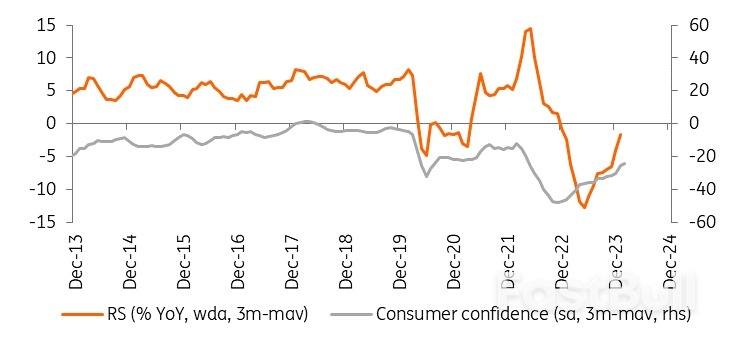
          It’s too early to call for a stable trend in retail sales

          Retail sales ended a 13-month streak of negative year-on-year performance as the volume of sales rose by 0.6% YoY in January. However, on a monthly basis, sales volumes, adjusted for seasonal and working day effects, were flat considering all sectors. At the component level, food sales were also flat on a monthly basis, while turnover of non-food shops increased. At the same time, fuel retailing saw a sharp fall of 3.6% on a monthly basis, but this was fully expected as a result of the excise duty hike.We believe that retail sales will gradually recover this year, but this trend will remain fragile. At the same time, we have already seen small increases in consumer confidence, which, together with positive real wage growth, will gradually reduce vulnerability and keep consumption on a gradual recovery path.
          Retail sales (RS) and consumer confidenceMonitoring Hungary: Waiting for More Clarity_4

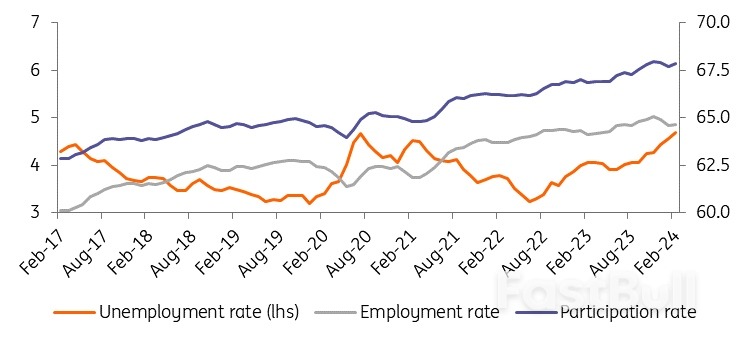
          Labour market tightness continues to ease

          Recently, we have seen a further deterioration in the labour market statistics, with the three-month (Dec-Feb) unemployment rate rising to 4.7%. Meanwhile, anecdotal evidence points to a further reduction in job vacancies as companies cut back on hiring. As the tightness in the labour market continues to ease, this is putting downward pressure on wage growth, limiting the chances of consumption-led reflation.However, this marked slowdown won't be reflected in incoming wage data until late spring, when last year's substantial wage increases (10-15% to compensate for the inflationary shock) will be incorporated into the base and offset this year's lower increase in compensation packages (5-10%). It is also an indication of the incipient difficulties in the labour market that the government is already planning a package of supply-side measures (first of all to help young people enter the labour market), financed by EU funds, to increase the overall participation rate.
          Historical trends in the Hungarian labour market (%)Monitoring Hungary: Waiting for More Clarity_5

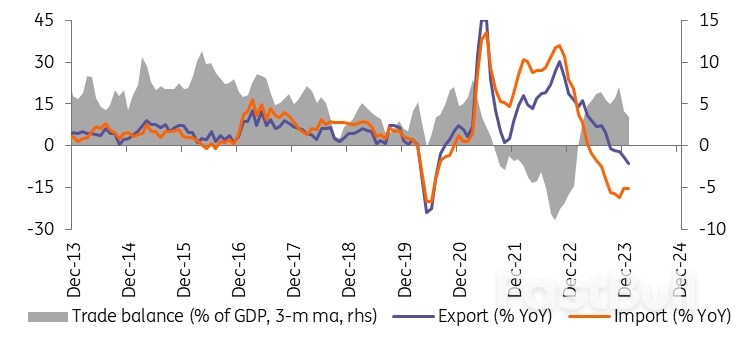
          The export outlook remains uncertain

          Throughout 2023, the trade balance improved markedly as domestic demand collapsed, reducing the need for imports, while export sales held up. In December, however, the trade balance surprised to the downside with a deficit of HUF 188bn, as external demand weakened markedly. The trade balance returned to surplus in January, but the current account hasn't followed suit.As the export outlook remains much more uncertain than a year ago, we expect the trade and current account balances to post smaller gains but are likely to remain in positive territory. On the other hand, the country's import bill depends on the extent of the recovery in domestic demand and the import share of both consumption and investment activity, which used to be high in Hungary.
          Trade balance (3-month moving average)Monitoring Hungary: Waiting for More Clarity_6

          Buckle up for two rounds of reflation in 2024

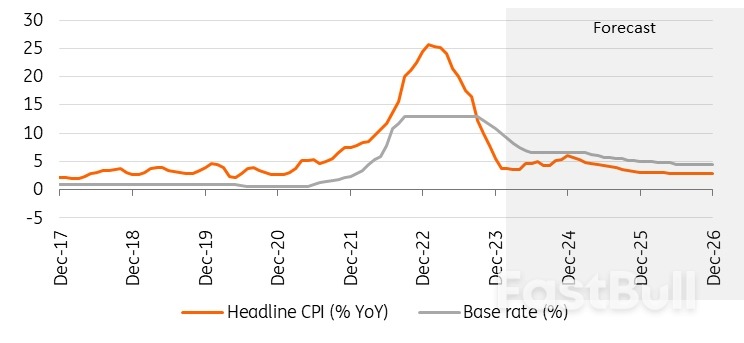
          Headline inflation is back within the central bank's tolerance band, as the year-on-year rate fell to 3.7% in February. The deceleration was mainly due to base effects, as the monthly inflation rate remains relatively high at 0.7%. At the component level, prices of durable goods fell on a monthly basis, while food, fuel, household energy and services prices increased. The latter component explains 71% of total inflation in terms of annual headline inflation.In the coming months, we expect headline inflation to remain below the upper limit of the central bank's tolerance band, but from May we see a slight reflation driven by base effects. In this context, another round of reflation will emerge towards the end of the year, hence our call for year-end inflation in the range of 5.5-6.0%. However, the pricing power of companies will depend very much on the state of the economic recovery, posing a two-sided risk, for now.
          Inflation and policy rateMonitoring Hungary: Waiting for More Clarity_7

          Central bank scales back the easing of monetary conditions

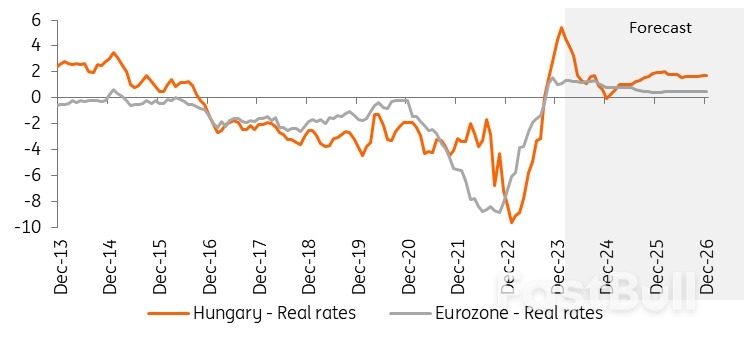
          At the March meeting, the National Bank of Hungary (NBH) reduced the pace of rate cuts to 75bp, bringing the base rate to 8.25%, while maintaining the +/- 100bp symmetric interest rate corridor around the base rate. With this move, the central bank erred on the side of caution. In its new forward guidance, the central bank made several hawkish hints. Most importantly, it narrowed its expected range for the policy rate at the end of June from 6.00-7.00% to 6.50-7.00%. This is still in line with our baseline scenario of a 6.50% policy rate after the June rate-setting meeting, so we leave our interest rate forecast unchanged. If anything, as a result of the new forward guidance and the recent market stability issues, we raise the possibility of a 50bp move in April (as opposed to our base case of a 75bp rate cut), as noted in our latest NBH Review note.
          Real rates (%)Monitoring Hungary: Waiting for More Clarity_8

          We already see some risks to the new deficit target

          The official ESA-based deficit target for 2024 remains at 2.9% of GDP, but neither the market nor we really believe this can be achieved. Hungarian ministers are openly talking about a new deficit target of 4.5% of GDP, which is likely to be officially amended in the spring parliamentary session. However, based on our technical projections, we can already see a slippage of around 1.0-1.5ppt even on the soon-to-be-updated deficit target.In our view, this gap can be narrowed either by government measures or by a change in the structure of economic growth. Last year was a recessionary year, but agriculture’s positive 2.2ppt contribution to GDP growth covered a lot of ground, which didn't help the budget too much in terms of revenue collection. In contrast, if we see a services-led recovery in 2024, the structure of growth could boost revenues beyond our technical projection, significantly narrowing the estimated gap.
          Budget performance (year-to-date, HUFbn)Monitoring Hungary: Waiting for More Clarity_9

          Forint’s positive reaction to hawkish NBH might be only temporary

          EUR/HUF is hovering around 395 after the March rate-setting meeting, which is lower than in pre-meeting days but still higher than the dip seen in March. The forint has been slowly but surely building strength, suggesting that the central bank's hawkish tone has finally reached the ears of market participants. However, we wouldn’t go so far as to say that HUF is out of the woods. A small hope for further minor appreciation comes from the rates space where we see the entire curve slightly higher, which if we see more repricing in the coming days could support FX. Otherwise, however, we are more likely to see a re-weakening back to the 397-398 EUR/HUF range as the dust settles after the latest rate-setting meeting.Looking further out the picture doesn't look rosy for FX either, especially going into the second quarter with the looming uncertainty regarding the European Parliament’s lawsuit in relation to parts of the EU funds and the approaching EU and local elections. The National Bank of Hungary thus has to rely on the start of the global rate-cutting cycle to keep FX in check if it wants to cut rates further in the coming months. Thus, we are likely to see higher volatility in the coming months than in the first quarter with our forecast of 405 for the end of the first half of the year.
          CEE FX performance vs EUR (29 December 2023 = 100%)Monitoring Hungary: Waiting for More Clarity_10

          The long ends of the curves remain attractive

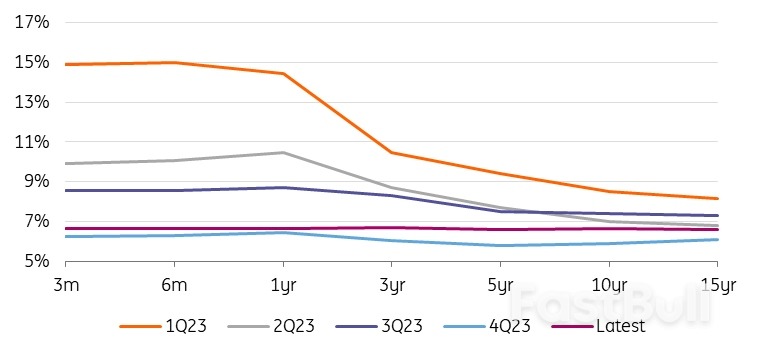
          The rates space picture hasn't changed much after the March rate decision. The IRS curve has repriced up only slightly, however, looking at short-term expectations for this year we find the current market pricing fair with some likelihood of small cuts in the second half of the year. The market sell-off has gone too far in our view and the belly and long-end curves have moved too high pushing the long-term policy rate well above 6%. In particular, we find the long end of the curves attractive and believe that once things calm down, market interest will return given the levels relative to CEE peers and core rates.In the IRS space, we see room for more flattening of the curve due to the narrative of a slowdown and pause in the cutting cycle now, but more rate cuts later and at the same time, a still attractive inflation profile within the CEE peers. Looking at 2s10s, we should see a flatter curve which also provides an attractive carry.
          Hungarian sovereign yield curve (end of period)Monitoring Hungary: Waiting for More Clarity_11In the Hungarian government bonds space, we have seen significant frontloading and buybacks in recent weeks, to prepare for the upcoming increase in this year's budget deficit. However, the auctions met with significant demand, almost the highest in the CEE region in bid-to-cover terms. With the assumption of 4.5% of GDP for this year's deficit, according to our calculations, roughly 40% of the total issuance of HGBs is covered, which provides sufficient comfort for the bond market in case of the risk of further fiscal slippage, which is one of the reasons why we are positive on HGBs at the moment, especially the long end of the curve.
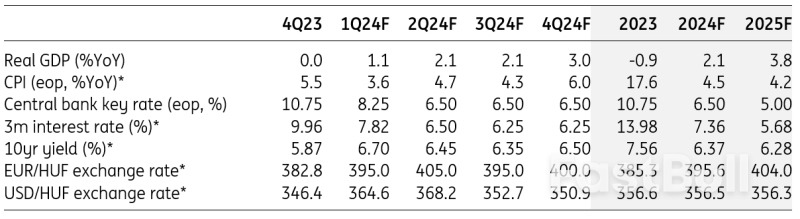
          Forecast summaryMonitoring Hungary: Waiting for More Clarity_12

          To stay updated on all economic events of today, please check out our Economic calendar
          Risk Warnings and Disclaimers
          You understand and acknowledge that there is a high degree of risk involved in trading. Following any strategies or investment methods may lead to potential losses. The content on the site is provided by our contributors and analysts for information purposes only. You are solely responsible for determining whether any trading assets, securities, strategy, or any other product is suitable for investing based on your own investment objectives and financial situation.
          Add to Favorites
          Share
          FastBull
          Copyright © 2025 FastBull Ltd

          728 RM B 7/F GEE LOK IND BLDG NO 34 HUNG TO RD KWUN TONG KLN HONG KONG

          TelegramInstagramTwitterfacebooklinkedin
          App Store Google Play Google Play
          Products
          Charts

          Chats

          Q&A with Experts
          Screeners
          Economic Calendar
          Data
          Tools
          Membership
          Features
          Function
          Markets
          Copy Trading
          Latest Signals
          Contests
          News
          Analysis
          24/7
          Columns
          Education
          Company
          Careers
          About Us
          Contact Us
          Advertising
          Help Center
          Feedback
          User Agreement
          Privacy Policy
          Business

          White Label

          Data API

          Web Plug-ins

          Poster Maker

          Affiliate Program

          Risk Disclosure

          The risk of loss in trading financial instruments such as stocks, FX, commodities, futures, bonds, ETFs and crypto can be substantial. You may sustain a total loss of the funds that you deposit with your broker. Therefore, you should carefully consider whether such trading is suitable for you in light of your circumstances and financial resources.

          No decision to invest should be made without thoroughly conducting due diligence by yourself or consulting with your financial advisors. Our web content might not suit you since we don't know your financial conditions and investment needs. Our financial information might have latency or contain inaccuracy, so you should be fully responsible for any of your trading and investment decisions. The company will not be responsible for your capital loss.

          Without getting permission from the website, you are not allowed to copy the website's graphics, texts, or trademarks. Intellectual property rights in the content or data incorporated into this website belong to its providers and exchange merchants.

          Not Logged In

          Log in to access more features

          FastBull Membership

          Not yet

          Purchase

          Become a signal provider
          Help Center
          Customer Service
          Dark Mode
          Price Up/Down Colors

          Log In

          Sign Up

          Position
          Layout
          Fullscreen
          Default to Chart
          The chart page opens by default when you visit fastbull.com