• Trade
  • Markets
  • Copy
  • Contests
  • News
  • 24/7
  • Calendar
  • Q&A
  • Chats
Trending
Screeners
SYMBOL
LAST
BID
ASK
HIGH
LOW
NET CHG.
%CHG.
SPREAD
SPX
S&P 500 Index
6846.50
6846.50
6846.50
6878.28
6827.18
-23.90
-0.35%
--
DJI
Dow Jones Industrial Average
47739.31
47739.31
47739.31
47971.51
47611.93
-215.67
-0.45%
--
IXIC
NASDAQ Composite Index
23545.89
23545.89
23545.89
23698.93
23455.05
-32.22
-0.14%
--
USDX
US Dollar Index
99.000
99.080
99.000
99.000
99.000
+0.050
+ 0.05%
--
EURUSD
Euro / US Dollar
1.16385
1.16393
1.16385
1.16388
1.16322
+0.00021
+ 0.02%
--
GBPUSD
Pound Sterling / US Dollar
1.33235
1.33248
1.33235
1.33235
1.33140
+0.00030
+ 0.02%
--
XAUUSD
Gold / US Dollar
4193.00
4193.44
4193.00
4193.80
4189.64
+3.30
+ 0.08%
--
WTI
Light Sweet Crude Oil
58.650
58.692
58.650
58.676
58.543
+0.095
+ 0.16%
--

Community Accounts

Signal Accounts
--
Profit Accounts
--
Loss Accounts
--
View More

Become a signal provider

Sell trading signals to earn additional income

View More

Guide to Copy Trading

Get started with ease and confidence

View More

Signal Accounts for Members

All Signal Accounts

Best Return
  • Best Return
  • Best P/L
  • Best MDD
Past 1W
  • Past 1W
  • Past 1M
  • Past 1Y

All Contests

  • All
  • Trump Updates
  • Recommend
  • Stocks
  • Cryptocurrencies
  • Central Banks
  • Featured News
Top News Only
Share

KCNA: North Korea's Supreme Leader Kim Jong UN Sends Condolences To Russian Embassy For Ambassador's Death

Share

Japan Prime Minister Takaichi: 30 Injuries Reported So Far From Monday Earthquake

Share

USA Senate Committee Votes To Advance Nomination Of Jared Isaacman To Head Nasa

Share

Singapore Post - New Rate For Standard Regular Mail & Standard Large Mail Will Be S$0.62 And S$0.90 Respectively

Share

Australia's S&P/ASX 200 Index Down 0.27% At 8601.10 Points In Early Trade

Share

Trump: The USA Needs Mexico To Release 200000 Acre-Feet Of Water Before December 31St, And The Rest Must Come Soon After

Share

Trump: I Have Authorized Documentation To Impose A 5% Tariff On Mexico If This Water Isn't Released

Share

Brazil's Sao Paulo State Governor Tarcisio De Freitas Says Flavio Bolsonaro Will Have His Support - Cnn Brasil

Share

Ukraine's Security Must Be Guaranteed, In The Long Term, As A First Line Of Defence For Our Union, Says European Commission President

Share

Ukraine's Sovereignty Must Be Respected, Says European Commission President

Share

The Goal Is A Strong Ukraine, On The Battlefield And At The Negotiating Table, Says European Commission President

Share

As Peace Talks Are Ongoing, The EU Remains Ironclad In Its Support For Ukraine, Says European Commission President

Share

Pepsico: Asking USA-Based Pepna Employees As Well As Pbus Division Offices And Pfus Region Offices To Work Remotely This Week

Share

A U.S. Judge Ruled That President Trump’s Ban On Several Wind Power Projects Was Illegal

Share

Senior USA Administration Official: We Continue To Monitor Drc-Rwanda Situation Closely, Continue To Work With All Sides To Ensure Commitments Are Honored

Share

Israeli Military Says It Has Struck Infrastructure Belonging To Hezbollah In Several Areas In Southern Lebanon

Share

SPDR Gold Holdings Down 0.11%, Or 1.14 Tonnes

Share

On Monday (December 8), In Late New York Trading, S&P 500 Futures Fell 0.21%, Dow Jones Futures Fell 0.43%, NASDAQ 100 Futures Fell 0.08%, And Russell 2000 Futures Fell 0.04%

Share

Morgan Stanley: Data Center ABS Spreads Are Expected To Widen In 2026

Share

(US Stocks) The Philadelphia Gold And Silver Index Closed Down 2.34% At 311.01 Points. (Global Session) The NYSE Arca Gold Miners Index Closed Down 2.17%, Hitting A Daily Low Of 2235.45 Points; US Stocks Remained Slightly Down Before The Opening Bell—holding Steady Around 2280 Points—before Briefly Rising Slightly

TIME
ACT
FCST
PREV
France Trade Balance (SA) (Oct)

A:--

F: --

P: --
Euro Zone Employment YoY (SA) (Q3)

A:--

F: --

P: --
Canada Part-Time Employment (SA) (Nov)

A:--

F: --

P: --

Canada Unemployment Rate (SA) (Nov)

A:--

F: --

P: --

Canada Full-time Employment (SA) (Nov)

A:--

F: --

P: --

Canada Labor Force Participation Rate (SA) (Nov)

A:--

F: --

P: --

Canada Employment (SA) (Nov)

A:--

F: --

P: --

U.S. PCE Price Index MoM (Sept)

A:--

F: --

P: --

U.S. Personal Income MoM (Sept)

A:--

F: --

P: --

U.S. Core PCE Price Index MoM (Sept)

A:--

F: --

P: --

U.S. PCE Price Index YoY (SA) (Sept)

A:--

F: --

P: --

U.S. Core PCE Price Index YoY (Sept)

A:--

F: --

P: --

U.S. Personal Outlays MoM (SA) (Sept)

A:--

F: --

P: --
U.S. 5-10 Year-Ahead Inflation Expectations (Dec)

A:--

F: --

P: --

U.S. Real Personal Consumption Expenditures MoM (Sept)

A:--

F: --

P: --
U.S. Weekly Total Rig Count

A:--

F: --

P: --

U.S. Weekly Total Oil Rig Count

A:--

F: --

P: --

U.S. Consumer Credit (SA) (Oct)

A:--

F: --

P: --
China, Mainland Foreign Exchange Reserves (Nov)

A:--

F: --

P: --

Japan Trade Balance (Oct)

A:--

F: --

P: --

Japan Nominal GDP Revised QoQ (Q3)

A:--

F: --

P: --

China, Mainland Imports YoY (CNH) (Nov)

A:--

F: --

P: --

China, Mainland Exports (Nov)

A:--

F: --

P: --

China, Mainland Imports (CNH) (Nov)

A:--

F: --

P: --

China, Mainland Trade Balance (CNH) (Nov)

A:--

F: --

P: --

China, Mainland Exports YoY (USD) (Nov)

A:--

F: --

P: --

China, Mainland Imports YoY (USD) (Nov)

A:--

F: --

P: --

Germany Industrial Output MoM (SA) (Oct)

A:--

F: --

P: --
Euro Zone Sentix Investor Confidence Index (Dec)

A:--

F: --

P: --

Canada National Economic Confidence Index

A:--

F: --

P: --

U.K. BRC Like-For-Like Retail Sales YoY (Nov)

--

F: --

P: --

U.K. BRC Overall Retail Sales YoY (Nov)

--

F: --

P: --

Australia Overnight (Borrowing) Key Rate

--

F: --

P: --

RBA Rate Statement
RBA Press Conference
Germany Exports MoM (SA) (Oct)

--

F: --

P: --

U.S. NFIB Small Business Optimism Index (SA) (Nov)

--

F: --

P: --

Mexico 12-Month Inflation (CPI) (Nov)

--

F: --

P: --

Mexico Core CPI YoY (Nov)

--

F: --

P: --

Mexico PPI YoY (Nov)

--

F: --

P: --

U.S. Weekly Redbook Index YoY

--

F: --

P: --

U.S. JOLTS Job Openings (SA) (Oct)

--

F: --

P: --

China, Mainland M1 Money Supply YoY (Nov)

--

F: --

P: --

China, Mainland M0 Money Supply YoY (Nov)

--

F: --

P: --

China, Mainland M2 Money Supply YoY (Nov)

--

F: --

P: --

U.S. EIA Short-Term Crude Production Forecast For The Year (Dec)

--

F: --

P: --

U.S. EIA Natural Gas Production Forecast For The Next Year (Dec)

--

F: --

P: --

U.S. EIA Short-Term Crude Production Forecast For The Next Year (Dec)

--

F: --

P: --

EIA Monthly Short-Term Energy Outlook
U.S. API Weekly Gasoline Stocks

--

F: --

P: --

U.S. API Weekly Cushing Crude Oil Stocks

--

F: --

P: --

U.S. API Weekly Crude Oil Stocks

--

F: --

P: --

U.S. API Weekly Refined Oil Stocks

--

F: --

P: --

South Korea Unemployment Rate (SA) (Nov)

--

F: --

P: --

Japan Reuters Tankan Non-Manufacturers Index (Dec)

--

F: --

P: --

Japan Reuters Tankan Manufacturers Index (Dec)

--

F: --

P: --

Japan Domestic Enterprise Commodity Price Index MoM (Nov)

--

F: --

P: --

Japan Domestic Enterprise Commodity Price Index YoY (Nov)

--

F: --

P: --

China, Mainland PPI YoY (Nov)

--

F: --

P: --

China, Mainland CPI MoM (Nov)

--

F: --

P: --

Italy Industrial Output YoY (SA) (Oct)

--

F: --

P: --

Q&A with Experts
    • All
    • Chatrooms
    • Groups
    • Friends
    Connecting
    .
    .
    .
    Type here...
    Add Symbol or Code

      No matching data

      All
      Trump Updates
      Recommend
      Stocks
      Cryptocurrencies
      Central Banks
      Featured News
      • All
      • Russia-Ukraine Conflict
      • Middle East Flashpoint
      • All
      • Russia-Ukraine Conflict
      • Middle East Flashpoint
      Search
      Products

      Charts Free Forever

      Chats Q&A with Experts
      Screeners Economic Calendar Data Tools
      Membership Features
      Data Warehouse Market Trends Institutional Data Policy Rates Macro

      Market Trends

      Market Sentiment Order Book Forex Correlations

      Top Indicators

      Charts Free Forever
      Markets

      News

      News Analysis 24/7 Columns Education
      From Institutions From Analysts
      Topics Columnists

      Latest Views

      Latest Views

      Trending Topics

      Top Columnists

      Latest Update

      Signals

      Copy Rankings Latest Signals Become a signal provider AI Rating
      Contests
      Brokers

      Overview Brokers Assessment Rankings Regulators News Claims
      Broker listing Forex Brokers Comparison Tool Live Spread Comparison Scam
      Q&A Complaint Scam Alert Videos Tips to Detect Scam
      More

      Business
      Events
      Careers About Us Advertising Help Center

      White Label

      Data API

      Web Plug-ins

      Affiliate Program

      Awards Institution Evaluation IB Seminar Salon Event Exhibition
      Vietnam Thailand Singapore Dubai
      Fans Party Investment Sharing Session
      FastBull Summit BrokersView Expo
      Recent Searches
        Top Searches
          Markets
          News
          Analysis
          User
          24/7
          Economic Calendar
          Education
          Data
          • Names
          • Latest
          • Prev

          View All

          No data

          Scan to Download

          Faster Charts, Chat Faster!

          Download App
          English
          • English
          • Español
          • العربية
          • Bahasa Indonesia
          • Bahasa Melayu
          • Tiếng Việt
          • ภาษาไทย
          • Français
          • Italiano
          • Türkçe
          • Русский язык
          • 简中
          • 繁中
          Open Account
          Search
          Products
          Charts Free Forever
          Markets
          News
          Signals

          Copy Rankings Latest Signals Become a signal provider AI Rating
          Contests
          Brokers

          Overview Brokers Assessment Rankings Regulators News Claims
          Broker listing Forex Brokers Comparison Tool Live Spread Comparison Scam
          Q&A Complaint Scam Alert Videos Tips to Detect Scam
          More

          Business
          Events
          Careers About Us Advertising Help Center

          White Label

          Data API

          Web Plug-ins

          Affiliate Program

          Awards Institution Evaluation IB Seminar Salon Event Exhibition
          Vietnam Thailand Singapore Dubai
          Fans Party Investment Sharing Session
          FastBull Summit BrokersView Expo

          Energy Outlook 2023: Drastic Shift in Natural Gas Outlook

          Justin

          Russia-Ukraine Conflict

          Commodity

          Energy

          Summary:

          European gas prices have collapsed over the Northern Hemisphere winter. Mild weather and weak industrial demand have ensured that gas storage has remained strong. The region should get through this winter comfortably and prospects also look better for the 23/24 winter. While we have cut our forecasts, significant risks to the upside remain.

          European storage to finish heating season well above average

          A late start to the 2022/23 heating season saw Europe building gas storage almost until mid-November. At a little over 95% full, storage was essentially maxed out. This was far above the target of 80% by 1 November 2022 set by the European Commission. While there have been some cold spells in the current heating season, it has been largely mild, which has meant storage levels have held up well. In fact, there have been days this winter when storage has seen net increases. Storage at the moment is 72% full, well above the five-year average of 54% for this time of year.
          Assuming Europe does not experience a prolonged cold spell in the current heating season, the region should exit the 2022/23 winter with storage above 50% full. This is significantly higher than the 26% seen at the end of the last heating season and above the five-year average of 34%.
          Ending this winter with very comfortable inventories makes the job of refilling storage over the injection season and hitting EU inventory targets of 90% by 1 November 2023 easier. Between 1 April and the end of October last year, the EU added in the region of 67bcm to storage. If we were to see similar storage levels at the start of the next heating season, the EU would only need to add around 43bcm of gas this year.

          EU storage to exit this winter comfortably (% full)Energy Outlook 2023: Drastic Shift in Natural Gas Outlook_1

          Aggressive demand cuts

          The level of demand destruction seen in recent months has been considerable. The latest numbers from Eurostat show that EU demand was 25% below the five-year average for October 2022 while Germany’s weekly data shows declines in the first two weeks of 2023 in excess of 30% from the 2018-21 average. However, it is important to note that demand in the third week of January was only around 9% below the 2018-21 average. Splitting it out, household demand was down 8.8% while industrial demand was almost 10% lower than the 2018-21 average. We will need to keep an eye on this, but it could suggest that demand is starting to respond to the lower price environment.
          The reduction in demand in recent months has far exceeded the Commission’s target of 15% below the five-year average between August 2022 and the end of March 2023. As a result, the level of demand destruction that will be needed from April through until March 2024 is more modest than initially expected. Our numbers suggest that a 10% decline from the five-year average is needed between April 2023 and March 2024 to meet the European Commission’s 90% storage target by 1 November 2023. The requirement for lower levels of demand destruction suggests that prices do not need to go as high as initially expected.
          However, two key assumptions behind this are that remaining Russian daily gas flows stay unchanged and that LNG import volumes into the EU grow marginally year-on-year in 2023. The big uncertainty over LNG flows into Europe is how strong a demand recovery we see from China this year.

          LNG market still tight in 2023

          A well-supplied European market has meant that we have seen some shifts in regional spreads. Most noticeable is the spread between TTF and Asian spot LNG. For the bulk of last year, TTF was trading at a premium to Asian LNG in order to pull in cargoes and make up for Russian supply losses. However, since mid-December, TTF is trading at a discount to Asia. This should support the redirecting of LNG cargoes towards Asia.
          Admittedly looking at the forward curves, TTF’s discount to Asia is only in the prompt market, and further along the curve there is little between the two markets. Clearly, there is little aggressive competition between the two regions for cargo at the moment, but this could change as China returns from its Lunar New Year holidays.
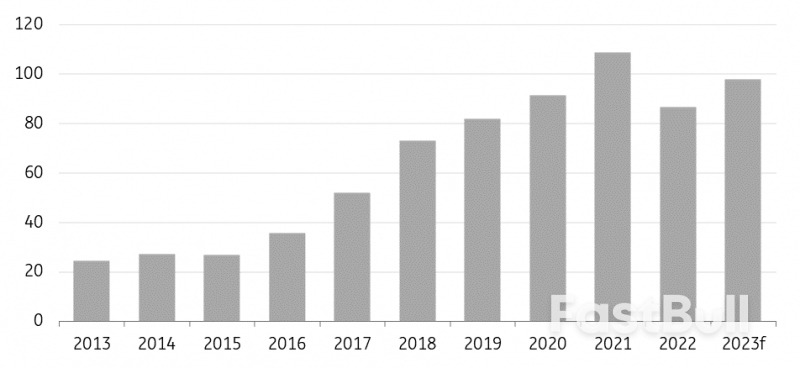
          Weaker Chinese demand through 2022 offered relief to Europe. Last year, China imported 87bcm of LNG, down 20% year-on-year and the weakest annual import volume since 2019. However, the relaxation of Covid measures and several support measures to help the domestic property sector could drive a recovery in demand this year. China also has a larger volume of contracts with fixed destination clauses this year (100bcm vs 88bcm last year according to the IEA).
          Ultimately though, Chinese demand is a big uncertainty for the global LNG market. While we are likely to see an increase in demand, it is difficult to gauge exactly how much stronger it could be this year. We are assuming for now that Chinese demand will not return to 2021 levels. Instead, we are expecting more modest growth of a little over 10% YoY.
          The restart of the Freeport LNG plant (20bcm per year) could provide some relief to a tight LNG market, particularly if we see stronger-than-expected Chinese demand. There appears to be some progress on the regulatory front for the restart of the plant, but the market may have to wait a while longer for exports to resume.

          Chinese LNG imports to see partial recovery in 2023 (bcm)

          Energy Outlook 2023: Drastic Shift in Natural Gas Outlook_2

          The highs are behind us

          The more comfortable storage situation does put Europe in a better position to handle the 2023/24 winter. It certainly isn’t looking as dire as it did just several months ago. Therefore, prices do not need to go as high as originally expected going into the next heating season. We expect TTF to average in the region of EUR60-65/MWh over the first half of 2023, increasing to EUR75-80/MWh over the second half of the year. The assumptions around this are that there are no further declines in remaining Russian gas flows, that we see a small increase in EU LNG imports over 2023 and that Europe experiences a normal winter in 2023/24. This should allow the EU to start the next heating season with storage exceeding the European Commission target of 90% by 1 November, and the region should get through the winter months in a fairly comfortable manner. However, Europe will rely more on storage in the 23/24 winter than it has in the current winter.

          What are the upside risks to our forecasts?

          There are two key upside risks to our new forecasts. Firstly, the bulk of Russian gas flows to the EU have already been halted. However, there is still the risk that flows via Ukraine and possibly even through TurkStream are stopped. If this was to occur, Europe could lose 15-20bcm of gas on an annual basis, which is still a sizeable volume. This would need to be made up either by further LNG imports or through higher levels of demand destruction. Both would likely require prices to move higher from current levels.
          The second key risk is related to Chinese LNG demand. We are assuming only a marginal recovery in Chinese import demand this year (a little over 10%), rather than returning to 2021 levels. If Chinese demand surprised to the upside, this would mean a tighter-than-expected LNG market, increasing the need for Europe to compete more aggressively with Asia for supply. This would also mean higher-than-expected prices.

          Source: ING

          Risk Warnings and Disclaimers
          You understand and acknowledge that there is a high degree of risk involved in trading. Following any strategies or investment methods may lead to potential losses. The content on the site is provided by our contributors and analysts for information purposes only. You are solely responsible for determining whether any trading assets, securities, strategy, or any other product is suitable for investing based on your own investment objectives and financial situation.
          Comments
          Add to Favorites
          Share

          Outlook 2023: Time for a Radical RE-think of Asset Allocation

          Justin
          There are four key factors at work.

          1.Contradictions between macro and micro

          A survey of chief financial officers in the US from Duke University showed the greatest divergence on record between the optimism of CFOs about their own companies and their predictions for the broader economy.
          This macro-micro dichotomy appears in (gloomy) top-down versus (sanguine) bottom-up forecasts for corporate earnings and defaults. We see it in deviations between what central banks say they are going to do and what the market expects. This is natural during regime transitions, and it can be a source of opportunity.

          2.Central banks will continue to tighten

          Last year saw some of the fastest monetary tightening on record, but the end-point is further away than the market expects. While headline inflation has been slowing, it remains high in the components of the basket where it tends to be stickier. The jobs market remains very tight, and central banks following models tied to labour market strength will probably have to continue to hike, barring a dramatic change in the data.

          3.Reality of tighter financial conditions

          The speed of this financial tightening – via rates, quantitative tightening and market corrections – increases the risk of financial accidents.
          In 2022, some $2tn of cryptocurrency paper wealth evaporated. The European Central Bank had to build a transmission protection instrument to protect weaker euro members as it fights inflation. The Bank of England had to underwrite the gilt market. Initial public offerings and syndicated lending has dried up. Some large real estate vehicles have had to provide deal enhancements to attract new investment. In many areas, marginal liquidity is hard to find.

          4.Credit trumps equity

          In the macro-micro debate, we concur with the macro forecasters for equities: the potential for downward revisions to earnings outlooks isn’t baked in. On credit, we agree with the micro forecasters: fundamentals are generally strong enough to limit defaults over the next two or three years.
          For a long time, the higher-risk sectors of the lower-risk asset classes, such as credit, were regarded as marginal sources of yield. In the economic slowdown of 2023, however, a combination of attractive yields, lower volatility and a position higher than equity in the capital structure suddenly brings them to the core of suggested asset mixes.
          Figure 1 sums up one implication of all this. It shows estimated returns and volatility for a range of asset classes according to our latest capital market assumptions (grey), relative to our assumptions a year ago (orange). The flattening of our estimated capital markets line indicates how much more attractive the outlook is for lower-volatility fixed-income assets, relative to riskier assets, than it was a year ago.
          Figure 1. Capital market assumptions: 2023 versus 2022
          Estimated annualised return and volatility, five-to-seven-year term

          Outlook 2023: Time for a Radical RE-think of Asset Allocation_1

          Source: Neuberger Berman, Bloomberg, Cambridge Associates, FactSet. Analytics as of 31 October 2022.

          The other thing to note is how big and rapid this adjustment has been. When things move this quickly, and when the economic crosscurrents are so complex, it’s important to focus on active management and markets that offer the most opportunity for active managers. Investors need to be mindful of opportunities across a broader range of risk factors and be ready to provide liquidity in a market prone to shocks and dislocations.
          There tends to be less dispersion between long-only public market investors’ returns compared with those of private market or hedge fund investors, but over the past decade that difference has become extreme (Figure 2). There will be much greater dispersion between winners and losers in all strategies, in both public and private markets, over the next decade.

          Figure 2. Low dispersion in active management over the last decade

          Manager performance dispersion, 2012-22
          Outlook 2023: Time for a Radical RE-think of Asset Allocation_2

          Source: JPMorgan Guide to Alternatives 4Q 2022.

          (Manager dispersion is based on annual returns for US fund global equities and US fund global bonds over the 10-year period ending 2Q 2022. Hedge fund returns are based on annual returns over a 10-year period ending 3Q 2022. Global private equity and global venture capital are represented by the 10-year period IRR ending 2Q 2022.)

          Source: Niall O'Sullivan

          Risk Warnings and Disclaimers
          You understand and acknowledge that there is a high degree of risk involved in trading. Following any strategies or investment methods may lead to potential losses. The content on the site is provided by our contributors and analysts for information purposes only. You are solely responsible for determining whether any trading assets, securities, strategy, or any other product is suitable for investing based on your own investment objectives and financial situation.
          Comments
          Add to Favorites
          Share

          Low Trade Among African Countries a Worrying Signal

          Cohen

          Economic

          Even as three major regional blocs in Africa urge Tanzania, South Sudan and the Democratic Republic of Congo to sign up a trade agreement that will expand their reach, a new report warns trade amongst African nations still remain the lowest globally with a paltry five countries out of 55 carrying out their trade within the continent.
          This is despite the implementation of the 1.2 billion-strong market under the continental free trade area (AfCFTA) in January 2021.
          Latest Mo Ibrahim Index report (2022) on African governance shows that the government's wavering commitments to open up the continent through improved transport network infrastructure and reduced restrictions to free movement of persons and labour have adversely affected intra-African trade, which stands at less than 13 percent.
          This compares unfavourably with Europe, Asia and the Americas whose intra-continental trade stands at 66.9 percent, 63.8 percent and 44.4 percent respectively.
          The report, released last week, shows that only five countries in Africa are trading within the continent where progress in governance has been threatened by worsening security, democratic backsliding, the Covid-19 pandemic, and being held hostage by deteriorating security and shrinking participatory environment.
          Work-in-progressThe report notes that despite government efforts to promote regional integration and a relaxation of visa regulations for travel among African countries intra-regional trade has still declined at an accelerating pace since 2012."Intra-continental trade remains the lowest of any world region. The dependence on external markets leaves the continent highly exposed to crises and shocks in other parts of the world, as showcased by the impact of Covid-19 and the ongoing Russia-Ukraine war," says report.
          The AfCFTA, launched in January 2021, commits signatories to removing tariffs on 90 percent of goods for other signatories, to progressively liberalise trade in services and address other non-tariff barriers."By lowering these barriers, the hope is that intra-regional trade will increase, and both spur economic transformation and increase resilience to shocks," says report.
          All African countries except Eritrea are signatories, and 44 countries out of 55 had ratified the agreement as of October 2022.
          Countries yet to deposit instrument of AfCFTA ratification include Benin, Botswana, Comoros, Liberia, Libya, Mozambique, Madagascar, Somalia, South Sudan, and Sudan.
          Boost intra-African tradeAccording to the United Nations Economic Commission for Africa (UNECA), the AfCFTA could boost intra-African trade by around 40 percent.
          According to the Mo Ibrahim index report, AfCFTA is work-in-progress and that intra-continental transport remains key to its success.
          According to the report, intra-regional trade has declined at an accelerating pace since 2012.
          In 33 African countries, intra-African trade has declined as a share of the total trade since 2012 while in 41 African countries, intra-African trade still accounted for less than a quarter of the total in 2021.
          The report notes that the AfCFTA is still a work in progress and must be accompanied by progress in other initiatives such as the Protocol on the Free Movement of Persons and the Single African Air Transport Market."Projects under the Programme for Infrastructure Development in Africa, designed to establish transnational transport corridors and telecommunications networks, must be completed," says report."Without the relevant infrastructure to ease movement within the continent, intra-regional trade will continue to be costly and inaccessible, regardless of tariff reductions. The success of related digital platforms will also be instrumental in building intra-African supply chains."In 41 African countries intra-African trade was still less than a quarter of total trade in 2021.
          According to the report the Economic Community of West African States (Ecowas) leads the way in Regional Integration due to government efforts and open visa regimes.
          Negative perceptionHowever, from a trade integration perspective, the Southern African Development Community's (SADC) share of intra-African trade is over twice that of Ecowas.
          Last year, a study by UNECA on selected African countries showed that things are not working on the ground after the AfCFTA came into effect on January 1, 2021.
          The survey conducted in seven countries — Angola, Côte d'Ivoire, Gabon, Kenya, Namibia, Nigeria and South Africa — shows that firms have a neutral to slightly negative overall perception of the environment for investing and trading in goods across Africa.
          The AfCFTA Country Business Index survey, launched in 2018, showed that the private sector has a negative perception of trade in goods, suggesting that more work needs to be done to remove tariff and non-tariff barriers.
          AfCFTA, which brings together 55 countries with a combined GDP of $3 trillion, was signed in Kigali, Rwanda, on March 21, 2018.
          Preferential treatmentUnder the agreement, 90 percent of goods originating from an exporting country within the free trade area would be subject to preferential treatment (zero import tariffs), with projections that the pact could boost intra-Africa trade by 33 percent.
          Meanwhile, a trade agreement combining the markets in three major regional blocs in Africa could be up and running once Tanzania, South Sudan and the DR Congo sign up.
          The Tripartite Free Trade Area (TFTA) agreement involves members of the East African Community (EAC), the Southern Africa Development Cooperation (SADC) and the Common Market for Eastern and Southern Africa (Comesa).
          These blocs had negotiated a pact that will allow countries uniform tariffs on imports and exports within the sphere of the blocs, providing certainty on trade among 29 countries in the three blocs.
          Advanced stage"Of the 29 member states, we need a minimum of 14 for the agreement to come into effect. So, we need three more to reach the threshold," said Dr Christopher Onyango, Director of Trade and Customs at Comesa Secretariat."Out of those that have not ratified within the EAC are Tanzania, the DR Congo and South Sudan which are at an advanced stage of ratification.
          Other countries whose ratification is still pending include Malawi, Lesotho and Comoros from the South and even Ethiopia from the North," said Dr Onyango.
          Operationalisation phaseSo far, 22 countries have signed the agreement while eleven member states namely Egypt, Uganda, Kenya, South Africa, Botswana, Burundi, Rwanda, Namibia, eSwatini, Zambia and Zimbabwe have ratified it.
          This week, trade experts from 17 countries under the Comesa-EAC-SADC Tripartite Agreement met in Nairobi, to pore over gaps in the TTNF.
          They met to review progress made on various focus areas needed to make the TFTA operational and urged the three eastern countries to agree on tariff offers to operationalise the agreement.
          It provides a framework for addressing multiplicity of memberships to various RECs, which is a challenge in regional integration.
          For instance, the Southern Africa Customs Union (SACU) and EAC Customs Unions have exchanged tariff offers that average 90 percent of their tariff books to be liberalised immediately.
          The SACU consists of Botswana, Lesotho, Namibia, South Africa, and Swaziland.
          Dr Onyango said the purpose of negotiating tariff offers across the three regional trading blocs was to ease trade among the 29 countries.

          Source: The East African

          To stay updated on all economic events of today, please check out our Economic calendar
          Risk Warnings and Disclaimers
          You understand and acknowledge that there is a high degree of risk involved in trading. Following any strategies or investment methods may lead to potential losses. The content on the site is provided by our contributors and analysts for information purposes only. You are solely responsible for determining whether any trading assets, securities, strategy, or any other product is suitable for investing based on your own investment objectives and financial situation.
          Comments
          Add to Favorites
          Share

          Rising Iran-Azerbaijan Rivalry Signals a Changing Caucasus

          Thomas

          Political

          The shifting geopolitics of the South Caucasus is fast emerging as a new global flashpoint. It is not clear if last week's attack on the embassy of Azerbaijan in Tehran is linked to heightened tensions between Iran and Baku. For now, the presidents of both countries have opted to calm down the war of words. Developments in Isfahan and Tehran on Sunday, raise further concerns. Still, there are key reasons to believe that this downward spiral in relations cannot be stopped unless both countries do much more to put relations back on a constructive track.
          For sure, there is much that Iran and Azerbaijan can do together – namely in the area of economic co-operation. This could include completing the much-touted International North-South Corridor (INSC) that traverse both countries as it provides a new trade transit route from the Indian Ocean to Europe. On the other hand, the respective leaderships of both Iran and Azerbaijan have made certain geopolitical calculations that are increasingly likely to make cordial relations a difficult objective to achieve.
          First, let's set the scene. Iran and Azerbaijan are close on many levels. Both are Shiite Muslim-majority countries. There are about 10 million people living in Azerbaijan but an estimated 15-20 million ethnic Azerbaijanis live in Iran. This separation came about when the Persian Empire lost its Caucasian territories to the Russians in the 19th century. When the Soviet Union collapsed in 1991, Iran welcomed the birth of the Republic of Azerbaijan and it never seriously invested much in exporting its Islamist ideology to its Shiite brethren to the north.
          There were two simple reasons. First, after centuries of Russian and Soviet rule, the independent Azerbaijanis were by and large unreceptive to Tehran's reactionary Islamist ideology. The second, much more important, reason was that Moscow from the mid-1990s onwards made it clear it did not look kindly to any Iranian (or other Middle Eastern) encroachment in the former Soviet south territories. Iran, already alienated from the West, chose not to upset Moscow's sensitivities. And for much of the time since the Soviet collapse, Tehran respected Russia's dominion over the South Caucasus.
          This state of affairs came crushing down in 2020. This is the year Baku fought a new war with Armenia over disputed territories. Tehran was blindsided by both Azerbaijan's military triumph but also the war's broader geopolitical implications. Baku's military victory over Armenia had been greatly assisted by two of Iran's regional rivals, Turkey and Israel.
          Not only did Tehran wake up to a deeper Israeli and Turkish footprint on its northern border but Russia's inability to keep Turkey and Israel out of the South Caucasus was probably the bigger shock to Tehran. Realising that Moscow's sway in the region had diminished, and was unlikely to return any time soon since Moscow became increasingly focused on its military mission in Ukraine, the Iranian government was forced to look for ways to regain influence in the region.
          In a nutshell, Tehran chose to pursue a carrot and stick strategy to shape Baku's next move. The two countries could focus on expanding economic and even military co-operation if only Azerbaijan refused to become a partner for Israel and Turkey, in their separate rivalries with Iran. If Baku refused to oblige Iran, then Tehran would look for ways to hit back, including raising questions about Azerbaijan's territorial integrity.
          And Iran has been hellbent in opposing a key effort by Baku to create a land corridor – Zangezur – from Azerbaijan proper to its exclave of Nakhchivan that borders Turkey. Baku's planned corridor would run through Armenian territory. Tehran sees this as an effort by Azerbaijan, backed by Turkey, to cut it off from Armenia, the Christian nation Tehran has consistently backed in its conflict with Azerbaijan.
          Iranian officials claim that the Israelis too want to use Azerbaijani territory to launch subversive operations against Iran. Tehran's ambassador in Baku recently warned that Iran has no desire to see Azerbaijan become a battleground for Iranian-Israeli rivalry but that what happens next would be up to Baku. To Tehran's deep frustration, Baku instead on January 11 appointed its first ever ambassador to Israel. The Iranians read this to mean that Baku has ultimately chosen to side with Israel in its regional rivalry with Iran.
          It can be argued that Tehran is the guiltiest in creating this uncomfortable geopolitical situation for itself. Iran for too long chose to give priority to Russian interests in the South Caucasus. Nor were Iranian officials monitoring Moscow's declining sway in this part of the world. Finally, Tehran's fixation over the past decade on intervening in the Arab world – from Lebanon to Syria to Iraq and Yemen – meant that it deprioritised the South Caucasus in its foreign policy.
          It was too late by the time Tehran awakened to the new realities of the South Caucasus after 2020. Tehran will continue to play catchup but it has to admit that its policy of carrots and sticks toward Baku has leaned too much on the latter. Tehran needs to do more to incentivise Baku to shape its next regional move.
          If this is not addressed, then, in a dangerous tit-for-tat, the Iranian authorities might hint that Azerbaijan has historically been part of Iran. The leadership in Baku could retaliate by claiming to represent the many millions-strong ethnic-Azerbaijani population living inside Iran's borders. It is truly a tinderbox. And yet, both Tehran and Baku have solid reasons to step away from the brink.

          Source: The National News

          Risk Warnings and Disclaimers
          You understand and acknowledge that there is a high degree of risk involved in trading. Following any strategies or investment methods may lead to potential losses. The content on the site is provided by our contributors and analysts for information purposes only. You are solely responsible for determining whether any trading assets, securities, strategy, or any other product is suitable for investing based on your own investment objectives and financial situation.
          Comments
          Add to Favorites
          Share

          ECB Cheat Sheet: Wake up, This isn't the Fed!

          Samantha Luan

          Central Bank

          Front-end pricing talk but it's a red herring

          Much has been said and written about the next two ECB meetings' rate hikes. The upshot is, as our colleagues highlight, the ECB still has a licence to hike, and a 50bp increase is pretty much set in stone this week. In all likelihood, guidance for a 50bp March hike will be repeated too but the March meeting will also feature a new set of forecasts that should heavily influence the ECB's decision. As a result, markets will be tempted to rely more on their anticipation of how the ECB staff forecast will evolve at that meeting, rather than on president Christine Lagarde's guidance.
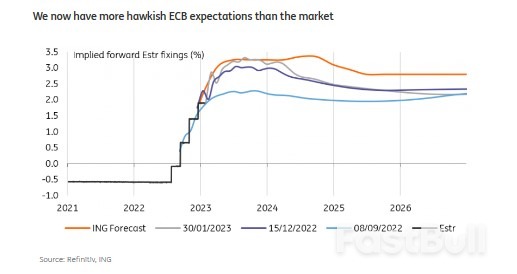
          As our economics team noted in their preview, "If everything else remains the same as it was in December, the ECB's headline [March] inflation projections could easily be lowered by 0.3 to 0.5 percentage points for 2024 and 2025". Cut-off for the FX, rates, and energy market prices is a little under one month away but, as things stand, this would imply 2025 inflation at 1.8%, under the ECB's 2% target. Worse, this would be premised on a curve that implies 80bp of cuts between the mid-2023 rate peak and end-2024.
          To cut a long story short, we wouldn't overstate the importance of the next two meetings for interest rates markets.

          ECB Cheat Sheet: Wake up, This isn't the Fed!_1Eyes on the prize, the belly's where the battle really is

          The curve is pricing a rapid decline in rates after they reach their peak in 2023. For a central bank expected to hike at least three more times, this is problematic. Lagarde is sure to be asked about this anomaly. If recent history is any guide, she'll likely take that opportunity to guide market rates higher. We doubt she'll manage to completely dis-invert the curve, however. The shape of the euro term structure cannot be seen entirely in isolation and some remnant of easing is likely to persist as long as the Fed is expected to cut more than 200bp by end-2024. But, at least, she should manage to delay cut expectations.
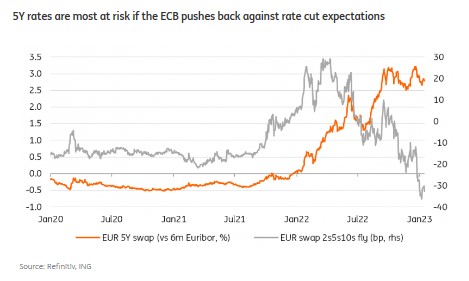
          The part of the curve most likely to be affected is the 5Y point. We think hike expectations are correctly set for the next few meetings which imply that short-dated bonds and swaps, say up to 2Y, are also correctly priced. Longer tenors, on the other hand, depend on more structural factors such as where investors think the long-term interest rate equilibrium lies. This is not something the ECB will change at this meeting. This leaves the maturity in between, aptly called the belly of the curve, as the sector most at risk of a pushback against cut expectations.
          What happens to the slope of the curve, for instance 2s10s, depends in greater parts on the tone of the ECB from one meeting to the next. We have a view (it will be hawkish) but given its recent unpredictability, we have a greater conviction on our outright (higher rates) and curvature (5Y rates to rise faster than other maturities) calls.

          ECB Cheat Sheet: Wake up, This isn't the Fed!_2'Detailed parameters' on quantitative tightening to come, but the market-moving information is already out

          The ECB has promised "detailed parameters" for the reduction of its asset purchase programme portfolio. With laying out the headline volumes already at the last meeting, the most market-moving aspects are already known. What we could expect is details about whether the reduction will be proportionate across the different asset classes. Within the public sector specifically, how the ECB will maintain alignment with the capital key distribution across countries. We do not anticipate the ECB to diverge from previous targets here, though we might get information on how special situations will be dealt with. For instance when overall redemptions in a month are below the targeted reduction volumes.
          Keeping in mind the focus the ECB and Isabel Schnabel in her recent speeches have put on "greening" the central bank's portfolios, there is a chance that this also translates into more concrete action in the public sector portfolio. A rebalancing towards supranational debt with their larger share of green bonds would make sense, and it would not impact the capital key alignment. It would also address the rising prominence of the European Union as an issuer. We doubt though that such tweaks by themselves will impact the market's currently benign take on sovereign spreads. This time they are more likely to take their cues from the overall tilt of the ECB's communication.

          This isn't a litmus test for the euro rally

          While it's undeniable that the ECB doubling down on its hawkish rhetoric has contributed to the strengthening of the euro since December, we don't see this week's policy meeting as a litmus test for the sustainability of the euro rally.
          The reasons are two-fold. First, EUR/USD may well return to being predominantly a dollar story this week. A Fed approaching peak rate and facing a worsening economic outlook has more room to surprise on the hawkish side, and we think it could offer a breather to the dollar. In contrast, as discussed above, we would not overstate the importance of the next two ECB meetings for rates.
          This leads us to the second reason: the ECB's communication hiccups have likely eroded the market's trust in Lagarde's guidance. Only a few hours after the December meeting, the news that many members had preferred 75bp was leaked. And if ECB members aligned behind the 50bp guidance in recent weeks, a probably more debated 50bp move in March may well cause sparse communication again after the February meeting. This – in our view – may lead markets to be more forward-looking than what Lagarde will wish them to be.
          Ultimately, data may remain a larger driver than Lagarde's guidance for the euro. If gas prices stay capped and economic surveys keep pointing up, a correction in EUR/USD after a hawkish Fed should not last long. We expect EUR/USD to trade around 1.07-1.10 for most of February. Another big break higher may need to wait for an official pivot by the Fed: we see this materialising in the second quarter, where we forecast a move to 1.15.

          Source: ING

          Risk Warnings and Disclaimers
          You understand and acknowledge that there is a high degree of risk involved in trading. Following any strategies or investment methods may lead to potential losses. The content on the site is provided by our contributors and analysts for information purposes only. You are solely responsible for determining whether any trading assets, securities, strategy, or any other product is suitable for investing based on your own investment objectives and financial situation.
          Comments
          Add to Favorites
          Share

          Will the Fed Overdo It?

          Cohen
          The US Federal Reserve is clearly determined to bring down inflation. But no one really knows how high it will have to raise its policy interest rate – and how long it will have to keep it there – to achieve its objective. Many are thus wondering whether the Fed will bring on a recession.
          Inflation is coming down, partly because snags in supply chains have been sorted out, but also because demand is weakening. Higher interest rates have slowed home purchases, and hence housing construction. Higher-priced goods and services have eaten into household budgets and impeded consumer spending. And China's anemic growth has dampened commodity prices globally.
          The Fed, however, is not satisfied with the current situation. It fears that until some slack emerges in America's red-hot labor market, wages could still catch up with inflation and then push it higher. The last thing the Fed wants is to hit pause and then see inflation ramp up again as financial markets celebrate and financial asset prices rise, reigniting demand. That would force policymakers to raise rates higher, and for longer. "One and done" would be far better than "rinse and repeat," both for the economy and the Fed's reputation.
          Moreover, the Fed does not necessarily believe that more slack in the labor market means much more unemployment. Ideally, the ratio of job openings to unemployed workers would come down, with job openings falling significantly. But even if unemployment rises modestly, the Fed will not be deterred. It has concluded that if the economy slows too much, it can always be stimulated back to growth through rate cuts. Hence, the consensus is that the Fed will err on the side of doing too much, as that would still allow it to keep any downturn mild by cutting rates. Indeed, market prices suggest the Fed will be back to cutting rates later this year.
          What could go wrong in this consensus view? Consider two alternative scenarios. First, the Fed might push the economy into a recession, but inflation could still settle stubbornly above its 2% target. Such stagflation – resembling the 1970s, when inflationary expectations became entrenched at higher levels – would impel the Fed to raise rates even further at the same time that the economy is shrinking. It is here that the Fed's inflation-fighting zeal, and its ability to withstand political pressure, would be truly tested.
          A second possibility is that inflation will come down, but with a sharp (rather than a gentle) fall in growth. Consider the current labor market. Not only have small and medium-size firms struggled to find workers, but, thus far, they have been holding on to employees even as large firms announce layoffs, precisely because they know how hard hiring has become. In fact, some are still hiring, encouraged by the prospect of recruiting more high-quality workers now that the big firms have shut their doors.
          But as slack builds up in the labor market, these smaller firms may become more confident that high-quality workers will remain available into the future. In that case, they, too, might pause hiring, or even shed some of the workers they hired when labor markets were tight. Put differently, the stream of layoffs that we are already seeing may become a flood.
          That would affect other markets. For example, US home sales have slowed considerably, but house prices have generally held up, probably because there is not much supply entering the market. With mortgage rates having risen by so much over the past year, a homeowner with a 30-year mortgage at 4% will have to shell out much more in monthly payments if she upgrades to a slightly better house with a new mortgage at 7%. Because she cannot afford to buy, she does not sell. And because this dynamic is limiting the supply of homes on the market, there is little downward pressure on prices.
          If layoffs increase, however, more homeowners will not be able to make even their 4% mortgage payments, and they will be forced into distressed sales. Supply will suddenly increase, home prices will fall sharply, and the combination of greater employment uncertainty and lower housing wealth could shatter consumer confidence, further reducing growth.
          Now consider another potential domino. We have just gone through a three-year period in which corporate bankruptcies fell, owing not least to pandemic-related fiscal support. Yet notwithstanding some recent signs of corporate distress, it would seem that many more "walking wounded" firms ought to be folding. Why aren't they?
          One reason is that many firms refinanced in the early months of the pandemic, taking advantage of easy credit conditions to extend the maturity of their debt. But the most vulnerable firms could do only so much at the time, and soon the volume of maturing corporate debt will increase. If that debt has to be rolled over in an environment of increasing economic gloom, it is a fair bet that many will not be able to refinance, and corporate bankruptcies will increase significantly. The mainstream financial sector may have been smart enough to steer clear of crypto, but it is not immune to household and corporate distress. And as we know from history, financial-sector losses can quickly lead to catastrophic scenarios.
          In these two scenarios, the Fed at least knows what it will have to do in the first one: raise rates to fight stubbornly high inflation. But if developments are downwardly non-linear, it is hard to see what signposts the Fed can use to navigate between the Scylla of doing too little and having to "rinse and repeat," and the Charybdis of doing too much and watching the economy fall off a cliff. Perhaps the best thing it can do is guard against complacency about the economy's ability to bend without breaking, and remain acutely sensitive to incoming data as we enter a period of maximum danger.

          Source: ZAWAY

          Risk Warnings and Disclaimers
          You understand and acknowledge that there is a high degree of risk involved in trading. Following any strategies or investment methods may lead to potential losses. The content on the site is provided by our contributors and analysts for information purposes only. You are solely responsible for determining whether any trading assets, securities, strategy, or any other product is suitable for investing based on your own investment objectives and financial situation.
          Comments
          Add to Favorites
          Share

          Staying the Course: Five Questions for the ECB

          Samantha Luan

          Central Bank

          The European Central Bank looks set on Thursday to deliver another large interest rate rise to curb inflation. What it does after that is less certain.
          ECB President Christine Lagarde, speaking in Davos recently, stressed the need for monetary policy to "stay the course."
          Investors are keen to get a sense of just how long and how far the central bank will keep hiking rates.
          "ECB policymakers think they have to kill inflation and will only stop hiking when they a see a big improvement in the inflation outlook," said Carsten Brzeski, global head of macro at ING.
          Here are five key questions on the radar for markets.

          1/ What will the ECB do on Thursday?

          The ECB raising its deposit rate by 50 basis points (bps) to 2.5% is seen as a done deal, so markets will focus on what Lagarde has to say.
          Signs of cooling inflation have prompted markets to push down expectations for where rates will peak to around 3.3%. Policymakers have already challenged market moves, and expectations could move back up towards 3.5% if a brighter economic outlook prompts further hawkish messaging.
          "The ECB needs to be hawkish," said Eoin Walsh, partner at TwentyFour Asset Management. "I don't know whether Lagarde will say that market pricing of the terminal rate is too low, but I expect her to reiterate that the ECB will continue to raise rates."
          2/ Will the ECB send any signals about March and beyond?
          Markets hope so since the outlook beyond Thursday is contentious. Some, including Dutch and Slovak officials, support a big rise in March. Comments from Lagarde suggest she would also back such a move.
          Policy doves are pushing back as headline inflation comes down. Italy's Fabio Panetta believes the ECB should not commit to any specific move beyond February.
          "There were questions recently about why markets don't understand what the ECB will do next," said ING's Brzeski. "Part of the reason is that markets are too optimistic but there's also a question about the ECB's own communication chaos and who we should listen to."

          Staying the Course: Five Questions for the ECB_13/ Are more details on quantitative tightening (QT) likely?

          The ECB plans to reduce bonds bought under its Asset Purchase Programme (APP) by 15 billion euros on average per month from March to June. UBS expects the ECB to reiterate that the pace of QT after June will be decided later, when some economists expect an acceleration.
          "The ECB will provide further guidance on the balance sheet rundown, including on how the different APP programs will be handled and importantly also on the planned unwind of cross-country holdings," said Patrick Saner, head of macro strategy at Swiss Re.

          Staying the Course: Five Questions for the ECB_24/ How quickly is core inflation likely to come down?

          That's not clear and predicting the path of inflation has been tricky.
          With updated ECB projections not out until March, Lagarde is likely to be pressed on how the ECB views core inflation, which strips out volatile food and energy prices. The ECB targets headline inflation at 2%, but officials are focused on a core measure.
          January euro zone inflation numbers on Wednesday could prove timely. Headline inflation eased to 9.2% in December, but a core measure also excluding alcohol and tobacco, rose to 5.2% from a 5%.

          Staying the Course: Five Questions for the ECB_35/ Is the ECB more upbeat on the growth outlook?

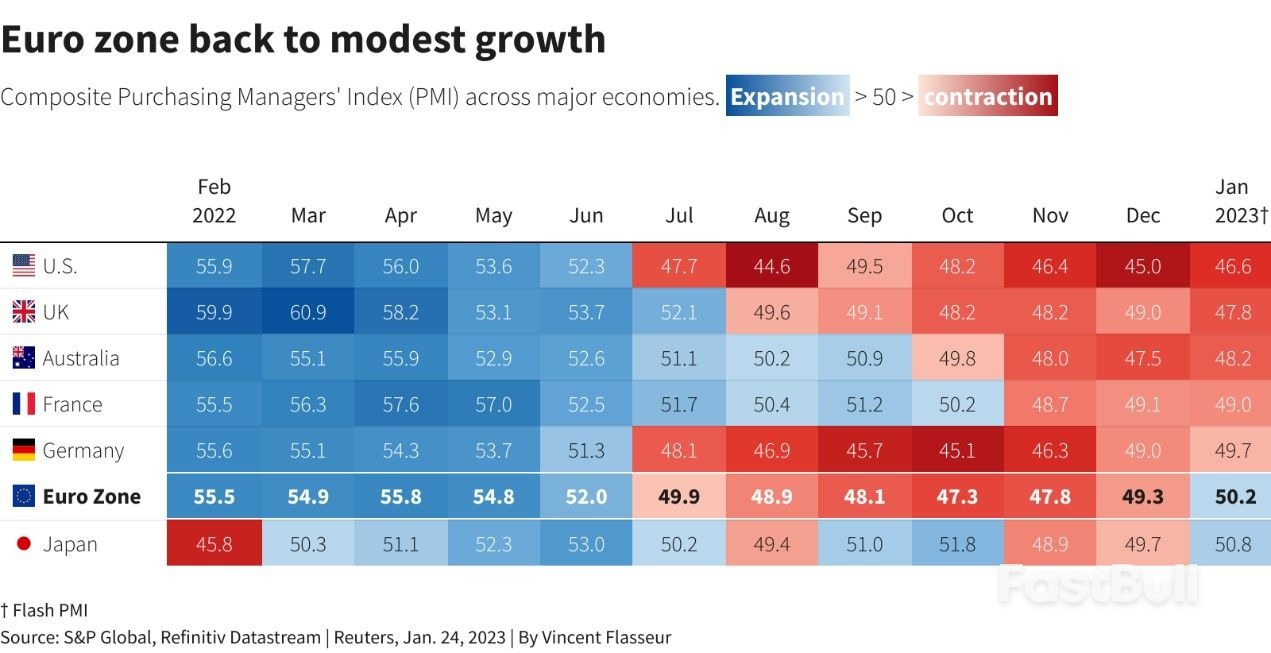
          The ECB's Mario Centeno reckons recession may be avoided. Business activity made a surprise return to modest growth in January, while JPMorgan has raised its first-quarter economic growth forecast to 1% from a contraction of 0.5% -- echoing a similar move from Goldman Sachs.
          "Yes, the ECB will for sure acknowledge the better domestic and external growth backdrop," said Swiss Re's Saner.
          "This will actually also allow them to make the case that rates need to go higher and stay there for a while, as a stronger demand environment inhibits core disinflation which is what matters most."

          Staying the Course: Five Questions for the ECB_4Source: Reuters

          Risk Warnings and Disclaimers
          You understand and acknowledge that there is a high degree of risk involved in trading. Following any strategies or investment methods may lead to potential losses. The content on the site is provided by our contributors and analysts for information purposes only. You are solely responsible for determining whether any trading assets, securities, strategy, or any other product is suitable for investing based on your own investment objectives and financial situation.
          Comments
          Add to Favorites
          Share
          FastBull
          Copyright © 2025 FastBull Ltd

          728 RM B 7/F GEE LOK IND BLDG NO 34 HUNG TO RD KWUN TONG KLN HONG KONG

          TelegramInstagramTwitterfacebooklinkedin
          App Store Google Play Google Play
          Products
          Charts

          Chats

          Q&A with Experts
          Screeners
          Economic Calendar
          Data
          Tools
          Membership
          Features
          Function
          Markets
          Copy Trading
          Latest Signals
          Contests
          News
          Analysis
          24/7
          Columns
          Education
          Company
          Careers
          About Us
          Contact Us
          Advertising
          Help Center
          Feedback
          User Agreement
          Privacy Policy
          Business

          White Label

          Data API

          Web Plug-ins

          Poster Maker

          Affiliate Program

          Risk Disclosure

          The risk of loss in trading financial instruments such as stocks, FX, commodities, futures, bonds, ETFs and crypto can be substantial. You may sustain a total loss of the funds that you deposit with your broker. Therefore, you should carefully consider whether such trading is suitable for you in light of your circumstances and financial resources.

          No decision to invest should be made without thoroughly conducting due diligence by yourself or consulting with your financial advisors. Our web content might not suit you since we don't know your financial conditions and investment needs. Our financial information might have latency or contain inaccuracy, so you should be fully responsible for any of your trading and investment decisions. The company will not be responsible for your capital loss.

          Without getting permission from the website, you are not allowed to copy the website's graphics, texts, or trademarks. Intellectual property rights in the content or data incorporated into this website belong to its providers and exchange merchants.

          Not Logged In

          Log in to access more features

          FastBull Membership

          Not yet

          Purchase

          Become a signal provider
          Help Center
          Customer Service
          Dark Mode
          Price Up/Down Colors

          Log In

          Sign Up

          Position
          Layout
          Fullscreen
          Default to Chart
          The chart page opens by default when you visit fastbull.com