• Trade
  • Markets
  • Copy
  • Contests
  • News
  • 24/7
  • Calendar
  • Q&A
  • Chats
Trending
Screeners
SYMBOL
LAST
BID
ASK
HIGH
LOW
NET CHG.
%CHG.
SPREAD
SPX
S&P 500 Index
6846.50
6846.50
6846.50
6878.28
6827.18
-23.90
-0.35%
--
DJI
Dow Jones Industrial Average
47739.31
47739.31
47739.31
47971.51
47611.93
-215.67
-0.45%
--
IXIC
NASDAQ Composite Index
23545.89
23545.89
23545.89
23698.93
23455.05
-32.22
-0.14%
--
USDX
US Dollar Index
99.000
99.080
99.000
99.000
99.000
+0.050
+ 0.05%
--
EURUSD
Euro / US Dollar
1.16371
1.16380
1.16371
1.16388
1.16322
+0.00007
+ 0.01%
--
GBPUSD
Pound Sterling / US Dollar
1.33225
1.33236
1.33225
1.33234
1.33140
+0.00020
+ 0.02%
--
XAUUSD
Gold / US Dollar
4191.17
4191.61
4191.17
4193.27
4189.64
+1.47
+ 0.04%
--
WTI
Light Sweet Crude Oil
58.660
58.702
58.660
58.676
58.543
+0.105
+ 0.18%
--

Community Accounts

Signal Accounts
--
Profit Accounts
--
Loss Accounts
--
View More

Become a signal provider

Sell trading signals to earn additional income

View More

Guide to Copy Trading

Get started with ease and confidence

View More

Signal Accounts for Members

All Signal Accounts

Best Return
  • Best Return
  • Best P/L
  • Best MDD
Past 1W
  • Past 1W
  • Past 1M
  • Past 1Y

All Contests

  • All
  • Trump Updates
  • Recommend
  • Stocks
  • Cryptocurrencies
  • Central Banks
  • Featured News
Top News Only
Share

KCNA: North Korea's Supreme Leader Kim Jong UN Sends Condolences To Russian Embassy For Ambassador's Death

Share

Japan Prime Minister Takaichi: 30 Injuries Reported So Far From Monday Earthquake

Share

USA Senate Committee Votes To Advance Nomination Of Jared Isaacman To Head Nasa

Share

Singapore Post - New Rate For Standard Regular Mail & Standard Large Mail Will Be S$0.62 And S$0.90 Respectively

Share

Australia's S&P/ASX 200 Index Down 0.27% At 8601.10 Points In Early Trade

Share

Trump: The USA Needs Mexico To Release 200000 Acre-Feet Of Water Before December 31St, And The Rest Must Come Soon After

Share

Trump: I Have Authorized Documentation To Impose A 5% Tariff On Mexico If This Water Isn't Released

Share

Brazil's Sao Paulo State Governor Tarcisio De Freitas Says Flavio Bolsonaro Will Have His Support - Cnn Brasil

Share

Ukraine's Security Must Be Guaranteed, In The Long Term, As A First Line Of Defence For Our Union, Says European Commission President

Share

Ukraine's Sovereignty Must Be Respected, Says European Commission President

Share

The Goal Is A Strong Ukraine, On The Battlefield And At The Negotiating Table, Says European Commission President

Share

As Peace Talks Are Ongoing, The EU Remains Ironclad In Its Support For Ukraine, Says European Commission President

Share

Pepsico: Asking USA-Based Pepna Employees As Well As Pbus Division Offices And Pfus Region Offices To Work Remotely This Week

Share

A U.S. Judge Ruled That President Trump’s Ban On Several Wind Power Projects Was Illegal

Share

Senior USA Administration Official: We Continue To Monitor Drc-Rwanda Situation Closely, Continue To Work With All Sides To Ensure Commitments Are Honored

Share

Israeli Military Says It Has Struck Infrastructure Belonging To Hezbollah In Several Areas In Southern Lebanon

Share

SPDR Gold Holdings Down 0.11%, Or 1.14 Tonnes

Share

On Monday (December 8), In Late New York Trading, S&P 500 Futures Fell 0.21%, Dow Jones Futures Fell 0.43%, NASDAQ 100 Futures Fell 0.08%, And Russell 2000 Futures Fell 0.04%

Share

Morgan Stanley: Data Center ABS Spreads Are Expected To Widen In 2026

Share

(US Stocks) The Philadelphia Gold And Silver Index Closed Down 2.34% At 311.01 Points. (Global Session) The NYSE Arca Gold Miners Index Closed Down 2.17%, Hitting A Daily Low Of 2235.45 Points; US Stocks Remained Slightly Down Before The Opening Bell—holding Steady Around 2280 Points—before Briefly Rising Slightly

TIME
ACT
FCST
PREV
France Trade Balance (SA) (Oct)

A:--

F: --

P: --
Euro Zone Employment YoY (SA) (Q3)

A:--

F: --

P: --
Canada Part-Time Employment (SA) (Nov)

A:--

F: --

P: --

Canada Unemployment Rate (SA) (Nov)

A:--

F: --

P: --

Canada Full-time Employment (SA) (Nov)

A:--

F: --

P: --

Canada Labor Force Participation Rate (SA) (Nov)

A:--

F: --

P: --

Canada Employment (SA) (Nov)

A:--

F: --

P: --

U.S. PCE Price Index MoM (Sept)

A:--

F: --

P: --

U.S. Personal Income MoM (Sept)

A:--

F: --

P: --

U.S. Core PCE Price Index MoM (Sept)

A:--

F: --

P: --

U.S. PCE Price Index YoY (SA) (Sept)

A:--

F: --

P: --

U.S. Core PCE Price Index YoY (Sept)

A:--

F: --

P: --

U.S. Personal Outlays MoM (SA) (Sept)

A:--

F: --

P: --
U.S. 5-10 Year-Ahead Inflation Expectations (Dec)

A:--

F: --

P: --

U.S. Real Personal Consumption Expenditures MoM (Sept)

A:--

F: --

P: --
U.S. Weekly Total Rig Count

A:--

F: --

P: --

U.S. Weekly Total Oil Rig Count

A:--

F: --

P: --

U.S. Consumer Credit (SA) (Oct)

A:--

F: --

P: --
China, Mainland Foreign Exchange Reserves (Nov)

A:--

F: --

P: --

Japan Trade Balance (Oct)

A:--

F: --

P: --

Japan Nominal GDP Revised QoQ (Q3)

A:--

F: --

P: --

China, Mainland Imports YoY (CNH) (Nov)

A:--

F: --

P: --

China, Mainland Exports (Nov)

A:--

F: --

P: --

China, Mainland Imports (CNH) (Nov)

A:--

F: --

P: --

China, Mainland Trade Balance (CNH) (Nov)

A:--

F: --

P: --

China, Mainland Exports YoY (USD) (Nov)

A:--

F: --

P: --

China, Mainland Imports YoY (USD) (Nov)

A:--

F: --

P: --

Germany Industrial Output MoM (SA) (Oct)

A:--

F: --

P: --
Euro Zone Sentix Investor Confidence Index (Dec)

A:--

F: --

P: --

Canada National Economic Confidence Index

A:--

F: --

P: --

U.K. BRC Like-For-Like Retail Sales YoY (Nov)

--

F: --

P: --

U.K. BRC Overall Retail Sales YoY (Nov)

--

F: --

P: --

Australia Overnight (Borrowing) Key Rate

--

F: --

P: --

RBA Rate Statement
RBA Press Conference
Germany Exports MoM (SA) (Oct)

--

F: --

P: --

U.S. NFIB Small Business Optimism Index (SA) (Nov)

--

F: --

P: --

Mexico 12-Month Inflation (CPI) (Nov)

--

F: --

P: --

Mexico Core CPI YoY (Nov)

--

F: --

P: --

Mexico PPI YoY (Nov)

--

F: --

P: --

U.S. Weekly Redbook Index YoY

--

F: --

P: --

U.S. JOLTS Job Openings (SA) (Oct)

--

F: --

P: --

China, Mainland M1 Money Supply YoY (Nov)

--

F: --

P: --

China, Mainland M0 Money Supply YoY (Nov)

--

F: --

P: --

China, Mainland M2 Money Supply YoY (Nov)

--

F: --

P: --

U.S. EIA Short-Term Crude Production Forecast For The Year (Dec)

--

F: --

P: --

U.S. EIA Natural Gas Production Forecast For The Next Year (Dec)

--

F: --

P: --

U.S. EIA Short-Term Crude Production Forecast For The Next Year (Dec)

--

F: --

P: --

EIA Monthly Short-Term Energy Outlook
U.S. API Weekly Gasoline Stocks

--

F: --

P: --

U.S. API Weekly Cushing Crude Oil Stocks

--

F: --

P: --

U.S. API Weekly Crude Oil Stocks

--

F: --

P: --

U.S. API Weekly Refined Oil Stocks

--

F: --

P: --

South Korea Unemployment Rate (SA) (Nov)

--

F: --

P: --

Japan Reuters Tankan Non-Manufacturers Index (Dec)

--

F: --

P: --

Japan Reuters Tankan Manufacturers Index (Dec)

--

F: --

P: --

Japan Domestic Enterprise Commodity Price Index MoM (Nov)

--

F: --

P: --

Japan Domestic Enterprise Commodity Price Index YoY (Nov)

--

F: --

P: --

China, Mainland PPI YoY (Nov)

--

F: --

P: --

China, Mainland CPI MoM (Nov)

--

F: --

P: --

Italy Industrial Output YoY (SA) (Oct)

--

F: --

P: --

Q&A with Experts
    • All
    • Chatrooms
    • Groups
    • Friends
    Connecting
    .
    .
    .
    Type here...
    Add Symbol or Code

      No matching data

      All
      Trump Updates
      Recommend
      Stocks
      Cryptocurrencies
      Central Banks
      Featured News
      • All
      • Russia-Ukraine Conflict
      • Middle East Flashpoint
      • All
      • Russia-Ukraine Conflict
      • Middle East Flashpoint
      Search
      Products

      Charts Free Forever

      Chats Q&A with Experts
      Screeners Economic Calendar Data Tools
      Membership Features
      Data Warehouse Market Trends Institutional Data Policy Rates Macro

      Market Trends

      Market Sentiment Order Book Forex Correlations

      Top Indicators

      Charts Free Forever
      Markets

      News

      News Analysis 24/7 Columns Education
      From Institutions From Analysts
      Topics Columnists

      Latest Views

      Latest Views

      Trending Topics

      Top Columnists

      Latest Update

      Signals

      Copy Rankings Latest Signals Become a signal provider AI Rating
      Contests
      Brokers

      Overview Brokers Assessment Rankings Regulators News Claims
      Broker listing Forex Brokers Comparison Tool Live Spread Comparison Scam
      Q&A Complaint Scam Alert Videos Tips to Detect Scam
      More

      Business
      Events
      Careers About Us Advertising Help Center

      White Label

      Data API

      Web Plug-ins

      Affiliate Program

      Awards Institution Evaluation IB Seminar Salon Event Exhibition
      Vietnam Thailand Singapore Dubai
      Fans Party Investment Sharing Session
      FastBull Summit BrokersView Expo
      Recent Searches
        Top Searches
          Markets
          News
          Analysis
          User
          24/7
          Economic Calendar
          Education
          Data
          • Names
          • Latest
          • Prev

          View All

          No data

          Scan to Download

          Faster Charts, Chat Faster!

          Download App
          English
          • English
          • Español
          • العربية
          • Bahasa Indonesia
          • Bahasa Melayu
          • Tiếng Việt
          • ภาษาไทย
          • Français
          • Italiano
          • Türkçe
          • Русский язык
          • 简中
          • 繁中
          Open Account
          Search
          Products
          Charts Free Forever
          Markets
          News
          Signals

          Copy Rankings Latest Signals Become a signal provider AI Rating
          Contests
          Brokers

          Overview Brokers Assessment Rankings Regulators News Claims
          Broker listing Forex Brokers Comparison Tool Live Spread Comparison Scam
          Q&A Complaint Scam Alert Videos Tips to Detect Scam
          More

          Business
          Events
          Careers About Us Advertising Help Center

          White Label

          Data API

          Web Plug-ins

          Affiliate Program

          Awards Institution Evaluation IB Seminar Salon Event Exhibition
          Vietnam Thailand Singapore Dubai
          Fans Party Investment Sharing Session
          FastBull Summit BrokersView Expo

          Energy Crisis Chips Away at Europe's Industrial Might

          Samantha Luan

          Commodity

          Energy

          Summary:

          Europe needs its industrial companies to save energy amid soaring costs and shrinking supplies, and they are delivering - demand for natural gas and electricity both fell in the past quarter.

          Europe needs its industrial companies to save energy amid soaring costs and shrinking supplies, and they are delivering - demand for natural gas and electricity both fell in the past quarter.
          It is far too early to rejoice, though. The drop is not just because industrial companies are turning down thermostats, they are also shutting down plants that may never reopen.
          And while lower energy use helps Europe weather the crisis sparked by Russia's war in Ukraine and Moscow's supply cuts, executives, economists and industry groups warn its industrial base may end up severely weakened if high energy costs persist.
          Energy-intensive industries, such as aluminium, fertilisers, and chemicals are at risk of companies permanently shifting production to locations where cheap energy abounds, such as the United States.
          Even as an unusually warm October and projections of a mild winter helped drive prices lower, natural gas in the United States still costs about a fifth what companies pay in Europe.
          "A lot of companies are just quitting production," Patrick Lammers, management board member at utility E.ON told a conference in London last month. "They actually demand destruct."
          That could lead to Europe de-industrialising very quickly, he added.
          Euro-zone News Story this month hit its weakest level since May 2020, signaling Europe was heading for a recession.
          Energy Crisis Chips Away at Europe's Industrial Might_1The International Energy Agency estimates European industrial gas demand fell by 25% in the third quarter from a year earlier. Analysts say widespread shutdowns had to be behind the drop because efficiency gains alone would not produce such savings.
          "We are doing all we can to prevent a reduction in industrial activity," an European Commission spokesperson said in an email.
          But when the weather turns colder and households crank up heating, the industrial sector will be the first to face cuts in case of shortages, economists warn.

          Exodus Fears

          European industry has been shifting production to locations with cheaper labour and lower other costs for decades, but the energy crisis is accelerating the exodus, analysts said.
          "If the energy prices stay so elevated that part of European industry becomes structurally uncompetitive, factories will shut down and move to the U.S. where there is an abundance of cheap shale energy," said Daniel Kral, senior economist at Oxford Economics.
          For example, EU primary aluminium output was halved, cut by 1 million tonnes, over the past year.
          Trade figures compiled by Reuters show all nine zinc smelters in the bloc have either cut or stopped production, which was replaced by imports from China, Kazakhstan, Turkey, and Russia.
          Reopening an aluminium smelter costs up to 400 million euros ($394 million) and is unlikely given Europe's uncertain economic outlook, Chris Heron at industry association Eurometaux said.
          "Historically, when these temporary closures happen, permanent closures come as a consequence," he added.
          Western efforts to secure supplies not just for energy but also for key minerals used in electric vehicles and renewable infrastructure are also at risk from high energy prices.
          Brussels is expected to propose new legislation early next year - the European Critical Raw Materials Act - to build up reserves of minerals indispensable in the transition to green economy, such as lithium, bauxite, nickel, and rare earths.
          But without more renewable power and lower costs, companies are unlikely to invest in Europe, Emanuele Manigrassi, climate and energy senior manager at European Aluminium, warned.

          Energy Crisis Chips Away at Europe's Industrial Might_2Packing Up

          The feared industrial erosion is already underway. Europe became a net importer of chemicals for the first time ever this year, according to Cefic, the European Chemical Industry Council.
          More than half of European ammonia production, a key ingredient in fertilisers, has shut, and has been replaced by imports, according to the International Fertilizer Association.
          Norwegian fertiliser maker Yara has cut two-thirds of its European ammonia production and has no immediate plans to ramp it back up.
          "We are watching the situation in the gas market closely and are making contingency plans," CEO Svein Tore Holsether told Reuters via email.
          Last week, the world's largest chemical group BASF questioned whether there was a business case for new plants in Europe.
          The company has also warned it would have to shut production at its main Ludwigshafen site - Germany's single-biggest industrial power consumer - if gas supplies fall below half of its needs.
          Some firms, including German viscose fibre maker Kelheim Fibres which supplies Procter & Gamble, are looking to other energy sources. This year, the German company has cut output twice at its factory in Bavaria.
          "From Jan. 1, we will be able to switch to oil," company executive Wolfgang Ott said, as the company seeks government help to cushion energy costs. It is even pondering a 2-megawatt solar project.
          German industries have been seeking speedier approvals to switch from gas to more polluting fuels, warning that otherwise they would be forced to cut production to meet Berlin's savings targets.
          In Greece, Selected Textiles, a small cotton yarn producer, has cut output as orders mainly from northern Europe have fallen.
          At its plant in Farsala, central Greece, CEO Apostolos Dontas estimated production would fall 30% this year.
          "We see our clients (...) are seriously concerned whether there will be an equivalent consumption of finished products in Europe and whether northern European manufacturers themselves will have access to natural gas," he told Reuters.
          Tata Chemicals, which usually operates on a five-year plan, is now working on a quarterly basis, its Europe managing director Martin Ashcroft said.
          "If this is a structural change and gas prices stay high for three or four years, the real risk is industry investment will be directed elsewhere to places with lower energy prices," Ashcroft added.
          ($1 = 1.0164 euros)

          Source: Reuters

          Risk Warnings and Disclaimers
          You understand and acknowledge that there is a high degree of risk involved in trading. Following any strategies or investment methods may lead to potential losses. The content on the site is provided by our contributors and analysts for information purposes only. You are solely responsible for determining whether any trading assets, securities, strategy, or any other product is suitable for investing based on your own investment objectives and financial situation.
          Comments
          Add to Favorites
          Share

          The Brexit Buzz in the UK is Back

          Kevin Du

          Political

          Something truly remarkable is happening in Britain. And no, I am not talking about the fact that we have had three prime ministers this year (so far). Nor am I thinking about the first person of Asian background to be prime minister of the UK, Rishi Sunak, though his rise is indeed is remarkable. Nor, even, am I thinking about the seven weeks of total madness that was the government of Liz Truss. This short-lived period of self-harm caused so much economic and political dislocation that Mr Sunak and his Chancellor of the Exchequer Jeremy Hunt are being forced to take another few weeks to figure out how to repair the damage caused by their own Conservative party.
          These changes are indeed remarkable, yet more astonishing than all of them – and underpinning every one of them – is the fact that the B-word is back in the British political vocabulary. The B-word is Brexit. It has largely been removed from British political discussions for some time. Former British Prime Minister Boris Johnson claimed Brexit was "done," and so we shouldn't talk about it any more. The Labour leader Keir Starmer decided that re-fighting Brexit was at best a waste of time and at worst would alienate Brexit supporting Labour voters. He therefore says very little about Brexit at all.
          Television news reports often discussed all kinds of problems – long queues of trucks at British ports, trade dislocation, lines of British travellers at airports, lower growth than other European countries, the weakness of the pound and price rises for imported goods – with only occasional mentions of the B-word. But now, slowly, it has begun to sink in to the British political consciousness that not only is Brexit not "done", it is also a failure at every level – an economic, political and constitutional failure, with different parts of the UK (Scotland and Northern Ireland, most obviously) resenting Brexit for the damage that has been caused, and with more to come.
          In the case of Northern Ireland, the result of Brexit has already been serious. It will get worse. The Democratic Unionist Party (DUP), which used to be Northern Ireland's biggest party, enthusiastically supported Brexit without ever explaining what the reality of their supposedly ideal Brexit would look like. They were against every Brexit idea put to parliament, yet still remain in favour of the idea of leaving the European Union.
          The result of their confusion is the Northern Ireland Protocol – which they loathe, yet their political manoeuvring helped create. The Protocol in effect treats Northern Ireland as if it were still in the EU in terms of trade. But that means a border in the Irish sea between Northern Ireland and the rest of the UK. The DUP have now brought down the devolved Stormont government in Northern Ireland. The result is talk of new elections, but new elections will solve nothing, except perhaps alienate voters even more. The DUP has already lost its position as the biggest party in Northern Ireland to the Irish Republican party, Sinn Fein. Historians will note that Northern Ireland was created in 1922 specifically to avoid an Irish Republican party ever holding power in Belfast.
          The sad fact is that Northern Ireland has not ever appeared high on the priority list of some of our many recent post-Brexit prime ministers. Mr Johnson agreed the Northern Ireland Protocol. Ms Truss had so little time in office she did nothing of substance about the problem. And now Mr Sunak has so many other things to think about, specifically the economy, that he appears to be too busy even to attend Cop27.
          But if Northern Ireland is barely on his radar, Mr Sunak is also unlikely to admit that Brexit has been a disaster, even if others are beginning to do precisely that. The Brexit silence is over. The Financial Times has released an excellent half hour video on the impact of successive government failures. As they put it: "The UK's recent disastrous "mini" Budget can trace its origins back to Britain's decision to leave the European Union. The economic costs of Brexit were masked by the Covid-19 pandemic and the crisis in Ukraine. But six years after the UK voted to leave, the effect has become clear." The FT film had three million views in a week.
          A short factual BBC film on the same subject had more than a million views after a day or two. The political omerta, the silence about the core issue which has undermined four prime ministers since 2016, divided the Conservative party and led to a lack of leadership in the Labour opposition, is slowly being broken. Of course, merely talking about a problem does not solve that problem. But at least honestly recognising that Brexit is indeed a problem, and one so significant that it has now undermined a series of British governments, opens the way to minimising future damage. There is an opportunity here for Mr Starmer. In order to seize it, he has to break his own relative silence and start saying the B-word.

          Source: The National News

          Risk Warnings and Disclaimers
          You understand and acknowledge that there is a high degree of risk involved in trading. Following any strategies or investment methods may lead to potential losses. The content on the site is provided by our contributors and analysts for information purposes only. You are solely responsible for determining whether any trading assets, securities, strategy, or any other product is suitable for investing based on your own investment objectives and financial situation.
          Comments
          Add to Favorites
          Share

          OPPORTUNITIES Always Hidden in the Crisis and DANGER

          King Ten

          The Death of Risky Assets

          If We Said that the Strong Dollar is to Blame for the Deep Fall of All Other Assets some Time Ago. Then What about the Roots of This Time? Perhaps It is The Reinforcement of Self-Protection under the Fear of Crisis. The Result of Investors' Self-Protection is a Frenzied Sell-Off, while Suppliers are Going to Reduce Production Capacity to Survive the Downturn.
          In Fact, Raising Interest Rates is Only a Necessary Way, the Price is the Increase in Economic Pressure, of Which the Greatest Pressure Must Belong to Risk Assets, Especially the Real Estate.
          Another Black Tuesday, CIFI Holding Group, Sunkwan Real Estate, and Greenland Holding Group All Announced Debt Defaults or Extensions. "Honors Student" CIFI is the Most Eye-Catching, It Stayed Up for two Months, and Finally "Knelt Down", and Wu Yajun Quickly Handed over the Power to Exit. "Self-Discipline Student" LongFor Group also Experienced an Unprecedented Double Kill of Stocks and Bonds, and Its Stock Price once Plummeted by 40%. This Can't Help but be Reminiscent of the "Five Golden Flowers" of Real Estate Private Enterprises, and Now only Country Garden, Midea Real Estate, and New Town Remain. Even if Their Financial Situation is Relatively Healthy at Present, They may Encounter the Problem of Stampede, or They may be the Last Line of Defense for Private Housing Companies in the Cold Real Estate Winter.

          Looking for the Dawn Through the Smog

          Real Estate has Two Legs, One is Financing, the Other is Sales, the Leg of Financing is Basically Abolished, and the Leg of Sales is also Faltering. In the Past, the Sales Department was in Full Swing, and Now Visitors are Few and Far Between. On the One Hand, It is the Change of Consumers' Own Confidence under the Epidemic.Lively Streets have Disappeared, Replaced by Sparse Passers-By Now; But the Major Reason is the Shaking of Faith in the Property Market. Once a House, Buying is Earning, after the Ebb Tide, the Current House is Like a Hot Potato.
          This is the Reality in Front of Us, but Investment is to Find Bright Spots, We Don't Know How Far Away the Smog is, but We Need to See the Dawn.
          First of All, the Real Estate Financing Environment is Quietly Improving, the Financing cost of New Bonds of Housing Enterprises are Declining, and the Financing Channels are also Greatly Expanding.
          In September this Year, Midea Property, New Town, Country Garden and CIFI Issued Medium-Term Notes, with Coupon Rates Lower than Those Issued by Relevant Private Enterprises in the Previous Period, which was Basically the Same as the Interest Rate Issued by State-Owned Enterprises.
          Secondly, the Profits of Housing Companies in the Third Quarter are also Retrograde. The Third Quarterly Report Shows that among the 95 A-Share Housing Companies, 38 have Achieved Year-On-Year Revenue Growth, Accounting for 40%; 24 Companies Achieved a Year-On-Year Increase in Net Profit Attributable to the Parent, Accounting for 25.27%. Among these Two Sets of Data, There are 12 Housing Companies that Increase both Revenue And Profit, Accounting for 12.63%, which Shows that There are Still Many Housing Companies that are Going Against the Wind.
          As an Ordinary Investor, You Can't Go Against the Trend, but as an Excellent Investor, You must have Insight into the Trend that Ordinary People Can't Detect, Create Momentum, and Turn the Ordinary into Magic. It is Easy to Follow the Trend, But it is Hard to Build Momentum. In this Real Estate Recession Transaction, the Trading Opportunity is a Short Opportunity for Investors to Panic and Sell, Resulting in a Decline in Asset Prices, which is the Trend; While the Opportunity to Go Long Below the Actual Value after the Price is Stampeded, that is the Momentum. It Depends on Your Vision and Pattern, and When the Smog Clears, You Will Witness the Dawn.
          Risk Warnings and Disclaimers
          You understand and acknowledge that there is a high degree of risk involved in trading. Following any strategies or investment methods may lead to potential losses. The content on the site is provided by our contributors and analysts for information purposes only. You are solely responsible for determining whether any trading assets, securities, strategy, or any other product is suitable for investing based on your own investment objectives and financial situation.
          Comments
          Add to Favorites
          Share

          The Difficult Quest for A Common Energy Policy

          Cohen

          Political

          The European Council recently confirmed that little, if anything, in the European Union moves without consent between France and Germany.
          French-German controversies have been at the core of the energy issue for weeks now. But it's not unusual for these two countries to adopt different stances at the onset of an EU crisis — nor for them to criticize each other. One might even argue that initial French-German differences are a precondition for later European compromises, as the two nations often represent the overall spectrum of member countries' preferences.
          What is disturbing in the present case, however, is that policymakers from both countries are debating bilateral disagreements publicly — and in an aggressive manner.
          Facing an escalating energy crisis, national leaders professed solidarity and pledged common action at the European Council last month. Their conclusions, however, remain full of vague and ambiguous formulations, notably on the "dynamic" price corridor for gas, essentially instructing the European Commission to come up with proposals for more ambitious and concrete measures.
          Meanwhile, French President Emmanuel Macron went so far as to call Germany "isolated," and in return, German Chancellor Olaf Scholz cancelled a planned bilateral meeting of ministers.
          What a difference compared to the COVID-19 crisis of just two years ago!
          Back in early 2020, France and Germany were again in disagreement, this time on the bloc's fiscal response to the pandemic. While France called for the joint issuing of government bonds, Germany at first insisted on using existing financial instruments instead. Importantly, however, then Chancellor Angela Merkel and Macron came to recognize that a common European response was imperative — not only financially but also to send a signal of political unity — and they later presented the blueprint for what would become the EU's NextGeneration recovery plan.
          The current energy crisis, by contrast, seems to be a more complicated task, as it involves several policy dimensions, including geopolitical questions and matters of energy security, supply and prices. And historically speaking, French-German bilateralism — as well as its potential to forge larger European compromises —has always had a more difficult time when several policy dimensions are involved.
          In this instance, one cannot help but recall the 1973 oil crisis, where French-German clashes similarly prevented a coordinated European response.
          Following the outbreak of the Arab-Israeli "Yom Kippur" War in early October 1973, the West's oil-consuming countries — including the European Economic Community (EEC) — faced rising prices thanks to production cuts. Arab countries sought to use oil as a weapon to divide the EEC and push its member countries to take a more critical stance toward Israel.
          Strategically distinguishing between "friendly," "neutral," and "unfriendly" countries, the Arab nations subjected the Netherlands to a full oil embargo as the only EEC member country, which led the Dutch government — along with the European Commission — to plead for European solidarity and the sharing of oil.
          However, members couldn't agree on an oil-sharing mechanism. More concerned about securing oil supplies, Germany echoed Dutch calls for greater solidarity, while France advocated for bilateral contracts with oil-producing countries. It argued that any intra-European sharing would only provoke the Arab countries and lead to further price hikes. And at the Washington Energy Conference just a few months later, German Finance Minister Helmut Schmidt bluntly told French Foreign Minister Michel Jobert his country had the necessary financial means and was willing to pay higher prices.
          One finds remarkable parallels to current discussions here, as much like today, different French and German approaches, priorities and economic philosophies prevented a European agreement. And next to energy itself, the 1973 oil crisis had an important foreign policy dimension too.
          France suggested a common European front and direct dialogue between Arab producer countries and European consumer countries. Initiating the Euro-Arab dialogue, it insisted on a common mandate for the Washington Energy Conference. Germany, meanwhile, favored the idea of a transatlantic consumer cartel, as suggested by United States President Richard Nixon and his Secretary of State Henry Kissinger. And although speaking in his capacity as president-in-office of the EEC Council, then German Foreign Minister Walter Scheel publicly supported the U.S. proposals, leading Jobert to designate his European colleagues as "traitors."
          Without France joining the U.S.-sponsored International Energy Agency — which was formally established in November 1974 — the Continent was perfectly split on energy and foreign policy.
          Of course, the lack of European coordination and action was costly. Although hindsight suggests the EEC didn't face an existential shortage in supply, oil prices still quadrupled. Political unity proved elusive too. Angry at the lack of solidarity, the Netherlands threatened to reduce the export of gas to European partners from the Groningen fields. And in a climate of distrust, planned integration projects — such as the transition to a European monetary union and the creation of a regional fund supporting the poorer areas of Europe — proved unrealistic.
          The experience of the 1973 oil crisis shows that energy challenges can hugely undermine European unity, and the popular notion of Europe emerging stronger from every crisis is far from certain. Thus, it's important that member countries — France and Germany in particular — develop a common vision and objective for addressing the current energy crisis.
          Europe needs bilateral initiatives, followed by compromises. Concretely speaking, this means determined and fast attempts to limit gas prices — and on this, primarily Germany must move. At the same time, France should withdraw its resistance to a true European energy market — including pipelines crossing its territory — while joint purchasing of gas would help too.
          But before anything else, the public bashing needs to stop.

          Source: Reuters

          Risk Warnings and Disclaimers
          You understand and acknowledge that there is a high degree of risk involved in trading. Following any strategies or investment methods may lead to potential losses. The content on the site is provided by our contributors and analysts for information purposes only. You are solely responsible for determining whether any trading assets, securities, strategy, or any other product is suitable for investing based on your own investment objectives and financial situation.
          Comments
          Add to Favorites
          Share

          Malaysia's General Election This Month Will Be Unlike Its Others

          Thomas

          Political

          For decades, Malaysians have been used to three things being true about their elections. There were two sides, with the sprawling Barisan Nasional (BN) coalition being opposed by what was often a combination of Chinese, reformist Malay, and Islamist parties. The BN always won. But it did so with a sufficiently convincing majority of the vote that no matter what the complaints, it could not be denied that these were fiercely fought democratic elections.
          That changed slightly in 2013, when the then opposition won the popular vote but not a majority in parliament; and drastically in 2018 when the new Pakatan Harapan (PH) coalition led to the first ever defeat for the BN.
          This general election on November 19, however, will be totally different to any the country has ever experienced. Firstly, the electorate has increased enormously, as nearly seven million people have been automatically registered to vote under a new law that also lowered the voting age to 18 from 21. No one can be certain for whom the young will cast their ballots, if they do so at all.
          Secondly, in peninsular Malaysia, which is home to 166 of the 222 parliamentary seats, there will be a competitive three way split for the first time. BN, led by current prime minister Ismail Sabri, will be fighting PH, led by the former deputy prime minister Anwar Ibrahim, but also the Perikatan Nasional (PN) alliance, composed chiefly of Bersatu, the party headed by Mr Ismail's predecessor as premier, Muhyiddin Yassin, and the Islamist party PAS.
          Two state elections over the past year, in Melaka and Johor, show what can happen when the three face off against each other. In Melaka, BN won 38 per cent of the vote, and 21 out of the 28 seats in the state assembly. PH won 36 per cent of the vote, but only five seats, while PN took 24 per cent of the vote and a mere two seats. In Johor, BN won 43 per cent of the vote, which resulted in 40 out of the 56 seats available. PH won 26 per cent, and 12 seats. PN won 24 per cent, but only three seats, with the final seat going to a youth party linked to PH.
          Significantly, although the approval rating of the Mr Ismail's interim government is 38 per cent, according to the independent Merdeka Centre pollsters – and that is one per cent lower than what they found just before the 2018 election that ousted the BN for the first time – this time there is no united opposition.
          Malaysians are so used to the idea that you win elections by having 50 per cent or more of the vote, that when I once told my former colleagues at the country's Institute of Strategic and International Studies that Tony Blair won his last UK general election with 35 per cent, they almost fell off their chairs. They may be about to see, however, just how much the first past the post election system can produce results that are wildly at odds with the number of votes cast. With a three way split, if the Melaka and Johor results were reproduced nationally, BN could win an overall majority without even needing the support of its traditional allies in the Borneo states of Sabah and Sarawak. That is unlikely. PH will expect to hold on to its urban strongholds, while PN should do well in the northern and eastern rural areas where PAS has often ruled at the state level.
          Outside observers may be wondering though how it has come to pass that the BN returning to power after being convincingly booted out in 2018 is now a serious prospect. Part of the answer is that that was an exceptionally polarised election. PH supporters painted the then BN government of Najib Razak – whose economic transformation programme earned consistent praise from the World Bank and the International Monetary Fund – as being on a par with the forces of the Dark Lord Sauron in JRR Tolkien's Lord of the Rings. They, on the other hand, were supposedly corruption-free reformists who would bring about an array of changes, some liberal, some populist. But they could not deliver. As PH's prime minister, Dr Mahathir Mohamad, admitted a few months after their victory: "We made a thick manifesto with all kinds of promises" because, "actually we did not expect to win."
          That may win marks for candour, but can hardly be expected to retain the trust of voters who expected better than the constant arguments, the failure to ratify accords such as the UN International Convention on the Elimination of All Forms of Racial Discrimination, and what one chief executive described to me as the "witch hunt" of all corporate and government figures, no matter how talented, who had any association with the Najib government.
          The PH government fell in February 2020, with one of its parties, Bersatu, then joining BN and PAS in the government headed by Mr Muhyiddin, which then changed again in August 2021 when Mr Ismail took over while presiding over essentially the same administration. Just about everyone has been in power at one point or another over the past four years, so there is no serious contender that can claim the purity of opposition. Disappointed liberals, always a tiny minority in any case, have no serious party to flock to that has not been tarnished by the compromises of government.
          The political instability of the past few years may well, however, have resulted in too many compromises, notwithstanding the chaos the pandemic caused both globally and locally. What Malaysia needs – and this applies whichever coalition wins – is a return to stability. That is what the country had under the BN from 1957 to 2018, when "Who will save Malaysia?" was PH's pitiful cry. BN supporters asked why the country needed saving from years of sterling growth, record foreign direct investment, a history of punching above its size in organisations such as the Association of Southeast Asian Nations and the Organisation of Islamic Co-operation, and a series of economic and political reforms that increased prosperity and, to a degree, personal freedom.
          Whichever government can return to that track – regardless of whether it is the BN, PH or PN – will be doing what the country requires. Otherwise, as many have said, Malaysia faces the dire prospect of a "lost decade", permanently stuck in the middle income trap, and adrift from the model of a moderate, multiracial, successful and harmonious society that it once was.

          Source: The National News

          Risk Warnings and Disclaimers
          You understand and acknowledge that there is a high degree of risk involved in trading. Following any strategies or investment methods may lead to potential losses. The content on the site is provided by our contributors and analysts for information purposes only. You are solely responsible for determining whether any trading assets, securities, strategy, or any other product is suitable for investing based on your own investment objectives and financial situation.
          Comments
          Add to Favorites
          Share

          The $24 Trillion Market That Predicts and Influences Interest Rates

          Alex

          Bond

          How much higher will interest rates go?
          It's a question nagging investors across the financial markets. Inflation is out of control, and traders fear that the Federal Reserve could tank the economy as it tries to wrestle prices lower by raising interest rates.
          In the stock market, the S&P 500 is down 19 percent this year, reflecting worries that a slow economy will hurt corporate profits. But even as the index jumped 8 percent in October, many analysts warned not to make too much of the rally.
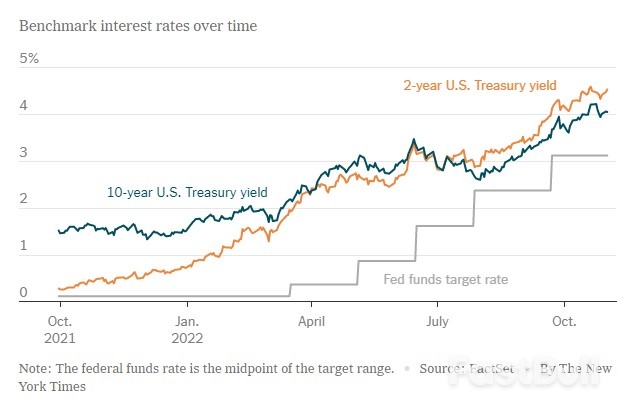
          The nearly $24 trillion market for U.S. government bonds, called the Treasury market, offers clearer signals about the prospects for both interest rates and the economy. Those come from yields — think of them as interest rates — on Treasury bonds, which have gone up fast this year. They started to rise well before the Fed began to raise its policy rate, in anticipation that it would do so.
          The Treasury market doesn't just interpret economic winds; it also influences them. When yields on government bonds rise, they affect everything from the housing market to student loans, and changes in the Treasury market often lead the stock market higher or lower.
          Here's a guide to understanding what is happening with Treasury yields right now, and why it matters.

          A bond is similar to any other kind of loan.

          First the basics.
          A bond is a form of debt, which means that when it is issued, someone is borrowing money and someone else is lending it. In the U.S. government bond market, the borrower is the federal government. Lots of governments do this: When the United States borrows, the bonds are called Treasuries. In Britain, they're called gilts, and in Japan, they're known as J.G.B.s which stands for Japanese government bonds.
          The lender is the bond investor, who expects to be paid interest on the investment. That's a key difference between a bond and other assets that people buy or trade, like stocks: That interest is known as the bond's coupon.
          The bond's yield is the total annual return someone can expect to earn from it. (A bond's yield rises as its price falls, and vice versa.)
          Just like the rate a homeowner pays on a mortgage, a bond yield reflects a lot of factors: when the debt will be repaid, the risk that it won't be, the investor's view on whether earnings on the loan will be more worthwhile than other investments — like stocks and cryptocurrencies
          When an investor owns a Treasury bond until it matures, the return an investor will receive is fixed, but because government bonds are publicly traded, their value can rise or fall just like a stock price and that means yields move higher or lower, too. Those changing yields reflect shifting views in the market on inflation and expectations for what the Fed will do with the interest rates it controls, said Dana D'Auria, co-chief investment officer at Envestnet.
          "They're kind of like stock prices in the sense that they have to reflect a ton of information, but they're only one number," Ms. D'Auria said.

          Treasury yields have been climbing fast.

          Even within the world of Treasuries, there is a lot of variety. The U.S. issues debt with a range of "maturities" — a term that refers to when it has to be paid back — from four-week Treasury bills to the 30-year Treasury note.
          Often, it's the 10-year Treasury note that gets a lot of attention. It has been climbing steadily since August and has more than doubled since the beginning of the year. That includes a 12-week streak of gains that lifted the yield to a 14-year high of 4.22 percent on Oct. 21. It has since come off that high and was closer to 4.04 percent at the end of Tuesday.
          Underpinning it all is the Fed's campaign to bring down inflation by raising interest rates to make it more expensive for consumers and companies to borrow money, with an aim of slowing consumption and easing pressure on prices.
          The central bank sets the target range for the Fed funds rate — which commercial banks charge to lend money to one another overnight — and interest rates across the economy adjust, broadly moving in line with the Fed's wishes.
          "When they raise interest rates, what that does is that raises borrowing costs for the government on the front end and it kind of bleeds into the other parts of the Treasury securities," said Jeffrey Sherman, the chief investment officer of DoubleLine, a money management firm.
          The $24 Trillion Market That Predicts and Influences Interest Rates_1But Treasury yields began to climb well before the Fed started raising interest rates, signaling the bond market's expectations that the Fed was about to act. Yields on the 10-year note, for example, had already climbed from 1.51 percent at the end of 2021 to 2.14 percent on March 15, the day before the Fed raised its benchmark interest rate for the first time this year, by a quarter of a percentage point.
          Another Treasury note, the two-year, which is seen as more reflective of Fed moves, rose from 0.73 percent at the end of December to 1.86 percent on March 15.
          It stood at 4.55 percent on Tuesday afternoon, compared with the Fed's policy rate, which hovered in the range of 3 to 3.25 percent. With investors already expecting the Fed to raise its rate to a range of 3.75 to 4 percent on Wednesday, the two-year shows that they think the Fed will keep going.
          "It's a prediction," said Kristina Hooper, the chief global market strategist at Invesco. "All it can do is try to reflect expectations around the Fed as opposed to where the Fed funds rate is now, and so we have to recognize that this has been an extraordinary year in which the Fed didn't realize where it was going."

          Rising yields affect borrowing costs throughout the economy.

          One reason the 10-year yield gets so much attention is that it is the starting point from which lenders determine mortgage rates, which means that as it rises, taking out a loan to buy a new home becomes more expensive.
          As of last Thursday, the average interest rate on a 30-year mortgage was 7.08 percent, up from 3.22 percent at the start of the year and its highest since 2002, according to data from Freddie Mac.
          "When Treasury yields go up, as we've seen very notably right now, it means that banks have to demand a higher interest rate from everyone that they're lending to, which means rates on mortgages go up, which means rates on auto loans go up," said Meghan Swiber, senior U.S. rates strategist at Bank of America.
          The higher mortgage rates have already hit home buyers. In September, home sales dropped almost 24 percent from the previous year, according to data from the National Association of Realtors.
          Government-backed student loans are also tied to Treasuries. They have a fixed rate that is set each July, so student borrowers won't be affected by the rising yields until next year.

          They also offer a view of what could happen next in the economy.

          The Treasury market also offers predictions for what will happen in the economy. Because Treasury bonds are issued in varying maturities, each one signals expectations for a different period of time.
          Typically, the longer the horizon for an investment, the more bond investors expect to be paid in interest. (We have more certainty about how things will go over the next three months than we do about the next decade.)
          So, the yield on a 10-year Treasury note is usually higher than the yield on one that matures in just a few months or a couple of years.
          That's not the case these days. Both the three-month and the two-year Treasury bills have yields higher than the 10-year note, creating a so-called inverted yield curve. When that happens, it shows investors are more worried about the economy in the short term than the long term, and it's a reliable predictor of recessions.
          Sometimes a recession doesn't follow this kind of move, and the rise in short-term yields doesn't tell us exactly when a recession will start. But it gets Wall Street's attention because this pattern has preceded every U.S. recession for the last half-century.

          Source: The New York Times

          Risk Warnings and Disclaimers
          You understand and acknowledge that there is a high degree of risk involved in trading. Following any strategies or investment methods may lead to potential losses. The content on the site is provided by our contributors and analysts for information purposes only. You are solely responsible for determining whether any trading assets, securities, strategy, or any other product is suitable for investing based on your own investment objectives and financial situation.
          Comments
          Add to Favorites
          Share

          U.S. Midterm Elections: How America Casts and Counts Its Votes

          Cohen

          Political

          Misinformation online and false claims of election fraud by former President Donald Trump and his allies have sharply eroded public trust in the integrity of U.S. elections. How Americans vote — and the equipment they use — varies widely, and some methods are more vulnerable to efforts to shake that trust.
          Election experts say the move in most states to hybrid voting systems – paper ballots tallied by electronic machines – could give voters greater confidence in the midterm elections.
          Electronic Voting Machines
          The United States invested heavily in paperless electronic voting machines after the contested presidential election pitting Democrat Al Gore against Republican George W. Bush in 2000 shook election officials' confidence in paper ballots.
          By 2006, the share of registered voters using paperless machines had surged, though hand-marked paper ballots that are later scanned by electronic tabulators remained the most popular. For the next decade, about a third of all votes were cast on direct recording electronic machines.
          These electronic voting machines store the votes in their memories. The lack of a physical record to back up an electronic vote means election officials must trust that the machines do not malfunction and change or lose a vote, that poll workers do not inadvertently alter votes, or that the machines are not hacked, said Douglas Jones, a retired University of Iowa computer science professor who spent decades studying the use of computers in elections.
          In 2016 about 22% of registered voters were living in jurisdictions that used electronic voting machines without paper trails, according to data from Verified Voting, a U.S. nonprofit that promotes the use of secure technology in election administration.
          By 2020 fewer than 9% of registered voters nationwide were living in jurisdictions that used electronic voting machines without paper trails for all voters — the smallest number since data was first available in 2006. This shift reflected election officials' growing concerns about foreign interference in elections and the need to have some way to audit tallies.
          For the November midterms, that number is expected to dwindle to about 5%, according to data from Verified Voting.
          Counties in six states still use paperless voting machines. Most are in solidly Republican or Democratic congressional districts, which decreases the likelihood of a contested election.
          However, there are six congressional districts that are considered at least somewhat competitive and are using electronic voting machines without paper records: the 2nd, 3rd, 5th and 7th districts in New Jersey; Indiana's 1st District; and Texas's 15th District.
          Paper Ballots
          The United States, like many countries, mostly uses paper ballots to vote. Nearly 70% of registered voters live in jurisdictions that primarily use hand-marked paper ballots, according to data from Verified Voting.
          About 23% of registered voters live in jurisdictions that primarily use machines called ballot-marking devices. These allow voters to make their selections electronically and also produce a paper record that can be scanned by another device.
          The extent to which voters use digital technology to cast their ballots has shifted over time. Paperless electronic voting, touted for its ability to tally votes quickly and accurately, largely decreased in popularity in the United States and European countries from the mid-2000s onward.
          Countries have turned to paper as the most secure way to audit their elections and detect potential vote tampering. To be sure, machines are still integral to the election process even when votes are cast on paper ballots. Optical scan tabulators count the results.
          Election experts say paper ballots help to secure elections because they allow voters to verify how they voted and officials to cross-check results in post-election audits.
          Georgia illustrates the importance of having a paper voting trail. The state had used paperless voting machines for several years. But just before the 2020 presidential election, it replaced its equipment with ballot marking devices, the machines in which voters make their selections electronically and can then review them on a printed paper ballot, which is then scanned and tabulated by a different machine.
          Trump challenged the results and falsely claims that there were widespread irregularities and fraud in states that he lost to Democratic opponent Joe Biden. Because there were paper ballots, however, election officials in Georgia were able to hand-count the votes and confirm Biden had indeed won the state.
          Vote-Tabulating Systems
          The push toward paper does not mean that machines are disappearing from voting places. Almost all still use machines to tabulate the paper ballots. Trump and his allies falsely claim that tabulators in some 2020 races were manipulated to flip votes from Trump to Biden.
          They are pushing for the machines to be ditched entirely and for the ballots to be counted by hand, which election officials say is logistically unfeasible. The claims have been thoroughly investigated and debunked.
          Still, claims of election fraud have sown widespread mistrust in elections, with an ABC/Ipsos poll in January finding only about 20% of the American public is very confident in the election system.

          Source: Reuters

          Risk Warnings and Disclaimers
          You understand and acknowledge that there is a high degree of risk involved in trading. Following any strategies or investment methods may lead to potential losses. The content on the site is provided by our contributors and analysts for information purposes only. You are solely responsible for determining whether any trading assets, securities, strategy, or any other product is suitable for investing based on your own investment objectives and financial situation.
          Comments
          Add to Favorites
          Share
          FastBull
          Copyright © 2025 FastBull Ltd

          728 RM B 7/F GEE LOK IND BLDG NO 34 HUNG TO RD KWUN TONG KLN HONG KONG

          TelegramInstagramTwitterfacebooklinkedin
          App Store Google Play Google Play
          Products
          Charts

          Chats

          Q&A with Experts
          Screeners
          Economic Calendar
          Data
          Tools
          Membership
          Features
          Function
          Markets
          Copy Trading
          Latest Signals
          Contests
          News
          Analysis
          24/7
          Columns
          Education
          Company
          Careers
          About Us
          Contact Us
          Advertising
          Help Center
          Feedback
          User Agreement
          Privacy Policy
          Business

          White Label

          Data API

          Web Plug-ins

          Poster Maker

          Affiliate Program

          Risk Disclosure

          The risk of loss in trading financial instruments such as stocks, FX, commodities, futures, bonds, ETFs and crypto can be substantial. You may sustain a total loss of the funds that you deposit with your broker. Therefore, you should carefully consider whether such trading is suitable for you in light of your circumstances and financial resources.

          No decision to invest should be made without thoroughly conducting due diligence by yourself or consulting with your financial advisors. Our web content might not suit you since we don't know your financial conditions and investment needs. Our financial information might have latency or contain inaccuracy, so you should be fully responsible for any of your trading and investment decisions. The company will not be responsible for your capital loss.

          Without getting permission from the website, you are not allowed to copy the website's graphics, texts, or trademarks. Intellectual property rights in the content or data incorporated into this website belong to its providers and exchange merchants.

          Not Logged In

          Log in to access more features

          FastBull Membership

          Not yet

          Purchase

          Become a signal provider
          Help Center
          Customer Service
          Dark Mode
          Price Up/Down Colors

          Log In

          Sign Up

          Position
          Layout
          Fullscreen
          Default to Chart
          The chart page opens by default when you visit fastbull.com