• Trade
  • Markets
  • Copy
  • Contests
  • News
  • 24/7
  • Calendar
  • Q&A
  • Chats
Trending
Screeners
SYMBOL
LAST
BID
ASK
HIGH
LOW
NET CHG.
%CHG.
SPREAD
SPX
S&P 500 Index
6870.39
6870.39
6870.39
6895.79
6858.28
+13.27
+ 0.19%
--
DJI
Dow Jones Industrial Average
47954.98
47954.98
47954.98
48133.54
47871.51
+104.05
+ 0.22%
--
IXIC
NASDAQ Composite Index
23578.12
23578.12
23578.12
23680.03
23506.00
+72.99
+ 0.31%
--
USDX
US Dollar Index
98.890
98.970
98.890
98.960
98.730
-0.060
-0.06%
--
EURUSD
Euro / US Dollar
1.16519
1.16527
1.16519
1.16717
1.16341
+0.00093
+ 0.08%
--
GBPUSD
Pound Sterling / US Dollar
1.33226
1.33235
1.33226
1.33462
1.33151
-0.00086
-0.06%
--
XAUUSD
Gold / US Dollar
4208.86
4209.27
4208.86
4218.85
4190.61
+10.95
+ 0.26%
--
WTI
Light Sweet Crude Oil
59.672
59.702
59.672
60.084
59.645
-0.137
-0.23%
--

Community Accounts

Signal Accounts
--
Profit Accounts
--
Loss Accounts
--
View More

Become a signal provider

Sell trading signals to earn additional income

View More

Guide to Copy Trading

Get started with ease and confidence

View More

Signal Accounts for Members

All Signal Accounts

Best Return
  • Best Return
  • Best P/L
  • Best MDD
Past 1W
  • Past 1W
  • Past 1M
  • Past 1Y

All Contests

  • All
  • Trump Updates
  • Recommend
  • Stocks
  • Cryptocurrencies
  • Central Banks
  • Featured News
Top News Only
Share

Standard Chartered Bought Back 571604 Total Shares On Other Exchanges For Gbp9.5 Million On Dec 5 - HKEX

Share

Morgan Stanley Reiterates Bullish Outlook On US Stocks Due To Fed Rate Cut Expectations. Morgan Stanley Strategists Believe That The US Stock Market Faces A "bullish Outlook" Given Improved Earnings Expectations And Anticipated Fed Rate Cuts. They Expect Strong Corporate Earnings By 2026, And Anticipate The Fed Will Cut Rates Based On Lagging Or Mildly Weak Labor Markets. They Expect The US Consumer Discretionary Sector And Small-cap Stocks To Continue To Outperform

Share

China's National Development And Reform Commission Announced That Starting From 24:00 On December 8, The Retail Price Limit For Gasoline And Diesel In China Will Be Reduced By 55 Yuan Per Ton, Which Translates To A Reduction Of 0.04 Yuan Per Liter For 92-octane Gasoline, 0.05 Yuan Per Liter For 95-octane Gasoline, And 0.05 Yuan Per Liter For 0# Diesel

Share

Tkms CEO: US Security Strategy Highlights Need For Europe To Take Care Of Its Own Defences

Share

USA S&P 500 E-Mini Futures Up 0.1%, NASDAQ 100 Futures Up 0.18%, Dow Futures Down 0.02%

Share

London Metal Exchange (LME): Copper Inventories Increased By 2,000 Tons, Aluminum Inventories Decreased By 2,500 Tons, Nickel Inventories Increased By 228 Tons, Zinc Inventories Increased By 2,375 Tons, Lead Inventories Decreased By 3,725 Tons, And Tin Inventories Decreased By 10 Tons

Share

Swiss Sight Deposits Of Domestic Banks At 440.519 Billion Sfr In Week Ending December 5 Versus 437.298 Billion Sfr A Week Earlier

Share

Czech November Jobless Rate 4.6% Versus Mkt Fcast 4.7%

Share

Czech Jobless Rate Unchanged At 4.6% In November

Share

Central Bank Data - Singapore November Foreign Exchange Reserves At $400.0 Billion

Share

Fitch On EMEA Homebuilders Says Weak Demand Is Likely To Constrain Completions And New Starts, Despite Easing Inflation And Gradual Rate Cuts

Share

French Otc Day-Ahead Baseload Power Price At 22.50 EUR/Mwh, Down 35.3% From The Price Paid Friday For Monday Delivery - Lseg Data

Share

Cambodia Information Minister: 4 Cambodian Civilians Killed, 9 Injured Amid Conflict With Thailand

Share

Tkms CEO: With Meko Frigates We Are Offering To German Government An Alternative To Delayed F126 Frigates

Share

Tkms CEO: Expect Decision On Canadian Submarine Order In 2026

Share

EU's Costa: Normal We Do Not Share Vision On Different Issues With The USA, But Interference In Political Life Is Unacceptable

Share

Swiss Six Exchange: Several Derivatives From UBS Are Under Mistrade Investigation

Share

Hsi Down 319 Pts, Hsti Closes Flat At 5662, Ccb Down Over 4%, Ping An, Hansoh Pharma, Global New Mat Hit New Highs, Market Turnover Rises

Share

It Was Gazprom's First Such LNG Delivery Since Sanctions Introduced In January, Lseg Data Shows

Share

United Arab Emirates Energy Minister: We Are Working To Open Opportunities For Ai Firms To Improve Efficiency Of Electricity Andwater Grids, We Already Saved 30% Of Energy Consumption By Using Ai

TIME
ACT
FCST
PREV
Japan Retail Sales (Oct)

A:--

F: --

P: --

Japan Retail Sales YoY (Oct)

A:--

F: --

P: --
Japan Industrial Inventory MoM (Oct)

A:--

F: --

P: --

Japan New Housing Starts YoY (Oct)

A:--

F: --

P: --

Japan Construction Orders YoY (Oct)

A:--

F: --

P: --

Germany Actual Retail Sales MoM (Oct)

A:--

F: --

P: --
France PPI MoM (Oct)

A:--

F: --

P: --
Germany Unemployment Rate (SA) (Nov)

A:--

F: --

P: --

Canada GDP MoM (SA) (Sept)

A:--

F: --

P: --
Canada GDP YoY (Sept)

A:--

F: --

P: --

U.S. Weekly Treasuries Held by Foreign Central Banks

A:--

F: --

P: --

China, Mainland NBS Manufacturing PMI (Nov)

A:--

F: --

P: --

China, Mainland Composite PMI (Nov)

A:--

F: --

P: --

China, Mainland NBS Non-manufacturing PMI (Nov)

A:--

F: --

P: --

South Korea Trade Balance Prelim (Nov)

A:--

F: --

P: --
South Korea IHS Markit Manufacturing PMI (SA) (Nov)

A:--

F: --

P: --

BOJ Gov Ueda Speaks
China, Mainland Caixin Manufacturing PMI (SA) (Nov)

A:--

F: --

P: --

India HSBC Manufacturing PMI Final (Nov)

A:--

F: --

P: --

Italy Manufacturing PMI (SA) (Nov)

A:--

F: --

P: --

U.K. Mortgage Lending (Oct)

A:--

F: --

P: --
U.K. M4 Money Supply YoY (Oct)

A:--

F: --

P: --

U.K. M4 Money Supply MoM (Oct)

A:--

F: --

P: --

U.K. Mortgage Approvals (Oct)

A:--

F: --

P: --
Canada National Economic Confidence Index

A:--

F: --

P: --

Canada Manufacturing PMI (SA) (Nov)

A:--

F: --

P: --

U.S. ISM Inventories Index (Nov)

A:--

F: --

P: --

U.S. ISM Manufacturing New Orders Index (Nov)

A:--

F: --

P: --

U.S. ISM Manufacturing Employment Index (Nov)

A:--

F: --

P: --

U.S. ISM Output Index (Nov)

A:--

F: --

P: --

U.S. ISM Manufacturing PMI (Nov)

A:--

F: --

P: --

Q&A with Experts
    • All
    • Chatrooms
    • Groups
    • Friends
    Connecting
    .
    .
    .
    Type here...
    Add Symbol or Code

      No matching data

      All
      Trump Updates
      Recommend
      Stocks
      Cryptocurrencies
      Central Banks
      Featured News
      • All
      • Russia-Ukraine Conflict
      • Middle East Flashpoint
      • All
      • Russia-Ukraine Conflict
      • Middle East Flashpoint
      Search
      Products

      Charts Free Forever

      Chats Q&A with Experts
      Screeners Economic Calendar Data Tools
      Membership Features
      Data Warehouse Market Trends Institutional Data Policy Rates Macro

      Market Trends

      Market Sentiment Order Book Forex Correlations

      Top Indicators

      Charts Free Forever
      Markets

      News

      News Analysis 24/7 Columns Education
      From Institutions From Analysts
      Topics Columnists

      Latest Views

      Latest Views

      Trending Topics

      Top Columnists

      Latest Update

      Signals

      Copy Rankings Latest Signals Become a signal provider AI Rating
      Contests
      Brokers

      Overview Brokers Assessment Rankings Regulators News Claims
      Broker listing Forex Brokers Comparison Tool Live Spread Comparison Scam
      Q&A Complaint Scam Alert Videos Tips to Detect Scam
      More

      Business
      Events
      Careers About Us Advertising Help Center

      White Label

      Data API

      Web Plug-ins

      Affiliate Program

      Awards Institution Evaluation IB Seminar Salon Event Exhibition
      Vietnam Thailand Singapore Dubai
      Fans Party Investment Sharing Session
      FastBull Summit BrokersView Expo
      Recent Searches
        Top Searches
          Markets
          News
          Analysis
          User
          24/7
          Economic Calendar
          Education
          Data
          • Names
          • Latest
          • Prev

          View All

          No data

          Scan to Download

          Faster Charts, Chat Faster!

          Download App
          English
          • English
          • Español
          • العربية
          • Bahasa Indonesia
          • Bahasa Melayu
          • Tiếng Việt
          • ภาษาไทย
          • Français
          • Italiano
          • Türkçe
          • Русский язык
          • 简中
          • 繁中
          Open Account
          Search
          Products
          Charts Free Forever
          Markets
          News
          Signals

          Copy Rankings Latest Signals Become a signal provider AI Rating
          Contests
          Brokers

          Overview Brokers Assessment Rankings Regulators News Claims
          Broker listing Forex Brokers Comparison Tool Live Spread Comparison Scam
          Q&A Complaint Scam Alert Videos Tips to Detect Scam
          More

          Business
          Events
          Careers About Us Advertising Help Center

          White Label

          Data API

          Web Plug-ins

          Affiliate Program

          Awards Institution Evaluation IB Seminar Salon Event Exhibition
          Vietnam Thailand Singapore Dubai
          Fans Party Investment Sharing Session
          FastBull Summit BrokersView Expo

          ECB Consensus Builds for June Rate Cut but no Appetite for Big Move

          Kevin Du

          Central Bank

          Economic

          Summary:

          Tariffs created disinflationary pressures. Data shows euro zone wage growth slowing. Longer term outlook remains foggy.

          European Central Bank policymakers are becoming increasingly confident about cutting interest rates in June as inflation continues its march lower, but there is little to no appetite for a big move, six sources told Reuters.
          ECB governors gathering in Washington for the International Monetary Fund and World Bank's Spring Meetings took stock of a weakening economy in the euro zone and around the world as uncertainty from tariffs imposed by U.S. President Donald Trump puts a dampener on investment.
          Data out of the euro zone also showed business growth stalling this month and pay hikes expected to ease considerably.
          Most importantly for inflation, the 20% tariff rate provisionally imposed by Trump on European goods had been less severe than modelled by the ECB and the risk of retaliation by the European Union had so far been averted.
          That meant that many governors were now seeing growing chances of an eighth quarter-point cut at their June 4 meeting, when the ECB will update its own economic forecasts. The ECB trimmed its benchmark rate to 2.25% earlier this month.
          In line with the ECB's official line, they were keeping an open mind, however, given that the decision was still more than a month away and economic policy had become unpredictable since Donald Trump's April 2 announcement.
          An ECB spokesperson declined to comment.
          Trump's move shook investor confidence in the U.S. economy and even its status as the world's safe haven, causing fuel prices as well as the dollar to fall against the euro.
          This resulted in growing disinflationary pressure in the euro zone, assuaging concerns about high price growth becoming entrenched among even some of the more hawkish members of the ECB's Governing Council.
          The outlook further out remains foggy, however, with the prospect of a more fragmented world, cheaper imports from China and stronger domestic demand from Germany's fiscal spending plans creating contrasting forces.
          For this reason, too, policymakers who spoke to Reuters saw no reason at present to consider a bigger, 50-basis-point cut, which they also believed might raise unnecessary alarm among market participants.

          Source: Reuters

          To stay updated on all economic events of today, please check out our Economic calendar
          Risk Warnings and Disclaimers
          You understand and acknowledge that there is a high degree of risk involved in trading. Following any strategies or investment methods may lead to potential losses. The content on the site is provided by our contributors and analysts for information purposes only. You are solely responsible for determining whether any trading assets, securities, strategy, or any other product is suitable for investing based on your own investment objectives and financial situation.
          Add to Favorites
          Share

          What's Next for Crude Oil?

          Thomas

          Commodity

          Economic

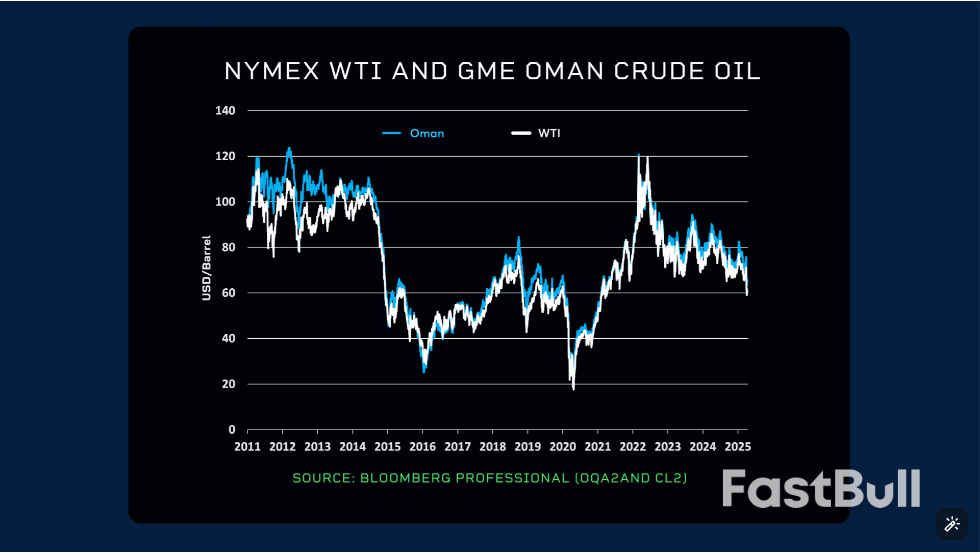
          For the past two years, West Texas Intermediate (WTI) crude oil prices appeared to have a solid floor at $64 per barrel. However, in early April, WTI broke through this support level, falling to a four-year low of $56 per barrel.
          What's Next for Crude Oil?_1
          The recent decline in crude oil prices is driven by three primary factors:
          1. Slowing Growth in China: Since 2005, there has been a notable relationship between Chinese economic growth and crude oil prices – when Chinese growth peaks, crude oil prices tend to peak about a year later. China's growth rate peaked in 2021, and crude prices followed suit, peaking in 2022.
          2. Increased U.S. Production: U.S. crude oil production has surged to 13.5 million barrels per day, adding significant supply to the global market.
          3. Improved Fuel Efficiency: Over the past two decades, vehicles have become increasingly fuel-efficient. On average, cars now use about 2% less fuel per unit of distance driven each year compared to the previous year. These factors have collectively made it challenging for crude oil prices to sustain a significant rally.

          OPEC's Role and Historical Context

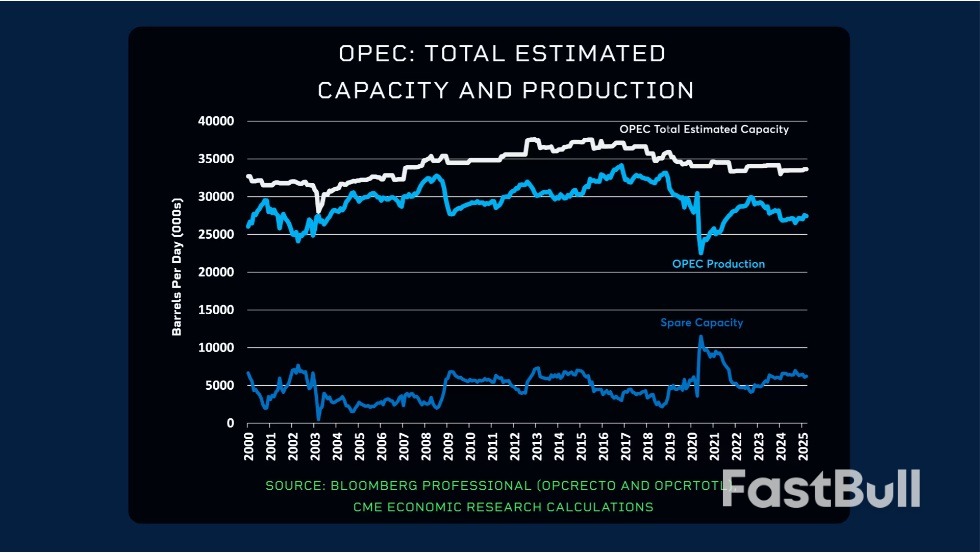
          Over the past few years, the Organization of the Petroleum Exporting Countries (OPEC) has cut production by 3.5 million barrels per day, with the majority of these cuts coming from Saudi Arabia. If Saudi Arabia decides to increase production, WTI prices could face further downward pressure.
          What's Next for Crude Oil?_2
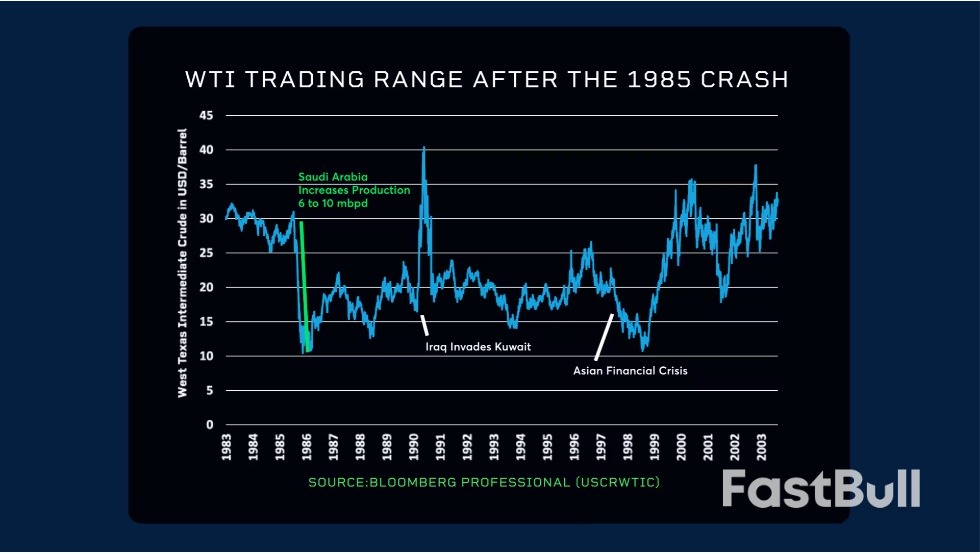
          Historical precedents highlight the potential impact of such a move. In late 2014, when Saudi Arabia boosted production, oil prices dropped from $90 to as low as $25 per barrel. Similarly, in 1985, Saudi Arabia increased production from 6 to 10 million barrels per day, causing oil prices to fall from $32 to $12 per barrel – a 70% decline.
          What's Next for Crude Oil?_3
          If Saudi Arabia opts to prioritize market share over price support, WTI prices could decline even further. Additionally, tariffs could slow global demand.

          Source: CME Group

          To stay updated on all economic events of today, please check out our Economic calendar
          Risk Warnings and Disclaimers
          You understand and acknowledge that there is a high degree of risk involved in trading. Following any strategies or investment methods may lead to potential losses. The content on the site is provided by our contributors and analysts for information purposes only. You are solely responsible for determining whether any trading assets, securities, strategy, or any other product is suitable for investing based on your own investment objectives and financial situation.
          Add to Favorites
          Share

          Trump's Next 100 Days To Feature Trade Deals, Peace Talks, 'torpedoes'

          Owen Li

          China–U.S. Trade War

          Key points:

          • Trump to celebrate first 100 days with a rally in Michigan
          • Official says Trump studying a travel ban on various countries
          • Trump expects trade deals within 90 days, analysts skeptical

          President Donald Trump and his administration this week will highlight the accomplishments of his first 100 days in office, while looking toward the next 100 days with a focus on trade deals and peace talks, White House officials said.

          After a pace of changes that have thrilled allies and stunned adversaries, including in social policy areas such as transgender rights, one official said Trump has "torpedoes" in store but did not explain what those were.

          Trump has enacted sweeping changes on a wide range of U.S. domestic and foreign policy priorities since taking office on January 20. He has upended the world economic order with tariffs, slashed the federal government with job cuts and done away with diversity programs in the public and private sector.

          He has also attacked academia, law firms and courts.

          This week, Trump plans to travel to Michigan for a rally to commemorate the 100-day milestone. The White House intends to highlight his economic vision, ejection of undocumented immigrants, changes to foreign policy, and work by billionaire Elon Musk's Department of Government Efficiency to purge the federal bureaucracy and cut what it sees as waste.

          Celebrating those moves will be part of a broad victory lap around Trump's second-term launch that the official, speaking on condition of anonymity, described to reporters as a conservative's fantasy.

          "Every morning I wake up, it’s like living in a dreamscape," he said.

          While Trump officials laud the speed and breadth of his efforts to remake American society, critics say Trump has trampled on the rights of citizens and non-citizens, alienated allies and threatened U.S. supremacy in the world.

          The president has withheld funding from universities for what his administration considers tolerance of anti-Semitic behavior; cut back on transgender rights; and done away with diversity, equity and inclusion (DEI) programs in the federal government and with federal contractors. This has had a broad knock-on effect throughout U.S. society.

          The official said there is more to come, with lots of “torpedoes under the water."

          That includes more executive action, a hallmark of Trump's first 100 days, which the official said would continue like a "snowball rolling downhill." He said the administration was still working on a travel ban for citizens from multiple countries.

          Courts have stymied some of Trump's actions, drawing scorn from his allies and White House rebukes that those judges are thwarting the will of the head of the executive branch and the people who elected him.

          While Trump will continue to wage war with the courts and a government bureaucracy that his team views as too bloated and out of line with his world view, another official said he would put more focus in his next 100 days on trade deals and peace talks.

          The president launched an all-out trade war on numerous countries this year before putting reciprocal tariffs largely on hold to allow for negotiations with individual nations. His administration hopes to secure agreements within 90 days.

          Experts say that is extremely unlikely, noting that Trump has not yet secured a single deal. His rhetoric about talks, particularly with China, has often been at odds with what the other country says is true.

          The president will take an extended trip abroad next month, visiting Saudi Arabia, Qatar and the United Arab Emirates, and continue to push for peace in Russia's war with Ukraine.

          Trump had promised to solve that conflict on "Day One," but peace has been elusive. The president conceded on Saturday that Russian President Vladimir Putin may not want to stop the war.

          Source: Reuters

          Risk Warnings and Disclaimers
          You understand and acknowledge that there is a high degree of risk involved in trading. Following any strategies or investment methods may lead to potential losses. The content on the site is provided by our contributors and analysts for information purposes only. You are solely responsible for determining whether any trading assets, securities, strategy, or any other product is suitable for investing based on your own investment objectives and financial situation.
          Add to Favorites
          Share

          World Bank Chief Economist Sounds Alarm on Emerging Market Debt Issues, Urges Liberalization

          Manuel

          Economic

          Bond

          Spiking trade uncertainty is compounding rising debt and sluggish growth problems facing emerging markets and developing countries, but cutting their own tariffs could provide a big boost, said Indermit Gill, the World Bank's chief economist.
          Gill said global economists were rapidly lowering their growth forecasts for advanced economies and somewhat less so for developing countries, at least for now, in the wake of a tsunami of tariffs announced by U.S. President Donald Trump.
          The International Monetary Fund and World Bank spring meetings this week in Washington have been dominated by worries about the economic fallout from century-high U.S. tariffs - and retaliatory ones announced by China, the European Union, Canada and others.
          The IMF on Tuesday slashed its economic forecasts for the U.S., China and most countries and warned that more trade strife would further slow growth. It forecast global growth of 2.8% for 2025, half a percentage point lower than its January forecast.
          The World Bank won't issue its own twice-yearly forecast until June, but Gill said a consensus of global economists showed sizeable downgrades in forecasts for growth and trade. Uncertainty indices, which were already running far higher than a decade ago, also spiked after Trump's April 2 tariff moves.
          Compared to earlier shocks, including the 2008-2009 global financial crisis and the COVID-19 pandemic, the current shock is the result of government policy, which meant it could also be reversed, Gill said in an interview with Reuters on Thursday.
          He said the current crisis would further depress growth in emerging markets, after steady declines from levels around 6% two decades ago, with global trade now slated to grow by just 1.5% - well below the 8% growth seen in the 2000s.
          "So it's a sudden slowdown on top of a situation that wasn't particularly good," he said, noting that portfolio flows to emerging markets and foreign direct investment (FDI) were also declining, much as they did during earlier crises.
          "FDI was 5% of GDP in emerging markets during good times. Now it's actually 1% and so both portfolio flows and FDI flows are down overall," he said.

          NEGOTIATE TRADE DEALS

          High debt levels mean that half of some 150 developing countries and emerging markets are either unable to make debt service payments or at risk of getting there, a rate that was double the level seen in 2024, and could grow further if the global economy slowed, Gill said.
          "If global growth slows down, trade slows down, more countries and interest rates stay high, then you are going to get many of these countries getting into debt distress, including some that are commodity exporters," he said.
          Net interest payments as a share of gross domestic product - a measure of how much countries spend to service their debts - now stand at 12% for emerging markets, compared to 7% in 2014, returning to levels last seen in the 1990s. The rates are even higher for poor countries, where debt servicing costs eat up 20% of GDP now, compared to 10% a decade ago, he said.
          That means countries are spending less on education, health care and other programs that could boost development, he said.
          Interest rates are also slated to stay high, given rising inflation expectations, which means countries' debt could rise further if they needed to roll over existing debt, Gill said.
          He said his advice to developing countries was to quickly and urgently negotiate agreements with the U.S. to lower their own tariff rates and avert high U.S. tariffs, and to extend lower tariff rates to other countries.
          Doing so now made sense, with U.S. pressure potentially easing domestic resistance. World Bank modeling showed that such moves could boost growth substantially, Gill said.

          Source: Reuters

          To stay updated on all economic events of today, please check out our Economic calendar
          Risk Warnings and Disclaimers
          You understand and acknowledge that there is a high degree of risk involved in trading. Following any strategies or investment methods may lead to potential losses. The content on the site is provided by our contributors and analysts for information purposes only. You are solely responsible for determining whether any trading assets, securities, strategy, or any other product is suitable for investing based on your own investment objectives and financial situation.
          Add to Favorites
          Share

          US Officials Adopt "Organized" Framework to Handle Trade Talks

          Manuel

          Political

          Economic

          China–U.S. Trade War

          President Donald Trump’s administration has drafted a framework to handle negotiations with trading partners rushing to secure deals to avert tariff hikes, according to people familiar with the matter.
          Under the blueprint, US negotiators will use a template that lays out common areas of concern to help guide the discussions, the people said, speaking on condition of anonymity to detail the plan. Among those categories are tariffs, non-tariff barriers, digital trade, economic security and commercial concerns.
          The talks would see the US host negotiators from a select number of countries each week, in a bid to manage the flood of foreign governments and trading blocs seeking tariff relief ahead of a mid-July deadline. That framework could change, according to the people familiar, and officials could raise additional issues specific to certain countries.
          The administration’s plans were first reported Friday by the Wall Street Journal. Under the structure, the US will hold discussions with about 18 countries — six every week — over three weeks, in a rotation until they hit the deadline, the Journal reported.
          The Office of the US Trade Representative, in a statement, said it is “working under an organized and rigorous framework and moving ahead quickly with willing trading partners.”
          “President Trump and USTR have made U.S. objectives clear and our trading partners have a very good sense of what they can each individually offer,” the statement added. “This is why USTR is receiving dozens of meaningful and substantial proposals from countries in pursuit of fair and reciprocal trade with the United States.”
          The effort offers to provide more clarity for a process that has unnerved equity and bond markets and left major US trading partners struggling to determine how to carry out talks with the US and what Trump is seeking.
          Trump earlier this month announced sharp tariff increases on about 60 countries but then quickly paused those measures for three months to allow trading partners to negotiate deals, keeping in place a baseline 10% rate during the negotiating period. That has set off a flurry of visits from foreign delegations eager to strike a deal.
          A South Korean delegation held talks earlier this week and Trump told reporters Friday that an agreement with Japan is “very close.”

          Source: Bloomberg

          To stay updated on all economic events of today, please check out our Economic calendar
          Risk Warnings and Disclaimers
          You understand and acknowledge that there is a high degree of risk involved in trading. Following any strategies or investment methods may lead to potential losses. The content on the site is provided by our contributors and analysts for information purposes only. You are solely responsible for determining whether any trading assets, securities, strategy, or any other product is suitable for investing based on your own investment objectives and financial situation.
          Add to Favorites
          Share

          Why Bitcoin Miners Soared This Week

          Manuel

          Cryptocurrency

          Stocks

          Bitcoin (BTC) has been on fire this week, rising 12% over the past seven days as of 2 p.m. ET on Friday. Investors have been in "risk on" mode this week as trade tensions between the U.S. and nearly every country in the world seem to be easing, for now.
          That helped companies downstream of Bitcoin's price, like Bitcoin miners. TeraWulf (WULF) is up 36% this week, Riot Platforms (RIOT) jumped 26.1%, and MARA Holdings (MARA) is up 17% for the week.

          Bitcoin's big move

          Cryptocurrencies have jumped this week as trade tensions eased around the world. The tensions didn't technically have anything to do with cryptocurrencies, but they certainly impact the value of tokens.
          Bitcoin, in particular, has proven to be highly correlated with growth stocks and magnifies the market's move in general. So, when investors bought growth stocks earlier this week, it's no surprise that Bitcoin was up sharply as well.
          What's interesting about the move recently is that Bitcoin hasn't been a hedge to the market or a safe haven to investors. Gold rose as the market fell, which is what many investors would expect Bitcoin to do, but it didn't, falling with the rest of the market.

          Why Bitcoin miners were up so much

          So, why were Bitcoin miners up more than Bitcoin itself? They tend to be a leveraged bet on the price of Bitcoin for two reasons.
          First, Bitcoin is their source of revenue, and when Bitcoin rises, they all make more money. The second impact is the Bitcoin they already hold on the balance sheet. MARA Holdings had 46,000 Bitcoins at its last disclosure, Riot Platforms has 19,223 Bitcoins, and TeraWulf has $274.5 million in cash and Bitcoin.
          Higher Bitcoin values quite literally improve their balance sheets.

          Leveraged growth in Bitcoin mining

          The other big news item for miners this week was Riot Platforms announcing a $100 million credit facility with Coinbase (COIN) backed by Bitcoin. Coinbase has begun making loans to consumers with Bitcoin as backing, but this is the biggest deal it's done with a corporation.
          If Riot and others can use Bitcoin as collateral for loans that will fund growth, it could be another catalyst for their businesses. Bitcoin mining hasn't been the easiest business to finance historically so this is welcome news for the industry. Given the high value of Bitcoin on their balance sheets, this could be a great funding source long term.

          Bitcoin is the key

          Ultimately, the price of Bitcoin is going to determine the fortune of these companies. It's their source of revenue and a huge part of their balance sheets.
          Investors also need to keep in mind the leveraged nature of the mining business. Values have gone up sharply as Bitcoin has risen, but if we go through another crypto winter we can see both balance sheets and operations deteriorate quickly. If that kind of risk isn't what you're looking for, Bitcoin is a great alternative.

          Source: The Motley Fool

          Risk Warnings and Disclaimers
          You understand and acknowledge that there is a high degree of risk involved in trading. Following any strategies or investment methods may lead to potential losses. The content on the site is provided by our contributors and analysts for information purposes only. You are solely responsible for determining whether any trading assets, securities, strategy, or any other product is suitable for investing based on your own investment objectives and financial situation.
          Add to Favorites
          Share

          Former Fed Governor Warsh Says US Central Bank Should Change its Ways

          Manuel

          Central Bank

          Forex

          Former Federal Reserve Governor Kevin Warsh, with whom President Donald Trump is reported to have discussed firing U.S. central bank chief Jerome Powell and installing him in his place, on Friday unleashed a barrage of criticism of the Fed and argued for fundamental changes to how it operates.
          While saying he believes in the "operational independence" of the Fed, Warsh told a conference in Washington organized by the Group of Thirty, an international body of financiers and academics, he believes the Fed has gone beyond its remit and undermined its own claims to independence.
          He urged the Fed to stop relying on "data dependence" to guide its decisions, and on forward guidance to let the public know where rates may be headed. And he blamed the central bank for aiding the expansion of the U.S. national debt and for allowing inflation to surge after the COVID-19 pandemic.
          "Fed claims of independence in bank matters undermine the case for independence in the conduct of monetary policy," Warsh said. "And when the Fed turns away from its creed and tradition, exercising powers that are the province of the Treasury Department, or taking positions on societal issues, it furtherjeopardizes its operational independence in what matters most."

          NERVOUS MARKETS

          Trump has repeatedly criticized Powell for not cutting interest rates since the Republican president took office in January. His escalating rhetoric against the Fed chief, along with hints he might try to remove him, triggered on Monday a selloff on financial markets that were already under pressure from fears that Trump's sweeping tariffs could send the U.S. economy into a recession.
          Trump has since said he has no intention of firing Powell and also appears to have backed off his aggressive trade war with China.
          The Wall Street Journal reported that Trump has privately been talking about firing Powell for months, discussing the possibility with Warsh as recently as February. The WSJ said Warsh advised the president to leave Powell as Fed chief until his term expires in May 2026.
          Trump's interest in having Warsh, a Republican who served in former President George W. Bush's administration and previously worked for Morgan Stanley, take over the top Fed job dates to his first term as president, when he ended up picking Powell instead to replace Janet Yellen.
          The president soon soured on Powell, railing publicly about too-high interest rates. In 2020, he called out Warsh at a White House signing of a China-U.S. trade pact and said he "would have been very happy" to have him heading the Fed instead of Powell.
          Warsh, currently a visiting fellow at Stanford University's Hoover Institution and an advisor to the Duquesne Family Office LLC, was a Fed governor from February 2006 to April 2011, leaving about a year before Powell became a governor.
          During his tenure at the Fed, Warsh was frequently an advocate for tighter, not easier, monetary policy and criticized the Fed's expansionary balance sheet policy. While stating the Fed must maintain monetary policy independence, Warsh also has argued it should not overstep its financial stability role to rescue banks, and should not expect autonomy for other functions, including regulatory policy or consumer protections.
          Treasury Secretary Scott Bessent has said the administration will start interviewing candidates for the top Fed job in the fall.

          Source: Reuters

          Risk Warnings and Disclaimers
          You understand and acknowledge that there is a high degree of risk involved in trading. Following any strategies or investment methods may lead to potential losses. The content on the site is provided by our contributors and analysts for information purposes only. You are solely responsible for determining whether any trading assets, securities, strategy, or any other product is suitable for investing based on your own investment objectives and financial situation.
          Add to Favorites
          Share
          FastBull
          Copyright © 2025 FastBull Ltd

          728 RM B 7/F GEE LOK IND BLDG NO 34 HUNG TO RD KWUN TONG KLN HONG KONG

          TelegramInstagramTwitterfacebooklinkedin
          App Store Google Play Google Play
          Products
          Charts

          Chats

          Q&A with Experts
          Screeners
          Economic Calendar
          Data
          Tools
          Membership
          Features
          Function
          Markets
          Copy Trading
          Latest Signals
          Contests
          News
          Analysis
          24/7
          Columns
          Education
          Company
          Careers
          About Us
          Contact Us
          Advertising
          Help Center
          Feedback
          User Agreement
          Privacy Policy
          Business

          White Label

          Data API

          Web Plug-ins

          Poster Maker

          Affiliate Program

          Risk Disclosure

          The risk of loss in trading financial instruments such as stocks, FX, commodities, futures, bonds, ETFs and crypto can be substantial. You may sustain a total loss of the funds that you deposit with your broker. Therefore, you should carefully consider whether such trading is suitable for you in light of your circumstances and financial resources.

          No decision to invest should be made without thoroughly conducting due diligence by yourself or consulting with your financial advisors. Our web content might not suit you since we don't know your financial conditions and investment needs. Our financial information might have latency or contain inaccuracy, so you should be fully responsible for any of your trading and investment decisions. The company will not be responsible for your capital loss.

          Without getting permission from the website, you are not allowed to copy the website's graphics, texts, or trademarks. Intellectual property rights in the content or data incorporated into this website belong to its providers and exchange merchants.

          Not Logged In

          Log in to access more features

          FastBull Membership

          Not yet

          Purchase

          Become a signal provider
          Help Center
          Customer Service
          Dark Mode
          Price Up/Down Colors

          Log In

          Sign Up

          Position
          Layout
          Fullscreen
          Default to Chart
          The chart page opens by default when you visit fastbull.com