• Trade
  • Markets
  • Copy
  • Contests
  • News
  • 24/7
  • Calendar
  • Q&A
  • Chats
Trending
Screeners
SYMBOL
LAST
BID
ASK
HIGH
LOW
NET CHG.
%CHG.
SPREAD
SPX
S&P 500 Index
6827.42
6827.42
6827.42
6899.86
6801.80
-73.58
-1.07%
--
DJI
Dow Jones Industrial Average
48458.04
48458.04
48458.04
48886.86
48334.10
-245.98
-0.51%
--
IXIC
NASDAQ Composite Index
23195.16
23195.16
23195.16
23554.89
23094.51
-398.69
-1.69%
--
USDX
US Dollar Index
97.950
98.030
97.950
98.500
97.950
-0.370
-0.38%
--
EURUSD
Euro / US Dollar
1.17394
1.17409
1.17394
1.17496
1.17192
+0.00011
+ 0.01%
--
GBPUSD
Pound Sterling / US Dollar
1.33707
1.33732
1.33707
1.33997
1.33419
-0.00148
-0.11%
--
XAUUSD
Gold / US Dollar
4299.39
4299.39
4299.39
4353.41
4257.10
+20.10
+ 0.47%
--
WTI
Light Sweet Crude Oil
57.233
57.485
57.233
58.011
56.969
-0.408
-0.71%
--

Community Accounts

Signal Accounts
--
Profit Accounts
--
Loss Accounts
--
View More

Become a signal provider

Sell trading signals to earn additional income

View More

Guide to Copy Trading

Get started with ease and confidence

View More

Signal Accounts for Members

All Signal Accounts

Best Return
  • Best Return
  • Best P/L
  • Best MDD
Past 1W
  • Past 1W
  • Past 1M
  • Past 1Y

All Contests

  • All
  • Trump Updates
  • Recommend
  • Stocks
  • Cryptocurrencies
  • Central Banks
  • Featured News
Top News Only
Share

USA Embassy In Lithuania: Maria Kalesnikava Is Not Going To Vilnius

Share

USA Embassy In Lithuania: Other Prisoners Are Being Sent From Belarus To Ukraine

Share

Ukraine President Zelenskiy: Five Ukrainians Released By Belarus In US-Brokered Deal

Share

USA Vilnius Embassy: USA Stands Ready For "Additional Engagement With Belarus That Advances USA Interests"

Share

USA Vilnius Embassy: Belarus, USA, Other Citizens Among The Prisoners Released Into Lithuania

Share

USA Vilnius Embassy: USA Will Continue Diplomatic Efforts To Free The Remaining Political Prisoners In Belarus

Share

USA Vilnius Embassy: Belarus Releases 123 Prisoners Following Meeting Of President Trump's Envoy Coale And Belarus President Lukashenko

Share

USA Vilnius Embassy: Masatoshi Nakanishi, Aliaksandr Syrytsa Are Among The Prisoners Released By Belarus

Share

USA Vilnius Embassy: Maria Kalesnikava And Viktor Babaryka Are Among The Prisoners Released By Belarus

Share

USA Vilnius Embassy: Nobel Peace Prize Laureate Ales Bialiatski Is Among The Prisoners Released By Belarus

Share

Belarusian Presidential Administration Telegram Channel: Lukashenko Has Pardoned 123 Prisoners As Part Of Deal With US

Share

Two Local Syrian Officials: Joint US-Syrian Military Patrol In Central Syria Came Under Fire From Unknown Assailants

Share

Israeli Military Says It Targeted 'Key Hamas Terrorist' In Gaza City

Share

Rwanda's Actions In Eastern Drc Are A Clear Violation Of Washington Accords Signed By President Trump - Secretary Of State Rubio

Share

Israeli Military Issues Evacuation Warning In Southern Lebanon Village Ahead Of Strike - Spokesperson On X

Share

Belarusian State Media Cites US Envoy Coale As Saying He Discussed Ukraine And Venezuela With Lukashenko

Share

Belarusian State Media Cites US Envoy Coale As Saying That US Removes Sanctions On Belarusian Potassium

Share

Thai Prime Minister: No Ceasefire Agreement With Cambodia

Share

US, Ukraine To Discuss Ceasefire In Berlin Ahead Of European Summit

Share

Incoming Czech Prime Minister Babis: Czech Republic Will Not Take On Guarantees For Ukraine Financing, European Commission Must Find Alternatives

TIME
ACT
FCST
PREV
U.K. Trade Balance Non-EU (SA) (Oct)

A:--

F: --

P: --

U.K. Trade Balance (Oct)

A:--

F: --

P: --

U.K. Services Index MoM

A:--

F: --

P: --

U.K. Construction Output MoM (SA) (Oct)

A:--

F: --

P: --

U.K. Industrial Output YoY (Oct)

A:--

F: --

P: --

U.K. Trade Balance (SA) (Oct)

A:--

F: --

P: --

U.K. Trade Balance EU (SA) (Oct)

A:--

F: --

P: --

U.K. Manufacturing Output YoY (Oct)

A:--

F: --

P: --

U.K. GDP MoM (Oct)

A:--

F: --

P: --

U.K. GDP YoY (SA) (Oct)

A:--

F: --

P: --

U.K. Industrial Output MoM (Oct)

A:--

F: --

P: --

U.K. Construction Output YoY (Oct)

A:--

F: --

P: --

France HICP Final MoM (Nov)

A:--

F: --

P: --

China, Mainland Outstanding Loans Growth YoY (Nov)

A:--

F: --

P: --

China, Mainland M2 Money Supply YoY (Nov)

A:--

F: --

P: --

China, Mainland M0 Money Supply YoY (Nov)

A:--

F: --

P: --

China, Mainland M1 Money Supply YoY (Nov)

A:--

F: --

P: --

India CPI YoY (Nov)

A:--

F: --

P: --

India Deposit Gowth YoY

A:--

F: --

P: --

Brazil Services Growth YoY (Oct)

A:--

F: --

P: --

Mexico Industrial Output YoY (Oct)

A:--

F: --

P: --

Russia Trade Balance (Oct)

A:--

F: --

P: --

Philadelphia Fed President Henry Paulson delivers a speech
Canada Building Permits MoM (SA) (Oct)

A:--

F: --

P: --

Canada Wholesale Sales YoY (Oct)

A:--

F: --

P: --

Canada Wholesale Inventory MoM (Oct)

A:--

F: --

P: --

Canada Wholesale Inventory YoY (Oct)

A:--

F: --

P: --

Canada Wholesale Sales MoM (SA) (Oct)

A:--

F: --

P: --

Germany Current Account (Not SA) (Oct)

A:--

F: --

P: --

U.S. Weekly Total Rig Count

A:--

F: --

P: --

U.S. Weekly Total Oil Rig Count

A:--

F: --

P: --

Japan Tankan Large Non-Manufacturing Diffusion Index (Q4)

--

F: --

P: --

Japan Tankan Small Manufacturing Outlook Index (Q4)

--

F: --

P: --

Japan Tankan Large Non-Manufacturing Outlook Index (Q4)

--

F: --

P: --

Japan Tankan Large Manufacturing Outlook Index (Q4)

--

F: --

P: --

Japan Tankan Small Manufacturing Diffusion Index (Q4)

--

F: --

P: --

Japan Tankan Large Manufacturing Diffusion Index (Q4)

--

F: --

P: --

Japan Tankan Large-Enterprise Capital Expenditure YoY (Q4)

--

F: --

P: --

U.K. Rightmove House Price Index YoY (Dec)

--

F: --

P: --

China, Mainland Industrial Output YoY (YTD) (Nov)

--

F: --

P: --

China, Mainland Urban Area Unemployment Rate (Nov)

--

F: --

P: --

Saudi Arabia CPI YoY (Nov)

--

F: --

P: --

Euro Zone Industrial Output YoY (Oct)

--

F: --

P: --

Euro Zone Industrial Output MoM (Oct)

--

F: --

P: --

Canada Existing Home Sales MoM (Nov)

--

F: --

P: --

Euro Zone Total Reserve Assets (Nov)

--

F: --

P: --

U.K. Inflation Rate Expectations

--

F: --

P: --

Canada National Economic Confidence Index

--

F: --

P: --

Canada New Housing Starts (Nov)

--

F: --

P: --

U.S. NY Fed Manufacturing Employment Index (Dec)

--

F: --

P: --

U.S. NY Fed Manufacturing Index (Dec)

--

F: --

P: --

Canada Core CPI YoY (Nov)

--

F: --

P: --

Canada Manufacturing Unfilled Orders MoM (Oct)

--

F: --

P: --

Canada Manufacturing New Orders MoM (Oct)

--

F: --

P: --

Canada Core CPI MoM (Nov)

--

F: --

P: --

Canada Manufacturing Inventory MoM (Oct)

--

F: --

P: --

Canada CPI YoY (Nov)

--

F: --

P: --

Canada CPI MoM (Nov)

--

F: --

P: --

Canada CPI YoY (SA) (Nov)

--

F: --

P: --

Canada Core CPI MoM (SA) (Nov)

--

F: --

P: --

Q&A with Experts
    • All
    • Chatrooms
    • Groups
    • Friends
    Connecting
    .
    .
    .
    Type here...
    Add Symbol or Code

      No matching data

      All
      Trump Updates
      Recommend
      Stocks
      Cryptocurrencies
      Central Banks
      Featured News
      • All
      • Russia-Ukraine Conflict
      • Middle East Flashpoint
      • All
      • Russia-Ukraine Conflict
      • Middle East Flashpoint
      Search
      Products

      Charts Free Forever

      Chats Q&A with Experts
      Screeners Economic Calendar Data Tools
      Membership Features
      Data Warehouse Market Trends Institutional Data Policy Rates Macro

      Market Trends

      Market Sentiment Order Book Forex Correlations

      Top Indicators

      Charts Free Forever
      Markets

      News

      News Analysis 24/7 Columns Education
      From Institutions From Analysts
      Topics Columnists

      Latest Views

      Latest Views

      Trending Topics

      Top Columnists

      Latest Update

      Signals

      Copy Rankings Latest Signals Become a signal provider AI Rating
      Contests
      Brokers

      Overview Brokers Assessment Rankings Regulators News Claims
      Broker listing Forex Brokers Comparison Tool Live Spread Comparison Scam
      Q&A Complaint Scam Alert Videos Tips to Detect Scam
      More

      Business
      Events
      Careers About Us Advertising Help Center

      White Label

      Data API

      Web Plug-ins

      Affiliate Program

      Awards Institution Evaluation IB Seminar Salon Event Exhibition
      Vietnam Thailand Singapore Dubai
      Fans Party Investment Sharing Session
      FastBull Summit BrokersView Expo
      Recent Searches
        Top Searches
          Markets
          News
          Analysis
          User
          24/7
          Economic Calendar
          Education
          Data
          • Names
          • Latest
          • Prev

          View All

          No data

          Scan to Download

          Faster Charts, Chat Faster!

          Download App
          English
          • English
          • Español
          • العربية
          • Bahasa Indonesia
          • Bahasa Melayu
          • Tiếng Việt
          • ภาษาไทย
          • Français
          • Italiano
          • Türkçe
          • Русский язык
          • 简中
          • 繁中
          Open Account
          Search
          Products
          Charts Free Forever
          Markets
          News
          Signals

          Copy Rankings Latest Signals Become a signal provider AI Rating
          Contests
          Brokers

          Overview Brokers Assessment Rankings Regulators News Claims
          Broker listing Forex Brokers Comparison Tool Live Spread Comparison Scam
          Q&A Complaint Scam Alert Videos Tips to Detect Scam
          More

          Business
          Events
          Careers About Us Advertising Help Center

          White Label

          Data API

          Web Plug-ins

          Affiliate Program

          Awards Institution Evaluation IB Seminar Salon Event Exhibition
          Vietnam Thailand Singapore Dubai
          Fans Party Investment Sharing Session
          FastBull Summit BrokersView Expo

          Dollar's Smile Makes Wall Street Frown

          Alex

          Forex

          Stocks

          Summary:

          The 'dollar smile' can be a blessing for Wall Street, or a curse.
          Right now, with the dollar's boom being driven by a destabilizing surge in U.S. bond yields, heightened uncertainty over global growth and rapidly deteriorating investor sentiment, it is definitely the latter.
          The gist of the 'dollar smile' theory, floated by currency analyst and now hedge fund manager Stephen Jen 20 years ago, is this: the dollar typically appreciates in good times (booming investor confidence and roaring markets) and bad (times of great financial stress and 'risk off' markets), but sags in between.
          U.S. economic outperformance in a solid global expansion attracting strong investment inflows into U.S. assets, and Treasury yields higher than their international peers is a recipe for strong dollar and buoyant Wall Street.
          The circumstances that have fostered the dollar's rapid rise since July could not be more different.
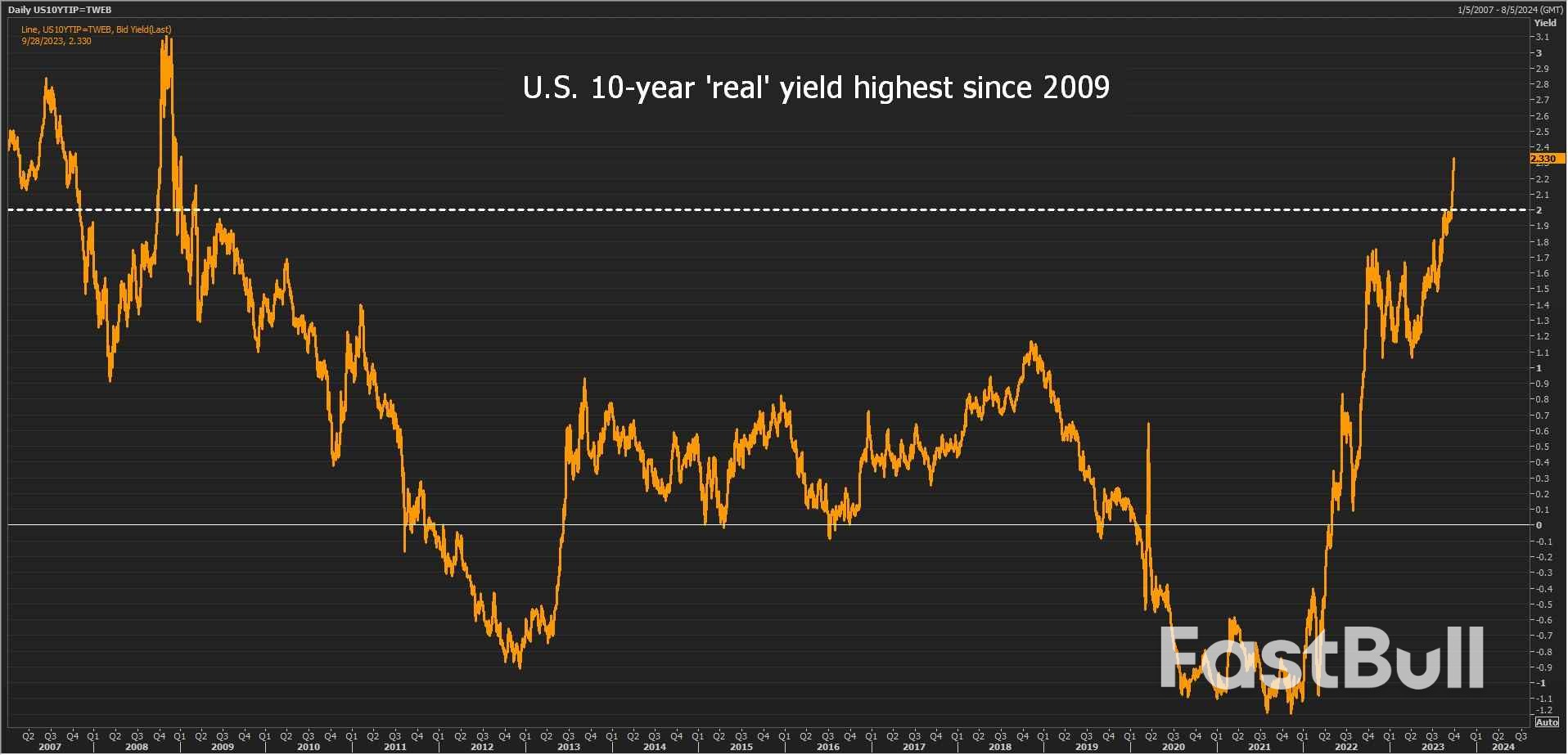
          The Chinese, European and many emerging economies are creaking, fears are growing that aggressive Fed policy will 'break' something at home, and the explosion in real yields has left Wall Street - especially growth and tech stocks - shrouded in a mushroom cloud of worry and uncertainty.
          In terms of the 'dollar smile', these are 'bad' times. There is a growing sense in markets that the negative relationship between U.S. stocks, the dollar, and yields could persist for months.
          "I expect it to remain negative for the foreseeable future, that is the next three to six months," reckons Stuart Kaiser, head of U.S. equity trading strategy at Citi. "This is a risk-off environment."
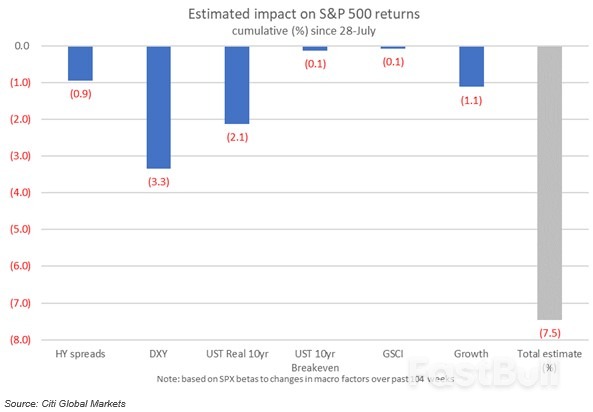
          Dollar's Smile Makes Wall Street Frown_1Kaiser reckons S&P 500 returns have fallen by around 7.5% over the last two months. The dollar has accounted for 3.3 percentage points of that and the 10-year real yield 2.1 pp, easily the two biggest contributors, he estimates.
          The dollar is up around 7% since mid-July and is on course to register its 11th consecutive weekly gain. That would be a record winning streak since the era of free-floating currencies began over 50 years ago.
          It has had bouts of stronger appreciation, such as the early 1980s and 2014-15, but never a more consistent move higher. And with U.S. bond yields the highest in years and still outpacing their global peers, it may not be over yet.Dollar's Smile Makes Wall Street Frown_2
          Financial Conditions Tighten
          A stronger dollar and rising bond yields, especially inflation-adjusted 'real yields,' in a "risk off" investment climate can scare the horses on Wall Street, potentially feeding a self-fulfilling spiral of selling and de-risking.
          There's no suggestion equities are about to crash. But the speed and extent of the move in the dollar and Treasuries, and tightening of financial conditions, warrant vigilance.
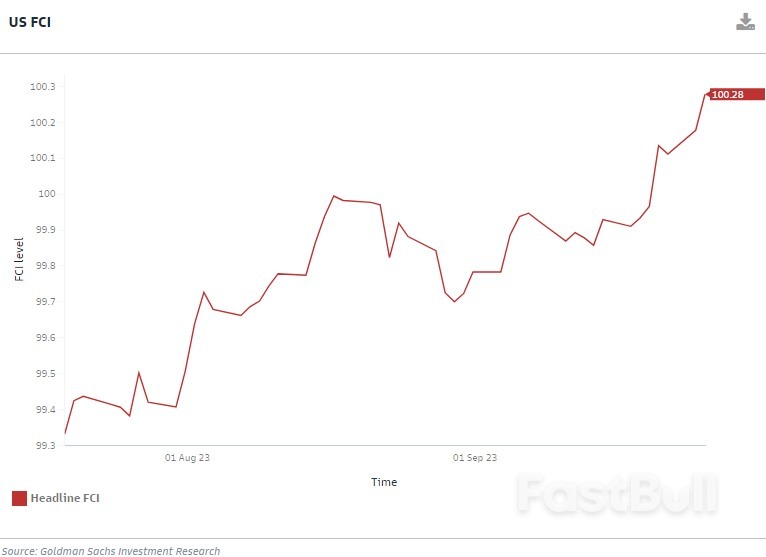
          According to Goldman Sachs, U.S. financial conditions are the tightest this year. This is not dissimilar to other major economies and regions, some of which - the euro zone, China and emerging markets - are feeling an even tighter squeeze.
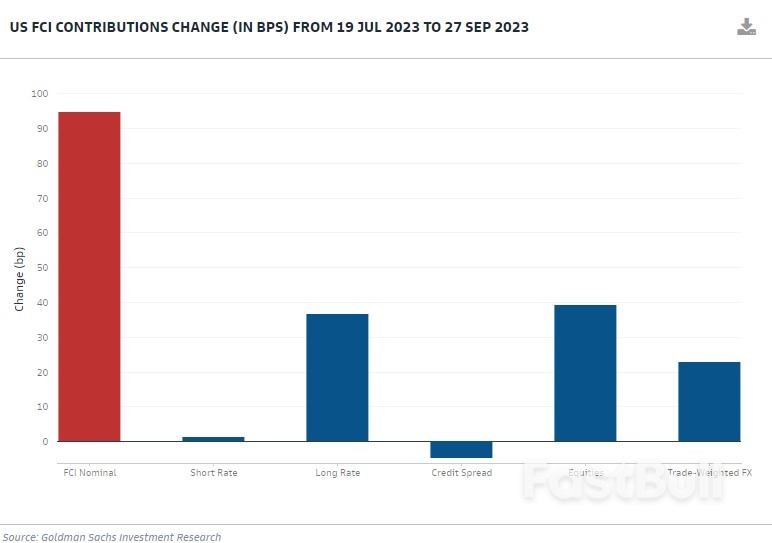
          The bank's U.S. financial conditions index (FCI) has risen 95 basis points since mid-July and the breakdown highlights how the dollar, yields and equities are feeding off each other.Dollar's Smile Makes Wall Street Frown_3Dollar's Smile Makes Wall Street Frown_4
          Compare that with the 100 bps rise in the global FCI or 145 bps jump in the emerging market FCI from their lows on July 25, which have been driven almost entirely by higher short and long rates. The FX impact, positive or negative, has been negligible.
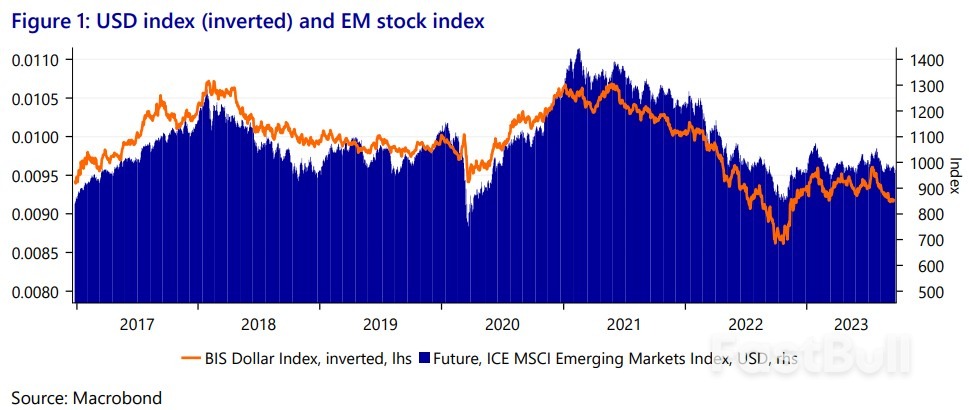
          As Rabobank's Jane Foley notes, the dollar's historical inverse correlation with emerging market stocks - a decent barometer of risk appetite - is "reasonably" strong.
          "This suggests that the dollar is set to find support on safe-haven demand even as the U.S. economy slows," Foley wrote on Thursday.
          Dollar's Smile Makes Wall Street Frown_5If these dynamics intensify and momentum builds up a head of steam, the dollar's strong exchange rate could also start to erode the dollar value of U.S. firms' overseas income, potentially having a material impact on corporate earnings.
          It might be too early for that to appear in third-quarter results - many big Wall Street firms will have hedged their currency exposure over the near term - but if sustained, fourth-quarter profits could be affected.
          There might be less cause for concern in corporate America, especially the growth-sensitive and tech sectors that led the rally in the first half of the year, if the dollar's surge was happening in a relatively stable fixed-income environment.
          But nominal and inflation-adjusted long-term bond yields have rocketed, threatening future cash flows and profits. Another reason for investors to be cautious.

          Source: Reuters

          Risk Warnings and Disclaimers
          You understand and acknowledge that there is a high degree of risk involved in trading. Following any strategies or investment methods may lead to potential losses. The content on the site is provided by our contributors and analysts for information purposes only. You are solely responsible for determining whether any trading assets, securities, strategy, or any other product is suitable for investing based on your own investment objectives and financial situation.
          Comments
          Add to Favorites
          Share

          A Dangerous Correlation for The Euro

          Damon

          Forex

          USD: Room for a rebound
          G10 FX volatility has rebounded in the last week of this month/quarter after a sell-off in long-dated treasuries and peripheral eurozone bonds. The sub-consensus 204k US jobless claims figure yesterday kept pointing at a jobs market that is inconsistent with a peak inflation narrative, especially when adding the recent rise in oil prices. Markets are – like ourselves – sceptical that the Federal Reserve will raise rates again given the US government shutdown’s prospected drag on growth, and this has been adding pressure on long-term treasuries. 10-year and 30-year treasuries are now yielding at 4.60% and 4.70%, the highest since 2007 and 2010 respectively.
          With the 10-year BTP-bund spread briefly touching 200bp yesterday (more in the EUR section below), everything seems to be pointing to a stronger dollar. However, the greenback moved in the opposite direction yesterday, entering a correction across the board. We suspect much of this counterintuitive move is due to quarter-end rebalancing, and because of the fact that the dollar had already rallied significantly ahead of yesterday’s events.
          Once the quarter-end adjustments are past us, the overall environment should favour another leg higher in the dollar. That is unless US data indicate otherwise, although the deterioration in the growth outlook in other alternative markets to the US has probably raised the bar for a negative US data surprise.
          Anyway, today is the busiest day of this week in the US calendar, with August’s personal income and PCE figures both set to be released. After a strong July, we expect to see weaker spending on goods coming through, especially in real terms. However, spending on tourism should be able to offset this, and we could see a slightly above-consensus read. Our economists also forecast a higher-than-consensus core PCE deflator (the Fed’s preferred measure of inflation): 0.3% compared to the expected 0.2% month-on-month reading.
          We could see a hawkish repricing in rate expectations coming to the dollar’s help today, and we are bullish on the greenback today. A return to the 106.50/107.00 area in DXY in the near term seems plausible in the current market conditions.
          EUR: TPI could partly mitigate the Italy spillover
          The 10-year BTP-Bund spread touched 200bp yesterday in the aftermath of a decision by the Italian government to raise the projected 2023 fiscal deficit from 4.5% to 5.3%, essentially putting it on a collision course with a likely retightening of EU fiscal rules after the Covid-era suspension. The five-year Italy CDS also jumped from 87bp to 110bp in the past week: this is still a very low level compared to the post-2022 election 180bp peak, the pandemic 270bp peak or the 2012 560bp peak. Still, it tells us that some concerns over long-term debt sustainability are resurging.
          Historically, the 200bp mark prompts the correlation between the euro and the BTP-Bund spread to pick up. Unlike previous instances, the ECB has the TPI in place and can use flexibility in its quantitative tightening programme to smoothen the impact on peripheral spreads. This means that the spillover into FX may be slower this time around.
          Incidentally, the BTP sell-off has coincided with the release of key CPI figures in the eurozone. Quarter-end rebalancing and a dollar correction seemed to overshadow the slower-than-expected German inflation figures yesterday. Spanish core inflation also declined despite an expected jump in the headline rate. Today, French figures are released before the eurozone-wide estimates: consensus is for a decline in the headline figure to 4.5% and in core to 4.8%. ECB President Christine Lagarde will speak at an event on the energy transition, and we’ll also hear from other Governing Council members (Vasle, Vuijcic, Kazaks, Visco).
          A rebound in the dollar, lingering concerns on Italian bonds (even if with a smaller intensity than in previous instances) and a decline in core inflation point to downside risks to EUR/USD today. We expect 1.0500 to be retested soon.
          Elsewhere in Europe, Norges Bank will release its October daily FX sales figures today. We estimate another increase, from NOK 1.1bn to 1.2bn, which may well disrupt the krone’s good performance recently.
          GBP: Chance of a further correction in EUR/GBP
          The Office for National Statistics confirmed the UK’s GDP growth was 0.2% in the second quarter, while the year-on-year number was revised higher from 0.4% to 0.6% compared to the flash estimate.
          GBP/USD has rallied in line with the dollar correction into this morning’s market open, but there are no real UK-specific drivers that would justify a sustained GBP outperformance at this stage. EUR/GBP has eased back from the 0.8700 level, in line with our expectations, after the turmoil in Italian bonds and given the big bulk of dovish Bank of England repricing had already happened. There is probably still additional room for a correction in EUR/GBP should Italian spreads keep widening.
          PLN: Key inflation print before next week's central bank meeting
          September inflation in Poland will be released today (it is always the first inflation number released in the CEE region) – a key piece of data ahead of next week's National Bank of Poland (NBP) meeting. Our economists expect a further decline from 10.1% to 8.3% YoY. Several factors are expected to contribute to disinflation in September apart from the high reference base from last year, when prices went up by 1.6% MoM. The outcome will certainly be a big focus for the market ahead of the upcoming NBP meeting. Moreover, the range of 8.0-8.9% indicates a large uncertainty in the estimates. For now, a 25bp rate cut seems the most likely scenario for us, but given the surprise at the last meeting with a 75bp cut, we can expect higher volatility in both FX and rates today.
          The Polish zloty has stabilised slightly above 4.600 EUR/PLN in recent days. The market is pricing in a bigger rate cut at the moment and remains on the dovish side. Thus, the scope for repricing is more hawkish in case of a surprise, which could support the zloty. At the moment, however, we see higher volatility rather than direction for the Polish zloty, which should remain near current levels until next week's meeting.

          Source: ING

          Risk Warnings and Disclaimers
          You understand and acknowledge that there is a high degree of risk involved in trading. Following any strategies or investment methods may lead to potential losses. The content on the site is provided by our contributors and analysts for information purposes only. You are solely responsible for determining whether any trading assets, securities, strategy, or any other product is suitable for investing based on your own investment objectives and financial situation.
          Comments
          Add to Favorites
          Share

          Sentiment Turns at Quarter End, Eyes Set on Eurozone CPI and US PCE

          Samantha Luan

          Economic

          Central Bank

          Forex

          The global markets experienced a noticeable shift in momentum as major US stock indexes concluded with substantial gains overnight, and treasury yields took a step back. This favorable swing persisted into Asian trading hours, marked by a remarkable rebound in Hong Kong stocks. Australian Dollar has been on the upswing, further bolstered by Copper's resurgence and a fresh wave of optimism concerning China's economic recovery. While Australian Dollar shows significant strength, New Zealand Dollar showcases a slight edge in its gains. Conversely, improved market sentiments have pushed Dollar and Yen to lower, with European majors demonstrating mixed performance.
          Investors are now shifting their focus towards today's Eurozone CPI data, which holds significance in determining if ECB has truly concluded its tightening journey. Likewise, US PCE inflation will be in the spotlight to deduce if Fed will deliver another interest rate hike in the fourth quarter, as previously indicated by the dot plot. Canadian Dollar also anticipates GDP data, which could provide further clarity on its economy. Yet, some market participants may choose a more cautious stance, preferring to see what next week brings with the onset of a new quarter.
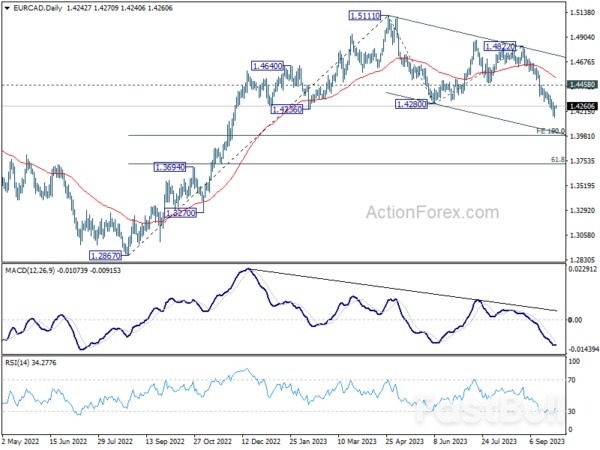
          Technically, EUR/CAD recovered after dipping to 1.4155 yesterday. But surprise from today's Eurozone CPI could trigger another way of selling. Current fall from 1.5111 is in progress and even as a corrective move, more downside should be seen to 100% projection of 1.5111 to 1.4280 from 1.4822 at 1.3991. This coincides with 50% retracement of 1.2867 to 1.5111 at 1.3989. In any case, outlook will stay bearish as long as 1.4458 resistance holds.
          Sentiment Turns at Quarter End, Eyes Set on Eurozone CPI and US PCE_1In Asia, at the time of writing, Nikkei is down -0.34%. Hong Kong HSI is up 2.62%. Singapore Strait Times is up 0.42%. Overnight, DOW rose 0.35%. S&P 500 rose 0.59%. NASDAQ rose 0.83%. 10-year yield dropped -0.029 to 4.597.
          Fed's Barkin: Path forward depends on inflationary pressures
          Richmond Fed President Thomas Barkin highlighted the existing uncertainties surrounding the economic outlook in remarks made overnight. He stated, "The range of potential outcomes, to me, is still pretty broad," emphasizing the unpredictability of the current economic situation.
          Reflecting on the recent decision of Fed to maintain status quo on interest rates, he said, "That's why I supported our decision to hold rates steady at the last meeting."
          "We have time to see if we've done enough, or whether there's more work to be done," he added.
          "The path forward to me depends on whether we can convince ourselves inflationary pressures are behind us, or whether we see them persisting," he said. Barkin further highlighted the significance of labor market developments in informing his perspective.
          Japan's industrial output flat in Aug, Tokyo inflation eases in Sep
          Japan's industrial output for August surprised by remaining steady month-on-month, outpacing expectations of a -0.8% mom decline. The seasonally adjusted index of production at factories and mines held its ground at 103.8, based on 2020 base of 100. Equally, index of industrial shipments ticked up by 0.1% to 103.2. In contrast, inventory index marked a -1.7% decrease to 104.6, registering the first decline in a quadrimestrial span.
          The Ministry of Economy, Trade and Industry maintained a cautious tone on the economy's direction, indicating that industrial output "fluctuated indecisively." However, optimism is still present; the ministry's poll suggests that manufacturers anticipate a 5.8% uptick in production for September, followed by a 3.8% rise in October.
          On the retail front, August saw a 7.0% yoy surge in retail sales, surpassing anticipated 6.4% yoy. This momentum builds upon the month's modest growth of 0.1% mom.
          The labor market remained resilient, with the unemployment rate steadfast at 2.7%. The job offers-to-applicants ratio for August persisted at 1.29, unchanged from July.
          Inflationary pressures seem to be cooling down. Tokyo's core CPI for September, excluding food, dipped more than forecasted, from 2.8% yoy to 2.5% yoy , as opposed to the predicted 2.6% yoy. Headline CPI decreased slightly from 2.9% yoy to 2.8% yoy. Additionally, core-core CPI, which excludes both food and energy, retreated from 4.0% yoy to 3.8% yoy.
          AUD/JPY and Copper soar on renewed China optimism
          Australian Dollar experienced a significant surge in today's Asian trading session, fueled in part by the vigorous rebound observed in Hong Kong stocks, the Chinese Yuan, and Copper prices. The rebound in stocks could attributed possible position adjustments after a tumultuous quarter in Hong Kong and China, and with the impending long holiday in China lasting until October 9. But there's still a budding sentiment of optimism concerning China's potential for economic recuperation.
          A noteworthy comment from the International Monetary Fund has contributed to this optimism. The IMF recently expressed its observation yesterday of certain stabilization signs in China's economy from the latest data sets. The institution holds a perspective that China could realistically achieve growth rate close to 5% this year. Looking forward, the IMF anticipates China's GDP growth to decelerate to approximately 3.5% over a medium-term horizon. Nevertheless, this pace could experience a boost if China embarks on economic reforms.
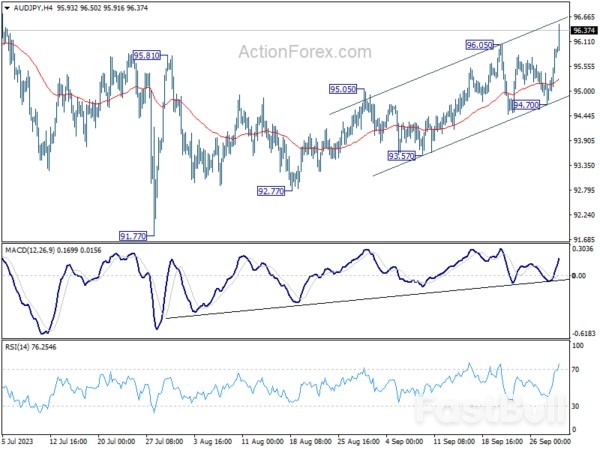
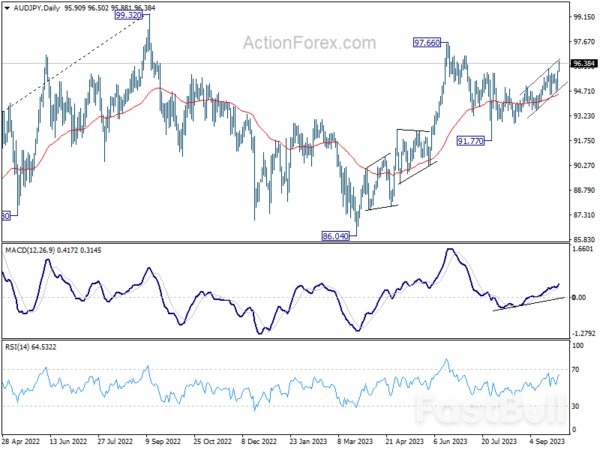
          AUD/JPY has powerfully broken 96.05 resistance mark, which is indicative of resumption of its recent rise from the 92.77. However, the nature of the current rally doesn't explicitly suggest it's impulsive, maintaining an air of ambiguity around potential technical interpretations.
          Sentiment Turns at Quarter End, Eyes Set on Eurozone CPI and US PCE_2In one scenario, if price action from 91.77 serves as the second leg of the pattern originating from 97.66, then the peak of the current rally might be restricted by 97.66 resistance.
          In another case, if the upswing from 91.77 is in continuation with the entire surge from 86.04, the climb could still be seen as the second leg of the pattern from the 2022 high of 99.32. As such, the upper boundary could be set by the 99.32 mark, even if 97.66 is surpassed.
          So, upside potential appears to be limited for the medium term.Sentiment Turns at Quarter End, Eyes Set on Eurozone CPI and US PCE_3
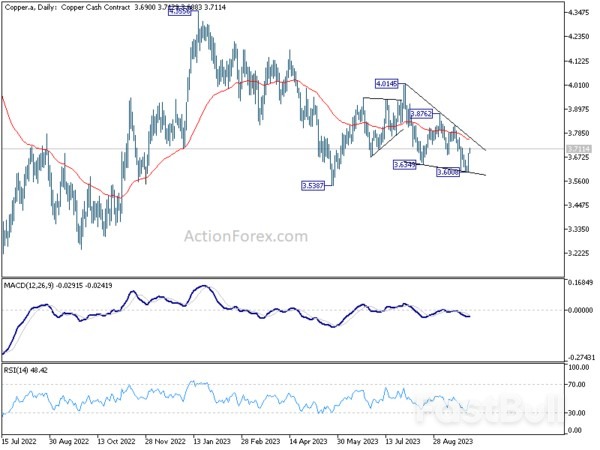
          Turning to Copper, its robust rebound this week suggests that decline from 4.0145 might have culminated, completing three waves that bottomed at 3.6008. Sustained trading above 55 D EMA (now at 3.7540) would solidify this viewpoint, setting sights on 3.8762 resistance for validation.
          For Australian Dollar to secure its foundational momentum, decisive break of 3.8762 resistance in Copper might be essential. Absent this, Aussie's rebound might retain its corrective nature.Sentiment Turns at Quarter End, Eyes Set on Eurozone CPI and US PCE_4

          Looking ahead

          Eurozone CPI is the main highlight in European session today. Other data include Germany import prices, retail sales and unemployment; France consumer spending; UK Q2 GDP final, mortgage approvals and M4 money supply; and Swiss KOF economic barometer.
          Later in the day, Canada GDP will be a focus. US will also release personal income and spending, PCE inflation, goods trade balance and Chicago PMI.

          EUR/AUD Daily Outlook

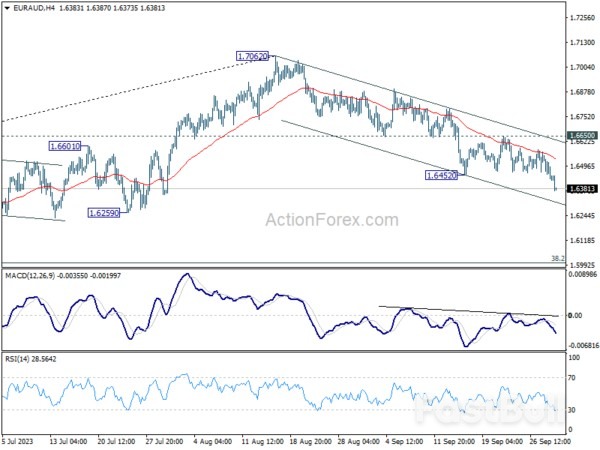
          EUR/AUD's fall from 1.7062 resumed by breaking through 1.6452 support. Intraday bias is back on the downside for 1.6000 fibonacci level, as a larger scale correction. On the upside, break of 1.6650 resistance is needed to indicate short term bottoming. Outlook, outlook will stay mildly bearish in case of recovery.Sentiment Turns at Quarter End, Eyes Set on Eurozone CPI and US PCE_5
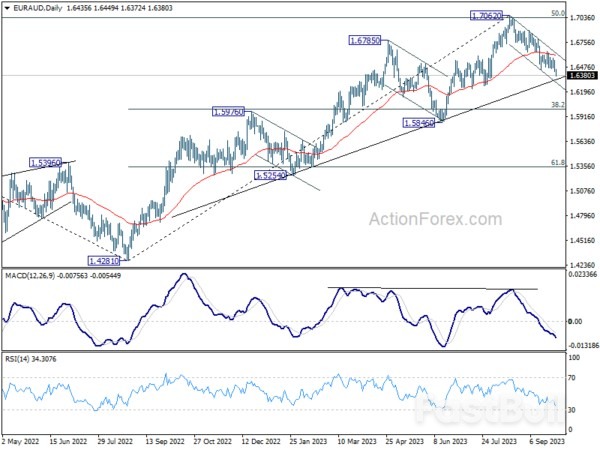
          In the bigger picture, fall from 1.7062 is probably correcting whole up trend from 1.4281 (2022 low). Deeper decline would be seen to 38.2% retracement of 1.4281 to 1.7062 at 1.6000. Strong support should be seen there to bring rebound, at least on first attempt. This will remain the favored case as long as 1.6650 resistance holds.Sentiment Turns at Quarter End, Eyes Set on Eurozone CPI and US PCE_6

          Source: ActionForex

          To stay updated on all economic events of today, please check out our Economic calendar
          Risk Warnings and Disclaimers
          You understand and acknowledge that there is a high degree of risk involved in trading. Following any strategies or investment methods may lead to potential losses. The content on the site is provided by our contributors and analysts for information purposes only. You are solely responsible for determining whether any trading assets, securities, strategy, or any other product is suitable for investing based on your own investment objectives and financial situation.
          Comments
          Add to Favorites
          Share

          Global Bond Investors Fear More Declines After Vicious Quarterly Selloff

          Cohen

          Economic

          Bond

          Fiscal concerns and worries over a prolonged period of elevated interest rates sent government bonds tumbling in the third quarter, and some investors believe more weakness is in store.
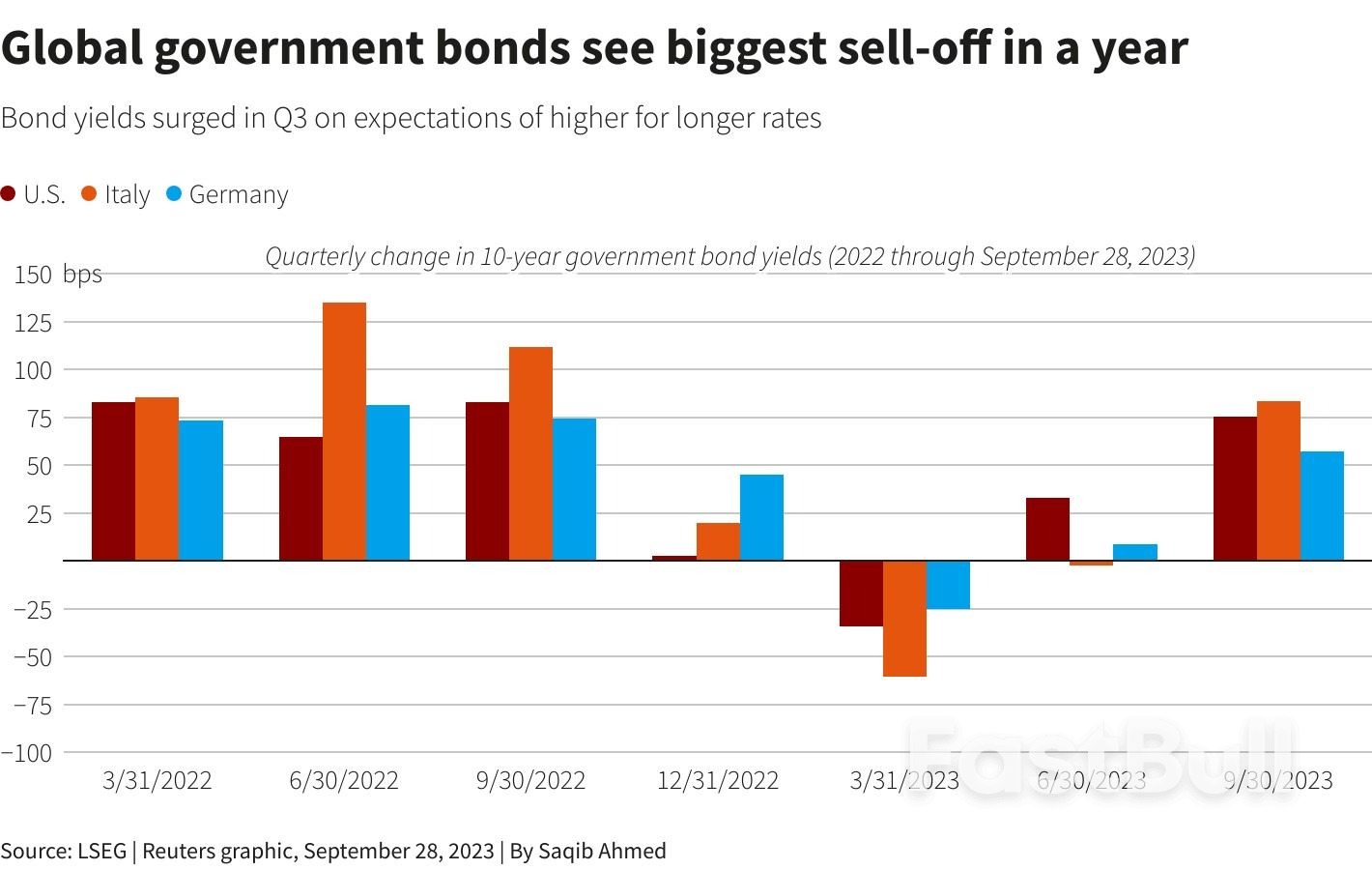
          U.S. and German government bond yields were set to end September with their biggest quarterly rises in a year, disappointing fund managers who were hoping for relief from the historic losses bonds suffered in 2022, when the U.S. Federal Reserve and other central banks raised interest rates to contain surging inflation.
          While bond yields - which move inversely to prices - appeared to be topping out earlier this year, renewed hawkishness from central banks has sent them soaring again in recent weeks.
          In the U.S., for example, benchmark 10-year Treasury yields are now hovering around 16-year highs at 4.55%, with some investors saying they could rise to 5% - a level not seen since 2007. Treasuries are on track to post their third straight annual loss, an event without precedence in U.S. history, according to Bank of America Global Research.
          The jump in yields is hurting equities, which are set for their first quarterly drop this year in the U.S. and Europe. With U.S. Treasury yields leading the rise, global currencies are reeling as the U.S. dollar rallies.
          “The bias is finally being absorbed by the marketplace that rates will remain higher for longer," said Greg Peters, co-chief investment officer at PGIM Fixed Income.
          Monetary policy expectations have been a key driver: the Fed last week surprised investors with their hawkish projections for rates, which show borrowing costs remaining around current levels throughout most of 2024.
          Investors have had to readjust swiftly, with traders now betting the Fed's policy rate, currently at 5.25%-5.50%, will be down to 4.8% by the end of 2024, much higher than the 4.3% they foresaw at the end of August.
          Similarly, investors have pushed back expectations of European Central Bank rate cuts as policymakers have stuck to their message to keep rates high for longer. Money markets pricing suggests traders see the ECB's deposit rate is seen at around 3.5% by the end of 2024, up from around 3.25% at end-August.Global Bond Investors Fear More Declines After Vicious Quarterly Selloff_1
          New Drivers
          Hawkish central banks have dulled the allure of longer-dated bonds, which with yield curves inverted, are still offering lower yields to investors than shorter-dated ones, said Kit Juckes, global head of currency strategy at Societe Generale, adding that high funding needs in the U.S. were pressuring bond markets.
          “It just looks as if finding enough buyers for … all the Treasuries is requiring a price discovery process that is painful," he said.
          Prices are also being swayed by additional catalysts that have become more prominent in recent weeks, investors said.
          Among them are fiscal concerns centered around the U.S., where the budget deficit has soared and a credit downgrade by ratings firm Fitch has unnerved some investors. At the same time, the Fed is progressing with “quantitative tightening" - a reversal of the massive central bank bond purchases undertaken to support markets in 2020.
          As a result, “yields will rise until investors believe that longer-dated bonds are compensating them for the supply that we know is coming," said Mike Riddell, senior portfolio manager at Allianz Global Investors.
          The jump in oil prices, which are nearing $100 a barrel and up 28% so far this quarter, is another key risk that could keep upward pressure on inflation, and therefore bond yields.
          Yields on the benchmark 10-year Treasury are up nearly 76 basis points so far this quarter, on track for their largest quarterly rise in a year.
          Germany's 10-year yield, the benchmark for the euro zone, is up 52 basis points to 2.9%, the biggest quarterly jump in a year.
          In Italy, 10-year yields have risen 75 basis points this month, with the debt continuing to sell off sharply on Thursday after Italy's government hiked its budget deficit targets and cut growth forecasts.
          How high?
          In addition to slamming bond investors, the rise in yields has hurt stocks, offering investment competition to equities while also raising the cost of borrowing for corporations and households.
          The S&P 500 index is down 3.4% this quarter, on track for its worst fall in a year, though it is up 11.3% year-to-date. Europe's Stoxx 600, meanwhile, has advanced 5.6% this year but lost 2.9% in the last three months.
          Investors have been revising their views for how high yields can go. Strategists at BofA Global Research said “sticky" inflation could push the US 10-year yield to 5%, a call echoed by ING which also said Germany's 10-year yield could see 3%.
          The swift runup in yields has “overshot where fundamentals should be and put us in highly speculative territory right now," said Ed Al-Hussainy, senior interest rate analyst at Columbia Threadneedle Investments, who believes there is a “high probability" of yields hitting 5%.
          Still, some investors see opportunity, despite the turbulence.
          Rick Rieder, BlackRock's chief investment officer of Global Fixed Income, said at CNBC's Delivering Alpha conference on Thursday that he likes shorter-dated bonds as well as the belly of the yield curve, and has also been buying commercial paper.
          Noah Wise, a portfolio manager at Allspring Investments, believes yields will ease in December, when investors have a clearer view of the Fed's monetary policy trajectory.
          “When investors see the Fed is likely to stay on the sidelines, that will be a less frightening market to get involved in," he said.

          Source: Yahoo

          To stay updated on all economic events of today, please check out our Economic calendar
          Risk Warnings and Disclaimers
          You understand and acknowledge that there is a high degree of risk involved in trading. Following any strategies or investment methods may lead to potential losses. The content on the site is provided by our contributors and analysts for information purposes only. You are solely responsible for determining whether any trading assets, securities, strategy, or any other product is suitable for investing based on your own investment objectives and financial situation.
          Comments
          Add to Favorites
          Share

          US and EU Inflation Set to Show Further Signs of Slowing

          CMC

          Forex

          As we come to the end of the week, month, and quarter it's not been a great quarter for equity markets. There's been a significant shift in sentiment over the summer as economic data has deteriorated and expectations around how long interest rates are likely to stay high have shifted well into 2024.
          European markets look set to open higher after US markets managed to rebound into the close after treasury yields retreated from their highs of the day to finish the day lower.
          Today's economic data is likely to feed into some of this narrative even if a lot of it is quite backward looking like the final revisions for UK Q2 GDP which will show a UK economy that is in a much better place than was thought to be the case at the time, but ultimately tells us very little about where the economy is now. For this we will need to look at the latest mortgage approvals and consumer credit numbers for August which are due at 9:30am.
          The most recent iteration of UK Q2 GDP showed an economy that is in better shape than originally thought, while recent revisions from the ONS announced at the beginning of this month suggest that we could see a further upgrade to the 0.2% growth we saw at the beginning of August. Expectations had been for a slowdown from the 0.1% seen in Q1, however a strong June GDP number of 0.5% put any thought of stagnation in Q2 very much on the back burner.
          The strong showing in June was driven by services as the hot weather prompted consumers to go out and spend money on travel, hotels and restaurants, as well as other leisure pursuits. We also saw a strong performance in construction and manufacturing with strong motor vehicle sales. The weak spots were in health and education due to industrial action, and while the resilience of the UK economy is welcome given the tough cost of living backdrop there is a concern that this could be as good as it gets as we head into Q3 and the second half of the year.
          On a more up to date note the most recent set of lending data for July clearly showed that higher rates are starting to bite, after mortgage approvals slowed more than expected in July to 49.4k, while consumer credit slowed to £1.2bn from £1.6bn. In a sign that interest rate hikes are starting to work, the latest M4 money supply data showed a sharp contraction of -0.9% on an annualised basis, which was the weakest reading since early 2015.
          This appears to have acted as a warning to the Bank of England that monetary policy is tight enough already, with the recent pause announced earlier this month. With interest rates at their highest levels since 2008 and house prices starting to slide back the demand for new mortgages could well slow further, with 47.4k approvals expected, particularly since the school holidays tend to see a seasonal slowdown as people go on holiday.
          We also have the latest flash CPI from the EU for September which is expected to show a sharp slowdown from the levels seen in August after Germany CPI slowed sharply to 4.3% yesterday from 6.4% the previous month.
          EU headline inflation remained unchanged in August at 5.3%, when many had been expecting a a slowdown to 5.2%, although core prices did slow to 5.3% from 5.5% so there does appear to be progress on core prices, which are expected to slow to 4.8%. With the ECB hiking rates by 25bps, a couple of weeks ago, officials on the governing council will be hoping for further respite from elevated inflation levels with today's flash numbers for September expected to slow to 4.5% at a time when the wider economy continues to show worrying signs of stagnation.
          The sharp rise in yields over the last few days also speaks to a concern that we could see further rate hikes from central banks in the coming months, despite a general feeling that we've hit a peak as far as the ECB and the Bank of England are concerned.
          Today's US inflation and personal spending numbers could go some way to tempering expectations about a November rate hike from the Federal Reserve.
          With the Fed pausing rates earlier this month, US central bankers will be hoping that the recent tick higher in headline CPI is merely a temporary phenomenon and something that doesn't start to impact on personal spending patterns.
          Personal spending remained strong in July rising by 0.8%, however the rise in gasoline prices since then could well start to impact on a wider level while also helping to put a floor under inflation, with expectations for a rise of 0.5% in August.
          On the core PCE deflator measure which is the Fed's preferred measure of inflation targeting this edged higher in July to 4.2%, and is expected to slip back to 3.9% in August. The deflator rose to 3.3% from 3.2%, and is forecast to move up to 3.5%.
          The Federal Reserve has continued to suggest that they may look to hike rates again in November if inflation doesn't show further signs of coming down. Today's numbers need to show that further downside is possible when it comes to core inflation for the prospect of a further rate hike by year end to recede.
          EUR/USD – rallied off the 1.0480 area yesterday where we may have seen a short-term base. A move below 1.0480 retargets parity. The main resistance remains back at the 1.0740 area, which we need to get above to stabilise and minimise the risk of further weakness.
          GBP/USD – broken a run of 6 daily declines rallying from 1.2110, with the bias for a retest of the 1.2000 area. We need to see a recovery through resistance at the 1.2300 area in the short term. Only a move back above the 1.2430 area and 200-day SMA stabilises and argues for a return to the 1.2600 area.
          EUR/GBP – slipped back towards the support at the 0.8620/30 area before rebounding. Needs to overcome the 0.8700 area and resistance at the 200-day SMA at 0.8720, which is capping the upside. A break of 0.8720 targets the 0.8800 area, however while below the bias remains for a pullback. Below 0.8620 targets 0.8580.
          USD/JPY – still on course for the 150.00 area with support currently at the lows last week at 147.20/30. A break above 150.00 retargets last year's higher at 152.00. Major support currently at the 146.00 area.
          Risk Warnings and Disclaimers
          You understand and acknowledge that there is a high degree of risk involved in trading. Following any strategies or investment methods may lead to potential losses. The content on the site is provided by our contributors and analysts for information purposes only. You are solely responsible for determining whether any trading assets, securities, strategy, or any other product is suitable for investing based on your own investment objectives and financial situation.
          Comments
          Add to Favorites
          Share

          Higher for Longer Drive-Up Bond Yields

          Danske Bank

          Economic

          Today we receive euro area inflation figures for September. We expect a decline in headline HICP to 4.4% from 5.3% in August driven by negative energy inflation, lower food prices, and a downtick in core inflation from 5.3% to 4.8%. The yearly growth rates will decline sharply as the base effects from inflation reducing government subsidies in 2022 and statistical distortions that kept inflation elevated over this summer fades. Yet, we expect the underlying momentum of inflation to remain high at 0.3% m/m and 0.4% m/m in seasonally adjusted headline and core inflation, respectively.
          In Norway, unemployment figures are published.
          In the US, we get PCE inflation figures for August. We have already received the CPI print for August but the PCE print should attract some attention as it is the Federal Reserve’s preferred inflation measure. We also receive US real private consumption growth volume which we expect to land around zero or even slightly negative.
          China releases PMIs for September over the weekend before going on holiday all of next week (Golden Week). For PMIs, we look for a slight further increase in the NBS manufacturing PMI whereas the Caixin PMI manufacturing may slip back after a stronger reading in August. The service PMIs are also worth keeping an eye on as a gauge of consumer spending.
          In the UK, we receive the final 2023Q2 GDP figures.

          The 60 second overview

          There is positive sentiment in Asian equity markets this morning, following yesterday’s positive sentiment in US and European equity markets despite the rising yields. The move in Asia is supported by optimism regarding spending in China during the “Golden Week” holiday.
          The market is looking for a confirmation of the soft landing in the US economy from today’s US data personal spending and income for August as well as a decline in the core-PCE that is one of Fed Chairman Powell’s preferred measures of inflation. This should be supportive for the Federal Reserve being on hold even though we are pricing out some of the rate cuts for 2024 and 2025 as central banks are “higher for longer”.
          The potential US government shut-down is an additional factor creating uncertainty regarding the economy as stated by another Fed official, and would keep the Fed pausing.
          We have several speeches by ECB members today and the market will be watching for comments on monetary policy.
          Equities: Global equities were higher yesterday driven by US and Europe. Many moving parts – and not all moving in the same direction – made yesterday a tricky day for investors. The risk-on was driven by cyclicals and partly growth stocks despite European yields moving higher. Yesterday’s big underperformer, and the only sector lower in the MSCI World Index was utilities. Hence, yesterday was not a one-way train but just as much a small reversal for the part of the market struggling the most in September. In US: Dow +0.4%, S&P 500 +0.6%, Nasdaq +0.8% and Russell 2000 +0.9%. Asian markets are mostly positive this morning with Chinese H-shares leading the way higher and Japan going against the tide. European and US futures are marginally higher.
          FI: Furthermore, there is not much “flight to quality” despite the widening of the 10Y BTPS-Bund spread as the Bund ASW-spread is still below 60bp and the German curve continues to disinvert between 2Y and 10Y as the market is pricing out future rate cuts. In the US market bond yields ended lower ahead of today’s inflation data. However, this morning we have seen a modest rise in US Treasury yields in Asian trading hours.
          FX: Following six consecutive sessions of gains, the broad USD index fell modestly yesterday. The JPY recovered some lost ground vs the USD with USD/JPY back closer to 149. The SEK continued to perform, whereas the previous NOK rally faded as the oil price rally took a breather yesterday.
          Credit: After an otherwise rough week credit spreads saw some relief yesterday where iTraxx Xover tightened 10bp and Main 2bp. Despite the positive tone, Xover has widened 25bp since trading in the new series commenced just over a week ago and Main 5bp above.
          Nordic macro
          Although the Norwegian labour market is still tight with solid demand for labour and low unemployment we are now seeing slightly slower employment growth, fewer vacancies and a gentle rise in the jobless rate. This deterioration is very moderate, however, and so we expect unemployment to be unchanged at 1.9% (s.a.) in September.
          In Sweden, August retail sales is released. After the sharp setback between Q1 2022 and Q1 2023 retail sales has been on a slight upward trajectory and July was up 1% mom. Question is if it is sustainable. In the last NIER survey the depressed confidence among consumers and retailers fell back again. At 09.00, Martin Flodén is scheduled for a speech on monetary policy.
          To stay updated on all economic events of today, please check out our Economic calendar
          Risk Warnings and Disclaimers
          You understand and acknowledge that there is a high degree of risk involved in trading. Following any strategies or investment methods may lead to potential losses. The content on the site is provided by our contributors and analysts for information purposes only. You are solely responsible for determining whether any trading assets, securities, strategy, or any other product is suitable for investing based on your own investment objectives and financial situation.
          Comments
          Add to Favorites
          Share

          Is There One Last Surprise in Store for US Corn, Beans in 2022/23?

          Owen Li

          Commodity

          U.S. corn supplies have been below normal for the last of couple years due to a combination of disappointing crops and stronger demand, though that run is expected to end once this year’s near-record crop is harvested.
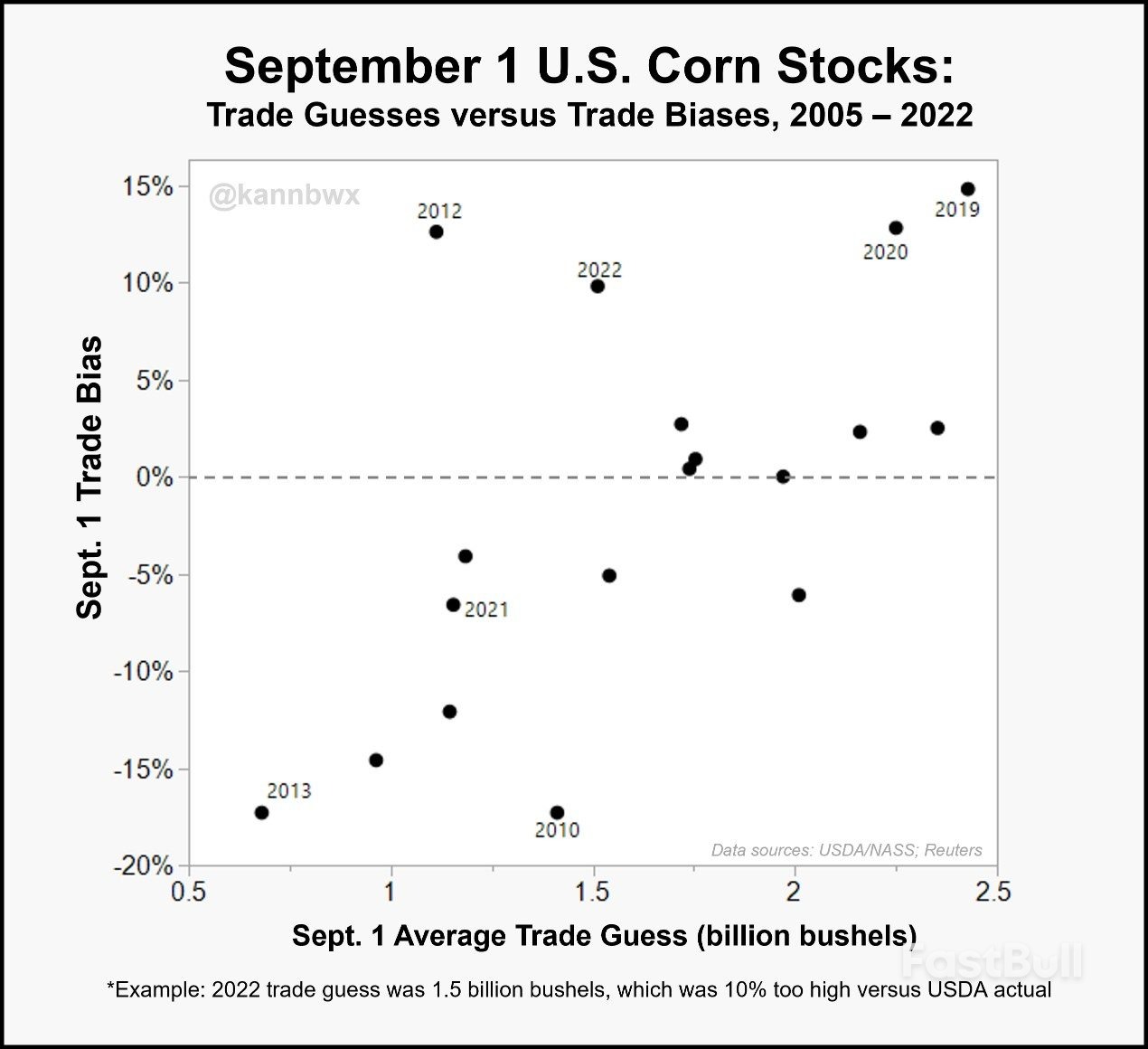
          However, the starting corn inventory for the current 2023-24 season will not be settled until the U.S. Department of Agriculture issues its next set of reports on Friday, and the trade has had trouble anticipating this number in recent years.
          On average, analysts expect Sept. 1 U.S. corn stocks at 1.429 billion bushels (bbu), a three-year high for the date but below the decade average. This survey-based figure becomes the ending stocks for the 2022-23 marketing year that concluded Aug. 31.
          Sept. 1 corn stocks have fallen outside the pre-report range of trade estimates in five of the last six years (not 2021). Four of those five misses occurred when Sept. 1 stocks came in low, generating bullish outcomes.
          Bullish Sept. 1 corn outcomes are more probable when supplies are already high and bearish ones tend to result during tighter supply years. This is likely based on the trade’s misjudgment of demand impacts when prices are unusually high or low.
          Is There One Last Surprise in Store for US Corn, Beans in 2022/23?_1That tendency may be less applicable this year since predicted Sept. 1 corn stocks are middle-of-the-road compared with the last couple of decades. Last year’s expectation of 1.5 bbu was similarly middle-ground, but Sept. 1 stocks came in 10% lower at 1.377 bbu.
          This year’s average trade guess implies June-August 2023 corn use down 10% on the year to a nine-year low for the period, likely due to fourth-quarter exports coming in a third lighter this year versus last.
          Ethanol production, which uses up to three times more U.S. corn than exports, was up about 2% on the year in the June-August time frame, and most-actively traded Chicago corn futures averaged about 19% lower through that period this year versus last.
          Only three of 20 polled analysts think Sept. 1 corn stocks were lighter in 2023 than in 2022. But even if that happens, it should not prevent substantial growth of U.S. corn stocks into 2024 unless an unforeseen demand situation arises.
          USDA estimated 2022-23 U.S. corn ending stocks at 1.452 bbu earlier this month.
          Soybeans
          Analysts see Sept. 1 U.S. soybean stocks at a seven-year low of 242 million bushels (mbu), slightly smaller than in the last two years. That is marginally lower than USDA’s latest 2022-23 ending stocks projection of 250 mbu.
          Sept. 1 soybean stocks have landed outside the range of expectations in four of the last six years, including the last two, which featured strongly bearish results. Trade estimates imply fourth-quarter soybean use down 20% from the prior year, primarily due to lagging exports.
          The outcome of Friday’s soybean number, especially if lighter than expected, could have a more persistent impact on the bean market versus that of corn. U.S. soybean stocks are already seen contracting through 2024 due to a shortfall in the crop.
          When USDA’s statistics agency analyzes the Sept. 1 survey data, it may choose to adjust the prior year’s harvest as explanation for the resulting stocks. The trade expects very minor declines in the 2022 corn and soybean crops.
          A misjudgment of the prior soybean harvest generally explains why the trade misses Sept. 1 soybean stocks, and this can be hard to gauge since the tendency has been mixed as to whether the soy crop rises or falls during the September review.
          To align with the soybean review, USDA in 2020 moved the review of the prior year’s corn crop to September from January. But regardless of the review's timing, the final corn crop almost always ends up equal to or lower than the last projected volume.

          Source: Reuters

          Risk Warnings and Disclaimers
          You understand and acknowledge that there is a high degree of risk involved in trading. Following any strategies or investment methods may lead to potential losses. The content on the site is provided by our contributors and analysts for information purposes only. You are solely responsible for determining whether any trading assets, securities, strategy, or any other product is suitable for investing based on your own investment objectives and financial situation.
          Comments
          Add to Favorites
          Share
          FastBull
          Copyright © 2025 FastBull Ltd

          728 RM B 7/F GEE LOK IND BLDG NO 34 HUNG TO RD KWUN TONG KLN HONG KONG

          TelegramInstagramTwitterfacebooklinkedin
          App Store Google Play Google Play
          Products
          Charts

          Chats

          Q&A with Experts
          Screeners
          Economic Calendar
          Data
          Tools
          Membership
          Features
          Function
          Markets
          Copy Trading
          Latest Signals
          Contests
          News
          Analysis
          24/7
          Columns
          Education
          Company
          Careers
          About Us
          Contact Us
          Advertising
          Help Center
          Feedback
          User Agreement
          Privacy Policy
          Business

          White Label

          Data API

          Web Plug-ins

          Poster Maker

          Affiliate Program

          Risk Disclosure

          The risk of loss in trading financial instruments such as stocks, FX, commodities, futures, bonds, ETFs and crypto can be substantial. You may sustain a total loss of the funds that you deposit with your broker. Therefore, you should carefully consider whether such trading is suitable for you in light of your circumstances and financial resources.

          No decision to invest should be made without thoroughly conducting due diligence by yourself or consulting with your financial advisors. Our web content might not suit you since we don't know your financial conditions and investment needs. Our financial information might have latency or contain inaccuracy, so you should be fully responsible for any of your trading and investment decisions. The company will not be responsible for your capital loss.

          Without getting permission from the website, you are not allowed to copy the website's graphics, texts, or trademarks. Intellectual property rights in the content or data incorporated into this website belong to its providers and exchange merchants.

          Not Logged In

          Log in to access more features

          FastBull Membership

          Not yet

          Purchase

          Become a signal provider
          Help Center
          Customer Service
          Dark Mode
          Price Up/Down Colors

          Log In

          Sign Up

          Position
          Layout
          Fullscreen
          Default to Chart
          The chart page opens by default when you visit fastbull.com