• Trade
  • Markets
  • Copy
  • Contests
  • News
  • 24/7
  • Calendar
  • Q&A
  • Chats
Trending
Screeners
SYMBOL
LAST
BID
ASK
HIGH
LOW
NET CHG.
%CHG.
SPREAD
SPX
S&P 500 Index
6827.42
6827.42
6827.42
6899.86
6801.80
-73.58
-1.07%
--
DJI
Dow Jones Industrial Average
48458.04
48458.04
48458.04
48886.86
48334.10
-245.98
-0.51%
--
IXIC
NASDAQ Composite Index
23195.16
23195.16
23195.16
23554.89
23094.51
-398.69
-1.69%
--
USDX
US Dollar Index
97.920
98.000
97.920
98.070
97.810
-0.030
-0.03%
--
EURUSD
Euro / US Dollar
1.17452
1.17459
1.17452
1.17596
1.17262
+0.00058
+ 0.05%
--
GBPUSD
Pound Sterling / US Dollar
1.33853
1.33862
1.33853
1.33961
1.33546
+0.00146
+ 0.11%
--
XAUUSD
Gold / US Dollar
4333.02
4333.43
4333.02
4350.16
4294.68
+33.63
+ 0.78%
--
WTI
Light Sweet Crude Oil
56.918
56.948
56.918
57.601
56.789
-0.315
-0.55%
--

Community Accounts

Signal Accounts
--
Profit Accounts
--
Loss Accounts
--
View More

Become a signal provider

Sell trading signals to earn additional income

View More

Guide to Copy Trading

Get started with ease and confidence

View More

Signal Accounts for Members

All Signal Accounts

Best Return
  • Best Return
  • Best P/L
  • Best MDD
Past 1W
  • Past 1W
  • Past 1M
  • Past 1Y

All Contests

  • All
  • Trump Updates
  • Recommend
  • Stocks
  • Cryptocurrencies
  • Central Banks
  • Featured News
Top News Only
Share

Bank Of America Expects A Deficit In Aluminium Next Year And Sees Prices Pushing Above $3000/T

Share

Fed Data - USA Effective Federal Funds Rate At 3.64 Percent On 12 December On $102 Billion In Trades Versus 3.64 Percent On $99 Billion On 11 December

Share

Brazil's Petrobras Says No Impact Seen On Oil, Petroleum Products Output As Workers Start Planned Strike

Share

Statement: US Travel Group Warns New Proposed Trump Administration Requirements For Foreign Tourists To Provide Social Media Histories Could Mean Millions Of People Opting Not To Visit

Share

Blackrock: Kerry White Will Become Head Of Citi Investment Management At Citi Wealth

Share

Blackrock: Rob Jasminski, Head Of Citi Investment Management, Has Joined With Team

Share

Blackrock: Effective Dec 15, Citi Investment Management Employees Will Join Blackrock

Share

Blackrock: Formally Launch Citi Portfolio Solutions Powered By Blackrock

Share

According To Data From The Federal Reserve Bank Of New York, The Secured Overnight Funding Rate (Sofr) Was 3.67% On The Previous Trading Day (December 15), Compared To 3.66% The Day Before

Share

Peru Energy And Mines Ministry: Copper Production Up 4.8% Year-On-Year In October To 248192 Metric Tons

Share

Security Source: Ukrainian Drones Hits Russian Oil Infrastructure In Caspian Sea For Third Time

Share

Spot Palladium Extends Gains, Last Up 5% To $1562.7/Oz

Share

Mexico's Economy Ministry Announces Start Of Anti-Dumping Investigation And Anti-Subsidy Investigations Into USA Pork Imports

Share

Canada Nov CPI Common +2.8%, CPI Median +2.8%, CPI Trim +2.8% On Year

Share

NY Fed's Empire State Prices Paid Index +37.6 In December Versus+49.0 In November

Share

Canada Nov Consumer Prices +0.1% On Month, +2.2% On Year

Share

Canada Nov CPI Core -0.1% On Month, +2.9% On Year

Share

Canada Nov Core CPI, Seasonally Adjusted +0.2% On Month, Oct +0.3% (Unrevised)

Share

UK Health Minister Streeting On Doctors' Strike: Vote To Go Ahead Reveals The Bma's Shocking Disregard For Patient Safety

Share

Venezuelan State Oil Company Pdvsa Says Was Subject To Cyber Attack But Operations Unaffected

TIME
ACT
FCST
PREV
Japan Tankan Small Manufacturing Outlook Index (Q4)

A:--

F: --

P: --

Japan Tankan Large Non-Manufacturing Outlook Index (Q4)

A:--

F: --

P: --

Japan Tankan Large Manufacturing Outlook Index (Q4)

A:--

F: --

P: --

Japan Tankan Small Manufacturing Diffusion Index (Q4)

A:--

F: --

P: --

Japan Tankan Large Manufacturing Diffusion Index (Q4)

A:--

F: --

P: --

Japan Tankan Large-Enterprise Capital Expenditure YoY (Q4)

A:--

F: --

P: --

U.K. Rightmove House Price Index YoY (Dec)

A:--

F: --

P: --

China, Mainland Industrial Output YoY (YTD) (Nov)

A:--

F: --

P: --

China, Mainland Urban Area Unemployment Rate (Nov)

A:--

F: --

P: --

Saudi Arabia CPI YoY (Nov)

A:--

F: --

P: --

Euro Zone Industrial Output YoY (Oct)

A:--

F: --

P: --

Euro Zone Industrial Output MoM (Oct)

A:--

F: --

P: --

Canada Existing Home Sales MoM (Nov)

A:--

F: --

P: --

Canada National Economic Confidence Index

A:--

F: --

P: --

Canada New Housing Starts (Nov)

A:--

F: --

P: --
U.S. NY Fed Manufacturing Employment Index (Dec)

A:--

F: --

P: --

U.S. NY Fed Manufacturing Index (Dec)

A:--

F: --

P: --

Canada Core CPI YoY (Nov)

A:--

F: --

P: --

Canada Manufacturing Unfilled Orders MoM (Oct)

A:--

F: --

P: --

U.S. NY Fed Manufacturing Prices Received Index (Dec)

A:--

F: --

P: --

U.S. NY Fed Manufacturing New Orders Index (Dec)

A:--

F: --

P: --

Canada Manufacturing New Orders MoM (Oct)

A:--

F: --

P: --

Canada Core CPI MoM (Nov)

A:--

F: --

P: --

Canada Trimmed CPI YoY (SA) (Nov)

A:--

F: --

P: --

Canada Manufacturing Inventory MoM (Oct)

A:--

F: --

P: --

Canada CPI YoY (Nov)

A:--

F: --

P: --

Canada CPI MoM (Nov)

A:--

F: --

P: --

Canada CPI YoY (SA) (Nov)

A:--

F: --

P: --

Canada Core CPI MoM (SA) (Nov)

A:--

F: --

P: --

Canada CPI MoM (SA) (Nov)

A:--

F: --

P: --

Federal Reserve Board Governor Milan delivered a speech
U.S. NAHB Housing Market Index (Dec)

--

F: --

P: --

Australia Composite PMI Prelim (Dec)

--

F: --

P: --

Australia Services PMI Prelim (Dec)

--

F: --

P: --

Australia Manufacturing PMI Prelim (Dec)

--

F: --

P: --

Japan Manufacturing PMI Prelim (SA) (Dec)

--

F: --

P: --

U.K. 3-Month ILO Employment Change (Oct)

--

F: --

P: --

U.K. Unemployment Claimant Count (Nov)

--

F: --

P: --

U.K. Unemployment Rate (Nov)

--

F: --

P: --

U.K. 3-Month ILO Unemployment Rate (Oct)

--

F: --

P: --

U.K. Average Weekly Earnings (3-Month Average, Including Bonuses) YoY (Oct)

--

F: --

P: --

U.K. Average Weekly Earnings (3-Month Average, Excluding Bonuses) YoY (Oct)

--

F: --

P: --

France Services PMI Prelim (Dec)

--

F: --

P: --

France Composite PMI Prelim (SA) (Dec)

--

F: --

P: --

France Manufacturing PMI Prelim (Dec)

--

F: --

P: --

Germany Services PMI Prelim (SA) (Dec)

--

F: --

P: --

Germany Manufacturing PMI Prelim (SA) (Dec)

--

F: --

P: --

Germany Composite PMI Prelim (SA) (Dec)

--

F: --

P: --

Euro Zone Composite PMI Prelim (SA) (Dec)

--

F: --

P: --

Euro Zone Services PMI Prelim (SA) (Dec)

--

F: --

P: --

Euro Zone Manufacturing PMI Prelim (SA) (Dec)

--

F: --

P: --

U.K. Services PMI Prelim (Dec)

--

F: --

P: --

U.K. Manufacturing PMI Prelim (Dec)

--

F: --

P: --

U.K. Composite PMI Prelim (Dec)

--

F: --

P: --

Euro Zone ZEW Economic Sentiment Index (Dec)

--

F: --

P: --

Germany ZEW Current Conditions Index (Dec)

--

F: --

P: --

Germany ZEW Economic Sentiment Index (Dec)

--

F: --

P: --

Euro Zone Trade Balance (Not SA) (Oct)

--

F: --

P: --

Euro Zone ZEW Current Conditions Index (Dec)

--

F: --

P: --

Euro Zone Trade Balance (SA) (Oct)

--

F: --

P: --

U.S. Retail Sales MoM (Excl. Automobile) (SA) (Oct)

--

F: --

P: --

Q&A with Experts
    • All
    • Chatrooms
    • Groups
    • Friends
    Connecting
    .
    .
    .
    Type here...
    Add Symbol or Code

      No matching data

      All
      Trump Updates
      Recommend
      Stocks
      Cryptocurrencies
      Central Banks
      Featured News
      • All
      • Russia-Ukraine Conflict
      • Middle East Flashpoint
      • All
      • Russia-Ukraine Conflict
      • Middle East Flashpoint
      Search
      Products

      Charts Free Forever

      Chats Q&A with Experts
      Screeners Economic Calendar Data Tools
      Membership Features
      Data Warehouse Market Trends Institutional Data Policy Rates Macro

      Market Trends

      Market Sentiment Order Book Forex Correlations

      Top Indicators

      Charts Free Forever
      Markets

      News

      News Analysis 24/7 Columns Education
      From Institutions From Analysts
      Topics Columnists

      Latest Views

      Latest Views

      Trending Topics

      Top Columnists

      Latest Update

      Signals

      Copy Rankings Latest Signals Become a signal provider AI Rating
      Contests
      Brokers

      Overview Brokers Assessment Rankings Regulators News Claims
      Broker listing Forex Brokers Comparison Tool Live Spread Comparison Scam
      Q&A Complaint Scam Alert Videos Tips to Detect Scam
      More

      Business
      Events
      Careers About Us Advertising Help Center

      White Label

      Data API

      Web Plug-ins

      Affiliate Program

      Awards Institution Evaluation IB Seminar Salon Event Exhibition
      Vietnam Thailand Singapore Dubai
      Fans Party Investment Sharing Session
      FastBull Summit BrokersView Expo
      Recent Searches
        Top Searches
          Markets
          News
          Analysis
          User
          24/7
          Economic Calendar
          Education
          Data
          • Names
          • Latest
          • Prev

          View All

          No data

          Scan to Download

          Faster Charts, Chat Faster!

          Download App
          English
          • English
          • Español
          • العربية
          • Bahasa Indonesia
          • Bahasa Melayu
          • Tiếng Việt
          • ภาษาไทย
          • Français
          • Italiano
          • Türkçe
          • Русский язык
          • 简中
          • 繁中
          Open Account
          Search
          Products
          Charts Free Forever
          Markets
          News
          Signals

          Copy Rankings Latest Signals Become a signal provider AI Rating
          Contests
          Brokers

          Overview Brokers Assessment Rankings Regulators News Claims
          Broker listing Forex Brokers Comparison Tool Live Spread Comparison Scam
          Q&A Complaint Scam Alert Videos Tips to Detect Scam
          More

          Business
          Events
          Careers About Us Advertising Help Center

          White Label

          Data API

          Web Plug-ins

          Affiliate Program

          Awards Institution Evaluation IB Seminar Salon Event Exhibition
          Vietnam Thailand Singapore Dubai
          Fans Party Investment Sharing Session
          FastBull Summit BrokersView Expo

          China Shakes Wheat Market With Cancelled Shipments From U.S., Australia

          Alex

          Economic

          Commodity

          Summary:

          Buyers seek better prices under Beijing's push to boost food security.

          The global wheat market has been hit by Chinese buyers cancelling major shipments, seemingly in an attempt to secure better prices and bolster the country's food security.
          Benchmark Chicago wheat futures are trading at about $5.50 per bushel, up slightly from a three-and-a-half-year low marked in mid-March but down about 10% from the beginning of the year.
          The U.S. Department of Agriculture last month said 504,000 tonnes of wheat sales to China had been cancelled. The figure is equivalent to about half the total U.S. wheat shipments to China in 2022 and the largest cancellation on record going back to 1999.
          About 1 million tonnes of Australian wheat exports to China have either been cancelled or postponed as well, Reuters reports.
          China is the world's largest grain importer. Buyers there have yet to provide a reason for the cancellations.
          Although China is facing an economic downturn, the price of food generally suffers less from economic fluctuations than the price of crude oil, copper and other industrial materials.
          "Buyers likely are trying to avoid going through with expensive contracts signed in the past, and are repurchasing at lower prices," said Ruan Wei at Japan's Norinchukin Research Institute, echoing a common view among market watchers.
          Demand for food-grade wheat imports grew in China after last summer's flooding in Henan affected harvest quality in the leading wheat-growing province. Chinese buyers appeared to have responded by securing large-scale contracts for high-quality wheat from Australia, Canada and the U.S.
          But Russia, the world's largest exporter of wheat, later ramped up cheap shipments after its second straight bumper crop. Benchmark Chicago wheat prices are now about 30% below a July 2023 peak.
          By the time deliveries from additional wheat contracts began reaching China, their prices appear to have been significantly above market rates, which in turn likely triggered the cancellations.
          China has not increased imports of Russian wheat, which does not meet its requirements. It is instead buying more wheat from France and Kazakhstan.
          Chinese buyers are known to be particularly sensitive to price shifts. In spring 2023, they abruptly cancelled 1.1 million tonnes in purchases of U.S. corn. They were later reported to have increased imports from Brazil instead, as a bumper stock there drove down prices.
          "Chinese moves to curb grain imports are likely to persist over the medium- to long-term," said Li Xuelian, a senior analyst at Marubeni Research Institute
          The Chinese government has focused more on food security since last year amid surging prices at home and tensions with the U.S. A food security law is set to take effect in June to help bolster domestic production of grains and diversify imports.
          China aims to eventually be fully self-sufficient on wheat and rice in particular, resulting in greater pressure to curb imports of these grains compared with corn and other grains mainly used for animal feed.

          Source:Reuters

          To stay updated on all economic events of today, please check out our Economic calendar
          Risk Warnings and Disclaimers
          You understand and acknowledge that there is a high degree of risk involved in trading. Following any strategies or investment methods may lead to potential losses. The content on the site is provided by our contributors and analysts for information purposes only. You are solely responsible for determining whether any trading assets, securities, strategy, or any other product is suitable for investing based on your own investment objectives and financial situation.
          Add to Favorites
          Share

          Stocks In Asia Cautious Ahead Of Key US Inflation

          Alex

          Stocks

          Economic

          Asian stocks traded cautiously ahead of key inflation data that will help shape the outlook for the Federal Reserve’s next steps.
          Equity benchmarks in Hong Kong and Australia edged higher, while mainland Chinese shares were slightly down at the open. Japanese stocks nudged lower with trading in the region muted by holidays in countries including South Korea. Contracts for US equities were steady after the S&P 500 fell as much as 0.8% Tuesday before finishing 0.1% higher.
          Treasuries were little changed in Asian trading after advancing Tuesday. Ten-year yields fell from their highest levels this year in a sign of short exposure being unwound before Wednesday’s US inflation reading. Markets have been tempering bets on Fed cuts as economic data remain strong, with officials pushing back against the need for easing.
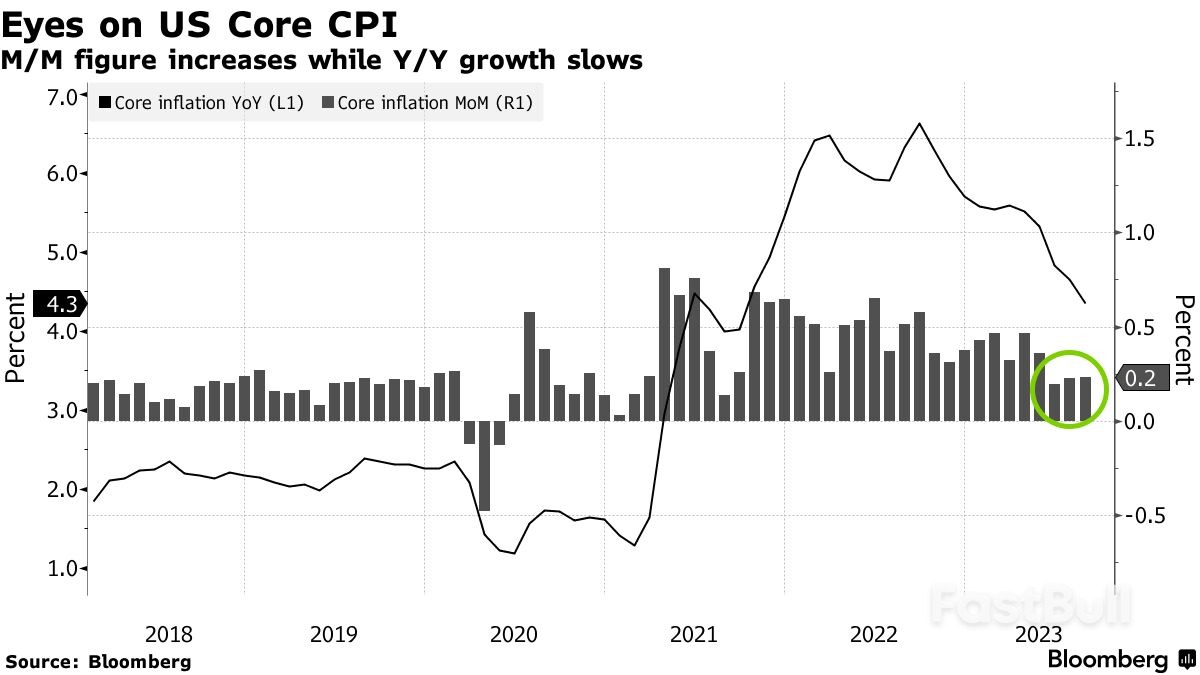
          “Traders are on edge for the US CPI for March,” Hebe Chen, a market analyst at IG Market Limited said. “It will bring a piece of heavy-weight evidence to either validate or disapprove of the Fed’s view that the hotter-than-anticipated readings in the previous two months were just a bump.”Stocks In Asia Cautious Ahead Of Key US Inflation_1
          The movement in Japanese stocks came as investors assessed the risk of further interest-rate hikes this year in Japan. The central bank will likely consider raising its inflation forecast at a policy meeting later this month after surprisingly strong results from annual wage negotiations, according to people familiar with the matter.
          “It’s all caution out there, really,” said Kyle Rodda, senior market analyst at Capital.com. “Japan is the epicentre as far as Asian markets are concerned because the yen got dangerously close to breaking 152 again yesterday, and some combination of a hot CPI print and even slightly hawkish Fed minutes may send it through that level.”
          Separately, Governor Kazuo Ueda reiterated that Japan’s economy continues to recover moderately. This followed comments Tuesday that suggested he is keeping his options open for a further paring back of monetary easing.
          Elsewhere in Asia, central banks in New Zealand and Thailand are expected to keep rates unchanged at meetings on Wednesday. The Reserve Bank of New Zealand may push back against investor bets that interest-rate cuts are coming, even though the economy has slumped into a double-dip recession, which may give a boost for the nation’s currency.
          In commodities, oil held a two-day decline after an industry report pointed to a gain in US crude stockpiles, although simmering tensions in the Middle East are expected to cap losses. Meanwhile, gold extended its bull run to a fresh record.

          Stocks Rebound

          After struggling throughout most of the session, the S&P 500 rose back above the 5,200 mark, with Tesla Inc. leading gains in megacaps. Nvidia Corp. sank as Intel Corp. unveiled a new version of its artificial-intelligence chip.
          US small-business optimism dropped to a more than 11-year low in March as sales expectations slumped and inflationary pressures remained a trouble spot, according to the National Federation of Independent Business.Stocks In Asia Cautious Ahead Of Key US Inflation_2
          Economists are forecasting that US consumer prices rose 0.3% in March on a monthly basis, both overall and excluding food and energy costs. The swaps market is pricing in around 65 basis points of Fed rate cuts by the end of this year — which is less than what the central bank forecast last month.
          “CPI is the critical number this week,” said Andrew Brenner at NatAlliance Securities. “The fear is that CPI has continued to be a thorn in the side of the Fed. But positioning is strongly bearish, and to quote some of the old traders we worked with in the past, ‘whatever hurts the most traders, when they are strongly positioned, is what happens’.”

          Source:Bloomberg

          To stay updated on all economic events of today, please check out our Economic calendar
          Risk Warnings and Disclaimers
          You understand and acknowledge that there is a high degree of risk involved in trading. Following any strategies or investment methods may lead to potential losses. The content on the site is provided by our contributors and analysts for information purposes only. You are solely responsible for determining whether any trading assets, securities, strategy, or any other product is suitable for investing based on your own investment objectives and financial situation.
          Add to Favorites
          Share

          [Fed] Two Officials Have Different Views on the Number of Rate Cuts 

          FastBull Featured

          Remarks of Officials

          Atlanta Fed President Raphael Bostic said on April 9 in an interview as follows.
          One rate cut is expected this year, but as economic activity and inflation continue to develop, it's possible for two rate cuts or no cuts in the coming months. That depends on the development of the U.S. economy and inflation.
          Risks are now balanced. Given that the U.S. economy has been so robust and so resilient, I can't take off the possibility that rate cuts may even have to move further out. If inflation begins to fall as it did in the second half of last year, or unexpected weakness is seen in the labor market, I'd be open to changing our policy stance and perhaps cutting rates sooner. That means there is still the possibility of several rate cuts this year.
          Chicago Fed President Austan Goolsbee also delivered a speech a day before, the main points of which are as follows.
          The current labor market is overheating according to some indicators, but in view of the serious labor shortage, the overheating will not be sustainable. The economy is gradually coming into a better balance. There are still some worrisome factors, however, such as rising consumer credit defaults.
          Current interest rates are high relative to inflation. In this case, the Fed must consider how long it needs to maintain the current restrictive interest rates. If rates stay high for too long, the unemployment rate will begin to rise.
          Both officials are concerned about potential unexpected weakness in the labor market. However, Goolsbee and Bostic have different views on the number of rate cuts. The former expects three rate cuts this year while the latter believes that only one cut is needed or even no rate cut this year.
          Risk Warnings and Disclaimers
          You understand and acknowledge that there is a high degree of risk involved in trading. Following any strategies or investment methods may lead to potential losses. The content on the site is provided by our contributors and analysts for information purposes only. You are solely responsible for determining whether any trading assets, securities, strategy, or any other product is suitable for investing based on your own investment objectives and financial situation.
          Add to Favorites
          Share

          Home Prices Have Risen 423% in 40 Years, Fueling Economic Discontent

          Kevin Du

          Economic

          But for one item in particular — houses — we’ve seen such sharp inflation over decades that it’s starting to change the landscape of American economic life. What happens in society, and in history, when costs for basic necessities, like shelter and food, shoot up in price?
          Let’s start by going back four decades, to 1984. The movie “Ghostbusters” was a blockbuster that year. And the median price of a new home wasn’t so scary: $79,900 in the fourth quarter of 1984, according to data from the Department of Housing and Urban Development.
          Since then, consumer prices overall have risen 203%, according to the Bureau of Labor Statistics information and analysis section. Meanwhile, the median price of a new home was $417,700 in the fourth quarter of 2023. That works out to an inflation rate of 423%.
          “There’s no question that the cost of a house has gone up relative to cost of living overall,” said Christopher Mayer, co-director of the Paul Milstein Center for Real Estate at Columbia Business School. “More and more, a single-family home has become a luxury good, which has not been the case in the United States until now. It’s a trend that, if it continues, I think will change society substantially.”
          Mayer conducted research in the 2010s finding that approximately 80% of people 65 and older owned their own homes, including a significant proportion who had neither a high school nor a college degree.
          He said that for previous generations, working-class homeownership was plausible, even likely. “Homeownership was not just about people in the middle or the upper middle class, homeownership was something that people in the lower middle class could have.”
          He’s seen this play out in his own family: “My in-laws lived in Redding, Pennsylvania; neither graduated from college. And yet, they were homeowners and owned multiple houses over their lives — having a part of the American dream. That would be very difficult for folks in the same circumstance, looking at the cost of homes today.”
          This is not the first time America has dealt with rapid, destabilizing price increases, said Thomas Stapleford, an economic historian at the University of Notre Dame. “The big moments of price inflation are happening around wars — Civil War, World War I, World War II.”
          In the early 1940s, as the U.S. prepared for war, factory towns sprang up across the country devoted to war production.
          “So you have this big influx of workers coming into an area where there’s not adequate housing at the time, there’s not necessarily adequate services,” said Stapleford. “So food prices, shelter prices are going way up.”
          The federal government took a number of actions in response, Stapleford said. It imposed price and wage controls, while the Bureau of Labor Statistics beefed up data gathering and analysis to better track inflation. Consumer product companies, meanwhile, got creative: “You have producers trying to navigate price controls and doing things like, ‘Well, maybe we’ll reduce the size of what’s going in a package, lower the quality of an item, use cheaper fabric.’ American housewives know that in fact prices are going up way more than the BLS index is showing.”
          Under wartime rules, unions had to petition the government for pay increases, which they supported with a public relations campaign calling attention to rising prices. The government countered by trying to convince consumers inflation wasn’t all that bad.
          “At one point in 1944, they actually produced a radio script called ‘Housewife versus Economist,’” Stapleford said. “It featured the acting director of the Bureau of Labor Statistics having a conversation with his wife. He talks about things like, ‘Well, you went and you purchased apples, and you saw the apples are so much more expensive than they were before. But maybe you didn’t notice how sugar prices are still the same.’”
          The government was trying to calm American housewives, in part because of how badly they had reacted to soaring food prices in the World War I period, Stapleford explained. “It’s food that’s the dominant feature at that point. For a working-class family, food took up a huge part of the budget.”
          Half or more of an urban working family’s monthly budget, in fact. In 1917, when food prices doubled, working-class women in New York rioted, just like they had more than a decade before in what came to be known as the 1902 kosher meat boycott.
          This is a long tradition, going back to the 1500s, according to Robert DuPlessis, emeritus professor of economic history at Swarthmore College.
          “In Europe in the 16th century, there was long-term inflation — partly due to population increase, part of it the influx of silver and gold from the New World,” DuPlessis explained. “Grain is the basic foodstuff. You can eat it as bread, you can eat it as gruel, but you also drink it in beverages, particularly beer. And if there’s a harvest failure, people feel it immediately.”
          When grain harvests in Western Europe repeatedly failed, “you actually get religious and political rebellion as a result of a disastrous bout of inflation. Grain prices basically triple in a couple of months.” People stopped buying meat and new clothes, DuPlessis said, so they could try and buy enough bread to survive. “You also see that people riot.”
          DuPlessis sees parallels today, as high home prices ripple through the late-pandemic economy. People have to rent rather than buy; they cut back on essentials to pay for housing; and they don’t buy as many of the consumer goods that go into houses, like furniture and appliances.
          “The housing inflation of today is a little bit like the grain inflation of the 16th — actually, into the 18th century,” DuPlessis said. “Because remember, grain riots had a lot to do with the onset of the French Revolution.”
          However, there are some reasons why riot and revolution may not be in the cards today. For one thing, food prices haven’t doubled or tripled in a matter of months. Instead, it’s taken four years since the pandemic hit for food prices to go up 25%, according to BLS data.
          And while new home prices have more than quintupled, that’s happened over 40 years. Meanwhile, as much as mortgage rates have gone up lately, they were twice as high in 1984, peaking that year above 14%.
          Still, Chris Mayer at Columbia Business School said home price inflation is fueling a lot of current discontent and disillusionment.
          “You have people who are really discouraged about the potential of becoming a homeowner,” Mayer said. “Consumers are not happy about their housing situation, and they don’t have a lot of confidence that’s going to change.”
          Mayer said that for the past century, homeownership has been a key stepping stone for building wealth and achieving the American dream. “Housing is aspirational: ‘When I make a lot of money, when I have kids, when I get married, when I get to the next stage of my life — am I going to be able to do something that’s a little bit better?’ And losing some of that future is discouraging.”
          Mayer posed the rhetorical question: “Are you better off relative to previous times? Housing leads the list of things where the answer to that question today for many people is: ‘No, I’m not better off.’”

          Source: Marketplace

          To stay updated on all economic events of today, please check out our Economic calendar
          Risk Warnings and Disclaimers
          You understand and acknowledge that there is a high degree of risk involved in trading. Following any strategies or investment methods may lead to potential losses. The content on the site is provided by our contributors and analysts for information purposes only. You are solely responsible for determining whether any trading assets, securities, strategy, or any other product is suitable for investing based on your own investment objectives and financial situation.
          Add to Favorites
          Share

          BOJ Is Said To Mull Raising Inflation View On Strong Pay Deals

          Samantha Luan

          Economic

          Central Bank

          The Bank of Japan will likely consider raising its inflation forecast at a policy meeting later this month after surprisingly strong results from annual wage negotiations, according to people familiar with the matter.
          The central bank will probably discuss revising up its projection for growth in consumer prices excluding fresh food from the current 2.4% for the fiscal year that started this month, the people said. In its first projection for the fiscal year from April 2026, the BOJ is likely to forecast inflation of around 2%, they added.
          The BOJ concludes its next two-day gathering on April 26 and is widely expected by economists to keep its policy settings steady for now.
          Since the central bank raised rates for the first time in 17 years last month and ended its massive monetary easing program, market players have been focusing on any hints for the timing of the next rate hikes.
          The yen briefly strengthened to 151.73 against the dollar following the news. The currency still remains close to the 152 mark seen by some traders as a potential level for intervention by Japan.
          Governor Kazuo Ueda has already managed to pare back stimulus at a faster pace than expected in his first year at the helm.
          Rising oil prices and the weak yen are spurring inflationary pressure that could fuel speculation of earlier moves by the BOJ. Among economists surveyed after the BOJ scrapped its negative rate in March, some 62% expect the next rate hike to come by the bank’s October meeting, with just under a quarter flagging July as the most likely month.
          Another factor prompting private economists to raise their inflation projections is the government’s decision to scrap a prolonged subsidy program that capped energy prices.
          Central bank officials are likely to consider raising a measure of the deeper inflation trend in fiscal 2024 that also excludes energy prices to 2% or more, the people said. Officials see rising personnel costs stemming from higher wages among the factors feeding into higher prices going forward, they added.
          Despite the raising of forecasts, officials flag that they need to be wary of possible downside risks to inflation too when making projections for fiscal 2026.
          The BOJ will finalize its new forecasts after parsing the latest data and analyzing market developments until the last minute, the people said.
          The news comes as government officials keep traders on high alert over potential currency intervention in support of the yen. Japan’s top currency bureaucrat Masato Kanda has signaled frustration over the yen’s persistent weakness even after the BOJ’s March 19 rate hike.
          Any inkling that Japan’s central bank might hike rates at a faster pace than expected could help strengthen the yen against the dollar. A shift in views on when the Federal Reserve will cut rates is an even bigger factor feeding into the exchange rate, with upcoming US inflation data due Wednesday in the spotlight.
          The BOJ justified its March move by saying it could foresee achieving its stable inflation target toward the end of the forecast period through fiscal 2025, following strong results from annual wage negotiations between companies and unions.
          Japan’s largest labor union federation last week updated its running tally of results for this year’s wage talks, saying workers had secured 5.24% wage gains as of April 2. At that pace the increases would be the biggest in more than 30 years.
          Among private sector economists revising their inflation forecasts higher, BNP Paribas upgraded its price growth forecast for this fiscal year to 3% from 2.2% on April 1, citing the result of the wage talks and the government’s decision on the energy program.
          SMBC Nikko Securities also raised its own prediction to 2.6% last week.

          Source:Bloomberg

          To stay updated on all economic events of today, please check out our Economic calendar
          Risk Warnings and Disclaimers
          You understand and acknowledge that there is a high degree of risk involved in trading. Following any strategies or investment methods may lead to potential losses. The content on the site is provided by our contributors and analysts for information purposes only. You are solely responsible for determining whether any trading assets, securities, strategy, or any other product is suitable for investing based on your own investment objectives and financial situation.
          Add to Favorites
          Share

          Hungary’s Deficit Target Rises to 4.5%

          ING

          Economic

          Central Bank

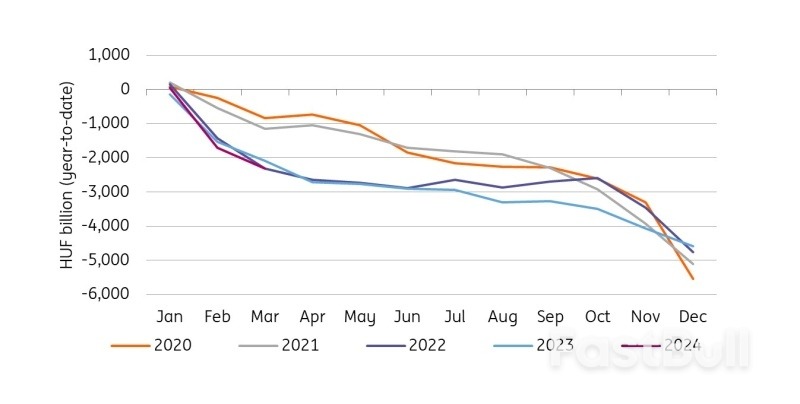
          Hungary's monthly budget deficit was HUF617bn in March, bringing the year-to-date general government cash flow deficit to HUF2.32tr at the end of the first quarter. The deficit in the third month showed a significant improvement compared to the extreme deficit in February. As the improvement was widely expected, we can't call it a significant positive surprise.
          The Ministry of Finance’s statement provided little information on the specifics of the structure of the deficit, as it mainly highlighted the cumulative changes during the first quarter of this year. However, we can also extract some interesting information from the February report. Interest expenditure remains a major factor in the widening of the deficit. In March, there was another substantial payment on retail government securities. Around HUF385bn was paid out in March alone, so around half of the monthly deficit was linked to this. In the first quarter of 2024, interest payments reached HUF1.24tr.
          The budget law still in force targets a deficit of HUF2.51tr, and in the first quarter we achieved more than 92% of this target. However, the Government Debt Management Agency changed its financing plan in early April, increasing this year's financing needs by HUF1.46tr to HUF3.98tr. If we adjust the official cash-flow-based deficit target for the newly added financing needs, the estimated shortfall is HUF4.0tr. So, the budget has covered 58% of the financing needs since the beginning of the year.

          Budget performance (year-to-date, HUFbn)

          Hungary’s Deficit Target Rises to 4.5%_1
          At the same time, the Ministry of Finance is talking about an updated deficit of 4.5% of GDP, although the new budget law hasn't been formed and voted yet. So, we don't know the updated nominal revenue, expenditure and deficit figures (cash flow and accrual based), and we therefore use the new financing plan as a proxy for the nominal deficit.
          In our view, based on the detailed February data, even the 4.5% of GDP deficit target is out of reach. We calculate an additional gap of 1.0-1.5% of GDP that needs to be covered if the government is serious about meeting the new target. Without knowing the details behind the March deficit, we are unable to update our technical projection, so we maintain this range as the slippage.
          However, Minister of National Development Márton Nagy announced that the government plans to postpone some investments and reduce spending in this year's budget. This is an earlier-than-expected admission that the budget will have to face some austerity measures in order to meet the new deficit target. This is clearly a positive development, as we had expected such an announcement only after the EP and local elections in June.
          The exact size of the expected spending freeze remains to be seen, but our technical projection and the fact that the 2024 budget trajectory has so far followed the 2022-2023 path suggest that around HUF1.25tr will have to be cut from the expenditure side to reach the 4.5% target.
          To stay updated on all economic events of today, please check out our Economic calendar
          Risk Warnings and Disclaimers
          You understand and acknowledge that there is a high degree of risk involved in trading. Following any strategies or investment methods may lead to potential losses. The content on the site is provided by our contributors and analysts for information purposes only. You are solely responsible for determining whether any trading assets, securities, strategy, or any other product is suitable for investing based on your own investment objectives and financial situation.
          Add to Favorites
          Share

          China Needs A Narrative That House Prices Are Going To Rise, Nomura’s Koo Says

          Alex

          Economic

          China needs to convince people that home prices are on their way up in order for economic activity to pick up, Richard Koo, chief economist at Nomura Research Institute, told CNBC’s Steve Sedgwick last week.
          Business and consumer appetite for new loans have had a tepid start to the year, while home prices dropped at a steeper pace in January than in February, according to Goldman Sachs’ analysis.
          In other words, as Koo warned last year, China may be entering a “balance sheet recession,” similar to what Japan experienced during its economic slump.
          “For them to come back and borrow money, we need a narrative that says, okay, this is the bottom of the prices, the prices will start going up from this point onwards,” Koo said.
          But it’s not clear whether prices have reached an actual bottom yet. Koo and other analysts have pointed out that in China’s policy-driven economy, house prices have not fallen as much as expected given declines in other aspects of the property market.
          Chinese officials have said that real estate remains in a period of “adjustment.” The country has also been emphasizing new growth drivers such as manufacturing and new energy vehicles.
          Real estate and related sectors have accounted for at least one-fifth of China’s economy, depending on analyst estimates. The property market began its latest slump after Beijing cracked down on developers’ high reliance on debt in 2020.
          That coincided with the shock from the Covid-19 pandemic.
          It also comes as China’s population has started to shrink, Koo pointed out — a big difference with Japan, whose population didn’t start to fall until 2009, he said.
          “That makes this narrative, that the prices have fallen enough, you should go out and borrow and buy houses, even more difficult to justify because [the] population is now shrinking,” Koo said.

          Lessons from history

          China’s economy officially grew by 5.2% in 2023, the first year since the end of Covid-19 controls. Beijing has set a target of around 5% growth for 2024.
          However, many analysts have said such a goal is ambitious without more stimulus.
          Chinese authorities have been reluctant to embark on large-scale support for the economy. Koo said an underlying reason is that Beijing views its prior stimulus program as a mistake.
          About 15 years ago, in the wake of the global financial crisis, China launched a 4 trillion yuan ($563.38 billion) stimulus package that was initially met with skepticism — and a 70% drop in Chinese stock prices, Koo said.
          “It was heading toward balance sheet recession, almost,” he said. “One year later, China had 12% growth.”
          But Beijing kept up its stimulus package even after the country had achieved rapid growth, which led to an overheating of growth and speculation, on top of corruption, Koo said. “That’s one of the reasons why this government, Mr. Xi Jinping, is still reluctant to put [out] a large package because so many people think the previous one was a failure.”
          Looking ahead, Koo said China should stimulate its economy to avoid a balance sheet recession, and that it should cut that support once growth reaches 12%. “Once the borrow[ing] is coming back, then you can cut, but not before.”

          Source:CNBC

          To stay updated on all economic events of today, please check out our Economic calendar
          Risk Warnings and Disclaimers
          You understand and acknowledge that there is a high degree of risk involved in trading. Following any strategies or investment methods may lead to potential losses. The content on the site is provided by our contributors and analysts for information purposes only. You are solely responsible for determining whether any trading assets, securities, strategy, or any other product is suitable for investing based on your own investment objectives and financial situation.
          Add to Favorites
          Share
          FastBull
          Copyright © 2025 FastBull Ltd

          728 RM B 7/F GEE LOK IND BLDG NO 34 HUNG TO RD KWUN TONG KLN HONG KONG

          TelegramInstagramTwitterfacebooklinkedin
          App Store Google Play Google Play
          Products
          Charts

          Chats

          Q&A with Experts
          Screeners
          Economic Calendar
          Data
          Tools
          Membership
          Features
          Function
          Markets
          Copy Trading
          Latest Signals
          Contests
          News
          Analysis
          24/7
          Columns
          Education
          Company
          Careers
          About Us
          Contact Us
          Advertising
          Help Center
          Feedback
          User Agreement
          Privacy Policy
          Business

          White Label

          Data API

          Web Plug-ins

          Poster Maker

          Affiliate Program

          Risk Disclosure

          The risk of loss in trading financial instruments such as stocks, FX, commodities, futures, bonds, ETFs and crypto can be substantial. You may sustain a total loss of the funds that you deposit with your broker. Therefore, you should carefully consider whether such trading is suitable for you in light of your circumstances and financial resources.

          No decision to invest should be made without thoroughly conducting due diligence by yourself or consulting with your financial advisors. Our web content might not suit you since we don't know your financial conditions and investment needs. Our financial information might have latency or contain inaccuracy, so you should be fully responsible for any of your trading and investment decisions. The company will not be responsible for your capital loss.

          Without getting permission from the website, you are not allowed to copy the website's graphics, texts, or trademarks. Intellectual property rights in the content or data incorporated into this website belong to its providers and exchange merchants.

          Not Logged In

          Log in to access more features

          FastBull Membership

          Not yet

          Purchase

          Become a signal provider
          Help Center
          Customer Service
          Dark Mode
          Price Up/Down Colors

          Log In

          Sign Up

          Position
          Layout
          Fullscreen
          Default to Chart
          The chart page opens by default when you visit fastbull.com