• Trade
  • Markets
  • Copy
  • Contests
  • News
  • 24/7
  • Calendar
  • Q&A
  • Chats
Trending
Screeners
SYMBOL
LAST
BID
ASK
HIGH
LOW
NET CHG.
%CHG.
SPREAD
SPX
S&P 500 Index
6870.39
6870.39
6870.39
6895.79
6858.28
+13.27
+ 0.19%
--
DJI
Dow Jones Industrial Average
47954.98
47954.98
47954.98
48133.54
47871.51
+104.05
+ 0.22%
--
IXIC
NASDAQ Composite Index
23578.12
23578.12
23578.12
23680.03
23506.00
+72.99
+ 0.31%
--
USDX
US Dollar Index
98.830
98.910
98.830
98.960
98.810
-0.120
-0.12%
--
EURUSD
Euro / US Dollar
1.16539
1.16546
1.16539
1.16553
1.16341
+0.00113
+ 0.10%
--
GBPUSD
Pound Sterling / US Dollar
1.33399
1.33406
1.33399
1.33420
1.33151
+0.00087
+ 0.07%
--
XAUUSD
Gold / US Dollar
4208.51
4208.96
4208.51
4213.06
4190.61
+10.60
+ 0.25%
--
WTI
Light Sweet Crude Oil
59.897
59.934
59.897
60.063
59.752
+0.088
+ 0.15%
--

Community Accounts

Signal Accounts
--
Profit Accounts
--
Loss Accounts
--
View More

Become a signal provider

Sell trading signals to earn additional income

View More

Guide to Copy Trading

Get started with ease and confidence

View More

Signal Accounts for Members

All Signal Accounts

Best Return
  • Best Return
  • Best P/L
  • Best MDD
Past 1W
  • Past 1W
  • Past 1M
  • Past 1Y

All Contests

  • All
  • Trump Updates
  • Recommend
  • Stocks
  • Cryptocurrencies
  • Central Banks
  • Featured News
Top News Only
Share

Governor: Russian Drone Strike On Ukraine's Sumy Injures At Least Seven

Share

Inida's Nifty Psu Bank Index Down 1.3%

Share

India Markets Regulator Official: Have Created A Platform For Real Time Monitoring Of Algo Returns

Share

Cambodia Provincial Official: 3 Cambodian Civilians Seriously Injured In Thai-Cambodia Fighting

Share

Russia's Air Defences Destroy 67 Ukrainian Drones Overnight, RIA Agency Reports

Share

India's Nifty 50 Index Down 0.37%

Share

Hsi Down 287 Pts, Hsti Down 13 Pts, Pop Mart Down Over 8%, Ping An Hit New Highs

Share

China's November Coal Imports Down 20% Year-On-Year

Share

At Least One Thai Soldier Killed And 7 Wounded - Thai Army Spokesman

Share

India's Nifty Bank Futures Up 0.73% In Pre-Open Trade

Share

Cambodia Has Expanded Clashes To Several New Locations - Thai Army Spokesman

Share

Cambodian Military Has Increased Deployment Of Troops And Weapons - Thai Army Spokesman

Share

India's Nifty 50 Futures Up 0.53% In Pre-Open Trade

Share

India's Nifty 50 Index Down 0.1% In Pre-Open Trade

Share

Indian Rupee Opens Down 0.1% At 90.0625 Per USA Dollar, Versus 89.98 Previous Close

Share

China November Copper Imports At 427000 Tonnes

Share

China November Coal Imports At 44.05 Million Tonnes

Share

China November Iron Ore Imports At 110.54 Million Tonnes, Down 0.7 % From October

Share

China November Meat Imports At 393000 Tonnes

Share

China Imported 8.11 Million Tonnes Of Soy In November

TIME
ACT
FCST
PREV
U.S. Personal Income MoM (Sept)

A:--

F: --

P: --

U.S. PCE Price Index YoY (SA) (Sept)

A:--

F: --

P: --

U.S. PCE Price Index MoM (Sept)

A:--

F: --

P: --

U.S. Personal Outlays MoM (SA) (Sept)

A:--

F: --

P: --

U.S. Core PCE Price Index MoM (Sept)

A:--

F: --

P: --

U.S. Core PCE Price Index YoY (Sept)

A:--

F: --

P: --

U.S. UMich 5-Year-Ahead Inflation Expectations Prelim YoY (Dec)

A:--

F: --

P: --

U.S. Real Personal Consumption Expenditures MoM (Sept)

A:--

F: --

P: --

U.S. UMich Current Economic Conditions Index Prelim (Dec)

A:--

F: --

P: --

U.S. UMich Consumer Sentiment Index Prelim (Dec)

A:--

F: --

P: --

U.S. UMich 1-Year-Ahead Inflation Expectations Prelim (Dec)

A:--

F: --

P: --

U.S. UMich Consumer Expectations Index Prelim (Dec)

A:--

F: --

P: --

U.S. Weekly Total Rig Count

A:--

F: --

P: --

U.S. Weekly Total Oil Rig Count

A:--

F: --

P: --

U.S. Unit Labor Cost Prelim (SA) (Q3)

--

F: --

P: --

U.S. Consumer Credit (SA) (Oct)

A:--

F: --

P: --

China, Mainland Foreign Exchange Reserves (Nov)

A:--

F: --

P: --

Japan Wages MoM (Oct)

A:--

F: --

P: --

Japan Trade Balance (Oct)

A:--

F: --

P: --

Japan Nominal GDP Revised QoQ (Q3)

A:--

F: --

P: --

Japan Trade Balance (Customs Data) (SA) (Oct)

A:--

F: --

P: --

Japan GDP Annualized QoQ Revised (Q3)

A:--

F: --

P: --
China, Mainland Exports YoY (CNH) (Nov)

A:--

F: --

P: --

China, Mainland Imports YoY (CNH) (Nov)

A:--

F: --

P: --

China, Mainland Exports (Nov)

A:--

F: --

P: --

China, Mainland Imports (CNH) (Nov)

A:--

F: --

P: --

China, Mainland Trade Balance (CNH) (Nov)

A:--

F: --

P: --

China, Mainland Imports YoY (USD) (Nov)

A:--

F: --

P: --

China, Mainland Exports YoY (USD) (Nov)

A:--

F: --

P: --

China, Mainland Trade Balance (USD) (Nov)

A:--

F: --

P: --

Germany Industrial Output MoM (SA) (Oct)

--

F: --

P: --

Euro Zone Sentix Investor Confidence Index (Dec)

--

F: --

P: --

Canada Leading Index MoM (Nov)

--

F: --

P: --

Canada National Economic Confidence Index

--

F: --

P: --

U.S. Dallas Fed PCE Price Index YoY (Sept)

--

F: --

P: --

China, Mainland Trade Balance (USD) (Nov)

--

F: --

P: --

U.S. 3-Year Note Auction Yield

--

F: --

P: --

U.K. BRC Overall Retail Sales YoY (Nov)

--

F: --

P: --

U.K. BRC Like-For-Like Retail Sales YoY (Nov)

--

F: --

P: --

Australia Overnight (Borrowing) Key Rate

--

F: --

P: --

RBA Rate Statement
RBA Press Conference
Germany Exports MoM (SA) (Oct)

--

F: --

P: --

U.S. NFIB Small Business Optimism Index (SA) (Nov)

--

F: --

P: --

Mexico Core CPI YoY (Nov)

--

F: --

P: --

Mexico 12-Month Inflation (CPI) (Nov)

--

F: --

P: --

Mexico PPI YoY (Nov)

--

F: --

P: --

Mexico CPI YoY (Nov)

--

F: --

P: --

U.S. Weekly Redbook Index YoY

--

F: --

P: --

U.S. JOLTS Job Openings (SA) (Oct)

--

F: --

P: --

China, Mainland M2 Money Supply YoY (Nov)

--

F: --

P: --

China, Mainland M0 Money Supply YoY (Nov)

--

F: --

P: --

China, Mainland M1 Money Supply YoY (Nov)

--

F: --

P: --

U.S. EIA Short-Term Crude Production Forecast For The Next Year (Dec)

--

F: --

P: --

U.S. EIA Short-Term Crude Production Forecast For The Year (Dec)

--

F: --

P: --

U.S. EIA Natural Gas Production Forecast For The Next Year (Dec)

--

F: --

P: --

EIA Monthly Short-Term Energy Outlook
U.S. 10-Year Note Auction Avg. Yield

--

F: --

P: --

U.S. API Weekly Cushing Crude Oil Stocks

--

F: --

P: --

U.S. API Weekly Crude Oil Stocks

--

F: --

P: --

Q&A with Experts
    • All
    • Chatrooms
    • Groups
    • Friends
    Connecting
    .
    .
    .
    Type here...
    Add Symbol or Code

      No matching data

      All
      Trump Updates
      Recommend
      Stocks
      Cryptocurrencies
      Central Banks
      Featured News
      • All
      • Russia-Ukraine Conflict
      • Middle East Flashpoint
      • All
      • Russia-Ukraine Conflict
      • Middle East Flashpoint
      Search
      Products

      Charts Free Forever

      Chats Q&A with Experts
      Screeners Economic Calendar Data Tools
      Membership Features
      Data Warehouse Market Trends Institutional Data Policy Rates Macro

      Market Trends

      Market Sentiment Order Book Forex Correlations

      Top Indicators

      Charts Free Forever
      Markets

      News

      News Analysis 24/7 Columns Education
      From Institutions From Analysts
      Topics Columnists

      Latest Views

      Latest Views

      Trending Topics

      Top Columnists

      Latest Update

      Signals

      Copy Rankings Latest Signals Become a signal provider AI Rating
      Contests
      Brokers

      Overview Brokers Assessment Rankings Regulators News Claims
      Broker listing Forex Brokers Comparison Tool Live Spread Comparison Scam
      Q&A Complaint Scam Alert Videos Tips to Detect Scam
      More

      Business
      Events
      Careers About Us Advertising Help Center

      White Label

      Data API

      Web Plug-ins

      Affiliate Program

      Awards Institution Evaluation IB Seminar Salon Event Exhibition
      Vietnam Thailand Singapore Dubai
      Fans Party Investment Sharing Session
      FastBull Summit BrokersView Expo
      Recent Searches
        Top Searches
          Markets
          News
          Analysis
          User
          24/7
          Economic Calendar
          Education
          Data
          • Names
          • Latest
          • Prev

          View All

          No data

          Scan to Download

          Faster Charts, Chat Faster!

          Download App
          English
          • English
          • Español
          • العربية
          • Bahasa Indonesia
          • Bahasa Melayu
          • Tiếng Việt
          • ภาษาไทย
          • Français
          • Italiano
          • Türkçe
          • Русский язык
          • 简中
          • 繁中
          Open Account
          Search
          Products
          Charts Free Forever
          Markets
          News
          Signals

          Copy Rankings Latest Signals Become a signal provider AI Rating
          Contests
          Brokers

          Overview Brokers Assessment Rankings Regulators News Claims
          Broker listing Forex Brokers Comparison Tool Live Spread Comparison Scam
          Q&A Complaint Scam Alert Videos Tips to Detect Scam
          More

          Business
          Events
          Careers About Us Advertising Help Center

          White Label

          Data API

          Web Plug-ins

          Affiliate Program

          Awards Institution Evaluation IB Seminar Salon Event Exhibition
          Vietnam Thailand Singapore Dubai
          Fans Party Investment Sharing Session
          FastBull Summit BrokersView Expo

          Changing Sentiment on the Cryptocurrency Industry within the US Political Landscape and the SEC

          Samantha Luan

          Cryptocurrency

          The sentiment towards the cryptocurrency industry in the United States evolved significantly within the political landscape and the SEC. Initially viewed with skepticism, digital currencies are now gaining traction and legitimacy.
          Early Skepticism and Regulation
          Early associations of cryptocurrencies with illicit activities and financial instability, such as those seen with the Silk Road marketplace and the Mt. Gox exchange collapse, led to a cautious approach from US regulators. Under SEC Chairman Jay Clayton (2017-2020), the Commission treated many ICOs as unregistered securities, which resulted in numerous enforcement actions and created a challenging environment for cryptocurrency businesses.
          Shifting Political Sentiment
          Recent years have seen a shift in political sentiment due to several factors:
          Mainstream Adoption: Companies like Tesla, Square, and PayPal adopting digital assets have enhanced their legitimacy.
          Technological Innovation: Blockchain technology's potential beyond digital currencies has been recognized in areas like supply chain management and decentralized finance (DeFi).
          Global Competition: The rise of central bank digital currencies (CBDCs) in countries like China has prompted US lawmakers to consider the strategic implications of digital currencies.
          Public and Political Support: Politicians like Senator Cynthia Lummis (R-WY) and Representative Tom Emmer (R-MN) actively promote favorable cryptocurrency legislation.
          The SEC's Evolving Stance
          Under Gary Gensler's leadership since April 2021, the SEC has taken a nuanced approach:
          Clearer Regulations: Emphasizing the need for regulatory clarity, particularly around cryptocurrency classification as securities.
          Enforcement and Oversight: Continuing enforcement actions against fraudulent activities while fostering a more predictable regulatory environment.
          Focus on Investor Protection: Highlighting robust disclosure requirements and measures to prevent market manipulation.
          Legislative Developments
          Several legislative moves reflect the changing sentiment:
          Infrastructure Bill: The $1.2 trillion bill passed in November 2021 included cryptocurrency tax reporting provisions, recognizing cryptocurrencies as part of the broader financial system.
          Proposed Legislation: Bills like the "Digital Commodity Exchange Act" aim to establish clearer regulatory frameworks.
          Central Bank Digital Currency (CBDC): The Federal Reserve is exploring a digital dollar to combine cryptocurrency benefits with financial stability.
          Conclusion
          The evolving sentiment towards the cryptocurrency industry within the US political landscape and the SEC marks a maturation of understanding and approach. Early skepticism is giving way to a more balanced perspective, driven by mainstream adoption, technological innovation, and strategic considerations. Ongoing dialogue among policymakers, regulators, and industry stakeholders will shape a sustainable and innovative future for cryptocurrencies in the United States.

          Source:TheStreet

          Risk Warnings and Disclaimers
          You understand and acknowledge that there is a high degree of risk involved in trading. Following any strategies or investment methods may lead to potential losses. The content on the site is provided by our contributors and analysts for information purposes only. You are solely responsible for determining whether any trading assets, securities, strategy, or any other product is suitable for investing based on your own investment objectives and financial situation.
          Add to Favorites
          Share

          U.S. Oil and Gas Output Curbed by Lower Prices

          Kevin Du

          Energy

          U.S. oil and gas production show further signs of flattening out or turning down, a delayed response to the decline in prices over the last two years after the initial shock caused by Russia's invasion of Ukraine in early 2022.
          Total crude and condensates production from the Lower 48 states, excluding federal waters in the Gulf of Mexico, averaged 11.0 million barrels per day (b/d) in May up from 10.6 million b/d in the same month a year earlier.
          The seasonal increase was the smallest since the first wave of the coronavirus pandemic in 2020 and before that the aftermath of the volume war fought between U.S. shale producers and Saudi Arabia in the mid-2010s.
          Production growth compared with the prior year slowed to just 0.4 million b/d from as much as 0.8 million to 1.0 million b/d in early in 2023, according to data from the U.S. Energy Information Administration (EIA).
          Drilling activity typically responds to a change in prices with a delay of 4-5 months reflecting the time needed to contract rigs, move them to the drilling site, set up the equipment and start boring.
          Production typically responds with an additional lag of 7-8 months reflecting the time needed to hydraulically fracture and complete wells, connect them to the pipeline gathering system and start commercial oil flows.
          So the current slowdown in both drilling rates and deceleration in production growth reflects the decline in oil prices from their peak in the middle of 2022 and especially since the middle of 2023.
          After adjusting for inflation, front-month U.S. crude futures prices have fallen to average of $74 per barrel so far in August 2024 from $84 in August 2023 and a high of $124 in June 2022.
          In real terms, prices have retreated to only the 44th percentile for all months since the turn of the century from the 82nd percentile just over two years ago.
          Lower prices have removed much of the incentive to increase output and encouraged exploration and production firms to focus on improving efficiency instead.
          The number of rigs drilling for oil averaged just 479 in July 2024 down from 534 a year earlier and a peak of 623 in December 2022.
          Over the same period, the number of rigs drilling primarily for gas has declined even more sharply, reducing growth in condensates recovered from gas wells.
          As a result, lower prices and slower growth in U.S. shale production have created conditions for Saudi Arabia and its OPEC⁺ allies to increase their own output by rescinding previous cuts and regain some market share.
          Instead, however, prices have tumbled even further recently, as traders become increasingly concerned about an economic slowdown in the major economies and associated deceleration in oil consumption growth.
          If the consumption slowdown fails to materialise, however, the deceleration in shale production has created conditions for OPEC⁺ to enjoy some combination of higher production and/or prices later in 2024 and in 2025.
          U.S. Gas Production
          With no equivalent of OPEC⁺ to coordinate a cut in production and support prices, U.S. gas futures prices, drilling activity and output have fallen much more sharply than for oil.
          Dry gas production averaged 101.3 billion cubic feet per day (bcf/d) in May down from 103.6 bcf/d in the same month a year earlier, EIA data show.
          The seasonal decline in output was the largest since the first wave of the pandemic in May 2020 and before that May 1999.
          In recent months, inflation-adjusted front-month gas futures prices have slumped to around $2 per million British thermal units, which was at or close to some of the lowest levels on record.
          The number of rigs drilling for gas has fallen to around 100 per month from a post-invasion high of 162 in September 2022. Lower production will eventually deplete inventories and push prices higher again.
          So far, the adjustment has been repeatedly postponed by a relatively cool summer in 2023 (which depressed airconditioning demand) followed by a mild winter in 2023/24 (which cut heating demand).
          In addition, the Freeport LNG's liquefaction facility has experienced multiple interruptions, slowing the growth in gas exports and making it harder to clear surplus stocks.
          As a result, prices have remained lower for longer to encourage gas-fired power generators to use as much gas as possible.
          Despite these setbacks, the adjustment process is well underway and inventories are likely to revert to more normal levels by the end of winter 2024/25, unless it proves to be another exceptionally mild one.

          Source: Reuters

          Risk Warnings and Disclaimers
          You understand and acknowledge that there is a high degree of risk involved in trading. Following any strategies or investment methods may lead to potential losses. The content on the site is provided by our contributors and analysts for information purposes only. You are solely responsible for determining whether any trading assets, securities, strategy, or any other product is suitable for investing based on your own investment objectives and financial situation.
          Add to Favorites
          Share

          Thai Court to Decide Fates of PM and Opposition Party

          Thomas

          Political

          Thailand's Constitutional Court will rule on two politically charged cases in the next week that will decide the fate of Prime Minister Srettha Thavisin and the popular opposition party, amid heightened uncertainty over potential upheaval.
          Both cases underline intractable rifts in Thai politics, defined by a two-decade struggle between its powerful conservative-royalist establishment, backed by the military, and parties with mass appeal such as Move Forward and Srettha's ruling Pheu Thai.

          What is the case against move forward?

          The court will rule on Wednesday on an election commission complaint seeking Move Forward's dissolution over its campaign to reform a strict law on royal insults that protects the monarchy from criticism.
          The complaint followed a January decision by the same court on the constitutionality of Move Forward's campaign, which it ruled was tantamount to an attempt to overthrow the system of government with the king as head of state.
          Move Forward rejects that but has since dropped the campaign on the orders of the court.
          The party has 30% of house seats after it won last year's election but was blocked by conservative lawmakers from forming a government.

          What happens if move forward is dissolved?

          If Move Forward is disbanded, 11 current and former party executives, including Pita Limjaroenrat, who led the party to victory in the election, could be banned from politics and prohibited from forming a new party, likely for a decade.
          Pita last month told Reuters he was hopeful his party would survive the case. It maintains the election commission's complaint was unlawful because it did not follow its own regulations.
          If the party is disbanded, its surviving 143 lawmakers will keep their seats and are expected to re-organise into another party, as they did in 2020 when its predecessor, Future Forward, was dissolved over a campaign funding violation, which was among the factors behind massive anti-government street protests.
          Dissolution may impact the movement's influence in parliament, however, as bans on its executives would see the removal of its ally and former member Padipat Suntiphada as first deputy house speaker.

          What is the case against PM Srettha?

          Srettha could be dismissed by the court on Aug. 14 after conservative senators alleged he violated the constitution by appointing to cabinet a former lawyer who was once jailed, whom the senators said did not meet ethical requirements.
          Pichit Chuenban, a former lawyer for the politically powerful Shinawatra family - the founders of Srettha's party - was briefly imprisoned for contempt of court in 2008 over an alleged attempt to bribe court staff, which was never proven.
          Srettha denies wrongdoing and says Pichit, who resigned from cabinet, had been thoroughly vetted.

          What If Srettha is dismissed?

          Tycoon Srettha's case is among factors that have heightened political uncertainty and roiled financial markets in Thailand, Southeast Asia's second-largest economy, which he has struggled to revive, with delays implementing his signature handout scheme amid falling popularity.
          If Srettha is removed, a new government must be formed and Pheu Thai would need to put forward a new candidate for premier to be voted on by parliament, with no guarantees it will succeed.
          The vote could pit Pheu Thai against coalition partners, or lead to concessions in return for parliamentary votes, both of which could result in a shakeup of the governing alliance and a realignment of cabinet and policies.

          Who could be PM If Srettha exits?

          Only those designated prime ministerial candidates by their parties prior to the last election can be nominated for premier.
          Those include Paetongtarn Shinawatra, the ruling party leader and daughter of influential billionaire Thaksin Shinawatra, former Justice Minister Chaikasem Nitisiri, Interior Minister and deputy premier Anutin Charnvirakul, Energy Minister Pirapan Salirathavibhaga and former army chief Prawit Wongsuwon, a former deputy premier who was involved in two coups.

          Source: Reuters

          Risk Warnings and Disclaimers
          You understand and acknowledge that there is a high degree of risk involved in trading. Following any strategies or investment methods may lead to potential losses. The content on the site is provided by our contributors and analysts for information purposes only. You are solely responsible for determining whether any trading assets, securities, strategy, or any other product is suitable for investing based on your own investment objectives and financial situation.
          Add to Favorites
          Share

          The Stock Market Rout May Not Be Over

          Alex

          Stocks

          For a while on August 5, things were looking awful. During the Asian trading session, Japan's benchmark Topix share index had fallen by 12 per cent, marking its worst day since 1987.
          Stock prices in South Korea and Taiwan had tanked by 9 per cent and 8 per cent respectively, and European markets were falling.
          Before trading began in America, the VIX index, which measures how wildly traders expect share prices to swing, was at a level it had only reached early in the COVID-19 pandemic and after Lehman Brothers collapsed in 2008.
          Ominously, though gold is usually a hedge against chaos, its price was falling — suggesting that investors might be selling assets they would rather hold on to in order to stay afloat.
          The previous week's rout in global markets seemed to be spiralling into a full-blown crisis.
          Mercifully, the panic started to ebb once Wall Street opened for business. The VIX fell back to only its highest during the crash of 2022; by the end of the day, the S&P 500 index of large American firms was down by a painful, but not catastrophic, 3 per cent.
          On August 6 European markets were fairly flat and Asian ones staged a blistering recovery, especially in Japan, where the Topix rose by 9 per cent. Half an hour after the opening bell had rung in New York, the S&P 500 was up by 1 per cent.
          Traders may be able to pause for breath and a few hours' sleep. Even as they do so, however, one question looms large. Did markets simply succumb to a brief bout of summer madness, or is the worst still to come?
          One clue to the answer is that what began as the unwinding of a few popular trades has now spread.
          The early stages of the fall, which began in mid-July, were led by Japanese stocks, American big-tech firms and global companies in the chipmaking supply chain. They were triggered by a rapidly strengthening yen in the first case and evaporating euphoria over artificial intelligence (AI) in the next two.
          On August 2 an unexpectedly weak American jobs report accelerated the plunge dramatically by suggesting that the world's biggest economy may be closer to recession than most had thought.
          That still left room for a fair few winners. Even as America's headline indices sank, shares in companies such as Johnson & Johnson, Procter & Gamble and UnitedHealth enjoyed a bounce on the day of the jobs report. Such firms are in sectors well-placed to weather a downturn (pharma, consumer staples and health care, respectively), and pay healthy dividends, raising their value as the Federal Reserve becomes more likely to cut interest rates.
          But by August 5 that was little help. Investors were ditching them alongside virtually every other stock in the S&P 500.
          Such indiscriminate selling may well resume. Christian Raute, a trading-strategy boss at Citigroup, a bank, says that the breadth of the selling suggests that professional investors have received a "tap on the shoulder" from above, ordering them to reduce their risk no matter what they need to offload to do so. For large funds, that will take more than just a few days of sales.
          In the meantime, other outfits will hesitate to buy even assets they think have become underpriced, fearing a behemoth somewhere still has a big position to dump into the market. The gut-churning drops, in other words, may be far from over.
          Investors may be forced out of especially crowded bets for other reasons. Look at the astonishing speed with which the Japanese yen has strengthened in recent weeks, for instance, which is probably because of the unravelling of "carry trades". These involve borrowing yen cheaply and using the proceeds to buy other assets — perhaps a higher-yielding currency, such as the American dollar or Mexican peso, or even stocks.
          But should the yen suddenly strengthen relative to the other asset, the trade quickly plunges into the red and may need to be terminated. Doing so involves selling the other asset and buying yen to pay back the debt, exacerbating the move and quite possibly forcing others into the same position, creating a vicious circle. If this generates a big loss, the investor may also need to exit other positions to meet it.
          Some of the violent recent swings in the yen, Japanese and American stocks, and indeed the Mexican peso may thus be down to yen-based carry trades. Moreover, any popular trade that some investors have funded through borrowing can fall victim to the same sort of doom loop. Bets on firms linked to AI euphoria are a prime candidate.
          The VIX index's hair-raising spike on August 5, caused by hordes of investors clamouring to buy insurance on the same stocks at once, suggests quite how crowded such positions are even after the recent unwinding. It also shows quite how much this crowding can move markets. And so there is plenty of potential for future sales, whether forced or voluntary, to cause further ructions.
          The most dangerous escalation would come if the turbulence left a sizeable investment vehicle unable to raise the cash to meet margin calls or close loss-making positions. That is what happened to Archegos, a family office, in 2021, prompting fire-sales of its assets and losses for its banks stretching into the billions. At a bigger outfit, such a collapse could spread contagion across the market and imperil other firms.
          As yet, "there is not sufficient pain to suggest a big player is in danger," says Citi's Mr Raute. "But if we see five more days of this, that may change."
          Another cause for panic could come from bad news on the economy, or on the viability of the AI boom.
          There are plenty of potential flashpoints before the summer is out. Around a quarter of firms in the S&P 500 are still due to report their second-quarter earnings. These include Home Depot and Walmart, barometers of American consumer sentiment, and Nvidia, on which the fortunes of AI investors everywhere depend. Inflation data released on August 14 will hint at whether the Fed can indeed cut rates by 0.5 percentage points in September, which many are convinced it must in order to stave off a recession. Given the carnage that followed the most recent jobs report, the next, on September 6th, is another obvious catalyst.
          Even now America's stockmarket remains more expensive relative to firms' underlying earnings than at almost any point in history. Greed has given way to fear, and the bulls have taken a battering. But if valuations are to return to normality, there is still a long way to go.

          Source: The Economist

          Risk Warnings and Disclaimers
          You understand and acknowledge that there is a high degree of risk involved in trading. Following any strategies or investment methods may lead to potential losses. The content on the site is provided by our contributors and analysts for information purposes only. You are solely responsible for determining whether any trading assets, securities, strategy, or any other product is suitable for investing based on your own investment objectives and financial situation.
          Add to Favorites
          Share

          Hot Ringgit Trade Gets Another Boost from Foreign Bond Flows

          Thomas

          Economic

          Bond

          The Malaysian ringgit's rally is luring global funds to buy more local bonds, giving a further boost to emerging market's top-performing currency this quarter.
          Foreign investors poured RM5.5 billion into Malaysian bonds in July, the largest monthly inflow in a year, according to data from Bank Negara Malaysia. The recent surge in the currency has pushed total returns on ringgit notes to 5.9% this year, among the highest in emerging markets.
          "Expectations of ringgit strength attracted foreign bond flows, probably on an FX-unhedged basis to position for FX gains, creating a positive feedback loop," said Winson Phoon, head of fixed-income research at Maybank Securities Pte in Singapore. "The stars have aligned for the ringgit and local bonds."
          Investors are increasingly taking a bullish position on the ringgit in a sign of confidence in the country's improving economic outlook. The Malaysian currency is up 5.5% against the dollar this quarter. Increased expectations for US interest rate cuts may further attract foreign flows to the domestic bond market.Hot Ringgit Trade Gets Another Boost from Foreign Bond Flows_1
          The rush to Malaysian debt securities is partly helped by light foreign positioning ahead of an expected Federal Reserve pivot. Global funds' purchase of bonds over the past 12 months remains at 0.6 standard deviation below the five-year average.
          Maybank sees the 10-year Malaysian government yield falling to 3.5% by mid-2025 amid expectations the central bank will maintain the overnight policy rate at 3% through next year. This is supported by waning inflation risks and solid domestic growth prospects. The 10-year benchmark note traded at about 3.75% on Wednesday.
          Investors will be on watch for the timing and extent of an eventual cut in subsidies for the nation's most widely used gasoline for further impact on consumer prices.
          "We favour tactically positioning for dollar-ringgit to push below our fair value target of 4.30," buoyed by an export recovery, unwinding of dollar longs and room for further foreign bonds and stocks inflows, CIMB Bhd strategists including Michelle Chia wrote in a note on Monday.
          Source: Bloomberg
          To stay updated on all economic events of today, please check out our Economic calendar
          Risk Warnings and Disclaimers
          You understand and acknowledge that there is a high degree of risk involved in trading. Following any strategies or investment methods may lead to potential losses. The content on the site is provided by our contributors and analysts for information purposes only. You are solely responsible for determining whether any trading assets, securities, strategy, or any other product is suitable for investing based on your own investment objectives and financial situation.
          Add to Favorites
          Share

          'Turnaround Tuesday' Soothes Nerves ... For Now

          Samantha Luan

          Economic

          Bond

          Investors in Asia will be hoping that the recovery in global sentiment and risk assets on Tuesday extends into Wednesday, although the rebound in U.S. bond yields and the dollar may cool some of that optimism.
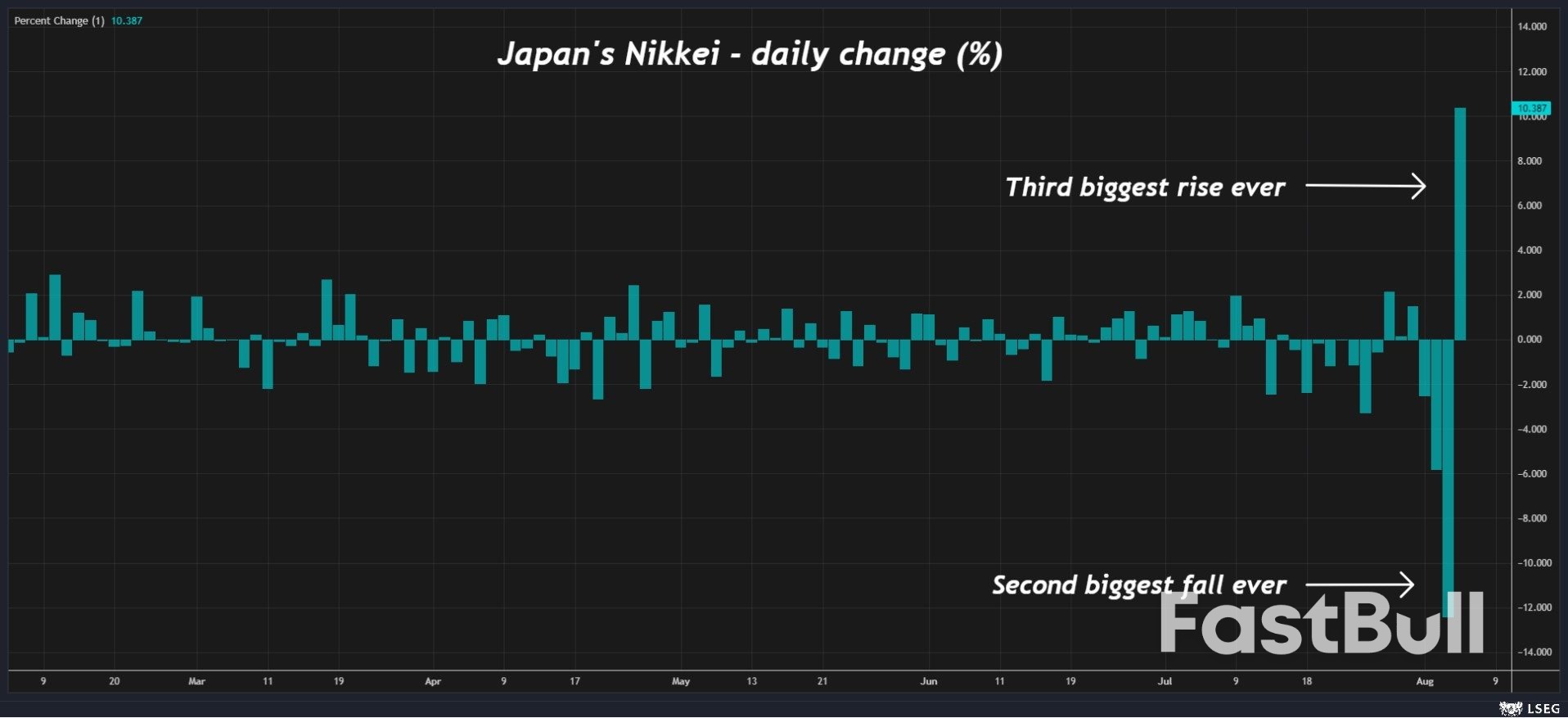
          Nothing epitomized 'Turnaround Tuesday' more than the whoosh in Japanese stocks - a day after tumbling 12% in their second biggest fall on record, stocks rallied 10% for their third biggest rise on record.
          In some ways, however, day-to-day swings of that magnitude based on not a lot of fresh or major market-moving news are red flags. They're typical of more protracted and volatile downturns, and many investors are retaining a cautious stance.'Turnaround Tuesday' Soothes Nerves ... For Now_1
          That said, any respite is welcome. Implied yen volatility remains elevated but eased off on Tuesday, and Wall Street and MSCI's emerging, Asian and world stock indices all gained more than 1%.
          Fears of impending U.S. recession will have been allayed further too, as the Atlanta Fed's GDPNow growth tracker estimate for third quarter GDP growth was raised to 2.9% from 2.6%.
          Little wonder that U.S. bond yields and the dollar rose. That's a twin dynamic that is rarely positive for emerging markets, but if it is part of a broader market recovery and cooling off in volatility then investors may be more forgiving.
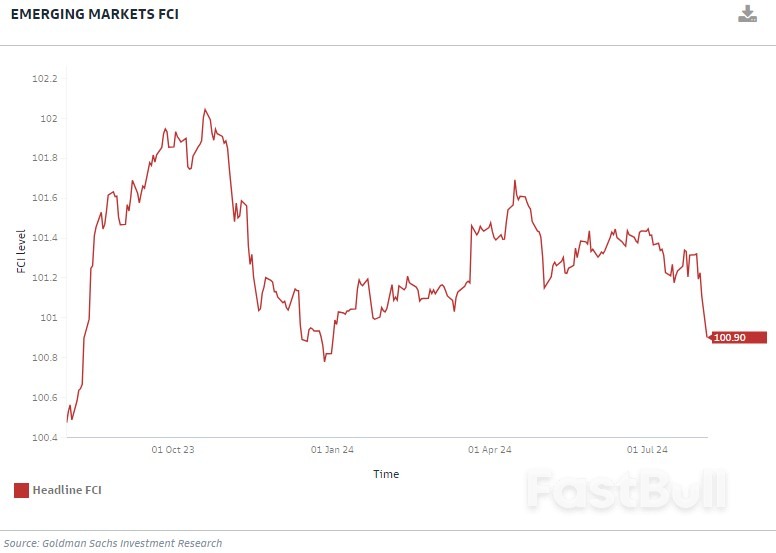
          Emerging market participants will also note that the steep fall in U.S. yields in recent weeks has more than offset the decline in stock prices. So much so that emerging market financial conditions are now the loosest since January, according to Goldman Sachs.'Turnaround Tuesday' Soothes Nerves ... For Now_2
          Wednesday's calendar in Asia includes Chinese trade figures for July, the latest FX reserves holdings from China, Japan and Hong Kong, and earnings reports from Singapore's top bank DBS and Japan's SoftBank Group.
          China's trade data will be under even particular scrutiny given the ratcheting up of U.S. trade and tariff tensions. Export growth is seen quickening, a potential silver lining to the world's second-largest economy still struggling under a property sector bust, weak consumer demand and the threat of deflation.
          Monthly changes in countries' FX reserves holdings rarely have an immediate impact on financial markets, but anyone with an interest in the dollar's reserve status will cast an eye towards the latest updates from Beijing, Tokyo and Hong Kong.
          That's nearly $5 trillion of reserves, 40% of the global total. China holds the world's largest stash, with $3.22 trillion, and Japan is the largest overseas holder of U.S. Treasuries, with $1.13 trillion.
          Several leading policymakers in the Asia and Pacific region are scheduled to speak on Wednesday, including Reserve Bank of Australia assistant governor Sarah Hunter, Bank of Japan deputy governor Uchida Shinichi and Bank of Thailand governor Sethaput Suthiwartnarueput.
          Here are key developments that could provide more direction to Asian markets on Wednesday:
          - China trade (July)
          - China, Japan, Hong Kong FX reserves (July)
          - Softbank earnings (Q1)

          Source: Reuters

          To stay updated on all economic events of today, please check out our Economic calendar
          Risk Warnings and Disclaimers
          You understand and acknowledge that there is a high degree of risk involved in trading. Following any strategies or investment methods may lead to potential losses. The content on the site is provided by our contributors and analysts for information purposes only. You are solely responsible for determining whether any trading assets, securities, strategy, or any other product is suitable for investing based on your own investment objectives and financial situation.
          Add to Favorites
          Share

          Goldman Sees Carbon Market Heading for Historic Tipping Point

          Samantha Luan

          Economic

          The cost of emitting carbon dioxide into the atmosphere is set to decouple from gas prices in the European Union, marking an historic shift in the dynamic between the two markets, according to the EMEA head of natural resources research at Goldman Sachs Group Inc.
          The EU is facing "a complete break from the historical relationship where lower gas always meant lower carbon," Goldman's Michele Della Vigna said in an interview. The development reflects the changing dynamics affecting the carbon market, including shrinking emissions caps, with industry replacing power producers as the biggest buyers of permits to pollute and "a complete change in the gas market," he said.
          Until now, gas prices have tended to move in tandem with the price for carbon allowances. But that relationship is unlikely to last, Della Vigna said.
          Russia's invasion of Ukraine triggered a new wave of energy investment in Europe, as the bloc raced to address supply holes. Not only did that race lead to a surge in the production of renewables, but with gas getting a stamp of approval in the EU's green taxonomy, its supply is now set to pick up meaningfully. Goldman predicts that infrastructure investments will drive up global liquid natural gas supplies by 50% in the next five years, leading to a halving of gas prices over the period.
          That has major implications for inflation, and will ultimately have a big impact on carbon prices, Della Vigna said.
          Assuming a 50% decline in the price of gas, "then actually even with a higher carbon price, we would see no inflation in energy in Europe, no hit" to consumers or industry, Della Vigna said. "If anything, the higher carbon price will be a helpful way to make sure power prices don't fall so much that the development of renewable power becomes challenged from an economics perspective."
          Concerns over inflation may make the EU less inclined to allow the carbon price "to go much higher than where it is at the moment in a high energy price environment," Della Vigna said. "That's why cheaper gas actually should mean higher carbon prices. Not just because of affordability, but also because cheaper gas means European heavy industry can come back and as they come back more emissions come back, which leads to a tighter carbon market from 2026."
          "Industry has gone back into properly developing a new infrastructure for liquefied natural gas," he said. And that "is now about to all come on stream."
          The development has the potential to drive the price of carbon allowances on the European Union's Emissions Trading System to as much as €130 a tonne by 2028, Della Vigna said. This year, prices have averaged at around €66 (RM323) a tonne, according to BloombergNEF.
          The EU's carbon market is set to tighten significantly in the coming decades as the bloc works toward its goal of net-zero emissions by the middle of the century. Analysts at BloombergNEF forecast EU carbon increasing to nearly €150 by 2030.
          At the same time, financial market participants have been buying allowances in anticipation of higher prices, Della Vigna said. As an asset, carbon allowances traded on the ETS can offer value if investors think prices will rise, "which is certainly our view," he said.
          "Clearly in a surplus the market tends to be weaker, and that's what we've seen in the last couple of years," he said. But from 2026, that surplus is likely to "turn into a deficit," he said.
          Carbon allowance prices are currently depressed after the EU brought forward some supply to help generate revenue for member states and move away from Russian energy supplies, said Huan Chang, an analyst with BloombergNEF. And for many industries, it's still cheaper to exceed emissions caps than it is to invest in decarbonising technologies. But with higher prices for carbon allowances, that looks set to change.
          Emissions covered by the EU ETS fell by 16% last year, representing the biggest annual decline on record.
          The EU, which has set a 2030 target to cut emissions by at least 55%, is gradually reducing the supply of ETS allowances as part of a defined strategy to force key sectors to decarbonise. Since the 2005 start of the EU ETS, emissions generated by companies it covers have fallen by 41%, according to EU data. That's led to a 28% decline in total emissions across the EU. Over time, the list of industries covered by the ETS has been expanded with shipping a recent addition.

          Source: Bloomberg

          To stay updated on all economic events of today, please check out our Economic calendar
          Risk Warnings and Disclaimers
          You understand and acknowledge that there is a high degree of risk involved in trading. Following any strategies or investment methods may lead to potential losses. The content on the site is provided by our contributors and analysts for information purposes only. You are solely responsible for determining whether any trading assets, securities, strategy, or any other product is suitable for investing based on your own investment objectives and financial situation.
          Add to Favorites
          Share
          FastBull
          Copyright © 2025 FastBull Ltd

          728 RM B 7/F GEE LOK IND BLDG NO 34 HUNG TO RD KWUN TONG KLN HONG KONG

          TelegramInstagramTwitterfacebooklinkedin
          App Store Google Play Google Play
          Products
          Charts

          Chats

          Q&A with Experts
          Screeners
          Economic Calendar
          Data
          Tools
          Membership
          Features
          Function
          Markets
          Copy Trading
          Latest Signals
          Contests
          News
          Analysis
          24/7
          Columns
          Education
          Company
          Careers
          About Us
          Contact Us
          Advertising
          Help Center
          Feedback
          User Agreement
          Privacy Policy
          Business

          White Label

          Data API

          Web Plug-ins

          Poster Maker

          Affiliate Program

          Risk Disclosure

          The risk of loss in trading financial instruments such as stocks, FX, commodities, futures, bonds, ETFs and crypto can be substantial. You may sustain a total loss of the funds that you deposit with your broker. Therefore, you should carefully consider whether such trading is suitable for you in light of your circumstances and financial resources.

          No decision to invest should be made without thoroughly conducting due diligence by yourself or consulting with your financial advisors. Our web content might not suit you since we don't know your financial conditions and investment needs. Our financial information might have latency or contain inaccuracy, so you should be fully responsible for any of your trading and investment decisions. The company will not be responsible for your capital loss.

          Without getting permission from the website, you are not allowed to copy the website's graphics, texts, or trademarks. Intellectual property rights in the content or data incorporated into this website belong to its providers and exchange merchants.

          Not Logged In

          Log in to access more features

          FastBull Membership

          Not yet

          Purchase

          Become a signal provider
          Help Center
          Customer Service
          Dark Mode
          Price Up/Down Colors

          Log In

          Sign Up
          Position
          Layout
          Fullscreen
          Default to Chart
          The chart page opens by default when you visit fastbull.com