• Trade
  • Markets
  • Copy
  • Contests
  • News
  • 24/7
  • Calendar
  • Q&A
  • Chats
Trending
Screeners
SYMBOL
LAST
BID
ASK
HIGH
LOW
NET CHG.
%CHG.
SPREAD
SPX
S&P 500 Index
6836.10
6836.10
6836.10
6878.28
6827.18
-34.30
-0.50%
--
DJI
Dow Jones Industrial Average
47675.08
47675.08
47675.08
47971.51
47611.93
-279.90
-0.58%
--
IXIC
NASDAQ Composite Index
23504.94
23504.94
23504.94
23698.93
23455.05
-73.17
-0.31%
--
USDX
US Dollar Index
99.020
99.100
99.020
99.160
98.730
+0.070
+ 0.07%
--
EURUSD
Euro / US Dollar
1.16391
1.16398
1.16391
1.16717
1.16162
-0.00035
-0.03%
--
GBPUSD
Pound Sterling / US Dollar
1.33262
1.33272
1.33262
1.33462
1.33053
-0.00050
-0.04%
--
XAUUSD
Gold / US Dollar
4192.36
4192.80
4192.36
4218.85
4175.92
-5.55
-0.13%
--
WTI
Light Sweet Crude Oil
58.628
58.658
58.628
60.084
58.495
-1.181
-1.97%
--

Community Accounts

Signal Accounts
--
Profit Accounts
--
Loss Accounts
--
View More

Become a signal provider

Sell trading signals to earn additional income

View More

Guide to Copy Trading

Get started with ease and confidence

View More

Signal Accounts for Members

All Signal Accounts

Best Return
  • Best Return
  • Best P/L
  • Best MDD
Past 1W
  • Past 1W
  • Past 1M
  • Past 1Y

All Contests

  • All
  • Trump Updates
  • Recommend
  • Stocks
  • Cryptocurrencies
  • Central Banks
  • Featured News
Top News Only
Share

President Trump Is Committed To The Continued Cessation Of Violence And Expects The Governments Of Cambodia And Thailand To Fully Honor Their Commitments To End This Conflict - Senior White House Official

Share

[Water Overflows From Spent Fuel Pool At Japanese Nuclear Facility] According To Japan's Nuclear Waste Management Company, Following A Strong Earthquake Off The Coast Of Aomori Prefecture Late On December 8th, Workers At The Nuclear Waste Treatment Plant In Rokkasho Village, Aomori Prefecture, Discovered "at Least 100 Liters Of Water" On The Ground Around The Spent Fuel Pool During An Inspection. Analysis Suggests This Water "may Have Overflowed Due To The Earthquake's Shaking." However, It Is Reported That The Overflowed Water "remains Inside The Building And Has Not Affected The External Environment."

Share

Trump Says Netflix, Paramount Are Not His Friends As Warner Bros Fight Heats Up

Share

On Monday (December 8), The ICE Dollar Index Rose 0.11% To 99.102 In Late New York Trading, Trading Between 98.794 And 99.227, Following A Significant Rally After The US Stock Market Opened. The Bloomberg Dollar Index Rose 0.12% To 1213.90, Trading Between 1210.34 And 1214.88

Share

Trump: Has Not Spoken To Kushner About Paramount Bid

Share

US President Trump: I Don’t Know Much About Paramount’s Hostile Takeover Bid For Warner Bros. Discovery

Share

Trump: I Want To Do What's Right

Share

Trump On Bids For Warner Bros: I'd Have To See Netflix, Paramount Percentages Of Market

Share

Trump On Vaccines: We Are Looking At A Lot Of Things

Share

Trump: EU Fine On X A “Nasty One”

Share

Trump: I Don't Want To Pay Insurance Companies, They Are Owned By Democrats

Share

Trump: On Healthcare, I Want The Money To Be Paid To The People

Share

US Treasury Secretary Bessenter: We Are Still Working Towards A Trade Agreement With India

Share

US Natural Gas Futures Drop 7% On Less Cold Forecasts, Near-Record Output

Share

[Trump: The US Will Not Experience Deflation] US President Trump Believes That US Inflation Will Decline Slightly Further, But There Will Be No Deflation

Share

Trump: We Will End Up Putting Severe Tariffs On Fertilizer From Canada If We Have To

Share

Bessent: We Are Still Working On India Trade Deal

Share

Brent Crude Futures Settle At $62.49/Bbl, Down $1.26, 1.98 Percent

Share

Trump: Farming Equipment Has Gotten Too Expensive

Share

Trump: We Will Take Off A Lot Of Environment Rules That Affect Tractor Companies

TIME
ACT
FCST
PREV
France Trade Balance (SA) (Oct)

A:--

F: --

P: --
Euro Zone Employment YoY (SA) (Q3)

A:--

F: --

P: --
Canada Part-Time Employment (SA) (Nov)

A:--

F: --

P: --

Canada Unemployment Rate (SA) (Nov)

A:--

F: --

P: --

Canada Full-time Employment (SA) (Nov)

A:--

F: --

P: --

Canada Labor Force Participation Rate (SA) (Nov)

A:--

F: --

P: --

Canada Employment (SA) (Nov)

A:--

F: --

P: --

U.S. PCE Price Index MoM (Sept)

A:--

F: --

P: --

U.S. Personal Income MoM (Sept)

A:--

F: --

P: --

U.S. Core PCE Price Index MoM (Sept)

A:--

F: --

P: --

U.S. PCE Price Index YoY (SA) (Sept)

A:--

F: --

P: --

U.S. Core PCE Price Index YoY (Sept)

A:--

F: --

P: --

U.S. Personal Outlays MoM (SA) (Sept)

A:--

F: --

P: --
U.S. 5-10 Year-Ahead Inflation Expectations (Dec)

A:--

F: --

P: --

U.S. Real Personal Consumption Expenditures MoM (Sept)

A:--

F: --

P: --
U.S. Weekly Total Rig Count

A:--

F: --

P: --

U.S. Weekly Total Oil Rig Count

A:--

F: --

P: --

U.S. Consumer Credit (SA) (Oct)

A:--

F: --

P: --
China, Mainland Foreign Exchange Reserves (Nov)

A:--

F: --

P: --

Japan Trade Balance (Oct)

A:--

F: --

P: --

Japan Nominal GDP Revised QoQ (Q3)

A:--

F: --

P: --

China, Mainland Imports YoY (CNH) (Nov)

A:--

F: --

P: --

China, Mainland Exports (Nov)

A:--

F: --

P: --

China, Mainland Imports (CNH) (Nov)

A:--

F: --

P: --

China, Mainland Trade Balance (CNH) (Nov)

A:--

F: --

P: --

China, Mainland Exports YoY (USD) (Nov)

A:--

F: --

P: --

China, Mainland Imports YoY (USD) (Nov)

A:--

F: --

P: --

Germany Industrial Output MoM (SA) (Oct)

A:--

F: --

P: --
Euro Zone Sentix Investor Confidence Index (Dec)

A:--

F: --

P: --

Canada National Economic Confidence Index

A:--

F: --

P: --

U.K. BRC Like-For-Like Retail Sales YoY (Nov)

--

F: --

P: --

U.K. BRC Overall Retail Sales YoY (Nov)

--

F: --

P: --

Australia Overnight (Borrowing) Key Rate

--

F: --

P: --

RBA Rate Statement
RBA Press Conference
Germany Exports MoM (SA) (Oct)

--

F: --

P: --

U.S. NFIB Small Business Optimism Index (SA) (Nov)

--

F: --

P: --

Mexico 12-Month Inflation (CPI) (Nov)

--

F: --

P: --

Mexico Core CPI YoY (Nov)

--

F: --

P: --

Mexico PPI YoY (Nov)

--

F: --

P: --

U.S. Weekly Redbook Index YoY

--

F: --

P: --

U.S. JOLTS Job Openings (SA) (Oct)

--

F: --

P: --

China, Mainland M1 Money Supply YoY (Nov)

--

F: --

P: --

China, Mainland M0 Money Supply YoY (Nov)

--

F: --

P: --

China, Mainland M2 Money Supply YoY (Nov)

--

F: --

P: --

U.S. EIA Short-Term Crude Production Forecast For The Year (Dec)

--

F: --

P: --

U.S. EIA Natural Gas Production Forecast For The Next Year (Dec)

--

F: --

P: --

U.S. EIA Short-Term Crude Production Forecast For The Next Year (Dec)

--

F: --

P: --

EIA Monthly Short-Term Energy Outlook
U.S. API Weekly Gasoline Stocks

--

F: --

P: --

U.S. API Weekly Cushing Crude Oil Stocks

--

F: --

P: --

U.S. API Weekly Crude Oil Stocks

--

F: --

P: --

U.S. API Weekly Refined Oil Stocks

--

F: --

P: --

South Korea Unemployment Rate (SA) (Nov)

--

F: --

P: --

Japan Reuters Tankan Non-Manufacturers Index (Dec)

--

F: --

P: --

Japan Reuters Tankan Manufacturers Index (Dec)

--

F: --

P: --

Japan Domestic Enterprise Commodity Price Index MoM (Nov)

--

F: --

P: --

Japan Domestic Enterprise Commodity Price Index YoY (Nov)

--

F: --

P: --

China, Mainland PPI YoY (Nov)

--

F: --

P: --

China, Mainland CPI MoM (Nov)

--

F: --

P: --

Italy Industrial Output YoY (SA) (Oct)

--

F: --

P: --

Q&A with Experts
    • All
    • Chatrooms
    • Groups
    • Friends
    Connecting
    .
    .
    .
    Type here...
    Add Symbol or Code

      No matching data

      All
      Trump Updates
      Recommend
      Stocks
      Cryptocurrencies
      Central Banks
      Featured News
      • All
      • Russia-Ukraine Conflict
      • Middle East Flashpoint
      • All
      • Russia-Ukraine Conflict
      • Middle East Flashpoint
      Search
      Products

      Charts Free Forever

      Chats Q&A with Experts
      Screeners Economic Calendar Data Tools
      Membership Features
      Data Warehouse Market Trends Institutional Data Policy Rates Macro

      Market Trends

      Market Sentiment Order Book Forex Correlations

      Top Indicators

      Charts Free Forever
      Markets

      News

      News Analysis 24/7 Columns Education
      From Institutions From Analysts
      Topics Columnists

      Latest Views

      Latest Views

      Trending Topics

      Top Columnists

      Latest Update

      Signals

      Copy Rankings Latest Signals Become a signal provider AI Rating
      Contests
      Brokers

      Overview Brokers Assessment Rankings Regulators News Claims
      Broker listing Forex Brokers Comparison Tool Live Spread Comparison Scam
      Q&A Complaint Scam Alert Videos Tips to Detect Scam
      More

      Business
      Events
      Careers About Us Advertising Help Center

      White Label

      Data API

      Web Plug-ins

      Affiliate Program

      Awards Institution Evaluation IB Seminar Salon Event Exhibition
      Vietnam Thailand Singapore Dubai
      Fans Party Investment Sharing Session
      FastBull Summit BrokersView Expo
      Recent Searches
        Top Searches
          Markets
          News
          Analysis
          User
          24/7
          Economic Calendar
          Education
          Data
          • Names
          • Latest
          • Prev

          View All

          No data

          Scan to Download

          Faster Charts, Chat Faster!

          Download App
          English
          • English
          • Español
          • العربية
          • Bahasa Indonesia
          • Bahasa Melayu
          • Tiếng Việt
          • ภาษาไทย
          • Français
          • Italiano
          • Türkçe
          • Русский язык
          • 简中
          • 繁中
          Open Account
          Search
          Products
          Charts Free Forever
          Markets
          News
          Signals

          Copy Rankings Latest Signals Become a signal provider AI Rating
          Contests
          Brokers

          Overview Brokers Assessment Rankings Regulators News Claims
          Broker listing Forex Brokers Comparison Tool Live Spread Comparison Scam
          Q&A Complaint Scam Alert Videos Tips to Detect Scam
          More

          Business
          Events
          Careers About Us Advertising Help Center

          White Label

          Data API

          Web Plug-ins

          Affiliate Program

          Awards Institution Evaluation IB Seminar Salon Event Exhibition
          Vietnam Thailand Singapore Dubai
          Fans Party Investment Sharing Session
          FastBull Summit BrokersView Expo

          Bond Quake Sees Doubling Down On The Shadows

          Cohen

          Bond

          Summary:

          The expanding shadows of private credit seem an odd place to lurk if central banks' 'higher-for-longer' mantra on interest rates suggests they keep things tight until something breaks.
          The expanding shadows of private credit seem an odd place to lurk if central banks' 'higher-for-longer' mantra on interest rates suggests they keep things tight until something breaks.
          And yet many asset managers are doubling down on the growing direct lending universe - assuming the higher returns in a "soft-landing" scenario for the world economy compensate for default or restructuring risks that are more manageable than in publicly-traded high-risk junk bonds.
          Screening out a lot of noise and holding your nerve in an inherently illiquid space seems to be a tall order.
          Right now, the noise is deafening and nerve is in short supply in the seemingly safest part of the debt market as longer-term government bonds that set base borrowing costs get whacked anew on rising uncertainty about where inflation and policy rates settle in the coming years and as debt piles rise.
          Without much change in near-term assumptions about peaking Federal Reserve policy rates, investors are starting to reprice long-term bonds to cope with a potentially more resilient, higher-inflation economy where the unwinding of central banks' gigantic balance sheets of bonds also whips away market supports.
          Fed or European Central Bank policy rates may well be cresting now at last, but if they don't come down again soon due to persistently above-target inflation - they could well start rising again from current levels if another cyclical expansion were to emerge without a recession ever occurring in this cycle.
          Debt supply projections and central bank balance sheet 'normalization' add to the angst.
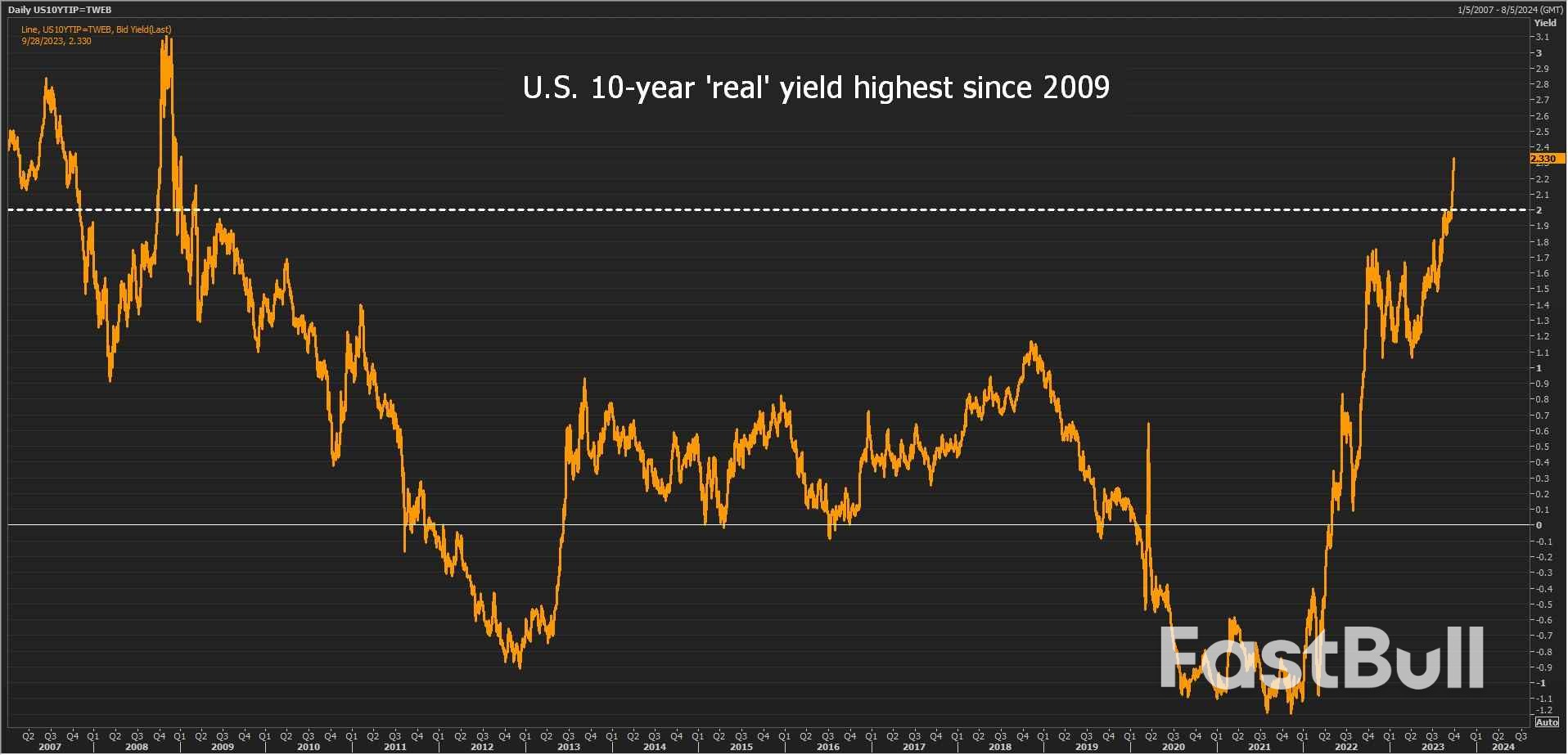
          The result has been benchmark U.S. 10-year yields have spiralled almost a full percentage point higher to 16-year highs near 4.7% over the past quarter - with real, inflation-adjusted yields up 80 basis points to some 2.34%.
          The deeply inverted 2-to-10-year yield curve gap that many has assumed was a harbinger of recession is narrowing sharply.
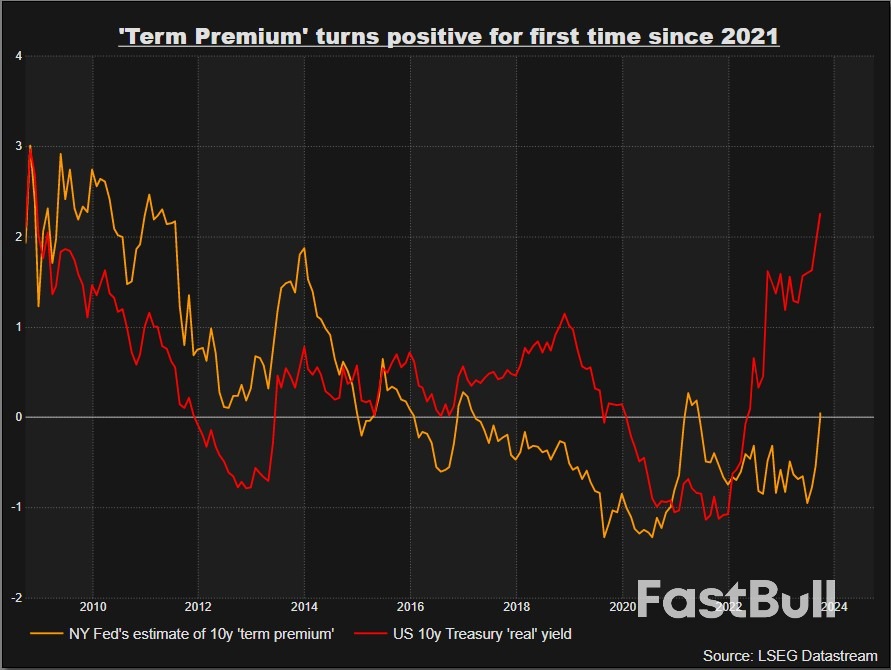
          But perhaps the best indication of long-term uncertainty and a lack of visibility is the return of a so-called term premium - an often fuzzy measure of the added compensation in yield that investors demand for holding long-term bonds to maturity against rolling shorter-term paper over the same period.
          Bond Quake Sees Doubling Down On The Shadows_1Bond analysts have differing models to measure this, but the New York Fed's estimate turned positive this week for the first time in more than two years - having been in negative territory for all but two brief occasions in the past eight years.
          Bond Quake Sees Doubling Down On The Shadows_2Shadow Play
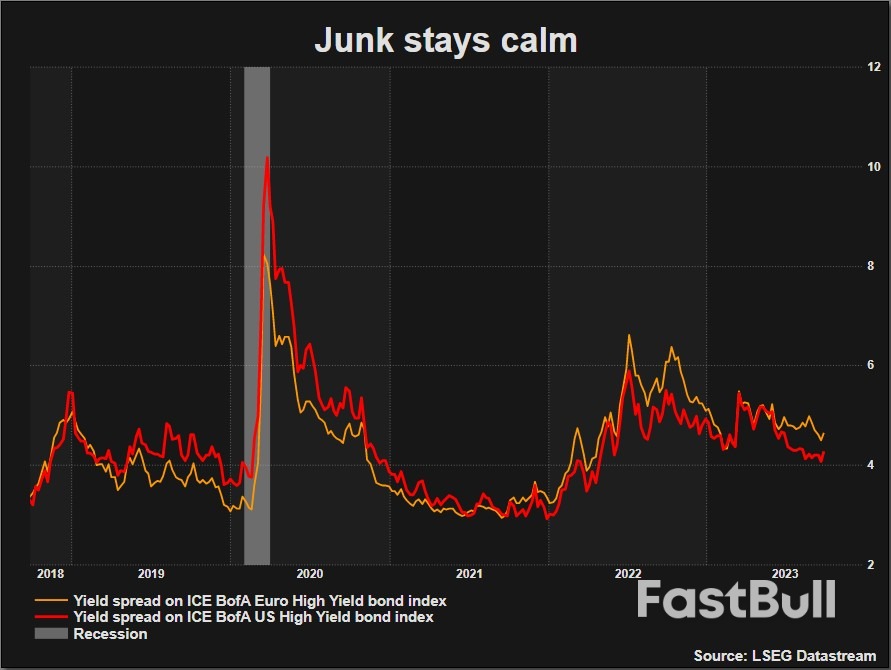
          And yet despite the government debt ructions and forecasts of gradually rising junk debt default rates close to 5% next year, the lack of an imminent recession has meant high-yield bond markets have remained relatively calm - with spreads over rising government yields still more than half a percentage point lower than the end of last year.
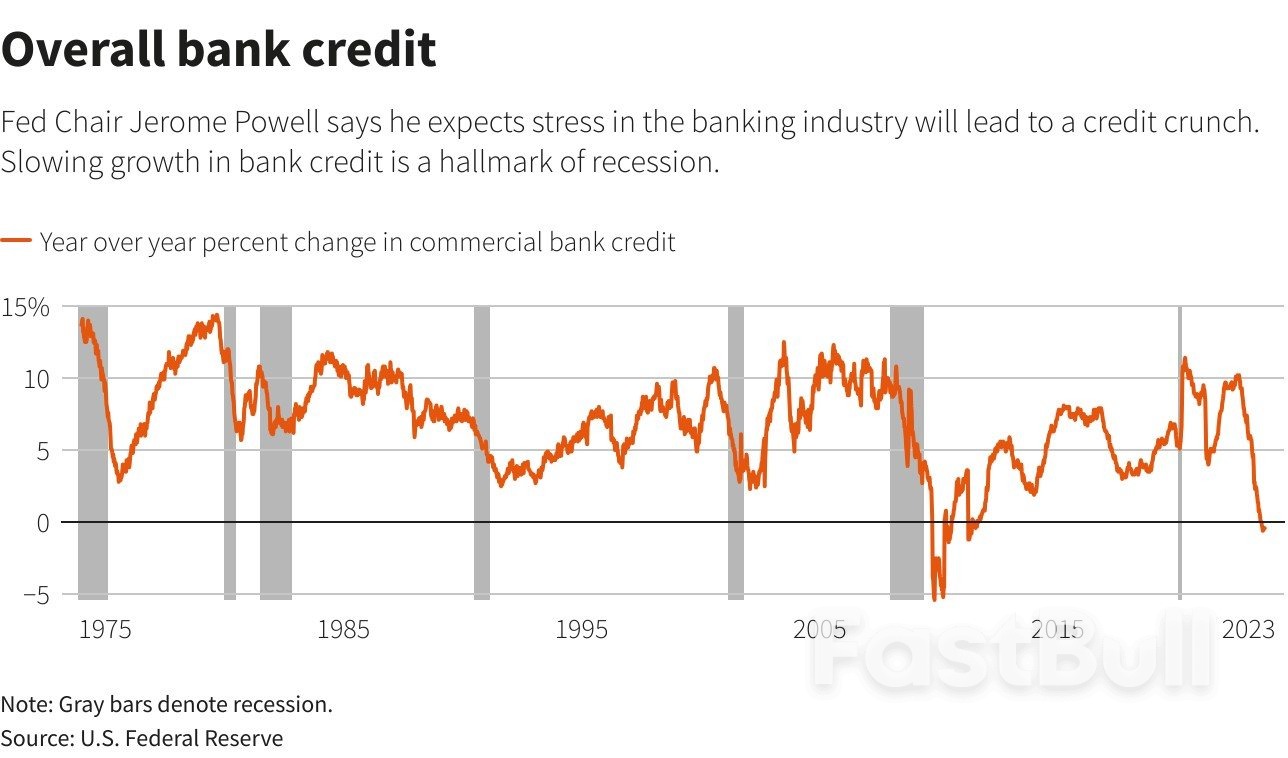
          The prospect of 'higher-for-longer' rates seems scary for fragile companies on floating-rate loans or who will be forced to refinance at much higher rates over that prolonged period - just as bank credit shrinks, lending standards tighten and bond markets gyrate.
          But at least public bond and leverage loan markets have visibility in pricing and offer some liquidity to get in or out.
          Many have long-feared the more opaque performance in private credit - direct lending by asset managers that Moody's estimates has more than doubled in size since 2015 to some $1.5 trillion and which is now as big as the global junk bond market.
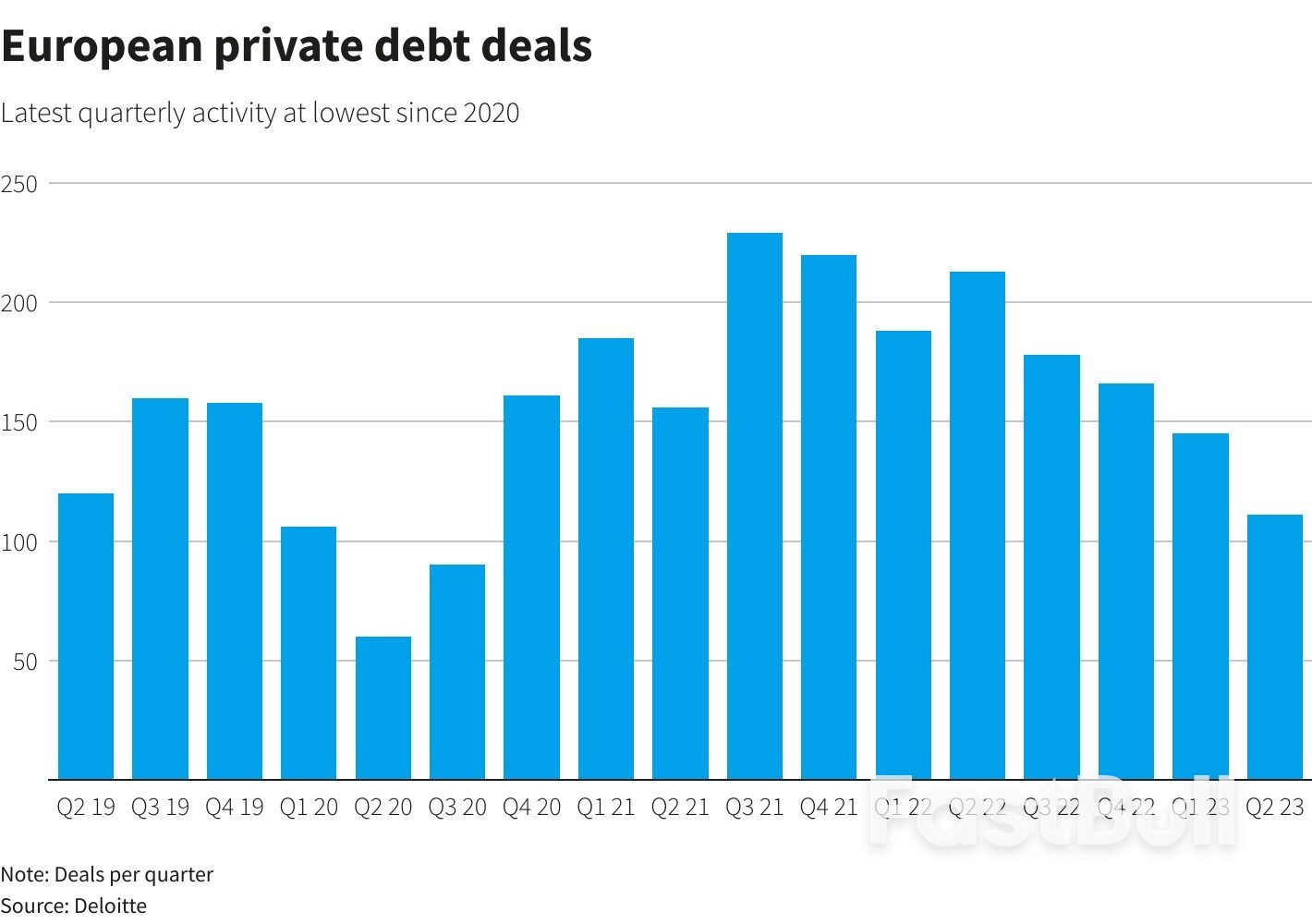
          With a lack of transparent data, especially in Europe, the sheer size of this debt pool hasn't really been tested in a major downturn or period of prolonged high interest rates. And regulators have fretted about system risks - even if investors are typically pension, insurance and sovereign wealth funds that can better deal with illiquidity over long periods.
          Unfazed, BlackRock credit strategists this week said the growing private credit world was well priced and structured to weather the storm - and the illiquidity premia worth it even if the more active name selection and widening dispersion of performance was now inevitable.
          That the numbers of borrowers in that space may grow further as banks scale back lending is no surprise.
          Bond Quake Sees Doubling Down On The Shadows_3But investment performance so far in this tightening cycle seems to stack up.
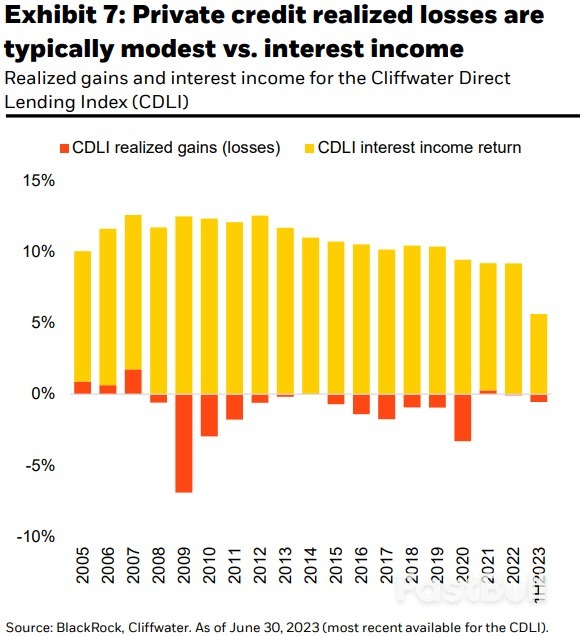
          Using a data set of 13,000 middle market loans totalling $284 billion embedded in the Cliffwater Direct Lending Index (CDLI), BlackRock showed realized loss rates from defaults or restructurings in the first half were 0.55% - compared to interest income of 5.63%.
          It also spotlighted data from the Lincoln International Senior Debt Index tracking 4,500 private borrowers that showed 425 loan terms were amended successfully in the first half of 2023 due largely to higher interest expenses. This meant loan covenant default rates actually fell during the second quarter.
          "This long-term relationship between lender and borrower can often result in a more efficient process for negotiating amendments versus what would otherwise occur in the syndicated public market," the BlackRock team reckoned, adding this was on top of a 170-basis-point yield pickup on the CDLI over comparable leveraged loan indexes.
          Bond Quake Sees Doubling Down On The Shadows_4Thierry Celestin, head of private assets at Lombard Odier, argues that, contrary to regulator concerns, the rise of private credit may actually lower systemic risks in a crisis by shifting the burden away from banks more vulnerable to short-term stress, dependent on deposits and subject to runs.
          "The illiquidity of private credit can be a barrier to some investors," he concluded, but the high returns, low volatility and diversification involved works for those "with the appropriate risk tolerance, appetite and long-term time frame".
          Shadowy or shining, the private credit world is set to face its first big test in a higher-for-longer world of unfolding bond market anxiety.Bond Quake Sees Doubling Down On The Shadows_5

          Source: Reuters

          Risk Warnings and Disclaimers
          You understand and acknowledge that there is a high degree of risk involved in trading. Following any strategies or investment methods may lead to potential losses. The content on the site is provided by our contributors and analysts for information purposes only. You are solely responsible for determining whether any trading assets, securities, strategy, or any other product is suitable for investing based on your own investment objectives and financial situation.
          Comments
          Add to Favorites
          Share

          What Could Break Under Higher-For-Longer Interest Rates?

          Damon

          Central Bank

          Economic

          As the final stretch of the year approaches, there's relief in markets that the sharpest global monetary tightening cycle in decades is finally nearing an end.
          Yet, the strain from interest rate hikes has just started to come through and with central banks signalling that rates will likely stay higher for longer, the notion of something "breaking" remains strong.
          Here's a look at some pressure points on the radar.
          What Could Break Under Higher-For-Longer Interest Rates?_11/ Property Pain
          Nowhere is the impact of higher rates being felt more acutely than in real estate, still reeling from COVID-19.
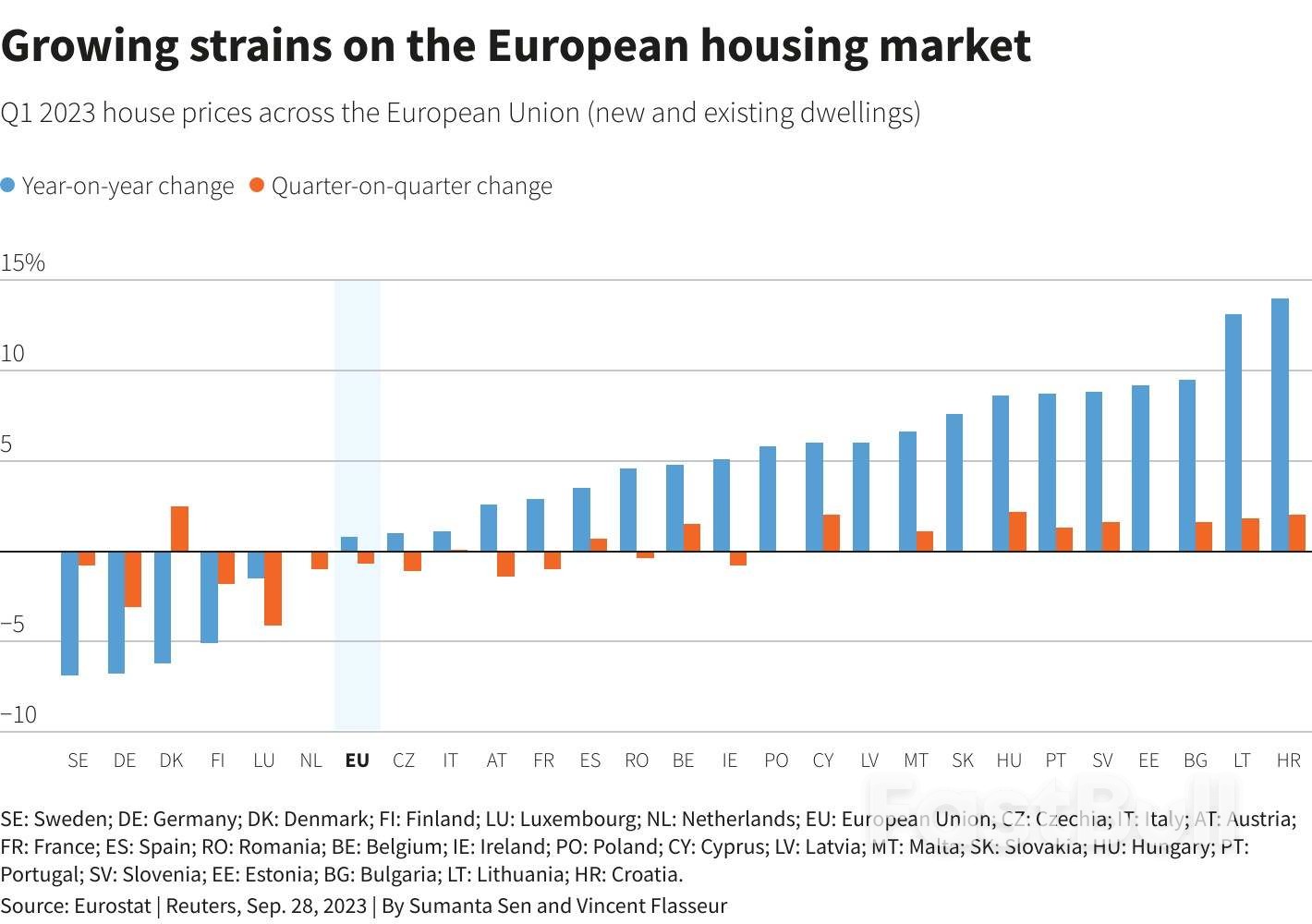
          A string of German developers have been tipped into insolvency, London's office market is in a "rental recession" as vacancies hit a 30-year high and U.S. banks revealed spiralling losses from property in first half figures and warned of more to come.
          Sweden is the hardest hit in Europe since much of its property debt is short-term, making it a harbinger for the region.
          Property group, which owns large tracts of property including hospitals and schools, is scrambling to repair its battered finances, marred by a heavy loss and dwindling cash.
          The crisis has also sucked in Sweden's biggest residential landlord, Heimstaden Bostad. The $30 billion investor with swathes of homes from Stockholm to Berlin is grappling with a multi-billion dollar funding crunch.What Could Break Under Higher-For-Longer Interest Rates?_2
          2/ Made In China
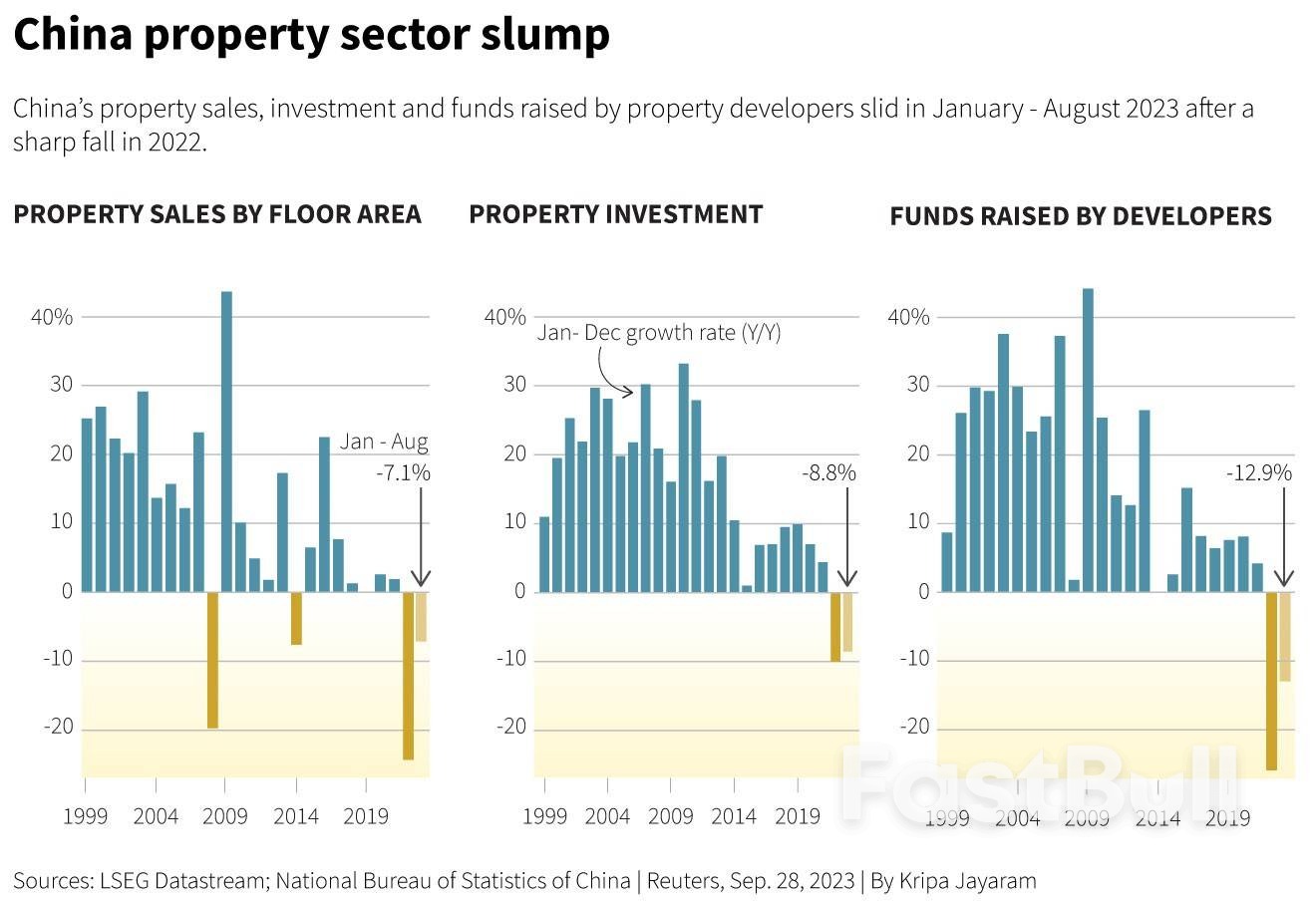
          Property is also at the heart of China's woes and one reason why the world's No.2 economy has shot up investors' worry list.
          China Evergrande Group, the world's most indebted developer with over $300 billion in total liabilities, is at the centre of an unprecedented property sector liquidity crisis. Country Garden, China's largest private developer, is battling to avoid a default.
          Since property accounts for roughly a quarter of the economy, concerns about the impact for China's already faltering growth and the ripple effects have risen.
          Chinese real estate was viewed as the most likely source of a global systemic credit event, according to BofA's September fund manager survey.What Could Break Under Higher-For-Longer Interest Rates?_3
          3/ Money Problems
          Corporate debt defaults have started ramping up, even in typically quiet months.
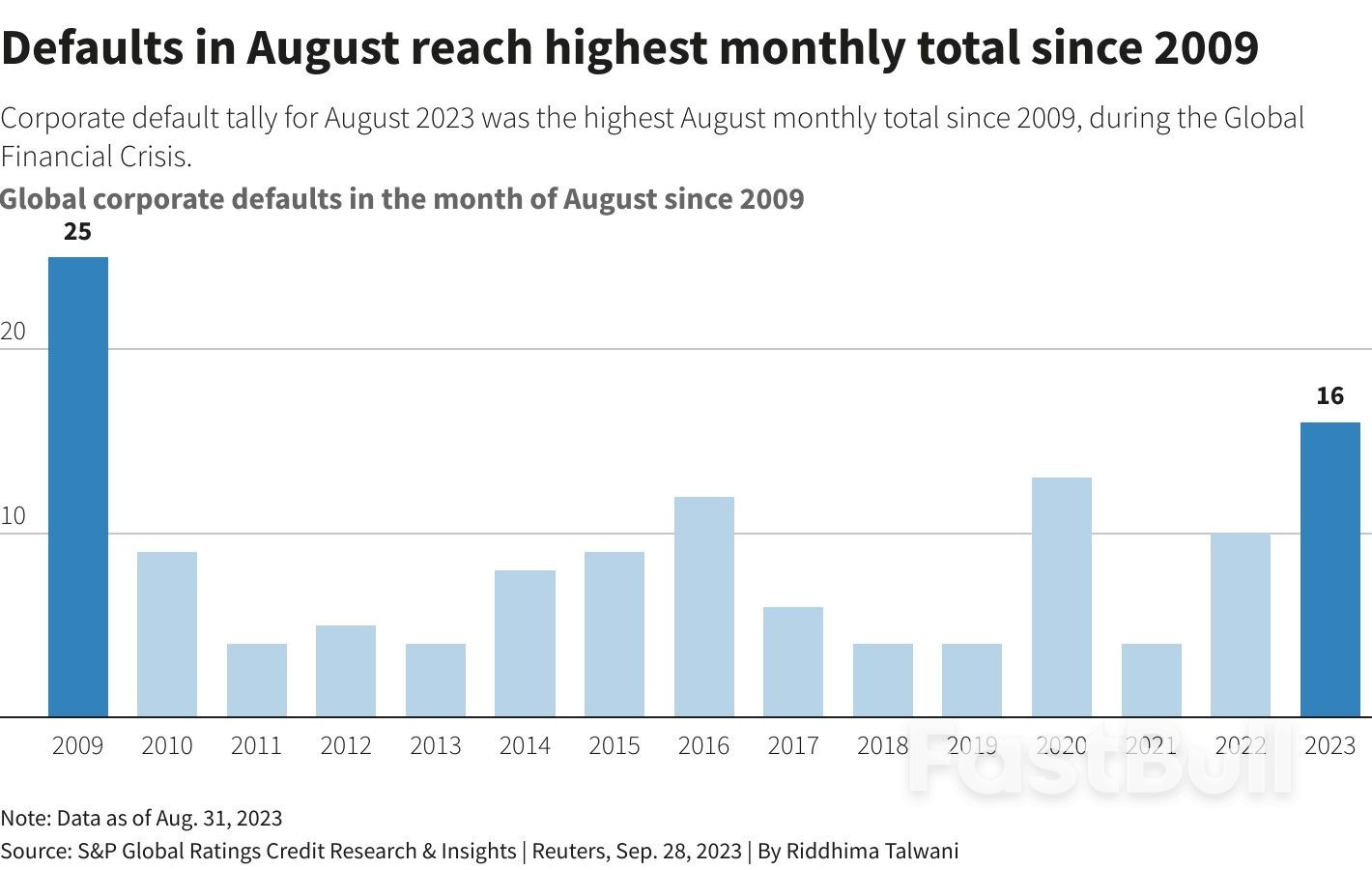
          The number of new corporate defaults globally reached 16 in August, the highest August tally since 2009, according to S&P, the latest sign that corporate stress is building.
          "There is lots of talk in the market about corporate stress and hidden leverage, but it has not erupted yet. We still think defaults are coming," said Markus Allenspach, head of fixed income research at Julius Baer.
          "We have many zombie companies in the United States and Europe from the low interest rates era, and I cannot imagine how they can survive now with high interest rates."
          S&P forecast that defaults among junk-rated European companies will reach 3.75% by June 2024 from 3.4% in August.What Could Break Under Higher-For-Longer Interest Rates?_4
          4/ Banking On It
          Banking stress has gone down the worry list since the March crisis wreaked havoc.
          Big U.S. banks sailed through the Federal Reserve's annual health check in June. The European Central Bank has asked banks to provide weekly liquidity data so it can carry out more frequent checks on their ability to ward off potential shocks as rates rise.
          Guy Miller, chief market strategist at Zurich Insurance Group, said banks are in a better position in terms of their capital and liquidity compared with March.
          Still, big question marks remain over their future, not least from a global property rout.
          "There is still an inherent vulnerability to deposit flight as well as to commercial real estate and other credit exposures for smaller banks," said Miller.
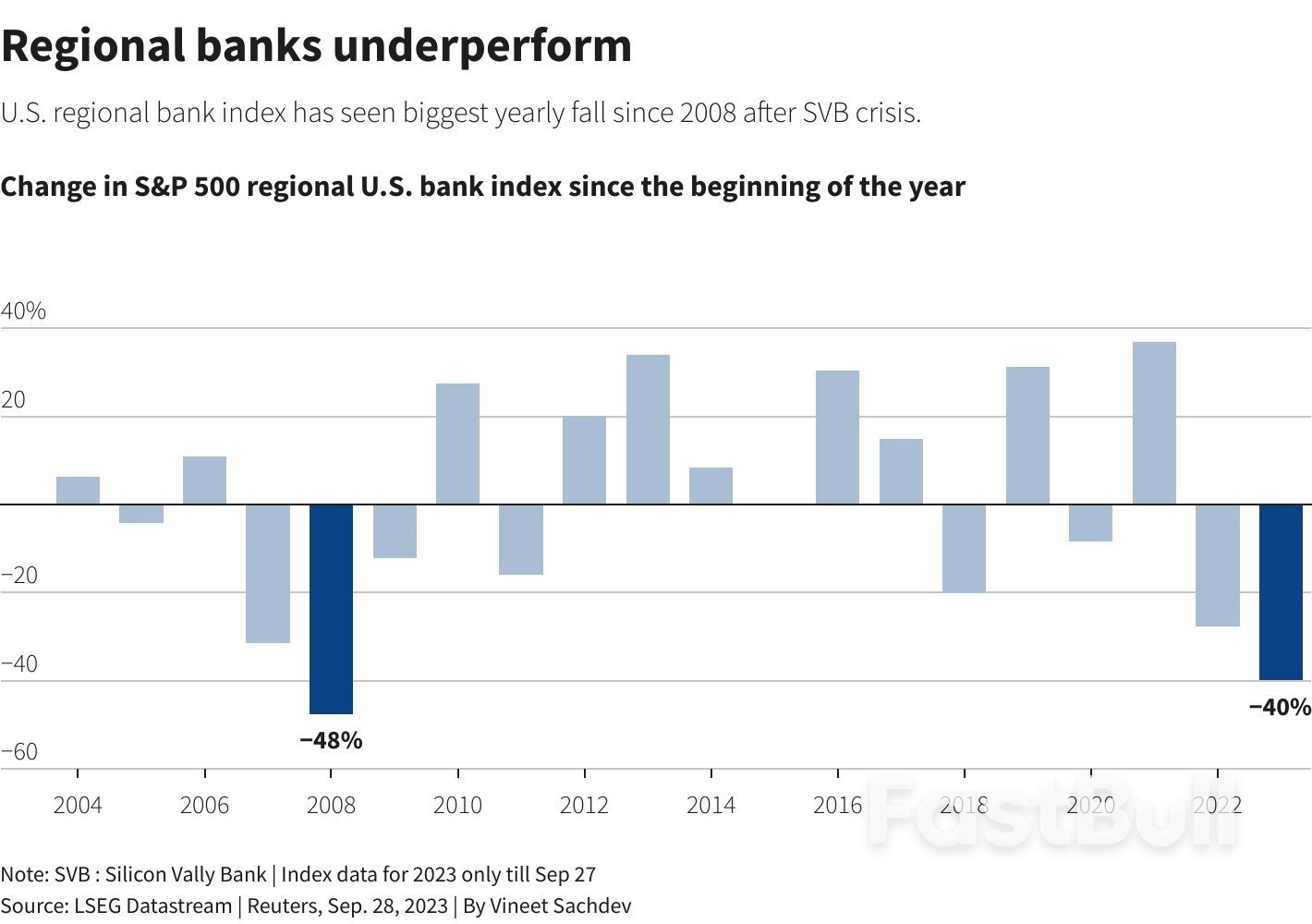
          The S&P 500 U.S. regional banks index is down almost 40% this year, set for its biggest annual drop since 2008.
          Miller noted that European banks are also vulnerable given their bigger size relative to the economy that leaves them more exposed to risks from various pockets.What Could Break Under Higher-For-Longer Interest Rates?_5
          5/ That Japan Factor
          The Bank of Japan has held steadfast to ultra-easy monetary policy but a tighter stance is on the cards. And the risks are rising of a sharp unwind from an era of Japanese cash pumping into everything from U.S. tech stocks to high-yielding emerging market currencies.
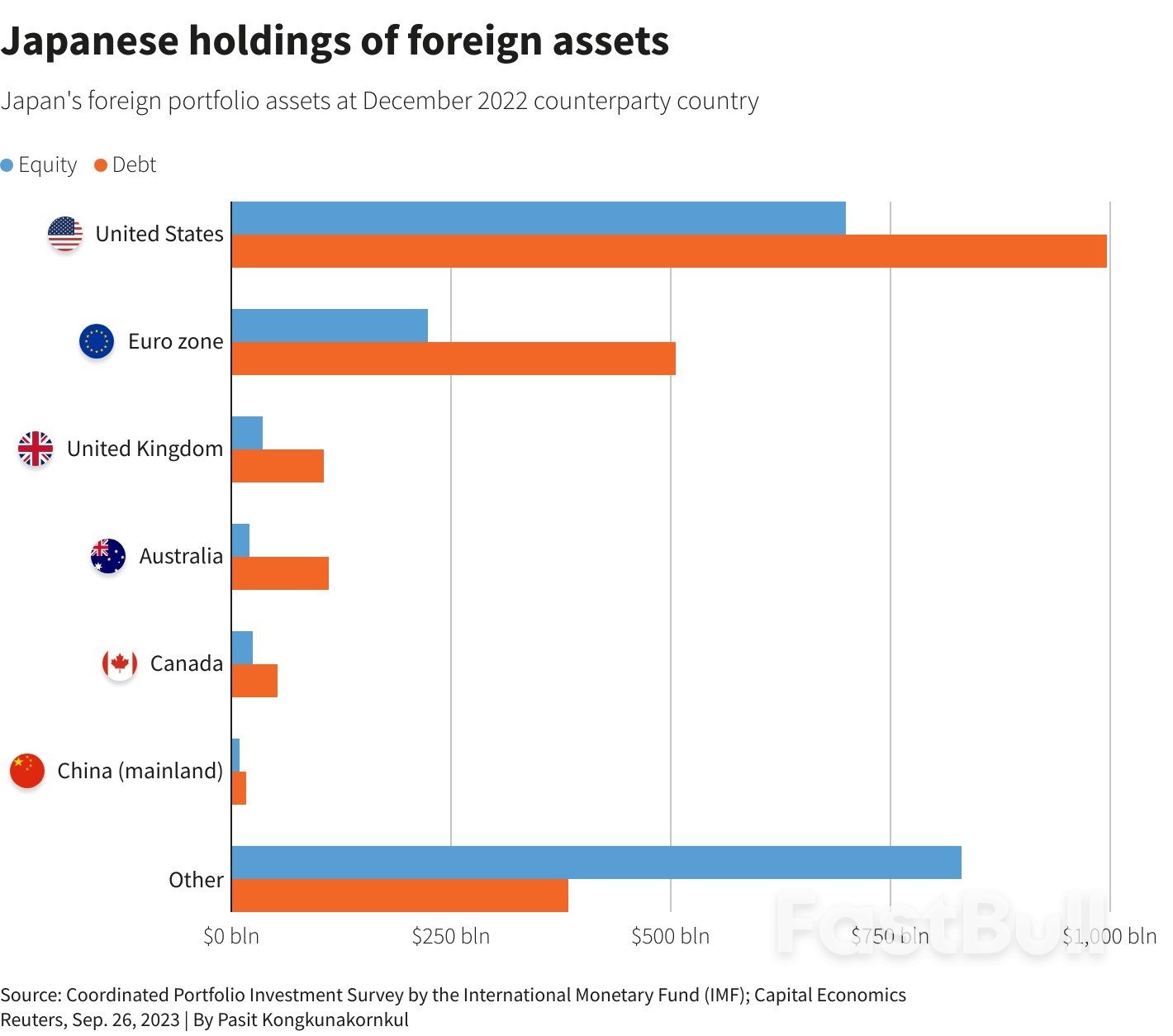
          Capital Economics expects the BOJ to hike its policy rate in January. It notes that Japanese investors, who have long sought better investment yields elsewhere, own around a trillion dollars of U.S. bonds. They are big holders of European and Australian debt.
          Japanese selling of Treasuries could further push up yields -- already at their highest since the global financial crisis. That could hurt equities, which tend to perform worse when investors expect higher returns from low-risk government bonds.
          Expect markets to show increased sensitivity to the BoJ in coming months.What Could Break Under Higher-For-Longer Interest Rates?_6

          Source: CNA

          To stay updated on all economic events of today, please check out our Economic calendar
          Risk Warnings and Disclaimers
          You understand and acknowledge that there is a high degree of risk involved in trading. Following any strategies or investment methods may lead to potential losses. The content on the site is provided by our contributors and analysts for information purposes only. You are solely responsible for determining whether any trading assets, securities, strategy, or any other product is suitable for investing based on your own investment objectives and financial situation.
          Comments
          Add to Favorites
          Share

          Yen Intervention A Hard Sell Even As 150/Dlr 'Red Line' Beckons

          Thomas

          Forex

          The yen's slide to the cusp of 150 per dollar has put investors on high alert for the risk of intervention. But, Japanese authorities could find propping up their currency both difficult to achieve and hard to justify.
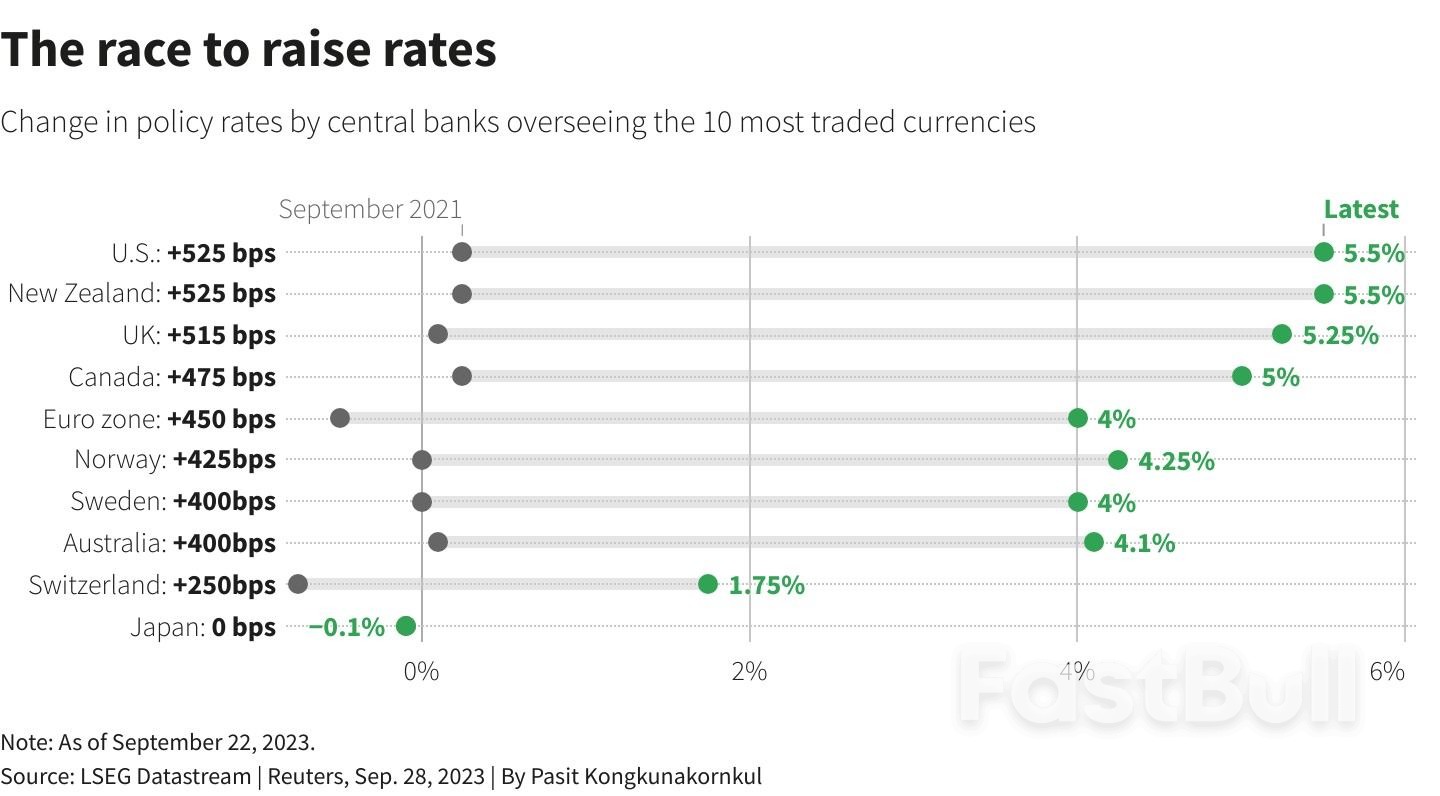
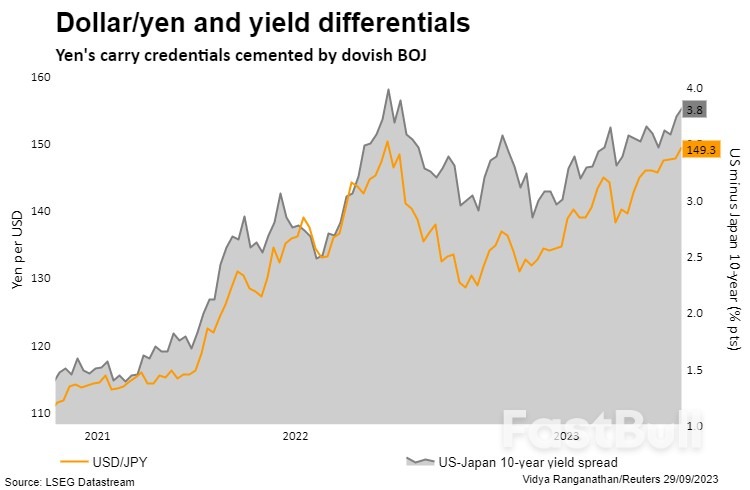
          At its core, the yen's 3% slide in September to its weakest in 11 months at 149.71 on Wednesday is a result of the Bank of Japan's hesitancy exiting an ultra-easy monetary policy while the U.S. Federal Reserve keeps its options open for further tightening.
          The dollar-yen pair traditionally tracks the gap between the countries' long-term yields, which has yawned to 380 basis points in the dollar's favour. U.S. Treasury yields jumped after Fed officials surprised markets last week by hinting at another rate rise this year.
          On the Japanese side, BOJ Governor Kazuo Ueda has quashed expectations for a hawkish shift during coming months by repeatedly emphasising a patient approach was needed to tightening the taps on its super loose policy.
          Intervention is both financially risky and politically charged. To make even a ripple in the $5 trillion currency market, the BOJ would need to draw down massive amounts of dollar reserves.
          Considering the major rich democracies commitment to letting markets determine exchange rates, Tokyo could get a grudging response from Washington when it tries explaining why it needed to pour so many dollars into the open market.
          "You've got the Fed and most other G-10 countries hiking rates, while the BOJ is emphatically saying they're not going to do anything, so if the currency weakens, it's like, Duh!" said Bart Wakabayashi, Tokyo branch manager at State Street Bank and Trust.
          "How can you have a conversation and justify a strong yen in these conditions? There's not a lot you can put on the table."
          Wakabayashi, like many other analysts and investors, considers the 150 yen per dollar level a red line for currency intervention, not least because of its significance as a symbol of climbing costs of living from imported food and fuel. Public opinion is particularly important now, amid speculation Prime Minister Fumio Kishida may call a snap election.
          Finance Minister Shunichi Suzuki said on Friday that the ministry doesn't have a "defence line."
          But he has repeated a warning several times this month that Tokyo is watching the currency market "with a sense of urgency," and "won't rule out any options" in responding to "excessive volatility".
          Masayuki Kichikawa, chief macro strategist at Sumitomo Mitsui DS Asset Management, says if Japan's Ministry of Finance, which manages the currency, does not defend the yen at 150, market participants will instantly try to force it lower to 155.
          "Politically and economically, it becomes problematic," he said. "The Japanese public is complaining about the rising cost of living, and although yen weakness is just one of several factors contributing to that, it's the most visible one."Yen Intervention A Hard Sell Even As 150/Dlr 'Red Line' Beckons_1
          Intervention Imminent
          The yen careened to a 32-year trough at 151.94 last October before being reined in by several bouts of heavy intervention, the first by Japanese authorities in a generation.
          But the turn in tide was helped at that time by a surprise cooling of U.S. inflation, which quelled bets for additional Fed tightening.
          Japanese authorities have been consistent in stressing that intervention doesn't target specific levels, and is instead designed to temper volatility and flush out speculators, particularly when moves are out of line with fundamentals.
          Currently, few of those conditions seem to be met.
          Measures of expected market volatility remain subdued. One-month volatility options sank to the lowest in a year and a half at the start of this week, after clearing last week's Fed and BOJ policy meetings.
          Yen speculative short positions are well back from highs reached in mid July, according to CFTC data.
          "There's nothing in terms of price action that reeks of disorderly conditions or speculative excess," said Ray Attrill, head of FX strategy at National Australia Bank. "Dollar-yen is arguably too low rather than too high here."
          Some analysts say fundamentals argue for the yen to already be on the weaker side of 150, and it has only been held back by the spectre of intervention and prospects of the BOJ moving away from negative interest rates.
          Against the euro and sterling, the yen has actually strengthened this month.
          Treasury Secretary Janet Yellen said last week that U.S. officials "generally understand the need to smooth out following undue volatility, but not to attempt to influence the level of exchange rates," when asked whether Washington would show understanding over yen intervention. "It depends very much on the details."
          Ultimately though, taking action is likely to be judged less costly than doing nothing.
          Aninda Mitra, head of Asia macro and investment strategy at BNY Mellon Investment Management said any intervention was "ultimately a political decision."
          "But from a purely economic and monetary standpoint, I doubt that it does much," Mitra added. "Rate differentials are still very much against the yen. If it's that futile, why even try it?"

          Source: ZAWYA

          Risk Warnings and Disclaimers
          You understand and acknowledge that there is a high degree of risk involved in trading. Following any strategies or investment methods may lead to potential losses. The content on the site is provided by our contributors and analysts for information purposes only. You are solely responsible for determining whether any trading assets, securities, strategy, or any other product is suitable for investing based on your own investment objectives and financial situation.
          Comments
          Add to Favorites
          Share

          French Inflation Stabilises in September

          Devin

          Economic

          Disinflation is here but will take time
          Inflation in France stood at 4.9% in September, the same as in August, but still higher than in June and July. The rise in petroleum products is causing energy inflation to rise sharply again, reaching 11.5% year-on-year, compared with 6.8% in August. At the same time, food prices are slowing year-on-year (+9.6% vs. 11.2% in August), as are services (+2.8% vs. +3%) and manufactured goods (+2.9% vs. +3.1% the previous month). The harmonised index, which is important for the European Central Bank, rose by 5.6% year-on-year in September, after 5.7%.
          Overall, these data confirm the findings of August. The trend towards disinflation is well underway in France, with a slowdown in the growth of prices for food, services, and manufactured goods. Nonetheless, the recent rise in oil prices means that the trend is less clear-cut than expected and more gradual, and further spikes in inflation caused by energy inflation cannot be ruled out in the coming months. The disinflation process is therefore likely to take longer than expected.
          In its latest forecasts, published in September, Banque de France predicts that inflation according to the harmonised index will return to 2.2% by the end of 2024 and 1.6% by the end of 2025, but it cannot be ruled out that we will have to wait longer to see inflation return to these levels. Given the trend in energy prices, we are expecting 2.4% at the end of 2024 and 1.9% at the end of 2025.
          Household consumption remains depressed
          Household consumption of goods fell by 0.5% in volume terms in August, after rising by 0.4% in July. It is therefore back below its June level, down by 1.9% year-on-year and by 4.7% compared with the situation prior to the pandemic. All categories of goods spending fell in August. Data on consumption of services have not yet been published, but they should be slightly better, given the good summer for tourism.
          Looking ahead, household consumption is unlikely to rebound strongly in September, as consumer confidence has fallen further in recent weeks. As a result, household consumption may once again fail to make a positive contribution to GDP growth in the third quarter.
          The resurgence of energy inflation, which is denting the purchasing power of households, particularly rural households, which are heavily dependent on cars and have lower incomes, is a further dampening element for consumption in the coming months. While this should help to accelerate the slowdown in food and goods prices, it also means that growth is likely to be weak over the coming months. We expect GDP growth to be close to 0% over the next three quarters, which would put average GDP growth in 2023 at 0.8% and in 2024 at 0.6%.

          Source: ING

          To stay updated on all economic events of today, please check out our Economic calendar
          Risk Warnings and Disclaimers
          You understand and acknowledge that there is a high degree of risk involved in trading. Following any strategies or investment methods may lead to potential losses. The content on the site is provided by our contributors and analysts for information purposes only. You are solely responsible for determining whether any trading assets, securities, strategy, or any other product is suitable for investing based on your own investment objectives and financial situation.
          Comments
          Add to Favorites
          Share

          Dollar's Smile Makes Wall Street Frown

          Alex

          Forex

          Stocks

          Right now, with the dollar's boom being driven by a destabilizing surge in U.S. bond yields, heightened uncertainty over global growth and rapidly deteriorating investor sentiment, it is definitely the latter.
          The gist of the 'dollar smile' theory, floated by currency analyst and now hedge fund manager Stephen Jen 20 years ago, is this: the dollar typically appreciates in good times (booming investor confidence and roaring markets) and bad (times of great financial stress and 'risk off' markets), but sags in between.
          U.S. economic outperformance in a solid global expansion attracting strong investment inflows into U.S. assets, and Treasury yields higher than their international peers is a recipe for strong dollar and buoyant Wall Street.
          The circumstances that have fostered the dollar's rapid rise since July could not be more different.
          The Chinese, European and many emerging economies are creaking, fears are growing that aggressive Fed policy will 'break' something at home, and the explosion in real yields has left Wall Street - especially growth and tech stocks - shrouded in a mushroom cloud of worry and uncertainty.
          In terms of the 'dollar smile', these are 'bad' times. There is a growing sense in markets that the negative relationship between U.S. stocks, the dollar, and yields could persist for months.
          "I expect it to remain negative for the foreseeable future, that is the next three to six months," reckons Stuart Kaiser, head of U.S. equity trading strategy at Citi. "This is a risk-off environment."
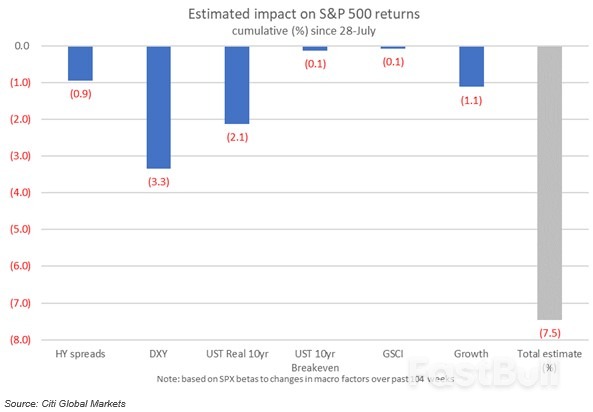
          Dollar's Smile Makes Wall Street Frown_1Kaiser reckons S&P 500 returns have fallen by around 7.5% over the last two months. The dollar has accounted for 3.3 percentage points of that and the 10-year real yield 2.1 pp, easily the two biggest contributors, he estimates.
          The dollar is up around 7% since mid-July and is on course to register its 11th consecutive weekly gain. That would be a record winning streak since the era of free-floating currencies began over 50 years ago.
          It has had bouts of stronger appreciation, such as the early 1980s and 2014-15, but never a more consistent move higher. And with U.S. bond yields the highest in years and still outpacing their global peers, it may not be over yet.Dollar's Smile Makes Wall Street Frown_2
          Financial Conditions Tighten
          A stronger dollar and rising bond yields, especially inflation-adjusted 'real yields,' in a "risk off" investment climate can scare the horses on Wall Street, potentially feeding a self-fulfilling spiral of selling and de-risking.
          There's no suggestion equities are about to crash. But the speed and extent of the move in the dollar and Treasuries, and tightening of financial conditions, warrant vigilance.
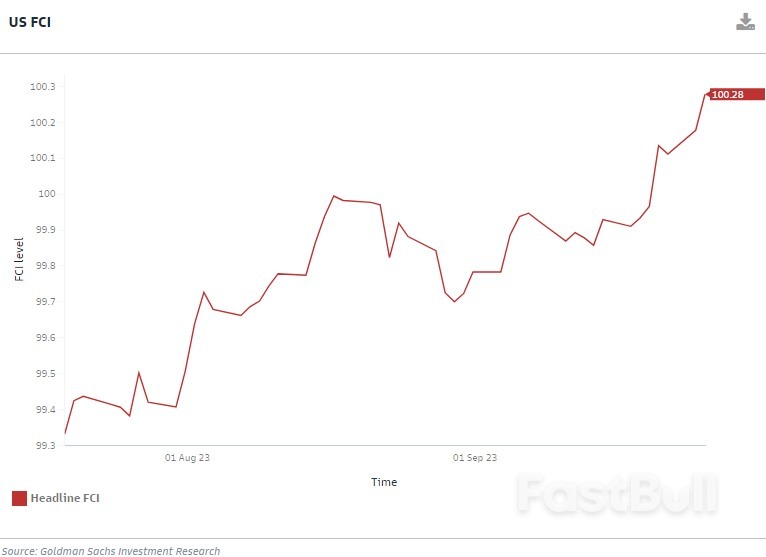
          According to Goldman Sachs, U.S. financial conditions are the tightest this year. This is not dissimilar to other major economies and regions, some of which - the euro zone, China and emerging markets - are feeling an even tighter squeeze.
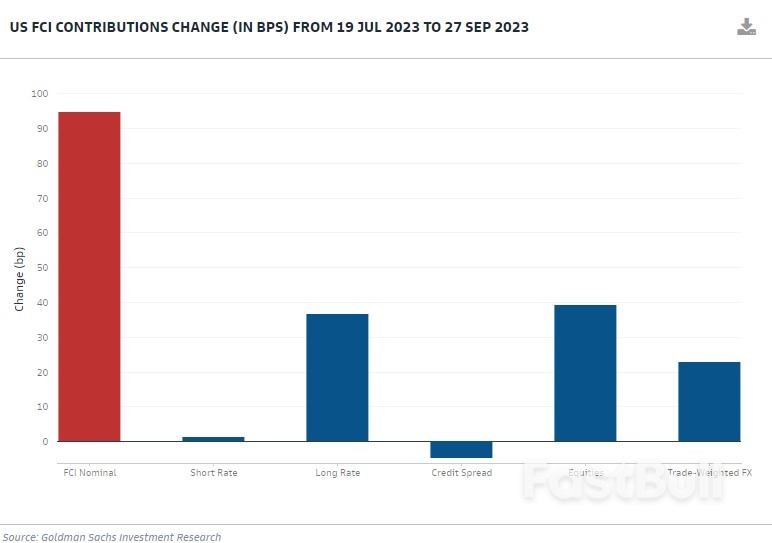
          The bank's U.S. financial conditions index (FCI) has risen 95 basis points since mid-July and the breakdown highlights how the dollar, yields and equities are feeding off each other.Dollar's Smile Makes Wall Street Frown_3Dollar's Smile Makes Wall Street Frown_4
          Compare that with the 100 bps rise in the global FCI or 145 bps jump in the emerging market FCI from their lows on July 25, which have been driven almost entirely by higher short and long rates. The FX impact, positive or negative, has been negligible.
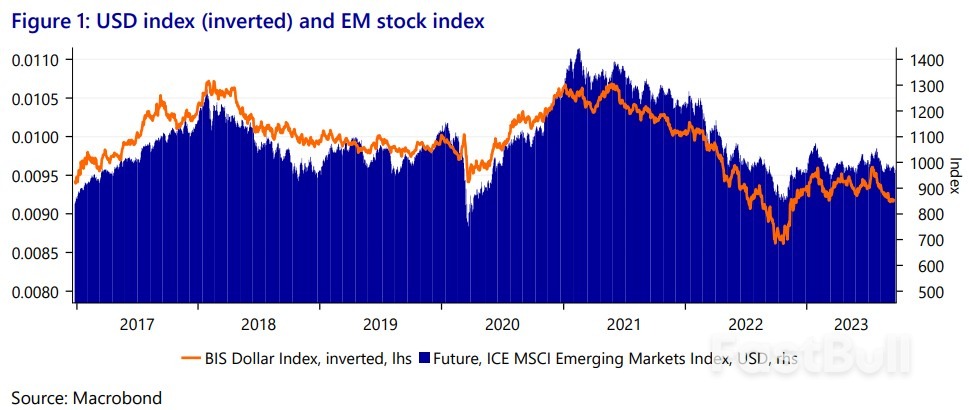
          As Rabobank's Jane Foley notes, the dollar's historical inverse correlation with emerging market stocks - a decent barometer of risk appetite - is "reasonably" strong.
          "This suggests that the dollar is set to find support on safe-haven demand even as the U.S. economy slows," Foley wrote on Thursday.
          Dollar's Smile Makes Wall Street Frown_5If these dynamics intensify and momentum builds up a head of steam, the dollar's strong exchange rate could also start to erode the dollar value of U.S. firms' overseas income, potentially having a material impact on corporate earnings.
          It might be too early for that to appear in third-quarter results - many big Wall Street firms will have hedged their currency exposure over the near term - but if sustained, fourth-quarter profits could be affected.
          There might be less cause for concern in corporate America, especially the growth-sensitive and tech sectors that led the rally in the first half of the year, if the dollar's surge was happening in a relatively stable fixed-income environment.
          But nominal and inflation-adjusted long-term bond yields have rocketed, threatening future cash flows and profits. Another reason for investors to be cautious.

          Source: Reuters

          Risk Warnings and Disclaimers
          You understand and acknowledge that there is a high degree of risk involved in trading. Following any strategies or investment methods may lead to potential losses. The content on the site is provided by our contributors and analysts for information purposes only. You are solely responsible for determining whether any trading assets, securities, strategy, or any other product is suitable for investing based on your own investment objectives and financial situation.
          Comments
          Add to Favorites
          Share

          A Dangerous Correlation for The Euro

          Damon

          Forex

          USD: Room for a rebound
          G10 FX volatility has rebounded in the last week of this month/quarter after a sell-off in long-dated treasuries and peripheral eurozone bonds. The sub-consensus 204k US jobless claims figure yesterday kept pointing at a jobs market that is inconsistent with a peak inflation narrative, especially when adding the recent rise in oil prices. Markets are – like ourselves – sceptical that the Federal Reserve will raise rates again given the US government shutdown’s prospected drag on growth, and this has been adding pressure on long-term treasuries. 10-year and 30-year treasuries are now yielding at 4.60% and 4.70%, the highest since 2007 and 2010 respectively.
          With the 10-year BTP-bund spread briefly touching 200bp yesterday (more in the EUR section below), everything seems to be pointing to a stronger dollar. However, the greenback moved in the opposite direction yesterday, entering a correction across the board. We suspect much of this counterintuitive move is due to quarter-end rebalancing, and because of the fact that the dollar had already rallied significantly ahead of yesterday’s events.
          Once the quarter-end adjustments are past us, the overall environment should favour another leg higher in the dollar. That is unless US data indicate otherwise, although the deterioration in the growth outlook in other alternative markets to the US has probably raised the bar for a negative US data surprise.
          Anyway, today is the busiest day of this week in the US calendar, with August’s personal income and PCE figures both set to be released. After a strong July, we expect to see weaker spending on goods coming through, especially in real terms. However, spending on tourism should be able to offset this, and we could see a slightly above-consensus read. Our economists also forecast a higher-than-consensus core PCE deflator (the Fed’s preferred measure of inflation): 0.3% compared to the expected 0.2% month-on-month reading.
          We could see a hawkish repricing in rate expectations coming to the dollar’s help today, and we are bullish on the greenback today. A return to the 106.50/107.00 area in DXY in the near term seems plausible in the current market conditions.
          EUR: TPI could partly mitigate the Italy spillover
          The 10-year BTP-Bund spread touched 200bp yesterday in the aftermath of a decision by the Italian government to raise the projected 2023 fiscal deficit from 4.5% to 5.3%, essentially putting it on a collision course with a likely retightening of EU fiscal rules after the Covid-era suspension. The five-year Italy CDS also jumped from 87bp to 110bp in the past week: this is still a very low level compared to the post-2022 election 180bp peak, the pandemic 270bp peak or the 2012 560bp peak. Still, it tells us that some concerns over long-term debt sustainability are resurging.
          Historically, the 200bp mark prompts the correlation between the euro and the BTP-Bund spread to pick up. Unlike previous instances, the ECB has the TPI in place and can use flexibility in its quantitative tightening programme to smoothen the impact on peripheral spreads. This means that the spillover into FX may be slower this time around.
          Incidentally, the BTP sell-off has coincided with the release of key CPI figures in the eurozone. Quarter-end rebalancing and a dollar correction seemed to overshadow the slower-than-expected German inflation figures yesterday. Spanish core inflation also declined despite an expected jump in the headline rate. Today, French figures are released before the eurozone-wide estimates: consensus is for a decline in the headline figure to 4.5% and in core to 4.8%. ECB President Christine Lagarde will speak at an event on the energy transition, and we’ll also hear from other Governing Council members (Vasle, Vuijcic, Kazaks, Visco).
          A rebound in the dollar, lingering concerns on Italian bonds (even if with a smaller intensity than in previous instances) and a decline in core inflation point to downside risks to EUR/USD today. We expect 1.0500 to be retested soon.
          Elsewhere in Europe, Norges Bank will release its October daily FX sales figures today. We estimate another increase, from NOK 1.1bn to 1.2bn, which may well disrupt the krone’s good performance recently.
          GBP: Chance of a further correction in EUR/GBP
          The Office for National Statistics confirmed the UK’s GDP growth was 0.2% in the second quarter, while the year-on-year number was revised higher from 0.4% to 0.6% compared to the flash estimate.
          GBP/USD has rallied in line with the dollar correction into this morning’s market open, but there are no real UK-specific drivers that would justify a sustained GBP outperformance at this stage. EUR/GBP has eased back from the 0.8700 level, in line with our expectations, after the turmoil in Italian bonds and given the big bulk of dovish Bank of England repricing had already happened. There is probably still additional room for a correction in EUR/GBP should Italian spreads keep widening.
          PLN: Key inflation print before next week's central bank meeting
          September inflation in Poland will be released today (it is always the first inflation number released in the CEE region) – a key piece of data ahead of next week's National Bank of Poland (NBP) meeting. Our economists expect a further decline from 10.1% to 8.3% YoY. Several factors are expected to contribute to disinflation in September apart from the high reference base from last year, when prices went up by 1.6% MoM. The outcome will certainly be a big focus for the market ahead of the upcoming NBP meeting. Moreover, the range of 8.0-8.9% indicates a large uncertainty in the estimates. For now, a 25bp rate cut seems the most likely scenario for us, but given the surprise at the last meeting with a 75bp cut, we can expect higher volatility in both FX and rates today.
          The Polish zloty has stabilised slightly above 4.600 EUR/PLN in recent days. The market is pricing in a bigger rate cut at the moment and remains on the dovish side. Thus, the scope for repricing is more hawkish in case of a surprise, which could support the zloty. At the moment, however, we see higher volatility rather than direction for the Polish zloty, which should remain near current levels until next week's meeting.

          Source: ING

          Risk Warnings and Disclaimers
          You understand and acknowledge that there is a high degree of risk involved in trading. Following any strategies or investment methods may lead to potential losses. The content on the site is provided by our contributors and analysts for information purposes only. You are solely responsible for determining whether any trading assets, securities, strategy, or any other product is suitable for investing based on your own investment objectives and financial situation.
          Comments
          Add to Favorites
          Share

          Sentiment Turns at Quarter End, Eyes Set on Eurozone CPI and US PCE

          Samantha Luan

          Economic

          Central Bank

          Forex

          The global markets experienced a noticeable shift in momentum as major US stock indexes concluded with substantial gains overnight, and treasury yields took a step back. This favorable swing persisted into Asian trading hours, marked by a remarkable rebound in Hong Kong stocks. Australian Dollar has been on the upswing, further bolstered by Copper's resurgence and a fresh wave of optimism concerning China's economic recovery. While Australian Dollar shows significant strength, New Zealand Dollar showcases a slight edge in its gains. Conversely, improved market sentiments have pushed Dollar and Yen to lower, with European majors demonstrating mixed performance.
          Investors are now shifting their focus towards today's Eurozone CPI data, which holds significance in determining if ECB has truly concluded its tightening journey. Likewise, US PCE inflation will be in the spotlight to deduce if Fed will deliver another interest rate hike in the fourth quarter, as previously indicated by the dot plot. Canadian Dollar also anticipates GDP data, which could provide further clarity on its economy. Yet, some market participants may choose a more cautious stance, preferring to see what next week brings with the onset of a new quarter.
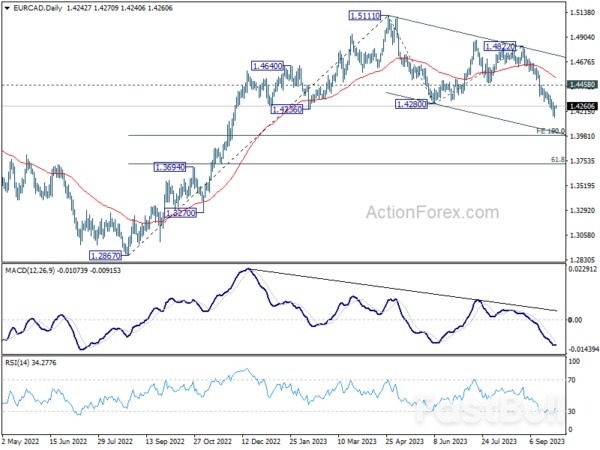
          Technically, EUR/CAD recovered after dipping to 1.4155 yesterday. But surprise from today's Eurozone CPI could trigger another way of selling. Current fall from 1.5111 is in progress and even as a corrective move, more downside should be seen to 100% projection of 1.5111 to 1.4280 from 1.4822 at 1.3991. This coincides with 50% retracement of 1.2867 to 1.5111 at 1.3989. In any case, outlook will stay bearish as long as 1.4458 resistance holds.
          Sentiment Turns at Quarter End, Eyes Set on Eurozone CPI and US PCE_1In Asia, at the time of writing, Nikkei is down -0.34%. Hong Kong HSI is up 2.62%. Singapore Strait Times is up 0.42%. Overnight, DOW rose 0.35%. S&P 500 rose 0.59%. NASDAQ rose 0.83%. 10-year yield dropped -0.029 to 4.597.
          Fed's Barkin: Path forward depends on inflationary pressures
          Richmond Fed President Thomas Barkin highlighted the existing uncertainties surrounding the economic outlook in remarks made overnight. He stated, "The range of potential outcomes, to me, is still pretty broad," emphasizing the unpredictability of the current economic situation.
          Reflecting on the recent decision of Fed to maintain status quo on interest rates, he said, "That's why I supported our decision to hold rates steady at the last meeting."
          "We have time to see if we've done enough, or whether there's more work to be done," he added.
          "The path forward to me depends on whether we can convince ourselves inflationary pressures are behind us, or whether we see them persisting," he said. Barkin further highlighted the significance of labor market developments in informing his perspective.
          Japan's industrial output flat in Aug, Tokyo inflation eases in Sep
          Japan's industrial output for August surprised by remaining steady month-on-month, outpacing expectations of a -0.8% mom decline. The seasonally adjusted index of production at factories and mines held its ground at 103.8, based on 2020 base of 100. Equally, index of industrial shipments ticked up by 0.1% to 103.2. In contrast, inventory index marked a -1.7% decrease to 104.6, registering the first decline in a quadrimestrial span.
          The Ministry of Economy, Trade and Industry maintained a cautious tone on the economy's direction, indicating that industrial output "fluctuated indecisively." However, optimism is still present; the ministry's poll suggests that manufacturers anticipate a 5.8% uptick in production for September, followed by a 3.8% rise in October.
          On the retail front, August saw a 7.0% yoy surge in retail sales, surpassing anticipated 6.4% yoy. This momentum builds upon the month's modest growth of 0.1% mom.
          The labor market remained resilient, with the unemployment rate steadfast at 2.7%. The job offers-to-applicants ratio for August persisted at 1.29, unchanged from July.
          Inflationary pressures seem to be cooling down. Tokyo's core CPI for September, excluding food, dipped more than forecasted, from 2.8% yoy to 2.5% yoy , as opposed to the predicted 2.6% yoy. Headline CPI decreased slightly from 2.9% yoy to 2.8% yoy. Additionally, core-core CPI, which excludes both food and energy, retreated from 4.0% yoy to 3.8% yoy.
          AUD/JPY and Copper soar on renewed China optimism
          Australian Dollar experienced a significant surge in today's Asian trading session, fueled in part by the vigorous rebound observed in Hong Kong stocks, the Chinese Yuan, and Copper prices. The rebound in stocks could attributed possible position adjustments after a tumultuous quarter in Hong Kong and China, and with the impending long holiday in China lasting until October 9. But there's still a budding sentiment of optimism concerning China's potential for economic recuperation.
          A noteworthy comment from the International Monetary Fund has contributed to this optimism. The IMF recently expressed its observation yesterday of certain stabilization signs in China's economy from the latest data sets. The institution holds a perspective that China could realistically achieve growth rate close to 5% this year. Looking forward, the IMF anticipates China's GDP growth to decelerate to approximately 3.5% over a medium-term horizon. Nevertheless, this pace could experience a boost if China embarks on economic reforms.
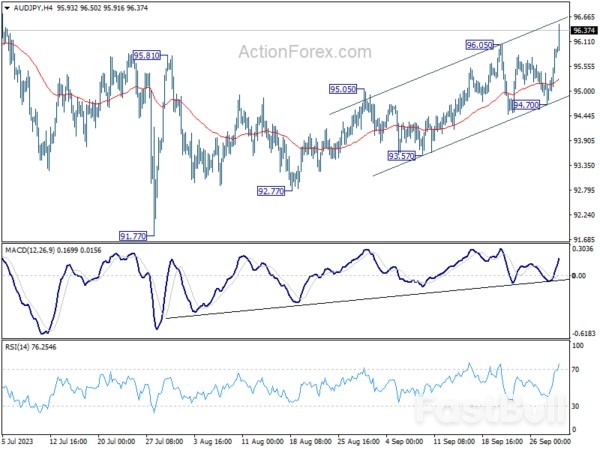
          AUD/JPY has powerfully broken 96.05 resistance mark, which is indicative of resumption of its recent rise from the 92.77. However, the nature of the current rally doesn't explicitly suggest it's impulsive, maintaining an air of ambiguity around potential technical interpretations.
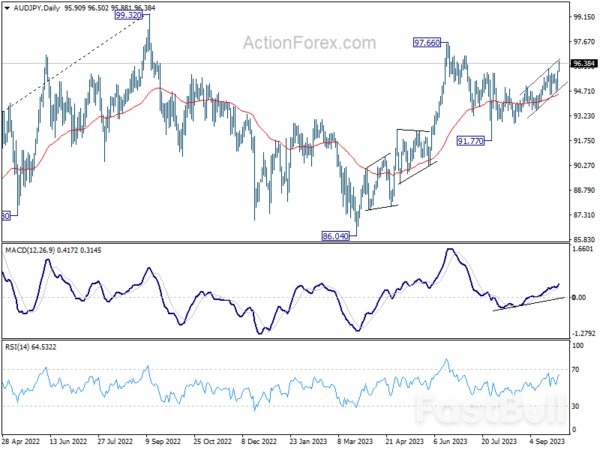
          Sentiment Turns at Quarter End, Eyes Set on Eurozone CPI and US PCE_2In one scenario, if price action from 91.77 serves as the second leg of the pattern originating from 97.66, then the peak of the current rally might be restricted by 97.66 resistance.
          In another case, if the upswing from 91.77 is in continuation with the entire surge from 86.04, the climb could still be seen as the second leg of the pattern from the 2022 high of 99.32. As such, the upper boundary could be set by the 99.32 mark, even if 97.66 is surpassed.
          So, upside potential appears to be limited for the medium term.Sentiment Turns at Quarter End, Eyes Set on Eurozone CPI and US PCE_3
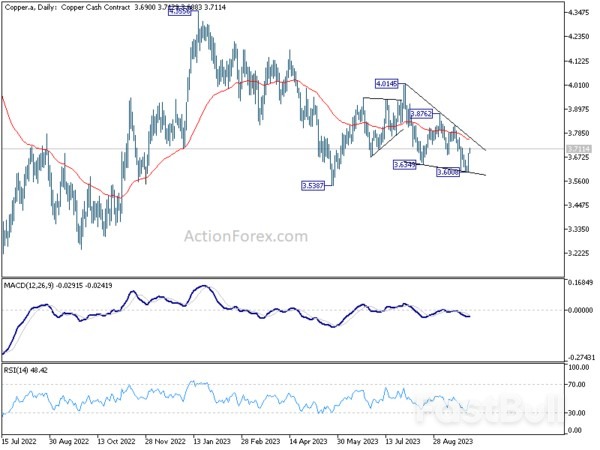
          Turning to Copper, its robust rebound this week suggests that decline from 4.0145 might have culminated, completing three waves that bottomed at 3.6008. Sustained trading above 55 D EMA (now at 3.7540) would solidify this viewpoint, setting sights on 3.8762 resistance for validation.
          For Australian Dollar to secure its foundational momentum, decisive break of 3.8762 resistance in Copper might be essential. Absent this, Aussie's rebound might retain its corrective nature.Sentiment Turns at Quarter End, Eyes Set on Eurozone CPI and US PCE_4

          Looking ahead

          Eurozone CPI is the main highlight in European session today. Other data include Germany import prices, retail sales and unemployment; France consumer spending; UK Q2 GDP final, mortgage approvals and M4 money supply; and Swiss KOF economic barometer.
          Later in the day, Canada GDP will be a focus. US will also release personal income and spending, PCE inflation, goods trade balance and Chicago PMI.

          EUR/AUD Daily Outlook

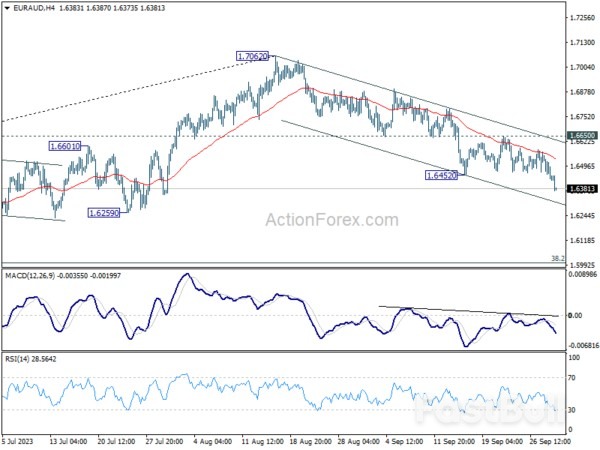
          EUR/AUD's fall from 1.7062 resumed by breaking through 1.6452 support. Intraday bias is back on the downside for 1.6000 fibonacci level, as a larger scale correction. On the upside, break of 1.6650 resistance is needed to indicate short term bottoming. Outlook, outlook will stay mildly bearish in case of recovery.Sentiment Turns at Quarter End, Eyes Set on Eurozone CPI and US PCE_5
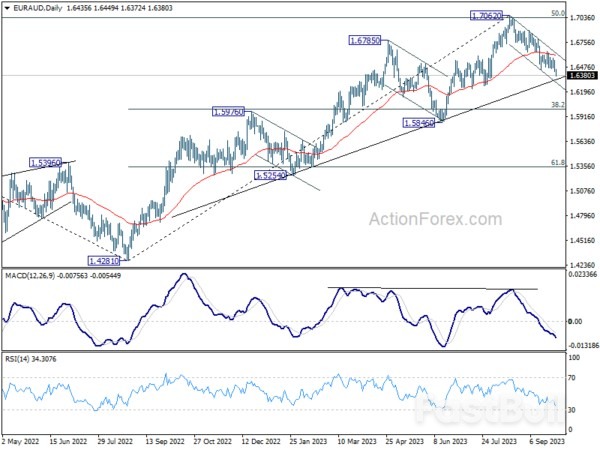
          In the bigger picture, fall from 1.7062 is probably correcting whole up trend from 1.4281 (2022 low). Deeper decline would be seen to 38.2% retracement of 1.4281 to 1.7062 at 1.6000. Strong support should be seen there to bring rebound, at least on first attempt. This will remain the favored case as long as 1.6650 resistance holds.Sentiment Turns at Quarter End, Eyes Set on Eurozone CPI and US PCE_6

          Source: ActionForex

          To stay updated on all economic events of today, please check out our Economic calendar
          Risk Warnings and Disclaimers
          You understand and acknowledge that there is a high degree of risk involved in trading. Following any strategies or investment methods may lead to potential losses. The content on the site is provided by our contributors and analysts for information purposes only. You are solely responsible for determining whether any trading assets, securities, strategy, or any other product is suitable for investing based on your own investment objectives and financial situation.
          Comments
          Add to Favorites
          Share
          FastBull
          Copyright © 2025 FastBull Ltd

          728 RM B 7/F GEE LOK IND BLDG NO 34 HUNG TO RD KWUN TONG KLN HONG KONG

          TelegramInstagramTwitterfacebooklinkedin
          App Store Google Play Google Play
          Products
          Charts

          Chats

          Q&A with Experts
          Screeners
          Economic Calendar
          Data
          Tools
          Membership
          Features
          Function
          Markets
          Copy Trading
          Latest Signals
          Contests
          News
          Analysis
          24/7
          Columns
          Education
          Company
          Careers
          About Us
          Contact Us
          Advertising
          Help Center
          Feedback
          User Agreement
          Privacy Policy
          Business

          White Label

          Data API

          Web Plug-ins

          Poster Maker

          Affiliate Program

          Risk Disclosure

          The risk of loss in trading financial instruments such as stocks, FX, commodities, futures, bonds, ETFs and crypto can be substantial. You may sustain a total loss of the funds that you deposit with your broker. Therefore, you should carefully consider whether such trading is suitable for you in light of your circumstances and financial resources.

          No decision to invest should be made without thoroughly conducting due diligence by yourself or consulting with your financial advisors. Our web content might not suit you since we don't know your financial conditions and investment needs. Our financial information might have latency or contain inaccuracy, so you should be fully responsible for any of your trading and investment decisions. The company will not be responsible for your capital loss.

          Without getting permission from the website, you are not allowed to copy the website's graphics, texts, or trademarks. Intellectual property rights in the content or data incorporated into this website belong to its providers and exchange merchants.

          Not Logged In

          Log in to access more features

          FastBull Membership

          Not yet

          Purchase

          Become a signal provider
          Help Center
          Customer Service
          Dark Mode
          Price Up/Down Colors

          Log In

          Sign Up

          Position
          Layout
          Fullscreen
          Default to Chart
          The chart page opens by default when you visit fastbull.com