• Trade
  • Markets
  • Copy
  • Contests
  • News
  • 24/7
  • Calendar
  • Q&A
  • Chats
Screeners
SYMBOL
LAST
ASK
BID
HIGH
LOW
NET CHG.
%CHG.
SPREAD
SPX
S&P 500 Index
6882.71
6882.71
6882.71
6936.08
6838.79
-35.10
-0.51%
--
DJI
Dow Jones Industrial Average
49501.29
49501.29
49501.29
49649.86
49112.43
+260.29
+ 0.53%
--
IXIC
NASDAQ Composite Index
22904.57
22904.57
22904.57
23270.07
22684.51
-350.61
-1.51%
--
USDX
US Dollar Index
97.590
97.670
97.590
97.750
97.470
+0.110
+ 0.11%
--
EURUSD
Euro / US Dollar
1.18002
1.18010
1.18002
1.18086
1.17800
-0.00043
-0.04%
--
GBPUSD
Pound Sterling / US Dollar
1.35788
1.35800
1.35788
1.36537
1.35398
-0.00731
-0.54%
--
XAUUSD
Gold / US Dollar
4860.68
4861.09
4860.68
5023.58
4788.42
-104.88
-2.11%
--
WTI
Light Sweet Crude Oil
63.540
63.570
63.540
64.398
63.245
-0.702
-1.09%
--

Community Accounts

Signal Accounts
--
Profit Accounts
--
Loss Accounts
--
View More

Become a signal provider

Sell trading signals to earn additional income

View More

Guide to Copy Trading

Get started with ease and confidence

View More

Signal Accounts for Members

All Signal Accounts

Best Return
  • Best Return
  • Best P/L
  • Best MDD
Past 1W
  • Past 1W
  • Past 1M
  • Past 1Y

All Contests

  • All
  • Trump Updates
  • Recommend
  • Stocks
  • Cryptocurrencies
  • Central Banks
  • Featured News
Top News Only
Share

BOE Governor Bailey: On Peter Mandelson Affair, Says I Am Shocked By What We Are Hearing

Share

Indonesia Central Bank Says Moody's Outlook Cut Doesn't Mean Economic Fundamentals Weakening

Share

BOE Governor Bailey: Falling Inflation Should Feed Into Expectations, That Should Give Me Confidence

Share

Indonesia Central Bank: To Work With Government To Strengthen Communication With Markets, Maintain Market Confidence

Share

Indonesia Central Bank: Financial Market Stability Is Also Expected To Remain Stable, Supported By Adequate Liquidity, Strong Banking Capital, Low Credit Risk

Share

US News Website Axios Reports That The United States And Russia Are Close To Reaching An Agreement To Continue To Abide By The New START Treaty After It Expires On Thursday

Share

Indonesia Central Bank: Rupiah Exchange Rate Is Expected To Remain Stable, Supported By Economic Prospects, Central Bank Stabilisation Commitment

Share

BOE Governor Bailey: We Have To Be Very Focused On Underlying Story On Inflation

Share

BOE Governor Bailey: We Need To See More Evidence That We Are Going To Get Sustainable Return To Inflation Target

Share

Indonesia Central Bank: Expects Indonesian Economic Prospects To Remain Solid With Improving Trend, Inflation Under Control

Share

The US News Website Axios Reports That The US And Russia Are Negotiating An Extension Of The New START Treaty

Share

Thomson Reuters: Continue To Assess Acquisition Candidates

Share

Bank Of England Governor Bailey: If The Outlook Develops As We Expect, There Is Still Room For Further Easing In The Near Future

Share

BOE Governor Bailey: For Every Rate Cut, How Much Further To Go Becomes Closer Call

Share

Bank Of England Governor Bailey: More Spare Capacity Could Lead To Inflation Falling Below Target

Share

Bank Of England Governor Bailey: Risk Consumption Will Be Slower Than We Expected

Share

BOE Governor Bailey: On Other Hand, Waiting Too Long Could Cause Sharper Downturn In Activity

Share

BOE Governor Bailey: On One Hand, Cutting Bank Rate Too Quickly Or Too Much Could Lead To Inflation Pressure Persisting

Share

Bank Of England Governor Bailey: Institutions Expect Growth To Remain Sluggish Throughout The Year

Share

Bank Of England Governor Bailey: Official Data Shows A Slight Increase In The Layoff Rate

TIME
ACT
FCST
PREV
U.S. ISM Non-Manufacturing Inventories Index (Jan)

A:--

F: --

P: --

U.S. EIA Weekly Crude Oil Imports Changes

A:--

F: --

P: --

U.S. EIA Weekly Heating Oil Stock Changes

A:--

F: --

P: --

U.S. EIA Weekly Crude Demand Projected by Production

A:--

F: --

P: --

U.S. EIA Weekly Gasoline Stocks Change

A:--

F: --

P: --

U.S. EIA Weekly Crude Stocks Change

A:--

F: --

P: --

U.S. EIA Weekly Cushing, Oklahoma Crude Oil Stocks Change

A:--

F: --

P: --

Australia Trade Balance (SA) (Dec)

A:--

F: --

P: --
Australia Exports MoM (SA) (Dec)

A:--

F: --

P: --
Japan 30-Year JGB Auction Yield

A:--

F: --

P: --

Indonesia Annual GDP Growth

A:--

F: --

P: --

Indonesia GDP YoY (Q4)

A:--

F: --

P: --

France Industrial Output MoM (SA) (Dec)

A:--

F: --

P: --
Italy IHS Markit Construction PMI (Jan)

A:--

F: --

P: --

Euro Zone IHS Markit Construction PMI (Jan)

A:--

F: --

P: --

Germany Construction PMI (SA) (Jan)

A:--

F: --

P: --

Italy Retail Sales MoM (SA) (Dec)

A:--

F: --

P: --

U.K. Markit/CIPS Construction PMI (Jan)

A:--

F: --

P: --

France 10-Year OAT Auction Avg. Yield

A:--

F: --

P: --

Euro Zone Retail Sales YoY (Dec)

A:--

F: --

P: --
Euro Zone Retail Sales MoM (Dec)

A:--

F: --

P: --
U.K. BOE MPC Vote Cut (Feb)

A:--

F: --

P: --

U.K. BOE MPC Vote Hike (Feb)

A:--

F: --

P: --

U.K. BOE MPC Vote Unchanged (Feb)

A:--

F: --

P: --

U.K. Benchmark Interest Rate

A:--

F: --

P: --

MPC Rate Statement
U.S. Challenger Job Cuts (Jan)

A:--

F: --

P: --

U.S. Challenger Job Cuts MoM (Jan)

A:--

F: --

P: --

U.S. Challenger Job Cuts YoY (Jan)

A:--

F: --

P: --

Bank of England Governor Bailey held a press conference on monetary policy.
Euro Zone ECB Marginal Lending Rate

--

F: --

P: --

Euro Zone ECB Deposit Rate

--

F: --

P: --

Euro Zone ECB Main Refinancing Rate

--

F: --

P: --

ECB Monetary Policy Statement
U.S. Weekly Initial Jobless Claims (SA)

--

F: --

P: --

U.S. Initial Jobless Claims 4-Week Avg. (SA)

--

F: --

P: --

U.S. Weekly Continued Jobless Claims (SA)

--

F: --

P: --

ECB Press Conference
U.S. JOLTS Job Openings (SA) (Dec)

--

F: --

P: --

U.S. EIA Weekly Natural Gas Stocks Change

--

F: --

P: --

BOC Gov Macklem Speaks
Mexico Policy Interest Rate

--

F: --

P: --

U.S. Weekly Treasuries Held by Foreign Central Banks

--

F: --

P: --

Reserve Bank of Australia Governor Bullock testified before Parliament.
India Benchmark Interest Rate

--

F: --

P: --

India Cash Reserve Ratio

--

F: --

P: --

India Repo Rate

--

F: --

P: --

India Reverse Repo Rate

--

F: --

P: --

Japan Leading Indicators Prelim (Dec)

--

F: --

P: --

Germany Industrial Output MoM (SA) (Dec)

--

F: --

P: --

Germany Exports MoM (SA) (Dec)

--

F: --

P: --

U.K. Halifax House Price Index YoY (SA) (Jan)

--

F: --

P: --

U.K. Halifax House Price Index MoM (SA) (Jan)

--

F: --

P: --

France Trade Balance (SA) (Dec)

--

F: --

P: --

Canada Leading Index MoM (Jan)

--

F: --

P: --

India Deposit Gowth YoY

--

F: --

P: --

Canada Employment (SA) (Jan)

--

F: --

P: --
Canada Full-time Employment (SA) (Jan)

--

F: --

P: --
Canada Part-Time Employment (SA) (Jan)

--

F: --

P: --
Canada Unemployment Rate (SA) (Jan)

--

F: --

P: --

Canada Labor Force Participation Rate (SA) (Jan)

--

F: --

P: --

Q&A with Experts
    • All
    • Chatrooms
    • Groups
    • Friends
    EuroTrader flag
    3548582
    im kinda new on the stock market
    @3548582you are welcome on board, what they mostly do here is talk about the markets and share trading kowledge with each other
    EuroTrader flag
    3548582
    guys what do i do here
    @3548582Do you trade the currency markets or you work on just the stock markets alone my friend
    3548582 flag
    idk i rlly jst started
    3548582 flag
    im checking eurusd
    3548582 flag
    and idrk abt that much
    EuroTrader flag
    3548582
    im checking eurusd
    @3548582okay, thats a good pair to start with, its not very volatile and pretty stable to trade as a beginner
    EuroTrader flag
    3548582
    im checking eurusd
    @3548582Have you learnt technical and fundamantal analysis or price action you make use of in analysing the markets
    3548490 flag
    Sanjeev Ku
    So you haven't seen the whole news report from the past few days, which is about margin trading on exchanges, including the US, China, and India.
    4RZD3WD38X flag
    @Sanjeev Kuwhat level I'd safe to sell on gold it's not moving towards 4935
    4RZD3WD38X flag
    @EuroTraderwhat level are you shorting on gold buddy?
    favour flag
    EuroTrader
    @EuroTraderyeah man and it's likely to repeat itself but on a different pair this time
    EuroTrader flag
    4RZD3WD38X
    @EuroTraderwhat level are you shorting on gold buddy?
    @4RZD3WD38Xi dont have a running sell trade on gold at the moment. still waiting for some further confirmation s
    3426137 flag
    Be patient, friend.
    EuroTrader flag
    favour
    @favourwhat pair is that, can you actually share with me, lets look at it together brotherly
    favour flag
    favour
    @EuroTraderhow's the trade on gold going man
    Sanjeev Ku flag
    Sanjeev Ku
    69629 done now 69335.if 68690 breaks 65676
    favour flag
    EuroTrader
    @EuroTradergold
    favour flag
    favour flag
    EuroTrader flag
    favour
    @favourclosed already on that retracement and i would have to wait for the start of the new york session
    Type here...
    Add Symbol or Code

      No matching data

      All
      Trump Updates
      Recommend
      Stocks
      Cryptocurrencies
      Central Banks
      Featured News
      • All
      • Russia-Ukraine Conflict
      • Middle East Flashpoint
      • All
      • Russia-Ukraine Conflict
      • Middle East Flashpoint
      Search
      Products

      Charts Free Forever

      Chats Q&A with Experts
      Screeners Economic Calendar Data Tools
      Membership Features
      Data Warehouse Market Trends Institutional Data Policy Rates Macro

      Market Trends

      Market Sentiment Order Book Forex Correlations

      Top Indicators

      Charts Free Forever
      Markets

      News

      News Analysis 24/7 Columns Education
      From Institutions From Analysts
      Topics Columnists

      Latest Views

      Latest Views

      Trending Topics

      Top Columnists

      Latest Update

      Signals

      Copy Rankings Latest Signals Become a signal provider AI Rating
      Contests
      Brokers

      Overview Brokers Assessment Rankings Regulators News Claims
      Broker listing Forex Brokers Comparison Tool Live Spread Comparison Scam
      Q&A Complaint Scam Alert Videos Tips to Detect Scam
      More

      Business
      Events
      Careers About Us Advertising Help Center

      White Label

      Broker API

      Data API

      Web Plug-ins

      Affiliate Program

      Awards Institution Evaluation IB Seminar Salon Event Exhibition
      Vietnam Thailand Singapore Dubai
      Fans Party Investment Sharing Session
      FastBull Summit BrokersView Expo
      Recent Searches
        Top Searches
          Markets
          News
          Analysis
          User
          24/7
          Economic Calendar
          Education
          Data
          • Names
          • Latest
          • Prev

          View All

          No data

          Scan to Download

          Faster Charts, Chat Faster!

          Download App
          English
          • English
          • Español
          • العربية
          • Bahasa Indonesia
          • Bahasa Melayu
          • Tiếng Việt
          • ภาษาไทย
          • Français
          • Italiano
          • Türkçe
          • Русский язык
          • 简中
          • 繁中
          Open Account
          Search
          Products
          Charts Free Forever
          Markets
          News
          Signals

          Copy Rankings Latest Signals Become a signal provider AI Rating
          Contests
          Brokers

          Overview Brokers Assessment Rankings Regulators News Claims
          Broker listing Forex Brokers Comparison Tool Live Spread Comparison Scam
          Q&A Complaint Scam Alert Videos Tips to Detect Scam
          More

          Business
          Events
          Careers About Us Advertising Help Center

          White Label

          Broker API

          Data API

          Web Plug-ins

          Affiliate Program

          Awards Institution Evaluation IB Seminar Salon Event Exhibition
          Vietnam Thailand Singapore Dubai
          Fans Party Investment Sharing Session
          FastBull Summit BrokersView Expo

          Bitcoin Slumps as Treasury Signals No Backstop, Deepening the Crypto Confidence Shock

          Gerik

          Economic

          Cryptocurrency

          Summary:

          Bitcoin fell below $71,000 after the U.S. Treasury made clear it cannot direct banks to rescue crypto markets, reinforcing risk-off sentiment and extending a broader deleveraging cycle across digital assets....

          Policy Clarity Removes A Key Assumption

          Bitcoin sold off sharply after U.S. Treasury Secretary Scott Bessent told lawmakers that the federal government lacks the authority to buy Bitcoin or compel banks to support the crypto market. Speaking before the House Financial Services Committee, Bessent stated that neither the Treasury nor the Financial Stability Oversight Council has the mandate to backstop digital assets. That clarification removed a lingering assumption among some investors that authorities might step in during periods of acute stress, triggering a renewed wave of selling.
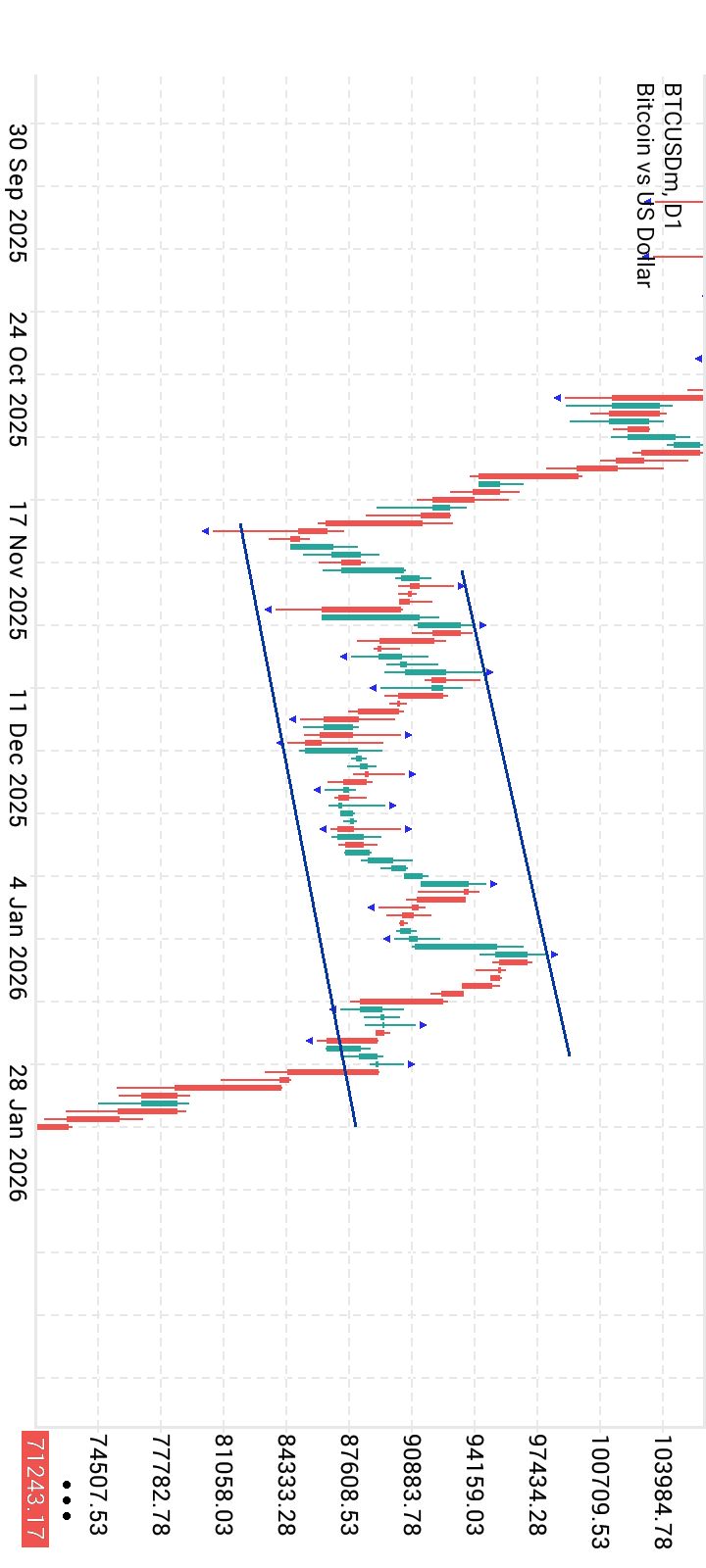
          The immediate market reaction pushed Bitcoin below $71,000, extending losses from earlier in the session. While prices later stabilized after approaching the psychologically important $70,000 level, the damage to sentiment was already evident.

          From Speculation To Systemic Anxiety

          The policy signal landed amid already fragile conditions. Bitcoin is down about 18% year to date and has recorded its fourth consecutive monthly decline after a sharp drop last weekend. The latest leg lower reflects more than a technical move. It underscores a shift in perception about crypto’s role during market stress. Without the prospect of official support, Bitcoin increasingly trades like a high-risk speculative asset rather than a hedge.
          Notable investor Michael Burry amplified those fears, warning that a sustained decline could trigger a “death spiral” of forced selling and value destruction. He argued that Bitcoin has failed to behave like a debasement hedge comparable to gold, instead revealing itself as an asset driven primarily by speculation.

          Broader Markets Add Downside Pressure

          The crypto slump has unfolded alongside broad-based selling across global markets. Risk assets weakened as investors reassessed rate sensitivity and liquidity conditions, with technology shares and other growth assets under pressure. The crypto market, already sliding for months due to whale selling and forced liquidations, proved especially vulnerable once cross-asset stress intensified.
          Additional uncertainty has come from monetary policy expectations. President Donald Trump’s decision to nominate Kevin Warsh as the next Federal Reserve chair has been interpreted by markets as a potentially more hawkish shift, reinforcing concerns about tighter financial conditions for speculative assets.

          Flows And Positioning Show Capitulation, Not Accumulation

          Market data suggests investors remain focused on reducing exposure rather than positioning for a rebound. Analysts at 10X Research noted that after Bitcoin broke below the $73,000 support level, sentiment shifted meaningfully and flows indicate that buyers are not yet stepping in. Deleveraging and position unwinding continue to dominate, a pattern consistent with late-stage corrections rather than early recovery phases.
          Ether and other major tokens have followed Bitcoin lower, reflecting a strong correlation across the digital asset complex rather than isolated weakness. The broader crypto market remains under pressure as confidence erodes and liquidity thins.

          Technical Levels Offer Little Comfort For Now

          Some strategists argue that the mid-$70,000 region could still act as a reference zone, given its role as a prior high in March 2024 and a low during the tariff-driven sell-off in April 2025. However, even proponents of selective dip-buying caution that downside risks persist. With positioning risk still elevated in traditional markets, spillovers into crypto remain likely.
          Bitcoin’s latest slide illustrates a deeper issue than price volatility. The Treasury’s message has clarified that digital assets stand outside the traditional financial safety net, leaving the market to absorb shocks on its own. Until confidence stabilizes and a credible catalyst emerges, Bitcoin’s trajectory appears tied to broader risk sentiment and the ongoing unwinding of speculative excess rather than any imminent policy relief.

          Source: Yahoo Finance

          To stay updated on all economic events of today, please check out our Economic calendar
          Risk Warnings and Disclaimers
          You understand and acknowledge that there is a high degree of risk involved in trading. Following any strategies or investment methods may lead to potential losses. The content on the site is provided by our contributors and analysts for information purposes only. You are solely responsible for determining whether any trading assets, securities, strategy, or any other product is suitable for investing based on your own investment objectives and financial situation.
          Add to Favorites
          Share

          How Fast Is The Asian Population Ageing?

          Samantha Luan

          Political

          Economic

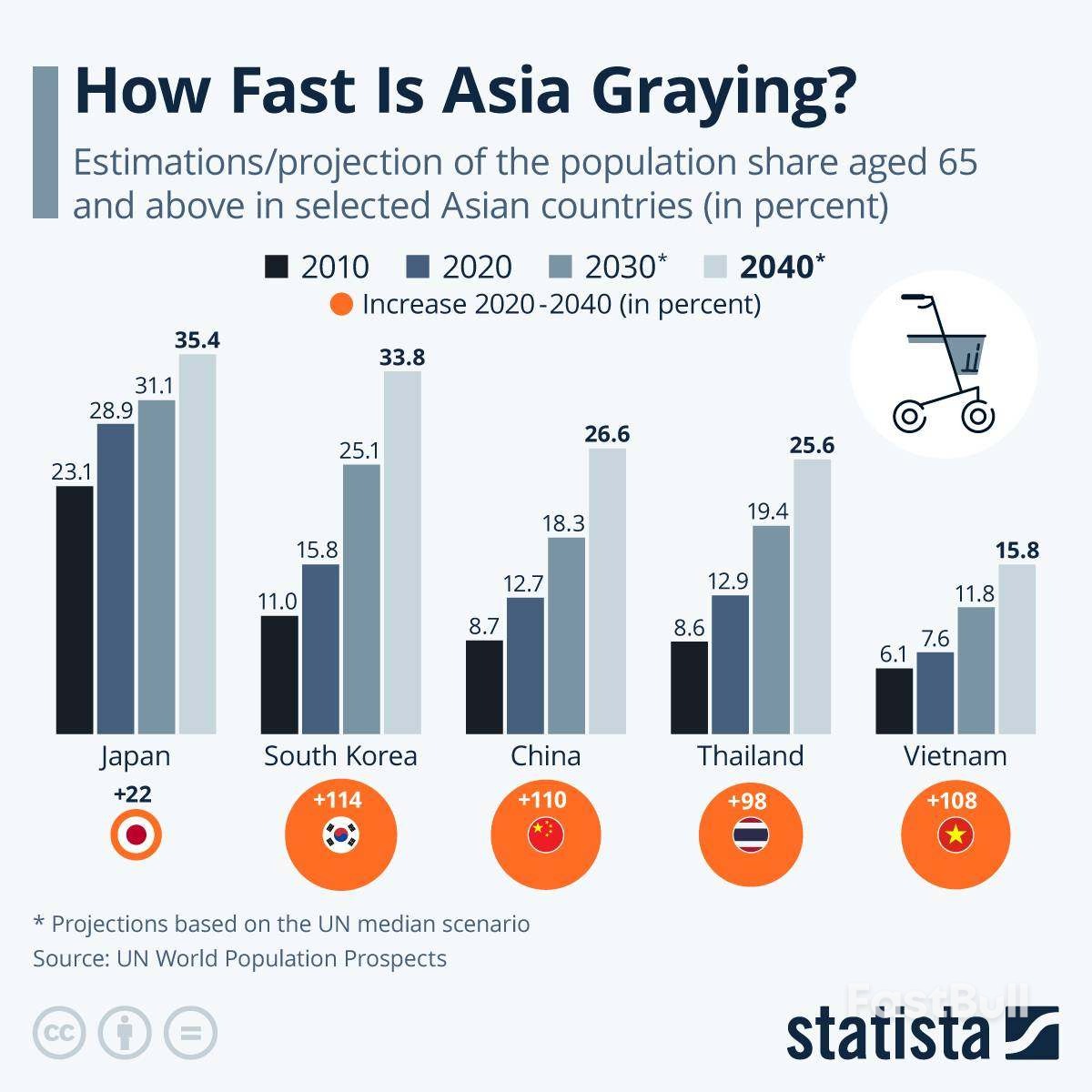
          The latest revision of UN World Population Prospects reveals that demographic shift is no longer a distant projection but an accelerating reality across parts of Asia, with the share of people aged 65 and over rising fast in several countries.

          As Statista's Tristan Gaudiaut reports, this trend poses a significant challenge in the region for labor markets, public finances and care systems within a single generation.

          The figures (UN medium-scenario projections) show Japan already far ahead, as older adults made up already around 29 percent of the population in 2020, and are projected to surpass 30 percent in the coming years: 31.1 percent by 2030 and 35.4 percent by 2040. But, as our infographic shows, the more striking story is the pace of change elsewhere.

          You will find more infographics at Statista

          South Korea and China are among the standout accelerators.

          Both countries are expected to see their 65+ population shares more than double between 2020 and 2040. In South Korea, this figure is projected to surge from 15.8 percent (2020) to 33.8 percent (2040), while in China, it is expected to rise from 12.7 percent to 26.6 percent.

          Those trajectories mirror intensifying national concerns about future labor supply and pension burdens, amid persistent low fertility and a shrinking workforce.

          Meanwhile, rapid ageing is not confined to the region's richest economies. Thailand and Vietnam start from lower baselines, yet both trend sharply upward by 2040.

          Both South-East Asian countries are projected to see their 65+ population shares double in twenty-years: Thailand to 25.6 percent and Vietnam to 15.8 percent.

          Source: Zero Hedge

          To stay updated on all economic events of today, please check out our Economic calendar
          Risk Warnings and Disclaimers
          You understand and acknowledge that there is a high degree of risk involved in trading. Following any strategies or investment methods may lead to potential losses. The content on the site is provided by our contributors and analysts for information purposes only. You are solely responsible for determining whether any trading assets, securities, strategy, or any other product is suitable for investing based on your own investment objectives and financial situation.
          Add to Favorites
          Share

          Canada Scraps 2035 Gas Car Ban for EV Incentives

          George Anderson

          Daily News

          Remarks of Officials

          Economic

          Political

          Canada’s government is set to scrap its planned 2035 ban on new internal combustion engine cars, shifting its strategy toward promoting electric vehicles through new incentives and stricter fuel standards.

          According to reports citing government and auto industry sources, the Mark Carney administration will officially announce a new automotive strategy that pivots away from a hard deadline for phasing out gasoline-powered vehicles.

          A New Strategy: Subsidies and Tighter Standards

          The new plan replaces the 2035 ban with a combination of consumer incentives and industry regulations. Key components of the new policy are expected to include:

          • Tax Relief for EV Buyers: A subsidy of C$5,000 (approximately $3,660) per electric vehicle to encourage adoption.

          • Infrastructure Investment: A C$1.5 billion fund dedicated to building out Canada's EV charging infrastructure.

          • Stricter Fuel Efficiency Rules: New, potentially tighter fuel efficiency standards will be implemented for all new vehicles.

          This approach signals that the government remains committed to transport electrification but is changing the method to achieve its goal.

          Responding to Auto Industry Pressure

          The policy shift is seen as a major concession to Canada's automotive industry, which strongly opposed the previous EV mandates. The original targets required EVs to account for 20% of sales in the near term, rising to 60% by 2030 and a full 100% by 2035.

          Automakers argued these goals were unrealistic and impossible to achieve within the proposed timeline. They also raised concerns that a forced transition to EVs would be expensive for consumers and limit their vehicle choices.

          Protecting Canadian Auto Jobs from US Tariffs

          Another critical driver behind the new strategy is a move to protect the domestic auto sector from U.S. trade policy. The government plans to prioritize support for companies that manufacture cars in Canada, aiming to safeguard thousands of jobs.

          This measure is a direct response to tariffs imposed by U.S. President Trump last year on foreign-made automobiles, creating pressure on Canada's export-oriented auto industry.

          A Mandate in Disguise?

          While the direct ban is being removed, it remains uncertain if the auto industry will fully embrace the new terms. The use of stringent fuel efficiency standards has been employed elsewhere as an indirect way to mandate EV sales.

          California offers a prominent example. The state has implemented such demanding emissions rules for light vehicles that it is difficult for most carmakers to comply without selling a significant number of zero-emission vehicles. This raises the question of whether Canada's new policy will achieve a similar outcome, effectively pushing the market toward EVs without an explicit ban.

          To stay updated on all economic events of today, please check out our Economic calendar
          Risk Warnings and Disclaimers
          You understand and acknowledge that there is a high degree of risk involved in trading. Following any strategies or investment methods may lead to potential losses. The content on the site is provided by our contributors and analysts for information purposes only. You are solely responsible for determining whether any trading assets, securities, strategy, or any other product is suitable for investing based on your own investment objectives and financial situation.
          Add to Favorites
          Share

          U.S.–India Trade Deal Faces Reality Check as Tariff Cuts Clash With Political and Energy Constraints

          Gerik

          Economic

          A Breakthrough Announcement With Unsettled Details

          Less than a week after India finalized a trade pact with the European Union, U.S. President Donald Trump announced a separate agreement with Indian Prime Minister Narendra Modi, framing it as a landmark reset in bilateral trade relations. Washington said it would slash tariffs on Indian goods to 18% from 50%, while India would cut tariffs on U.S. goods to zero, open its agricultural market, replace Russian crude with U.S. and Venezuelan supply, and purchase $500 billion worth of American goods.
          New Delhi welcomed the reduction in U.S. tariffs, with Modi publicly expressing appreciation for Trump’s gesture. However, beyond this shared optimism, substantial gaps have already emerged between what Washington claims has been agreed and what Indian officials are prepared to confirm. Economists at Oxford Economics have warned that several U.S. claims remain unverified by Indian authorities and appear unrealistic, raising the risk of U.S. backtracking if expectations are not met.

          Tariffs And The Risk Of Reversal

          The uncertainty is heightened by precedent. Just last month, the Trump administration raised tariffs on South Korean imports after accusing Seoul of delaying legislative approval of an earlier trade agreement. Analysts at Nomura described the India deal as a meaningful breakthrough, but cautioned that no agreement is secure under an administration willing to reverse course if implementation lags.
          This dynamic creates a fragile foundation. The deal’s political announcement has moved faster than the underlying technical negotiations, increasing the likelihood that future clarifications could expose disagreements rather than cement consensus.

          Agriculture Becomes The First Fault Line

          The most visible point of friction has emerged in agriculture. India’s Commerce and Industry Minister Piyush Goyal stated that the agreement would fully protect sensitive sectors such as agriculture and dairy, signaling clear limits to market liberalization. U.S. officials, by contrast, insist that India will remove both tariff and non-tariff barriers on a broad range of agricultural products, with U.S. Trade Representative Jamieson Greer describing zero tariffs on items such as nuts, fruits, vegetables, wine, and spirits as a major win.
          This disagreement reflects deeper domestic constraints in India. Farming remains the primary livelihood for roughly 42% of the population, making it a politically charged sector. The Modi government’s failed farm reform push in 2021, which was withdrawn after prolonged protests, remains a cautionary memory. With key state elections approaching in West Bengal, Tamil Nadu, and Kerala, all regions with strong farm lobbies, India is likely to proceed cautiously rather than accept sweeping agricultural concessions.
          From a market perspective, analysts warn that a surge of cheaper imported food could disrupt domestic producers, weaken incentives for local value addition, and ripple through India’s fast-moving consumer goods ecosystem. These risks make agriculture a structural constraint rather than a negotiable detail.

          Energy Security And Russian Oil Dependence

          Energy has emerged as an equally contentious issue. Washington’s demand that India stop importing Russian crude and replace it with U.S. or Venezuelan oil runs directly into India’s energy security calculus. Russia remains India’s largest crude supplier, shipping around 1.06 million barrels per day in January, according to Rystad Energy. Russian oil trades at a steep discount due to sanctions, making it significantly cheaper than U.S. or Middle Eastern alternatives.
          Analysts at Kpler estimate Russian Urals crude is priced roughly $11 per barrel below Brent, while Middle Eastern grades cost up to $9 more. Replacing Russian supply would raise India’s import bill, compress refining margins for state-owned companies such as Indian Oil and Bharat Petroleum, and worsen current account pressures at a time when capital outflows remain a concern.
          Strategically, India is also unlikely to abandon its long-standing relationship with Moscow. Experts at Chatham House argue that New Delhi will balance geopolitical pressure with economic self-interest, suggesting that full compliance with U.S. demands on energy is improbable.

          The Ambition To Buy $500 Billion Of U.S. Goods

          Adding another layer of strain is Washington’s expectation that India will buy $500 billion worth of American goods. India’s total goods imports stood at $720 billion in fiscal year 2025, with imports from the U.S. accounting for just $45.3 billion. Even spread over several years, reaching half a trillion dollars would require a dramatic reorientation of India’s trade structure.
          Indian officials have hinted at increased purchases in sectors such as energy, nuclear power, aviation, and data centers, but have offered no concrete timeline or breakdown. Analysts widely view the figure as aspirational rather than operational, noting that it risks becoming a political benchmark rather than an achievable trade target.

          Negotiations Still In Motion

          Neither side has announced a formal signing date, with Indian officials indicating that a joint statement will follow once details are finalized. Risk consultants have advised investors to treat current pledges as opening positions rather than settled outcomes, warning that unresolved differences on agriculture, energy, and import commitments could reignite friction as talks continue.
          The U.S.–India trade deal underscores the growing strategic importance of the bilateral relationship, but it also highlights the limits imposed by domestic politics, economic realities, and geopolitical balancing. While tariff cuts may offer near-term confidence to markets, the harder elements of the agreement remain contested. The eventual shape of the deal will depend less on headline announcements and more on whether negotiators can reconcile ambition with feasibility without triggering political backlash on either side.

          Source: CNBC

          To stay updated on all economic events of today, please check out our Economic calendar
          Risk Warnings and Disclaimers
          You understand and acknowledge that there is a high degree of risk involved in trading. Following any strategies or investment methods may lead to potential losses. The content on the site is provided by our contributors and analysts for information purposes only. You are solely responsible for determining whether any trading assets, securities, strategy, or any other product is suitable for investing based on your own investment objectives and financial situation.
          Add to Favorites
          Share

          Bitcoin Slides Below $72,000 as Confidence Erodes Across Risk Assets

          Gerik

          Economic

          Cryptocurrency

          A Sharp Break Signals Deepening Market Stress

          Bitcoin fell below the $72,000 threshold on Thursday, reaching levels last seen around 15 months ago and extending a prolonged decline that has erased more than 42% of its value since peaking in October last year. The world’s largest cryptocurrency briefly flirted with the $70,000 level before stabilizing near $71,000 in London trading. This move places Bitcoin close to its weakest levels since the period following President Donald Trump’s election victory in November 2024, reinforcing the sense that a longer-term downtrend remains intact.
          Market participants increasingly describe the current environment as a loss of conviction rather than a purely technical correction. Shiliang Tang of Monarq Asset Management characterized the situation as a “crisis of faith,” capturing the shift from speculative enthusiasm toward widespread doubt about near-term recovery prospects.

          From Crypto-Specific Liquidations To Cross-Asset Pressure

          Earlier phases of Bitcoin’s decline were largely driven by crypto-specific factors such as forced liquidations and leverage unwinding. The latest leg lower, however, has coincided with synchronized selling across global markets. U.S. equities came under renewed pressure on Wednesday, with the Nasdaq 100 falling more than 2% and losses spreading through software, semiconductor, and other interest rate-sensitive sectors. Weakness carried into Thursday across Asian and European markets.
          This shift suggests a correlation between Bitcoin’s latest losses and broader risk aversion rather than a single crypto-centric trigger. Unlike equities, which only recently turned sharply lower, digital assets had already been sliding for months, leaving them vulnerable when global sentiment deteriorated further.

          Fear Dominates Crypto Sentiment

          Sentiment indicators point to extreme pessimism across the digital asset space. Andrew Tu of Efficient Frontier noted that the market has entered a phase of “extreme fear” after a rout over the past week. He warned that failure to hold above $72,000 could open the door to a deeper decline toward $68,000, or even a return to the post-rally lows seen in 2024.
          These expectations reflect not just technical levels but also waning belief in crypto’s resilience. Bitcoin is down about 17% so far this year, while the broader cryptocurrency market has shed more than $460 billion in value in just one week, underscoring the scale of capital withdrawal underway.

          ETF Flows Highlight Investor Uncertainty

          Investor behavior in U.S.-listed Bitcoin exchange-traded funds has been volatile, reinforcing the picture of fragile confidence. After attracting roughly $562 million in net inflows on Monday, the group saw $272 million of outflows on Tuesday, according to Bloomberg data. Such rapid reversals point to short-term positioning rather than conviction-driven allocations, amplifying price swings during periods of stress.
          The choppy ETF flows suggest that institutional participation has not yet provided a stabilizing anchor. Instead, these vehicles appear to be transmitting broader market anxiety directly into Bitcoin prices, increasing sensitivity to shifts in global risk appetite.

          Safe Haven Narrative Under Pressure

          As Bitcoin continues to fall alongside equities, skepticism is growing about its ability to act as a hedge during periods of market turmoil. The latest sell-off has challenged the narrative that digital assets can decouple from traditional risk assets when volatility rises. Instead, Bitcoin’s performance increasingly resembles that of a high-beta asset, moving in tandem with broader financial conditions.
          For now, Bitcoin’s trajectory appears tied less to incremental crypto developments and more to the direction of global risk sentiment. Unless confidence stabilizes across equities and credit markets, the pressure on digital assets is likely to persist. The current environment suggests that restoring trust, rather than identifying a single bullish catalyst, will be critical for any durable recovery in Bitcoin prices.

          Source: Bloomberg

          To stay updated on all economic events of today, please check out our Economic calendar
          Risk Warnings and Disclaimers
          You understand and acknowledge that there is a high degree of risk involved in trading. Following any strategies or investment methods may lead to potential losses. The content on the site is provided by our contributors and analysts for information purposes only. You are solely responsible for determining whether any trading assets, securities, strategy, or any other product is suitable for investing based on your own investment objectives and financial situation.
          Add to Favorites
          Share

          Why Malaysia's Ringgit Rally Could Have Legs

          Owen Li

          Central Bank

          Energy

          Political

          Stocks

          Bond

          Data Interpretation

          Daily News

          Remarks of Officials

          Forex

          Economic

          The Malaysian ringgit, Asia's top-performing currency last year, has further potential to strengthen as the nation's economy continues to show robust growth, according to Finance Minister II Datuk Seri Amir Hamzah Azizan.

          In a recent interview, the finance minister suggested that official growth forecasts may soon be revised upward. He argued that the ringgit was undervalued in the past year and the market is now adjusting to its fundamental strength. This momentum is supported by January's capital inflows into Malaysia's equity and bond markets, a trend he expects to continue.

          "I think the ringgit still has potential because growth is still intact in this country and it's still growing well," Amir Hamzah stated. The currency pared its losses during his remarks, trading at 3.9437 against the dollar in Kuala Lumpur.

          A Resilient Economy Powers the Currency

          Malaysia's economy has demonstrated impressive resilience, weathering challenges like US tariffs that have impacted global trade. This strength has allowed the central bank to hold its benchmark interest rate steady since July.

          Economic performance is outpacing much of Southeast Asia, driven by several key factors:

          • Strong Domestic Demand: Local consumption remains a solid foundation for growth.

          • Strategic Investments: The country is attracting capital into high-value sectors like electronics, data centers, and energy transition projects.

          In 2025, Malaysia's economy expanded by 4.9%, exceeding the government's own forecast of 4% to 4.8%. While the official projection for this year is a more moderate 4% to 4.5%, Amir Hamzah expressed optimism that Bank Negara Malaysia could raise this estimate in its upcoming review. He also noted a lack of catalysts that would cause inflation to rise this year.

          Central Bank Holds a Steady Course

          Bank Negara Malaysia (BNM) is focused on maintaining stability to support the economy. BNM Governor Datuk Seri Abdul Rasheed Ghaffour recently stated that while uncertainty remains high, he is "cautiously optimistic" about 2026.

          "What's important for us is to ensure that we provide a conducive environment from monetary stability and financial stability for us to be able to achieve sustainable growth," he explained.

          This sentiment is shared by the private sector. Datuk Seri Khairussaleh Ramli, CEO of Malayan Banking Bhd (Maybank), the country's largest bank, anticipates that BNM will likely keep interest rates unchanged throughout the year as economic growth moderates.

          Fiscal Discipline and Diversification

          The ringgit’s rally—up 3% this year after a nearly 10% gain in 2025—is not just a story about a weaker dollar. It is rooted in structural improvements, rising investment, and a clear government agenda for fiscal consolidation.

          Prime Minister Datuk Seri Anwar Ibrahim's administration aims to narrow the budget deficit to 3.5% of GDP this year, down from a target of 3.8% in 2025. Amir Hamzah confirmed the 2025 target was "within reach," with final figures expected by the end of February. This commitment to fiscal health is designed to boost investor confidence.

          A core part of this strategy is a deliberate shift away from reliance on petroleum-related revenue. The government is focused on diversifying its economic base, improving tax collection, and reducing subsidy spending.

          "The key for Malaysia was the diversification," said Amir Hamzah. "The more we push for economic diversification, the more we improve our fiscal space and tax collections, the resilience of the fiscal space of the government is much better."

          To stay updated on all economic events of today, please check out our Economic calendar
          Risk Warnings and Disclaimers
          You understand and acknowledge that there is a high degree of risk involved in trading. Following any strategies or investment methods may lead to potential losses. The content on the site is provided by our contributors and analysts for information purposes only. You are solely responsible for determining whether any trading assets, securities, strategy, or any other product is suitable for investing based on your own investment objectives and financial situation.
          Add to Favorites
          Share

          Naturalization in South Korea Accelerates as Migration Patterns Continue to Shift

          Gerik

          Economic

          Naturalization Approvals Rebound in 2025

          According to data released on February 4 by the Immigration and Foreigners Policy Bureau under the Ministry of Justice of South Korea, a total of 11,344 applicants were granted South Korean citizenship in 2025, out of 18,623 official naturalization cases reviewed. This marks a continued recovery in naturalization numbers following the disruptions seen during the early pandemic years.
          Looking at the longer-term trajectory, the number of foreign nationals acquiring South Korean citizenship rose from 9,914 people in 2019 to a record high of 13,885 in 2020. Experts attribute this sharp increase to the Covid-19 period, when international mobility was restricted and many long-term foreign residents opted for naturalization to secure residency stability and access to social protections. After a modest decline in 2021 and 2022, the upward trend resumed in 2023 and continued through 2024 and 2025, suggesting that structural rather than temporary factors are now driving demand for citizenship.

          Nationality Composition Reflects Regional Migration Ties

          In terms of nationality breakdown, Chinese nationals represented the largest share of newly naturalized citizens in 2025, accounting for 56.5% or 6,420 people. This was the highest proportion recorded since the pandemic, highlighting the scale and persistence of Chinese migration to South Korea. Vietnamese nationals ranked second, comprising 23.4% of new citizens, followed by applicants from the Philippines at 3.1% and Thailand at 2.2%.
          This distribution reflects both geographic proximity and long-standing labor, marriage, and education links between South Korea and other Asian economies. The figures suggest a strong correlation between sustained migrant residence and eventual naturalization, rather than a sudden policy-driven shift in citizenship approvals.

          Restoration of Citizenship Also on the Rise

          Beyond first-time naturalizations, South Korea has also seen a steady increase in applications from individuals seeking to restore previously lost citizenship. The number of restored citizenship cases rose from 1,764 in 2020 to 4,037 in 2025, indicating growing interest among former citizens in reestablishing legal and social ties with the country.
          Among this group, Japanese nationals accounted for the largest share at 3.2%, followed by Chinese nationals at 2.5%, while Vietnamese applicants represented 0.8%. This trend reflects changing personal, economic, and family considerations, rather than a single policy trigger, and points to South Korea’s evolving role as a long-term destination rather than a transitional stop.

          Renunciations Decline as Emigration Patterns Shift

          In contrast, the number of people renouncing or losing South Korean citizenship declined in 2025. A total of 25,002 individuals gave up or lost citizenship during the year, down 5.6% from 2024. Of those exiting South Korean nationality, a dominant 72.1% or 18,015 people transitioned to U.S. citizenship, underscoring the continued attractiveness of the United States as a destination for higher-income migration. Canada, Australia, and Japan followed as secondary destinations.
          This decline suggests a moderation in outward citizenship shifts, potentially linked to improved domestic opportunities and stronger integration pathways within South Korea.

          Integration Programs Expand to Support New Citizens

          To facilitate smoother settlement and social cohesion, the South Korean government has continued to expand migrant integration initiatives. Participation in the Early Adaptation Program reached 37,514 people in 2025, while the Social Integration Program recorded 90,180 participants over the same period.
          These programs are designed to support language acquisition, cultural understanding, and employment readiness, forming a causal foundation for higher naturalization success rates and long-term social stability. The scale of participation indicates that integration policy is increasingly central to South Korea’s demographic and labor strategy.
          Taken together, the data from 2025 point to a sustained normalization and expansion of naturalization in South Korea. Rising approvals, a diversified nationality profile, growing citizenship restoration, and declining renunciations all suggest that the country is transitioning toward a more permanent and institutionalized model of immigration. While short-term fluctuations remain influenced by global conditions, the underlying trend reflects deeper demographic needs and a gradual redefinition of South Korea as a multicultural society.

          Source: CNBC

          To stay updated on all economic events of today, please check out our Economic calendar
          Risk Warnings and Disclaimers
          You understand and acknowledge that there is a high degree of risk involved in trading. Following any strategies or investment methods may lead to potential losses. The content on the site is provided by our contributors and analysts for information purposes only. You are solely responsible for determining whether any trading assets, securities, strategy, or any other product is suitable for investing based on your own investment objectives and financial situation.
          Add to Favorites
          Share
          FastBull
          Copyright © 2026 FastBull Ltd

          728 RM B 7/F GEE LOK IND BLDG NO 34 HUNG TO RD KWUN TONG KLN HONG KONG

          TelegramInstagramTwitterfacebooklinkedin
          App Store Google Play Google Play
          Products
          Charts

          Chats

          Q&A with Experts
          Screeners
          Economic Calendar
          Data
          Tools
          Membership
          Features
          Function
          Markets
          Copy Trading
          Latest Signals
          Contests
          News
          Analysis
          24/7
          Columns
          Education
          Company
          Careers
          About Us
          Contact Us
          Advertising
          Help Center
          Feedback
          User Agreement
          Privacy Policy
          Personal Information Protection Statement
          Business

          White Label

          Broker API

          Data API

          Web Plug-ins

          Poster Maker

          Affiliate Program

          Risk Disclosure

          The risk of loss in trading financial instruments such as stocks, FX, commodities, futures, bonds, ETFs and crypto can be substantial. You may sustain a total loss of the funds that you deposit with your broker. Therefore, you should carefully consider whether such trading is suitable for you in light of your circumstances and financial resources.

          No decision to invest should be made without thoroughly conducting due diligence by yourself or consulting with your financial advisors. Our web content might not suit you since we don't know your financial conditions and investment needs. Our financial information might have latency or contain inaccuracy, so you should be fully responsible for any of your trading and investment decisions. The company will not be responsible for your capital loss.

          Without getting permission from the website, you are not allowed to copy the website's graphics, texts, or trademarks. Intellectual property rights in the content or data incorporated into this website belong to its providers and exchange merchants.

          Not Logged In

          Log in to access more features

          Connect Broker
          Become a signal provider
          Help Center
          Customer Service
          Dark Mode
          Price Up/Down Colors

          Log In

          Sign Up

          Position
          Layout
          Fullscreen
          Default to Chart
          The chart page opens by default when you visit fastbull.com