• Trade
  • Markets
  • Copy
  • Contests
  • News
  • 24/7
  • Calendar
  • Q&A
  • Chats
Trending
Screeners
SYMBOL
LAST
BID
ASK
HIGH
LOW
NET CHG.
%CHG.
SPREAD
SPX
S&P 500 Index
6870.39
6870.39
6870.39
6895.79
6858.28
+13.27
+ 0.19%
--
DJI
Dow Jones Industrial Average
47954.98
47954.98
47954.98
48133.54
47871.51
+104.05
+ 0.22%
--
IXIC
NASDAQ Composite Index
23578.12
23578.12
23578.12
23680.03
23506.00
+72.99
+ 0.31%
--
USDX
US Dollar Index
98.930
99.010
98.930
98.960
98.730
-0.020
-0.02%
--
EURUSD
Euro / US Dollar
1.16475
1.16482
1.16475
1.16717
1.16341
+0.00049
+ 0.04%
--
GBPUSD
Pound Sterling / US Dollar
1.33201
1.33210
1.33201
1.33462
1.33136
-0.00111
-0.08%
--
XAUUSD
Gold / US Dollar
4198.61
4198.95
4198.61
4218.85
4190.61
+0.70
+ 0.02%
--
WTI
Light Sweet Crude Oil
59.296
59.326
59.296
60.084
58.980
-0.513
-0.86%
--

Community Accounts

Signal Accounts
--
Profit Accounts
--
Loss Accounts
--
View More

Become a signal provider

Sell trading signals to earn additional income

View More

Guide to Copy Trading

Get started with ease and confidence

View More

Signal Accounts for Members

All Signal Accounts

Best Return
  • Best Return
  • Best P/L
  • Best MDD
Past 1W
  • Past 1W
  • Past 1M
  • Past 1Y

All Contests

  • All
  • Trump Updates
  • Recommend
  • Stocks
  • Cryptocurrencies
  • Central Banks
  • Featured News
Top News Only
Share

Chinese Foreign Minister Wang Yi: Hopes Germany Will View China More Objectively And Rationally, Adhere To The Positioning Of China-Germany Partnership

Share

China Foreign Ministry: China's Foreign Minister Wang Yi Meets German Counterpart

Share

Israeli Government Spokesperson: Netanyahu Will Meet Trump On December 29

Share

Stc Did Not Ask Internationally-Government To Leave Aden - Senior Stc Official To Reuters

Share

Members Of Internationally-Recognised Government, Opposed To Northern Houthis, Have Left Aden - Senior Stc Official To Reuters

Share

Yemen's Southern Separatist Group Stc Is Now Present In All Governorates Of South Yemen, Including The Southern City Of Aden - Senior Stc Official To Reuters

Share

[Trump: Single Rule Executive Order For AI To Be Issued This Week] US President Trump Stated That If We Are To Continue To Lead In Artificial Intelligence, There Must Be Only One Rulebook. So Far, We Have Beaten All The Countries In This Race, But If In The Future 50 States Are Involved In Setting The Rules And Approval Processes, And Many Of Those States Are Likely To Violate Those Rules, This Advantage Will Quickly Disappear. There Is No Doubt About That! Artificial Intelligence Will Be Destroyed In Its Infancy! I Will Issue A "single Rule" Executive Order This Week. You Can't Expect A Company To Get Approval From 50 States Every Time It Wants To Do Something. That Will Never Work!

Share

Two Iraq Energy Officials: Iraq Shuts Down Entire West Qurna 2 Production Of Around 460000 Barrels/Day Due To Export Pipeline Leak

Share

Petroleum Ministry: Egypt Exports LNG Shipment To Turkey Chartered By Shell

Share

White House Economic Adviser Hassett: Trump Will Release A Lot Of Positive Economic News

Share

Ukraine President Zelenskiy: We Can't Manage Without Europeans, We Can't Manage Without The Americans, That's Why We Have Some Important Decisions To Make

Share

White House Economic Adviser Hassett On Netflix, Wbd: In The End Justice Department Will Study Impact For Quite A While

Share

White House Economic Adviser Hassett On Trump's Ai 'One Rule': Order Should Help Ai Companies Understand What The Rules Are

Share

German Chancellor Merz: Sceptical About Some Of The Details In Documents Coming From The United States

Share

White House Economic Adviser Hassett On Aca Subsidies: There Is Room For Negotiation

Share

French President Macron: Russia Economy Is Starting To Suffer After Latest Sanctions

Share

Ukraine President Zelenskiy: Unity Between Europe, Ukraine And Unites States Is Important

Share

UK Labour Party Leader Starmer: Matters For Ukraine Are For Ukraine

Share

China's Commerce Minister: China Has Already Implemented Export License Exemptions For Nexperia Chips

Share

China's Commerce Minister: China Is Gradually Applying A General Licensing System In Areas Such As Rare Earths

TIME
ACT
FCST
PREV
France Trade Balance (SA) (Oct)

A:--

F: --

P: --
Euro Zone Employment YoY (SA) (Q3)

A:--

F: --

P: --
Canada Part-Time Employment (SA) (Nov)

A:--

F: --

P: --

Canada Unemployment Rate (SA) (Nov)

A:--

F: --

P: --

Canada Full-time Employment (SA) (Nov)

A:--

F: --

P: --

Canada Labor Force Participation Rate (SA) (Nov)

A:--

F: --

P: --

Canada Employment (SA) (Nov)

A:--

F: --

P: --

U.S. PCE Price Index MoM (Sept)

A:--

F: --

P: --

U.S. Personal Income MoM (Sept)

A:--

F: --

P: --

U.S. Core PCE Price Index MoM (Sept)

A:--

F: --

P: --

U.S. PCE Price Index YoY (SA) (Sept)

A:--

F: --

P: --

U.S. Core PCE Price Index YoY (Sept)

A:--

F: --

P: --

U.S. Personal Outlays MoM (SA) (Sept)

A:--

F: --

P: --
U.S. 5-10 Year-Ahead Inflation Expectations (Dec)

A:--

F: --

P: --

U.S. Real Personal Consumption Expenditures MoM (Sept)

A:--

F: --

P: --
U.S. Weekly Total Rig Count

A:--

F: --

P: --

U.S. Weekly Total Oil Rig Count

A:--

F: --

P: --

U.S. Consumer Credit (SA) (Oct)

A:--

F: --

P: --
China, Mainland Foreign Exchange Reserves (Nov)

A:--

F: --

P: --

Japan Trade Balance (Oct)

A:--

F: --

P: --

Japan Nominal GDP Revised QoQ (Q3)

A:--

F: --

P: --

China, Mainland Imports YoY (CNH) (Nov)

A:--

F: --

P: --

China, Mainland Exports (Nov)

A:--

F: --

P: --

China, Mainland Imports (CNH) (Nov)

A:--

F: --

P: --

China, Mainland Trade Balance (CNH) (Nov)

A:--

F: --

P: --

China, Mainland Exports YoY (USD) (Nov)

A:--

F: --

P: --

China, Mainland Imports YoY (USD) (Nov)

A:--

F: --

P: --

Germany Industrial Output MoM (SA) (Oct)

A:--

F: --

P: --
Euro Zone Sentix Investor Confidence Index (Dec)

A:--

F: --

P: --

Canada National Economic Confidence Index

A:--

F: --

P: --

U.K. BRC Like-For-Like Retail Sales YoY (Nov)

--

F: --

P: --

U.K. BRC Overall Retail Sales YoY (Nov)

--

F: --

P: --

Australia Overnight (Borrowing) Key Rate

--

F: --

P: --

RBA Rate Statement
RBA Press Conference
Germany Exports MoM (SA) (Oct)

--

F: --

P: --

U.S. NFIB Small Business Optimism Index (SA) (Nov)

--

F: --

P: --

Mexico 12-Month Inflation (CPI) (Nov)

--

F: --

P: --

Mexico Core CPI YoY (Nov)

--

F: --

P: --

Mexico PPI YoY (Nov)

--

F: --

P: --

U.S. Weekly Redbook Index YoY

--

F: --

P: --

U.S. JOLTS Job Openings (SA) (Oct)

--

F: --

P: --

China, Mainland M1 Money Supply YoY (Nov)

--

F: --

P: --

China, Mainland M0 Money Supply YoY (Nov)

--

F: --

P: --

China, Mainland M2 Money Supply YoY (Nov)

--

F: --

P: --

U.S. EIA Short-Term Crude Production Forecast For The Year (Dec)

--

F: --

P: --

U.S. EIA Natural Gas Production Forecast For The Next Year (Dec)

--

F: --

P: --

U.S. EIA Short-Term Crude Production Forecast For The Next Year (Dec)

--

F: --

P: --

EIA Monthly Short-Term Energy Outlook
U.S. API Weekly Gasoline Stocks

--

F: --

P: --

U.S. API Weekly Cushing Crude Oil Stocks

--

F: --

P: --

U.S. API Weekly Crude Oil Stocks

--

F: --

P: --

U.S. API Weekly Refined Oil Stocks

--

F: --

P: --

South Korea Unemployment Rate (SA) (Nov)

--

F: --

P: --

Japan Reuters Tankan Non-Manufacturers Index (Dec)

--

F: --

P: --

Japan Reuters Tankan Manufacturers Index (Dec)

--

F: --

P: --

Japan Domestic Enterprise Commodity Price Index MoM (Nov)

--

F: --

P: --

Japan Domestic Enterprise Commodity Price Index YoY (Nov)

--

F: --

P: --

China, Mainland PPI YoY (Nov)

--

F: --

P: --

China, Mainland CPI MoM (Nov)

--

F: --

P: --

Q&A with Experts
    • All
    • Chatrooms
    • Groups
    • Friends
    Connecting
    .
    .
    .
    Type here...
    Add Symbol or Code

      No matching data

      All
      Trump Updates
      Recommend
      Stocks
      Cryptocurrencies
      Central Banks
      Featured News
      • All
      • Russia-Ukraine Conflict
      • Middle East Flashpoint
      • All
      • Russia-Ukraine Conflict
      • Middle East Flashpoint
      Search
      Products

      Charts Free Forever

      Chats Q&A with Experts
      Screeners Economic Calendar Data Tools
      Membership Features
      Data Warehouse Market Trends Institutional Data Policy Rates Macro

      Market Trends

      Market Sentiment Order Book Forex Correlations

      Top Indicators

      Charts Free Forever
      Markets

      News

      News Analysis 24/7 Columns Education
      From Institutions From Analysts
      Topics Columnists

      Latest Views

      Latest Views

      Trending Topics

      Top Columnists

      Latest Update

      Signals

      Copy Rankings Latest Signals Become a signal provider AI Rating
      Contests
      Brokers

      Overview Brokers Assessment Rankings Regulators News Claims
      Broker listing Forex Brokers Comparison Tool Live Spread Comparison Scam
      Q&A Complaint Scam Alert Videos Tips to Detect Scam
      More

      Business
      Events
      Careers About Us Advertising Help Center

      White Label

      Data API

      Web Plug-ins

      Affiliate Program

      Awards Institution Evaluation IB Seminar Salon Event Exhibition
      Vietnam Thailand Singapore Dubai
      Fans Party Investment Sharing Session
      FastBull Summit BrokersView Expo
      Recent Searches
        Top Searches
          Markets
          News
          Analysis
          User
          24/7
          Economic Calendar
          Education
          Data
          • Names
          • Latest
          • Prev

          View All

          No data

          Scan to Download

          Faster Charts, Chat Faster!

          Download App
          English
          • English
          • Español
          • العربية
          • Bahasa Indonesia
          • Bahasa Melayu
          • Tiếng Việt
          • ภาษาไทย
          • Français
          • Italiano
          • Türkçe
          • Русский язык
          • 简中
          • 繁中
          Open Account
          Search
          Products
          Charts Free Forever
          Markets
          News
          Signals

          Copy Rankings Latest Signals Become a signal provider AI Rating
          Contests
          Brokers

          Overview Brokers Assessment Rankings Regulators News Claims
          Broker listing Forex Brokers Comparison Tool Live Spread Comparison Scam
          Q&A Complaint Scam Alert Videos Tips to Detect Scam
          More

          Business
          Events
          Careers About Us Advertising Help Center

          White Label

          Data API

          Web Plug-ins

          Affiliate Program

          Awards Institution Evaluation IB Seminar Salon Event Exhibition
          Vietnam Thailand Singapore Dubai
          Fans Party Investment Sharing Session
          FastBull Summit BrokersView Expo

          Biden and McCarthy to Meet on Monday As U.S. Debt Ceiling Talks Resume

          Kevin Du
          Summary:

          U.S. President Joe Biden and House Republican Speaker Kevin McCarthy will meet to discuss the debt ceiling on Monday, after a "productive" phone call as the president headed back to Washington, the two sides said on Sunday.

          U.S. President Joe Biden and House Republican Speaker Kevin McCarthy will meet to discuss the debt ceiling on Monday, after a "productive" phone call as the president headed back to Washington, the two sides said on Sunday.

          McCarthy, speaking to reporters at the U.S. Capitol following the call, said there were positive discussions on solving the crisis and that staff-level talks were set to resume later on Sunday.

          Asked if he was more hopeful after talking to the president, McCarthy said: "Our teams are talking today and we're setting [sic] to have a meeting tomorrow. That's better than it was earlier. So, yes."

          A White House official confirmed Monday's meeting but offered no specific time. Staff members from both sides will reconvene for talks at 6 p.m. on Sunday.

          Biden, before leaving Japan following the G-7 summit earlier on Sunday, said he would be willing to cut spending together with tax adjustments to reach a deal, but the latest offer from Republicans was "unacceptable."

          Less than two weeks remain until June 1, when the Treasury Department has warned that the federal government could be unable to pay all its debts, a deadline U.S. Treasury Secretary Janet Yellen reaffirmed on Sunday. A failure to lift the debt ceiling by that date would trigger a default that would cause chaos in financial markets and spike interest rates.

          McCarthy's comments on Sunday appeared more positive than the increasingly heated rhetoric in recent days, as both sides reverted to calling the other's position extremist and talks stalled.

          "Much of what they've already proposed is simply, quite frankly, unacceptable," Biden told a news conference in Hiroshima. "It's time for Republicans to accept that there is no bipartisan deal to be made solely, solely on their partisan terms. They have to move as well."

          The president later tweeted that he would not agree to a deal that protected "Big Oil" subsidies and "wealthy tax cheats," while putting health care and food assistance at risk for millions of Americans.

          He also suggested some Republican lawmakers were willing to see the U.S. default on its debt so that the disastrous results would prevent Biden, a Democrat, from winning reelection in 2024.

          After Sunday's call, McCarthy said while there was still no final deal, there was an understanding to get negotiators on both sides back together before the two leaders met: "There's no agreement. We're still apart."

          "What I'm looking at are where our differences are and how could we solve those, and I felt that part was productive," he told reporters.

          Meanwhile, concerns about default are weighing on markets as an increase in the government's self-imposed borrowing limit is needed regularly to cover costs of spending and tax cuts previously approved by lawmakers.

          On Friday, the United States was forced to pay record-high interest rates in a recent debt offer.

          McCarthy said Republicans backed an increase in the defense budget while cutting overall spending, and that debt ceiling talks have not included discussions about tax cuts passed under former President Donald Trump.

          A source familiar with the negotiations said the Biden administration had proposed keeping non-defense discretionary spending flat for the next year.

          Biden ahead of the call stressed that he was open to making spending cuts and said he was not concerned they would lead to a recession, but he could not agree to Republicans' current demands.

          The Republican-led House last month passed legislation that would cut a wide swath of government spending by 8% next year. Democrats say that would force average cuts of at least 22% on programs like education and law enforcement, a figure top Republicans have not disputed.

          Republicans hold a slim majority in the House and Biden's fellow Democrats have narrow control of the Senate, so no deal can pass without bipartisan support. But time is running short as Monday's meeting will take place with just 10 days left to hammer out a deal before hitting Treasury's deadline.

          McCarthy has said he will give House lawmakers 72 hours to review an agreement before bringing it up for a vote.

          The last time the nation has come this close to default was in 2011, also with a Democratic president and Senate with a Republican-led House.

          Congress eventually averted default, but the economy endured heavy shocks, including the first-ever downgrade of the United States' top-tier credit rating and a major stock sell-off.

          Article Source: Asia_Nikkei

          Risk Warnings and Disclaimers
          You understand and acknowledge that there is a high degree of risk involved in trading. Following any strategies or investment methods may lead to potential losses. The content on the site is provided by our contributors and analysts for information purposes only. You are solely responsible for determining whether any trading assets, securities, strategy, or any other product is suitable for investing based on your own investment objectives and financial situation.
          Comments
          Add to Favorites
          Share

          China to Hold Rates Steady, Markets Digest G7

          Damon

          Stocks

          The People's Bank of China is expected to keep key lending rates on hold on Monday, as traders in Asia digest the implications of the G7's stance on China and the tense and fluid situation in Washington regarding the U.S. debt ceiling standoff.
          Looking further into the week, the main regional drivers for Asian markets are likely to be policy decisions in New Zealand, South Korea and Indonesia, inflation figures from Singapore and Malaysia, and Japanese unemployment and retail sales figures.
          In their joint communique on Saturday, G7 leaders said they are looking to "de-risk, not decouple" economic engagement with China. Neither are they turning inward, and nor do they want to hamper China's economic development, they said.
          But Chinese markets have weakened sharply in recent weeks as economic indicators have fallen off a cliff, against the backdrop of major world powers appearing to reconsider their long-term investment strategy towards China.
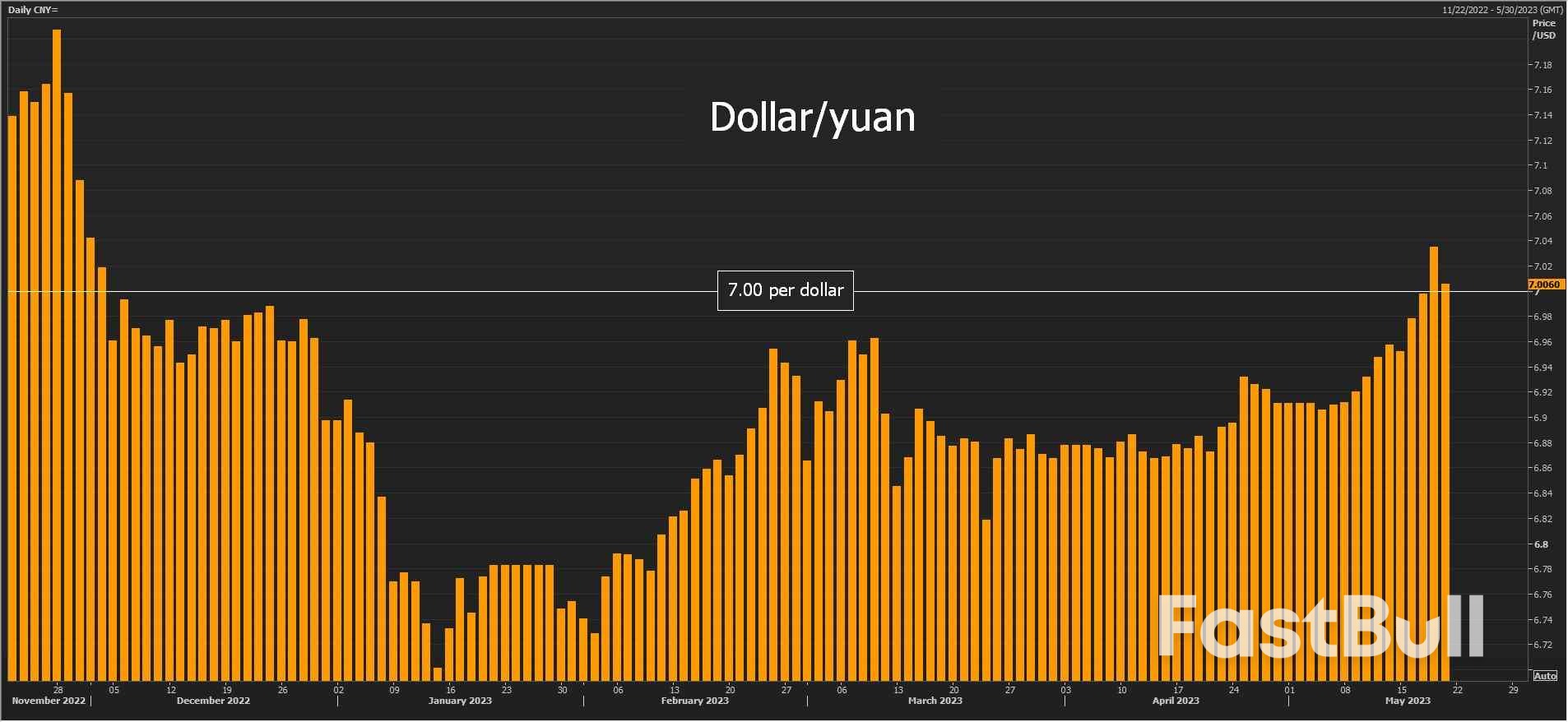
          China to Hold Rates Steady, Markets Digest G7_1The Chinese yuan has fallen through the 7.00 per dollar barrier but is unlikely to get any immediate policy support, as the PBOC is expected to leave one-year and five-year loan prime rates unchanged on Monday at 3.65% and 4.30%, respectively.
          If anything, the weak economy and evaporating inflation could steer the PBOC towards easing policy in the coming months.
          It could not be more different in Japan. Stocks have powered to a 33-year high, the economy grew much faster than expected in the first quarter, and the Bank of Japan could soon start to reverse its ultra-loose policy. Investors like what they see.
          China to Hold Rates Steady, Markets Digest G7_2Wider market sentiment on Monday could be set by the mood music in Washington around the debt ceiling. President Joe Biden and House Republican Speaker Kevin McCarthy will meet after a "productive" phone call on Sunday as the president returned from the G7 summit.
          McCarthy said on Sunday there were positive discussions on solving the crisis and that staff-level talks will resume ahead of his meeting with Biden. Markets will see this as progress.
          On the other hand, Treasury Secretary Janet Yellen reiterated that June 1 remains a "hard deadline" for raising the debt ceiling. If not, the government will likely run out of cash and fail to meet all its commitments through June 15, when more tax receipts are due.
          Time is running out and as long as there is no deal, a U.S. default, a potential catastrophe for world markets, cannot be completely ruled out.
          Later this week the Reserve Bank of New Zealand is expected to raise its cash rate one last time by 25 basis points to 5.50%, while Bank of Korea and Bank Indonesia are seen keeping their benchmark rates on hold at 3.50% and 5.75%, respectively.
          Here are three key developments that could provide more direction to markets on Monday:
          - China loan prime rates decision
          - Japan machinery orders (March)
          - Euro zone consumer confidence (May)

          Source: Yahoo

          Risk Warnings and Disclaimers
          You understand and acknowledge that there is a high degree of risk involved in trading. Following any strategies or investment methods may lead to potential losses. The content on the site is provided by our contributors and analysts for information purposes only. You are solely responsible for determining whether any trading assets, securities, strategy, or any other product is suitable for investing based on your own investment objectives and financial situation.
          Comments
          Add to Favorites
          Share

          Debt Deal Concerns Weigh on US Stocks as Investors Brace for Uncertainty"

          Warren Takunda

          Bond

          Stocks

          The US stock market experienced a downward trend on Friday as concerns over a pause in debt limit talks rattled investors. The Dow Jones closed over 100 points lower, while the S&P 500 and Nasdaq experienced marginal dips of 0.1% and 0.2% respectively. This development added a dose of uncertainty to an already volatile market. Additionally, Federal Reserve Chair Jerome Powell's comments on inflation and the banking sector's stress further contributed to the cautious sentiment among investors. Amidst these market fluctuations, specific companies stood out, some facing declines while others surprised with positive outcomes.

          Debt Ceiling Negotiations

          Investors were closely monitoring the progress of debt limit talks in the United States. The uncertainty surrounding the resolution of the debt ceiling issue created unease, leading to a negative market sentiment. As negotiations hit a pause, investors grew increasingly concerned about potential disruptions in the economy. The lingering uncertainty surrounding the debt ceiling only intensified the market's vulnerability to sudden shocks and added pressure on market participants.

          Inflation Concerns and Monetary Policy

          Federal Reserve Chair Jerome Powell's remarks regarding inflation levels and monetary policy also captured investors' attention. Powell acknowledged that inflation was above the target rate of 2% and emphasized the central bank's commitment to bringing it back to the desired level. However, Powell also highlighted stress within the banking sector, suggesting that raising interest rates might not be necessary at this time. This nuanced perspective on monetary policy created a mixed response among investors, further contributing to the overall market unease.

          Corporate Highlights

          Within the corporate landscape, several companies made headlines during the week. Deere, a well-known agricultural machinery manufacturer, experienced a 1.9% decline in its stock price despite exceeding expectations in earnings and revenue. Conversely, Foot Locker, a leading athletic footwear and apparel retailer, saw a significant drop of 27.1% following disappointing quarterly results. On a more positive note, Farfetch, an online luxury fashion retailer, witnessed a surge of 14.7% after reporting surprising first-quarter revenue figures. These divergent outcomes exemplify the unpredictable nature of the market and the importance of scrutinizing individual company performances.

          Weekly Market Performance

          Despite the overall market volatility, the Dow Jones managed to add 0.7% for the week, indicating a relatively modest gain. The S&P 500 fared better, registering a 1.8% increase and achieving its best weekly performance since March. The Nasdaq outperformed both indices, surging by 3%, marking its largest weekly gain in two months. These numbers reflect the resilience of the market and the potential for recovery amidst prevailing uncertainty.
          Risk Warnings and Disclaimers
          You understand and acknowledge that there is a high degree of risk involved in trading. Following any strategies or investment methods may lead to potential losses. The content on the site is provided by our contributors and analysts for information purposes only. You are solely responsible for determining whether any trading assets, securities, strategy, or any other product is suitable for investing based on your own investment objectives and financial situation.
          Comments
          Add to Favorites
          Share

          In The Face of a Global Banking Crisis, Are Malaysian Banks Safe?

          Thomas

          Central Bank

          The recent failures of Silicon Valley Bank (SVB) in the U.S. and Credit Suisse in Europe have shaken customer confidence in the banking and financial system as a whole, sending a clear signal to banks worldwide that there is a danger to being complacent.
          Unlike the Lehman Brothers' collapse in 2008, SVB's collapse — the second largest bank failure in U.S. history — was not due to poor credit risk management. It could be attributed to several reasons: (i) SVB's inability to effectively deploy huge deposits into effective interest-yielding assets, which caused an asset-liability maturity mismatch; (ii) concentration risk in tech sectors, which are facing liquidity constraints due to the "funding winter"; (iii) game-theory-driven bank run on deposits; and (iv) the rising interest rate as an external macro trigger.
          Meanwhile in Europe, Credit Suisse's series of issues and scandals involving alleged misconduct, money laundering, sanctions busting and tax evasion have been brewing for years — leading to snowballed losses of CHF7.3 billion in 2022, and its eventual failure and acquisition by UBS in March this year.
          Although our local banking system is designed to be more robust, there are critical lessons that can be learnt, so as to prevent similar incidents from occurring in Malaysia.

          The banking landscape in Malaysia

          Malaysia has many traditional banks in the market, but we are also expecting five new digital banks to start operations in the near future. While exciting, their arrival might not come without prominent confidence concerns. Digital banks are usually smaller and newer to the game, without any physical presence that gives the sense of trustworthiness. They are also most often loss-making in the initial years. According to Boston Consulting Group's Fintech Control Tower tracking, only fewer than 5% of the over 250 digital banks globally are currently profitable.
          That being said, the context here in Malaysia is slightly different. First, Bank Negara Malaysia has been prudent in shaping its policies and conducting tight supervision of all Malaysian banks. For example, Bank Negara actively regulates all banks on the Liquidity Coverage Ratio (LCR) requirement for sufficient liquidity buffers as well as concentration risks into selected sectors. In the case of the US, where there are more than 5,000 banks, smaller banks like SVB received less regulatory oversight and were exempted from certain strict requirements applied to larger banks. SVB's LCR was estimated at 75% as at end-2022, which was below what is considered safe.
          Secondly, unlike the SVB case, where more than 90% of the bank's deposits were uninsured, Malaysia's Perbadanan Insurans Deposit Malaysia estimates that 97% of depositors are protected in full, even with the RM250,000 cap, thereby reducing the likelihood of Malaysian banks experiencing an SVB-like overnight bank run on deposits.
          These are undoubtedly commendable measures, but even so, Malaysian banks cannot afford to rest on their laurels.

          Five critical lessons to strengthen resilience

          1. Get the basics right — recognise that banking is a risk management game
          Banks must actively manage various asset-liability risks, for example credit risk, interest rate risk as well as liquidity risk.
          SVB held a large proportion of assets in what was deemed as the "safest" asset from a credit risk standpoint (the U.S. Treasuries), but the very long duration securities were funded by short-term deposits. The liquidity need to sell the bonds before maturity at lower prices (caused by the rapid interest rate hikes by the U.S. Federal Reserve) resulted in significant unrealised losses, which could have been avoided if the bonds were held to maturity.
          Most banks would probably conduct interest rate, credit and liquidity risk stress testing individually. But what banks need to do more is balance sheet modelling and stress testing across risk-types to have a more complete understanding of the interconnectedness of all risks.
          2. Reevaluate portfolio concentration — too much of a focus strategy is a double-edged sword
          Focus has been one of the three generic competitive strategies in the classic Michael Porter framework. The focus strategy served SVB well for a long time as it was celebrated as a bank that thrived in the tech start-up sector, which was booming for decades. However, banks must remember that they are in the business of managing risks, and should consider focusing on a few sectors and avoid concentrating risk in too narrow a segment.
          Apart from tried-and-true analysis of concentration risk, banks should also perform network analyses, like those used for financial crimes, to determine linkages in the deposit book and identify nodes that are connected or have influence over others. In the case of the SVB bank run, influence was concentrated in a few venture capitalists that accelerated the run-off by advising their portfolio companies to move their money. Having this critical information mapped out in advance will allow banks to enhance the monitoring of those influencers and proactively manage such events.
          3. Grow sustainably — look at both sides of the balance sheet
          The current era of "funding winter" and potential global recession means the pursuit of growth at all cost is no longer tenable. Banks (even more so fast-growing digital banks) should revisit the strategy of burning excessive cash for customers and growth.
          The traditional use of attractive deposit interest rates as an acquisition and growth lever might not be sustainable, especially in the current climate of rising interest rates.
          Banks need to consider both sides of the balance sheet. For example, excessive growth on deposits without a good strategy to deploy the funding effectively might spell doom. A cautionary tale is the demise of Australia's first licensed neobank, Xinja, which could not lend out its huge deposit balance effectively.
          Banks should place emphasis on building and leveraging ecosystem advantage (whether through their own affiliate companies or partner companies) as well as developing unique products and propositions that would acquire customers.
          4. Have a crisis playbook fit for the social media age
          SVB represents the first major bank failure in the social media age. The fact that the U.S. Federal Deposit Insurance Corporation took over SVB in the middle of the day rather than waiting for close of business shows how quickly the situation changed. The pace and collective response of depositors was enabled by social media, digital communication and digital banking. This made the speed of the crisis closer in resemblance to a massive cyber breach than to a bank run from decades past.
          SVB seemed unprepared to respond to such events in a coordinated fashion, both internally and in communication with its investors and depositors. Customer comments indicate that client-facing and investor-facing staff were unprepared to deal with the resulting enquiries or manage the high volume of withdrawals. A failure to provide answers to key investors and depositors was a fundamental contributor to the speed of SVB's demise.
          Banks must establish, review and regularly exercise playbooks for a liquidity crisis. These playbooks should enable banks to better position their approach to key areas such as liquidity raising, internal organisation, operational resilience, as well as investor, regulatory and customer communications. Just like a cyber event or operational incident response, banks should regularly conduct "war gaming" exercises to ensure a coordinated response across departments in the event of a similar crisis.
          5. Be swift in resolving issues
          Issues surrounding Credit Suisse had been known for years, highlighting the need for structural fixes. But banks, especially larger ones, tend to act slower given their scale and internal bureaucracies.
          To prevent crises, boards and management teams should not treat critical risk issues as the sole responsibility of their risk committees. Instead, they need to also include it as one of their top priorities, building an action plan with clear timelines that promote accountability.
          When news of these bank failures broke — almost back-to-back — no doubt many customers and investors were caught off guard. And rightly so, because banks are institutions in which people place their confidence and trust. For that, banks owe it to their stakeholders to do all they can to ensure their systems, processes and strategies are resilient against unforeseen risks. The crisis is a stark reminder of the price of complacency, but out of it have emerged lessons that Malaysian banks should give serious consideration to. The consequences of ignoring them, as we have seen, can prove fatal.

          Source: The Edge Malaysia

          Risk Warnings and Disclaimers
          You understand and acknowledge that there is a high degree of risk involved in trading. Following any strategies or investment methods may lead to potential losses. The content on the site is provided by our contributors and analysts for information purposes only. You are solely responsible for determining whether any trading assets, securities, strategy, or any other product is suitable for investing based on your own investment objectives and financial situation.
          Comments
          Add to Favorites
          Share

          Week Ahead – RBNZ, Fed Minutes, UK & US Inflation, Flash PMIs to Headline Packed Week

          Justin

          Central Bank

          Economic

          RBNZ to hike again, but will it be the last?

          The Reserve Bank of New Zealand will be the only major central bank holding a policy meeting next week. It is widely tipped to hike borrowing costs by 25 basis points when it meets on Wednesday. That would make it the 12th straight increase since the cycle began last October, taking the cash rate to 5.50% – the highest among advanced nations.
          Week Ahead – RBNZ, Fed Minutes, UK & US Inflation, Flash PMIs to Headline Packed Week_1
          However, investors don’t think the RBNZ will stop there as a further 25-bps hike is priced in over the summer. This is more hawkish than the RBNZ’s own forecast of where rates will peak, which was projected at 5.50% back in February. The Bank will publish its updated forecasts in the quarterly Monetary Policy Statement on Wednesday and so the local dollar could gain if policymakers up their terminal rate to match or exceed the markets’.
          The latest employment report supports the case for more tightening as the jobless rate remained low at 3.4% and wage growth accelerated slightly in the first quarter. Retail sales data due the same day as the policy decision could show that consumer spending bounced back in Q1.
          However, there is also an argument to stop at 5.50% as in the RBNZ’s latest expectations survey, inflation expectations for two years ahead fell within the Bank’s 1-3% target band to 2.79%. Hence, there is some downside risk too for the kiwi from the meeting.

          All eyes on US data as June Fed decision in the balance

          With pause speculation also intensifying for the Fed, PCE inflation and the May FOMC meeting minutes will be watched across the Pacific next week. US economic indicators have been somewhat mixed lately, yet that underlying strength seems to be holding up even after 500-bps worth of rate increases and a mini banking crisis. From the recent Fedspeak, most officials appear to be swaying towards another hike in June and if there is a pause, it will likely be a conditional one. Wednesday’s Fed minutes could reveal more.
          However, the reality is that policymakers haven’t quite made up their minds about the June decision yet and one of the reasons for that is there are still three major reports on the way before then, the first of which is Friday’s PCE inflation numbers.
          Week Ahead – RBNZ, Fed Minutes, UK & US Inflation, Flash PMIs to Headline Packed Week_2
          The core PCE price index – the Fed’s preferred price metric – is forecast to have moderated 0.2 percentage points to 4.4% in April. This would be a sign of progress after being stuck in the 4.6%-4.7% range for the past few months. The personal income and spending readings will be important as well, as US consumers do not appear to have turned significantly more cautious. In fact, personal consumption is expected to have risen by 0.4% m/m in April.
          Durable goods orders are also due the same day, but ahead of Friday’s releases, the flash PMIs will be grabbing some attention on Tuesday. Investors will be scrutinizing the subcomponents of the PMI indices for an early look at new orders, employment and input prices in the first half of May.
          Other data will include new home sales on Tuesday and the second estimate of Q1 GDP on Thursday.
          After two weeks of strong gains, the US dollar could be in line for a negative correction should the incoming numbers disappoint and rate cut expectations for the Fed are ramped up again. But if they reinforce the view that inflation and the broader economy are not slowing fast enough, the greenback’s upswing could turn into a rampage.
          Week Ahead – RBNZ, Fed Minutes, UK & US Inflation, Flash PMIs to Headline Packed Week_3

          Can Eurozone PMIs lift the euro?

          The euro, along with the yen, has been the biggest casualty of the dollar’s comeback efforts even though there’s been no dramatic repricing of rate hike probabilities for the European Central Bank. The recent batch of worrying German data has instilled a downward bias to the euro amid the greenback’s revival and the single currency has had to surrender some key levels.
          Tuesday’s flash PMIs could play a vital role in either putting a floor under the euro’s slide or deepening its losses. The forecasts don’t point to much of a change in the economic picture in the Eurozone. The manufacturing sector is expected to contract again, with growth being propped up by services industries.
          Week Ahead – RBNZ, Fed Minutes, UK & US Inflation, Flash PMIs to Headline Packed Week_4
          A surprise rebound in manufacturing output, especially in Germany, could help allay concerns about waning economic momentum. For the same reason, investors will also be watching Germany’s Ifo business climate gauge and the detailed Q2 GDP print on Wednesday and Thursday, respectively.

          Some good news from UK CPI, but maybe not for the pound

          The pound has been able to withstand the dollar’s resurgence somewhat better than the other majors. With the Bank of England recently saying it no longer anticipates a recession and inflation remaining in double-digit territory, investors think rate hikes have more room to run in the UK, versus rate cuts being priced in for the Fed.
          But the consensus view that inflation in the UK will be more persistent than in other countries could begin to lose some clout on Wednesday when the consumer price index for April is released. The headline rate of CPI is expected to have finally dropped below 10% last month, easing to 7.9% from 10.1% in March. The core figure is forecast to fall to 5.7%.
          Week Ahead – RBNZ, Fed Minutes, UK & US Inflation, Flash PMIs to Headline Packed Week_5
          A day earlier, the May PMIs will be eyed for clues on how economic activity fared amid the extra public holiday to celebrate King Charles’ coronation. On Friday, the spotlight will fall on the April retail sales stats.
          The overall strength of the data could determine whether or not sterling is able to maintain its relative outperformance against the dollar.
          Elsewhere, the flash PMIs will be the main highlight in Australia, April wage figures due Thursday will be monitored in Canada, while in Japan, there’s a slew of data, including machinery orders (Monday), manufacturing PMI (Tuesday) and a preview of inflation in May with the Tokyo CPIs (Friday).

          Source:XM

          To stay updated on all economic events of today, please check out our Economic calendar
          Risk Warnings and Disclaimers
          You understand and acknowledge that there is a high degree of risk involved in trading. Following any strategies or investment methods may lead to potential losses. The content on the site is provided by our contributors and analysts for information purposes only. You are solely responsible for determining whether any trading assets, securities, strategy, or any other product is suitable for investing based on your own investment objectives and financial situation.
          Comments
          Add to Favorites
          Share

          World Can't Afford U.S.-Style Home Energy Consumption Habits

          Damon

          Economic

          The U.S. is hoping to play key leadership roles in an array of areas tied to the global energy transition, from developing corporate champions that drive emissions reductions to funding research and development of clean-burning fuels.
          But while the global community will welcome American ingenuity being deployed to help solve climate-related challenges, many will be wary of following the United States' example in terms of electricity use per household, which on a per capita basis is by far the highest of any major economy.
          Each person in the United States consumes 12.87 megawatt hours of electricity per year, according to think tank Ember, which is three and a half times more than the global average, and over twice as much as the average person in Europe.
          World Can't Afford U.S.-Style Home Energy Consumption Habits_1In turn, electricity generation is the second largest source of greenhouse gas emissions in the United States after transport, accounting for 25% of national emissions in 2021, according to the U.S. Environmental Protection Agency.
          As the American auto fleet becomes increasingly electrified and more factories look to switch energy sources from burning fossil fuels to drawing power from the grid, the country's demand for electricity looks set to only increase going forward.
          That means power producers may need to continue relying on fossil fuels to generate electricity even as record volumes of renewable energy are deployed across U.S. grids, which may hinder emissions reduction efforts despite ambitious pollution-capping goals.

          Homes Rule

          A key driver behind America's outsized electricity consumption is the preference for single family homes over all other types of residences.
          Detached single family homes made up about 62% of all U.S. housing stock in 2020, or about 77 million of the 123 million housing units in the country, according to data from the U.S. Energy Information Administration (EIA).
          World Can't Afford U.S.-Style Home Energy Consumption Habits_2Large apartment buildings accounted for the second-largest share of dwellings, and totalled around 23 million units, while smaller apartment buildings, attached single-family houses and mobile homes made up the remainder.
          For many in the United States, owning your own home is a key part of the so-called American Dream.
          A 2022 survey by financial services firm Bankrate found that more people (74% of respondents) cited home ownership as the most important prosperity metric than being able to retire (66%), owning an automobile (50%) or having children (40%.)
          However, having one's own separated patch of land comes with a cost, as heating and cooling detached dwellings costs more and is far less efficient than heating and cooling larger buildings that contain multiple households.
          According to the EIA's latest Residential Energy Consumption Survey 57% of electricity used by detached households is used for space heating, and 64% for air conditioning.
          That compares to 22% for heating and 18% for air conditioning in large apartments, and highlights the significant waste loss encountered by detached home owners when it comes to keeping household members comfortable year-round.
          A key part of the problem for many detached home owners is the home's age, as 65% of all U.S. housing units were built before 1990, and 37% were built before 1970, EIA data shows.
          Such old homes inevitably struggle with drafts, poor insulation and ill-fitting windows that lead to heat loss in winter and overheating in summer.
          Tax credits are being made available for home efficiency improvements via the Inflation Reduction Act passed in 2022, but with the cost of living running high just as interest rates scale their highest levels in years, household spending across the United States has slowed, denting efforts to elevate nationwide efficiency standards.

          Other Ways of Living

          The United States is not alone in facing rising living costs while trying to improve the efficiencies of buildings.
          However, no other region favours single family homes over other types of dwelling to the same degree, and so other countries face slightly easier challenges in terms of enabling building upgrades.
          In the European Union, roughly 53% of the population lives in a house, while 46% live in apartments.
          In cities, 71% of the EU population lives in apartments, which accounts for the region consuming less than half of the electricity consumed per capita than in the United States.
          Differences in home ownership are also key, as nearly half of the populations in key economies such as Germany, Austria and Switzerland are tenants rather than home owners, with their apartment buildings typically owned by pension funds that have a vested interest in ensuring high efficiency standards.
          Similarly, a vast majority of China's population lives in apartments, and apartments are more popular than individual houses in the cities of India, Japan and Southeast Asia.
          In Africa, which will see larger population growth than any other region over the remainder of this century, apartments are also becoming increasingly popular among urban dwellers.
          If that trend continues, then electricity consumption totals per person in Africa and other major emerging markets are more likely to resemble the relatively low per capita use trends seen in China and Europe.
          But if global populations develop a taste for American style homes, then electricity demand levels could quickly jump to twice as much, and upend efforts to constrain overall energy generation totals and associated emissions.

          Source:Reuters

          To stay updated on all economic events of today, please check out our Economic calendar
          Risk Warnings and Disclaimers
          You understand and acknowledge that there is a high degree of risk involved in trading. Following any strategies or investment methods may lead to potential losses. The content on the site is provided by our contributors and analysts for information purposes only. You are solely responsible for determining whether any trading assets, securities, strategy, or any other product is suitable for investing based on your own investment objectives and financial situation.
          Comments
          Add to Favorites
          Share

          Southern Europe Braces for Climate Change-Fuelled Summer of Drought

          Cohen

          Energy

          Southern Europe is bracing for a summer of ferocious drought, with some regions already suffering water shortages and farmers expecting their worst yields in decades.
          As climate change makes the region hotter and drier, years of consecutive drought have depleted groundwater reserves. Soils have become bone dry in Spain, southern France and Italy. Low river and reservoir levels are threatening this summer's hydropower production.
          With temperatures climbing into summertime, scientists warn Europe is on track for another brutal summer, after suffering its hottest on record last year – which fuelled a drought European Union researchers said was the worst in at least 500 years.
          So far this year, the situation is most severe in Spain.
          "The situation of drought is going to worsen this summer," said Jorge Olcina, professor of geographic analysis at the University of Alicante, Spain.
          There's little chance at this point of rainfall resolving the underlying drought, either. "At this time of the year, the only thing we can have are punctual and local storms, which are not going to solve the rainfall deficit," Olcina said.
          Seeking emergency EU assistance, Spain's Agriculture Minister Luis Planas warned that "the situation resulting from this drought is of such magnitude that its consequences cannot be tackled with national funds alone," according to an April 24 letter sent to the European Commission (EC) and seen by Reuters.
          Climate Change Trend
          Southern Europe is not alone in suffering severe water shortages this year. The Horn of Africa is enduring its worst drought in decades, while a historic drought in Argentina has hammered soy and corn crops.
          More frequent and severe drought in the Mediterranean region - where the average temperature is now 1.5C higher than 150 years ago – is in line with how scientists have forecast climate change will impact the region.
          "In terms of the climate change signal, it very much fits with what we're expecting," said Hayley Fowler, Professor of Climate Change Impacts at Newcastle University.
          Despite these long-held forecasts, preparation is lagging. Many farming regions have yet to adopt water-saving methods like precision irrigation or switch to more drought-hardy crops, such as sunflowers.
          "Governments are late. Companies are late," said Robert Vautard, a climate scientist and director of France's Pierre-Simon Laplace Institute. "Some companies are not even thinking of changing the model of their consumption, they are just trying to find some miraculous technologies that would bring water."
          France is emerging from its driest winter since 1959, with drought "crisis" alerts already activated in four departmental prefects, restricting non-priority water withdrawals - including for agriculture, according to government website Propluvia.
          Portugal, too, is experiencing an early arrival of drought. Some 90% of the mainland is suffering from drought, with severe drought affecting one-fifth of the country - nearly five times the area reported a year earlier.
          In Spain, which saw less than half its average rainfall through April this year, thousands of people are relying on truck deliveries for drinking water, while regions including Catalonia have imposed water restrictions.
          Some farmers have already reported crop losses as high as 80%, with cereals and oilseeds among those affected, farming groups have said.
          "This is the worst loss of harvest for decades,” Pekka Pesonen, who heads the European farming group Copa-Cogeca, said of Spain. "It's worse than last year's situation."
          Spain is responsible for half of the EU's production of olives and one third of its fruit, according to the Commission.
          With its reservoirs at on average 50% of capacity, the country last week earmarked more than 2 billion euros ($2.20 billion) in emergency response funding. It is still awaiting a reply from the Commission on its request for a 450-million-euro crisis fund to be mobilized from the bloc's farming subsidy budget.
          The Commission said it was monitoring the situation closely.
          "Severe drought in Southern Europe is particularly worrying, not only for the farmers there but also because this can push up already very high consumer prices if the EU production is significantly lower," Commission spokesperson Miriam Garcia Ferrer said.
          Similar struggles are expected in Italy, where up to 80% of the country's water supply goes toward agriculture. But with this year's thin mountain snow cover and low soil moisture, Italian farmers are planning to cut back – sowing summer crops across an area 6% smaller than last year's planting area, according to national data on sowing intentions.
          After two years of water scarcity, northern Italy has a 70% deficit in snow water reserves and a 40% deficit of soil moisture, said Luca Brocca, a Director of Research at Italy's National Research Council.
          Such deep shortages set the stage for a repeat of last year's summer, when Italy suffered its most severe drought in 70 years.
          "2022 was really exceptional. And also this year, it seems to be really exceptional," Brocca said.
          ($1 = 0.9084 euros)

          Source: Reuters

          Risk Warnings and Disclaimers
          You understand and acknowledge that there is a high degree of risk involved in trading. Following any strategies or investment methods may lead to potential losses. The content on the site is provided by our contributors and analysts for information purposes only. You are solely responsible for determining whether any trading assets, securities, strategy, or any other product is suitable for investing based on your own investment objectives and financial situation.
          Comments
          Add to Favorites
          Share
          FastBull
          Copyright © 2025 FastBull Ltd

          728 RM B 7/F GEE LOK IND BLDG NO 34 HUNG TO RD KWUN TONG KLN HONG KONG

          TelegramInstagramTwitterfacebooklinkedin
          App Store Google Play Google Play
          Products
          Charts

          Chats

          Q&A with Experts
          Screeners
          Economic Calendar
          Data
          Tools
          Membership
          Features
          Function
          Markets
          Copy Trading
          Latest Signals
          Contests
          News
          Analysis
          24/7
          Columns
          Education
          Company
          Careers
          About Us
          Contact Us
          Advertising
          Help Center
          Feedback
          User Agreement
          Privacy Policy
          Business

          White Label

          Data API

          Web Plug-ins

          Poster Maker

          Affiliate Program

          Risk Disclosure

          The risk of loss in trading financial instruments such as stocks, FX, commodities, futures, bonds, ETFs and crypto can be substantial. You may sustain a total loss of the funds that you deposit with your broker. Therefore, you should carefully consider whether such trading is suitable for you in light of your circumstances and financial resources.

          No decision to invest should be made without thoroughly conducting due diligence by yourself or consulting with your financial advisors. Our web content might not suit you since we don't know your financial conditions and investment needs. Our financial information might have latency or contain inaccuracy, so you should be fully responsible for any of your trading and investment decisions. The company will not be responsible for your capital loss.

          Without getting permission from the website, you are not allowed to copy the website's graphics, texts, or trademarks. Intellectual property rights in the content or data incorporated into this website belong to its providers and exchange merchants.

          Not Logged In

          Log in to access more features

          FastBull Membership

          Not yet

          Purchase

          Become a signal provider
          Help Center
          Customer Service
          Dark Mode
          Price Up/Down Colors

          Log In

          Sign Up

          Position
          Layout
          Fullscreen
          Default to Chart
          The chart page opens by default when you visit fastbull.com