Markets
News
Analysis
User
24/7
Economic Calendar
Education
Data
- Names
- Latest
- Prev




Signal Accounts for Members
All Signal Accounts
All Contests


U.K. Retail Sales MoM (SA) (Dec)A:--
F: --
P: --
France Manufacturing PMI Prelim (Jan)A:--
F: --
P: --
France Services PMI Prelim (Jan)A:--
F: --
P: --
France Composite PMI Prelim (SA) (Jan)A:--
F: --
P: --
Germany Manufacturing PMI Prelim (SA) (Jan)A:--
F: --
P: --
Germany Services PMI Prelim (SA) (Jan)A:--
F: --
P: --
Germany Composite PMI Prelim (SA) (Jan)A:--
F: --
P: --
Euro Zone Composite PMI Prelim (SA) (Jan)A:--
F: --
P: --
Euro Zone Manufacturing PMI Prelim (SA) (Jan)A:--
F: --
P: --
Euro Zone Services PMI Prelim (SA) (Jan)A:--
F: --
P: --
U.K. Composite PMI Prelim (Jan)A:--
F: --
P: --
U.K. Manufacturing PMI Prelim (Jan)A:--
F: --
P: --
U.K. Services PMI Prelim (Jan)A:--
F: --
P: --
Mexico Economic Activity Index YoY (Nov)A:--
F: --
P: --
Russia Trade Balance (Nov)A:--
F: --
P: --
Canada Core Retail Sales MoM (SA) (Nov)A:--
F: --
P: --
Canada Retail Sales MoM (SA) (Nov)A:--
F: --
U.S. IHS Markit Manufacturing PMI Prelim (SA) (Jan)A:--
F: --
P: --
U.S. IHS Markit Services PMI Prelim (SA) (Jan)A:--
F: --
P: --
U.S. IHS Markit Composite PMI Prelim (SA) (Jan)A:--
F: --
P: --
U.S. UMich Consumer Sentiment Index Final (Jan)A:--
F: --
P: --
U.S. UMich Current Economic Conditions Index Final (Jan)A:--
F: --
P: --
U.S. UMich Consumer Expectations Index Final (Jan)A:--
F: --
P: --
U.S. Conference Board Leading Economic Index MoM (Nov)A:--
F: --
P: --
U.S. Conference Board Coincident Economic Index MoM (Nov)A:--
F: --
P: --
U.S. Conference Board Lagging Economic Index MoM (Nov)A:--
F: --
P: --
U.S. UMich 1-Year-Ahead Inflation Expectations Final (Jan)A:--
F: --
P: --
U.S. Conference Board Leading Economic Index (Nov)A:--
F: --
P: --
U.S. Weekly Total Rig CountA:--
F: --
P: --
U.S. Weekly Total Oil Rig CountA:--
F: --
P: --
Germany Ifo Business Expectations Index (SA) (Jan)--
F: --
P: --
Germany IFO Business Climate Index (SA) (Jan)--
F: --
P: --
Germany Ifo Current Business Situation Index (SA) (Jan)--
F: --
P: --
Mexico Unemployment Rate (Not SA) (Dec)--
F: --
P: --
Canada National Economic Confidence Index--
F: --
P: --
U.S. Non-Defense Capital Durable Goods Orders MoM (Excl. Aircraft) (Nov)--
F: --
P: --
U.S. Durable Goods Orders MoM (Excl. Defense) (SA) (Nov)--
F: --
P: --
U.S. Durable Goods Orders MoM (Excl.Transport) (Nov)--
F: --
P: --
U.S. Durable Goods Orders MoM (Nov)--
F: --
P: --
U.S. Dallas Fed General Business Activity Index (Jan)--
F: --
P: --
U.K. BRC Shop Price Index YoY (Jan)--
F: --
P: --
China, Mainland Industrial Profit YoY (YTD) (Dec)--
F: --
P: --
Mexico Trade Balance (Dec)--
F: --
P: --
U.S. S&P/CS 20-City Home Price Index YoY (Not SA) (Nov)--
F: --
P: --
U.S. S&P/CS 20-City Home Price Index MoM (SA) (Nov)--
F: --
P: --
U.S. FHFA House Price Index MoM (Nov)--
F: --
P: --
U.S. FHFA House Price Index (Nov)--
F: --
P: --
U.S. Richmond Fed Manufacturing Composite Index (Jan)--
F: --
P: --
U.S. Conference Board Present Situation Index (Jan)--
F: --
P: --
U.S. Conference Board Consumer Expectations Index (Jan)--
F: --
P: --
U.S. Richmond Fed Manufacturing Shipments Index (Jan)--
F: --
P: --
U.S. Richmond Fed Services Revenue Index (Jan)--
F: --
P: --
U.S. Conference Board Consumer Confidence Index (Jan)--
F: --
P: --
Australia RBA Trimmed Mean CPI YoY (Q4)--
F: --
P: --
Australia CPI YoY (Q4)--
F: --
P: --
Australia CPI QoQ (Q4)--
F: --
P: --
Germany GfK Consumer Confidence Index (SA) (Feb)--
F: --
P: --
India Industrial Production Index YoY (Dec)--
F: --
P: --
India Manufacturing Output MoM (Dec)--
F: --
P: --


No matching data
Latest Views
Latest Views
Trending Topics
Top Columnists
Latest Update
White Label
Data API
Web Plug-ins
Affiliate Program
View All

No data
Natural gas futures threaten $3.00 support on bearish EIA inventory report. Storage levels 106 Bcf above average limit rally despite cold weather forecast.
Key Points:
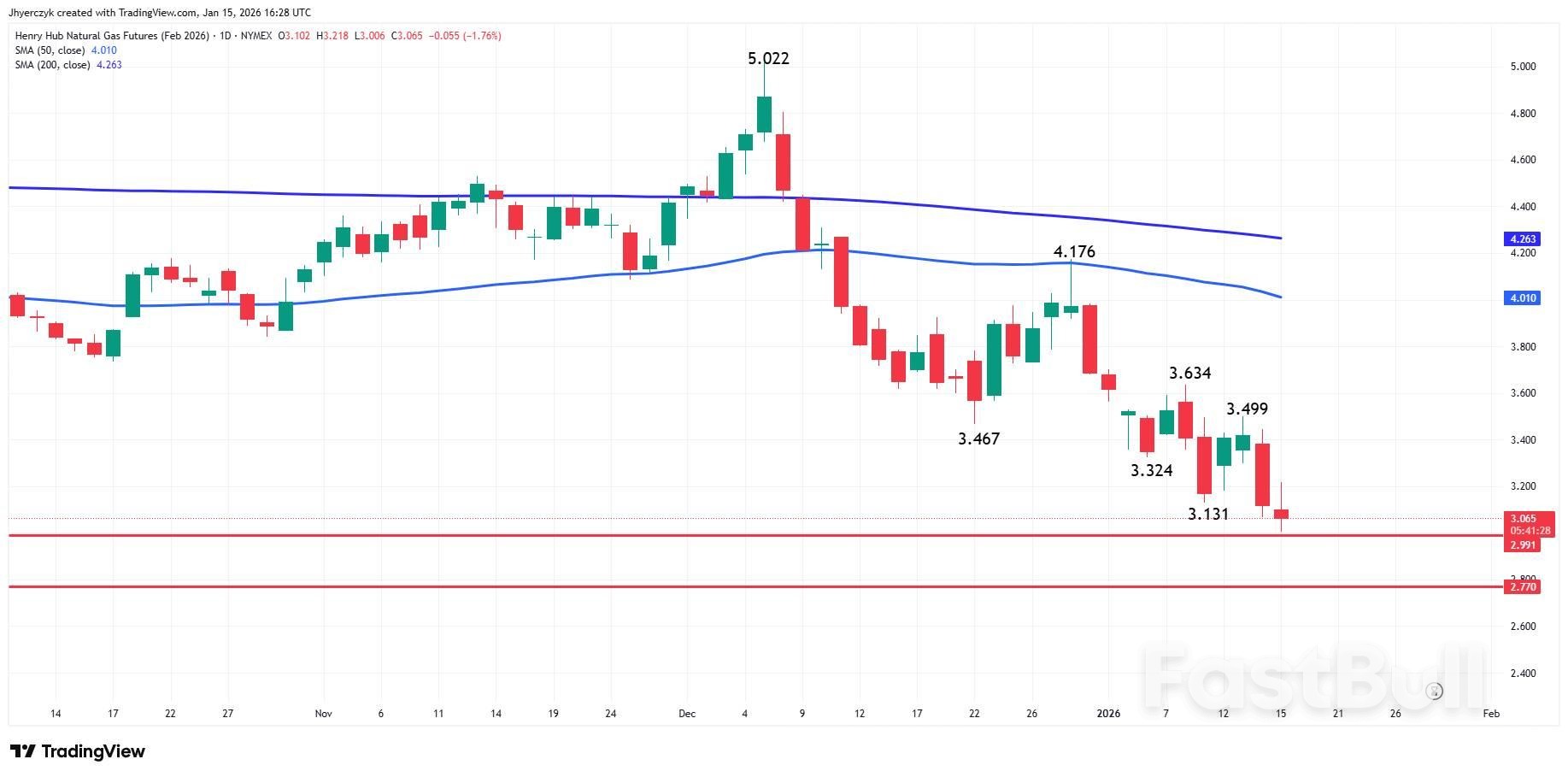
Natural gas futures are trading lower on Thursday after the release of a bearish government storage report. The market is now a threat to challenge the psychological $3.00 level. A successful breach of this level will open the door to a test of a multi-month target at $2.770.
At 16:27 GMT, February Natural Gas Futures are trading $3.065, down $0.055 or -1.76%.
The nearest swing chart resistance is $3.499, followed by $3.634. Short-covering could take out these levels at some point in the future, but any rally is likely to be stopped by the intermediate trend indicator or 50-day moving average at $4.010, or the long-term trend indicator, the 200-day moving average at $4.263.
With the trend decisively lower, the market should remain in "sell the rally mode" until the 200-day moving average is overcome with conviction.
According to the U.S. Energy Information Administration (EIA), "Working gas in storage was 3,185 Bcf as of Friday, January 9, 2026. This represents a net decrease of 71 Bcf from the previous week. Stocks were 33 Bcf higher than last year at this time and 106 Bcf above the five-year average of 3,079 Bcf. At 3,185 Bcf, total working gas is within the five-year historical range."
Ahead of today's weekly storage report, surveys suggested a draw of 87 to 91 Bcf, lighter than the 5-year average of -146 Bcf. Temperatures were much warmer than normal over most of the U.S. for the sample week, while wind generation was only slightly changed, according to NatGasWeather.
NatGasWeather's latest forecast suggests moderate demand between January 15–21. They see "frosty" air advancing across the Midwest and East the next few days with highs of 10s to 40s, lows of -0s to 30s for stronger national demand.
Late this weekend and into early next week, the northern U.S. is expected to experience a more impressive cold shot, including lows of 20s–30s into Northern Texas, the South, and Southeast. It will be mild in the West.
Looking ahead, looking at the words used by the weather forecasters, the upcoming cold is expected to be a short-term event, hence the phrase "cold shot." This is probably why we are seeing a limited reaction to the upcoming cold. Furthermore, the storage levels are just too high to support a meaningful rally and are headed in the wrong direction for the bulls.
Yesterday, the EIA's short-term report also predicted a bearish outlook for prices in 2026, before a bullish rebound next year.
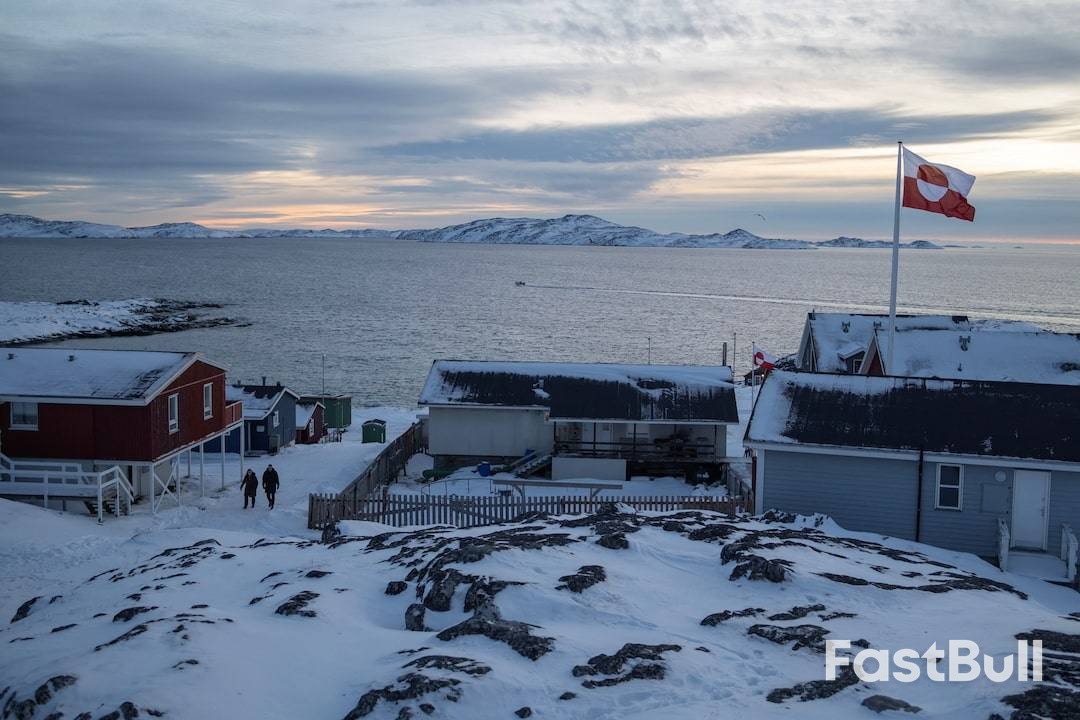
European military personnel are arriving in Greenland in a calculated move to reinforce the island's security, marking the first step in Denmark's plan to establish a larger, more permanent NATO footprint in the Arctic. The deployment comes against a backdrop of persistent strategic interest from U.S. President Donald Trump, who has declared the vast, autonomous territory vital to American national security.
This initiative follows a high-stakes meeting between U.S., Danish, and Greenlandic officials that failed to resolve the diplomatic impasse. President Trump has continued to assert that Denmark cannot be relied upon to protect Greenland from potential Russian or Chinese ambitions, a claim that Copenhagen and Nuuk firmly reject.
In a coordinated effort, several European nations have dispatched small military teams to Greenland to begin preparations for larger-scale drills scheduled for later this year. Though the initial numbers are modest, the message is clear.
A Danish Air Force C-130 has already landed at Nuuk airport, disembarking personnel in military fatigues. This deployment is part of a broader European contribution:
• Germany: A 13-person reconnaissance team.
• France: Approximately 15 mountain specialists, with land, air, and naval assets expected to follow.
• Sweden: Three officers.
• Norway: Two officers.
• Finland: Two military liaison officers.
• United Kingdom: One officer joining the reconnaissance group.
• Netherlands: One navy officer.
These forces will supplement the roughly 150 Danish military and civilian personnel already at the Joint Arctic Command and the 200 U.S. troops currently stationed on the island.

President Trump's focus on Greenland is rooted in its strategic location and rich mineral resources. He has publicly stated that the island is essential to U.S. security and has not ruled out using force to acquire it. Both Greenland and Denmark have dismissed the notion that the island is for sale, describing such threats as reckless.
Danish Defence Minister Troels Lund Poulsen stated that the plan is for "a larger and more permanent presence throughout 2026." He added, "This is crucial to show that security in the Arctic is not only for the Kingdom of Denmark; it is for all of NATO."
According to Marc Jacobsen, an associate professor at the Royal Danish Defence College, the European military deployment sends two distinct signals to the U.S. administration.
First, it acts as a deterrent, demonstrating a united front prepared to defend Greenland's sovereignty. Second, it serves as a form of reassurance, showing that European allies are taking American security concerns in the Arctic seriously and are stepping up their own military commitments in the region.
The increased military activity has drawn a sharp response from Moscow. Russia has labeled NATO's narrative of a Moscow-Beijing threat in the Arctic a "myth" intended to create hysteria. A Russian foreign ministry spokeswoman also warned that any attempt to ignore Moscow's interests in the region would not go unanswered.
The situation has created anxiety among some EU members, who have backed Denmark and warned that a U.S. military seizure of Greenland could threaten the future of the NATO alliance itself.

Despite the external pressures, Greenland and Denmark are maintaining a united front. After meeting with U.S. Secretary of State Marco Rubio and Vice President JD Vance, they announced the formation of a joint working group to address American concerns.
In a speech in Copenhagen, Greenland's Prime Minister Jens-Frederik Nielsen received a standing ovation after emphatically stating the island has no desire to be run by or become part of the United States.
"We choose the Greenland we know today, as part of the Kingdom of Denmark," Nielsen declared, reinforcing the island's commitment to its current autonomous status.

Canada's automotive sector experienced a sharp decline in November, reeling from a combination of global chip shortages, softening demand, and escalating trade pressures from the United States.
The downturn in the auto industry had a significant ripple effect, pulling down the country's broader economic activity. According to data released Thursday by Statistics Canada, overall manufacturing sales fell 1.2% for the month, while wholesale receipts dropped 1.8%.
Both figures fell short of analyst forecasts. A Bloomberg survey of economists had anticipated a smaller 1.1% decline in factory sales and a slight 0.1% gain in wholesale trade, signaling unexpected weakness in the Canadian economy.
The motor vehicle industry was the primary driver of the negative results. Manufacturing sales within the auto sector plunged 15.9% in November, marking the second consecutive monthly drop and hitting their lowest level since October 2022.
A similar trend was seen in wholesale figures, where sales of motor vehicles and parts fell by 11.5%. This also represented the weakest performance for the category since October 2022, with declines recorded in both finished vehicles and parts and accessories.
Statistics Canada attributed the slump to several factors. Production at a major auto assembly plant was severely disrupted by the ongoing global semiconductor shortage. This supply-chain issue compounded the effects of weakening demand and broader trade headwinds.
This latest data points to an economy struggling under the weight of U.S. President Donald Trump's tariffs, with fading momentum suggesting a slow finish to the year for Canadian growth.
"This continues the mediocre trend for the Canadian economy seen over the past year," noted Benjamin Reitzes, a rates and macro strategist at Bank of Montreal.
Reitzes added that ongoing trade uncertainty is likely to result in uneven growth, a factor that should "silence any chatter of Bank of Canada hikes for now."
The central bank has indicated that its current policy rate of 2.25% remains at "about the right level," provided that inflation and economic output perform as expected.
President Donald Trump has unveiled a new healthcare framework, urging Congress to pass it into law immediately to lower drug prices and insurance premiums. The move is widely seen as an effort to address a key political vulnerability for his party ahead of the midterm elections.
In a video message, Trump called his proposal "The Great Healthcare Plan" and demanded swift legislative action to provide "immediate relief to the American people."
While the White House has described the proposal as a comprehensive plan, it remains light on many details crucial for legislative review. The core objectives focus on reducing costs for consumers and increasing transparency.
Key components of the plan include:
• Codifying Drug Deals: Making the voluntary price-reduction deals Trump has secured with drugmakers legally binding.
• Over-the-Counter Access: Expanding the range of medications available for purchase without a prescription.
• Direct Subsidies: Rerouting billions in government subsidies for insurance. Instead of going to insurance companies, the funds would be sent directly to consumers to purchase health plans.
• Targeting Middlemen: A measure aimed at ending "kickbacks" paid to large brokerage middlemen, which the plan claims artificially inflate the cost of health insurance.
A significant portion of the proposal is dedicated to forcing greater transparency from the healthcare industry. The plan would require insurance companies to simplify their language to help consumers make better decisions.
Under these new rules, insurers would need to:
• Publish rates and coverage comparisons in "Plain English."
• Disclose the percentage of revenue paid out in claims versus their overhead and profits.
• Report the percentage of insurance claims they reject.
• Publicize average wait times for routine care.
Furthermore, any healthcare provider or insurer participating in Medicare or Medicaid would be required to prominently display their prices and fees.
The president's announcement comes as his administration works to counter public anxiety over the rising cost of living, which has negatively impacted perceptions of his economic agenda. Healthcare costs remain a central point of frustration for many voters.
Democrats have capitalized on the expiration of key subsidies under the Affordable Care Act (ACA), also known as Obamacare, to criticize the administration over affordability. The issue underscores Trump’s long-standing struggle to repeal and replace the signature policy of his predecessor, Barack Obama, and unite Republicans behind an alternative.
The political timing is critical. Open enrollment for Obamacare plans has just ended, but Congress is deadlocked on how to reinstate the lapsed subsidies. This impasse threatens to cause premiums to double for over 20 million people.
The situation is particularly precarious for the Republican party, as the tax credits largely benefited consumers in GOP-led states, creating a significant risk in a tightly contested election for control of Congress.
Trump has further complicated any potential legislative solution by threatening to veto bills that would revive the expiring subsidies. He is instead committed to his plan of giving subsidies directly to Americans—an approach many health experts argue would be difficult to implement and offers no guarantee of better healthcare outcomes.
Russia's oil and gas revenues, the financial engine of its war in Ukraine, fell to a five-year low in 2025 as a result of slumping crude prices and a steep decline in natural gas exports.
According to data released by the Finance Ministry on Thursday, the nation's budget collected a total of 8.48 trillion rubles ($108 billion) in oil and gas taxes last year. This figure represents a 24% decrease from 2024 and marks the lowest intake since the beginning of the decade.
As a top-three global oil producer with the world's largest gas reserves, Russia depends heavily on energy taxes to fund state operations. The revenue decline—driven by lower global oil prices, a stronger ruble, and energy sanctions—coincides with a period of significantly increased military spending by the Kremlin to support the war, now approaching its fifth year.
To cover the growing shortfall between income and expenditure, the Russian government has utilized over half of its National Wellbeing Fund, a reserve intended to cushion the economy from shocks. It has also resorted to expensive borrowing that will require years to repay.
Oil revenues alone dropped by more than 22% year-on-year to 7.13 trillion rubles, the lowest level recorded since 2023. This downturn was fueled by concerns about a global crude oversupply and specific discounts applied to Russian oil due to Western sanctions, which together constricted the flow of money into state coffers.
Price Pressures and Sanctions
Official data shows the average price of Urals, Russia's primary export blend, was calculated at $57.65 per barrel for tax purposes in 2025, a 15% drop from the previous year.
The financial pressure intensified starting in November, when the U.S. sanctioned major producers Rosneft PJSC and Lukoil PJSC. Following this, the discount on Urals crude compared to the Brent benchmark widened to approximately $27 per barrel at the point of export, as buyers required greater financial incentives to continue their purchases.
The Stronger Ruble's Impact
A stronger domestic currency also contributed to the decline in revenues. In 2025, the ruble traded at an average of 85.67 per dollar, which was 6.4% stronger than in 2024. The combination of weaker Urals prices and a stronger ruble meant that the Russian budget received fewer rubles for each barrel of oil produced and sold on the international market.
Russia's tax income from the natural gas industry experienced an even sharper decline, falling over 30% to 1.35 trillion rubles. Historical data indicates this is the lowest level since the pandemic year of 2020.
Once the single largest supplier of natural gas to Europe, Russia has progressively lost nearly its entire client base in the region since the start of the war in Ukraine.
The situation worsened from January 2025, when the gas transit deal through Ukraine expired, cutting off a key export route and leaving state-owned Gazprom PJSC with fewer westward pipelines. While Russia has been increasing its natural gas exports to China, these deliveries are not sufficient to fully compensate for the loss of the vast European market.
The United States has imposed new sanctions on five Iranian officials and a prison, escalating its response to Tehran's crackdown on widespread national protests. The move signals President Donald Trump's ongoing pressure campaign against the Iranian government.

According to a statement from the U.S. Treasury Department, the sanctions target senior figures considered architects of the government's response to the protests. Those named include:
• The Secretary of the Supreme Council for National Security
• Commanders from the Islamic Revolutionary Guard Corps (IRGC)
• Commanders from law enforcement forces
Additionally, sanctions were placed on Fardis Prison. The U.S. State Department cited reports that women in the facility have "endured cruel, inhuman, and degrading treatment."
Treasury Secretary Scott Bessent delivered a sharp message to Iran's leaders in a video statement, warning that Washington is monitoring their financial activities.
"U.S. Treasury knows, that like rats on a sinking ship, you are frantically wiring funds stolen from Iranian families to banks and financial institutions around the world," Bessent said. "Rest assured, we will track them and you."
He continued by relaying a message from President Trump: "But there's still time, if you choose to join us. As President Trump has said, stop the violence and stand with the people of Iran." Bessent affirmed that "the United States stands firmly behind the Iranian people in their call for freedom and justice."
Iran's mission to the United Nations did not provide an immediate comment on the new sanctions. The country's leadership has consistently blamed the unrest on foreign adversaries, including the United States and Israel.
Meanwhile, Iranian President Masoud Pezeshkian stated on Thursday that his government is attempting to address the economic problems that initially triggered the protests. He said the administration intends to tackle corruption and foreign exchange rates to improve the purchasing power of poorer citizens.
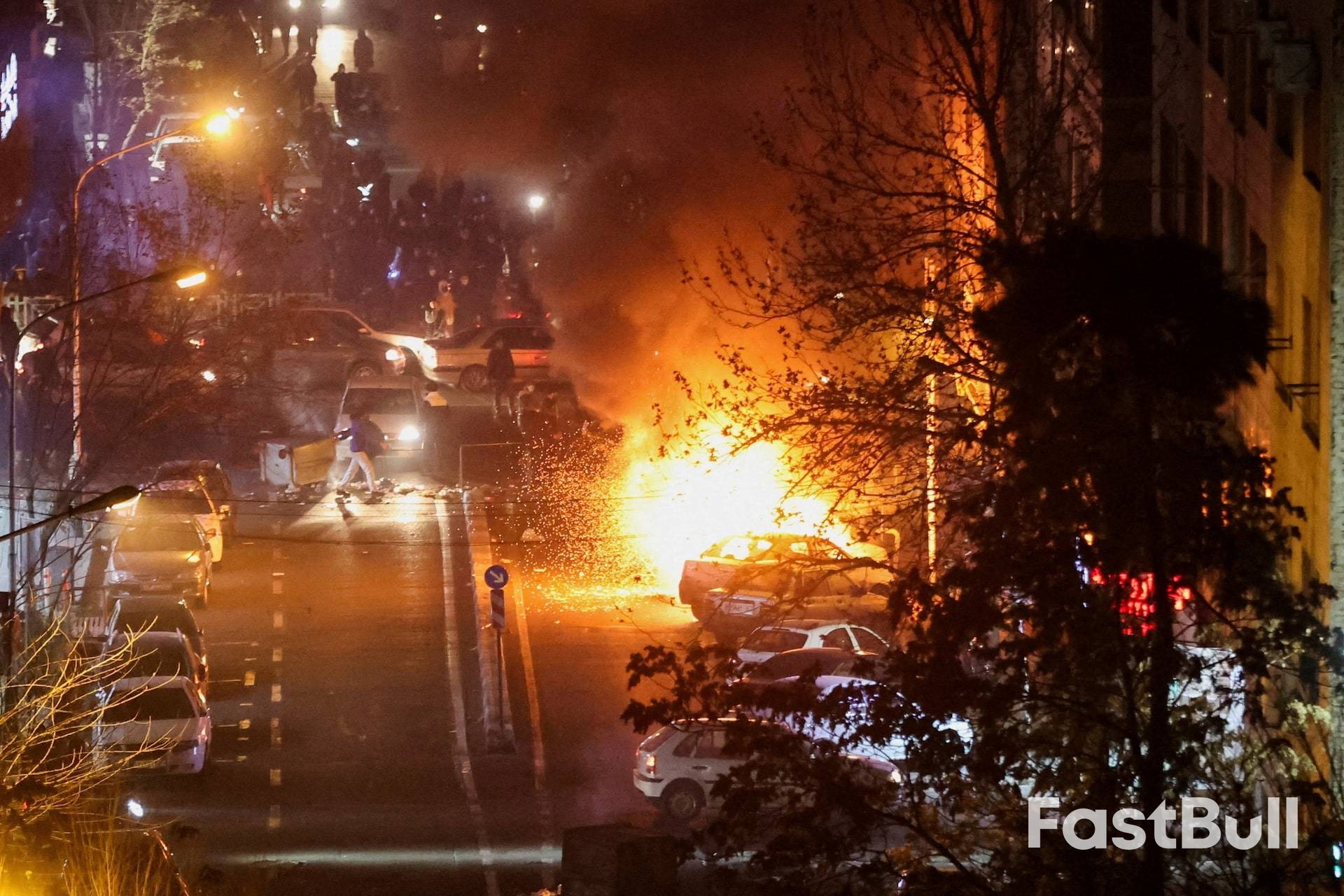
The unrest, which began on December 28 with demonstrations over soaring prices, evolved into a significant challenge to the country's clerical establishment. According to the U.S.-based HRANA rights group, the violence has so far resulted in the verified deaths of 2,435 protesters and 153 government-affiliated individuals.
In a separate but related action, the Treasury also sanctioned 18 individuals. They are accused of participating in "shadow banking" networks designed to launder the proceeds from Iranian petroleum and petrochemical sales to foreign markets.
These actions are the latest move in the Trump administration's "maximum pressure" campaign. The policy aims to reduce Iran's oil exports to zero and prevent Tehran from developing a nuclear weapon—a goal Iran denies pursuing.
White Label
Data API
Web Plug-ins
Poster Maker
Affiliate Program
The risk of loss in trading financial instruments such as stocks, FX, commodities, futures, bonds, ETFs and crypto can be substantial. You may sustain a total loss of the funds that you deposit with your broker. Therefore, you should carefully consider whether such trading is suitable for you in light of your circumstances and financial resources.
No decision to invest should be made without thoroughly conducting due diligence by yourself or consulting with your financial advisors. Our web content might not suit you since we don't know your financial conditions and investment needs. Our financial information might have latency or contain inaccuracy, so you should be fully responsible for any of your trading and investment decisions. The company will not be responsible for your capital loss.
Without getting permission from the website, you are not allowed to copy the website's graphics, texts, or trademarks. Intellectual property rights in the content or data incorporated into this website belong to its providers and exchange merchants.
Not Logged In
Log in to access more features

FastBull Membership
Not yet
Purchase
Log In
Sign Up