• Trade
  • Markets
  • Copy
  • Contests
  • News
  • 24/7
  • Calendar
  • Q&A
  • Chats
Trending
Screeners
SYMBOL
LAST
BID
ASK
HIGH
LOW
NET CHG.
%CHG.
SPREAD
SPX
S&P 500 Index
6827.42
6827.42
6827.42
6899.86
6801.80
-73.58
-1.07%
--
DJI
Dow Jones Industrial Average
48458.04
48458.04
48458.04
48886.86
48334.10
-245.98
-0.51%
--
IXIC
NASDAQ Composite Index
23195.16
23195.16
23195.16
23554.89
23094.51
-398.69
-1.69%
--
USDX
US Dollar Index
97.950
98.030
97.950
98.500
97.950
-0.370
-0.38%
--
EURUSD
Euro / US Dollar
1.17394
1.17409
1.17394
1.17496
1.17192
+0.00011
+ 0.01%
--
GBPUSD
Pound Sterling / US Dollar
1.33707
1.33732
1.33707
1.33997
1.33419
-0.00148
-0.11%
--
XAUUSD
Gold / US Dollar
4299.39
4299.39
4299.39
4353.41
4257.10
+20.10
+ 0.47%
--
WTI
Light Sweet Crude Oil
57.233
57.485
57.233
58.011
56.969
-0.408
-0.71%
--

Community Accounts

Signal Accounts
--
Profit Accounts
--
Loss Accounts
--
View More

Become a signal provider

Sell trading signals to earn additional income

View More

Guide to Copy Trading

Get started with ease and confidence

View More

Signal Accounts for Members

All Signal Accounts

Best Return
  • Best Return
  • Best P/L
  • Best MDD
Past 1W
  • Past 1W
  • Past 1M
  • Past 1Y

All Contests

  • All
  • Trump Updates
  • Recommend
  • Stocks
  • Cryptocurrencies
  • Central Banks
  • Featured News
Top News Only
Share

Israel Says It Kills Senior Hamas Commander Raed Saed In Gaza

Share

Ukraine's Navy Says Russian Drone Attack Hit Civilian Turkish Vessel Carrying Sunflower Oil To Egypt On Saturday

Share

Israeli Military Says It Put Planned Strike On South Lebanon Site On Hold After Lebanese Army Requested Access

Share

Norwegian Nobel Committee: Calls On The Belarusian Authorities To Release All Political Prisoners

Share

Norwegian Nobel Committee: His Freedom Is A Deeply Welcome And Long-Awaited Moment

Share

Ukraine Says It Received 114 Prisoners From Belarus

Share

USA Embassy In Lithuania: Maria Kalesnikava Is Not Going To Vilnius

Share

USA Embassy In Lithuania: Other Prisoners Are Being Sent From Belarus To Ukraine

Share

Ukraine President Zelenskiy: Five Ukrainians Released By Belarus In US-Brokered Deal

Share

USA Vilnius Embassy: USA Stands Ready For "Additional Engagement With Belarus That Advances USA Interests"

Share

USA Vilnius Embassy: Belarus, USA, Other Citizens Among The Prisoners Released Into Lithuania

Share

USA Vilnius Embassy: USA Will Continue Diplomatic Efforts To Free The Remaining Political Prisoners In Belarus

Share

USA Vilnius Embassy: Belarus Releases 123 Prisoners Following Meeting Of President Trump's Envoy Coale And Belarus President Lukashenko

Share

USA Vilnius Embassy: Masatoshi Nakanishi, Aliaksandr Syrytsa Are Among The Prisoners Released By Belarus

Share

USA Vilnius Embassy: Maria Kalesnikava And Viktor Babaryka Are Among The Prisoners Released By Belarus

Share

USA Vilnius Embassy: Nobel Peace Prize Laureate Ales Bialiatski Is Among The Prisoners Released By Belarus

Share

Belarusian Presidential Administration Telegram Channel: Lukashenko Has Pardoned 123 Prisoners As Part Of Deal With US

Share

Two Local Syrian Officials: Joint US-Syrian Military Patrol In Central Syria Came Under Fire From Unknown Assailants

Share

Israeli Military Says It Targeted 'Key Hamas Terrorist' In Gaza City

Share

Rwanda's Actions In Eastern Drc Are A Clear Violation Of Washington Accords Signed By President Trump - Secretary Of State Rubio

TIME
ACT
FCST
PREV
U.K. Trade Balance Non-EU (SA) (Oct)

A:--

F: --

P: --

U.K. Trade Balance (Oct)

A:--

F: --

P: --

U.K. Services Index MoM

A:--

F: --

P: --

U.K. Construction Output MoM (SA) (Oct)

A:--

F: --

P: --

U.K. Industrial Output YoY (Oct)

A:--

F: --

P: --

U.K. Trade Balance (SA) (Oct)

A:--

F: --

P: --

U.K. Trade Balance EU (SA) (Oct)

A:--

F: --

P: --

U.K. Manufacturing Output YoY (Oct)

A:--

F: --

P: --

U.K. GDP MoM (Oct)

A:--

F: --

P: --

U.K. GDP YoY (SA) (Oct)

A:--

F: --

P: --

U.K. Industrial Output MoM (Oct)

A:--

F: --

P: --

U.K. Construction Output YoY (Oct)

A:--

F: --

P: --

France HICP Final MoM (Nov)

A:--

F: --

P: --

China, Mainland Outstanding Loans Growth YoY (Nov)

A:--

F: --

P: --

China, Mainland M2 Money Supply YoY (Nov)

A:--

F: --

P: --

China, Mainland M0 Money Supply YoY (Nov)

A:--

F: --

P: --

China, Mainland M1 Money Supply YoY (Nov)

A:--

F: --

P: --

India CPI YoY (Nov)

A:--

F: --

P: --

India Deposit Gowth YoY

A:--

F: --

P: --

Brazil Services Growth YoY (Oct)

A:--

F: --

P: --

Mexico Industrial Output YoY (Oct)

A:--

F: --

P: --

Russia Trade Balance (Oct)

A:--

F: --

P: --

Philadelphia Fed President Henry Paulson delivers a speech
Canada Building Permits MoM (SA) (Oct)

A:--

F: --

P: --

Canada Wholesale Sales YoY (Oct)

A:--

F: --

P: --

Canada Wholesale Inventory MoM (Oct)

A:--

F: --

P: --

Canada Wholesale Inventory YoY (Oct)

A:--

F: --

P: --

Canada Wholesale Sales MoM (SA) (Oct)

A:--

F: --

P: --

Germany Current Account (Not SA) (Oct)

A:--

F: --

P: --

U.S. Weekly Total Rig Count

A:--

F: --

P: --

U.S. Weekly Total Oil Rig Count

A:--

F: --

P: --

Japan Tankan Large Non-Manufacturing Diffusion Index (Q4)

--

F: --

P: --

Japan Tankan Small Manufacturing Outlook Index (Q4)

--

F: --

P: --

Japan Tankan Large Non-Manufacturing Outlook Index (Q4)

--

F: --

P: --

Japan Tankan Large Manufacturing Outlook Index (Q4)

--

F: --

P: --

Japan Tankan Small Manufacturing Diffusion Index (Q4)

--

F: --

P: --

Japan Tankan Large Manufacturing Diffusion Index (Q4)

--

F: --

P: --

Japan Tankan Large-Enterprise Capital Expenditure YoY (Q4)

--

F: --

P: --

U.K. Rightmove House Price Index YoY (Dec)

--

F: --

P: --

China, Mainland Industrial Output YoY (YTD) (Nov)

--

F: --

P: --

China, Mainland Urban Area Unemployment Rate (Nov)

--

F: --

P: --

Saudi Arabia CPI YoY (Nov)

--

F: --

P: --

Euro Zone Industrial Output YoY (Oct)

--

F: --

P: --

Euro Zone Industrial Output MoM (Oct)

--

F: --

P: --

Canada Existing Home Sales MoM (Nov)

--

F: --

P: --

Euro Zone Total Reserve Assets (Nov)

--

F: --

P: --

U.K. Inflation Rate Expectations

--

F: --

P: --

Canada National Economic Confidence Index

--

F: --

P: --

Canada New Housing Starts (Nov)

--

F: --

P: --

U.S. NY Fed Manufacturing Employment Index (Dec)

--

F: --

P: --

U.S. NY Fed Manufacturing Index (Dec)

--

F: --

P: --

Canada Core CPI YoY (Nov)

--

F: --

P: --

Canada Manufacturing Unfilled Orders MoM (Oct)

--

F: --

P: --

Canada Manufacturing New Orders MoM (Oct)

--

F: --

P: --

Canada Core CPI MoM (Nov)

--

F: --

P: --

Canada Manufacturing Inventory MoM (Oct)

--

F: --

P: --

Canada CPI YoY (Nov)

--

F: --

P: --

Canada CPI MoM (Nov)

--

F: --

P: --

Canada CPI YoY (SA) (Nov)

--

F: --

P: --

Canada Core CPI MoM (SA) (Nov)

--

F: --

P: --

Q&A with Experts
    • All
    • Chatrooms
    • Groups
    • Friends
    Connecting
    .
    .
    .
    Type here...
    Add Symbol or Code

      No matching data

      All
      Trump Updates
      Recommend
      Stocks
      Cryptocurrencies
      Central Banks
      Featured News
      • All
      • Russia-Ukraine Conflict
      • Middle East Flashpoint
      • All
      • Russia-Ukraine Conflict
      • Middle East Flashpoint
      Search
      Products

      Charts Free Forever

      Chats Q&A with Experts
      Screeners Economic Calendar Data Tools
      Membership Features
      Data Warehouse Market Trends Institutional Data Policy Rates Macro

      Market Trends

      Market Sentiment Order Book Forex Correlations

      Top Indicators

      Charts Free Forever
      Markets

      News

      News Analysis 24/7 Columns Education
      From Institutions From Analysts
      Topics Columnists

      Latest Views

      Latest Views

      Trending Topics

      Top Columnists

      Latest Update

      Signals

      Copy Rankings Latest Signals Become a signal provider AI Rating
      Contests
      Brokers

      Overview Brokers Assessment Rankings Regulators News Claims
      Broker listing Forex Brokers Comparison Tool Live Spread Comparison Scam
      Q&A Complaint Scam Alert Videos Tips to Detect Scam
      More

      Business
      Events
      Careers About Us Advertising Help Center

      White Label

      Data API

      Web Plug-ins

      Affiliate Program

      Awards Institution Evaluation IB Seminar Salon Event Exhibition
      Vietnam Thailand Singapore Dubai
      Fans Party Investment Sharing Session
      FastBull Summit BrokersView Expo
      Recent Searches
        Top Searches
          Markets
          News
          Analysis
          User
          24/7
          Economic Calendar
          Education
          Data
          • Names
          • Latest
          • Prev

          View All

          No data

          Scan to Download

          Faster Charts, Chat Faster!

          Download App
          English
          • English
          • Español
          • العربية
          • Bahasa Indonesia
          • Bahasa Melayu
          • Tiếng Việt
          • ภาษาไทย
          • Français
          • Italiano
          • Türkçe
          • Русский язык
          • 简中
          • 繁中
          Open Account
          Search
          Products
          Charts Free Forever
          Markets
          News
          Signals

          Copy Rankings Latest Signals Become a signal provider AI Rating
          Contests
          Brokers

          Overview Brokers Assessment Rankings Regulators News Claims
          Broker listing Forex Brokers Comparison Tool Live Spread Comparison Scam
          Q&A Complaint Scam Alert Videos Tips to Detect Scam
          More

          Business
          Events
          Careers About Us Advertising Help Center

          White Label

          Data API

          Web Plug-ins

          Affiliate Program

          Awards Institution Evaluation IB Seminar Salon Event Exhibition
          Vietnam Thailand Singapore Dubai
          Fans Party Investment Sharing Session
          FastBull Summit BrokersView Expo

          Asia Morning Bites

          Samantha Luan

          Stocks

          Bond

          Political

          Summary:

          China's 20th Party Congress remains in focus - delays to data.
          Global markets

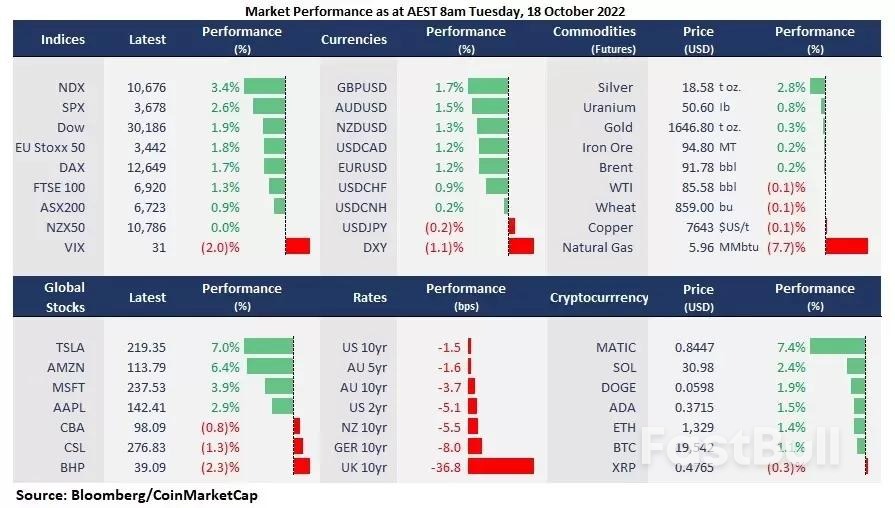
          U.S. stocks erased their losses from Friday's session, opening higher and then trading quite flat until the close. The S&P500 rose 2.65% and the NASDAQ was up 3.43%.
          Falling bond yields may have helped restore some confidence, and this may have been helped by tailwinds from the UK Gilts market, where new Chancellor, Jeremy Hunt, took an axe to the previous mini-budget and put the UK's finances on a sounder footing.
          30Y UK Gilt yields fell 40.2bp, the 10Y dropped 35.7bp and 2Y Gilt yields declined by 33.3bp. 10Y European government bond yields declined by about 8bp on average, while the 10Y U.S. Treasury yield was down just 0.8bp.
          Equity futures suggest that the positive tone will persist into today's trading, and this could help lift the EUR further. EUR/USD rose to 0.9843 yesterday from about 0.972 and could be buoyed further if risk sentiment holds up. The AUD is trading just below 63 cents, after touching 0.6189 briefly yesterday.
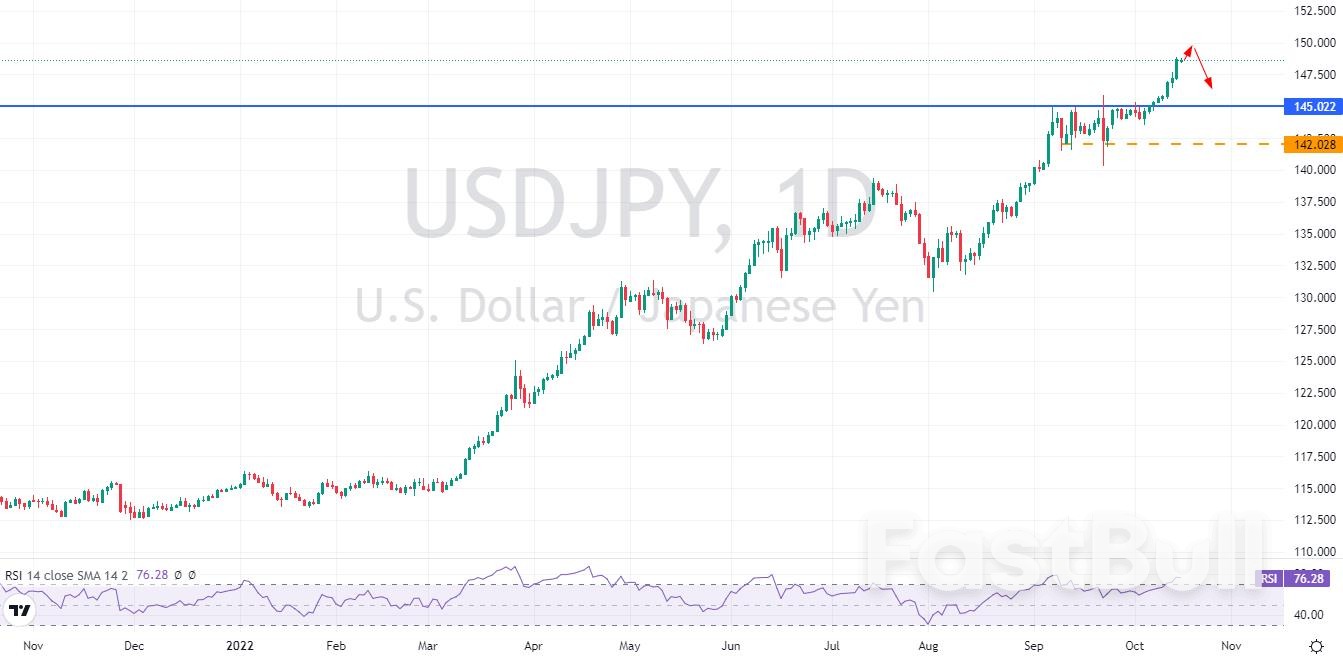
          Cable has recovered all the way to 1.1356, though it looked as if it might hit 1.145 at one point yesterday. But the JPY seems to be looking at further weakness, missing out on the G-10 rallies, and edging ever closer to 150. The BoJ will be getting anxious after their recent jawboning seems to have fallen on deaf ears.
          Asian FX has lagged behind the G-10 rally, and will likely pick up the slack today. Yesterday, the VND was the weakest of the Asia pack, dropping as the central bank widened the trading band to 5% (from 3%) on either side of the fixing rate.

          G-7 Macro

          It is very quiet on the G-7 calendar today. Germany's ZEW business survey is probably the main pick of the day.
          The expectations component of the survey is not far above the Global Financial Crisis low of -63.9, and could well push below that today. The consensus expects it to fall to -66.5.

          China

          There are some delays to the economic data scheduled for release during the Party Congress. These include the customs export and import numbers, which were scheduled for release yesterday, as well as GDP, retail sales, industrial production, and fixed asset investment, which were previously scheduled for release today. We aren't concerned that the release in the data is because it is particularly weak.
          Although we don't expect it to paint a particularly positive picture of the Chinese economy when it is eventually released. Rather, the delay suggests that the government believes that the 20th Party Congress is the most important thing happening in China right now and would like to avoid other information flows that could create mixed messages.

          Source: ING

          Risk Warnings and Disclaimers
          You understand and acknowledge that there is a high degree of risk involved in trading. Following any strategies or investment methods may lead to potential losses. The content on the site is provided by our contributors and analysts for information purposes only. You are solely responsible for determining whether any trading assets, securities, strategy, or any other product is suitable for investing based on your own investment objectives and financial situation.
          Comments
          Add to Favorites
          Share

          Wall Street Rallies to Kick Off The Week Ahead of Major Tech Earnings

          Damon

          Stocks

          Bond

          Forex

          US stocks rebounded strongly amid a tech-fuelled rally after a drop last Friday. There is a combination of reasons why stock markets continued the rebounding momentum since hotter-than-expected US CPI data was released last week. Firstly, rates eased surging after the UK's new finance minister Jeremy Hunt made a U-turn of the previously proposed tax-cutting plan. The UK 10-year gilt yield fell to 3.96% from 4.32% a day ago, boosting the British Pound to jump 1% against the US dollar. Secondly, a bunch of US big banks' earnings came in stronger than expected, leading earnings optimism into the second half of October. Netflix and Tesla's shares jumped 6.6% and 7%, respectively, ahead of their third-quarter earnings reports on Wednesday and Thursday. Third, major US indices are at key technical support levels, algorithmic trading may have caused short covering in positions.Wall Street Rallies to Kick Off The Week Ahead of Major Tech Earnings_1
          S&P 200 rebounds at the 200 weekly moving average, with the pivotal support around 3,500. All 11 sectors in the S&P 500 finished higher, with consumer discretionary leading gains, up 4.23%. The other two growth sectors, including technology and communication services, were also up more than 3%. And Real Estate jumped 3.9% amid banks' earnings optimism.
          Goldman Sachs is reportedly planning to merge trading and investment banking, making its four main divisions into three, one day ahead of the third quarter earnings reports, which is the third reorganization since 2018. The bank will also split the money-losing consumer banking between two new divisions. Apparently, the bank is under pressure due to a downgrade in valuation by analysts.
          Credit Suisse considers selling its US asset management business, CSAM, amid its billions of dollars in losses. The unit may draw interest from private equity firms, while the bank is also in process of selling its securitized products, according to Bloomberg.
          USD/JPY tops 149, the highest since September 1990 after the BOJ confirmed to keep its ultra-loss monetary policy last week, while the US dollar index fell due to a slide in global bond yields, with most major currencies jumping about 1% against the greenback.
          Asian markets are set to open higher following a strong close on Wall Street. ASX futures were up 0.92%. Nikkei 225 futures jumped 1.42% and Hang Seng Index futures rose 1.81%.
          Crude oil was flat on mixed signals that the Chinese Party Congress offered over the weekend. President Xi's speech shows that the country's zero Covid policy will remain while continue supporting property and technology with stimulus measures. A softened US dollar also helped ease falls in the prices on Monday.
          Gold futures finished higher after paring early gains. The precious metal may continue to be under pressure of rising rates and a strong dollar, with a key resistance level around the 20-day MA at 1,677.

          Source: CMC

          Risk Warnings and Disclaimers
          You understand and acknowledge that there is a high degree of risk involved in trading. Following any strategies or investment methods may lead to potential losses. The content on the site is provided by our contributors and analysts for information purposes only. You are solely responsible for determining whether any trading assets, securities, strategy, or any other product is suitable for investing based on your own investment objectives and financial situation.
          Comments
          Add to Favorites
          Share

          Trade outlook 2023: Slow Steaming in Rough Waters

          Kevin Du

          Global trade growth held up well in 2022, before entering the slow lane

          So far this year, global merchandise trade has held up extremely well given the volatile and uncertain environment, with world goods trade standing at 4.7% year-to-date (January to July) according to CPB world trade data. Despite households worrying about the rising cost of living and the end of lockdowns, which resulted in a shift back to services and travelling, consumers' appetite to spend on physical things was still running high in the first half of the year compared to the previous year.
          Looking at the details, the eurozone and the US registered YTD growth of around 6%, while the UK figure was in double digits, thanks to an extremely low comparative base of 2021. Emerging economies registered a solid growth rate of 4.1%. Only Eastern Europe/CIS and China's YTD growth figures were in negative territory with the former being especially hampered by the war in Ukraine and the latter suffering from Covid lockdowns. Although we expect the rest of the year to result in subdued goods trade, global trade will still likely see a growth rate of 3.8% this year, far better than we had expected back in April and much closer to our initial call of 4.1% in January.

          Resolved congestion at US bottleneck port illustrative of supply chain relief

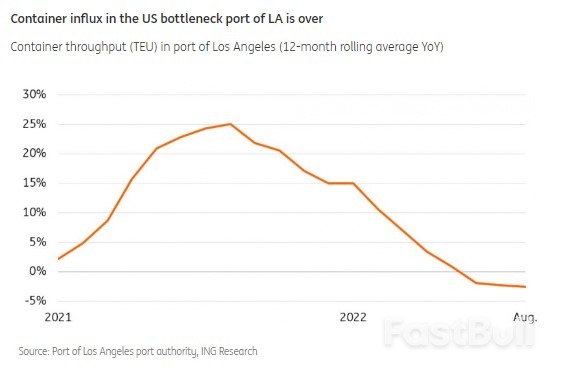
          Slowing consumer demand is bringing relief to global supply chains. After an unprecedented wave of incoming containers, leading to record throughput and peaking congestion in dominant US container gateway LA-Longbeach in early 2022, volumes trended down. With operations fully resumed after Covid, the impressive backlog of waiting vessels was quickly reduced and almost cleared in September. To avoid new supply chain disruptions and build resilience, shippers in the US increased their inventories to relatively high levels in the first quarter of 2022, according to the logistics managers index. They also started ordering early for the holiday season, which flattened the traditional peak season (the third quarter). At the same time, consumers shifted back to services and started to cut spending on goods. This created a 'Bullwhip effect' of self-reinforcing inventory moderation across the supply chain which drove volumes down. Consequently, the 12-month rolling TEU-throughput has slipped into negative territory. And this could continue for a while. The slack in spending on goods (or normalisation) is also reflected in the parcel delivering figures of FedEx and other delivery companies. Moreover, global air cargo volume – known as an early indicator for consumer products demand – has also slumped since early 2022, showing a 5% decline YTD after an initial strong recovery in 2020 and 2021.

          Trade outlook 2023: Slow Steaming in Rough Waters_1But congestion and delays won't completely end before 2023

          Although major ports, including US-bottleneck LA-Long Beach and Shanghai, have managed to get through unprecedented backlogs, there is still a long way to go before global congestion eases. In the US, more ships are directed to the East Coast and elsewhere, diverted to smaller ports which still see more delays. This is also the reason why transatlantic container rates are at more elevated levels. Ocean timelines of cargo ex-works until the port of destination have improved since their peak at the start of 2022, but they still hover around double the pre-pandemic lead times of around 80-90 days. This also means that arrival performance has a long way to go to return to normal levels. Since May, global schedule reliability, tracked by Sea Intelligence, has embarked on a cautious recovery path, standing at 46.2% in August. However, this is still a far cry from the 2018-19 average of 74%. Some 7% of the fleet is stuck queuing up in ports around the world, with 11% of goods still being blocked on waiting container ships.

          Falling container rates mark a turning point in transport and trade costs

          Softening demand has sent spot rates on the major trade lanes down, ending an extraordinary two-year period in container shipping. Spot rates have been coming down for longer on the main trades from Asia, but higher contract rates and an initiated shift to longer-term contracts by container liners pushed average transport costs for larger shippers up in the first half of 2022. Mid-year, Maersk had 71% of shipments fixed in long contracts. Nevertheless renegotiated contracts have likely reached a turning point as well. And with falling average global earnings for vessels, the mixed bucket of tariffs for shippers is now beyond its peak, and with the economic headwinds, the balance could quickly shift. Smaller shippers now benefit the most from lower tariffs as they are usually dependent on the spot market. Dry bulk rates have also weakened, although they still hover above pre-pandemic levels. Yet, contrary to the container market, tanker rates have rallied after a difficult pandemic phase with lower oil demand – with the Ukraine war having severe implications for the oil and tanker market.
          Trade outlook 2023: Slow Steaming in Rough Waters_2Overall, global supply chain pressures have come down from the peak registered in December 2021, but are still some way off their average level, meaning that supply chain uncertainty is still an everyday reality for the rest of 2022. Shippers have anticipated that.
          Our outlook for 2023: receding demand meets over-supply

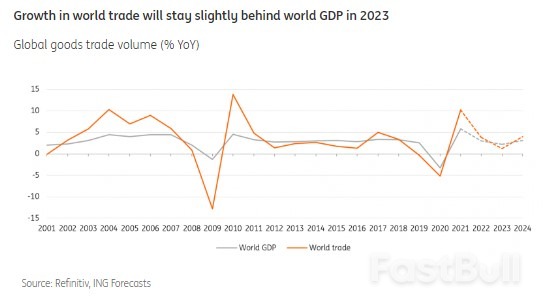
          The current market moderation is expected to spill over into 2023. With recessionary scenarios running high, we don't expect world trade to exceed 2% next year and are pencilling in a subdued growth rate of 1.2% for global goods trade. This falls behind expected GDP growth. With 1) consumer demand faltering, 2) the energy and subsequent inflation crisis persisting, and 3) ongoing labour and material shortages, there are simply not enough silver linings to keep global goods trade robustly flowing. Energy prices are very likely to remain high, burdening companies' cost competitiveness and households' purchasing power, despite government compensation packages.

          Trade outlook 2023: Slow Steaming in Rough Waters_3US and European demand-side weakness tempers expectations, while Asia holds up better
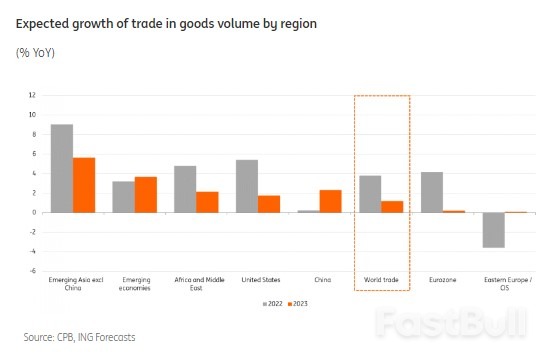
          Although governments around the world are trying to support the demand-side with large fiscal stimulus packages, the uncertainty around the final energy bill in Europe, tightening credit conditions in the US, and a subdued growth environment in China do not speak in favour of robust demand. Consumers face economic uncertainty and the strong dollar has led to more expensive cross-border shopping in China. The European picture shows similarities, as European consumer confidence has tested new lows amid the energy crisis. While consumer spending in the US held up relatively well in 2022, we expect it to fall in 2023 due to rising interest rates resulting in ever-tighter credit conditions and rising unemployment, further weighing on demand.
          Consequently, trade in consumer products is expected to stick below growth averages next year. On the industrial side, sliding new export orders (PMI) also indicate a slowdown, with Europe in the eye of the energy storm. Order books, while still reasonably filled, are declining. Meanwhile, trade in Asia might fare better than elsewhere next year with the region better able to weather disruptions. Intra-Asian trade has proved robust with many companies reorienting and diversifying their business activities towards Asia excluding China. Once again, we expect intra-Asian trade to show higher growth rates than overall trade.
          Global energy supply remains tense
          The winter season of 2023/24 could prove more challenging for gas supplies with minimal Russian gas flows. Therefore, building inventories will become more challenging next year, leading to gas prices rising to 200€/MWh. The EU ban on Russian oil comes into force on 5 December, followed by a refined products ban on 5 February, which might lead to a decline in the Russian oil supply. If insurance and shipping firms are stopped from providing transportation of Russian energy products above the agreed-upon cap by the G7, the international energy supply will automatically be curtailed and global trade patterns will shift. Although other large tanker 'flag states' like Liberia and Panama could step in by taking the leading role in transporting Russian oil around the world from Greece, Cyprus, and Malta, this shift won't come without obstacles. In addition, China and India are wary of the risk of secondary sanctions, which might limit their appetite for Russian commodity products next year.

          Ongoing labour and material shortages persist

          There is a significant risk of strikes and labour negotiations in the transportation sector due to spiking inflation and eroding purchasing power. Strikes in all parts of the world this year, such as in the US, UK, Germany, South Africa and South Korea have made the transport sector hold its breath. And the war in Ukraine remains a downside risk. As we've written previously, 10.5% of all seafarers come from Russia and 4% from Ukraine, according to the International Chamber of Shipping. With Russia possibly announcing a full mobilisation, already persisting shortages of sailors could, in theory, intensify. Then, new Covid-19 lockdowns in China might return in 2023. Although restrictions have tended to become shorter and more focused, activity will be impacted nonetheless. As a result of the persistent zero-Covid policy, congestion in Chinese ports increased significantly this year, with container dwell times on the import-side soaring due to difficulties with inland connections and closed factories in the region. This creates production backlogs, leading to a wave of export traffic through the port later and affecting global ports and sailing schemes as well.

          Trade outlook 2023: Slow Steaming in Rough Waters_4Continued recovery of oil product flows support trade in 2023
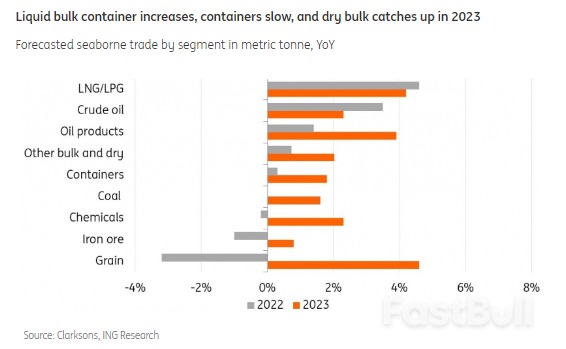
          More than 80% of world trade is seaborne. The breakdown in typical flows shows a mixed picture but is expected to sum up to just above 2% year-on-year in 2023 in terms of tonnage. This exceeds our forecast for world goods trade (in value), which can be explained by the fact that the energy crisis leads to more seaborne transport of energy carriers (like liquefied natural gas [LNG]). Next to that, airfreight carries mainly consumer goods, which has a more moderate outlook.
          Demand for oil and oil products is continuing to catch up after the pandemic setback and this is expected to continue in 2023, although the economic slowdown will weigh on demand. The European urgency to replace piped natural gas is also leading to a rush for seaborne LNG flows, but in terms of trade this is mainly a replacement of piped gas.
          On the container side, the inflationary environment with eroded purchasing power continues to temper demand for consumer goods in 2023, with growth sticking under 2% which is well below its long-term average. For dry bulk flows, 2023 is set to be a better year as industrial demand from China (particularly important for iron ore) is expected to catch up. On the other side, demand for coal from Europe continues to be strong and hampered grain trade due to the Black Sea blockage in 2022 is assumed to be less disturbed. Trade outlook 2023: Slow Steaming in Rough Waters_5

          2023 balance and rates: clearing backlogs and new capacity put extra pressure on container tariffs

          Next year we won't see another shortage in container shipping, as subsiding backlogs will boost productivity and a flood of new vessels will come online from 2023 amid a weakened market. Twenty-eight percent of the current installed fleet capacity is on order and just under half of that is expected to be delivered over the course of next year. This obviously threatens to accelerate the downward trend in spot prices. But container rates will not go down the drain, for these three reasons (in addition to the strong dollar):
          Better capacity management
          During the pandemic, container liners and alliances learned how to better manage capacity cancelling and cooperate in alliances, by cancelling scheduled sailings (blank sailings), (super) slow steaming, and scrapping less efficient older-generation vessels. During the previous two periods, scrapping numbers were extremely low and new IMO energy efficiency and intensity standards from 2023 (also turning into a vessel rating) will have an influence on this perspective.
          Increasing operational costs and larger capital investments
          Second, costs are higher in general due to increases in compliant fuel, port and infrastructure fees (for example, the Suez Canal rate hike of 15%) and wages. Next, ordered dual fuel and new-generation vessels require larger capital investments. And alternative fuels like LNG, biofuels and methanol are more costly. Lastly, more regulation is coming: in Europe, shipping is proposed to be included in the emissions trading scheme (ETS) as part of the new climate strategy, and the FuelEU Maritime proposal prescribes an annual reduction of the carbon-intensity of existing ships by 2% in 2025 which leads to the increased use of more expensive low carbon fuels. On a global scale, collectives including the getting to zero coalition and cargo owners for zero-emission vessels are also pushing for low-carbon solutions from 2030. The bottom line is, the cost base will be higher.
          Global supply chains are still fragile and exposed to volatility, leading to fragile supply chains
          Third, the war in Ukraine has disrupted the market, leading to trade inefficiencies such as longer routes. The workforce is also still stretched and spiking inflation could lead to more strikes and interruptions at ports. Lockdowns are still a local disruptive threat in China, while extreme weather events are a bigger operational risk in shipping. This means costly frictions remain a threat.

          Extreme weather is considered a bigger threat for supply chains than it used to be

          For the second time in only four years, low water levels in Germany's main rivers have seriously threatened economic activity, with most of the goods transported being intermediate goods and raw materials that are required for further processing in other industries and are preferably transported by ship, including bulk goods such as coal and steel, dangerous goods and heavy goods. In the US, falling water levels in the Mississippi River are currently log-jamming more than 100 vessels. In China, heatwaves and little rainfall have caused drought in the southwestern Chinese province of Sichuan, a hydroelectric power producer. Some factories in western China have been affected by limited-to-no-power supply, shopping malls have little air-con and lighting, and some apartments have been left without a working lift. Extreme weather events are becoming an ever-larger threat to the transportation sector, seriously affecting supply chains and hampering world trade. With extreme weather events on the rise, weather forecasts represent a disruptive threat urging resilience in global supply chains.

          Source: ING

          Risk Warnings and Disclaimers
          You understand and acknowledge that there is a high degree of risk involved in trading. Following any strategies or investment methods may lead to potential losses. The content on the site is provided by our contributors and analysts for information purposes only. You are solely responsible for determining whether any trading assets, securities, strategy, or any other product is suitable for investing based on your own investment objectives and financial situation.
          Comments
          Add to Favorites
          Share

          'Avatar Jail': Does the Metaverse Need Its Own Police Force?

          Kevin Du
          Two people enter the metaverse. They appear as avatars, wear virtual reality headsets and haptic suits that provide virtual feedback to the body. One person virtually assaults the other. What happens next?
          It sounds utterly unreal but experts believe the metaverse's murkier side, and the potential for crime from assault to hacking to even avatar rape, has yet to be fully considered.
          How to police the metaverse ― an online world where people may live their lives in the form of avatars ― has, then, opened a new frontier for governments, technological companies and police forces.
          The issue was in sharp focus this week at Abu Dhabi's International Exhibition of National Security and Resilience conference where attendees heard hard questions being asked about trying to police the metaverse.
          "If we start to see the metaverse doing what I think it will do, which is become ever more realistic and ever more huge, then you have to start to ask very difficult questions about what physical policing in virtual reality represents," said Gareth Stubbs, a former UK police officer who spoke at the conference on Monday.
          "If we introduce haptic suits with feedback from bodily touch … that opens up a huge amount of crime categories that focus on the body," said Mr Stubbs, who lectures at Rabdan Academy in Abu Dhabi.
          "It could be regulated through things such as consent. But it is open to abuse and open to hacking and open to impersonation."

          What is the metaverse?

          The metaverse is envisaged as a new online world where someone with a 3D avatar ― a representation of yourself ― uses a virtual reality headset to go to concerts, work or just socialise. It was first mentioned in a 1992 science fiction novel, Snow Crash. The online community, Second Life, that was released in 2003 was loosely based on the concept. But interest has increased in the past few years driven by advancements in technology and huge investment by companies such as Facebook, which rebranded as Meta in 2021.
          Some remain sceptical and it is thought the metaverse is still many years from fruition. However, interest is building and the UAE has announced it will establish a Ministry of Economy office there. Ajman Police has also conducted trials and Dubai's Metaverse Assembly last month attracted experts from across the world to explore its potential.
          But questions are also being asked about policing and about who is responsible for regulating it. There have even been reports of avatars harassing others in Meta's existing virtual reality world, Horizons.
          "Speaking from a US perspective, crimes in the metaverse relate mostly to inappropriate behaviour [harassment, use of explicit language, racism etc]," said Prof Marco Marabelli, an expert in the field who teaches at Bentley University in the US.
          "These are important issues. The problem is that because the metaverse 'runs' in real time, it is often difficult to keep digital traces of what happens on the platform or platforms. This makes it hard to prosecute perpetrators. This is a source of concern."

          Quicker response needed from regulators

          Experts at the Abu Dhabi conference suggested that governments and regulators around the globe were not moving quickly enough. Mr Stubbs said it was vital that the lawlessness of the early internet where criminals exploited the slow response of regulators was not repeated with the metaverse.
          "People would say it was the heyday of the internet," he said. "Yeah it was but a lot of bad stuff happened as well as the good stuff. Look at cybercrime. That has been stratospheric in growth. This was the untold story as the internet was developing.
          "Law and regulation … will take years to set up and you'll have that black spot … of unregulated space and that unregulated space gives space to bad actors. I'm not saying that's all you will get [but] we should not be ignoring it."
          Prof Marabelli said one of the problems with emerging technologies was that legislators often started to address the issue only once the damage was done.
          "One partial solution ... is to generate high level laws and regulations that protect basic rights of citizens with respect to technologies. Data privacy laws, laws that regulate how algorithms can be used with the general public with respect to transparency and accountability and so on," he said.
          "To this end, Europe is way ahead of the US," he said, pointing to the adaption of GDPR and the proposed first-ever legal framework on the use of artificial intelligence.
          "But recently the [President Joe] Biden administration is making important steps towards protecting citizens from inappropriate use of algorithmic-based systems," said Prof Marabelli, referring to the publication of the AI bill of rights, a set of guidelines that aims to encourage responsible use of artificial intelligence.
          He also pointed to the fact that governments don't lead technology research like they used to ― private companies do ― and they often do not have the tools to assess technology because these companies frequently do not share research data on their innovations and potential dark side. He referred to the Wall Street Journal article that found Instagram led young teens with eating disorders to actually eat less.
          "If it weren't for a whistleblower we would have never known about this internal research. This is highly problematic," said Prof Marabelli.

          How might the metaverse be policed?

          What would policing in the metaverse look like? First, the platforms could use online tools and artificial intelligence to detect errant behaviour. Meta even introduced a tool to try to stop bad behaviour where people can prevent others from interacting with them, but this puts the onus on users.
          Another is a system similar to speed cameras where someone who breaks the rules gets a fine in the real world, while a third is the emergence of volunteer police officers similar to moderators seen on social media groups today. But what is also possible, Mr Stubbs said, is a strange new world of police officer avatars dispensing online justice.
          "We might see … a police officer avatar on active patrol in much the same way as I'd be on foot patrol in Blackpool town centre," said Mr Stubbs, who spent years on the beat on council estates in Blackpool. "So it could be a visual deterrent."
          We could also see "avatar jail", because the avatar is so tied to your real life, not being allowed to use it would be a real punishment. "I know that's a reimaging of the custody system of sorts but it doesn't cause any physical harm to the person," Mr Stubbs said.
          "It is not technically incarceration but the boundaries are blurring. It is weird. But we will probably see the creation of a new type of policing in the metaverse. It won't look like the old one. The challenge will be to try to figure out what it looks like."

          How the metaverse will change the world

          Despite the scepticism from some quarters, investment is pouring into the metaverse. Meta chief executive Mark Zuckerberg this year said he envisioned a "billion people" in the metaverse spending hundreds of dollars each on digital goods. But experts caution that the VR headsets are still some way from being comfortable and it will take years before its potential to reshape sectors from education to health are seen.
          "It is currently at the centre of research of what we call 'future of work'," Prof Marabelli said.
          "However, the technology ... is still very immature. Mark Zuckerberg said he thinks the metaverse will be ready for the general public in five years from now. I think that a decade could be a more accurate bet. But it will come. And will change many work practices and possibly our private lives. As the internet and social media did."

          Source: The National News

          Risk Warnings and Disclaimers
          You understand and acknowledge that there is a high degree of risk involved in trading. Following any strategies or investment methods may lead to potential losses. The content on the site is provided by our contributors and analysts for information purposes only. You are solely responsible for determining whether any trading assets, securities, strategy, or any other product is suitable for investing based on your own investment objectives and financial situation.
          Comments
          Add to Favorites
          Share

          Targeted Energy Support in EU is Easier said than Done

          Cohen
          European Union governments have pledged "targeted and temporary" support against high energy prices for households and firms, so as not to undermine central bank efforts to fight inflation, but officials warn it will be politically very difficult to deliver.
          Speaking on the sidelines of the IMF and World Bank meetings in Washington, senior euro zone officials said political pressure to shield voters and their jobs in the face of soaring energy prices was stronger than dry macroeconomic calculations.
          "If some two thirds of inflation comes from an external energy supply shock, rather than from excessive demand, will tightening fiscal policy solve it? No," one senior euro zone official said.
          "For politicians this is a very difficult situation, nobody really knows how to reconcile the monetary and fiscal policy aspect and, in the end, everybody is doing what they have to do to keep their voters shielded," the official said.
          But protecting households and firms with public money acts effectively as an economic stimulus programme, working against the European Central Bank's efforts to tame record inflation and weakening the price signal meant to reduce demand.
          To avoid fuelling inflation, euro zone finance ministers pledged to keep such help temporary and targeted, but EU Economics Commissioner Paolo Gentiloni, a former Italian prime minister, said in September it would be hard to keep to this goal.
          "I know it is very difficult because when you introduce a measure the tendency to leave it there is inevitable and it is difficult to limit your support to certain groups," he said.
          The very terms of "targeted and temporary" are understood differently among euro zone finance ministers, causing a lot of tension during discussions, officials said.
          "Targeted could mean targeting the poorest in the society, but it could also mean targeting the root of the problem, which means high energy prices," a second euro zone official said, also noting that in a crisis situation it was difficult for politicians to hand out help to some but not to others.
          "Temporary is also tricky -- if you raise minimum wages or welfare to help the poorest, it will stay that way," he said.

          Households Vs Companies

          IMF's European Department head Alfred Kammer said a good example of targeted and temporary was help for low and middle-income households through lump-sum rebates on energy bills.
          But officials also note that since energy prices are not expected to fall back to levels seen before the start of the war in Ukraine anytime soon, it will be hard to decide when to withdraw those rebates.
          The different levels of support that euro zone countries can afford raise additional tensions, especially after Germany announced a support scheme for households and companies of up to 200 billion euros ($194 billion)-- an amount few other governments in Europe could match.
          While Berlin's plans were welcomed by voters and markets, a massive package announced in Britain that included freezing energy prices triggered a market backlash, showing not all countries have the same room for manoeuvre in the eyes of investors. Still, many officials feel governments don't have much choice.
          "In a cost-of-living crisis like this you have to protect the social fabric," a third senior euro zone official said.
          While help for households is generally accepted among euro zone governments, massive support for companies distorts competition in the EU's single market, giving firms from richer countries an unfair competitive advantage, officials said.
          "The real issue is with help for companies. Now it is every man [country] for himself, not a good situation," the first official said.
          Individual governments can handle support to households, officials said, but any help for companies should be coordinated at the EU level to preserve fair competition across the borders of the 27 countries forming the EU's single market.
          ($1 = 1.0289 euros)

          Source: Reuters

          Risk Warnings and Disclaimers
          You understand and acknowledge that there is a high degree of risk involved in trading. Following any strategies or investment methods may lead to potential losses. The content on the site is provided by our contributors and analysts for information purposes only. You are solely responsible for determining whether any trading assets, securities, strategy, or any other product is suitable for investing based on your own investment objectives and financial situation.
          Comments
          Add to Favorites
          Share

          How Britain's Pension Scheme Hedge Became a Trillion Pound Gamble

          Owen Li
          It started out simply enough: British pension schemes were looking for a way to match their assets to future pension payments.
          Schemes run for pharmacy Boots and bookseller WHSmith were early adopters in the 2000s of an investment strategy of dumping stocks for bonds, to shield themselves from interest rate changes.
          But fifteen years later, the strategy now adopted by nearly two-thirds of pension schemes has ended up revolving around financial derivatives rather than just bonds - injecting a growing amount of risk to schemes that is only now becoming apparent as interest rates surge.
          In the so-called LDI or liability-driven investment strategy that became popular, pension schemes would use derivatives - contracts that derive their value from one or more assets - to protect themselves from potential swings in interest rates. With a small amount of capital they could gain large exposures.
          There is a catch: if the derivative becomes loss-making for the pension fund because of a change in underlying asset prices, for example, it can be called up for more money, sometimes at short notice.
          None of this mattered for a long time and consultants predicted in 2018 that the market would soon reach the "The Age of Peak LDI" - it was so popular that the pensions industry was running out of assets to hedge.
          LDI assets quadrupled in a decade to 1.6 trillion pounds ($1.79 trillion) last year.
          But the strategy gradually became riskier, according to interviews with pension scheme trustees, consultants, industry experts and asset managers. Things began to unravel as Britain's Sept. 23 "mini-budget" sparked a jump in UK government bond yields, driving pension funds to race to raise cash to prop up their LDI hedges.
          Those derivatives came close to imploding, forcing the Bank of England to pledge on Sept 28 to buy bonds to calm the panic.
          The scale of the money using the LDI strategy, and ever higher borrowing through the derivatives, had amplified risks that appeared hidden during a decade of low interest rates.
          When rates began rising in 2022 and warnings about risk got louder, schemes were slow to act, according to those interviewed.
          "I do not like the term (LDI) and never did, it has been hijacked by consultants and has morphed into what we are seeing now," said John Ralfe, who in 2001 led the 2.3 billion pound Boots Pension Fund's shift into bonds. The fund didn't load up on debt, he told Reuters.
          "Pension schemes were doing disguised borrowing, it's absolutely toxic," Ralfe said. "There was much greater risk in the financial system than anyone - including me - would have thought."
          Boots did not respond to request for comment on Friday. WHSmith did not respond to request for comment on Thursday.
          Globally, investors are worrying about other financial products predicated on low interest rates, now that rates are rising.
          "The so-called LDI Crisis in the UK is just the symptom of a greater economic malaise," said Nicolas J. Firzli, executive director of the World Pensions Council.

          Riskier Bets

          In the two decades since Ralfe's time at Boots, defined benefit pension schemes - which guarantee retirees a set amount of pension payments - have loaded up on LDI and derivatives, using them to borrow and invest in other assets.
          If leverage in the LDI strategy was three times, for example, it meant the scheme only needed to spend 3.3 million pounds for 10 million pounds of interest rate protection.
          Instead of buying bonds to protect against falling rates - a key determinant of a scheme's funding position - a scheme could cover 75% of its assets, but only tie up 25% of the money, using the rest for other investments.
          The remaining money could be chanelled into higher-yielding equities, private credit or infrastructure.
          The strategy worked, and schemes' funding deficits narrowed because the hedges made them less exposed to falling interest rates. Lower interest rates require pension schemes to hold more money now for future pensions payments.
          This pleased companies and regulators.
          Asset managers including Legal & General Investment Management, Insight Investment and BlackRock offered LDI funds in a low-margin but big volume business. The FCA, which regulates LDI providers, declined to comment.
          Consultants such as Aon and Mercer pitched LDI to trustees, while The Pensions Regulator (TPR) - the government entity regulating pension funds - encouraged schemes to use liability matching to narrow deficits.
          Nearly two-thirds of Britain's defined benefit pension schemes use LDI funds, according to TPR.
          The strategy worked as long as government bond yields stayed below pre-agreed limits embedded in the derivatives.
          "LDI had been thought of (among clients) as a fire and forget strategy," said Nigel Sillis, a portfolio manager at Cardano, which offers LDI strategies.
          The industry had been "a little complacent" about the knowledge among pension trustees, he added.
          The risk grew over time. A senior executive at an asset manager which sells LDI products said leverage rose, with some managers offering tailored products of five times leverage, versus a maximum of two or three times a decade ago.
          Pension schemes had rarely been asked for extra collateral before 2022, and a risk-averse industry had become less prudent, the executive said, speaking on the condition of anonymity.
          TPR says no scheme has been at risk of going insolvent -- rising yields actually improve the funding position of funds -- but schemes lacked access to liquidity.
          Still, the regulator this week acknowledged that some funds would have suffered.
          When yields surged in an unprecendented move between Sept. 23 and Sept. 28, pension schemes were left scrambling to find cash for collateral. If they did not find it in time, the LDI providers wound down their hedges, leaving schemes exposed when yields tanked following the BoE intervention.
          A small minority of schemes would have seen a 10-20% worsening in their funding position, according to Nikesh Patel, head of client solutions at asset manager Kempen Capital Management.
          Simon Daniel, partner at law firm Eversheds Sutherland, said pension schemes were now arranging standby facilities with their sponsoring employers to get cash for collateral.

          Warnings

          Risks in LDI had been flagged for years.
          The Bank of England's Financial Policy Committee highlighted the need to monitor risks around LDI funds' use of leverage in 2018, BoE deputy governor Jon Cunliffe said this month.
          There were more warnings this year, especially as rates began to soar.
          Pensions consultants Mercer warned clients in June to "act quickly" to make sure they had cash. Aon said in July that pension funds should prepare for "urgent intervention" to protect their hedges.
          TPR had "consistently alerted trustees to liquidity risk", CEO Charles Counsell said this week.
          Yet in the slow-moving world of pension funds, where trustees and consultants tend to draft investment strategy shifts over years, not weeks, few funds were reducing leverage or boosting collateral, according to consultants and trustees.
          Some of the most sophisticated pension schemes were even bulking up on LDI this year, after rates started to rise.
          The Universities Superannuation Scheme, Britain's biggest pension fund, earlier this year partly linked a decision to raise exposure to LDI to the "distinct possibility of further falls in UK real interest rates", against which it needed to protect its 90-billion-pound portfolio.
          Britain's 30-year inflation linked bond yield has tripled since late June.
          In a statement this week USS defended its approach, noting it had plenty of cash to meet margin calls and that it was not a forced seller of assets. It said it was comfortable if rates rose and hedging became costlier.
          That discussion had barely started elsewhere.
          "When people talked about interest rates, all they obsessed about was interest rates falling," said David Fogarty, an independent trustee at professional pension scheme trustee provider Dalriada Trustees.
          "There were not many discussions about leverage either."

          Source: Reuters

          Risk Warnings and Disclaimers
          You understand and acknowledge that there is a high degree of risk involved in trading. Following any strategies or investment methods may lead to potential losses. The content on the site is provided by our contributors and analysts for information purposes only. You are solely responsible for determining whether any trading assets, securities, strategy, or any other product is suitable for investing based on your own investment objectives and financial situation.
          Comments
          Add to Favorites
          Share

          Market Outlook for the Week-Foreign Exchange

          Winkelmann

          Central Bank

          Last week, the U.S. September consumer price growth exceeded expectations as housing rents rose to a record high since 1990 and food costs increased as well, with the core CPI rising 6.6% year-on-year, the largest increase since August 1982. Earlier announced the U.S. September PPI rose more than expected, and inflation stayed high, reinforcing the Fed's expectation of a 75 bps rate hike in November, and the market even began to partially bet on the Fed to raise rates by 75 bps in December.
          At the same time, speeches from Fed officials are also very hawkish, despite concerns from all walks of life that excessive Fed rate hikes will exacerbate the risk of global recession, especially in emerging market countries, the Fed almost unanimously believes that reducing inflation is still the top priority. The market expects the Fed to raise interest rates further, with the peak rate likely to reach 5% next year.
          Overall, the Fed's hawkish stance has pushed the dollar's continued strengthening, while the global central banks' synchronized rate hikes to combat inflation could send the world economy into recession, and with concerns about the geopolitical situation, the dollar also plays a safe-haven attraction. In the short term, although the Fed has raised interest rates by a cumulative 300 bps so far this year, U.S. inflation has eased less than expected and is still a long way from the long-term inflation target of 2%. With continued inflationary pressures, the Fed is expected to remain relatively tight, and the dollar's gains are likely to continue.

          EURUSD

          Recently, with the approach of the winter heating season and the escalation of the Russia-Ukraine conflict, the energy crisis in Europe continues to fester and the soaring cost of energy has increased inflationary pressure in Europe. The latest data shows that in September this year, the CPI in the 19 countries of the Eurozone recorded a year-on-year increase of 10%, a record high. This also prompted the European Central Bank to continue to raise interest rates.
          However, the risk of recession is increasing due to the weakness of the eurozone economy, which is also facing additional pressure from geopolitical tensions. The latest economic data show that the European economy has slowed sharply, and the IMF expects GDP growth in the European advanced economies to fall from 3.2% in 2022 to 0.6% in 2023. As the European Central Bank's speed of raising interest rates can not keep up with the speed of the United States, the euro is still facing greater downward pressure.
          This week will also be published in the euro zone September CPI final and economic expectations survey, expected inflation will remain high. Investors also need to pay attention to the speeches of the European Central Bank officials, as well as the EU leaders' summit and news on the geopolitical situation.
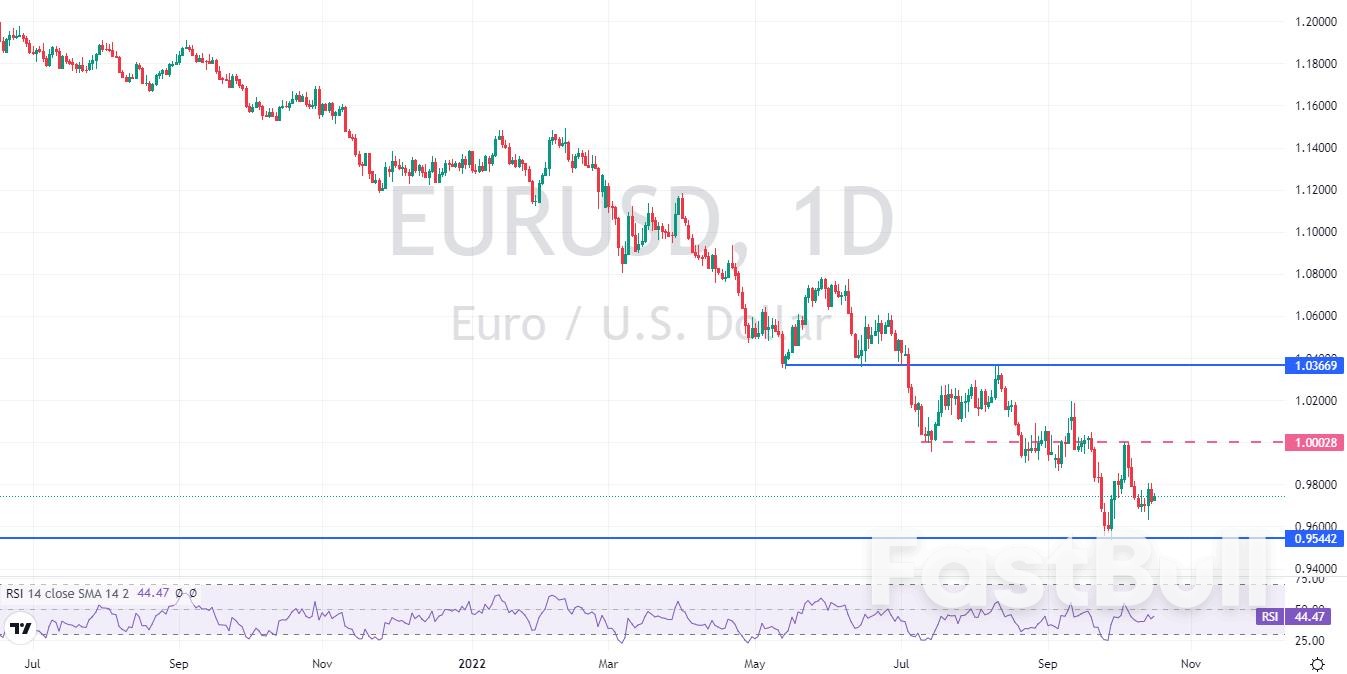
          Technical graphics show that EURUSD has recently continued to oscillate below the 1.00 mark, and although it has occasionally rebounded, it has not changed its short-side trend.
          This week is still dominated by oscillations, with both long and short opportunities. 1.00 is still the resistance that the bulls need to overcome, while the support below near 0.9540 is also obvious and difficult to break in the short term.
          Market Outlook for the Week-Foreign Exchange_1

          GBPUSD

          Recently, the British pound is largely affected by the British "debt market crisis". British Prime Minister Truss came to power after the launch of the largest tax cut plan in 50 years, triggering market panic, and the United Kingdom suffered a "stock, debt and exchange" triple kills, forcing the Bank of England to "buy bonds to save the market".
          Until recent days, forced to pressure political pressure, British Prime Minister Truss replaced the Chancellor of the Exchequer Kwarteng, the new Chancellor of the Exchequer Hunt is considering the cancellation of most of the tax cut plan. The confusion over the UK's fiscal policy and political situation has exacerbated concerns about the UK's economic outlook and continues to put downward pressure on the pound.
          Almost all indicators show that the UK is in the midst of a historically rare energy crisis and high inflation, and the economic outlook continues to deteriorate, the UK's fiscal stimulus will increase inflationary pressures in the medium term, apparently undermining the central bank's monetary policy, the difficulty of reducing inflation has become more difficult, coupled with the continued pressure of the rising dollar, the outlook for the pound is not optimistic. At least until British economic growth really rebounds, the pound's downtrend is unlikely to reverse.
          This Friday will be released the UK consumer confidence index for October, and market pessimism may further pressure the pound.
          From the Technical graphic, GBPUSD has fallen for two consecutive weeks, leaving a long upper shadow line, indicating that the pressure above is high, and may still oscillate down in the short term under the pressure of the lower trend line. Once the support around 1.0945 is broken, the pound will go further down to 1.055 and around 1.036, and if it continues to break down, it may fall towards 1.00.
          Market Outlook for the Week-Foreign Exchange_2

          AUDUSD

          Recent global recession fears continue to fester, the U.S. dollar continues to firm, while commodity prices such as crude oil are relatively weak, and the risk-sensitive commodity currency, the Australian dollar, remains weak to the downside.
          This week the Australian Federal Reserve will release its monetary policy meeting minutes, which are expected to remain the same old story, with its policy bias depending on economic data and still raising interest rates for some time to come... Given that the pace of interest rate hikes by the Australian Fed is slower than the Fed, the strong dollar is still suppressing the Australian dollar to the downside, and Fed officials will still make frequent appearances this week to take a stand, whose speech tone and guidance on interest rates will continue to influence the trading sentiment of the dollar and foreign exchange markets.
          Looking at the technical graphic, AUDUSD continues to oscillate downward trend, and the oscillation range continues to move down, keeping the short term in the low finishing, with multiple cycle RSI indicators located below the midline 50, the overall is still weak. Once it falls below 0.6200, the rebound back to test and will not break, which will open further downside space. However, one needs to beware of the risk of an oversold rally, which is expected to further rebound to 0.6400 and around 0.6530 if it breaks above 0.6330.Market Outlook for the Week-Foreign Exchange_3

          USDJPY

          The weakening trend of the yen continues due to the huge divergence in monetary policy between the US and Japan, despite the previous intervention by the Japanese government, which eased the depreciation of the yen to some extent. However, with the recent renewed strength of the dollar, the depreciation of the yen has far exceeded the last intervention level of 145.0 and broken through 148.0, while the Japanese government has stayed put, indicating that the Japanese government may not be defending a particular exchange rate level, but simply does not want to see the yen fluctuate too much.
          Tracing the action of intervention in the depreciation of the yen in 1998, it took several consecutive interventions to really stop the yen's decline, and this time may not be an exception, especially before the Fed's interest rate hike cycle has reached an inflection point, even if the Japanese government intervenes in the currency market again, it may not be able to stop the long-term upward trend of the dollar against the yen. The market may still challenge the 150.0 level to the upside, though one still needs to be wary of the risk of an overbought pullback and unexpected intervention by the Japanese government.
          From a technical graphic point of view, USDJPY accelerated further higher after breaking 145.0, getting closer to the key psychological level of 150, and the RSI indicator is also severely overbought, which does not rule out the possibility of a high retracement, with the downside direction focusing on the support of 145.0 and 146.0 levels.
          Market Outlook for the Week-Foreign Exchange_4
          Risk Warnings and Disclaimers
          You understand and acknowledge that there is a high degree of risk involved in trading. Following any strategies or investment methods may lead to potential losses. The content on the site is provided by our contributors and analysts for information purposes only. You are solely responsible for determining whether any trading assets, securities, strategy, or any other product is suitable for investing based on your own investment objectives and financial situation.
          Comments
          Add to Favorites
          Share
          FastBull
          Copyright © 2025 FastBull Ltd

          728 RM B 7/F GEE LOK IND BLDG NO 34 HUNG TO RD KWUN TONG KLN HONG KONG

          TelegramInstagramTwitterfacebooklinkedin
          App Store Google Play Google Play
          Products
          Charts

          Chats

          Q&A with Experts
          Screeners
          Economic Calendar
          Data
          Tools
          Membership
          Features
          Function
          Markets
          Copy Trading
          Latest Signals
          Contests
          News
          Analysis
          24/7
          Columns
          Education
          Company
          Careers
          About Us
          Contact Us
          Advertising
          Help Center
          Feedback
          User Agreement
          Privacy Policy
          Business

          White Label

          Data API

          Web Plug-ins

          Poster Maker

          Affiliate Program

          Risk Disclosure

          The risk of loss in trading financial instruments such as stocks, FX, commodities, futures, bonds, ETFs and crypto can be substantial. You may sustain a total loss of the funds that you deposit with your broker. Therefore, you should carefully consider whether such trading is suitable for you in light of your circumstances and financial resources.

          No decision to invest should be made without thoroughly conducting due diligence by yourself or consulting with your financial advisors. Our web content might not suit you since we don't know your financial conditions and investment needs. Our financial information might have latency or contain inaccuracy, so you should be fully responsible for any of your trading and investment decisions. The company will not be responsible for your capital loss.

          Without getting permission from the website, you are not allowed to copy the website's graphics, texts, or trademarks. Intellectual property rights in the content or data incorporated into this website belong to its providers and exchange merchants.

          Not Logged In

          Log in to access more features

          FastBull Membership

          Not yet

          Purchase

          Become a signal provider
          Help Center
          Customer Service
          Dark Mode
          Price Up/Down Colors

          Log In

          Sign Up

          Position
          Layout
          Fullscreen
          Default to Chart
          The chart page opens by default when you visit fastbull.com