• Trade
  • Markets
  • Copy
  • Contests
  • News
  • 24/7
  • Calendar
  • Q&A
  • Chats
Trending
Screeners
SYMBOL
LAST
BID
ASK
HIGH
LOW
NET CHG.
%CHG.
SPREAD
SPX
S&P 500 Index
6850.25
6850.25
6850.25
6878.28
6841.15
-20.15
-0.29%
--
DJI
Dow Jones Industrial Average
47821.44
47821.44
47821.44
47971.51
47709.38
-133.54
-0.28%
--
IXIC
NASDAQ Composite Index
23533.89
23533.89
23533.89
23698.93
23505.52
-44.23
-0.19%
--
USDX
US Dollar Index
99.150
99.230
99.150
99.160
98.730
+0.200
+ 0.20%
--
EURUSD
Euro / US Dollar
1.16173
1.16180
1.16173
1.16717
1.16162
-0.00253
-0.22%
--
GBPUSD
Pound Sterling / US Dollar
1.33114
1.33124
1.33114
1.33462
1.33053
-0.00198
-0.15%
--
XAUUSD
Gold / US Dollar
4192.95
4193.29
4192.95
4218.85
4175.92
-4.96
-0.12%
--
WTI
Light Sweet Crude Oil
58.910
58.940
58.910
60.084
58.837
-0.899
-1.50%
--

Community Accounts

Signal Accounts
--
Profit Accounts
--
Loss Accounts
--
View More

Become a signal provider

Sell trading signals to earn additional income

View More

Guide to Copy Trading

Get started with ease and confidence

View More

Signal Accounts for Members

All Signal Accounts

Best Return
  • Best Return
  • Best P/L
  • Best MDD
Past 1W
  • Past 1W
  • Past 1M
  • Past 1Y

All Contests

  • All
  • Trump Updates
  • Recommend
  • Stocks
  • Cryptocurrencies
  • Central Banks
  • Featured News
Top News Only
Share

Israeli Prime Minister Netanyahu: Hamas Has Violated The Ceasefire Agreement, And We Will Never Allow Its Members To Re-arm Themselves And Threaten US

Share

Israeli Prime Minister Netanyahu: We Are Working To Return The Body Of Another Detainee From The Gaza Strip

Share

Iraq's West Qurna 2 Oil Field Will Increase Oil Production Beyond Normal Levels To Compensate For The Production Stoppage Caused By The Trump Administration's Sanctions Against Russia

Share

Israeli Prime Minister Netanyahu: We Are Close To Completing The First Phase Of Trump’s Plan And Will Now Focus On Disarming Gaza And Seizing Hamas Weapons

Share

Moody's Affirmed Burberry's Long-term Rating Of Baa3 And Revised Its Outlook (from Negative) To Stable

Share

The Trump Administration Supports Iraq's Plan To Transfer Russian Oil Company Lukoil Pjsc's Assets In The West Qurna 2 Oil Field To An American Company

Share

JMA: Tsunami Of 70 Centimetres Observed In Japan's Kuji Port In Iwate Prefecture

Share

The U.S. Bureau Of Labor Statistics Plans To Release A Press Release On January 15, 2026, For November 2025, Along With Data For October

Share

Tiger Global Has Established A New Fund, Aiming To Raise $2 Billion To $3 Billion

Share

The U.S. Bureau Of Labor Statistics Announced That It Will Not Release A Press Release Regarding The U.S. Import And Export Price Index (MXP) For October 2025

Share

The U.S. Bureau Of Labor Statistics (BLS) Will Not Release U.S. October CPI Data

Share

Government Negotiator: Dutch Political Center And Center Right Parties D66,  Cda And Vvd Advised To Start Talks On Possible Government

Share

New York Fed: November Home Price Rise Expectation Steady At 3%

Share

New York Fed: US Households' Personal Finance Worries Grew In November

Share

New York Fed: November Five-Year-Ahead Expected Inflation Rate Unchanged At 3%

Share

New York Fed: Households More Pessimistic On Current, Future Financial Situations In November

Share

New York Fed Report: USA Households' Year-Ahead Expected Inflation Rate Unchanged At 3.2% In November

Share

New York Fed: November Year-Ahead Expected Rise In Medical Costs Highest Since January 2014

Share

New York Fed: Labor Market Expectations Improved In November

Share

New York Fed: November Three-Year-Ahead Expected Inflation Rate Unchanged At 3%

TIME
ACT
FCST
PREV
France Trade Balance (SA) (Oct)

A:--

F: --

P: --
Euro Zone Employment YoY (SA) (Q3)

A:--

F: --

P: --
Canada Part-Time Employment (SA) (Nov)

A:--

F: --

P: --

Canada Unemployment Rate (SA) (Nov)

A:--

F: --

P: --

Canada Full-time Employment (SA) (Nov)

A:--

F: --

P: --

Canada Labor Force Participation Rate (SA) (Nov)

A:--

F: --

P: --

Canada Employment (SA) (Nov)

A:--

F: --

P: --

U.S. PCE Price Index MoM (Sept)

A:--

F: --

P: --

U.S. Personal Income MoM (Sept)

A:--

F: --

P: --

U.S. Core PCE Price Index MoM (Sept)

A:--

F: --

P: --

U.S. PCE Price Index YoY (SA) (Sept)

A:--

F: --

P: --

U.S. Core PCE Price Index YoY (Sept)

A:--

F: --

P: --

U.S. Personal Outlays MoM (SA) (Sept)

A:--

F: --

P: --
U.S. 5-10 Year-Ahead Inflation Expectations (Dec)

A:--

F: --

P: --

U.S. Real Personal Consumption Expenditures MoM (Sept)

A:--

F: --

P: --
U.S. Weekly Total Rig Count

A:--

F: --

P: --

U.S. Weekly Total Oil Rig Count

A:--

F: --

P: --

U.S. Consumer Credit (SA) (Oct)

A:--

F: --

P: --
China, Mainland Foreign Exchange Reserves (Nov)

A:--

F: --

P: --

Japan Trade Balance (Oct)

A:--

F: --

P: --

Japan Nominal GDP Revised QoQ (Q3)

A:--

F: --

P: --

China, Mainland Imports YoY (CNH) (Nov)

A:--

F: --

P: --

China, Mainland Exports (Nov)

A:--

F: --

P: --

China, Mainland Imports (CNH) (Nov)

A:--

F: --

P: --

China, Mainland Trade Balance (CNH) (Nov)

A:--

F: --

P: --

China, Mainland Exports YoY (USD) (Nov)

A:--

F: --

P: --

China, Mainland Imports YoY (USD) (Nov)

A:--

F: --

P: --

Germany Industrial Output MoM (SA) (Oct)

A:--

F: --

P: --
Euro Zone Sentix Investor Confidence Index (Dec)

A:--

F: --

P: --

Canada National Economic Confidence Index

A:--

F: --

P: --

U.K. BRC Like-For-Like Retail Sales YoY (Nov)

--

F: --

P: --

U.K. BRC Overall Retail Sales YoY (Nov)

--

F: --

P: --

Australia Overnight (Borrowing) Key Rate

--

F: --

P: --

RBA Rate Statement
RBA Press Conference
Germany Exports MoM (SA) (Oct)

--

F: --

P: --

U.S. NFIB Small Business Optimism Index (SA) (Nov)

--

F: --

P: --

Mexico 12-Month Inflation (CPI) (Nov)

--

F: --

P: --

Mexico Core CPI YoY (Nov)

--

F: --

P: --

Mexico PPI YoY (Nov)

--

F: --

P: --

U.S. Weekly Redbook Index YoY

--

F: --

P: --

U.S. JOLTS Job Openings (SA) (Oct)

--

F: --

P: --

China, Mainland M1 Money Supply YoY (Nov)

--

F: --

P: --

China, Mainland M0 Money Supply YoY (Nov)

--

F: --

P: --

China, Mainland M2 Money Supply YoY (Nov)

--

F: --

P: --

U.S. EIA Short-Term Crude Production Forecast For The Year (Dec)

--

F: --

P: --

U.S. EIA Natural Gas Production Forecast For The Next Year (Dec)

--

F: --

P: --

U.S. EIA Short-Term Crude Production Forecast For The Next Year (Dec)

--

F: --

P: --

EIA Monthly Short-Term Energy Outlook
U.S. API Weekly Gasoline Stocks

--

F: --

P: --

U.S. API Weekly Cushing Crude Oil Stocks

--

F: --

P: --

U.S. API Weekly Crude Oil Stocks

--

F: --

P: --

U.S. API Weekly Refined Oil Stocks

--

F: --

P: --

South Korea Unemployment Rate (SA) (Nov)

--

F: --

P: --

Japan Reuters Tankan Non-Manufacturers Index (Dec)

--

F: --

P: --

Japan Reuters Tankan Manufacturers Index (Dec)

--

F: --

P: --

Japan Domestic Enterprise Commodity Price Index MoM (Nov)

--

F: --

P: --

Japan Domestic Enterprise Commodity Price Index YoY (Nov)

--

F: --

P: --

China, Mainland PPI YoY (Nov)

--

F: --

P: --

China, Mainland CPI MoM (Nov)

--

F: --

P: --

Q&A with Experts
    • All
    • Chatrooms
    • Groups
    • Friends
    Connecting
    .
    .
    .
    Type here...
    Add Symbol or Code

      No matching data

      All
      Trump Updates
      Recommend
      Stocks
      Cryptocurrencies
      Central Banks
      Featured News
      • All
      • Russia-Ukraine Conflict
      • Middle East Flashpoint
      • All
      • Russia-Ukraine Conflict
      • Middle East Flashpoint
      Search
      Products

      Charts Free Forever

      Chats Q&A with Experts
      Screeners Economic Calendar Data Tools
      Membership Features
      Data Warehouse Market Trends Institutional Data Policy Rates Macro

      Market Trends

      Market Sentiment Order Book Forex Correlations

      Top Indicators

      Charts Free Forever
      Markets

      News

      News Analysis 24/7 Columns Education
      From Institutions From Analysts
      Topics Columnists

      Latest Views

      Latest Views

      Trending Topics

      Top Columnists

      Latest Update

      Signals

      Copy Rankings Latest Signals Become a signal provider AI Rating
      Contests
      Brokers

      Overview Brokers Assessment Rankings Regulators News Claims
      Broker listing Forex Brokers Comparison Tool Live Spread Comparison Scam
      Q&A Complaint Scam Alert Videos Tips to Detect Scam
      More

      Business
      Events
      Careers About Us Advertising Help Center

      White Label

      Data API

      Web Plug-ins

      Affiliate Program

      Awards Institution Evaluation IB Seminar Salon Event Exhibition
      Vietnam Thailand Singapore Dubai
      Fans Party Investment Sharing Session
      FastBull Summit BrokersView Expo
      Recent Searches
        Top Searches
          Markets
          News
          Analysis
          User
          24/7
          Economic Calendar
          Education
          Data
          • Names
          • Latest
          • Prev

          View All

          No data

          Scan to Download

          Faster Charts, Chat Faster!

          Download App
          English
          • English
          • Español
          • العربية
          • Bahasa Indonesia
          • Bahasa Melayu
          • Tiếng Việt
          • ภาษาไทย
          • Français
          • Italiano
          • Türkçe
          • Русский язык
          • 简中
          • 繁中
          Open Account
          Search
          Products
          Charts Free Forever
          Markets
          News
          Signals

          Copy Rankings Latest Signals Become a signal provider AI Rating
          Contests
          Brokers

          Overview Brokers Assessment Rankings Regulators News Claims
          Broker listing Forex Brokers Comparison Tool Live Spread Comparison Scam
          Q&A Complaint Scam Alert Videos Tips to Detect Scam
          More

          Business
          Events
          Careers About Us Advertising Help Center

          White Label

          Data API

          Web Plug-ins

          Affiliate Program

          Awards Institution Evaluation IB Seminar Salon Event Exhibition
          Vietnam Thailand Singapore Dubai
          Fans Party Investment Sharing Session
          FastBull Summit BrokersView Expo

          America's New Nuclear Power Industry has a Russian Problem

          Alex
          Summary:

          U.S. firms developing a new generation of small nuclear power plants to help cut carbon emissions have a big problem: only one company sells the fuel they need, and it's Russian.

          U.S. firms developing a new generation of small nuclear power plants to help cut carbon emissions have a big problem: only one company sells the fuel they need, and it's Russian.
          That's why the U.S. government is urgently looking to use some of its stockpile of weapons-grade uranium to help fuel the new advanced reactors and kick-start an industry it sees as crucial for countries to meet global net-zero emissions goals.
          "Production of HALEU is a critical mission and all efforts to increase its production are being evaluated," a spokesperson for the U.S. Department of Energy (DOE) said.
          The energy crisis triggered by the war in Ukraine has renewed interest in nuclear power. Backers of smaller, next-generation reactors say they are more efficient, quicker to build, and could turbocharge the shift away from fossil fuels.
          But without a reliable source of the high assay low enriched uranium (HALEU) the reactors need, developers worry they won't receive orders for their plants. And without orders, potential producers of the fuel are unlikely to get commercial supply chains up and running to replace the Russian uranium.
          "We understand the need for urgent action to incentivize the establishment of a sustainable, market-driven supply of HALEU," the DOE spokesperson said.
          The U.S. government is in the final stages of evaluating how much of its inventory of 585.6 tonnes of highly enriched uranium to allocate to reactors, the spokesperson said.
          The fact that Russia has a monopoly on HALEU has long been a concern for Washington but the war in Ukraine has changed the game, as neither the government nor the companies developing the new advanced reactors want to rely on Moscow.
          HALEU is enriched to levels of up to 20%, rather than around 5% for the uranium that powers most nuclear plants. But only TENEX, which is part of Russian state-owned nuclear energy company Rosatom, sells HALEU commercially at the moment.
          While no Western countries have sanctioned Rosatom over Ukraine, mainly because of its importance to the global nuclear industry, U.S. power plant developers such as X-energy and TerraPower don't want to be dependent on a Russian supply chain.
          "We didn't have a fuel problem until a few months ago," said Jeff Navin, director of external affairs at TerraPower, whose chairman is billionaire Bill Gates. "After the invasion of Ukraine, we were not comfortable doing business with Russia."

          Chicken And Egg

          Nuclear power currently generates about 10% of the world's electricity and many countries are now exploring new nuclear projects to improve their energy supply and energy security, as well as to help meet goals for cutting greenhouse gas emissions.
          But with large-scale projects still challenging for reasons including huge up-front costs, project delays, cost overruns and competition from cheaper energy sources such as wind, several developers have proposed so-called small modular reactors (SMR).
          While the SMRs on offer from companies such as EDF and Rolls-Royce use existing technology and the same fuel as traditional reactors, nine out of 10 of the advanced reactors funded by Washington are designed to use HALEU.
          Proponents say these advanced plants need less frequent refuelling and are three times as efficient as traditional models. Some analysts say this means they will ultimately overtake conventional nuclear technology, though the designs have yet to be tested on a commercial scale.
          The average levelised cost of electricity - the price needed for advanced projects to break even - is $60 per megawatt-hour compared with $97 for conventional plants, according to data from research group the Energy Innovation Reform Project.
          Some analysts say the price difference might be narrower at the moment, because the smaller advanced reactors using HALEU don't yet have economies of scale from mass production.
          Companies in the United States and Europe have plans to produce HALEU on a commercial scale but even in the most optimistic scenarios, they say it would take at least five years from the point they decide to proceed.
          And this chicken and egg conundrum is complicating the smooth development of HALEU supply.
          "Nobody wants to order 10 reactors without a fuel source, and nobody wants to invest in a fuel source without 10 reactor orders," said Daniel Poneman, chief executive of U.S. nuclear fuel supplier Centrus Energy Corp.
          For firms interested in new advanced reactors, such as Washington state's public utility Energy Northwest, fuel supplies are certainly an issue in the decision making process.
          "A reliable HALEU supply is one of many factors under consideration," the company said in an emailed statement.

          Alternative Supplies

          The U.S. government recognised years ago that Russia's monopoly on HALEU could hamper the development of the advanced reactors it hopes will provide low-carbon energy at home and also be exported to markets in Europe and Asia.
          The government awarded a shared-cost contract in 2019 to Centrus, the only company outside Russia which currently has a licence to make HALEU, to build a demonstration facility.
          While the facility was due to start making HALEU this year, production has been put back to 2023, partly because of delays in getting hold of storage containers due to supply chain issues during the global pandemic, Centrus said.
          Once the facility gets up and running, it will take five years before Centrus can start producing 13 tonnes of HALEU a year. But that's only a third of the amount the DOE projects will be needed for U.S. reactors by 2030.
          TerraPower, for example, said it will need 15 tonnes of HALEU for the first fuel load of its advanced reactor.
          Other potential HALEU producers are further behind.
          French state-owned uranium mining and enrichment company Orano says it could start producing HALEU in five to eight years, but will only apply for a production licence once it has customers with long-term contracts.
          In a response to a DOE request for information about how to establish a programme to support HALEU production, Orano said it would be down to the U.S. government to kick-start the industry.
          "Orano's assessment shows that the single most important factor enabling success is the DOE guaranteeing a certain volume of demand," the company said in a statement on its website.
          European uranium enrichment company Urenco, meanwhile, says it is considering sites in the United States and Britain for HALEU production but has yet to apply for licences.

          Clock Is Ticking

          For TerraPower and X-energy, which have projects planned in the U.S. states of Wyoming and Washington respectively, the clock is ticking.
          Washington awarded them contracts to build two demonstration rectors by 2028 and shared the costs. But without Russian fuel, that deadline will fall well before any alternative commercial suppliers would be up and running.
          While the 20% enrichment levels for HALEU are well below the roughly 90% level needed for weapons, companies need special licences to produce it. Additional security and certification requirements are also required for production sites, packaging and transportation of the fuel.
          To speed up the process and break the deadlock, the U.S. government is looking to "downblend" weapons-grade highly enriched uranium sitting in its stockpile, though that will also take time.
          The U.S. government said in 2016 it had downblended 7.1 tonnes between Sept. 30, 2013 and March 31, 2016. Asked this month whether the process had become any faster, the DOE said: "Downblending rates are consistently evaluated for acceleration opportunities."
          The Inflation Reduction Act U.S. President Joe Biden signed in August contained $700 million to secure HALEU supplies from the government and a consortium partnered with the DOE for use in advanced reactors and research.
          In September, the White House asked Congress for another $1.5 billion in a temporary government funding bill to boost domestic supply of low enriched uranium and HALEU, to address potential difficulties in accessing Russian fuel.
          Lawmakers took the measure out of the bill over concerns about costs, though it remains a priority for some Biden officials, including Energy Secretary Jennifer Granholm.
          Last year, nuclear power stations in the United States imported about 14% of their uranium from Russia, along with 28% of their enrichment services, according to the U.S. Energy Information Administration.

          Source: Reuters

          Risk Warnings and Disclaimers
          You understand and acknowledge that there is a high degree of risk involved in trading. Following any strategies or investment methods may lead to potential losses. The content on the site is provided by our contributors and analysts for information purposes only. You are solely responsible for determining whether any trading assets, securities, strategy, or any other product is suitable for investing based on your own investment objectives and financial situation.
          Comments
          Add to Favorites
          Share

          How Long Will India's Shining Economy Hold Amid the Gradual Global Meltdown?

          Thomas

          Political

          A 'synchronized' recession has gripped the global economy. In its latest World Economic Outlook report, the International Monetary Fund (IMF) trimmed its 2023 global GDP forecast to 2.7 percent from 2.9 percent in July, but retained its world growth forecast for the current calendar year at 3.2 percent. "The worst is yet to come," it warns.
          The IMF predicts a third of the global economy will contract in the calendar year 2023, and cautions that the world's engines of production and consumption—China and US—will continue to see a decline in economic activity. China is expected to limp to recovery, and grow at 3.2 percent this year, whereas the US economy is likely to remain flat at 1.6 percent. Few European countries may see their economies shrink in the coming quarters.
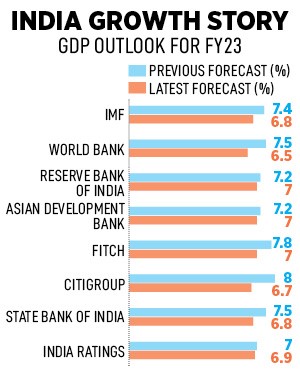
          Most global banks and agencies have downgraded their growth outlook for India to below 7 percent. 'A weaker-than-expected outturn in the period of April to June, and more subdued external demand' have prompted the IMF to slash India's FY23 GDP estimate to 6.8 percent from 7.4 percent earlier. The World Bank has cut its forecast by 1 percent to 6.5 percent, and the Citigroup has reduced it to 6.7 percent from 8 percent earlier.
          The impact of the Russian invasion of Ukraine, a cost-of-living crisis stoked by stubborn inflation, and the slowdown in China have hit the global economy. Despite the grim outlook, India is the fastest-growing large economy in the world, and the jury is out on whether the country has decoupled from the world.

          India Shining

          Several analysts and fund managers Forbes India interacted with are of the view that India will continue to outperform its peers. "India has emerged as a shining star in this calendar year with healthy outperformance amid varied global headwinds on macros, inflation, rates, currency and geopolitics," says Gautam Duggad, head of research, institutional equities, Motilal Oswal.
          If equity returns is a benchmark, then India did outshine most peers in local currency terms. Most global equity markets fell between 20 percent and 25 percent in the current calendar year. Furthermore, domestic investors have held fort despite the prolonged spell of heavy selling by FIIs (foreign institutional investors) for nearly one year.
          Duggad explains the outperformance is driven by strong corporate earnings growth over the past two years, resilience of Indian stock markets, and macroeconomic management by the government and the central bank.
          The IMF has described India as a 'bright spot', 'bright light', which is 'sure to leave a mark on the world'. Excluding Saudi Arabia, as per the IMF, India is the only economy that is likely to witness a GDP growth rate of over 6 percent.
          But many economists argue that India is not decoupled from the world, and a 6 percent growth rate at a time when inflation is over 7 percent is worrisome.

          The cracks

          How Long Will India's Shining Economy Hold Amid the Gradual Global Meltdown?_1Suvodeep Rakshit, senior economist, Kotak Institutional Equities, notes, "No country is an island. A growing rhetoric of India decoupling from the rest of the world may not bear out." Economists are concerned that the havoc in the global economy will hurt India's macro-outlook over the next 18 to 24 months.
          Rakshit elaborates, "While India could fare well relatively, it faces headwinds from imminent global demand and trade slowdown, risks of higher-for-longer global inflation and interest rates, a strengthening US dollar, and enduring geopolitical tensions."
          The risks are interconnected and have a cascading impact on the country's fiscal health. The prolonged war between Russia and Ukraine has accentuated volatility of energy prices. The Indian rupee dived to a lifetime low of 83 against the greenback on Wednesday. In the coming months, the extent of the rupee depreciation and the central bank's response will be critical. India's foreign exchange reserves dipped by nearly $100 billion in calendar year 22.
          Global growth is expected to remain anaemic. The US Federal Reserve is determined to rein in inflation with a series of rate hikes even at the cost of a looming recession. Undoubtedly, India is less vulnerable than its Asian peers, and better placed to face the impact than it was during the earlier periods of US recession. Yet, it isn't immune to the ongoing upheaval in the global economy.
          "Global slowdowns typically transmit through trade, commodity prices, capital flows and financial sector channels," states Rakshit.
          Robust domestic demand is the key defence against slowing global demand. However, economists point out that durable recovery is yet to pick up meaningfully, and it is essentially exports that helped boost the GDP to pre-pandemic levels. Clearly, a slowdown in exports will pinch consumption, and deter firms and small business owners from fresh investments. Kotak Institutional Equities says 45 percent of exports is driven by labour-intensive MSMEs (medium- and small-sized enterprises).
          The US and the top five EU (European Union) nations account for approximately 30 percent of the country's total exports. "A large part of the global exports is dependent on the US and Europe which, in turn, will have an indirect impact on India too," adds Rakshit.
          In the backdrop of a global slowdown, most analysts expect commodity prices to correct. However, the outlook for energy prices is uncertain at this juncture, and higher energy prices can erase the benefits of lower commodity prices and widen the trade deficit. The current account deficit is likely to rise to 3.9 percent in FY23.
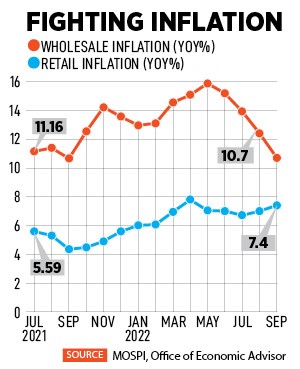
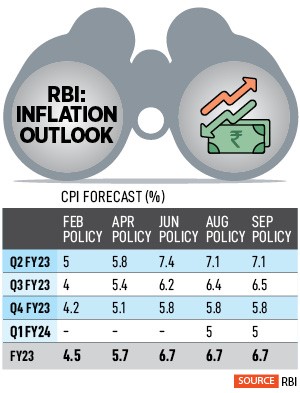
          Headline inflation has crossed the Reserve Bank of India's (RBI) upper threshold of 6 percent for over 10 months. Rakshit points out that global factors have a bearing on the prices of nearly 15 to 20 percent of the CPI basket. Since April, the repo rate has increased by 1.9 percent to 5.9 percent. The Monetary Policy Committee has refrained from giving a forward guidance on rates, but has articulated that its top priority is to rein in inflation.
          While the odds are hard to ignore, given the gradual slide in several macro parameters, markets are confident about India's growth story. However, in a volatile global environment, there are multiple moving parts weighing on the fiscal health of India. The government and the RBI have their task cut out. How Long Will India's Shining Economy Hold Amid the Gradual Global Meltdown?_2

          How Long Will India's Shining Economy Hold Amid the Gradual Global Meltdown?_3Source: Forbes India

          Risk Warnings and Disclaimers
          You understand and acknowledge that there is a high degree of risk involved in trading. Following any strategies or investment methods may lead to potential losses. The content on the site is provided by our contributors and analysts for information purposes only. You are solely responsible for determining whether any trading assets, securities, strategy, or any other product is suitable for investing based on your own investment objectives and financial situation.
          Comments
          Add to Favorites
          Share

          Unseasonal Rain, Crop Losses Could Keep India's Food Inflation High

          Owen Li

          Energy

          Economic

          Indian rice farmer Ibrahim Shaikh says he looked up at the sky daily and prayed for unseasonal rains to stop. His prayers unanswered, he says he started harvesting the wet crop earlier this week.
          "The crop was ready for harvesting 10 days back and twenty to thirty percent of the grains have been lost because of heavy rains. If I don't harvest now, I won't get anything," Shaikh said, as he dried harvested paddy on a plastic sheet in Kadadhe village, 110 km (70 miles) east of Mumbai.
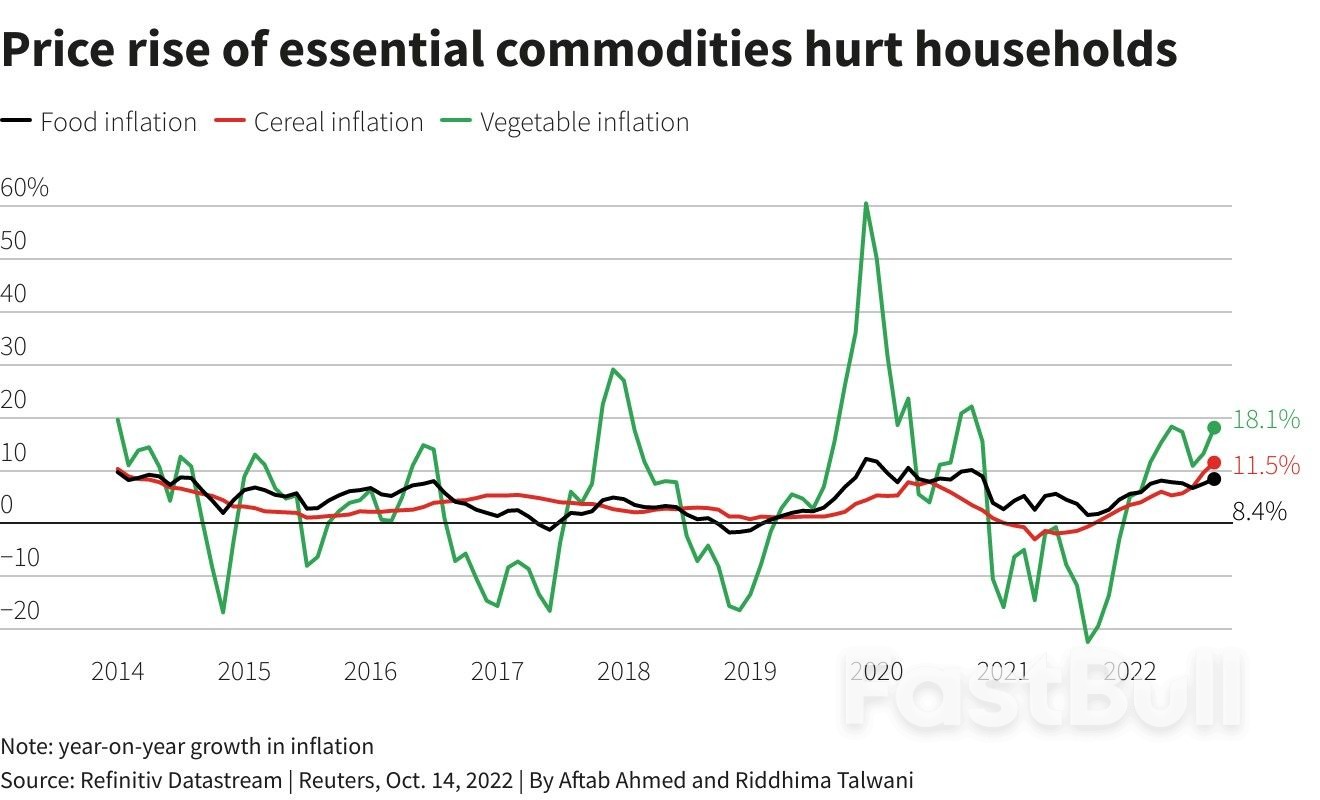
          The crop losses for Shaikh and farmers across the country mean that food prices, already at their highest in over two years, could stay elevated, instead of tapering after the harvest as they usually do. India's millions of rural poor will be particularly affected, hit by both the bad crop and the high prices.
          Along with grains, the prices of vegetables, milk, pulses and edible oils, which account for over a quarter of the overall consumer price index, are rising and likely to remain high in coming months.
          Economists say annual headline inflation will likely start easing from September's 7.41% peak because of a jump in the index in corresponding months last year, but price pressures on grains, vegetable and milk will persist.
          Earlier this week, the Reserve Bank of India said headline inflation will ease from September levels albeit stubbornly and the fight against inflation will be "dogged and prolonged."
          Besides keeping inflation high, higher food prices will be more of a burden in the countryside, where wages have not kept pace with inflation. Meanwhile, rising incomes and a boom in consumption in the towns and cities are driving overall growth to a forecast 7% in the current April-March fiscal year, the highest among major world economies.
          A Reuters Oct 13-19 poll of economists said growth likely slowed in the July-September quarter, although it should come in at 6.9% for the full fiscal year.
          Unseasonal Rain, Crop Losses Could Keep India's Food Inflation High_1According to a research report by Crisil, September inflation was at 8.1% for rural poor, defined as the bottom 20% of the population in terms of consumption. In urban areas, inflation for the wealthiest 20 percent segment was only 7.2%.
          "Higher food inflation does tend to act as a regressive tax on the poor," said Yuvika Singhal, economist at QuantEco Research. "In a post pandemic world, it can stand to perpetuate the K-shaped economic recovery and widen income inequalities further."
          Popat Pawar, who works on a farm in the Pune district of Maharashtra state, says he is getting work, but his employer is not ready to increase wages.
          "Prices of everything from edible oils, vegetables to milk have gone up. It is not possible to run household expenses with the same amount of income," said 43-years-old Pawar, whose says his savings were exhausted last year when he was hospitalised with COVID-19.
          Rice farmer Baban Pingle, in Kotharni village in Pune district, says he can't raise wages as his production costs have gone up with higher diesel and fertiliser prices. Besides, he also needs to spend more on buying essentials.
          "We produce only rice. Everything else we have to buy. We are also feeling the pinch of inflation, and we don't know how much rice we can produce. The entire crop could be damaged because of the rains," Pingle said.

          Free Food Scheme May Not Last

          The prospect of stubbornly high inflation could force the central bank to increase rates further, possibly dampening growth.
          The government, which is facing key state elections later this year, will be under pressure to respond to the rural distress.
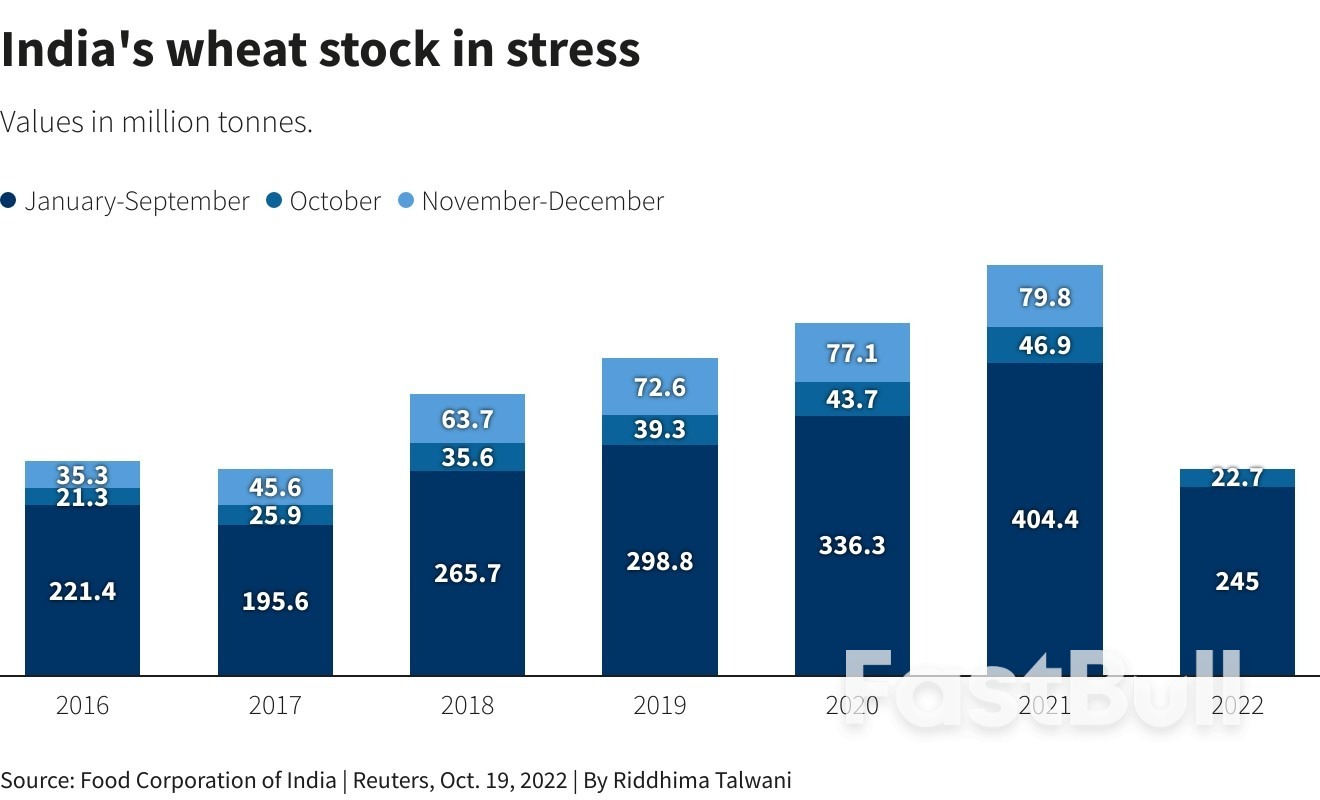
          Last month, India extended the world's biggest free food programme for the poor by three months to December but traders say the programme cannot be prolonged for much longer since food stocks are dwindling. Wheat stocks with state-run agencies have fallen to 22.7 million tonnes as on Oct. 1 from to 46.9 million tonnes a year ago.
          However, government officials say stocks are adequate.
          Unseasonal Rain, Crop Losses Could Keep India's Food Inflation High_2Limited supplies have lifted local wheat prices to a record high. Imports are not an option because of high prices overseas after the war in Ukraine.
          Edible oil prices are also rebounding after a recent drop as heavy rains are disrupting palm oil output in key producing countries, while concerns are rising over sunflower oil supplies from the Black Sea region, said B.V. Mehta, executive director of the Solvent Extractors' Association.
          Meanwhile, leading milk producers are raising prices as stocks of milk products are getting depleted because of robust exports of milk powder and butter, said B. B. Thombare, chairman of dairy company Natural Sugar and Allied Industries.
          "Milk production is rising but prices are unlikely to come down because of thin stocks of milk products," he said.

          Source: Reuters

          To stay updated on all economic events of today, please check out our Economic calendar
          Risk Warnings and Disclaimers
          You understand and acknowledge that there is a high degree of risk involved in trading. Following any strategies or investment methods may lead to potential losses. The content on the site is provided by our contributors and analysts for information purposes only. You are solely responsible for determining whether any trading assets, securities, strategy, or any other product is suitable for investing based on your own investment objectives and financial situation.
          Comments
          Add to Favorites
          Share

          Key Issues as Malaysia Prepares to Vote

          Thomas

          Political

          Malaysia will hold a general election on Nov. 19, its election commission said on Thursday, in a contest that the country's ruling graft-tainted party hopes will strengthen its hold on power.
          Here are the key issues that will determine how Malaysians vote:

          Economy & Inflation

          Rising prices and economic prospects will be voters' top considerations as the government and central bank have warned of slowing growth next year.
          The economy is expected to expand 4%-5% next year, following this year's expected 6.5%-7% growth.
          Prices have been creeping up, especially for food items.
          The government has said it will trim back subsidies from 2023 due to fiscal pressures, which could result in further price increases if the new administration proceeds with the plan.
          "The top issue (in the election) would be socioeconomic well-being which is rapidly deteriorating," said Oh Ei Sun, a senior fellow with Singapore's Institute of International Affairs.
          Most of the country's ethnic-Malay majority would expect the United Malays National Organisation (UMNO) party "as being most willing to provide handouts during these harsh times", he said.

          Political Stability

          Malaysians have been frustrated with the politicking that has rocked the country since the historic election win by the opposition over UMNO in 2018.
          The win by the Mahathir Mohamad-led alliance was the first by the opposition in Malaysia's history.
          Since its ouster, UMNO has tried to make its way back to power and has been the main source of turmoil, with infighting both within its ranks and among its alliance partners.
          The country has had three prime ministers in the last two years.
          Announcing the dissolution of parliament, Prime Minister Ismail Sabri Yaakob said political instability has had a negative impact on the economy and expressed a need to return the mandate to the people.
          Analysts also expect the instability to hurt voter turnout, especially among those who traditionally vote for the opposition, due to disillusionment.

          Corruption

          Graft was a key reason for UMNO's defeat in 2018, and some critics say a convincing UMNO win in the upcoming election could worsen corruption and see the return of graft-tainted politicians to power.
          Several of the party's top leaders were charged after the election loss, and they are the ones who urged Ismail to call for early polls.
          Ismail last month announced a wide-ranging misconduct probe against a former attorney-general who had brought graft cases against UMNO officials.
          Former premier Najib Razak, along with UMNO president Ahmad Zahid Hamidi and several other senior party officials, were slapped with dozens of corruption charges. All have denied wrongdoing, with Najib and Ahmad Zahid describing the charges against them as politically motivated.
          In August, Najib started a 12-year jail term after being convicted of corruption and money laundering in a case linked to the multibillion-dollar financial scandal 1MDB. He still faces four other trials.

          Race And Religion

          Race and religion remain divisive issues in Malaysia - a diverse, multi-ethnic country of some 32.7 million people.
          Ethnic Malays, who are mainly Muslim, and indigenous groups make up about 70% of the population, while the rest is made up of mostly ethnic Chinese and Indians.
          Analysts say conservative Malays, who make up the bulk of voters, are more likely to return to supporting UMNO after feeling sidelined by Mahathir's administration, which saw a higher number of non-Malays appointed to high-ranking cabinet positions.
          UMNO, as part of the Barisan Nasional alliance, governed Malaysia for more than 60 years since independence until 2018.
          The Malay nationalist party has built its support over the years through a strong system of patronage, especially with ethnic Malays.

          Source: Reuters

          Risk Warnings and Disclaimers
          You understand and acknowledge that there is a high degree of risk involved in trading. Following any strategies or investment methods may lead to potential losses. The content on the site is provided by our contributors and analysts for information purposes only. You are solely responsible for determining whether any trading assets, securities, strategy, or any other product is suitable for investing based on your own investment objectives and financial situation.
          Comments
          Add to Favorites
          Share

          What is Indonesia's Proposed Tin Export Ban About?

          Owen Li

          Commodity

          Indonesia, the world's biggest exporter of refined tin, is planning to ban exports of the metal to attract investment in processing it domestically, although the government said the timing had yet to be decided.

          What is the plan?

          Indonesia plans to ban the export of tin ingots to encourage investors to set up productions facilities and develop its industries to process tin into other products at home, a government official said. It has a similar policy for nickel ore.
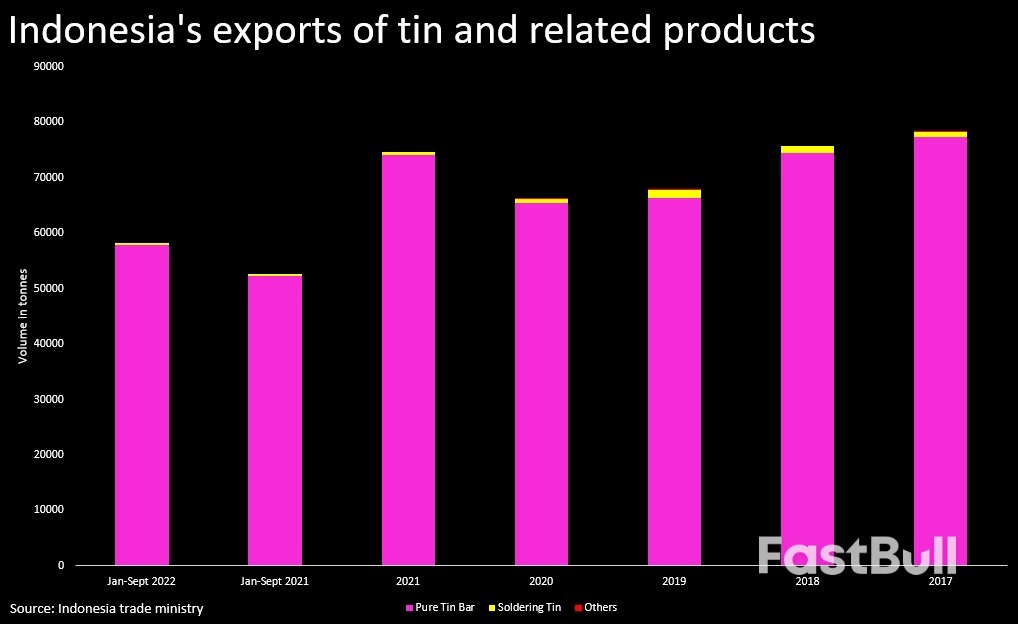
          However, unlike nickel, Indonesia already exports high purity refined tin, having banned exports of tin ore from late 2014. It exports tin bars, solder bar and wires, according to trade ministry data.
          The ban is part of a broader Indonesian plan to reserve mineral resources like nickel, tin, copper and bauxite for domestic processing and export higher value-added products instead of just shipping cheap raw materials.
          Indonesia only consumes 5% of the refined tin it produces and exports 95%.

          What is Indonesia's Proposed Tin Export Ban About?_1When will the ban be imposed?

          President Joko Widodo said the government had not decided when the ban will be implemented and the timing would be announced once authority has completed their deliberations.
          Senior mining ministry official Ridwan Djamaludin said authorities were calculating how much investment and time Indonesia needed to prepare at home to be able to absorb its production.

          What investment is Indonesia seeking?

          Authorities may focus on seeking investment in tin forming industries and tin chemical production.
          According to government data, Indonesia already has tin bar and tin coating production facilities but it does not have other forming facilities for products such as tin rod or tin powder.
          An investment ministry official said the government wanted to focus on attracting investment that offers the best value addition.

          How much tin does Indonesia produce, export?

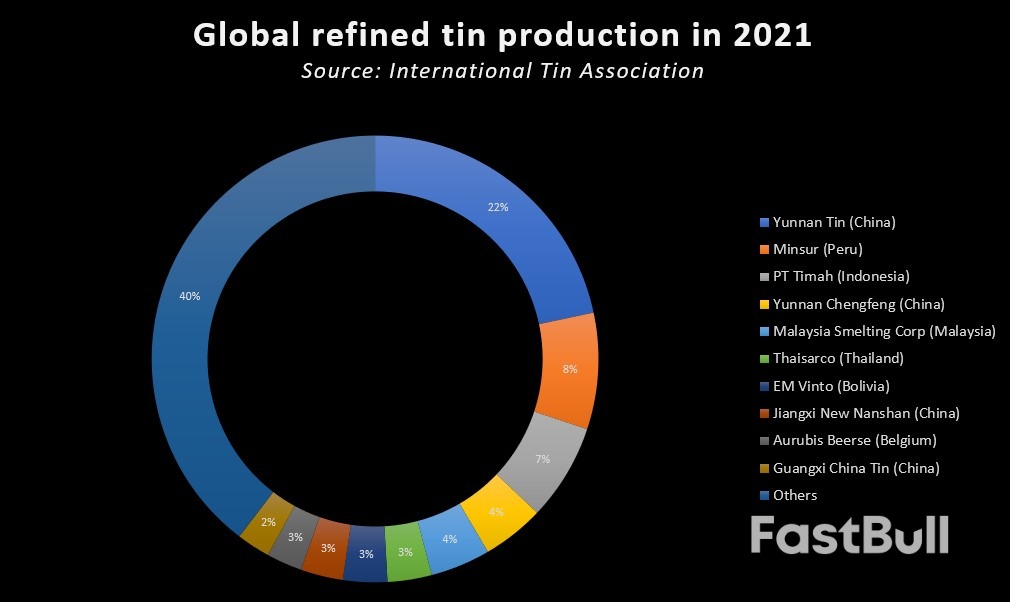
          PT Timah, Indonesia's biggest tin miner and smelter, produced 26,500 tonnes of refined tin in 2021, or 7% of global output and a sharp 42% drop from a year earlier, data provided by the International Tin Association showed.
          The company said its output continued to fall this year, down 26% year-on-year to 8,805 tonnes in the first half of 2022.
          Indonesia exported 74,671.57 tonnes of tin metals in 2021, worth $2.42 billion, trade ministry data showed.
          From January to September this year, it exported 58,178.69 tonnes of tin metals, up 11% from the same period last year.

          What is Indonesia's Proposed Tin Export Ban About?_2Who are the buyers?

          China is the top importer of Indonesian tin bars, according to shipment data this year, followed by Singapore, India and South Korea.
          Other buyers include Netherlands, Belgium and Turkey.

          How would a ban impact price?

          Chinese buyers are boosting tin imports, wary of the possible Indonesian export ban, although consumer demand is slowing along with global economic growth, Sucden Financial analyst Geordie Wilkes said on Tuesday.
          "The import arbitrage was open but also the threat of an Indonesian ban also lead to what we saw with nickel is a front loading of those material imports there," he said.
          "Consumption is not quite there and the profitability is a lot less considering the price has fallen quite sharply," Wilkes said, adding that market sentiment is expected to stay weak.
          "We expect price to remain on the back foot for tin."
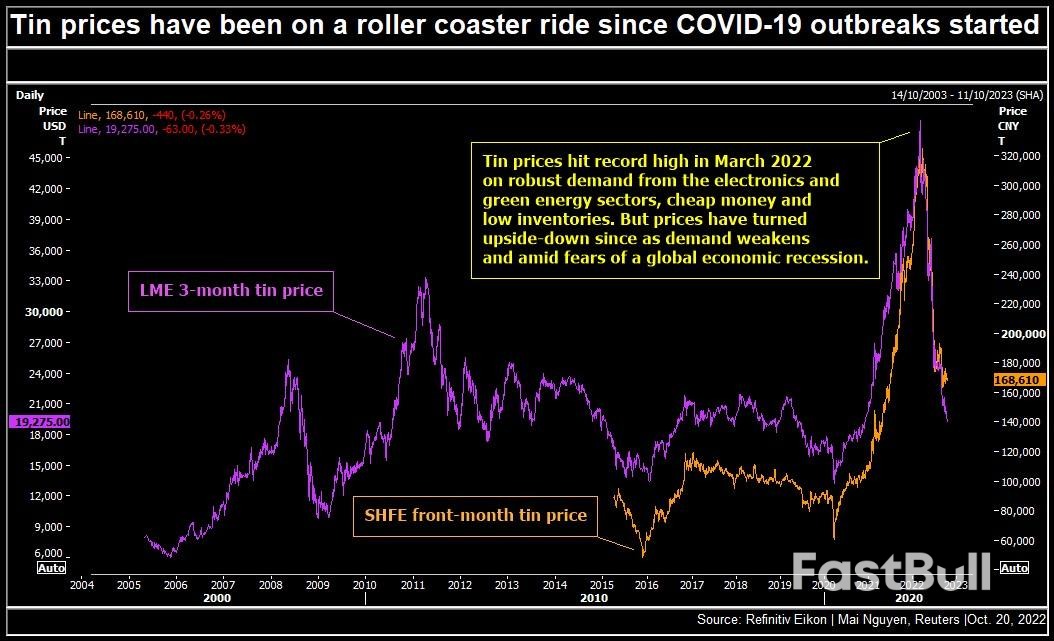
          Benchmark three-month tin price on the London Metal Exchange was at $19,220 a tonne at 0823 GMT, down 50% year-to-date and is the worst performer in the LME base metals complex.

          What is Indonesia's Proposed Tin Export Ban About?_3Source: Reuters

          Risk Warnings and Disclaimers
          You understand and acknowledge that there is a high degree of risk involved in trading. Following any strategies or investment methods may lead to potential losses. The content on the site is provided by our contributors and analysts for information purposes only. You are solely responsible for determining whether any trading assets, securities, strategy, or any other product is suitable for investing based on your own investment objectives and financial situation.
          Comments
          Add to Favorites
          Share

          BoE's Broadbent says Market Bets on Rate Hikes Would Hit Economy

          Samantha Luan

          Central Bank

          Bank of England Deputy Governor Ben Broadbent told investors on Thursday that the big increases in interest rates they had been pricing on the back of Prime Minister Liz Truss's fiscal plans would deliver a "pretty material" hit to the economy.
          In a speech, Broadbent said it was now unclear how much the government's energy price cap plan will add to inflation pressure in the medium term after the scheme was drastically scaled back by new finance minister Jeremy Hunt.
          "The MPC (Monetary Policy Committee) is likely to respond relatively promptly to news about fiscal policy," Broadbent said in the speech delivered at Imperial College in London.
          "Whether official interest rates have to rise by quite as much as currently priced in financial markets remains to be seen," he said.
          Despite falling in recent days, the expectations financial markets for the BoE's Bank Rate to peak at about 5.25% was "by some distance the largest rise in market interest rates between MPC forecasts since the Committee was founded," Broadbent said.
          "If Bank Rate really were to reach 5.25%, given reasonable policy multipliers, the cumulative impact on GDP of the entire hiking cycle would be just under 5% - of which only around one quarter has already come through," he said.
          Investors further reined in their expectations of a full percentage-point interest rate increase by the BoE next month and British government bond future prices rose as Broadbent spoke.
          Rate futures put a 17% chance on a 100 basis-point increase on Nov. 3, down from 25% earlier on Thursday. A whole percentage-point rate hike was seen as a near certainty before Truss was forced to backtrack on her unfunded tax cut plans.
          Broadbent said in his speech that if government support mitigates the effect of inflation on households - as it is doing with its cap on energy prices - there was a bigger job "at the margin" for monetary policy to do.
          But there was now uncertainty about the scale of the plan which finance minister Hunt has said will run for six months, not two years as originally planned by Truss, although targeted support would continue after that.
          "We are unlikely to know for a while precisely the form that will take," Broadbent said.

          Source: Reuters

          Risk Warnings and Disclaimers
          You understand and acknowledge that there is a high degree of risk involved in trading. Following any strategies or investment methods may lead to potential losses. The content on the site is provided by our contributors and analysts for information purposes only. You are solely responsible for determining whether any trading assets, securities, strategy, or any other product is suitable for investing based on your own investment objectives and financial situation.
          Comments
          Add to Favorites
          Share

          As UK Economic Policy Slides into An Ideological Abyss, Can Replacing Truss Revive Market Confidence?

          Kevin Du

          Political

          Political chaos in the UK has become commonplace since Brexit in 2016. Liz Truss, the new prime minister, has been in office for only a few weeks, and her government is teetering on the verge of collapse as she doesn't have the confidence of her own party.
          This is something that has never happened in modern British politics for a century. The Conservative Party seems to have realized that the new prime minister, who has vowed to be the modern "Iron Lady," is unable to take on the arduous task of revitalizing the British economy. But the question is: Can replacing Truss truly revive market confidence?
          It is a hasty judgment to blame the current economic problems in the UK simply on the unpopularity of Truss' tax-cut plan. Tax cuts are not without merit in stimulating economic growth. However, the real concern is: Is the market still interested in what constitutes an effective economic growth policy? Among the numerous comments, the following two standpoints have been repeatedly mentioned by experts from different political camps: First, even if an effective economic development strategy is proposed now, it will take time to implement it. Can the UK still wait? Second, what is exactly dragging down the UK economy? The government has not thoroughly analyzed what kind of political and social environment is needed for social and economic growth.
          Now the British government seems to be really thinking about the problem "seriously". Nevertheless, not long ago, the world economic community predicted that the UK is currently "on the brink of recession" and that the UK economy has entered a "technical recession." When the market and the public have lost patience and economic recession has become the "general anticipation" of British society, any policy will be of no avail.
          Ineffective social governance has undermined the foundations of the British economy. "Small government, big society" was once the proud political label of British and American political culture. British parliamentary debates have also been portrayed as the standard of modern political life. However, after Brexit, social and livelihood issues have not been effectively addressed, and the plight of domestic and foreign affairs has not really been responded to. Politicians in the UK shuttle among meetings discussing various proposals, and staging political shows, which is the norm in British political life now.
          Any capital would like to have a lasting and stable investment environment, a healthy and promising political system, and an optimistic and positive social mentality. These extremely important elements of the investment environment are scarce in the UK today.
          The ideologicalization of the British economy has greatly depleted the key elements of British development. The British economy is fundamentally based on commerce and free trade, which is the secret of its continued prosperity in recent history. However, the international community has witnessed the British government's economic policy sliding into an ideological abyss in recent years.
          In the Russia-Ukraine conflict, the British government used extreme measures to deal with Russian assets in the UK on the grounds of sanctions against Russia, which is tantamount to burying the sacred rules and open principles of the British market with its own hands. In its relations with China, the UK has repeatedly weaponized the concept of "national security" and created artificial barriers in the fields of 5G application, commercial investment, and scientific and technological cooperation. How can a country that lacks basic commercial credibility and continuity of economic policies build an international business environment that is adapted to the country's economic development?
          If the UK wants to gain lasting momentum for future economic growth, it must rebuild its strategic awareness for the future world. We live in a world of violent turbulences and changes. The essential features of this change are not only the transfer of the world's economic center, but also the self-development and transformation of the cultural destiny of all countries in the world.
          The UK is a pivotal country with global historical significance in modern times. It has injected political ideology and economic development concepts with extensive influence into the process of world modernization. However, the process of world history cannot always proceed mechanically in the direction set by a few Western countries. Modern human civilization facing the future needs new concepts and thinking. Unfortunately, the current mainstream ideology of British politics is based on zero-sum game and the law of the jungle during the Cold War, a cultural mentality that will probably lead to social unrest far more violent than economic recession.

          Source: Global Times

          Risk Warnings and Disclaimers
          You understand and acknowledge that there is a high degree of risk involved in trading. Following any strategies or investment methods may lead to potential losses. The content on the site is provided by our contributors and analysts for information purposes only. You are solely responsible for determining whether any trading assets, securities, strategy, or any other product is suitable for investing based on your own investment objectives and financial situation.
          Comments
          Add to Favorites
          Share
          FastBull
          Copyright © 2025 FastBull Ltd

          728 RM B 7/F GEE LOK IND BLDG NO 34 HUNG TO RD KWUN TONG KLN HONG KONG

          TelegramInstagramTwitterfacebooklinkedin
          App Store Google Play Google Play
          Products
          Charts

          Chats

          Q&A with Experts
          Screeners
          Economic Calendar
          Data
          Tools
          Membership
          Features
          Function
          Markets
          Copy Trading
          Latest Signals
          Contests
          News
          Analysis
          24/7
          Columns
          Education
          Company
          Careers
          About Us
          Contact Us
          Advertising
          Help Center
          Feedback
          User Agreement
          Privacy Policy
          Business

          White Label

          Data API

          Web Plug-ins

          Poster Maker

          Affiliate Program

          Risk Disclosure

          The risk of loss in trading financial instruments such as stocks, FX, commodities, futures, bonds, ETFs and crypto can be substantial. You may sustain a total loss of the funds that you deposit with your broker. Therefore, you should carefully consider whether such trading is suitable for you in light of your circumstances and financial resources.

          No decision to invest should be made without thoroughly conducting due diligence by yourself or consulting with your financial advisors. Our web content might not suit you since we don't know your financial conditions and investment needs. Our financial information might have latency or contain inaccuracy, so you should be fully responsible for any of your trading and investment decisions. The company will not be responsible for your capital loss.

          Without getting permission from the website, you are not allowed to copy the website's graphics, texts, or trademarks. Intellectual property rights in the content or data incorporated into this website belong to its providers and exchange merchants.

          Not Logged In

          Log in to access more features

          FastBull Membership

          Not yet

          Purchase

          Become a signal provider
          Help Center
          Customer Service
          Dark Mode
          Price Up/Down Colors

          Log In

          Sign Up

          Position
          Layout
          Fullscreen
          Default to Chart
          The chart page opens by default when you visit fastbull.com