• Trade
  • Markets
  • Copy
  • Contests
  • News
  • 24/7
  • Calendar
  • Q&A
  • Chats
Trending
Screeners
SYMBOL
LAST
BID
ASK
HIGH
LOW
NET CHG.
%CHG.
SPREAD
SPX
S&P 500 Index
6870.39
6870.39
6870.39
6895.79
6858.28
+13.27
+ 0.19%
--
DJI
Dow Jones Industrial Average
47954.98
47954.98
47954.98
48133.54
47871.51
+104.05
+ 0.22%
--
IXIC
NASDAQ Composite Index
23578.12
23578.12
23578.12
23680.03
23506.00
+72.99
+ 0.31%
--
USDX
US Dollar Index
98.820
98.900
98.820
98.960
98.730
-0.130
-0.13%
--
EURUSD
Euro / US Dollar
1.16597
1.16605
1.16597
1.16717
1.16341
+0.00171
+ 0.15%
--
GBPUSD
Pound Sterling / US Dollar
1.33291
1.33301
1.33291
1.33462
1.33151
-0.00021
-0.02%
--
XAUUSD
Gold / US Dollar
4217.05
4217.46
4217.05
4218.85
4190.61
+19.14
+ 0.46%
--
WTI
Light Sweet Crude Oil
59.983
60.020
59.983
60.063
59.752
+0.174
+ 0.29%
--

Community Accounts

Signal Accounts
--
Profit Accounts
--
Loss Accounts
--
View More

Become a signal provider

Sell trading signals to earn additional income

View More

Guide to Copy Trading

Get started with ease and confidence

View More

Signal Accounts for Members

All Signal Accounts

Best Return
  • Best Return
  • Best P/L
  • Best MDD
Past 1W
  • Past 1W
  • Past 1M
  • Past 1Y

All Contests

  • All
  • Trump Updates
  • Recommend
  • Stocks
  • Cryptocurrencies
  • Central Banks
  • Featured News
Top News Only
Share

Angola November Inflation At 0.85% Month-On-Month

Share

Indonesia Finance Minister: Potential Revenues From Planned Gold And Coal Export Taxes At 23 Trillion Rupiah

Share

Angola November Inflation At 16.56% Year-On-Year

Share

United Arab Emirates Oct Bank Lending +15.65% Year-On-Year - Central Bank

Share

United Arab Emirates Oct M3 Money Supply +14.98% Year-On-Year - Central Bank

Share

Bayer Seen Up 1.8% In Pre-Mkt Indications After Jp Morgan Raises To Overweight From Neutral

Share

Most Active China Coking Coal Contract Falls 7.1% To 1082.5 Yuan/Metric Ton

Share

German Foreign Minister Says A Lot Of Work Is Still Needed To Persuade China To Issue General Export Licences For Rare Earths

Share

European Central Bank's Schnabel 'Rather Comfortable' On Investor Bets Next Move To Be Interest Rate Hike

Share

Agriculture Ministry: Uganda October Coffee Shipments Up 38% From Last Year

Share

Russia's Nornickel: Cobalt Production Capacity To Be At Up To 3000 Tons Per Year

Share

Russia's Nornickel: Fully Restarts Cobalt Production In Murmansk Region

Share

India's Nifty Realty Index Down 2.7%

Share

China Vice President, In Meeting With German Foreign Minister: China Willing To Enhance Communication With Germany - Xinhua

Share

Japan Finance Minister Katayama: Will Take Appropriate Action If Necessary

Share

Japan Finance Minister Katayama: Concerned About Forex Moves

Share

Japan Finance Minister Katayama: Recently Seeing One-Sided, Rapid Moves

Share

LME Three-month Copper Rose To $11,771 Per Tonne, Setting A New Record High

Share

Shanghai's Most Active Copper Contract Sets Peak At 93300 Yuan Per Metric Ton

Share

Thai Prime Minister: Thailand Does Not Want Violence

TIME
ACT
FCST
PREV
U.S. Personal Income MoM (Sept)

A:--

F: --

P: --

U.S. PCE Price Index YoY (SA) (Sept)

A:--

F: --

P: --

U.S. PCE Price Index MoM (Sept)

A:--

F: --

P: --

U.S. Personal Outlays MoM (SA) (Sept)

A:--

F: --

P: --

U.S. Core PCE Price Index MoM (Sept)

A:--

F: --

P: --

U.S. Core PCE Price Index YoY (Sept)

A:--

F: --

P: --

U.S. UMich 5-Year-Ahead Inflation Expectations Prelim YoY (Dec)

A:--

F: --

P: --

U.S. Real Personal Consumption Expenditures MoM (Sept)

A:--

F: --

P: --

U.S. UMich Current Economic Conditions Index Prelim (Dec)

A:--

F: --

P: --

U.S. UMich Consumer Sentiment Index Prelim (Dec)

A:--

F: --

P: --

U.S. UMich 1-Year-Ahead Inflation Expectations Prelim (Dec)

A:--

F: --

P: --

U.S. UMich Consumer Expectations Index Prelim (Dec)

A:--

F: --

P: --

U.S. Weekly Total Rig Count

A:--

F: --

P: --

U.S. Weekly Total Oil Rig Count

A:--

F: --

P: --

U.S. Unit Labor Cost Prelim (SA) (Q3)

--

F: --

P: --

U.S. Consumer Credit (SA) (Oct)

A:--

F: --

P: --

China, Mainland Foreign Exchange Reserves (Nov)

A:--

F: --

P: --

Japan Wages MoM (Oct)

A:--

F: --

P: --

Japan Trade Balance (Oct)

A:--

F: --

P: --

Japan Nominal GDP Revised QoQ (Q3)

A:--

F: --

P: --

Japan Trade Balance (Customs Data) (SA) (Oct)

A:--

F: --

P: --

Japan GDP Annualized QoQ Revised (Q3)

A:--

F: --

P: --
China, Mainland Exports YoY (CNH) (Nov)

A:--

F: --

P: --

China, Mainland Trade Balance (USD) (Nov)

A:--

F: --

P: --

China, Mainland Imports YoY (CNH) (Nov)

A:--

F: --

P: --

China, Mainland Exports (Nov)

A:--

F: --

P: --

China, Mainland Imports (CNH) (Nov)

A:--

F: --

P: --

China, Mainland Trade Balance (CNH) (Nov)

A:--

F: --

P: --

China, Mainland Imports YoY (USD) (Nov)

A:--

F: --

P: --

China, Mainland Exports YoY (USD) (Nov)

A:--

F: --

P: --

Germany Industrial Output MoM (SA) (Oct)

--

F: --

P: --

Euro Zone Sentix Investor Confidence Index (Dec)

--

F: --

P: --

Canada Leading Index MoM (Nov)

--

F: --

P: --

Canada National Economic Confidence Index

--

F: --

P: --

U.S. Dallas Fed PCE Price Index YoY (Sept)

--

F: --

P: --

China, Mainland Trade Balance (USD) (Nov)

--

F: --

P: --

U.S. 3-Year Note Auction Yield

--

F: --

P: --

U.K. BRC Overall Retail Sales YoY (Nov)

--

F: --

P: --

U.K. BRC Like-For-Like Retail Sales YoY (Nov)

--

F: --

P: --

Australia Overnight (Borrowing) Key Rate

--

F: --

P: --

RBA Rate Statement
RBA Press Conference
Germany Exports MoM (SA) (Oct)

--

F: --

P: --

U.S. NFIB Small Business Optimism Index (SA) (Nov)

--

F: --

P: --

Mexico Core CPI YoY (Nov)

--

F: --

P: --

Mexico 12-Month Inflation (CPI) (Nov)

--

F: --

P: --

Mexico PPI YoY (Nov)

--

F: --

P: --

Mexico CPI YoY (Nov)

--

F: --

P: --

U.S. Weekly Redbook Index YoY

--

F: --

P: --

U.S. JOLTS Job Openings (SA) (Oct)

--

F: --

P: --

China, Mainland M2 Money Supply YoY (Nov)

--

F: --

P: --

China, Mainland M0 Money Supply YoY (Nov)

--

F: --

P: --

China, Mainland M1 Money Supply YoY (Nov)

--

F: --

P: --

U.S. EIA Short-Term Crude Production Forecast For The Next Year (Dec)

--

F: --

P: --

U.S. EIA Short-Term Crude Production Forecast For The Year (Dec)

--

F: --

P: --

U.S. EIA Natural Gas Production Forecast For The Next Year (Dec)

--

F: --

P: --

EIA Monthly Short-Term Energy Outlook
U.S. 10-Year Note Auction Avg. Yield

--

F: --

P: --

U.S. API Weekly Cushing Crude Oil Stocks

--

F: --

P: --

U.S. API Weekly Crude Oil Stocks

--

F: --

P: --

U.S. API Weekly Refined Oil Stocks

--

F: --

P: --

Q&A with Experts
    • All
    • Chatrooms
    • Groups
    • Friends
    Connecting
    .
    .
    .
    Type here...
    Add Symbol or Code

      No matching data

      All
      Trump Updates
      Recommend
      Stocks
      Cryptocurrencies
      Central Banks
      Featured News
      • All
      • Russia-Ukraine Conflict
      • Middle East Flashpoint
      • All
      • Russia-Ukraine Conflict
      • Middle East Flashpoint

      Search
      Products

      Charts Free Forever

      Chats Q&A with Experts
      Screeners Economic Calendar Data Tools
      Membership Features
      Data Warehouse Market Trends Institutional Data Policy Rates Macro

      Market Trends

      Market Sentiment Order Book Forex Correlations

      Top Indicators

      Charts Free Forever
      Markets

      News

      News Analysis 24/7 Columns Education
      From Institutions From Analysts
      Topics Columnists

      Latest Views

      Latest Views

      Trending Topics

      Top Columnists

      Latest Update

      Signals

      Copy Rankings Latest Signals Become a signal provider AI Rating
      Contests
      Brokers

      Overview Brokers Assessment Rankings Regulators News Claims
      Broker listing Forex Brokers Comparison Tool Live Spread Comparison Scam
      Q&A Complaint Scam Alert Videos Tips to Detect Scam
      More

      Business
      Events
      Careers About Us Advertising Help Center

      White Label

      Data API

      Web Plug-ins

      Affiliate Program

      Awards Institution Evaluation IB Seminar Salon Event Exhibition
      Vietnam Thailand Singapore Dubai
      Fans Party Investment Sharing Session
      FastBull Summit BrokersView Expo
      Recent Searches
        Top Searches
          Markets
          News
          Analysis
          User
          24/7
          Economic Calendar
          Education
          Data
          • Names
          • Latest
          • Prev

          View All

          No data

          Scan to Download

          Faster Charts, Chat Faster!

          Download App
          English
          • English
          • Español
          • العربية
          • Bahasa Indonesia
          • Bahasa Melayu
          • Tiếng Việt
          • ภาษาไทย
          • Français
          • Italiano
          • Türkçe
          • Русский язык
          • 简中
          • 繁中
          Open Account
          Search
          Products
          Charts Free Forever
          Markets
          News
          Signals

          Copy Rankings Latest Signals Become a signal provider AI Rating
          Contests
          Brokers

          Overview Brokers Assessment Rankings Regulators News Claims
          Broker listing Forex Brokers Comparison Tool Live Spread Comparison Scam
          Q&A Complaint Scam Alert Videos Tips to Detect Scam
          More

          Business
          Events
          Careers About Us Advertising Help Center

          White Label

          Data API

          Web Plug-ins

          Affiliate Program

          Awards Institution Evaluation IB Seminar Salon Event Exhibition
          Vietnam Thailand Singapore Dubai
          Fans Party Investment Sharing Session
          FastBull Summit BrokersView Expo

          Technical Outlook and Review

          IC Markets

          Commodity

          Cryptocurrency

          Stocks

          Forex

          Summary:

          The DXY chart currently has a bearish overall momentum, but there is a potential for a bullish continuation towards the 1st resistance.

          DXY

          The DXY chart currently has a bearish overall momentum, but there is a potential for a bullish continuation towards the 1st resistance.
          The 1st support at 103.56 is identified as an overlap support and also coincides with the 50% Fibonacci retracement level. This level suggests a potential area of support where buyers might step in or where a pause in the bearish movement could occur. The confluence of an overlap support and Fibonacci retracement level makes it a significant support level.
          The 2nd support at 102.82 is another overlap support and coincides with the 61.80% Fibonacci retracement level. Similar to the 1st support, this level also indicates potential support and adds to the significance of this price zone.
          On the resistance side, the 1st resistance at 104.81 is categorized as a pullback resistance. This level may act as a barrier to further upward movement and is an area where selling interest could potentially emerge.
          The 2nd resistance at 105.94 is noted as an overlap resistance, suggesting potential selling pressure in this area.
          Intermediate support at 104.02 is a multi-swing low support and could serve as an additional level to watch.Technical Outlook and Review_1

          EUR/USD

          The EUR/USD chart currently has a bearish overall momentum, suggesting the potential for a bearish continuation towards the 1st support.
          The 1st support at 1.0764 is identified as a pullback support. This level indicates a potential area where buyers might step in or where the bearish movement could find temporary support.
          The 2nd support at 1.0663 is an overlap support. Overlap supports often carry significance as they represent areas where price has previously found support or resistance, making it a relevant support level.
          On the resistance side, the 1st resistance at 1.0884 is categorized as a multi-swing high resistance. This level may act as a barrier to further upward movement and could be a point where selling interest emerges.
          The 2nd resistance at 1.0943 is noted as a swing high resistance, further reinforcing its potential as a level where the price might encounter selling pressure.Technical Outlook and Review_2

          EUR/JPY

          The EUR/JPY chart currently exhibits a bearish overall momentum, suggesting the potential for a bearish reaction off the 1st resistance level, followed by a drop towards the 1st support.
          The 1st support at 160.40 is identified as an overlap support. This level may have historical significance as an area where buyers have previously shown interest, making it a relevant support level.
          On the resistance side, the 1st resistance at 164.15 is categorized as a multi-swing high resistance. This suggests that it has historically acted as a barrier to further upward movements.Technical Outlook and Review_3

          EUR/GBP

          The EUR/GBP chart currently displays a bearish overall momentum, indicating the potential for a bearish reaction off the 1st resistance level, followed by a drop towards the 1st support.
          The 1st support at 0.8729 is identified as an overlap support. This level has historical significance as an area where buyers have previously stepped in, making it a relevant support level.
          The 2nd support at 0.8688 is another overlap support, reinforcing its potential as a support level. Multiple instances of price reacting at this level in the past suggest its importance.
          On the resistance side, the 1st resistance at 0.8750 is categorized as a multi-swing high resistance, indicating that it has historically acted as a barrier to further upward movement.
          The 2nd resistance at 0.8775 coincides with the 127.20% Fibonacci Extension level, indicating potential resistance based on Fibonacci analysis. This level adds another layer of significance to the resistance.

          Technical Outlook and Review_4GBP/USD

          The GBP/USD chart currently has a bullish overall momentum, suggesting the potential for a bullish continuation towards the 1st resistance.
          The 1st support at 1.23979 is identified as a pullback support and coincides with the 38.20% Fibonacci Retracement level. This confluence of support factors makes it a significant level where buyers may step in or where the bullish movement could find temporary support.
          The 2nd support at 1.23185 is also a pullback support and coincides with the 61.80% Fibonacci Retracement level, adding to its significance as a potential support level.
          On the resistance side, the 1st resistance at 1.2499 is categorized as a swing high resistance. This level, along with the 127.20% level, suggests that there could be selling interest in this area, potentially acting as a barrier to further upward movement.Technical Outlook and Review_5

          GBP/JPY

          The GBP/JPY chart currently shows a bullish overall momentum, suggesting the potential for a bullish bounce off the 1st support and a move towards the 1st resistance level.
          The 1st support at 186.61 is considered a pullback support and coincides with the 23.60% Fibonacci Retracement level. This level indicates a potential area of support where buyers may step in, and it aligns with a Fibonacci level, adding to its significance.
          The 2nd support at 185.69 is another pullback support, and it aligns with the 38.20% Fibonacci Retracement level. This further reinforces its potential as a support level and suggests that it could act as a barrier against a significant downside move.
          On the resistance side, the 1st resistance at 188.15 is categorized as a multi-swing high resistance, indicating a historical area where selling interest has been observed. Traders may anticipate some selling pressure in this area.Technical Outlook and Review_6

          USD/CHF

          The USD/CHF chart currently exhibits a neutral overall momentum, suggesting potential price fluctuations between the 1st resistance and 1st support levels.
          The 1st support level at 0.8861 is identified as a pullback support, and it also coincides with the 127.20% Fibonacci Extension level. This confluence of support factors indicates that there could be a significant level of support in this area, potentially attracting buyers or acting as a barrier to further downward movement.
          The 2nd support level at 0.8766 is considered a multi-swing low support, which reinforces its potential as a support level. Multi-swing lows often signify areas where buyers have intervened in the past, making it a relevant support level.
          On the resistance side, the 1st resistance at 0.8904 is categorized as a pullback resistance. This level could potentially act as a barrier to upward price movement, where sellers may step in or where the price could find resistance.
          The 2nd resistance at 0.8961 is also a pullback resistance, further indicating a potential level of selling pressure in the USD/CHF chart.

          Technical Outlook and Review_7USD/JPY

          The USD/JPY chart currently displays a bullish overall momentum, indicating the potential for a bullish continuation towards the 1st resistance level.
          The 1st support at 150.26 is identified as an overlap support, and it also coincides with the 61.80% Fibonacci Retracement level. This confluence of support factors suggests that there could be a significant level of support in this area, potentially attracting buyers or serving as a level where the bearish momentum may pause.
          The 2nd support at 149.28 is considered a swing low support, further reinforcing its potential as a support level. Swing lows often represent areas where buyers have previously entered the market, making it a relevant support level.
          On the resistance side, the 1st resistance at 151.71 is categorized as a multi-swing high resistance. This level may act as a barrier to upward price movement, where sellers may step in or where the price could encounter resistance.
          The 2nd resistance at 152.66 is noted as a -27% Fibonacci Expansion level, which indicates a potential price projection beyond the previous high points. It could serve as an extended target if the bullish momentum continues.

          Technical Outlook and Review_8USD/CAD

          The USD/CAD chart currently exhibits a bearish overall momentum, indicating the potential for a bearish reaction off the 1st resistance level with a subsequent drop towards the 1st support level.
          The 1st support at 1.3627 is identified as a swing low support. This level signifies a point where the price has previously found buying interest or reversed its bearish movement. Traders may expect this level to act as a potential area of support.
          The 2nd support at 1.3522 is considered a pullback support. Pullback supports often indicate areas where buyers are likely to step in, further reinforcing the potential significance of this level as a support zone.
          On the resistance side, the 1st resistance at 1.3766 is categorized as an overlap resistance. This level coincides with the 61.80% Fibonacci Retracement level, suggesting potential selling interest in this area and acting as a barrier to further upward movement.
          The 2nd resistance at 1.3849 is noted as a swing high resistance. This level marks a point where the price has previously encountered selling pressure and reversed its direction.

          Technical Outlook and Review_9AUD/USD

          The AUD/USD chart currently shows a bearish overall momentum, suggesting the potential for a bearish continuation towards the 1st support level.
          The 1st support at 0.6445 is identified as a pullback support, and it also coincides with the 50% Fibonacci Retracement level. This level indicates that there could be a significant level of support, and traders may expect the price to find buying interest or a pause in the bearish movement around this area.
          The 2nd support at 0.6393 is considered a pullback support as well, further reinforcing its potential as a support level. Pullback supports often indicate areas where buyers have stepped in previously, making it a relevant support level.
          On the resistance side, the 1st resistance at 0.6517 is categorized as a multi-swing high resistance. This level suggests that there could be selling interest in this area, potentially acting as a barrier to further upward movement.
          The 2nd resistance at 0.6585 coincides with the 127.20% Fibonacci Retracement level and is also noted as a swing high resistance. This level further strengthens its significance as a resistance zone.

          Technical Outlook and Review_10NZD/USD

          The NZD/USD chart currently exhibits a bearish overall momentum, indicating the potential for a bearish continuation towards the 1st support level.
          The 1st support at 0.5939 is identified as a pullback support. This level suggests that there could be a significant level of support, potentially causing the price to find buying interest or experience a pause in its bearish movement around this area.
          The 2nd support at 0.5859 is considered an overlap support, further reinforcing its potential as a support level. Overlap supports often indicate areas where buyers have intervened previously, making it a relevant support level.
          On the resistance side, the 1st resistance at 0.6010 is categorized as an overlap resistance. This level could act as a barrier to further upward movement due to potential selling interest.
          The 2nd resistance at 0.6049 coincides with a swing high resistance, making it another significant resistance zone.

          Technical Outlook and Review_11DJ30

          The DJ30 (Dow Jones 30) chart currently exhibits a neutral overall momentum, suggesting the potential for price to fluctuate between the 1st resistance and 1st support levels.
          The 1st support at 34,755.26 is identified as a pullback support level, indicating that this area may have historical significance as a support zone.
          The 2nd support at 34,408.91 coincides with the 23.60% Fibonacci Retracement level, making it another potential support level. Fibonacci retracement levels often act as relevant price areas.
          On the resistance side, the 1st resistance at 35,073.60 is categorized as an overlap resistance, suggesting that there may be selling interest in this area, potentially acting as a barrier to further upward movement.
          The 2nd resistance at 35,366.48 is considered a multi-swing high resistance, indicating another potential level where the price may encounter selling pressure.

          Technical Outlook and Review_12GER40

          The GER40 chart currently has a bearish overall momentum, suggesting the potential for a bearish reaction off the 1st resistance level followed by a drop towards the 1st support.
          The 1st support at 15,559.5 is considered a pullback support level, indicating that this area may have historical significance as a support zone.
          The 2nd support at 15,330.5 is an overlap support level, reinforcing its potential as a relevant support level where buyers have previously stepped in.
          On the resistance side, the 1st resistance at 15,846.8 is categorized as a swing high resistance, and it also coincides with the 127.20% Fibonacci Extension level. This suggests that there could be significant selling interest in this area, making it a key barrier to further upward movement.
          The 2nd resistance at 15,985.1 is another swing high resistance, indicating another potential level where the price may encounter selling pressure.

          Technical Outlook and Review_13US500

          The US500 chart currently exhibits a bearish overall momentum, indicating the potential for a bearish reaction off the 1st resistance level with a subsequent drop towards the 1st support.
          The 1st support at 4,393.2 is identified as an overlap support, suggesting that this level may have historical significance as a support zone.
          The 2nd support at 4,329.9 is also an overlap support, further reinforcing its potential as a relevant support level.
          On the resistance side, the 1st resistance at 4,515.3 is categorized as a multi-swing high resistance, indicating that this level has historically acted as a significant barrier to further upward movement.
          The 2nd resistance at 4,595.8 is a swing high resistance, making it another key level where traders may anticipate selling pressure.

          Technical Outlook and Review_14BTC/USD

          The BTC/USD chart currently shows a bullish overall momentum, indicating the potential for a bullish continuation towards the 1st resistance.
          The 1st support at 35,629 is identified as an overlap support, suggesting that this level may provide significant support for the price. Traders may expect buying interest or a pause in the bullish movement around this area.
          The 2nd support at 33,174 is considered a pullback support and coincides with the 161.80% Fibonacci Extension level. This level adds to its significance as a potential support level.
          On the resistance side, the 1st resistance at 37,853 is categorized as a multi-swing high resistance. This level suggests that there may be selling interest in this area, potentially acting as a barrier to further upward movement.
          The 2nd resistance at 39,434 is noted as a significant resistance level, coinciding with the 161.80% Fibonacci Extension. This adds another layer of resistance to the chart.Technical Outlook and Review_15

          ETH/USD

          The ETH/USD chart currently displays a bearish overall momentum, suggesting the potential for a bearish continuation towards the 1st support.
          The 1st support at 1,865.40 is identified as an overlap support and also coincides with the 127.20% Fibonacci Extension level. This confluence of technical factors indicates that this level could provide significant support, and traders may anticipate a potential bounce or a pause in the bearish movement around this area.
          The 2nd support at 1,737.54 is considered an overlap support and is further reinforced by the 61.80% Fibonacci Retracement level. This makes it a relevant support level with the potential to halt or slow down the bearish momentum.
          On the resistance side, the 1st resistance at 2,121.26 is categorized as a multi-swing high resistance, suggesting that this level may act as a barrier to upward movement.
          Intermediate resistance at 2,068.80 is also a significant level, coinciding with a swing high resistance. Traders should pay attention to this level as it may pose resistance during the bearish continuation.Technical Outlook and Review_16

          WTI/USD

          The WTI chart currently exhibits a bullish overall momentum, suggesting the potential for a bullish bounce off the 1st support level with a potential move towards the 1st resistance.
          The 1st support at 72.28 is identified as a swing low support and coincides with the 161.80% Fibonacci Extension level. This level indicates strong potential support and may attract buying interest or a reversal of the price's bullish movement.
          The 2nd support at 69.92 is considered an overlap support, further reinforcing its potential as a support level. Overlap supports often indicate areas where buyers have previously intervened, making it a relevant support level.
          On the resistance side, the 1st resistance at 75.15 is categorized as a pullback resistance. This level suggests the possibility of selling interest in this area, potentially acting as a barrier to further upward movement.
          The 2nd resistance at 79.93 is noted as an overlap resistance, indicating another significant resistance zone.Technical Outlook and Review_17

          XAU/USD (GOLD)

          The XAU/USD chart currently exhibits a bearish overall momentum, suggesting the potential for a bearish continuation towards the 1st support level.
          The 1st support at 1975.12 is identified as a pullback support level, indicating a point where the price may find buying interest or a pause in its bearish movement. This level is significant as it represents a potential area where buyers could step in.
          The 2nd support at 1953.25 is considered an overlap support, further reinforcing its potential as a support level. Overlap supports often indicate areas where price reversals or consolidations have occurred in the past, making it a relevant support level to watch.
          On the resistance side, the 1st resistance at 1992.48 is categorized as a pullback resistance. This level may act as a barrier to upward price movement, where sellers may become more active or where the price could encounter resistance.
          The 2nd resistance at 2006.69 is noted as a swing high resistance, signifying a point where the price previously encountered selling pressure and reversed its direction.Technical Outlook and Review_18
          Risk Warnings and Disclaimers
          You understand and acknowledge that there is a high degree of risk involved in trading. Following any strategies or investment methods may lead to potential losses. The content on the site is provided by our contributors and analysts for information purposes only. You are solely responsible for determining whether any trading assets, securities, strategy, or any other product is suitable for investing based on your own investment objectives and financial situation.
          Comments
          Add to Favorites
          Share

          Malaysia's Economy Grows Faster Than Expected in Q3 on Domestic Demand

          Thomas

          Economic

          Malaysia's economy grew faster than expected in the third quarter, with the central bank expecting buoyant domestic demand to continue offsetting a slowdown in exports.
          Gross domestic product (GDP) expanded 3.3 per cent from a year earlier in the July-September period, data from Bank Negara Malaysia (BNM) and the Statistics Department showed, beating analysts' estimates for a 3 per cent expansion and recovering from a near two-year low of 2.9 per cent in the second quarter.
          The reading was in line with advance estimates released on Oct. 20.
          Malaysia's economic growth is expected to meet the government's target of 4 per cent this year, driven by strong domestic spending, improving labour market conditions, and rising tourism, BNM Governor Abdul Rasheed Ghaffour told reporters.
          "Malaysia's economic fundamentals remain strong and supportive of growth moving forward," he said, adding that GDP had exceeded pre-pandemic levels.
          The government estimates the economy will expand by between 4 per cent to 5 per cent in 2024.
          The Southeast Asian economy has faced sharply slower growth this year after a 22-year high of 8.7 per cent in 2022, amid weaker international demand.
          Malaysia, a major global supplier of palm oil and semiconductors, saw exports decline 12 per cent in the third quarter, though the central bank expects a recovery amid a pickup in the tech cycle next year.
          The central bank held its key interest rate unchanged at 3.00 per cent earlier this month amid moderating inflation, and warned of risks due to weaker-than-expected external demand and declines in commodity production.
          Headline inflation came in at 2 per cent in the third quarter, and is expected to remain modest going into next year, Abdul Rasheed said.
          He downplayed concerns about the ringgit currency, which has fallen around 6 per cent against the U.S. dollar this year, one of the weakest performers in the region, saying it did not reflect strength in the economy.
          "In the longer run, we believe that the ringgit will reflect the underlying fundamentals that have been quite strong," Abdul Rasheed said.
          Mohd Afzanizam Abdul Rashid, chief economist at Bank Muamalat Malaysia, said the economy "still had room to grow".
          "Tourist arrivals have yet to reach the pre-pandemic levels and the technology sector has been negative this year but expected to improve in 2024," he said.
          "All in all, I think next year's growth projection of 4 per cent to 5 per cent is an attainable target."

          Source: Reuters

          To stay updated on all economic events of today, please check out our Economic calendar
          Risk Warnings and Disclaimers
          You understand and acknowledge that there is a high degree of risk involved in trading. Following any strategies or investment methods may lead to potential losses. The content on the site is provided by our contributors and analysts for information purposes only. You are solely responsible for determining whether any trading assets, securities, strategy, or any other product is suitable for investing based on your own investment objectives and financial situation.
          Comments
          Add to Favorites
          Share

          Preserving the Gains and Timing the Turning Points

          Westpac

          Economic

          Australia appears to be further behind in the inflation and interest rate cycles than many of its peers. The RBA is also choosing a somewhat different strategy in order to preserve the gains made on unemployment since the pandemic. In doing so it is leveraging the fact that the tax system is helping dampen household demand. It is also avoiding the risk involved in a more aggressive tightening, that reversing course too late leads to an unnecessarily sharp downturn and undershoot of the inflation target.
          Labour markets in both Australia and the United States have clearly turned. As Westpac colleague Economist Ryan Wells reported yesterday, the unemployment rate ticked back up to 3.7% in October and total hours worked seems to be leveling out. In the United States, the unemployment rate has risen ½ppt since the beginning of the year. While some of this reflects the belated return of US labour supply, jobs growth has also slowed.
          These developments have led market participants to focus on the question of when central banks will reverse course and start cutting policy rates. Yet for Australia, the question remains whether the RBA still has further to go with rate increases. We are often asked why Australia seems likely to be later to reach the rate-cutting phase of the cycle than some other advanced countries. Relatedly, we are also often asked why – even if the RBA were to raise rates further – the peak level seems likely to be materially lower than in the United States, New Zealand and several other peer countries.
          Part of the reason for the later peak is simply that Australia has been later to the inflation surge and reversal than many other advanced economies. We were later to open up after the pandemic, thanks to the hard lockdowns during the 2021 Delta wave. We were therefore later to see a mismatch emerge between rebounding demand and a supply side that needed to be reconfigured to recover. Given the extraordinary circumstances, it could not be assumed that Australia would follow the path of countries like the United States. Not every economy followed that path as it opened up. Much depended on whether the policy support during the pandemic phase was enough to fill the income hole created by lockdowns and other health-related restrictions on activity. This couldn't be assessed in advance. Japan and many other Asian economies are clear counterexamples to the US case, with domestic inflation not taking hold in the same way. (See Westpac colleague Economist Illiana Jain's note on 8 November.) So it would not have been reasonable to tighten policy in anticipation of an inflation surge that had not yet occurred and was not certain to do so.
          Framed in this way, Australia can be viewed as being six or so months behind some other countries in its disinflation journey. Like the United States earlier in the year, Australia is still in the phase of being surprised how slow services inflation declines at first. A further wrinkle here is that the shock to energy prices following Russia's invasion of Ukraine last year only flowed through to domestic retail electricity costs in July this year. In this sense, the dynamics of the inflation cycle can also be a little slower.
          The other main driver of the later expected turning point for rates is that the RBA has, for a variety of reasons, seemingly chosen a ‘not quite as high for longer' strategy. Foremost among these reasons is the RBA's stated desire to preserve, as much as possible, the recent gains on unemployment. This had been clearly stated by the previous Governor, and Governor Bullock has continued using similar language.
          At 3.7% in October, Australia's unemployment rate is around 1½ppts below pre-pandemic levels. The RBA does not want to undo these gains. Other countries' central banks presumably do not feel the same sense of urgency on this, even if they have full employment mandates. The United States, euro area and Canada all achieved multidecade lows for their unemployment rates in the years leading up to the pandemic. So perhaps they are less worried about not being able to do so again.
          There is of course a risk involved in the RBA's strategy, in that a longer return to the inflation target raises the chance that inflation expectations will increase, making it harder to get inflation down. That gamble appears to have paid off so far. Measures of medium-term inflation expectations have largely remained in line with target. In addition, wages growth has not taken off in the same way as it did in the United States, Canada and some other countries. The September quarter read for the Wage Price Index was very high because of the flow-through of award wage increases. But as Westpac colleague Senior Economist Justin Smirk reported on Wednesday, outcomes outside the award system suggest that growth has peaked.
          This relatively modest response of wages to the tight labour market contrasts with the experience in other countries. It also connects with some of the other reasons the RBA has been able to adopt this more drawn-out strategy.
          The first and best-known of these is that, unlike the United States and Canada, most mortgages in Australia are variablerate. Monetary tightening therefore passes through to lending rates faster here and affects the incomes of more households earlier. Even if the endpoint for inflation is the same as elsewhere, the costs are different. It is therefore understandable that the RBA might seek to balance the trade-off differently while still meeting its target.
          A less well-known difference is that fiscal policy is working in the same direction as monetary policy here, to a greater extent than elsewhere, especially as it pertains to the household sector. As has been noted in the media recently, Australia is one of the countries that does not routinely index tax brackets for inflation. In the United States and Canada, at least, federal tax brackets are indexed. (State/provincial tax rates are a different story.) A consequence of the arrangements in Australia is that higher tax payments are currently dragging more on household incomes than net interest payments are. The RBA routinely publishes graphs in the Statement on Monetary Policy that show this, so they are surely aware of the issue.
          The upshot of both differences is that real household disposable income is contracting at present and is likely to do so for a while, despite strong population growth. The household sector is being squeezed in a way we are not seeing elsewhere. It is therefore understandable that policymakers here would make different choices.
          Finally, the Board will be aware that there is not much benefit to a more aggressive path for rates. Documents released under FOI in May showed that RBA staff regularly model the likely outcome of different paths for the cash rate. A note written in January, included in that release, modelled the effects of paths for the cash rate based on the actions of the RBNZ and Bank of Canada. It turns out that in the current situation, where much of the inflation surge reflects supply shocks, a more aggressive path does not buy much in terms of an earlier return of inflation to target. It does, however, involve noticeably higher unemployment.
          What that note also showed was that market pricing at the time implied that both the RBNZ and Bank of Canada would be cutting rates by now. Obviously things have changed since then. But it does highlight that the success of an aggressive tightening depends on the policymaker being able to reverse course at the right moment. Otherwise, you would end up keeping policy tight for too long and undershooting the inflation target for no real benefit. If you are sufficiently humble about your ability to forecast, you would not bank on getting the timing right on that turning point. That context lends further weight to a strategy more like the one the RBA has chosen. While the February and subsequent meetings are still live, depending on inflation outcomes, it should be understood that the RBA is not following the template set out by other countries.
          To stay updated on all economic events of today, please check out our Economic calendar
          Risk Warnings and Disclaimers
          You understand and acknowledge that there is a high degree of risk involved in trading. Following any strategies or investment methods may lead to potential losses. The content on the site is provided by our contributors and analysts for information purposes only. You are solely responsible for determining whether any trading assets, securities, strategy, or any other product is suitable for investing based on your own investment objectives and financial situation.
          Comments
          Add to Favorites
          Share

          Latest News on the Israeli-Palestinian Conflict (November 17)

          Thomas

          Palestinian-Israeli conflict

          Latest news on the Israeli-Palestinian conflict

          0:45
          More than 200 people in San Francisco, USA, protested on the Bay Bridge, demanding that Biden call for an immediate ceasefire in the "Israeli-Palestinian conflict". The Bay Bridge was forced to close.
          More than 200 people in the United States protested on the westbound line of the Bay Bridge yesterday morning, demanding that US President Biden call for an immediate ceasefire in the "Israeli-Palestinian conflict" and end US military assistance to Israel.
          The West Line is the main traffic artery from the East Bay to San Francisco. Traffic was severely blocked due to related demonstrations. Residents of different ethnic groups at the scene held hands and unfurled banners that read "Biden Harris: Ceasefire Now" on all lanes. Some people dressed up as corpses and covered their bodies with white sheets and placards that read " 11,000 dead.”
          1:35
          The Israel Defense Forces destroyed a monument erected there to commemorate the events of Mawi Marmara.
          Latest News on the Israeli-Palestinian Conflict (November 17)_1
          2:27
          Israeli occupying forces opened fire on Palestinian civilians trying to evacuate from Gaza City to the southern Gaza Strip via the "Israeli Security Route".
          4:13
          Hezbollah claimed to have fired a Net missile at Israeli tanks in the Birnit area not long ago.
          4:18
          The Israel Defense Forces took photos inside Gaza's Shifa hospital to show off their "victory."
          Latest News on the Israeli-Palestinian Conflict (November 17)_2
          5:18
          In response to the Turkish president calling Israel a terrorist state, the Israeli media ridiculed President Erdogan's assassination by a bee.
          5:25
          A Lebanese resistance group fired anti-tank missiles at Israel. They fired multiple times in the Misgav Am area and at IDF outposts in the Metula and Yiftach areas. IDF troops responded with artillery attacks on the source of the fire.
          6:15
          Jewish protesters have blocked a major bridge in the US city of Boston, demanding Senator Elizabeth Warren support an immediate ceasefire in Gaza.
          6:31
          Syrian Ministry of Defense:
          At around 2:25 this morning, the "Israel Defense Forces" launched an air invasion from the direction of the occupied Syrian Golan Heights, targeting several locations near Damascus. Our air defense systems faced the invading missiles and shot down most of them.
          7:26
          World Food Program: Food shortage in Gaza Strip, widespread hunger among people
          The United Nations World Food Program issued a statement stating that since the beginning of the current round of Palestinian-Israeli conflict, only 10% of the food needed has entered the Gaza Strip. The Gaza Strip now faces a huge food gap, widespread hunger among the population, and almost all residents in urgent need of food assistance.
          The statement emphasized that since the opening of the Rafah port on October 21, 1,129 trucks carrying aid supplies have entered the Gaza Strip, of which only 447 carried food. In order to ensure that more food aid enters the Gaza Strip, opening one port alone cannot meet the needs. The only hope is to open another safe channel. Additionally, fuel shortages are affecting transportation and distribution efforts, including food aid.
          The statement called for the need to continue and expand the scale of food assistance to the Gaza Strip so that humanitarian work can be carried out in safe and orderly conditions to meet the basic needs of local residents for food.
          9:50
          Fierce armed conflicts broke out in Jenin between Palestinian resistance groups and the Israel Defense Forces. Loud explosions were reported in the area and resistance groups detonated a number of explosive devices, successfully targeting IDF vehicles and bulldozers. The Israel Defense Forces cut off power to parts of the city.
          10:19
          Israel now admits that there are no Hamas tunnels under Shifa Hospital, no Hamas command center.
          Then netizens couldn't take it anymore: "Didn't you prove yesterday that Israel itself built a tunnel under the hospital in 1983 or some other nonsense? 24 hours later you proved there was no tunnel under the hospital? Are you sure you took the right medicine today? ?”
          12:36
          Major General Qani, commander of the Quds Force of the Iranian Revolutionary Guards, wrote to Zaev, commander-in-chief of the Qassam Brigades, to ensure the unity of the "Arc of Resistance" and the Palestinian resistance organizations.
          In the letter, he praised the Qassam Brigades for writing a great legend called "Aqsa Flood", which was achieved by the Qassam Brigades and the Gaza Resistance.
          The letter stated that it clearly demonstrated the weakness and fragility of the Zionist usurpation regime, and demonstrated through practical and decisive actions that it is more fragile than a spider's web.
          In describing this great event, there was enough consensus among enemies and friends that Palestine and the region would not remain the same after the Al-Aqsa Flood.
          He said the resistance's attacks on enemy troops and armored vehicles proved to everyone that the Gaza resistance was innovative.
          14:05
          Thai Government: Received assurances from Hamas that 25 Thai nationals are safe.
          Thailand is the third country most affected by the Israeli-Palestinian conflict: 39 Thai citizens were killed and 25 Thai citizens were taken hostage.
          A member of the Thai negotiating team said: Hamas assured Bangkok that "the detained Thai nationals are safe" but that they will only be released if a ceasefire is declared.
          It is understood that there are approximately 30,000 Thai foreign workers working in Israel.
          15:17
          Israeli military again bombs Jabaliya refugee camp in northern Gaza Strip, killing dozens
          According to Al Jazeera, Israel once again bombed the Jabaliya refugee camp in the northern Gaza Strip, causing the collapse of a large number of houses and killing and injuring dozens of people, most of whom were women and children.
          The video showed that rescuers and citizens, without equipment, tried to lift large pieces of concrete with their bare hands and struggled to rescue missing people from under the rubble.
          Rescuers also tried to break through the concrete at the home of journalist Ramzi Abu Qumsan and rescue the children who were still alive underneath. In another house, citizens are trying to listen to the cries for help coming from under the rubble...
          16:53
          Brazilian President Lula condemned Israel: "I have never seen such cruel violence against innocent people."
          17:01
          Iran airlifted integrated surveillance and combat drones to Syria. After upgrading satellite communications, the combat radius can reach 2,000 kilometers.

          Article source: "The Gift of the Beautiful Fairy" WeChat public account

          Risk Warnings and Disclaimers
          You understand and acknowledge that there is a high degree of risk involved in trading. Following any strategies or investment methods may lead to potential losses. The content on the site is provided by our contributors and analysts for information purposes only. You are solely responsible for determining whether any trading assets, securities, strategy, or any other product is suitable for investing based on your own investment objectives and financial situation.
          Comments
          Add to Favorites
          Share

          Argentina Faces Nail-Biter Election as Economy Crumbles

          Alex

          Economic

          One candidate is Economy Minister Sergio Massa, 51, who has overseen annual inflation of 143 percent and record poverty levels.
          His rival is a complete outsider, the libertarian and self-described "anarcho-capitalist" Javier Milei, who has vowed to halt Argentina's unbridled spending, ditch the peso for the US dollar, and "dynamite" the central bank.
          Polls have the candidate's neck-and-neck, with Milei at a very slight advantage.
          "It's very, very uncertain. And a lot of voters are going to make their decision literally in the last day, or hours, even at the voting booth," said Nicolas Saldias, a senior analyst with the Economist Intelligence Unit.
          The stakes are enormous for Latin America's third-biggest economy, which has struggled with decades of fiscal woes.
          With over $400 billion in public debt, central bank reserves in the red, and no credit line, the next government "will be digging Argentina out of an unbelievably deep hole with very few resources to do so," said Benjamin Gedan, director of the Argentina Project at the Washington-based Wilson Center.
          Argentina Faces Nail-Biter Election as Economy Crumbles_1Despite heavy government subsidies of fuel, transport and electricity, and millions receiving social welfare, poverty levels stand at over 40 percent.
          "Argentina has been a macroeconomic and social disaster for 50 years," said analyst Carlos Gervasoni of the Universidad Torcuato Di Tella.
          He said the emergence of Milei, a TikTok-savvy outsider who has upended Argentine politics and fired up the youth, was the consequence of decades of decline and stagnation in the country.
          "What exists now doesn't work for me. Maybe this change would be good," said Milei supporter Matias Esoukourian, a 19-year-old economics student.
          Milei ditches his chainsaw
          The 53-year-old Buenos Aires lawmaker with wild hair and a rock-star persona has gripped a disillusioned public with his fiery outbursts against a "thieving and useless political class."
          Before a first-round vote in October, he would leap onto stage with a powered-up chainsaw, vowing to slash public spending.
          He is against abortion and has said he wanted to make it easier to buy guns and sell human organs. He has also denied humans are responsible for climate change and frequently insulted Pope Francis, a fellow Argentine.
          While Milei had led the polls before the first round, it was Massa who confounded expectations by scoring the most votes in the October election, leading by 7 points.
          This has led Milei to tone down his rhetoric in a bid to appeal to more moderate voters, saying dollarization will be more incremental, ditching the chainsaw, and trying to avoid angry outbursts.
          He also won the key backing of Patricia Bullrich, who placed third in the first-round -- though it remains to be seen if her voters will back him.
          Massa, meanwhile, has worked hard to distance himself from the more controversial members of his unpopular ruling Peronist coalition.
          Gervasoni, the analyst, said Massa has been "openly and shamelessly using the state apparatus" to help his electoral chances.
          This includes using adverts to warn transport prices would increase under Milei as well as slashing taxes and granting cash payouts to millions.
          "He can't run on his record, given how disastrously he's managed the economy, and he can't really run on his ideas, because if he had good ideas, you'd be seeing him implement them," said the Wilson Center's Gedan.
          "And so, what's left for him is to fearmonger about what a Milei presidency would mean, whether that's the dismantling of the social welfare system or wrecking Argentina's key foreign relationships."
          'Bewildered'
          Maria Lopez, 39, an employee at a trendy jewelry store in the capital, said she felt "bewildered," but didn't want to cast a blank ballot.
          She and her husband have stalled their plan to try for a baby in the current economy.
          "You can't plan the future, whether it's children or projects. Rent went through the roof. It gets harder and harder to make it to the end of the month."
          "It's scary not knowing what will happen" after the election, she said.
          Analysts say a devaluation of the strictly controlled peso is inevitable, with the value of black-market dollars now 150 percent higher than the official exchange.
          Political analyst Ana Iparraguirre said that Argentines should brace themselves.
          "Whoever comes into office has to make some quick decisions that are going to hurt people."

          Source: France24

          To stay updated on all economic events of today, please check out our Economic calendar
          Risk Warnings and Disclaimers
          You understand and acknowledge that there is a high degree of risk involved in trading. Following any strategies or investment methods may lead to potential losses. The content on the site is provided by our contributors and analysts for information purposes only. You are solely responsible for determining whether any trading assets, securities, strategy, or any other product is suitable for investing based on your own investment objectives and financial situation.
          Comments
          Add to Favorites
          Share

          Asia Market Update: Oil Prices at Fresh Four-Month Low, ASX 200 Retracing from Cloud Resistance

          IG

          Stocks

          Energy

          Market Recap

          Major US indices remain stuck in their subdued tone in the lead-up to the weekend break, failing to react much to lower Treasury yields brought on by a series of downside surprises in US economic data. If anything, data on Thursday further highlighted the economic risks as a trade-off to tight monetary policies, with US initial jobless claims rising more than expected for the fourth consecutive week while industrial production contracted at its sharpest pace month-on-month since December 2022.
          The softer data may be in line with what policymakers hope to see, serving as validation for dovish expectations lately as rate expectations continue to price for an end to the Federal Reserve's (Fed) hiking cycle and the first rate cut in May 2024. The US dollar consolidates further after its 1.5% sell-off on Tuesday – a more resilient showing given the dip in Treasury yields but the near-term downward trend remains.
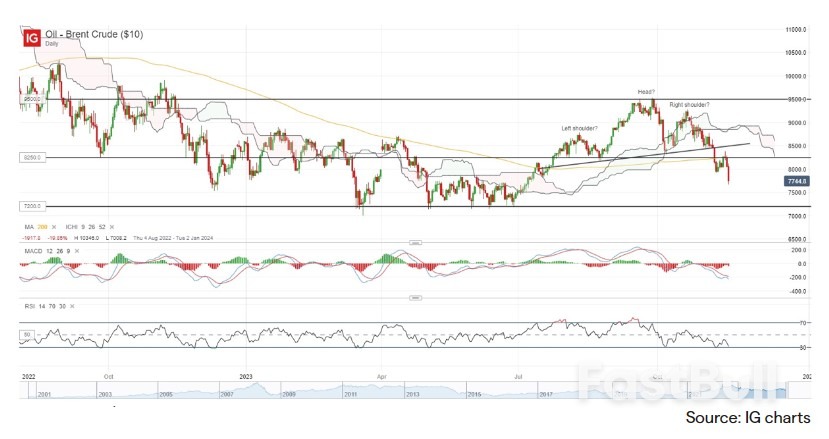
          On the other hand, rising economic risks have not been well-received by Brent crude prices, which fell close to 4% overnight to its lowest level since July this year. A retest of its 200-day moving average (MA) was met with a bearish rejection recently, with a head-and-shoulder formation breakdown in early-November this year potentially leaving the pattern completion at the US$72.00 level on watch. A bearish crossover remains presented on its weekly moving average convergence/divergence (MACD), while its weekly relative strength index (RSI) continues to drag further below the 50 level as signs of sellers in control for now.Asia Market Update: Oil Prices at Fresh Four-Month Low, ASX 200 Retracing from Cloud Resistance_1

          Asia Open

          Asian stocks look set to mirror Wall Street with muted moves, with Nikkei +0.05%, ASX -0.21% and KOSPI -0.56% at the time of writing. Softer Treasury yields and a significant dip in oil prices have not worked the way it should, in terms of supporting gains across the region. Chinese equities remain in a weary state, with the Nasdaq Golden Dragon China Index down more than 3% overnight, following a 1.4% earlier decline in the Hang Seng Index (HSI).
          Alibaba failed to lift sentiments with its 2Q 2023 results, plunging 9.1% as investors shun at the news that the company was scrapping plans to spin out its cloud computing division as a result of US chip export restrictions. Aside, China's house prices also contracted for the fourth straight month, which seem to reflect the limited policy success thus far in driving recovery for its property sector, with weak housing demand likely to persist.
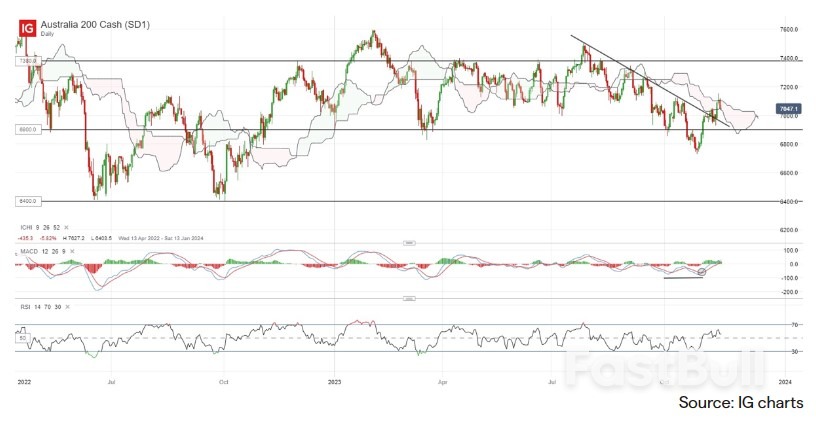
          The ASX 200 struggled to see any pick-up in today's session, as a retest of its Ichimoku cloud on the daily chart was met with some resistance lately with a formation of a daily bearish pin bar on Wednesday. A break above a previous downward trendline resistance may still be supportive of a near-term upward trend, but the upper edge of the daily cloud resistance at the 7,100 level will have to be overcome to provide some conviction for the bulls.Asia Market Update: Oil Prices at Fresh Four-Month Low, ASX 200 Retracing from Cloud Resistance_2
          Risk Warnings and Disclaimers
          You understand and acknowledge that there is a high degree of risk involved in trading. Following any strategies or investment methods may lead to potential losses. The content on the site is provided by our contributors and analysts for information purposes only. You are solely responsible for determining whether any trading assets, securities, strategy, or any other product is suitable for investing based on your own investment objectives and financial situation.
          Comments
          Add to Favorites
          Share

          Access to Oil, Geopolitical Pressures: What Is the US' Motive Behind Easing Venezuelan Sanctions?

          Devin

          Commodity

          Political

          Questions have been raised over the true intention behind the United States' move to ease sanctions on Venezuela's oil and gas sector.
          The dramatic shift in ties has met accusations of diplomatic hypocrisy, after Washington last month U-turned on years of punishing measures against the country's socialist government.
          In return, Venezuelan President Nicolas Maduro is expected to let election monitors into the country to observe its presidential contest next year, while also allowing opposition candidates to run.
          The US has been seeking other sources of fuel amid a global energy crunch, and Venezuela, with the world's largest proven oil reserves, could be part of the answer.
          However, the move may also be driven by geopolitics, as the US seeks to keep Venezuela's distance from Iran, China and Russia, experts told CNA.
          Mutually Beneficial
          The new US-Venezuela relationship is, however, built on a shaky platform of mutual interests.
          Much of Venezuela's oil production had been frozen by sanctions after former US president Donald Trump imposed the restrictions in 2019.
          Russia's invasion of Ukraine last year, however, shifted the US' political priorities.
          The thaw began in November last year, when the US allowed American company Chevron to resume the production and export of Venezuelan oil.
          This came in exchange for democratic concessions, with the Maduro government agreeing to restart talks with the opposition.
          "It wasn't about democracy," Dr Ryan Berg, director of the Americas Program at the Center for Strategic and International Studies, told CNA.
          "In my opinion, it is about getting about 100,000 to 150,000 extra barrels of oil per day from Venezuelan production, and making sure that they come to the United States in a context that was characterised by a tight international oil market in the wake of Russia's invasion of Ukraine."
          Geopolitical Forces at Play
          Other geopolitical forces could also have been at play behind Washington's change of heart towards Venezuela, said analysts.
          With the US facing geopolitical pressure to counter Russia and China, pulling closer to Caracas may actually be more about trying to push Venezuela away from its allies, said experts.
          "Some things are missing here: the release of American hostages, committing to the defence of human rights, (and) committing to not continuing to violate human rights," political analyst Oswaldo Ramirez Colina, director of ORC Consultants, told CNA.
          The agreed deal on electoral guarantees had stopped short of Mr. Maduro agreeing to reinstate opposition candidates who had been barred from public office. Three US citizens also remain wrongfully detained in Venezuela.
          "I believe that the interest of the Biden administration with Venezuela is to keep it away from Iran mainly, secondly from Russia, (and) beyond that, China," he added.
          Russian Foreign Minister Sergei Lavrov hosted his Venezuelan counterpart Yvan Gil Pinto in Moscow on Thursday (Nov 16).
          Meanwhile, China remains Venezuela's main creditor, and the two countries have been growing closer.
          Mr. Maduro met with his Chinese counterpart Xi Jinping in Beijing in September this year, and the duo promised to upgrade the relationship between their countries.
          Washington's shift in policy is not seen as doing much to break the burgeoning bond, said Dr Berg.
          "I think China is so involved in Latin America and the Caribbean that to just address China's influence in Venezuela kind of misses the broader picture," he said.
          While China's influence in Venezuela is significant, it is not as concerning as its influence in other places that are more important to the US as allies, he explained.
          These include Brazil, Argentina, Peru and Chile, he said.
          Before this pivot, Washington had been backing the former Venezuelan opposition leader Juan Guaido.
          He was invited as a guest of honour to the 2020 State of the Union address, to illustrate the US' recognition that he was the country's true president.
          Republicans on Capitol Hill are now accusing President Joe Biden and the Democrats of forgetting the opposition Washington had backed for more than five years.
          The White House had said that the arrangement simply aims to persuade an authoritarian regime to hold free and fair elections.
          However, the quid pro quo nature of the new relationship — oil for the US, money for Venezuela — has not been lost on many in both Washington and Caracas.

          Source: CNA

          Risk Warnings and Disclaimers
          You understand and acknowledge that there is a high degree of risk involved in trading. Following any strategies or investment methods may lead to potential losses. The content on the site is provided by our contributors and analysts for information purposes only. You are solely responsible for determining whether any trading assets, securities, strategy, or any other product is suitable for investing based on your own investment objectives and financial situation.
          Comments
          Add to Favorites
          Share
          FastBull
          Copyright © 2025 FastBull Ltd

          728 RM B 7/F GEE LOK IND BLDG NO 34 HUNG TO RD KWUN TONG KLN HONG KONG

          TelegramInstagramTwitterfacebooklinkedin
          App Store Google Play Google Play
          Products
          Charts

          Chats

          Q&A with Experts
          Screeners
          Economic Calendar
          Data
          Tools
          Membership
          Features
          Function
          Markets
          Copy Trading
          Latest Signals
          Contests
          News
          Analysis
          24/7
          Columns
          Education
          Company
          Careers
          About Us
          Contact Us
          Advertising
          Help Center
          Feedback
          User Agreement
          Privacy Policy
          Business

          White Label

          Data API

          Web Plug-ins

          Poster Maker

          Affiliate Program

          Risk Disclosure

          The risk of loss in trading financial instruments such as stocks, FX, commodities, futures, bonds, ETFs and crypto can be substantial. You may sustain a total loss of the funds that you deposit with your broker. Therefore, you should carefully consider whether such trading is suitable for you in light of your circumstances and financial resources.

          No decision to invest should be made without thoroughly conducting due diligence by yourself or consulting with your financial advisors. Our web content might not suit you since we don't know your financial conditions and investment needs. Our financial information might have latency or contain inaccuracy, so you should be fully responsible for any of your trading and investment decisions. The company will not be responsible for your capital loss.

          Without getting permission from the website, you are not allowed to copy the website's graphics, texts, or trademarks. Intellectual property rights in the content or data incorporated into this website belong to its providers and exchange merchants.

          Not Logged In

          Log in to access more features

          FastBull Membership

          Not yet

          Purchase

          Become a signal provider
          Help Center
          Customer Service
          Dark Mode
          Price Up/Down Colors

          Log In

          Sign Up

          Position
          Layout
          Fullscreen
          Default to Chart
          The chart page opens by default when you visit fastbull.com