• Trade
  • Markets
  • Copy
  • Contests
  • News
  • 24/7
  • Calendar
  • Q&A
  • Chats
Trending
Screeners
SYMBOL
LAST
BID
ASK
HIGH
LOW
NET CHG.
%CHG.
SPREAD
SPX
S&P 500 Index
6870.39
6870.39
6870.39
6895.79
6858.28
+13.27
+ 0.19%
--
DJI
Dow Jones Industrial Average
47954.98
47954.98
47954.98
48133.54
47871.51
+104.05
+ 0.22%
--
IXIC
NASDAQ Composite Index
23578.12
23578.12
23578.12
23680.03
23506.00
+72.99
+ 0.31%
--
USDX
US Dollar Index
98.880
98.960
98.880
98.960
98.730
-0.070
-0.07%
--
EURUSD
Euro / US Dollar
1.16534
1.16541
1.16534
1.16717
1.16341
+0.00108
+ 0.09%
--
GBPUSD
Pound Sterling / US Dollar
1.33194
1.33203
1.33194
1.33462
1.33136
-0.00118
-0.09%
--
XAUUSD
Gold / US Dollar
4208.03
4208.44
4208.03
4218.85
4190.61
+10.12
+ 0.24%
--
WTI
Light Sweet Crude Oil
59.450
59.480
59.450
60.084
59.291
-0.359
-0.60%
--

Community Accounts

Signal Accounts
--
Profit Accounts
--
Loss Accounts
--
View More

Become a signal provider

Sell trading signals to earn additional income

View More

Guide to Copy Trading

Get started with ease and confidence

View More

Signal Accounts for Members

All Signal Accounts

Best Return
  • Best Return
  • Best P/L
  • Best MDD
Past 1W
  • Past 1W
  • Past 1M
  • Past 1Y

All Contests

  • All
  • Trump Updates
  • Recommend
  • Stocks
  • Cryptocurrencies
  • Central Banks
  • Featured News
Top News Only
Share

Russian Defence Ministry: Russian Forces Take Control Of Novodanylivka In Ukraine's Zaporizhzhia Region

Share

Russian Defence Ministry: Russian Forces Take Control Of Chervone In Ukraine's Donetsk Region

Share

French Finance Ministry: Government Started Process To Block Temporarily Shein Platform

Share

Finance Minister: Indonesia To Impose Coal Export Tax Of Up To 5% Next Year

Share

[Trump Considering Fired Homeland Security Secretary Noem? White House Denies] According To Reports From US Media Outlets Such As The Daily Beast And The UK's Independent, The White House Has Denied Reports That US President Trump Is Considering Firing Homeland Security Secretary Noem. White House Spokesperson Abigail Jackson Posted On Social Media On The 7th Local Time, Calling The Claims "fake News" And Stating That "Secretary Noem Has Done An Excellent Job Implementing The President's Agenda And 'making America Safe Again'."

Share

HKEX: Standard Chartered Bought Back 571604 Total Shares On Other Exchanges For Gbp9.5 Million On Dec 5

Share

Morgan Stanley Reiterates Bullish Outlook On US Stocks Due To Fed Rate Cut Expectations. Morgan Stanley Strategists Believe That The US Stock Market Faces A "bullish Outlook" Given Improved Earnings Expectations And Anticipated Fed Rate Cuts. They Expect Strong Corporate Earnings By 2026, And Anticipate The Fed Will Cut Rates Based On Lagging Or Mildly Weak Labor Markets. They Expect The US Consumer Discretionary Sector And Small-cap Stocks To Continue To Outperform

Share

China's National Development And Reform Commission Announced That Starting From 24:00 On December 8, The Retail Price Limit For Gasoline And Diesel In China Will Be Reduced By 55 Yuan Per Ton, Which Translates To A Reduction Of 0.04 Yuan Per Liter For 92-octane Gasoline, 0.05 Yuan Per Liter For 95-octane Gasoline, And 0.05 Yuan Per Liter For 0# Diesel

Share

Tkms CEO: US Security Strategy Highlights Need For Europe To Take Care Of Its Own Defences

Share

USA S&P 500 E-Mini Futures Up 0.1%, NASDAQ 100 Futures Up 0.18%, Dow Futures Down 0.02%

Share

London Metal Exchange (LME): Copper Inventories Increased By 2,000 Tons, Aluminum Inventories Decreased By 2,500 Tons, Nickel Inventories Increased By 228 Tons, Zinc Inventories Increased By 2,375 Tons, Lead Inventories Decreased By 3,725 Tons, And Tin Inventories Decreased By 10 Tons

Share

Swiss Sight Deposits Of Domestic Banks At 440.519 Billion Sfr In Week Ending December 5 Versus 437.298 Billion Sfr A Week Earlier

Share

Czech November Jobless Rate 4.6% Versus Mkt Fcast 4.7%

Share

Czech Jobless Rate Unchanged At 4.6% In November

Share

Singapore Central Bank Data: November Foreign Exchange Reserves At $400.0 Billion

Share

Fitch On EMEA Homebuilders Says Weak Demand Is Likely To Constrain Completions And New Starts, Despite Easing Inflation And Gradual Rate Cuts

Share

French Otc Day-Ahead Baseload Power Price At 22.50 EUR/Mwh, Down 35.3% From The Price Paid Friday For Monday Delivery - Lseg Data

Share

Cambodia Information Minister: 4 Cambodian Civilians Killed, 9 Injured Amid Conflict With Thailand

Share

Tkms CEO: With Meko Frigates We Are Offering To German Government An Alternative To Delayed F126 Frigates

Share

Tkms CEO: Expect Decision On Canadian Submarine Order In 2026

TIME
ACT
FCST
PREV
France Industrial Output MoM (SA) (Oct)

A:--

F: --

P: --
France Trade Balance (SA) (Oct)

A:--

F: --

P: --
Euro Zone Employment YoY (SA) (Q3)

A:--

F: --

P: --
Canada Part-Time Employment (SA) (Nov)

A:--

F: --

P: --

Canada Unemployment Rate (SA) (Nov)

A:--

F: --

P: --

Canada Full-time Employment (SA) (Nov)

A:--

F: --

P: --

Canada Labor Force Participation Rate (SA) (Nov)

A:--

F: --

P: --

Canada Employment (SA) (Nov)

A:--

F: --

P: --

U.S. PCE Price Index MoM (Sept)

A:--

F: --

P: --

U.S. Personal Income MoM (Sept)

A:--

F: --

P: --

U.S. Core PCE Price Index MoM (Sept)

A:--

F: --

P: --

U.S. PCE Price Index YoY (SA) (Sept)

A:--

F: --

P: --

U.S. Core PCE Price Index YoY (Sept)

A:--

F: --

P: --

U.S. Personal Outlays MoM (SA) (Sept)

A:--

F: --

P: --
U.S. 5-10 Year-Ahead Inflation Expectations (Dec)

A:--

F: --

P: --

U.S. Real Personal Consumption Expenditures MoM (Sept)

A:--

F: --

P: --
U.S. Weekly Total Rig Count

A:--

F: --

P: --

U.S. Weekly Total Oil Rig Count

A:--

F: --

P: --

U.S. Consumer Credit (SA) (Oct)

A:--

F: --

P: --
China, Mainland Foreign Exchange Reserves (Nov)

A:--

F: --

P: --

Japan Trade Balance (Oct)

A:--

F: --

P: --

Japan Nominal GDP Revised QoQ (Q3)

A:--

F: --

P: --

China, Mainland Imports YoY (CNH) (Nov)

A:--

F: --

P: --

China, Mainland Exports (Nov)

A:--

F: --

P: --

China, Mainland Imports (CNH) (Nov)

A:--

F: --

P: --

China, Mainland Trade Balance (CNH) (Nov)

A:--

F: --

P: --

China, Mainland Exports YoY (USD) (Nov)

A:--

F: --

P: --

China, Mainland Imports YoY (USD) (Nov)

A:--

F: --

P: --

Germany Industrial Output MoM (SA) (Oct)

A:--

F: --

P: --
Euro Zone Sentix Investor Confidence Index (Dec)

A:--

F: --

P: --

Canada National Economic Confidence Index

--

F: --

P: --

U.K. BRC Like-For-Like Retail Sales YoY (Nov)

--

F: --

P: --

U.K. BRC Overall Retail Sales YoY (Nov)

--

F: --

P: --

Australia Overnight (Borrowing) Key Rate

--

F: --

P: --

RBA Rate Statement
RBA Press Conference
Germany Exports MoM (SA) (Oct)

--

F: --

P: --

U.S. NFIB Small Business Optimism Index (SA) (Nov)

--

F: --

P: --

Mexico 12-Month Inflation (CPI) (Nov)

--

F: --

P: --

Mexico Core CPI YoY (Nov)

--

F: --

P: --

Mexico PPI YoY (Nov)

--

F: --

P: --

U.S. Weekly Redbook Index YoY

--

F: --

P: --

U.S. JOLTS Job Openings (SA) (Oct)

--

F: --

P: --

China, Mainland M1 Money Supply YoY (Nov)

--

F: --

P: --

China, Mainland M0 Money Supply YoY (Nov)

--

F: --

P: --

China, Mainland M2 Money Supply YoY (Nov)

--

F: --

P: --

U.S. EIA Short-Term Crude Production Forecast For The Year (Dec)

--

F: --

P: --

U.S. EIA Natural Gas Production Forecast For The Next Year (Dec)

--

F: --

P: --

U.S. EIA Short-Term Crude Production Forecast For The Next Year (Dec)

--

F: --

P: --

EIA Monthly Short-Term Energy Outlook
U.S. API Weekly Gasoline Stocks

--

F: --

P: --

U.S. API Weekly Cushing Crude Oil Stocks

--

F: --

P: --

U.S. API Weekly Crude Oil Stocks

--

F: --

P: --

U.S. API Weekly Refined Oil Stocks

--

F: --

P: --

South Korea Unemployment Rate (SA) (Nov)

--

F: --

P: --

Japan Reuters Tankan Non-Manufacturers Index (Dec)

--

F: --

P: --

Japan Reuters Tankan Manufacturers Index (Dec)

--

F: --

P: --

Japan Domestic Enterprise Commodity Price Index MoM (Nov)

--

F: --

P: --

Japan Domestic Enterprise Commodity Price Index YoY (Nov)

--

F: --

P: --

China, Mainland PPI YoY (Nov)

--

F: --

P: --

Q&A with Experts
    • All
    • Chatrooms
    • Groups
    • Friends
    Connecting
    .
    .
    .
    Type here...
    Add Symbol or Code

      No matching data

      All
      Trump Updates
      Recommend
      Stocks
      Cryptocurrencies
      Central Banks
      Featured News
      • All
      • Russia-Ukraine Conflict
      • Middle East Flashpoint
      • All
      • Russia-Ukraine Conflict
      • Middle East Flashpoint

      Search
      Products

      Charts Free Forever

      Chats Q&A with Experts
      Screeners Economic Calendar Data Tools
      Membership Features
      Data Warehouse Market Trends Institutional Data Policy Rates Macro

      Market Trends

      Market Sentiment Order Book Forex Correlations

      Top Indicators

      Charts Free Forever
      Markets

      News

      News Analysis 24/7 Columns Education
      From Institutions From Analysts
      Topics Columnists

      Latest Views

      Latest Views

      Trending Topics

      Top Columnists

      Latest Update

      Signals

      Copy Rankings Latest Signals Become a signal provider AI Rating
      Contests
      Brokers

      Overview Brokers Assessment Rankings Regulators News Claims
      Broker listing Forex Brokers Comparison Tool Live Spread Comparison Scam
      Q&A Complaint Scam Alert Videos Tips to Detect Scam
      More

      Business
      Events
      Careers About Us Advertising Help Center

      White Label

      Data API

      Web Plug-ins

      Affiliate Program

      Awards Institution Evaluation IB Seminar Salon Event Exhibition
      Vietnam Thailand Singapore Dubai
      Fans Party Investment Sharing Session
      FastBull Summit BrokersView Expo
      Recent Searches
        Top Searches
          Markets
          News
          Analysis
          User
          24/7
          Economic Calendar
          Education
          Data
          • Names
          • Latest
          • Prev

          View All

          No data

          Scan to Download

          Faster Charts, Chat Faster!

          Download App
          English
          • English
          • Español
          • العربية
          • Bahasa Indonesia
          • Bahasa Melayu
          • Tiếng Việt
          • ภาษาไทย
          • Français
          • Italiano
          • Türkçe
          • Русский язык
          • 简中
          • 繁中
          Open Account
          Search
          Products
          Charts Free Forever
          Markets
          News
          Signals

          Copy Rankings Latest Signals Become a signal provider AI Rating
          Contests
          Brokers

          Overview Brokers Assessment Rankings Regulators News Claims
          Broker listing Forex Brokers Comparison Tool Live Spread Comparison Scam
          Q&A Complaint Scam Alert Videos Tips to Detect Scam
          More

          Business
          Events
          Careers About Us Advertising Help Center

          White Label

          Data API

          Web Plug-ins

          Affiliate Program

          Awards Institution Evaluation IB Seminar Salon Event Exhibition
          Vietnam Thailand Singapore Dubai
          Fans Party Investment Sharing Session
          FastBull Summit BrokersView Expo

          Higher for Longer Drive-Up Bond Yields

          Danske Bank

          Economic

          Summary:

          In Norway, unemployment figures are published.

          Today we receive euro area inflation figures for September. We expect a decline in headline HICP to 4.4% from 5.3% in August driven by negative energy inflation, lower food prices, and a downtick in core inflation from 5.3% to 4.8%. The yearly growth rates will decline sharply as the base effects from inflation reducing government subsidies in 2022 and statistical distortions that kept inflation elevated over this summer fades. Yet, we expect the underlying momentum of inflation to remain high at 0.3% m/m and 0.4% m/m in seasonally adjusted headline and core inflation, respectively.
          In Norway, unemployment figures are published.
          In the US, we get PCE inflation figures for August. We have already received the CPI print for August but the PCE print should attract some attention as it is the Federal Reserve’s preferred inflation measure. We also receive US real private consumption growth volume which we expect to land around zero or even slightly negative.
          China releases PMIs for September over the weekend before going on holiday all of next week (Golden Week). For PMIs, we look for a slight further increase in the NBS manufacturing PMI whereas the Caixin PMI manufacturing may slip back after a stronger reading in August. The service PMIs are also worth keeping an eye on as a gauge of consumer spending.
          In the UK, we receive the final 2023Q2 GDP figures.

          The 60 second overview

          There is positive sentiment in Asian equity markets this morning, following yesterday’s positive sentiment in US and European equity markets despite the rising yields. The move in Asia is supported by optimism regarding spending in China during the “Golden Week” holiday.
          The market is looking for a confirmation of the soft landing in the US economy from today’s US data personal spending and income for August as well as a decline in the core-PCE that is one of Fed Chairman Powell’s preferred measures of inflation. This should be supportive for the Federal Reserve being on hold even though we are pricing out some of the rate cuts for 2024 and 2025 as central banks are “higher for longer”.
          The potential US government shut-down is an additional factor creating uncertainty regarding the economy as stated by another Fed official, and would keep the Fed pausing.
          We have several speeches by ECB members today and the market will be watching for comments on monetary policy.
          Equities: Global equities were higher yesterday driven by US and Europe. Many moving parts – and not all moving in the same direction – made yesterday a tricky day for investors. The risk-on was driven by cyclicals and partly growth stocks despite European yields moving higher. Yesterday’s big underperformer, and the only sector lower in the MSCI World Index was utilities. Hence, yesterday was not a one-way train but just as much a small reversal for the part of the market struggling the most in September. In US: Dow +0.4%, S&P 500 +0.6%, Nasdaq +0.8% and Russell 2000 +0.9%. Asian markets are mostly positive this morning with Chinese H-shares leading the way higher and Japan going against the tide. European and US futures are marginally higher.
          FI: Furthermore, there is not much “flight to quality” despite the widening of the 10Y BTPS-Bund spread as the Bund ASW-spread is still below 60bp and the German curve continues to disinvert between 2Y and 10Y as the market is pricing out future rate cuts. In the US market bond yields ended lower ahead of today’s inflation data. However, this morning we have seen a modest rise in US Treasury yields in Asian trading hours.
          FX: Following six consecutive sessions of gains, the broad USD index fell modestly yesterday. The JPY recovered some lost ground vs the USD with USD/JPY back closer to 149. The SEK continued to perform, whereas the previous NOK rally faded as the oil price rally took a breather yesterday.
          Credit: After an otherwise rough week credit spreads saw some relief yesterday where iTraxx Xover tightened 10bp and Main 2bp. Despite the positive tone, Xover has widened 25bp since trading in the new series commenced just over a week ago and Main 5bp above.
          Nordic macro
          Although the Norwegian labour market is still tight with solid demand for labour and low unemployment we are now seeing slightly slower employment growth, fewer vacancies and a gentle rise in the jobless rate. This deterioration is very moderate, however, and so we expect unemployment to be unchanged at 1.9% (s.a.) in September.
          In Sweden, August retail sales is released. After the sharp setback between Q1 2022 and Q1 2023 retail sales has been on a slight upward trajectory and July was up 1% mom. Question is if it is sustainable. In the last NIER survey the depressed confidence among consumers and retailers fell back again. At 09.00, Martin Flodén is scheduled for a speech on monetary policy.
          To stay updated on all economic events of today, please check out our Economic calendar
          Risk Warnings and Disclaimers
          You understand and acknowledge that there is a high degree of risk involved in trading. Following any strategies or investment methods may lead to potential losses. The content on the site is provided by our contributors and analysts for information purposes only. You are solely responsible for determining whether any trading assets, securities, strategy, or any other product is suitable for investing based on your own investment objectives and financial situation.
          Comments
          Add to Favorites
          Share

          Is There One Last Surprise in Store for US Corn, Beans in 2022/23?

          Owen Li

          Commodity

          U.S. corn supplies have been below normal for the last of couple years due to a combination of disappointing crops and stronger demand, though that run is expected to end once this year’s near-record crop is harvested.
          However, the starting corn inventory for the current 2023-24 season will not be settled until the U.S. Department of Agriculture issues its next set of reports on Friday, and the trade has had trouble anticipating this number in recent years.
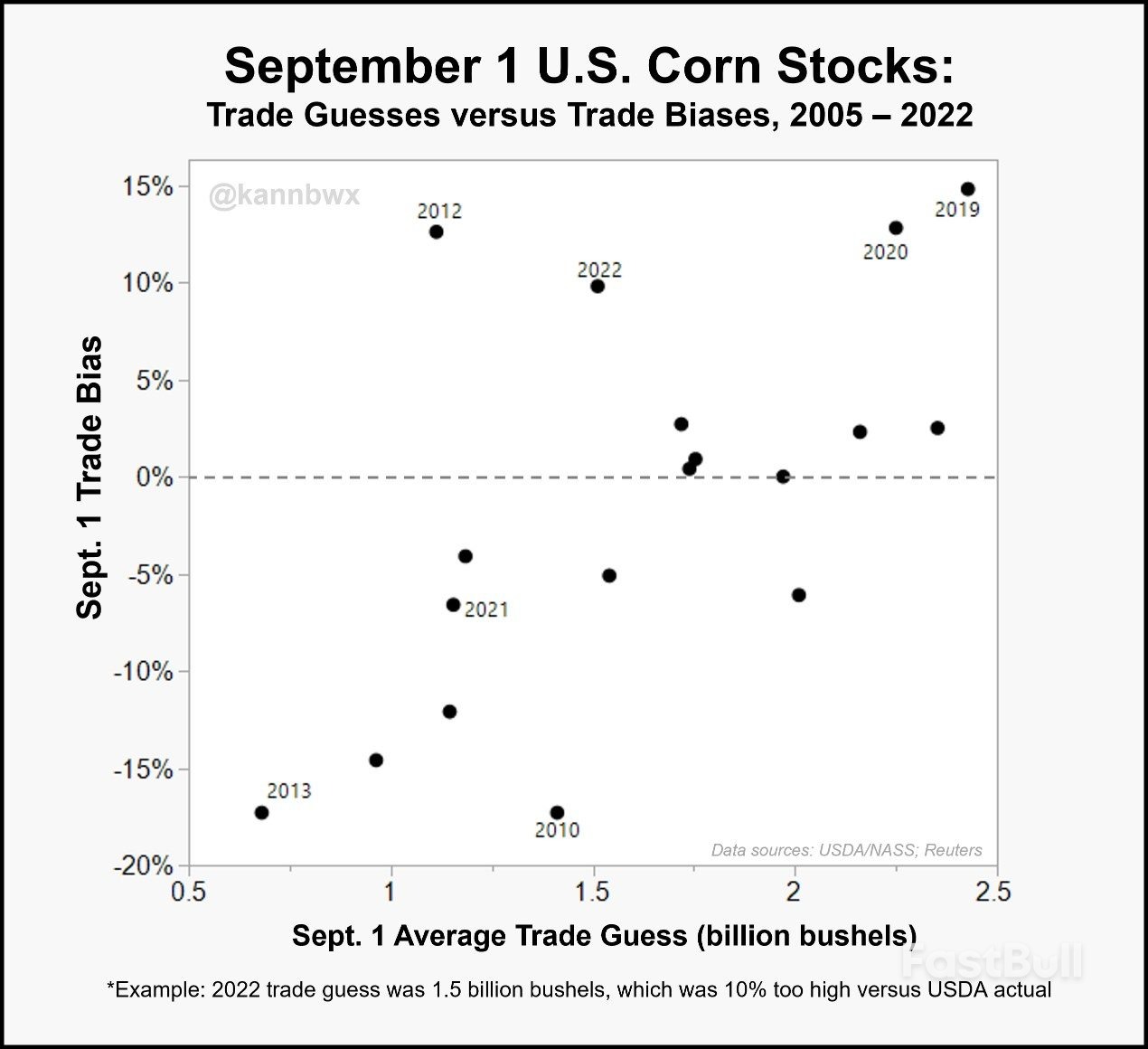
          On average, analysts expect Sept. 1 U.S. corn stocks at 1.429 billion bushels (bbu), a three-year high for the date but below the decade average. This survey-based figure becomes the ending stocks for the 2022-23 marketing year that concluded Aug. 31.
          Sept. 1 corn stocks have fallen outside the pre-report range of trade estimates in five of the last six years (not 2021). Four of those five misses occurred when Sept. 1 stocks came in low, generating bullish outcomes.
          Bullish Sept. 1 corn outcomes are more probable when supplies are already high and bearish ones tend to result during tighter supply years. This is likely based on the trade’s misjudgment of demand impacts when prices are unusually high or low.
          Is There One Last Surprise in Store for US Corn, Beans in 2022/23?_1That tendency may be less applicable this year since predicted Sept. 1 corn stocks are middle-of-the-road compared with the last couple of decades. Last year’s expectation of 1.5 bbu was similarly middle-ground, but Sept. 1 stocks came in 10% lower at 1.377 bbu.
          This year’s average trade guess implies June-August 2023 corn use down 10% on the year to a nine-year low for the period, likely due to fourth-quarter exports coming in a third lighter this year versus last.
          Ethanol production, which uses up to three times more U.S. corn than exports, was up about 2% on the year in the June-August time frame, and most-actively traded Chicago corn futures averaged about 19% lower through that period this year versus last.
          Only three of 20 polled analysts think Sept. 1 corn stocks were lighter in 2023 than in 2022. But even if that happens, it should not prevent substantial growth of U.S. corn stocks into 2024 unless an unforeseen demand situation arises.
          USDA estimated 2022-23 U.S. corn ending stocks at 1.452 bbu earlier this month.
          Soybeans
          Analysts see Sept. 1 U.S. soybean stocks at a seven-year low of 242 million bushels (mbu), slightly smaller than in the last two years. That is marginally lower than USDA’s latest 2022-23 ending stocks projection of 250 mbu.
          Sept. 1 soybean stocks have landed outside the range of expectations in four of the last six years, including the last two, which featured strongly bearish results. Trade estimates imply fourth-quarter soybean use down 20% from the prior year, primarily due to lagging exports.
          The outcome of Friday’s soybean number, especially if lighter than expected, could have a more persistent impact on the bean market versus that of corn. U.S. soybean stocks are already seen contracting through 2024 due to a shortfall in the crop.
          When USDA’s statistics agency analyzes the Sept. 1 survey data, it may choose to adjust the prior year’s harvest as explanation for the resulting stocks. The trade expects very minor declines in the 2022 corn and soybean crops.
          A misjudgment of the prior soybean harvest generally explains why the trade misses Sept. 1 soybean stocks, and this can be hard to gauge since the tendency has been mixed as to whether the soy crop rises or falls during the September review.
          To align with the soybean review, USDA in 2020 moved the review of the prior year’s corn crop to September from January. But regardless of the review's timing, the final corn crop almost always ends up equal to or lower than the last projected volume.

          Source: Reuters

          Risk Warnings and Disclaimers
          You understand and acknowledge that there is a high degree of risk involved in trading. Following any strategies or investment methods may lead to potential losses. The content on the site is provided by our contributors and analysts for information purposes only. You are solely responsible for determining whether any trading assets, securities, strategy, or any other product is suitable for investing based on your own investment objectives and financial situation.
          Comments
          Add to Favorites
          Share

          Shutdown Looms as US Senate, House Advance Separate Spending Plans

          Cohen

          Political

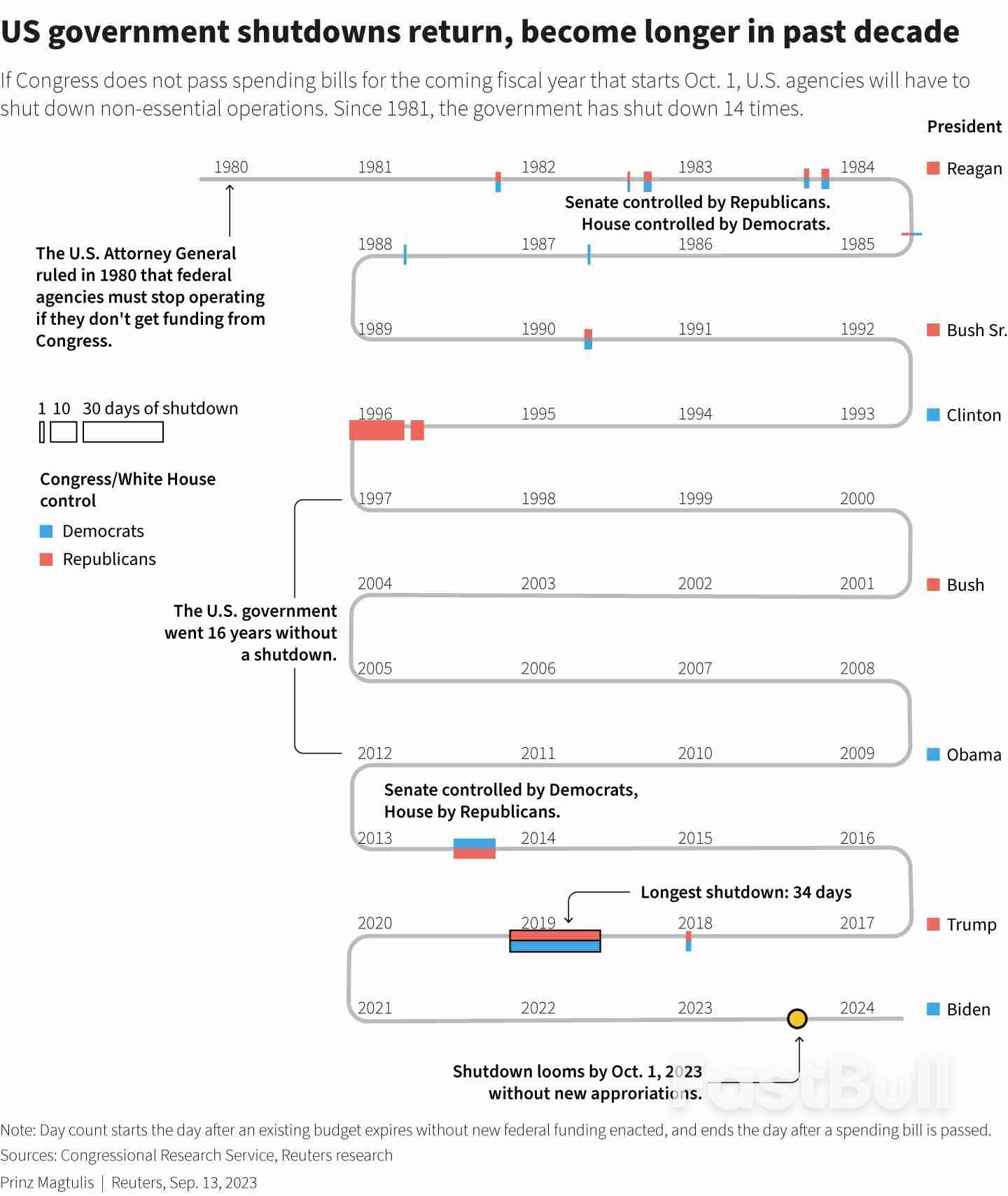
          The Democratic-led U.S. Senate forged ahead on Thursday with a bipartisan stopgap funding bill aimed at averting a fourth partial government shutdown in a decade, while the House began voting on partisan Republican spending bills with no chance of becoming law.
          The divergent paths of the two chambers increased the odds that federal agencies will run out of money on Sunday, furloughing hundreds of thousands of federal workers and halting a wide range of services from economic data releases to nutrition benefits.
          The House of Representatives passed three of four bills funding parts of the government, though the partisan bills would not alone prevent a shutdown, even if they could overcome strong opposition from Senate Democrats and become law.
          The Senate earlier in the day had voted 76-22 to open debate on a stopgap bill known as a continuing resolution, or CR, which would extend federal spending until Nov. 17, and authorize roughly $6 billion each for domestic disaster response funding and aid to Ukraine to defend itself against Russia.
          The Senate measure has already been rejected by Republicans, who control the House.
          House Republicans, led by a small faction of hardline conservatives in the chamber they control by a 221-212 margin, have rejected spending levels for fiscal year 2024 set in a deal Speaker Kevin McCarthy negotiated with Biden in May.
          The agreement included $1.59 trillion in discretionary spending in fiscal 2024. House Republicans are demanding another $120 billion in cuts, plus tougher legislation that would stop the flow of immigrants at the U.S. southern border with Mexico.
          The funding fight focuses on a relatively small slice of the $6.4 trillion U.S. budget for this fiscal year. Lawmakers are not considering cuts to popular benefit programs such as Social Security and Medicare.
          McCarthy is facing intense pressure from his caucus to cut spending and achieve other conservative priorities. Several hardliners have threatened to oust him from his leadership role if he passes a spending bill that requires any Democratic votes to pass.
          The House defeated a bill on agriculture funding by a 237-191 margin. Twenty-seven of McCarthy's Republicans rejected it, mostly moderates in competitive districts who were worried about steep cuts to funding, as well as a provision limiting access to abortion medication.
          Former President Donald Trump has taken to social media to push his congressional allies toward a shutdown.
          McCarthy, for his part, suggested on Thursday that a shutdown could be avoided if Senate Democrats agreed to address border issues in their stopgap measure.
          "I talked this morning to some Democratic senators over there that are more aligned with what we want to do. They want to do something about the border," McCarthy told reporters in the U.S. Capitol.
          "We're trying to work to see, could we put some border provisions in that current Senate bill that would actually make things a lot better," he said.
          The House Freedom Caucus, home to the hardliners forcing McCarthy's hand, in an open letter to him on Thursday demanded a timeline for passing the seven remaining appropriations bills and a plan to further reduce the top-line discretionary spending figure, among other questions.
          "No Member of Congress can or should be expected to consider supporting a stop-gap funding measure without answers to these reasonable questions," the letter, led by the group's chair, Republican Representative Scott Perry, read.
          'One option to avoid a shutdown'
          The Senate measure has passed two procedural hurdles this week with strong bipartisan support.
          "Congress has only one option - one option - to avoid a shutdown: bipartisanship," Senate Majority Leader Chuck Schumer said on Thursday. "With bipartisanship, we can responsibly fund the government and avoid the sharp and unnecessary pain for the American people and the economy that a shutdown will bring."
          Credit agencies have warned that brinkmanship and political polarization are harming the U.S. financial outlook. Moody's, the last major ratings agency to rate the U.S. government "Aaa" with a stable outlook, said on Monday that a shutdown would harm the country's credit rating.
          Fitch, another major ratings agency, already downgraded the U.S. government to "AA+" after Congress flirted with defaulting on the nation's debt earlier this year.Shutdown Looms as US Senate, House Advance Separate Spending Plans_1

          Source: Yahoo

          Risk Warnings and Disclaimers
          You understand and acknowledge that there is a high degree of risk involved in trading. Following any strategies or investment methods may lead to potential losses. The content on the site is provided by our contributors and analysts for information purposes only. You are solely responsible for determining whether any trading assets, securities, strategy, or any other product is suitable for investing based on your own investment objectives and financial situation.
          Comments
          Add to Favorites
          Share

          U.S. Oil Futures Surge as Cushing Stocks Evaporate

          Owen Li

          Energy

          U.S. crude futures prices have surged higher and the curve has moved into an increasingly severe backwardation as inventories drain away from around the futures delivery point at Cushing in Oklahoma.
          There is no doubt the global petroleum market has tightened since the start of the third quarter as a result of Saudi and Russian production cuts as well as an improving economic outlook in the U.S.
          But it has probably not tightened anything like as fast or as far as the sudden depletion of inventories at Cushing and the rise in futures prices suggests.
          The draw-down of crude inventories in the rest of the U.S. and other major consuming centres in Europe and Asia has been much more modest.
          The differential depletion of inventories around the delivery point and abrupt shift into a rampaging backwardation are classic hallmarks of a short squeeze.
          The tightening production-consumption balance has created ideal conditions: "You always squeeze the market with the fundamentals, not against them," as one senior trader told me over lunch more than a decade ago.
          The severe backwardation is likely to persist until the front-month futures contract approaches expiry on Oct. 20 and/or Cushing inventories start to rise.
          Cushing Drained
          Front-month U.S. crude futures prices climbed to $94 per barrel on Sept. 27 from $86 on Sept. 1 and $68 on June 27, as traders anticipated inventories will deplete further in the weeks ahead.
          The six-month calendar spread tightened into a backwardation of $10 per barrel from $4 on Sept. 1 and a contango of 8 cents on June 27.
          The sudden tightening of physical oil supplies at Cushing has coincided with extra production cuts by Saudi Arabia and Russia since the start of July.
          The extra cuts will have removed -125 million barrels of crude from the market by the end of September and -245 million barrels by the end of December if implemented in full.
          Crude stocks around the futures delivery point depleted by another -1 million barrels over the seven days ending on Sept. 22, according to data from the U.S. Energy Information Administration (EIA).
          Cushing inventories had fallen in 12 of the most recent 13 weeks by a total of -21 million barrels since June 23 (“Weekly petroleum status report”, EIA, September 27).
          As a result, Cushing stocks were -19 million barrels (-46% or -1.24 standard deviations) below the prior ten-year seasonal average, up from a deficit of just -1 million barrels (-2% or -0.06 standard deviations) at the end of June.
          Cushing stocks are at the lowest level for the time of year since 2014 and before that 2008, when futures prices were trading around $121 and $148 per barrel respectively, adjusting for inflation.
          Cushing inventories have depleted much faster and further than in the rest of the country, implying stocks have been drained intentionally.
          Commercial crude inventories in the rest of the country have fallen in just eight of the last 13 weeks by a total of only -17 million barrels since June 23.
          Cushing inventories accounted for less than 10% of all crude stocks nationwide on June 23 but have since accounted for almost 60% of the nationwide depletion.
          Nationwide crude stocks were just -2 million barrels (-0.5% or -0.04 standard deviations) below the ten-year seasonal average on Sept. 22.
          The position has changed only slightly from a surplus of +9 million barrels (+2% or +0.15 standard deviations) at the end of June.
          Deliverable Supply
          Calendar spreads are correlated with the volume of crude readily deliverable against the futures contract, which means oil stored in the tank farms at Cushing or easily deliverable by pipeline, not with total crude stocks.
          The intensifying shortage of crude at Cushing has therefore sent calendar spreads flying and in the process lifted front-month prices.
          Futures traders with short positions must now pay almost $2.50 per barrel to defer delivery for one month from November 2023 to December 2023, and by more than $6 to defer for three months until February 2024.
          The sudden tightening of oil supplies around the delivery point has squeezed hedge funds and other money managers who held bearish short positions.
          Hedge fund short positions in the NYMEX futures contract had been cut to just 20 million barrels on Sept. 19 from 136 million barrels on June 27.
          Most hedge fund positions are concentrated in futures contracts with nearby dates because they are the most volatile and liquid.
          The rush to cover short positions has therefore disproportionately lifted the prices for the front-month futures contract.
          Short covering has anticipated, accelerated and amplified the surge in front-month futures prices and the march towards a severe backwardation.
          In turn, the rapid strengthening of U.S. crude futures have bled across into other benchmarks including Brent and lifted oil prices worldwide.

          Source: Reuters

          Risk Warnings and Disclaimers
          You understand and acknowledge that there is a high degree of risk involved in trading. Following any strategies or investment methods may lead to potential losses. The content on the site is provided by our contributors and analysts for information purposes only. You are solely responsible for determining whether any trading assets, securities, strategy, or any other product is suitable for investing based on your own investment objectives and financial situation.
          Comments
          Add to Favorites
          Share

          Rising Towards the Sun in the Darkest Moment

          Peterson

          Commodity

          Forex

          Economic

          In the past, the price of gold has attracted much attention. On the one hand, the gold price in China is too high; on the other hand, it keeps falling on the international market. The gold price in China is still at a historical high, while the international gold price has fluctuated all the way down from the high in May. The bearish mainstream bias in the market has seen a low of US$1,800 in the year. The uptrend logic in China is still the investment channels and exchange rate factors, which have also stimulated many cross-border gold dealers, so I will leave it here for the time being. The depressed factor of international gold price is also relatively clear, that is, the strong upward trend of the interest rate of USD and U.S. Treasury Securities. The deeper reason behind it is that the sharp upward trend of energy prices has once again caused inflation to rise. U.S. crude oil rose from US$67 in July to US$94, with a range as high as 40%. The rise of inflation has become unstoppable. Moreover, the U.S. data show that the possibility of a soft landing of the economy is increasing and employment is still improving, which is also the backbone of the U.S. authorities.
          But is the real economy really as optimistic as the U.S. authorities think? At present, the U.S. economy is facing triple pressures. One is that the repayment of student loans due on October 1 will greatly affect consumption, the other is the risk of government closure on September 30, as well as a large-scale strike in the automobile industry. The U.S. automobile industry strike, which has been going on for 2 weeks, is an unexpected event, but is equally capable of influencing sentiment and could even affect next month's non-farm payrolls data (if the strike lasts beyond 9 October). At present, Biden supports workers to raise their wages by 40%. If the strike is ended by compromise, it will greatly increase the pressure of inflation, which will once again push up the expectation of raising interest rates in November or even later, which may be a great blow to automobile companies. However, nothing comes for free, and it will eventually hit consumption and the economy. In addition, the U.S. federal government will end this fiscal year on September 30, and the two parties in the U.S. Congress have still failed to reach an agreement on the spending bill. The possibility that the U.S. government will be shut down on October 1 is increasing.
          What's next for the gold price? It may be the darkest hour for gold prices at the moment, and we investors may not be too pessimistic, as gold prices have hit highs several times over the past 2022 in the most dramatic rate hiking cycle for the USD, with more factors being the over-anticipated purchases of gold by global central banks as well as the timing of risks in the U.S. banking system. At present, the USD is at the end of the interest rate hike, but the high interest rate will be maintained for a long time, which is not good news for the gold price, but the gold price is rising towards the sun. For investment, we don't need to guess where the bottom is. Instead, we can wait patiently for the bullish signal. Instead of spending time trading, we can get a positive trend by waiting!
          To stay updated on all economic events of today, please check out our Economic calendar
          Risk Warnings and Disclaimers
          You understand and acknowledge that there is a high degree of risk involved in trading. Following any strategies or investment methods may lead to potential losses. The content on the site is provided by our contributors and analysts for information purposes only. You are solely responsible for determining whether any trading assets, securities, strategy, or any other product is suitable for investing based on your own investment objectives and financial situation.
          Comments
          Add to Favorites
          Share

          RBA Board a Certain Hold Next Week

          Damon

          Central Bank

          Economic

          The Reserve Bank Board meets next week on October 3 with Governor Bullock presiding over her first meeting.
          We are certain that the Board will decide to continue the pause that began at the July meeting.
          The Board meetings which occur immediately before the release of the quarterly Inflation Report and the updating of the staff's forecasts (namely those in April, July and October) have been ones where the Board has shown a preference to pause – even during this long tightening cycle.
          At the October meeting last year, there was a surprise slowing in the pace of tightening from 50bps to 25bps; in January this year there was no meeting; April saw the first pause in the cycle after consecutive hikes in February and March; and July saw a pause after consecutive hikes in May and June.
          Rates remained on hold in August and September so a move in October would be very surprising.
          That does not preclude the Board from continuing to consider the two options – an increase of 0.25% or hold rates steady.
          After describing the decision in June as "finely balanced" the Board has described the "on hold" decision as the "stronger one" in subsequent meetings – indicating a clear preference for the pause option.
          The October decision statement is likely to repeat the sentiment, "members noted that some further tightening in policy may be required should inflation prove more persistent than expected."
          That statement is a sensible position for a cautious central bank to hold, while inflation remains above the target band, while also providing some residual support for the vulnerable AUD (recently fallen below US64¢).
          It is unlikely that the August monthly Inflation Indicator is a game changer. Annual inflation lifted from 4.9% in the year to July to 5.2%, mainly reflecting a 9% lift in petrol prices. A more reliable monthly Indicator than the Trimmed Mean monthly, which excludes volatile items, actually slowed from 5.8% to 5.5%.
          The more comprehensive September quarterly Inflation Report will be watched closely by the Board and the market – with information from that quarterly update to feed into the RBA's considerations at the November Board meeting.
          While the Bank does not publish its forecasts for annual inflation to the September quarter it does provide December and June.
          It is currently expecting inflation to fall from around 6.0% in June (Trimmed Mean 5.9%; Headline 6.0%) to around 4% in December (TM 3.9% and Headline 4.1%).
          Results around 5% for the September quarter would be in line with their expectations. These numbers would also have to be considered in the context of ongoing weakness in household spending; signs of a turning point in the labour market (job vacancies fell 9% in the three months from May to August); and real concerns around the outlook for China.
          The market is currently giving around a 40% chance of a rate hike in November lifting to 90% in March.
          Despite this market pricing, which is also indicating no rate cuts until 2025 we expect that the cash rate will remain on hold until August next year when the first rate cut can proceed. Our forecast for the conditions the Board will be facing by then will be an inflation rate that has fallen from 4.1% to 3.4%; an unemployment rate of 4.5%; and economic growth through the year to June of 1.0%.
          One argument we see for the expected rate hike by March is that Australian rates are just too low relative to other central banks.

          RBA Board a Certain Hold Next Week_1Figure 1 compares the movement in the effective mortgage rate for Australia and other majors.

          Australian borrowers have been much more sensitive to the recent sharp tightening cycle than other countries due to the low proportion of fixed rate loans – even recognising that the share reached around 35% in 2022. Effective mortgage rates have lifted from 3.3% to 3.6% in the US compared to 2.75% to 5.6% in Australia.
          The impact, which from Australia's rates holding well below US rates has been through the AUD/USD, which remains fragile at US64¢.
          But this negative yield differential with the US is not a new story.
          The "new story" is the relentless upgrade of the growth outlook for the US economy. Earlier this year Consensus forecasts for US growth in 2023 were around 0.4%, with general expectation of a recession at some time over 2023 and into 2024. Recent Consensus and FOMC forecasts have lifted growth in the US for 2023 to 2% while talk of recession has been scaled right back.
          As we show in Figure 2, the shape of the US yield curve continues to be consistent with a recession. But in recent weeks yields have risen and the curve has begun to flatten – a bear flattener where long bond rates have risen by more than short rates.RBA Board a Certain Hold Next Week_2
          That lifting of the yield curve has also impacted the near term prospect for the RBA, but reflects, in our view, more of a curve movement driven by rising long rates than the expectation of an RBA rate hike.
          The decision by the FOMC to issue guidance in its "dot plot" that there will only be two rate cuts next year rather than four has had some impact but, at this stage, surprisingly less than might have been expected. The key reason why the FOMC scaled back its rate forecasts was a reduction in its forecast for the unemployment rate by end 2024 from 4.5% to 4.1%. Westpac is more cautious on the US economy next year, expecting the unemployment rate to reach around 5%. We have therefore retained our call for four FOMC rate cuts in 2024.
          However, we have sharply lifted our profile for the US ten year bond rate by end 2024 by 60bps to 4%. That still leaves a slightly inverse yield curve for the US by end 2024.
          Despite the FOMC cutting rates next year bonds may be even less attractive than we are expecting. With the US economy avoiding a recession and the FOMC cutting rates the market may require a regular shaped yield curve much earlier than we are currently expecting.
          That need for a regular shaped curve signals a sharp rise in bond rates. A potential outcome would pressure the equity market.The issue here is that despite the sharp tightening cycle which the FOMC has implemented equity markets have been resilient – limiting the main channel through which FOMC policy can impact the US economy.
          As we saw in 2018, any major negative outcome in the US equity market is likely to trigger an aggressive response from the FOMC.
          A much more rapid easing cycle from the FOMC in 2024 would take pressure off the AUD; and certainly, set the scene for the RBA to follow.

          Source: Westpac Banking Corporation

          To stay updated on all economic events of today, please check out our Economic calendar
          Risk Warnings and Disclaimers
          You understand and acknowledge that there is a high degree of risk involved in trading. Following any strategies or investment methods may lead to potential losses. The content on the site is provided by our contributors and analysts for information purposes only. You are solely responsible for determining whether any trading assets, securities, strategy, or any other product is suitable for investing based on your own investment objectives and financial situation.
          Comments
          Add to Favorites
          Share

          Germany's Economic Health Check Shows Further Signs of Weakness

          Devin

          Economic

          Weak growth, worsening sentiment, and pessimistic forecasts have brought back headlines and public discussion over one key theme over the last few months: whether Germany is once again the 'sick man of Europe'. The Economist reintroduced the debate this summer more than two decades after its groundbreaking front page. The infamous headline certainly seems justified when looking at the current state of the German economy.
          A worrying economic health check
          More than 10 years ago, Germany was celebrating its Wirtschaftswunder 2.0 and grew by 2.1% on average per year between 2010 and 2015. The eurozone – excluding the German economy – grew by only 0.8% on average per year over the same period. Between 2016 and 2022, however, other eurozone economies picked up speed and Germany lost momentum. GDP growth in the monetary union (excluding Germany) was 1.7% on average per year between 2016 and 2022, compared with an average GDP growth per year of 1.1% in Germany.
          Germany's Economic Health Check Shows Further Signs of Weakness_1Currently, cyclical headwinds like the still-unfolding impact of the European Central Bank's monetary policy tightening and high inflation – plus the stuttering Chinese economy – are being met by structural challenges like the energy transition and shifts in the global economy, alongside a lack of investment in digitalisation, infrastructure and education. To be clear, Germany's international competitiveness had already deteriorated before the Covid-19 pandemic and the war in Ukraine.
          To a large extent, Germany's issues are homemade. Supply chain frictions in the wake of the pandemic, the war in Ukraine and the energy crisis have only exposed these structural weaknesses. These deficiencies are the flipside of fiscal austerity and wrong policy preferences over the last decade.Germany's Economic Health Check Shows Further Signs of Weakness_2
          Germany's low level of investment activity in recent years is evidence of the fact that the country has long rested on its functioning business model of importing cheap energy and exporting goods. While fixed capital investment in Germany grew by an average of 4.4% per year between 2010 and 2015, growth was only 3.1% between 2016 and 2022.Germany's Economic Health Check Shows Further Signs of Weakness_3
          Just like the economic growth story, the picture elsewhere in the eurozone looks quite the opposite. Excluding Germany, the eurozone's fixed capital investments grew by an average of 1.9% per year between 2010 and 2015. In the years 2016-2022, average investment growth per year was 4.9%.
          German business model needs an overhaul
          The structural transitions the economy is facing will come at a cost. Just think of energy-intensive production. In the production of food, beverages and tobacco, for example, more than half of the total energy consumption is covered by natural gas. Such a large share of consumption is met by renewable energy sources only in the manufacturing of wood and wood products. The shift from natural gas production to greener forms of production will initially come with productivity losses and, as a result, cause products to become more expensive.Germany's Economic Health Check Shows Further Signs of Weakness_4
          The good old growth driver, exports, is also stuttering. On the one hand, China's economic weakness and the expected economic downturn in the US are a burden on German exports. If both of its main trading partners are not doing well economically, this automatically does not bode well for German trade. Secondly, the globalised world as we know it will change. This does not necessarily mean deglobalisation, but rather that trade flows will change. Be it supply chain disruptions in recent years or geopolitical tension, there is certainly a case for diversifying trading partners more and, if possible, bringing production closer to home. However, this development will also be accompanied by efficiency losses and higher prices.Germany's Economic Health Check Shows Further Signs of Weakness_5
          More fallout from a lack of investment
          The general lack of investment is reflected in crumbling infrastructure. The quality of German roads has been rated worse and worse by various indices since 2010, and digital infrastructure in Germany remains in need of improvement as well. Fibre connections, or high-speed Internet, only accounted for some 8% of total German broadband connections in 2022. The OECD average in the same year was 36%.Germany's Economic Health Check Shows Further Signs of Weakness_6
          The consequences of an aging society
          Demographic change will also structurally weigh on the German economy in the coming years. By 2060, the German working population could shrink up to around 25% compared with 2019. Assuming high labour market participation and high net migration, the loss would still be 5%.Germany's Economic Health Check Shows Further Signs of Weakness_7
          Particularly over the next 12 years as the baby boomer generation retires from the German labour market, the shortage of skilled workers in Germany will become much more severe. However, in addition to labour market migration, another factor which could help to fill the gap in the German jobs market is automation. Nearly 80% of baby boomers currently employed in humanities and social sciences could be replaced by fellow robots. In the cleaning profession, more than 60% of employees aged over 55 could be replaced by automation.
          Germany's Economic Health Check Shows Further Signs of Weakness_8They say a real crisis only shows in the labour market. With a seasonally adjusted unemployment rate of just 5.7%, the German labour market is holding up very robustly. Beneath the surface, however, the first effects of the tense economic situation are beginning to show. For roughly a year now, the number of job postings has been declining, and companies' employment expectations are also slowly becoming much more gloomy. For the time being, it is therefore likely that labour unions will increasingly argue for job security rather than strong wage increases.Germany's Economic Health Check Shows Further Signs of Weakness_9
          Taking all the above findings into account, it is clear that the German economy – like a patient that has not taken good care of itself over the last decade – is now paying the price for too little maintenance work. As a result, the country has lost international competitiveness in almost every single ranking. In the European Commission's latest industrial survey, for example, more companies than ever before stated that they expect Germany's competitive position to deteriorate – both within and outside of the EU.Germany's Economic Health Check Shows Further Signs of Weakness_10
          Germany has shown regularly in the past that it can master crises. At the current juncture, however, the remedy for the country's current economic problems is not a simple one. It requires a long list of policy measures, structural reforms and investments to bring the economy back to full speed. More than twenty years ago, it took around five years between the first diagnosis and the beginning of serious structural reforms. Let's hope that it will be less this time around.

          Source: ING

          To stay updated on all economic events of today, please check out our Economic calendar
          Risk Warnings and Disclaimers
          You understand and acknowledge that there is a high degree of risk involved in trading. Following any strategies or investment methods may lead to potential losses. The content on the site is provided by our contributors and analysts for information purposes only. You are solely responsible for determining whether any trading assets, securities, strategy, or any other product is suitable for investing based on your own investment objectives and financial situation.
          Comments
          Add to Favorites
          Share
          FastBull
          Copyright © 2025 FastBull Ltd

          728 RM B 7/F GEE LOK IND BLDG NO 34 HUNG TO RD KWUN TONG KLN HONG KONG

          TelegramInstagramTwitterfacebooklinkedin
          App Store Google Play Google Play
          Products
          Charts

          Chats

          Q&A with Experts
          Screeners
          Economic Calendar
          Data
          Tools
          Membership
          Features
          Function
          Markets
          Copy Trading
          Latest Signals
          Contests
          News
          Analysis
          24/7
          Columns
          Education
          Company
          Careers
          About Us
          Contact Us
          Advertising
          Help Center
          Feedback
          User Agreement
          Privacy Policy
          Business

          White Label

          Data API

          Web Plug-ins

          Poster Maker

          Affiliate Program

          Risk Disclosure

          The risk of loss in trading financial instruments such as stocks, FX, commodities, futures, bonds, ETFs and crypto can be substantial. You may sustain a total loss of the funds that you deposit with your broker. Therefore, you should carefully consider whether such trading is suitable for you in light of your circumstances and financial resources.

          No decision to invest should be made without thoroughly conducting due diligence by yourself or consulting with your financial advisors. Our web content might not suit you since we don't know your financial conditions and investment needs. Our financial information might have latency or contain inaccuracy, so you should be fully responsible for any of your trading and investment decisions. The company will not be responsible for your capital loss.

          Without getting permission from the website, you are not allowed to copy the website's graphics, texts, or trademarks. Intellectual property rights in the content or data incorporated into this website belong to its providers and exchange merchants.

          Not Logged In

          Log in to access more features

          FastBull Membership

          Not yet

          Purchase

          Become a signal provider
          Help Center
          Customer Service
          Dark Mode
          Price Up/Down Colors

          Log In

          Sign Up

          Position
          Layout
          Fullscreen
          Default to Chart
          The chart page opens by default when you visit fastbull.com