• Trade
  • Markets
  • Copy
  • Contests
  • News
  • 24/7
  • Calendar
  • Q&A
  • Chats
Trending
Screeners
SYMBOL
LAST
BID
ASK
HIGH
LOW
NET CHG.
%CHG.
SPREAD
SPX
S&P 500 Index
6827.42
6827.42
6827.42
6899.86
6801.80
-73.58
-1.07%
--
DJI
Dow Jones Industrial Average
48458.04
48458.04
48458.04
48886.86
48334.10
-245.98
-0.51%
--
IXIC
NASDAQ Composite Index
23195.16
23195.16
23195.16
23554.89
23094.51
-398.69
-1.69%
--
USDX
US Dollar Index
97.950
98.030
97.950
98.500
97.950
-0.370
-0.38%
--
EURUSD
Euro / US Dollar
1.17394
1.17409
1.17394
1.17496
1.17192
+0.00011
+ 0.01%
--
GBPUSD
Pound Sterling / US Dollar
1.33707
1.33732
1.33707
1.33997
1.33419
-0.00148
-0.11%
--
XAUUSD
Gold / US Dollar
4299.39
4299.39
4299.39
4353.41
4257.10
+20.10
+ 0.47%
--
WTI
Light Sweet Crude Oil
57.233
57.485
57.233
58.011
56.969
-0.408
-0.71%
--

Community Accounts

Signal Accounts
--
Profit Accounts
--
Loss Accounts
--
View More

Become a signal provider

Sell trading signals to earn additional income

View More

Guide to Copy Trading

Get started with ease and confidence

View More

Signal Accounts for Members

All Signal Accounts

Best Return
  • Best Return
  • Best P/L
  • Best MDD
Past 1W
  • Past 1W
  • Past 1M
  • Past 1Y

All Contests

  • All
  • Trump Updates
  • Recommend
  • Stocks
  • Cryptocurrencies
  • Central Banks
  • Featured News
Top News Only
Share

Ukraine Says It Received 114 Prisoners From Belarus

Share

USA Embassy In Lithuania: Maria Kalesnikava Is Not Going To Vilnius

Share

USA Embassy In Lithuania: Other Prisoners Are Being Sent From Belarus To Ukraine

Share

Ukraine President Zelenskiy: Five Ukrainians Released By Belarus In US-Brokered Deal

Share

USA Vilnius Embassy: USA Stands Ready For "Additional Engagement With Belarus That Advances USA Interests"

Share

USA Vilnius Embassy: Belarus, USA, Other Citizens Among The Prisoners Released Into Lithuania

Share

USA Vilnius Embassy: USA Will Continue Diplomatic Efforts To Free The Remaining Political Prisoners In Belarus

Share

USA Vilnius Embassy: Belarus Releases 123 Prisoners Following Meeting Of President Trump's Envoy Coale And Belarus President Lukashenko

Share

USA Vilnius Embassy: Masatoshi Nakanishi, Aliaksandr Syrytsa Are Among The Prisoners Released By Belarus

Share

USA Vilnius Embassy: Maria Kalesnikava And Viktor Babaryka Are Among The Prisoners Released By Belarus

Share

USA Vilnius Embassy: Nobel Peace Prize Laureate Ales Bialiatski Is Among The Prisoners Released By Belarus

Share

Belarusian Presidential Administration Telegram Channel: Lukashenko Has Pardoned 123 Prisoners As Part Of Deal With US

Share

Two Local Syrian Officials: Joint US-Syrian Military Patrol In Central Syria Came Under Fire From Unknown Assailants

Share

Israeli Military Says It Targeted 'Key Hamas Terrorist' In Gaza City

Share

Rwanda's Actions In Eastern Drc Are A Clear Violation Of Washington Accords Signed By President Trump - Secretary Of State Rubio

Share

Israeli Military Issues Evacuation Warning In Southern Lebanon Village Ahead Of Strike - Spokesperson On X

Share

Belarusian State Media Cites US Envoy Coale As Saying He Discussed Ukraine And Venezuela With Lukashenko

Share

Belarusian State Media Cites US Envoy Coale As Saying That US Removes Sanctions On Belarusian Potassium

Share

Thai Prime Minister: No Ceasefire Agreement With Cambodia

Share

US, Ukraine To Discuss Ceasefire In Berlin Ahead Of European Summit

TIME
ACT
FCST
PREV
U.K. Trade Balance Non-EU (SA) (Oct)

A:--

F: --

P: --

U.K. Trade Balance (Oct)

A:--

F: --

P: --

U.K. Services Index MoM

A:--

F: --

P: --

U.K. Construction Output MoM (SA) (Oct)

A:--

F: --

P: --

U.K. Industrial Output YoY (Oct)

A:--

F: --

P: --

U.K. Trade Balance (SA) (Oct)

A:--

F: --

P: --

U.K. Trade Balance EU (SA) (Oct)

A:--

F: --

P: --

U.K. Manufacturing Output YoY (Oct)

A:--

F: --

P: --

U.K. GDP MoM (Oct)

A:--

F: --

P: --

U.K. GDP YoY (SA) (Oct)

A:--

F: --

P: --

U.K. Industrial Output MoM (Oct)

A:--

F: --

P: --

U.K. Construction Output YoY (Oct)

A:--

F: --

P: --

France HICP Final MoM (Nov)

A:--

F: --

P: --

China, Mainland Outstanding Loans Growth YoY (Nov)

A:--

F: --

P: --

China, Mainland M2 Money Supply YoY (Nov)

A:--

F: --

P: --

China, Mainland M0 Money Supply YoY (Nov)

A:--

F: --

P: --

China, Mainland M1 Money Supply YoY (Nov)

A:--

F: --

P: --

India CPI YoY (Nov)

A:--

F: --

P: --

India Deposit Gowth YoY

A:--

F: --

P: --

Brazil Services Growth YoY (Oct)

A:--

F: --

P: --

Mexico Industrial Output YoY (Oct)

A:--

F: --

P: --

Russia Trade Balance (Oct)

A:--

F: --

P: --

Philadelphia Fed President Henry Paulson delivers a speech
Canada Building Permits MoM (SA) (Oct)

A:--

F: --

P: --

Canada Wholesale Sales YoY (Oct)

A:--

F: --

P: --

Canada Wholesale Inventory MoM (Oct)

A:--

F: --

P: --

Canada Wholesale Inventory YoY (Oct)

A:--

F: --

P: --

Canada Wholesale Sales MoM (SA) (Oct)

A:--

F: --

P: --

Germany Current Account (Not SA) (Oct)

A:--

F: --

P: --

U.S. Weekly Total Rig Count

A:--

F: --

P: --

U.S. Weekly Total Oil Rig Count

A:--

F: --

P: --

Japan Tankan Large Non-Manufacturing Diffusion Index (Q4)

--

F: --

P: --

Japan Tankan Small Manufacturing Outlook Index (Q4)

--

F: --

P: --

Japan Tankan Large Non-Manufacturing Outlook Index (Q4)

--

F: --

P: --

Japan Tankan Large Manufacturing Outlook Index (Q4)

--

F: --

P: --

Japan Tankan Small Manufacturing Diffusion Index (Q4)

--

F: --

P: --

Japan Tankan Large Manufacturing Diffusion Index (Q4)

--

F: --

P: --

Japan Tankan Large-Enterprise Capital Expenditure YoY (Q4)

--

F: --

P: --

U.K. Rightmove House Price Index YoY (Dec)

--

F: --

P: --

China, Mainland Industrial Output YoY (YTD) (Nov)

--

F: --

P: --

China, Mainland Urban Area Unemployment Rate (Nov)

--

F: --

P: --

Saudi Arabia CPI YoY (Nov)

--

F: --

P: --

Euro Zone Industrial Output YoY (Oct)

--

F: --

P: --

Euro Zone Industrial Output MoM (Oct)

--

F: --

P: --

Canada Existing Home Sales MoM (Nov)

--

F: --

P: --

Euro Zone Total Reserve Assets (Nov)

--

F: --

P: --

U.K. Inflation Rate Expectations

--

F: --

P: --

Canada National Economic Confidence Index

--

F: --

P: --

Canada New Housing Starts (Nov)

--

F: --

P: --

U.S. NY Fed Manufacturing Employment Index (Dec)

--

F: --

P: --

U.S. NY Fed Manufacturing Index (Dec)

--

F: --

P: --

Canada Core CPI YoY (Nov)

--

F: --

P: --

Canada Manufacturing Unfilled Orders MoM (Oct)

--

F: --

P: --

Canada Manufacturing New Orders MoM (Oct)

--

F: --

P: --

Canada Core CPI MoM (Nov)

--

F: --

P: --

Canada Manufacturing Inventory MoM (Oct)

--

F: --

P: --

Canada CPI YoY (Nov)

--

F: --

P: --

Canada CPI MoM (Nov)

--

F: --

P: --

Canada CPI YoY (SA) (Nov)

--

F: --

P: --

Canada Core CPI MoM (SA) (Nov)

--

F: --

P: --

Q&A with Experts
    • All
    • Chatrooms
    • Groups
    • Friends
    Connecting
    .
    .
    .
    Type here...
    Add Symbol or Code

      No matching data

      All
      Trump Updates
      Recommend
      Stocks
      Cryptocurrencies
      Central Banks
      Featured News
      • All
      • Russia-Ukraine Conflict
      • Middle East Flashpoint
      • All
      • Russia-Ukraine Conflict
      • Middle East Flashpoint
      Search
      Products

      Charts Free Forever

      Chats Q&A with Experts
      Screeners Economic Calendar Data Tools
      Membership Features
      Data Warehouse Market Trends Institutional Data Policy Rates Macro

      Market Trends

      Market Sentiment Order Book Forex Correlations

      Top Indicators

      Charts Free Forever
      Markets

      News

      News Analysis 24/7 Columns Education
      From Institutions From Analysts
      Topics Columnists

      Latest Views

      Latest Views

      Trending Topics

      Top Columnists

      Latest Update

      Signals

      Copy Rankings Latest Signals Become a signal provider AI Rating
      Contests
      Brokers

      Overview Brokers Assessment Rankings Regulators News Claims
      Broker listing Forex Brokers Comparison Tool Live Spread Comparison Scam
      Q&A Complaint Scam Alert Videos Tips to Detect Scam
      More

      Business
      Events
      Careers About Us Advertising Help Center

      White Label

      Data API

      Web Plug-ins

      Affiliate Program

      Awards Institution Evaluation IB Seminar Salon Event Exhibition
      Vietnam Thailand Singapore Dubai
      Fans Party Investment Sharing Session
      FastBull Summit BrokersView Expo
      Recent Searches
        Top Searches
          Markets
          News
          Analysis
          User
          24/7
          Economic Calendar
          Education
          Data
          • Names
          • Latest
          • Prev

          View All

          No data

          Scan to Download

          Faster Charts, Chat Faster!

          Download App
          English
          • English
          • Español
          • العربية
          • Bahasa Indonesia
          • Bahasa Melayu
          • Tiếng Việt
          • ภาษาไทย
          • Français
          • Italiano
          • Türkçe
          • Русский язык
          • 简中
          • 繁中
          Open Account
          Search
          Products
          Charts Free Forever
          Markets
          News
          Signals

          Copy Rankings Latest Signals Become a signal provider AI Rating
          Contests
          Brokers

          Overview Brokers Assessment Rankings Regulators News Claims
          Broker listing Forex Brokers Comparison Tool Live Spread Comparison Scam
          Q&A Complaint Scam Alert Videos Tips to Detect Scam
          More

          Business
          Events
          Careers About Us Advertising Help Center

          White Label

          Data API

          Web Plug-ins

          Affiliate Program

          Awards Institution Evaluation IB Seminar Salon Event Exhibition
          Vietnam Thailand Singapore Dubai
          Fans Party Investment Sharing Session
          FastBull Summit BrokersView Expo

          September 28th Financial News

          FastBull Featured

          Daily News

          Summary:

          McConnell embraces the U.S. Senate's stopgap spending bill; lower crude inventories push prices higher; the UAW could expand strikes if significant progress is not made in Friday's talks...

          [Quick Facts]

          1. McConnell embraces the U.S. Senate's stopgap spending bill.
          2. How credible is the number of U.S. job openings?
          3. Lower crude inventories push prices higher.
          4. The UAW could expand strikes if significant progress is not made in Friday's talks.
          5. Japan's September economic report's assessment of domestic corporate goods prices changes from slowly declining to flat.

          [News Details]

          McConnell embraces the U.S. Senate's stopgap spending bill
          On September 28, U.S. Senate Republican Leader Mitch McConnell drew a line in the sand with House Republicans calling for a government shutdown. This highlighted divisions within the Republican Party and weakened House Speaker Kevin McCarthy's negotiating leverage as Washington inches closer to a disruption in federal funding on October 1. After a closed-door meeting of Senate Republicans on Wednesday, McConnell embraced a cross-party package to keep the government running until mid-November and provide $6 billion in new aid to Ukraine. The measure sparked heavy criticism from conservative hard-liners in the House.
          How credible is the number of U.S. job openings?
          Official figures show that there are about 9 million job openings in the U.S., but if you talk to some job seekers, you will realize that these jobs seem to be in another parallel universe. What's frustrating for job seekers is that employers won't really fill all the job openings listed for a variety of reasons. Revelio Labs, a workforce intelligence firm, says reported incidences of ghosting have doubled in many industries versus pre-pandemic, while the average job posting is only about half as likely to result in a new hire today. This information casts more doubt on the U.S. government's Job Openings and Labor Turnover Survey (JOLTS), especially when the Federal Reserve has viewed the number of job openings as a key indicator that the labor market is too tight.
          Lower crude inventories push prices higher
          Lower crude oil inventories may drive up WTI and Brent oil prices, but weak fuel demand remains a concern. Refineries are still running at high capacity, though they may slow down as the maintenance season begins and gasoline margins decline. While reduced supply has helped push crude oil prices higher, it has also impacted fuel consumption in the U.S.. Consumption has slowed on a seasonally adjusted basis as consumers are struggling with high gasoline prices. Diesel inventories have increased, but not enough to narrow the refining margin gap. However, the deterioration in economic activity could impact margins in the coming months. Diesel is expected to remain more profitable than gasoline for the rest of the year.
          The UAW could expand strikes if significant progress is not made in Friday's talks
          In a speech at 10 a.m. ET on Sept. 29, United Auto Workers (UAW) President Shawn Fain said the UAW could further expand its strikes against Detroit's legacy automakers on Friday if significant progress is not made in labor negotiations. The deadline for a strike expansion would be noon that day.
          Unlike previous strikes, this time UAW leaders have made targeted strikes at selected plants rather than launching a nationwide strike. The strike currently involves about 18,300 workers or 12.5 percent of the UAW's 146,000 members whose labor contracts expired on September 14. Striking workers receive $500 a week from the UAW's strike fund.
          Key demands made by the UAW include a 40 percent pay raise, a 32-hour work week, restoration of the traditional pension system, elimination of pay grades, and a return of cost-of-living pay raises. So far, the UAW and the auto companies remain far apart on key economic issues.
          Japan's September economic report's assessment of domestic corporate goods prices changes from slowly declining to flat
          The Japanese government has recently released its September economic report. Compared with August, the September report's judgment on Japan's economic situation remained broadly unchanged, reiterating that the economy is slowly recovering. In terms of policy stance, the Bank of Japan is expected to achieve the 2% inflation target in a sustained and stable manner by raising wages. The report emphasized the need to protect residents from the recent rapid price increases, achieve sustainable wage growth, and promote domestic investment, among other things.
          Compared with August, the September report's assessment of residential construction changed from "roughly flat" to "weaker," the assessment of corporate earnings changed from "slowly improving" to "improving," and the assessment of domestic corporate goods prices changed from "slowly declining" to "flat."

          [Focus of the Day]

          UTC+8 20:30 U.S. Weekly Initial Jobless Claims (SA)
          UTC+8 21:00 Chicago Fed Chairman Goolsbee delivers a speech
          UTC+8 22:00 U.S. Pending Homes Sales Index MoM (SA) (Aug)
          UTC+8 22:00 European Central Bank Governor Holzmann speaks
          UTC+8 22:45 Bank of England's Monetary Policy Committee Member Green delivers a speech
          TBD U.S. Senate's procedural vote on the stopgap spending bill
          Risk Warnings and Disclaimers
          You understand and acknowledge that there is a high degree of risk involved in trading. Following any strategies or investment methods may lead to potential losses. The content on the site is provided by our contributors and analysts for information purposes only. You are solely responsible for determining whether any trading assets, securities, strategy, or any other product is suitable for investing based on your own investment objectives and financial situation.
          Comments
          Add to Favorites
          Share

          Australian Dollar Attempts to Recover from 10-Month Lows Amid Downbeat Retail Sales

          FXOpen

          Forex

          The Australian Dollar (AUD) hit a 10-month low on Wednesday. However, the AUD/USD pair attempts to recover from the recent losses despite disappointing Australia's Retail Sales data.
          Australia's monthly Consumer Price Index (CPI) has rebounded from July's reading, which could be attributed to the increasing energy prices. This expected increase in inflation has raised anticipations of another interest rate hike by the Reserve Bank of Australia (RBA). However, the AUD failed to gain traction of positive Consumer Price Index (CPI) figures.
          The Aussie Dollar is under downward pressure due to increased risk aversion sentiment in the market. The drop-in commodity prices are also acting as a limiting factor on the upside potential of the AUD/USD pair.
          The U.S. Dollar Index (DXY) continues to strengthen, propelled by robust macroeconomic data from the United States (U.S.), trading at its highest levels since December. This surge in the U.S. Dollar (USD) is attributed to the positive performance of U.S. Treasury yields over an impending U.S. government shutdown. The yield on the 10-year U.S. Treasury note has reached record highs.
          The bullish momentum in the USD is further reinforced by the hawkish remarks made by Federal Reserve (Fed) board members. Neel Kashkari, the President of the Minneapolis Federal Reserve, recently made comments that suggest the potential for additional rate hikes in the future.
          Kashkari also left open the possibility of interest rates remaining at their current levels if rate cuts are delayed even further.
          Daily Digest Market Movers: Australian Dollar falls on market caution, higher U.S. Treasury yields, hot macros
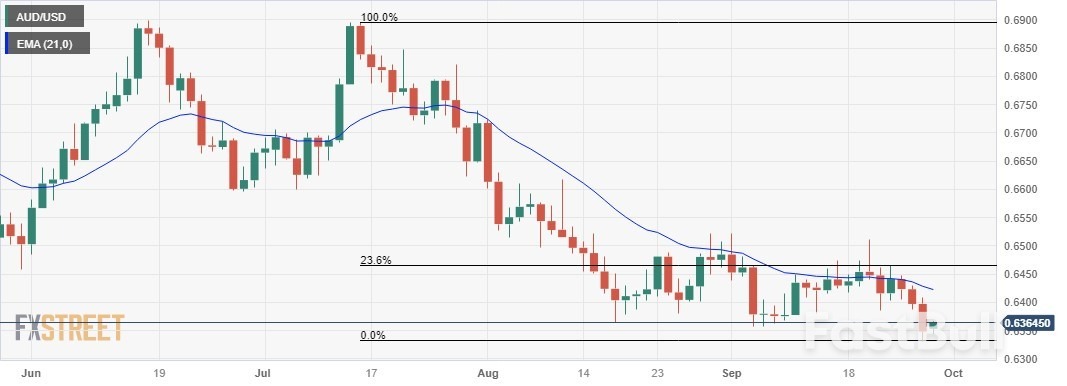
          • AUD/USD attempts to rebound after hitting a 10-month low at 0.6331 on Wednesday, trading around 0.6360 at the time of writing during early Asian trading hours on Thursday.
          • Australian Retail Sales for August, fell to 0.2% from the previous rate of 0.5%. The index was expected to grow at a 0.3% rate.
          • Australia's Monthly Consumer Price Index (CPI) year-over-year for August rose 5.2% as expected, up from the previous rate of 4.9%.
          • There is a growing expectation for rate increases in the subsequent November and December meetings by the RBA.
          • U.S. Durable Goods Orders rose 0.2%, swinging from the previous decline of 5.6% and market expectation of a 0.5% decline in August.
          • EIA Crude Oil Stocks Change data, on the week ending on September 22, decreased to a reading of -2.17M from -2.135M prior. The report was expected to release a -0.32M figures.
          • The situation in China regarding Evergrande continues to worsen, with increasing turmoil, intrigue, and uncertainty. Bloomberg reported on Wednesday that the chairman of the company had been placed under police surveillance.
          • Evergrande, the world's most indebted developer with over $300 billion in total liabilities, is at the heart of an unprecedented liquidity crisis in China's property sector.
          • The hawkish remarks from Neel Kashkari, the President of the Minneapolis Federal Reserve have led to a broad-based strengthening of the U.S. Dollar (USD) and have acted as a headwind for the AUD/USD pair. Kashkari emphasized the potential for additional rate hikes in the future.
          • Traders await the U.S. data such as the Core Personal Consumption Expenditure (PCE) Price Index, the Fed's preferred measure of consumer inflation, which is due on Friday. The annual rate is expected to reduce from 4.2% to 3.9%.
          Technical Analysis: Australian Dollar hovers around 0.6350, barrier at 0.6400 psychological level
          Australian Dollar trades higher around 0.6360 psychological level during the Asian session on Thursday. AUD/USD pair could find a barrier around 0.6400 psychological level, followed by the 21-day Exponential Moving Average (EMA) at 0.6422. A firm break above the latter could support the Aussie Dollar (AUD) to explore the region around 26.6% Fibonacci retracement at 0.6464. On the downside, the monthly low at 0.6357 aligned with the 0.6350 psychological level could be the key support, following the 0.6300 psychological level.Australian Dollar Attempts to Recover from 10-Month Lows Amid Downbeat Retail Sales_1

          Australian Dollar FAQs

          What key factors drive the Australian Dollar?
          One of the most significant factors for the Australian Dollar (AUD) is the level of interest rates set by the Reserve Bank of Australia (RBA). Because Australia is a resource-rich country another key driver is the price of its biggest export, Iron Ore. The health of the Chinese economy, its largest trading partner, is a factor, as well as inflation in Australia, its growth rate, and Trade Balance. Market sentiment – whether investors are taking on more risky assets (risk-on) or seeking safe havens (risk-off) – is also a factor, with risk-on positive for AUD.
          How do the decisions of the Reserve Bank of Australia impact the Australian Dollar?
          The Reserve Bank of Australia (RBA) influences the Australian Dollar (AUD) by setting the level of interest rates that Australian banks can lend to each other. This influences the level of interest rates in the economy as a whole. The main goal of the RBA is to maintain a stable inflation rate of 2-3% by adjusting interest rates up or down. Relatively high interest rates compared to other major central banks support the AUD, and the opposite for relatively low. The RBA can also use quantitative easing and tightening to influence credit conditions, with the former AUD-negative and the latter AUD-positive.
          How does the health of the Chinese Economy impact the Australian Dollar?
          China is Australia's largest trading partner so the health of the Chinese economy is a major influence on the value of the Australian Dollar (AUD). When the Chinese economy is doing well it purchases more raw materials, goods and services from Australia, lifting demand for the AUD, and pushing up its value. The opposite is the case when the Chinese economy is not growing as fast as expected. Positive or negative surprises in Chinese growth data, therefore, often have a direct impact on the Australian Dollar and its pairs.
          How does the price of Iron Ore impact the Australian Dollar?
          Iron Ore is Australia's largest export, accounting for $118 billion a year according to data from 2021, with China as its primary destination. The price of Iron Ore, therefore, can be a driver of the Australian Dollar. Generally, if the price of Iron Ore rises, AUD also goes up, as aggregate demand for the currency increases. The opposite is the case if the price of Iron Ore falls. Higher Iron Ore prices also tend to result in a greater likelihood of a positive Trade Balance for Australia, which is also positive of the AUD.
          How does the Trade Balance impact the Australian Dollar?
          The Trade Balance, which is the difference between what a country earns from its exports versus what it pays for its imports, is another factor that can influence the value of the Australian Dollar. If Australia produces highly sought after exports, then its currency will gain in value purely from the surplus demand created from foreign buyers seeking to purchase its exports versus what it spends to purchase imports. Therefore, a positive net Trade Balance strengthens the AUD, with the opposite effect if the Trade Balance is negative.
          Risk Warnings and Disclaimers
          You understand and acknowledge that there is a high degree of risk involved in trading. Following any strategies or investment methods may lead to potential losses. The content on the site is provided by our contributors and analysts for information purposes only. You are solely responsible for determining whether any trading assets, securities, strategy, or any other product is suitable for investing based on your own investment objectives and financial situation.
          Comments
          Add to Favorites
          Share

          Doom Loop Momentum Builds

          Damon

          Economic

          Sometimes markets get up a head of steam and it becomes very difficult to slow the momentum, far less reverse it.
          There's a case to make that this is where markets - U.S., Asian and global, across asset classes - find themselves, feeding off each other and accelerating self-fulfilling loops.
          Right now, these are 'doom' loops - rising U.S. bond yields, a rampant dollar, higher oil prices, tightening financial conditions, deepening growth fears, decreasing risk appetite and increasingly fragile equity markets.
          Wall Street's performance on Wednesday illustrated this phenomenon - despite plunging the day before, it barely recovered any ground at all. Asian stocks barely clawed back any of the previous days' losses either, and world stocks racked up a ninth straight decline.
          These moves are unlikely to provide a springboard for Asian markets on Thursday, and beyond Australian retail sales there is nothing on the economic or policy calendar likely to do so either.
          Recent rebounds in the S&P 500 have been sporadic and limited. The index has risen 0.5% or more only twice this month, and has not posted a gain of 1%. It has fallen at least 0.5% six times, three of those being 1% declines or more.
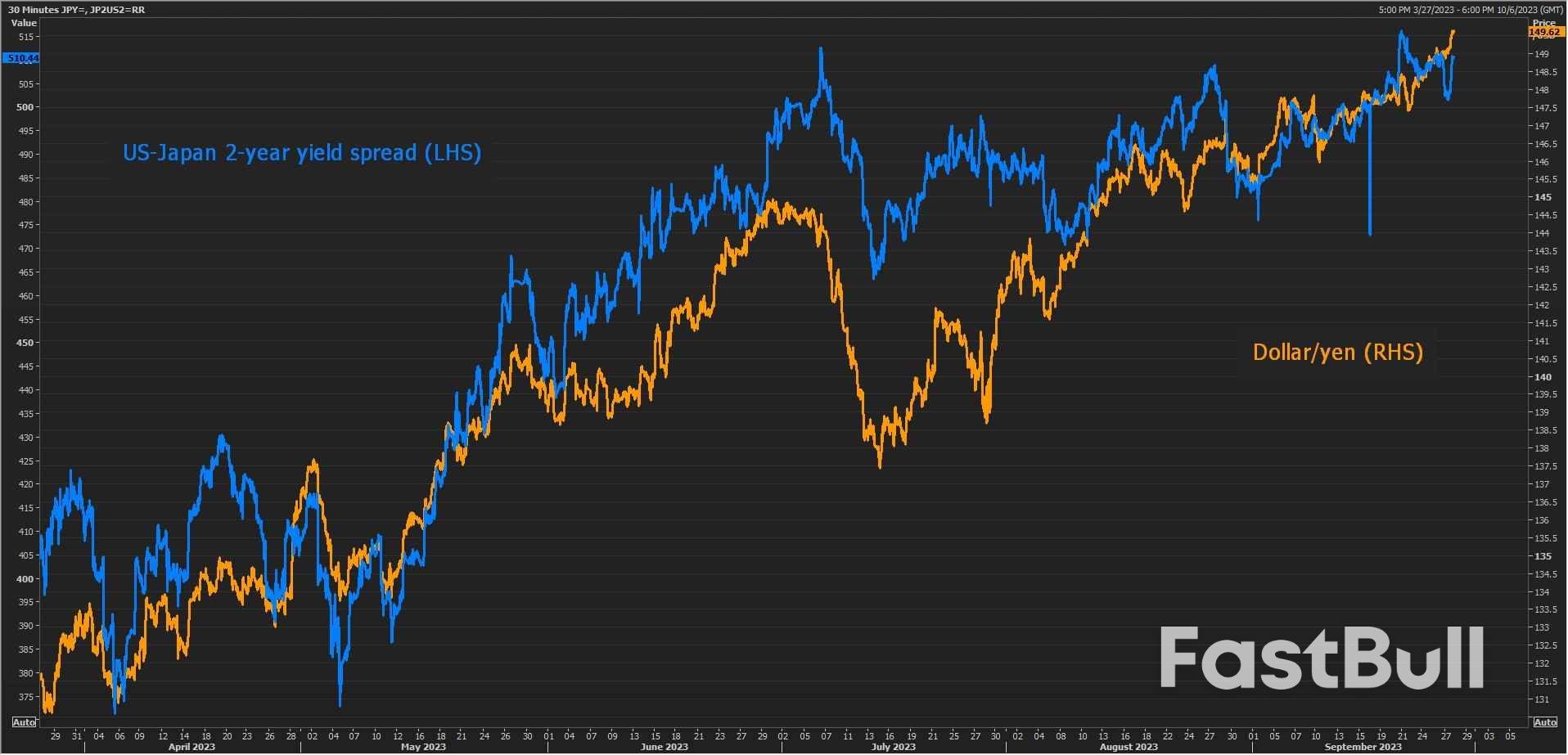
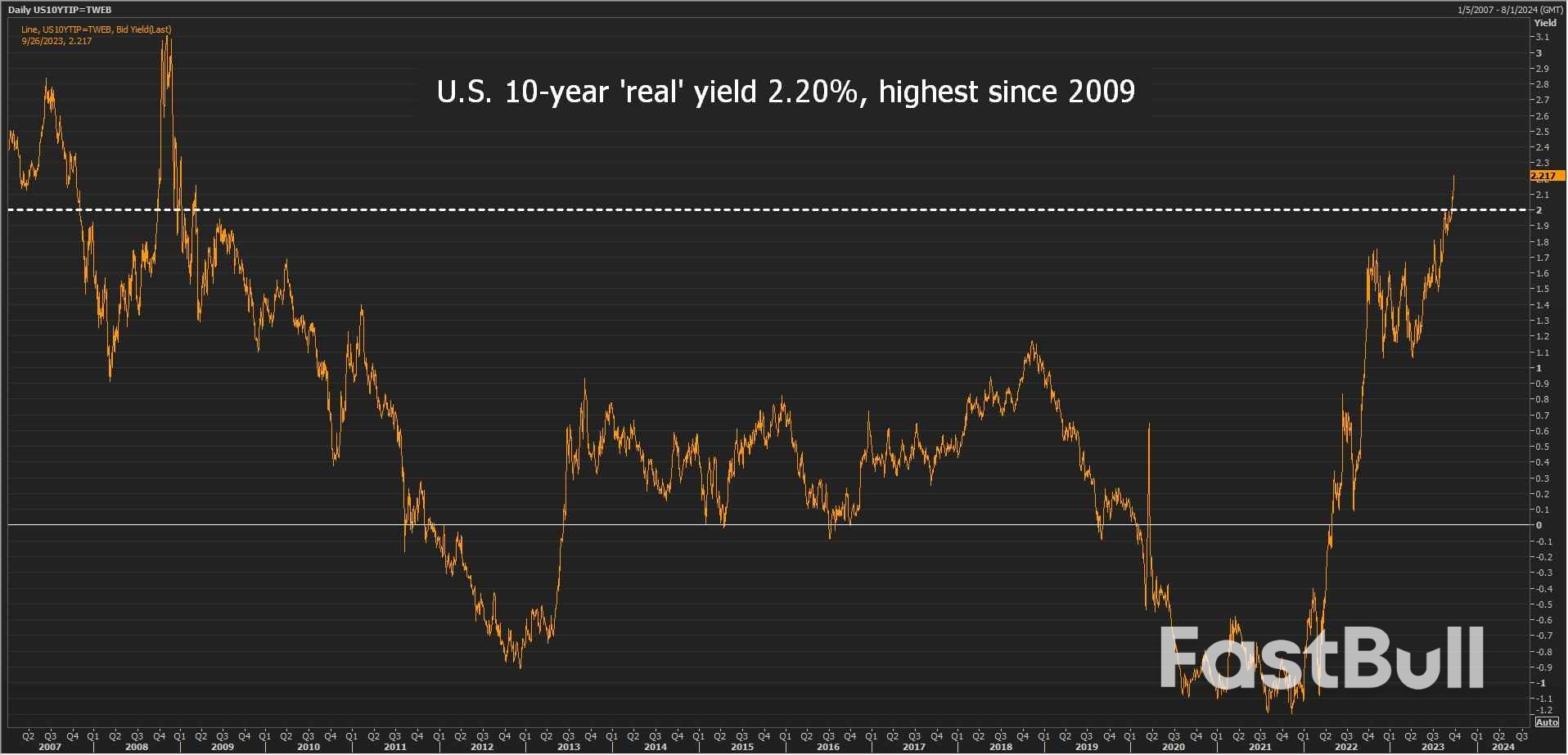
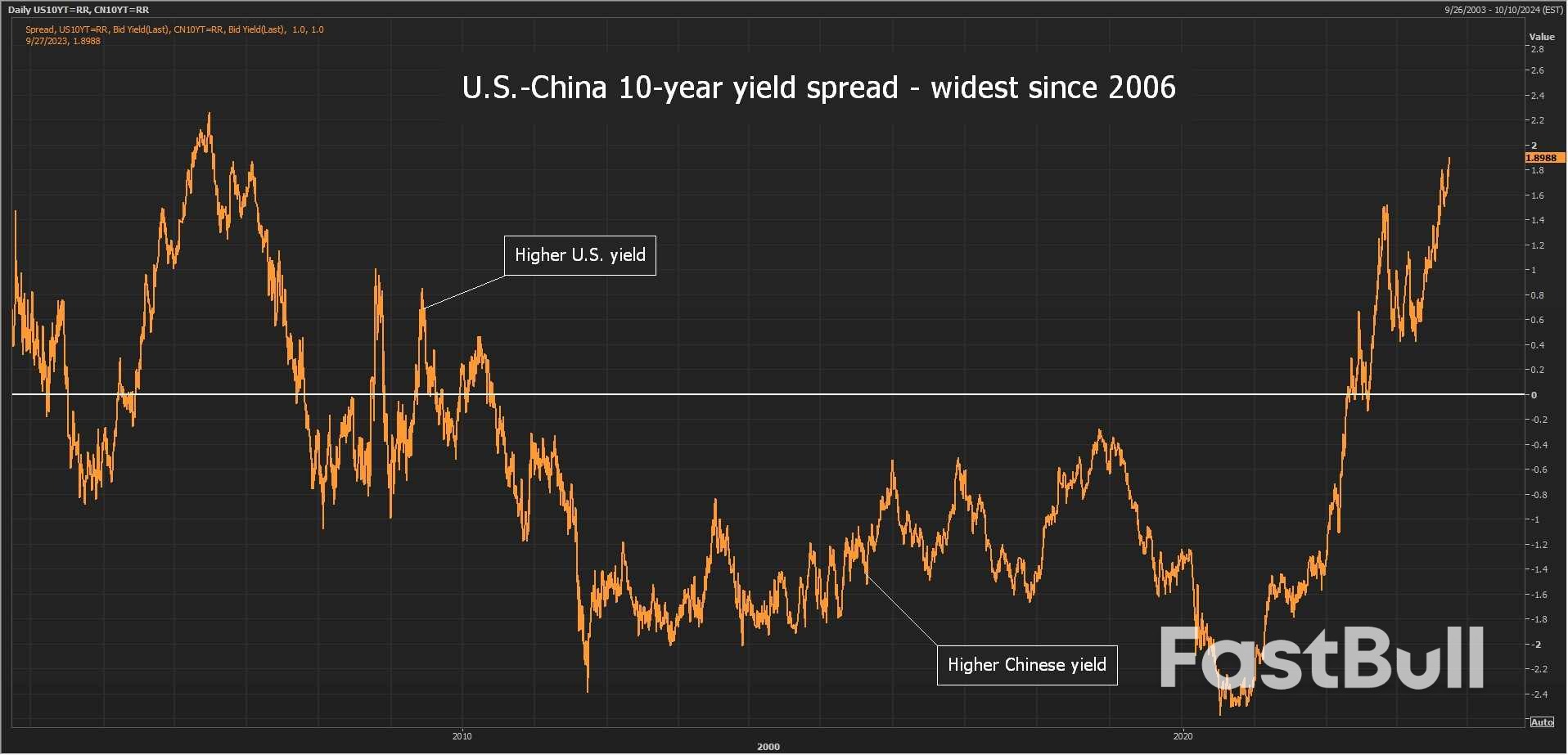
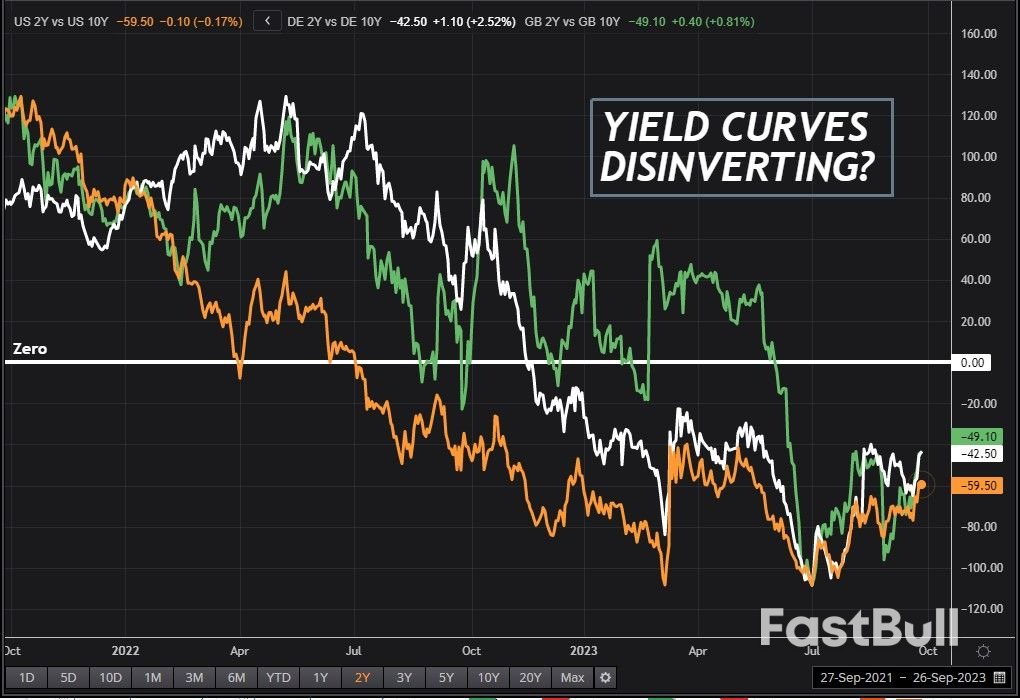
          Meanwhile, U.S. bond yields, the dollar and oil all rose again on Wednesday, and Treasury yield spreads over other bonds widened. The 10-year U.S.-Chinese spread is now 190 basis points, the widest since 2006, and the 2-year U.S.-Japanese spread is well above 500 bps and pushing dollar/yen closer to the 150.00 level.
          Still no intervention from Japan though.Doom Loop Momentum Builds_1Doom Loop Momentum Builds_2
          Doom Loop Momentum Builds_3In China, the turmoil, intrigue and uncertainty surrounding Evergrande is deepening, as Bloomberg reported on Wednesday that the company's chairman had been placed under police surveillance.
          The world's most indebted developer with more than $300 billion in total liabilities is at the center of an unprecedented liquidity crisis in China's property sector, which accounts for roughly a quarter of the economy.
          China's creaking property market is depressing world copper prices - often seen as a bellwether for the global economy - so Evergrande's debt restructuring has implications far beyond China's borders.
          There are signs that Beijing's steps to boost the economy in recent months may be having an effect. Profits at China's industrial firms for the first eight months of the year fell 11.7%, but that was down from a 15.5% contraction for the first seven months.
          A modest recovery may be underway. But it can take a long time for momentum to build or change course.
          Here are key developments that could provide more direction to markets on Thursday:
          - Australia retail sales (August)
          - Germany CPI inflation (September, prelim)
          - Fed Chair Jerome Powell speaks

          Source: Yahoo

          To stay updated on all economic events of today, please check out our Economic calendar
          Risk Warnings and Disclaimers
          You understand and acknowledge that there is a high degree of risk involved in trading. Following any strategies or investment methods may lead to potential losses. The content on the site is provided by our contributors and analysts for information purposes only. You are solely responsible for determining whether any trading assets, securities, strategy, or any other product is suitable for investing based on your own investment objectives and financial situation.
          Comments
          Add to Favorites
          Share

          S&P 500 Ekes Out Slim Gain as Investors Weigh Elevated Yields

          Samantha Luan

          Stocks

          The S&P 500 eked out a fractional gain on Wednesday after a see-saw session, as investors weighed whether to start bargain hunting following a sell-off fueled by elevated Treasury yields and uncertainty about the path ahead for interest rates.
          Investors were also attuned to developments in Washington as divisions among U.S. lawmakers put the federal government at risk of a partial shutdown by the weekend.
          A possible shutdown has added to worries for stock investors as they grapple with benchmark Treasury yields that have climbed to 16-year highs after the Federal Reserve last week signaled a hawkish long-term path for interest rates.
          At the same time, as the S&P 500 has sharply pared its year-to-date gain, some investors are wondering if the market is close to a bottom.
          "At some point people will start to buy stocks for the fourth quarter, and the third-quarter selling might be almost done," said Peter Tuz, president of Chase Investment Counsel.
          "At a certain level, people are going to get back in thinking the fourth quarter might be a pretty good one."
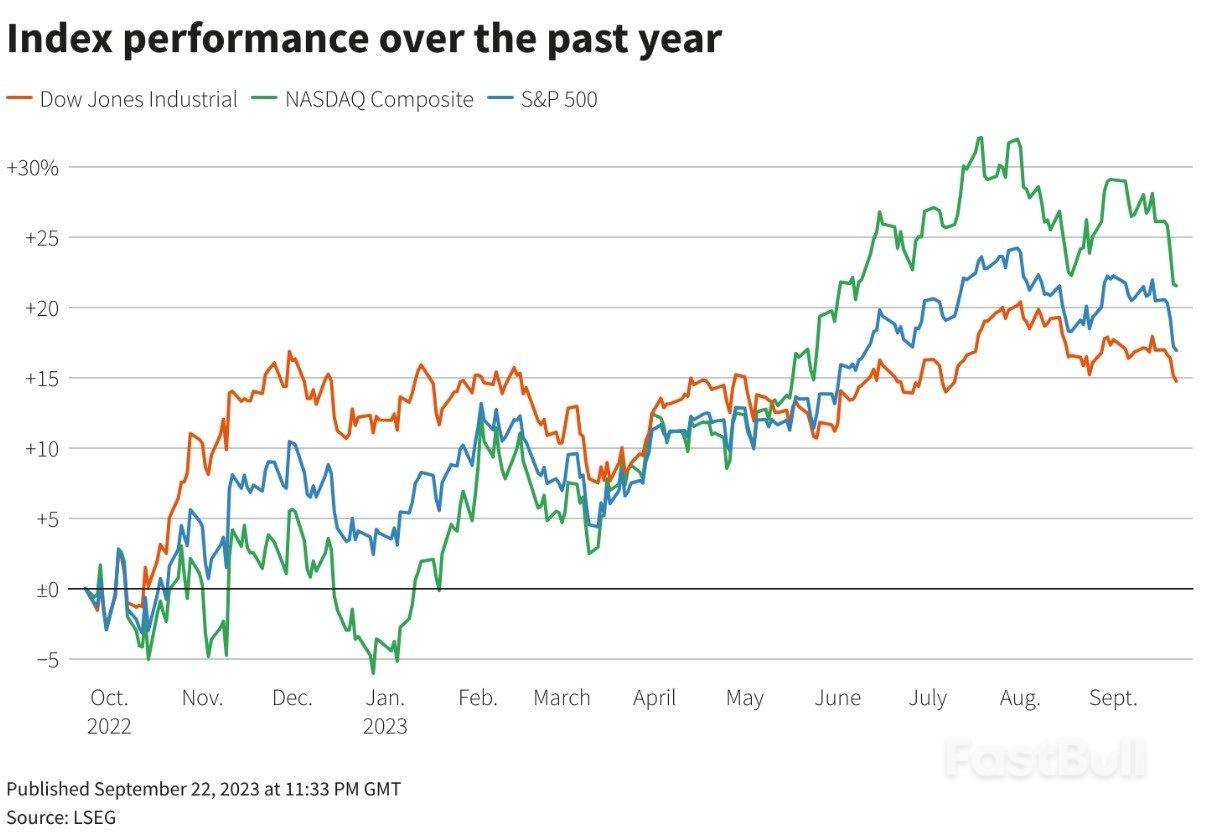
          The Dow Jones Industrial Average fell 68.61 points, or 0.2%, to 33,550.27, the S&P 500 gained 0.98 points, or 0.02%, at 4,274.51 and the Nasdaq Composite rose 29.24 points, or 0.22%, to 13,092.85.
          During the session, the S&P 500 rose as much as 0.4% and fell as much as 0.8% before paring losses.
          Among S&P 500 sectors, the rate-sensitive utilities group fell most, dropping 1.9%. Energy rose 2.5%, as Brent crude breached $97 a barrel, with the jump in oil prices posing a renewed threat to inflation that has been moderating.
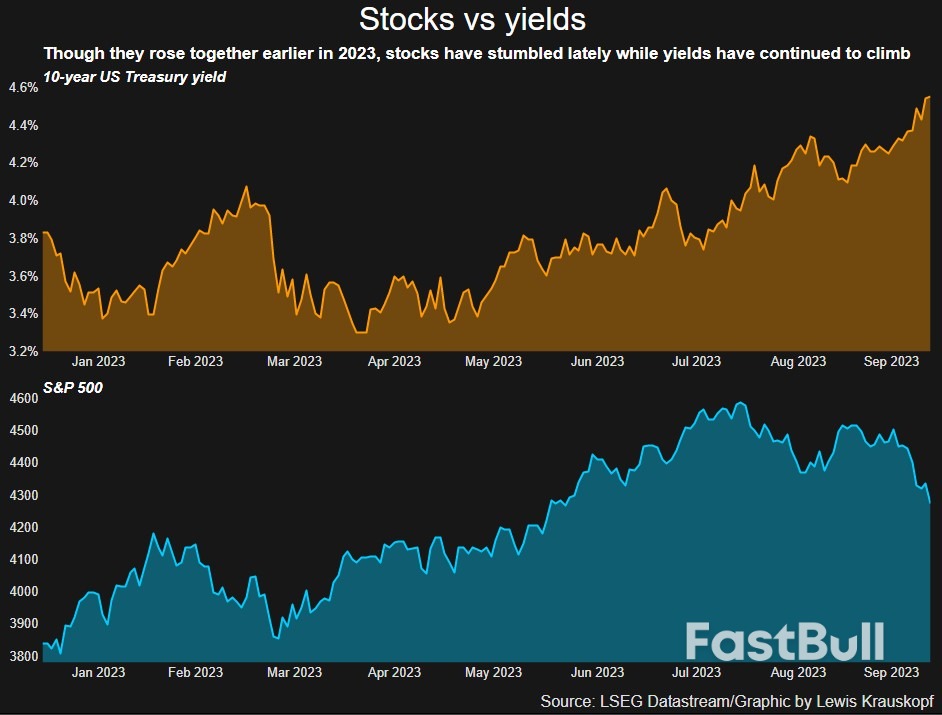
          The S&P 500 has fallen about 7% since late July, but remains up over 11% for 2023.
          "Investors are looking for a turning point," said Art Hogan, chief market strategist at B. Riley Wealth. "Clearly, it is not going to take much of a breath of fresh air in this market for people to chase this."S&P 500 Ekes Out Slim Gain as Investors Weigh Elevated Yields_1
          In Washington, Republican U.S. House Speaker Kevin McCarthy rejected a stopgap funding bill advancing in the Senate, bringing the government closer to its fourth partial shutdown in a decade.
          Data on Wednesday showed orders for long-lasting U.S. manufactured goods rose in August while business spending on equipment appeared to regain momentum after faltering early in the third quarter.
          Investors are focusing on Friday's monthly personal consumption expenditures price index for a fresh view of inflation. This week also brings second-quarter Gross Domestic Product and remarks from Federal Reserve Chair Jerome Powell.
          In company news, Costco Wholesale shares rose 1.9% after the retailer topped market estimates for quarterly revenue and profit.
          Declining issues were roughly split with advancers on the NYSE. There were 56 new highs and 440 new lows on the NYSE.
          On the Nasdaq, advancing issues outnumbered decliners by a 1.1-to-1 ratio. The Nasdaq recorded 35 new highs and 333 new lows.
          About 10.9 billion shares changed hands in U.S. exchanges, compared with the 10.2 billion daily average over the last 20 sessions.

          Source: Reuters

          Risk Warnings and Disclaimers
          You understand and acknowledge that there is a high degree of risk involved in trading. Following any strategies or investment methods may lead to potential losses. The content on the site is provided by our contributors and analysts for information purposes only. You are solely responsible for determining whether any trading assets, securities, strategy, or any other product is suitable for investing based on your own investment objectives and financial situation.
          Comments
          Add to Favorites
          Share

          US Government Shutdown Makes It Likely the Fed Is Finished Hiking

          Justin

          Political

          Central Bank

          Economic

          Another headwind for growth

          We’ve written a lot about the headwinds facing the US economy as we enter the fourth quarter. The exhaustion of pandemic era accrued savings for many households is likely to be a very important theme, as will the ongoing tightening of lending conditions amidst 20+ year high borrowing costs. Then there are higher energy costs that are eating into spending power plus the restart of student loan repayments that will intensify the squeeze on household finances in the months ahead. Now added to that list is the high probability of a government shutdown, which will see government work disrupted, hundreds of thousands of government workers and private sector vendors not being paid and economic data flow impeded.
          With Congress deadlocked over an agreement to provide funding for the start of the fiscal year on 1 October, we have the very real threat that government agencies start shutting down imminently. This has happened on 14 occasions since 1981 with some shutdowns lasting just a day or two while the longest stretched for 34 days between December 2018 and January 2019. The typical duration is around one to two weeks, after which politicians come to their senses amid an electoral backlash and agree a funding package.
          With government workers receiving back-pay the economic fallout is usually fairly limited with the Office of Management and Budget estimating the 16-day government shutdown in 2013 crimped third quarter 2013 GDP by roughly 0.3 percentage points.

          A long shutdown could mean the economy shrinks in the fourth quarter

          However, tensions appear higher this time and the potential for an extended period of brinkmanship given the proximity of next year’s Presidential election means that we need to be prepared for a shutdown that could stretch to several weeks. While there is a consensus on the need to narrow government spending deficits, the Democrats want to achieve it via tax increases and the Republicans want it to be realised via large spending cuts. Funding for Ukraine is also a point of tension. Adding to the challenge is the Republican Party’s narrow majority in the House and hardliners unwillingness (so far) to contemplate concessions.
          With no allocated funding we could see upwards of 800,000 workers furloughed – sent home without pay – while hundreds of thousands of other 'essential' federal government workers including Homeland Security, prison staff, military and legal workers would be required to continue working despite not being paid. Absenteeism could be an issue with the number of workers calling in sick typically rising when they are not being paid. National parks and museums may close in many instances and businesses surrounding them would inevitably be impacted while contractors employed by the federal government will also see payments being delayed or lost completely. Consumer and business sentiment is hurt and spending inevitably weakens.
          The ready reckoner is typically it knocks 0.1-0.2pp off quarterly annualised GDP growth for every week the shutdown drags on, but the economy makes perhaps half back when there is an agreement and back pay is returned. In an extreme example of it lasting a couple of months with agreement resolved by early December we could be talking a dent to GDP growth nearly a full percentage point. Given consensus expectations are only 0.4% for fourth quarter annualised growth, this would run the very real risk of a negative GDP print for the quarter.

          Economic weakness and an absence of data means the Fed is finished hiking

          Such an outcome would weaken the justification for the final Federal Reserve interest rate hike officials are forecasting for either the November or December FOMC meeting. But even if a shutdown is briefer it will have the potential to disrupt data flow that will damage the visibility for the Federal Reserve. The October jobs report looks very vulnerable given the surveys are completed the week of the 12th, while CPI may also be impacted. No data is the worst case, but even if we do get the reports published there will be question markets over quality and reliability.
          Given the lack of clarity on the state of the economy it too would strengthen the case for the Fed holding interest rates steady again in November. This would give more time for the economic slowdown we anticipate to emerge and with core inflation likely to continue moderating, makes it all the more likely that the Fed’s hiking cycle is already over.

          Here’s how a government shutdown might impact financial markets

          The first thing to note is this is different from the debt ceiling debacle that struck some months back. A key element then centred on the risk that the US Treasury could run out of cash and not be in a position make coupon and redemption payments on government debt, which in turn risked a technical default and potential significant instability on financial markets. In the extreme it could have taken the system down. It was also possible back then that parts of the government could have been shut down to help prioritise the servicing of the debt. In the event, these extremes did not occur, as the debt ceiling was eventually suspended (albeit a tad too close to potential default for comfort).
          The government shutdown that we are talking about here is different, at least in terms of its impact on Treasuries. The Treasury can continue to issue debt to raise cash, so there is no risk to the payment of interest or redemption payments on government debt. Hence there is no risk of default on the debt. The important nuance here is the Treasury has the cash. It’s just that they don’t have a legal right to spend it beyond the end of September. For spending to continue unfettered into October, the appropriate spending bill(s) need to be passed by Congress. Only the parts of government impacted by the specific spending bills are impacted, but that is wide enough to cause considerable pain to many government employees or social security recipients.
          The impact of a shutdown of some parts of government on financial markets is mostly centred on the dampening effect it has on economic activity. As a stand-alone issue, this should place downward pressure on Treasury yields. And the degree of severity would depend on how long the (partial) government shutdown lasts. There is also the possibility that risk assets could fret as an element of macro uncertainty is thrown into the equation. That too would likely push cash into bonds and money market funds (and out of risk assets). Importantly though, there is no material incremental default risk for Treasuries, and so the financial system should not come under pressure.
          There is a technical dimension to this too. To the extent that the Treasury continues to issue on bond markets, and then spends less of the cash raised, there is a tightening of underlying liquidity conditions. This can act as a force of upside to ultra-short term rates. It should not be significant, but at the margin acts as something of a counter-weight to the downward pressure on (longer tenor) market rates. But it should not be a dominating influence. Either way there should not be a huge impact either way, provided it does not get out of hand in terms of longevity of any (partial) government shutdown.

          Source: ING

          To stay updated on all economic events of today, please check out our Economic calendar
          Risk Warnings and Disclaimers
          You understand and acknowledge that there is a high degree of risk involved in trading. Following any strategies or investment methods may lead to potential losses. The content on the site is provided by our contributors and analysts for information purposes only. You are solely responsible for determining whether any trading assets, securities, strategy, or any other product is suitable for investing based on your own investment objectives and financial situation.
          Comments
          Add to Favorites
          Share

          Harsh Reality of 'Higher-for-Longer' Rates Looms Over U.S. Stocks

          Damon

          Economic

          Stocks

          As the Federal Reserve's hawkish stance boosts Treasury yields and slams stocks, some investors are preparing for more pain ahead.
          For most of the year, equity investors brushed off a rise in Treasury yields as a by-product of better-than-expected economic growth, despite worries that yields could eventually weigh on stocks if they rose too high.
          Those concerns may be taking on fresh urgency after the Fed last week forecast it would leave rates elevated for longer than many investors were expecting.
          Following a 1.5% tumble on Tuesday, the S&P 500 is now down more than 7% from its July highs, stung by sharp declines in shares of some of this year's biggest winners -- including Apple, Amazon.com and Nvidia. At the same time, yields on the U.S. benchmark 10-year Treasury stand near a 16-year peak at 4.55%.
          With policymakers projecting rates will remain around current levels until the end of 2024, some investors say more volatility could be in store. Higher yields on Treasuries - which are sensitive to interest rate expectations and seen as risk free because they are backed by the U.S. government - offer investment competition to stocks while raising the cost of borrowing for corporations and households.
          The market "is recalibrating what is the right valuation for equities in a 5% interest rate world," said Jake Schurmeier, a portfolio manager at Harbor Capital Advisors. "Investors are asking, 'Why do I need to (take) equity risk when I get more returns than that just by holding a Treasury bill?'"
          If history is any indication, higher rates are a less favorable environment for equity investors. An analysis by AQR Capital Management going back to 1990 showed U.S. equities returned an average of 5.4% over cash when rates were above their median level - as they are now - compared with a return of 11.5% when interest rates were below their median.
          "Stock markets are just plain expensive," said Dan Villalon, principal and global co-head of portfolio solutions at AQR Capital Management, who believes rates will be higher over the next five to 10 years than in the previous decade, impacting returns.
          AQR's analysis showed that trend-following hedge funds tend to outperform when rates are elevated, as they hold large cash positions that benefit from higher rates.
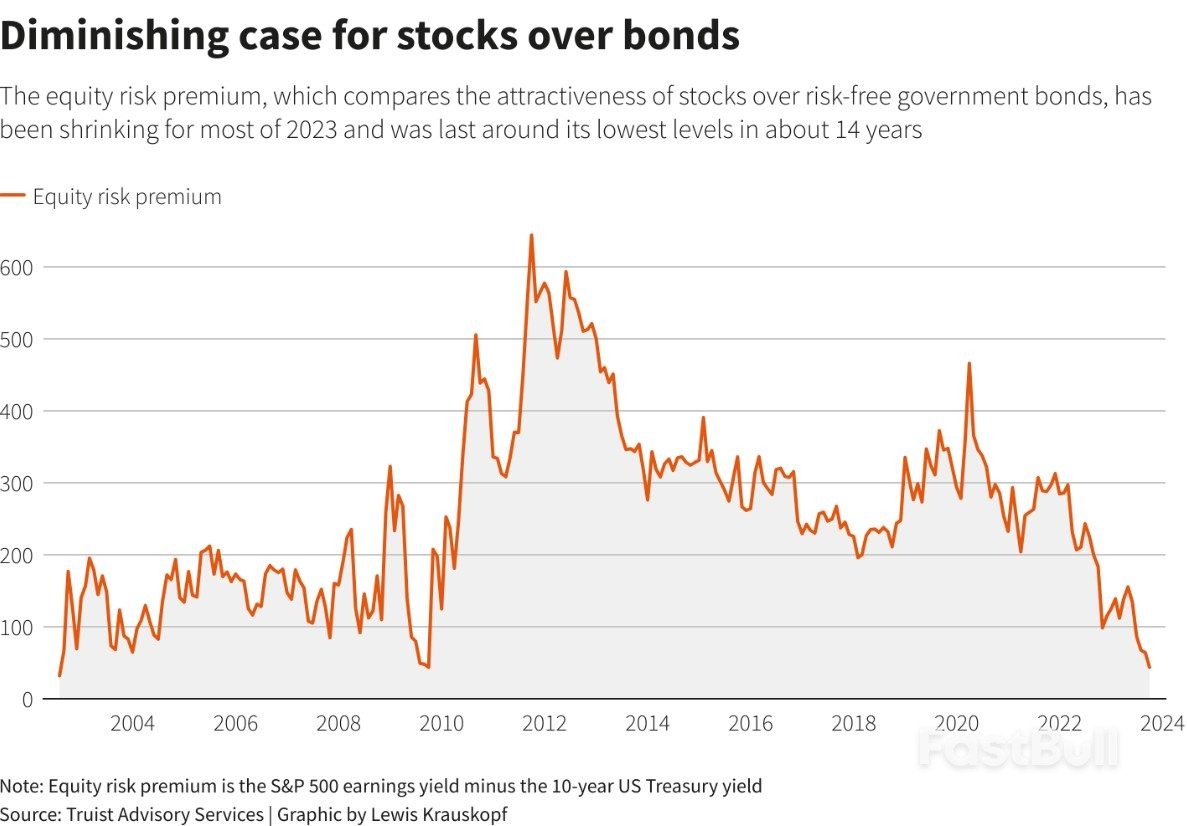
          The equity risk premium, which compares the attractiveness of stocks over risk-free government bonds, has been shrinking for most of 2023 and was last around its lowest levels in about 14 years, according to Keith Lerner, co-chief investment officer at Truist Advisory Services.
          The current ERP level has historically translated to just a 1.3% average 12-month excess return of the S&P 500 over the 10-year Treasury, according to Lerner.Harsh Reality of 'Higher-for-Longer' Rates Looms Over U.S. Stocks_1
          The 10-year Treasury yield up to 4.5% "changes the narrative for stocks," said Robert Pavlik, senior portfolio manager at Dakota Wealth Management, who is holding a higher-than-normal cash position.
          "Investors are going to be even more worried that we could enter into a recession as the cost of borrowing is increasing and corporate margins will be squeezed," he said.
          Analysts at BofA Global Research argue that equities - specifically, the tech-heavy Nasdaq 100, which has soared 33% in 2023 in part due to excitement over advances in artificial intelligence - have until recently ignored the risk of rising rates.
          "Sentiment could be turning, however. The Nasdaq has started to move inversely with real rates again," the bank's analysts wrote. "If this continues, the risk is that equities have a long way to go to price-in rate sensitivity again, hence more downside."
          Schurmeier, of Harbor Capital, said he's been increasing his exposure to long-duration bonds and value stocks in anticipation that a period of high rates will weigh on growth stocks, as occurred in the mid-2000s following the bursting of the tech bubble.
          Of course, plenty of investors believe the Fed will cut rates as soon as economic growth starts to wobble. Futures tied to the Fed's key policy rate show investors pricing in the first rate cut in July 2024.
          "We don't believe that 'higher for longer' will prove true," said Eric Kuby, chief investment officer at North Star Investment Management Corp.
          Still, he has been holding off on adding to the firm's holdings of small-cap consumer stocks, wary there may be more market volatility ahead as investors digest higher rates and other factors, including elevated energy prices.
          "Certainly, the combination of the Fed's jawboning and the spike in oil prices are creating headwinds for equities," he said.

          Source: Yahoo

          To stay updated on all economic events of today, please check out our Economic calendar
          Risk Warnings and Disclaimers
          You understand and acknowledge that there is a high degree of risk involved in trading. Following any strategies or investment methods may lead to potential losses. The content on the site is provided by our contributors and analysts for information purposes only. You are solely responsible for determining whether any trading assets, securities, strategy, or any other product is suitable for investing based on your own investment objectives and financial situation.
          Comments
          Add to Favorites
          Share

          'Unknown Unknowns' Unnerving Markets for Q4

          Cohen

          Economic

          Call it seasonal blues, poor positioning or a nagging anxiety about being wrong-footed, but wavering world stock markets appear to many to be uncomfortably prone to a left field hit.
          It doesn't take a sleuth to spot a whole heap of macro event risks out there - or that the financial universe is not best priced for those as it heads for the final quarter of 2023.
          Another U.S. government shutdown hoves into view this week with 2024's White House election now on the horizon, threatening sovereign credit ratings just as markets struggle to absorb mounting debt sales and the Federal Reserve's balance sheet rundown removes it from the fray.
          And a smouldering Chinese property bust and increasingly rancorous geopolitics darken the global economic outlook just as an oil price rebound spurs headline inflation rates still well above targets - a development that could well force the Fed and other central banks to hold credit tighter and for longer than many have bet.
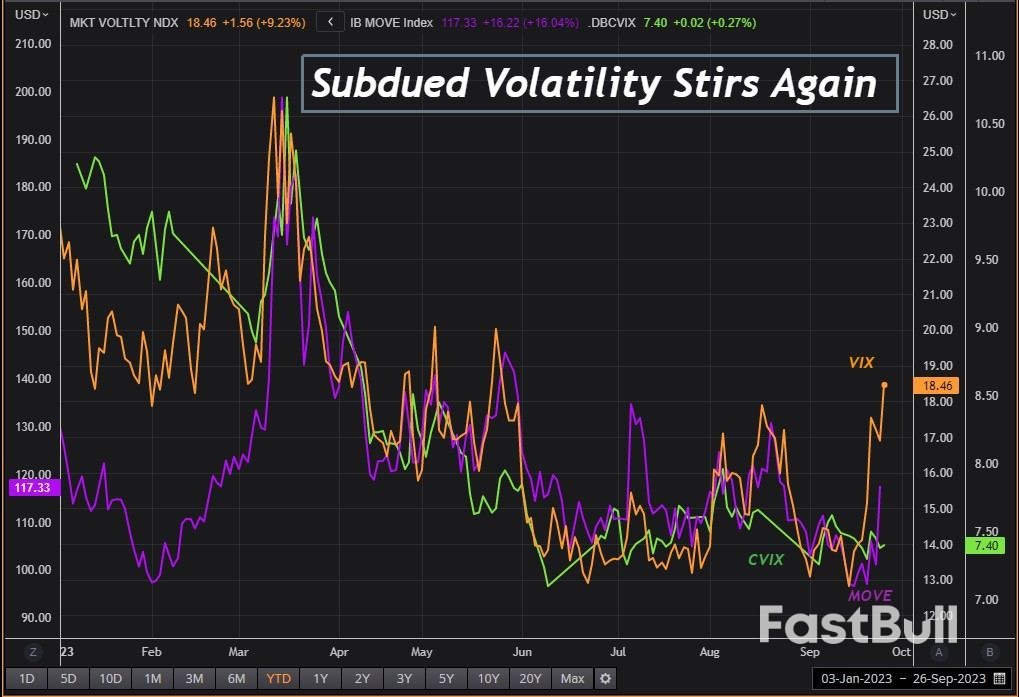
          And yet, until this week's shakeout at least, implied volatility gauges across stock, bond and currency markets had been subsiding to their lowest in years.
          Only 10 days ago, the VIX one-month gauge of implied S&P500 volatility recorded its lowest close since the COVID-19 pandemic first hit three years ago. The equivalent MOVE index of one-month Treasury bond volatility touched its lowest since before the Fed first raised rates in March 2022 and exchange rate volatility captured by the CVIX have again hovered around those pre-tightening levels since mid-year.
          The most basic reasoning is that investors have finally been dragged kicking and screaming from hugely defensive investment positions into an assumption of a soft U.S. economic landing along with what's been sarcastically dubbed an "immaculate disinflation".
          Confounded by this year's additional fillip from the artificial intelligence craze that added juice to mega cap tech stocks and flattered double-digit gains in the main benchmarks, an element of FOMO - or fear of missing out - has emerged too.
          The change of heart came drip-by-drip with every month's economic data - the U.S. economy and labour market had simply not yet rolled over after 18 months of swingeing Fed rate hikes and as inflation more than halved.
          And after three quarters of oddly poor positioning -underweight equity and overweight bonds and cash - the worm had turned in portfolios by September.
          The soft-landing bit at least is now overwhelmingly consensus thinking, according to asset manager surveys. Many investors have removed underweight equity positions, some even chasing the tech-led U.S. market higher and doubling down on bonds to catch a "peak interest rate" moment to boot.
          And few have seemed minded to hedge those new positions in options markets, perhaps convinced the untypical correlation of stock and bonds losses of the last couple of years would reverse to protect portfolios in a clear run to year-end.
          The continued positive correlation of equity and bond market losses this week, however, will have unnerved the herd again - not least because a fresh surge in bond yields hits that narrow tech-led group the hardest.'Unknown Unknowns' Unnerving Markets for Q4_1'Unknown Unknowns' Unnerving Markets for Q4_2'Unknown Unknowns' Unnerving Markets for Q4_3
          Concentration Risk and Triggers
          And yet most of the macro-economic or earnings risks still seem in plain sight. Few can surely be unfocussed on central bank policy, economic activity and politics - the "known unknowns" in the parlance of former U.S. defence secretary Donald Rumsfeld.
          What worries some now is what Melissa Brown, managing director of applied research at quantitative research firm Qontigo, fears are the "unknown unknowns" embedded in stock and index performance.
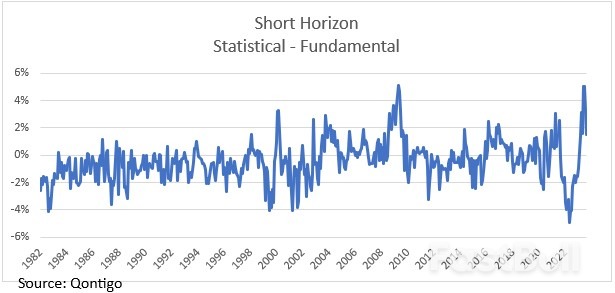
          To highlight this, she shows a rising "risk spread" between fundamental models of risk - based on observable earnings projections and individual company or sectoral drivers - and statistical models derived from market pricing and dynamics.
          That spread - which shows the statistical model predicting a higher risk than the fundamental analysis - returned earlier this year to peaks not seen since April 2009. Although it's off its highs since, it remains well above averages for the 40-year series.
          "We believe this indicates that the statistical models may be 'seeing' a risk not captured by our fundamental models," Brown wrote. "Could it be 'concentration risk'?"
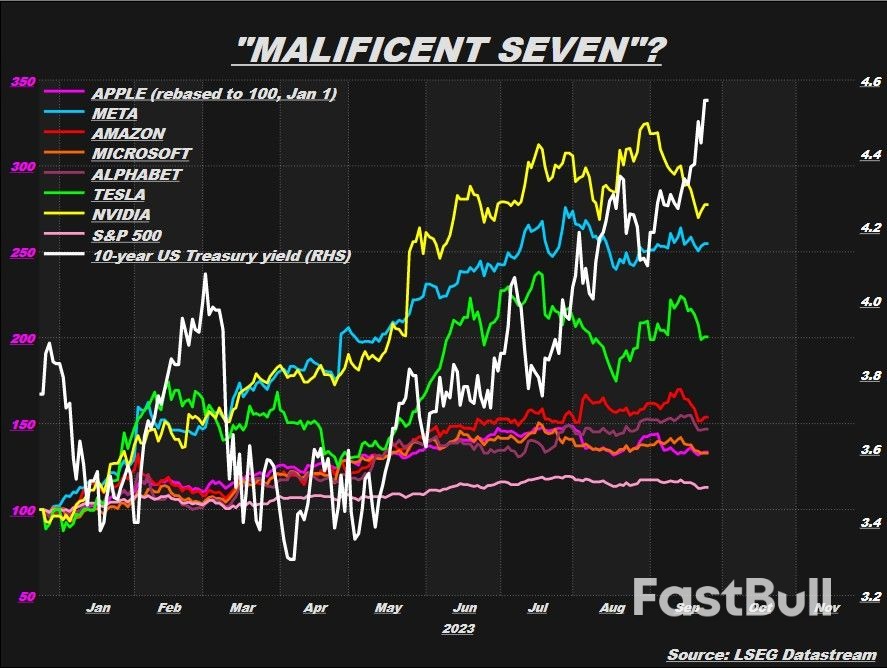
          Brown posits that it may be concentration of portfolios in the narrow leadership of so-called "magnificent seven" leading U.S. stocks - Apple, Microsoft, Amazon, Alphabet, Meta, Tesla and Nvidia - and the wider index implications of a shock in any one of them that is now a possible curveball.
          Hedge funds held record exposure to these seven stocks last month, according to Goldman Sachs, and they made up about 20% of the total net market value held by hedge funds it tracked.
          Along with sky-high valuations and a "crowding factor" that has many investors chasing the same names, red flags are flying - and yet without an obvious identifiable trigger.
          "The prolonged low volatility period since late April has resulted in a higher-than-prudent willingness to speculate in the market, which manifests itself through concentrated portfolios and a lack of downside risk protection," Brown concludes.
          "As both the macro and geopolitical environment remain unpredictable, the probability of a risk event trigger remains larger than normal."
          And yet for others, not least due to the overwhelming about-face in consensus this year and also the wobble this week, the simplest trigger for a shakeout may just be recession after all.
          "Recession risk remains material and is higher than what the markets are pricing in," Shamik Dhar, Chief Economist at BNY Mellon IM told clients this week. "Whilst 'recession fatigue' from a downturn that never seems to arrive is understandable, this fatigue is not an excuse to abandon the data and adopt an investment strategy of hope."
          The fuzzy radar screen may make for a rough final quarter.'Unknown Unknowns' Unnerving Markets for Q4_4'Unknown Unknowns' Unnerving Markets for Q4_5

          Source: Reuters

          To stay updated on all economic events of today, please check out our Economic calendar
          Risk Warnings and Disclaimers
          You understand and acknowledge that there is a high degree of risk involved in trading. Following any strategies or investment methods may lead to potential losses. The content on the site is provided by our contributors and analysts for information purposes only. You are solely responsible for determining whether any trading assets, securities, strategy, or any other product is suitable for investing based on your own investment objectives and financial situation.
          Comments
          Add to Favorites
          Share
          FastBull
          Copyright © 2025 FastBull Ltd

          728 RM B 7/F GEE LOK IND BLDG NO 34 HUNG TO RD KWUN TONG KLN HONG KONG

          TelegramInstagramTwitterfacebooklinkedin
          App Store Google Play Google Play
          Products
          Charts

          Chats

          Q&A with Experts
          Screeners
          Economic Calendar
          Data
          Tools
          Membership
          Features
          Function
          Markets
          Copy Trading
          Latest Signals
          Contests
          News
          Analysis
          24/7
          Columns
          Education
          Company
          Careers
          About Us
          Contact Us
          Advertising
          Help Center
          Feedback
          User Agreement
          Privacy Policy
          Business

          White Label

          Data API

          Web Plug-ins

          Poster Maker

          Affiliate Program

          Risk Disclosure

          The risk of loss in trading financial instruments such as stocks, FX, commodities, futures, bonds, ETFs and crypto can be substantial. You may sustain a total loss of the funds that you deposit with your broker. Therefore, you should carefully consider whether such trading is suitable for you in light of your circumstances and financial resources.

          No decision to invest should be made without thoroughly conducting due diligence by yourself or consulting with your financial advisors. Our web content might not suit you since we don't know your financial conditions and investment needs. Our financial information might have latency or contain inaccuracy, so you should be fully responsible for any of your trading and investment decisions. The company will not be responsible for your capital loss.

          Without getting permission from the website, you are not allowed to copy the website's graphics, texts, or trademarks. Intellectual property rights in the content or data incorporated into this website belong to its providers and exchange merchants.

          Not Logged In

          Log in to access more features

          FastBull Membership

          Not yet

          Purchase

          Become a signal provider
          Help Center
          Customer Service
          Dark Mode
          Price Up/Down Colors

          Log In

          Sign Up

          Position
          Layout
          Fullscreen
          Default to Chart
          The chart page opens by default when you visit fastbull.com