• Trade
  • Markets
  • Copy
  • Contests
  • News
  • 24/7
  • Calendar
  • Q&A
  • Chats
Trending
Screeners
SYMBOL
LAST
BID
ASK
HIGH
LOW
NET CHG.
%CHG.
SPREAD
SPX
S&P 500 Index
6827.42
6827.42
6827.42
6899.86
6801.80
-73.58
-1.07%
--
DJI
Dow Jones Industrial Average
48458.04
48458.04
48458.04
48886.86
48334.10
-245.98
-0.51%
--
IXIC
NASDAQ Composite Index
23195.16
23195.16
23195.16
23554.89
23094.51
-398.69
-1.69%
--
USDX
US Dollar Index
97.950
98.030
97.950
98.500
97.950
-0.370
-0.38%
--
EURUSD
Euro / US Dollar
1.17394
1.17409
1.17394
1.17496
1.17192
+0.00011
+ 0.01%
--
GBPUSD
Pound Sterling / US Dollar
1.33707
1.33732
1.33707
1.33997
1.33419
-0.00148
-0.11%
--
XAUUSD
Gold / US Dollar
4299.39
4299.39
4299.39
4353.41
4257.10
+20.10
+ 0.47%
--
WTI
Light Sweet Crude Oil
57.233
57.485
57.233
58.011
56.969
-0.408
-0.71%
--

Community Accounts

Signal Accounts
--
Profit Accounts
--
Loss Accounts
--
View More

Become a signal provider

Sell trading signals to earn additional income

View More

Guide to Copy Trading

Get started with ease and confidence

View More

Signal Accounts for Members

All Signal Accounts

Best Return
  • Best Return
  • Best P/L
  • Best MDD
Past 1W
  • Past 1W
  • Past 1M
  • Past 1Y

All Contests

  • All
  • Trump Updates
  • Recommend
  • Stocks
  • Cryptocurrencies
  • Central Banks
  • Featured News
Top News Only
Share

USA Embassy In Lithuania: Maria Kalesnikava Is Not Going To Vilnius

Share

USA Embassy In Lithuania: Other Prisoners Are Being Sent From Belarus To Ukraine

Share

Ukraine President Zelenskiy: Five Ukrainians Released By Belarus In US-Brokered Deal

Share

USA Vilnius Embassy: USA Stands Ready For "Additional Engagement With Belarus That Advances USA Interests"

Share

USA Vilnius Embassy: Belarus, USA, Other Citizens Among The Prisoners Released Into Lithuania

Share

USA Vilnius Embassy: USA Will Continue Diplomatic Efforts To Free The Remaining Political Prisoners In Belarus

Share

USA Vilnius Embassy: Belarus Releases 123 Prisoners Following Meeting Of President Trump's Envoy Coale And Belarus President Lukashenko

Share

USA Vilnius Embassy: Masatoshi Nakanishi, Aliaksandr Syrytsa Are Among The Prisoners Released By Belarus

Share

USA Vilnius Embassy: Maria Kalesnikava And Viktor Babaryka Are Among The Prisoners Released By Belarus

Share

USA Vilnius Embassy: Nobel Peace Prize Laureate Ales Bialiatski Is Among The Prisoners Released By Belarus

Share

Belarusian Presidential Administration Telegram Channel: Lukashenko Has Pardoned 123 Prisoners As Part Of Deal With US

Share

Two Local Syrian Officials: Joint US-Syrian Military Patrol In Central Syria Came Under Fire From Unknown Assailants

Share

Israeli Military Says It Targeted 'Key Hamas Terrorist' In Gaza City

Share

Rwanda's Actions In Eastern Drc Are A Clear Violation Of Washington Accords Signed By President Trump - Secretary Of State Rubio

Share

Israeli Military Issues Evacuation Warning In Southern Lebanon Village Ahead Of Strike - Spokesperson On X

Share

Belarusian State Media Cites US Envoy Coale As Saying He Discussed Ukraine And Venezuela With Lukashenko

Share

Belarusian State Media Cites US Envoy Coale As Saying That US Removes Sanctions On Belarusian Potassium

Share

Thai Prime Minister: No Ceasefire Agreement With Cambodia

Share

US, Ukraine To Discuss Ceasefire In Berlin Ahead Of European Summit

Share

Incoming Czech Prime Minister Babis: Czech Republic Will Not Take On Guarantees For Ukraine Financing, European Commission Must Find Alternatives

TIME
ACT
FCST
PREV
U.K. Trade Balance Non-EU (SA) (Oct)

A:--

F: --

P: --

U.K. Trade Balance (Oct)

A:--

F: --

P: --

U.K. Services Index MoM

A:--

F: --

P: --

U.K. Construction Output MoM (SA) (Oct)

A:--

F: --

P: --

U.K. Industrial Output YoY (Oct)

A:--

F: --

P: --

U.K. Trade Balance (SA) (Oct)

A:--

F: --

P: --

U.K. Trade Balance EU (SA) (Oct)

A:--

F: --

P: --

U.K. Manufacturing Output YoY (Oct)

A:--

F: --

P: --

U.K. GDP MoM (Oct)

A:--

F: --

P: --

U.K. GDP YoY (SA) (Oct)

A:--

F: --

P: --

U.K. Industrial Output MoM (Oct)

A:--

F: --

P: --

U.K. Construction Output YoY (Oct)

A:--

F: --

P: --

France HICP Final MoM (Nov)

A:--

F: --

P: --

China, Mainland Outstanding Loans Growth YoY (Nov)

A:--

F: --

P: --

China, Mainland M2 Money Supply YoY (Nov)

A:--

F: --

P: --

China, Mainland M0 Money Supply YoY (Nov)

A:--

F: --

P: --

China, Mainland M1 Money Supply YoY (Nov)

A:--

F: --

P: --

India CPI YoY (Nov)

A:--

F: --

P: --

India Deposit Gowth YoY

A:--

F: --

P: --

Brazil Services Growth YoY (Oct)

A:--

F: --

P: --

Mexico Industrial Output YoY (Oct)

A:--

F: --

P: --

Russia Trade Balance (Oct)

A:--

F: --

P: --

Philadelphia Fed President Henry Paulson delivers a speech
Canada Building Permits MoM (SA) (Oct)

A:--

F: --

P: --

Canada Wholesale Sales YoY (Oct)

A:--

F: --

P: --

Canada Wholesale Inventory MoM (Oct)

A:--

F: --

P: --

Canada Wholesale Inventory YoY (Oct)

A:--

F: --

P: --

Canada Wholesale Sales MoM (SA) (Oct)

A:--

F: --

P: --

Germany Current Account (Not SA) (Oct)

A:--

F: --

P: --

U.S. Weekly Total Rig Count

A:--

F: --

P: --

U.S. Weekly Total Oil Rig Count

A:--

F: --

P: --

Japan Tankan Large Non-Manufacturing Diffusion Index (Q4)

--

F: --

P: --

Japan Tankan Small Manufacturing Outlook Index (Q4)

--

F: --

P: --

Japan Tankan Large Non-Manufacturing Outlook Index (Q4)

--

F: --

P: --

Japan Tankan Large Manufacturing Outlook Index (Q4)

--

F: --

P: --

Japan Tankan Small Manufacturing Diffusion Index (Q4)

--

F: --

P: --

Japan Tankan Large Manufacturing Diffusion Index (Q4)

--

F: --

P: --

Japan Tankan Large-Enterprise Capital Expenditure YoY (Q4)

--

F: --

P: --

U.K. Rightmove House Price Index YoY (Dec)

--

F: --

P: --

China, Mainland Industrial Output YoY (YTD) (Nov)

--

F: --

P: --

China, Mainland Urban Area Unemployment Rate (Nov)

--

F: --

P: --

Saudi Arabia CPI YoY (Nov)

--

F: --

P: --

Euro Zone Industrial Output YoY (Oct)

--

F: --

P: --

Euro Zone Industrial Output MoM (Oct)

--

F: --

P: --

Canada Existing Home Sales MoM (Nov)

--

F: --

P: --

Euro Zone Total Reserve Assets (Nov)

--

F: --

P: --

U.K. Inflation Rate Expectations

--

F: --

P: --

Canada National Economic Confidence Index

--

F: --

P: --

Canada New Housing Starts (Nov)

--

F: --

P: --

U.S. NY Fed Manufacturing Employment Index (Dec)

--

F: --

P: --

U.S. NY Fed Manufacturing Index (Dec)

--

F: --

P: --

Canada Core CPI YoY (Nov)

--

F: --

P: --

Canada Manufacturing Unfilled Orders MoM (Oct)

--

F: --

P: --

Canada Manufacturing New Orders MoM (Oct)

--

F: --

P: --

Canada Core CPI MoM (Nov)

--

F: --

P: --

Canada Manufacturing Inventory MoM (Oct)

--

F: --

P: --

Canada CPI YoY (Nov)

--

F: --

P: --

Canada CPI MoM (Nov)

--

F: --

P: --

Canada CPI YoY (SA) (Nov)

--

F: --

P: --

Canada Core CPI MoM (SA) (Nov)

--

F: --

P: --

Q&A with Experts
    • All
    • Chatrooms
    • Groups
    • Friends
    Connecting
    .
    .
    .
    Type here...
    Add Symbol or Code

      No matching data

      All
      Trump Updates
      Recommend
      Stocks
      Cryptocurrencies
      Central Banks
      Featured News
      • All
      • Russia-Ukraine Conflict
      • Middle East Flashpoint
      • All
      • Russia-Ukraine Conflict
      • Middle East Flashpoint
      Search
      Products

      Charts Free Forever

      Chats Q&A with Experts
      Screeners Economic Calendar Data Tools
      Membership Features
      Data Warehouse Market Trends Institutional Data Policy Rates Macro

      Market Trends

      Market Sentiment Order Book Forex Correlations

      Top Indicators

      Charts Free Forever
      Markets

      News

      News Analysis 24/7 Columns Education
      From Institutions From Analysts
      Topics Columnists

      Latest Views

      Latest Views

      Trending Topics

      Top Columnists

      Latest Update

      Signals

      Copy Rankings Latest Signals Become a signal provider AI Rating
      Contests
      Brokers

      Overview Brokers Assessment Rankings Regulators News Claims
      Broker listing Forex Brokers Comparison Tool Live Spread Comparison Scam
      Q&A Complaint Scam Alert Videos Tips to Detect Scam
      More

      Business
      Events
      Careers About Us Advertising Help Center

      White Label

      Data API

      Web Plug-ins

      Affiliate Program

      Awards Institution Evaluation IB Seminar Salon Event Exhibition
      Vietnam Thailand Singapore Dubai
      Fans Party Investment Sharing Session
      FastBull Summit BrokersView Expo
      Recent Searches
        Top Searches
          Markets
          News
          Analysis
          User
          24/7
          Economic Calendar
          Education
          Data
          • Names
          • Latest
          • Prev

          View All

          No data

          Scan to Download

          Faster Charts, Chat Faster!

          Download App
          English
          • English
          • Español
          • العربية
          • Bahasa Indonesia
          • Bahasa Melayu
          • Tiếng Việt
          • ภาษาไทย
          • Français
          • Italiano
          • Türkçe
          • Русский язык
          • 简中
          • 繁中
          Open Account
          Search
          Products
          Charts Free Forever
          Markets
          News
          Signals

          Copy Rankings Latest Signals Become a signal provider AI Rating
          Contests
          Brokers

          Overview Brokers Assessment Rankings Regulators News Claims
          Broker listing Forex Brokers Comparison Tool Live Spread Comparison Scam
          Q&A Complaint Scam Alert Videos Tips to Detect Scam
          More

          Business
          Events
          Careers About Us Advertising Help Center

          White Label

          Data API

          Web Plug-ins

          Affiliate Program

          Awards Institution Evaluation IB Seminar Salon Event Exhibition
          Vietnam Thailand Singapore Dubai
          Fans Party Investment Sharing Session
          FastBull Summit BrokersView Expo

          September 26th Financial News

          FastBull Featured

          Daily News

          Summary:

          Fed's Goolsbee: Rates will have to stay higher for longer; Japan will compile a new economic stimulus package; ECB Lagarde: No rate cuts are being considered...

          [Quick Facts]

          1. Fed's Goolsbee: Rates will have to stay higher for longer.
          2. Japan will compile a new economic stimulus package.
          3. ECB Lagarde: No rate cuts are being considered.
          4. U.S. 10-year bond yield hits a 16-year high and the long-treasury bond ETF sinks.

          [News Details]

          Fed's Goolsbee: Rates will have to stay higher for longer
          The risk of inflation staying higher than the Fed's target is the bigger risk, Chicago Fed President Austan Goolsbee said on Monday, It feels like rates will have to stay higher for longer than markets had expected, he added. The Fed would need to "play by ear" whether any further rate increases are needed.
          The debate over the current phase of Fed policy will "stop being how much more are they going to raise, and transform into well how long do we need to hold rates" at the peak level.
          Although the Federal Reserve has been raising interest rates, the United States is still possible to avoid a recession.
          At present, FOMC hawkish officials not only implied there would be one more rate hike in the year but also expected rates to stay high for longer. They lowered their forecast for next year's interest rate cuts to 50 basis points from 100 basis points.
          Japan will compile a new economic stimulus package
          Japanese Prime Minister Fumio Kishida on Monday unveiled the main elements of a new economic stimulus package to be formulated next month. The package will help ease the impact of rising prices on households and raise wages.
          Kishida will instruct his Cabinet on Tuesday to put together the package and quickly set up an extra budget to fund it.
          The package will include measures to protect people from cost-push inflation, support sustainable wage and income growth, promote domestic investment to spur economic growth, carry out reforms to overcome population decline and encourage infrastructure investment, etc.
          With the new economic measures, Kishida pledged to shift Japan's economy, which has tended to focus on cost-cutting, away from such practices. Kishida also warned investors who try to sell the yen, by saying that he was closely monitoring exchange rate movements with a high sense of urgency.
          ECB Lagarde: No rate cuts are being considered
          Our future decisions will ensure that the key ECB interest rates will be set at sufficiently restrictive levels for as long as necessary, said European Central Bank (ECB) President Christine Lagarde on Monday. There is little likelihood of easing monetary policy in the short term, and the prospect of a rate cut is not even being considered at the moment.
          The economic outlook for the euro area is deteriorating, with economic activity generally stagnating in the first half of 2023. Recent indicators pointed to further weakness in the third quarter. Lower demand for exports in the euro area and a tighter financing environment are dampening growth. The service sector is also weakening and job creation in the service sector is slowing.
          U.S. 10-year bond yield hits a 16-year high and the long-treasury bond ETF sinks
          As the market officially enters the final week of the third quarter this week, the sharp decline in U.S. Treasuries over the past few months continues. 10-year bond yield rose 10.4 basis points overnight to 4.539%, the highest since October 2007, and the 30-year yield rose as much as 13 basis points to 4.66%, a level not seen since April 2011, as markets anticipated the Fed to keep interest rates high, and the supply of new bonds was expected to keep rising as the federal government struggles with growing deficits.
          Additionally, the $39 billion iShares 20+ Year Treasury Bond ETF has lost 48% from its all-time high in 2020 and is trading at its lowest point since 2011.

          [Focus of the Day]

          UTC+8 15:00 ECB Governing Council member Simkus speaks
          UTC+8 16:00 ECB Governing Council member Kazimir delivers a speech
          UTC+8 22:00 U.S. New Home Sales MoM (Aug)
          UTC+8 00:30 Next Day: ECB Governing Council member Holzmann speaks
          TBD U.S. House of Representatives to vote on temporary spending bills
          Risk Warnings and Disclaimers
          You understand and acknowledge that there is a high degree of risk involved in trading. Following any strategies or investment methods may lead to potential losses. The content on the site is provided by our contributors and analysts for information purposes only. You are solely responsible for determining whether any trading assets, securities, strategy, or any other product is suitable for investing based on your own investment objectives and financial situation.
          Comments
          Add to Favorites
          Share

          Why Recession Predictions Have Been Wrong So Far

          Glendon

          Economic

          Stocks

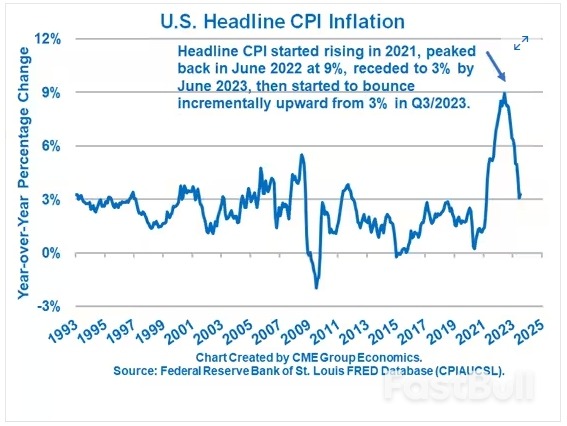
          In investment management, past performance is no guarantee of future returns. In economics, we've seen many predictions of a U.S. recession that so far, at least, have not materialized. Investors should take note that the past performance of a key economic tenet — that a recession follows an inverted yield curve — may no longer be as reliable today as it once was.
          Let's first look back at the pace of inflation. When it started to ramp higher in 2021, many economists, as well as the Federal Reserve, dismissed the pattern as “transitory.” But by March 2022, the Fed understood that the new inflation pattern was serious and commenced raising short-term rates. That November, the Fed's guidance hardened, with Fed Chair Jerome Powell stating that “reducing inflation is likely to require a sustained period of below-trend growth and some softening of labor market conditions.”
          Why Recession Predictions Have Been Wrong So Far_1
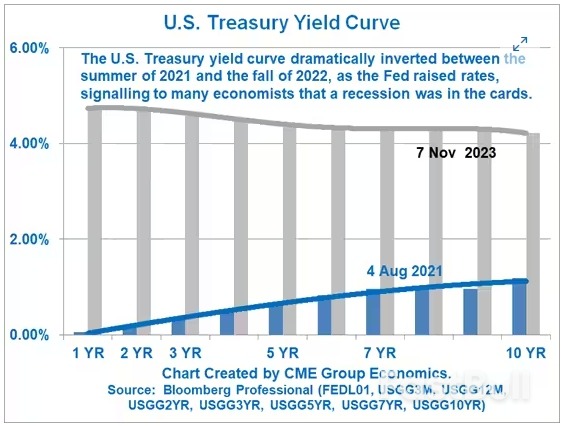
          At this point, the U.S. Treasury two-year yield was higher than the 10-year yield, creating an inverted yield curve, and rates were rising at the most rapid pace since the early 1980s. For the vast majority of economists, these facts were strong signals to forecast rising unemployment and a U.S. recession in 2023.
          Why Recession Predictions Have Been Wrong So Far_2
          Yet as the fourth quarter of 2023 approaches, signs of a U.S. recession are not so clear. The consensus of many economists has shifted away from the recession forecast, although some have merely pushed the timing into 2024, citing lags in monetary policy, or shifted to words like “mild” or “soft landing” to describe any possible future downturn.

          Yield-curve indicator breaks down

          Why the shift? Regardless of whether we eventually end up in a recession, the key here is how an inverted yield curve may not mean the same as it did 20 years ago. Has our economy become far more resilient in the face of restrictive interest rate policies?
          Let's look at what history shows us. Back in the 1950s, '60s and '70s, manufacturing was the engine of the U.S. economy, with the purchase of durable goods often facilitated by credit. If one wanted to buy a house, a 30-year fixed-rate mortgage was the only choice. Moreover, that choice was typically provided by a savings and loan institution that borrowed short-term from savers and lent long-term for houses or medium-term for cars.
          Taking interest-rate risk and surviving short periods of inverted yield curves was the savings and loan business model, since efficient rate hedging vehicles were not available. When the Fed hiked interest rates, lending slowed for houses and cars, the economy slumped, and unemployment eventually started to rise.
          Fast forward to today. The U.S. is a service-sector economy, and most service purchases do not involve a loan or credit. Mortgages come in all shapes, sizes, terms and maturities, and are originated by specialized brokers that package and sell the mortgages to investors who want to hold this risk. For financial institutions, the ability to hedge and manage interest-rate risk is further supported by deep markets in swaps, futures and options.
          Higher rates, which alter the time value of money, still have a profound impact on asset markets, from equities to fixed income. But the impact of those rates on the real economy is much less clear as the U.S. economy evolves. Yet, most econometric models still rely on historic relationships, which don't take into account recent structural changes impacting interest-rate sensitivity.
          Moreover, the last three serious recessions all required something big and systematic to break. In 1991, it was the savings and loan industry and the housing market, brought on by tighter credit conditions. In 2008, it was the financial crisis brought on by risk taking in subprime housing. In 2020, it was the Covid-19 pandemic, which had nothing to do with rates.
          This year, the failure of a few niche regional banks could have been the trigger for contagion and a serious banking system collapse. That was not the case because regulators quickly backstopped the system. Additionally, most banks had hedged their positions.
          Could it be that a less interest-rate sensitive economy and a regulatory network committed to preventing systemic financial-system breakdowns has reduced the power of an inverted yield curve to forecast a recession? Time will tell. Until then, investors should be cautious about relying on historical parallels as they prepare their portfolios for the risks ahead.

          Source: Market Watch

          To stay updated on all economic events of today, please check out our Economic calendar
          Risk Warnings and Disclaimers
          You understand and acknowledge that there is a high degree of risk involved in trading. Following any strategies or investment methods may lead to potential losses. The content on the site is provided by our contributors and analysts for information purposes only. You are solely responsible for determining whether any trading assets, securities, strategy, or any other product is suitable for investing based on your own investment objectives and financial situation.
          Comments
          Add to Favorites
          Share

          UAW Strike: Why Are US Car Workers Walking Out?

          Michelle

          Political

          UAW Strike: Why Are US Car Workers Walking Out?_1
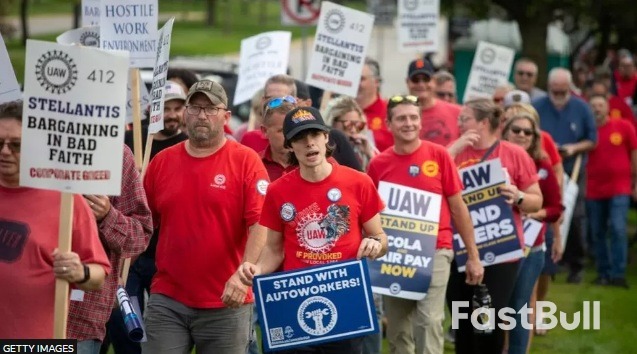
          The United Auto Workers (UAW) union has declared a strike targeting Ford, General Motors and Stellantis, in a bid to put pressure on the carmakers to grant higher pay and make other improvements in new labour agreements.
          It comes at a time of broader labour unrest and casts a cloud of uncertainty over an industry that accounts for 3% of the national economy.
          US President Joe Biden has been forced to weigh in on the dispute, which is playing out in states that have disproportionate importance in national elections.

          What is the UAW?

          The UAW was founded in 1935 to represent workers at America's motor giants: Ford, GM and Chrysler - now part of Stellantis.
          It was a hugely powerful force in US politics after World War Two, at a time when those companies were the world's pre-eminent car giants and manufacturing jobs in the motor industry were seen as a path to the middle class.
          UAW membership peaked in 1979 at almost 1.5 million.
          Today, it represents more than 400,000 active workers across a wide range of sectors, including hospitals and universities, including more than 140,000 members who work at Ford, GM and Stellantis.
          This is the first strike in the UAW's 88-year history to target all three companies - known as the Detroit Three - at once.
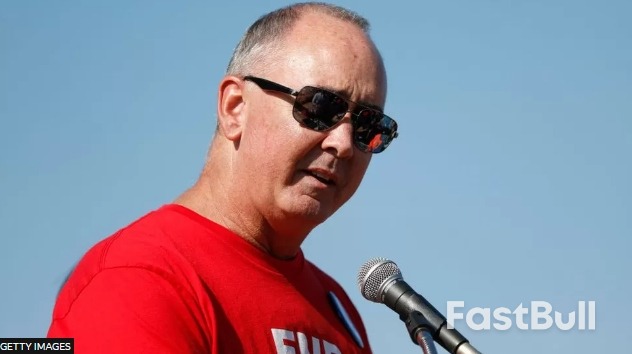
          The action is the brainchild of Shawn Fain, a fiery former electrician in the industry who was narrowly elected this spring promising a more transparent and combative approach to contract negotiations.
          UAW Strike: Why Are US Car Workers Walking Out?_2

          UAW president Shawn Fain declined the traditional handshake with company executives at the start of negotiations

          Where is the strike happening?

          The work stoppage started on 15 September at three factories, which together employed about 12,700 workers.
          They were:
          A GM assembly plant in Wentzville, Missouri that works on GMC Canyon and Chevrolet Colorado midsize pickups, as well as the GMC Savana and Chevrolet Express full-size vans.
          A ford site in Wayne, Michigan that works on Bronco SUVs and Ranger midsize pickup trucks.
          A stellantis site in Toledo, Ohio that works on Jeep Wranglers and Gladiator pickups.
          A week later, the UAW expanded the walkout to 38 parts distribution centres at General Motors and Stellantis, asking roughly 5,600 more workers to participate in stoppages.
          The three companies account for roughly 40% of car sales. These shutdowns affect a small fraction of their production.
          But with inventories sitting at relatively low levels, analysts have warned that a prolonged stoppage could still lead to higher prices for buyers.

          What are the UAW demands?

          The walkout began after the expiration of 2019 labour contracts between the union and three companies on 14 September.
          The two sides are negotiating over issues such as pay, days off and cost of living adjustments,as well as systems that pay newer and "temporary" hires less for comparable work.
          UAW president Shawn Fain has cast the fight as part of a broader battle over economic justice and the billionaire class.
          The UAW opened negotiations seeking a 40% pay rise over the four years of the contract.
          The union has rebuffed claims that the figure is outlandish, noting double-digit jumps in the pay packages for company bosses, a surge in profits - and money the companies have spent buying their own shares - as well as decades of declining pay power in the industry, including in recent years, when prices surged.
          The chief executives of all three companies had pay packages last year worth more than $20m.
          The fight also comes as the industry is investing heavily in electric vehicles. The union is worried about that shift, since producing such cars requires fewer workers and currently involves non-union labour.

          What is the latest update on the negotiations?

          GM boss Mary Barra said the union's initial demands amounted to $100bn in costs. Ford chief Jim Farley said they would drive his firm to bankruptcy.
          The car companies face fierce competition from the likes of Toyota and Tesla, which do not have unionised workforces and enjoy lower labour costs. The Detroit Three are also under pressure to spend heavily on electric vehicle investments.
          The UAW reduced its pay demands to a 36% rise, but the car companies maintain its requests are still too onerous. Their recent counter-offers include raises of roughly 20%.
          They have also already announced temporary layoffs for thousands of other staff whose work depends on the striking factories.
          Mr Fain has said talks are progressing at Ford, which he said had signed off on pay increases tied to inflation among other demands. He said talks appeared at an impasse with the other two companies.
          Former President Donald Trump, who is running for re-election, is reportedly planning a trip to Detroit next week to address auto workers.

          How long will this last?

          The last time the UAW went on strike, against GM during 2019 negotiations, the walkout lasted six weeks.
          The UAW has $825m on hand to support workers participating in the strike, enough to last about two months with all members participating.
          The decision to take targeted action is aimed generating uncertainty for the car companies and at preserving that fund - and limiting the pain felt by workers, who are eligible for $500 a week from the union, less than typical wages.

          Source: BBC

          Risk Warnings and Disclaimers
          You understand and acknowledge that there is a high degree of risk involved in trading. Following any strategies or investment methods may lead to potential losses. The content on the site is provided by our contributors and analysts for information purposes only. You are solely responsible for determining whether any trading assets, securities, strategy, or any other product is suitable for investing based on your own investment objectives and financial situation.
          Comments
          Add to Favorites
          Share

          Inverted U.S. Yields Lure Investors Into Short-Term Bonds

          Glendon

          Economic

          Bond

          Inverted U.S. Yields Lure Investors Into Short-Term Bonds_1
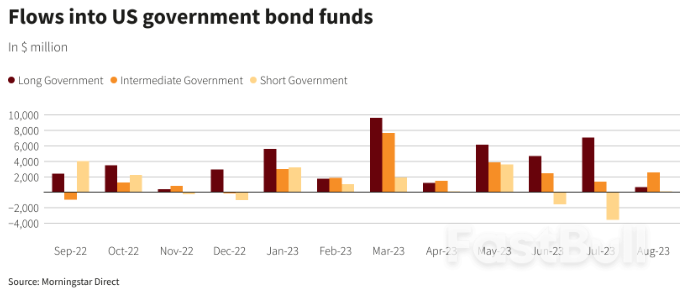
          Short-term U.S. government bonds have attracted bigger investment flows this year than longer-term paper, an unusual pattern engendered by the inverted yield curve and the Federal Reserve's intent to keep interest rates higher for longer.
          The Fed's aggressive rate hikes and hawkishness have kept short-end yields elevated for most of 2023. One-year Treasury note yields are about a percentage point higher than those on 10-year bonds.
          That has meant global investors can avoid the relatively less liquid, longer-tenure bonds just for the sake of extra yield and premium.
          According to Morningstar data, inflows into short and medium-term U.S. Treasury bond funds, which invest in maturity periods of 1 year to 6 years, stood at $29.3 billion in the first eight months of this year, a 70.3% rise over last year.
          Inverted U.S. Yields Lure Investors Into Short-Term Bonds_2
          On the other hand, inflows into Treasury funds that invest in bonds with maturities longer than six years dropped to $36.9 billion, an 11.5% decline from last year.
          "The absolute yield on short-term Treasuries is extremely attractive. Currently, 2-year Treasuries are yielding over 5%, a level that has not been present in almost 20 years," said Adam Coons, portfolio manager at Winthrop Capital Management.
          "Additionally, the 2-year note is out-yielding the S&P 500 by over 3.5%, which is also the highest difference in 20 years."
          At its latest policy review, the Federal Reserve reinforced the hawkishness and, besides keeping the door open to more rate rises, it has kept rate projections through 2024 significantly higher than previously expected.
          LSEG Lipper data shows U.S. short-term bond funds have outperformed this year, delivering a gain of 2.2% in price terms compared with an average 2.1% dip in long-term bond funds.
          Among top short-term funds, the iShares 0-3 Month Treasury Bond ETF has drawn about $7.3 billion in inflows this year, while SPDR Bloomberg 1-3 Month T-Bill ETF , and WisdomTree Floating Rate Treasury Fund have attracted a net $2.1 billion and $4.4 billion respectively. The cumulative flows of the three funds were 13.4% higher than last year.

          PICKING MATURITIES

          Long-term bonds have their defenders.
          "The key reasons to own a long-dated bond is to lock in current interest rates and protect against lower rates in the future, and owning a long-term bond can be viewed as protection against a softer economy where yields may drop, and thus prices rise," said Matt Dmytryszyn, chief investment officer at Telemus.
          Most analysts expect short-term bond funds to continue to lure more money in the months ahead.
          "I continue to discount the belief that it might be appropriate to cut rates soon. I don’t think we get to that point without a recession," said Jeff Klingelhofer, co-head of investments at Thornburg Investment Management.
          Klingelhofer reckons a 3.5-year is the sweet spot, since even in a deep recession, longer-end rates would not fall much "because we have exited the world of very low, sustained rates."
          To reduce the risks of a possible Fed easing in case the economy decelerates, Winthrop's Coons said he is using the inverted yield curve to run a barbell duration strategy.
          "We are anchoring portfolios with the higher yielding short-term bonds. We are then reducing or eliminating exposure to bonds with maturities 3-9 years and instead investing into duration through 10-30 year bonds," he said.
          "The longer-duration bonds will have a higher sensitivity to the movement in interest rates, giving us more appreciation potential over the intermediate to long term."

          Source: REUTERS

          To stay updated on all economic events of today, please check out our Economic calendar
          Risk Warnings and Disclaimers
          You understand and acknowledge that there is a high degree of risk involved in trading. Following any strategies or investment methods may lead to potential losses. The content on the site is provided by our contributors and analysts for information purposes only. You are solely responsible for determining whether any trading assets, securities, strategy, or any other product is suitable for investing based on your own investment objectives and financial situation.
          Comments
          Add to Favorites
          Share

          Increase in Minimum Reserves Would Hit Bank Liquidity at Crucial Moment

          Justin

          Central Bank

          Economic

          ECB looks for ways to curb excess liquidity

          Among potential ways to reduce the excess liquidity in the banking system, the ECB is reportedly considering increasing the minimum reserve requirements (MRR). Several ECB policymakers are said to be in favour of a move higher in MRRs to 3% or even to 4%. Both the Belgian central bank’s Pierre Wunch and the ECB’s Pablo Hernández de Cos have indicated they do not see “strong arguments” for this, or see this as “obvious” while the Bundesbank’s Joachim Nagel has indicated he would support a move higher.
          Currently, banks have to meet a 1% minimum reserve requirement on average during the reserve maintenance period.
          The 1% MRR corresponds to €165bn for the sector. If the ECB were to increase the MRR to say 3%, the MRR would increase by €330bn to close to €500bn. Setting the requirement to 4% would result in an increase of €500bn to €660bn assuming other things stay intact.
          A higher MRR would have several negative implications for the banking system.

          Dent on bank profitability

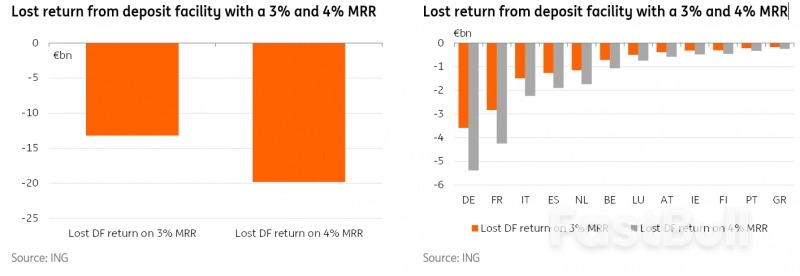
          Higher required minimum reserves would, other things being equal, reduce the amount of funds that banks can deposit at the ECB's deposit facility. As the ECB pays interest on the deposit facility but not on the minimum reserves, higher required reserves would represent a drag on net interest income.
          We calculate that raising the minimum reserve requirement from 1% to 3% or even 4% would cost €13bn-€20bn in lost interest on the deposit facility for the eurozone banking system based on the current deposit facility rate.
          The largest absolute impact would be felt by German banks, followed by French, Italian and Spanish names. Taking into account the relative size of the banking sector (total MFI assets), the impact would be largest for banks in smaller countries, however, such as in the Baltics, Cyprus and Slovenia, with Belgium also among the more impacted countries on a relative basis. The relative costs would be more limited for banks in Ireland, France and Germany when considering the MFI balance sheet size.

          Increase in MRR would result in smaller revenues for banks from the ECB deposit facility

          Increase in Minimum Reserves Would Hit Bank Liquidity at Crucial Moment_1

          But the larger unknown comes from the actual liquidity drain

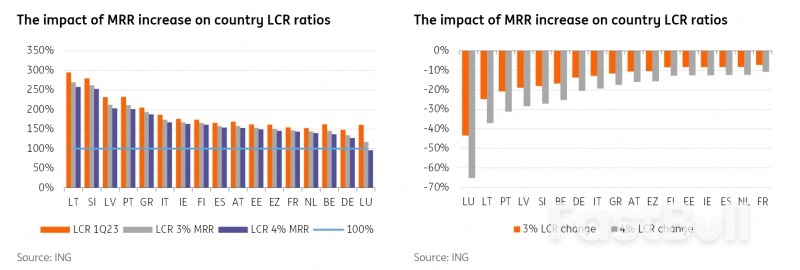
          The increase in minimum reserve requirements would also have a negative impact on banks' liquidity positions. Banks have to meet a 100% Liquidity Coverage Ratio (LCR) requirement. For the LCR calculation, banks can include in their Level 1 assets reserves at the central bank provided that the credit institution is permitted to withdraw such reserves at any time during stress periods (see Article 10(1) (b) (iii) of the Commission Delegated Regulation (EU) 2015/61). More specifically, based on the ECB guidance from 2015, the part of the daily account holdings that exceed the average daily required reserves is considered withdrawable at any time in times of stress and is eligible for inclusion in Level 1 assets. As such, central bank minimum reserves are not usable towards the LCR Level 1 liquidity buffers, meaning that increasing the requirements would have a similar negative impact on bank liquidity buffers.
          As of the first quarter 2023, the 111 significant institutions supervised by the ECB had an average LCR ratio of 161.3%. Of the total €5.1tn in liquid assets that these banks held, €4.9tn were Level 1 assets, with a limited amount of €149bn in Extremely High Quality Covered Bonds.
          If the €5.1tn liquidity buffers of significant institutions were to absorb the MRR increase to 3% or 4%, the buffers would drop to €4.8tn or €4.6tn. This would roughly equate to a decline in the LCR of 10-16 percentage points. It is good to note that here, the actual impact would likely be smaller than this, as we have included liquidity buffers of only the larger banks (significant institutions) in our assessment.
          On a country basis, while the potential decline in LCR would be larger for smaller banking systems on a relative basis, the impact for countries such as Germany and Belgium also looks hefty.

          An increase in minimum reserve requirements would substantially pressure bank liquidity coverage ratios

          Increase in Minimum Reserves Would Hit Bank Liquidity at Crucial Moment_2

          And then what?

          Banks would likely seek to take measures to offset part of the impact on profitability and liquidity metrics following an increase in the MRR.
          One way would be to try and limit the size of the increase. The MRR is calculated based on shorter than two-year customer deposits and funding. Banks could seek to replace their shorter-term funding with longer-term funding. They could also try and rebalance their funding profile away from deposits towards bond markets. This would limit the increase in deposit rates while the higher wholesale funding share would have a negative impact on net interest income. Not all banks can issue longer-term funding at sustainable levels, however. Even better-rated banks seem to have avoided printing at the longer end of the bank bond curve recently as investor demand seems to be mainly present at the shorter end and perhaps the belly of the curve due to the current interest rate expectations and the shape of the curve.
          The potential negative impact on liquidity buffers is large and would come in an environment with recent bank failures both in the US and in Switzerland that were all in one way or another driven by a sudden loss of liquidity. We consider a decline in liquidity buffers as a risk factor, in particular in the context of the ongoing decrease in the TLTRO-III funding programme with the total programme maturing in 2024.
          Some very liquid banks could absorb the drain in their LCR ratios with existing buffers. Others would likely try and replenish the levels. Alongside lowering the MRR, alternatives here would include cutting back lending or perhaps increasing wholesale funding to replenish liquidity buffers.
          Banks most hit by the change would be those with lower credit ratings, as they would have to pay more in the form of higher risk premiums for their bond market funding. In the end, more banks could end up using the normal ECB funding operations which, in the past, have been associated with a negative stigma and offer only a short-term relief due to the relatively short maturity of three months in the case of LTROs.
          An increase in minimum required reserves would be clearly negative for banks. While the excess liquidity of €3.66tn still sloshing around in the system would limit the impact to some extent, in combination with the expected run-off of the TLTROs, we believe there could be a risk of unintended consequences.
          If the ECB wanted to limit the likely bank liquidity impact, it could look into adjusting the LCR calculation in relation to minimum reserves.

          Source: ING

          To stay updated on all economic events of today, please check out our Economic calendar
          Risk Warnings and Disclaimers
          You understand and acknowledge that there is a high degree of risk involved in trading. Following any strategies or investment methods may lead to potential losses. The content on the site is provided by our contributors and analysts for information purposes only. You are solely responsible for determining whether any trading assets, securities, strategy, or any other product is suitable for investing based on your own investment objectives and financial situation.
          Comments
          Add to Favorites
          Share

          UK's Fossil Fuel Car Ban Delay May Only Stall Investment

          Devin

          Economic

          Britain's decision to delay a ban on new fossil fuel car sales may make little difference to the pace of a shift to electric vehicles (EVs), even though the news drew anger from automakers worried about supply chains and investment uncertainty.
          UK Prime Minister Rishi Sunak, who is expected to face a tough election in 2024, said the five-year delay to 2035 was not political and was about "doing what's right for the country".
          Following polarised debate over emissions charges on older more polluting vehicles, he said he was seeking to help those stung by the cost-of-living crisis and unable to afford expensive EVs.
          Industry analysts, however, said Sunak above all had undermined investment certainty when British companies are fighting to attract investors to a relatively small market cut loose from the European Union following Brexit.
          Announced in 2020, the 2030 ban was touted by then prime minister Boris Johnson, with whom Sunak has clashed, as a way to establish British global EV leadership. The UK goal was ahead of the 2035 ban in the European Union, where most British-made cars are sold.
          "We should have been at 2035 from day one, but it moved because it's become part of a political debate," said Philip Nothard, UK insight and strategy director at car dealer services company Cox Automotive. "The timing sends the message that things can change again, making it difficult for companies to manage their investment strategies."
          Already the 2030 deadline had some flexibility.
          In the government's original proposal, under a zero-emission vehicle (ZEV) mandate on how many EVs carmakers have to sell, 80% of new cars sold in the UK would be fully electric by 2030 - with low emission hybrids allowed until 2035.
          Under the new mandate that the government could make public as early as this week, the 80% 2030 electric target should remain - with the other 20% a mixture of fossil fuel models and hybrids until 2035.
          While some carmakers have complained, Jaguar Land Rover said: "We look forward to the certainty the ZEV Mandate will bring."
          In 2022, around 1.6 million new cars were sold in Britain, just 2% of global sales, meaning the country has little impact on overall figures.
          Global carmakers have already bet big on electric - partly because it is too expensive to make combustion engine cars while also investing heavily in EVs.
          Britain's delay "won't make much of a difference," said Andy Leyland, managing director of Supply Chain Insights. "Legacy automotive needs to go full electric to be able to compete on cost with Tesla and Chinese producers."
          "No industrial strategy"
          Last week Volvo Cars said it would cease making diesel models in early 2024 as part of plans to go all electric by 2030. Both Stellantis and Ford have committed to going 100% electric in Europe by 2030.
          The result will be a reduced selection of fossil fuel models.
          Adrian Keen, CEO at UK rapid public EV charger company InstaVolt, operates 1,250 chargers and as EV prices fall, he expects consumers to keep buying them. So InstaVolt's plans for 10,000 chargers by 2030 remain unchanged.
          "For us, it's business as usual," Keen said.
          But Andy Palmer, former CEO of Aston Martin, interpreted the delay as the latest sign the UK government lacks a long-term plan.
          Palmer is chairman of Slovak EV battery startup Inobat, which was considering building battery plant in Britain, but is "focusing our attentions on Spain right now" because of its long-term industrial strategy and investor focus.
          "In Britain, there's no industrial strategy, no intent for industrial strategy and no desire for an industrial strategy," Palmer said.
          Meanwhile, Britain faces a looming "rules of origins" problem with its Brexit trade deal that could mean 10% tariffs imposed on EVs between Britain and the EU in 2024, a deal the EU shows little interest in changing.
          "The UK (fossil fuel ban) delay is not a good sign in terms of stability, but they have realigned with EU regulation," said Denis Schemoul, director of European vehicle forecasting at S&P Global Mobility. "But the implications of the rules of origin are much more immediate."
          ($1 = 0.8169 pounds)

          Source: Yahoo

          To stay updated on all economic events of today, please check out our Economic calendar
          Risk Warnings and Disclaimers
          You understand and acknowledge that there is a high degree of risk involved in trading. Following any strategies or investment methods may lead to potential losses. The content on the site is provided by our contributors and analysts for information purposes only. You are solely responsible for determining whether any trading assets, securities, strategy, or any other product is suitable for investing based on your own investment objectives and financial situation.
          Comments
          Add to Favorites
          Share

          Questions About Russia's Clout in Ex-USSR Grow After Karabakh Crisis

          Thomas

          Political

          Russian foreign policy hawks savoured chaotic scenes at Kabul airport when U.S. forces quit Afghanistan two years ago. Images of fleeing Armenians at Russia's own peacekeeping base at an airport in Nagorno-Karabakh have been harder for them to watch.
          Just as Washington's retreat prompted some Americans to fret over U.S. power and emboldened its foes, the apparent impotence of Russian peacekeepers stationed in Karabakh to prevent Turkish-backed Azerbaijani forces from sweeping in to seize the area by force is awkward for Moscow.
          Karabakh, an ethnic Armenian enclave internationally recognised as Azerbaijan but run by a breakaway administration since a war in the early 1990s, is in a corner of the former Soviet Union that Moscow views as its own backyard but where its influence is under pressure from Turkey, Azerbaijan and Iran at a time when it is distracted by its own war in Ukraine.
          Russia, which has military facilities, including an airbase, in Armenia, has signalled it has no intention of withdrawing its forces from the South Caucasus, a region crisscrossed with oil and gas pipelines.
          But its handling of the Karabakh crisis has forced it into a blame game with Armenia and obliged it to defend its foreign policy in the region.
          Hundreds are believed to have been killed in Karabakh in recent days where over 100,000 ethnic Armenian civilians will now have to choose between exile from what they view as their historical homeland or integration into what many of them see as a hostile state despite Azerbaijani assurances.
          "The dramatic photos of many frightened people at Stepanakert airport (in Karabakh) are an obvious visual rhyme with the photos of crowds at Kabul airport in 2021," said Alexander Baunov, a former Russian diplomat who is now a senior fellow at the Carnegie think-tank.
          "Moscow concluded from the Kabul pictures that America was weak and that the historical chance to deal with Ukraine had come. Who will draw what conclusions from the Karabakh pictures?"
          The anger felt by some Russians over what they view as their declining influence in the South Caucasus was amplified by the killing of five Russian peacekeepers in an apparent accident involving Azerbaijani forces.
          Photographs of the incident's aftermath posted on social media showed the rear windscreen of the vehicle which the Russian soldiers were travelling in riddled with bullet holes.
          "Azerbaijan defeated Karabakh with a clear taste of Russian blood on its lips," wrote Zhivov Z, one of many Russian military bloggers who have come to prominence as commentators on the Ukraine war.
          "All those who are now dancing around the Azerbaijani victory - you are dancing on the bodies of Russian officers," he wrote, calling, along with other bloggers, for Moscow to retaliate against Baku.
          An outbreak of anti-Russian feeling in Armenia, traditionally one of Russia's closest allies, has made the situation more difficult for Moscow, whose resources and attention are stretched by the war in Ukraine.
          Protesters who say they feel betrayed by Russia's failure to stop Azerbaijan have gathered outside the Russian embassy in Yerevan, the Armenian capital, and chanted anti-Russian slogans.
          "This is a dangerous tendency," said Sergei Markov, a former Kremlin adviser. "Anti-Russian hysteria is being stoked."
          Damage Limitation
          Nikol Pashinyan, Armenia's prime minister, angered Moscow in the run-up to the crisis by saying it had been a mistake to rely solely on Russia to protect his country's security.
          Accusing the roughly 2,000 Russian peacekeepers in Karabakh of failing to do their job, he then pointedly held joint military drills with U.S. forces while promising to diversify Yerevan's security partners.
          Russia has responded with a damage limitation exercise, blaming the debacle squarely on Pashinyan and accusing him of diplomatic incompetence and ingratitude.
          Pashinyan, who came to power on the back of street protests in 2018 that diluted Russian influence, has long been seen by Moscow as too pro-Western. It now accuses him of triggering the crisis by saying - after Russian peacekeepers were deployed to Karabakh in 2020 following Armenia's defeat in a 44-day war - that he recognised Azerbaijan's territorial integrity.
          Baku has long argued that Karabakh falls within its own borders, but Karabakh Armenians wanted Pashinyan to recognise their independence and unify them with Armenia.
          Some Russian officials such as Dmitry Medvedev, deputy chairman of the Security Council, have signalled they would be happy to see Pashinyan - who is now facing calls from his rivals to resign - toppled.
          "Guess what fate awaits him?" Medvedev wrote on Tuesday, the day that Azerbaijan sent its forces into Karabakh, after publishing a list of what he saw as Pashinyan's mistakes, including "flirting with NATO".
          Russia may be on the backfoot but it believes Armenia's room for manoeuvre is limited, whoever is in charge.
          Margarita Simonyan, one of Russia's most powerful state media managers and herself of Armenian descent, said Moscow should not have to explain its actions in Karabakh to Pashinyan, whom she accused of selling out his own people.
          "Russia can get by without Armenia," she wrote. "Armenia cannot get by without Russia."

          Source: Reuters

          Risk Warnings and Disclaimers
          You understand and acknowledge that there is a high degree of risk involved in trading. Following any strategies or investment methods may lead to potential losses. The content on the site is provided by our contributors and analysts for information purposes only. You are solely responsible for determining whether any trading assets, securities, strategy, or any other product is suitable for investing based on your own investment objectives and financial situation.
          Comments
          Add to Favorites
          Share
          FastBull
          Copyright © 2025 FastBull Ltd

          728 RM B 7/F GEE LOK IND BLDG NO 34 HUNG TO RD KWUN TONG KLN HONG KONG

          TelegramInstagramTwitterfacebooklinkedin
          App Store Google Play Google Play
          Products
          Charts

          Chats

          Q&A with Experts
          Screeners
          Economic Calendar
          Data
          Tools
          Membership
          Features
          Function
          Markets
          Copy Trading
          Latest Signals
          Contests
          News
          Analysis
          24/7
          Columns
          Education
          Company
          Careers
          About Us
          Contact Us
          Advertising
          Help Center
          Feedback
          User Agreement
          Privacy Policy
          Business

          White Label

          Data API

          Web Plug-ins

          Poster Maker

          Affiliate Program

          Risk Disclosure

          The risk of loss in trading financial instruments such as stocks, FX, commodities, futures, bonds, ETFs and crypto can be substantial. You may sustain a total loss of the funds that you deposit with your broker. Therefore, you should carefully consider whether such trading is suitable for you in light of your circumstances and financial resources.

          No decision to invest should be made without thoroughly conducting due diligence by yourself or consulting with your financial advisors. Our web content might not suit you since we don't know your financial conditions and investment needs. Our financial information might have latency or contain inaccuracy, so you should be fully responsible for any of your trading and investment decisions. The company will not be responsible for your capital loss.

          Without getting permission from the website, you are not allowed to copy the website's graphics, texts, or trademarks. Intellectual property rights in the content or data incorporated into this website belong to its providers and exchange merchants.

          Not Logged In

          Log in to access more features

          FastBull Membership

          Not yet

          Purchase

          Become a signal provider
          Help Center
          Customer Service
          Dark Mode
          Price Up/Down Colors

          Log In

          Sign Up

          Position
          Layout
          Fullscreen
          Default to Chart
          The chart page opens by default when you visit fastbull.com