• Trade
  • Markets
  • Copy
  • Contests
  • News
  • 24/7
  • Calendar
  • Q&A
  • Chats
Trending
Screeners
SYMBOL
LAST
BID
ASK
HIGH
LOW
NET CHG.
%CHG.
SPREAD
SPX
S&P 500 Index
6827.42
6827.42
6827.42
6899.86
6801.80
-73.58
-1.07%
--
DJI
Dow Jones Industrial Average
48458.04
48458.04
48458.04
48886.86
48334.10
-245.98
-0.51%
--
IXIC
NASDAQ Composite Index
23195.16
23195.16
23195.16
23554.89
23094.51
-398.69
-1.69%
--
USDX
US Dollar Index
97.950
98.030
97.950
98.500
97.950
-0.370
-0.38%
--
EURUSD
Euro / US Dollar
1.17394
1.17409
1.17394
1.17496
1.17192
+0.00011
+ 0.01%
--
GBPUSD
Pound Sterling / US Dollar
1.33707
1.33732
1.33707
1.33997
1.33419
-0.00148
-0.11%
--
XAUUSD
Gold / US Dollar
4299.39
4299.39
4299.39
4353.41
4257.10
+20.10
+ 0.47%
--
WTI
Light Sweet Crude Oil
57.233
57.485
57.233
58.011
56.969
-0.408
-0.71%
--

Community Accounts

Signal Accounts
--
Profit Accounts
--
Loss Accounts
--
View More

Become a signal provider

Sell trading signals to earn additional income

View More

Guide to Copy Trading

Get started with ease and confidence

View More

Signal Accounts for Members

All Signal Accounts

Best Return
  • Best Return
  • Best P/L
  • Best MDD
Past 1W
  • Past 1W
  • Past 1M
  • Past 1Y

All Contests

  • All
  • Trump Updates
  • Recommend
  • Stocks
  • Cryptocurrencies
  • Central Banks
  • Featured News
Top News Only
Share

Ukraine's Navy Says Russian Drone Attack Hit Civilian Turkish Vessel Carrying Sunflower Oil To Egypt On Saturday

Share

Israeli Military Says It Put Planned Strike On South Lebanon Site On Hold After Lebanese Army Requested Access

Share

Norwegian Nobel Committee: Calls On The Belarusian Authorities To Release All Political Prisoners

Share

Norwegian Nobel Committee: His Freedom Is A Deeply Welcome And Long-Awaited Moment

Share

Ukraine Says It Received 114 Prisoners From Belarus

Share

USA Embassy In Lithuania: Maria Kalesnikava Is Not Going To Vilnius

Share

USA Embassy In Lithuania: Other Prisoners Are Being Sent From Belarus To Ukraine

Share

Ukraine President Zelenskiy: Five Ukrainians Released By Belarus In US-Brokered Deal

Share

USA Vilnius Embassy: USA Stands Ready For "Additional Engagement With Belarus That Advances USA Interests"

Share

USA Vilnius Embassy: Belarus, USA, Other Citizens Among The Prisoners Released Into Lithuania

Share

USA Vilnius Embassy: USA Will Continue Diplomatic Efforts To Free The Remaining Political Prisoners In Belarus

Share

USA Vilnius Embassy: Belarus Releases 123 Prisoners Following Meeting Of President Trump's Envoy Coale And Belarus President Lukashenko

Share

USA Vilnius Embassy: Masatoshi Nakanishi, Aliaksandr Syrytsa Are Among The Prisoners Released By Belarus

Share

USA Vilnius Embassy: Maria Kalesnikava And Viktor Babaryka Are Among The Prisoners Released By Belarus

Share

USA Vilnius Embassy: Nobel Peace Prize Laureate Ales Bialiatski Is Among The Prisoners Released By Belarus

Share

Belarusian Presidential Administration Telegram Channel: Lukashenko Has Pardoned 123 Prisoners As Part Of Deal With US

Share

Two Local Syrian Officials: Joint US-Syrian Military Patrol In Central Syria Came Under Fire From Unknown Assailants

Share

Israeli Military Says It Targeted 'Key Hamas Terrorist' In Gaza City

Share

Rwanda's Actions In Eastern Drc Are A Clear Violation Of Washington Accords Signed By President Trump - Secretary Of State Rubio

Share

Israeli Military Issues Evacuation Warning In Southern Lebanon Village Ahead Of Strike - Spokesperson On X

TIME
ACT
FCST
PREV
U.K. Trade Balance Non-EU (SA) (Oct)

A:--

F: --

P: --

U.K. Trade Balance (Oct)

A:--

F: --

P: --

U.K. Services Index MoM

A:--

F: --

P: --

U.K. Construction Output MoM (SA) (Oct)

A:--

F: --

P: --

U.K. Industrial Output YoY (Oct)

A:--

F: --

P: --

U.K. Trade Balance (SA) (Oct)

A:--

F: --

P: --

U.K. Trade Balance EU (SA) (Oct)

A:--

F: --

P: --

U.K. Manufacturing Output YoY (Oct)

A:--

F: --

P: --

U.K. GDP MoM (Oct)

A:--

F: --

P: --

U.K. GDP YoY (SA) (Oct)

A:--

F: --

P: --

U.K. Industrial Output MoM (Oct)

A:--

F: --

P: --

U.K. Construction Output YoY (Oct)

A:--

F: --

P: --

France HICP Final MoM (Nov)

A:--

F: --

P: --

China, Mainland Outstanding Loans Growth YoY (Nov)

A:--

F: --

P: --

China, Mainland M2 Money Supply YoY (Nov)

A:--

F: --

P: --

China, Mainland M0 Money Supply YoY (Nov)

A:--

F: --

P: --

China, Mainland M1 Money Supply YoY (Nov)

A:--

F: --

P: --

India CPI YoY (Nov)

A:--

F: --

P: --

India Deposit Gowth YoY

A:--

F: --

P: --

Brazil Services Growth YoY (Oct)

A:--

F: --

P: --

Mexico Industrial Output YoY (Oct)

A:--

F: --

P: --

Russia Trade Balance (Oct)

A:--

F: --

P: --

Philadelphia Fed President Henry Paulson delivers a speech
Canada Building Permits MoM (SA) (Oct)

A:--

F: --

P: --

Canada Wholesale Sales YoY (Oct)

A:--

F: --

P: --

Canada Wholesale Inventory MoM (Oct)

A:--

F: --

P: --

Canada Wholesale Inventory YoY (Oct)

A:--

F: --

P: --

Canada Wholesale Sales MoM (SA) (Oct)

A:--

F: --

P: --

Germany Current Account (Not SA) (Oct)

A:--

F: --

P: --

U.S. Weekly Total Rig Count

A:--

F: --

P: --

U.S. Weekly Total Oil Rig Count

A:--

F: --

P: --

Japan Tankan Large Non-Manufacturing Diffusion Index (Q4)

--

F: --

P: --

Japan Tankan Small Manufacturing Outlook Index (Q4)

--

F: --

P: --

Japan Tankan Large Non-Manufacturing Outlook Index (Q4)

--

F: --

P: --

Japan Tankan Large Manufacturing Outlook Index (Q4)

--

F: --

P: --

Japan Tankan Small Manufacturing Diffusion Index (Q4)

--

F: --

P: --

Japan Tankan Large Manufacturing Diffusion Index (Q4)

--

F: --

P: --

Japan Tankan Large-Enterprise Capital Expenditure YoY (Q4)

--

F: --

P: --

U.K. Rightmove House Price Index YoY (Dec)

--

F: --

P: --

China, Mainland Industrial Output YoY (YTD) (Nov)

--

F: --

P: --

China, Mainland Urban Area Unemployment Rate (Nov)

--

F: --

P: --

Saudi Arabia CPI YoY (Nov)

--

F: --

P: --

Euro Zone Industrial Output YoY (Oct)

--

F: --

P: --

Euro Zone Industrial Output MoM (Oct)

--

F: --

P: --

Canada Existing Home Sales MoM (Nov)

--

F: --

P: --

Euro Zone Total Reserve Assets (Nov)

--

F: --

P: --

U.K. Inflation Rate Expectations

--

F: --

P: --

Canada National Economic Confidence Index

--

F: --

P: --

Canada New Housing Starts (Nov)

--

F: --

P: --

U.S. NY Fed Manufacturing Employment Index (Dec)

--

F: --

P: --

U.S. NY Fed Manufacturing Index (Dec)

--

F: --

P: --

Canada Core CPI YoY (Nov)

--

F: --

P: --

Canada Manufacturing Unfilled Orders MoM (Oct)

--

F: --

P: --

Canada Manufacturing New Orders MoM (Oct)

--

F: --

P: --

Canada Core CPI MoM (Nov)

--

F: --

P: --

Canada Manufacturing Inventory MoM (Oct)

--

F: --

P: --

Canada CPI YoY (Nov)

--

F: --

P: --

Canada CPI MoM (Nov)

--

F: --

P: --

Canada CPI YoY (SA) (Nov)

--

F: --

P: --

Canada Core CPI MoM (SA) (Nov)

--

F: --

P: --

Q&A with Experts
    • All
    • Chatrooms
    • Groups
    • Friends
    Connecting
    .
    .
    .
    Type here...
    Add Symbol or Code

      No matching data

      All
      Trump Updates
      Recommend
      Stocks
      Cryptocurrencies
      Central Banks
      Featured News
      • All
      • Russia-Ukraine Conflict
      • Middle East Flashpoint
      • All
      • Russia-Ukraine Conflict
      • Middle East Flashpoint
      Search
      Products

      Charts Free Forever

      Chats Q&A with Experts
      Screeners Economic Calendar Data Tools
      Membership Features
      Data Warehouse Market Trends Institutional Data Policy Rates Macro

      Market Trends

      Market Sentiment Order Book Forex Correlations

      Top Indicators

      Charts Free Forever
      Markets

      News

      News Analysis 24/7 Columns Education
      From Institutions From Analysts
      Topics Columnists

      Latest Views

      Latest Views

      Trending Topics

      Top Columnists

      Latest Update

      Signals

      Copy Rankings Latest Signals Become a signal provider AI Rating
      Contests
      Brokers

      Overview Brokers Assessment Rankings Regulators News Claims
      Broker listing Forex Brokers Comparison Tool Live Spread Comparison Scam
      Q&A Complaint Scam Alert Videos Tips to Detect Scam
      More

      Business
      Events
      Careers About Us Advertising Help Center

      White Label

      Data API

      Web Plug-ins

      Affiliate Program

      Awards Institution Evaluation IB Seminar Salon Event Exhibition
      Vietnam Thailand Singapore Dubai
      Fans Party Investment Sharing Session
      FastBull Summit BrokersView Expo
      Recent Searches
        Top Searches
          Markets
          News
          Analysis
          User
          24/7
          Economic Calendar
          Education
          Data
          • Names
          • Latest
          • Prev

          View All

          No data

          Scan to Download

          Faster Charts, Chat Faster!

          Download App
          English
          • English
          • Español
          • العربية
          • Bahasa Indonesia
          • Bahasa Melayu
          • Tiếng Việt
          • ภาษาไทย
          • Français
          • Italiano
          • Türkçe
          • Русский язык
          • 简中
          • 繁中
          Open Account
          Search
          Products
          Charts Free Forever
          Markets
          News
          Signals

          Copy Rankings Latest Signals Become a signal provider AI Rating
          Contests
          Brokers

          Overview Brokers Assessment Rankings Regulators News Claims
          Broker listing Forex Brokers Comparison Tool Live Spread Comparison Scam
          Q&A Complaint Scam Alert Videos Tips to Detect Scam
          More

          Business
          Events
          Careers About Us Advertising Help Center

          White Label

          Data API

          Web Plug-ins

          Affiliate Program

          Awards Institution Evaluation IB Seminar Salon Event Exhibition
          Vietnam Thailand Singapore Dubai
          Fans Party Investment Sharing Session
          FastBull Summit BrokersView Expo

          Dollar Faces Challenges Amid Christmas Holiday Break

          Saif

          Forex

          Summary:

          The article discusses the challenges facing the dollar during the Christmas holiday break, as it experienced a decline in value amidst thin trading. The subdued currency movements are attributed to both the holiday-induced quiet trading and emerging signals of decreasing inflation in the United States, potentially giving the Federal Reserve room to implement interest rate cuts in the coming year. Additionally, the yen's stability near a five-month high indicates a focus on potential policy shifts by the Bank of Japan, adding a layer of complexity to the currency landscape.

          On Tuesday, the dollar experienced a slump amidst thin trading due to the Christmas holiday, while grappling with pressures indicating a decline in inflation in the world's largest economy. This trend might provide the Federal Reserve with ample room to reduce interest rates in the coming year.
          Currency movements were largely subdued in the aftermath of Christmas, with markets remaining closed in Australia, New Zealand, and Hong Kong as part of the holiday break. During this time, the yen stabilized near its highest level in five months, recently reached amid speculations that the Bank of Japan might soon end its ultra-loose monetary policy. Throughout much of 2022 and 2023, this policy kept the Japanese currency under pressure, as other major central banks opted to raise interest rates.
          Adding to its strength, the yen received additional support from comments by the Bank of Japan Governor, Kozo Oda, who hinted at the possibility of a policy shift.
          The dollar's performance on Tuesday reflected the market's response to the Christmas holiday break and emerging signals of decreasing inflation in the United States. This decline in inflationary pressures is seen as potentially giving the Federal Reserve room to implement interest rate cuts in the coming year. The central bank's ability to adjust interest rates is crucial in steering the economy, especially during times of changing economic conditions.
          The subdued currency movements were further pronounced by the closure of major markets in the Asia-Pacific region. Australia, New Zealand, and Hong Kong observed a holiday break, contributing to the overall quiet trading environment. The absence of these key players in the financial markets added to the limited liquidity and restrained the usual volatility.
          Simultaneously, the yen's stability near a five-month high indicated that traders are closely monitoring developments in Japan. The potential shift in the Bank of Japan's monetary policy is a significant factor influencing the yen's strength. While the ultra-loose monetary policy has been a persistent element in the Japanese financial landscape, the recent remarks by Governor Kozo Oda suggest a potential change in direction.
          In conclusion, the dollar's performance during the post-Christmas period reflects a combination of holiday-induced quiet trading and evolving economic indicators. As the year comes to a close, the focus turns to the potential policy changes by major central banks, particularly the Federal Reserve and the Bank of Japan, which could shape the currency landscape in the coming year.
          Risk Warnings and Disclaimers
          You understand and acknowledge that there is a high degree of risk involved in trading. Following any strategies or investment methods may lead to potential losses. The content on the site is provided by our contributors and analysts for information purposes only. You are solely responsible for determining whether any trading assets, securities, strategy, or any other product is suitable for investing based on your own investment objectives and financial situation.
          Comments
          Add to Favorites
          Share

          Market Concentration in Magnificent Seven Distorts Index Exposures

          Glendon

          Economic

          Stocks

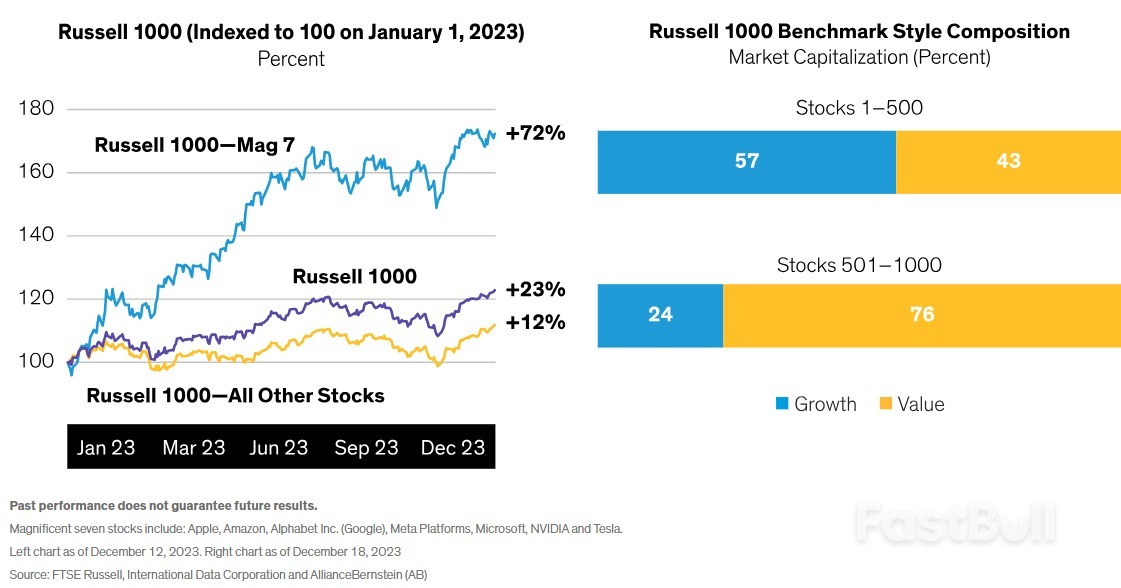
          US equity market returns have been disproportionately driven by the so-called Magnificent Seven (Mag 7) stocks this year. Their dominance has created style imbalances within large-cap benchmarks that deserve closer attention from investors.
          In a dramatic year for equity markets, the biggest actors on the US market stage hogged the limelight. The seven largest stocks in the Russell 1000 Index, which account for about 28% of the large-cap benchmark, surged by 72% through December 12—eclipsing returns for the rest of the market (Display). Similar trends were seen in global markets, such as the MSCI World, where the US Mag 7 stocks account for 19% of the benchmark.
          Market Concentration in Magnificent Seven Distorts Index Exposures_1
          The heavy market concentration in the Mag 7, which are seen as the big winners from the artificial intelligence revolution, profoundly affected investor outcomes. Portfolios that held all seven—Apple, Amazon, Alphabet Inc. (Google), Meta Platforms, Microsoft, NVIDIA and Tesla—enjoyed supercharged returns. Actively managed portfolios that didn't own some of these stocks were saddled with big underweight positions, making it almost impossible to beat the benchmark—especially since the rest of the market underperformed.

          Backstage at the Benchmark

          Extreme market concentration has had other, less visible effects on the market. In particular, the style composition of key equity benchmarks has been skewed in surprising ways.
          Index providers typically target a balanced style split between growth and value stocks in broad market benchmarks. Since the Mag 7 are mostly growth companies, their weight in the Russell 1000 creates a skew across the market-capitalization spectrum. The largest 500 companies in the Russell 1000 are somewhat tilted toward growth stocks. And as a result, the next 500 companies are heavily skewed toward value stocks—accounting for 73% of the weight in this segment of the market.

          Heavy Concentration Adds Risks

          Why does this matter to investors?
          First, the heavy concentration of larger weights in growth stocks adds benchmark risk. Passive investors enjoyed the Mag 7 rally but are also exposed to a potential turn in sentiment because of a lack of diversification in the index and the increasingly correlated trading patterns of these names. To be sure, the mega-caps include attractive companies, but we believe they should be held in accordance with a portfolio's investing philosophy at appropriate weights after a comprehensive evaluation of each stock's business potential and valuation.
          Second, investors in mid-cap stocks, the 800 smaller companies in the Russell 1000, must be aware of the unusually high concentration of value stocks relative to history. Value stocks require a different type of analysis than growth stocks for investors to identify the best long-term opportunities.
          Finally, unseen style biases warrant strategic consideration, in our view. Investors should proactively verify that their passive and active portfolios across an equity allocation are positioned with appropriate style exposures for their long-term objectives.

          Source: Alliance Bernstein

          To stay updated on all economic events of today, please check out our Economic calendar
          Risk Warnings and Disclaimers
          You understand and acknowledge that there is a high degree of risk involved in trading. Following any strategies or investment methods may lead to potential losses. The content on the site is provided by our contributors and analysts for information purposes only. You are solely responsible for determining whether any trading assets, securities, strategy, or any other product is suitable for investing based on your own investment objectives and financial situation.
          Comments
          Add to Favorites
          Share

          December 26th Financial News

          FastBull Featured

          Daily News

          [Quick Facts]

          1. BOJ governor notes progress in price target, hinting at possible policy shift.
          2. The world's major central banks pause rate hike cycles in Dec.
          3. The dollar weakens to a five-month low.
          4. While under NATO sanctions, Russia's crude exports are still at record highs.

          [News Details]

          BOJ governor notes progress in price target, hinting at possible policy shift
          The likelihood of achieving the central bank's inflation target is "gradually rising," Bank of Japan (BOJ) Governor Kazuo Ueda said on Monday. The central bank will consider changing policy if prospects of sustainably achieving the 2% target increase "sufficiently."
          The BOJ has not yet decided on a specific time to change its accommodative monetary policy stance due to uncertainties in economic and market developments. "We will carefully examine economic developments as well as firms' wage- and price-setting behavior, and thereby decide on future monetary policy in an appropriate manner," Kazuo Ueda said. The wording is slightly different from his usual call for the temporary need to "patiently" maintain the ultra-loose policy.
          The world's major central banks pause rate hike cycles in Dec
          With the Fed's monetary policy shift finally coming in December, the world's major central banks in developed countries only saw one rate hike this month, while more central banks in emerging countries chose to cut rates.
          The European Central Bank, Bank of England, Bank of Japan, Reserve Bank of Australia, Bank of Canada, and Swiss National Bank all left interest rates unchanged at their meetings, as did the Federal Reserve. The Fed's strikingly dovish turn took markets by surprise and increased bets that rate cuts would be faster and earlier than previously forecast. Policymakers in Europe and elsewhere have not echoed these forecasts. Markets appear to be at odds with policymakers' views on the timing of rate cuts.
          For now, a slowing global economy, reduced inflationary pressures and a cooling labor market will open the door for major central banks to cut rates next year. Five of the 18 central banks in a sample of developing economies cut rates, the most in at least three years. The Czech central bank launched an easing cycle, while Brazil, Hungary, Colombia, and Chile doubled their easing. Across the Reuters markets sample, 13 central banks held rate-setting meetings in December.
          The dollar weakens to a five-month low
          As U.S. inflation has continued to fall, the market has become more convinced that the Fed has been at the end of its rate hike cycle. There has been more frequent discussion of rate cuts in 2024. As a result, the dollar index has fallen to a five-month low.
          According to data from the U.S. Commodity Futures Trading Commission (CFTC), hedge funds, asset management companies, and other speculative market participants all increased bearish bets on the dollar. By last week, more than 39,000 contracts were tied to expectations of a weaker dollar, an increase of more than 10,000 contracts from a week ago when the Federal Reserve was preparing for the policy meeting, the data showed.
          Last week's U.S. PCE data added significantly to the Fed's recent tilt toward a more accommodative monetary policy stance. In addition, under the double pressure of monetary and fiscal policy tightening, the market generally expects that the U.S. economy will be likely to move downward next year and may even fall into recession.
          While under NATO sanctions, Russia's crude exports are still at record highs
          Turkey has become the largest importer of Russian energy in the Western Hemisphere after many European countries stopped importing most of their oil and gas from Russia. Turkey, a NATO member, has not chosen to oppose Russia because of the Russia-Ukraine conflict but has deepened bilateral economic and trade cooperation with Russia.
          Data from the London Stock Exchange show that Turkish companies have saved about $2 billion on their energy bills in 2023 by increasing imports of relatively inexpensive Russian oil and refined products. Russian Urals crude oil shipments to Turkey rose to an all-time high of 400,000 barrels per day in November 2023, accounting for about 14% of Russia's total seaborne oil exports last month, a figure that is expected to rise further in the coming months.

          [Focus of the Day]

          None
          Risk Warnings and Disclaimers
          You understand and acknowledge that there is a high degree of risk involved in trading. Following any strategies or investment methods may lead to potential losses. The content on the site is provided by our contributors and analysts for information purposes only. You are solely responsible for determining whether any trading assets, securities, strategy, or any other product is suitable for investing based on your own investment objectives and financial situation.
          Comments
          Add to Favorites
          Share

          These Are the World's Most Expensive Cities

          Alex

          Economic

          The global cost-of-living crisis that began in 2022 is now so much part of daily life that it is entering the vernacular. “Cozzie livs”, British slang for the crisis, was recently named Australia's word of the year by the Macquarie Dictionary.
          The latest Worldwide Cost of Living survey by eiu, our sister company, confirms that inflation remains high worldwide: the prices of 200 products and services that it tracks rose by an average of 7.4% over the past year. This is down slightly from 8.1% in 2022, but remains well above the average of 2.9% over the previous five years. Our map and chart below reveal which cities are the most expensive.
          These Are the World's Most Expensive Cities_1
          Tied in first place this year were Singapore and Zurich. Singapore is no stranger to the top spot: it has ranked as the priciest place to live in nine of the past 11 years. Groceries, alcohol and clothing in the international business hub can cost a small fortune.
          The cost of a certificate needed to own a car (which the government wants to discourage) recently topped $106,000. Zurich, meanwhile, jumped five places from last year. Switzerland's largest city is perennially pricey; it came joint first in 2020 and rarely leaves the top ten.
          Its rise to the top of the index is mostly because the Swiss franc has appreciated by more than 10% against the dollar over the past year. (The survey's benchmark city is New York, so if a country's currency strengthens its cities will generally move up the ranking.)
          Western European cities, including Copenhagen, Dublin and Vienna, take around half of the top 20 spots. Rising prices are one reason. Another is that the European Central Bank raised interest rates six times in 2023 to tame inflation, which caused the euro to appreciate by 7% against the dollar. North American cities dropped in the ranking this year: New York, last year's joint most-expensive city with Singapore, fell to third place.
          These Are the World's Most Expensive Cities_2
          The three biggest climbers were Santiago de Querétaro and Aguascalientes in Mexico, and Costa Rica's capital, San José. Beijing was one of four Chinese cities among the ten biggest decliners in the ranking. That reflects the depreciation of the renminbi and the faltering of China's recovery from the pandemic. Moscow and St Petersburg fell furthest, plummeting by 105 places to 142nd and by 74 places to 147th, respectively. The rouble collapsed against the dollar because of Western sanctions on Russian oil and high levels of military spending.
          In last year's report eiu predicted correctly that energy prices and supply-chain problems would ease in 2023. This year's ends on a more pessimistic note. Interest rates are unlikely to come down soon, which will constrain economic growth; energy prices could rise again if the Israel-Hamas war spreads across the Middle East; and El Niño—which began in June and will last well into next year—could yet push up food prices. “Cozzie livs” will remain popular into 2024.

          Source: Economist

          To stay updated on all economic events of today, please check out our Economic calendar
          Risk Warnings and Disclaimers
          You understand and acknowledge that there is a high degree of risk involved in trading. Following any strategies or investment methods may lead to potential losses. The content on the site is provided by our contributors and analysts for information purposes only. You are solely responsible for determining whether any trading assets, securities, strategy, or any other product is suitable for investing based on your own investment objectives and financial situation.
          Comments
          Add to Favorites
          Share

          Restructuring China-US Relations in 2024 Is Fraught with Uncertainties

          Owen Li

          Political

          Restructuring China-US Relations in 2024 Is Fraught with Uncertainties_1
          Two recent developments cast a bright light of hope for the future: the advancement of direct US-China military talks and the possible resumption of narcotics control discussions. These events are more than isolated diplomatic gestures. They represent a mutual willingness to stabilize one of the world's most important bilateral relationships.
          The US-China relationship is an important fulcrum for balancing the global order. Its stability or lack thereof has far-reaching implications for regional and international peace and security. Progress in the military dialogue demonstrates that the US and China will be willing to work to manage and mitigate strategic risks. Similarly, the gradual resumption of narcotics control talks demonstrates the two countries' willingness to work together to address transnational challenges that affect the well-being of their peoples.
          However, it is important to recognize that the path to restructuring this complex relationship is fraught with uncertainty. This uncertainty, to global and Chinese observers, is precisely another defining and certain effect of the evolution of American politics, like an absurd drama. The script of US politics has changed, and the relationship with China cannot be separated from that script and become a theater on its own.
          Therefore, the China-US relationship is also affected by the uncertainty of the evolution of the domestic political drama in the US, and it is precisely because of this uncertainty that containing China will continue to be the main theme of US foreign policy, and the future development of China-US relations will still be full of conflicts. China is clearly aware of and prepared for this.
          After a year marked by the US crackdown on Chinese enterprises and "made-in-China" on a broad scale, it is apparent that the US strategy to counter China's rise has solidified and is irreversible. In response, China is poised to adopt a more assertive stance, preparing for potential countermeasures and strategic "breakthroughs."
          In the new year, China's advancements in high technology, exemplified by its burgeoning electric car industry, rebuilding the world trade networks, as well as playing an active peace role in international hot issues, signal a renewed momentum in its economic transformation and a more proactive diplomatic posture. These developments could play a critical role in reshaping US-China relations.
          Looking ahead, the challenge for both countries is not merely to restructure their bilateral relationship but to redefine their political, economic and trade relations with the rest of the world. The concept of "decoupling" has dominated much of the discourse, but the future may demand a focus on "reconnecting" - establishing stable communication mechanisms and maintaining essential connections not only between the two countries, but also with the world. The scene begins to change to a wider international background.
          Even more pressing is how both countries will forge new global connections. This will have a significant influence on the global supply and trade chains, as well as how the world order evolves.
          The US, for its part, is likely to persist in its efforts to build coalitions aimed at marginalizing and containing China. US Secretary of State Antony Blinken's recent remarks underscore a commitment to engage China from a "position of strength" and leverage alliances in the Indo-Pacific region.
          While such rhetoric has been overused, it reflects a broader strategic approach that extends beyond the bilateral relationship to encompass global geopolitical dynamics. The shifting focus of the international background raises the question of how China will navigate this environment, seeking to promote peaceful development conducive to its interests.
          When people see more chaos from the political drama in Washington, especially when they no longer expect this hegemonic country to solve global problems, including existing wars and conflicts, their attention will gradually shift to the performance of China and other major countries in the global landscape.
          The US will continue to rely on its own strength to contain China. However, as more and more countries seek to enhance bilateral or multilateral cooperation and approaches based on their own national interests, the US' pursuit will inevitably become gradually ineffective. China's approach to carving out its place in the global community may well be more consequential for the trajectory of this century than the specifics of US containment strategies.

          Source: Global Times

          Risk Warnings and Disclaimers
          You understand and acknowledge that there is a high degree of risk involved in trading. Following any strategies or investment methods may lead to potential losses. The content on the site is provided by our contributors and analysts for information purposes only. You are solely responsible for determining whether any trading assets, securities, strategy, or any other product is suitable for investing based on your own investment objectives and financial situation.
          Comments
          Add to Favorites
          Share

          Is the 'Big Ease' Coming in 2024 or Will Rate-Cut Hopes Get Dashed?

          Glendon

          Central Bank

          Economic

          Central banks from most major developed economies closed out 2023 with a blitz of policy meetings in December that effectively shut the books on the aggressive rate hikes that have dominated the economic and financial landscape since 2022. The lone outlier, the Bank of Japan (BOJ), never managed to kill off its negative rates policy and signaled last week at the year's final meeting of a Group of Seven central banks that a shift away from that stance was not imminent.
          Allowing the rest of the big central banks to call time on rate hikes was the favorable turn inflation took over the course of 2023. After starting the year with annual inflation rates that were on average 3.7 times the 2% target shared by the U.S. Federal Reserve, European Central Bank (ECB), Bank of England, Bank of Canada and BOJ, the pace of price increases is now down to 1.5 times that target.
          Of course that means more work to do to complete the "last mile" in the inflation fight. Central bankers are loathe to declare victory prematurely and are battling with over-eager financial markets to retain maximum optionality, prompting the drum beat of pledges to hold rates high for a longer period or raise them again if necessary - the latter in particular being seen increasingly as an empty threat.
          Inflation, however, does not need to drop all the way to 2% in order for rate cuts to begin, and 2-handle inflation rates could soon be the norm.
          Is the 'Big Ease' Coming in 2024 or Will Rate-Cut Hopes Get Dashed?_1Is the 'Big Ease' Coming in 2024 or Will Rate-Cut Hopes Get Dashed?_2WHY IT MATTERS
          Holding rates steady as inflation rates slow further is another form of policy tightening that may not be appropriate for much longer.
          That is something some Fed officials have begun openly bandying about as a reason for the rate cuts they flagged last week as being in the cards next year, especially if they hope to deliver a "soft landing" for the U.S. economy.
          Keeping rates restrictive for longer than necessary risks a harsher outcome, one featuring a rapid slowdown in economic activity, a painful rise in unemployment and a recession that much of the world has managed to dodge so far despite that scenario being the more traditional end to rate-hike cycles.
          Rate-sensitive economic sectors everywhere - such as housing and manufacturing - have felt the pinch of higher rates for more than a year.
          While services activity generally has continued to expand, S&P Global's measure of manufacturing activity in developed economies has been in contraction since October 2022, although there are indications the worst may be over with the latest reading at the highest level since the spring. Emerging market factory output, which has been at stall speed for much of 2023, also edged higher.

          WHAT IT MEANS FOR 2024

          A major game of chicken is underway as market actors have set expectations for far more policy easing than central bankers are likely to be willing to provide.
          For instance, while last week's projections from Fed officials themselves indicated they expect 75 basis points of rate reductions over the course of 2024, bond and rate futures markets are now positioned for twice that amount. That led at least one U.S. central bank official, Chicago Fed President Austan Goolsbee, to confess that he was "confused" by the market's behavior.
          Across the Atlantic, meanwhile, sources familiar with the matter told Reuters it is unlikely that the ECB will be in position to cut rates before June, three months later than market pricing there now reflects.
          The key to it all, of course, rests with inflation since policymakers have said they are willing to stomach some level of economic pain, if necessary, to finally return price pressures to their target levels.
          Politics may play a hand as well, with general elections scheduled for later in the year, in the U.S and UK in particular. Central bankers who prize their political independence may not want to be seen taking major action too close to elections lest they be accused of trying to tip the outcome.
          And as the year closed, a potential new spoiler was emerging that could complicate the rate-cut thesis: Attacks by Iran-backed Houthi rebels on cargo vessels in the Red Sea forced shippers to halt or reroute traffic, a supply chain hiccup that could impede further swift progress on inflation.

          Source: REUTERS

          To stay updated on all economic events of today, please check out our Economic calendar
          Risk Warnings and Disclaimers
          You understand and acknowledge that there is a high degree of risk involved in trading. Following any strategies or investment methods may lead to potential losses. The content on the site is provided by our contributors and analysts for information purposes only. You are solely responsible for determining whether any trading assets, securities, strategy, or any other product is suitable for investing based on your own investment objectives and financial situation.
          Comments
          Add to Favorites
          Share

          Stocks Near Record Highs as 2023 Ends: What's Ahead This Week

          Chandan Gupta

          Stocks

          Traders' Opinions

          As the US stock market gears up for its final 2023 trading week, a clearer narrative emerges. Recent inflation data indicates the Federal Reserve's progress toward its 2% inflation target, potentially paving the way for interest rate cuts.
          Signs of recession are sparse; interest rates have eased from recent highs, with major indices like the Dow Jones and S&P 500 flirting with all-time highs. The Nasdaq Composite has surged by over 40% throughout the year.
          In the upcoming week, investors eagerly anticipate whether the S&P 500 will clinch a new record, following the Dow's recent milestone. Economic focus narrows on Tuesday's home price data and Thursday's initial jobless claims report, while a quiet earnings calendar leaves markets awaiting substantial news.
          It's worth noting that markets will be closed on Monday for Christmas.Stocks Near Record Highs as 2023 Ends: What's Ahead This Week_1

          Inflation nears the Fed's target

          Friday's inflation report showcased a meaningful step for the Fed in steering inflation back to its targeted 2%. The core PCE Price Index, which excludes volatile food and energy, revealed a 3.2% year-over-year increase in November, marking the slowest climb since April 2021.
          Digging deeper into this data offers a crucial insight. The six-month annualized "core" PCE stood at 1.9% in November, indicating the Fed's proximity to its objective.
          Despite recent attempts by some Fed members to temper expectations of rate cuts, analysts like Andrew Hunter from Capital Economics remain unconvinced. Hunter highlighted the sub-2% annualized pace of core PCE inflation over the past six months, suggesting that this last push for hawkishness isn't swaying market sentiment.

          With mounting signs indicating a decrease in the post-pandemic inflation surge, Hunter foresees a significant cut in interest rates in the upcoming year.Stocks Near Record Highs as 2023 Ends: What's Ahead This Week_2

          Anticipation of swift rate cuts by the Fed next year has been a key driver behind the market's momentum in 2023.
          While the AI-related excitement dominated the tech landscape after a lackluster 2022, the latter part of this year has pivoted significantly toward discussions around interest rates.
          A dip in the US stock market during autumn coincided with Treasury yields soaring to levels not seen in 16 years. This surge occurred as concerns about persisting inflation pressures emerged, casting doubt on whether the Fed would ease its policies from their prolonged highs set over 22 years.
          However, recent data, coupled with the Fed's projections, have assuaged many of these concerns.

          Pursuing the year ahead: 2024 in focus

          As 2023 wraps up with the stock market surging towards all-time highs, predictions for 2024 have already lost their freshness.
          Goldman Sachs' equity strategy team recently upped their 2024 S&P 500 price target from 4,700 to 5,100.
          Back in mid-November, when many in Wall Street began forecasting the year ahead, uncertainty loomed over the trajectory of inflation, economic growth, and the Fed's moves.Stocks Near Record Highs as 2023 Ends: What's Ahead This Week_3
          As we approach the end of two eventful years in market history, Bespoke Investment Group highlighted some stats underscoring that history might relegate these post-pandemic fluctuations to obscurity.
          On November 30, 2023, the S&P 500 closed at 4,567.80, almost identical to its close on the same day in 2021, at 4,567.00. In between, investors weathered the worst year in a generation, followed by one of the index's best five years since the financial crisis. However, as time moves forward from this period of stagnant stock movement, the intensity of both moments might fade from memory.
          Bespoke also pointed out that during the 2022 sell-off, the seven largest S&P 500 stocks collectively lost $4.9 trillion, while this year, these same stocks gained back the same amount in market cap.
          Looking into 2024, Wall Street forecasts suggest a cautious optimism among investors. While the S&P 500 typically gains around 9% annually, most predictions hover around a 5% increase for the coming year.
          However, as observed by former Yahoo Finance managing editor Sam Ro, "average" years are rare in the stock market. Over the years, the S&P 500 has seen significant gains 33 times and losses 15 times since 1957, painting an unpredictable landscape.
          Amidst these forecasts, it seems evident that Wall Street might again miss the mark on where stocks will land by next year's end. Bespoke's insights emphasize that seeking precision within a single year is an exercise in futility; in due course, the tumultuous gains or losses of any given year will flatten. Ultimately, the broader trajectory of market history follows its own course.
          Risk Warnings and Disclaimers
          You understand and acknowledge that there is a high degree of risk involved in trading. Following any strategies or investment methods may lead to potential losses. The content on the site is provided by our contributors and analysts for information purposes only. You are solely responsible for determining whether any trading assets, securities, strategy, or any other product is suitable for investing based on your own investment objectives and financial situation.
          Comments
          Add to Favorites
          Share
          FastBull
          Copyright © 2025 FastBull Ltd

          728 RM B 7/F GEE LOK IND BLDG NO 34 HUNG TO RD KWUN TONG KLN HONG KONG

          TelegramInstagramTwitterfacebooklinkedin
          App Store Google Play Google Play
          Products
          Charts

          Chats

          Q&A with Experts
          Screeners
          Economic Calendar
          Data
          Tools
          Membership
          Features
          Function
          Markets
          Copy Trading
          Latest Signals
          Contests
          News
          Analysis
          24/7
          Columns
          Education
          Company
          Careers
          About Us
          Contact Us
          Advertising
          Help Center
          Feedback
          User Agreement
          Privacy Policy
          Business

          White Label

          Data API

          Web Plug-ins

          Poster Maker

          Affiliate Program

          Risk Disclosure

          The risk of loss in trading financial instruments such as stocks, FX, commodities, futures, bonds, ETFs and crypto can be substantial. You may sustain a total loss of the funds that you deposit with your broker. Therefore, you should carefully consider whether such trading is suitable for you in light of your circumstances and financial resources.

          No decision to invest should be made without thoroughly conducting due diligence by yourself or consulting with your financial advisors. Our web content might not suit you since we don't know your financial conditions and investment needs. Our financial information might have latency or contain inaccuracy, so you should be fully responsible for any of your trading and investment decisions. The company will not be responsible for your capital loss.

          Without getting permission from the website, you are not allowed to copy the website's graphics, texts, or trademarks. Intellectual property rights in the content or data incorporated into this website belong to its providers and exchange merchants.

          Not Logged In

          Log in to access more features

          FastBull Membership

          Not yet

          Purchase

          Become a signal provider
          Help Center
          Customer Service
          Dark Mode
          Price Up/Down Colors

          Log In

          Sign Up

          Position
          Layout
          Fullscreen
          Default to Chart
          The chart page opens by default when you visit fastbull.com