• Trade
  • Markets
  • Copy
  • Contests
  • News
  • 24/7
  • Calendar
  • Q&A
  • Chats
Trending
Screeners
SYMBOL
LAST
BID
ASK
HIGH
LOW
NET CHG.
%CHG.
SPREAD
SPX
S&P 500 Index
6859.66
6859.66
6859.66
6878.28
6858.25
-10.74
-0.16%
--
DJI
Dow Jones Industrial Average
47810.00
47810.00
47810.00
47971.51
47771.72
-144.98
-0.30%
--
IXIC
NASDAQ Composite Index
23590.22
23590.22
23590.22
23698.93
23579.88
+12.10
+ 0.05%
--
USDX
US Dollar Index
99.100
99.180
99.100
99.100
98.730
+0.150
+ 0.15%
--
EURUSD
Euro / US Dollar
1.16261
1.16269
1.16261
1.16717
1.16260
-0.00165
-0.14%
--
GBPUSD
Pound Sterling / US Dollar
1.33108
1.33117
1.33108
1.33462
1.33106
-0.00204
-0.15%
--
XAUUSD
Gold / US Dollar
4180.12
4180.53
4180.12
4218.85
4175.92
-17.79
-0.42%
--
WTI
Light Sweet Crude Oil
59.006
59.036
59.006
60.084
58.892
-0.803
-1.34%
--

Community Accounts

Signal Accounts
--
Profit Accounts
--
Loss Accounts
--
View More

Become a signal provider

Sell trading signals to earn additional income

View More

Guide to Copy Trading

Get started with ease and confidence

View More

Signal Accounts for Members

All Signal Accounts

Best Return
  • Best Return
  • Best P/L
  • Best MDD
Past 1W
  • Past 1W
  • Past 1M
  • Past 1Y

All Contests

  • All
  • Trump Updates
  • Recommend
  • Stocks
  • Cryptocurrencies
  • Central Banks
  • Featured News
Top News Only
Share

US Dollar Extends Gains Versus Yen After Japan Earthquake, Last Up 0.2% At 155.64 Yen

Share

US Natural Gas Futures Drop 6% On Less Cold Forecasts, Near-Record Output

Share

Russian Central Bank: Sets Official Rouble Rate For December 9 At 77.2733 Roubles Per USA Dollar (Previous Rate - 76.0937)

Share

Russian Deputy Prime Minister Novak: Russia Will Restrict Gold Exports Starting In 2026

Share

US Dollar Touches Session High Versus Yen On Earthquake News, Last Up 0.5% At 155.81%

Share

NHK: A 40-centimeter-high Tsunami Has Reached Mutsuki Port In Aomori, Japan

Share

ICE Cotton Stocks Totalled To 13971 - December 08, 2025

Share

Japan Prime Minister Takaichi: Trying To Gather Information After Quake

Share

UK Trade Minister To Visit US This Week For Talks On Tariffs

Share

Head Of Yemen's Anti-Houthi Presidential Council Says Actions Of Southern Transitional Council Across South Yemen Undermines Legitimacy Of Internationally-Recognised Government

Share

Carvana Rose 9.1% And Crh Rose 6.8% As Both Companies Were Added To The S&P 500 Index

Share

Japanese Regulators Say No Problems Have Been Found At The Onagawa Nuclear Power Plant

Share

KYODO News: Some Tohoku Shinkansen Services Have Been Suspended Following The Earthquake In Japan

Share

The Japan Meteorological Agency Has Issued Tsunami Warnings For The Central Pacific Coast Of Hokkaido, The Pacific Coast Of Aomori Prefecture, And Iwate Prefecture

Share

Euro Hits Session High Versus Yen Following Strong Japan Quake, Last Up 0.3% At 181.36 Yen

Share

The S&P 500 Opened 4.80 Points Higher, Or 0.07%, At 6875.20; The Dow Jones Industrial Average Opened 16.52 Points Higher, Or 0.03%, At 47971.51; And The Nasdaq Composite Opened 60.09 Points Higher, Or 0.25%, At 23638.22

Share

Reuters Poll - Swiss National Bank Policy Rate To Be 0.00% At End-2026, Said 21 Of 25 Economists, Four Said It Would Be Cut To -0.25%

Share

USGS - Magnitude 7.6 Earthquake Strikes Misawa, Japan

Share

Reuters Poll - Swiss National Bank To Hold Policy Rate At 0.00% On December 11, Said 38 Of 40 Economists, Two Said Cut To -0.25%

Share

Traders Believe There Is A 20% Chance That The European Central Bank Will Raise Interest Rates Before The End Of 2026

TIME
ACT
FCST
PREV
France Trade Balance (SA) (Oct)

A:--

F: --

P: --
Euro Zone Employment YoY (SA) (Q3)

A:--

F: --

P: --
Canada Part-Time Employment (SA) (Nov)

A:--

F: --

P: --

Canada Unemployment Rate (SA) (Nov)

A:--

F: --

P: --

Canada Full-time Employment (SA) (Nov)

A:--

F: --

P: --

Canada Labor Force Participation Rate (SA) (Nov)

A:--

F: --

P: --

Canada Employment (SA) (Nov)

A:--

F: --

P: --

U.S. PCE Price Index MoM (Sept)

A:--

F: --

P: --

U.S. Personal Income MoM (Sept)

A:--

F: --

P: --

U.S. Core PCE Price Index MoM (Sept)

A:--

F: --

P: --

U.S. PCE Price Index YoY (SA) (Sept)

A:--

F: --

P: --

U.S. Core PCE Price Index YoY (Sept)

A:--

F: --

P: --

U.S. Personal Outlays MoM (SA) (Sept)

A:--

F: --

P: --
U.S. 5-10 Year-Ahead Inflation Expectations (Dec)

A:--

F: --

P: --

U.S. Real Personal Consumption Expenditures MoM (Sept)

A:--

F: --

P: --
U.S. Weekly Total Rig Count

A:--

F: --

P: --

U.S. Weekly Total Oil Rig Count

A:--

F: --

P: --

U.S. Consumer Credit (SA) (Oct)

A:--

F: --

P: --
China, Mainland Foreign Exchange Reserves (Nov)

A:--

F: --

P: --

Japan Trade Balance (Oct)

A:--

F: --

P: --

Japan Nominal GDP Revised QoQ (Q3)

A:--

F: --

P: --

China, Mainland Imports YoY (CNH) (Nov)

A:--

F: --

P: --

China, Mainland Exports (Nov)

A:--

F: --

P: --

China, Mainland Imports (CNH) (Nov)

A:--

F: --

P: --

China, Mainland Trade Balance (CNH) (Nov)

A:--

F: --

P: --

China, Mainland Exports YoY (USD) (Nov)

A:--

F: --

P: --

China, Mainland Imports YoY (USD) (Nov)

A:--

F: --

P: --

Germany Industrial Output MoM (SA) (Oct)

A:--

F: --

P: --
Euro Zone Sentix Investor Confidence Index (Dec)

A:--

F: --

P: --

Canada National Economic Confidence Index

A:--

F: --

P: --

U.K. BRC Like-For-Like Retail Sales YoY (Nov)

--

F: --

P: --

U.K. BRC Overall Retail Sales YoY (Nov)

--

F: --

P: --

Australia Overnight (Borrowing) Key Rate

--

F: --

P: --

RBA Rate Statement
RBA Press Conference
Germany Exports MoM (SA) (Oct)

--

F: --

P: --

U.S. NFIB Small Business Optimism Index (SA) (Nov)

--

F: --

P: --

Mexico 12-Month Inflation (CPI) (Nov)

--

F: --

P: --

Mexico Core CPI YoY (Nov)

--

F: --

P: --

Mexico PPI YoY (Nov)

--

F: --

P: --

U.S. Weekly Redbook Index YoY

--

F: --

P: --

U.S. JOLTS Job Openings (SA) (Oct)

--

F: --

P: --

China, Mainland M1 Money Supply YoY (Nov)

--

F: --

P: --

China, Mainland M0 Money Supply YoY (Nov)

--

F: --

P: --

China, Mainland M2 Money Supply YoY (Nov)

--

F: --

P: --

U.S. EIA Short-Term Crude Production Forecast For The Year (Dec)

--

F: --

P: --

U.S. EIA Natural Gas Production Forecast For The Next Year (Dec)

--

F: --

P: --

U.S. EIA Short-Term Crude Production Forecast For The Next Year (Dec)

--

F: --

P: --

EIA Monthly Short-Term Energy Outlook
U.S. API Weekly Gasoline Stocks

--

F: --

P: --

U.S. API Weekly Cushing Crude Oil Stocks

--

F: --

P: --

U.S. API Weekly Crude Oil Stocks

--

F: --

P: --

U.S. API Weekly Refined Oil Stocks

--

F: --

P: --

South Korea Unemployment Rate (SA) (Nov)

--

F: --

P: --

Japan Reuters Tankan Non-Manufacturers Index (Dec)

--

F: --

P: --

Japan Reuters Tankan Manufacturers Index (Dec)

--

F: --

P: --

Japan Domestic Enterprise Commodity Price Index MoM (Nov)

--

F: --

P: --

Japan Domestic Enterprise Commodity Price Index YoY (Nov)

--

F: --

P: --

China, Mainland PPI YoY (Nov)

--

F: --

P: --

China, Mainland CPI MoM (Nov)

--

F: --

P: --

Q&A with Experts
    • All
    • Chatrooms
    • Groups
    • Friends
    Connecting
    .
    .
    .
    Type here...
    Add Symbol or Code

      No matching data

      All
      Trump Updates
      Recommend
      Stocks
      Cryptocurrencies
      Central Banks
      Featured News
      • All
      • Russia-Ukraine Conflict
      • Middle East Flashpoint
      • All
      • Russia-Ukraine Conflict
      • Middle East Flashpoint
      Search
      Products

      Charts Free Forever

      Chats Q&A with Experts
      Screeners Economic Calendar Data Tools
      Membership Features
      Data Warehouse Market Trends Institutional Data Policy Rates Macro

      Market Trends

      Market Sentiment Order Book Forex Correlations

      Top Indicators

      Charts Free Forever
      Markets

      News

      News Analysis 24/7 Columns Education
      From Institutions From Analysts
      Topics Columnists

      Latest Views

      Latest Views

      Trending Topics

      Top Columnists

      Latest Update

      Signals

      Copy Rankings Latest Signals Become a signal provider AI Rating
      Contests
      Brokers

      Overview Brokers Assessment Rankings Regulators News Claims
      Broker listing Forex Brokers Comparison Tool Live Spread Comparison Scam
      Q&A Complaint Scam Alert Videos Tips to Detect Scam
      More

      Business
      Events
      Careers About Us Advertising Help Center

      White Label

      Data API

      Web Plug-ins

      Affiliate Program

      Awards Institution Evaluation IB Seminar Salon Event Exhibition
      Vietnam Thailand Singapore Dubai
      Fans Party Investment Sharing Session
      FastBull Summit BrokersView Expo
      Recent Searches
        Top Searches
          Markets
          News
          Analysis
          User
          24/7
          Economic Calendar
          Education
          Data
          • Names
          • Latest
          • Prev

          View All

          No data

          Scan to Download

          Faster Charts, Chat Faster!

          Download App
          English
          • English
          • Español
          • العربية
          • Bahasa Indonesia
          • Bahasa Melayu
          • Tiếng Việt
          • ภาษาไทย
          • Français
          • Italiano
          • Türkçe
          • Русский язык
          • 简中
          • 繁中
          Open Account
          Search
          Products
          Charts Free Forever
          Markets
          News
          Signals

          Copy Rankings Latest Signals Become a signal provider AI Rating
          Contests
          Brokers

          Overview Brokers Assessment Rankings Regulators News Claims
          Broker listing Forex Brokers Comparison Tool Live Spread Comparison Scam
          Q&A Complaint Scam Alert Videos Tips to Detect Scam
          More

          Business
          Events
          Careers About Us Advertising Help Center

          White Label

          Data API

          Web Plug-ins

          Affiliate Program

          Awards Institution Evaluation IB Seminar Salon Event Exhibition
          Vietnam Thailand Singapore Dubai
          Fans Party Investment Sharing Session
          FastBull Summit BrokersView Expo

          World Balance Sheet May Need AI-Style Productivity Leap

          Kevin Du

          Economic

          Summary:

          Hype or hope, this year's boom in artificial intelligence along with other productivity-enhancing tech developments may be one of few ways to sustain an increasingly fragile "global balance sheet" over coming decades.

          Hype or hope, this year's boom in artificial intelligence along with other productivity-enhancing tech developments may be one of few ways to sustain an increasingly fragile "global balance sheet" over coming decades.
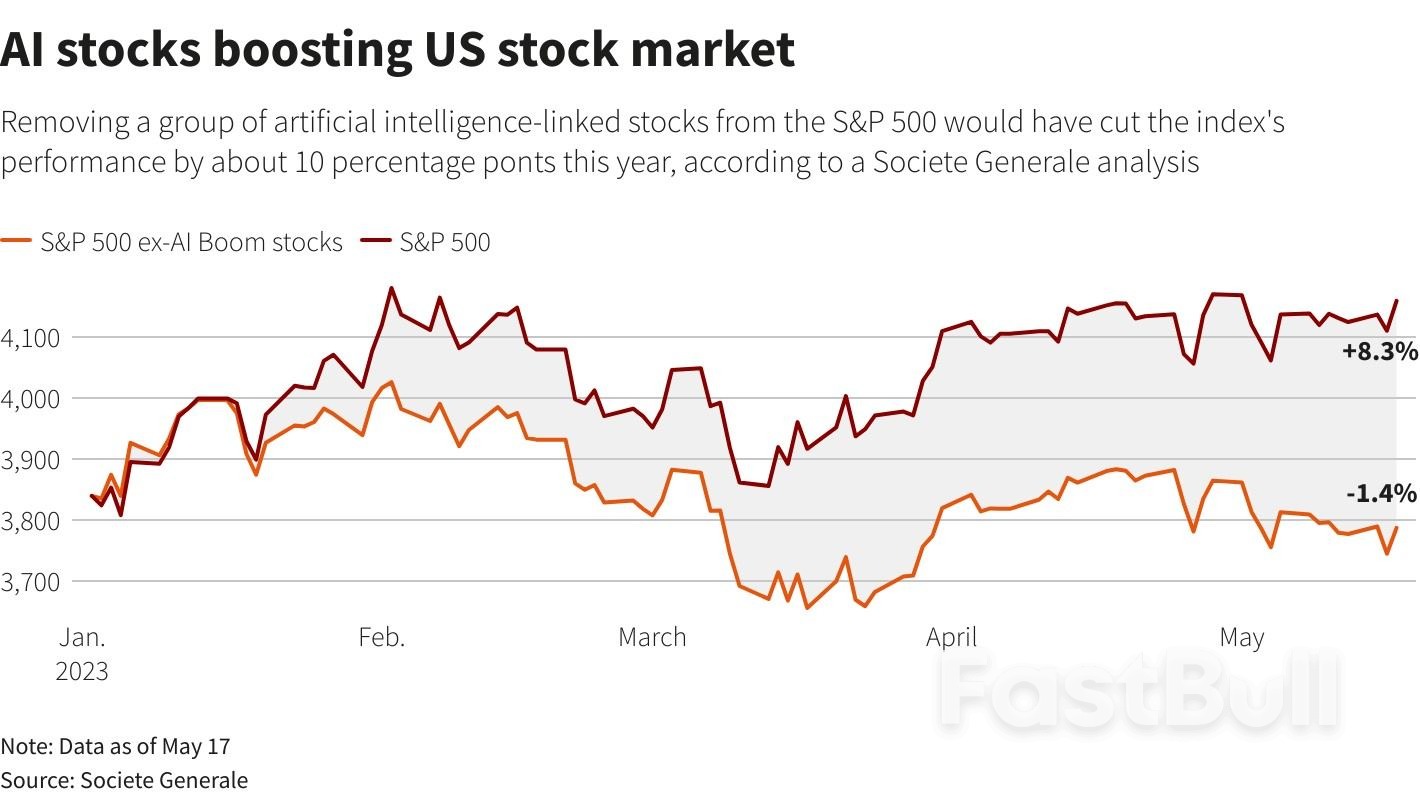
          There is little doubt about the market heat, corporate alarm and social anxieties created in the mere six months since the breakthrough in "generative AI" tools took the world by storm. What it means for jobs, productivity, profit margins and even trustworthy information dominates the debate.
          Even Bank of America's strategists have taken to describing the stock market craze around it as a "baby bubble" already.
          But in a study into the sustainability of two decades of debt-fueled asset-price gains - a $160 trillion ballooning of "paper wealth" - McKinsey Global Institute reckons accelerating productivity may be the only one of four scenarios that can keep income and wealth growing over coming decades by seeding an economic expansion that catches up with a bloated balance sheet.
          That notional global balance sheet - which comes in at more than $500 trillion, or half a quadrillion - adds up all the real assets in the economy, such as real estate, plants, machinery and intangibles, and all the financial assets and liabilities, such as equity, debt, deposits and pension assets.
          The nub of McKinsey's question is how potentially seismic changes afoot in inflation, interest rates, banking, geopolitics and supply chains may upend those past two decades of slow growth, high liquidity, "seemingly endless" wealth gains and rising inequality.
          That was a world in which the notional world balance sheet outpaced GDP growth, with every dollar of investment generating $1.90 in debt, McKinsey claimed.
          And last year's $8 trillion asset price implosion was just a taster of what that shakeup can do to global household wealth.
          The four possible scenarios sketched by McKinsey through 2030 in a report called "The future of wealth and growth hangs in the balance" have extreme outcomes.
          The first scenario is just a reversion to pre-pandemic growth and inflation norms, weak investment and a savings glut. It sees the biggest annual asset price gains over the coming eight years as an extension of the "wealth illusion" of the past decade. The worst asset price losses and GDP drop comes in a scenario that apes post-property-bust Japan of the 1990s.
          Between the two is a higher-for-longer inflation picture that echoes the 1970s energy crisis and erodes real wealth.
          The only unambiguously positive outcome is a productivity surge - with tech deployment, productive investment, real wealth gains, falling balance sheet risk and falling inequality - not unlike early post-World War Two decades in the United States.
          In that rosy scenario, sustainable real interest rates return to a positive 1% over the 2022-2030 period, average annual real equity and bond gains hit 4-5%.
          U.S. household wealth alone would expand by some $17 trillion by 2030, compared with a $31 trillion collapse in the case of 1990s Japan.
          "Governments and corporations alike should collectively strive toward accelerated productivity growth, the only one of MGI's modeled scenarios that achieves strong growth in income and wealth over the long term and a healthy global balance sheet," the report concluded, highlighting demographic and supply-chain problems ahead that demand this direction.
          "First and foremost, it requires productive capital allocation and investment as well as more rapid adoption of digital tools."World Balance Sheet May Need AI-Style Productivity Leap_1
          World Balance Sheet May Need AI-Style Productivity Leap_2Worker Shortage Vs AI Layoffs
          But there are many doubts, not least the acknowledgment by MGI that digitization over the past 20 years has not yet led to that sort of surge in productivity growth.
          Even if the latest hoopla around generative AI is overstated, there is genuine trepidation about waves of white- collar worker redundancy that may come from this. That hardly jibes with a rosy outlook - even if asset wealth is enhanced.
          After all, Goldman Sachs earlier this year estimated 300 million jobs worldwide could be at risk from automation and generative AI could dispense with a quarter of all current work in the United States and Europe - even though productivity enhancements may lift world economic growth by 7% and average profit margins of S&P 500 companies by 4%.
          Others have talked of pressure on governments to ultimately offset potentially devastating job losses with schemes such as Universal Basic Income, which some fear may require central banks to cap borrowing costs artificially in future - even proving inflationary as a result.
          But if looming worker shortages were the big worry within ageing developed countries, then the tech may not be as dire for the world of work as it first seems - even if requiring deft management, sequencing and even regulation to avoid outsized hits to different countries or population cohorts.
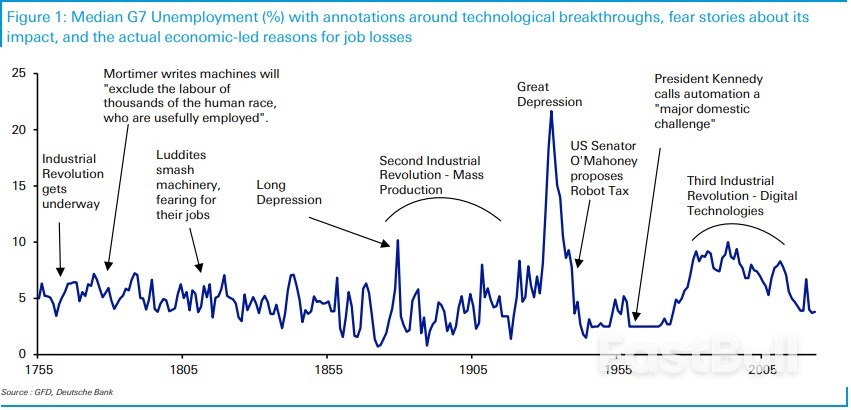
          Deutsche Bank strategists Jim Reid and Henry Allen this week examined how most new technologies over recent centuries were feared due to unemployment concerns - but these were typically unfounded as freed-up resources, higher productivity and real wages lifted living standards at large and made way for other industries and jobs to spring up.
          "Humans are inherently ambitious and will always seek new opportunities when technology closes off previous areas. Such upheaval has always been growth- and employment-enhancing," they concluded.
          "Whilst there are legitimate fears about what AI means for society, we are sceptical that this time is different and it will lead to widespread job losses."World Balance Sheet May Need AI-Style Productivity Leap_3

          World Balance Sheet May Need AI-Style Productivity Leap_4Source: ZAWYA

          To stay updated on all economic events of today, please check out our Economic calendar
          Risk Warnings and Disclaimers
          You understand and acknowledge that there is a high degree of risk involved in trading. Following any strategies or investment methods may lead to potential losses. The content on the site is provided by our contributors and analysts for information purposes only. You are solely responsible for determining whether any trading assets, securities, strategy, or any other product is suitable for investing based on your own investment objectives and financial situation.
          Comments
          Add to Favorites
          Share

          Is the Debt Ceiling Stalemate Just Posturing — or Is This Time Truly Different?

          Justin

          Economic

          Bond

          Political

          On Thursday, Punchbowl News reported that Republicans are now privately optimistic about reaching a deal. And yet House Speaker Kevin McCarthy has been insisting this week that the only “concession” House Republicans will offer to Democrats is raising the debt ceiling — hardly a concession. On Wednesday, Minority Leader Hakeem Jeffries accused Republicans of being “determined to crash the economy because they believe it will benefit them politically.”
          If you take this at face value, it may sound like the parties are terrifyingly far apart, and that a disastrous default could be imminent. But should you take it at face value?
          The markets evidently think you shouldn’t. Stock traders’ apparent view is that this is all just posturing, and that a deal will be struck.
          Because that’s how it always goes with debt ceiling brinkmanship. “Debt Ceiling Drama is Political Theater, Not an Existential Crisis,” a headline in the financial website TheStreet reads. In Washington, too, it’s hard to find many who will outright predict a default is the likely outcome.
          That’s because, in a high-stakes, adversarial negotiation with an impending deadline, it’s common for both sides to dig in until the last minute, trying to drive as hard a bargain as possible. (Take Fox’s settlement with Dominion, reached just as a trial in the defamation lawsuit the voting machine company brought against the network was about to begin.)
          Capitol Hill watchers frequently see this dynamic play out in Congress, where negotiators often loudly insist there’s no deal until, at the end of a prolonged process, one suddenly materializes:
          A default wouldn’t really be in anyone’s interest. Kevin McCarthy doesn’t want a default. Senate Minority Leader Mitch McConnell doesn’t want a default. Rich Republican donors don’t want a default that would likely cause economic chaos and make them a lot poorer.
          What Republicans want is a deal. President Biden wants a deal too. So, this thinking goes, probably, they’ll come up with one.
          There’s also a more pessimistic take.

          The pessimists have a darker view about the House GOP

          The key difference between optimists and pessimists is that the optimists have more faith in the competence and reasonableness of Speaker McCarthy, and the rationality of the GOP generally.
          When House Republicans make absurd demands, the optimists interpret that as tough negotiating. When McCarthy sounds unreasonable in public, the optimists think he’s just trying to sound tough for the GOP base, to convince them he’s fighting as hard as he can — but that he actually really is, in good faith, seeking a deal. They think the adults are in charge of the House GOP.
          The pessimists, who are generally on the left, would suggest a few points in response.
          The House GOP is so extreme that McCarthy won’t be able to lock down the votes for a reasonable deal: Back when McCarthy was trying to lock down the votes for speaker, he had to bow and scrape to get the votes he needed from the hard right. One concession he made was a rules change that effectively makes it easier to force a no-confidence vote in his leadership.
          To avoid that, some believe, he’ll pander even more to the far right, making sure to get their blessing on any deal. But, the argument goes, these members of Congress are so extreme and untethered from political reality that they’ll never agree to anything realistic — anything Democrats have a chance of accepting.
          The optimists’ response to this would be to point out that McCarthy does not actually need the votes of the far right (any bipartisan deal is expected to lose votes from the far right and far left), and that he’d just ideally like to keep their grumbling to a minimum to prevent a revolt against his speakership. Perhaps he can do this by convincing them he fought hard for their priorities.
          Republicans have an incentive to crash the economy and hurt Biden’s presidency: An even darker theory is that the GOP actually has no political incentive to avoid a default — indeed, they may outright want an economic crisis, assuming that Biden as the incumbent president will get the blame, and the GOP will benefit in the 2024 elections.
          The optimists would respond that it’s hardly inevitable voters would blame Biden (Republican extremism, it’s now clear, did indeed hurt certain candidates in the 2022 midterms), that Republican donors’ pocketbooks would also be hurt by a market panic, and just that this is too much of an evil caricature of the other party.
          Miscalculation or bungling could lead to a default no one wants: In adversarial negotiations with a deadline, everyone wants to signal maximal toughness until the last minute, when things suddenly get real.
          But one complication about the current situation is it doesn’t seem the parties know and agree on exactly when the “X-date” — the crisis date — is. Treasury Secretary Janet Yellen has claimed it is “potentially as early as June 1,” but that statement is ambiguous, and some outside analysts think it will be later in June. If Republicans don’t have an accurate view of when it is, they could keep posturing until it’s too late.
          More prosaically, negotiations could collapse because one side “misreads” the other, holding out for more concessions than are in the offing. This is the “incompetence scenario” for a default. And if you think McCarthy is an incompetent bungler, you may view this as disturbingly likely.
          The optimistic take here would be that if a default was really truly just days away, the Biden administration would surely make that information known. Additionally, if it looks like default might really happen, an eventual market panic could bring the parties back to the table. Finally, McCarthy has been a whole lot more competent at managing his conference this year than many expected. (Then again, he hasn’t had to sell them on an unpalatable deal just yet.)

          Disaster may be unlikely — but unlikely things can happen

          Overall, I think the optimists’ case is more convincing than the pessimists’. I think things will probably be fine.
          But how certain am I of that? What are the odds that one of the pessimistic scenarios turns out to be right? Is there a 1 percent chance of disaster? 5 percent? 10 percent? I’m hesitant to put an exact number on it.
          More to the point, the severe consequences of default are disturbing enough that even a low-probability chance they’ll actually happen is disquieting. Unlikely things sometimes happen!
          Which is why it would be nice if Republicans dispensed with this debt ceiling nonsense and negotiated over spending without playing chicken with the global economy. But I’m not holding my breath for that.

          Source:Vox

          To stay updated on all economic events of today, please check out our Economic calendar
          Risk Warnings and Disclaimers
          You understand and acknowledge that there is a high degree of risk involved in trading. Following any strategies or investment methods may lead to potential losses. The content on the site is provided by our contributors and analysts for information purposes only. You are solely responsible for determining whether any trading assets, securities, strategy, or any other product is suitable for investing based on your own investment objectives and financial situation.
          Comments
          Add to Favorites
          Share

          Europe Hits Resistance in Race to Finalise Green Laws

          Cohen

          Energy

          Increased political resistance to new EU laws to protect the environment has left the European Commission fighting to keep intact its vision for Europe's green transition.
          Ahead of elections in the European Parliament in June next year, the European Union is racing to finish legislation that includes two landmark nature bills - binding targets for countries to restore damaged natural habitats and a goal to halve chemical pesticide use by 2030.
          Much EU environment legislation has been passed over the last two years, but the appetite on the part of some lawmakers and member states for more is waning and farming groups say further change must be conditional on more financial support.
          Brussels proposed the nature measures last June. Opposition has mounted in recent weeks, as EU countries and lawmakers prepare for the final negotiations. The European Parliament's biggest group, the European People's Party, has called for the nature law to be scrapped saying it would hurt farmers.
          "It's just too much. People are frustrated with new rules every year," EPP lawmaker Peter Liese said.
          The Commission proposal gives countries discretion to decide how and where to reverse biodiversity loss. But that flexibility, Liese said, makes it impossible for farmers to prepare.
          "No farmer can predict what's happening on his land, what kind of rules he has to follow, in the next years," Liese said.
          Other EU green proposals have also met resistance. And as the elections approach, unfinished laws are piling up. Their fate would be unclear under a new EU Parliament with a different composition.
          French President Emmanuel Macron this month suggested a pause on new European environment regulation, to give industries time to absorb recently-agreed laws.
          The Commission last week delayed another scheduled package of environmental proposals, plus a bill on microplastic pollution. A Commission spokesperson declined to comment on the reason for the delay.
          Meanwhile, EU countries are pushing to weaken proposed pollution curbs for farms and methane emission limits for energy producers. Some capitals want to scrap new car pollution limits, and the EU's renewable energy targets are deadlocked by an argument over whether nuclear energy can be included.
          Nature And Climate Link
          In the last two years, the Commission, whose make-up will also change following next year's parliamentary elections, has proposed more than 30 laws designed to deliver green goals. The aim is to steer countries towards the EU's target to have zero net greenhouse gas emissions by 2050.
          Most have been successfully passed, including tighter CO2 limits for cars, higher CO2 costs for industries and requirements to expand CO2-absorbing forests.
          Many of the remaining bills are focused less on planet-warming CO2 emissions than on other environmental calamites - pollution, the collapse of bee and butterfly populations, or Europe's poor soil health.
          EU officials say these crises are just as important as climate change, and are inextricably linked.
          Restored ecosystems such as forests and peatlands, for instance, absorb more CO2 emissions. Greenhouse gas emissions from agriculture - the sector most affected by the nature laws - have barely fallen since 2005, the European Environment Agency has said.
          Scientists have also raised alarm that drastic declines in insect populations have serious implications for other species and food crop yields.
          "Without the nature pillar, the climate pillar is also not viable," EU climate policy chief Frans Timmermans told EU lawmakers this week.
          Campaigners say losing the bill would also undermine the EU's international standing, after it lobbied for more ambitious global action at last year's U.N. biodiversity COP15 summit.
          Some countries, however, say more environment laws would overburden industries and risk denting political support for green measures.
          Belgian Prime Minister Alexander De Croo this week said nature restoration, pesticide control and soil quality needed to be addressed, but he considered they were "lower ranked priorities" than tackling climate change.
          "We could lose that momentum that we have built if we overburden ourselves with challenges that are not as life-threatening as climate change," he told the Wirtschaftstag economic conference.
          Nature Versus Infrastructure
          In closed-door negotiations, countries are seeking a long list of changes to the nature restoration law, diplomats said.
          Denmark and the Netherlands are among those that want amendments to ensure countries can still quickly build infrastructure such as wind farms in areas where nature is being restored.
          "We cannot do everything everywhere - housing, energy transition, nature restoration, flood protection," Dutch Nature Minister Christianne van der Wal told Reuters.
          Farming groups say the EU's increasing environmental demands are not being matched with funding - which they say should be in addition to the EU's existing farming subsidies.
          "The missing EU funding for this is a clear problem," said Pekka Pesonen, who heads European farming group Copa-Cogeca.
          Even if countries find a compromise, the European Parliament could block the law, if other lawmaker groups side with the EPP. Two EU Parliament committees this week voted to reject it, signalling a tough vote ahead in the full Parliament.

          Source: The Straits Times

          Risk Warnings and Disclaimers
          You understand and acknowledge that there is a high degree of risk involved in trading. Following any strategies or investment methods may lead to potential losses. The content on the site is provided by our contributors and analysts for information purposes only. You are solely responsible for determining whether any trading assets, securities, strategy, or any other product is suitable for investing based on your own investment objectives and financial situation.
          Comments
          Add to Favorites
          Share

          How CBDCs Can Democratise Banking and Improve Financial Health

          Justin

          Economic

          Central bank digital currencies are often used to pay salaries during the initial stages of implementation and as early use cases. While the sand dollar in the Bahamas was the first use of a CBDC for payroll in 2021, the deputy prime minister of Ukraine announced in January 2023 that Ministry of Digital Transformation staff would receive salaries in CBDC once the currency was implemented. And from May 2023, Changshu, a city of 1.5m people in eastern China, will pay public employees and government workers with the digital renminbi.
          Alongside CBDC distribution through welfare, lotteries or giveaways for early adopters, paying public wages in CBDCs could be the first step of rolling out a CBDC adoption initiative. People who receive a CBDC in their digital wallets would be more likely to continue using it for payments.
          But there should be practical benefits that encourage people to use CBDC in day-to-day life and that improve people’s financial health. By ‘financial health’, we mean factors that can influence an individual or organisation’s financial well-being, such as saving habits, managing debts or use of financial services ranging from investments to insurance.

          CBDC data enables better financial products

          CBDCs help protect privacy because, unlike other digital payments, CBDCs would not involve disclosing personal data to third parties. At the same time, governments can obtain real-time information about payment transactions (e.g. volume, numbers) in the economy, which can make for high-quality and timely analysis.
          Around 60% of the world’s population participates in the informal sector. Although mostly prevalent in emerging and developing economies, it is also an important part of advanced economies. CBDCs would enable access to formal financial products through a digital fingerprint. The inability to generate a fingerprint is a typical reason why people lack access to loans and other products.
          CBDCs could be the entry point to the formal financial system and economy for individuals and for micro-, small- and medium-sized enterprises. With the consent of the user, a digital fingerprint could be shared with lending platforms, adding traditional credit markers, such as income history, debt load and repayment record data, which unbanked and underbanked people can benefit from. They would also have access to a digital wallet, meaning they can establish credit, build a lending history and, with the experience they gain using CBDCs, access more conventional financial instruments.
          Findings by the International Monetary Fund reiterate that data from CBDC use can also increase overall lending in an economy if certain conditions are met. Using CBDCs for payments provides an alternative and ‘safe’ savings vehicle even when overall lending decreases, which means households benefit. CBDCs also generate greater surplus in lending by reducing asymmetry for credit-risk information.
          If non-bank payment system providers can distribute CBDCs, fewer funds will flow into deposit accounts from the unbanked because a bank account is no longer needed to access a CBDC. If CBDC data is shareable with banks, those without bank accounts can still build credit and access lower-interest-rate loans. This design is ideal for household welfare if the gains from greater access to CBDCs outweigh the contraction in lending.

          Gig economy benefits from CBDC

          As opposed to civil servants receiving salaries in CBDC within full-time fixed contracts, there are many employees worldwide with freelance, contract and part-time arrangements. These so-called ‘gig workers’ get short-term employment assignments on popular platforms such as Freelancer, Uber or Fiverr. The market size of the global gig economy was valued at $413.9bn in 2022 and is expected to expand at a compound annual growth rate of 14.2% during the forecast period, reaching $918.9bn by 2028.
          Given the short-term nature of the contracts, the wages of gig workers are typically lower and more frequent than the wages of traditional employees (who receive their salaries once a month or once every two weeks). CBDCs set specific requirements regarding the payment rails for delivery of wages: payment should be in real time and cost-efficient for smaller amounts.
          There are a variety of payment instruments and methods partially fulfilling these needs, such as instant payment systems, card schemes, electronic money and cryptocurrencies (mostly stablecoins). Both traditional payment mechanisms and novel cryptocurrencies suffer from drawbacks that make them unsuitable for making real-time payments at scale. These include a need for a bank account/payment card, additional fees and charges, support of a limited number of global currencies (applies to traditional instruments), complicated access to crypto wallets, lack of liquidity and volatility (with regard to cryptocurrencies).
          Because a CBDC is issued by a central bank and pegged to a local currency, it is secure and inherently not volatile – unlike cryptocurrencies. CBDCs would reduce costs because value is moved efficiently and payments are made instantly, rendering intermediaries unnecessary in processing transactions. Gig economy platforms can benefit from CBDC’s innovative features, such as programmable payments, and gig payments can be one of the domains where cross-border CBDCs can be deployed.
          There is no single existing technological solution that has all the core traits of a CBDC. However, CBDCs have the potential to improve access to financial services and to improve the financial health of people.

          Source:Roman Hartinger

          To stay updated on all economic events of today, please check out our Economic calendar
          Risk Warnings and Disclaimers
          You understand and acknowledge that there is a high degree of risk involved in trading. Following any strategies or investment methods may lead to potential losses. The content on the site is provided by our contributors and analysts for information purposes only. You are solely responsible for determining whether any trading assets, securities, strategy, or any other product is suitable for investing based on your own investment objectives and financial situation.
          Comments
          Add to Favorites
          Share

          Now that He's in 2024 Race, DeSantis Needs More Than Anti-Trump Voters

          Alex

          Political

          If Ron DeSantis hopes to defeat Donald Trump and win the 2024 Republican presidential nomination, he will ultimately have to bring every possible anti-Trump voter he can into the fold. But even that likely will not be enough, political analysts say.
          DeSantis will also have to pull some supporters away from Trump — and that could make for a tricky balancing act that DeSantis is already struggling with.
          "You can't court MAGA while courting the rest of the party," said Chris Stirewalt, a Republican analyst with the American Enterprise Institute, referring to Trump's diehard supporters in his Make America Great Again movement. "That's a difficult decision he is going to have to make."
          The Florida governor announced his bid on Wednesday after months of speculation. With deep financial resources and a growing national profile, DeSantis will quickly become Trump's top rival in the race.
          But he will have much work to do: Reuters/Ipsos polling conducted this month showed Trump backed by 49% of Republicans and DeSantis 19%.
          DeSantis' initial challenge is that the anti-Trump field is fractured. Nikki Haley, Trump's former ambassador to the United Nations, and Tim Scott, a U.S. senator from South Carolina, among others, are already in the race, with more candidates such as Trump's former vice president, Mike Pence, perhaps to follow.
          DeSantis' campaign will have to figure out how to appeal to mainstream Republicans turned off by Trump while also finding ways to attract conservative voters who may be unsure about supporting Trump in 2024 even if they have backed him before.
          "He can't win the nomination with only non-Trump votes," said Sarah Isgur, a veteran of several Republican presidential campaigns. "He has to peel voters away from Trump."
          A longtime Republican pollster, Whit Ayres, argues that the Republican electorate is divided into three segments, with Trump die-hards comprising about 30-35% of the party, anti-Trump voters making up about 10% and the rest somewhere in between - what he calls "maybe-Trumpers."
          "It looks to me like DeSantis is going after the always-Trumpers rather than the maybe-Trumpers," Ayres said.
          That's a waste of time, Ayres said. Instead, DeSantis' mission should be to convince "voters looking for an alternative to Trump that he's the right guy."
          Stirewalt agrees, saying DeSantis needs to first build a strong base within the segment of the party not aligned with Trump before he can try to broaden his appeal.
          "He needs a launchpad," Stirewalt said.
          DeSantis appears, however, to have chosen to court the party's most conservative voters - and those most likely to stay with Trump - to the dismay of some potential donors and supporters.
          As governor, he signed one of the most restrictive abortion bills in the nation earlier this year, and made it easier for residents to carry concealed weapons. He suggested supporting Ukraine was not in the national interest before backtracking under a fire storm of criticism.
          And his continued feud with Walt Disney Co., one of the largest employers in Florida, has baffled some traditional Republicans who prefer a hands-off approach to corporate governance.
          DeSantis' political team did not respond to a request for comment.
          In a telephone call with donors last week, DeSantis said Trump would not be able to beat Democratic President Joe Biden and that he was the only one capable of winning both the Republican primary and the general election, according to the New York Times, which listened to the call.
          An analysis of recent Reuters/Ipsos polling data shows that the core DeSantis voter is more likely to be an older college graduate who lives in the suburbs and drives an SUV. Trump's strength is pronounced among younger, less educated voters who are more likely to live in rural areas and drive pick-up trucks.
          In Reuters/Ipsos polling conducted this month, Trump garnered 36% of Republicans with a college degree, and DeSantis 26%.
          The poll showed Trump dominating among rural Republicans 53% to 19%. But the gap narrows in the suburbs, where Trump has 44% of Republican support to DeSantis' 21%, the poll found. A separate Reuters/Ipsos poll in March found 43% of DeSantis supporters said they drove SUVs, compared to 31% of Trump supporters.
          A DeSantis voter is also more likely to want the United States to strongly support Ukraine in its war with Russia, to not believe the 2020 election was riddled by fraud, and to be strongly opposed to progressive policies such as affirmative action and the teaching in schools of so-called Critical Race Theory, the argument that the U.S. is riven by systemic racism.
          Trump's own prospects are clouded by his ongoing legal problems, including being indicted for a hush-money scheme involving a porn star, a recent finding by a New York jury that he committed sexual abuse, and the potential for charges stemming from his efforts to overturn the 2020 election.
          Isgur said DeSantis has time to build a winning coalition, arguing that non-Trump voters are likely to forgive the Florida governor for tacking hard to the right to chase some Trump supporters if it helps him secure the nomination.
          But can DeSantis pull it off?
          Isgur has her doubts, given Trump's strength. "I'm just not sure it's possible," she said.

          Source: The Japan Times

          Risk Warnings and Disclaimers
          You understand and acknowledge that there is a high degree of risk involved in trading. Following any strategies or investment methods may lead to potential losses. The content on the site is provided by our contributors and analysts for information purposes only. You are solely responsible for determining whether any trading assets, securities, strategy, or any other product is suitable for investing based on your own investment objectives and financial situation.
          Comments
          Add to Favorites
          Share

          Europe's South Needs to Realise Its High Solar Potential

          Damon

          Energy

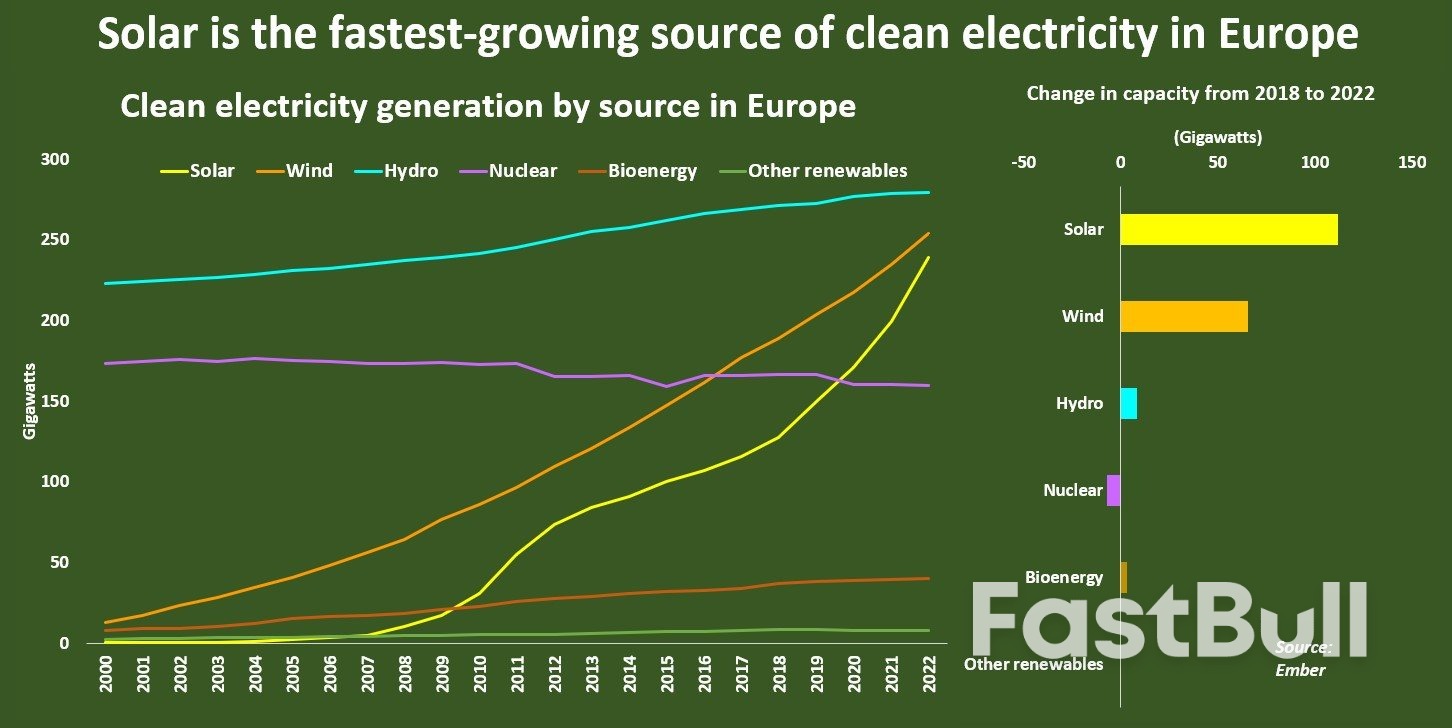
          Solar power is a key driver of Europe's energy transition away from fossil fuels, with solar capacity growing by more than twice the pace of wind capacity since 2018 as governments and utilities across the region accelerate green energy roll-outs.
          Installed solar capacity in Europe has jumped by 88% since 2018, dwarfing the 35% rise in wind capacity over the same period, and in 2022 accounted for 24% of Europe's clean energy generation, versus wind's 26%, data from think tank Ember shows.
          Further rapid growth in solar capacity is expected in the coming years thanks to massive government support, and could result in solar power overtaking wind as the primary source of Europe's clean electricity within the coming decade.
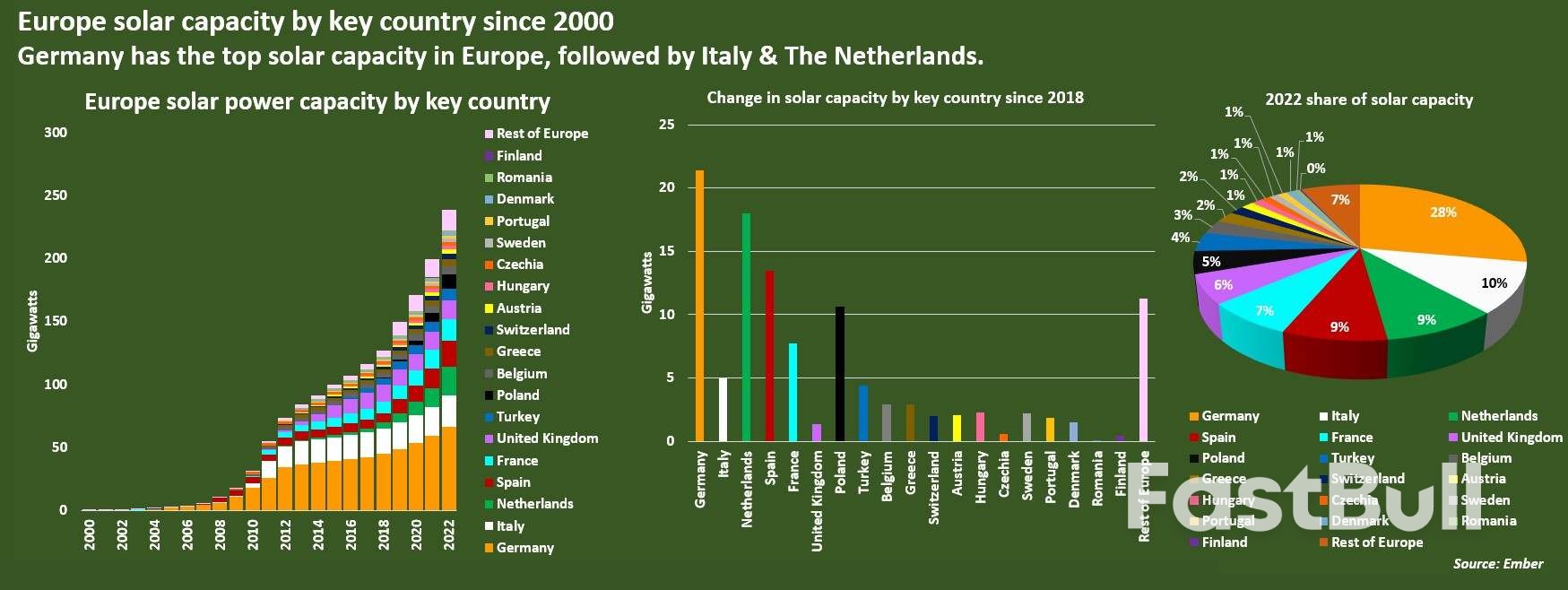
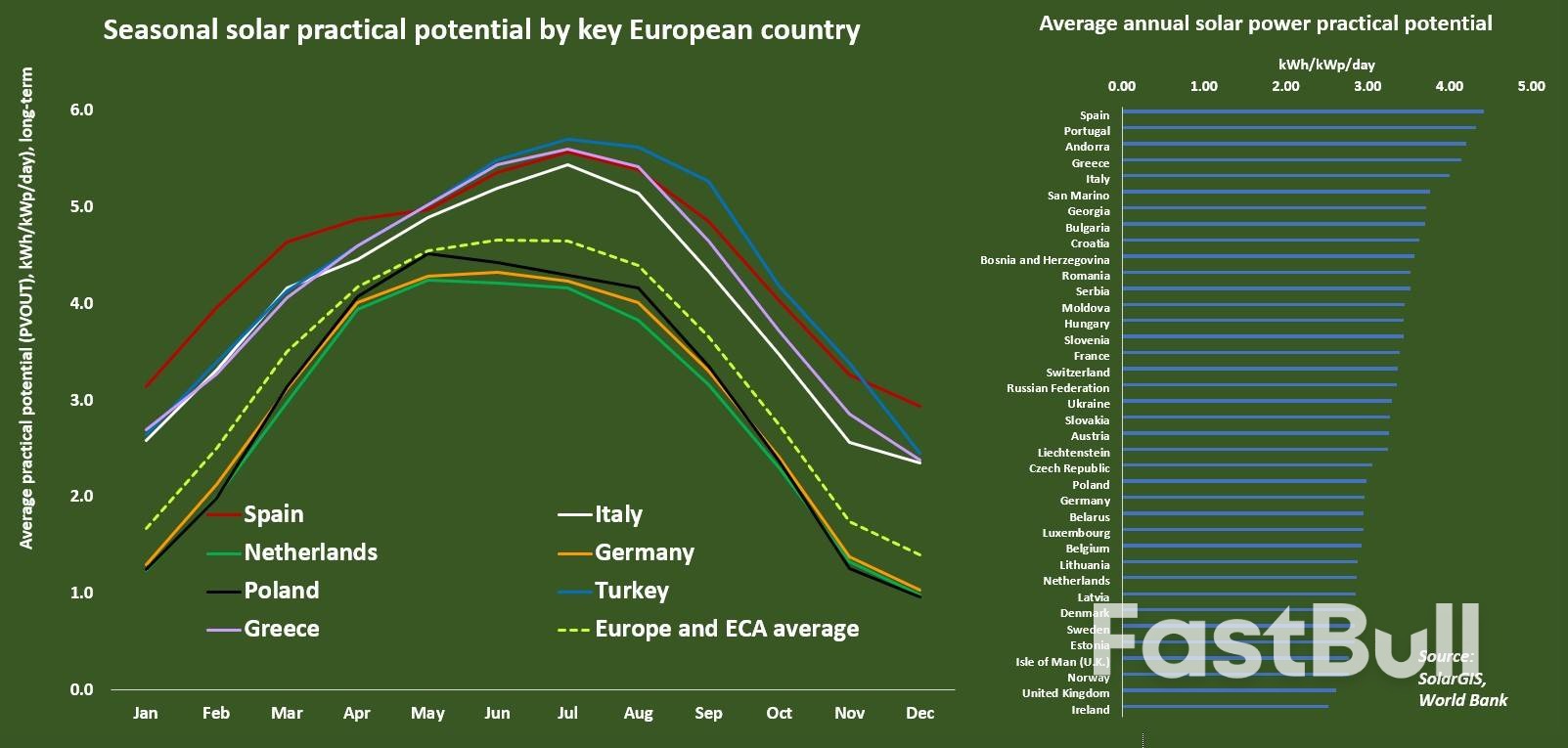
          Europe's South Needs to Realise Its High Solar Potential_1However, nearly 60% of Europe's installed solar capacity is located in northern European countries such as Germany, The Netherlands, France, Belgium and Scandinavia, which are often cloudy and have reduced daylight during winter, which results in relatively low solar power yields compared to other areas.
          Europe's South Needs to Realise Its High Solar Potential_2As a result, much of the next phase of growth in Europe's solar capacity is likely to take place across the southern parts of the continent, which are better suited than the north for large scale solar power generation thanks to far more year-round sunshine, and often more land that can be used for utility-scale solar plants.
          Full Potential
          A useful measure of how suitable an area is for solar power production is the so-called practical solar photovoltaic (PV) output potential (PVOUT).
          The PVOUT metric is a measurement of the power output achievable by a typical utility-scale PV system, taking into account local land use constraints and the amount of solar radiation available to generate power.
          According to the Global Solar Atlas, "the PVOUT represents the amount of power generated per unit of the installed PV capacity over the long-term, and is measured in kilowatthours per installed kilowatt-peak of the system capacity (kWh/kWp)."
          Europe's South Needs to Realise Its High Solar Potential_3A ranking of European countries by this metric shows that Spain has nearly 50% greater solar potential than Germany, which is by far the region's largest solar producer.
          Spain's PVOUT reading of 4.41 kWh/kWp is the highest in Europe, and compares to 2.96 for Germany, 2.86 for The Netherlands, and 2.84 for Denmark and Sweden, according to data published by the World Bank and SolarGIS.
          In 2022, Spain had 20.52 gigawatts (GW) of installed solar power, according to Ember. That compares to more than 66GW in Germany, and 22.6 GW in The Netherlands.
          However, Spain's capacity growth of 190% since 2018 is among the highest in the continent, and the country's growth pace looks set to continue exceeding the regional average thanks to new and more aggressive climate-related ambitions being considered by the Spanish government.
          Expanded solar capacity is a key feature of those plans, with French energy firm TotalEnergies announcing this week that it received environmental permits for 3 gigawatts of solar capacity across 48 planned plants in the Madrid, Murcia and Aragon regions.
          Neighbour Portugal, which also scored highly in terms of PVOUT, is also planning rapid renewable energy expansion, with the country's largest utility EDP in March saying it will spend 25 billion euros ($27 billion) over four years to nearly double its renewable energy capacity to 33 gigawatts (GW) by 2026.
          Andorra, Greece, Italy and Bulgaria also have relatively high PVOUT scores thanks to abundant sunshine as well as suitable pockets of land that could be deployed for use as solar farms, and are all expected to see large government support for solar projects in the coming years.
          In combination, these batches of projects could help push southern Europe's share of solar capacity sharply higher from the roughly 26% share of Europe's total capacity in 2022, and help put the south on the map as a key new frontier for Europe's solar power generation over the coming decades.

          Source: ET EnergyWorld

          Risk Warnings and Disclaimers
          You understand and acknowledge that there is a high degree of risk involved in trading. Following any strategies or investment methods may lead to potential losses. The content on the site is provided by our contributors and analysts for information purposes only. You are solely responsible for determining whether any trading assets, securities, strategy, or any other product is suitable for investing based on your own investment objectives and financial situation.
          Comments
          Add to Favorites
          Share

          Real-Time Settlement of Bonds Is ‘Fundamentally Problematic’

          Justin

          Economic

          Bond

          Instant settlement of debt securities is frequently cited as something that can be achieved with electronic debt capital markets platforms and digital bonds. But it is simply not realistic when the current payments system in bonds markets is flawed.
          The developments in digital bond markets, ways to improve the inefficiencies in primary debt markets and the challenges faced by issuers were discussed in detail at the Public sector debt summit, hosted by OMFIF’s Sovereign Debt Institute in London. This exclusive, in-person event brought together around 20 global sovereign, supranational and agency borrowers, a similar number of investors as well as other key market participants to explore the important issues facing the public sector bond market.

          Speed over efficiency

          Settlement of SSA bonds typically takes five to seven days. This is referred to as ‘T+5’ and ‘T+7’, where T is the transaction date and the number being the amount of days after which the bonds settle – when the security clears from seller to buyer. Electronic DCM platforms and digital bonds can speed up this settlement and even bring same-day settlement. But this has its problems: one head of funding at a leading supranational borrower at the summit described T+0 settlement as ‘fundamentally problematic’.
          ‘I’m not convinced at the moment when we have failed now to be able to make very simple payments correctly through the systems in a way that it should that [T+0] is actually even desirable,’ she said. ‘Maybe at the moment we need to be working out how we go back to basics to ensure that we can all agree payments in a very seamless way before we then start trying to take the next steps.’
          It is simply not possible to digitalise the entire chain of issuance in the bond markets, particularly on payments where not all systems agree on the same number. ‘Sometimes we need to go back to Excel spreadsheets, because our system is not going to produce the same answer as a bank system, which is going to be different than the paying agent, which is going to be different than the other leads,’ she explained.
          When new risk-free reference rates were being rolled out a few years ago, public sector borrowers ran into many issues with the first coupon payments for those deals. The issuers’ internal and external systems all produced different figures thanks to differences in rounding, causing issuers to manually calculate the coupons on Excel spreadsheets before a new structure for those transactions was introduced. This is an example of where digitalisation and real-time settlement would have created more problems rather than a solution.

          Business problem, not technology

          In addition to the issues around payments, there are concerns for global investors in different times zones. As safe-haven assets and highly rated, SSA bonds are high-demand securities with investors all over the world entering the books of these deals.
          ‘Fundamentally, it is a business problem, not a technology problem,’ said a senior official at a settlement house. ‘And the business problem first needs to be addressed, before we run with the technology.’ In a poll of the attendees at the summit, 75% said T+0 was not achievable from a business perspective.
          T+2 or T+3 settlement is perhaps more realistic to take into account the different time zones for investors across Asia, Latin America and other regions. Any settlement quicker than that is problematic for custodian banks to get all the information from investors and send the money for settlement.
          There was unanimity among issuers at the summit on the need to improve the inefficiencies of the technology and systems in bond markets before the advancement in technology and the introduction of digital assets.
          ‘We always forget that internal digitalisation is probably the biggest challenge,’ said a senior funding official at a European agency borrower. ‘To go from paper to a purely digital document and how to integrate that in the process.’ The official said the issuer was working on a test trade via a digital post-trade platform to see how they could digitalise the process of issuing bonds.
          ‘What I’ve learned is that we have to take small steps, so that’s what we’re trying to do,’ said a treasurer at another European agency borrower, who said they were onboarding a digital platform’s workflow system. ‘We issue bonds many times a year, so how can it be that legal documentation takes such a long time, because I would assume that the legal documentation is the same every time and that you only have to adjust the coupon and maturity?’
          The reality is that bond markets have not moved a long way towards digitalisation and there is much more work for all parties in the debt capital markets to get on with.

          Source:Burhan Khadbai

          To stay updated on all economic events of today, please check out our Economic calendar
          Risk Warnings and Disclaimers
          You understand and acknowledge that there is a high degree of risk involved in trading. Following any strategies or investment methods may lead to potential losses. The content on the site is provided by our contributors and analysts for information purposes only. You are solely responsible for determining whether any trading assets, securities, strategy, or any other product is suitable for investing based on your own investment objectives and financial situation.
          Comments
          Add to Favorites
          Share
          FastBull
          Copyright © 2025 FastBull Ltd

          728 RM B 7/F GEE LOK IND BLDG NO 34 HUNG TO RD KWUN TONG KLN HONG KONG

          TelegramInstagramTwitterfacebooklinkedin
          App Store Google Play Google Play
          Products
          Charts

          Chats

          Q&A with Experts
          Screeners
          Economic Calendar
          Data
          Tools
          Membership
          Features
          Function
          Markets
          Copy Trading
          Latest Signals
          Contests
          News
          Analysis
          24/7
          Columns
          Education
          Company
          Careers
          About Us
          Contact Us
          Advertising
          Help Center
          Feedback
          User Agreement
          Privacy Policy
          Business

          White Label

          Data API

          Web Plug-ins

          Poster Maker

          Affiliate Program

          Risk Disclosure

          The risk of loss in trading financial instruments such as stocks, FX, commodities, futures, bonds, ETFs and crypto can be substantial. You may sustain a total loss of the funds that you deposit with your broker. Therefore, you should carefully consider whether such trading is suitable for you in light of your circumstances and financial resources.

          No decision to invest should be made without thoroughly conducting due diligence by yourself or consulting with your financial advisors. Our web content might not suit you since we don't know your financial conditions and investment needs. Our financial information might have latency or contain inaccuracy, so you should be fully responsible for any of your trading and investment decisions. The company will not be responsible for your capital loss.

          Without getting permission from the website, you are not allowed to copy the website's graphics, texts, or trademarks. Intellectual property rights in the content or data incorporated into this website belong to its providers and exchange merchants.

          Not Logged In

          Log in to access more features

          FastBull Membership

          Not yet

          Purchase

          Become a signal provider
          Help Center
          Customer Service
          Dark Mode
          Price Up/Down Colors

          Log In

          Sign Up

          Position
          Layout
          Fullscreen
          Default to Chart
          The chart page opens by default when you visit fastbull.com