• Trade
  • Markets
  • Copy
  • Contests
  • News
  • 24/7
  • Calendar
  • Q&A
  • Chats
Trending
Screeners
SYMBOL
LAST
BID
ASK
HIGH
LOW
NET CHG.
%CHG.
SPREAD
SPX
S&P 500 Index
6827.42
6827.42
6827.42
6899.86
6801.80
-73.58
-1.07%
--
DJI
Dow Jones Industrial Average
48458.04
48458.04
48458.04
48886.86
48334.10
-245.98
-0.51%
--
IXIC
NASDAQ Composite Index
23195.16
23195.16
23195.16
23554.89
23094.51
-398.69
-1.69%
--
USDX
US Dollar Index
97.950
98.030
97.950
98.500
97.950
-0.370
-0.38%
--
EURUSD
Euro / US Dollar
1.17394
1.17409
1.17394
1.17496
1.17192
+0.00011
+ 0.01%
--
GBPUSD
Pound Sterling / US Dollar
1.33707
1.33732
1.33707
1.33997
1.33419
-0.00148
-0.11%
--
XAUUSD
Gold / US Dollar
4299.39
4299.39
4299.39
4353.41
4257.10
+20.10
+ 0.47%
--
WTI
Light Sweet Crude Oil
57.233
57.485
57.233
58.011
56.969
-0.408
-0.71%
--

Community Accounts

Signal Accounts
--
Profit Accounts
--
Loss Accounts
--
View More

Become a signal provider

Sell trading signals to earn additional income

View More

Guide to Copy Trading

Get started with ease and confidence

View More

Signal Accounts for Members

All Signal Accounts

Best Return
  • Best Return
  • Best P/L
  • Best MDD
Past 1W
  • Past 1W
  • Past 1M
  • Past 1Y

All Contests

  • All
  • Trump Updates
  • Recommend
  • Stocks
  • Cryptocurrencies
  • Central Banks
  • Featured News
Top News Only
Share

Iranian Media Says 18 Crew Members Of Foreign Tanker Seized In Gulf Of Oman Over Carrying 'Smuggled Fuel' Detained

Share

Regional Governor: Two Killed In Ukrainian Drone Strike On Russia's Saratov

Share

Chinese Foreign Ministry - China Foreign Minister Met With United Arab Emirates Counterpart On Dec 12

Share

China's Central Financial And Economic Affairs Commission Deputy Director: Will Expand Export And Increase Import In 2026

Share

Thai Leader Anutin: Landmine Blast That Killed Thai Soldiers 'Not A Roadside Accident'

Share

Thai Leader Anutin: Thailand To Continue Military Action Until 'We Feel No More Harm'

Share

Cambodian Prime Minister Hun Manet Says He Had Phone Calls With Trump And Malaysian Leader Anwar About Ceasefire

Share

Cambodia's Hun Manet Says USA, Malaysia Should Verify 'Which Side Fired First' In Latest Conflict

Share

Cambodia's Hun Manet: Cambodia Maintains Its Stance In Seeking Peaceful Resolution Of Disputes

Share

Nasdaq Companies: Allergan, Ferrovia, Insmed, Monolithic Power Systems, Seagate Technology, And Western Digital Will Be Added To The NASDAQ 100 Index. Biogen, CdW, GlobalFoundries, Lululemon, ON Semiconductor, And Tradedesk Will Be Removed From The NASDAQ 100 Index

Share

Witkoff Headed To Berlin This Weekend To Meet With Zelenskiy, European Leaders -Wsj Reporter On X

Share

Russia Attacks Two Ukrainian Ports, Damaging Three Turkish-Owned Vessels

Share

[Historic Flooding Occurs In At Least Four Rivers In Washington State Due To Days Of Torrential Rains] Multiple Areas In Washington State Have Been Hit By Severe Flooding Due To Days Of Torrential Rains, With At Least Four Rivers Experiencing Historic Flooding. Reporters Learned On The 12th That The Floods Caused By The Torrential Rains In Washington State Have Destroyed Homes And Closed Several Highways. Experts Warn That Even More Severe Flooding May Occur In The Future. A State Of Emergency Has Been Declared In Washington State

Share

Trump Says Proposed Free Economic Zone In Donbas Would Work

Share

Trump: I Think My Voice Should Be Heard

Share

Trump Says Will Be Choosing New Fed Chair In Near Future

Share

Trump Says Proposed Free Economic Zone In Donbas Complex But Would Work

Share

Trump Says Land Strikes In Venezuela Will Start Happening

Share

US President Trump: Thailand And Cambodia Are In A Good Situation

Share

State Media: North Korean Leader Kim Hails Troops Returning From Russia Mission

TIME
ACT
FCST
PREV
U.K. Trade Balance Non-EU (SA) (Oct)

A:--

F: --

P: --

U.K. Trade Balance (Oct)

A:--

F: --

P: --

U.K. Services Index MoM

A:--

F: --

P: --

U.K. Construction Output MoM (SA) (Oct)

A:--

F: --

P: --

U.K. Industrial Output YoY (Oct)

A:--

F: --

P: --

U.K. Trade Balance (SA) (Oct)

A:--

F: --

P: --

U.K. Trade Balance EU (SA) (Oct)

A:--

F: --

P: --

U.K. Manufacturing Output YoY (Oct)

A:--

F: --

P: --

U.K. GDP MoM (Oct)

A:--

F: --

P: --

U.K. GDP YoY (SA) (Oct)

A:--

F: --

P: --

U.K. Industrial Output MoM (Oct)

A:--

F: --

P: --

U.K. Construction Output YoY (Oct)

A:--

F: --

P: --

France HICP Final MoM (Nov)

A:--

F: --

P: --

China, Mainland Outstanding Loans Growth YoY (Nov)

A:--

F: --

P: --

China, Mainland M2 Money Supply YoY (Nov)

A:--

F: --

P: --

China, Mainland M0 Money Supply YoY (Nov)

A:--

F: --

P: --

China, Mainland M1 Money Supply YoY (Nov)

A:--

F: --

P: --

India CPI YoY (Nov)

A:--

F: --

P: --

India Deposit Gowth YoY

A:--

F: --

P: --

Brazil Services Growth YoY (Oct)

A:--

F: --

P: --

Mexico Industrial Output YoY (Oct)

A:--

F: --

P: --

Russia Trade Balance (Oct)

A:--

F: --

P: --

Philadelphia Fed President Henry Paulson delivers a speech
Canada Building Permits MoM (SA) (Oct)

A:--

F: --

P: --

Canada Wholesale Sales YoY (Oct)

A:--

F: --

P: --

Canada Wholesale Inventory MoM (Oct)

A:--

F: --

P: --

Canada Wholesale Inventory YoY (Oct)

A:--

F: --

P: --

Canada Wholesale Sales MoM (SA) (Oct)

A:--

F: --

P: --

Germany Current Account (Not SA) (Oct)

A:--

F: --

P: --

U.S. Weekly Total Rig Count

A:--

F: --

P: --

U.S. Weekly Total Oil Rig Count

A:--

F: --

P: --

Japan Tankan Large Non-Manufacturing Diffusion Index (Q4)

--

F: --

P: --

Japan Tankan Small Manufacturing Outlook Index (Q4)

--

F: --

P: --

Japan Tankan Large Non-Manufacturing Outlook Index (Q4)

--

F: --

P: --

Japan Tankan Large Manufacturing Outlook Index (Q4)

--

F: --

P: --

Japan Tankan Small Manufacturing Diffusion Index (Q4)

--

F: --

P: --

Japan Tankan Large Manufacturing Diffusion Index (Q4)

--

F: --

P: --

Japan Tankan Large-Enterprise Capital Expenditure YoY (Q4)

--

F: --

P: --

U.K. Rightmove House Price Index YoY (Dec)

--

F: --

P: --

China, Mainland Industrial Output YoY (YTD) (Nov)

--

F: --

P: --

China, Mainland Urban Area Unemployment Rate (Nov)

--

F: --

P: --

Saudi Arabia CPI YoY (Nov)

--

F: --

P: --

Euro Zone Industrial Output YoY (Oct)

--

F: --

P: --

Euro Zone Industrial Output MoM (Oct)

--

F: --

P: --

Canada Existing Home Sales MoM (Nov)

--

F: --

P: --

Euro Zone Total Reserve Assets (Nov)

--

F: --

P: --

U.K. Inflation Rate Expectations

--

F: --

P: --

Canada National Economic Confidence Index

--

F: --

P: --

Canada New Housing Starts (Nov)

--

F: --

P: --

U.S. NY Fed Manufacturing Employment Index (Dec)

--

F: --

P: --

U.S. NY Fed Manufacturing Index (Dec)

--

F: --

P: --

Canada Core CPI YoY (Nov)

--

F: --

P: --

Canada Manufacturing Unfilled Orders MoM (Oct)

--

F: --

P: --

Canada Manufacturing New Orders MoM (Oct)

--

F: --

P: --

Canada Core CPI MoM (Nov)

--

F: --

P: --

Canada Manufacturing Inventory MoM (Oct)

--

F: --

P: --

Canada CPI YoY (Nov)

--

F: --

P: --

Canada CPI MoM (Nov)

--

F: --

P: --

Canada CPI YoY (SA) (Nov)

--

F: --

P: --

Canada Core CPI MoM (SA) (Nov)

--

F: --

P: --

Q&A with Experts
    • All
    • Chatrooms
    • Groups
    • Friends
    Connecting
    .
    .
    .
    Type here...
    Add Symbol or Code

      No matching data

      All
      Trump Updates
      Recommend
      Stocks
      Cryptocurrencies
      Central Banks
      Featured News
      • All
      • Russia-Ukraine Conflict
      • Middle East Flashpoint
      • All
      • Russia-Ukraine Conflict
      • Middle East Flashpoint
      Search
      Products

      Charts Free Forever

      Chats Q&A with Experts
      Screeners Economic Calendar Data Tools
      Membership Features
      Data Warehouse Market Trends Institutional Data Policy Rates Macro

      Market Trends

      Market Sentiment Order Book Forex Correlations

      Top Indicators

      Charts Free Forever
      Markets

      News

      News Analysis 24/7 Columns Education
      From Institutions From Analysts
      Topics Columnists

      Latest Views

      Latest Views

      Trending Topics

      Top Columnists

      Latest Update

      Signals

      Copy Rankings Latest Signals Become a signal provider AI Rating
      Contests
      Brokers

      Overview Brokers Assessment Rankings Regulators News Claims
      Broker listing Forex Brokers Comparison Tool Live Spread Comparison Scam
      Q&A Complaint Scam Alert Videos Tips to Detect Scam
      More

      Business
      Events
      Careers About Us Advertising Help Center

      White Label

      Data API

      Web Plug-ins

      Affiliate Program

      Awards Institution Evaluation IB Seminar Salon Event Exhibition
      Vietnam Thailand Singapore Dubai
      Fans Party Investment Sharing Session
      FastBull Summit BrokersView Expo
      Recent Searches
        Top Searches
          Markets
          News
          Analysis
          User
          24/7
          Economic Calendar
          Education
          Data
          • Names
          • Latest
          • Prev

          View All

          No data

          Scan to Download

          Faster Charts, Chat Faster!

          Download App
          English
          • English
          • Español
          • العربية
          • Bahasa Indonesia
          • Bahasa Melayu
          • Tiếng Việt
          • ภาษาไทย
          • Français
          • Italiano
          • Türkçe
          • Русский язык
          • 简中
          • 繁中
          Open Account
          Search
          Products
          Charts Free Forever
          Markets
          News
          Signals

          Copy Rankings Latest Signals Become a signal provider AI Rating
          Contests
          Brokers

          Overview Brokers Assessment Rankings Regulators News Claims
          Broker listing Forex Brokers Comparison Tool Live Spread Comparison Scam
          Q&A Complaint Scam Alert Videos Tips to Detect Scam
          More

          Business
          Events
          Careers About Us Advertising Help Center

          White Label

          Data API

          Web Plug-ins

          Affiliate Program

          Awards Institution Evaluation IB Seminar Salon Event Exhibition
          Vietnam Thailand Singapore Dubai
          Fans Party Investment Sharing Session
          FastBull Summit BrokersView Expo

          Will Bitcoin Price Remain Stable Till August?Here’s All

          Alex

          Cryptocurrency

          Summary:

          Simultaneously, the recent U.S. Job data showed that the inflation pressure has cooled, although it still stayed above the Fed’s 2% target range. Given that, some have raised their bets over a potential rate cut in July. Notably, such a factor, if happens, could potentially boost the investors’ sentiment, and help Bitcoin maintain stability in August. Meanwhile, as of writing, the Bitcoin price was down 1.10% and traded at $63,585.38, while its trading volume rose 67.61% to $30.56 billion. However, the crypto has touched a high of 65,494.90 in the last 24 hours.
          The Bitcoin price has started the week with an upward momentum, before witnessing a volatile on May 7. Notably, the price of the largest crypto by market, along with several other altcoins, has witnessed heightened volatility in recent weeks due to a flurry of reasons. For instance, the significant outflow from the U.S. Spot Bitcoin ETF has weighed on the sentiments in recent weeks.
          So, let’s take a look at the factors that have so far impacted the Bitcoin price, and how it may perform in the long term.

          Factors Impacting Bitcoin Price:

          The Bitcoin price was largely impacted this year due to U.S. Spot Bitcoin ETF approval, the Fed’s policy rate stance, and the Bitcoin Halving. Here we take a quick recap of the year.

          Bitcoin ETF Hype

          The Bitcoin price has noted positive trading since last year, as investors were anticipating the Bitcoin ETF. Notably, the approval of the U.S. Spot Bitcoin ETF in January has bolstered investors’ confidence. In addition, the positive influx into the investment instrument has also fuelled the market sentiment.
          Meanwhile, the immense success of the Bitcoin ETFs has also sent the BTC price to its all-time high in mid-March. Simultaneously, the recent approval of the Spot ETF in Hong Kong has further bolstered confidence, while reflecting the the growing institutional confidence in the sector.

          Federal Reserve’s Interest Rate

          The Federal Reserve’s stance with their policy rates has also weighed on the sentiments so far this year. For context, the market was anticipating around five rate cuts through the year, while expecting the inflation to cool.
          However, the economic data has shown that inflation has stayed strong while dampening hopes over potential rate cuts this year. Now, a flurry of analysts are expecting a single or two rate cuts through the year. Besides, some have also put their bets on no change in the policy rates in 2024.

          Bitcoin Halving

          The Bitcoin Halving is one of the key events the market was waiting for in 2024. The recent Halving event has so far fuelled the confidence of the market participants, given its potential impact on the BTC in previous events.
          Historically, the Bitcoin Halving event has triggered a significant rally in the BTC price, sending it to a new high. Considering that the market was also bullish towards the flagship crypto. However, several market pundits suggested a short-term volatility after the halving, while maintaining an upward trajectory for the long term.
          Now that we have gone through some of the basic factors that have impacted the BTC performance significantly, let’s look at how the Bitcoin price might perform in the coming days.

          Will Bitcoin Price Remain Stable In August?

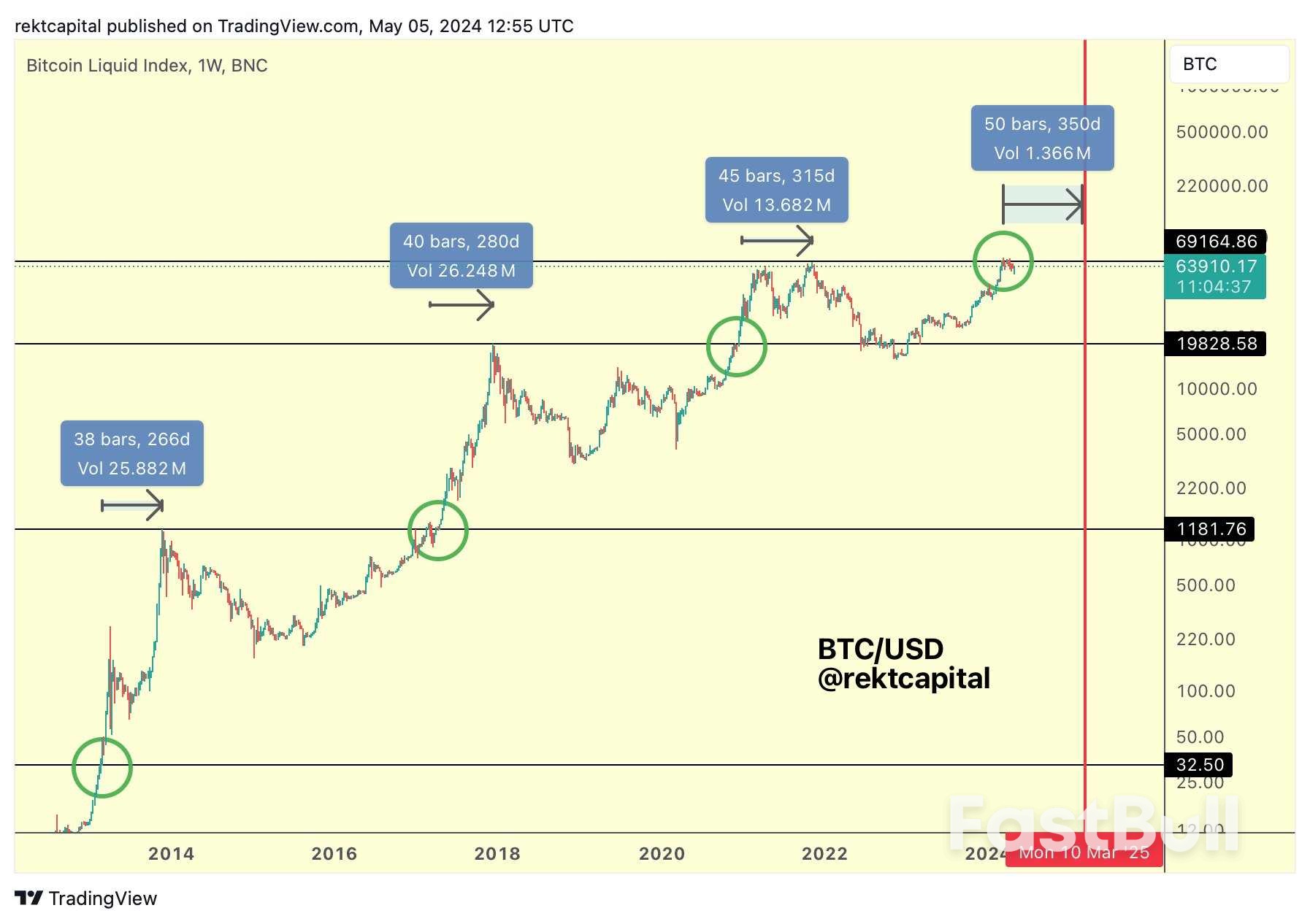
          Rekt Capital, a prominent crypto market analyst, provides insights into Bitcoin’s potential peak in the current cycle. Analyzing historical trends, he suggests Bitcoin could peak between mid-December 2024 and early March 2025.
          However, he also noted that the ongoing deceleration in the cycle may lead to a resynchronization with traditional Halving cycles. As Bitcoin consolidates, the potential for stability and resynchronization increases, impacting its peak timeframe.
          Will Bitcoin Price Remain Stable Till August?Here’s All_1
          Notably, the analyst highlights that Bitcoin’s performance beyond old All-Time Highs has historically lengthened, suggesting a longer Bull Market Peak timeframe. With these factors in mind, investors anticipate stability and potential peak adjustments in the coming months, influencing Bitcoin’s price trajectory in August 2024.
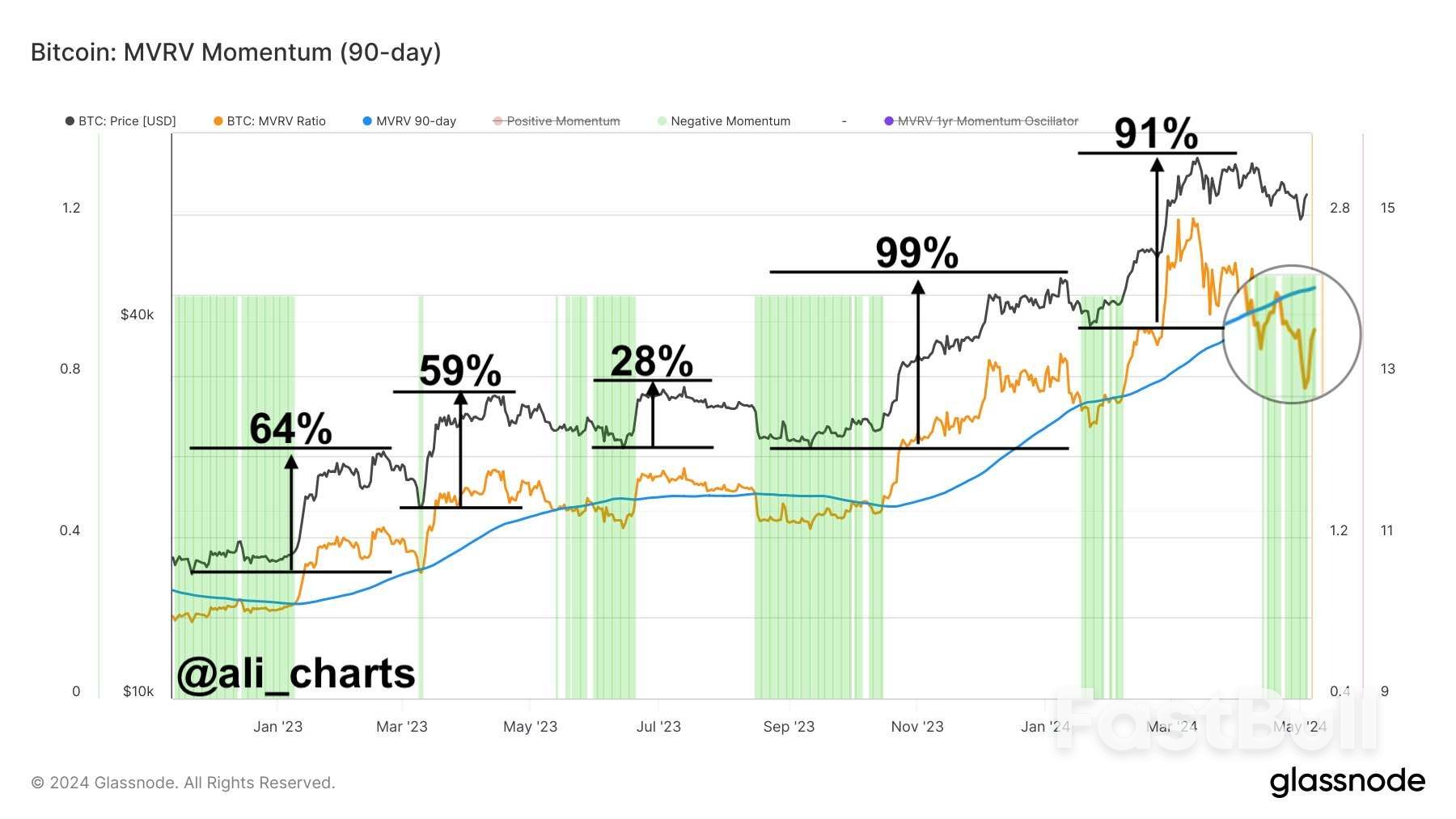
          In addition, another market expert, Ali Martinez said that despite the recent advancement in Bitcoin price this week, the “MVRV 90-Day Ratio” suggests that Bitcoin is still under a “prime buy zone.” This has also fuelled the confidence of the investors, over a potential stability in the BTC’s trajectory in the coming days.Will Bitcoin Price Remain Stable Till August?Here’s All_2
          Simultaneously, the recent U.S. Job data showed that the inflation pressure has cooled, although it still stayed above the Fed’s 2% target range. Given that, some have raised their bets over a potential rate cut in July. Notably, such a factor, if happens, could potentially boost the investors’ sentiment, and help Bitcoin maintain stability in August.
          Meanwhile, as of writing, the Bitcoin price was down 1.10% and traded at $63,585.38, while its trading volume rose 67.61% to $30.56 billion. However, the crypto has touched a high of 65,494.90 in the last 24 hours.

          Source:coingape

          Risk Warnings and Disclaimers
          You understand and acknowledge that there is a high degree of risk involved in trading. Following any strategies or investment methods may lead to potential losses. The content on the site is provided by our contributors and analysts for information purposes only. You are solely responsible for determining whether any trading assets, securities, strategy, or any other product is suitable for investing based on your own investment objectives and financial situation.
          Add to Favorites
          Share

          Dollar Regains Momentum As Yen Struggles

          Samantha Luan

          Economic

          Forex

          The offshore yuan further retreated from a more than three-month high hit last week, helped by hopes of further policy stimulus from Beijing to shore up its economy. It last stood at 7.2247 per dollar.
          The yen was last little changed at 154.75 per dollar, edging away from its peak of 151.86 hit last week on the back of suspected intervention from Japanese authorities to prop up the sliding currency.
          Analysts have said that any intervention from Tokyo would only serve as a temporary respite for the yen, given stark interest rate differentials between the U.S. and Japan remain.
          Bank of Japan Governor Kazuo Ueda said on Wednesday the central bank will scrutinise the impact of yen moves on inflation in guiding monetary policy, while the country's Finance Minister Shunichi Suzuki repeated a warning that authorities were ready to respond to excessively volatile moves in the currency market.
          "If we were to see a sudden, sharp move up in dollar/yen then I would expect them to step into the market to support the yen. But if we continue to see a gradual move up, I doubt they'll come in, but there's obviously a risk," said Carol Kong, a currency strategist at Commonwealth Bank of Australia.
          The euro and New Zealand dollar edged 0.02% lower each to $1.0752 and $0.6000, respectively.
          Against a basket of currencies, the greenback was steady at 105.41, some distance away from a roughly one-month low it hit last week.
          Investors continue to be focused on the pace and timing of Fed rate cuts that will likely drive currency moves, with the latest weaker-than-expected U.S. jobs data and an easing bias from the U.S. central bank cementing expectations that rates will likely be lower by the end of the year.
          While Minneapolis Fed President Neel Kashkari said on Tuesday it is too soon to declare that inflation has definitely stalled out, that did little to move the needle on market pricing for rate cuts.
          "The market brushed off comments from Minneapolis Fed President Kashkari, who sits at the hawkish end of the spectrum and is a non-voter this year," said Rodrigo Catril, senior FX strategist at National Australia Bank.
          Elsewhere, sterling dipped 0.08% to $1.2499, ahead of the Bank of England's policy decision on Thursday, where focus will be on how soon the central bank could begin cutting rates.
          Analysts expect the central bank to leave the door open to lower interest rates as early as June.
          The Australian dollar fell 0.2% to $0.6585, pressured in part by a less hawkish outlook from the Reserve Bank of Australia than anticipated after it held interest rates steady on Tuesday.

          Source: Reuters

          To stay updated on all economic events of today, please check out our Economic calendar
          Risk Warnings and Disclaimers
          You understand and acknowledge that there is a high degree of risk involved in trading. Following any strategies or investment methods may lead to potential losses. The content on the site is provided by our contributors and analysts for information purposes only. You are solely responsible for determining whether any trading assets, securities, strategy, or any other product is suitable for investing based on your own investment objectives and financial situation.
          Add to Favorites
          Share

          AUD to USD Forecast: RBA Forward Guidance and Fed Chatter Influences

          Owen Li

          Economic

          Forex

          The RBA, the Australian Labor Market, and China
          On Wednesday (May 8), market risk sentiment will likely influence buyer demand for the AUD/USD early in the session.
          However, the AUD/USD may remain under pressure due to the less hawkish-than-expected RBA press conference. On Wednesday, the RBA will release its chart pack, which provides investors with graphics of the Australian economy and financial markets.
          During the RBA press conference, RBA Governor Michele Bullock discussed tight labor market conditions, household income, and the sticky inflation environment. The graphics will likely illustrate the balancing act the RBA faces. On the one hand, the RBA needs to bring inflation down, but on the other, the RBA wants to avoid adversely impacting the labor market.
          Later this week, economic indicators from China will influence sentiment toward the global macroeconomic environment. On Thursday, trade data from China will provide a snapshot of the demand environment. RBA staff consider the Chinese economy in their forecasts. An improving demand environment could be another challenge for the RBA to face in combating inflation.
          However, investors must wait until next week for the next round of Australian wage growth and unemployment figures. Deteriorating labor market conditions could prompt a reassessment of the RBA’s wait-and-see strategy.

          US Economic Calendar: FOMC Member Speakers in the Spotlight

          Later in the Wednesday session, investors should monitor FOMC member speeches. FOMC members Philip Jefferson, Susan Collins, and Lisa Cook are on the calendar to speak.
          Views on inflation, the labor market, the economic outlook, and the timing of a Fed rate cut need consideration.
          Recent speeches have impacted investor expectations of a September Fed rate cut. Minneapolis Fed President Neel Kashkari released a hawkish new essay on Tuesday (May 7), suggesting a possible need for a Fed rate hike. While the US Jobs Report was weaker than expected, inflation remains the bugbear.
          According to the CME FedWatch Tool, the chances of the Fed leaving interest rates unchanged in September increased from 34.3% to 35.5% on Tuesday (May 7).

          Short-Term Forecast

          Near-term AUD/USD trends will hinge on trade data from China and FOMC member speeches. A more hawkish Fed could tilt monetary policy divergence toward the US dollar. RBA Governor Michele Bullock poured cold water on speculation about an RBA rate hike. The status quo would leave interest rate differentials stacked against the Aussie dollar.

          AUD/USD Price Action

          Daily ChartAUD to USD Forecast: RBA Forward Guidance and Fed Chatter Influences_1
          The AUD/USD hovered above the 50-day and 200-day EMAs, sending bullish price signals.
          An Aussie dollar return to the $0.66500 handle would support a move toward the $0.67003 resistance level.
          The RBA chart pack and FOMC member speeches need consideration.
          Conversely, an AUD/USD break below the $0.65760 support level and the 200-day EMA could give the bears a run at the 50-day EMA. A fall through the 50-day EMA would bring sub-$0.65 into view.
          With a 14-period Daily RSI reading of 56.76, the AUD/USD may move to the $0.67003 resistance level before entering overbought territory.

          Source: FX Empire

          To stay updated on all economic events of today, please check out our Economic calendar
          Risk Warnings and Disclaimers
          You understand and acknowledge that there is a high degree of risk involved in trading. Following any strategies or investment methods may lead to potential losses. The content on the site is provided by our contributors and analysts for information purposes only. You are solely responsible for determining whether any trading assets, securities, strategy, or any other product is suitable for investing based on your own investment objectives and financial situation.
          Add to Favorites
          Share

          China-West Divide Threatens ‘Reversal’ For Global Economy, IMF Official Warns

          Alex

          Economic

          A top official with the International Monetary Fund (IMF) has lamented the economic fallout from years of strained relations between China and the West, and warned the situation for the world economy would only grow more dire if the acrimony continues unabated.
          With the world now divided among three broad blocs of countries – China-leaning, US-leaning, and nonaligned – both a “significant reversal of the gains from economic integration” and “a broad retreat from global rules of engagement” are on the horizon, said Gita Gopinath, the first deputy managing director of the financial agency.
          Gopinath, who has often led annual audits of China’s financial system, made the remarks in a speech at Stanford University on Tuesday.
          Her remarks come at a time of increased geopolitical uncertainty over a number of challenges, most notably an escalating rivalry between the US and China and the war in Ukraine.
          Although economic fragmentation is not yet as severe as it was during the Cold War, Gopinath said, it carries a much greater potential cost thanks to higher global reliance on trade.
          China’s share of US imports fell by 8 percentage points between 2017 and 2023 as trade and overall relations between the two countries fragmented, while the US’ share of China’s exports fell by about 4 percentage points during the same period.
          Trade between blocs of countries aligned with either China or the US was also negatively affected, Gopinath said.
          Between the middle of 2022 and 2023, the average weighted quarter-on-quarter trade growth between US-leaning countries and China-leaning countries fell by nearly five percentage points compared with the five-year period between 2017 and early 2022.
          Similar patterns could also be observed following Russia’s invasion of Ukraine, with trade and investment between blocs falling more than trade within blocs.
          Meanwhile, the currency composition of trade finance had also changed more for China-leaning countries than US-leaning ones, according to Gopinath. The proportion of US dollar-denominated trade finance payments among China-leaning countries fell since early 2022, while the yuan-denominated share doubled from around 4 to 8 per cent. US-leaning countries experienced little change.
          This would persist even if Russia was excluded from the China-leaning bloc, she said, indicating a more globally pervasive trend.
          Gopinath’s speech coincided with President Xi Jinping’s first diplomatic visit to Europe in five years – with stops scheduled in France, Serbia and Hungary – to mitigate alarm over China’s economic ambitions and its close ties to Russia.
          High-level dialogues between Beijing and the West have increased in recent months, as top officials try to repair relations tested by years of wrangling over national security concerns, allegations of anticompetitive behaviour and China’s support for Russia in the wake of its invasion of Ukraine and the numerous Western sanctions that followed.
          Foreign direct investment into China has suffered, with flows over January to March this year totalling only 301 billion yuan – a 26 per cent year-on-year drop, according to official data released last month.
          Despite Beijing’s attempts to woo back foreign investors, many international companies remain wary, citing China’s economic slowdown and ongoing geopolitical tussles.
          A survey from the American Chamber of Commerce in China released in February found that nearly half of the respondents did not plan to expand investment in China. A separate survey from the European Chamber of Commerce in China in June found that 11 per cent of respondents had already shifted investments out of China, with a further 8 per cent moving investments planned for China to other destinations.
          So far, the erosion of direct US-China economic ties has been allayed through third-party “connector countries” like Mexico and Vietnam, which have become conduits for redirecting trade, Gopinath said.
          But the cost of worsening divisions could vary greatly, she added, with losses ranging from as little as 0.2 per cent of world GDP in a mild scenario to 7 per cent in an extreme one.
          The consequences of such a downturn would not be suffered uniformly, with the IMF predicting low-income countries would be hit harder by trade fragmentation due to a greater reliance on agricultural imports and investment from more developed countries.
          Going forward, “pragmatic steps” would need to be taken to rebuild trust, Gopinath said, starting with countries keeping open lines of communication.
          “Dialogue between the US and China – which we are now seeing – can help prevent the worst outcomes from occurring. Non-aligned countries can also play a bigger role, using their economic and diplomatic heft to keep the world integrated,” she said.
          Others have been less hopeful in their projections. A separate report, released on Tuesday by the Economist Intelligence Unit, predicted that economic and diplomatic ties between China and the US will worsen through the rest of the decade, regardless of the outcome of the US presidential elections in November.

          Source:scmp

          To stay updated on all economic events of today, please check out our Economic calendar
          Risk Warnings and Disclaimers
          You understand and acknowledge that there is a high degree of risk involved in trading. Following any strategies or investment methods may lead to potential losses. The content on the site is provided by our contributors and analysts for information purposes only. You are solely responsible for determining whether any trading assets, securities, strategy, or any other product is suitable for investing based on your own investment objectives and financial situation.
          Add to Favorites
          Share

          Hang Seng Index, ASX 200, Nikkei 225: Fed Speeches and Corporate Earnings

          Kevin Du

          Economic

          Stocks

          US Equity Markets: FOMC Member Commentary and Economic Sentiment
          On Tuesday (May 7), the RCM/TIPP Economic Optimism Index drew investor interest following the US Jobs Report and ISM Services PMI survey.
          The Index decreased from 43.2 to 41.8 in May, signaling a more pessimistic outlook for the US economy. However, FOMC member speeches also captured investor attention amid fluctuating expectations for a September Fed rate cut.
          FOMC member Neel Kashkari released an essay on monetary policy and inflation with a hawkish spin.
          On Tuesday (May 7), the Nasdaq Composite Index declined by 0.10%. The Dow and the S&P 500 ended the session up 0.08% and 0.13%, respectively.
          Fed speakers and the US equity market movements will likely set the tone for the Wednesday (May 8) Asian session.

          Asian Economic Calendar: Stock Investments by Foreigners and Corporate Earnings

          On Wednesday (May 8), foreign investments into Japanese stocks will draw investor interest. Upward trends in investment by foreigners could drive buyer demand for Nikkei-listed stocks.
          In the week ending April 20, foreign investments in Japanese stocks declined by ¥492.4 billion.
          Beyond the numbers, investors should also consider central bank commentary, which influences market risk sentiment.
          Furthermore, corporate earnings also warrant investor attention. Mitsubishi Motor Corp. (7211), Yamaha Corp. (7951), Manulife Financial (HK: 0945), and Wesfarmers (ASX: WES) are among the big names to release earnings results.

          Commodities: Crude Oil, Gold, and Iron Ore

          On Tuesday (May 7), gold spot (XAU/USD) fell by 0.42% to close the session at $2,314.10. WTI crude oil declined by 0.13%, ending the day at $78.38.
          On the Singapore Futures Exchange, iron ore prices were down 0.03% on Wednesday (May 8). Iron ore spot fell by 1.16% on Tuesday (May 7).

          The USD/JPY and the Nikkei

          The USD/JPY increased by 0.54% on Tuesday (May 7), closing the session at 154.691. USD/JPY trends may influence buyer appetite for Nikkei 225-listed export stocks. A weaker Yen could support export stocks.

          The Futures Markets

          On Wednesday (May 7), the ASX 200 was up 14 points, while the Nikkei 225 was down by 180 points.

          ASX 200

          Hang Seng Index, ASX 200, Nikkei 225: Fed Speeches and Corporate Earnings_1
          The ASX 200 rallied 1.44% on Tuesday (May 7). Gains were broad-based for the second successive session, with the S&P/ASX All Tech Index advancing by 1.62%. A less hawkish-than-expected RBA drove buyer demand for ASX 200-listed stocks.
          Commonwealth Bank of Australia (CBA) and Westpac Banking Corp. (WBC) rallied 2.07% and 2.84%, respectively. ANZ Group Holdings Ltd. (ANZ) gained 0.07%, with National Australia Bank Ltd. (NAB) rising by 0.95%. ANZ lagged the broader market after a profit miss.
          BHP Group Ltd (BHP) and Rio Tinto Group Ltd. (RIO) ended the session up 1.57% and 1.57%, respectively. Fortescue Metals Group Ltd. (FMG) advanced by 1.75%.
          Gold-related and oil stocks also had positive sessions.
          Gold-related stocks Northern Star Resources Ltd. (NST) and Evolution Mining Ltd (EVN) rose by 1.17% and 1.61%, respectively.
          Woodside Energy Group Ltd (WDS) and Santos Ltd (STO) increased by 1.87% and 0.94%, respectively.

          Hang Seng Index

          Hang Seng Index, ASX 200, Nikkei 225: Fed Speeches and Corporate Earnings_2
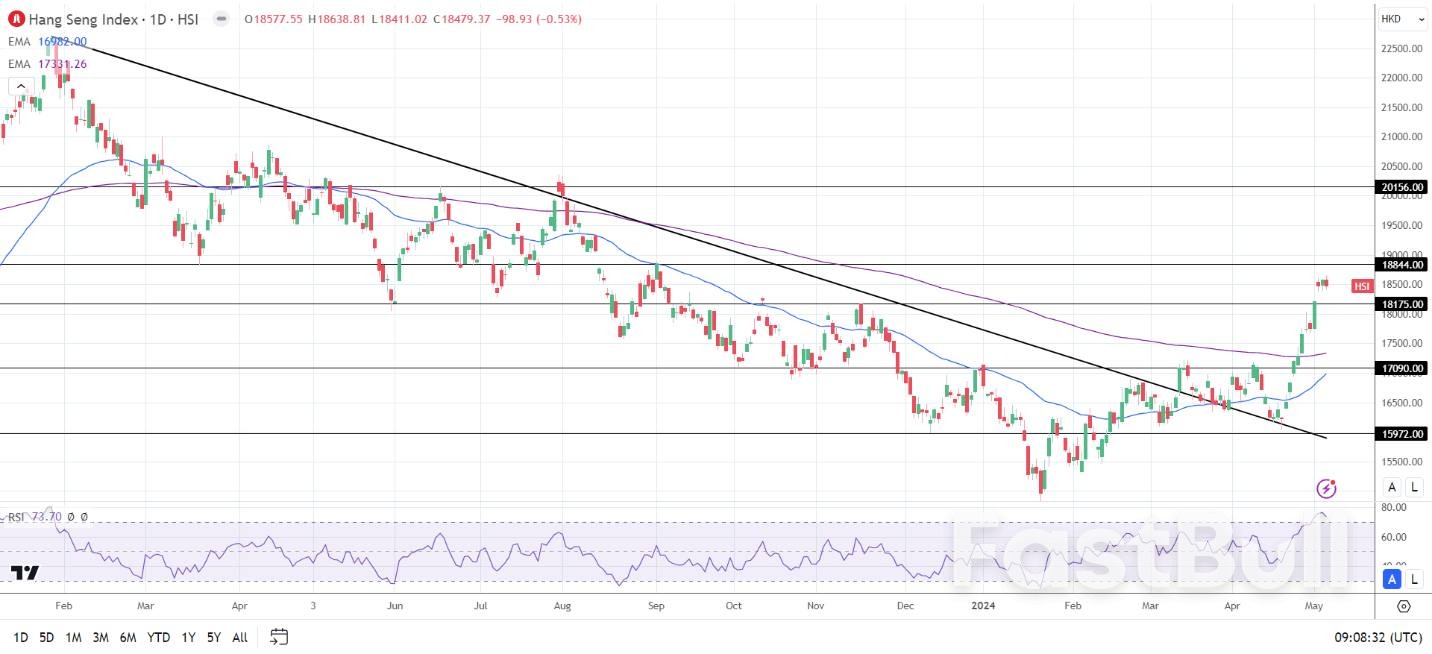
          The Hang Seng Index declined by 0.53% on Tuesday (May 7). Tech stocks dragged the HSI into the red, with the Hang Seng Tech Index (HSTECH) sliding by 2.13%. However, real estate stocks limited the downside. The Hang Seng Mainland Properties Index (HSMPI) gained 0.75%.
          Alibaba (9988) and Tencent (0700) fell by 1.82% and 1.19%, respectively.
          However, bank stocks had a positive session. HSBC (0005) advanced by 0.72%. China Construction Bank (0939) and Industrial Commercial Bank (1398) saw gains of 0.38% and 0.47%, respectively.

          The Nikkei 225

          Hang Seng Index, ASX 200, Nikkei 225: Fed Speeches and Corporate Earnings_3
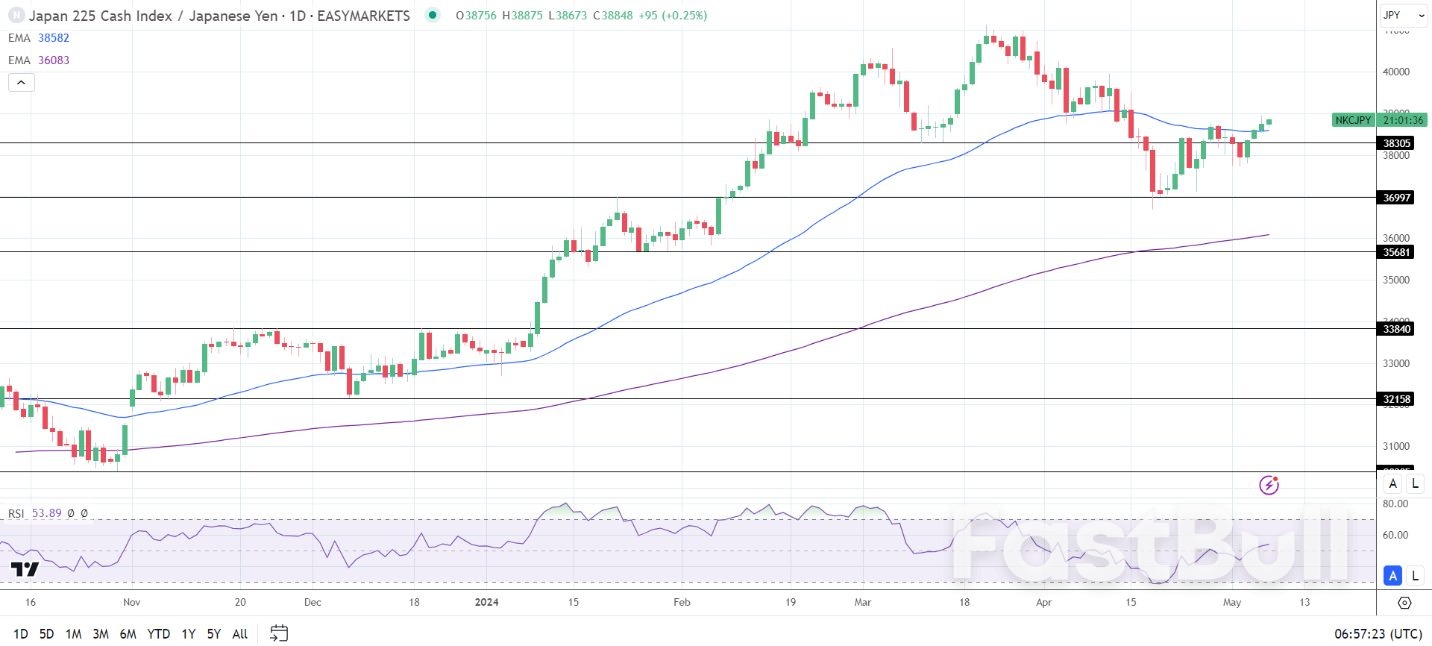
          The Nikkei 225 reopened after a two-day holiday, rallying 1.57% on Tuesday (May 7).
          Bank stocks had a positive start to the week. Sumitomo Mitsui Financial Group Inc. (8316) and Mitsubishi UFJ Financial Group Inc. (8306) rose by 0.42% and 0.32%, respectively.
          However, it was a mixed session for the main components of the Nikkei 225.
          Tokyo Electron Ltd. (8035) and Softbank Group Corp. (9948) surged 5.23% and 3.66%, respectively. Fast Retailing Co. Ltd. (9983) ended the session up 3.16%.
          However, Sony Group Corporation (6758) slid by 2.91% over investor concerns about a bid to acquire Paramount Global. KDDI Corp. (9433) declined by 1.00%.
          For upcoming economic events, refer to our economic calendar.

          Source: FX Empire

          To stay updated on all economic events of today, please check out our Economic calendar
          Risk Warnings and Disclaimers
          You understand and acknowledge that there is a high degree of risk involved in trading. Following any strategies or investment methods may lead to potential losses. The content on the site is provided by our contributors and analysts for information purposes only. You are solely responsible for determining whether any trading assets, securities, strategy, or any other product is suitable for investing based on your own investment objectives and financial situation.
          Add to Favorites
          Share

          JPMorgan Shows Why US Default Rate Is Less A Worry For Investors

          Samantha Luan

          Economic

          JPMorgan Chase & Co.’s Nelson Jantzen has a calming notion for investors alarmed by the US corporate default rate rising to almost 6% by one calculation.
          About half the volume of corporate debt included in the default rate in one measurement isn’t wholly a problem for investors, at least not now. In another analysis, the speculative-grade default rate is actually closer to about 3% at the end of March, according to Jantzen, a head of US high yield and leveraged loan strategy.
          The difference stems from what happens when a company tries to avoid bankruptcy by entering a distressed debt exchange. Such a swap can result in all of a company’s debt counting as having defaulted according to an issuer-weighted metric widely used in the industry.
          But a distressed debt exchange may not translate to a company failing to make all its interest payments. In a par-weighted measure, debt used in a distressed exchange is included but only the amount that was actually swapped.
          “A lot of the confusion is around the absolute numbers being reported because people aren’t necessarily feeling it to that effect in their portfolio,” Jantzen said in a telephone interview.
          Distressed debt exchanges are becoming popular as a way for troubled companies to preserve the value of their bonds and loans by extending maturities on specific obligations, usually with the holders agreeing to take a haircut, or reduced price. While such swaps still represent events of default, investors are betting on a better return than if the borrower tried another workout route, such as filing for bankruptcy.
          More than 50% of the default volume in the first quarter included a distressed debt exchange, compared to around 30% in 2023, according to JPMorgan data.

          Moody’s Method

          At Moody’s Ratings, the company that for more than a century has set creditworthiness standards on Wall Street, analysts say the US default rate hit 5.8% at the end of March, a level not seen since 2021.
          That’s an issuer-weighted calculation, which includes the likelihood that bond and loan covenants will spur accelerated payments on all debt when an issuer defaults. This approach counts a distressed exchange as equivalent to a bankruptcy or default.
          “Our default rate will be a little more elevated,” said Julia Chursin, vice president of the corporate finance group at Moody’s. “But if you exclude distressed exchanges, you are omitting a large chunk of the market.”
          The gap in the default rate shown by the two methodologies is the highest on record, according to JPMorgan. Some portfolio managers say they’ve had to explain why to investors.
          “That’s a pretty material difference,” said Joe Lynch, global head of non-investment grade credit at Neuberger Berman. “There are a lot of implications for how investors look at these metrics.”
          S&P Global Ratings estimates the first-quarter default rate at 4.8%, while Fitch Ratings reports separate metrics by volume and by count for high-yield bonds and leveraged loans. Moody’s also reports a par-weighted default rate but only for high-yield bonds.

          Investor Preference

          Most investors tend to prefer par-weighted calculations because they reflect real losses on returns, rather than the number of companies that had a default, according to Michael Best, portfolio manager at Barings.
          “You can have small bad companies default for any number of reasons,” he said. “If you have a name that’s held by everybody default, that matters more to investors in larger corporate fixed income.”
          To be sure, any one measurement of the rate at which companies are defaulting will offer an incomplete picture of corporate stress. The rise of distressed debt exchanges has also come with more companies defaulting multiple times and ultimately filing for bankruptcy, even after restructuring their debt at least once.
          And that also means diminishing recoveries, especially when those distressed debt exchanges pit lenders against each other. A benign default rate could still translate to more losses for lenders if recoveries plunge.
          “You’re seeing different recoveries in the same lender class,” said Samantha Milner, a partner and US liquid credit portfolio manager at Ares Management. “So how do you avoid or minimize the defaults, and then maximize the recoveries?”
          Whichever methodology investors embrace in assessing the overall risk of more defaults, Moody’s has what may be welcome news. The ratings firm expects their calculation of the default rate peaked in the first quarter and will moderate to the mean of around 4.7% by June.
          Taking note of the par-weighted metric, JPMorgan in a note on Tuesday said that “default rates on HY bonds and loans remain low despite two years of increasingly restrictive Fed policy.”
          Even an anticipated delay of a few months by the central bank in cutting rates “is unlikely to materially change the trend in corporate credit metrics,” JPMorgan said.

          Source:Bloomberg

          To stay updated on all economic events of today, please check out our Economic calendar
          Risk Warnings and Disclaimers
          You understand and acknowledge that there is a high degree of risk involved in trading. Following any strategies or investment methods may lead to potential losses. The content on the site is provided by our contributors and analysts for information purposes only. You are solely responsible for determining whether any trading assets, securities, strategy, or any other product is suitable for investing based on your own investment objectives and financial situation.
          Add to Favorites
          Share

          Russian Oil-Product Stranded At Sea As Korea Cracks Down

          Cohen

          Economic

          Political

          Cargoes of an oil product from Russia are building up at sea as South Korean buyers turn cautious, highlighting how the invasion of Ukraine is still impacting flows more than two years later.
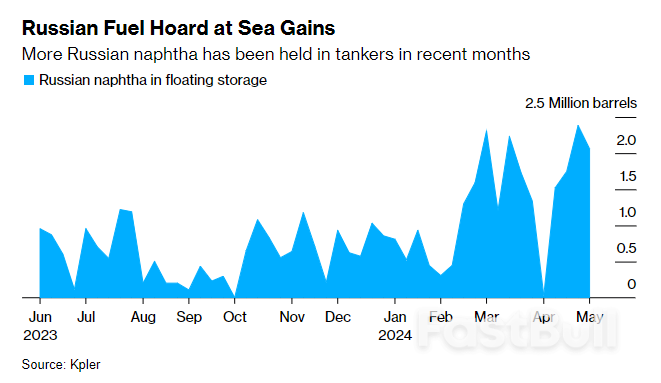
          More than 2 million barrels of Russian naphtha, a building block for plastics, have been held in 10 tankers for more than a week, with some in the waters near Oman and Malta, as of May 7, according to market intelligence firm Kpler. That’s up from a weekly average of about 790,000 barrels in January and February.
          Russian Oil-Product Stranded At Sea As Korea Cracks Down_1
          Petrochemical makers in South Korea — traditionally major buyers of the Russian product — are now shunning direct imports, and any cargoes with unclear origins, for fear of government scrutiny, according to traders with knowledge of the matter who asked not to be identified. That follows the launch in March of an investigation into naphtha imports by the country’s authorities.
          Global energy markets — for crude oil, natural gas, and petroleum products — were upended by the invasion in early 2022 as some buyers shunned exports, flows were rerouted, and a web of western sanctions and price caps brought an extra layer of complication. Like most import-dependent economies, South Korea, and its refiners and plastics makers, have been forced to adapt.
          Before the assault on Kyiv, Russia was South Korea’s top naphtha supplier. While direct flows dwindled after the war began, imports from nations such as United Arab Emirates, Malaysia, Singapore and Tunisia swelled, according to Kpler data. In March, however, South Korean authorities launched the probe to examine whether naphtha from Russia was being re-labeled.
          Since then, imports from Mideast suppliers — such as Kuwait and Oman — have risen, according to Viktor Katona, an analyst at Kpler. At the same time, Russian naphtha flows to China and Taiwan have expanded, Katona said, noting shipments from Moscow accounted for more than half of Taiwan’s imports in April.
          While South Korean refiners and petrochemical companies are allowed to import naphtha from Moscow, they need to comply with a Group of Seven price cap that bars access to western services if cargoes cost more than certain levels. Seoul isn’t a part of the G-7 but it has supported measures that the group imposed in an effort to punish Russia for the war.

          Source:Bloomberg

          To stay updated on all economic events of today, please check out our Economic calendar
          Risk Warnings and Disclaimers
          You understand and acknowledge that there is a high degree of risk involved in trading. Following any strategies or investment methods may lead to potential losses. The content on the site is provided by our contributors and analysts for information purposes only. You are solely responsible for determining whether any trading assets, securities, strategy, or any other product is suitable for investing based on your own investment objectives and financial situation.
          Add to Favorites
          Share
          FastBull
          Copyright © 2025 FastBull Ltd

          728 RM B 7/F GEE LOK IND BLDG NO 34 HUNG TO RD KWUN TONG KLN HONG KONG

          TelegramInstagramTwitterfacebooklinkedin
          App Store Google Play Google Play
          Products
          Charts

          Chats

          Q&A with Experts
          Screeners
          Economic Calendar
          Data
          Tools
          Membership
          Features
          Function
          Markets
          Copy Trading
          Latest Signals
          Contests
          News
          Analysis
          24/7
          Columns
          Education
          Company
          Careers
          About Us
          Contact Us
          Advertising
          Help Center
          Feedback
          User Agreement
          Privacy Policy
          Business

          White Label

          Data API

          Web Plug-ins

          Poster Maker

          Affiliate Program

          Risk Disclosure

          The risk of loss in trading financial instruments such as stocks, FX, commodities, futures, bonds, ETFs and crypto can be substantial. You may sustain a total loss of the funds that you deposit with your broker. Therefore, you should carefully consider whether such trading is suitable for you in light of your circumstances and financial resources.

          No decision to invest should be made without thoroughly conducting due diligence by yourself or consulting with your financial advisors. Our web content might not suit you since we don't know your financial conditions and investment needs. Our financial information might have latency or contain inaccuracy, so you should be fully responsible for any of your trading and investment decisions. The company will not be responsible for your capital loss.

          Without getting permission from the website, you are not allowed to copy the website's graphics, texts, or trademarks. Intellectual property rights in the content or data incorporated into this website belong to its providers and exchange merchants.

          Not Logged In

          Log in to access more features

          FastBull Membership

          Not yet

          Purchase

          Become a signal provider
          Help Center
          Customer Service
          Dark Mode
          Price Up/Down Colors

          Log In

          Sign Up
          Position
          Layout
          Fullscreen
          Default to Chart
          The chart page opens by default when you visit fastbull.com