Markets
News
Analysis
User
24/7
Economic Calendar
Education
Data
- Names
- Latest
- Prev


Signal Accounts for Members
All Signal Accounts
All Contests


U.S. Weekly Total Oil Rig CountA:--
F: --
P: --
Japanese Prime Minister Sanae Takaichi delivers a speech
Germany Ifo Business Expectations Index (SA) (Jan)A:--
F: --
P: --
Germany IFO Business Climate Index (SA) (Jan)A:--
F: --
P: --
Germany Ifo Current Business Situation Index (SA) (Jan)A:--
F: --
P: --
Brazil Current Account (Dec)A:--
F: --
P: --
Mexico Unemployment Rate (Not SA) (Dec)A:--
F: --
P: --
Canada National Economic Confidence IndexA:--
F: --
P: --
U.S. Non-Defense Capital Durable Goods Orders MoM (Excl. Aircraft) (Nov)A:--
F: --
U.S. Durable Goods Orders MoM (Excl. Defense) (SA) (Nov)A:--
F: --
U.S. Durable Goods Orders MoM (Excl.Transport) (Nov)A:--
F: --
P: --
U.S. Durable Goods Orders MoM (Nov)A:--
F: --
U.S. Chicago Fed National Activity Index (Nov)A:--
F: --
U.S. Dallas Fed New Orders Index (Jan)A:--
F: --
P: --
U.S. Dallas Fed General Business Activity Index (Jan)A:--
F: --
U.S. 2-Year Note Auction Avg. YieldA:--
F: --
P: --
U.K. BRC Shop Price Index YoY (Jan)A:--
F: --
P: --
China, Mainland Industrial Profit YoY (YTD) (Dec)A:--
F: --
P: --
Germany 2-Year Schatz Auction Avg. YieldA:--
F: --
P: --
Mexico Trade Balance (Dec)A:--
F: --
P: --
U.S. Weekly Redbook Index YoYA:--
F: --
P: --
U.S. S&P/CS 20-City Home Price Index YoY (Not SA) (Nov)A:--
F: --
P: --
U.S. S&P/CS 20-City Home Price Index MoM (SA) (Nov)A:--
F: --
U.S. FHFA House Price Index MoM (Nov)A:--
F: --
P: --
U.S. FHFA House Price Index (Nov)A:--
F: --
P: --
U.S. FHFA House Price Index YoY (Nov)A:--
F: --
U.S. S&P/CS 10-City Home Price Index YoY (Nov)A:--
F: --
P: --
U.S. S&P/CS 10-City Home Price Index MoM (Not SA) (Nov)A:--
F: --
P: --
U.S. S&P/CS 20-City Home Price Index (Not SA) (Nov)A:--
F: --
P: --
U.S. S&P/CS 20-City Home Price Index MoM (Not SA) (Nov)A:--
F: --
P: --
U.S. Richmond Fed Manufacturing Composite Index (Jan)--
F: --
P: --
U.S. Conference Board Present Situation Index (Jan)--
F: --
P: --
U.S. Conference Board Consumer Expectations Index (Jan)--
F: --
P: --
U.S. Richmond Fed Manufacturing Shipments Index (Jan)--
F: --
P: --
U.S. Richmond Fed Services Revenue Index (Jan)--
F: --
P: --
U.S. Conference Board Consumer Confidence Index (Jan)--
F: --
P: --
U.S. 5-Year Note Auction Avg. Yield--
F: --
P: --
U.S. API Weekly Refined Oil Stocks--
F: --
P: --
U.S. API Weekly Crude Oil Stocks--
F: --
P: --
U.S. API Weekly Gasoline Stocks--
F: --
P: --
U.S. API Weekly Cushing Crude Oil Stocks--
F: --
P: --
Australia RBA Trimmed Mean CPI YoY (Q4)--
F: --
P: --
Australia CPI YoY (Q4)--
F: --
P: --
Australia CPI QoQ (Q4)--
F: --
P: --
Germany GfK Consumer Confidence Index (SA) (Feb)--
F: --
P: --
Germany 10-Year Bund Auction Avg. Yield--
F: --
P: --
India Industrial Production Index YoY (Dec)--
F: --
P: --
India Manufacturing Output MoM (Dec)--
F: --
P: --
U.S. MBA Mortgage Application Activity Index WoW--
F: --
P: --
Canada Overnight Target Rate--
F: --
P: --
BOC Monetary Policy Report
U.S. EIA Weekly Crude Stocks Change--
F: --
P: --
U.S. EIA Weekly Cushing, Oklahoma Crude Oil Stocks Change--
F: --
P: --
U.S. EIA Weekly Crude Demand Projected by Production--
F: --
P: --
U.S. EIA Weekly Crude Oil Imports Changes--
F: --
P: --
U.S. EIA Weekly Heating Oil Stock Changes--
F: --
P: --
U.S. EIA Weekly Gasoline Stocks Change--
F: --
P: --
BOC Press Conference
Russia PPI MoM (Dec)--
F: --
P: --
Russia PPI YoY (Dec)--
F: --
P: --
U.S. Target Federal Funds Rate Lower Limit (Overnight Reverse Repo Rate)--
F: --
P: --


No matching data
Latest Views
Latest Views
Trending Topics
Top Columnists
Latest Update
White Label
Data API
Web Plug-ins
Affiliate Program
View All

No data
Silver's record $100/ounce price, driven by speculation, echoes past unsustainable booms. A correction may loom.
While many investors focus on big tech, the precious metals sector has delivered stunning returns, with silver leading the charge. Prices for the metal have soared by an incredible 240% over the last 12 months, driven by supply concerns from China and political uncertainty in the U.S.
This month, silver prices topped $100 per ounce for the first time ever. But before jumping into the frenzy, it's worth examining the drivers behind this rally and why history suggests it may not be sustainable.
The current surge in silver's value isn't based on a single factor but a combination of geopolitical tensions, currency weakness, and supply chain fears.
Geopolitical Risk and a Weaker Dollar
A primary catalyst is growing geopolitical turmoil. The Trump administration's unpredictable trade policy, which has imposed tariffs ranging from 10% to 50% on most of the world, has rattled international investors. This uncertainty is raising questions about the U.S. dollar's long-term stability as the world's primary reserve currency.
Reflecting this sentiment, the U.S. dollar index, which measures the greenback against other major currencies, has fallen nearly 10% in the past year, signaling that some investors are moving their capital elsewhere.

Further eroding confidence in the dollar are concerns over rising deficit spending and the independence of the central bank. President Trump has repeatedly pressured Federal Reserve Chairman Jerome Powell to lower interest rates. While Powell has resisted, these confrontations risk reducing trust in the U.S. monetary system.
China's Export Policy Stokes Supply Fears
Adding to the momentum, China announced new export restrictions that fueled market anxiety. Under the policy, only 44 companies will be permitted to export silver from 2026 to 2027.
However, the real-world impact of this announcement may be limited. According to Bloomberg, a similar licensing system has been active since 2019 without causing any significant supply bottlenecks. Furthermore, China’s silver exports reached 5,100 tons last year—the highest volume in 16 years—suggesting that supply remains robust for now.
Over the last century, silver has experienced several massive speculative rallies, all of which ultimately ended in a crash. The current situation bears a striking resemblance to previous cycles.
Echoes of the 2011 Price Collapse
The most recent boom and bust occurred in 2011, following the Great Recession. The drivers then were remarkably similar to today's: macroeconomic anxiety fueled by the first-ever U.S. credit rating downgrade, the eurozone debt crisis, and fears of runaway inflation.
That rally, however, was short-lived. After its peak, silver's price collapsed, shedding approximately 70% of its value by 2015 before beginning the slow climb that led to the current surge.
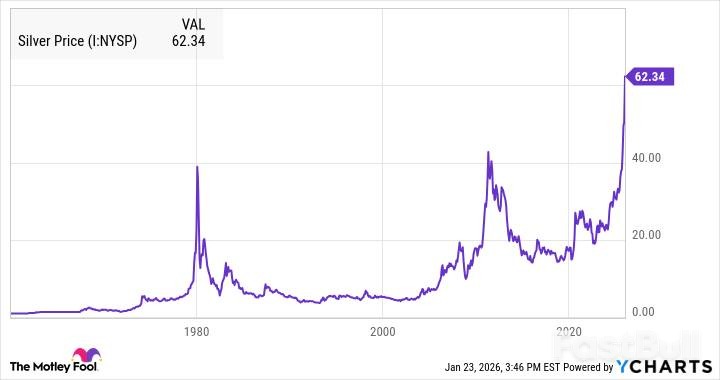
Speculative rallies often lose steam because they are fueled by hype rather than sustainable, fundamental demand. For silver, industrial use is a critical and often overlooked factor.
Industrial applications account for about 59% of all silver consumption, with major demand coming from the solar and electric vehicle (EV) industries, which value its high conductivity.
Cheaper Metals Poised to Replace Silver
When silver prices rise to uneconomical levels, manufacturers begin substituting it with cheaper alternatives like copper or aluminum. This trend is already underway.
Bloomberg recently reported that major Chinese solar cell manufacturer LONGi Green Energy Technology has started replacing silver with base metals to cut costs. This shift is likely to continue across other industries until silver prices return to more reasonable levels. In the long run, high prices will also incentivize increased mining output, further boosting supply and putting downward pressure on prices.
When a commodity price hits unprecedented highs, it’s easy to believe that "this time is different." But history shows it rarely is. Silver, much like crude oil and cobalt, has a long record of boom-and-bust cycles.
The current rally appears driven by speculation that will likely fade as market hype subsides and industrial users shift to alternatives. For now, investors should consider taking profits or avoiding new positions in this volatile market.
Russian forces have launched a significant wave of drone strikes across Ukraine, heavily targeting energy infrastructure in the southern port city of Odesa. Ukrainian President Volodymyr Zelenskiy stated the attack directly threatens ongoing diplomatic efforts to end the war.
The overnight assault involved some 165 drones deployed against cities from Lviv in the west to Kharkiv in the east. The main focus was Odesa, where Zelenskiy reported on social media platform X that over 50 unmanned aerial vehicles struck energy facilities, injuring dozens.
This strategy appears timed to exploit harsh winter conditions, with freezing temperatures straining heat and water supplies for Ukrainian families. The strikes aim to cripple the nation's already damaged energy system.
The attacks coincide with a series of US-brokered peace talks between Russian and Ukrainian negotiators, part of an initiative sought by President Donald Trump. Zelenskiy argued that the Kremlin's actions are undermining the fragile diplomatic process.
"Every such Russian strike erodes the diplomacy that is still ongoing and undermines the efforts of partners who are helping to end this war," he said, calling for increased pressure on Moscow from the US and European allies. "Without pressure on the aggressor, wars do not stop."
Negotiations, which began last week in the United Arab Emirates, are set to continue but have yet to produce tangible results. The talks in Abu Dhabi have been described as constructive by Trump officials, particularly because the two sides met face-to-face instead of through intermediaries.
Key Sticking Points in Negotiations
Deep disagreements over territorial control remain the primary obstacle. Russia continues to demand that Ukrainian forces withdraw from areas in the eastern Donbas region that its troops have not yet seized. This demand, which covers parts of the Donetsk and Luhansk regions, has been rejected by Zelenskiy.
Despite the deadlock, the Ukrainian leader has pointed to some progress, especially regarding the establishment of security guarantees from the United States.
Odesa and its surrounding region host vital Black Sea port infrastructure that is essential for Ukraine's grain exports. This strategic importance has made the city a frequent target of Russian attacks since the full-scale invasion began in February 2022.
According to the national grid operator Ukrenergo, the latest strikes damaged the region's power infrastructure, triggering local blackouts. These power failures add to more than 500 weather-related outages across the country. However, no damage to the port facilities themselves was reported.

Saudi Arabia's state-owned oil giant, Aramco, has successfully issued a $4 billion bond, marking its first entry into the debt market this year. The move comes as global oil prices remain weak, hovering in the low $60s per barrel range.
The company, which is the world's largest crude exporter, initially announced its plan to issue U.S. dollar-denominated international bonds under its Global Medium Term Note Programme, stating the final amount would depend on market conditions.
The offering ultimately raised $4 billion through a four-tranche bond that attracted more than $21 billion in orders from investors.
This exceptionally high demand allowed Aramco to secure more favorable terms. According to market sources, the company was able to offer lower yields compared to benchmark U.S. Treasuries than it had initially guided, reducing its borrowing costs.
While this is Aramco's first bond sale of the year, it represents the company's second debt issuance in the last five months, highlighting a growing trend. In September 2025, the oil firm offered Islamic bonds, known as sukuk, with five and ten-year maturities.
The turn to debt markets follows a period of financial pressure caused by declining oil prices. Lower prices have already reduced Aramco's cash flows, with Q1 figures showing a decline and Q2 results revealing an even larger drop in both cash flow and profits as prices slumped.
Aramco's recent bond sale is part of a broader pattern of increased borrowing by Saudi Arabia as the Kingdom grapples with the financial impact of lower oil revenue. This trend suggests that the country's finances are under strain.
Other recent debt activities include:
• Saudi Arabia: The Kingdom sold $5.5 billion in Islamic bonds, which received orders totaling $17.5 billion.
• Public Investment Fund (PIF): The nation's sovereign wealth fund raised $2 billion by selling 10-year dollar bonds to help finance its investment plans.
Saudi Arabia’s budget deficit expanded last year as oil prices have remained well below the estimated $90 per barrel the Kingdom needs to balance its budget, prompting both the government and its flagship company to increasingly tap debt markets for funding.
Germany has successfully raised €6.5 billion from its first-ever sale of new 20-year government bonds, attracting a near-record flood of investor orders that signals intense appetite for sovereign debt.
The offering for the new May 2047 note drew orders exceeding €72 billion, just shy of the national record set for a 30-year bond two years ago. According to sources familiar with the deal, the final price was set at two basis points over comparable bonds, slightly tighter than the initial guidance.
This landmark sale is part of a broader government strategy to increase its debt offerings and expand its range of maturities. The move follows the loosening of strict borrowing limits last year, an effort aimed at revitalizing Europe's largest economy.
The successful German offering highlights a historically busy start to the year for global bond sales, as borrowers capitalize on strong investor demand. Other European nations, including Italy and Portugal, have also recently seen record-breaking orders for their debt issues.
Financial authorities anticipated strong interest, partly due to an overhaul of the Dutch pension system—the largest in the region—which has dampened appetite for longer-term 30-year bonds and shifted focus to intermediate maturities.
"It's been a very good start of the year for all these syndications," said Evelyne Gomez-Liechti, a strategist at Mizuho International plc. "Investors are happy to have German risk at current yield levels."
A key driver of the high demand is the attractiveness of current yields. German 20-year yields are trading around 3.39%, close to a 14-year high reached last month.
Furthermore, this particular bond maturity is considered relatively cheap. When compared to its 10- and 30-year peers, the 20-year sector is trading near its most affordable level in over a decade, making it a compelling opportunity for investors.

While Germany has occasionally sold debt with this maturity in the past decade, those were bonds originally issued with longer terms that had shortened over time. This sale marks the first new issuance specifically targeting the 20-year segment.
"The 20-year segment is being developed to meet demand," noted Tammo Diemer, co-director of Germany's finance agency, when the plan was first announced last month.
The decision to launch a new 20-year bond comes with historical context. Five years ago, the United States struggled to find consistent buyers when it reintroduced its own 20-year bonds. A notably poor auction in May of that year even triggered a wider market selloff.
Steven Mnuchin, who served as Treasury Secretary under President Donald Trump and brought the bond back, later admitted the move was "costly to the taxpayer."
However, market appetite appears to have evolved. A recent US sale of 20-year bonds was oversubscribed by the second-highest margin on record, indicating that investor demand for this maturity is improving.
Germany opted for a debt syndication, a method that is typically more expensive than a conventional auction but allows governments to raise large sums quickly while diversifying their investor base. The bookrunners for the deal included Barclays plc, BNP Paribas SA, Citigroup Inc, Deutsche Bank AG, JPMorgan Chase & Co, and Morgan Stanley.
The strong demand for German debt was not limited to this offering. On Tuesday, the finance agency also sold new two-year notes through a standard auction, which was similarly met with robust investor interest.
The Czech National Bank (CNB) may consider a small interest rate cut at its upcoming policy meeting, driven primarily by economic shifts happening outside the country, according to Vice-Governor Jan Frait.
In an interview on Monday, Frait suggested that external pressures, such as potential rate cuts by other major central banks, are now a central consideration for the CNB's board.
"In my view the external forces are exactly what the meeting will be and should be about," Frait said, describing them as a "very, very strong set of factors."
This focus on international trends marks a significant pivot, as the Czech Republic's domestic economy shows signs that would typically support maintaining higher interest rates. Frait acknowledged that a domestic recovery, a tight labor market, rising wages, and a loose fiscal policy all argue against monetary easing.
"Labour market and wage developments were truly an argument for maintaining relatively higher interest rates," he stated.
Despite these strong local indicators, the vice-governor projected that rates would likely remain stable or fall by a maximum of 50 basis points over the course of the year.
The central bank's last policy move was in May 2025, when it cut its main repo rate by half to 3.50% before pausing.
Initially, the CNB had signaled that its next adjustment would likely be a rate hike. However, the board altered its perspective in December, changing its official risk assessment for meeting its 2% inflation target from "inflationary" to "neutral." This adjustment opened the door for discussions about potential rate cuts.
The bank’s next meeting on February 5 will be crucial, as board members will review new economic forecasts alongside their rate decision. Frait underscored the importance of pre-emptive policymaking but did not reveal how he intends to vote.
Prime Minister Narendra Modi announced an ambitious plan to attract US$100 billion (RM395.45 billion) in investment into India's oil and gas sector by the end of the decade. Speaking via video at the India Energy Week conference, Modi outlined a strategy centered on expanding drilling into previously restricted territories.
To support this push, India also plans to increase its refining capacity by one million barrels per day, reaching a total of six million. This move signals a long-term commitment to domestic energy processing and provides a stable demand outlook for potential explorers.
The new initiative aims to address a long-standing economic vulnerability. For decades, India's own oil production has failed to keep pace with its surging demand, forcing the country to import 90% of its crude oil and half of its natural gas needs.
This heavy reliance on foreign energy is a significant drain on the nation's foreign exchange reserves. In December alone, oil and gas imports comprised 17% of the total value of goods shipped from overseas.
Currently, India's domestic oil output averages just 550,000 barrels a day—comparable to the combined production of OPEC members Congo and Gabon, but only a small fraction of the country's total consumption.
To reverse this trend, India is opening nearly one million square kilometers of previously ring-fenced areas to oil and gas exploration. This new territory is in addition to the 170 blocks already available for drilling.
A key component of this strategy is the National Deepwater Exploration Mission, which was launched last August. The mission's goals include:
• Unlocking between 600 million and 1,200 million tonnes of oil and gas reserves.
• Drilling 40 new wildcat wells to discover new fields.
• Doubling the country's reserves by 2032.
• Tripling domestic output by 2047.
• Ultimately slashing import dependency by 88%.
White Label
Data API
Web Plug-ins
Poster Maker
Affiliate Program
The risk of loss in trading financial instruments such as stocks, FX, commodities, futures, bonds, ETFs and crypto can be substantial. You may sustain a total loss of the funds that you deposit with your broker. Therefore, you should carefully consider whether such trading is suitable for you in light of your circumstances and financial resources.
No decision to invest should be made without thoroughly conducting due diligence by yourself or consulting with your financial advisors. Our web content might not suit you since we don't know your financial conditions and investment needs. Our financial information might have latency or contain inaccuracy, so you should be fully responsible for any of your trading and investment decisions. The company will not be responsible for your capital loss.
Without getting permission from the website, you are not allowed to copy the website's graphics, texts, or trademarks. Intellectual property rights in the content or data incorporated into this website belong to its providers and exchange merchants.
Not Logged In
Log in to access more features
Log In
Sign Up