• Trade
  • Markets
  • Copy
  • Contests
  • News
  • 24/7
  • Calendar
  • Q&A
  • Chats
Trending
Screeners
SYMBOL
LAST
BID
ASK
HIGH
LOW
NET CHG.
%CHG.
SPREAD
SPX
S&P 500 Index
6827.42
6827.42
6827.42
6899.86
6801.80
-73.58
-1.07%
--
DJI
Dow Jones Industrial Average
48458.04
48458.04
48458.04
48886.86
48334.10
-245.98
-0.51%
--
IXIC
NASDAQ Composite Index
23195.16
23195.16
23195.16
23554.89
23094.51
-398.69
-1.69%
--
USDX
US Dollar Index
98.000
98.080
98.000
98.070
97.920
+0.050
+ 0.05%
--
EURUSD
Euro / US Dollar
1.17331
1.17338
1.17331
1.17447
1.17283
-0.00063
-0.05%
--
GBPUSD
Pound Sterling / US Dollar
1.33558
1.33567
1.33558
1.33740
1.33549
-0.00149
-0.11%
--
XAUUSD
Gold / US Dollar
4328.24
4328.63
4328.24
4329.64
4294.68
+28.85
+ 0.67%
--
WTI
Light Sweet Crude Oil
57.548
57.585
57.548
57.601
57.194
+0.315
+ 0.55%
--

Community Accounts

Signal Accounts
--
Profit Accounts
--
Loss Accounts
--
View More

Become a signal provider

Sell trading signals to earn additional income

View More

Guide to Copy Trading

Get started with ease and confidence

View More

Signal Accounts for Members

All Signal Accounts

Best Return
  • Best Return
  • Best P/L
  • Best MDD
Past 1W
  • Past 1W
  • Past 1M
  • Past 1Y

All Contests

  • All
  • Trump Updates
  • Recommend
  • Stocks
  • Cryptocurrencies
  • Central Banks
  • Featured News
Top News Only
Share

India Foreign Ministry: Foreign Minister To Visit United Arab Emirates And Israel

Share

Reuters Poll - Bank Of Thailand To Lower Key Policy Rate To 1.00% In Q1 Of 2026, Said A Majority Of Economists

Share

Reuters Poll - Bank Of Thailand To Cut Its Key Interest Rate To 1.25% On December 17, Said 26 Of 27 Economists

Share

Thai Finance Minister: Earlier Stimulus Measures To Shore Up Economy

Share

Thai Finance Minister: Strong Baht Driven By Capital Inflows

Share

Thai Finance Minister: Has Discussed With Central Bank To Handle Baht

Share

India's Nifty Bank Futures Down 0.1% In Pre-Open Trade

Share

India's Nifty 50 Futures Down 0.3% In Pre-Open Trade

Share

India's Nifty 50 Index Down 0.45% In Pre-Open Trade

Share

Indian Rupee Weakens Past 90.55 Versus USA Dollar To All-Time Low

Share

China's Fossil-Fuelled Power Generation Falls 4.2% Year-On-Year In November

Share

Indian Rupee Opens Down 0.1% At 90.5450 Per USA Dollar, Versus 90.4150 Previous Close

Share

Australia Home Minister: Father Involved In Bondi Gun Attack Came To Australia On Student Visa, Son Is An Australian-Born Citizen

Share

Australian Prime Minister Albanese: Stricter Gun Control Laws Will Include Restrictions On The Number Of Guns An Individual Can Own Or License To Use

Share

Australia's Prime Minister Albanese: We Are Considering A Review Of Gun Licenses For Some Time

Share

Australia's Prime Minister Albanese: Government Considering Tougher Gun Laws

Share

China Stats Bureau Spokesperson: Next Year, Adverse Impact Of Protectionism And Unilateralism May Continue

Share

China's Onshore Yuan Strengthens To A High Of 7.0516 Per Dollar, Strongest Level Since Oct 8, 2024

Share

Indonesia's November Refined Tin Exports At 7458.64 Metric Tons

Share

China's National Bureau Of Statistics: In The Next Stage, We Will Continue To Implement The Special Action To Boost Consumption And Focus On Stabilizing Employment And Promoting Income Growth

TIME
ACT
FCST
PREV
U.K. Trade Balance (Oct)

A:--

F: --

P: --

France HICP Final MoM (Nov)

A:--

F: --

P: --

China, Mainland Outstanding Loans Growth YoY (Nov)

A:--

F: --

P: --

China, Mainland M2 Money Supply YoY (Nov)

A:--

F: --

P: --

China, Mainland M0 Money Supply YoY (Nov)

A:--

F: --

P: --

China, Mainland M1 Money Supply YoY (Nov)

A:--

F: --

P: --

India CPI YoY (Nov)

A:--

F: --

P: --

India Deposit Gowth YoY

A:--

F: --

P: --

Brazil Services Growth YoY (Oct)

A:--

F: --

P: --

Mexico Industrial Output YoY (Oct)

A:--

F: --

P: --

Russia Trade Balance (Oct)

A:--

F: --

P: --

Philadelphia Fed President Henry Paulson delivers a speech
Canada Building Permits MoM (SA) (Oct)

A:--

F: --

P: --

Canada Wholesale Sales YoY (Oct)

A:--

F: --

P: --

Canada Wholesale Inventory MoM (Oct)

A:--

F: --

P: --

Canada Wholesale Inventory YoY (Oct)

A:--

F: --

P: --

Canada Wholesale Sales MoM (SA) (Oct)

A:--

F: --

P: --

Germany Current Account (Not SA) (Oct)

A:--

F: --

P: --

U.S. Weekly Total Rig Count

A:--

F: --

P: --

U.S. Weekly Total Oil Rig Count

A:--

F: --

P: --

Japan Tankan Small Manufacturing Outlook Index (Q4)

A:--

F: --

P: --

Japan Tankan Large Non-Manufacturing Diffusion Index (Q4)

A:--

F: --

P: --

Japan Tankan Large Non-Manufacturing Outlook Index (Q4)

A:--

F: --

P: --

Japan Tankan Large Manufacturing Outlook Index (Q4)

A:--

F: --

P: --

Japan Tankan Small Manufacturing Diffusion Index (Q4)

A:--

F: --

P: --

Japan Tankan Large Manufacturing Diffusion Index (Q4)

A:--

F: --

P: --

Japan Tankan Large-Enterprise Capital Expenditure YoY (Q4)

A:--

F: --

P: --

U.K. Rightmove House Price Index YoY (Dec)

A:--

F: --

P: --

China, Mainland Industrial Output YoY (YTD) (Nov)

A:--

F: --

P: --

China, Mainland Urban Area Unemployment Rate (Nov)

A:--

F: --

P: --

Saudi Arabia CPI YoY (Nov)

--

F: --

P: --

Euro Zone Industrial Output YoY (Oct)

--

F: --

P: --

Euro Zone Industrial Output MoM (Oct)

--

F: --

P: --

Canada Existing Home Sales MoM (Nov)

--

F: --

P: --

Euro Zone Total Reserve Assets (Nov)

--

F: --

P: --

U.K. Inflation Rate Expectations

--

F: --

P: --

Canada National Economic Confidence Index

--

F: --

P: --

Canada New Housing Starts (Nov)

--

F: --

P: --

U.S. NY Fed Manufacturing Employment Index (Dec)

--

F: --

P: --

U.S. NY Fed Manufacturing Index (Dec)

--

F: --

P: --

Canada Core CPI YoY (Nov)

--

F: --

P: --

Canada Manufacturing Unfilled Orders MoM (Oct)

--

F: --

P: --

U.S. NY Fed Manufacturing Prices Received Index (Dec)

--

F: --

P: --

U.S. NY Fed Manufacturing New Orders Index (Dec)

--

F: --

P: --

Canada Manufacturing New Orders MoM (Oct)

--

F: --

P: --

Canada Core CPI MoM (Nov)

--

F: --

P: --

Canada Trimmed CPI YoY (SA) (Nov)

--

F: --

P: --

Canada Manufacturing Inventory MoM (Oct)

--

F: --

P: --

Canada CPI YoY (Nov)

--

F: --

P: --

Canada CPI MoM (Nov)

--

F: --

P: --

Canada CPI YoY (SA) (Nov)

--

F: --

P: --

Canada Core CPI MoM (SA) (Nov)

--

F: --

P: --

Canada CPI MoM (SA) (Nov)

--

F: --

P: --

Federal Reserve Board Governor Milan delivered a speech
U.S. NAHB Housing Market Index (Dec)

--

F: --

P: --

Australia Composite PMI Prelim (Dec)

--

F: --

P: --

Australia Services PMI Prelim (Dec)

--

F: --

P: --

Australia Manufacturing PMI Prelim (Dec)

--

F: --

P: --

Japan Manufacturing PMI Prelim (SA) (Dec)

--

F: --

P: --

U.K. Unemployment Rate (Nov)

--

F: --

P: --

U.K. 3-Month ILO Unemployment Rate (Oct)

--

F: --

P: --

Q&A with Experts
    • All
    • Chatrooms
    • Groups
    • Friends
    Connecting
    .
    .
    .
    Type here...
    Add Symbol or Code

      No matching data

      All
      Trump Updates
      Recommend
      Stocks
      Cryptocurrencies
      Central Banks
      Featured News
      • All
      • Russia-Ukraine Conflict
      • Middle East Flashpoint
      • All
      • Russia-Ukraine Conflict
      • Middle East Flashpoint
      Search
      Products

      Charts Free Forever

      Chats Q&A with Experts
      Screeners Economic Calendar Data Tools
      Membership Features
      Data Warehouse Market Trends Institutional Data Policy Rates Macro

      Market Trends

      Market Sentiment Order Book Forex Correlations

      Top Indicators

      Charts Free Forever
      Markets

      News

      News Analysis 24/7 Columns Education
      From Institutions From Analysts
      Topics Columnists

      Latest Views

      Latest Views

      Trending Topics

      Top Columnists

      Latest Update

      Signals

      Copy Rankings Latest Signals Become a signal provider AI Rating
      Contests
      Brokers

      Overview Brokers Assessment Rankings Regulators News Claims
      Broker listing Forex Brokers Comparison Tool Live Spread Comparison Scam
      Q&A Complaint Scam Alert Videos Tips to Detect Scam
      More

      Business
      Events
      Careers About Us Advertising Help Center

      White Label

      Data API

      Web Plug-ins

      Affiliate Program

      Awards Institution Evaluation IB Seminar Salon Event Exhibition
      Vietnam Thailand Singapore Dubai
      Fans Party Investment Sharing Session
      FastBull Summit BrokersView Expo
      Recent Searches
        Top Searches
          Markets
          News
          Analysis
          User
          24/7
          Economic Calendar
          Education
          Data
          • Names
          • Latest
          • Prev

          View All

          No data

          Scan to Download

          Faster Charts, Chat Faster!

          Download App
          English
          • English
          • Español
          • العربية
          • Bahasa Indonesia
          • Bahasa Melayu
          • Tiếng Việt
          • ภาษาไทย
          • Français
          • Italiano
          • Türkçe
          • Русский язык
          • 简中
          • 繁中
          Open Account
          Search
          Products
          Charts Free Forever
          Markets
          News
          Signals

          Copy Rankings Latest Signals Become a signal provider AI Rating
          Contests
          Brokers

          Overview Brokers Assessment Rankings Regulators News Claims
          Broker listing Forex Brokers Comparison Tool Live Spread Comparison Scam
          Q&A Complaint Scam Alert Videos Tips to Detect Scam
          More

          Business
          Events
          Careers About Us Advertising Help Center

          White Label

          Data API

          Web Plug-ins

          Affiliate Program

          Awards Institution Evaluation IB Seminar Salon Event Exhibition
          Vietnam Thailand Singapore Dubai
          Fans Party Investment Sharing Session
          FastBull Summit BrokersView Expo

          Why Le Pen's Party Cannot Shake Its 'Far-Right' Tag

          Cohen

          Political

          Summary:

          A weekend march in Paris against anti-Semitism attracted Marine Le Pen's National Rally but many remain wary of the movement's true intentions.

          On Monday, French police arrested eight youngsters, aged from 11 to 17, suspected of chanting slogans calling for the death of Jews in an unsavoury episode on the Paris Metro last month.
          Filmed on October 31 by another passenger, the group also targeted the police, sexual minorities, and France itself, before mocking one woman brave enough to intervene. "We are Nazis and we are proud," they chanted during a tirade of hatred that lasted no less than 10 minutes, just weeks after Hamas killed about 1,200 people in southern Israel.
          Since the horrific carnage of October 7, France – which has a Jewish population estimated at 500,000, Europe's biggest – has recorded more than 1,500 acts of anti-Semitism. This alarming statistic added a bleak backdrop to the marches against anti-Semitism on Sunday that brought 182,000 people on to French streets.
          It was an expression of mass concern that assumed special significance because of the presence of Marine Le Pen and others from her far-right National Rally (RN) – along with at least two senior members of Eric Zemmour's even more extreme Renaissance party. It was also marked by the absence of Jean-Luc Melenchon, leader of the far-left France Unbowed, and the bulk of his supporters.
          President Emmanuel Macron stayed away, too, for which he drew some criticism. He probably limited the damage by letting it be known that his "heart and thoughts" were with the marchers, even as he saw his job as decision-making in the general interest rather than joining demonstrations.
          Some French political observers believe Ms Le Pen, who leads the RN group in the French parliament, is heading for power. Hers is the country's most popular party, and with the collapse of support for the conventional left and right, there is no longer the comforting reassurance that the "republican front" that has always kept it out of high office will once again hold firm when Mr. Macron completes his second and final term as President in 2027.
          From being a despised, mob-like fringe that voters could be counted on to unite and defeat, RN has largely achieved Ms Le Pen's ambition of seeing it accepted as a party like any other, no longer untouchably anti-republican. Many working-class voters who previously voted for the left have switched to her, seduced by an anti-immigrant mantra and France-first, protectionist economic policies.
          RN's show of solidarity with French Jews underlines a remarkable evolution for a movement founded by Ms Le Pen's father, Jean-Marie, repeatedly punished in the courts for anti-Semitic and racist statements.
          RN began life with the more menacing National Front as its name, gaining favour among disgruntled French military veterans appalled that Algeria had been granted independence. Its appeal extended to those who viewed Jews with disdain. According to Sandrine Rousseau, a member of parliament for the Greens, RN is now "whitewashing itself in the face of the anti-Semitism of its birth".
          Ms Le Pen's senior colleagues point out that several years have elapsed since she distanced herself from her father's ugly rhetoric (he has never repented for describing Nazi gas chambers as a mere detail of war history). It has been a slow process. Early in their estrangement, Mr. Le Pen boasted that there were no more than wafer-thin differences in their outlooks. His daughter, though, has called the Holocaust "the abomination of abominations" and pursued a relentless policy of attempting to « detoxify » her party's image, albeit without success in the eyes of political enemies.
          Sometime before Mr. Macron's first, resounding victory to become President in 2017, with 66 per cent of the vote in the run-off against Ms Le Pen, her aides privately admitted that whereas perceptions of Islamophobia presented no difficulty on campaign trails, anti-Semitism was the issue that kept the party marginalised.
          Even in its rehabilitated form, RN continues to be treated as an extremist movement that demonises France's Muslim population, also Europe's largest and estimated by the German data-gathering company Statista at 5.7 million.
          And the stridently pro-Jewish sentiments of today still sit uncomfortably not only with RN's past but with lingering self-denial.
          Jordan Bardella, who succeeded Ms Le Pen as RN president a year ago, called the party's record on anti-Semitism "perfectly irreproachable". But in the same BFMTV interview, he said did not believe Jean-Marie Le Pen was anti-Semitic, despite his brushes with the law for being just that and despite also asserting that anti-Semitism was the cause of the father-daughter split, leading to her expulsion of him from the party.
          For all its indignant protestations, RN cannot shake off the far-right label. Legitimate reservations linger about the true feelings of all those within a party that has in the past found room for Holocaust deniers and admirers of Adolf Hitler.
          Even so, it is a measure of Ms Le Pen's effective leadership that an important member of France's Jewish community warmly welcomed her support at a time of suffering and fear for those of his faith.
          "For me, the DNA of the far right is anti-Semitism," Serge Klarsfeld, 88, who helped bring Nazi war criminals to justice, told the conservative Le Figaro newspaper. "So when I see a big party of the far right abandon anti-Semitism and negationism and move towards our republican values, naturally I rejoice."
          He voiced sadness at the far-left boycott.
          In France as in Britain – and beyond in the West – many socialists have concentrated their anger on Israel's violent response to October 7, and the resulting deaths of thousands of civilians. There is deep disapproval of Israeli policy and a strong conviction that Palestinians are fully entitled to their homeland.
          And while most on the left resent the suspicion of anti-Semitism, the charge has been made and – viewed from the right – sticks.
          Mr. Melenchon has struggled to win broad sympathy for his claims that Sunday's demonstrations united forces offering "unconditional support" to Israel in its "massacre" of Gazans.
          Only about a hundred people attended his party's own rally in Paris "against anti-Semitism, all forms of racism and the extreme right". A handful of Jewish counter-demonstrators tried to disrupt the event, citing the party's refusal to categorise Hamas as a terrorist organisation.
          But just as pro-Palestinian protests are joined by a few who might share Hamas's hatred of the state of Israel, there will have been plenty among those marching on Sunday who regard Israeli actions as wholly justified however many civilians perish.
          On the same day that Parisian police hauled in teenagers suspected of inciting hatred against Jews on the Metro, there were commemorations of the anniversary of the ISIS attacks that left 130 dead and hundreds more wounded in Paris on November 13, 2015.
          That atrocity and others fuelled anti-Muslim hostility around France; attacks against mosques and other Islamic targets also became more common. Such incidents are as abhorrent as the targeting of Jews.
          But it may be a naive and forlorn hope that selective attitudes should make way for an end to all prejudice, and for all deaths in conflict to be mourned, whether caused by militant groups or nation-states.

          Source: The National News

          Risk Warnings and Disclaimers
          You understand and acknowledge that there is a high degree of risk involved in trading. Following any strategies or investment methods may lead to potential losses. The content on the site is provided by our contributors and analysts for information purposes only. You are solely responsible for determining whether any trading assets, securities, strategy, or any other product is suitable for investing based on your own investment objectives and financial situation.
          Comments
          Add to Favorites
          Share

          The Weekly Bottom Line: Extended Fed Pause Looking Increasingly Likely

          TD Securities

          Economic

          U.S. – Extended Fed Pause Looking Increasingly Likely

          Market sentiment was decisively in the risk-on camp this week, as a softer reading on October inflation and signs of slowing consumer spending fueled expectations of a longer Fed pause. Also providing a lift to equities was Congress acting to pass yet another short-term funding bill that avoids an immediate government shutdown by extending current levels of spending through mid-January. The S&P 500 is shaping up to end the week 2% higher – extending its winning streak to three-consecutive weeks. Longer-term yields traded lower, with the 10-year Treasury ending the week down 18 basis-points to 4.43%.
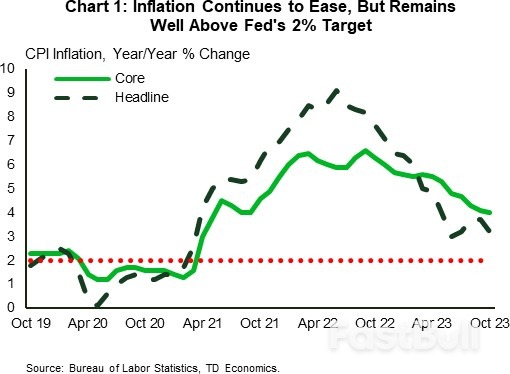
          Turning to the Consumer Price Index (CPI) report, both headline and core inflation came in below market expectations. Falling energy and goods prices, a further easing on housing costs and some deceleration in the ‘supercore' measure all contributed to last month's softer print. On a twelve-month basis, core inflation is down 2.6 percentage points from last year's high but, at 4%, remains well above the Fed's 2% inflation target (Chart 1). As noted in our commentary, the challenge for the Fed going forward is that much of the low hanging fruit on the dis-inflation front has now been picked. With supply-chain issues largely resolved, it is unlikely that falling goods prices will continue to exert as much of a drag on inflation going forward. Ultimately, this means a more pronounced slowing in consumer spending will be required to sustain continued downward pressure on inflation.
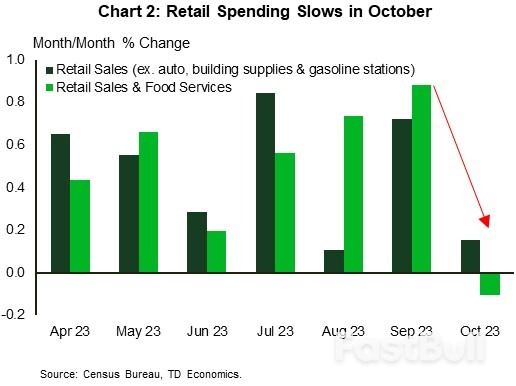
          The Weekly Bottom Line: Extended Fed Pause Looking Increasingly Likely_1Retail sales data out this week showed that spending activity moderated in October. Although some of the weakness was attributed to a pullback in vehicle sales (possibly impacted by the UAW strike), the less volatile components still showed a meaningful deceleration in spending relative to prior months (Chart 2). Moreover, higher frequency credit card spend data reported through the first week of November has shown that spending activity has continued to moderate into the holiday shopping season.
          The Weekly Bottom Line: Extended Fed Pause Looking Increasingly Likely_2At this point, the tailwinds for the consumer seem to be fading. Over two-thirds of the excess savings accumulated during the pandemic have now been exhausted, with most of the remaining savings likely residing with higher income households who tend to have a lower marginal propensity to consume. This is happening at a time when 27 million borrowers have started to make regular student loan repayments amidst a backdrop of deteriorating consumer sentiment and expectations of a cooling labor market.
          To that end, recent readings on initial jobless claims have already turned higher over the past month, as have continued claims – recently touching a near two-year high. This suggests that not only are more workers losing their jobs but it's also becoming a bit harder to find another. Ultimately, the labor market remains very tight by historical standards, but the recent drift higher in claims data suggests underlying conditions are easing on the margin. Although the Fed will need to see further evidence of cooling in the months ahead to rule out another rate hike next year, the recent data flow favors the FOMC holding rates steady in December.

          Canada – Supply, Supply, Supply

          Canadian bond yields were down this week. However, as is often the case, developments south of the border were the driver. Markets seemed to breathe a collective sigh of relief after a softer-than-expected U.S. CPI report offered some hope that the Federal Reserve wouldn't be taking their policy rate higher in the near-term. This prospect also supported a rally in Canadian equities, even as oil prices continued to drop on demand concerns and a larger-than-expected inventory build. It also helped prop up the Canadian dollar, although at around 0.73 U.S. cents, the loonie continues to fly low compared to its U.S. counterpart.
          Next week features the release of the Canadian inflation report for October. U.S. all-items inflation trends have historically been a good guide for overall Canadian CPI, so the good showing stateside this week bodes well for the Canadian print. Specifically, markets expect all-items inflation to have cooled to 3.2% year-on-year in October, a marked deceleration from the heated pace observed during much of the summer. As in the U.S., energy prices should lead the inflation deceleration. However, policymakers will be keying in on core inflation, which is also expected to show some modest cooling in year-on-year terms. Notably, U.S. core inflation (i.e., ex-food and energy) eased a touch in October although the correlation between it and the equivalent Canadian measure isn't nearly as tight as it is for overall inflation.
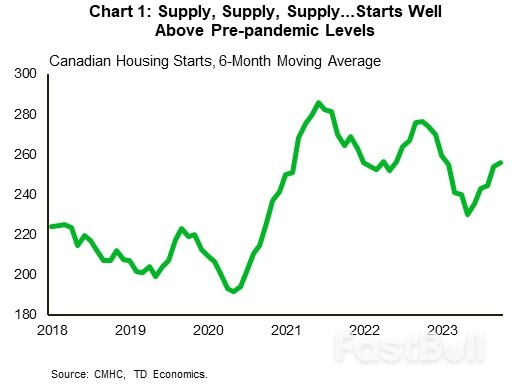
          The fall federal fiscal update is also on tap for next week, and the government has telegraphed its intentions. As Minister Freeland noted in a speech this week, the focus will be on housing "supply, supply, supply", amid Canada's affordability crisis. Builders are certainly doing their part to respond to this challenge, with this week's report on housing starts showing them rising to a highly elevated level of 275k units, which is not too far off the record pace hit in early 2021. On a six-month average basis, starts are sitting at a very healthy 253k units (Chart 1), with the largest contributions coming from condos and purpose-built rental construction. While these are good trends indeed, the time it takes to complete a housing project in Canada is on the rise, and even these lofty levels of homebuilding may not be enough to prevent a housing shortage from accumulating given very robust population growth.The Weekly Bottom Line: Extended Fed Pause Looking Increasingly Likely_3
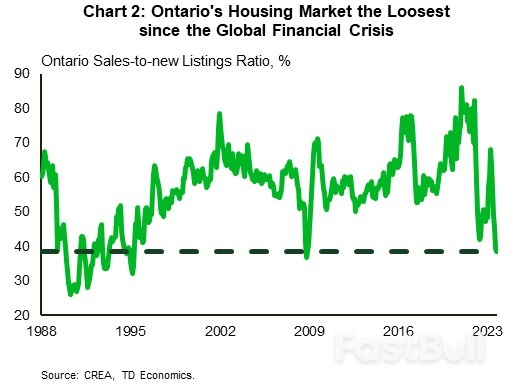
          From a near-term residential investment and GDP growth perspective, last month's modest gain in housing starts should provide some offset to the 5% month-on-month decline in October's Canadian home sales. As expected, average and benchmark home prices pulled back last month, as did new listings. Arguably the most eye-catching aspect of the report was the decline in Ontario's sales-to-new listings ratio, which hit its lowest level since the Global Financial Crisis (Chart 2). This is a strong signal that more home price declines may be on the way.The Weekly Bottom Line: Extended Fed Pause Looking Increasingly Likely_4
          To stay updated on all economic events of today, please check out our Economic calendar
          Risk Warnings and Disclaimers
          You understand and acknowledge that there is a high degree of risk involved in trading. Following any strategies or investment methods may lead to potential losses. The content on the site is provided by our contributors and analysts for information purposes only. You are solely responsible for determining whether any trading assets, securities, strategy, or any other product is suitable for investing based on your own investment objectives and financial situation.
          Comments
          Add to Favorites
          Share

          Has Dollar Rally Run Its Course?

          XM

          Forex

          Jobs and inflation data hurt the dollar

          The US dollar suffered a major blow this week after the US CPI data revealed that inflation cooled by more than anticipated in October, adding credence to investors' view that the end credits of the Fed's tightening crusade have already rolled, despite Chair Powell and several of his colleagues pushing back against such expectations recently.
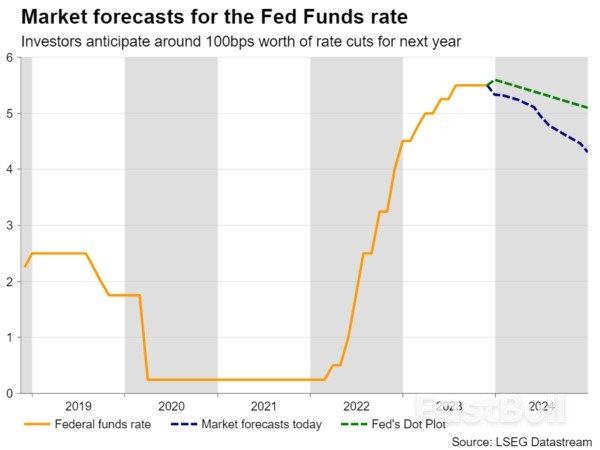
          This was the second hit in less than two weeks for the US dollar, with the first one coming after the disappointing jobs report for the same month. Bearing in mind that the Fed is linking its monetary policy decisions to both inflation and the labor market, easing conditions on both fronts prompted market participants to price out any chance for another hike this year and to pencil in around 100bps worth of rate reductions for next year.

          Fed to cut in 2024; but by how much?

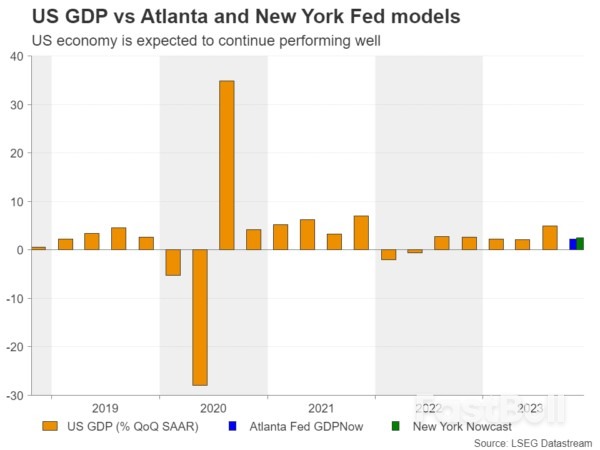
          Nonetheless, there is no evidence yet supporting so many basis points worth of cuts for next year. Yes, the US economy is expected to have slowed in Q4, with the Atlanta Fed GDPNow and the New York Fed Nowcast models projecting growth rates of 2.2% and 2.5% respectively, but with interest rates at such high levels and the economy growing at the astounding pace of 4.9% in Q3, such a slowdown appears quite normal.
          Has Dollar Rally Run Its Course?_1On the other hand, the Fed could start cutting rates and monetary policy would still stay tight, pushing inflation in the right direction. So, should data continue to suggest that inflation is drifting south faster than anticipated, then the Fed may be tempted to start cutting sooner than it currently anticipates, in order to avoid a more severe than forecast economic slowdown.
          According to its September dot plot, the Committee is projecting one more hike and expects interest rates to end 2024 within the 5.00-5.25% range. In other words, it anticipates only 50bps worth cuts for next year, which is a decent deviation from what the market is currently pricing in. Therefore, the big question moving forward is: Who is right? The market or the Fed?Has Dollar Rally Run Its Course?_2

          US economy seen slowing, but 100bps cuts not justified

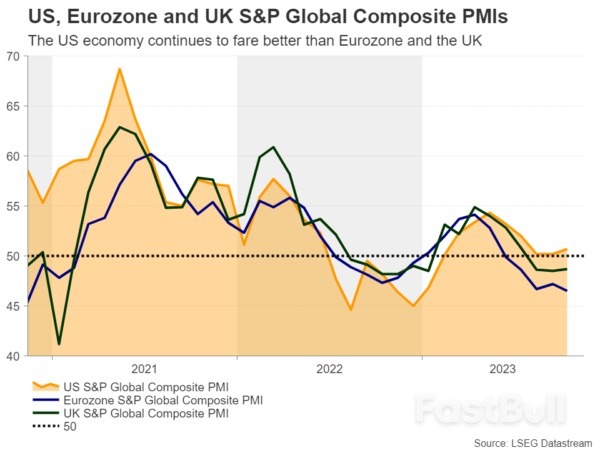
          The Fed's own economic forecasts suggest that the economy could slow to 1.5% growth in 2024 and then reaccelerate to 1.8% in 2025, with inflation easing to 2.2% by the end of 2025 and hitting the 2% objective in 2025. Indeed, such projections do not justify 100bps worth of rate cuts and should incoming data continue to point to a US economy that is faring better than its major peers, investors may be eventually convinced to lift their implied path. Even if new rate hike bets do not resurface, market participants could scale back a decent amount of basis points worth of cuts, which could prove positive for long-dated Treasury yields, and thereby help the dollar rebound.
          Although traders currently appear willing to sell the dollar more aggressively on anything confirming the 'no more hikes' narrative than on anything corroborating the Fed's 'higher for longer' mantra, there is nothing suggesting that a bearish reversal is imminent. The Eurozone seems to be headed for its own recession, which could eventually prompt the ECB to start cutting its own rates before the Fed does. The UK economy is also in a bad shape and following the larger-than-expected slowdown in UK inflation during October and disappointing growth-related data, investors may be tempted to continue bringing forward their BoE cut bets. This could happen despite Governor Bailey arguing that it is too early to be thinking about rate cuts. Such thinking by investors is likely to leave the euro and the pound in a vulnerable position for a while longer.Has Dollar Rally Run Its Course?_3

          Dollar could struggle against aussie, kiwi, and yen

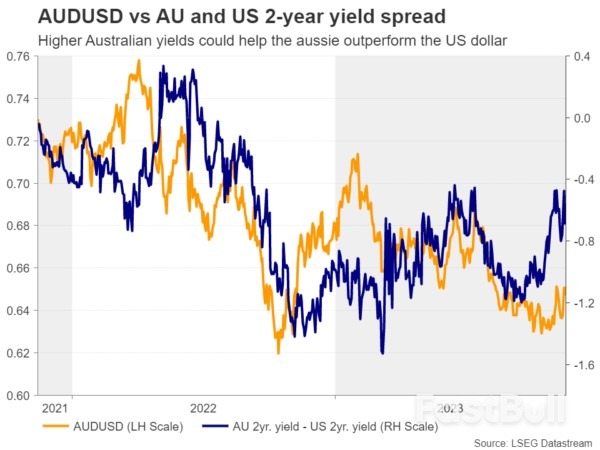
          Currencies that have more chances in outperforming the dollar may be the risk-linked aussie and kiwi, as expectations of several rate cuts by the Fed have already been translated to increasing risk appetite, as made evident by the latest rally in Wall Street. What's more, with investors not even pricing in a full 25bps cut by the RBA in 2024, the aussie could perform even better. That said, this may be a story for next year, when the Fed begins to cut rates and the slide in short-dated Treasury yields accelerates. The yen could also perform better than it did this year if the BoJ abandons its yield curve control (YCC) policy, although improving risk appetite is usually not a plus for this currency.Has Dollar Rally Run Its Course?_4
          Risk Warnings and Disclaimers
          You understand and acknowledge that there is a high degree of risk involved in trading. Following any strategies or investment methods may lead to potential losses. The content on the site is provided by our contributors and analysts for information purposes only. You are solely responsible for determining whether any trading assets, securities, strategy, or any other product is suitable for investing based on your own investment objectives and financial situation.
          Comments
          Add to Favorites
          Share

          Why Ferrous Scrap Is Emerging as A Key Strategic Raw Material

          ING

          Economic

          Steel scrap is key in establishing a circular economy
          Global ferrous scrap consumption in steel production is set to rise as efforts to reduce the industry's environmental footprint are ramped up alongside an expected increase in the share of Electric Arc Furnace (EAF) in the global steelmaking process.
          The steel sector accounts for at least 7% of global greenhouse gas emissions. With global steel demand set to increase to around 2.6 billion tonnes by 2050, the transition to a low-carbon economy requires a change in how steel is produced. Part of steel's decarbonisation path is through the increased use of scrap. Today, around 30% of steel is produced through recycling scrap – and this share is forecast to rise to 50% by 2050.
          Steel is predominantly made via two main processes: the blast furnace-basic oxygen furnace (BF-BOF) process, which uses coke to produce iron from ore, and the Electric Arc Furnace process (EAF). These two methods are often referred to as the 'primary' and 'secondary' processes that melt down scrap and recycled steel. The BF-BOF process is the most common steelmaking process and the most emissions-intensive, with 90% of production relying on coal. Emissions from scrap-based EAFs are mostly indirect. Those emissions are not produced by the steel plant but by the electricity generators that supply electricity to the furnaces. If the electricity used in this process is produced via renewable energy, this production route can have very low CO2 emissions. When using grey electricity as energy input, scrap-EAF steelmaking emits 0.67 tons of CO2 per tonne of crude steel cast, vs 2.32 tonnes in the case of BF-BOF steelmaking. Carbon intensity is far lower when using green electricity.
          Scrap not only plays a key role in reducing industry emissions but also in reducing resource consumption. Every tonne of scrap used for steel production avoids the emission of 1.5 tonnes of CO2 and the consumption of 1.4 tonnes of iron ore, 740kg of coal and 120kg of limestone, according to calculations from Worldsteel.
          The steel sector also has alternatives to BF-BOF and EAF plants. These include Direct Reduced Iron (DRI) plants which use natural gas, and eventually (once available) green hydrogen made from renewable energy instead of coking coal to reduce the iron ore. For now, however, steel-makingscrap-based EAF has the lowest carbon footprint across steel making technologies – at least until DRI technology advances to using hydrogen.
          Growing global EAF steel output is leading to increasing scrap use
          Steel production around the world is increasingly switching to electric arc furnaces. The share of EAF in global steel production increased from 25% to 28% between 2015 and 2022, and is expected to increase further as steelmakers globally are looking to transition to greener steelmaking processes. This holds significant implications for the steel scrap market as competition for the raw material continues to grow.Why Ferrous Scrap Is Emerging as A Key Strategic Raw Material_1
          Why Ferrous Scrap Is Emerging as A Key Strategic Raw Material_2Between regions, steel production is the most electrified in the Middle East, where 95% of steel capacity are electric steel mills. In the US, that share was 69% in 2022, while in the EU, it stood at 43.7%.
          As the world's largest steel producer, China is lagging at 9.5% but is also significantly expanding its capacity in this area. The country plans to increase its share of steel from EAFs to 15% by 2025 amid a drive to reduce carbon emissions, increasing its appetite for ferrous scrap. The country aims to achieve carbon neutrality by 2060.
          In India, the world's second-largest steel producer, the share has been growing in recent years; in 2022, over 54% of the country's steel was produced from EAFs. India's steel sector has a higher energy intensity compared to the global average. With a national target of net-zero emissions by 2070 and Indian steel demand expected to grow, investment in new blast furnace capacity has surged in recent years.
          The largest producer of steel is naturally the largest consumer of scrap. Last year, China used 215.31 million tonnes of scrap, 4.8% lower year-on-year, as data from the Bureau of International Recycling (BIR) showed. There was also a decline in the country's crude steel production (-1.7% to 1018.0 million tonnes) amid weakness in the real estate sector.Why Ferrous Scrap Is Emerging as A Key Strategic Raw Material_3Why Ferrous Scrap Is Emerging as A Key Strategic Raw Material_4
          Why Ferrous Scrap Is Emerging as A Key Strategic Raw Material_5Steel is one of the most highly recycled materials in use today, and it can be recycled repeatedly without losing its properties. Today, around 90% of steel products are recovered at the end of their life and recycled to produce new steel. In theory, all new steel could be made using recycled steel, as its properties remain intact during the recycling process. However, this isn't feasible currently due to a shortage of scrap. Globally, the current production of steel is three times higher than the supplies of scrap available.
          The average lifespan of steel products can vary, ranging from just a few weeks for steel packaging to as long as 100 years for buildings and infrastructure. On average, a steel product has a lifespan of around 40 years. Only as more steel products become obsolete can the world produce more recycled steel.
          Why Ferrous Scrap Is Emerging as A Key Strategic Raw Material_6The continued growth in steel demand means that it is unlikely for the industry to be able to transition to entirely scrap-based production during this century, according to Worldsteel calculations.
          Why Ferrous Scrap Is Emerging as A Key Strategic Raw Material_7Global steel production experienced significant growth in the early 21st century, primarily driven by China's expansion. As more steel materials reach the end of their useful lives, the availability of scrap steel is expected to increase from the mid-2020s onwards. According to Worldsteel estimates, global end-of-life ferrous scrap availability was approximately 400 Mt in 2019. By 2030, global end-of-life scrap availability is projected to reach around 600 Mt – and by 2050, approximately 900 Mt.
          At the same time, global demand for steel scrap could reach 778 million tonnes by 2030, according to data from the POSCO Research Institute. By 2050, a deadline set by several global steel producers to achieve carbon neutrality goals, global demand will reach 964 million tonnes.
          The main potential of scrap resources is in Asian countries. In the EU, North America and Japan, scrap resources will not show significant growth, while demand will continue to rise. This is why the trend of steel scrap export restrictions is gaining traction globally.
          Restrictions in the scrap trade increase amid decarbonisation drive
          The growing number of trade restrictions on scrap is a good indicator of its increasing value in the global decarbonisation drive. More countries are imposing export bans to protect this raw material as EAF production is slowly becoming the leading technology in steel production.
          Why Ferrous Scrap Is Emerging as A Key Strategic Raw Material_8Exports of ferrous scrap are most actively restricted in Africa, MENA countries and Asia, according to data from the Organisation for Economic Co-operation and Development (OECD). These are countries with historically low steel consumption and insufficient scrap resources. Export duty is the most common tool, but export bans are used almost as often as duties, as shown in data from the OECD.
          In the EU, the European Parliament approved a proposal to revise the Waste Shipment Regulation (WSR) earlier this year. According to the amendments to the WSR, starting from 2025, the export of safe waste for recycling – of ferrous and non-ferrous metal scrap in particular – to countries outside the OECD will be allowed only if those countries apply for consent and demonstrate their ability to manage waste effectively. The European Commission will also carefully monitor the export of waste to OECD member countries. As a result, the EU can turn from a net scrap exporter to a net scrap importer in just five years, as shown by the International Rebar Producers and Exporters Association (IREPAS) data.
          The EU is the largest exporter of scrap in the world. Last year, the bloc maintained its position despite a 9.4% year-on-year decline in shipped volumes to 17.596 million tonnes; the main buyer was Turkey (-18.9% to 10.563 million tonnes), according to the BIR.
          Restrictions in Europe are likely to have significant consequences for the global scrap market. Currently, 25% of EU scrap exports go to non-OECD countries, and these export volumes are likely to reduce due to the regulation.
          Why Ferrous Scrap Is Emerging as A Key Strategic Raw Material_9As an OECD member and the largest national seaborne importer of ferrous scrap, Turkey could benefit from the WSR and reduced competition for the material. The country remains the largest national seaborne importer of ferrous scrap, importing over 20 million tonnes last year (down 16.5% year-on-year), with the US as its main supplier (up 4.9% to 3.953 million tonnes), as shown in data from the BIR. Turkey is expected to remain a large net importer of scrap in the long term, given that its domestic scrap supply is too limited to satisfy its EAF production capacity. The country mainly produces steel via the EAF process. In 2022, the country's share of EAF in crude steel output was 71.5%.
          Why Ferrous Scrap Is Emerging as A Key Strategic Raw Material_10As the second-largest steel scrap importer and a non-OECD member, India aims to become the largest steel producer after China. The country already relies on more than 50% on EAF production and therefore could be severely affected by the WSR. India imported 1.373 million tonnes of ferrous scrap from the EU last year, an increase of 156% from the year before. The country plans annually to import about 30 million tons of raw steel materials by 2030 to meet the government's vision of achieving 300 million tonnes per year of steel capacity.
          Why Ferrous Scrap Is Emerging as A Key Strategic Raw Material_11An amendment to the bloc's Critical Raw Materials Act (CRMA) could also result in ferrous scrap being categorised as a protected material, along with other strategic materials like lithium, copper, cobalt and nickel – all of which are seen as key to the green energy transition.
          The addition of ferrous scrap as a critical raw material would make it highly protected under EU law. If ferrous scrap is added to the final list of the CRMA, it could become challenging to continue exporting the material, including to buyers inside the OECD like Turkey.
          As part of the CRMA, the EU has set targets for the region to mine 10% of the critical raw materials it consumes, with recycling adding a further 25% and increased processing to 40% of its needs by 2030. In addition, there should be a substantial increase in the recovery of raw materials present in waste. The political agreement now needs to be formally approved by both Parliament and Council to become law. Meanwhile, the EU has also decided to exempt scrap from the scope of the Carbon Border Adjustment Mechanism (CBAM), which would prevent barriers to importing the material.
          Seaborne ferrous scrap trade likely to fall further
          The volume of seaborne ferrous scrap trade is likely to fall further as more and more countries introduce legislation to retain the scrap they produce within their borders for domestic use. Global recycled steel trade – including trade within the EU – amounted to 97.6 million tonnes last year, down 14.9% compared to 2021, as data from the BIR shows.
          The recycled steel export trade within the EU totalled 26.445 million tonnes in 2022 for a year-on-year drop of 10.4%. There was also a decline in recycled steel shipments out of the US last year, down 2.4% to 17.476 million tonnes – although it remained the world's second-largest recycled steel exporter.
          Most of the world's leading exporters are major net recycled steel exporters. Last year's export surplus, for instance, was 13.7 million tonnes for the EU and 12.8 million tonnes for the US (according to BIR data).
          Why Ferrous Scrap Is Emerging as A Key Strategic Raw Material_12Demand for ferrous scrap will continue to grow globally amid the increasing focus on the material as a key raw material in the low-carbon emissions steelmaking process. Steel scrap has an essential place in the decarbonisation drive toward establish a circular economy. Last year, the proportions of recycled steel used in crude steel production increased to 22% in China, 58% in the EU, 70% in the US and toward37% in Japan.
          Why Ferrous Scrap Is Emerging as A Key Strategic Raw Material_13Steel mills look to secure scrap supply
          To deliver low carbon emissions steel, steel mills globally have been acquiring scrap recyclers as part of a strategy to secure access to the raw material as demand continues to rise amid the decarbonisation drive.
          In the US, the country's largest steelmaker, Nucor, has acquired Garden Street Iron & Metal's assets on behalf of its recycling subsidiary, River Metals Recycling. Last year, Steel Dynamics acquired Roca Acero, a Mexican metals recycling company, as part of its raw materials purchasing strategy. In Europe, ArcelorMittal bought Poland-based Zlomex at the end of last year. The Polish transaction was the fourth scrap metal acquisition ArcelorMittal has undertaken in Europe in 2022. The steelmaker is significantly ramping up its scrap requirement as it seeks to shift the bulk of its European steelmaking capacity from a basic oxygen furnace to an electric arc furnace partially fed by direct-reduced iron by 2030.
          We expect vertical integration in the steel industry to continue as steel mills seek to secure access to scrap steel required for low-carbon emission steelmaking, which in turn will drive mergers and acquisitions moving forward.
          To stay updated on all economic events of today, please check out our Economic calendar
          Risk Warnings and Disclaimers
          You understand and acknowledge that there is a high degree of risk involved in trading. Following any strategies or investment methods may lead to potential losses. The content on the site is provided by our contributors and analysts for information purposes only. You are solely responsible for determining whether any trading assets, securities, strategy, or any other product is suitable for investing based on your own investment objectives and financial situation.
          Comments
          Add to Favorites
          Share

          Latest News on the Israeli-Palestinian Conflict (November 19)

          Thomas

          Palestinian-Israeli conflict

          Latest news on the Israeli-Palestinian conflict

          0:07
          "Since yesterday morning, our fighters have successfully inflicted casualties on occupation soldiers by attacking occupation soldiers with anti-personnel explosive devices, and they have completely destroyed or damaged 17 Israeli troops on the axis of the invasion in the Gaza Strip," the Hamas al-Qasan Brigade said. vehicle.
          0:35
          With bodies still scattered in the streets and under the rubble, a new health disaster looms over Gaza: diseases such as cholera and immune system disorders threaten to spread across the Strip.
          1:09
          German doctors led a massive pro-Palestinian demonstration in Berlin, defying authorities' restrictions.
          1:25
          Galant of Israel's Northern Command said: "We charge a price for every strike, and we attack Hezbollah through immediate attack attempts and prepared infrastructure in advance." Hezbollah has been paying a heavy price and we are preparing for the future.
          If Hezbollah makes a mistake, we will know what to do - we are ready on land, we are ready in the air, we are ready at sea, our intelligence is keeping an eye on things, and together we can respond to anything Challenge - Our goal is to make northern residents feel safe.
          2:01
          Lebanese media confirmed: Israeli warplanes are currently attacking Wadi Zabkin and Alma a-Shaab in southern Lebanon.
          2:57
          The US State Department and Pentagon spokesmen (and the President of the United States) officially and intentionally promoted lies from the "Hamas Command Center" in order to promote war crimes against Shifa Hospital, which must be held accountable in the war crimes investigation.
          3:44
          U.S. President Joe Biden said the Palestinian Authority should control Gaza. Israeli Prime Minister Netanyahu replied to Biden: The Palestinian Authority cannot control Gaza.
          6:27
          CNN reports: Biden threatens to ban "extremist" settlers from Judea and Samaria from entering the United States.
          6:36
          Latest News on the Israeli-Palestinian Conflict (November 19)_1 Iran's Foreign Minister mocked Israel: Hezbollah has entered a war stage with Israel today, and Israel cannot withstand a war of attrition.
          7:01
          The IDF detained ambulance workers in Jenin, restricting their freedom, and medical personnel reported being stopped and searched in various parts of the city.
          9:28
          Before, it was Canada, France, and now, Germany can’t stand it any longer!
          According to Reuters, on November 18, local time, German Chancellor Scholz criticized Israel's "settlement" policy in the West Bank and once again called on both Palestine and Israel to resolve the conflict through a "two-state solution."
          10:23
          It turns out that the hole the IDF claimed was a tunnel beneath Shifa Hospital was actually a septic tank containing waste.
          11:38
          Israeli Foreign Minister angrily criticizes WHO Tedros for condoning Hamas?
          After meeting with WHO Director-General Tedros Adhanom Ghebreyesus in Geneva yesterday, Israeli Foreign Minister Eli Cohen said that Hamas abused hospitals as a cover for terrorist activities, and the WHO did not care.
          He said the WHO would only condemn Israel and demand good treatment of Hamas prisoners of war, but would remain silent on Hamas's abuse of hospitals. This shows that the WHO condones barbaric acts and only speaks to civilized people but cannot restrain the behavior of terrorist organizations. Tedros cannot be held responsible for this.
          14:09
          Netizen analysis: Jordan’s operation directly stabs Palestine in the back.
          Almost in line with the actions of the Israeli army, the Jordanian army moved a large number of armored vehicles to the east bank of the Jordan River. The purpose was not to help fight against Israel, but to prevent armed personnel from escaping into Jordan after Israel's raids. The purpose was to cut off the retreat. Let the Israeli army catch the turtle in the urn. The reason why the Arabs can never defeat Israel is not that they are not strong enough, but that they can never remain united and only think about their own small interests every day.

          Source of the article: "Gift from the Beautiful Fairy" WeChat public account

          Risk Warnings and Disclaimers
          You understand and acknowledge that there is a high degree of risk involved in trading. Following any strategies or investment methods may lead to potential losses. The content on the site is provided by our contributors and analysts for information purposes only. You are solely responsible for determining whether any trading assets, securities, strategy, or any other product is suitable for investing based on your own investment objectives and financial situation.
          Comments
          Add to Favorites
          Share

          Crude Overshoots; Silver the Comeback Kid

          SAXO

          Commodity

          A very mixed week in commodities with two distinct developments attracting most of the attention. On top, we find the precious metal sector which rallied 3.8% amid the growing belief that interest rates around the world have peaked. At the other end, the prospect of a slowing economic outlook and ample supply helped send the energy sector lower by 2.6%, in the process reversing the bulk of the gains that were forced upon the market by unilateral production cuts earlier this year.
          The best performing commodities were the ones that in recent months had seen fading demand and increased short selling from investors, namely platinum group metals, silver, copper, and corn, while the other end saw losses being led by natural gas and crude oil as speculators continued to reverse long positions that had been initiated in recent months following Saudi Arabia and Russia's now failed attempt to force prices higher.
          Meanwhile, the industrial metal sector also rose with copper heading for its best week since July with sentiment receiving a boost from easing tensions between the US and China, a softer dollar, and robust demand from China amid continued stimulus to support growth. The agriculture sector was unchanged with end of week profit taking in coffee and continued weakness in wheat which continues to be weighed down by ample supply from the key producers around the world, being offset by gains in corn, cotton and soybeans.
          Crude Overshoots; Silver the Comeback Kid_1On the macro-economic front, a variety of economic data from key economies around the world strengthened the view that aggressive policy-tightening cycles from the Federal Reserve and other central banks have reached the end of the road, with the focus now turning to the timing, as well as the pace, of future rate cuts. Traders responded to softness in inflation and jobs data by raising 2024 rate cut expectations in the US and Europe to a full percentage point, with the first cuts so far pencilled in to occur sometime during the second quarter.
          Traders use SOFR futures contracts to bet on the direction of US short term rates, and following this week's events, the market is now pricing in a +1% rate cut before December 2024. The SOFR contracts also tells us that traders expect the incoming rate cut cycle will continue until December 2025, at which point the rate will through around 3.75% before rising again.
          Crude Overshoots; Silver the Comeback Kid_2Financial markets responded to these developments by sending US long-end Treasury yields sharply lower. The dollar suffered a broad retreat against its major peers, while global equity markets rose, especially those beaten down sectors that have struggled recently amid elevated levels of debt and an increasing cost of servicing that debt. Examples of themes benefiting were energy storage and renewable energy, two areas that support demand for metals such as beaten down and under owned silver and platinum.

          Crude oil slump draws fresh attention to November 26 OPEC meeting

          Broad losses across the energy sector saw the Bloomberg Energy Subindex trade down more than 2% on the week, thereby extending a four-week 10% tumble to the lowest level since July. While the latest triggers were rising US inventories and continued demand worries, the drivers were accelerated technical selling from traders being increasingly forced to reduce longs while adding fresh short positions amid a deteriorating technical outlook.
          The crude oil slump to a July low accelerated after prices failed to reach safer grounds last Tuesday when a broad risk-on rally was triggered after a weaker than expected US CPI print raised the prospect for peak rates and lower funding costs. The failure to break higher gave technical-focused short sellers the confidence to mark prices lower, culminating in Thursday's 5% slump which took the Brent and WTI into technical bear market territory, having fallen by more than 20% from the early October peaks.
          According to the futures market, the short-term demand outlook is showing signs of weakening. This is most notable in WTI where the spread between the prompt delivery month and three months later has returned to a $0.4/bbl contango for the first time since July. The spread reached a $6.2/bbl backwardation back in late September when tight supply focus peaked following Saudi and Russian production cuts. The equivalent three-month spread in Brent is also toying with contango, having collapsed from around $5.7/bbl to the current $0.05/bbl.
          All these developments have seen third quarter strength deflate rapidly with production cuts from Russia and not least Saudi Arabia having a limited impact on the market. From late June to late September, Brent crude oil rallied by around one-third in response to Saudi production cuts amid a quest for higher prices and OPEC estimates of a 3 million barrel a day supply deficit. However, since then, the demand outlook has weakened, thereby forcing a strong sell reaction from speculators who got caught with a big long and the smallest gross short position in 12 years. The level of speculative short positions held into a weakening market helps dictate the size of a sell off as short positions are needed to absorb selling pressure from longs trying to get out.
          As we highlighted in our latest commodity weekly, we worried that the crude oil market was at risk overshooting to the downside and with Brent below $80 and WTI below $75, we believe that stage has now been reached, with Thursday's sell-off looking like a capitulation move, potentially signalling a bottom. The latest weakness came after the EIA, in its latest update covering two weeks' worth of data, reported a 17.5 million barrel increase in nationwide stockpiles. However, what went somewhat unnoticed was an almost identical drop in total inventories of gasoline, distillates, and jet fuel of 16.4 million barrels. Apart from implied gasoline demand rising to a supportive 9 mb/d, the highest level for this time of year since 2021, some price support may also begin to emerge as refineries come out of maintenance, thereby raising demand for crude oil.
          In WTI, a return above $75 may send the first signal of consolidation while a break back above $80, and Brent above $83.50, will be required before talking about a fresh through. However, with the latest slump being driven by technical developments more than fundamentals, a potential low is in our opinion within reach with traders also having to consider the risk of a geopolitical flareup and additional action to support prices from OPEC and non-OPEC when they meet on November 26.

          Crude Overshoots; Silver the Comeback Kid_3Silver takes the lead in strong week for precious metals

          Gold prices recovered strongly during the past week after a much-needed correction ran out of steam around $1935, a key technical support level. However, while last month's surge was driven by geopolitical worries and financial risks associated with surging US bond yields, the latest rebound has been driven by the assumption interest rates have peaked and will turn lower next year. These developments also help explain why semi-industrial metals like silver and platinum missed last month's rally before taking the lead this past week.
          The prospect for lower funding costs supporting liquidity intensive industries, some of which need platinum and silver, has supported a strong rebound in these two beaten down and under owned metals. In addition, the recent weakness relative to gold can also be partly explained by the absence of central bank demand for these metals. Hedge funds in the week to November 7 held a 105k contract (10.5m ounces) net long in COMEX gold futures, more than 20k above the one-year average. Meanwhile in silver funds held a near neutral position of just 2.2k contracts, some 10k below the one-year average while a small net short of 1.4k contracts were held in platinum, some 8k below the one-year average.
          Apart from central bank buying, which continues at a record pace, leveraged fund accounts, such as hedge funds and CTA's as well as investor demand for ETFs remain key in underpinning a continued rally in gold. The prospect for peak rates, once confirmed, will drive down the cost of holding non-interest paying precious metal positions, and this will be the trigger for the next move higher. Until then, we keep our patiently bullish view on gold and silver and see setbacks as a buying opportunity.
          Silver trades near $24, up more than 7% on the week as speculators scramble to re-enter long positions amid an outlook for lower rates and with that the prospect for improved industrial demand. A not yet confirmed trend line from the May peak may offer some resistance at $24.25 ahead of $25 while support is likely to emerge ahead of the 200-day moving average, currently at $23.30.Crude Overshoots; Silver the Comeback Kid_4
          Risk Warnings and Disclaimers
          You understand and acknowledge that there is a high degree of risk involved in trading. Following any strategies or investment methods may lead to potential losses. The content on the site is provided by our contributors and analysts for information purposes only. You are solely responsible for determining whether any trading assets, securities, strategy, or any other product is suitable for investing based on your own investment objectives and financial situation.
          Comments
          Add to Favorites
          Share

          How FTX Became The 'Grand Finale of The Crypto Magic Show'

          Kevin Du

          Cryptocurrency

          When former crypto titan Sam Bankman-Fried was convicted of seven counts of fraud and conspiracy on November 2, US Attorney Damian Williams called the case "one of the biggest financial frauds in American history".
          While that is undoubtedly true based on the sums of money involved, academics say the scandal's legacy is likely to be more complicated than relatively straightforward frauds like Bernie Madoff's infamous Ponzi scheme or the crimes committed by Elizabeth Holmes at her blood-testing company, Theranos.
          That is because the rise and fall of FTX is not just a story about the misdeeds of one person, but rather a broader tale about the sudden mania that erupted around a new type of financial system designed to circumvent the regulatory guardrails meant to protect investors from exactly this type of outcome.
          Cornell Law School professor Saule T. Omarova draws a parallel between Mr Bankman-Fried's trial and the global financial crisis of 2008, which she said was "so obviously linked to institutional practices and regulatory failures" that the focus was on the banking system's shortcomings.
          Mr Bankman-Fried's case raises the question: Is it really just about one man's fraud, or does it prove that the entire model of the cryptocurrency market is flawed?
          "It's disheartening to see how easy it is for a new kind of business to grow in the financial sector to such prominence and size in such a short period of time," Prof Omarova said.
          "The law and regulation had very limited reach into that sphere and there was no political appetite to sit down and think about the systemic implications of allowing these types of business to flourish."
          After the financial crisis of 2008, the US Congress passed the Dodd-Frank Act, which overhauled banking regulations to protect borrowers and the financial system.
          And in 2019, the US Securities and Exchange Commission published a list of the reforms it undertook following the Madoff scandal, including revitalising the enforcement division, enhancing safeguards for investors' assets and conducting risk-based examinations of financial companies.
          Yet, efforts to bring more order to digital asset markets through legislation have long been stalled in a deeply partisan Congress.
          That has left regulators like the SEC to police the industry as best as they can based on laws already on the books, resulting in complicated legal entanglements.
          In June, the agency sued market leaders Coinbase Global and Binance Holdings for operating what they consider to be illegal exchanges. Both are fighting the regulator's actions.
          "Because the crypto industry has not yet become the source of financing for the real economy, it has not reached the kind of maturity that would focus everybody's attention on structural problems," Prof Omarova said.
          "As much as we worry or care about individual investors who lost their money in FTX, somebody should have worried about how one, two, or 300 FTXs were allowed to grow over time."
          To some, Mr Bankman-Fried's case is emblematic of the era in which it occurred, a period in time when investors were especially blind to risks that now seem obvious in hindsight.
          "This was like the grand finale of a magic show," said Peter Atwater, an adjunct professor of economics at William and Mary who studies the role of confidence in business and markets.
          "We live in a golden age of illusion, where investors pour money into dreams that border on pure fiction."
          He added that the speed at which Mr Bankman-Fried's rags-to-riches-to-rags tale unfolded makes the case difficult to compare with fraudsters like Madoff, the financier who was sentenced to 150 years in prison in 2009 for stealing $65 billion from thousands of investors.
          Madoff executed his Ponzi scheme over the course of more than 20 years. Holmes, who was sentenced to prison for more than 11 years for defrauding investors of nearly $145 million, saw the rise and fall of Theranos play out for over a decade.
          "FTX rose and fell in the span of a year," Prof Atwater said. "It was one of the last partygoers to the event, and they arrived on the scene when confidence was at its highest and scrutiny was non-existent."
          That confidence is gone forever for some of the FTX customers who are owed $8.7 billion from the exchange.
          This lack of confidence extends beyond Mr Bankman-Fried's company.
          Amy Fisher, a former FTX customer who filed a claim to recover her assets, said that the funds she lost were not her life savings, but they were enough for her to turn her back on digital currencies altogether.
          "I wouldn't trust crypto with a 10-foot pole," Ms Fisher said.
          "When I lost my money, I vowed to stay away from the industry. There were so many instances where I dodged a bullet, but it gets tiring after a while."

          Source: The National News

          Risk Warnings and Disclaimers
          You understand and acknowledge that there is a high degree of risk involved in trading. Following any strategies or investment methods may lead to potential losses. The content on the site is provided by our contributors and analysts for information purposes only. You are solely responsible for determining whether any trading assets, securities, strategy, or any other product is suitable for investing based on your own investment objectives and financial situation.
          Comments
          Add to Favorites
          Share
          FastBull
          Copyright © 2025 FastBull Ltd

          728 RM B 7/F GEE LOK IND BLDG NO 34 HUNG TO RD KWUN TONG KLN HONG KONG

          TelegramInstagramTwitterfacebooklinkedin
          App Store Google Play Google Play
          Products
          Charts

          Chats

          Q&A with Experts
          Screeners
          Economic Calendar
          Data
          Tools
          Membership
          Features
          Function
          Markets
          Copy Trading
          Latest Signals
          Contests
          News
          Analysis
          24/7
          Columns
          Education
          Company
          Careers
          About Us
          Contact Us
          Advertising
          Help Center
          Feedback
          User Agreement
          Privacy Policy
          Business

          White Label

          Data API

          Web Plug-ins

          Poster Maker

          Affiliate Program

          Risk Disclosure

          The risk of loss in trading financial instruments such as stocks, FX, commodities, futures, bonds, ETFs and crypto can be substantial. You may sustain a total loss of the funds that you deposit with your broker. Therefore, you should carefully consider whether such trading is suitable for you in light of your circumstances and financial resources.

          No decision to invest should be made without thoroughly conducting due diligence by yourself or consulting with your financial advisors. Our web content might not suit you since we don't know your financial conditions and investment needs. Our financial information might have latency or contain inaccuracy, so you should be fully responsible for any of your trading and investment decisions. The company will not be responsible for your capital loss.

          Without getting permission from the website, you are not allowed to copy the website's graphics, texts, or trademarks. Intellectual property rights in the content or data incorporated into this website belong to its providers and exchange merchants.

          Not Logged In

          Log in to access more features

          FastBull Membership

          Not yet

          Purchase

          Become a signal provider
          Help Center
          Customer Service
          Dark Mode
          Price Up/Down Colors

          Log In

          Sign Up

          Position
          Layout
          Fullscreen
          Default to Chart
          The chart page opens by default when you visit fastbull.com