• Trade
  • Markets
  • Copy
  • Contests
  • News
  • 24/7
  • Calendar
  • Q&A
  • Chats
Trending
Screeners
SYMBOL
LAST
BID
ASK
HIGH
LOW
NET CHG.
%CHG.
SPREAD
SPX
S&P 500 Index
6827.42
6827.42
6827.42
6899.86
6801.80
-73.58
-1.07%
--
DJI
Dow Jones Industrial Average
48458.04
48458.04
48458.04
48886.86
48334.10
-245.98
-0.51%
--
IXIC
NASDAQ Composite Index
23195.16
23195.16
23195.16
23554.89
23094.51
-398.69
-1.69%
--
USDX
US Dollar Index
97.950
98.030
97.950
98.500
97.950
-0.370
-0.38%
--
EURUSD
Euro / US Dollar
1.17394
1.17409
1.17394
1.17496
1.17192
+0.00011
+ 0.01%
--
GBPUSD
Pound Sterling / US Dollar
1.33707
1.33732
1.33707
1.33997
1.33419
-0.00148
-0.11%
--
XAUUSD
Gold / US Dollar
4299.39
4299.39
4299.39
4353.41
4257.10
+20.10
+ 0.47%
--
WTI
Light Sweet Crude Oil
57.233
57.485
57.233
58.011
56.969
-0.408
-0.71%
--

Community Accounts

Signal Accounts
--
Profit Accounts
--
Loss Accounts
--
View More

Become a signal provider

Sell trading signals to earn additional income

View More

Guide to Copy Trading

Get started with ease and confidence

View More

Signal Accounts for Members

All Signal Accounts

Best Return
  • Best Return
  • Best P/L
  • Best MDD
Past 1W
  • Past 1W
  • Past 1M
  • Past 1Y

All Contests

  • All
  • Trump Updates
  • Recommend
  • Stocks
  • Cryptocurrencies
  • Central Banks
  • Featured News
Top News Only
Share

Cambodian Prime Minister Hun Manet Says He Had Phone Calls With Trump And Malaysian Leader Anwar About Ceasefire

Share

Cambodia's Hun Manet Says USA, Malaysia Should Verify 'Which Side Fired First' In Latest Conflict

Share

Cambodia's Hun Manet: Cambodia Maintains Its Stance In Seeking Peaceful Resolution Of Disputes

Share

Nasdaq Companies: Allergan, Ferrovia, Insmed, Monolithic Power Systems, Seagate Technology, And Western Digital Will Be Added To The NASDAQ 100 Index. Biogen, CdW, GlobalFoundries, Lululemon, ON Semiconductor, And Tradedesk Will Be Removed From The NASDAQ 100 Index

Share

Witkoff Headed To Berlin This Weekend To Meet With Zelenskiy, European Leaders -Wsj Reporter On X

Share

Russia Attacks Two Ukrainian Ports, Damaging Three Turkish-Owned Vessels

Share

[Historic Flooding Occurs In At Least Four Rivers In Washington State Due To Days Of Torrential Rains] Multiple Areas In Washington State Have Been Hit By Severe Flooding Due To Days Of Torrential Rains, With At Least Four Rivers Experiencing Historic Flooding. Reporters Learned On The 12th That The Floods Caused By The Torrential Rains In Washington State Have Destroyed Homes And Closed Several Highways. Experts Warn That Even More Severe Flooding May Occur In The Future. A State Of Emergency Has Been Declared In Washington State

Share

Trump Says Proposed Free Economic Zone In Donbas Would Work

Share

Trump: I Think My Voice Should Be Heard

Share

Trump Says Will Be Choosing New Fed Chair In Near Future

Share

Trump Says Proposed Free Economic Zone In Donbas Complex But Would Work

Share

Trump Says Land Strikes In Venezuela Will Start Happening

Share

US President Trump: Thailand And Cambodia Are In A Good Situation

Share

State Media: North Korean Leader Kim Hails Troops Returning From Russia Mission

Share

The 10-year Treasury Yield Rose About 5 Basis Points During The "Fed Rate Cut Week," And The 2/10-year Yield Spread Widened By About 9 Basis Points. On Friday (December 12), In Late New York Trading, The Yield On The Benchmark 10-year US Treasury Note Rose 2.75 Basis Points To 4.1841%, A Cumulative Increase Of 4.90 Basis Points For The Week, Trading Within A Range Of 4.1002%-4.2074%. It Rose Steadily From Monday To Wednesday (before The Fed Announced Its Rate Cut And Treasury Bill Purchase Program), Subsequently Exhibiting A V-shaped Recovery. The 2-year Treasury Yield Fell 1.82 Basis Points To 3.5222%, A Cumulative Decrease Of 3.81 Basis Points For The Week, Trading Within A Range Of 3.6253%-3.4989%

Share

Trump: Lots Of Progress Being Made On Russia-Ukraine

Share

NOPA November US Soybean Crush Estimated At 220.285 Million Bushels

Share

SPDR Gold Trust Reports Holdings Up 0.22%, Or 2.28 Tonnes, To 1053.11 Tonnes By Dec 12

Share

Brazil's Moraes: We Knew Truth Would Prevail Once It Reached USA Authorities

Share

Brazil's Moraes Thanks President Lula's Commitment To Removal Of USA Sanctions Against Him

TIME
ACT
FCST
PREV
U.K. Trade Balance Non-EU (SA) (Oct)

A:--

F: --

P: --

U.K. Trade Balance (Oct)

A:--

F: --

P: --

U.K. Services Index MoM

A:--

F: --

P: --

U.K. Construction Output MoM (SA) (Oct)

A:--

F: --

P: --

U.K. Industrial Output YoY (Oct)

A:--

F: --

P: --

U.K. Trade Balance (SA) (Oct)

A:--

F: --

P: --

U.K. Trade Balance EU (SA) (Oct)

A:--

F: --

P: --

U.K. Manufacturing Output YoY (Oct)

A:--

F: --

P: --

U.K. GDP MoM (Oct)

A:--

F: --

P: --

U.K. GDP YoY (SA) (Oct)

A:--

F: --

P: --

U.K. Industrial Output MoM (Oct)

A:--

F: --

P: --

U.K. Construction Output YoY (Oct)

A:--

F: --

P: --

France HICP Final MoM (Nov)

A:--

F: --

P: --

China, Mainland Outstanding Loans Growth YoY (Nov)

A:--

F: --

P: --

China, Mainland M2 Money Supply YoY (Nov)

A:--

F: --

P: --

China, Mainland M0 Money Supply YoY (Nov)

A:--

F: --

P: --

China, Mainland M1 Money Supply YoY (Nov)

A:--

F: --

P: --

India CPI YoY (Nov)

A:--

F: --

P: --

India Deposit Gowth YoY

A:--

F: --

P: --

Brazil Services Growth YoY (Oct)

A:--

F: --

P: --

Mexico Industrial Output YoY (Oct)

A:--

F: --

P: --

Russia Trade Balance (Oct)

A:--

F: --

P: --

Philadelphia Fed President Henry Paulson delivers a speech
Canada Building Permits MoM (SA) (Oct)

A:--

F: --

P: --

Canada Wholesale Sales YoY (Oct)

A:--

F: --

P: --

Canada Wholesale Inventory MoM (Oct)

A:--

F: --

P: --

Canada Wholesale Inventory YoY (Oct)

A:--

F: --

P: --

Canada Wholesale Sales MoM (SA) (Oct)

A:--

F: --

P: --

Germany Current Account (Not SA) (Oct)

A:--

F: --

P: --

U.S. Weekly Total Rig Count

A:--

F: --

P: --

U.S. Weekly Total Oil Rig Count

A:--

F: --

P: --

Japan Tankan Large Non-Manufacturing Diffusion Index (Q4)

--

F: --

P: --

Japan Tankan Small Manufacturing Outlook Index (Q4)

--

F: --

P: --

Japan Tankan Large Non-Manufacturing Outlook Index (Q4)

--

F: --

P: --

Japan Tankan Large Manufacturing Outlook Index (Q4)

--

F: --

P: --

Japan Tankan Small Manufacturing Diffusion Index (Q4)

--

F: --

P: --

Japan Tankan Large Manufacturing Diffusion Index (Q4)

--

F: --

P: --

Japan Tankan Large-Enterprise Capital Expenditure YoY (Q4)

--

F: --

P: --

U.K. Rightmove House Price Index YoY (Dec)

--

F: --

P: --

China, Mainland Industrial Output YoY (YTD) (Nov)

--

F: --

P: --

China, Mainland Urban Area Unemployment Rate (Nov)

--

F: --

P: --

Saudi Arabia CPI YoY (Nov)

--

F: --

P: --

Euro Zone Industrial Output YoY (Oct)

--

F: --

P: --

Euro Zone Industrial Output MoM (Oct)

--

F: --

P: --

Canada Existing Home Sales MoM (Nov)

--

F: --

P: --

Euro Zone Total Reserve Assets (Nov)

--

F: --

P: --

U.K. Inflation Rate Expectations

--

F: --

P: --

Canada National Economic Confidence Index

--

F: --

P: --

Canada New Housing Starts (Nov)

--

F: --

P: --

U.S. NY Fed Manufacturing Employment Index (Dec)

--

F: --

P: --

U.S. NY Fed Manufacturing Index (Dec)

--

F: --

P: --

Canada Core CPI YoY (Nov)

--

F: --

P: --

Canada Manufacturing Unfilled Orders MoM (Oct)

--

F: --

P: --

Canada Manufacturing New Orders MoM (Oct)

--

F: --

P: --

Canada Core CPI MoM (Nov)

--

F: --

P: --

Canada Manufacturing Inventory MoM (Oct)

--

F: --

P: --

Canada CPI YoY (Nov)

--

F: --

P: --

Canada CPI MoM (Nov)

--

F: --

P: --

Canada CPI YoY (SA) (Nov)

--

F: --

P: --

Canada Core CPI MoM (SA) (Nov)

--

F: --

P: --

Q&A with Experts
    • All
    • Chatrooms
    • Groups
    • Friends
    Connecting
    .
    .
    .
    Type here...
    Add Symbol or Code

      No matching data

      All
      Trump Updates
      Recommend
      Stocks
      Cryptocurrencies
      Central Banks
      Featured News
      • All
      • Russia-Ukraine Conflict
      • Middle East Flashpoint
      • All
      • Russia-Ukraine Conflict
      • Middle East Flashpoint
      Search
      Products

      Charts Free Forever

      Chats Q&A with Experts
      Screeners Economic Calendar Data Tools
      Membership Features
      Data Warehouse Market Trends Institutional Data Policy Rates Macro

      Market Trends

      Market Sentiment Order Book Forex Correlations

      Top Indicators

      Charts Free Forever
      Markets

      News

      News Analysis 24/7 Columns Education
      From Institutions From Analysts
      Topics Columnists

      Latest Views

      Latest Views

      Trending Topics

      Top Columnists

      Latest Update

      Signals

      Copy Rankings Latest Signals Become a signal provider AI Rating
      Contests
      Brokers

      Overview Brokers Assessment Rankings Regulators News Claims
      Broker listing Forex Brokers Comparison Tool Live Spread Comparison Scam
      Q&A Complaint Scam Alert Videos Tips to Detect Scam
      More

      Business
      Events
      Careers About Us Advertising Help Center

      White Label

      Data API

      Web Plug-ins

      Affiliate Program

      Awards Institution Evaluation IB Seminar Salon Event Exhibition
      Vietnam Thailand Singapore Dubai
      Fans Party Investment Sharing Session
      FastBull Summit BrokersView Expo
      Recent Searches
        Top Searches
          Markets
          News
          Analysis
          User
          24/7
          Economic Calendar
          Education
          Data
          • Names
          • Latest
          • Prev

          View All

          No data

          Scan to Download

          Faster Charts, Chat Faster!

          Download App
          English
          • English
          • Español
          • العربية
          • Bahasa Indonesia
          • Bahasa Melayu
          • Tiếng Việt
          • ภาษาไทย
          • Français
          • Italiano
          • Türkçe
          • Русский язык
          • 简中
          • 繁中
          Open Account
          Search
          Products
          Charts Free Forever
          Markets
          News
          Signals

          Copy Rankings Latest Signals Become a signal provider AI Rating
          Contests
          Brokers

          Overview Brokers Assessment Rankings Regulators News Claims
          Broker listing Forex Brokers Comparison Tool Live Spread Comparison Scam
          Q&A Complaint Scam Alert Videos Tips to Detect Scam
          More

          Business
          Events
          Careers About Us Advertising Help Center

          White Label

          Data API

          Web Plug-ins

          Affiliate Program

          Awards Institution Evaluation IB Seminar Salon Event Exhibition
          Vietnam Thailand Singapore Dubai
          Fans Party Investment Sharing Session
          FastBull Summit BrokersView Expo

          Why An Erratic Fed Could Pose Biggest Risk to Global Economy in 2024

          Thomas

          Economic

          Central Bank

          Summary:

          Given the US bubble economy, a rising fiscal deficit and foolish behaviour of markets, the Federal Reserve faces a tough balancing act. It has already had to walk back some dovish statements, and further policy mistakes risk damaging the entire world.
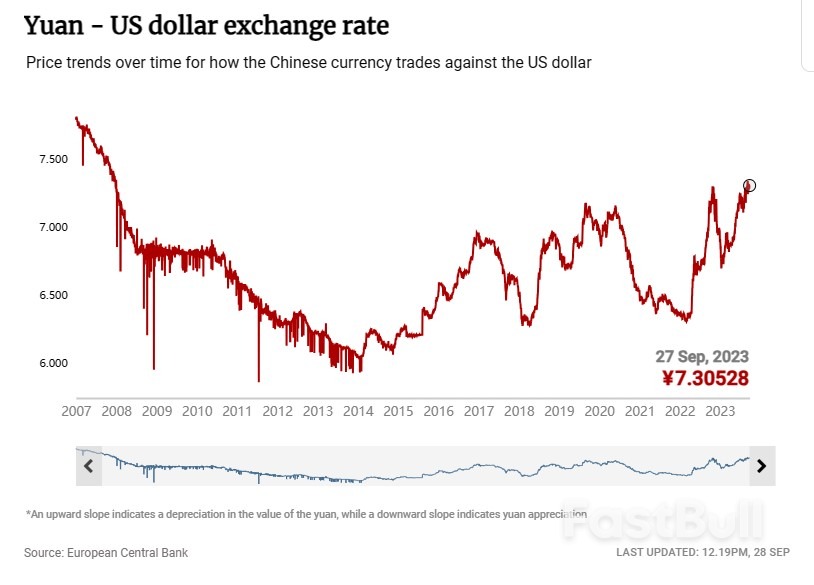
          The Federal Reserve's ability to tame America's monetary bubble remains the biggest factor in the global economic outlook. The US central bank made an unexpected dovish turn at the latest Federal Open Market Committee meeting but has already had to walk some of that back.
          The Fed is on schedule to trim its balance sheet by another US$1.1 trillion next year. There will, without doubt, be financial incidents and an erratic Fed would only make things worse. This could be the biggest threat to the global economy in 2024.
          The US bond market nearly met with disaster in October. Surging bond yields raised doubts over whether the US government could continue to borrow trillions to fund itself. It could be that Washington did something special on the side to calm the market. Certainly, the episode demonstrated the increasing difficulty for the United States to tame inflation, maintain growth and ensure government funding.
          The US government borrowed US$2 trillion from the public in the 2023 financial year. The Congressional Budget Office predicts a fiscal deficit of at least 6 per cent of GDP every year over the next 10 years. The expectation of declining interest rates will help the government to borrow enough to keep things running, which was probably the primary motivation behind the Fed's change of tune.
          The US market welcomed news of the Fed's dovish stand. If the current bubble expands for a few months, inflation is sure to become a more serious issue. Rising paper wealth will lead to more spending. This is a constraint on what the Fed could say. It had to turn around and pour cold water on the market. The Fed needs to ensure the bubble is not too hot or too cold to maintain a stable and growing economy.
          The US is a bubble economy. The most revealing indicator of this is the rising ratio of paper wealth to GDP. The driving force of a macro bubble is always excessive money supply. The Fed's balance sheet is a giveaway in that regard – it expanded it by about US$4 trillion, from about US$900 billion in 2008, to support the financial system during and after the 2008 financial crisis and added another US$4 trillion during the Covid-19 pandemic.
          The second part was a mistake. The pandemic disrupted the supply side and monetary stimulus couldn't do anything about the disruptions. Instead, it just added fuel to the bubble. The Fed has yet to correct this mistake. Its balance sheet has been trimmed by about US$1.2 trillion so far, but the cental bank's balance sheet might never be normalised. Much of the monetary overhang will be absorbed by inflation.
          It was bizarre for the Fed to signal that the inflation fight was over. A tight labour market, elevated food prices and rent, strong wage growth, spreading unionisation and low productivity all point to an inflation-prone economy. There were temporary factors, such as supply chain disruption and surging energy prices, fuelling high inflation beforehand.
          A nice, parabolic inflation chart becomes visible as these factors fade. Some might conclude from this that the recent spell of inflation was just a fluke. If the Fed thought that was the case, it would cut interest rates aggressively. The market would then become white hot, followed by a violent burst, like in 2000 and 2008. The Fed is clearly not that foolish.
          Why An Erratic Fed Could Pose Biggest Risk to Global Economy in 2024_1The world has experienced a massive monetary bubble on the yuan-US dollar peg. The US and China account for about 40 per cent of the global economy. The peg guarantees that the currency market cannot exert pressure on their monetary policy.
          The large monetary expansion stoked a massive property bubble in China and a similar bubble in the US stock market. The Chinese bubble led to overinvestment and overcapacity while that in the US led to overconsumption. They were balanced in their excesses and remained stable.
          China's property bubble has been deflating for two years, while the US has kept its bubble going with massive fiscal deficits. A one-legged global economy isn't a stable situation. If the US wants to carry on in this way, its fiscal deficit will become bigger and bigger. As a result, the US bond market will become the engine for the global economy. Would the world have the confidence to put all its money in this basket?
          The current trend is bad for the US in the long term. The yuan-dollar peg is keeping the US currency overvalued as other currencies have to try to stay competitive against the yuan. A shrinking manufacturing sector and rising trade deficit are symptoms of an overvalued dollar. This is why, despite rising subsidies, US manufacturing is crumbling. The economy is becoming increasingly dependent on government deficit spending.
          US bond yields have to be high to attract enough money to fund the government deficit. If people expect declining interest rates, they will be more willing to put money in the market. The Fed would want to engineer expectations of rate cuts, but not its actual realisation. How long could such a situation last? However long the world remains dumb to the fact, that's to the Fed's benefit. If people wake up, though, all bets would be off.

          Source: South China Morning Post

          To stay updated on all economic events of today, please check out our Economic calendar
          Risk Warnings and Disclaimers
          You understand and acknowledge that there is a high degree of risk involved in trading. Following any strategies or investment methods may lead to potential losses. The content on the site is provided by our contributors and analysts for information purposes only. You are solely responsible for determining whether any trading assets, securities, strategy, or any other product is suitable for investing based on your own investment objectives and financial situation.
          Comments
          Add to Favorites
          Share

          UK Economy Set to Escape Hard Landing in Boost for Rishi Sunak

          Devin

          Economic

          Britain's economy probably will avoid a recession in 2024 and strengthen in the second half of the year as consumers benefit from falling inflation and the easing of a lengthy cost-of-living crisis.
          In aggregate, the 52 economists surveyed by Bloomberg believe the Treasury and the Bank of England (BOE) will engineer a soft landing for the economy next year, with growth of 0.3% and a recession averted.
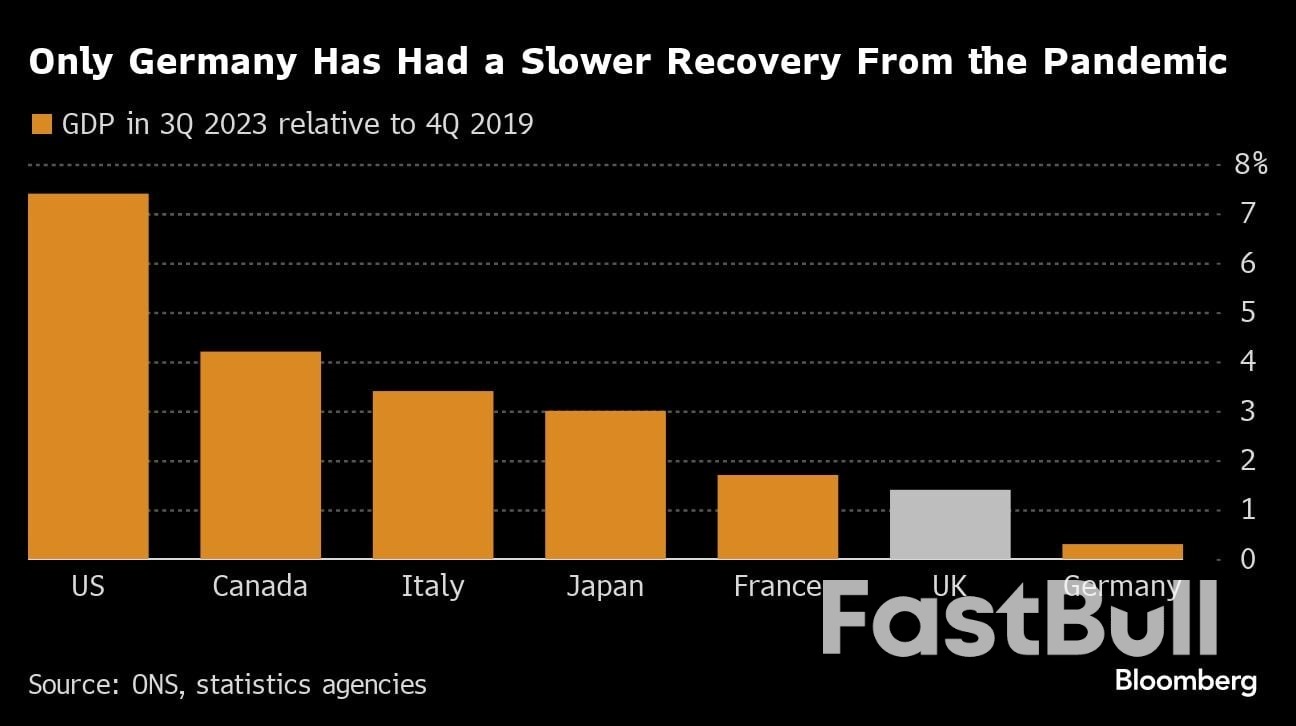
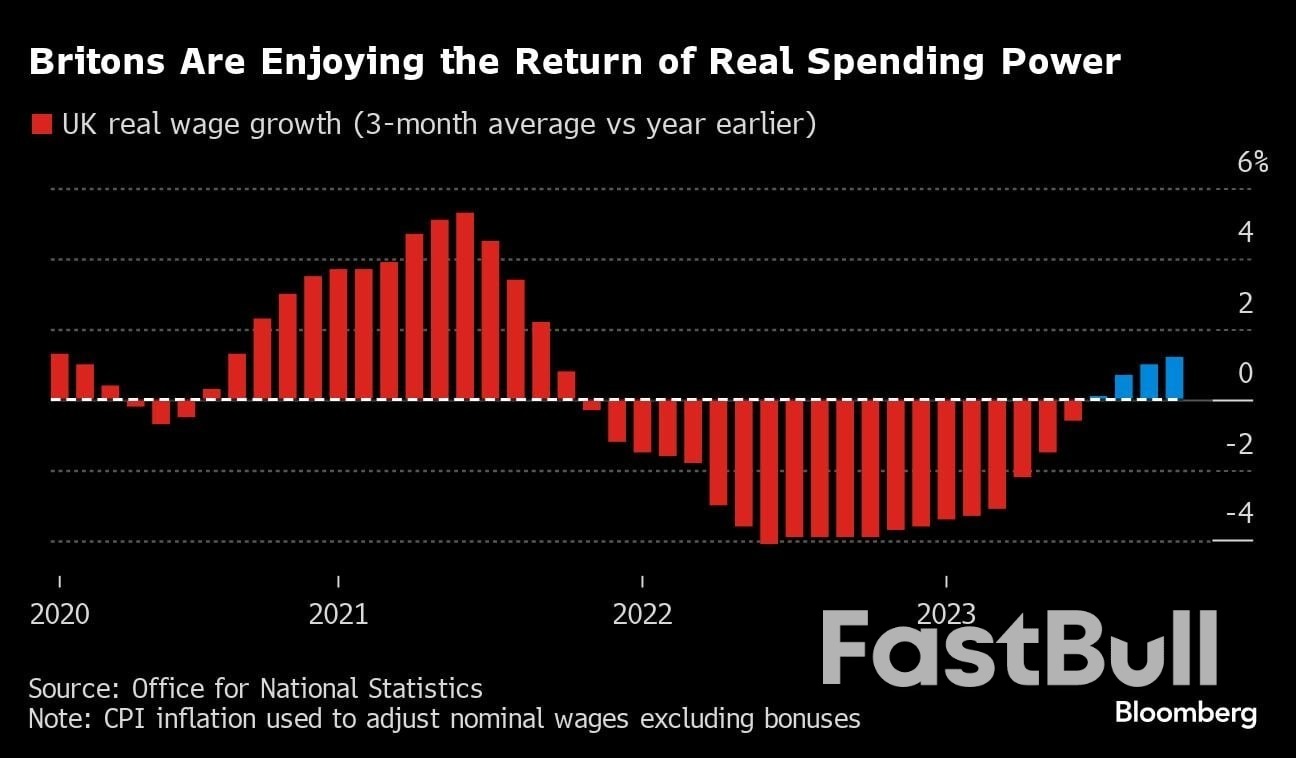
          If the economy is to decide the outcome of the election, which must be called by January 2025, Prime Minister Rishi Sunak's best chance is to wait until the summer, judging by forecasts for the year ahead. While those readings signal Britain will join Germany at the bottom of the Group of Seven (G7) growth table, next year also is expected to deliver an advance in real incomes for consumers after the worst inflation shock in three decades.
          UK Economy Set to Escape Hard Landing in Boost for Rishi Sunak_1"The outlook is far rosier for 2024 than expected 12 months ago," said Barret Kupelian, chief economist at the consulting firm PwC.
          No issue matters more to voters than the economy, with polls by YouGov and Ipsos showing concerns about slipping living standards outranking those about health and immigration. The forecasts show the government's may benefit from waiting until the summer to call a vote.
          UK Economy Set to Escape Hard Landing in Boost for Rishi Sunak_2Sunak and Chancellor of the Exchequer Jeremy Hunt have been laying the groundwork for a growth-enhancing consumer boom, scheduling a budget statement on March 6 to highlight the centrepiece of their agenda.
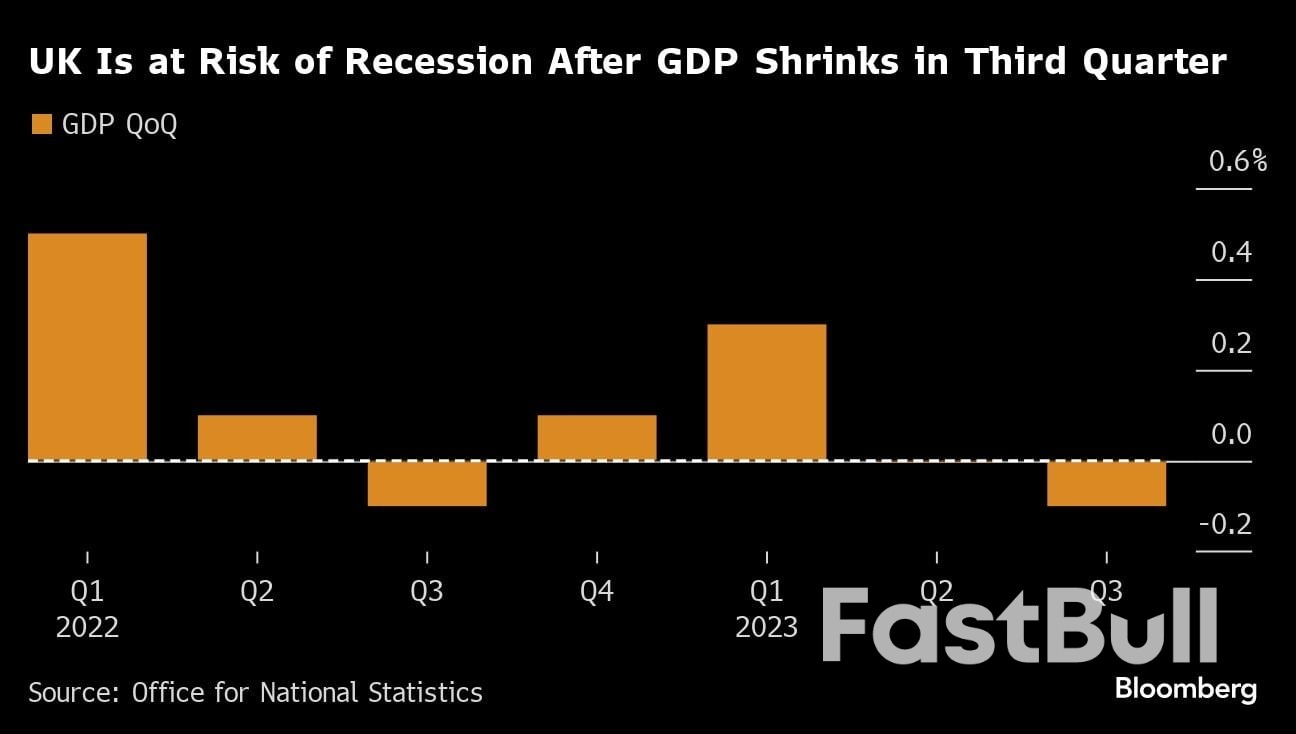
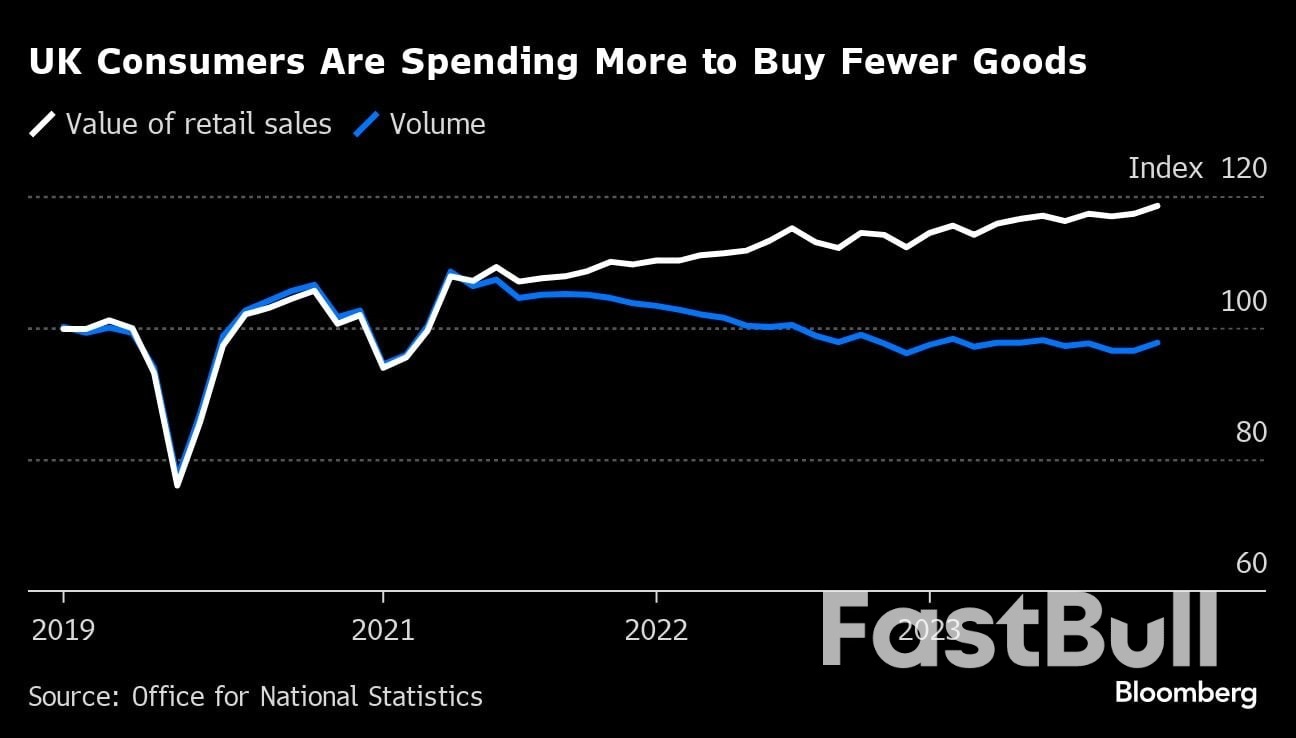
          The starting point for the economy is ugly. Revisions to gross domestic product for the second and third quarters of 2023 suggest the UK may have fallen into recession at the end of this year. Official estimates published on Dec 22 show the economy shrank 0.1% in the third quarter (3Q) as consumers tightened their belts.
          Almost a third of the economists who submitted quarterly forecasts to the Bloomberg survey expect a contraction in the final three months of 2023. That would put the UK in recession under the common definition of two consecutive quarters of negative growth.
          UK Economy Set to Escape Hard Landing in Boost for Rishi Sunak_3Early 2024 will be touch-and-go as well, according to Dan Hanson, senior UK economist at Bloomberg Economics. The UK will "tread a fine line between stagnation and contraction in the first half," he said.
          The backdrop will improve from the summer. In the second half, growth picks up to 0.2% a quarter in the Bloomberg survey. The outlook is for consumer comes to come to the rescue thanks both to government decisions and good luck, according to Simon French, head of research at Panmure Gordon.
          At last month's Autumn Statement, Hunt announced a 9.8% increase in the minimum wage for those aged 21 and over, an 8.5% increase in the state pension and a 6.7% increase in working age benefits. The up-ratings take effect from April.
          At that point, Deutsche Bank chief UK economist Sanjay Raja expects headline inflation to be little more than 2%. For 20 million Britons, it will mean a big, immediate improvement in living standards, French said.
          UK Economy Set to Escape Hard Landing in Boost for Rishi Sunak_4By then, 33 million workers will already be benefitting from the 2% cut in National Insurance from January, which Raja estimates "will add nearly £10 billion (RM58.89 billion) to disposable incomes in 2024."
          An improving outlook would help Sunak and Hunt's argument that they've piloted the UK through a difficult patch following the pandemic and war in Ukraine, which sent inflation soaring.
          In a budget scheduled for March 6, Hunt is expected to put more money in the pockets of consumers by lopping 1% off income tax, handing households £7 billion a year from April.
          UK Economy Set to Escape Hard Landing in Boost for Rishi Sunak_5Sunak and Hunt may also get lucky. The typical household energy bill is on track to fall 14% from £1,928 a year in January to £1,660 in April, according to Cornwall Insight. Raja estimates energy bills will "cost households £10 billion less than they did in 2023."
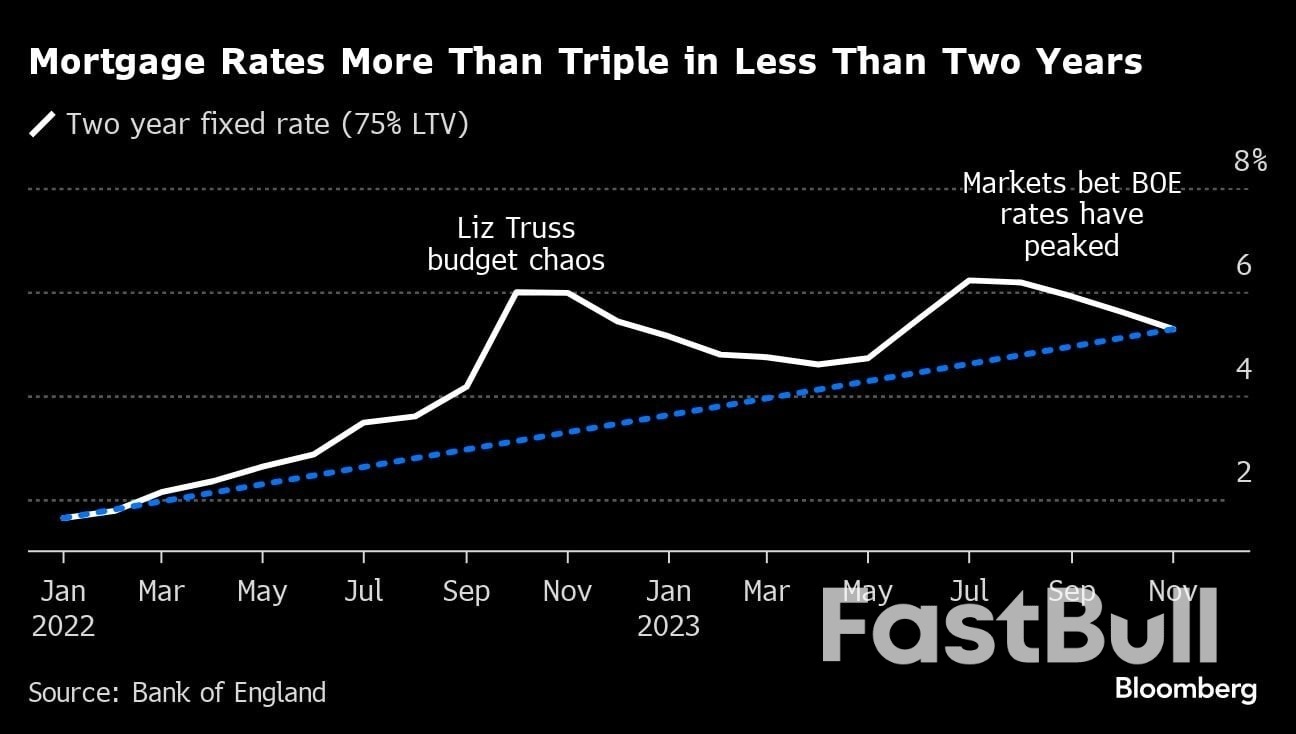
          Consumer price inflation is dropping faster than expected, helping the poorest households the most. That trend has shifted the debate about interest rates away from further increases and toward cuts starting from the middle of next year. Investors are pricing in five quarter-point reductions in the key rate, which at 5.25% now is at the highest level since 2008.
          That sentiment alone is a big help to mortgage borrowers, about 20% of whom will have to refinance their loans next year. With markets tilting towards rate cuts, those whose low-cost deals are ending are facing a much less severe hit than analysts had warned of.
          "We are back on the path to healthy, sustainable growth," Hunt said this month after the surprisingly sharp fall in inflation from to 3.9% for November from 4.6% the month before.
          Living standards still have some way to go to make up ground lost during the pandemic and cost-of-living crisis, but, for the first time since 2018, households may feel noticeably better off.
          "I expect there will be quite a sizeable increase in real household disposable incomes at the back end of next year," French said.
          Charles Goodhart, a former BOE ratesetter, is equally optimistic. "My expectation is that 2024 will look very nice because we're having a reversal of the upsurge in energy prices," he told the Financial Times in mid-December.UK Economy Set to Escape Hard Landing in Boost for Rishi Sunak_6
          Investors are buying into the positive story. The FTSE 100 jumped in the final weeks of 2023. House prices, so often a determinant of consumer confidence, will continue to tread water next year despite the huge rise in interest rates from 0.1% to 5.25% in the past 24 months, mortgage lenders Halifax and Nationwide both reckon.
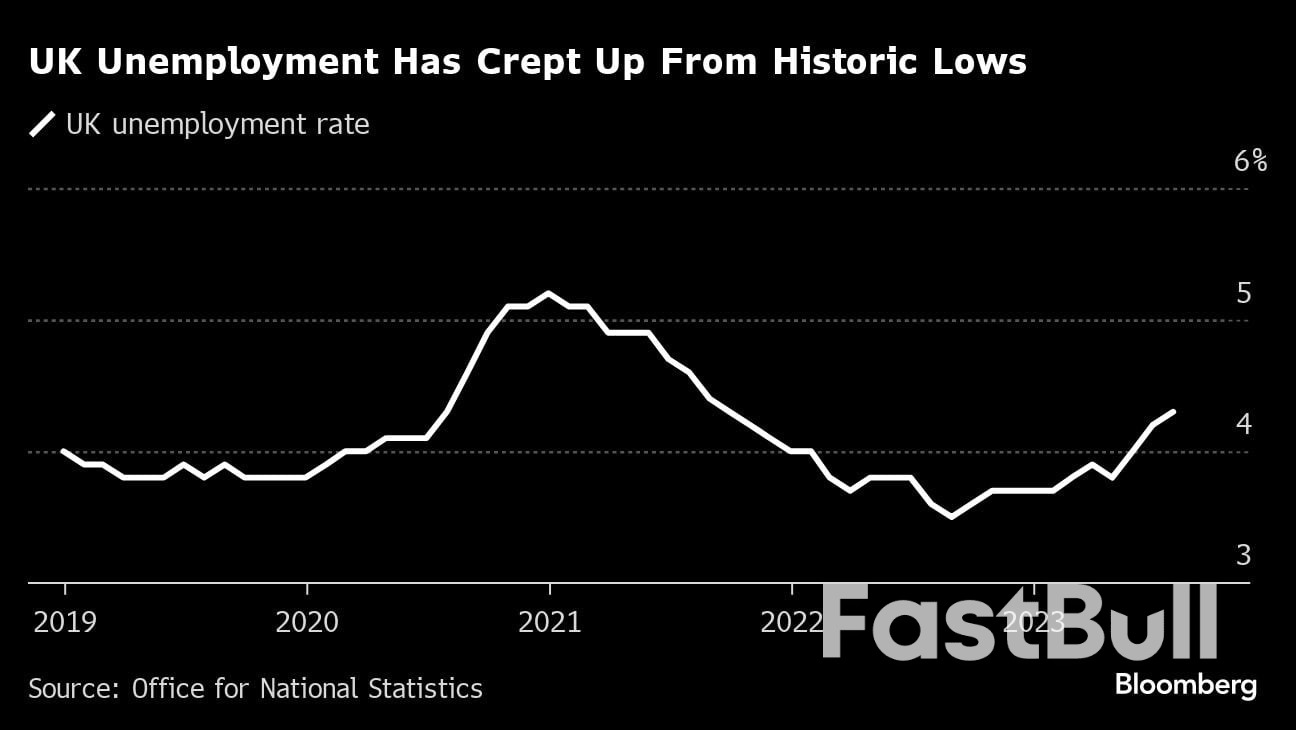
          The UK's resilient labour market will also help. A surge in unemployment, currently at 4.2%, would destabilize the economy but the Bloomberg survey showed that 24 of the 26 economists who provided responses think joblessness will remain below 5% next year.
          UK Economy Set to Escape Hard Landing in Boost for Rishi Sunak_7Households still have some excess savings that were set aside in the pandemic, and "private sector balance sheets are healthy," said Raja, referring to both households and businesses.
          Even so, the outlook remains unusually uncertain. Growth forecasts for 2024 by the economists surveyed range from minus 0.7% to a positive 1.9%, reflecting the risks that remain.
          A flare up of the war in Ukraine or regional expansion of the Israel-Gaza conflict could drive up energy prices once more. Supply chains are at risk of disruption after Houthi rebels attacked commercial shipping in the Red Sea, prompting the US to intervene.
          Hanson said "the main risk is that the economy holds up and inflation proves more stubborn than we expect" so the BOE is unable to provide the anticipated stimulus of rate cuts.
          The economists who provided an inflation forecast for the survey were sanguine, however. The median prediction was 3% and the highest 3.8%.

          Source: Bloomberg

          To stay updated on all economic events of today, please check out our Economic calendar
          Risk Warnings and Disclaimers
          You understand and acknowledge that there is a high degree of risk involved in trading. Following any strategies or investment methods may lead to potential losses. The content on the site is provided by our contributors and analysts for information purposes only. You are solely responsible for determining whether any trading assets, securities, strategy, or any other product is suitable for investing based on your own investment objectives and financial situation.
          Comments
          Add to Favorites
          Share

          Better Jobs Mean Better Development

          Cohen

          Economic

          Conventional economics has always had a blind spot when it comes to jobs. The problem goes back to Adam Smith, who placed consumers, rather than workers, on the throne of economic life.
          Modern economics has since codified this approach by capturing individual well-being in the form of a preference function defined over our consumption bundle. We maximise "utility" by selecting the goods and services that offer us the most satisfaction. Though each consumer is also a worker of some kind, jobs enter the equation only implicitly through the income they provide, by determining how much money we have available to spend on consumption.
          Yet, the nature of one's job has implications far beyond one's budget. Jobs are a source of personal dignity and social recognition. We know that jobs matter because people who lose them tend to experience large and persistent reductions in life satisfaction. The monetary equivalent of such drops is typically a multiple of a person's income, rendering compensation through government transfers (such as unemployment insurance) infeasible for all practical purposes.
          More broadly, jobs are the cement of social life. When decent, middle-class jobs disappear — owing to automation, trade or austerity policies — there are not just direct economic effects but also far-reaching social and political ones. Crime rises, families break apart, addiction and suicide rates soar and support for authoritarianism increases.
          When economists and policymakers think of social justice, they typically focus on the "distributive" variety — who gets what? But, as political philosopher Michael J Sandel argues, perhaps a more important yardstick is "contributive justice", which refers to the opportunities to win the social respect that comes with good jobs and "producing what others need and value".
          While these issues are typically considered in the context of advanced economies, they are equally important for developing countries.
          In fact, people moving from bad jobs to better jobs encapsulates the entire process of structural change that drives economic development. Unlocking this process in a rapid and sustainable manner is crucial and industrialisation, historically, has been the main engine for doing so.
          The trouble now is that manufacturing industries are no longer the labour-absorbing sectors they once were. A combination of factors — particularly the increased skill- and capital-intensity of modern manufacturing methods and stiff international competition to join global value chains — has made it very difficult for developing economies to increase employment in formal manufacturing. Even countries with strong industrial sectors — not least China — are experiencing declines in manufacturing as a share of total employment.
          The inevitable consequence of these trends is that the bulk of the better jobs will have to be generated in services, both in developing and developed countries. But since most services in developing countries are highly unproductive and informal, this shift poses a major challenge. Making matters worse, most governments are unaccustomed to thinking of service sectors as growth engines. Growth policies — whether they relate to research and development, governance, regulation or industrial policies — typically target large manufacturing firms that compete on world markets.
          Difficult though it may be, governments must learn how to enhance productivity and employment simultaneously in labour-intensive service sectors. That means adopting measures with many of the same features of "modern industrial policy," whereby the state, in exchange for job creation, pursues close, iterative collaboration with firms to remove obstacles to their expansion.
          There are already some examples of this model around the world. Consider the Indian state of Haryana's partnership (begun in 2018) with the ride-hailing services Ola and Uber. Established with the goal of increasing employment for young people by making it easier for these firms to identify and hire drivers, this public-private partnership is based on a clear quid pro quo. Haryana has eased regulations that hampered the services' growth, shared databases of unemployed youth and held exclusive job fairs for the companies, which in turn have made (soft) commitments to employ a meaningful number of young people.
          The agreement is dynamic. Allowing the terms to adapt to changing circumstances helps to build mutual trust without binding the firms to rigid conditionalities. In less than a year, the partnership has created more than 44,000 new jobs for Haryana's youth.
          Of course, services are a hotchpotch of different activities, with great heterogeneity in the size and shape of firms. Any realistic programme to expand productive employment in services will have to be selective, focusing on those firms and subsectors that are more likely to be successful. There will be a need for experimentation and local governments — municipalities and sub-national authorities — will often be in a better position than national officials to carry out pilot programmes.
          Ultimately, economic growth and equity both require a jobs-centred approach to development. While economic growth is possible only if workers move towards better, more productive jobs, equity requires improvements in the employment prospects for workers at the bottom of the income distribution.
          A services-based model cannot generate the kind of growth miracles that export-oriented industrialisation produced in the past. But it can still lead to higher-quality growth with much greater social inclusion and a broader middle class.

          Source: The Edge Malaysia

          To stay updated on all economic events of today, please check out our Economic calendar
          Risk Warnings and Disclaimers
          You understand and acknowledge that there is a high degree of risk involved in trading. Following any strategies or investment methods may lead to potential losses. The content on the site is provided by our contributors and analysts for information purposes only. You are solely responsible for determining whether any trading assets, securities, strategy, or any other product is suitable for investing based on your own investment objectives and financial situation.
          Comments
          Add to Favorites
          Share

          Year-End Thoughts and What to Expect in 2024

          SAXO

          Economic

          The year of extremes and divergences
          Just as one could not imagine equities to be crazier it did happen in 2023. It is always difficult to summarize a year in all its details but below are some of the key events to reflect on.
          Consensus was clearly in the recession camp but the global economy proved to be resilient against aggressive monetary policy hikes.
          Monetary policy lags have turned out to be historical long this time most likely due to the extended period the economy was in an ultra-low interest rate environment.
          There were great hopes for China, but the year proved to be the year of many false starts and the once unbeatable country is facing serious structural growth issues.
          The rapidly rising interest rates caused for a brief period a banking crisis that was quickly contained and isolated to a few weak banks. Silicon Valley Bank went bankrupt and UBS took over Credit Suisse.
          The market was convinced that the central bank would cave in during 2023 but instead central banks were steadfast and bolstered the “higher for longer” narrative pushing the US 10-year yield to 5% before aggressively falling back to the levels where they started the year.
          Generative AI became the talk on Wall Street and investors rushed to get in on the action as Nvidia delivered two monster earnings releases on a level never seen before in history.
          The technology hype cycle over generative AI pushed US equity markets to new historical highs in terms of index concentration with the “magnificent seven” stocks outperforming the S&P 500 by a factor of four.
          Hopes were high for a geopolitical breakthrough in Ukraine that could force Russia to negotiate peace but instead the war transcended into a WWI style war of attrition with no end in sight.
          To make matters worse in geopolitics a new hot spot emerged in the Middle East with Hamas attack on Israeli civilians and subsequent brutal invasion of Gaza by Israeli forces. Recently the conflict has led to attacks on ships in the Red Sea forcing ships from Asia to Europe to reroute around Africa at increased costs.
          As much as technology was the winner in the global equity market, so was the green transformation stocks the biggest losing theme driven by an industry crisis in wind turbines and inventory glut in solar panels.
          COP28 ended with the promise to start the era of declining consumption of fossil fuels. The rapid adoption of energy efficient solutions and in particular fast adoption of electric vehicles is already causing significant impact on oil markets. This trend will be hugely important for Saudi Arabia and Russia in the years to come shaping geopolitics.
          While central bank policy was more or less synchronized Bank of Japan held on to its negative policy rates and yield-curve-control of the 10-year maturities government bonds. The divergent policy with the rest of the world left JPY to absorb all pressures leaving the financial market wondering when Bank of Japan will come back to the real world.
          The strong USD and high interest rates had a negative impact on emerging market equities which once again underperformed and has moved to the dustbin of history, at least for now. Global investors seem increasingly uninterested in emerging markets.
          Embrace for surprises in 2024
          As 2023 is coming to an end investors will be wondering whether 2024 can once again surprise everyone. Consensus is increasingly betting on a mild recession in the US economy somewhere around mid-year. Under the assumption that consensus is always wrong this leads to two paths in 2024, 1) a hard landing scenario as high interest rates finally bite, or 2) a reacceleration of growth in the global economy. Growth remains ugly in Europe albeit stabilizing in a mild recession dynamic while the US economy remains resilient.
          Next year will evolve around the following key topics:
          Will inflation and wages prove stickier than expected and thus forcing central banks to keep policy rates higher for longer?
          If Bank of Japan comes back to the normal world of interest rates will set in motion deleveraging dynamics as JPY has been used as key funding currency for carry trades?
          General elections in India (Apr), US (Nov) and potentially UK (latest call in Dec) all have the ingredients to surprise markets and add to geopolitical risks.
          Can US technology live up to the extreme expectations for earnings growth all will 2024 make it painfully clear that investors got carried away again.
          Will the world get another upside surprise from generative AI that will unleash animal spirits once again?
          Will the global economy fall into a recession or reaccelerate? Here China plays a crucial role. The key risk to the economy is the expected lower fiscal impulse in Europe and the US.
          Will technology adoption in electric vehicles be another year of extreme growth marking the beginning of the end for crude oil market as we have come to know it? Will it force Saudi Arabia to make hasty decisions?
          Will emerging markets stage a comeback in financial markets or disappoint once more?
          If interest rates continue lower will green transformation stocks maybe become the biggest winner of 2024?
          Can peace be achieved in the Middle East and will Ukraine muster enough support from the EU and US to avoid losing more territory to Russia as the war drags into its third year in 2024?
          One thing is for sure, financial markets and geopolitical events will never stop surprising us and investors must be ready to embrace uncertainty as a new year is set to begin.
          To stay updated on all economic events of today, please check out our Economic calendar
          Risk Warnings and Disclaimers
          You understand and acknowledge that there is a high degree of risk involved in trading. Following any strategies or investment methods may lead to potential losses. The content on the site is provided by our contributors and analysts for information purposes only. You are solely responsible for determining whether any trading assets, securities, strategy, or any other product is suitable for investing based on your own investment objectives and financial situation.
          Comments
          Add to Favorites
          Share

          The Stock Market Story of 2023? The Growing Domination of US Tech

          Damon

          Stocks

          In the old days, there were the FAANGs, the five big US tech stocks that dominated the investment landscape – Facebook (now Meta), Amazon, Apple, Netflix and Google (now Alphabet). That picture is now out of date. Say hello instead to what is variously called the Super Seven or the Magnificent Seven – four of the above (the dropout being Netflix) plus Microsoft, Tesla and the chip-maker Nvidia. This group's domination is the stock market story of 2023.
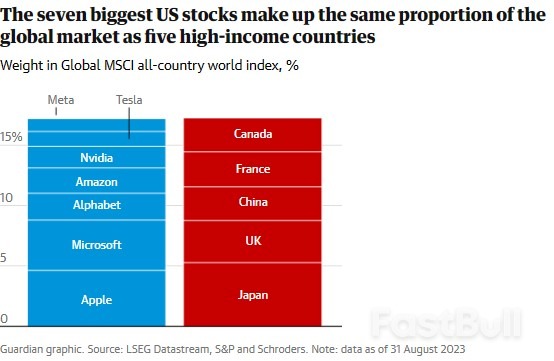
          The chart below is "one for the ages", says Duncan Lamont, the head of strategic research at the fund manager Schroders. It shows how, even if you invest via one of the broadest and most widely used "global" stock market indices, you will end up with a portfolio that is very American and very skewed towards US tech.
          The index is the MSCI All Country World Index (ACWI), which covers approximately 85% of "the global investable equity opportunity", as the compilers put it, by measuring almost 3,000 large and mid-sized companies in 23 developed markets and 24 emerging ones. The bigger a company becomes in value, the greater its weighting in the index.
          The Stock Market Story of 2023? The Growing Domination of US Tech_1The seven are now so big that they account for 17.2% of the whole thing, while the combined representatives of Japan, the UK, China, France and Canada contribute 17.3%. Seven US companies equals five countries. "This is far from diversified exposure," says Lamont. Apple alone, with a market value of $3tn, is bigger than the entire UK stock market.
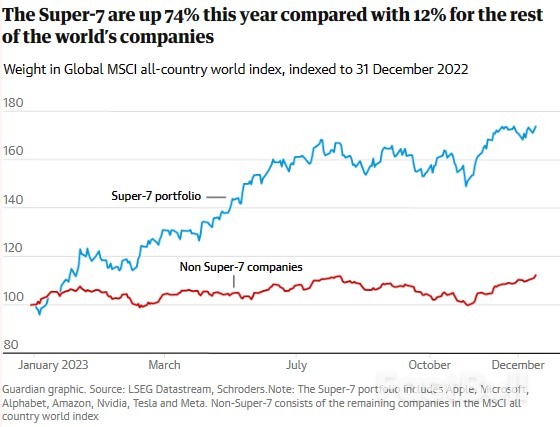
          The numbers have become so astonishing, in part, because of what is shown in the second chart. Up to last week, the group of seven has risen in value by 74% in 2023. The rest of the world's equities, within the same ACWI index, have managed 12%. If your portfolio did not include the Magnificent Seven in 2023, it was hard to keep up.
          Is this degree of concentration healthy? It's certainly unprecedented. Thanks to the whoosh from the seven during 2023, US stocks now account for 63% of the supposedly global ACWI. Even in the go-go days of the Japanese economic miracle, the country accounted for only 44% of the same index. "The US has far exceeded the level of concentration of Japan in the 1980s, which everyone thought was extreme at the time," says Lamont.
          The Stock Market Story of 2023? The Growing Domination of US Tech_2Yet it would be hard to argue that the rise of the seven has been fuelled by the type of wild speculation that created the turn-of-the-century dotcom bubble. The 240% rise in Nvidia's stock price this year may or may not be overdone, but it's undeniable that the company's order book for computer chips is booming as the artificial intelligence (AI) revolution arrives.
          It would also be wrong to think of the seven as entirely alike. All have leading positions in growing markets and Amazon, Google and Microsoft have big cloud services divisions. But Amazon's retail division has little in common with Google's search business and Microsoft's core software business is different again. All may benefit from AI, which helps to explain the stock market's renewed love affair with technology in 2023 after a heavy "down" year in 2022, but the degrees will differ. Tesla remains, primarily, a maker of electric vehicles.
          Instead, it's probably more sensible just to think through the implications of such extreme market concentration. In a broadly exposed investment portfolio a lot of risk – in both directions – is driven by just seven stocks.
          Lamont makes a couple of points. First, the statistically correct observation that the US stock market is now priced at nose-bleed levels, historically speaking, isn't telling the full story. Rather, it's reflecting the influence of the seven. "US exceptionalism is not all stocks," he says. "It is a small number crushing everything in the path." The average US stock is not expensive by traditional investment yardsticks.
          Second, there is scope for disappointment when stocks are priced for perfection. The Schroders research found that periods of high concentration in markets have tended to be followed by periods of poorer performance by the bigger stocks. "This time may be different, and we are in uncharted territory to an extent," concedes Lamont.
          You could say it suits Schroders, as an active management house, to suggest the pendulum is about to swing away from passive index-followers. But the basic point feels intuitively correct: the current concentration is extraordinary, out of whack with historical norms and the relative lack of diversification is possibly underappreciated by investors. Timing is always a mug's game – but a reversal looks the way to bet.

          Source: The Guardian

          Risk Warnings and Disclaimers
          You understand and acknowledge that there is a high degree of risk involved in trading. Following any strategies or investment methods may lead to potential losses. The content on the site is provided by our contributors and analysts for information purposes only. You are solely responsible for determining whether any trading assets, securities, strategy, or any other product is suitable for investing based on your own investment objectives and financial situation.
          Comments
          Add to Favorites
          Share

          Dubai's Red-Hot Property Market Is Bracing for A Slowdown

          Devin

          Economic

          Just nine months after buying their first property in Dubai, Dina Habib and Karim Yusuf are already planning their next move within the city.
          The Egyptian couple, who spent eight years renting in the emirate, are selling their two-bedroom apartment in the Jumeirah Village Circle district on the edge of Dubai for a 26% premium over the 1.7 million dirhams (RM2.15 dirhams) they paid for the property in March.
          Habib is hoping to secure a larger property for her family of three for the same price or less.
          "For many years, we've paid someone else's mortgage because we were scared to buy in a market that went up and down," said the 39-year-old researcher. "Now, we think the market may have peaked and so we're planning to sell and buy a house with a garden next year when prices hopefully fall a bit."
          Habib and Yusuf are among hundreds of thousands of homeowners attempting to navigate Dubai's red-hot housing market, which has outperformed most others around the world this year. They join tenants, property analysts and developers in trying to predict whether the market is finally starting to turn as a slew of new properties are delivered and global economic uncertainty catches up with the emirate.
          So far, the boom has been underpinned by an influx of wealthy investors such as Russians seeking to shield their assets, crypto millionaires and rich Indians seeking second homes. The government's handling of the pandemic and its liberal visa policies also attracted more foreign buyers.
          Since January 2020, rentals in the emirate have surged about 42%, while home prices have jumped roughly 33%, according to property advisory firm CBRE Group Inc. Villa rentals have seen some of the biggest increases and now go for an average of US$88,400 (RM411,314) a year.
          The surge has pushed many tenants like Habib to take the plunge and buy a property to avoid repeated rent hikes or being pushed even further out of the city. After her landlord increased the rent on her two-bedroom property by 16% over three years, Habib bought the apartment she's now trying to sell.
          Dubai's property market has long been known for sharp booms and busts, with one of its most dramatic downturns coming in 2009, following years of debt-fuelled growth. The crash left some of its largest developers on the brink of bankruptcy. Prices rebounded in 2011 before slumping again in 2014 after an oil price collapse hurt regional economies. Since then, the government has introduced a series of reforms for buyers and developers to limit volatility including raising required down payments for mortgages to 20%.
          Still, selling a property "in the hope of picking up a similar property next year at a lower price is a risky bet," said Taimur Khan, CBRE's head of research who expects price increases to moderate at between 5% and 10% next year, but doesn't see "a compelling argument for why prices will fall when the population continues to increase and the economy is growing."
          For now at least, there's little evidence across the city that the market is starting to slow. Long traffic jams block the emirate's major highways even on weekends, waiting lists for member clubs run impossibly long and student enrollments at schools have surged 12% this year, their biggest increase since 2007.
          ‘Less of a boom'
          But some analysts are starting to warn that 2024 could mark a turning point. Earlier this month, Morgan Stanley said that it sees "continued tailwinds" for the market and expects next year to be "less of a boom than 2023."
          And while rents continue to increase to eye-popping levels, the rate of the surge is cooling in some of the city's most popular neighbourhoods. In November, the average rent rose 19.2%, slightly lower than the 19.7% growth registered in October, according to CBRE.
          At the same time, the number of property transactions fell 13% in November from a year earlier mainly due to a 26.4% slump in off-plan sales as new projects sold out and developers ran out of inventory. Still, sales of existing homes rose 5.1% that month.
          Prathyusha Gurrapu, head of research and advisory at the property firm Cushman & Wakefield Core, also expects prices to moderate — but not fall — next year. She says population growth will support the market and "if the Fed cuts interest rates, that will encourage mortgage buyers." Mortgages currently account for only about a quarter of all property transactions in Dubai, according to Morgan Stanley.
          S&P last month said it expects home prices to rise 5% to 7% next year before declining 5% to 10% over the following 12 to 18 months as global economic uncertainty and an uptick in the supply of new homes impact the market.
          "There are no big signs of the cycle turning already but we know that buyers are downsizing a bit so average property size is shrinking," said Tatjana Lescova, S&P's associate director of corporate ratings. "The bulk of the market is coming to a certain limit in terms of purchasing power."
          Developer shift
          After a record year for new sales and launches, developers are also starting to adapt.
          S&P expects about 40,000 properties to be delivered in Dubai next year and the same number in 2025. That's a lot compared to previous years at between 15,000 to 30,000 homes. As a result, Morgan Stanley expects developers' focus to shift to earnings growth as such large backlogs are executed, although companies usually deliver fewer properties than estimated.
          Dubai's track record of boom-bust cycles is unsettling for Mohamed Alabbar, founder of Emaar Properties PJSC, which built the world's tallest skyscraper and accounts for about 30% of Dubai's property market. Emaar Development, the construction unit, has seen revenue backlog from property sales in its home market surge 60% from a year earlier to 59.6 billion dirhams as of Sept 30.
          Emaar, which is set to record its highest annual profit since 2012, is using the city's booming economy as an opportunity to manage its finances, but Alabbar remains cautious. Project execution and the health of the balance sheet of contractors are among his biggest concerns.
          "Dubai is flying. The UAE is flying. But this is the time to think what can go wrong," Alabbar said in a recent interview.
          Hussain Sajwani, the founder of Damac Properties PJSC, one of Dubai's largest privately-owned developers, said he doesn't think the emirate's real estate market is overheating just yet and expects the increase in prices to stabilise. Still, the billionaire is also finding it difficult to predict what may happen next year.
          Prices could fluctuate "about 10% up or down," he said in an interview with Bloomberg TV earlier this month.

          Source: Bloomberg

          To stay updated on all economic events of today, please check out our Economic calendar
          Risk Warnings and Disclaimers
          You understand and acknowledge that there is a high degree of risk involved in trading. Following any strategies or investment methods may lead to potential losses. The content on the site is provided by our contributors and analysts for information purposes only. You are solely responsible for determining whether any trading assets, securities, strategy, or any other product is suitable for investing based on your own investment objectives and financial situation.
          Comments
          Add to Favorites
          Share

          Bonds, Cash or Gold for 2024?

          Thomas

          Economic

          Commodity

          Bond

          How should you allocate your portfolio assets for 2024, a year of grave uncertainty?
          The good ol' 60/40 rule of 60% equity and 40% bonds and cash portfolio allocation is alive and well in 2023, although returns have been driven solely by equities. Fixed income, traditionally 40% of such portfolios, faced a third consecutive year of losses as interest rates rose. According to JPMorgan Asset Management, overall portfolio year-to-date gains in 2023 were nearly 7%, as bonds have underperformed. Equity gains were due mostly to a narrow band of tech stocks. Will next year be better?
          Portfolio performance is closely related to two fundamental factors — the state of the economy and market interest rates. Since most of the global economy is still struggling, with only the US economy holding up reasonably, the key variable now is the trajectory of US interest rates, which may signal how portfolios will perform.
          The US Federal Reserve interest rate policy has been the central culprit behind the recent multi-year fixed-income losses. When interest rates rise, bond prices fall.
          After forcefully raising rates 11 times from 2022 to 2023, the Fed has opted to keep rates at the 5.25% to 5.50% level since July.
          The market views this positively as a sign that inflation has peaked, clearing the way for future rate cuts.
          The higher interest rates have not only affected growth prospects, but also asset prices, such as real estate and the price of bonds, which then in turn affect the quality of balance sheets, since those countries and companies with excess debt may keel over, causing financial instability.
          The Fed's November Beige Book that compiles data and anecdotes on economic conditions sampled across the US revealed that price increases had “largely moderated” but “remained elevated” with expectations of further but moderate inflation. The report found that prospects had diminished over the next six to 12 months as consumers showed greater price sensitivity, while manufacturers' outlook also weakened. Loan appetite was softer, which dampened commercial and residential real estate activity.
          Governor Christopher Waller, a Republican member of the Fed Open Markets Committee, recently signalled some indication that rates may have peaked, entering a phase when data numbers on inflation and jobs will shape key decisions on whether to cut interest rates.
          Given these conditions, JPMorgan forecasts that rate cuts could begin in the middle of next year, with the effect of eventually seeing 10-year Treasury yields reaching 3.75% by year end (currently 4.2%). This implies a soft landing would be achieved, with the US economy gliding down to 0.7% growth in 2024. In this orderly scenario, bond prices would rise as yields fall from the highs.
          JPMorgan suggests that US corporate investment-grade bonds may achieve total returns of 12.4%. US high-yield bonds may also benefit, but to a lesser degree due to higher credit risks.
          Other analysts, such as HSBC Asset Management, offer a slightly different view, noting that credit spreads often widen at the end of almost every Fed tightening cycle since 1980, as high interest rates squeeze the borrower. Profits erode and overleveraged corporations are exposed. In short, credit risks will hurt corporate bond prices. Thus, 10-year yields may fall to 3% by end-2024, but HSBC recommends buying long-dated inflation-protected Treasury bonds (TIPS), which currently offer a higher return than the projected long-term real gross domestic product (GDP) growth of 1.85%.
          What about other markets? If the US is heading for a soft landing, Europe is still struggling to deal with the effects of the Ukraine war and higher inflation. China is facing deflationary pressure from the soft real estate market and declining consumer/corporate confidence. With war in Gaza and a massive devaluation in Argentina, the rest of the world worries about how overall trade will perform.
          Deutsche Bank forecasts that global GDP growth will slow to 2.4% in 2024, down from 3.2% this year. This projection assumes that India and China will need to grow by 6% and 4.7% respectively. Complications remain. According to United Nations Conference on Trade and Development (UNCTAD), global trade is expected to shrink 5% to US$30.7 trillion (RM143 trillion) this year, with diminishing prospects for next year. International Monetary Fund (IMF) first deputy managing director Gita Gopinath has warned that up to 7% of global GDP is at risk from economic fragmentation and the departure from open trade.
          That is not all. The year 2024 will also be an election year for many countries with implications for global geopolitics. This cycle begins with the January presidential vote in Taiwan. But the most consequential one would be the November US presidential election. Current polls suggest that if he is not indicted first, Trump may win that election, signalling four more years of controversial policies. However, the consensus view is that US antagonistic policies on China will remain unchanged.
          Fear and uncertainty naturally spur a flight to safe assets, traditionally towards the US dollar and Treasuries. Yet ongoing scrutiny of American creditworthiness stemming from the government's propensity to favour politics over fiscal responsibility is pushing the other safe-haven asset — gold. The gold price touched US$2,100 per ounce, a historical high, partly due to prospect of lower interest rates, but also because gold does not have counterparty risks.
          Small wonder that countries have brought their gold back to their own central bank vaults.
          All signs point towards investor cautiousness, irrespective of preferences for bonds, gold or cash. One thing is clear — the confluence of multiple unexpected events from geopolitics, climate disasters, war and tech disruption means higher market volatility. Mind the bumps.

          Source: The Edge Malaysia

          To stay updated on all economic events of today, please check out our Economic calendar
          Risk Warnings and Disclaimers
          You understand and acknowledge that there is a high degree of risk involved in trading. Following any strategies or investment methods may lead to potential losses. The content on the site is provided by our contributors and analysts for information purposes only. You are solely responsible for determining whether any trading assets, securities, strategy, or any other product is suitable for investing based on your own investment objectives and financial situation.
          Comments
          Add to Favorites
          Share
          FastBull
          Copyright © 2025 FastBull Ltd

          728 RM B 7/F GEE LOK IND BLDG NO 34 HUNG TO RD KWUN TONG KLN HONG KONG

          TelegramInstagramTwitterfacebooklinkedin
          App Store Google Play Google Play
          Products
          Charts

          Chats

          Q&A with Experts
          Screeners
          Economic Calendar
          Data
          Tools
          Membership
          Features
          Function
          Markets
          Copy Trading
          Latest Signals
          Contests
          News
          Analysis
          24/7
          Columns
          Education
          Company
          Careers
          About Us
          Contact Us
          Advertising
          Help Center
          Feedback
          User Agreement
          Privacy Policy
          Business

          White Label

          Data API

          Web Plug-ins

          Poster Maker

          Affiliate Program

          Risk Disclosure

          The risk of loss in trading financial instruments such as stocks, FX, commodities, futures, bonds, ETFs and crypto can be substantial. You may sustain a total loss of the funds that you deposit with your broker. Therefore, you should carefully consider whether such trading is suitable for you in light of your circumstances and financial resources.

          No decision to invest should be made without thoroughly conducting due diligence by yourself or consulting with your financial advisors. Our web content might not suit you since we don't know your financial conditions and investment needs. Our financial information might have latency or contain inaccuracy, so you should be fully responsible for any of your trading and investment decisions. The company will not be responsible for your capital loss.

          Without getting permission from the website, you are not allowed to copy the website's graphics, texts, or trademarks. Intellectual property rights in the content or data incorporated into this website belong to its providers and exchange merchants.

          Not Logged In

          Log in to access more features

          FastBull Membership

          Not yet

          Purchase

          Become a signal provider
          Help Center
          Customer Service
          Dark Mode
          Price Up/Down Colors

          Log In

          Sign Up

          Position
          Layout
          Fullscreen
          Default to Chart
          The chart page opens by default when you visit fastbull.com