• Trade
  • Markets
  • Copy
  • Contests
  • News
  • 24/7
  • Calendar
  • Q&A
  • Chats
Trending
Screeners
SYMBOL
LAST
BID
ASK
HIGH
LOW
NET CHG.
%CHG.
SPREAD
SPX
S&P 500 Index
6827.42
6827.42
6827.42
6899.86
6801.80
-73.58
-1.07%
--
DJI
Dow Jones Industrial Average
48458.04
48458.04
48458.04
48886.86
48334.10
-245.98
-0.51%
--
IXIC
NASDAQ Composite Index
23195.16
23195.16
23195.16
23554.89
23094.51
-398.69
-1.69%
--
USDX
US Dollar Index
97.950
98.030
97.950
98.500
97.950
-0.370
-0.38%
--
EURUSD
Euro / US Dollar
1.17394
1.17409
1.17394
1.17496
1.17192
+0.00011
+ 0.01%
--
GBPUSD
Pound Sterling / US Dollar
1.33707
1.33732
1.33707
1.33997
1.33419
-0.00148
-0.11%
--
XAUUSD
Gold / US Dollar
4299.39
4299.39
4299.39
4353.41
4257.10
+20.10
+ 0.47%
--
WTI
Light Sweet Crude Oil
57.233
57.485
57.233
58.011
56.969
-0.408
-0.71%
--

Community Accounts

Signal Accounts
--
Profit Accounts
--
Loss Accounts
--
View More

Become a signal provider

Sell trading signals to earn additional income

View More

Guide to Copy Trading

Get started with ease and confidence

View More

Signal Accounts for Members

All Signal Accounts

Best Return
  • Best Return
  • Best P/L
  • Best MDD
Past 1W
  • Past 1W
  • Past 1M
  • Past 1Y

All Contests

  • All
  • Trump Updates
  • Recommend
  • Stocks
  • Cryptocurrencies
  • Central Banks
  • Featured News
Top News Only
Share

Ukraine's Navy Says Russian Drone Attack Hit Civilian Turkish Vessel Carrying Sunflower Oil To Egypt On Saturday

Share

Israeli Military Says It Put Planned Strike On South Lebanon Site On Hold After Lebanese Army Requested Access

Share

Norwegian Nobel Committee: Calls On The Belarusian Authorities To Release All Political Prisoners

Share

Norwegian Nobel Committee: His Freedom Is A Deeply Welcome And Long-Awaited Moment

Share

Ukraine Says It Received 114 Prisoners From Belarus

Share

USA Embassy In Lithuania: Maria Kalesnikava Is Not Going To Vilnius

Share

USA Embassy In Lithuania: Other Prisoners Are Being Sent From Belarus To Ukraine

Share

Ukraine President Zelenskiy: Five Ukrainians Released By Belarus In US-Brokered Deal

Share

USA Vilnius Embassy: USA Stands Ready For "Additional Engagement With Belarus That Advances USA Interests"

Share

USA Vilnius Embassy: Belarus, USA, Other Citizens Among The Prisoners Released Into Lithuania

Share

USA Vilnius Embassy: USA Will Continue Diplomatic Efforts To Free The Remaining Political Prisoners In Belarus

Share

USA Vilnius Embassy: Belarus Releases 123 Prisoners Following Meeting Of President Trump's Envoy Coale And Belarus President Lukashenko

Share

USA Vilnius Embassy: Masatoshi Nakanishi, Aliaksandr Syrytsa Are Among The Prisoners Released By Belarus

Share

USA Vilnius Embassy: Maria Kalesnikava And Viktor Babaryka Are Among The Prisoners Released By Belarus

Share

USA Vilnius Embassy: Nobel Peace Prize Laureate Ales Bialiatski Is Among The Prisoners Released By Belarus

Share

Belarusian Presidential Administration Telegram Channel: Lukashenko Has Pardoned 123 Prisoners As Part Of Deal With US

Share

Two Local Syrian Officials: Joint US-Syrian Military Patrol In Central Syria Came Under Fire From Unknown Assailants

Share

Israeli Military Says It Targeted 'Key Hamas Terrorist' In Gaza City

Share

Rwanda's Actions In Eastern Drc Are A Clear Violation Of Washington Accords Signed By President Trump - Secretary Of State Rubio

Share

Israeli Military Issues Evacuation Warning In Southern Lebanon Village Ahead Of Strike - Spokesperson On X

TIME
ACT
FCST
PREV
U.K. Trade Balance Non-EU (SA) (Oct)

A:--

F: --

P: --

U.K. Trade Balance (Oct)

A:--

F: --

P: --

U.K. Services Index MoM

A:--

F: --

P: --

U.K. Construction Output MoM (SA) (Oct)

A:--

F: --

P: --

U.K. Industrial Output YoY (Oct)

A:--

F: --

P: --

U.K. Trade Balance (SA) (Oct)

A:--

F: --

P: --

U.K. Trade Balance EU (SA) (Oct)

A:--

F: --

P: --

U.K. Manufacturing Output YoY (Oct)

A:--

F: --

P: --

U.K. GDP MoM (Oct)

A:--

F: --

P: --

U.K. GDP YoY (SA) (Oct)

A:--

F: --

P: --

U.K. Industrial Output MoM (Oct)

A:--

F: --

P: --

U.K. Construction Output YoY (Oct)

A:--

F: --

P: --

France HICP Final MoM (Nov)

A:--

F: --

P: --

China, Mainland Outstanding Loans Growth YoY (Nov)

A:--

F: --

P: --

China, Mainland M2 Money Supply YoY (Nov)

A:--

F: --

P: --

China, Mainland M0 Money Supply YoY (Nov)

A:--

F: --

P: --

China, Mainland M1 Money Supply YoY (Nov)

A:--

F: --

P: --

India CPI YoY (Nov)

A:--

F: --

P: --

India Deposit Gowth YoY

A:--

F: --

P: --

Brazil Services Growth YoY (Oct)

A:--

F: --

P: --

Mexico Industrial Output YoY (Oct)

A:--

F: --

P: --

Russia Trade Balance (Oct)

A:--

F: --

P: --

Philadelphia Fed President Henry Paulson delivers a speech
Canada Building Permits MoM (SA) (Oct)

A:--

F: --

P: --

Canada Wholesale Sales YoY (Oct)

A:--

F: --

P: --

Canada Wholesale Inventory MoM (Oct)

A:--

F: --

P: --

Canada Wholesale Inventory YoY (Oct)

A:--

F: --

P: --

Canada Wholesale Sales MoM (SA) (Oct)

A:--

F: --

P: --

Germany Current Account (Not SA) (Oct)

A:--

F: --

P: --

U.S. Weekly Total Rig Count

A:--

F: --

P: --

U.S. Weekly Total Oil Rig Count

A:--

F: --

P: --

Japan Tankan Large Non-Manufacturing Diffusion Index (Q4)

--

F: --

P: --

Japan Tankan Small Manufacturing Outlook Index (Q4)

--

F: --

P: --

Japan Tankan Large Non-Manufacturing Outlook Index (Q4)

--

F: --

P: --

Japan Tankan Large Manufacturing Outlook Index (Q4)

--

F: --

P: --

Japan Tankan Small Manufacturing Diffusion Index (Q4)

--

F: --

P: --

Japan Tankan Large Manufacturing Diffusion Index (Q4)

--

F: --

P: --

Japan Tankan Large-Enterprise Capital Expenditure YoY (Q4)

--

F: --

P: --

U.K. Rightmove House Price Index YoY (Dec)

--

F: --

P: --

China, Mainland Industrial Output YoY (YTD) (Nov)

--

F: --

P: --

China, Mainland Urban Area Unemployment Rate (Nov)

--

F: --

P: --

Saudi Arabia CPI YoY (Nov)

--

F: --

P: --

Euro Zone Industrial Output YoY (Oct)

--

F: --

P: --

Euro Zone Industrial Output MoM (Oct)

--

F: --

P: --

Canada Existing Home Sales MoM (Nov)

--

F: --

P: --

Euro Zone Total Reserve Assets (Nov)

--

F: --

P: --

U.K. Inflation Rate Expectations

--

F: --

P: --

Canada National Economic Confidence Index

--

F: --

P: --

Canada New Housing Starts (Nov)

--

F: --

P: --

U.S. NY Fed Manufacturing Employment Index (Dec)

--

F: --

P: --

U.S. NY Fed Manufacturing Index (Dec)

--

F: --

P: --

Canada Core CPI YoY (Nov)

--

F: --

P: --

Canada Manufacturing Unfilled Orders MoM (Oct)

--

F: --

P: --

Canada Manufacturing New Orders MoM (Oct)

--

F: --

P: --

Canada Core CPI MoM (Nov)

--

F: --

P: --

Canada Manufacturing Inventory MoM (Oct)

--

F: --

P: --

Canada CPI YoY (Nov)

--

F: --

P: --

Canada CPI MoM (Nov)

--

F: --

P: --

Canada CPI YoY (SA) (Nov)

--

F: --

P: --

Canada Core CPI MoM (SA) (Nov)

--

F: --

P: --

Q&A with Experts
    • All
    • Chatrooms
    • Groups
    • Friends
    Connecting
    .
    .
    .
    Type here...
    Add Symbol or Code

      No matching data

      All
      Trump Updates
      Recommend
      Stocks
      Cryptocurrencies
      Central Banks
      Featured News
      • All
      • Russia-Ukraine Conflict
      • Middle East Flashpoint
      • All
      • Russia-Ukraine Conflict
      • Middle East Flashpoint
      Search
      Products

      Charts Free Forever

      Chats Q&A with Experts
      Screeners Economic Calendar Data Tools
      Membership Features
      Data Warehouse Market Trends Institutional Data Policy Rates Macro

      Market Trends

      Market Sentiment Order Book Forex Correlations

      Top Indicators

      Charts Free Forever
      Markets

      News

      News Analysis 24/7 Columns Education
      From Institutions From Analysts
      Topics Columnists

      Latest Views

      Latest Views

      Trending Topics

      Top Columnists

      Latest Update

      Signals

      Copy Rankings Latest Signals Become a signal provider AI Rating
      Contests
      Brokers

      Overview Brokers Assessment Rankings Regulators News Claims
      Broker listing Forex Brokers Comparison Tool Live Spread Comparison Scam
      Q&A Complaint Scam Alert Videos Tips to Detect Scam
      More

      Business
      Events
      Careers About Us Advertising Help Center

      White Label

      Data API

      Web Plug-ins

      Affiliate Program

      Awards Institution Evaluation IB Seminar Salon Event Exhibition
      Vietnam Thailand Singapore Dubai
      Fans Party Investment Sharing Session
      FastBull Summit BrokersView Expo
      Recent Searches
        Top Searches
          Markets
          News
          Analysis
          User
          24/7
          Economic Calendar
          Education
          Data
          • Names
          • Latest
          • Prev

          View All

          No data

          Scan to Download

          Faster Charts, Chat Faster!

          Download App
          English
          • English
          • Español
          • العربية
          • Bahasa Indonesia
          • Bahasa Melayu
          • Tiếng Việt
          • ภาษาไทย
          • Français
          • Italiano
          • Türkçe
          • Русский язык
          • 简中
          • 繁中
          Open Account
          Search
          Products
          Charts Free Forever
          Markets
          News
          Signals

          Copy Rankings Latest Signals Become a signal provider AI Rating
          Contests
          Brokers

          Overview Brokers Assessment Rankings Regulators News Claims
          Broker listing Forex Brokers Comparison Tool Live Spread Comparison Scam
          Q&A Complaint Scam Alert Videos Tips to Detect Scam
          More

          Business
          Events
          Careers About Us Advertising Help Center

          White Label

          Data API

          Web Plug-ins

          Affiliate Program

          Awards Institution Evaluation IB Seminar Salon Event Exhibition
          Vietnam Thailand Singapore Dubai
          Fans Party Investment Sharing Session
          FastBull Summit BrokersView Expo

          Weighing Up the Global Banking Crisis

          Samantha Luan

          Economic

          Summary:

          A look at the day ahead in Asian markets from Jamie McGeever.
          Asia's economic data and policy calendar this week is light, which is perhaps just as well because investors' focus is firmly fixed elsewhere - the global banking crisis and what it means for growth, markets, and policy.
          Some may balk at recent events being termed a 'crisis', but consider: two of America's top 25 banks have collapsed; a global giant, Credit Suisse, has been swallowed up; worries over another, Deutsche Bank, are mounting; the Fed has taken emergency steps and provided backstops worth hundreds of billions of dollars.
          Fears over deteriorating credit conditions are rising, despite the swift and bold action from U.S. and Swiss authorities. Fed and European Central Bank officials raised the warning flags on Sunday, echoing soundings from across the private sector last week.
          This is the precarious backdrop to the final week of the quarter. The turmoil and volatility across interest rates and fixed-income markets since Silicon Valley Bank was shuttered by California regulators on March 10 has been severe.
          Asia will not be immune. If safe-haven buying and rising demand for dollar liquidity and collateral pushes up the dollar, economies in the region will be under pressure.
          Weakening domestic exchange rates push up price pressures, forcing central banks into a corner - tighten policy when growth is slowing, or allow inflation to rise? A stronger dollar also, all else equal, tightens financial conditions.
          Currency market volatility has been surprisingly subdued since the banking crisis flared up. Maybe that is about to change.
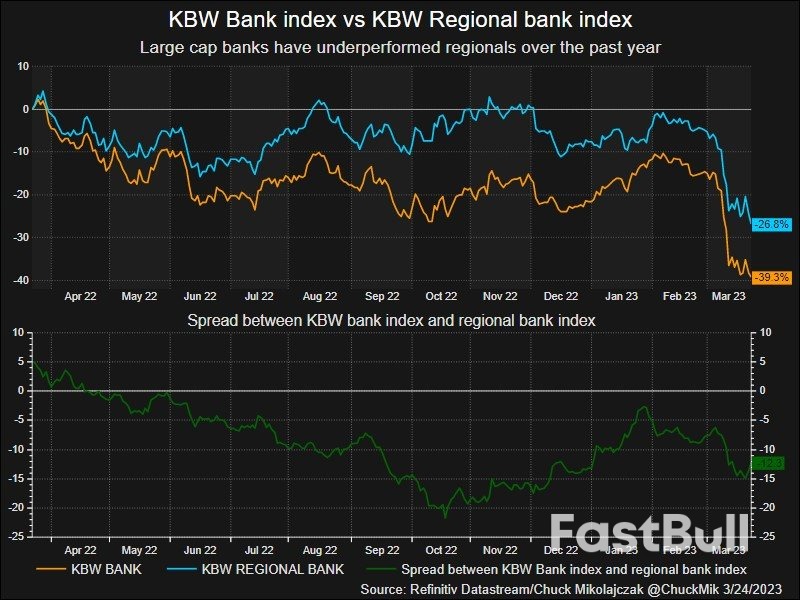
          Weighing Up the Global Banking Crisis_1Bank stocks have tumbled but stocks in general, and particularly the interest rate-sensitive tech sector, have held up better. More speculative corners of the investment universe, like Bitcoin and cryptocurrencies, have significantly outperformed.
          The Nasdaq is up two weeks in a row, and still up 3% for the month, while Bitcoin is up 35% since SVB collapsed.
          Weighing Up the Global Banking Crisis_2How much longer can they defy gravity? If bond yields and implied rates are plunging because a looming credit crunch makes recession far more likely, risk appetite is likely to change accordingly.
          Perhaps the Fed and other central banks can achieve the holy grail of a soft landing, and take the seemingly contradictory policy steps of promoting financial stability and tackling inflation without any further ructions in the financial system.
          Perhaps.
          Trade figures from Hong Kong and Thailand are the main Asian data points on Monday. Later in the week Vietnamese GDP, a Thai interest rate decision, Japanese retail sales and unemployment are on the docket, while the preliminary PMIs for March across the continent - including China - start filtering in.
          Here are three key developments that could provide more direction to markets on Monday:
          - Germany Ifo index (March)
          - ECB's Schnabel speaks
          - BoE Governor Andrew Bailey peaks

          Source: Yahoo

          To stay updated on all economic events of today, please check out our Economic calendar
          Risk Warnings and Disclaimers
          You understand and acknowledge that there is a high degree of risk involved in trading. Following any strategies or investment methods may lead to potential losses. The content on the site is provided by our contributors and analysts for information purposes only. You are solely responsible for determining whether any trading assets, securities, strategy, or any other product is suitable for investing based on your own investment objectives and financial situation.
          Comments
          Add to Favorites
          Share

          March 27th Financial News

          FastBull Featured

          Daily News

          【Quick Facts】

          1. The Fed may not cut interest rates easily.
          2. Eurozone PMI data hides the uncertainty of economic outlook.
          3. Russia is about to complete its commitment to cut oil production by 500,000 BPD.
          4. Disagreement appears within the Fed.
          5. Knot: support for continued rate hikes in May to fight inflation.

          【News Details】

          1. The Fed may not cut interest rates easily.
          Combing the historical conditions for the Fed to cut interest rates, it was found that either the risk of recession and deflation rose significantly; otherwise, there is a major "black swan" in the financial markets, and may evolve into financial systemic risk. Learning from history, the Fed may not easily cut interest rates if a bigger financial risk event than the current one does not occur. This time the Fed may take "high interest rates + temporary expansion of the balance sheet" combination to deal with the dual challenge of inflation and financial risk. So why is the market so looking forward to a rate cut? One explanation is the hope that the "Fed put option" reproduced, so that the market to return to the stock and bond double bullish, and asset prices rose across the board "good old days".
          2. Eurozone PMI data hides the uncertainty of economic outlook.
          Eurozone PMI data for March confirmed the improving economic trend, but did not reflect the downside risks to the economic outlook from recent financial market volatility. The banking sector turmoil did not materially affect any of the component data of the PMI, even for some sentiment-influenced data such as expectations for future activity. This may reflect the timing of data collection, but it is more likely that firms remain uncertain about the potential impact of current tensions on their activities.
          3. Russia is about to complete its commitment to cut oil production by 500,000 BPD.
          Russian Deputy Prime Minister Alexander Novak said in a statement that the country is close to completing its pledged production cut, which is to cut output by 500,000 BPD from the actual output level of 10 million BPD. Novak said Russia is now close to completing this pledged cut and will achieve the target in the coming days.
          4. Disagreement appears within the Fed.
          St. Louis Fed President Bullard said he has raised the Fed's 2023 interest rate forecast to 5.625%.
          Atlanta Fed President Bostic continues to emphasize that anti-inflation remains a top priority and further policy tightening may be needed.
          And Minneapolis Fed President Kashkari seems to have softened his stance, saying that banking sector stress has increased the risk of recession and that it is too early to make any predictions for the next interest rate meeting. For now, the Fed interest rate swaps completely rule out the possibility of a 25 bps rate hike in May.
          5. Knot: support for continued rate hikes in May to fight inflation.
          Klass Knot, an executive member of the ECB and president of De Nederlandsche Bank (DNB), said the following in an interview on Thursday (local time):
          Stresses that the real inflation problem lies in core inflation, which shows no sign of abating yet. Think the ECB's work is not over yet. The question to ponder is whether simply keeping interest rates at a mildly restrictive level is enough to bring about the "disinflation" the ECB wants to see.
          Given that the risks to the inflation outlook are clearly tilted to the upside, without the Credit Suisse episode, I would have been very confident that the ECB would need to raise rates further in May. However, it is still believed that the ECB will need to raise rates again in May, and the magnitude is not certain at this point.
          Market turmoil will likely still affect monetary policy if private sector financing costs remain high, but the impact would need to be "robust and permanent" to change the policy outlook.
          If the turmoil does not intensify in the coming weeks, then the ECB can gradually stop reinvesting under the APP altogether, but only if it does not cause excessive turbulence in the eurozone bond markets.

          【Focus of the Day】

          UTC+8 16:30 ECB Governing Council member Nagel to speak
          UTC+8 21:40 ECB Executive Committee member Elderson to speak
          UTC+8 22:00 ECB Governing Council member Centeno to speak
          UTC+8 23:00 ECB Executive Committee member Schnabel to speak
          Risk Warnings and Disclaimers
          You understand and acknowledge that there is a high degree of risk involved in trading. Following any strategies or investment methods may lead to potential losses. The content on the site is provided by our contributors and analysts for information purposes only. You are solely responsible for determining whether any trading assets, securities, strategy, or any other product is suitable for investing based on your own investment objectives and financial situation.
          Comments
          Add to Favorites
          Share

          Bank Disquiet, Fed Keep Investors on Edge in Nervy U.S. Stock Market

          Alex

          Stocks

          Investors are preparing for a long U.S. stock market slog, braced for more banking sector tumult and worries over how the Federal Reserve's tightening will impact the economy.
          Financial stocks in the United States experienced sharp moves throughout the week after the collapse of two U.S. lenders and last weekend's Swiss-government-orchestrated takeover of troubled Credit Suisse by rival UBS.
          "Volatility will continue because we still don't know the extent of the disruptions with in the banking sector," said Cameron Dawson, Chief Investment Officer at NewEdge Wealth.
          Many worry that other nasty surprises lurk as the rapid series of interest rate hikes the Fed has delivered over the past year dry up cheap money and widen fissures in the economy.
          "Investors are acting first and looking into the nuances later," said Wei Li, global chief investment strategist at fund giant BlackRock. "It's understandable because it's not super clear that this is definitely contained."
          In recent days, investors focused on Deutsche Bank, whose shares have lost around more than a quarter of their value this month, including Friday's 8.5% fall, and the cost of protecting against a default on its bonds soared, even though few put it in a class with Credit Suisse.
          "We are not concerned today about counterparty, liquidity issues" with Deutsche, JPMorgan analysts said on Friday.
          For now, few investors see this year's events as a repeat of the systemic crisis that swept through markets in 2008, taking down Lehman Brothers and prompting government bailouts.
          But investors are wary of another bank run if people think U.S. or European regulators will not step in to shield deposits.
          "It's almost like the prisoner's dilemma where if everyone agrees that they won't pull their deposits then everything should be okay, but if just one person decides they are getting out then the snowball keeps growing," said Tim Murray, capital market strategist in the Multi-Asset Division of T. Rowe Price.
          Murray is underweight equities, focusing on money market accounts that offer yields comparable to Treasuries.
          'Highly unusual'
          Apollo Global Management Chief Economist Torsten Slok said the growing divergence between the Fed fund's rate and the far lower interest rate on checking accounts is increasing the risk of bank deposit outflows. The Fed raised rates by 25 basis points on Wednesday to the 4.75% to 5% range.
          "Higher rates as a source of instability for deposits and Treasury holdings is highly unusual compared to previous banking crises, where the source of instability has typically been credit losses putting downward pressure on the illiquid side of banks' balance sheets," he wrote in a note on Saturday.
          Data released on Friday by the Federal Reserve showed that deposits at small U.S. banks dropped by a record amount following the collapse of Silicon Valley Bank on March 10.
          Meanwhile Federal Reserve emergency lending to banks, which hit record levels, remained high in the latest week amid ongoing anxiety, data released Thursday showed.
          "We're watching very closely all of the data about how much liquidity is being drawn from the Fed's different facilities," said Dawson. "If we continue to see the usage of these facilities, it could point that more banks are feeling funding constrains or liquidity needs, which means that the contagion may not be over."
          U.S. authorities are considering expanding a bank emergency lending facility in ways that would give First Republic Bank more time to shore up its balance sheet, Bloomberg reported Saturday, citing people with knowledge of the situation.
          'Crisis of confidence'
          Uncertainty over the Fed's intentions is also amplifying investor hesitation in stocks and sparking huge swings in U.S. government bond prices, after policymakers indicated they were on the verge of pausing further increases as banking sector worries risk tightening economic conditions.
          Investors piled into the safe haven of U.S. Treasuries over the past week, sending yields on the two-year note, which closely reflects Fed policy expectations, to 3.76%, the lowest since mid-September.
          Further banking industry failures could mean rate cuts sooner as weakened financial conditions allow the Fed to ease up on its fight against inflation, said Tony Rodriguez, head of fixed income strategy at Nuveen. Futures contracts suggest the Fed will start cutting rates by year-end.
          Falling interest rates would make dividend-paying stocks and some riskier assets such as higher-quality below-investment-grade bonds attractive, Rodriguez said.
          Risk assets have been somewhat resilient despite the concerns in the banking sector, said Jason England, global bonds portfolio manager at Janus Henderson Investors. The S&P 500 is up 3.4% this year, though far off its early February highs, and it rose 1% this week, helped by a rally in tech shares.
          "If inflation comes down because of disruptions in banks and you create tightening for homeowners, the Fed suddenly has its work done for it," he said.
          England expects longer-duration bond yields to start to rise from current levels, making short-term bonds and money market funds more attractive.
          Indeed, plenty of investors seem to be giving stocks the cold shoulder. Allocations to U.S. equities fell to an 18-year low while cash allocations crept higher in March, the most recent fund manager survey from BoFA Global Research showed.
          Investors will likely remain steeled for another potential high-profile failure until the Fed or Treasury respond in a way that calms fears of another bank run, said Katie Nixon, chief investment officer, wealth management, at Northern Trust, who is focusing on tech-sector stocks with "fortress balance sheets."
          "Right now it's a crisis of confidence and everyone is looking for direction," she said.

          Source: Reuters

          Risk Warnings and Disclaimers
          You understand and acknowledge that there is a high degree of risk involved in trading. Following any strategies or investment methods may lead to potential losses. The content on the site is provided by our contributors and analysts for information purposes only. You are solely responsible for determining whether any trading assets, securities, strategy, or any other product is suitable for investing based on your own investment objectives and financial situation.
          Comments
          Add to Favorites
          Share

          How Safe is My Money in A U.S. Bank and What is Insured?

          Alex
          In the United States and many other countries, the government guarantees a certain amount of each customer's deposits in the event of a bank failure, to protect both consumers and the broader financial system.
          With the collapse of Silicon Valley Bank and Signature Bank and the U.S. government backstopping all deposits at those firms, here is the state of play of deposit insurance in the United States:
          What is the U.S. deposit insurance limit?
          Currently, the Federal Deposit Insurance Corp (FDIC)guarantees deposits of up to $250,000 per person, per bank. That limit was enshrined in law by the 2010 Dodd-Frank reform law passed following the 2008 financial crisis.
          That means, for example, that a married couple sharing a savings account would be guaranteed for up to $500,000 in deposits. It also means that $1 million in savings can be insured if the cash is spread across four different accounts at four different banks. Accounts the FDIC guarantees includes checking and savings accounts, as well as money market accounts and certificates of deposit.
          Customer deposits at federally insured credit unions are also protected up to at least $250,000 per individual depositor through the National Credit Union Share Insurance Fund, which is administered by the National Credit Union Administration.
          Whose deposits are not insured?
          Generally speaking, accounts exceeding the $250,000 limit mostly belong to entities that need a lot of cash on hand to make payroll such as small businesses, nonprofits or municipal governments.
          Many other investments, such as stocks, annuities or mutual funds, are not protected from losses.
          More than $9.2 trillion of U.S. bank deposits were uninsured at the end of last year, accounting for more than 40% of all deposits, according to U.S. central bank data.
          What happened with depositors at Silicon Valley bank and signature bank?
          The collapse of SVB on March 10 - the largest bank failure since 2008 - sparked concerns over whether small-business clients would be able to pay their staff if the FDIC only protected deposits of up to $250,000.
          Some 89% of SVB's $175 billion in deposits were uninsured as of the end of 2022, according to the FDIC.
          On March 12, U.S. regulators including the FDIC announced that they would make all SVB and Signature Bank depositors whole, even those whose accounts exceeded $250,000, through a "systemic risk exception" designed to prevent broader contagion to the U.S. banking system. Any losses to the FDIC's deposit insurance fund will be recovered by a special assessment on banks, the FDIC said.
          Treasury Secretary Janet Yellen denied that the emergency actions meant that a blanket government guarantee now existed for all deposits, and said during a congressional hearing that any future failure would need to pose risks similar to those seen at SVB and Signature to qualify for the exception.
          In a speech to bankers on Tuesday, Yellen said that the U.S. banking system was stabilizing and steps taken to guarantee deposits in those institutions showed a "resolute commitment" to ensure depositors' savings and banks remain safe. She also clarified that the government could similarly backstop smaller institutions if they too posed contagion risks.
          What if i have more than $250,000 in my bank account?
          While individuals are at risk of losing their money above the deposit insurance limit if a bank fails, the FDIC frequently arranges the sale of an ailing lender to a peer institution, which would then take over all the deposits. If a sale isn't possible, the FDIC winds the bank down and pays out on the insured deposits. The process typically takes 90 days. Account holders can then can try to recover any uninsured deposits from the failed bank's liquidated assets.
          What are the risks of uninsured deposits for banks?
          For banks, a high amount of uninsured deposits pose their own risks. FDIC research from 2018 shows that account holders with uninsured funds are more sensitive to bad news and more quickly move funds to protect them. That means when a bank is in trouble, it may see money heading out the door when it needs it most.
          Generally speaking, regulators do not discourage banks from taking in uninsured deposits, so long as they manage that liquidity risk.
          Could the government raise the deposit insurance limit?
          Some U.S. lawmakers have said Congress should consider whether a higher federal insurance limit on bank deposits was needed in the wake of the collapse of SVB and Signature Bank.
          Senator Elizabeth Warren, a Democrat, and Senator Mike Rounds, a Republican, have questioned whether the $250,000 deposit insurance limit is still appropriate.
          But increasing that limit would require legislation, which could face an uphill battle in a divided Congress heading into an election year.
          Government officials have discussed the idea of increasing deposit insurance without obtaining approval from Congress as they brainstormed various approaches to solving the turmoil in banking, according to a Reuters report. However, that idea was not universally supported and is not seen as necessary by some officials.
          Yellen on Wednesday that the FDIC was not considering providing "blanket insurance" for banking deposits beyond the FDIC's current $250,000 limit.

          Source: Reuters

          Risk Warnings and Disclaimers
          You understand and acknowledge that there is a high degree of risk involved in trading. Following any strategies or investment methods may lead to potential losses. The content on the site is provided by our contributors and analysts for information purposes only. You are solely responsible for determining whether any trading assets, securities, strategy, or any other product is suitable for investing based on your own investment objectives and financial situation.
          Comments
          Add to Favorites
          Share

          Week Ahead - Eurozone and Us Inflation to Come under the Microscope after Rate Decisions

          Justin

          Central Bank

          Economic

          Will PCE inflation further complicate the Fed’s rate path?

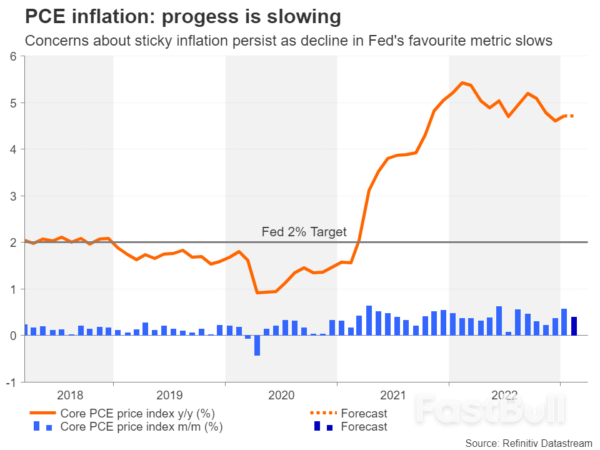
          Hot on the heels of the FOMC meeting and the banking crisis, investors will have to digest another dose of inflation data out of America. The PCE inflation report comes out on Friday along with personal income and spending numbers. Whilst there’s been good progress in overall price pressures easing in recent months, the Fed is focusing its efforts these days on services inflation, and on that, Chair Jerome Powell’s latest assessment is that there has not been any progress when excluding housing components.
          Policymakers will get the chance to take another look at February prices, this time in the form of the core PCE price index. The Fed pays a lot more attention to this particular measure of inflation so any upside surprises could boost bets of a follow-up 25-basis-point rate hike in May, which at the moment, the odds are constantly swinging above and below 50%.
          Week Ahead - Eurozone and Us Inflation to Come under the Microscope after Rate Decisions_1
          The strength of the consumer will be in focus too, with the Conference Board’s closely watched consumer confidence gauge out on Tuesday and the personal consumption print due Friday. The former is more forward looking so any deterioration in the March figure might be associated with the blow up of regional banks.
          In other data, housing indicators from S&P Corelogic Case-Shiller Index (Tuesday) and pending home sales (Wednesday) will be important amid signs that the sector is rebounding after falling off a cliff last year when the Fed’s tightening campaign went into overdrive. The final estimate of Q4 GDP is due Thursday, and finally, the Chicago PMI will round up Friday’s releases.
          With market sentiment still quite fragile in the aftermath of the bank collapses, investors are more likely to react negatively to strong data as they would give the Fed less reason to be cautious. However, this may not necessarily lift the US dollar much, as even in the most bullish scenario, the Fed’s terminal rate has permanently shifted lower.

          Eurozone inflation expected to edge down again

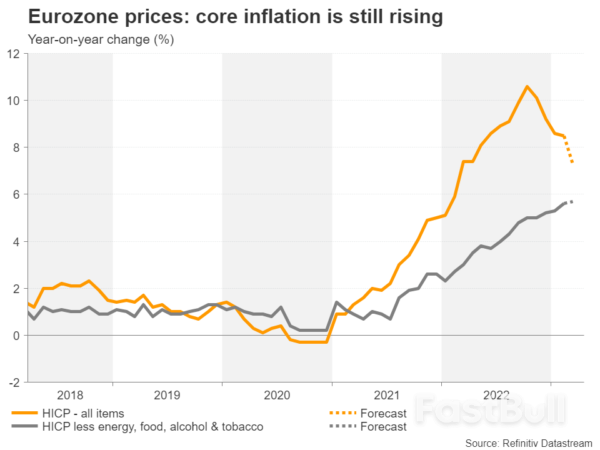
          The European Central Bank may have dropped its forward guidance in March, but since that meeting, policymakers have been eager to signal that further rate increases are nevertheless likely in the coming months as inflation remains far above their 2% target. Headline inflation could ease below 8% when the flash estimates for March are published on Friday. However, the bigger headache for the ECB is the continued climb in the underlying measures of inflation.
          When excluding food, energy, alcohol and energy, the consumer price index is forecast to creep up to 5.8% in March from 5.6% in February.
          Week Ahead - Eurozone and Us Inflation to Come under the Microscope after Rate Decisions_2
          The longer this trend continues, the greater the odds that the ECB will remain on a tightening path and the possibility of that happening whilst the Fed goes on pause is buoying the euro. Having consolidated over the last couple of months, the euro has a good chance of surpassing its February 2 peak of $1.1033 as long as the impact from the banking crisis on the Eurozone economy remains contained.
          It’s a different matter in the US, however, where there is a heightened risk of a credit squeeze even if there aren’t any fresh casualties from the fallout of Silicon Valley Bank’s collapse. Powell himself has highlighted the danger that credit conditions are likely to tighten regardless of whether there are further rate increases, as banks turn more cautious and hand out fewer risky loans.
          That’s not to say, though, that the European economies won’t feel any aftershocks and investors will be on alert for any dip in business confidence. The March surveys will kick off on Monday with Germany’s Ifo business climate index, followed by the Eurozone economic sentiment indicator on Thursday.

          Aussie eyes CPI data as RBA pause hangs in the balance

          The Reserve Bank of Australia started its debate about pausing long before the banking turmoil and will probably be even more inclined to do so at its April meeting. Markets have currently priced in about 90% probability of a pause and inflation figures due on Wednesday could push those bets closer to 100% if they unexpectedly decline further.
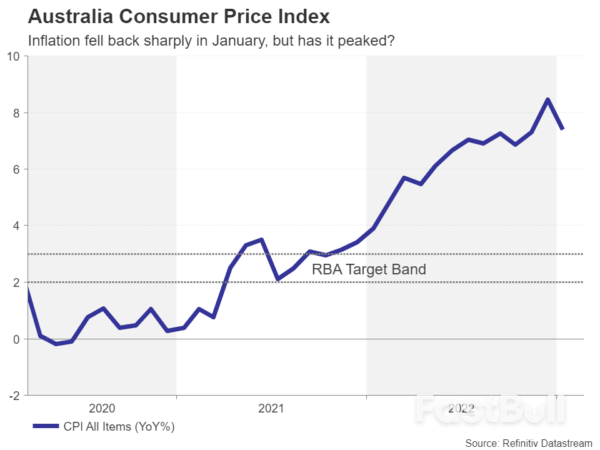
          The RBA is hoping that inflation peaked in December when it hit 8.4% before sharply dropping to 7.4% in February. Another fall in March would be seen as sealing the deal for an April pause, although such an outcome would not bode well for the Australian dollar.
          Week Ahead - Eurozone and Us Inflation to Come under the Microscope after Rate Decisions_3
          Alternatively, stronger-than-expected CPI readings would be positive for the aussie, and there could be some upside too from manufacturing PMIs out of China on Friday should they point to a further rebound in the economy in March.

          Japan’s inflation picture still unclear

          Sticking to the Asia-pacific region, it’s a data heavy week in Japan, with the flurry primarily taking place on Friday. Preliminary industrial production stats, retail sales and the jobless rate, all for February, are on the agenda. But of most interest to investors will likely be the March CPI prints for the Tokyo region, which are seen as a precursor for the nationwide numbers published much later.
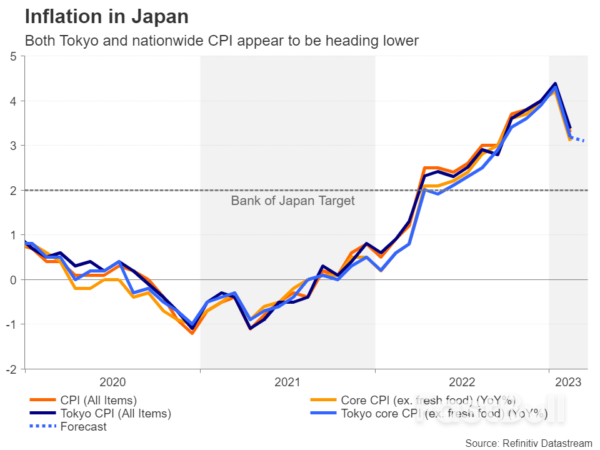
          Week Ahead - Eurozone and Us Inflation to Come under the Microscope after Rate Decisions_4
          Japan’s inflation rate eased back sharply in February, taking the pressure off the Bank of Japan to further scale back its stimulus policies. The March forecast is that core CPI in Tokyo continued to moderate slightly. The yen, which has been on a roll lately against its US counterpart, might struggle to extend its gains if the forecasts are met.
          However, in the event that inflation reverses higher again, this could intensify speculation of some sort of policy action by the BoJ at its April meeting, as it would come on the back of the Spring wage negotiations where labour unions agreed to an inflationary pay deal that averages at 3.8% y/y.

          Source:XM

          To stay updated on all economic events of today, please check out our Economic calendar
          Risk Warnings and Disclaimers
          You understand and acknowledge that there is a high degree of risk involved in trading. Following any strategies or investment methods may lead to potential losses. The content on the site is provided by our contributors and analysts for information purposes only. You are solely responsible for determining whether any trading assets, securities, strategy, or any other product is suitable for investing based on your own investment objectives and financial situation.
          Comments
          Add to Favorites
          Share

          How Realistic is a Hydrogen-Powered Economy?

          Cohen
          Clean-burning hydrogen has been hyped as a potential solution to a swath of climate-related energy problems, from fuelling trucks and powering industry to generating electricity - all while emitting only puffs of harmless vapour.
          The fuel is getting backing from an array of influential stakeholders, including fossil fuel firms which hope to avoid future stranded oil and gas assets by switching to the production, distribution and storage of hydrogen instead.
          But for such a bright future to become reality, there needs to be a rapid and widespread surge in hydrogen demand that will justify a concurrent jump up in hydrogen production - ideally from renewable energy sources so that the fuel's only climate footprint is water.
          Very little green hydrogen, or hydrogen produced from green energy sources, exists today, as most current hydrogen is made using natural gas, and known as blue hydrogen.
          But several firms have committed to scaling up green hydrogen output over the coming decade, using solar or wind energy to power electrolysers that will split water into its constituent parts, hydrogen and oxygen.
          How Realistic is a Hydrogen-Powered Economy?_1The prevailing hope is that the ongoing acceleration in renewable energy development will trigger a surge in renewable energy supplies and a sharp drop in the cost of power produced from green sources.
          In turn, that should drive the cost of renewable-powered electrolysis below that of other forms of hydrogen production, and allow for a rapid global surge in green hydrogen output.
          Feasible Future
          While industry analysts can see a viable path to greater hydrogen supply, it is less clear how the demand side pans out.
          Hydrogen can theoretically be used for a variety of purposes, but it is difficult to assess the most likely major applications decades from now, even if we can assume steadily declining prices.
          Further complicating the picture is that many firms which are considered as viable potential users of green hydrogen currently use very little or none of it, and will need several years and hefty budgets to retool power systems to run effectively off hydrogen.
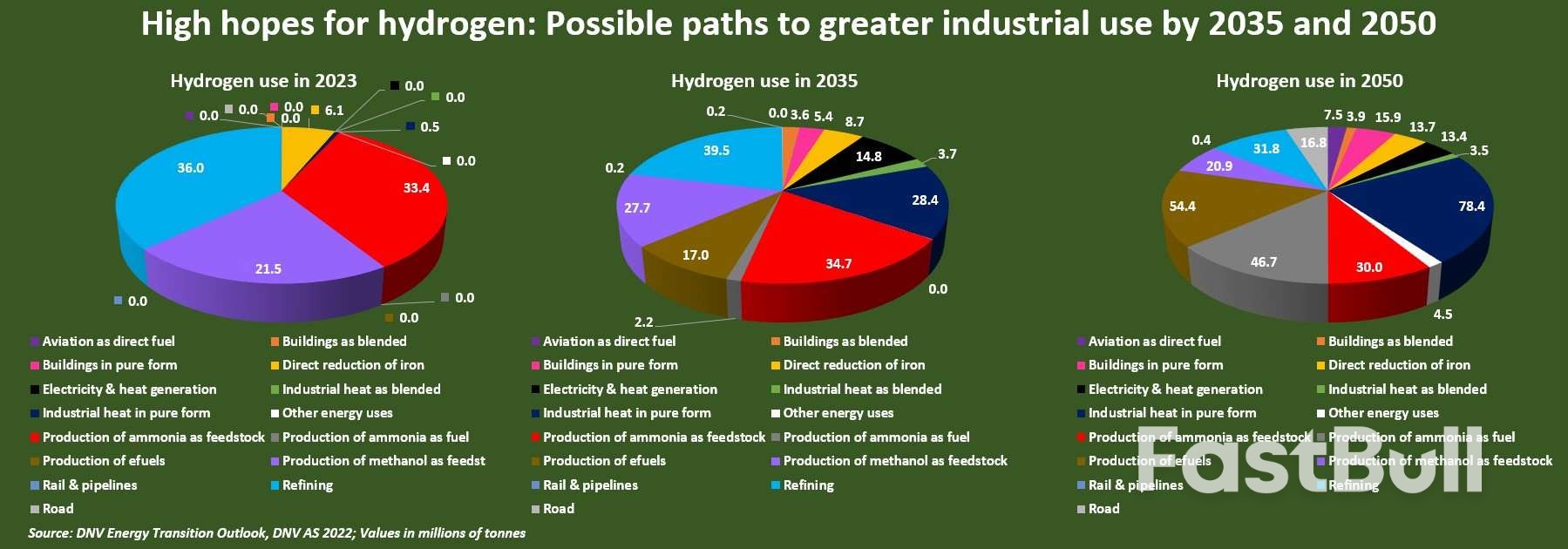
          How Realistic is a Hydrogen-Powered Economy?_2Currently, more than 90% of the world's hydrogen is used for just three industrial applications: to lower sulphur content in diesel by refiners; to produce methanol used by fuel blenders; and to make ammonia for fertilizers and chemicals.
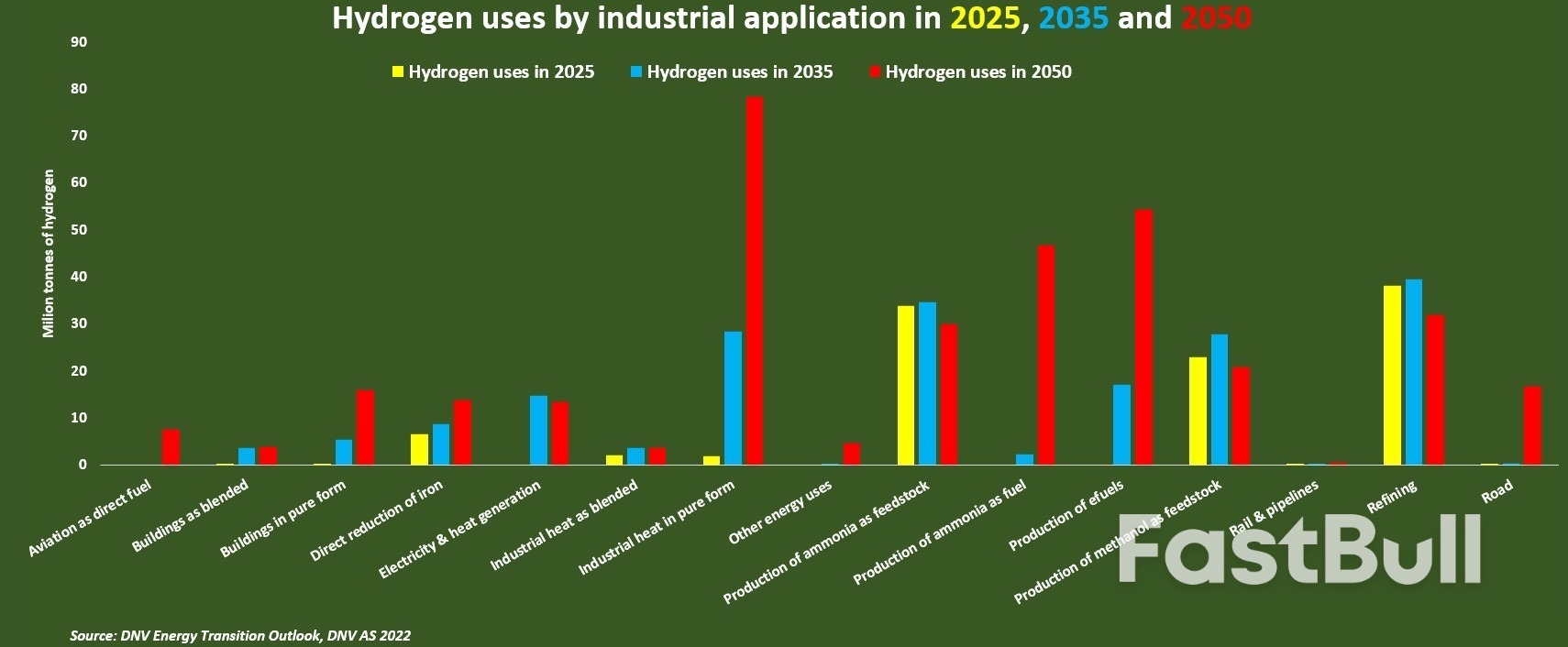
          However, risk assurance firm DNV has taken a stab at laying out where growth is likely by geography and industry through 2050, and highlighted 15 likely usage cases come mid-century.
          Industrial Heat
          Currently accounting for less than 1% of global hydrogen consumption, the deployment of hydrogen as a direct heating source for industry will be the largest single usage case for hydrogen by 2050, DNV data shows.
          Industrial heating will account for nearly 80 million tonnes of the roughly 341 million tonnes used globally in 2050, mainly in China and the Indian subcontinent, followed by Europe, the Middle East and North America.
          How Realistic is a Hydrogen-Powered Economy?_3As China and India look set to remain major global manufacturing hubs for decades, it makes sense that their industries will be big users of power fuels, and seek ways to reduce emissions.
          However, a key challenge in those countries will be how to economically install the plumbing needed to connect industrial burners with hydrogen suppliers.
          In Europe and the United States, extensive existing natural gas pipelines can be easily converted to hydrogen carriers, allowing businesses to switch over from gas to hydrogen once market conditions dictate.
          Many industry and factories across Asia and elsewhere, however, run off their own coal boilers and lack a network of connecting pipelines that can potentially feed them hydrogen in a cheap and safe manner.
          China and India plan to increase pipeline connectivity in the coming years, but given the prioritisation of developing renewable power over fossil fuels are unlikely to match the scale of pipeline connectivity in Europe where a vast majority of heavy industry and large manufacturers have direct pipelined gas.
          Without pipelines, industries in Asia and elsewhere looking to use hydrogen may need to rely on more piecemeal delivery systems such as truck fleets, which will be more costly than wholesale pipeline systems and may slow the uptake of hydrogen as a primary fuel source.
          Going Direct
          Large refineries, chemical producers, smelters and fuel blending operations may have an easier time in tapping hydrogen than smaller industrial plants and factories, and look set to account for roughly half of global hydrogen use by 2050, DNV data shows.
          Such businesses are more likely to receive government support for energy system overhauls than factories due to their importance to the local and international economy.
          Operations like refineries and smelters also tend to be located on large and remote land parcels that can be more easily connected to pipeline systems than more numerous but more dispersed factories.
          Office and residential buildings that are already connected to gas systems can also easily convert from gas to hydrogen for heating and power, and look set to account for around 6% of global use by 2050.
          The aviation and rail systems are also expected to become notable users of hydrogen once prices become more attractive and industrial knowledge about handling and storage of the fuel improves.
          In all, DNV data shows strong growth potential for hydrogen use across a variety of industries by 2050.
          But the price of hydrogen versus alternative fuels, as well as the ability to supply the hydrogen economically to where it is needed, remain major hurdles that the industry will need to clear if the fuel is to fulfil its promise as the clean-burning solution to many of today's dirty energy problems.

          Source: ETEnergyworld

          Risk Warnings and Disclaimers
          You understand and acknowledge that there is a high degree of risk involved in trading. Following any strategies or investment methods may lead to potential losses. The content on the site is provided by our contributors and analysts for information purposes only. You are solely responsible for determining whether any trading assets, securities, strategy, or any other product is suitable for investing based on your own investment objectives and financial situation.
          Comments
          Add to Favorites
          Share

          Gigs, Scams, Ghost Work: India Tech Sector's Dark Side

          Thomas

          Economic

          After finishing college in the western Indian city of Ahmedabad, Saurav hunted for work for more than four months before he came across an advertisement for jobs at a call centre. He signed up, not knowing it would one day land him in jail.
          In his job, Saurav - who asked to go by one name to protect his identity - called people in the United States, enticed them to sign up for loans and insurance policies, then told them they needed to improve their credit score by paying $50-$100.
          Only, he did not work for a bank or an insurer, but a scam call centre that pitched fake products and robbed people of money that they thought would improve their credit scores.
          "I didn't realise at first. It was only much later that I realised that the job was to cheat people after speaking to other colleagues who worked there," said Saurav, 25.
          "But I was already too involved in it, and I was certain that I would not get another job where I could earn 20,000-25,000 rupees ($241-$302) a month, so I continued working there," he told the Thomson Reuters Foundation.
          The call centre was one of thousands perpetuating telefraud on millions of people every day in India, the United States, Britain and elsewhere, with employees posing as tax officials, as workers at banks and insurers, and as tech support.
          Indian police have raided hundreds of such centres in Ahmedabad, Delhi, Gurugram, Mumbai and Kolkata in recent years, and said they have charged thousands with fraud.
          Saurav and two of his colleagues were arrested last year, and he spent five months in jail.
          As he belatedly realised, was part of the dark underbelly of India's $220-billion information technology services industry that boomed as global firms outsourced customer support to cheaper workers with college degrees who spoke English.
          But these very same factors also encouraged a parallel industry of scam call centres, with American citizens alone losing more than $10 billion to phishing gangs and fraud call centre operations in India last year, according to data from the Federal Bureau of Investigation cited by local media.
          "All one needs is a computer or laptop, a phone, an internet connection, and data, which is available easily on the black market," said Ajit Rajiaan, a deputy commissioner of police in Ahmedabad, who has raided dozens of such operations in the city.
          "The call centre can be run from a house, an office, or just about any place," he said, adding that nearly all those who have been arrested at such operations are men aged 18 to 25, with either a high school education or a college degree.
          Future of Work
          India is poised to become the world's most populous country in April, overtaking China with more than 1.43 billion people, according to estimates by the United Nations.
          It also has among the youngest populations, with more than 40% under 25 years. Yet the pace of economic growth is not enough to accommodate some 12 million people joining the workforce each year.
          So educated youth - once touted as a demographic dividend - are forced to turn to the gig economy delivering food and groceries, to scam call centres, online microwork, and other low-paid jobs, analysts say.
          "We are at a critical moment," said Amit Basole at the Azim Premji University Centre for Sustainable Employment, pointing to high rates of unemployment among educated youth, low labour force participation of women, and "forced self-employment" because of the lack of productive jobs.
          "Newly created jobs are often of the precarious kind - including gig work," he added.
          Mohammed Ahmed, 21, knows this first-hand.
          He has worked part-time for more than two years for Zomato and Swiggy, the largest food delivery platforms in India, putting in about six hours a day and earning about 10,000 rupees a month while he goes to college.
          "I will not get a job with just a Bachelor's degree. I have to also do a Master's degree," he said.
          "Even then I am not sure I can get a well-paying job. So I need this job to earn a living."
          India is one of the largest and fastest-growing markets for the so-called gig economy, with nearly 8 million workers in 2020-21, and forecast to expand to 24 million workers by 2029-30, according to government think-tank Niti Aayog.
          But workers earn low wages and have few protections.
          "The government, the industry and employers pitch gig work as the future of work, glorifying it as something that is desirable," said Rikta Krishnaswamy, a coordinator at the All India Gig Workers' Union.
          "But what we are really seeing is an erosion of hard-won labour rights. With increased digitisation, gig work is only going to get bigger and worse - especially with data annotation and labelling for AI."
          Ghost Workers
          AI relies on data annotation, which is the action of tagging content such as text, photos, audio and video so that machine learning models can recognise them.
          Up to 1 million Indians could be working full-time or part-time in data annotation and labelling by 2030, estimates IT industry body NASSCOM.
          Workers in India already make up about a third of remote online workers for clients largely in the U.S. and Britain, according to the International Labour Organization.
          Several firms also provide managed services with full-time workers earning about 15,000-25,000 rupees a month.
          "Data annotation is the current outsourcing model. But clients don't pay much because it is a low-skill job," said Muzammil Hussain, founder of Tika Data in Bengaluru that has labelled more than 20 million images and 1 million words.
          "The money for this work is always going to be low because it is easy work, even if it's labour intensive," he said.
          About 50,000 freelancers operate as ghost workers, getting just a few cents to label data on platforms such as the crowdsourcing website for businesses Amazon Mechanical Turk, according to NASSCOM.
          Many are based in small towns, and have to deal with uncertain hours and wages.
          "It's hard to get an account, and there is a limited number of jobs for workers in India," said Naga Raj, 28, who has done on-demand tasks on Amazon Mechanical Turk for more than three years.
          "I may do 10-12 tasks, but only two or three may get approved, and I will only get paid for those - but I don't have a choice," he said.
          Workers like Raj are at the "bottom of the AI value chain" with no prospect of higher wages or upskilling, said Urvashi Aneja, director of Digital Futures Lab, who studies the platform economy.
          "There is a strong policy push that India can be the back-end for global AI production. But a lot of this work is very precarious, and it's not being thought through holistically, from the point of view of worker welfare or longevity," she said.
          "It's a pretty bleak outlook: a lot of the clickwork and piecework that is being outsourced now will also get automated."
          ($1 = 82.9249 Indian rupees)

          Source: bdnews24

          To stay updated on all economic events of today, please check out our Economic calendar
          Risk Warnings and Disclaimers
          You understand and acknowledge that there is a high degree of risk involved in trading. Following any strategies or investment methods may lead to potential losses. The content on the site is provided by our contributors and analysts for information purposes only. You are solely responsible for determining whether any trading assets, securities, strategy, or any other product is suitable for investing based on your own investment objectives and financial situation.
          Comments
          Add to Favorites
          Share
          FastBull
          Copyright © 2025 FastBull Ltd

          728 RM B 7/F GEE LOK IND BLDG NO 34 HUNG TO RD KWUN TONG KLN HONG KONG

          TelegramInstagramTwitterfacebooklinkedin
          App Store Google Play Google Play
          Products
          Charts

          Chats

          Q&A with Experts
          Screeners
          Economic Calendar
          Data
          Tools
          Membership
          Features
          Function
          Markets
          Copy Trading
          Latest Signals
          Contests
          News
          Analysis
          24/7
          Columns
          Education
          Company
          Careers
          About Us
          Contact Us
          Advertising
          Help Center
          Feedback
          User Agreement
          Privacy Policy
          Business

          White Label

          Data API

          Web Plug-ins

          Poster Maker

          Affiliate Program

          Risk Disclosure

          The risk of loss in trading financial instruments such as stocks, FX, commodities, futures, bonds, ETFs and crypto can be substantial. You may sustain a total loss of the funds that you deposit with your broker. Therefore, you should carefully consider whether such trading is suitable for you in light of your circumstances and financial resources.

          No decision to invest should be made without thoroughly conducting due diligence by yourself or consulting with your financial advisors. Our web content might not suit you since we don't know your financial conditions and investment needs. Our financial information might have latency or contain inaccuracy, so you should be fully responsible for any of your trading and investment decisions. The company will not be responsible for your capital loss.

          Without getting permission from the website, you are not allowed to copy the website's graphics, texts, or trademarks. Intellectual property rights in the content or data incorporated into this website belong to its providers and exchange merchants.

          Not Logged In

          Log in to access more features

          FastBull Membership

          Not yet

          Purchase

          Become a signal provider
          Help Center
          Customer Service
          Dark Mode
          Price Up/Down Colors

          Log In

          Sign Up

          Position
          Layout
          Fullscreen
          Default to Chart
          The chart page opens by default when you visit fastbull.com