• Trade
  • Markets
  • Copy
  • Contests
  • News
  • 24/7
  • Calendar
  • Q&A
  • Chats
Trending
Screeners
SYMBOL
LAST
BID
ASK
HIGH
LOW
NET CHG.
%CHG.
SPREAD
SPX
S&P 500 Index
6827.42
6827.42
6827.42
6899.86
6801.80
-73.58
-1.07%
--
DJI
Dow Jones Industrial Average
48458.04
48458.04
48458.04
48886.86
48334.10
-245.98
-0.51%
--
IXIC
NASDAQ Composite Index
23195.16
23195.16
23195.16
23554.89
23094.51
-398.69
-1.69%
--
USDX
US Dollar Index
97.950
98.030
97.950
98.500
97.950
-0.370
-0.38%
--
EURUSD
Euro / US Dollar
1.17394
1.17409
1.17394
1.17496
1.17192
+0.00011
+ 0.01%
--
GBPUSD
Pound Sterling / US Dollar
1.33707
1.33732
1.33707
1.33997
1.33419
-0.00148
-0.11%
--
XAUUSD
Gold / US Dollar
4299.39
4299.39
4299.39
4353.41
4257.10
+20.10
+ 0.47%
--
WTI
Light Sweet Crude Oil
57.233
57.485
57.233
58.011
56.969
-0.408
-0.71%
--

Community Accounts

Signal Accounts
--
Profit Accounts
--
Loss Accounts
--
View More

Become a signal provider

Sell trading signals to earn additional income

View More

Guide to Copy Trading

Get started with ease and confidence

View More

Signal Accounts for Members

All Signal Accounts

Best Return
  • Best Return
  • Best P/L
  • Best MDD
Past 1W
  • Past 1W
  • Past 1M
  • Past 1Y

All Contests

  • All
  • Trump Updates
  • Recommend
  • Stocks
  • Cryptocurrencies
  • Central Banks
  • Featured News
Top News Only
Share

Thai Leader Anutin: Landmine Blast That Killed Thai Soldiers 'Not A Roadside Accident'

Share

Thai Leader Anutin: Thailand To Continue Military Action Until 'We Feel No More Harm'

Share

Cambodian Prime Minister Hun Manet Says He Had Phone Calls With Trump And Malaysian Leader Anwar About Ceasefire

Share

Cambodia's Hun Manet Says USA, Malaysia Should Verify 'Which Side Fired First' In Latest Conflict

Share

Cambodia's Hun Manet: Cambodia Maintains Its Stance In Seeking Peaceful Resolution Of Disputes

Share

Nasdaq Companies: Allergan, Ferrovia, Insmed, Monolithic Power Systems, Seagate Technology, And Western Digital Will Be Added To The NASDAQ 100 Index. Biogen, CdW, GlobalFoundries, Lululemon, ON Semiconductor, And Tradedesk Will Be Removed From The NASDAQ 100 Index

Share

Witkoff Headed To Berlin This Weekend To Meet With Zelenskiy, European Leaders -Wsj Reporter On X

Share

Russia Attacks Two Ukrainian Ports, Damaging Three Turkish-Owned Vessels

Share

[Historic Flooding Occurs In At Least Four Rivers In Washington State Due To Days Of Torrential Rains] Multiple Areas In Washington State Have Been Hit By Severe Flooding Due To Days Of Torrential Rains, With At Least Four Rivers Experiencing Historic Flooding. Reporters Learned On The 12th That The Floods Caused By The Torrential Rains In Washington State Have Destroyed Homes And Closed Several Highways. Experts Warn That Even More Severe Flooding May Occur In The Future. A State Of Emergency Has Been Declared In Washington State

Share

Trump Says Proposed Free Economic Zone In Donbas Would Work

Share

Trump: I Think My Voice Should Be Heard

Share

Trump Says Will Be Choosing New Fed Chair In Near Future

Share

Trump Says Proposed Free Economic Zone In Donbas Complex But Would Work

Share

Trump Says Land Strikes In Venezuela Will Start Happening

Share

US President Trump: Thailand And Cambodia Are In A Good Situation

Share

State Media: North Korean Leader Kim Hails Troops Returning From Russia Mission

Share

The 10-year Treasury Yield Rose About 5 Basis Points During The "Fed Rate Cut Week," And The 2/10-year Yield Spread Widened By About 9 Basis Points. On Friday (December 12), In Late New York Trading, The Yield On The Benchmark 10-year US Treasury Note Rose 2.75 Basis Points To 4.1841%, A Cumulative Increase Of 4.90 Basis Points For The Week, Trading Within A Range Of 4.1002%-4.2074%. It Rose Steadily From Monday To Wednesday (before The Fed Announced Its Rate Cut And Treasury Bill Purchase Program), Subsequently Exhibiting A V-shaped Recovery. The 2-year Treasury Yield Fell 1.82 Basis Points To 3.5222%, A Cumulative Decrease Of 3.81 Basis Points For The Week, Trading Within A Range Of 3.6253%-3.4989%

Share

Trump: Lots Of Progress Being Made On Russia-Ukraine

Share

NOPA November US Soybean Crush Estimated At 220.285 Million Bushels

Share

SPDR Gold Trust Reports Holdings Up 0.22%, Or 2.28 Tonnes, To 1053.11 Tonnes By Dec 12

TIME
ACT
FCST
PREV
U.K. Trade Balance Non-EU (SA) (Oct)

A:--

F: --

P: --

U.K. Trade Balance (Oct)

A:--

F: --

P: --

U.K. Services Index MoM

A:--

F: --

P: --

U.K. Construction Output MoM (SA) (Oct)

A:--

F: --

P: --

U.K. Industrial Output YoY (Oct)

A:--

F: --

P: --

U.K. Trade Balance (SA) (Oct)

A:--

F: --

P: --

U.K. Trade Balance EU (SA) (Oct)

A:--

F: --

P: --

U.K. Manufacturing Output YoY (Oct)

A:--

F: --

P: --

U.K. GDP MoM (Oct)

A:--

F: --

P: --

U.K. GDP YoY (SA) (Oct)

A:--

F: --

P: --

U.K. Industrial Output MoM (Oct)

A:--

F: --

P: --

U.K. Construction Output YoY (Oct)

A:--

F: --

P: --

France HICP Final MoM (Nov)

A:--

F: --

P: --

China, Mainland Outstanding Loans Growth YoY (Nov)

A:--

F: --

P: --

China, Mainland M2 Money Supply YoY (Nov)

A:--

F: --

P: --

China, Mainland M0 Money Supply YoY (Nov)

A:--

F: --

P: --

China, Mainland M1 Money Supply YoY (Nov)

A:--

F: --

P: --

India CPI YoY (Nov)

A:--

F: --

P: --

India Deposit Gowth YoY

A:--

F: --

P: --

Brazil Services Growth YoY (Oct)

A:--

F: --

P: --

Mexico Industrial Output YoY (Oct)

A:--

F: --

P: --

Russia Trade Balance (Oct)

A:--

F: --

P: --

Philadelphia Fed President Henry Paulson delivers a speech
Canada Building Permits MoM (SA) (Oct)

A:--

F: --

P: --

Canada Wholesale Sales YoY (Oct)

A:--

F: --

P: --

Canada Wholesale Inventory MoM (Oct)

A:--

F: --

P: --

Canada Wholesale Inventory YoY (Oct)

A:--

F: --

P: --

Canada Wholesale Sales MoM (SA) (Oct)

A:--

F: --

P: --

Germany Current Account (Not SA) (Oct)

A:--

F: --

P: --

U.S. Weekly Total Rig Count

A:--

F: --

P: --

U.S. Weekly Total Oil Rig Count

A:--

F: --

P: --

Japan Tankan Large Non-Manufacturing Diffusion Index (Q4)

--

F: --

P: --

Japan Tankan Small Manufacturing Outlook Index (Q4)

--

F: --

P: --

Japan Tankan Large Non-Manufacturing Outlook Index (Q4)

--

F: --

P: --

Japan Tankan Large Manufacturing Outlook Index (Q4)

--

F: --

P: --

Japan Tankan Small Manufacturing Diffusion Index (Q4)

--

F: --

P: --

Japan Tankan Large Manufacturing Diffusion Index (Q4)

--

F: --

P: --

Japan Tankan Large-Enterprise Capital Expenditure YoY (Q4)

--

F: --

P: --

U.K. Rightmove House Price Index YoY (Dec)

--

F: --

P: --

China, Mainland Industrial Output YoY (YTD) (Nov)

--

F: --

P: --

China, Mainland Urban Area Unemployment Rate (Nov)

--

F: --

P: --

Saudi Arabia CPI YoY (Nov)

--

F: --

P: --

Euro Zone Industrial Output YoY (Oct)

--

F: --

P: --

Euro Zone Industrial Output MoM (Oct)

--

F: --

P: --

Canada Existing Home Sales MoM (Nov)

--

F: --

P: --

Euro Zone Total Reserve Assets (Nov)

--

F: --

P: --

U.K. Inflation Rate Expectations

--

F: --

P: --

Canada National Economic Confidence Index

--

F: --

P: --

Canada New Housing Starts (Nov)

--

F: --

P: --

U.S. NY Fed Manufacturing Employment Index (Dec)

--

F: --

P: --

U.S. NY Fed Manufacturing Index (Dec)

--

F: --

P: --

Canada Core CPI YoY (Nov)

--

F: --

P: --

Canada Manufacturing Unfilled Orders MoM (Oct)

--

F: --

P: --

Canada Manufacturing New Orders MoM (Oct)

--

F: --

P: --

Canada Core CPI MoM (Nov)

--

F: --

P: --

Canada Manufacturing Inventory MoM (Oct)

--

F: --

P: --

Canada CPI YoY (Nov)

--

F: --

P: --

Canada CPI MoM (Nov)

--

F: --

P: --

Canada CPI YoY (SA) (Nov)

--

F: --

P: --

Canada Core CPI MoM (SA) (Nov)

--

F: --

P: --

Q&A with Experts
    • All
    • Chatrooms
    • Groups
    • Friends
    Connecting
    .
    .
    .
    Type here...
    Add Symbol or Code

      No matching data

      All
      Trump Updates
      Recommend
      Stocks
      Cryptocurrencies
      Central Banks
      Featured News
      • All
      • Russia-Ukraine Conflict
      • Middle East Flashpoint
      • All
      • Russia-Ukraine Conflict
      • Middle East Flashpoint
      Search
      Products

      Charts Free Forever

      Chats Q&A with Experts
      Screeners Economic Calendar Data Tools
      Membership Features
      Data Warehouse Market Trends Institutional Data Policy Rates Macro

      Market Trends

      Market Sentiment Order Book Forex Correlations

      Top Indicators

      Charts Free Forever
      Markets

      News

      News Analysis 24/7 Columns Education
      From Institutions From Analysts
      Topics Columnists

      Latest Views

      Latest Views

      Trending Topics

      Top Columnists

      Latest Update

      Signals

      Copy Rankings Latest Signals Become a signal provider AI Rating
      Contests
      Brokers

      Overview Brokers Assessment Rankings Regulators News Claims
      Broker listing Forex Brokers Comparison Tool Live Spread Comparison Scam
      Q&A Complaint Scam Alert Videos Tips to Detect Scam
      More

      Business
      Events
      Careers About Us Advertising Help Center

      White Label

      Data API

      Web Plug-ins

      Affiliate Program

      Awards Institution Evaluation IB Seminar Salon Event Exhibition
      Vietnam Thailand Singapore Dubai
      Fans Party Investment Sharing Session
      FastBull Summit BrokersView Expo
      Recent Searches
        Top Searches
          Markets
          News
          Analysis
          User
          24/7
          Economic Calendar
          Education
          Data
          • Names
          • Latest
          • Prev

          View All

          No data

          Scan to Download

          Faster Charts, Chat Faster!

          Download App
          English
          • English
          • Español
          • العربية
          • Bahasa Indonesia
          • Bahasa Melayu
          • Tiếng Việt
          • ภาษาไทย
          • Français
          • Italiano
          • Türkçe
          • Русский язык
          • 简中
          • 繁中
          Open Account
          Search
          Products
          Charts Free Forever
          Markets
          News
          Signals

          Copy Rankings Latest Signals Become a signal provider AI Rating
          Contests
          Brokers

          Overview Brokers Assessment Rankings Regulators News Claims
          Broker listing Forex Brokers Comparison Tool Live Spread Comparison Scam
          Q&A Complaint Scam Alert Videos Tips to Detect Scam
          More

          Business
          Events
          Careers About Us Advertising Help Center

          White Label

          Data API

          Web Plug-ins

          Affiliate Program

          Awards Institution Evaluation IB Seminar Salon Event Exhibition
          Vietnam Thailand Singapore Dubai
          Fans Party Investment Sharing Session
          FastBull Summit BrokersView Expo

          US Soybean Exports Under Scrutiny Amid Worst Sales Run in Years

          Owen Li

          Commodity

          Summary:

          Last week's U.S. soybean export sales exceeded all trade expectations for the first time since November...
          Last week's U.S. soybean export sales exceeded all trade expectations for the first time since November, but that is not at all representative of how little interest international buyers have expressed of late.
          The U.S. Department of Agriculture already predicts domestic exporters in 2023-24 will ship their second-smallest soybean volume in a decade, though some of the recent numbers suggest the agency's outlook may still be too optimistic.
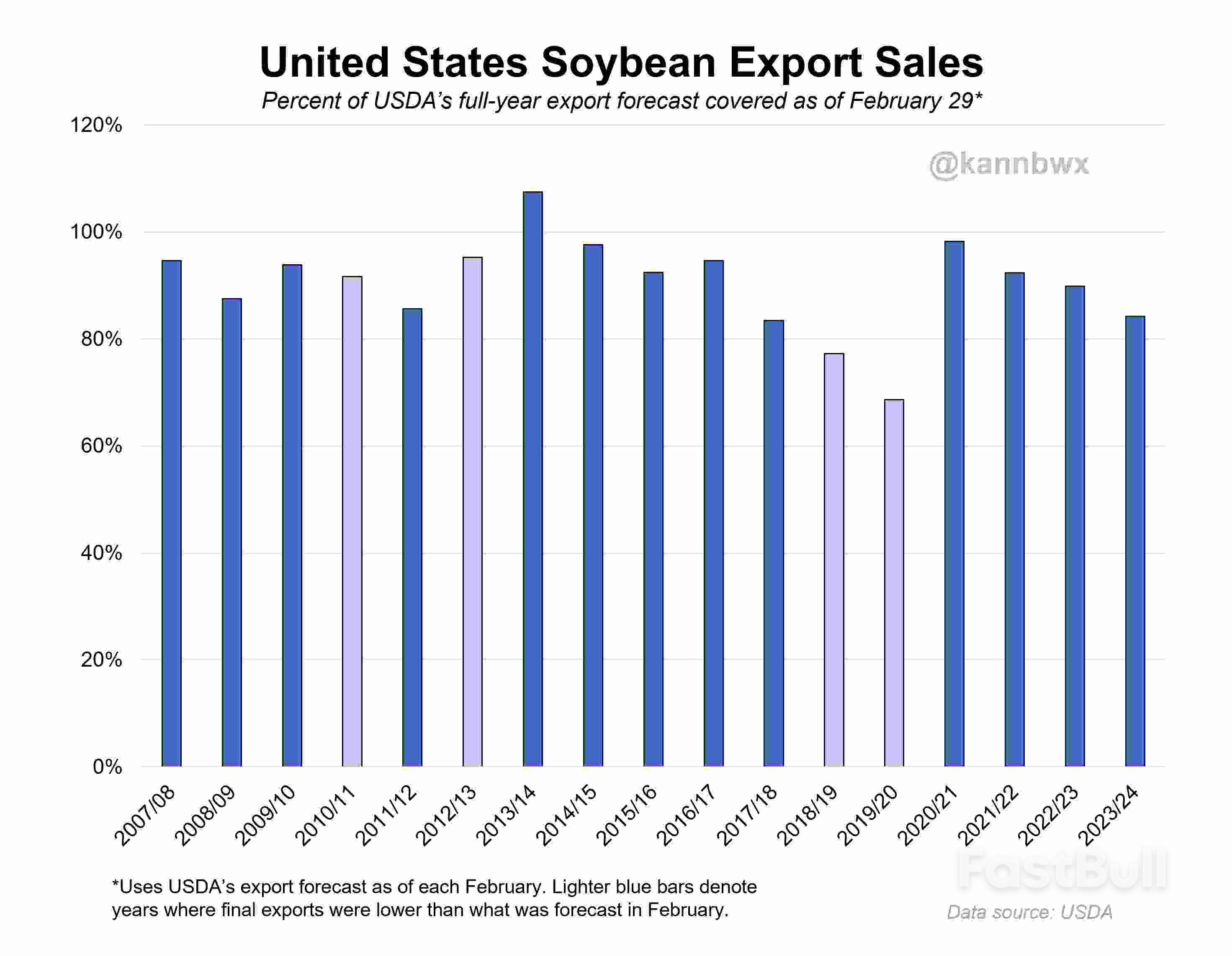
          As of Feb. 29, some 39.4 million metric tons of U.S. soybeans had been sold for shipment in 2023-24, which began Sept. 1. That represents 84% of USDA's full-year target of 46.8 million tons (1.72 billion bushels).
          That compares with 90% a year earlier and a three-year average of 94%. Outside the two trade war years, it is the second-lightest end-February sales coverage in well over a decade, after 83% in 2017-18.US Soybean Exports Under Scrutiny Amid Worst Sales Run in Years_1
          Final soybean exports do not usually end up lower than USDA's February forecast, as the trade war years of 2018-19 and 2019-20 were the only two such instances in the last decade. Exports ended up higher even in 2017-18, but the start of the trade war and crop problems in Argentina were outlying factors that season.
          Although the coverage level does not definitively warrant a lower export forecast, dreadful recent sales could be justification. In the 10 weeks ended Feb. 29, only around 3.3 million tons of soybeans were sold for export in 2024, by far the lowest volume for the period in at least 16 years.
          The 16-plus-year-low stat remains true when accounting for the light forecast, as that volume represents 7% of USDA's full-year export target. The five-year average for that period is 13%, and the prior lowest was 9% in 2016-17.
          The trade was unprepared for such poor sales. In those 10 weeks, all the lowest trade estimates summed to 3.7 million tons and the high ones to 9.2 million. The originally printed sales sum to 3.5 million tons, and weekly volumes were below the lowest trade guess in seven of the last 10 weeks.
          Thursday's data showed soybean sales in the week ended Feb. 29 at a seven-week high of 614,000 tons, just topping the trade high of 600,000. That volume is slightly above average for the week.
          Not only have sufficient supplies in Brazil hampered U.S. exports, but demand from top buyer China is unimpressive given very poor crush margins. China's customs on Thursday reported January and February soybean imports totaled just 13 million tons, down 9% on the year and the lowest for the period since 2019.
          USDA's next chance to adjust U.S. and global supply and demand outlooks is on Friday.

          Corn

          U.S. corn export bookings have performed better relative to soybeans. Some 39.2 million tons of corn had been sold for export in 2023-24 as of Feb. 29, representing 74% of USDA's full-year forecast of 53.3 million tons (2.1 billion bushels).
          That compares with a five-year average of 72%, spanning from 62% in both 2019-20 and 2022-23 to 90% in 2020-21.US Soybean Exports Under Scrutiny Amid Worst Sales Run in Years_2
          Similar to soybeans, final U.S. corn exports in recent years are usually equal to or higher than what USDA said in February. In the last decade, there are only two instances where final exports were lower, 2018-19 and 2022-23, and sales coverage by this point was 65% and 62%, respectively.
          Corn export sales in the latest 10 weeks total 9.8 million tons, a three-year high for the period, and that represents 18% of the full-year target, a bit below the recent average around 19%.
          Mexico remains by far the biggest U.S. corn buyer for 2023-24, accounting for a record 44% of total U.S. corn sales by the end of February, midway through the marketing year.
          By Feb. 29, corn sales to Mexico totaled 17.3 million tons, a larger volume than the United States has ever shipped to Mexico in a full season. The previous record sales to Mexico for the date were around 14 million tons two years ago.

          Source: Reuters

          Risk Warnings and Disclaimers
          You understand and acknowledge that there is a high degree of risk involved in trading. Following any strategies or investment methods may lead to potential losses. The content on the site is provided by our contributors and analysts for information purposes only. You are solely responsible for determining whether any trading assets, securities, strategy, or any other product is suitable for investing based on your own investment objectives and financial situation.
          Add to Favorites
          Share

          US, Euro Rate Path Set to Diverge ... Finally

          Kevin Du

          Economic

          Central Bank

          It's been a long time coming, but the remarkably tight correlation between U.S. and euro zone interest rate expectations is set to unravel.
          The European Central Bank's downward revisions to its growth and inflation outlook on Thursday speak to an economic reality that means the ECB's rate-cutting cycle will start soon, despite President Christine Lagarde's protestations to the contrary.
          The U.S. economy, on the other hand is running hot and signs are emerging that some price pressures are re-accelerating. Speculation is growing that the Federal Reserve could raise its long-term 'neutral' interest rate projection later this month.
          Understandably, officials from both central banks have leaned against these narratives - the ECB doesn't want to lose its inflation-fighting credibility, and the Fed doesn't want to crash the economy's 'soft' or 'no landing'.
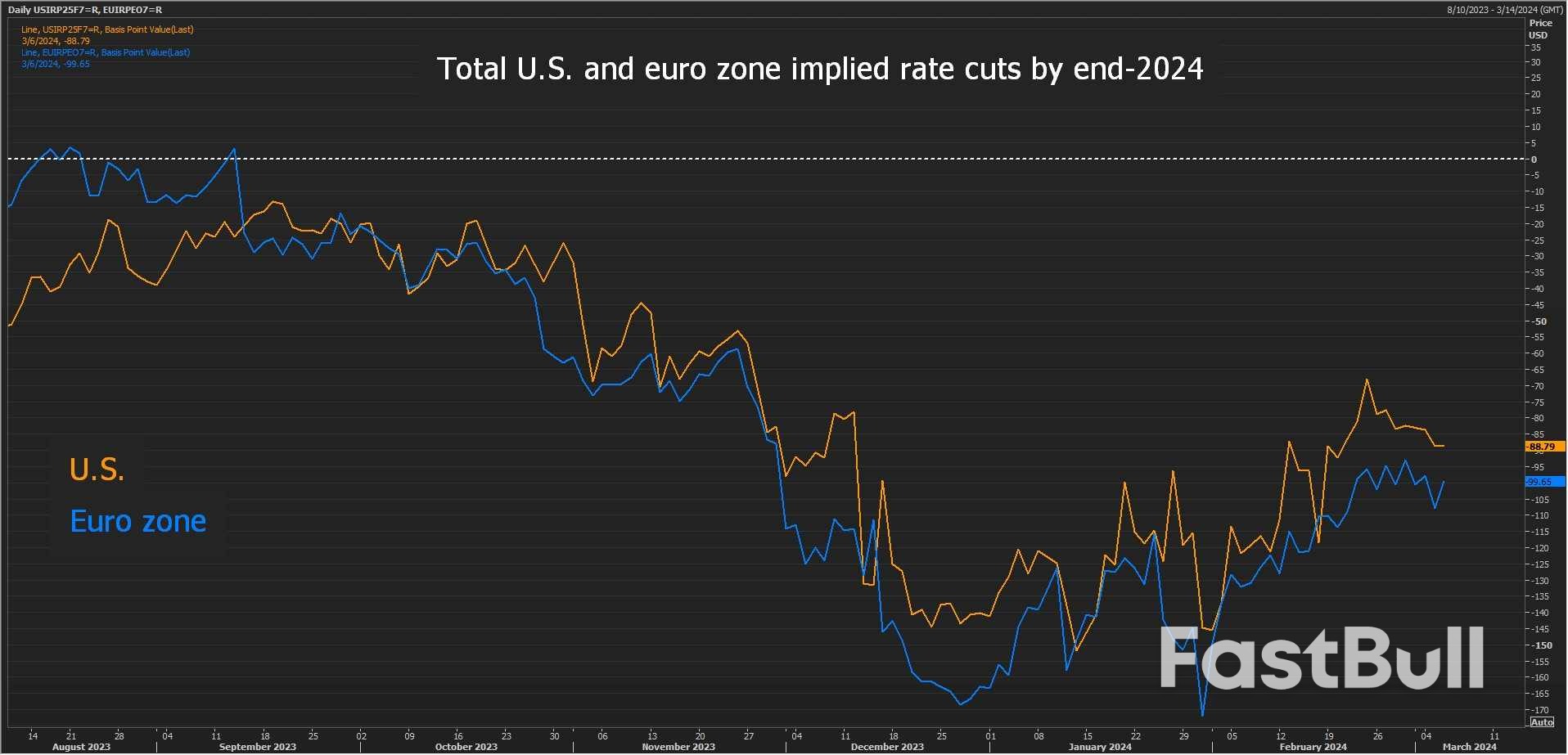
          The rhetoric from Fed and ECB officials, aimed at giving themselves as much flexibility as possible, has struck a common tone. As a result, the expected path for U.S. and euro zone rates this year and into 2025 has been almost identical.
          The correlation between short-dated U.S. and euro zone government bonds has never been stronger, shackling the euro/dollar exchange rate and depressing FX and bond market volatility.
          It's a merry dance that financial markets have played along with. But for how much longer?
          "ECB policymakers have been pushing back hard against the idea of rate cuts, maybe as part of a futile effort to support the exchanges rate. But this can't go on much longer, maybe a couple of months," said Dario Perkins, global macro strategist at TS Lombard.
          "Reality will set in, for the ECB and markets," he added.
          The ECB now expects inflation to fall to 1.9% in the summer of next year and stay there until the end of 2026. It had previously expected inflation to fall below its 2% target by early 2026.
          The ECB also cut its 2024 GDP growth forecast to just 0.6%, less than half the Fed's last U.S. growth projection for this year of 1.4%. This could be raised later this month.US, Euro Rate Path Set to Diverge ... Finally_1

          No fed cuts this year?

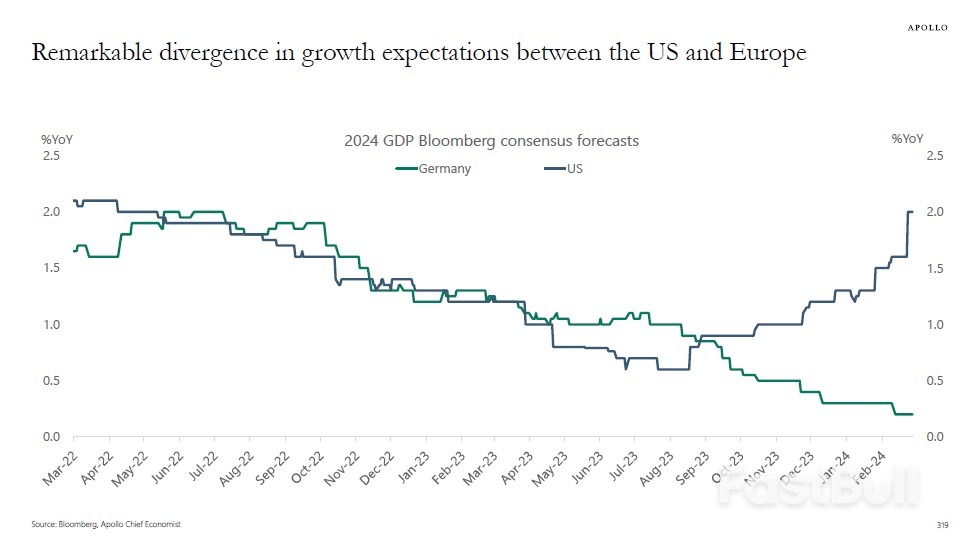
          Torsten Slok, chief economist and partner at Apollo Global Management, on Thursday highlighted the yawning chasm opening up between the U.S. and German growth outlooks for this year.
          Last week, citing a reacceleration in U.S. growth and price pressures, Slok issued one of the first calls from a major financial institution that the Fed will not cut rates at all this year.
          "The bottom line is that the Fed will spend most of 2024 fighting inflation," he wrote on March 1. "As a result, the Fed will not cut rates this year and rates are going to stay higher for longer."
          US, Euro Rate Path Set to Diverge ... Finally_2Markets haven't begun pricing in this divergence yet. The euro has depreciated by less than 1% against the dollar this year, and recent research by State Street found that two-year U.S. and German sovereign bond yields is at an all-time high.
          Current market pricing has both central banks delivering their first rate cut in the middle of this year, easing policy by around 90 to 95 basis points by the end of December, and by around 125 bps a year from now.
          But this tight relationship is likely to be tested.
          Analysts at Deutsche Bank see euro zone inflation returning to 2% by the middle of this year, a year earlier than the ECB expects, and is penciling in 150 bps of rate cuts this year.
          For financial markets, particularly currencies, it is the terminal level of interest rates that matters more than when the starting gun for rate cuts is fired.
          "We see the risks as skewed to the downside for EURUSD this year, with the European growth/inflation/fiscal mix more conducive to a larger ECB cutting cycle relative to the Fed," Deutsche analysts wrote in a recent note.

          Source: Yahoo

          To stay updated on all economic events of today, please check out our Economic calendar
          Risk Warnings and Disclaimers
          You understand and acknowledge that there is a high degree of risk involved in trading. Following any strategies or investment methods may lead to potential losses. The content on the site is provided by our contributors and analysts for information purposes only. You are solely responsible for determining whether any trading assets, securities, strategy, or any other product is suitable for investing based on your own investment objectives and financial situation.
          Add to Favorites
          Share

          Markets See Clearer ECB Rate-Cut Roadmap as Inflation Fog Lifts

          Devin

          Economic

          Central Bank

          Investors are increasingly confident the European Central Bank may lead global peers with a rate cut in June as new economic projections put on-target inflation in sight.
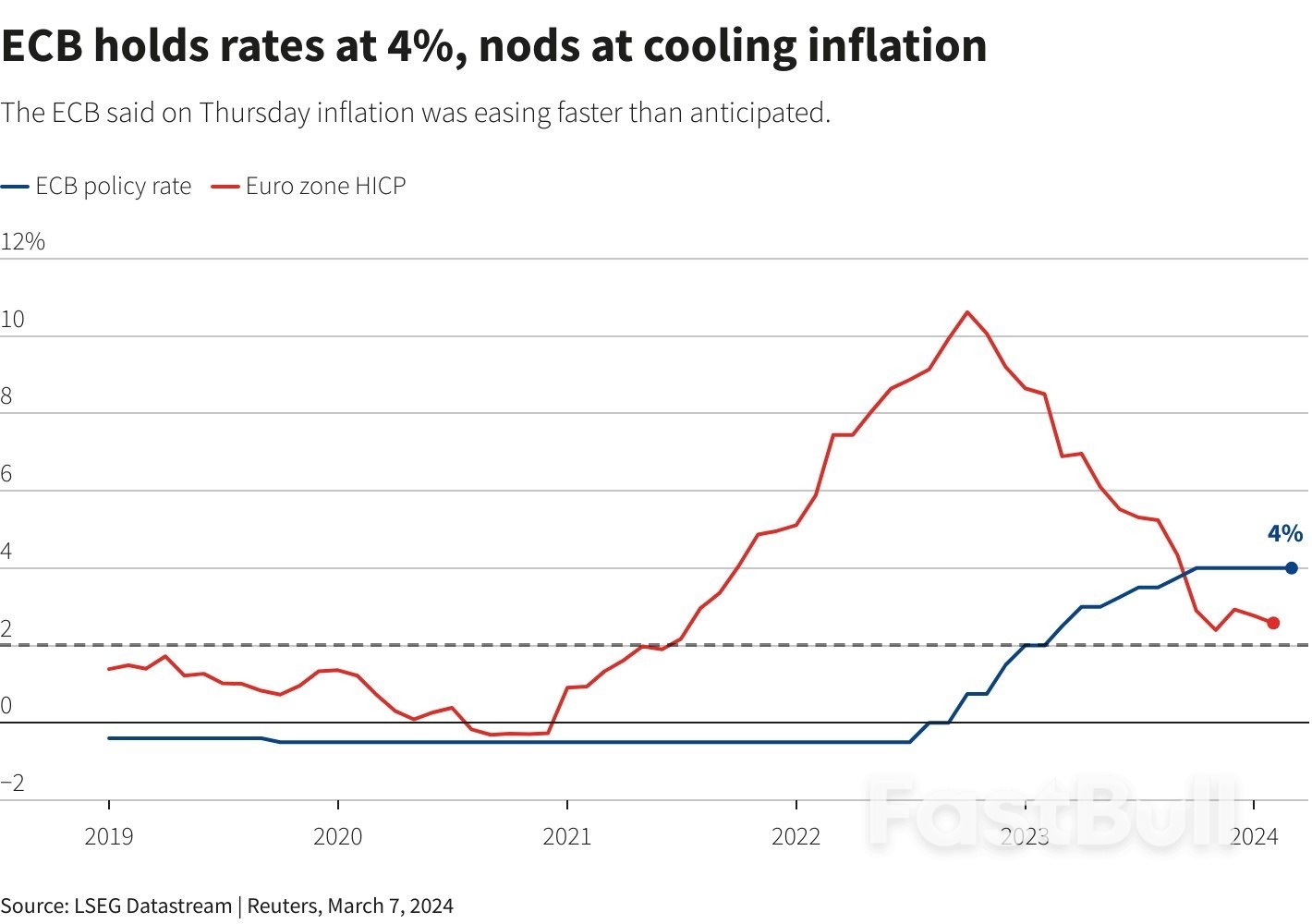
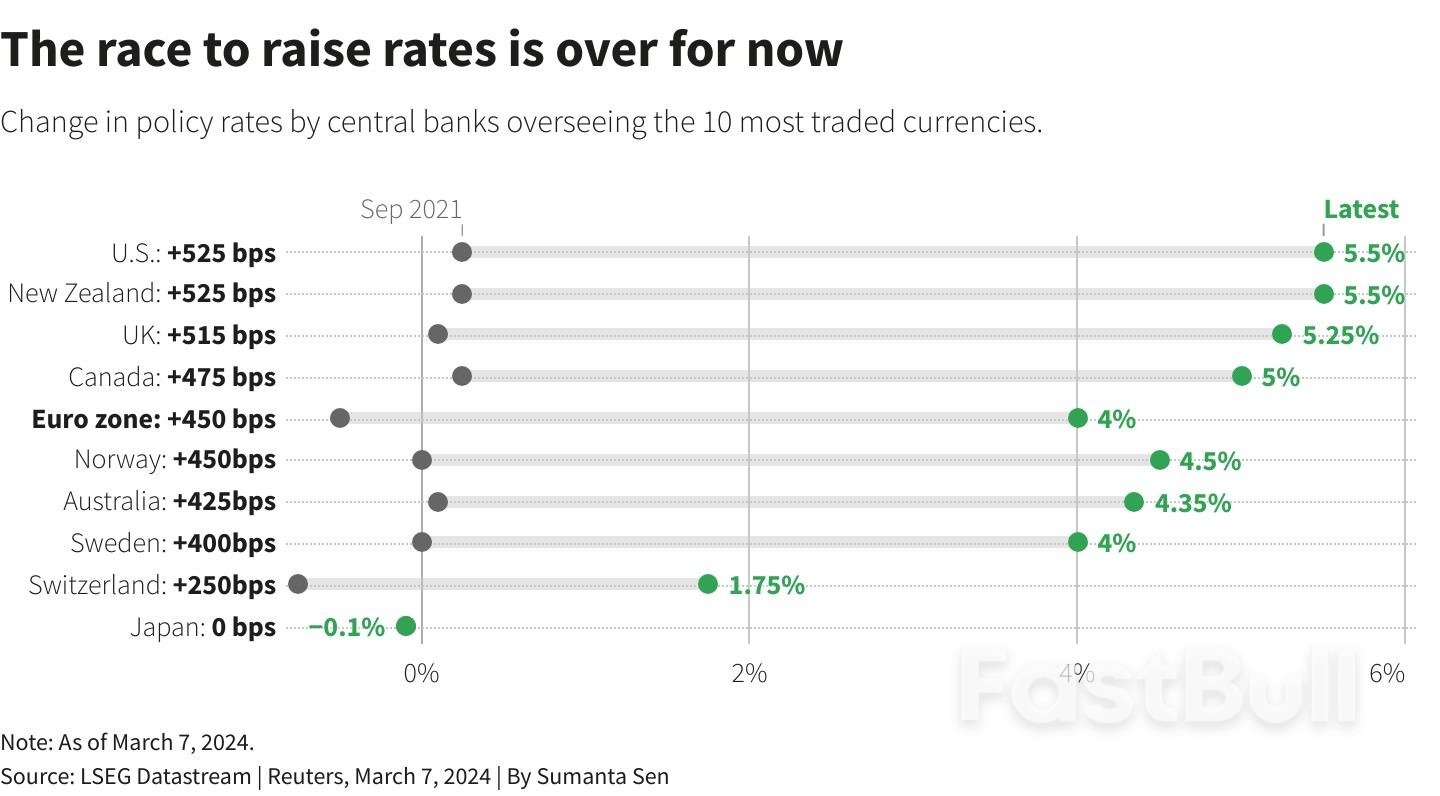
          Markets took Thursday's ECB revisions as further confirmation that interest rate cuts would start soon. The ECB lifted its key rate to a record 4% in its fastest paced hiking cycle in its history, from July 2022 to last September.
          Policymakers now see inflation, which surged to a peak over 10% in 2022, falling to its 2% target next year, rather than in 2026.
          Germany's interest rate sensitive two-year bond yield fell as much as 10 basis points (bps) to a three-week low as market rate cut expectations rose. European stocks rallied 1%, the euro briefly slipped.
          Traders became more confident that cuts would start in June, seeing over a 90% chance, from 85% earlier on Thursday.
          ECB chief Christine Lagarde emphasised the bank would have seen a lot more data in June.
          Lagarde "was as explicit as she could be for a June rate cut", said Danske Bank chief analyst Piet Christiansen.Markets See Clearer ECB Rate-Cut Roadmap as Inflation Fog Lifts_1
          Markets now see the ECB lowering rates by just over 95 bps this year, versus just over 90 bps before the meeting.
          Another source of comfort was relative optimism on wage growth, which the bank has singled out as the single most important factor determining whether it can cut rates.
          "The ducks are lining up", said Seema Shah, chief global strategist at Principal Asset Management, which manages $700 billion, noting Lagarde's comment that wage growth was moderating.
          Confidence in a June cut also marks the latest victory for policymakers, who just weeks ago were trying to tame trader bets on speedier rate cuts.
          After January's ECB meeting investors had expected 140 bps of rate cuts this year commencing in April, now they expect nearly two less moves.
          Germany's benchmark 10-year bond yield is nearly 30 bps higher than at the start of 2024, meaning tighter financial conditions.
          The risk to all the optimism, of course, is what economic data shows. And while acknowledging slowing wage growth, the ECB said wages were still keeping price pressures high.
          "There is a clear road map so anything that goes in the opposite direction of this would be disruptive for markets," said Gilles Moec, chief economist at insurer AXA Group, citing an acceleration in wages of inflation, especially from the services sector, as examples.Markets See Clearer ECB Rate-Cut Roadmap as Inflation Fog Lifts_2

          Who first?

          As conviction grows the ECB will likely move in June, focus also turns to whether it will cut before the U.S. Federal Reserve, in what would be an unusual move.
          Currency traders will be watching closely as relative interest rates are a key market driver. The dollar was broadly soft on Thursday, meaning that a post-ECB fall in the euro was brief.
          Traders on Thursday saw a similar chance of the ECB and Fed cutting rates in June.
          But they have started to flag the risk that the Fed might not be able to cut rates at all this year if the world's largest economy holds strong.
          And they don't doubt the ECB can move first given a much weaker economy. Still, some economists reckon moving before the Fed could dampen how much the ECB cuts overall.
          "Where uncertainty remains is in terms of the pace of easing once the rate cutting cycle starts," said Frederik Ducrozet, head of macroeconomic research at Pictet Wealth Management.
          Ducrozet expected an ECB pause in July after a June cut, then 25 bps reductions per meeting from September while a weaker economy relative to the U.S. might require further easing in 2025.
          "That's where the potential for market re-pricing looks greater," he added.
          For now, what may be more significant for euro zone markets is the spillovers from swings in U.S. rate cut expectations and Treasuries given that euro zone and U.S. bonds have moved in tandem at a record pace recently.
          "We import a lot of this tightening and easing from the U.S," said Danske Bank's Christiansen.
          "So, this repricing we've seen in rates is actually coming more from the U.S. rather than a repricing on European fundamentals."

          Source: The Globe and Mail

          To stay updated on all economic events of today, please check out our Economic calendar
          Risk Warnings and Disclaimers
          You understand and acknowledge that there is a high degree of risk involved in trading. Following any strategies or investment methods may lead to potential losses. The content on the site is provided by our contributors and analysts for information purposes only. You are solely responsible for determining whether any trading assets, securities, strategy, or any other product is suitable for investing based on your own investment objectives and financial situation.
          Add to Favorites
          Share

          March 8th Financial News

          FastBull Featured

          Daily News

          [Quick Facts]

          1. Japan's Jan household spending fell 6.3% y/y, the largest drop in 35 months.
          2. Gaza ceasefire talks show no signs of progress.
          3. Moody's downgrades banking sector outlooks for Britain, Germany, etc.
          4. Fed's Mester sees rate cuts later this year, but not in a hurry.
          5. Powell says the Fed is not far from confidence to cut interest rates.
          6. The ECB is paving the way for a rate cut.

          [News Details]

          Japan's Jan household spending fell 6.3% y/y, the largest drop in 35 months
          Household spending in Japan fell by 6.3% from a year earlier in January, far exceeding the expected 4.3% and marking the 11th consecutive month of decline, data released by the Japanese government on Friday showed. It was also the largest drop since February 2021.
          The figure did not necessarily represent a decline in broader consumption trends, said an interior affairs ministry official. The fall was due to decreases in new car purchases amid factory suspensions, lower energy bills due to warm weather, and the backdrop of higher spending in the same month last year from post-pandemic travel subsidies, the official said.
          Gaza ceasefire talks show no signs of progress
          Fearing a possible escalation of the conflict during the Muslim fasting month of Ramadan, Israel and Hamas held four days of talks brokered by Qatar and Egypt, aiming to achieve a 40-day ceasefire, but no progress was made in the negotiations. The two sides accused each other of being responsible for the failure to reach an agreement. The United States said that Hamas is responsible for reaching an agreement on the Israeli hostage issue.
          Talks would resume without an Israeli delegation in Cairo on Sunday and mediators had set a deadline for both sides to respond to the truce proposal, Egyptian security sources said. Hamas did not confirm Egypt's comments on the deadline, and Hamas officials said they had made their position clear.
          A Hamas official said the U.S. was working with Israel so its comments were misleading. Hamas insisted that the ceasefire agreement should include a process to end the war. Sami Abu Zuhri, a senior Hamas official, said Israel had been "obstructing" efforts to reach a ceasefire. A ceasefire must be achieved before the hostages are released, Israeli troops must leave Gaza, and all Gazans must be able to return to the homes they fled.
          Moody's downgrades banking sector outlooks for Britain, Germany, etc
          Moody's has changed its outlook to negative from stable for banking sectors in Belgium, France, Germany, the Netherlands, Sweden, and the United Kingdom. High interest rates will curb economic growth, constrain lending, and lead to a deterioration in corporate loan performance, while increased funding costs will lower profits compared to 2023 in most countries, Moody's said.
          The outlook remained stable for the Danish, Spanish, and Swiss banking sectors, and the outlook changed to stable from negative for the Italian banking sector which will benefit from resilient operating conditions, with stable profitability and strong capital offsetting a mild deterioration in asset quality.
          Fed's Mester sees rate cuts later this year, but not in a hurry
          The Fed's interest rate policy is currently in a "good position", so it can wait a bit before taking action to cut interest rates to assess economic performance, Cleveland Fed President Loretta Mester said on Thursday.
          The bigger mistake would be cutting interest rates too soon or too quickly without sufficient evidence that inflation is on the path back to 2% in a sustainable and timely manner.
          I believe the Fed will be able to lower rates this year, but there is no urgency to act yet. I expect that we will cut rates later this year, and my basic scenario is that when we begin to cut rates, we will go forward at a gradual pace so that we can continue to manage risks.
          Powell says the Fed is not far from confidence to cut interest rates
          The Fed's policy rate is very restrictive at present and interest rates are far from neutral, said Federal Reserve Chairman Jerome Powell at a hearing before the Senate on March 7. The current monetary policy is in the right place. When the Fed is more confident about inflation down to 2%, it is time to relax monetary tightening. The Fed is not far from confidence to cut interest rates.
          I'm fully aware of the risk of cutting rates too late. If the economy develops as expected, we will carefully consider gradually removing the restrictive stance of policy this year.
          Then Powell repeated what he said in the press conference following the conclusion of the January monetary policy meeting. If the economic situation develops in line with expectations, it may be appropriate to start cutting interest rates sometime later this year. However, the economic outlook is uncertain, and there is no guarantee that inflation will continue to fall to the Fed's target of 2%. Before deciding to cut rates, Fed officials need to be "more confident" that inflation will fall back to 2%.
          The discussions over the long-term shape of the balance sheet are just beginning at this point. The Fed's holdings of U.S. Treasury bonds are likely to become shorter in duration. "It will take a while" before the Fed's Treasury holdings tilt more decisively toward Treasury bills. There's a "longer-term aspiration" with regard to reducing the share of mortgage-backed securities.
          The ECB is paving the way for a rate cut
          The European Central Bank (ECB) announced its latest interest rate decision on Thursday, leaving three key rates (interest rates on the main refinancing operations, the deposit facility, and the marginal lending facility) unchanged for the fourth consecutive time. The statement indicated that key interest rates in the euro will remain unchanged for a sufficiently long period to help achieve the 2% medium-term inflation target. The ECB Governing Council will continue to set the level and duration of interest rates based on data. Interest rate decisions will be made based on forthcoming economic and financial data, underlying inflation dynamics, and an assessment of the inflation outlook based on the strength of monetary policy transmission.
          Restricted financing conditions and the previous interest rate hikes continue to curb demand, helping to reduce inflation. While most underlying inflation indicators have eased further, price pressures remain high, partly due to stronger wage growth.
          Inflation expectations were lowered to 2.3% for 2024, and adjusted to 2.0% and 1.9% for 2025 and 2026, respectively. Economic growth expectations were down to 0.6% for 2024 and adjusted to 1.5% and 1.6% for 2025 and 2026, respectively.
          Internal discussions have begun about easing the restrictive stance and the central bank will not wait until inflation reaches 2% before taking action, ECB President Christine Lagarde said at a press conference. No rate cuts were discussed at this meeting and no commitment was made to the pace of future interest rate adjustments.
          A general slowdown has been seen in underlying inflation. There is more confidence in achieving the inflation target, but that's not enough as core indicators have not yet reached expected levels. The euro area economy remains weak and risks are still tilted to the downside.
          The latest forecasts set the stage for the ECB to cut interest rates for the first time around the middle of the year. The downward revisions to growth and inflation forecasts provide ample justification for a near-term rate cut, while disappointing industrial production data from Germany only justifies the need for a rate cut.

          [Focus of the Day]

          UTC+8 20:00 NY Fed President Williams Speaks
          UTC+8 21:30 U.S. Non-farm Payrolls (Feb)
          Risk Warnings and Disclaimers
          You understand and acknowledge that there is a high degree of risk involved in trading. Following any strategies or investment methods may lead to potential losses. The content on the site is provided by our contributors and analysts for information purposes only. You are solely responsible for determining whether any trading assets, securities, strategy, or any other product is suitable for investing based on your own investment objectives and financial situation.
          Add to Favorites
          Share

          As The Cookie Crumbles, Election Year Inflation Debate Could Get Messy

          Alex

          Economic

          U.S. Senator John Fetterman, who famously trolled an election opponent's shopping for "crudite" in a discussion of high food prices, on Thursday tried to bring a dose of realism to an inflation debate likely to be a central issue in the upcoming presidential election.
          Food prices have risen, with a shock-to-the-pocketbook 20% run-up in the two years between January 2021 and January 2023, the fastest such surge on record and a likely GOP talking point heading into the presidential election campaign.
          But, noting a recent internet meme featuring outrage over an "$18 dollar cookie," Fetterman asked Federal Reserve Chair Jerome Powell for context during a hearing before the Senate Banking Committee.
          "Is that reflective of our economy?" the Pennsylvania Democrat asked.
          "I certainly hope not. I don't do much shopping these days, but that sounds like a pretty expensive cookie," Powell said, adding inflation "has been coming down sharply since the middle of last year."
          Indeed prices for food to prepare at home as of January were rising at just a 1.3% annual rate, in line with what has been typical in recent decades and a far cry from the breakout in food costs that occurred when global commodity markets and supply chains were roiled by the pandemic and the Russian war in Ukraine.
          And, as it happens, cookie prices have been falling year-over-year for the past two months, Consumer Price Index data shows.As The Cookie Crumbles, Election Year Inflation Debate Could Get Messy_1

          A Hard Few Years

          There is no argument that inflation in the last three years has been extraordinary, with consumer prices rising as recently as June 2022 at a 9.1% annual rate, a level not seen since 1981.
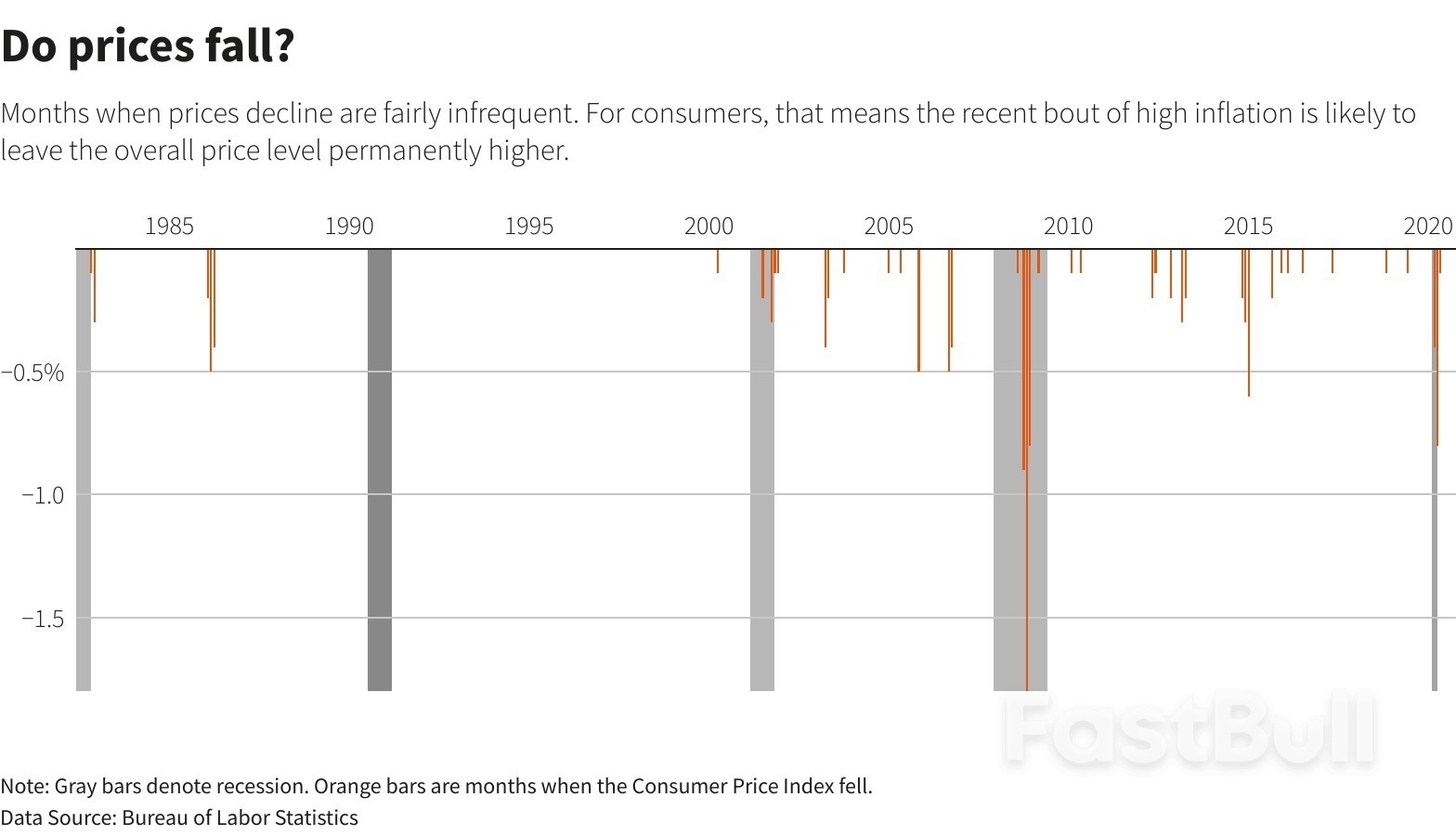
          While the climb down to the current 3.1% rate has also been fast, Republicans highlight that the higher overall price level is here to stay.
          That's true.
          But it is pretty much always true -- it is unusual for the overall CPI to decline.As The Cookie Crumbles, Election Year Inflation Debate Could Get Messy_2
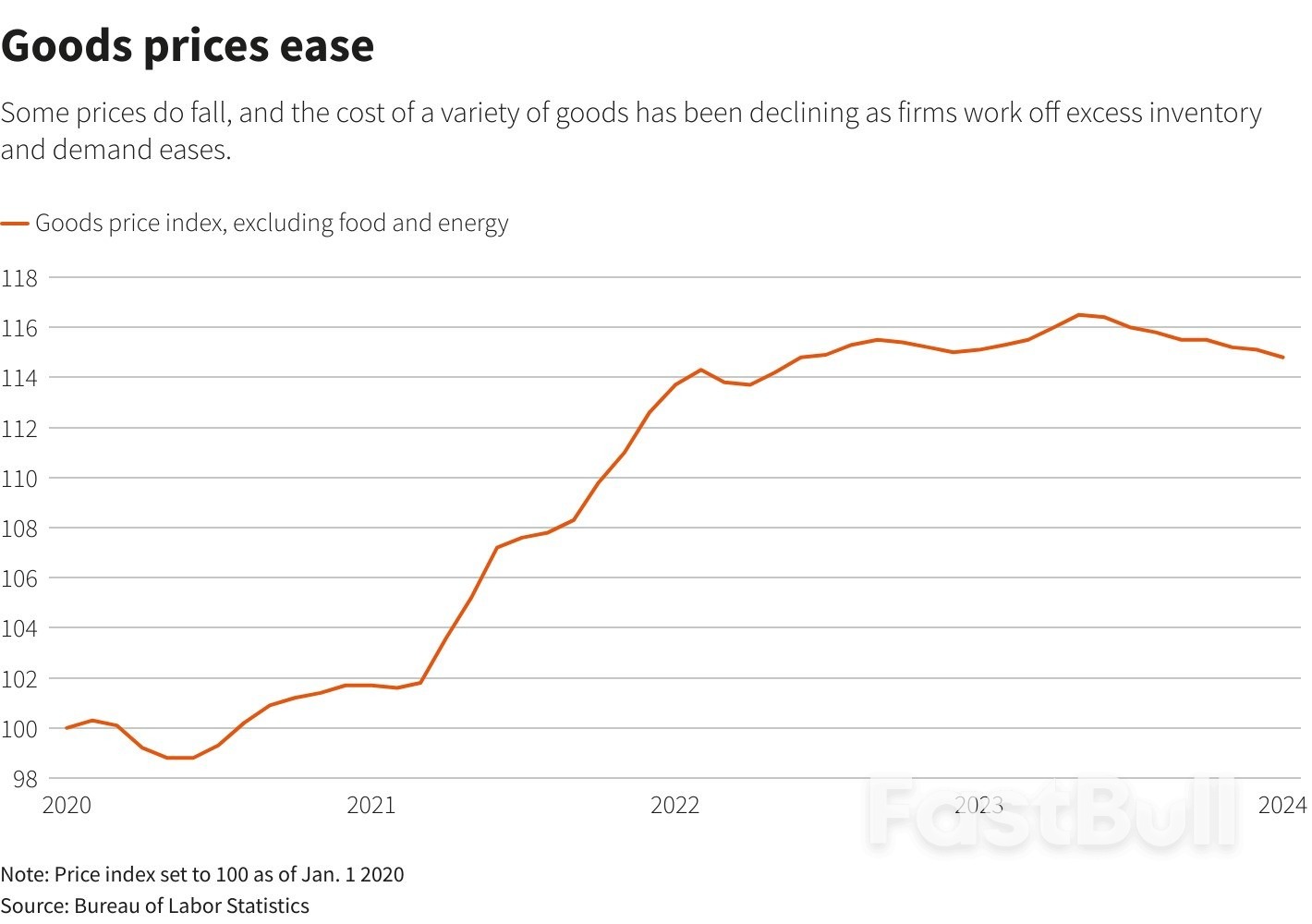
          It is also true that different components of CPI behave differently.
          Goods prices, in fact, have been falling, returning to a pre-pandemic pattern that helped keep overall inflation low.
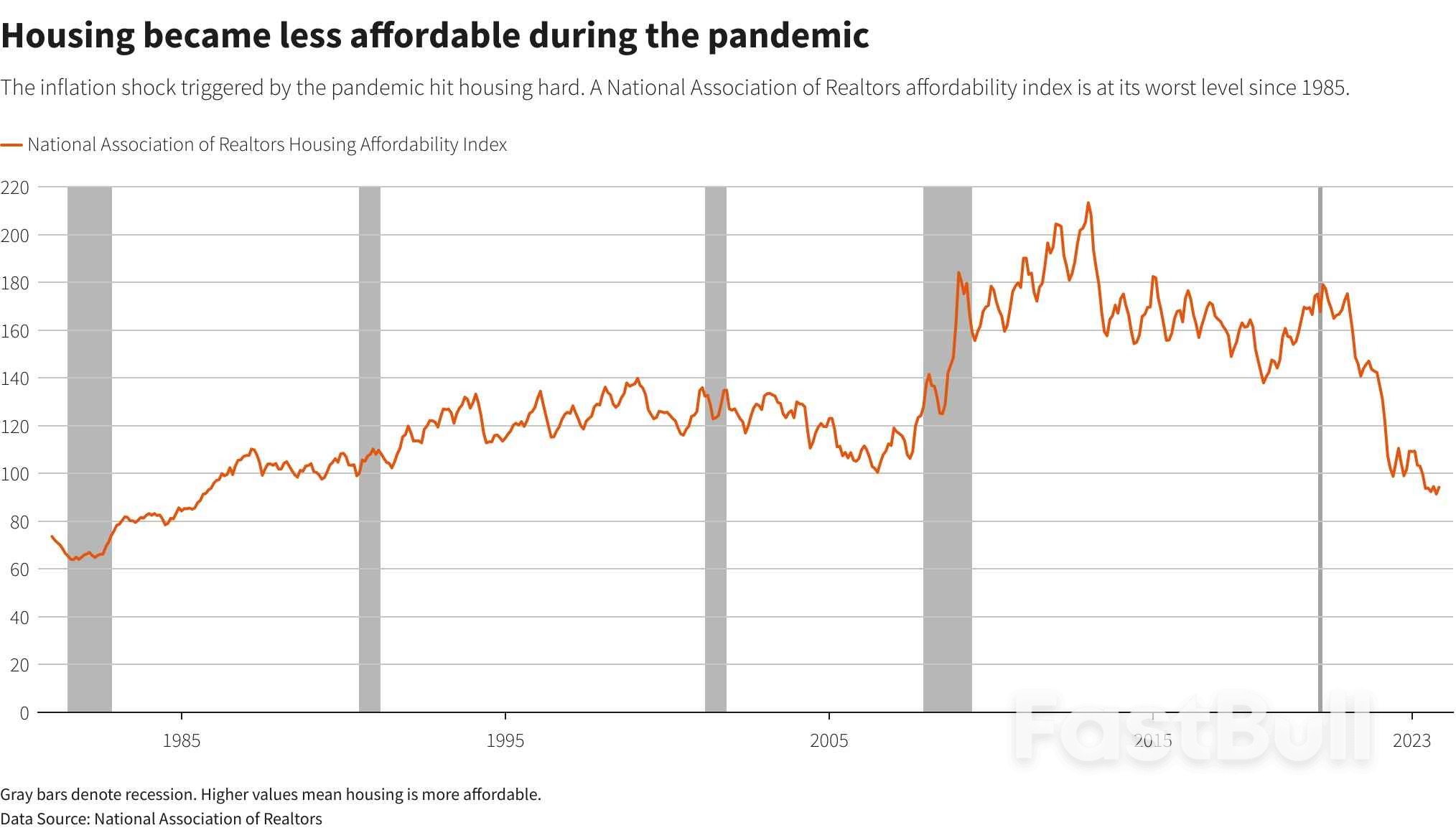
          As The Cookie Crumbles, Election Year Inflation Debate Could Get Messy_3And yet, some of the relative price changes that happened during the pandemic don't just pose a hardship, they are arguably stark enough to alter how people behave.
          Perhaps the most notable example is housing. The median U.S. home price, at $417,000 at the end of 2023, was nearly 30% higher than at the start of the pandemic.
          Current high mortgage rates have created a doubly confounding situation -- first-time buyers are priced out, while current mortgage holders are incentivized to stay in place and not trade into a higher-rate loan. This is a point Republicans are likely to emphasize and which the Biden administration may try to address with new housing proposals.As The Cookie Crumbles, Election Year Inflation Debate Could Get Messy_4

          Will memories be short?

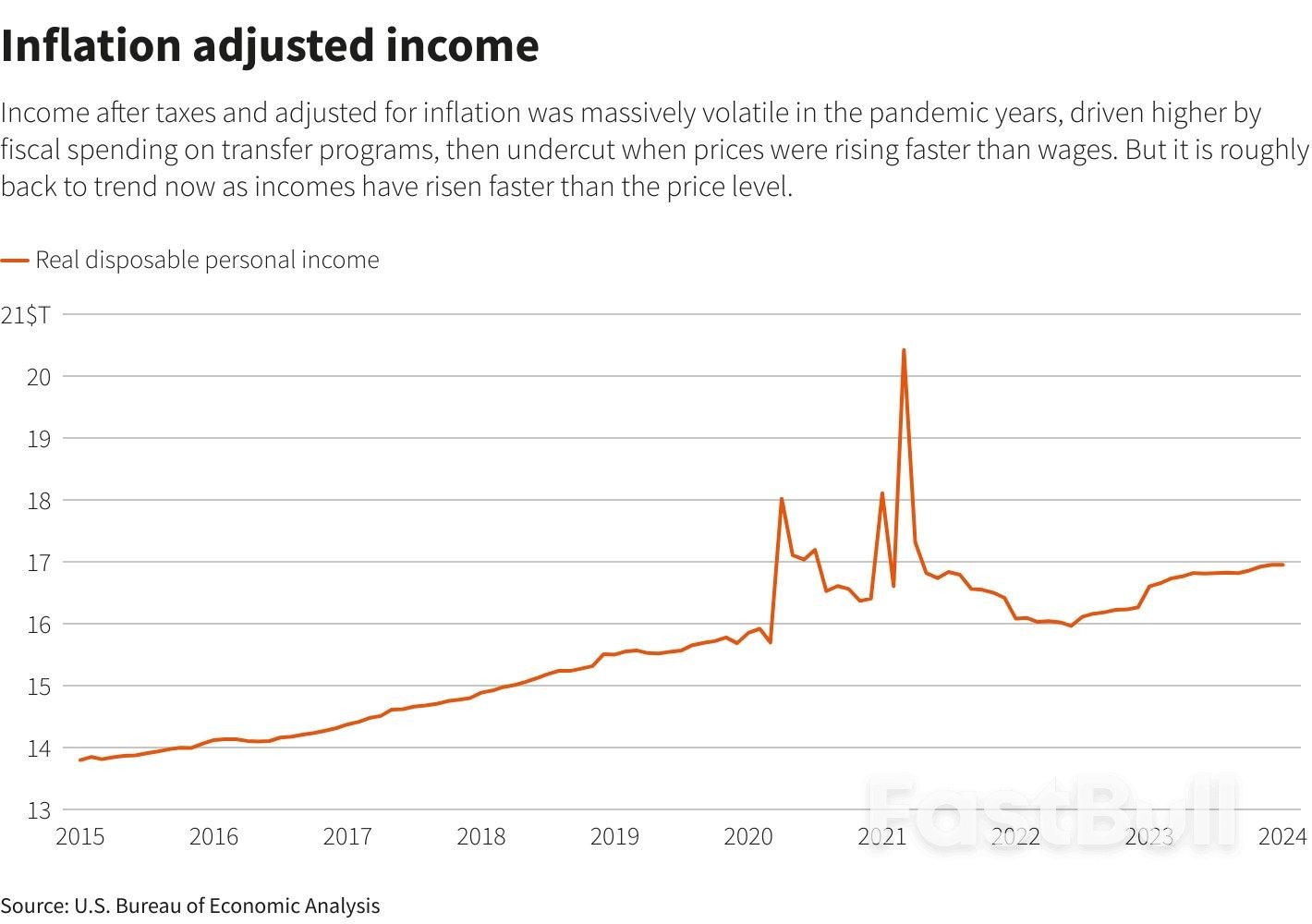
          Inflation easing also means recent wage gains stretch farther, allowing some recovery of the purchasing power lost when prices surged.
          The rise in "real," or inflation-adjusted incomes, is something the Biden administration has emphasized.As The Cookie Crumbles, Election Year Inflation Debate Could Get Messy_5
          Whether that registers in improved sentiment, however, is another issue.
          As with inflation, the details matter. While some pandemic-era wage gains were larger for less well-paid jobs, lower-income households also devote a greater share of their incomes on basics like housing, food and gas, for which prices rose sharply.
          Economists and Fed officials have noted "stress" developing among those households. Even if the economy overall is seeing real wages rise, it doesn't mean every family is experiencing the same.

          Source: Reuters

          To stay updated on all economic events of today, please check out our Economic calendar
          Risk Warnings and Disclaimers
          You understand and acknowledge that there is a high degree of risk involved in trading. Following any strategies or investment methods may lead to potential losses. The content on the site is provided by our contributors and analysts for information purposes only. You are solely responsible for determining whether any trading assets, securities, strategy, or any other product is suitable for investing based on your own investment objectives and financial situation.
          Add to Favorites
          Share

          The Slow Lane in the Tunnel

          Westpac

          Economic

          Central Bank

          This week's national accounts confirmed our view that the domestic economic is soft, especially the consumer. Pressures on households should start to ease in the period ahead.
          The big-picture themes from the national accounts for the December quarter were largely as expected. The Australian economy is soft, expanding just 0.2% in the quarter and 1½% over 2023 as a whole. Domestic demand in the December quarter was weaker still, especially in the private sector. Almost all the 0.1% increase in domestic demand in the quarter came from the public sector.
          Much of 2023's weakness stemmed from the household sector. Consumption has been weak and this remained the case in the December quarter. Discretionary spending continues to decline, with overseas holidays especially weak. Part of this might be the result of shifting seasonal patterns in spending and holidaying. Even so, households are objectively limiting their spending in the face of income pressures. Consumption per person has been falling in Australia, unlike in most peer economies. It is no wonder that consumer sentiment has been so depressed.
          We have been highlighting these income pressures for some time. The triple squeeze of a rising cost of living, increasing tax take and higher interest rates has required households to respond.
          It has been less recognised that the squeeze from rising taxation as a share of income has been greater than from rising net interest payments. (Indeed, the ABS revised down the interest flow series this week, relative to previous releases.) This does not mean monetary policy has done little to slow the economy or combat inflation – there are other channels of monetary policy transmission beyond the immediate effect on household cash flows. But it does put the role of fiscal policy, and particularly bracket creep, in perspective.
          There is light at the end of the tunnel for households. As inflation has declined, the squeeze on real household incomes from this source has diminished. The drag from taxation and net interest payments has also eased a little. Some of the former might reflect timing effects for tax return lodgements. Meanwhile the November increase in the cash rate would have taken effect in people's debt repayments too late to have boosted the quarterly total for net payments by much.
          As a result, real household disposable income increased in the quarter. It was only barely above the level a year previously, though. Once the growth in population over the same period is accounted for, real household disposable income is still going backwards.
          Inflation's grip on households' spending power will continue to ease over the course of 2024. That is the desired outcome. With tax cuts – and, we believe, some reductions in the cash rate – coming in the second half of the year, that triple squeeze will truly begin to unwind.
          It would not be appropriate to interpret the coming turnaround in real incomes as an upside risk that threatens an upsurge in demand-driven inflation. Rather, it represents an extraordinary phase in the household sector's experience coming to a close. Two years of declining real incomes in the face of a tight labour market is not a combination that should be regarded as normal. And there are some potential offsets to this turnaround, especially from the labour market, which is expected to slow with a lag given current slow growth in activity. There are also some increases in net interest payments yet to come through.
          Businesses have also adjusted to the slow demand. Some of them have run down their inventories, while investment in new equipment declined in the quarter. Consistent with our forecasts, the resilience that was believed to have prevailed in the first half of 2023 has not carried through into the second half. Activity in non-residential construction has held up, and opportunities in energy transition, resources and elsewhere remain. But with ongoing cost pressures and soft demand, many businesses would understandably seek to delay or rationalise their spending on new equipment.
          The RBA would be comfortable with these outcomes. They have been seeking to slow demand because they want to bring the level of demand back into balance with supply. The December quarter outcome certainly helps achieve that objective. It also supports our house view that the RBA will reach the point of being prepared to reduce some of the contractionary stance of policy late in the year, most likely starting from September.
          The RBA would also have been heartened by the ongoing turnaround in labour productivity, which increased as they – and we – expected. The second consecutive quarterly increase in this series does not make a trend. But it does lend weight to our view that much of the earlier slump was an artefact of the population surge. Over time, the capital stock will catch up – as long as investment does not decline precipitously.
          Where they might be less comfortable is on the housing front. The potential wealth effect of a renewed upsurge in housing prices is unlikely to be the main concern given any additional consumer demand needs to be set against the weak starting point.
          Rather, the issue at present is the low rate of new production of housing in the context of high construction costs and ongoing (if more moderate) population growth. New housing construction is one of the most important channels of the transmission of monetary policy, here and overseas. The current low rate of dwelling investment is therefore an expected outcome of the RBA's policy actions. To the extent that higher interest rates have dampened dwelling investment, however, they exacerbate Australia's current housing affordability challenges in the medium term. These challenges also relate to some of the other headwinds affecting the industry, including the competing bid for resources from non-residential construction. The inflation–employment trade-off is therefore not the only short-term policy dilemma that policymakers must navigate.
          To stay updated on all economic events of today, please check out our Economic calendar
          Risk Warnings and Disclaimers
          You understand and acknowledge that there is a high degree of risk involved in trading. Following any strategies or investment methods may lead to potential losses. The content on the site is provided by our contributors and analysts for information purposes only. You are solely responsible for determining whether any trading assets, securities, strategy, or any other product is suitable for investing based on your own investment objectives and financial situation.
          Add to Favorites
          Share

          Global Market Sunshine to Pierce China Clouds

          Samantha Luan

          Economic

          Trading in Asia on Friday is shaping up to be a battle between global market strength on one side, and local caution on the other, particularly surrounding the two regional powerhouses China and Japan.
          U.S., European and world stocks as measured by the MSCI All-Country index soared to record highs again on Thursday, spurred by - what else? - another surge in chip stocks. Hopes that the Fed and ECB could soon start cutting rates also boosted sentiment.
          New highs for the S&P 500 and Nasdaq, a weaker dollar and lower U.S. Treasury yields should be a positive cocktail for Asian stocks. The MSCI Asia ex-Japan index will have its seventh weekly rise in eight if it avoids a 1% decline on Friday.
          But concern over China's economy and deepening U.S.-Sino trade tensions are never far from the surface, and they bubbled up again on Thursday.
          In Japan, meanwhile, the Nikkei slumped 1% after the yen clocked its biggest rise of the year on mounting speculation that the Bank of Japan could end negative interest rates as soon as this month.
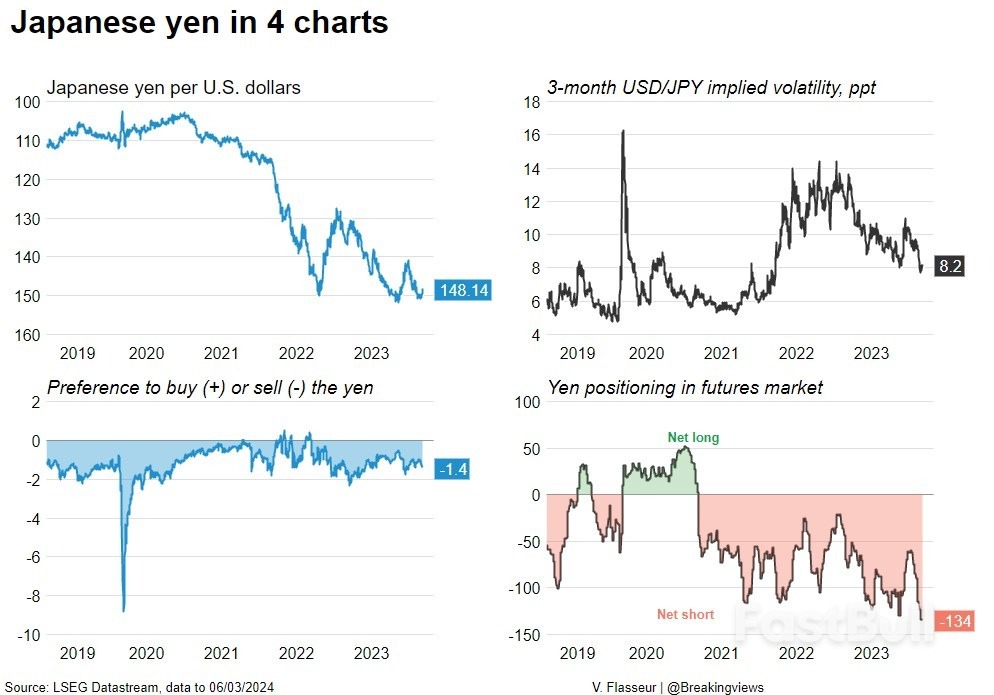
          The Nikkei has touched record highs recently so some profit-taking is to be expected. Similarly, U.S. futures market data show speculative short positions in the yen are the largest in six years, so a bout of short covering was always likely.Global Market Sunshine to Pierce China Clouds_1
          Japan dominates the Asian economic calendar on Friday, with the latest household spending, bank lending, trade and current account data all scheduled for release.
          The news flow around China over the last 24 hours hasn't been particularly bullish for asset prices.
          S&P Global warned that China's credit rating could be cut if its economic recovery remains weak or is driven largely by extensive stimulus. S&P last downgraded China in 2017 but rival agency Moody's put Beijing on a downgrade warning in December.
          Beijing is fighting deflation, a property sector crash and slowing growth. The sums needed to turn all that around, as well as bail out indebted local governments, are extremely high.
          On the trade front, three U.S. Senate Democrats from auto manufacturing states on Thursday urged the Biden administration to hike import tariffs on Chinese electric vehicles, the latest push by lawmakers to protect the U.S. auto sector.
          With pressure growing on the White House to take further steps to prevent Chinese vehicle imports, the U.S. House Energy and Commerce committee approved legislation to vote on legislation giving China's Byte Dance six months to divest from short video app TikTok or face a U.S. ban.
          This is the backdrop to IMF Managing Director Kristalina Georgieva and First Deputy Managing Director Gita Gopinath's planned visit to Beijing later this month to meet with Chinese authorities and attend economic conferences.
          Here are key developments that could provide more direction to markets on Friday:
          - Japan household spending (January)
          - Japan trade and current account (January)
          - Taiwan trade (February)

          Source: Reuters

          To stay updated on all economic events of today, please check out our Economic calendar
          Risk Warnings and Disclaimers
          You understand and acknowledge that there is a high degree of risk involved in trading. Following any strategies or investment methods may lead to potential losses. The content on the site is provided by our contributors and analysts for information purposes only. You are solely responsible for determining whether any trading assets, securities, strategy, or any other product is suitable for investing based on your own investment objectives and financial situation.
          Add to Favorites
          Share
          FastBull
          Copyright © 2025 FastBull Ltd

          728 RM B 7/F GEE LOK IND BLDG NO 34 HUNG TO RD KWUN TONG KLN HONG KONG

          TelegramInstagramTwitterfacebooklinkedin
          App Store Google Play Google Play
          Products
          Charts

          Chats

          Q&A with Experts
          Screeners
          Economic Calendar
          Data
          Tools
          Membership
          Features
          Function
          Markets
          Copy Trading
          Latest Signals
          Contests
          News
          Analysis
          24/7
          Columns
          Education
          Company
          Careers
          About Us
          Contact Us
          Advertising
          Help Center
          Feedback
          User Agreement
          Privacy Policy
          Business

          White Label

          Data API

          Web Plug-ins

          Poster Maker

          Affiliate Program

          Risk Disclosure

          The risk of loss in trading financial instruments such as stocks, FX, commodities, futures, bonds, ETFs and crypto can be substantial. You may sustain a total loss of the funds that you deposit with your broker. Therefore, you should carefully consider whether such trading is suitable for you in light of your circumstances and financial resources.

          No decision to invest should be made without thoroughly conducting due diligence by yourself or consulting with your financial advisors. Our web content might not suit you since we don't know your financial conditions and investment needs. Our financial information might have latency or contain inaccuracy, so you should be fully responsible for any of your trading and investment decisions. The company will not be responsible for your capital loss.

          Without getting permission from the website, you are not allowed to copy the website's graphics, texts, or trademarks. Intellectual property rights in the content or data incorporated into this website belong to its providers and exchange merchants.

          Not Logged In

          Log in to access more features

          FastBull Membership

          Not yet

          Purchase

          Become a signal provider
          Help Center
          Customer Service
          Dark Mode
          Price Up/Down Colors

          Log In

          Sign Up

          Position
          Layout
          Fullscreen
          Default to Chart
          The chart page opens by default when you visit fastbull.com