• Trade
  • Markets
  • Copy
  • Contests
  • News
  • 24/7
  • Calendar
  • Q&A
  • Chats
Trending
Screeners
SYMBOL
LAST
BID
ASK
HIGH
LOW
NET CHG.
%CHG.
SPREAD
SPX
S&P 500 Index
6827.42
6827.42
6827.42
6899.86
6801.80
-73.58
-1.07%
--
DJI
Dow Jones Industrial Average
48458.04
48458.04
48458.04
48886.86
48334.10
-245.98
-0.51%
--
IXIC
NASDAQ Composite Index
23195.16
23195.16
23195.16
23554.89
23094.51
-398.69
-1.69%
--
USDX
US Dollar Index
97.950
98.030
97.950
98.500
97.950
-0.370
-0.38%
--
EURUSD
Euro / US Dollar
1.17394
1.17409
1.17394
1.17496
1.17192
+0.00011
+ 0.01%
--
GBPUSD
Pound Sterling / US Dollar
1.33707
1.33732
1.33707
1.33997
1.33419
-0.00148
-0.11%
--
XAUUSD
Gold / US Dollar
4299.39
4299.39
4299.39
4353.41
4257.10
+20.10
+ 0.47%
--
WTI
Light Sweet Crude Oil
57.233
57.485
57.233
58.011
56.969
-0.408
-0.71%
--

Community Accounts

Signal Accounts
--
Profit Accounts
--
Loss Accounts
--
View More

Become a signal provider

Sell trading signals to earn additional income

View More

Guide to Copy Trading

Get started with ease and confidence

View More

Signal Accounts for Members

All Signal Accounts

Best Return
  • Best Return
  • Best P/L
  • Best MDD
Past 1W
  • Past 1W
  • Past 1M
  • Past 1Y

All Contests

  • All
  • Trump Updates
  • Recommend
  • Stocks
  • Cryptocurrencies
  • Central Banks
  • Featured News
Top News Only
Share

Thai Leader Anutin: Landmine Blast That Killed Thai Soldiers 'Not A Roadside Accident'

Share

Thai Leader Anutin: Thailand To Continue Military Action Until 'We Feel No More Harm'

Share

Cambodian Prime Minister Hun Manet Says He Had Phone Calls With Trump And Malaysian Leader Anwar About Ceasefire

Share

Cambodia's Hun Manet Says USA, Malaysia Should Verify 'Which Side Fired First' In Latest Conflict

Share

Cambodia's Hun Manet: Cambodia Maintains Its Stance In Seeking Peaceful Resolution Of Disputes

Share

Nasdaq Companies: Allergan, Ferrovia, Insmed, Monolithic Power Systems, Seagate Technology, And Western Digital Will Be Added To The NASDAQ 100 Index. Biogen, CdW, GlobalFoundries, Lululemon, ON Semiconductor, And Tradedesk Will Be Removed From The NASDAQ 100 Index

Share

Witkoff Headed To Berlin This Weekend To Meet With Zelenskiy, European Leaders -Wsj Reporter On X

Share

Russia Attacks Two Ukrainian Ports, Damaging Three Turkish-Owned Vessels

Share

[Historic Flooding Occurs In At Least Four Rivers In Washington State Due To Days Of Torrential Rains] Multiple Areas In Washington State Have Been Hit By Severe Flooding Due To Days Of Torrential Rains, With At Least Four Rivers Experiencing Historic Flooding. Reporters Learned On The 12th That The Floods Caused By The Torrential Rains In Washington State Have Destroyed Homes And Closed Several Highways. Experts Warn That Even More Severe Flooding May Occur In The Future. A State Of Emergency Has Been Declared In Washington State

Share

Trump Says Proposed Free Economic Zone In Donbas Would Work

Share

Trump: I Think My Voice Should Be Heard

Share

Trump Says Will Be Choosing New Fed Chair In Near Future

Share

Trump Says Proposed Free Economic Zone In Donbas Complex But Would Work

Share

Trump Says Land Strikes In Venezuela Will Start Happening

Share

US President Trump: Thailand And Cambodia Are In A Good Situation

Share

State Media: North Korean Leader Kim Hails Troops Returning From Russia Mission

Share

The 10-year Treasury Yield Rose About 5 Basis Points During The "Fed Rate Cut Week," And The 2/10-year Yield Spread Widened By About 9 Basis Points. On Friday (December 12), In Late New York Trading, The Yield On The Benchmark 10-year US Treasury Note Rose 2.75 Basis Points To 4.1841%, A Cumulative Increase Of 4.90 Basis Points For The Week, Trading Within A Range Of 4.1002%-4.2074%. It Rose Steadily From Monday To Wednesday (before The Fed Announced Its Rate Cut And Treasury Bill Purchase Program), Subsequently Exhibiting A V-shaped Recovery. The 2-year Treasury Yield Fell 1.82 Basis Points To 3.5222%, A Cumulative Decrease Of 3.81 Basis Points For The Week, Trading Within A Range Of 3.6253%-3.4989%

Share

Trump: Lots Of Progress Being Made On Russia-Ukraine

Share

NOPA November US Soybean Crush Estimated At 220.285 Million Bushels

Share

SPDR Gold Trust Reports Holdings Up 0.22%, Or 2.28 Tonnes, To 1053.11 Tonnes By Dec 12

TIME
ACT
FCST
PREV
U.K. Trade Balance Non-EU (SA) (Oct)

A:--

F: --

P: --

U.K. Trade Balance (Oct)

A:--

F: --

P: --

U.K. Services Index MoM

A:--

F: --

P: --

U.K. Construction Output MoM (SA) (Oct)

A:--

F: --

P: --

U.K. Industrial Output YoY (Oct)

A:--

F: --

P: --

U.K. Trade Balance (SA) (Oct)

A:--

F: --

P: --

U.K. Trade Balance EU (SA) (Oct)

A:--

F: --

P: --

U.K. Manufacturing Output YoY (Oct)

A:--

F: --

P: --

U.K. GDP MoM (Oct)

A:--

F: --

P: --

U.K. GDP YoY (SA) (Oct)

A:--

F: --

P: --

U.K. Industrial Output MoM (Oct)

A:--

F: --

P: --

U.K. Construction Output YoY (Oct)

A:--

F: --

P: --

France HICP Final MoM (Nov)

A:--

F: --

P: --

China, Mainland Outstanding Loans Growth YoY (Nov)

A:--

F: --

P: --

China, Mainland M2 Money Supply YoY (Nov)

A:--

F: --

P: --

China, Mainland M0 Money Supply YoY (Nov)

A:--

F: --

P: --

China, Mainland M1 Money Supply YoY (Nov)

A:--

F: --

P: --

India CPI YoY (Nov)

A:--

F: --

P: --

India Deposit Gowth YoY

A:--

F: --

P: --

Brazil Services Growth YoY (Oct)

A:--

F: --

P: --

Mexico Industrial Output YoY (Oct)

A:--

F: --

P: --

Russia Trade Balance (Oct)

A:--

F: --

P: --

Philadelphia Fed President Henry Paulson delivers a speech
Canada Building Permits MoM (SA) (Oct)

A:--

F: --

P: --

Canada Wholesale Sales YoY (Oct)

A:--

F: --

P: --

Canada Wholesale Inventory MoM (Oct)

A:--

F: --

P: --

Canada Wholesale Inventory YoY (Oct)

A:--

F: --

P: --

Canada Wholesale Sales MoM (SA) (Oct)

A:--

F: --

P: --

Germany Current Account (Not SA) (Oct)

A:--

F: --

P: --

U.S. Weekly Total Rig Count

A:--

F: --

P: --

U.S. Weekly Total Oil Rig Count

A:--

F: --

P: --

Japan Tankan Large Non-Manufacturing Diffusion Index (Q4)

--

F: --

P: --

Japan Tankan Small Manufacturing Outlook Index (Q4)

--

F: --

P: --

Japan Tankan Large Non-Manufacturing Outlook Index (Q4)

--

F: --

P: --

Japan Tankan Large Manufacturing Outlook Index (Q4)

--

F: --

P: --

Japan Tankan Small Manufacturing Diffusion Index (Q4)

--

F: --

P: --

Japan Tankan Large Manufacturing Diffusion Index (Q4)

--

F: --

P: --

Japan Tankan Large-Enterprise Capital Expenditure YoY (Q4)

--

F: --

P: --

U.K. Rightmove House Price Index YoY (Dec)

--

F: --

P: --

China, Mainland Industrial Output YoY (YTD) (Nov)

--

F: --

P: --

China, Mainland Urban Area Unemployment Rate (Nov)

--

F: --

P: --

Saudi Arabia CPI YoY (Nov)

--

F: --

P: --

Euro Zone Industrial Output YoY (Oct)

--

F: --

P: --

Euro Zone Industrial Output MoM (Oct)

--

F: --

P: --

Canada Existing Home Sales MoM (Nov)

--

F: --

P: --

Euro Zone Total Reserve Assets (Nov)

--

F: --

P: --

U.K. Inflation Rate Expectations

--

F: --

P: --

Canada National Economic Confidence Index

--

F: --

P: --

Canada New Housing Starts (Nov)

--

F: --

P: --

U.S. NY Fed Manufacturing Employment Index (Dec)

--

F: --

P: --

U.S. NY Fed Manufacturing Index (Dec)

--

F: --

P: --

Canada Core CPI YoY (Nov)

--

F: --

P: --

Canada Manufacturing Unfilled Orders MoM (Oct)

--

F: --

P: --

Canada Manufacturing New Orders MoM (Oct)

--

F: --

P: --

Canada Core CPI MoM (Nov)

--

F: --

P: --

Canada Manufacturing Inventory MoM (Oct)

--

F: --

P: --

Canada CPI YoY (Nov)

--

F: --

P: --

Canada CPI MoM (Nov)

--

F: --

P: --

Canada CPI YoY (SA) (Nov)

--

F: --

P: --

Canada Core CPI MoM (SA) (Nov)

--

F: --

P: --

Q&A with Experts
    • All
    • Chatrooms
    • Groups
    • Friends
    Connecting
    .
    .
    .
    Type here...
    Add Symbol or Code

      No matching data

      All
      Trump Updates
      Recommend
      Stocks
      Cryptocurrencies
      Central Banks
      Featured News
      • All
      • Russia-Ukraine Conflict
      • Middle East Flashpoint
      • All
      • Russia-Ukraine Conflict
      • Middle East Flashpoint
      Search
      Products

      Charts Free Forever

      Chats Q&A with Experts
      Screeners Economic Calendar Data Tools
      Membership Features
      Data Warehouse Market Trends Institutional Data Policy Rates Macro

      Market Trends

      Market Sentiment Order Book Forex Correlations

      Top Indicators

      Charts Free Forever
      Markets

      News

      News Analysis 24/7 Columns Education
      From Institutions From Analysts
      Topics Columnists

      Latest Views

      Latest Views

      Trending Topics

      Top Columnists

      Latest Update

      Signals

      Copy Rankings Latest Signals Become a signal provider AI Rating
      Contests
      Brokers

      Overview Brokers Assessment Rankings Regulators News Claims
      Broker listing Forex Brokers Comparison Tool Live Spread Comparison Scam
      Q&A Complaint Scam Alert Videos Tips to Detect Scam
      More

      Business
      Events
      Careers About Us Advertising Help Center

      White Label

      Data API

      Web Plug-ins

      Affiliate Program

      Awards Institution Evaluation IB Seminar Salon Event Exhibition
      Vietnam Thailand Singapore Dubai
      Fans Party Investment Sharing Session
      FastBull Summit BrokersView Expo
      Recent Searches
        Top Searches
          Markets
          News
          Analysis
          User
          24/7
          Economic Calendar
          Education
          Data
          • Names
          • Latest
          • Prev

          View All

          No data

          Scan to Download

          Faster Charts, Chat Faster!

          Download App
          English
          • English
          • Español
          • العربية
          • Bahasa Indonesia
          • Bahasa Melayu
          • Tiếng Việt
          • ภาษาไทย
          • Français
          • Italiano
          • Türkçe
          • Русский язык
          • 简中
          • 繁中
          Open Account
          Search
          Products
          Charts Free Forever
          Markets
          News
          Signals

          Copy Rankings Latest Signals Become a signal provider AI Rating
          Contests
          Brokers

          Overview Brokers Assessment Rankings Regulators News Claims
          Broker listing Forex Brokers Comparison Tool Live Spread Comparison Scam
          Q&A Complaint Scam Alert Videos Tips to Detect Scam
          More

          Business
          Events
          Careers About Us Advertising Help Center

          White Label

          Data API

          Web Plug-ins

          Affiliate Program

          Awards Institution Evaluation IB Seminar Salon Event Exhibition
          Vietnam Thailand Singapore Dubai
          Fans Party Investment Sharing Session
          FastBull Summit BrokersView Expo

          U.S. Futures Inch Higher, Nvidia to Report This Week

          Cohen

          Economic

          Stocks

          Political

          Summary:

          What's moving markets?

          U.S. stock futures edge higher after the Dow ended trading on Friday above the 40,000 mark for the first time. Nvidia is due to headline this week's corporate earnings calendar, with the maker of artificial intelligence-optimized chips expected to report another quarter of surging revenues. Elsewhere, several Fed officials are set to speak on Monday, as investors attempt to gauge to road ahead for the central bank's monetary policy.

          1. Futures point higher

          U.S. stock futures were broadly higher on Monday, suggesting an extension in a rally in the prior session that drove the blue-chip Dow Jones Industrial Average to its first-ever close above the 40,000 level.
          By 03:48 ET (07:48 GMT), the Dow futures contract had gained 19 points or 0.1%, S&P 500 futures had risen by 4 points or 0.1%, and Nasdaq 100 futures had advanced by 22 points or 0.1%.
          Recent data indicating a possible cooling in the U.S. economy have alleviated some persistent inflation concerns, fueling hopes that the Federal Reserve will start to bring interest rates down from more than two-decade highs as soon as September. Along with the Dow, the benchmark S&P 500 and tech-heavy Nasdaq Composite all touched record marks last week.
          The durability of the strength on Wall Street will likely be tested by a fresh batch of corporate results this week, including quarterly returns from artificial intelligence darling Nvidia (see below). Durable goods and consumer sentiment data will also be in focus as markets hunt for more evidence that growth is moderating enough to give the Fed justification for rolling out rate cuts this year.

          2. Nvidia earnings ahead this week

          Nvidia is set to highlight the earnings calendar this week, with traders keen to see if the maker of AI-specialized graphics processing units will once again post spiking revenues at its all-important data center unit.
          Shares in the company have rocketed higher by nearly 92% this year, making it one of the focal points of the AI boom. In February, Nvidia said it expects revenues to jump to $24 billion in the first quarter, with Chief Executive Jensen Huang noting that he believed "accelerated computing and generative AI have hit the tipping point."
          Comments from Huang will also likely be in the spotlight. Nvidia faces competition from rival chipmakers like Intel and Advanced Micro Devices , as well as supply chain constraints and geopolitical tensions that threaten AI chip exports from the U.S. to China. Meanwhile, major tech players like Google-parent Alphabet and e-commerce titan Amazon are reportedly beginning to build their own AI chips in-house, potentially limiting their need for Nvidia's chips.

          3. Fed speakers, minutes on tap

          Several Fed officials are due to deliver speeches on Monday that may provide insight into the path ahead for the central bank's moentary policy.
          Fed board members Christopher Waller, Philip Jefferson and Michael Barr are scheduled to speak at separate events.
          Later in the week, the Fed is set to publish the minutes from its April 30-May 1 meeting, when Chair Jerome Powell indicated that rates are likely to remain higher for longer because of lingering inflationary pressures.
          However, since then, data has shown that U.S. consumer prices -- a key gauge of inflation -- increased at a slower than anticipated pace in April, while a crucial labor market report undershot estimates.
          The numbers bolstered wagers that the Fed will introduce two 25-basis point cuts to borrowing costs this year. Rates currently stand at a 23-year high of 5.25% to 5.5%.

          4. China keeps loan prime rate unchanged

          The People’s Bank of China kept its benchmark loan prime rate (LPR) unchanged on Monday as widely expected, even as Beijing continued to roll out other stimulus measures to support the economy.
          The PBOC maintained its one-year LPR at 3.45%, while the five-year rate, which is used to determine mortgage rates, was left at 3.95%.
          Both rates were kept at record lows, as Beijing sought to shore up economic growth by keeping local monetary conditions as loose as possible.
          Elsewhere, Hong Kong-listed shares of mainland Chinese property developers dropped despite Beijing announcing fresh measures last week aimed at supporting the ailing industry. China has unveiled a string of these policies in recent weeks, including a softening of home buying restrictions across several major cities and funds for local governments to buy real estate from developers.

          5. Crude gains amid Iran uncertainty

          Crude prices edged higher Monday, adding to the previous week’s gains, as uncertainty swirled around the political situation in the Middle East following the reported death of Iranian President Ebrahim Raisi.
          By 03:44 ET, the U.S. crude futures (WTI) traded 0.3% higher at $79.81 per barrel, while the Brent contract climbed 0.3% to $84.23 a barrel. Brent had ended the previous week up about 1%, its first weekly gain in three weeks, while WTI rose 2% on improved economic indicators from the U.S. and China, the world's largest oil consumers.
          Iranian state media said Raisi, who was seen a possible successor to Supreme Leader Ayatollah Ali Khamenei, died in a helicopter crash on Sunday in a remote region in the country's north-west.
          Raisi’s death comes amid simmering tensions in the oil-rich Middle East, with Israel and the militant group Hamas at war in Gaza. Israel and Iran also launched strikes against each other earlier this year.

          Source:Investing

          To stay updated on all economic events of today, please check out our Economic calendar
          Risk Warnings and Disclaimers
          You understand and acknowledge that there is a high degree of risk involved in trading. Following any strategies or investment methods may lead to potential losses. The content on the site is provided by our contributors and analysts for information purposes only. You are solely responsible for determining whether any trading assets, securities, strategy, or any other product is suitable for investing based on your own investment objectives and financial situation.
          Add to Favorites
          Share

          Pound to Australian Dollar Week Ahead Forecast: Bracing for the Next Leg Lower

          Warren Takunda

          Economic

          Forex

          The Aussie has been buoyed by rising hopes the Federal Reserve will cut interest rates and news of significant efforts by Chinese authorities to bolster its flailing residential property market; both developments are supportive of global investor sentiment.
          The Australian Dollar is the ultimate procyclical 'high beta' currency that tends to benefit in times of improving sentiment, making it the G10's outperformer of the past month.
          "The strongest currencies since mid-April have been the Australian dollar and the New Zealand dollar. Indeed, the Australian dollar has rallied by 3.7% versus the US dollar, and the New Zealand dollar by 2.9%," says Georgette Boele, Senior FX Strategist at ABN AMRO.
          That said, the Aussie's rally has stalled recently, allowing the Pound to Pound to Australian dollar exchange rate (GBP/AUD) the chance to consolidate and form a horizontal support line.
          We suspect this period of consolidation can extend into the coming days and potentially even deliver some upside for GBP/AUD:
          Pound to Australian Dollar Week Ahead Forecast: Bracing for the Next Leg Lower_1

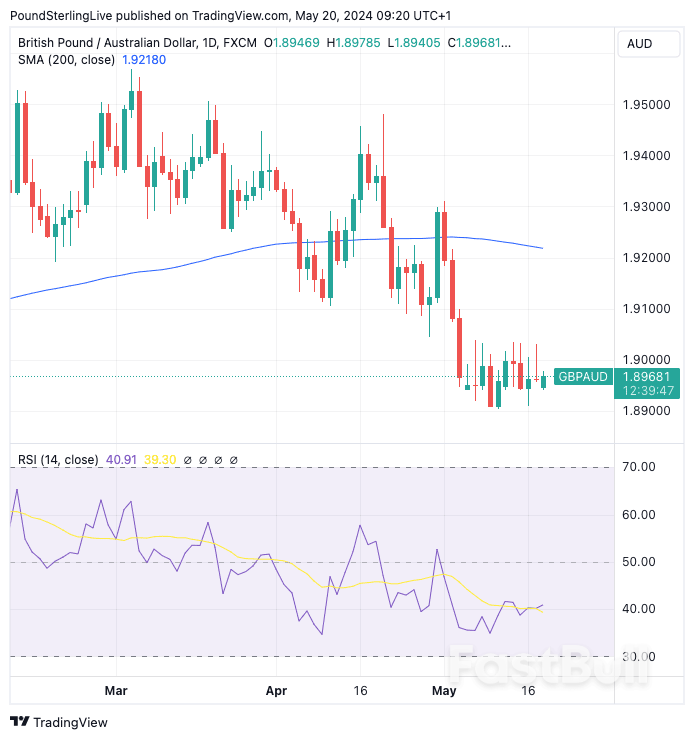
          Above: GBP/AUD at daily intervals.

          Note the Relative Strength Index (RSI) in the lower panel has turned up, which is consistent with easing downside pressure and the potential for a small recovery.
          Support is seen at 1.89070, and resistance is at 1.90, and we expect moves on either side of these levels to fade (the obvious caveat being a surprise in the midweek UK inflation release, see more below).
          The majority of technical signals we follow show the Australian Dollar as being the preferred currency in the pair. GBP/AUD resides below its key moving averages and momentum indicators remain pointed lower; we therefore see any gains as being a counter-trend correction that will ultimately fade and take the market below 1.89070.
          There are no significant releases due out of Australia this week and the focus for GBP/AUD falls on Wednesday's UK inflation report.
          The market expects CPI inflation to fall to 2.1% year-on-year in April from 3.1% in March, and the core inflation rate to fall to 3.7% from 4.2%.
          Any deviation from these expectations can influence the currency, with the Pound gaining on upside surprises and falling on any undershoot as this will firm the odds for a June interest rate cut.
          The Reserve Bank of Australia is meanwhile only likely to cut interest rates in late 2024 or early-2025, meaning the AUD can look forward to a supportive interest rate market setup in the coming months, further pressuring GBP/AUD.

          Source: Poundsterlinglive

          To stay updated on all economic events of today, please check out our Economic calendar
          Risk Warnings and Disclaimers
          You understand and acknowledge that there is a high degree of risk involved in trading. Following any strategies or investment methods may lead to potential losses. The content on the site is provided by our contributors and analysts for information purposes only. You are solely responsible for determining whether any trading assets, securities, strategy, or any other product is suitable for investing based on your own investment objectives and financial situation.
          Add to Favorites
          Share

          How High is Too High?

          Swissquote

          Economic

          Central Bank

          Equity bulls around the globe celebrated in style the softer-than-expected US CPI data last week. The global equity rally was further juiced by the expectation that a softer inflation in the US would not only allow the Federal Reserve (Fed) to start cutting the rates this year, but also allow the other major central banks, like the European Central Bank (ECB) and the Bank of England (BoE), to carry on with their plans to cut their own rates and – maybe – cut more than people think they could.
          The S&P500, Nasdaq 100 and Dow Jones renewed record last week, the Big US retailers quarterly results hinted that consumer demand may be coming to a slippery ground, the latter sent Walmart shares to a fresh high last week after the announcement of its Q1 results.
          Macy's, Lowe's and Target earnings are due this week and could come to cement the ‘troubled outlook for spending' story – that could continue to butter the bread of the Fed doves and further fuel the reflation trade that benefits grandly to the stocks at this side of the Atlantic Ocean as well. The European Stoxx 600 and the British FTSE 100 followed suit with fresh records, the treasuries had their best month this year and the US dollar fell.
          But note that the US 2-year yield rebounded past the 4.80% level the greenback kicks off the week under some selling pressure, and the US dollar index held ground above a major Fibonacci support, the 38.2% retracement on the ytd rally that distinguishes the ytd positive trend from a medium term bearish reversal.
          The soft CPI data could've certainly marked the end of this year's positive trend but people still took into consideration that the producer price data released just a bit earlier than the US CPI last week came in hotter-than-expected and as JP's Jamie Dimon said ‘costs link to the green economy, remilitarization, infrastructure spending, trade disputes, and large fiscal deficits may mean inflation will stay sticky'. And he is probably right.
          But regardless of the warnings, the equity market cleared an important barrier to the present optimism, and is looking to jump over the next big barrier – Nvidia earnings – this week. Nvidia is expected to reveal another blowout quarter where sales may have hit the $24bn mark. Remember that big AI spenders like Meta said earlier in this earning season that they will be spending more on AI. The latter hinted that demand for Nvidia's AI chips may remain sustained for some more time.
          Price-wise, Nvidia gained more than 700% since the beginning of last year on AI boom, and is trading at a spitting distance from the $1000 per share level. This week's results will either send the share above this $1000 level or trigger profit taking near it. But any misstep from Nvidia – which has been the icon of the AI rally – has potential to trigger a broader market selloff, especially across the technology stocks. Note that, the price-to-estimated earnings of the S&P500's technology sector bounced above the 28 level, which has acted as an important resistance since 2020. Therefore, the current levels could well be appropriate for a correction. And a potential disappointment from Nvidia could pull that trigger.

          Also this week

          Canada and the UK are due to announce their latest CPI updates on Tuesday and Wednesday respectively, the Reserve Bank of New Zealand (RBNZ) is expected to maintain its policy rate unchanged at 5.50% and the FOMC is scheduled to release the minutes of its latest meeting. Inflation in the UK is expected to have fallen from 3.2% to 2.1% in April. If that's the case, the BoE rate cut bets could take a lift and limit Cable's upside potential before the 1.28 mark.
          Elsewhere, the EURUSD rallied and stepped into the bullish consolidation zone last week on the back of a softer-than-expected US inflation, but sees resistance into the 1.09 mark. Released last Friday, the series of inflation numbers from the Eurozone came with no surprise. Inflation in the Eurozone eased in April, keeping the prospects of a June rate cut well alive. The divergence between the ECB and the Fed outlooks narrowed slightly due to a softer-than-expected US CPI report, but it could not suffice to justify an extension of gains toward the 1.10 psychological mark.
          In commodities, US crude rebounded and is testing the $80pb psychological offers this morning. The dovish central bank expectations continue to support the reflation trade, which in return is supportive of energy and commodity prices. Fresh Chinese stimulus measures aiming to address the country's heavily bleeding property market, and the latest – and better-than-expected – rebound in Chinese industrial production also support the rally in commodity prices. The copper futures begin the week at fresh ATH and the CSI 300 index is pushing higher this Monday, as well.
          To stay updated on all economic events of today, please check out our Economic calendar
          Risk Warnings and Disclaimers
          You understand and acknowledge that there is a high degree of risk involved in trading. Following any strategies or investment methods may lead to potential losses. The content on the site is provided by our contributors and analysts for information purposes only. You are solely responsible for determining whether any trading assets, securities, strategy, or any other product is suitable for investing based on your own investment objectives and financial situation.
          Add to Favorites
          Share

          Will The Indian Stock Market Continue Its Upward Momentum This Week? Here's What Experts Say

          Samantha Luan

          Economic

          Stocks

          After experiencing significant volatility, the Indian benchmark indices resumed their upward momentum last week, with both the Nifty 50 and Sensex achieving their second-best weekly gains in 2024, led by favorable domestic and global factors.
          The Nifty 50 closed the week with a gain of 2.03%, marking its most significant weekly increase since January 2024, while the Sensex also ended the week with a gain of 1.85%, its highest since January.
          Several factors contributed to this upward movement. Firstly, there were expectations of a rate cut from the US Federal Reserve. Additionally, forecasts indicating an earlier start to the monsoon season with expectations of above-average rainfall boosted market sentiment.
          Furthermore, strong domestic buying, improved voter turnout in the fourth phase, and stability in crude oil prices also played significant roles in driving the market higher. Also, markets received a boost after US benchmark indices reached record highs.
          Metal stocks, on the other hand, surged significantly following China's announcement of a comprehensive stimulus package aimed at bolstering its distressed property market. The measures include the relaxation of mortgage regulations and encouragement for local governments to purchase unsold homes.
          In the latest trading session, the Nifty Metal index surged to a record high of 9,633 points, marking a significant milestone. The index closed with a notable gain of 7.03%, reflecting strong bullish momentum in the metal sector.

          Strong DII's support

          Despite considerable FII selling, the market has demonstrated resilience, largely due to DIIs absorbing the majority of selling. Trendlyne data showed that out of the last 13 sessions, FIIs remained net sellers in 11, withdrawing Rs. 35,527 crore from the Indian stock market.
          Conversely, DIIs countered this by purchasing nearly an equivalent amount, with ₹33,973 crore being invested during this period.
          "The main trigger for the FII selling has been the outperformance of the Hong Kong index Hang Seng, which shot up by 19.33% during the last one month. FIIs are moving money from expensive markets like India to cheap markets like Hong Kong, where the PE is around 10 compared to around 20 PE in India," said Dr V K Vijayakumar, Chief Investment Strategist, Geojit Financial Services.
          "Another important trend is the stability of FII inflows into debt. So far for CY2024, while the equity market has witnessed FPI outflows of ₹26,019 crore, the debt market has witnessed inflows of ₹45,086 crores. Going forward, there is likely to be a dramatic change in FPI equity flows in response to election results. Political stability will attract huge inflows," he added.
          Sunil Damania, Chief Investment Officer, MojoPMS, said, "There are two main reasons why foreign portfolio investors (FPIs) have been selling in FY2025. First, there's uncertainty about the upcoming election. FPIs generally don't like uncertainty; they prefer to play it safe and lock in the profits they made last year. Second, the market valuations are quite high."
          "We anticipate the market remaining volatile after June 4th. Once the election concludes, all eyes will be on the July budget announcement, triggering more speculation and potential market swings. The high market valuations could act as a barrier to significant market gains, but there's also a possibility of a downturn."
          "Despite the current short-term uncertainty, we maintain a positive outlook for the Indian equity market and project strong returns over the next three to five years," added Sunil Damania.

          Volatility to continue?

          Looking ahead, analysts anticipate that the volatility in the Indian benchmarks will continue this week, commencing on Tuesday. The market will remain closed for the fifth phase of parliamentary election voting in Mumbai on Monday.
          Investors will keep a close eye on various factors throughout the week, including the January-March quarter results, voter turnout in the fifth phase of elections (especially in the Mumbai region), macroeconomic data from both India and abroad, foreign fund withdrawals, fluctuations in crude oil prices, and global market cues.
          These factors are poised to influence market sentiment and trading activity this week.
          “The coming week is a holiday-shortened one, and market focus will remain on earnings reports, ongoing elections, and global index performance for further cues," Ajit Mishra, SVP, Research, Religare Broking, told ANI.
          "Most key sectors participated in the uptrend, with realty, metal, and energy sectors leading the gains, while FMCG was the exception. Notably, the buoyancy in broader indices stood out, with the midcap index reaching a record high and gaining between 4.5% and 5.6%," Mishra added.
          "The outlook for the market will be guided by the major domestic and global economic data, such as India's PMI manufacturing and service data, UK inflation data, US initial jobless claims, S&P global services data, and S&P global manufacturing PMI and Q4 corporate results," Arvinder Singh Nanda, Senior Vice President, Master Capital Services, told PTI.
          Vinod Nair, Head of Research, Geojit Financial Services, said, “The release of PMI data for May from both the US and India next week will be closely monitored for further market insights. Amidst ongoing uncertainties surrounding election results and quarterly earnings, we anticipate continued volatility in the near term."
          Source:mint
          To stay updated on all economic events of today, please check out our Economic calendar
          Risk Warnings and Disclaimers
          You understand and acknowledge that there is a high degree of risk involved in trading. Following any strategies or investment methods may lead to potential losses. The content on the site is provided by our contributors and analysts for information purposes only. You are solely responsible for determining whether any trading assets, securities, strategy, or any other product is suitable for investing based on your own investment objectives and financial situation.
          Add to Favorites
          Share

          ‘Will Indians Become Rich Before India Grows Old?’: Raghuram Rajan On The Job Scenario

          Alex

          Economic

          Political

          Former Reserve Bank of India governor Raghuram Rajan posed a question in his discussion with CNN’s Fareed Zakaria on his show GPS on joblessness in the country: “Will Indians become rich before India grows old?”
          Rajan was speaking to Zakaria on India’s unemployment figures, which Centre for Monitoring Indian Economy (CMIE) puts at 8.1 per cent for April 2024. Zakaria said that only 37.6 per cent of the working population is gainfully employed.
          “Even if India is the fastest growing economy in the G20, it is also the poorest country,” said the economist, also the coauthor of ‘Breaking the Mold: India’s Untraveled Path to Prosperity’. He said that India is currently getting the benefits of the population dividend. “Young people are coming into the labour force in massive quantities. If we could employ them, India would grow much faster,” said Rajan, giving examples of China and Korea in their strong growth periods.
          Zakaria pointed out that China, Korea, and Taiwan were growing at 10 per cent when they were at the stage where India is, as compared to India’s 6.5 per cent growth.
          “Relative to the rich countries, we look really good. Also we have a large population, so we are overtaking countries in terms of overall GDP. We have just overtaken the UK, India is the fifth-largest economy. Soon, India will overtake stagnant Japan and Germany to become the third-largest economy. The real issue is: Can Indians become rich before India grows old?” said Rajan. He argued that the population dividend that India is reaping now won’t remain the same, and that fewer people will join the workforce. He pointed out that the Indian population would age.
          “By 2047-2050 we are going to start growing old. Are we going to be rich by then? Not at 6-6.5 per cent growth,” said Rajan.
          The economist, in a question on how much credit the Modi government deserves, acknowledged that they must be credited for many things like the infrastructure developments. “If you want roads to be built, railways to be built, that centralised coordination happens well with a more authoritarian government, which is what the Modi government is,” said Rajan, pointing that a freer environment is necessary for innovation, debate, and arguments. “You can’t suppress protests in universities…or independent media,” said Rajan, adding that if one is going on a new path, they should know where they are going wrong.
          Rajan said that the government needs to acknowledge the problem of unemployment. The ‘White Paper on The Indian Economy’ released in February 2024, does not mention the word ‘unemployment’, said the economist.
          Responding to a question on issues of minorities and nationalism, Rajan said: “That’s a huge worry. No country has ever succeeded by treating a large part of its population as second-class citizens. They should get the sense of progress, that things are getting better. You cannot reverse the environment of equality that India has enjoyed since independence.” He said that some actions that certain BJP governments are taking are sending a very strong signal to Muslim as well as other minorities.
          Rajan said that the Constitution is something to be proud of and emerged out of certain frailties after partition. He said leaders are often heard saying they believe in the Constitution, but the fundamental part of the Constitution is equality.
          The immediate issue, said Rajan, for India was to create enough jobs, upskill people to make them employable, and enhance India’s women labour force participation. He also said India does not have a single university in the top 100. “But if you bring the diaspora together, we can populate many universities in India with professors of the highest calibre sitting across the world. Can we get a few of them back to give competition to the Oxfords and Harvards,” asked Rajan.
          He said that India always has a way of surprising, and that “again and again we would be surprised by the maturity of the Indian electorate”.

          Source:Business Today

          To stay updated on all economic events of today, please check out our Economic calendar
          Risk Warnings and Disclaimers
          You understand and acknowledge that there is a high degree of risk involved in trading. Following any strategies or investment methods may lead to potential losses. The content on the site is provided by our contributors and analysts for information purposes only. You are solely responsible for determining whether any trading assets, securities, strategy, or any other product is suitable for investing based on your own investment objectives and financial situation.
          Add to Favorites
          Share

          Inflation in the UK Is About to Tumble. But How Far – And for How Long?

          Kevin Du

          Economic

          Jeremy Hunt knows it. Rachel Reeves knows it too. The Office for National Statistics will come bearing good news on Wednesday when it releases the latest inflation figures. The only real question is just how good the news will be.
          In the year to March, annual inflation as measured by the consumer prices index stood at 3.2%. The figure for April will be a lot lower and if Hunt gets lucky it might even fall as low as the government's 2% target.
          The sharp decline is mainly due to movements in electricity and gas prices. Domestic energy bills rose in April 2023 but have fallen by 12% this year for most households. The energy price cap was set at £1,690 last month compared with £2,500 a year earlier.
          Base effects – in other words, what happened a year ago – coupled with cheaper heating and lighting this year means it is inevitable the inflation rate will tumble.
          Hunt is a seasoned enough politician to avoid claiming total victory when the figures come out. The chancellor is aware that voters have seen prices rise by 20% in less than three years and may be unwilling to accept that the cost of living crisis is over.
          And this is not “game over” by any means. The Bank of England expects less favourable base effects later this year to push the annual inflation rate back up to about 2.5% in the second half of 2024 – the period when the prime minister seems likely to call a general election.
          But even with the additional caveat that prices are not actually falling but simply rising at a slower rate, the position is a lot more comfortable than it was for Hunt when he was appointed by Liz Truss to succeed Kwasi Kwarteng as chancellor in October 2022. In that month, inflation hit 11.1% – its highest level in four decades.
          "The focus is not the headline rate – which is influenced by global prices – but on inflation generated by the domestic economy"
          Double-digit inflation conjured up unhappy memories of the mid-1970s, when inflation soared to a postwar high of more than 25% and eventually led to the need for a bailout from the International Monetary Fund – assistance that came with strings attached.
          By coincidence, an IMF team has been in the UK for the past two weeks conducting its annual health check on the economy. Unlike in 1976, the fund will not be demanding unpopular spending cuts, and the findings of this so-called article IV consultation will prove helpful to Hunt if it finds that the UK is through the worst of the cost of living crisis. But the study may contain a sting in the tail if it also ­concludes that any further pre-election tax cuts will be followed by post-election tax increases or fresh austerity measures.
          In the short term, though, the focus will be on what lower inflation means for interest rates. Having raised the official cost of borrowing at 14 successive meetings of its monetary policy committee between December 2021 and August 2023, Threadneedle Street has left rates unchanged since. The reason for that is that a majority of MPC members want to be sure that inflation has truly been beaten.
          The focus is not the headline rate of inflation – which is influenced by the global prices of energy and food – but on inflation generated by the domestic economy. As a proxy for that, the MPC watches services-sector inflation, which is currently running at 6%. While the headline inflation number will be good on Wednesday, it will be the small print that really counts.
          Susannah Streeter, head of money and markets at Hargreaves Lansdown, said: “If inflation hits the sweet spot, hopes will shoot higher that a rate cut will come in June. But it would be wise not to reach for the bunting and go splashing the celebratory cash even if the longed-for 2% target is reached.
          “Bank of England policymakers have stressed that it will need confidence that inflation will consistently stay at or near the target before they start reducing borrowing costs.”

          Source: The Guardian

          To stay updated on all economic events of today, please check out our Economic calendar
          Risk Warnings and Disclaimers
          You understand and acknowledge that there is a high degree of risk involved in trading. Following any strategies or investment methods may lead to potential losses. The content on the site is provided by our contributors and analysts for information purposes only. You are solely responsible for determining whether any trading assets, securities, strategy, or any other product is suitable for investing based on your own investment objectives and financial situation.
          Add to Favorites
          Share

          Soaring Debt And Deficits Causing Worry About Threats To The Economy And Markets

          Cohen

          Economic

          Government debt that has swelled nearly 50% since the early days of the Covid pandemic is generating elevated levels of worry both on Wall Street and in Washington.
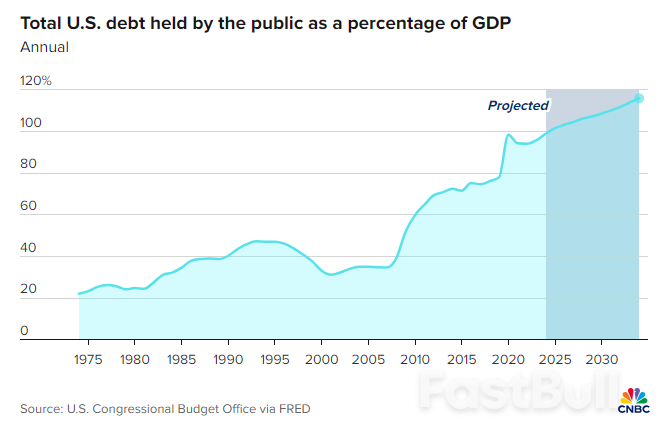
          The federal IOU is now at $34.5 trillion, or about $11 trillion higher than where it stood in March 2020. As a portion of the total U.S. economy, it is now more than 120%.
          Concern over such eye-popping numbers had been largely confined to partisan rancor on Capitol Hill as well as from watchdogs like the Committee for a Responsible Federal Budget. However, in recent days the chatter has spilled over into government and finance heavyweights, and even has one prominent Wall Street firm wondering if costs associated with the debt pose a significant risk to the stock market rally.Soaring Debt And Deficits Causing Worry About Threats To The Economy And Markets_1
          “We’re running big structural deficits, and we’re going to have to deal with this sooner or later, and sooner is a lot more attractive than later,” Fed Chair Jerome Powell said in remarks Tuesday to an audience of bankers in Amsterdam.
          While he has assiduously avoided commenting on such matters, Powell encouraged the audience to read the recent Congressional Budget Office reports on the nation’s fiscal condition.
          “Everyone should be reading the things that they’re publishing about the U.S. budget deficit and should be very concerned that this is something that elected people need to get their arms around sooner rather than later,” he said.

          Uncharted territory for debt and deficits

          Indeed, the CBO numbers are ominous, as they outline the likely path of debt and deficits.
          The watchdog agency estimates that debt held by the public, which currently totals $27.4 trillion and excludes intragovernmental obligations, will rise from the current 99% of GDP to 116% over the next decade. That would be "an amount greater than at any point in the nation's history," the CBO said in its most recent update.Soaring Debt And Deficits Causing Worry About Threats To The Economy And Markets_2
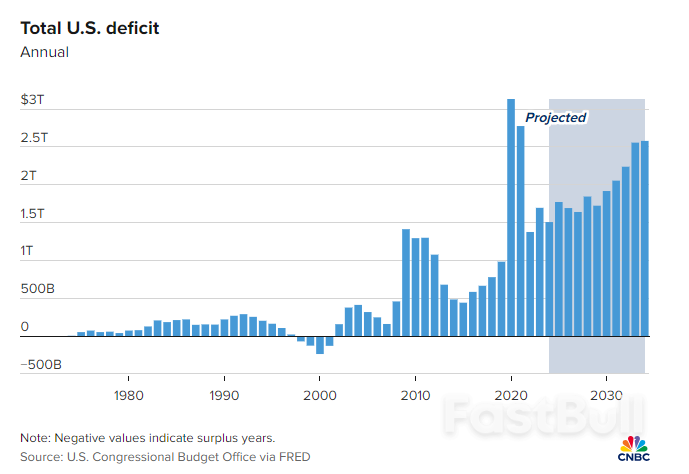
          Surging budget deficits have been driving the debt, and the CBO only expects that to get worse.
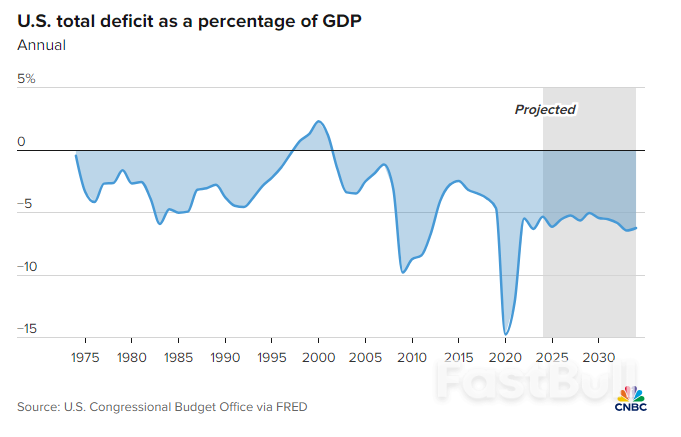
          The agency forecasts a $1.6 trillion shortfall in fiscal 2024 — it is already at $855 billion through the first seven months — that will balloon to $2.6 trillion by 2034. As a share of GDP, the deficit will grow from 5.6% in the current year to 6.1% in 10 years.
          "Since the Great Depression, deficits have exceeded that level only during and shortly after World War II, the 2007–2009 financial crisis, and the corona­virus pandemic," the report stated.
          In other words, such high deficit levels are common mostly in economic downturns, not the relative prosperity that the U.S. has enjoyed for most of era following the brief plunge after the pandemic declaration in March 2020. From a global perspective, European Union member nations are required to keep deficits to 3% of GDP.
          The potential long-term ramifications of the debt were the topic of an interview JPMorgan Chase CEO Jamie Dimon gave to London-based Sky News on Wednesday.
          "America should be quite aware that we have got to focus on our fiscal deficit issues a little bit more, and that is important for the world," the head of the largest U.S. bank by assets said.
          "At one point it will cause a problem and why should you wait?" Dimon added. "The problem will be caused by the market and then you will be forced to deal with it and probably in a far more uncomfortable way than if you dealt with it to start."
          Soaring Debt And Deficits Causing Worry About Threats To The Economy And Markets_3
          Similarly, Bridgewater Associates founder Ray Dalio told the Financial Times a few days ago that he is concerned the soaring U.S. debt levels will make Treasurys less attractive "particularly from international buyers worried about the US debt picture and possible sanctions."
          So far, that hasn't been the case: Foreign holdings of U.S. federal debt stood at $8.1 trillion in March, up 7% from a year ago, according to Treasury Department data released Wednesday. Risk-free Treasurys are still seen as an attractive place to park cash, but that could change if the U.S. doesn't rein in its finances.

          Market impact

          More immediately, there are concerns that rising bond yields could spill over into the equity markets.
          “The huge obvious problem is that the U.S. federal debt is now on a completely unsustainable long-term trajectory,” analysts at Wolfe Research said in a recent note. The firm worries that “bond vigilantes” will go on strike unless the U.S. gets its fiscal house in order, while rising interest costs crowd out spending.
          “Our sense is that policymakers (on both sides of the aisle) will be unwilling to address the U.S.’s long-term fiscal imbalances in a serious way until the market begins to push back hard on this unsustainable situation,” the Wolfe analysts wrote. “We believe that policymakers and the market are most likely underestimating future projected net interest costs.”
          Interest rate hikes from the Federal Reserve have complicated the debt situation. Starting in March 2022 through July 2023, the central bank took up its short-term borrowing rate 11 times, totaling 5.25 percentage points, policy tightening that corresponded with a sharp rise in Treasury yields.
          Net interest on the debt, which totals government debt payments minus what it gets from investment income, have totaled $516 billion this fiscal year. That’s more than government outlays for national defense or Medicare and about four times as much as it has spent on education.
          The presidential election could make some modest differences in the fiscal situation. Debt has soared under President Joe Biden and had escalated under his Republican challenger, former President Donald Trump, following the aggressive spending response to the pandemic.
          “The election could change the medium-term fiscal outlook, though potentially less than one might imagine,” Goldman Sachs economists Alec Phillips and Tim Krupa said in a note.
          A GOP sweep could lead to an extension of the expiring corporate tax cuts Trump pushed through in 2017 — corporate tax receipts have about doubled since then — while a Democratic win might see tax increases, though “much of this would likely go toward new spending,” the Goldman economists said.
          However, the biggest issue with the budget is spending on Social Security and Medicare, and “under no scenario” regarding the election does reform on either program seem likely, Goldman said.

          Source:CNBC

          To stay updated on all economic events of today, please check out our Economic calendar
          Risk Warnings and Disclaimers
          You understand and acknowledge that there is a high degree of risk involved in trading. Following any strategies or investment methods may lead to potential losses. The content on the site is provided by our contributors and analysts for information purposes only. You are solely responsible for determining whether any trading assets, securities, strategy, or any other product is suitable for investing based on your own investment objectives and financial situation.
          Add to Favorites
          Share
          FastBull
          Copyright © 2025 FastBull Ltd

          728 RM B 7/F GEE LOK IND BLDG NO 34 HUNG TO RD KWUN TONG KLN HONG KONG

          TelegramInstagramTwitterfacebooklinkedin
          App Store Google Play Google Play
          Products
          Charts

          Chats

          Q&A with Experts
          Screeners
          Economic Calendar
          Data
          Tools
          Membership
          Features
          Function
          Markets
          Copy Trading
          Latest Signals
          Contests
          News
          Analysis
          24/7
          Columns
          Education
          Company
          Careers
          About Us
          Contact Us
          Advertising
          Help Center
          Feedback
          User Agreement
          Privacy Policy
          Business

          White Label

          Data API

          Web Plug-ins

          Poster Maker

          Affiliate Program

          Risk Disclosure

          The risk of loss in trading financial instruments such as stocks, FX, commodities, futures, bonds, ETFs and crypto can be substantial. You may sustain a total loss of the funds that you deposit with your broker. Therefore, you should carefully consider whether such trading is suitable for you in light of your circumstances and financial resources.

          No decision to invest should be made without thoroughly conducting due diligence by yourself or consulting with your financial advisors. Our web content might not suit you since we don't know your financial conditions and investment needs. Our financial information might have latency or contain inaccuracy, so you should be fully responsible for any of your trading and investment decisions. The company will not be responsible for your capital loss.

          Without getting permission from the website, you are not allowed to copy the website's graphics, texts, or trademarks. Intellectual property rights in the content or data incorporated into this website belong to its providers and exchange merchants.

          Not Logged In

          Log in to access more features

          FastBull Membership

          Not yet

          Purchase

          Become a signal provider
          Help Center
          Customer Service
          Dark Mode
          Price Up/Down Colors

          Log In

          Sign Up
          Position
          Layout
          Fullscreen
          Default to Chart
          The chart page opens by default when you visit fastbull.com