
• Trade
  • Markets
  • Copy
  • Contests
  • News
  • 24/7
  • Calendar
  • Q&A
  • Chats
Trending
Screeners
SYMBOL
LAST
BID
ASK
HIGH
LOW
NET CHG.
%CHG.
SPREAD
SPX
S&P 500 Index
6827.42
6827.42
6827.42
6899.86
6801.80
-73.58
-1.07%
--
DJI
Dow Jones Industrial Average
48458.04
48458.04
48458.04
48886.86
48334.10
-245.98
-0.51%
--
IXIC
NASDAQ Composite Index
23195.16
23195.16
23195.16
23554.89
23094.51
-398.69
-1.69%
--
USDX
US Dollar Index
97.990
98.070
97.990
98.070
97.920
+0.040
+ 0.04%
--
EURUSD
Euro / US Dollar
1.17318
1.17325
1.17318
1.17447
1.17283
-0.00076
-0.06%
--
GBPUSD
Pound Sterling / US Dollar
1.33593
1.33603
1.33593
1.33740
1.33546
-0.00114
-0.09%
--
XAUUSD
Gold / US Dollar
4340.76
4341.19
4340.76
4347.21
4294.68
+41.37
+ 0.96%
--
WTI
Light Sweet Crude Oil
57.537
57.574
57.537
57.601
57.194
+0.304
+ 0.53%
--

Community Accounts

Signal Accounts
--
Profit Accounts
--
Loss Accounts
--
View More

Become a signal provider

Sell trading signals to earn additional income

View More

Guide to Copy Trading

Get started with ease and confidence

View More

Signal Accounts for Members

All Signal Accounts

Best Return
  • Best Return
  • Best P/L
  • Best MDD
Past 1W
  • Past 1W
  • Past 1M
  • Past 1Y

All Contests

  • All
  • Trump Updates
  • Recommend
  • Stocks
  • Cryptocurrencies
  • Central Banks
  • Featured News
Top News Only
Share

Stats Office - Swiss November Producer/Import Prices -1.6% Year-On-Year (Versus-1.7% In Prior Month)

Share

Stats Office - Swiss November Producer/Import Prices -0.5% Month-On-Month (Versus-0.3% In Prior Month)

Share

Thailand To Hold Elections On Feb 8 - Multiple Local Media Reports

Share

Taiwan Dollar Falls 0.6% To 31.384 Per USA Dollar, Lowest Since December 3

Share

Stats Office - Botswana November Consumer Inflation At 0.0% Month-On-Month

Share

Stats Office - Botswana November Consumer Inflation At 3.8% Year-On-Year

Share

Statistics Bureau - Kazakhstan's Jan-Nov Industrial Output +7.4% Year-On-Year

Share

Fca: Sets Out Plans To Help Build Mortgage Market Of Future

Share

Eurostoxx 50 Futures Up 0.38%, DAX Futures Up 0.43%, FTSE Futures Up 0.37%

Share

[Delivery Of New US Presidential Aircraft Delayed Again] According To The Latest Timeline Released By The US Air Force, The Delivery Of The First Of The Two Newly Commissioned Air Force One Presidential Aircraft Will Not Be Earlier Than 2028. This Means That The Delivery Of The New Air Force One Has Been Delayed Once Again

Share

German Nov Wholesale Prices +0.3% Month-On-Month

Share

Norway's Nov Trade Balance Nok 41.3 Billion - Statistics Norway

Share

German Nov Wholesale Prices +1.5% Year-On-Year

Share

Romania's Adjusted Industrial Production +0.4% Month-On-Month In October, +0.2% Year-On-Year - Statistics Board

Share

Russia Says It Destroyed 130 Ukrainian Drones Overnight, Some Moscow Airports Disrupted

Share

EU Commissioner Kos: This Is No Time To Speculate On Timeframe For Ukraine's Accession To EU

Share

Lithuania Foreign Minister: Ukraine Needs Article 5-Alike Security Guarantees, With Nuclear Deterrent

Share

Russia's Central Bank Says It Seeks 18.2 Trillion Roubles In Damages From Euroclear

Share

Lithuania's Foreign Minister Says Expects EU Today To Broaden Belarus Sanctions Regime To Include Hybrid Activity

Share

India's Nifty 50 Index Pares Losses, Last Down 0.1%

TIME
ACT
FCST
PREV
U.K. Trade Balance Non-EU (SA) (Oct)

A:--

F: --

P: --

France HICP Final MoM (Nov)

A:--

F: --

P: --

China, Mainland Outstanding Loans Growth YoY (Nov)

A:--

F: --

P: --

China, Mainland M2 Money Supply YoY (Nov)

A:--

F: --

P: --

China, Mainland M0 Money Supply YoY (Nov)

A:--

F: --

P: --

China, Mainland M1 Money Supply YoY (Nov)

A:--

F: --

P: --

India CPI YoY (Nov)

A:--

F: --

P: --

India Deposit Gowth YoY

A:--

F: --

P: --

Brazil Services Growth YoY (Oct)

A:--

F: --

P: --

Mexico Industrial Output YoY (Oct)

A:--

F: --

P: --

Russia Trade Balance (Oct)

A:--

F: --

P: --

Philadelphia Fed President Henry Paulson delivers a speech
Canada Building Permits MoM (SA) (Oct)

A:--

F: --

P: --

Canada Wholesale Sales YoY (Oct)

A:--

F: --

P: --

Canada Wholesale Inventory MoM (Oct)

A:--

F: --

P: --

Canada Wholesale Inventory YoY (Oct)

A:--

F: --

P: --

Canada Wholesale Sales MoM (SA) (Oct)

A:--

F: --

P: --

Germany Current Account (Not SA) (Oct)

A:--

F: --

P: --

U.S. Weekly Total Rig Count

A:--

F: --

P: --

U.S. Weekly Total Oil Rig Count

A:--

F: --

P: --

Japan Tankan Small Manufacturing Outlook Index (Q4)

A:--

F: --

P: --

Japan Tankan Large Non-Manufacturing Diffusion Index (Q4)

A:--

F: --

P: --

Japan Tankan Large Non-Manufacturing Outlook Index (Q4)

A:--

F: --

P: --

Japan Tankan Large Manufacturing Outlook Index (Q4)

A:--

F: --

P: --

Japan Tankan Small Manufacturing Diffusion Index (Q4)

A:--

F: --

P: --

Japan Tankan Large Manufacturing Diffusion Index (Q4)

A:--

F: --

P: --

Japan Tankan Large-Enterprise Capital Expenditure YoY (Q4)

A:--

F: --

P: --

U.K. Rightmove House Price Index YoY (Dec)

A:--

F: --

P: --

China, Mainland Industrial Output YoY (YTD) (Nov)

A:--

F: --

P: --

China, Mainland Urban Area Unemployment Rate (Nov)

A:--

F: --

P: --

Saudi Arabia CPI YoY (Nov)

A:--

F: --

P: --

Euro Zone Industrial Output YoY (Oct)

--

F: --

P: --

Euro Zone Industrial Output MoM (Oct)

--

F: --

P: --

Canada Existing Home Sales MoM (Nov)

--

F: --

P: --

Euro Zone Total Reserve Assets (Nov)

--

F: --

P: --

U.K. Inflation Rate Expectations

--

F: --

P: --

Canada National Economic Confidence Index

--

F: --

P: --

Canada New Housing Starts (Nov)

--

F: --

P: --

U.S. NY Fed Manufacturing Employment Index (Dec)

--

F: --

P: --

U.S. NY Fed Manufacturing Index (Dec)

--

F: --

P: --

Canada Core CPI YoY (Nov)

--

F: --

P: --

Canada Manufacturing Unfilled Orders MoM (Oct)

--

F: --

P: --

U.S. NY Fed Manufacturing Prices Received Index (Dec)

--

F: --

P: --

U.S. NY Fed Manufacturing New Orders Index (Dec)

--

F: --

P: --

Canada Manufacturing New Orders MoM (Oct)

--

F: --

P: --

Canada Core CPI MoM (Nov)

--

F: --

P: --

Canada Trimmed CPI YoY (SA) (Nov)

--

F: --

P: --

Canada Manufacturing Inventory MoM (Oct)

--

F: --

P: --

Canada CPI YoY (Nov)

--

F: --

P: --

Canada CPI MoM (Nov)

--

F: --

P: --

Canada CPI YoY (SA) (Nov)

--

F: --

P: --

Canada Core CPI MoM (SA) (Nov)

--

F: --

P: --

Canada CPI MoM (SA) (Nov)

--

F: --

P: --

Federal Reserve Board Governor Milan delivered a speech
U.S. NAHB Housing Market Index (Dec)

--

F: --

P: --

Australia Composite PMI Prelim (Dec)

--

F: --

P: --

Australia Services PMI Prelim (Dec)

--

F: --

P: --

Australia Manufacturing PMI Prelim (Dec)

--

F: --

P: --

Japan Manufacturing PMI Prelim (SA) (Dec)

--

F: --

P: --

U.K. Unemployment Claimant Count (Nov)

--

F: --

P: --

U.K. Unemployment Rate (Nov)

--

F: --

P: --

Q&A with Experts
    • All
    • Chatrooms
    • Groups
    • Friends
    Connecting
    .
    .
    .
    Type here...
    Add Symbol or Code

      No matching data

      All
      Trump Updates
      Recommend
      Stocks
      Cryptocurrencies
      Central Banks
      Featured News
      • All
      • Russia-Ukraine Conflict
      • Middle East Flashpoint
      • All
      • Russia-Ukraine Conflict
      • Middle East Flashpoint
      Search
      Products

      Charts Free Forever

      Chats Q&A with Experts
      Screeners Economic Calendar Data Tools
      Membership Features
      Data Warehouse Market Trends Institutional Data Policy Rates Macro

      Market Trends

      Market Sentiment Order Book Forex Correlations

      Top Indicators

      Charts Free Forever
      Markets

      News

      News Analysis 24/7 Columns Education
      From Institutions From Analysts
      Topics Columnists

      Latest Views

      Latest Views

      Trending Topics

      Top Columnists

      Latest Update

      Signals

      Copy Rankings Latest Signals Become a signal provider AI Rating
      Contests
      Brokers

      Overview Brokers Assessment Rankings Regulators News Claims
      Broker listing Forex Brokers Comparison Tool Live Spread Comparison Scam
      Q&A Complaint Scam Alert Videos Tips to Detect Scam
      More

      Business
      Events
      Careers About Us Advertising Help Center

      White Label

      Data API

      Web Plug-ins

      Affiliate Program

      Awards Institution Evaluation IB Seminar Salon Event Exhibition
      Vietnam Thailand Singapore Dubai
      Fans Party Investment Sharing Session
      FastBull Summit BrokersView Expo
      Recent Searches
        Top Searches
          Markets
          News
          Analysis
          User
          24/7
          Economic Calendar
          Education
          Data
          • Names
          • Latest
          • Prev

          View All

          No data

          Scan to Download

          Faster Charts, Chat Faster!

          Download App
          English
          • English
          • Español
          • العربية
          • Bahasa Indonesia
          • Bahasa Melayu
          • Tiếng Việt
          • ภาษาไทย
          • Français
          • Italiano
          • Türkçe
          • Русский язык
          • 简中
          • 繁中
          Open Account
          Search
          Products
          Charts Free Forever
          Markets
          News
          Signals

          Copy Rankings Latest Signals Become a signal provider AI Rating
          Contests
          Brokers

          Overview Brokers Assessment Rankings Regulators News Claims
          Broker listing Forex Brokers Comparison Tool Live Spread Comparison Scam
          Q&A Complaint Scam Alert Videos Tips to Detect Scam
          More

          Business
          Events
          Careers About Us Advertising Help Center

          White Label

          Data API

          Web Plug-ins

          Affiliate Program

          Awards Institution Evaluation IB Seminar Salon Event Exhibition
          Vietnam Thailand Singapore Dubai
          Fans Party Investment Sharing Session
          FastBull Summit BrokersView Expo

          US Macroeconomic Outlook: Q1 2024

          Damon

          Economic

          Summary:

          Disinflationary progress should lead to a rate cut by the Fed around the middle of the year. As the economy slows further, the Fed should eventually cut rates more than the market is currently pricing in. Core PCE inflation is expected to slow further below 2.5% in the coming months.
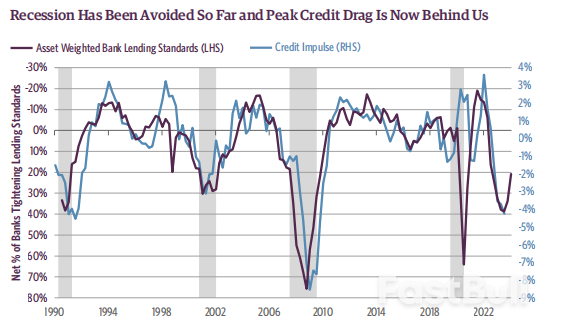
          Although the risk of a recession has decreased, it is far from eliminating

          The U.S. economy has undergone considerable correction over the past two years due to the Fed's aggressive tightening of monetary policy. Several manifestations of the tightening cycle have been revealed: an inverted yield curve, impacted interest rate-sensitive sectors, slowing credit growth, and a weak labor market. However, the recession has been avoided so far.
          A unique set of features of the current economic cycle may well be responsible for this economic resilience. During 2020 and 2021, the private sector anchored low-interest loans, which mitigated the impact of rising borrowing costs.
          As the pandemic took a toll on labor supply, many businesses began to experience labor hoarding (preferring to retain employees rather than lay off them). In addition, the asynchronous nature of the post-pandemic recovery has also led to recessions in different sectors at different times, so that no single quarter of economic data will look particularly bad.
          There was a surge in immigration last year, which helped to improve fiscal capacity and reduce price pressures. With the fiscal deficit exceeding 7% of GDP last year, fiscal policy unexpectedly turned into expansionary policy, which mitigated the impact of monetary policy.
          US Macroeconomic Outlook: Q1 2024_1Financial conditions have eased markedly in recent months as a recession has been avoided and the Fed is widely expected to cut rates, helping to reduce the risk of a near-term recession. While the risk of a recession has diminished, it is far from eliminated. There are still some sectors under pressure, such as commercial real estate, which has a potential spillover risk to smaller banks that could spread into the economy. What's more, maintaining a long-term low unemployment rate is a daunting task.
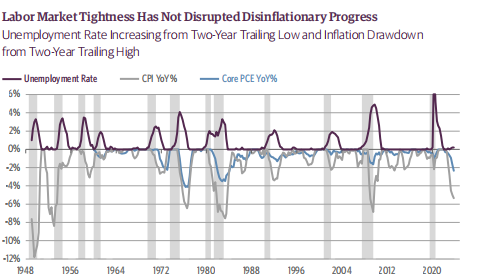
          Overall, despite the economic situation recovering, inflation progress will lead to a rate cut by the Fed around the middle of the year. With the slower economy, the Fed may eventually cut rates more than the market is currently pricing in.

          Although the path to disinflation is bumpy, inflation is still falling

          Inflation data at the start of the year was higher than expected, which hit the confidence of the market and the Fed in the sustainability of disinflation. Market concerns are also elevated by strong economic growth and accelerating growth signs shown in some sectors.
          However, it's important to analyze the drivers of inflation before acknowledging the inflation outlook. For example, strong economic growth and low unemployment have not weighed on inflation over the past year, suggesting that inflationary pressures remain low. This is also one of the evidence to support a pullback in inflation, which is largely related to the post-pandemic recovery.
          In terms of economic growth, the growth rate of economic supply has been higher than that of demand in the past few quarters. Supply chains have recovered. Rising labor force participation and increased immigration have created a strong labor supply. At the same time, worker productivity is recovering rapidly after a downturn during the pandemic. The expansion of economic capacity has led to strong output growth and a decline in price growth.
          US Macroeconomic Outlook: Q1 2024_2In addition, the unemployment rate has remained in the low range. Labor market tightness has not disrupted disinflationary progress, as the easing of the labor market has already been achieved through other ways. Specifically, as the supply of labor improves, job vacancies and job hopping have decreased, which released upward pressure on wages and, in turn, inflation.
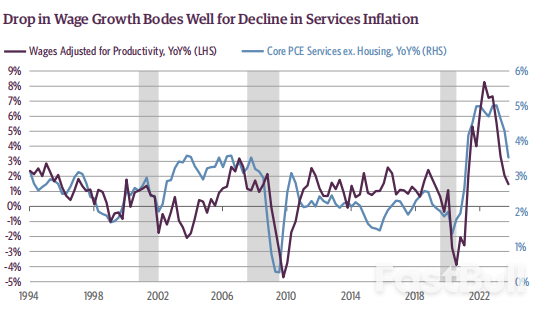
          Given that the disinflation process has been achieved under these unique circumstances, maintaining the current high economic growth and low unemployment rate may not prevent inflation from falling further.
          On the contrary, there are some positive signals that inflation will be lower in the future. The first is wage growth: labor costs are the biggest cost for most businesses (especially in the service sector). After wage growth peaked at 5.7% in mid-2022, nominal wages have slowed to 4.3% in Q4 2023. When measured in productivity-adjusted wages, the drop in wage growth appears to have been larger than expected (from a peak of 8.3% to 1.5%), a pace that is fully consistent with the conditions for persistent inflation.
          US Macroeconomic Outlook: Q1 2024_3Housing inflation has also played a key role in disinflation. In the February CPI inflation report, the core CPI came in at 3.8%, with rental inflation (including landlord equivalent rent) accounting for 2.5%. However, multiple sources suggest that this figure will drop significantly in the coming months. Over the past year and a half, new rents have slowed down significantly. These new leases are a reliable leading signal of overall rental growth. In addition, there will be a large supply of apartments in the market this year amid rising vacancy rates, which will further dampen rental growth. Headline inflation should come down with actual data fed back into the CPI and PCE data, as housing costs are the biggest driver of inflation at the moment.
          US Macroeconomic Outlook: Q1 2024_4Finally, consumer and business expectations for inflation have fallen sharply and have returned to pre-pandemic ranges, reducing the likelihood of a rebound in inflation. In conclusion, core PCE inflation is expected to slow further below 2.5% in the coming months. While the road to inflation has been a bit bumpy lately, inflation is moving lower overall, setting the stage for the Fed to start cutting rates to the neutral level.
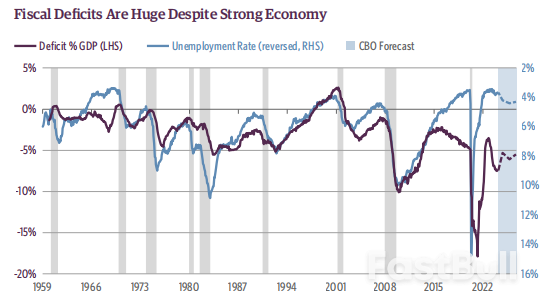
          Fiscal Deficits will put upward pressure on interest rates

          One of the biggest macroeconomic surprises last year was the magnitude of fiscal policy expansion, which mitigated the impact of tightening monetary policy on the economy.
          US Macroeconomic Outlook: Q1 2024_5While much of the deficit expansion is not stimulus in the traditional sense, it has had an important impact on supporting economic activity and preventing a recession, as credit-sensitive sectors are hit by the Fed's tightening. The opposite dynamics are expected in 2024 - as the Fed begins to cut interest rates, credit conditions will no longer tighten, and fiscal policy support for growth will weaken.
          According to the latest CBO forecast, the deficit ratio should be reduced to 5.3% in 2024. While the deficit rate remains high by historical standards, what matters is the change in the deficit rate relative to the economic growth rate. Fiscal contributions to economic growth are shifting from a huge contribution to a modest decline in 2024, which supports the cooling inflation view.
          While the recent impact on the growth outlook is changing, the long-term fiscal position has not. According to CBO projections, the debt-to-GDP ratio will rise from the current 97% to 116% by 2034, reaching the highest level in US history. However, debt was only 35% of GDP in 2007.
          Why is debt increasing? First, growing debt and deficits will put upward pressure on interest rates, which in turn will act on private investment, forcing it to increase productivity. Moreover, even if interest rates stabilize, a rising debt burden means increasing interest costs. In addition, rising debt has made it more difficult to cope with new economic shocks, such as recessions.
          US Macroeconomic Outlook: Q1 2024_6In recent years, fiscal stimulus has been instrumental in driving economic recovery and inflation. While the cyclical dynamics of the economy and Fed policy will be the main driver of interest rates in the near term, the increase in debt, deficits, and the supply of Treasuries will exert long-term upward pressure on interest rates.
          To stay updated on all economic events of today, please check out our Economic calendar
          Risk Warnings and Disclaimers
          You understand and acknowledge that there is a high degree of risk involved in trading. Following any strategies or investment methods may lead to potential losses. The content on the site is provided by our contributors and analysts for information purposes only. You are solely responsible for determining whether any trading assets, securities, strategy, or any other product is suitable for investing based on your own investment objectives and financial situation.
          Add to Favorites
          Share

          Markets Mixed After US Inflation Data, China Figures Give Boost

          Alex

          Stocks

          Traders were also cheered by a big jump in Chinese factory activity that fuelled hopes the world's number two economy may be on its way back after bottoming out.
          The Dow and S&P 500 ended at records Thursday, with the latter chalking up its best first quarter since 2019.
          Long-awaited figures on the personal consumption expenditures (PCE) index -- the Fed's preferred gauge of inflation -- showed a small on-year rise in March compared with February, though the core reading eased slightly.
          Powell said the report "is pretty much in line with our expectations" and decision-makers were on track to hit their long-term inflation target of two percent.
          He said that while the recent inflation data was higher than the Fed would have liked, the February figures were "definitely more along the lines of what we want to see".
          The data appeared to have little impact on traders' expectations for a June interest rate cut but Powell warned they were unlikely to fall to the levels seen after the 2008 global financial crisis.
          Friday's news followed a surprise upward revision Thursday to fourth-quarter US economic growth that some observers said could complicate the Fed's plans to cut borrowing costs.
          In Asian trade, Seoul, Singapore and Manila rose, while there were losses in Taipei and Jakarta.
          Hong Kong, Sydney, Wellington, London, Paris and Frankfurt were closed for Easter.
          Gold hit a record high of $2,265.73, according to Bloomberg News, extending the year's rally fuelled by US central bank hints at an easing of credit conditions.
          It is also being supported by its attraction as a safe haven in times of turmoil, with geopolitical tensions growing.
          Shanghai jumped around one percent as traders welcomed news that China's manufacturing grew for the first time in half a year, giving a boost to leaders as they battle to kickstart the struggling economy.
          The 50.8 reading in March was the first showing expansion since September and was well above forecasts.
          "The industrial sector seems to be resilient, partly helped by strong exports," said Zhang Zhiwei at Pinpoint Asset Management.
          "If fiscal spending rises and exports remain strong, the economic momentum may improve."
          But Tokyo sank more than one percent as the Bank of Japan's closely watched Tankan survey showed that confidence among Japan's largest manufacturers slipped in the first quarter, having risen for three straight quarters.
          The yen strengthened slightly, having stabilised at the end of last week after hitting a 34-year low against the dollar on Wednesday.

          Source:AFP

          Risk Warnings and Disclaimers
          You understand and acknowledge that there is a high degree of risk involved in trading. Following any strategies or investment methods may lead to potential losses. The content on the site is provided by our contributors and analysts for information purposes only. You are solely responsible for determining whether any trading assets, securities, strategy, or any other product is suitable for investing based on your own investment objectives and financial situation.
          Add to Favorites
          Share

          BOJ’s Stash of Bonds Is Set to Shrink for First Time Since 2008

          Alex

          Central Bank

          Economic

          Bond

          The Bank of Japan’s gross purchases are estimated to fall below the amount of maturing debt in the July-September period for the first time in 16 years, according to a Bloomberg analysis of the central bank’s balance sheet. The shortfall will be a modest ¥196 billion ($1.29 billion) but will increase in 2025 even if the central bank maintains its monthly debt buying at about ¥6 trillion as mentioned in its March policy statement.
          Although the BOJ’s bond holdings have often fallen in the last month of the quarter, a decrease for the entire period hasn’t happened since the last three months of 2008. That would pose a challenge to the nation’s $7.4 trillion bond market that has been used to very low or often negative local inflation and ample central bank support — features that are quickly becoming things of the past.
          “If the bond market remains strong, speculation will grow that the BOJ starts to reduce its debt purchases in April,” said Kazuhiko Sano, chief strategist at Tokai Tokyo Securities Co. “Yields will rise once the BOJ slows bond buying.”
          On top of this projected decline, signs of shift in the BOJ’s position means a reduction in holdings may be even larger than expected. Governor Kazuo Ueda last month said he will consider dialing back bond purchases at some point, and stressed that the BOJ’s approach will be to use short-term interest rates as a policy tool, rather than the huge amount of debt it’s piled up.
          If the BOJ’s purchase amounts across all tenors are at the lower end of the planned range, that would equal a reduction in monthly bond buying of about ¥1 trillion, said Naoya Hasegawa, a senior bond strategist at Okasan Securities Co., citing the summary of opinions from the BOJ’s March meeting.
          Central bank chief Ueda was vague about the impact that the BOJ’s ownership has on the Japanese government bond market — it currently holds 54% of outstanding debt. For traders, memories are still fresh of a BOJ report from March 2021 which indicated that any cut in holdings by just 1% of the market would push up the benchmark 10-year yield by 2 basis points.
          The anticipated decrease likely wouldn’t be enough to meaningfully reduce the BOJ’s stash of bonds. The central bank is keeping in place operations to buy an unlimited quantity of notes at fixed yields and is offering cheap loans to encourage banks to purchase debt.
          A decrease in the BOJ’s ownership may not have the same effect on the market as an increase. Investors are typically loss-averse, so a selloff in the face of falling prices may be steeper, suggesting a drop in the BOJ’s ownership may exert a greater upward pressure on yields.
          The central bank will probably stay on the sidelines as Ueda said that its stance is essentially to let the market decide bond yields. Given that Japanese yields are still below inflation, though, most investors are likely to balk at the levels for sale.
          “No matter how large the BOJ’s bond holdings are, they won’t prevent yields from rising when there are a lot of selling flows,” said Sano at Tokai Tokyo. “Current yields are too low considering that the BOJ is expected to raise interest rates again.”

          Source: Bloomberg

          To stay updated on all economic events of today, please check out our Economic calendar
          Risk Warnings and Disclaimers
          You understand and acknowledge that there is a high degree of risk involved in trading. Following any strategies or investment methods may lead to potential losses. The content on the site is provided by our contributors and analysts for information purposes only. You are solely responsible for determining whether any trading assets, securities, strategy, or any other product is suitable for investing based on your own investment objectives and financial situation.
          Add to Favorites
          Share

          Focus on Bitcoin in Q1 Overshadows Broadening of US ETF Landscape

          Warren Takunda

          Economic

          Cryptocurrency

          The birth of spot bitcoin exchange-traded funds (ETFs) and the quest for new ways to invest in the artificial intelligence overshadowed other trends in the broader ETF market in the first quarter, but analysts say other themes like single-country ETFs and bond ETFs are likely to play out through 2024.
          Here are some of the trends identified by market participants and analysts for the ETF industry for the second quarter and beyond.

          JAPAN

          As the Nikkei 225 (.N225), opens new tab benchmark index notched its first record high since 1989, investors are flocking to single-country ETFs focused on Japan. As of the final days of the first quarter, the group of ETFs saw $3.3 billion of inflows -- more than half the $6.2 billion they attracted throughout 2023 as a whole, according to data from State Street Global Advisors. Almost a third of that amount, $996 million, flowed into a single ETF, the WisdomTree Japan Hedged Equity Fund , according to data from VettaFi. That fund, which strips out currency risk, has been particularly appealing to both investors and traders as the yen has tumbled to a 34-year low.

          MOVING PAST THE "MAGNIFICENT SEVEN"

          State Street's data shows that U.S. stock market leadership appears to be broadening beyond megacap technology stocks. While technology-focused ETFs pulled in $9 billion in the first three months of the year, only $500 million of that came in March, said Matthew Bartolini, head of SPDR Americas Research at State Street. By comparison, he said, "energy ETFs took in $1.2 billion; industrial funds another $1 billion, and real estate $2 billion."
          Investors also showed growing interest in value stocks in the first quarter, noted Brian Kraus, senior vice president for systematic ETFs at Hartford Funds. He noted that the Russell 1000 Value Index gained 5.25% in March, while the Russell 1000 Growth climbed only 2.78%.
          WATCHING THE FED; EYEING BOND ETFs
          Actively managed bond ETFs continue to gather assets and expand in number and focus, even as the focus shifts to different slices of that universe as Federal Reserve policymakers come closer to cutting interest rates. Drew Pettit, director of ETF strategy at Citigroup, flags the "risk on" rotation that has boosted corporate bond ETFs, in particular, and cautioned that "risk taking has become particularly aggressive" in this space.

          NEW PLAYERS MAKING THEIR MARK

          While the three largest players -- BlackRock (BLK.N), opens new tab, Vanguard and State Street -- continue to account for some 75% of the assets in the $8.2 trillion U.S. ETF market, newer arrivals are growing more rapidly. The debut of the Fidelity Wise Origin Bitcoin Fund (FBTC.Z), opens new tab, which has $10 billion in assets, triggered a 16% surge in Fidelity's overall ETF assets, according to TrackInsight, double that of Vanguard and triple the growth of State Street. The market is also keeping a keen eye on Invesco (IVZ.N), opens new tab, Capital Group, Dimensional Fund Advisors and even smaller players, like Janus Henderson.

          NEW RISKS, NEW STRATEGIES

          For now, said Citigroup's Pettit, investors continue to focus more on getting exposure to the broad market than to emerging risks. But he expects that will change as the coming months unfold and geopolitical anxieties and market volatility cause risk awareness to increase. "As more of those risks pop up," he said, "we'll start seeing investors turn to more specific, targeted ETFs," such as sector funds.

          Source: Reuters

          To stay updated on all economic events of today, please check out our Economic calendar
          Risk Warnings and Disclaimers
          You understand and acknowledge that there is a high degree of risk involved in trading. Following any strategies or investment methods may lead to potential losses. The content on the site is provided by our contributors and analysts for information purposes only. You are solely responsible for determining whether any trading assets, securities, strategy, or any other product is suitable for investing based on your own investment objectives and financial situation.
          Add to Favorites
          Share

          China Industrial Upswing Is Latest Sign Of Economic Recovery

          Alex

          Economic

          China’s factory activity beat expectations in March, boosting optimism about the country’s ability to achieve its ambitious growth goal of around 5% this year.
          The Caixin manufacturing purchasing managers’ index rose to 51.1 on Monday — above the 50 mark that indicates expansion for a fifth month, the longest streak in more than two years.
          Government data published on Sunday showed manufacturing PMI in March snapped a five-month contraction to rise to the highest in a year. Both numbers beat market expectations, adding to evidence that the country’s industrial sector is building momentum for an economic recovery.
          China’s benchmark CSI 300 Index rose 1.5%, the most in a month, on Monday. Stock trading in Hong Kong was closed due to a public holiday. The yield on 10-year government bonds rose 1 basis point to 2.31% as of 11:58 a.m. in Shanghai.
          China Industrial Upswing Is Latest Sign Of Economic Recovery_1
          The PMI readings, the first batch of data each month to provide a snapshot of the health of the world’s second-largest economy, suggest the economic recovery gained traction in March following resilient industrial output and exports data in the first two months of the year. The industrial engine is one reason for optimism amid a property crisis, sagging consumer confidence and geopolitical tensions.
          Jacqueline Rong, chief China economist at BNP Paribas SA, said that even if seasonal factors were excluded, “industrial momentum might have firmed in March.”

          Rekindled Hopes

          Exports jumped in the January-February period amid a global trade upcycle, rekindling hopes that improving foreign demand will help drive a broader recovery in the Chinese economy after being a drag last year.
          In a sign exports likely continued to be robust in March, the subgauge of new export orders in the official PMI rebounded to 51.3, the first time in a year it expanded. Broader demand also picked up steam, with the subgauge of new orders rising to 53, the highest in a year.
          China has tried to boost domestic spending and pledged to provide government funds to encourage consumers and businesses to replace old goods, including cars, appliances and equipment, which should be a boon for industrial firms. It hasn’t unveiled details such as the value of the aid yet.
          “Looking forward, the roll-out of policies such as the large-scale equipment upgrade will continue to support demand for the manufacturing sector,” Xiao Jinchuan, an analyst with Guangfa Securities Co., wrote in a note dated Monday.
          Figures released by the National Bureau of Statistics also showed a gauge of non-manufacturing activity rose to 53 in March, stronger than economists had estimated.

          Caution Remains

          Despite the pickup in most subindexes in the PMI surveys, economists cautioned it remains to be seen how sustainable the rebound will be given persistent weakness in a few areas.
          A contraction in the subgauge of output prices in the official manufacturing PMI deepened in March, highlighting lingering deflationary pressures that squeeze the profit margins of companies. The Caixin survey also showed both gauges for input costs and output prices hit the lowest since July 2023.
          While the data indicates a “generally stable and positive economic recovery,” the economy is still facing headwinds, said Wang Zhe, senior economist at Caixin Insight Group. “Downward economic pressures persist, employment remains subdued, prices remain low, and insufficient effective demand has not been fundamentally resolved, underscoring the need to further boost domestic and external demand.”
          Employment in the non-manufacturing sector shrank to the lowest level in five months, according to the NBS, likely a sign demand for services sectors such as tourism, catering and hotels eased after the long Chinese New Year holiday. A similar measure for the manufacturing sector stayed under 50 for a 13th straight month, adding to evidence of a gloomy job market.
          “Companies are still facing some outstanding problems in operation, with a rather high proportion of firms reporting intensifying competition and insufficient market demand,” Zhao Qinghe, an NBS analyst, said in a statement on Sunday.

          Source:Bloomberg

          To stay updated on all economic events of today, please check out our Economic calendar
          Risk Warnings and Disclaimers
          You understand and acknowledge that there is a high degree of risk involved in trading. Following any strategies or investment methods may lead to potential losses. The content on the site is provided by our contributors and analysts for information purposes only. You are solely responsible for determining whether any trading assets, securities, strategy, or any other product is suitable for investing based on your own investment objectives and financial situation.
          Add to Favorites
          Share

          Will the S&P 500 Continue Soaring in 2024 After a 10% Gain in Q1? Here's What History Shows

          Kevin Du

          Stocks

          Economic

          Historically speaking

          Let's look back at how the S&P has performed in the first quarter compared to the full year. The following table shows data from 1983 through 2023:
          Will the S&P 500 Continue Soaring in 2024 After a 10% Gain in Q1? Here's What History Shows_1
          Will the S&P 500 Continue Soaring in 2024 After a 10% Gain in Q1? Here's What History Shows_2
          Since 1983, there have been only seven instances where the S&P 500 ended Q1 with a gain of ten percent or more. Each time, the index finished the year in positive territory. However, the S&P lost ground in the remaining three quarters of 1987. In two other years (1986 and 2012) it rose less than 2% after the first quarter. Still, the S&P soared much higher by year-end in four of the seven years when it had a double-digit gain in Q1.
          What about the track record when the S&P 500 delivered any positive gain in Q1? This happened 28 times since 1983 (excluding this year). The index finished higher in 23 of those years. In 17 cases, the S&P delivered stronger gains in the last three quarters than in the first quarter.

          Let the good times roll

          If history is a guide, the chances that the S&P 500 will perform well during the rest of 2024 look pretty good. There are other reasons to expect stocks to continue their winning ways too.
          The U.S. economy appears to be relatively strong. Real GDP growth in the fourth quarter of 2023 was 3.4%. There are no signs that the economy is slowing so far this year.
          Unemployment rates remain low. In February, the rate was 3.9%. Many economists view an unemployment rate between 4% and 5% as full employment.
          Although the consumer price index (CPI) rose slightly in February to 3.2%, inflation has moderated significantly compared to 2022 and 2023. The Federal Reserve still projects three interest rate cuts later this year. These cuts would likely provide positive catalysts for the stock market.
          We also have a presidential election in the U.S. In 20 of the last 24 presidential election years, the S&P 500 rose.

          Potential flies in the ointment

          Can investors count on the S&P 500 continuing to soar in 2024 after delivering a 10% gain in Q1? Unfortunately, the answer is "no." There could be some potential flies in the ointment.
          Resurging inflation is a real possibility. If the Fed decided against cutting interest rates (or worse, raised rates again), stocks would probably suffer.
          A major geopolitical crisis could also derail the current market momentum. We don't have to limit the potential culprits to the current turmoil in Gaza or Ukraine; any number of hot spots across the globe could boil over.
          We can't rule out "black swan" events either. A major natural disaster or massive cyberattack could cause stocks to sink.
          The bottom line is that no one knows what the future holds. But based on history, starting on a decidedly positive note bodes well for the S&P 500 for the rest of this year.

          Source: The Motley Fool

          To stay updated on all economic events of today, please check out our Economic calendar
          Risk Warnings and Disclaimers
          You understand and acknowledge that there is a high degree of risk involved in trading. Following any strategies or investment methods may lead to potential losses. The content on the site is provided by our contributors and analysts for information purposes only. You are solely responsible for determining whether any trading assets, securities, strategy, or any other product is suitable for investing based on your own investment objectives and financial situation.
          Add to Favorites
          Share

          Pound Sterling Juggles As Investors Seek Fresh BoE’s Interest Rate Guidance

          Samantha Luan

          Forex

          The Pound Sterling (GBP) struggles to make a decisive move in Monday’s London session as investors are yet to return to the FX domain after a holiday-stretched weekend on account of Good Friday and Easter Monday. The GBP/USD pair consolidates slightly above the round-level support of 1.2600 as investors await fresh guidance on when the Bank of England (BoE) and the Federal Reserve (Fed) will pivot to rate cuts.
          Earlier this year, the Fed was expected to start reducing interest rates sooner than the BoE, supporting the Pound Sterling’s valuation against the US Dollar. However, the BoE is currently anticipated to follow the Fed’s footprints and start rate cuts from June. Two BoE policymakers, Catherine Mann and Jonathan Haskel, who were described as hawks, see no need for more rate hikes as higher interest rates are impacting labor market conditions and consumer spending.
          Catherine Mann said in an interview with Bloomberg last week that she dropped her rate hike call after observing that consumers are reluctant to pay higher prices on services such as travel and hospitality. Mann added that firms are cutting working hours in times when more employment is required. She further added that the number of workers in the labor market will increase due to the government's cuts to social security rates.
          The Pound Sterling is expected to depreciate if the BoE reduces key borrowing rates earlier than expected after consistently raising them for more than two years.
          Meanwhile, the US Dollar Index (DXY) is broadly sideways around 104.50 as investors await the crucial United States Nonfarm Payrolls (NFP) report for March, which will be published on Friday. The official labor market data is one of the main economic data releases that influences the Fed’s rate cut expectations.

          Daily digest market movers: Pound Sterling follows US Dollar’s footprints

          The Pound Sterling trades in a tight range slightly above 1.2600 as investors look for fresh cues about when the Bank of England will start reducing interest rates. The market expectations for the BoE pivoting to rate cuts have come forward to the June meeting as the central bank was seen as slightly dovish in its latest monetary policy statement.
          The BoE sounded dovish as none of the policymakers voted for a rate hike. This indicates that BoE policymakers see current interest rates as restrictive. Policymakers do not see more interest rate hikes appropriate when they are worried that further policy tightening could dampen the economic outlook or they see progress in inflation declining to the 2% target.
          In addition, BoE Governor Andrew Bailey said after the last BoE meeting that market expectations for two or three rate cuts this year are “reasonable,” boosting expectations for the BoE to cut interest rates from June.
          On the economic front, investors will focus on the United Kingdom’s S&P Global/CIPS Manufacturing PMI final data for March, which will be published on Tuesday. The factory data is forecasted to have remained unchanged from its preliminary reading of 49.9, which came in marginally below the 50.0 threshold that separates expansion from contraction. Investors will keenly focus on the agency’s commentary on businesses’ expectations for the domestic and global demand outlook.
          Meanwhile, the appeal for risk-perceived assets is quite upbeat as S&P 500 futures are positive. Market sentiment has turned cheerful as expectations for the Federal Reserve to begin to reduce interest rates from the June meeting have recently increased.
          In today’s session, investors will focus on the United States ISM Manufacturing PMI for March, which will be published at 14:00 GMT. The PMI is estimated to increase to 48.4 from 47.8 in February.

          Technical Analysis: Pound Sterling consolidates around 1.2600Pound Sterling Juggles As Investors Seek Fresh BoE’s Interest Rate Guidance_1

          The Pound Sterling trades back and forth above 1.2600 against the US Dollar. The GBP/USD pair is expected to remain sideways as investors await a fresh trigger for the interest rate guidance. The Cable has been trading in the 1.2575-1.2675 range for the past six trading sessions. The 200-day Exponential Moving Average (EMA) near 1.2590 provides support to the Pound Sterling bulls.
          On a broader time frame, the horizontal support from December 8 low at 1.2500 would provide further cushion to the Pound Sterling. Meanwhile, the upside is expected to remain limited near an eight-month high of around 1.2900.
          The 14-period Relative Strength Index (RSI) hovers near 40.00. If it dips below this level, bearish momentum will trigger.

          Source:FXStreet

          Risk Warnings and Disclaimers
          You understand and acknowledge that there is a high degree of risk involved in trading. Following any strategies or investment methods may lead to potential losses. The content on the site is provided by our contributors and analysts for information purposes only. You are solely responsible for determining whether any trading assets, securities, strategy, or any other product is suitable for investing based on your own investment objectives and financial situation.
          Add to Favorites
          Share
          FastBull
          Copyright © 2025 FastBull Ltd

          728 RM B 7/F GEE LOK IND BLDG NO 34 HUNG TO RD KWUN TONG KLN HONG KONG

          TelegramInstagramTwitterfacebooklinkedin
          App Store Google Play Google Play
          Products
          Charts

          Chats

          Q&A with Experts
          Screeners
          Economic Calendar
          Data
          Tools
          Membership
          Features
          Function
          Markets
          Copy Trading
          Latest Signals
          Contests
          News
          Analysis
          24/7
          Columns
          Education
          Company
          Careers
          About Us
          Contact Us
          Advertising
          Help Center
          Feedback
          User Agreement
          Privacy Policy
          Business

          White Label

          Data API

          Web Plug-ins

          Poster Maker

          Affiliate Program

          Risk Disclosure

          The risk of loss in trading financial instruments such as stocks, FX, commodities, futures, bonds, ETFs and crypto can be substantial. You may sustain a total loss of the funds that you deposit with your broker. Therefore, you should carefully consider whether such trading is suitable for you in light of your circumstances and financial resources.

          No decision to invest should be made without thoroughly conducting due diligence by yourself or consulting with your financial advisors. Our web content might not suit you since we don't know your financial conditions and investment needs. Our financial information might have latency or contain inaccuracy, so you should be fully responsible for any of your trading and investment decisions. The company will not be responsible for your capital loss.

          Without getting permission from the website, you are not allowed to copy the website's graphics, texts, or trademarks. Intellectual property rights in the content or data incorporated into this website belong to its providers and exchange merchants.

          Not Logged In

          Log in to access more features

          FastBull Membership

          Not yet

          Purchase

          Become a signal provider
          Help Center
          Customer Service
          Dark Mode
          Price Up/Down Colors

          Log In

          Sign Up

          Position
          Layout
          Fullscreen
          Default to Chart
          The chart page opens by default when you visit fastbull.com