• Trade
  • Markets
  • Copy
  • Contests
  • News
  • 24/7
  • Calendar
  • Q&A
  • Chats
Trending
Screeners
SYMBOL
LAST
BID
ASK
HIGH
LOW
NET CHG.
%CHG.
SPREAD
SPX
S&P 500 Index
6827.42
6827.42
6827.42
6899.86
6801.80
-73.58
-1.07%
--
DJI
Dow Jones Industrial Average
48458.04
48458.04
48458.04
48886.86
48334.10
-245.98
-0.51%
--
IXIC
NASDAQ Composite Index
23195.16
23195.16
23195.16
23554.89
23094.51
-398.69
-1.69%
--
USDX
US Dollar Index
97.950
98.030
97.950
98.500
97.950
-0.370
-0.38%
--
EURUSD
Euro / US Dollar
1.17394
1.17409
1.17394
1.17496
1.17192
+0.00011
+ 0.01%
--
GBPUSD
Pound Sterling / US Dollar
1.33707
1.33732
1.33707
1.33997
1.33419
-0.00148
-0.11%
--
XAUUSD
Gold / US Dollar
4299.39
4299.39
4299.39
4353.41
4257.10
+20.10
+ 0.47%
--
WTI
Light Sweet Crude Oil
57.233
57.485
57.233
58.011
56.969
-0.408
-0.71%
--

Community Accounts

Signal Accounts
--
Profit Accounts
--
Loss Accounts
--
View More

Become a signal provider

Sell trading signals to earn additional income

View More

Guide to Copy Trading

Get started with ease and confidence

View More

Signal Accounts for Members

All Signal Accounts

Best Return
  • Best Return
  • Best P/L
  • Best MDD
Past 1W
  • Past 1W
  • Past 1M
  • Past 1Y

All Contests

  • All
  • Trump Updates
  • Recommend
  • Stocks
  • Cryptocurrencies
  • Central Banks
  • Featured News
Top News Only
Share

Iranian Media Says 18 Crew Members Of Foreign Tanker Seized In Gulf Of Oman Over Carrying 'Smuggled Fuel' Detained

Share

Regional Governor: Two Killed In Ukrainian Drone Strike On Russia's Saratov

Share

Chinese Foreign Ministry - China Foreign Minister Met With United Arab Emirates Counterpart On Dec 12

Share

China's Central Financial And Economic Affairs Commission Deputy Director: Will Expand Export And Increase Import In 2026

Share

Thai Leader Anutin: Landmine Blast That Killed Thai Soldiers 'Not A Roadside Accident'

Share

Thai Leader Anutin: Thailand To Continue Military Action Until 'We Feel No More Harm'

Share

Cambodian Prime Minister Hun Manet Says He Had Phone Calls With Trump And Malaysian Leader Anwar About Ceasefire

Share

Cambodia's Hun Manet Says USA, Malaysia Should Verify 'Which Side Fired First' In Latest Conflict

Share

Cambodia's Hun Manet: Cambodia Maintains Its Stance In Seeking Peaceful Resolution Of Disputes

Share

Nasdaq Companies: Allergan, Ferrovia, Insmed, Monolithic Power Systems, Seagate Technology, And Western Digital Will Be Added To The NASDAQ 100 Index. Biogen, CdW, GlobalFoundries, Lululemon, ON Semiconductor, And Tradedesk Will Be Removed From The NASDAQ 100 Index

Share

Witkoff Headed To Berlin This Weekend To Meet With Zelenskiy, European Leaders -Wsj Reporter On X

Share

Russia Attacks Two Ukrainian Ports, Damaging Three Turkish-Owned Vessels

Share

[Historic Flooding Occurs In At Least Four Rivers In Washington State Due To Days Of Torrential Rains] Multiple Areas In Washington State Have Been Hit By Severe Flooding Due To Days Of Torrential Rains, With At Least Four Rivers Experiencing Historic Flooding. Reporters Learned On The 12th That The Floods Caused By The Torrential Rains In Washington State Have Destroyed Homes And Closed Several Highways. Experts Warn That Even More Severe Flooding May Occur In The Future. A State Of Emergency Has Been Declared In Washington State

Share

Trump Says Proposed Free Economic Zone In Donbas Would Work

Share

Trump: I Think My Voice Should Be Heard

Share

Trump Says Will Be Choosing New Fed Chair In Near Future

Share

Trump Says Proposed Free Economic Zone In Donbas Complex But Would Work

Share

Trump Says Land Strikes In Venezuela Will Start Happening

Share

US President Trump: Thailand And Cambodia Are In A Good Situation

Share

State Media: North Korean Leader Kim Hails Troops Returning From Russia Mission

TIME
ACT
FCST
PREV
U.K. Trade Balance Non-EU (SA) (Oct)

A:--

F: --

P: --

U.K. Trade Balance (Oct)

A:--

F: --

P: --

U.K. Services Index MoM

A:--

F: --

P: --

U.K. Construction Output MoM (SA) (Oct)

A:--

F: --

P: --

U.K. Industrial Output YoY (Oct)

A:--

F: --

P: --

U.K. Trade Balance (SA) (Oct)

A:--

F: --

P: --

U.K. Trade Balance EU (SA) (Oct)

A:--

F: --

P: --

U.K. Manufacturing Output YoY (Oct)

A:--

F: --

P: --

U.K. GDP MoM (Oct)

A:--

F: --

P: --

U.K. GDP YoY (SA) (Oct)

A:--

F: --

P: --

U.K. Industrial Output MoM (Oct)

A:--

F: --

P: --

U.K. Construction Output YoY (Oct)

A:--

F: --

P: --

France HICP Final MoM (Nov)

A:--

F: --

P: --

China, Mainland Outstanding Loans Growth YoY (Nov)

A:--

F: --

P: --

China, Mainland M2 Money Supply YoY (Nov)

A:--

F: --

P: --

China, Mainland M0 Money Supply YoY (Nov)

A:--

F: --

P: --

China, Mainland M1 Money Supply YoY (Nov)

A:--

F: --

P: --

India CPI YoY (Nov)

A:--

F: --

P: --

India Deposit Gowth YoY

A:--

F: --

P: --

Brazil Services Growth YoY (Oct)

A:--

F: --

P: --

Mexico Industrial Output YoY (Oct)

A:--

F: --

P: --

Russia Trade Balance (Oct)

A:--

F: --

P: --

Philadelphia Fed President Henry Paulson delivers a speech
Canada Building Permits MoM (SA) (Oct)

A:--

F: --

P: --

Canada Wholesale Sales YoY (Oct)

A:--

F: --

P: --

Canada Wholesale Inventory MoM (Oct)

A:--

F: --

P: --

Canada Wholesale Inventory YoY (Oct)

A:--

F: --

P: --

Canada Wholesale Sales MoM (SA) (Oct)

A:--

F: --

P: --

Germany Current Account (Not SA) (Oct)

A:--

F: --

P: --

U.S. Weekly Total Rig Count

A:--

F: --

P: --

U.S. Weekly Total Oil Rig Count

A:--

F: --

P: --

Japan Tankan Large Non-Manufacturing Diffusion Index (Q4)

--

F: --

P: --

Japan Tankan Small Manufacturing Outlook Index (Q4)

--

F: --

P: --

Japan Tankan Large Non-Manufacturing Outlook Index (Q4)

--

F: --

P: --

Japan Tankan Large Manufacturing Outlook Index (Q4)

--

F: --

P: --

Japan Tankan Small Manufacturing Diffusion Index (Q4)

--

F: --

P: --

Japan Tankan Large Manufacturing Diffusion Index (Q4)

--

F: --

P: --

Japan Tankan Large-Enterprise Capital Expenditure YoY (Q4)

--

F: --

P: --

U.K. Rightmove House Price Index YoY (Dec)

--

F: --

P: --

China, Mainland Industrial Output YoY (YTD) (Nov)

--

F: --

P: --

China, Mainland Urban Area Unemployment Rate (Nov)

--

F: --

P: --

Saudi Arabia CPI YoY (Nov)

--

F: --

P: --

Euro Zone Industrial Output YoY (Oct)

--

F: --

P: --

Euro Zone Industrial Output MoM (Oct)

--

F: --

P: --

Canada Existing Home Sales MoM (Nov)

--

F: --

P: --

Euro Zone Total Reserve Assets (Nov)

--

F: --

P: --

U.K. Inflation Rate Expectations

--

F: --

P: --

Canada National Economic Confidence Index

--

F: --

P: --

Canada New Housing Starts (Nov)

--

F: --

P: --

U.S. NY Fed Manufacturing Employment Index (Dec)

--

F: --

P: --

U.S. NY Fed Manufacturing Index (Dec)

--

F: --

P: --

Canada Core CPI YoY (Nov)

--

F: --

P: --

Canada Manufacturing Unfilled Orders MoM (Oct)

--

F: --

P: --

Canada Manufacturing New Orders MoM (Oct)

--

F: --

P: --

Canada Core CPI MoM (Nov)

--

F: --

P: --

Canada Manufacturing Inventory MoM (Oct)

--

F: --

P: --

Canada CPI YoY (Nov)

--

F: --

P: --

Canada CPI MoM (Nov)

--

F: --

P: --

Canada CPI YoY (SA) (Nov)

--

F: --

P: --

Canada Core CPI MoM (SA) (Nov)

--

F: --

P: --

Q&A with Experts
    • All
    • Chatrooms
    • Groups
    • Friends
    Connecting
    .
    .
    .
    Type here...
    Add Symbol or Code

      No matching data

      All
      Trump Updates
      Recommend
      Stocks
      Cryptocurrencies
      Central Banks
      Featured News
      • All
      • Russia-Ukraine Conflict
      • Middle East Flashpoint
      • All
      • Russia-Ukraine Conflict
      • Middle East Flashpoint
      Search
      Products

      Charts Free Forever

      Chats Q&A with Experts
      Screeners Economic Calendar Data Tools
      Membership Features
      Data Warehouse Market Trends Institutional Data Policy Rates Macro

      Market Trends

      Market Sentiment Order Book Forex Correlations

      Top Indicators

      Charts Free Forever
      Markets

      News

      News Analysis 24/7 Columns Education
      From Institutions From Analysts
      Topics Columnists

      Latest Views

      Latest Views

      Trending Topics

      Top Columnists

      Latest Update

      Signals

      Copy Rankings Latest Signals Become a signal provider AI Rating
      Contests
      Brokers

      Overview Brokers Assessment Rankings Regulators News Claims
      Broker listing Forex Brokers Comparison Tool Live Spread Comparison Scam
      Q&A Complaint Scam Alert Videos Tips to Detect Scam
      More

      Business
      Events
      Careers About Us Advertising Help Center

      White Label

      Data API

      Web Plug-ins

      Affiliate Program

      Awards Institution Evaluation IB Seminar Salon Event Exhibition
      Vietnam Thailand Singapore Dubai
      Fans Party Investment Sharing Session
      FastBull Summit BrokersView Expo
      Recent Searches
        Top Searches
          Markets
          News
          Analysis
          User
          24/7
          Economic Calendar
          Education
          Data
          • Names
          • Latest
          • Prev

          View All

          No data

          Scan to Download

          Faster Charts, Chat Faster!

          Download App
          English
          • English
          • Español
          • العربية
          • Bahasa Indonesia
          • Bahasa Melayu
          • Tiếng Việt
          • ภาษาไทย
          • Français
          • Italiano
          • Türkçe
          • Русский язык
          • 简中
          • 繁中
          Open Account
          Search
          Products
          Charts Free Forever
          Markets
          News
          Signals

          Copy Rankings Latest Signals Become a signal provider AI Rating
          Contests
          Brokers

          Overview Brokers Assessment Rankings Regulators News Claims
          Broker listing Forex Brokers Comparison Tool Live Spread Comparison Scam
          Q&A Complaint Scam Alert Videos Tips to Detect Scam
          More

          Business
          Events
          Careers About Us Advertising Help Center

          White Label

          Data API

          Web Plug-ins

          Affiliate Program

          Awards Institution Evaluation IB Seminar Salon Event Exhibition
          Vietnam Thailand Singapore Dubai
          Fans Party Investment Sharing Session
          FastBull Summit BrokersView Expo

          Unlocking A $74 Billion Boom: Australia's Thriving Private Commercial Real Estate Debt Market

          Cohen

          Economic

          Summary:

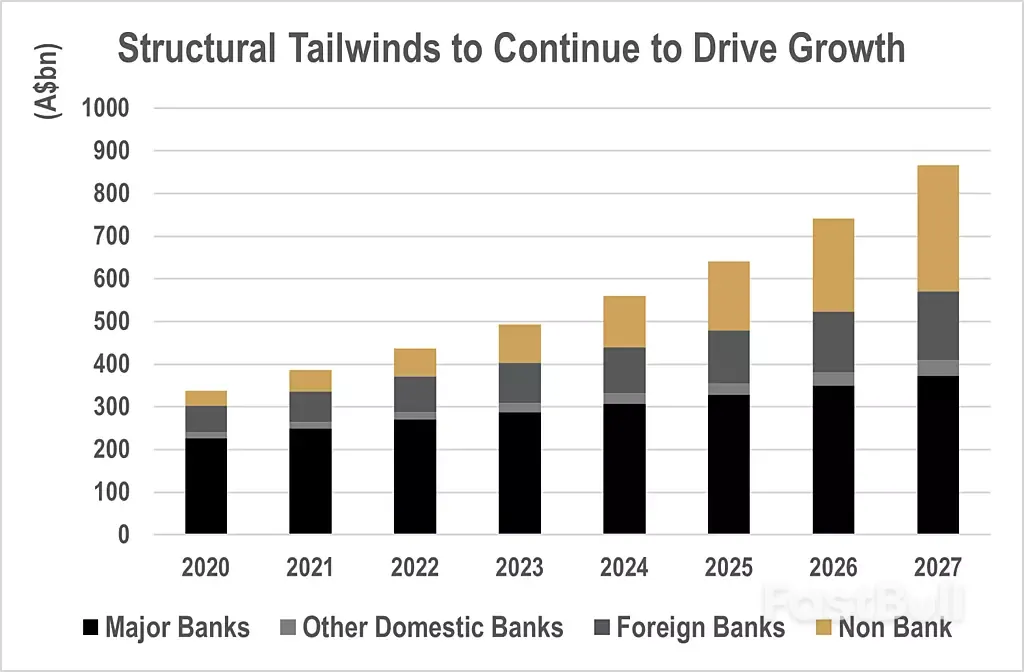
          The Australian Commercial Real Estate Debt (ACRED) sector has undergone a remarkable transformation in recent years, witnessing a robust 7.9% Compound Annual Growth Rate (CAGR) since 2013.
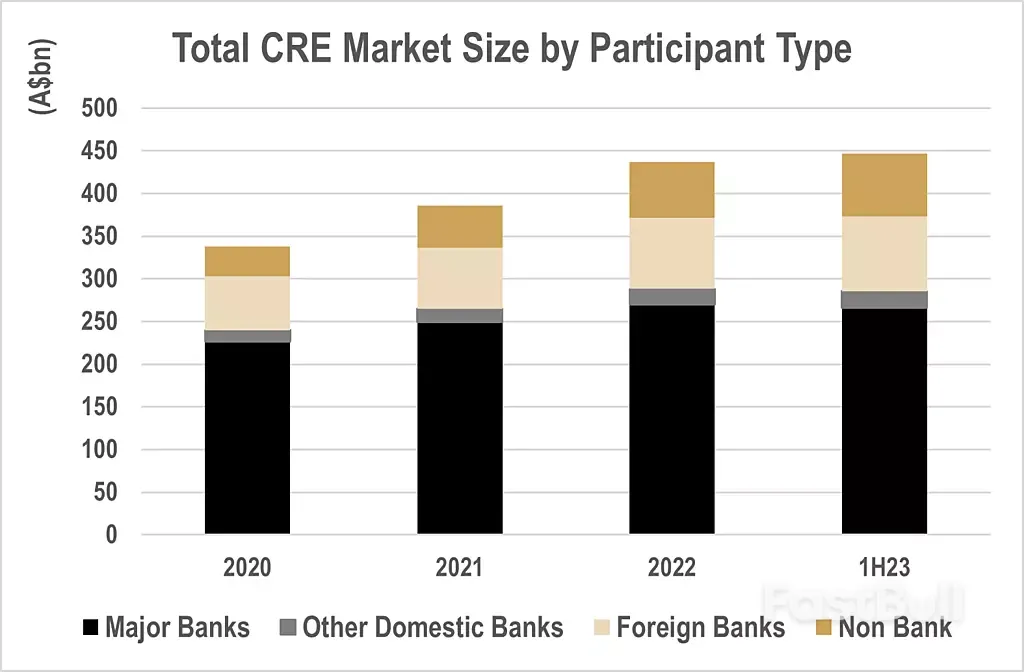
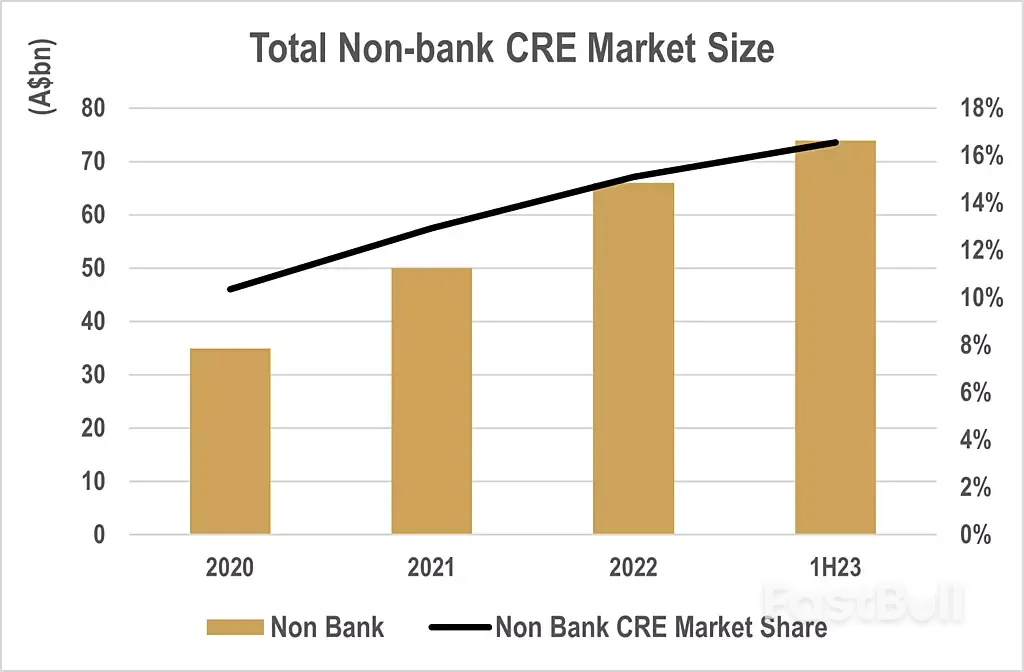
          As of June 2023, the market has burgeoned to an impressive $447 billion, with $373 billion attributed to traditional lenders (Bank’s) and a substantial $74 billion to non-bank lenders. This surge in non-bank lending has reshaped the landscape, marking a notable shift away from the historical dominance of major banks towards the growing non-bank ACRED segment, which now commands a 16% market share, up from 10.4% in 2020.

          Unlocking A $74 Billion Boom: Australia's Thriving Private Commercial Real Estate Debt Market_1Source: Foresight Analytics, APRA

          Over the last decade, major banks have seen their market share erode from 86% in 2013 to 73% in March 2023, emphasising a significant change in the financing dynamics of the sector with foreign banks and other domestic banks taking market share. The retreat of traditional financiers, driven in part by Basel III reforms and heightened risk aversion partly imposed by APRA, has paved the way for alternative lenders to fill the void. The non-bank ACRED lenders, primarily funded by high-net-worth, family office and institutional investors, have demonstrated a remarkable 35% CAGR since 2020, positioning them as key players in the ACRED space.
          Unlocking A $74 Billion Boom: Australia's Thriving Private Commercial Real Estate Debt Market_2

          Source: Foresight Analytics. ARES

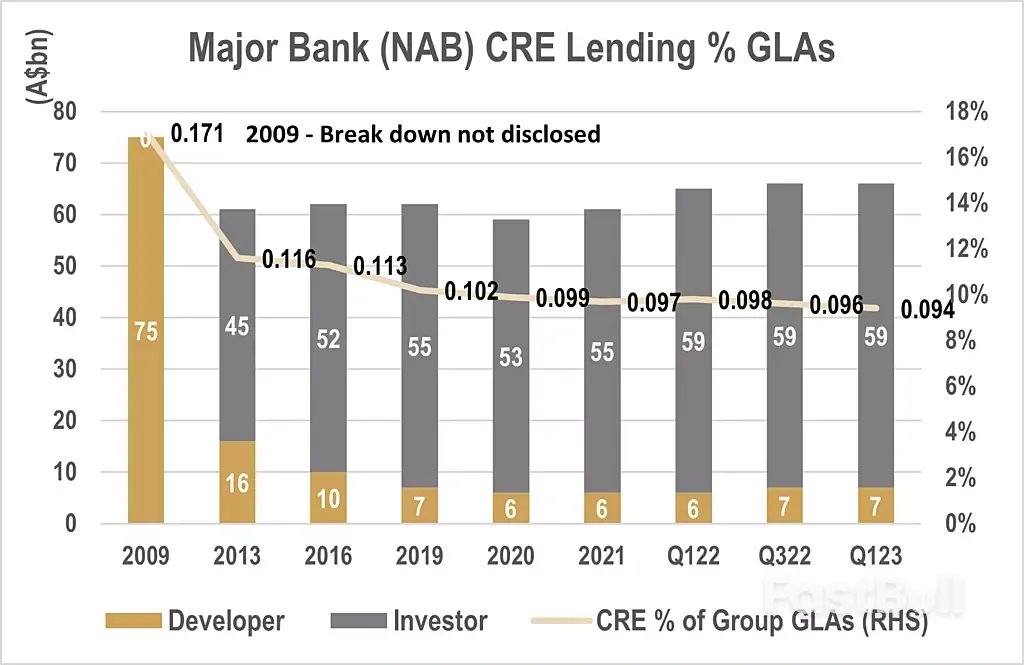
          The ACRED markets have experienced significant opportunities due to the Major Banks' decreased involvement in development funding. As shown the below chart, NAB's developer financing in their CRE book declined from 16% in 2013 to a 7% in 2023. Additionally, the proportion of Commercial Real Estate (CRE) lending relative to Gross Loans and Advances (GLA) has dropped from 17.1% to 9.4% in 2023. This shift underscores the Major Banks', in this case NAB’s, emphasis on residential home lending.
          Unlocking A $74 Billion Boom: Australia's Thriving Private Commercial Real Estate Debt Market_3

          Source: Foresight Analytics Research Insights on ACRED, November 2023

          Decoding the growth of the non-bank ACRED market
          The remarkable growth in the non-bank ACRED space can be attributed to a number of key factors.
          One significant driver is the growing awareness of and its appeal to High Net Worth (HNW) investors, particularly the baby boomer demographic. Australia’s aging population is more and more in search of higher income with less risk. We see that ACRED's track record in downside protection via its mortgage backed collateral, positions it as an ideal asset class for investors at or near retirement age. Offering monthly or quarterly income with limited downside risk, ACRED mitigates sequencing risk for retirees who may need periodic capital drawdowns. With the 65+ age cohort in Australia projected to grow by 42% between 2023 and 2040, ACRED aligns well with the evolving investor demographics. HNW investors have only recently been able to access non-bank ACRED as this has largely been the domain of large family offices.
          While the 'search for yield' dynamic continues, non-bank ACRED lending yields remain highly attractive, outperforming other asset classes on a risk adjusted basis. We believe that non-bank ACRED has emerged as a true portfolio diversifier, lowering overall portfolio risk while enhancing returns. Non-bank ACRED, demonstrates a low or negative correlation with major asset classes, making it a stabilising force during crises and economic uncertainty. The resilience exhibited during the COVID-19 environment positions ACRED as a strategic allocation for investors focusing on capital preservation with stable, defensive, and asset-backed income.
          The liquidity profile of non-bank ACRED managed funds, with redemptions offered typically quarterly, half yearly or yearly for pooled funds and longer for single asset direct offers, contrasts with the limited liquidity/exit options in U.S. or European direct lending markets largely held by institutional investors. Non-bank ACRED's relatively short weighted average loan expiry (WALE) adds to its appeal. The funding landscape for ACRED managers has expanded beyond traditional sources, with superannuation funds, institutional investors, including major foreign banks and overseas institutions, contributing to the sector's growth. With the emergence of the asset class in recent years, the influx of institutional investors, offering warehouse facilities and acquiring equity stakes in local businesses, reflects the global recognition of the scarcity premium present in the Australian non-bank ACRED space.
          The ACRED segment's increasing popularity can also be attributed to its proven track record. Foresight Analytics, in a recently commissioned report on the ACRED market, reports a notable absence of material arrears, defaults, or loss-given-defaults (LGDs) in private debt strategies, highlighting the sector's robust risk management.
          Additionally, the scarcity premium in the Australian ACRED market offers a premium over other developed markets like Europe and North America which further contributes to its allure. The lower competition for ACRED investment managers sustains this scarcity premium, indicating its persistence in the foreseeable future.

          Forward growth projections for Australian commercial real estate private debt

          Forecasting the trajectory of non-bank ACRED involves navigating uncertainties, prompting the adoption of a scenario-based approach for future growth guidance. This method relies on two key pillars: the total growth of the ACRED market and the market share changes within the non-bank private lender segment.
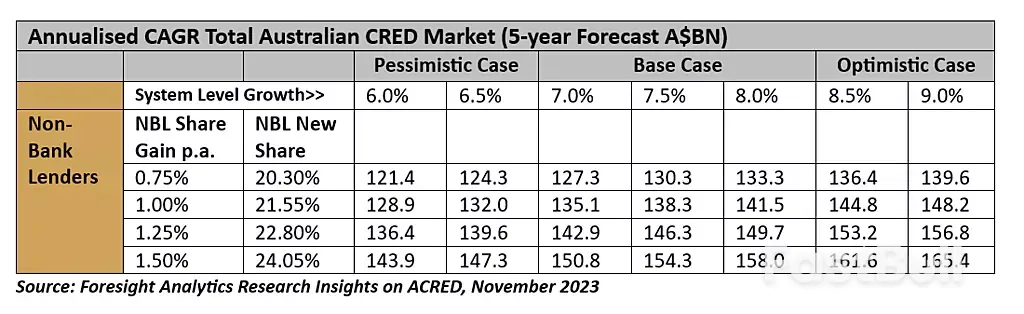
          The base case scenario for ACRED market trajectory envisions a 7.0-8.0% CAGR for the total sector over the medium term (five years). This conservative estimate contrasts with the system level CAGR of 12% over the last three years, emphasising a cautious outlook. Additionally, the assumption includes an annual total market share growth rate of 1.0-1.25% for the non-bank lender segment, again conservative, compared to the 5% plus market share gain recorded over the previous three years.
          The below ACRED forecast scenario analysis combines the CAGR for total market growth and the annual market share gain non-bank ACRED lenders. The matrix illustrates various total ACRED market annual growth rates (6% to 9%) and the corresponding total market size in five years. Simultaneously, it outlines different annual market share gain assumptions for non-bank ACRED lenders and the resulting total market share by March 2028.
          Unlocking A $74 Billion Boom: Australia's Thriving Private Commercial Real Estate Debt Market_4
          This base case scenario envisions a market size ranging from $138.3 billion (1.9X) to $146.3 billion (2X) in 2028, presenting a substantial $70 billion plus opportunity for non-bank lenders. This base case aligns with an estimated total ACRED market of $642 billion by 2028.
          In their analysis, Foresight Analytics highlights a significant opportunity for growth-oriented non-bank lenders with the scale and capacity to capitalise on the unfolding market dynamics. As anticipated, growth will not be uniform across the sector, with mid-sized lenders, managing sub $2 billion lending books, standing out as the prime candidates to double their growth over the next five years.
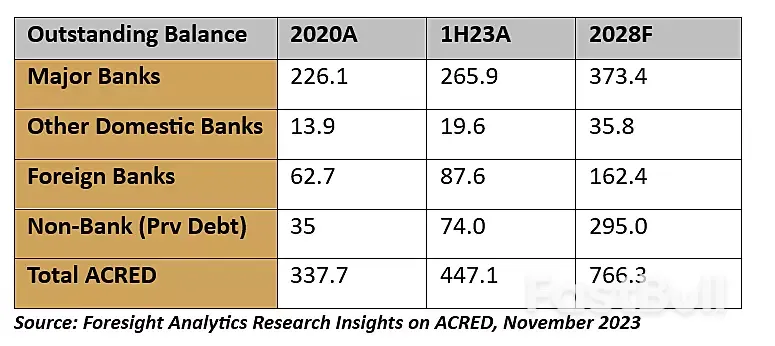
          The below charts illustrate the sizing of the market and sub-segment lender exposures, assuming the most recent historical CAGRs persist over the next 5-year period. The optimistic projections hint at a potential fourfold growth in the non-bank ACRED market size, reaching $295 billion This scenario is compared with the conservative view of $70 billion in the base case scenario. This emphasises the transformative potential for non-bank lenders, positioning them as key players in the evolving landscape of ACRED.Unlocking A $74 Billion Boom: Australia's Thriving Private Commercial Real Estate Debt Market_5Unlocking A $74 Billion Boom: Australia's Thriving Private Commercial Real Estate Debt Market_6

          Source: Foresight Analytics Research Insights on ACRED, November 2023

          The Australian Commercial Real Estate Private Debt sector is undergoing a transformative journey, driven by shifting market dynamics, regulatory reforms, and the rise of non-bank lenders. The growth trends, trajectory, and future projections indicate a fundamental reshaping of the industry, with private lenders poised to play a more significant role. As the sector continues to navigate constant economic uncertainties, maintaining a focus on downside protection, transparency, and asset quality will be instrumental in securing continued trust and therefore investment from investors. The ACRED sector's evolution is a testament to its adaptability and resilience, offering a promising landscape for investors and lenders alike in the years to come.

          Source:livewire

          To stay updated on all economic events of today, please check out our Economic calendar
          Risk Warnings and Disclaimers
          You understand and acknowledge that there is a high degree of risk involved in trading. Following any strategies or investment methods may lead to potential losses. The content on the site is provided by our contributors and analysts for information purposes only. You are solely responsible for determining whether any trading assets, securities, strategy, or any other product is suitable for investing based on your own investment objectives and financial situation.
          Comments
          Add to Favorites
          Share

          Dollar Scales Fresh Peaks As Fed Cut Bets Recede

          Cohen

          Economic

          Central Bank

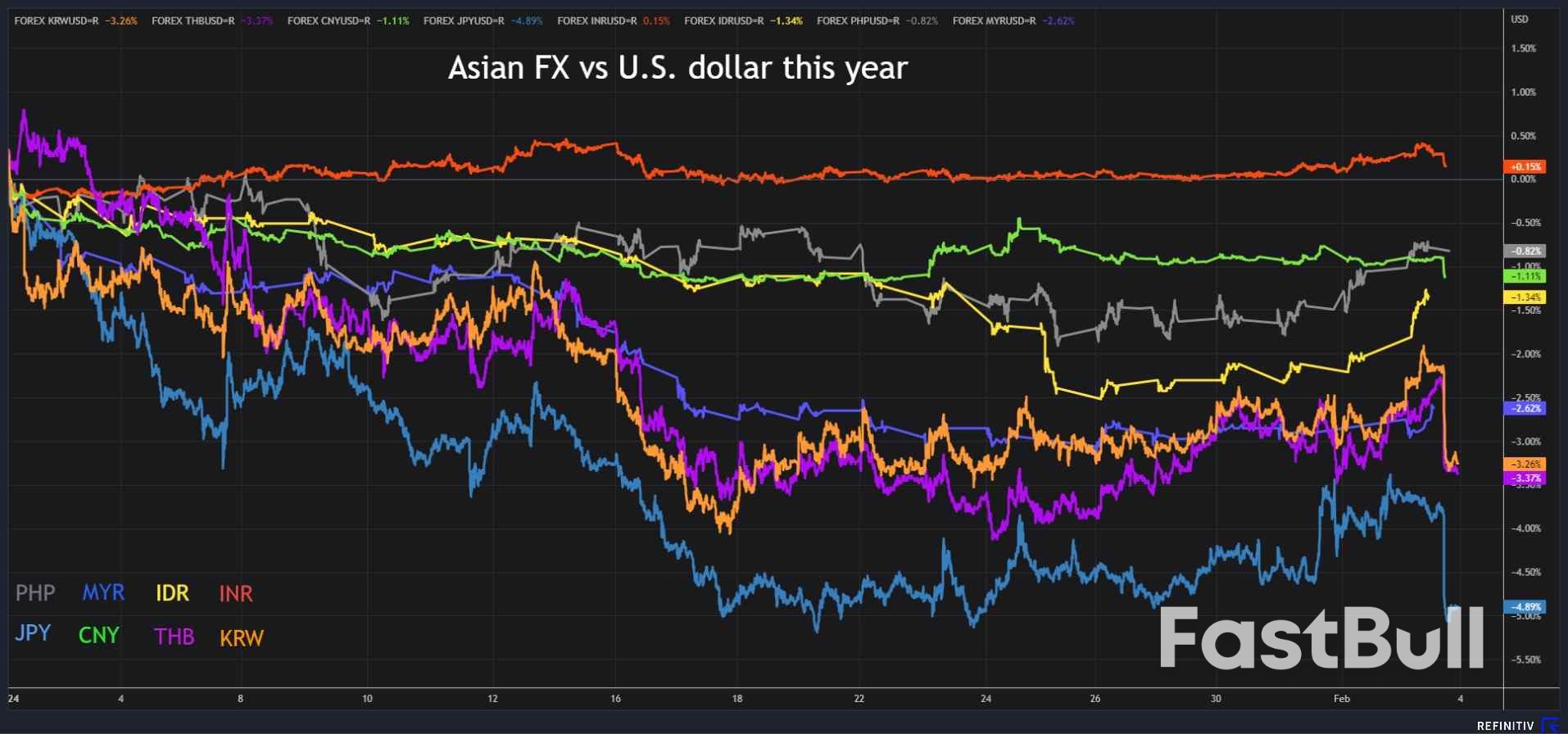
          The yen as well as the Australian and New Zealand dollars meanwhile tumbled to two-month lows, while the euro similarly bottomed at a more than one-month trough of $1.07675 against a stronger greenback.
          The dollar index peaked at 104.18, its highest since December.
          The Fed repricing has come on the back of Friday's blockbuster U.S. jobs report that far exceeded market expectations, reinforcing Chair Jerome Powell's statement at the conclusion of the central bank's policy meeting last week that a March rate cut was unlikely.
          "A one-two punch from Jay Powell's FOMC presser and a very strong nonfarm payrolls report have essentially closed the door on a March rate cut," said Chris Weston, head of research at Pepperstone.
          Traders are pricing in just a 20 per cent chance that the Fed could begin easing rates in March, as compared to a nearly 50 per cent chance a week ago, according to the CME FedWatch tool. The odds for a cut in May have also lengthened.
          In an interview with the CBS news show "60 Minutes" that aired Sunday night, Powell said the Fed can be "prudent" in deciding when to cut its benchmark interest rate, with a strong economy allowing central bankers time to build confidence inflation will continue to slow.
          Fed funds futures now show roughly 137 basis points worth of easing priced in for the Fed this year, down from 150 bps at the end of last year.
          The Japanese yen was last 0.15 per cent lower at 148.58 per dollar, having hit a trough of 148.82 earlier in the session.
          The Aussie slid 0.33 per cent to $0.6490, while the kiwi lost 0.25 per cent to last trade at $0.6050.
          Sterling bottomed at $1.2600, its lowest since Jan. 17.
          "The dollar is likely to hold on to its recent gains," said Carol Kong, a currency strategist at Commonwealth Bank of Australia (CBA).
          Treasury yields also jumped on expectations of higher-for-longer U.S. rates, with the two-year yield, which typically reflects near-term interest rate expectations, last up nearly seven bps at 4.4386 per cent.
          The benchmark 10-year yield rose five bps to 4.0829 per cent.
          Elsewhere, China's securities regulator vowed to prevent abnormal market fluctuation, after Chinese stocks plunged to five-year lows, but announced no specific measures.
          That did little to help the yuan, with the offshore yuan last marginally lower at 7.2182 per dollar, pressured by a stronger greenback.
          It had fallen to a more than two-week low of 7.2225 per dollar earlier in the session.
          "I doubt (the news) will materially support (the yuan) in the near term, unless we get more concrete details," said CBA's Kong.
          "So far we've just seen speculation and some media reports talking about further support for the equity market or the property market. But we haven't really seen a lot of details on those easing measures from the Chinese government.
          "So I think markets are still pretty doubtful about whether or not those reports will materialise."

          Source:CNA

          To stay updated on all economic events of today, please check out our Economic calendar
          Risk Warnings and Disclaimers
          You understand and acknowledge that there is a high degree of risk involved in trading. Following any strategies or investment methods may lead to potential losses. The content on the site is provided by our contributors and analysts for information purposes only. You are solely responsible for determining whether any trading assets, securities, strategy, or any other product is suitable for investing based on your own investment objectives and financial situation.
          Comments
          Add to Favorites
          Share

          Battling Between US Optimism, China Pessimism

          Owen Li

          Stocks

          Economic

          Central Bank

          A wave of economic data from the Asia & Pacific region hits local markets on Monday, as investors get their first chance to react to the sizzling U.S. employment numbers from Friday and digest the latest deterioration in sentiment towards China.
          Monday's economic calendar includes purchasing managers index figures from several countries including China and Japan, Indonesian GDP, Thai inflation and Australian trade.
          If Asian markets take their cue from Wall Street, expect a burst higher. There was nothing in the January jobs report that suggests the U.S. economy's momentum is fading. Quite the opposite.
          With the tailwinds of bumper tech earnings also behind them, the S&P 500 roared to a new all-time high and the Nasdaq jumped to a fresh two-year peak. Remarkably, that is the S&P 500's 13th weekly gain out of the last 14.
          Music to Asian bulls' ears, right? Yes, but there are grounds for caution - the dollar bounced back, U.S. bond yields are soaring, and concern over China's economy and markets is back at the forefront of investors' minds.Battling Between US Optimism, China Pessimism_1
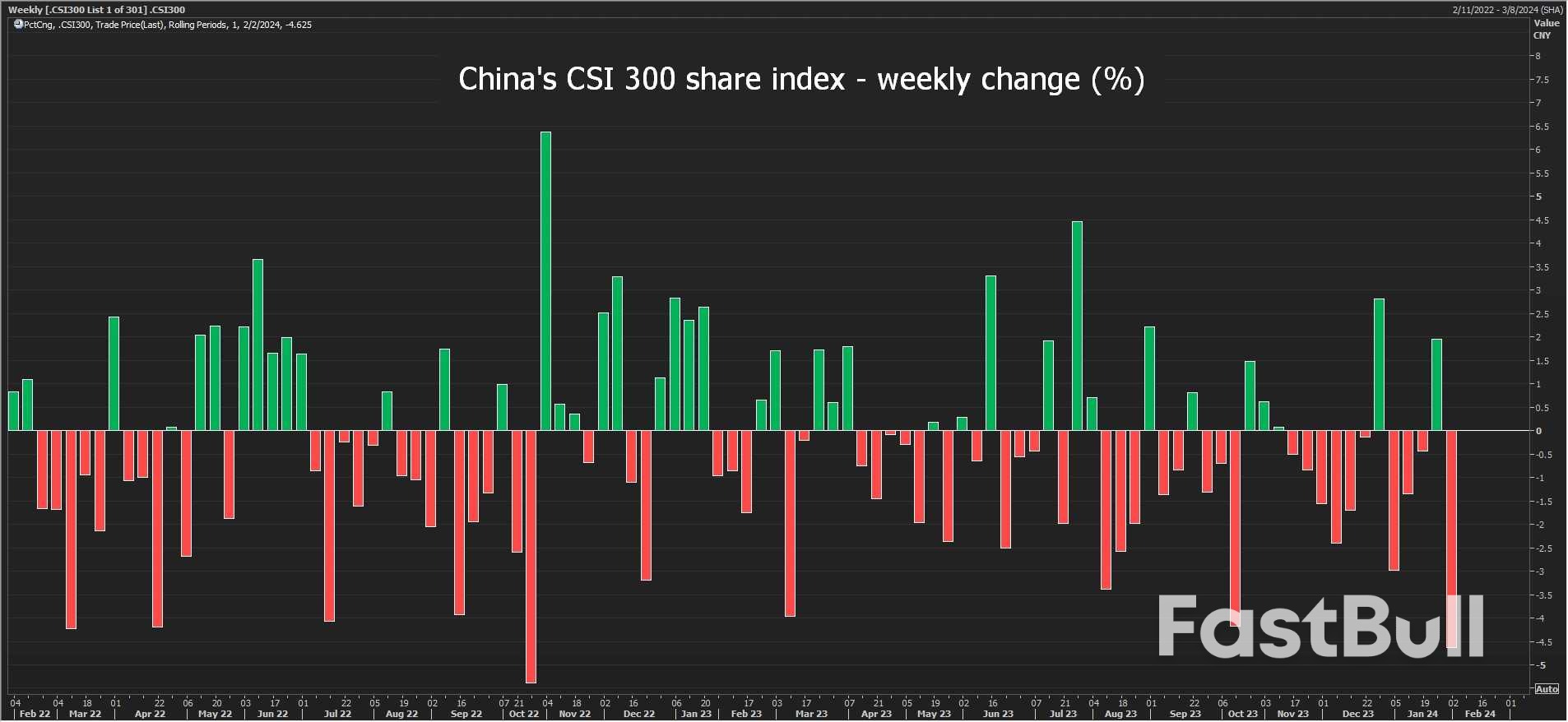
          China's CSI 300 index of blue chip shares fell on Friday, bringing its losses for the week to 4.6%. That's the biggest weekly decline since October 2022, and comes as the index fell six months in a row for the first time ever.
          The IMF last week warned that China's growth could slow to 3.5% by 2028, and the United States added more than a dozen Chinese companies to those it alleges are working with Beijing's military, as part of a broader effort to keep American technology from aiding China.
          Meanwhile, Republican presidential candidate Donald Trump has said he would impose tariffs on China again if he is elected in November and they could exceed 60%.
          That said, the poor price action, newsflow and sentiment are drawing some investors in. Bank of America and EPFR data show cumulative inflows into Chinese stocks have hit a new record, and Goldman Sachs says hedge funds have been buying at the fastest pace in five years.
          Battling Between US Optimism, China Pessimism_2Elsewhere on Monday, Indonesia releases fourth-quarter GDP figures. Investors expect year-on-year growth of 5.0%, supported by resilient domestic consumption, but quarter-on-quarter growth of just 0.4%.
          Figures from Bangkok are expected to show annual headline inflation in Thailand remains stuck just under 0.6%, and core prices again shrinking by around 0.8%.
          The government has raised pressure on the Bank of Thailand to cut its policy rate, currently at a decade-high of 2.50%, at its Feb. 7 meeting. But the central bank has pushed back, and governor Sethaput Suthiwartnarueput told Reuters last week that the current rate was 'broadly neutral'.
          Here are key developments that could provide more direction to markets on Monday:
          - China Caixin services PMI (January)
          - Indonesia GDP (Q4)
          - Australia trade (December)

          Source: Reuters

          To stay updated on all economic events of today, please check out our Economic calendar
          Risk Warnings and Disclaimers
          You understand and acknowledge that there is a high degree of risk involved in trading. Following any strategies or investment methods may lead to potential losses. The content on the site is provided by our contributors and analysts for information purposes only. You are solely responsible for determining whether any trading assets, securities, strategy, or any other product is suitable for investing based on your own investment objectives and financial situation.
          Comments
          Add to Favorites
          Share

          Tight Supply Adds Fuel to Uranium and Cocoa Rally

          Owen Li

          Commodity

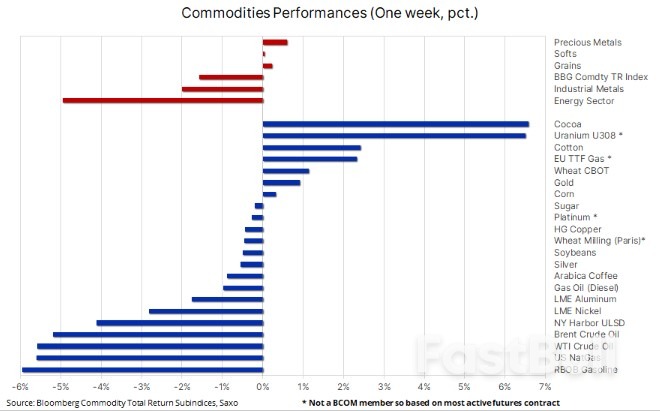
          The commodities sector gave back some of its recent strong gains this past week with losses being driven by industrial metals – as the boost from the recent cut in China's reserve ratio faded – and energy, as talks of a ceasefire in Gaza deflated the geopolitical risk premium. Precious metals, meanwhile, received an initial boost from a sharp fall in US Treasury yields driven by fresh concerns over US regional banks and their exposure to commercial real estate, and following the US Federal Reserve's signal that the next move in rates would be lower, albeit perhaps not as soon as the market had hoped for, not least following another very strong US job report for January which showed a big rise in new jobs and rising wages.
          Overall, the Bloomberg Commodity Total Return Index (BCOM), which tracks a basket of 24 major commodity futures spread across energy, metals and agricultural, trades down around 1.6% on the week and 1% on the year. Among those commodities that are included in the BCOM index, the top performers are cocoa, cotton and wheat, while the bottom five are all related to the energy sector.

          Tight Supply Adds Fuel to Uranium and Cocoa Rally_1Cocoa breaks $5000 per ton for the first time since 1977

          The agriculture sector trades mixed with the grains sector showing continued signs of stabilizing, with the biggest short positions held by speculators across six grain and soy contracts since 2019 also providing some emerging support. The softs sector, by far the best performing sector during the last twelve months, traded higher for a fourth week, reaching a ten-year high in the process. The latest strength is supported by a parabolic rise in cocoa, surging above $5000 per ton for the first time since 1977. Cocoa prices have now more than doubled during the past year, driven by low supplies from Ivory Coast and Ghana, the world's two biggest producers. The current season which began in October has so far, due to dry weather conditions, seen arrivals to ports in Ivory Coast trail last year by around 36%, with the latest bout of drought potentially hurting next season's bigger main crop, thereby keeping the world in a prolonged deficit.

          Uranium sector strength on growing global acceptance

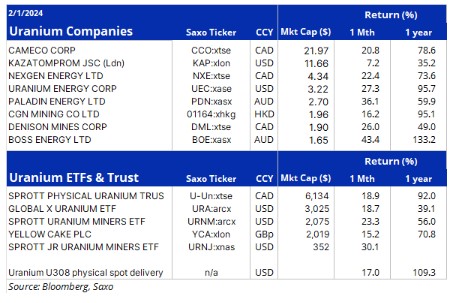
          The top performer this past week was spot uranium, which rose strongly after Kazatomprom, the world's top producer, cut their 2024 production guidance as expected by 14.2%, due to limited access to sulphuric acid which is used as the leaching agent to dissolve the uranium oxides from the ore, allowing for the recovery of uranium. During the past year, spot uranium has more than doubled to reach a 16-year high above $100 per pound as the sector goes through a strong revival following years in the doldrum. Nuclear power is seeing a growing global acceptance with major economies embracing nuclear energy as part of the green-energy transition.
          With demand on the rise, prices have surged on supply risks, including lower production guidance from producers and geopolitical tensions affecting uranium-producing countries. In addition, the emergence of and growing popularity of investment vehicles holding physical uranium on behalf of investors, have also contributed to the current tightness, in the process supporting the spot price as well as a the stock market performance of mining companies, reactor builders and fuel makers.
          While the focus in terms of delivering strong returns has been on the tech-heavy Nasdaq 100 and its 12-month gain of around 35%, the Global X Uranium ETF, a $3 billion market cap ETF that tracks a basket of companies involved in uranium mining and the production of nuclear components, has returned close to 40% during this time. The Sprott Physical Uranium Trust, which holds all its assets in physical uranium trades up 93% during the past year and since its inception a couple of years ago it has grown to become a $6.2 billion titan. Together with London-based Yellow Cake Plc, their rapid growth has probably been adding fuel to the rally by further tightening spot market availability.

          Tight Supply Adds Fuel to Uranium and Cocoa Rally_2Choppy price action in crude oil continues

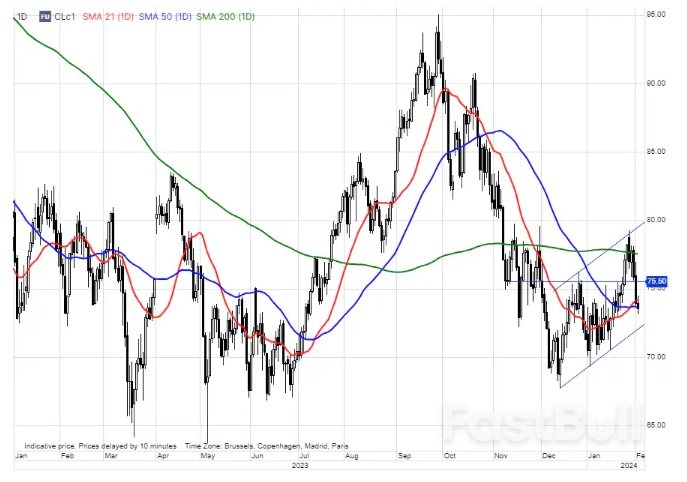
          The major crude oil futures gave back most of their recent strong gains amid talks of a Gaza ceasefire reducing the geopolitical temperature. The fall was further strengthened by selling from wrong-footed traders who bought the recent technical break above $75.50 in WTI and $80.50 in Brent, only to be forced to adjust once prices broke back below. Overall, in the past few months, and since Houthi rebels began attacking ships in the Red Sea, traders have been dealing with a lot of ‘noise' in the market resulting in very choppy trading conditions as prices continue to ebb and flow with the news from the Middle East.
          Meanwhile, diesel prices in London and New York also traded lower after rallying strongly last month amid logistical challenges in the Red Sea where Houthi attacks have forced the redirection of shipments to Europe, forcing them onto longer voyage times, and hence higher freight costs. In addition, the mid-January US cold ‘bomb' drove a demand spike while recent drone attacks on Russian energy facilities have also increased supply concerns. Overall, the Ny Harbor ULSD and London Gas Oil futures contracts both maintain a year-to-date gain around 10% while WTI and Brent trade higher by less than 4%.
          We maintain the view that, unless a serious and very unlikely supply disruption occurs in the Middle East, both WTI and Brent will likely remain range bound around $75 in WTI and $80 in Brent with no single trigger being strong enough to change the dynamics of a market that has divided its focus between growth worries, especially in China, the world's top importer, as well as rising non-OPEC+ production, OPEC+ cuts – now expected to be extended beyond the first quarter – and geopolitical risks. On top of this, we may see risk appetite ebb and flow in line with changes in the expected pace of US rate cuts. In the short-term, WTI will be facing strong resistance ahead of $80 and Brent ahead of $85.

          Tight Supply Adds Fuel to Uranium and Cocoa Rally_3Gold remains stuck on rate cut delay

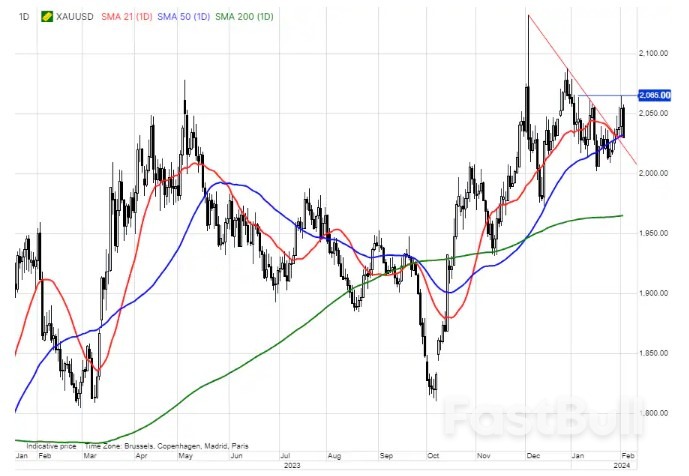
          The precious metals sector started February on a firm footing after spending most of January consolidating the strong gains seen during Q4 last year when gold rose 11.4% and silver 7.2%. The small losses seen in both metals last month was mostly driven by a stronger dollar and the market taking a raincheck on the timing, pace, and depth of incoming rate cuts. This past week, however, gold has risen towards key resistance around $2067, supported by a drop in the dollar and after US regional bank concerns resurfaced amid losses in commercial real estate helping drive US Treasury yields sharply lower.
          The latest Federal Reserve meeting described an uncertain path toward rate cuts in 2024 after Fed Chair Powell emphasized the need for more evidence that inflation is heading toward its 2% year-over-year target – a level that has already been reached using shorter time horizons – while also taking the strong labor market into consideration. However, a weaker than expected weekly jobless claims helped reignite expectations for a March rate cut, before deflating completely following a very strong January US job report which showed strength in both job creation and wages. US 10-year US Treasury yields paired back an earlier slump but stayed lower on the week around 4% while the dollar was heading for an unchanged week.
          According to the World Gold Council (WGC), total gold demand hit a record of 4,899 tons in 2023, supported by strong demand in the over-the-counter market, as well as from sustained central-bank buying – the People's Bank of China has been a continually active buyer, accounting for close to one-quarter of all central bank purchases. The WGC expects gold demand to expand again in 2024 as the US Federal Reserve moves toward cutting interest rates, potentially lifting demand from ETF investors who have been net sellers since 2022.
          While we maintain our bullish outlook for gold and silver, seeing them reach $2300 and $28 respectively this year, both precious metals are likely to remain stuck in the short-term until we get a better understanding about the timing, pace and depth of future US and EU rate cuts. Until the first cut is delivered, the market may at times run ahead of itself, in the process building up rate cut expectations to levels that leave prices vulnerable to a correction. With that in mind, the short-term direction of gold and silver will continue to be dictated by incoming economic data and their impact on the dollar, yields and not least rate cut expectations.Tight Supply Adds Fuel to Uranium and Cocoa Rally_4
          Risk Warnings and Disclaimers
          You understand and acknowledge that there is a high degree of risk involved in trading. Following any strategies or investment methods may lead to potential losses. The content on the site is provided by our contributors and analysts for information purposes only. You are solely responsible for determining whether any trading assets, securities, strategy, or any other product is suitable for investing based on your own investment objectives and financial situation.
          Comments
          Add to Favorites
          Share

          Robust US Economy Disrupts Market's Fed Cut Hopes

          Alex

          Economic

          Stocks

          Robust US economic data is confronting investors with an unexpected question: whether strong growth can keep driving stocks higher even if the Federal Reserve delivers less monetary policy easing than the market had hoped.
          Expectations that the Fed would begin cutting rates sent stocks soaring at the end of 2023 and pushed the S&P 500 to a record high in January.
          The index is up 4 per cent this year after surging 24 per cent in 2023.
          That narrative has been jolted by evidence that the economy may be running too hot for the Fed to cut rates without risking an inflationary rebound.
          Friday's blockbuster US employment number was the latest sign of stronger-than-expected growth, after Fed Chairman Jerome Powell days earlier deflated hopes the central bank would begin lowering rates in March.
          “Looking back on the fourth quarter and the recent rally in stocks, a lot of it was driven from the thought of a Fed pivot, and the Fed pivot is evaporating in front of our eyes,” said Matthew Miskin, co-chief investment strategist at John Hancock Investment Management.
          Market expectations of a near-term rate cut dimmed after the jobs data, with futures tied to the Fed's main policy rate reflecting a 70 per cent chance of the central bank lowering borrowing costs at its May 1 meeting, from more than 90 per cent on Thursday, according to the CME FedWatch Tool.
          The probability of a March cut stood at about 20 per cent, from just under 50 per cent a week ago.
          With Friday's jobs report, “the six or seven rate cuts that markets had been pricing in seems very offside”, Seema Shah, chief global strategist at Principal Asset Management, said in a written commentary.
          Friday's jobs report showed non-farm payrolls increased by 353,000 jobs last month – well above the 180,000 increase expected by economists polled by Reuters.
          The economy also added 126,000 more jobs in November and December than previously reported.
          Plenty of investors believe the strong growth is a positive for stocks, especially if accompanied by better-than-expected corporate earnings.
          The S&P 500 hit a high on Friday after the jobs data, helped by the soaring shares of Facebook parent Meta Platforms and Amazon, which rose 20 per cent and 8 per cent, respectively, following their corporate results.
          For 2024, S&P 500 earnings are expected to jump nearly 10 per cent after a 3.6 per cent rise in 2023, according to LSEG data.
          “I'll trade a stronger economy with less rate cuts than a weaker economy with more rate cuts,” said Keith Lerner, co-chief investment officer at Truist Advisory Services.
          Analysts at Capital Economics forecast a “banner” year for US stocks, finishing 2024 more than 10 per cent above current index levels at 5,500.
          Optimism over the business potential of artificial intelligence, which helped power stocks such as Nvidia last year, are likely to drive those gains, they said.
          However, sustained above trend growth poses another issue – fears of an inflationary rebound.
          “January job growth figures were strong, possibly too strong,” said Russell Price, chief economist at Ameriprise, in a Friday note.
          “There were multiple signs of strong wage growth, which could filter through to resurgent … inflation pressures if maintained.”
          A longer period of high interest rates also could increase stress for areas of the economy that are already hurting, such as commercial property.
          Ramped-up growth, along with expectations of rates staying at current levels for longer, could drive Treasury yields up.
          Higher yields can pressure equities because they compete with stocks for investors, while higher rates raise the cost of capital in the economy.
          The benchmark 10-year Treasury yield, which moves inversely to bond prices, hit 4.05 per cent on Friday.
          Investors are still pricing in around 125 basis points of Fed cuts this year, LSEG data shows. That is down from around 150 basis points priced in earlier this week, but still far more than the 75 basis points the Fed has projected.

          Source: The National News

          To stay updated on all economic events of today, please check out our Economic calendar
          Risk Warnings and Disclaimers
          You understand and acknowledge that there is a high degree of risk involved in trading. Following any strategies or investment methods may lead to potential losses. The content on the site is provided by our contributors and analysts for information purposes only. You are solely responsible for determining whether any trading assets, securities, strategy, or any other product is suitable for investing based on your own investment objectives and financial situation.
          Comments
          Add to Favorites
          Share

          [ECB] Nagel: It's Too Early to Cut Interest Rates

          FastBull Featured

          Remarks of Officials

          Joachim Nagel, a member of the European Central Bank's (ECB) Governing Council and president of the Deutsche Bundesbank, was interviewed by the Frankfurter Allgemeine Zeitung on Feb. 3. The main points are as follows:
          Q1: How is the ECB's de-inflation progressing?
          A1: We cannot let our guard down too quickly, and we have now reached a critical stage in the fight against inflation.
          Q2: Will you cut rates for the first time in the summer?
          A2: We are focused on the data, not the timing. The Council believes that our monetary policy is working and will bring inflation back to the target level without putting too much pressure on the economy. In other words, a soft landing in the eurozone is possible.
          Q3: Why is it so hard to bring down inflation as it goes on? Especially the "last mile"?
          qA3: We cannot undermine the gains made on inflation by cutting rates too soon. At the moment, in my view, there is still a lot of uncertainty about the price outlook: that's why it's too early to cut rates.
          Q4: Are you concerned that geopolitical unrest or rising wages could trigger a new round of inflation?
          A4: Both factors could come into play, and the Red Sea incident is disrupting the supply chain; as for the issue of wages, they tend not to rise until relatively late in the year, and are therefore a lagging indicator. Profits have risen earlier, and both profits and wages can have a big impact on inflation. Our monetary policymakers would therefore be well advised to base their decisions on actual data and the current outlook.
          Q5: Is it a coincidence that German inflation fell sharply in January?
          A5: The anomaly of upward inflation in December was due to a one-off factor in energy prices. Over the next few months, food and other prices are expected to continue to normalize, and inflation in 2024 is moving in the right direction (inflation downturn).
          Q6: The market is betting that the ECB will cut rates in Q2, but why has the ECB dampened market expectations several times recently?
          A6: We would like to avoid a situation where market financing conditions are too easy to keep inflation sufficiently in check. If there is a mismatch between financial conditions and the inflation outlook, it will become more difficult to maintain price stability. Sending signals to market participants from time to time can help to avoid such a situation as far as possible, and will also enable the public and the financial markets to have a better understanding of the path of the policy.
          Q7: Have you now abandoned "forward-looking guidance"?
          A7: No, "forward guidance" does not apply in times of uncertainty. That is why we are not in a position to provide any forward guidance on the way forward at this time. There is one direction that has been set, but one thing is clear: by the end of this year, we will have cut our bond holdings significantly.

          Original Interview

          Risk Warnings and Disclaimers
          You understand and acknowledge that there is a high degree of risk involved in trading. Following any strategies or investment methods may lead to potential losses. The content on the site is provided by our contributors and analysts for information purposes only. You are solely responsible for determining whether any trading assets, securities, strategy, or any other product is suitable for investing based on your own investment objectives and financial situation.
          Comments
          Add to Favorites
          Share

          International Business: A Spotlight On Thailand And Vietnam

          Cohen

          Economic

          Vietnam’s recent development and the opportunities for foreign investment

          Ever since the US embargo was lifted and Vietnam opened its doors to Foreign Direct Investment (FDI) almost 30 years ago, it has remained an attractive location for multinational corporations looking to take advantage of low-cost labour and favourable government policy. Since then, it has become a prolific manufacturing hub, accounting for 70 percent of the country’s exports. Currently, it is the main production centre for global brands like Samsung, LG and Intel. And with the tensions around China, major suppliers for big US firms like Apple are setting up in Vietnam too.
          Sitting at the crossroads of other major ASEAN nations, bordering China, and with a long coastline that makes it a natural hub for shipping, Vietnam is uniquely positioned both geographically and logistically. The country boasts a fast-growing and young population, reaching almost 100 million, resulting in a strong labour force. It is also one of the few nations to experience positive GDP growth since the pandemic. Politically, Vietnam is also considered quite stable compared with its neighbours.
          Big areas for FDI in Vietnam include manufacturing, processing, real estate, electronics, pharmaceuticals, the automotive industry, fast-moving consumer goods (FMCG) and, increasingly, renewables. There remains a lot of foreign interest in Vietnam’s infrastructure too, particularly from the EU, such as the new metro lines and international airport developments.
          When it comes to attracting FDI within the ASEAN region, the competition between markets is fierce. The EU is an essential trading partner for Vietnam. It is the third largest partner for exports and the fifth for imports. Vietnam has built special, long-standing relationships with various individual nations within the EU over the years. This includes Germany, which is by far the country’s largest trading partner, responsible for a third of all exports coming out of the EU and into Vietnam.

          Thailand’s changing trading relationships with the EU

          As another of ASEAN’s rising stars, Thailand is a popular location for foreign investment in the region for many of the same reasons as Vietnam. In its international trading partnerships, particularly with the EU, the relationship has recently evolved from a one-way arrangement to one in which Thai businesses are looking to invest in EU-based projects. Notable examples include investments in department stores in Italy and offshore wind farms in Germany.
          Germany is also Thailand’s largest EU trading partner. In the last decade, however, Thailand has consistently lost out to Vietnam when attracting investment from the likes of China, Korea, Japan and the US. While the Thai labour force remains skilled – especially in electronics and automotive parts – and the government continues to support these areas, costs have become much higher. Combined with increased political instability in recent years, foreign investors are now wary.

          Developing infrastructure and shifting to a skills-based economy

          In a bid to shift away from labour-intensive industries to a more skills-based economy, Thailand is now focusing on developing its infrastructure and embracing new technologies. Through the construction of a high-speed rail link, Thailand aims to connect its ports and industrial areas with the rest of the country and allow it to better compete with Vietnam as well as other ASEAN powerhouses such as Indonesia and Malaysia.
          The Vietnamese government, meanwhile, has introduced appealing tax incentives to encourage more businesses within ASEAN to set up there. Vietnam recently began a strategic partnership with South Korea, which would bring billions of dollars of investment for the country. Samsung, for example, has already pumped nearly US$18 billion into Vietnam.
          Japan is also one of Vietnam’s long-standing trading partners within the region. In the past ten years, Japanese companies have moved factories and production capabilities to Vietnam as part of the popular ‘China plus one’ diversification strategy. Canon, for example, has since tripled the size of its factory near Hanoi. Japan also provides finance for some of the big infrastructure projects in Vietnam.

          Source: Commerzbank

          To stay updated on all economic events of today, please check out our Economic calendar
          Risk Warnings and Disclaimers
          You understand and acknowledge that there is a high degree of risk involved in trading. Following any strategies or investment methods may lead to potential losses. The content on the site is provided by our contributors and analysts for information purposes only. You are solely responsible for determining whether any trading assets, securities, strategy, or any other product is suitable for investing based on your own investment objectives and financial situation.
          Comments
          Add to Favorites
          Share
          FastBull
          Copyright © 2025 FastBull Ltd

          728 RM B 7/F GEE LOK IND BLDG NO 34 HUNG TO RD KWUN TONG KLN HONG KONG

          TelegramInstagramTwitterfacebooklinkedin
          App Store Google Play Google Play
          Products
          Charts

          Chats

          Q&A with Experts
          Screeners
          Economic Calendar
          Data
          Tools
          Membership
          Features
          Function
          Markets
          Copy Trading
          Latest Signals
          Contests
          News
          Analysis
          24/7
          Columns
          Education
          Company
          Careers
          About Us
          Contact Us
          Advertising
          Help Center
          Feedback
          User Agreement
          Privacy Policy
          Business

          White Label

          Data API

          Web Plug-ins

          Poster Maker

          Affiliate Program

          Risk Disclosure

          The risk of loss in trading financial instruments such as stocks, FX, commodities, futures, bonds, ETFs and crypto can be substantial. You may sustain a total loss of the funds that you deposit with your broker. Therefore, you should carefully consider whether such trading is suitable for you in light of your circumstances and financial resources.

          No decision to invest should be made without thoroughly conducting due diligence by yourself or consulting with your financial advisors. Our web content might not suit you since we don't know your financial conditions and investment needs. Our financial information might have latency or contain inaccuracy, so you should be fully responsible for any of your trading and investment decisions. The company will not be responsible for your capital loss.

          Without getting permission from the website, you are not allowed to copy the website's graphics, texts, or trademarks. Intellectual property rights in the content or data incorporated into this website belong to its providers and exchange merchants.

          Not Logged In

          Log in to access more features

          FastBull Membership

          Not yet

          Purchase

          Become a signal provider
          Help Center
          Customer Service
          Dark Mode
          Price Up/Down Colors

          Log In

          Sign Up

          Position
          Layout
          Fullscreen
          Default to Chart
          The chart page opens by default when you visit fastbull.com