• Trade
  • Markets
  • Copy
  • Contests
  • News
  • 24/7
  • Calendar
  • Q&A
  • Chats
Trending
Screeners
SYMBOL
LAST
BID
ASK
HIGH
LOW
NET CHG.
%CHG.
SPREAD
SPX
S&P 500 Index
6827.42
6827.42
6827.42
6899.86
6801.80
-73.58
-1.07%
--
DJI
Dow Jones Industrial Average
48458.04
48458.04
48458.04
48886.86
48334.10
-245.98
-0.51%
--
IXIC
NASDAQ Composite Index
23195.16
23195.16
23195.16
23554.89
23094.51
-398.69
-1.69%
--
USDX
US Dollar Index
97.950
98.030
97.950
98.500
97.950
-0.370
-0.38%
--
EURUSD
Euro / US Dollar
1.17394
1.17409
1.17394
1.17496
1.17192
+0.00011
+ 0.01%
--
GBPUSD
Pound Sterling / US Dollar
1.33707
1.33732
1.33707
1.33997
1.33419
-0.00148
-0.11%
--
XAUUSD
Gold / US Dollar
4299.39
4299.39
4299.39
4353.41
4257.10
+20.10
+ 0.47%
--
WTI
Light Sweet Crude Oil
57.233
57.485
57.233
58.011
56.969
-0.408
-0.71%
--

Community Accounts

Signal Accounts
--
Profit Accounts
--
Loss Accounts
--
View More

Become a signal provider

Sell trading signals to earn additional income

View More

Guide to Copy Trading

Get started with ease and confidence

View More

Signal Accounts for Members

All Signal Accounts

Best Return
  • Best Return
  • Best P/L
  • Best MDD
Past 1W
  • Past 1W
  • Past 1M
  • Past 1Y

All Contests

  • All
  • Trump Updates
  • Recommend
  • Stocks
  • Cryptocurrencies
  • Central Banks
  • Featured News
Top News Only
Share

Thai Leader Anutin: Landmine Blast That Killed Thai Soldiers 'Not A Roadside Accident'

Share

Thai Leader Anutin: Thailand To Continue Military Action Until 'We Feel No More Harm'

Share

Cambodian Prime Minister Hun Manet Says He Had Phone Calls With Trump And Malaysian Leader Anwar About Ceasefire

Share

Cambodia's Hun Manet Says USA, Malaysia Should Verify 'Which Side Fired First' In Latest Conflict

Share

Cambodia's Hun Manet: Cambodia Maintains Its Stance In Seeking Peaceful Resolution Of Disputes

Share

Nasdaq Companies: Allergan, Ferrovia, Insmed, Monolithic Power Systems, Seagate Technology, And Western Digital Will Be Added To The NASDAQ 100 Index. Biogen, CdW, GlobalFoundries, Lululemon, ON Semiconductor, And Tradedesk Will Be Removed From The NASDAQ 100 Index

Share

Witkoff Headed To Berlin This Weekend To Meet With Zelenskiy, European Leaders -Wsj Reporter On X

Share

Russia Attacks Two Ukrainian Ports, Damaging Three Turkish-Owned Vessels

Share

[Historic Flooding Occurs In At Least Four Rivers In Washington State Due To Days Of Torrential Rains] Multiple Areas In Washington State Have Been Hit By Severe Flooding Due To Days Of Torrential Rains, With At Least Four Rivers Experiencing Historic Flooding. Reporters Learned On The 12th That The Floods Caused By The Torrential Rains In Washington State Have Destroyed Homes And Closed Several Highways. Experts Warn That Even More Severe Flooding May Occur In The Future. A State Of Emergency Has Been Declared In Washington State

Share

Trump Says Proposed Free Economic Zone In Donbas Would Work

Share

Trump: I Think My Voice Should Be Heard

Share

Trump Says Will Be Choosing New Fed Chair In Near Future

Share

Trump Says Proposed Free Economic Zone In Donbas Complex But Would Work

Share

Trump Says Land Strikes In Venezuela Will Start Happening

Share

US President Trump: Thailand And Cambodia Are In A Good Situation

Share

State Media: North Korean Leader Kim Hails Troops Returning From Russia Mission

Share

The 10-year Treasury Yield Rose About 5 Basis Points During The "Fed Rate Cut Week," And The 2/10-year Yield Spread Widened By About 9 Basis Points. On Friday (December 12), In Late New York Trading, The Yield On The Benchmark 10-year US Treasury Note Rose 2.75 Basis Points To 4.1841%, A Cumulative Increase Of 4.90 Basis Points For The Week, Trading Within A Range Of 4.1002%-4.2074%. It Rose Steadily From Monday To Wednesday (before The Fed Announced Its Rate Cut And Treasury Bill Purchase Program), Subsequently Exhibiting A V-shaped Recovery. The 2-year Treasury Yield Fell 1.82 Basis Points To 3.5222%, A Cumulative Decrease Of 3.81 Basis Points For The Week, Trading Within A Range Of 3.6253%-3.4989%

Share

Trump: Lots Of Progress Being Made On Russia-Ukraine

Share

NOPA November US Soybean Crush Estimated At 220.285 Million Bushels

Share

SPDR Gold Trust Reports Holdings Up 0.22%, Or 2.28 Tonnes, To 1053.11 Tonnes By Dec 12

TIME
ACT
FCST
PREV
U.K. Trade Balance Non-EU (SA) (Oct)

A:--

F: --

P: --

U.K. Trade Balance (Oct)

A:--

F: --

P: --

U.K. Services Index MoM

A:--

F: --

P: --

U.K. Construction Output MoM (SA) (Oct)

A:--

F: --

P: --

U.K. Industrial Output YoY (Oct)

A:--

F: --

P: --

U.K. Trade Balance (SA) (Oct)

A:--

F: --

P: --

U.K. Trade Balance EU (SA) (Oct)

A:--

F: --

P: --

U.K. Manufacturing Output YoY (Oct)

A:--

F: --

P: --

U.K. GDP MoM (Oct)

A:--

F: --

P: --

U.K. GDP YoY (SA) (Oct)

A:--

F: --

P: --

U.K. Industrial Output MoM (Oct)

A:--

F: --

P: --

U.K. Construction Output YoY (Oct)

A:--

F: --

P: --

France HICP Final MoM (Nov)

A:--

F: --

P: --

China, Mainland Outstanding Loans Growth YoY (Nov)

A:--

F: --

P: --

China, Mainland M2 Money Supply YoY (Nov)

A:--

F: --

P: --

China, Mainland M0 Money Supply YoY (Nov)

A:--

F: --

P: --

China, Mainland M1 Money Supply YoY (Nov)

A:--

F: --

P: --

India CPI YoY (Nov)

A:--

F: --

P: --

India Deposit Gowth YoY

A:--

F: --

P: --

Brazil Services Growth YoY (Oct)

A:--

F: --

P: --

Mexico Industrial Output YoY (Oct)

A:--

F: --

P: --

Russia Trade Balance (Oct)

A:--

F: --

P: --

Philadelphia Fed President Henry Paulson delivers a speech
Canada Building Permits MoM (SA) (Oct)

A:--

F: --

P: --

Canada Wholesale Sales YoY (Oct)

A:--

F: --

P: --

Canada Wholesale Inventory MoM (Oct)

A:--

F: --

P: --

Canada Wholesale Inventory YoY (Oct)

A:--

F: --

P: --

Canada Wholesale Sales MoM (SA) (Oct)

A:--

F: --

P: --

Germany Current Account (Not SA) (Oct)

A:--

F: --

P: --

U.S. Weekly Total Rig Count

A:--

F: --

P: --

U.S. Weekly Total Oil Rig Count

A:--

F: --

P: --

Japan Tankan Large Non-Manufacturing Diffusion Index (Q4)

--

F: --

P: --

Japan Tankan Small Manufacturing Outlook Index (Q4)

--

F: --

P: --

Japan Tankan Large Non-Manufacturing Outlook Index (Q4)

--

F: --

P: --

Japan Tankan Large Manufacturing Outlook Index (Q4)

--

F: --

P: --

Japan Tankan Small Manufacturing Diffusion Index (Q4)

--

F: --

P: --

Japan Tankan Large Manufacturing Diffusion Index (Q4)

--

F: --

P: --

Japan Tankan Large-Enterprise Capital Expenditure YoY (Q4)

--

F: --

P: --

U.K. Rightmove House Price Index YoY (Dec)

--

F: --

P: --

China, Mainland Industrial Output YoY (YTD) (Nov)

--

F: --

P: --

China, Mainland Urban Area Unemployment Rate (Nov)

--

F: --

P: --

Saudi Arabia CPI YoY (Nov)

--

F: --

P: --

Euro Zone Industrial Output YoY (Oct)

--

F: --

P: --

Euro Zone Industrial Output MoM (Oct)

--

F: --

P: --

Canada Existing Home Sales MoM (Nov)

--

F: --

P: --

Euro Zone Total Reserve Assets (Nov)

--

F: --

P: --

U.K. Inflation Rate Expectations

--

F: --

P: --

Canada National Economic Confidence Index

--

F: --

P: --

Canada New Housing Starts (Nov)

--

F: --

P: --

U.S. NY Fed Manufacturing Employment Index (Dec)

--

F: --

P: --

U.S. NY Fed Manufacturing Index (Dec)

--

F: --

P: --

Canada Core CPI YoY (Nov)

--

F: --

P: --

Canada Manufacturing Unfilled Orders MoM (Oct)

--

F: --

P: --

Canada Manufacturing New Orders MoM (Oct)

--

F: --

P: --

Canada Core CPI MoM (Nov)

--

F: --

P: --

Canada Manufacturing Inventory MoM (Oct)

--

F: --

P: --

Canada CPI YoY (Nov)

--

F: --

P: --

Canada CPI MoM (Nov)

--

F: --

P: --

Canada CPI YoY (SA) (Nov)

--

F: --

P: --

Canada Core CPI MoM (SA) (Nov)

--

F: --

P: --

Q&A with Experts
    • All
    • Chatrooms
    • Groups
    • Friends
    Connecting
    .
    .
    .
    Type here...
    Add Symbol or Code

      No matching data

      All
      Trump Updates
      Recommend
      Stocks
      Cryptocurrencies
      Central Banks
      Featured News
      • All
      • Russia-Ukraine Conflict
      • Middle East Flashpoint
      • All
      • Russia-Ukraine Conflict
      • Middle East Flashpoint
      Search
      Products

      Charts Free Forever

      Chats Q&A with Experts
      Screeners Economic Calendar Data Tools
      Membership Features
      Data Warehouse Market Trends Institutional Data Policy Rates Macro

      Market Trends

      Market Sentiment Order Book Forex Correlations

      Top Indicators

      Charts Free Forever
      Markets

      News

      News Analysis 24/7 Columns Education
      From Institutions From Analysts
      Topics Columnists

      Latest Views

      Latest Views

      Trending Topics

      Top Columnists

      Latest Update

      Signals

      Copy Rankings Latest Signals Become a signal provider AI Rating
      Contests
      Brokers

      Overview Brokers Assessment Rankings Regulators News Claims
      Broker listing Forex Brokers Comparison Tool Live Spread Comparison Scam
      Q&A Complaint Scam Alert Videos Tips to Detect Scam
      More

      Business
      Events
      Careers About Us Advertising Help Center

      White Label

      Data API

      Web Plug-ins

      Affiliate Program

      Awards Institution Evaluation IB Seminar Salon Event Exhibition
      Vietnam Thailand Singapore Dubai
      Fans Party Investment Sharing Session
      FastBull Summit BrokersView Expo
      Recent Searches
        Top Searches
          Markets
          News
          Analysis
          User
          24/7
          Economic Calendar
          Education
          Data
          • Names
          • Latest
          • Prev

          View All

          No data

          Scan to Download

          Faster Charts, Chat Faster!

          Download App
          English
          • English
          • Español
          • العربية
          • Bahasa Indonesia
          • Bahasa Melayu
          • Tiếng Việt
          • ภาษาไทย
          • Français
          • Italiano
          • Türkçe
          • Русский язык
          • 简中
          • 繁中
          Open Account
          Search
          Products
          Charts Free Forever
          Markets
          News
          Signals

          Copy Rankings Latest Signals Become a signal provider AI Rating
          Contests
          Brokers

          Overview Brokers Assessment Rankings Regulators News Claims
          Broker listing Forex Brokers Comparison Tool Live Spread Comparison Scam
          Q&A Complaint Scam Alert Videos Tips to Detect Scam
          More

          Business
          Events
          Careers About Us Advertising Help Center

          White Label

          Data API

          Web Plug-ins

          Affiliate Program

          Awards Institution Evaluation IB Seminar Salon Event Exhibition
          Vietnam Thailand Singapore Dubai
          Fans Party Investment Sharing Session
          FastBull Summit BrokersView Expo

          UK Election Opens Door to a Higher Pound to Euro Exchange Rate Say Analysts

          Warren Takunda

          Economic

          Political

          Summary:

          Strategists say the UK General Election of July 04 is no headwind to Pound Sterling; in fact, it is why some are holding a bullish stance on the UK currency.
          Pound Sterling rose following the release of above-consensus data Wednesday and held onto them after Prime Minister Rishi Sunak announced the UK will go to the polls on July 04 and, according to pollsters, vote in a new government.
          The Pound to Euro exchange rate traded at its highest level in two and a half months at 1.1746 as newswires first broke the news Sunak was set to call the July 04 vote.
          Sterling's resilience is the initial confirmatory signal from the market that political angst no longer has the hold on Sterling as has been the case in recent years.
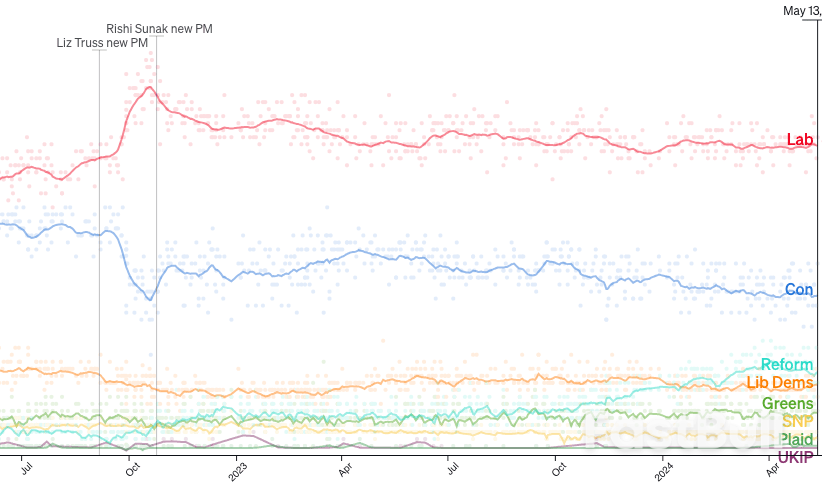
          Polls heavily favour the opposition Labour Party, who would likely foment closer ties between the EU and UK, according to strategists at Barclays.
          Barclays has been constructive on the Pound for some months now, with an expected closer relationship with Europe as a central pillar of this stance.
          "Demand is resilient and the prospect for closer ties with the EU should trigger a partial, yet sizeable, unwind of the pound's Brexit premium following the next UK general election. We maintain a constructive view of the pound (particularly vs EUR and CHF)," says Barclays.
          UK Election Opens Door to a Higher Pound to Euro Exchange Rate Say Analysts_1

          Above: Poll of polls by Politico.

          Barclays forecasts that EUR/GBP will grind toward 0.82 by Q1 2025, which gives a GBP/EUR target of 1.22.
          With the hard-left Jeremy Corbyn no longer at the helm of Labour, the prospect for economic disruption is greatly minimised. In fact, the Labour and Conservative parties have near-identical centrist economic policy stances.
          "Despite the fact that the UK is facing an election... the 20 pt lead in the polls that has been held by the Labour party for some time suggests limited room for surprises," says Jane Foley, Senior FX Strategist at Rabobank.
          "While traditionally, the market is more cautious about a left-of-centre government, the Labour Party has been openly wooing UK business," she adds.
          It is speculated that Sunak went for a July vote as it became clear there was no fiscal space to allow Jeremy Hunt to deliver an Autumn Statement that would allow further tax giveaways to bolster the Conservative's position.
          "Constraints implied by the UK’s poor fiscal position combined with the policy mistakes made by Truss in 2022, suggests limited room for any move away from prudent budget policy after the election," says Foley.
          UK Election Opens Door to a Higher Pound to Euro Exchange Rate Say Analysts_2

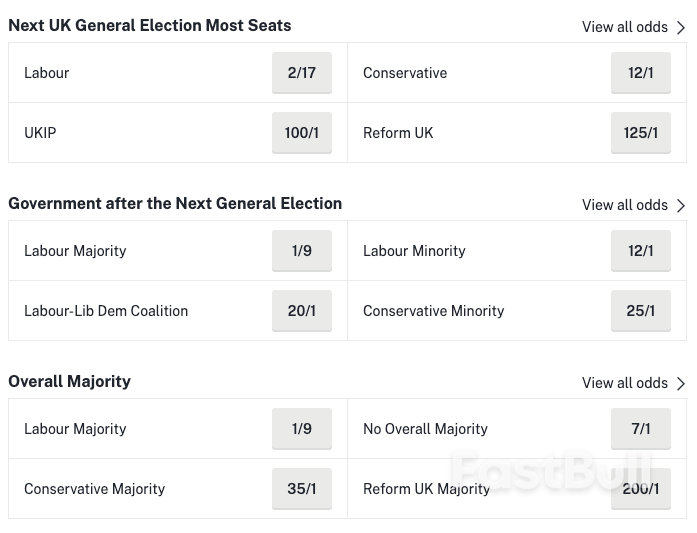
          Above: Odds heavily favour a Labour majority outcome on July 04. Image: Oddschecker.

          The ongoing improvement in UK business investment might also continue under Chancellor Rachel Reeves, who appears to recognise the importance of business investment in improving productivity and growth.
          "Assuming that the UK political backdrop remains calm, we expect that GBP can continue its slow grind higher medium-term," says Foley.
          Rabobank maintains a 6-12 month forecast of EUR/GBP 0.84 based on the view that a more stable UK political landscape will allow GBP to continue the slow, grinding recovery that has been in evidence since the start of 2023.
          EUR/GBP at 0.84 gives a GBP/EUR exchange rate of 1.19.

          Source: Poundsterlinglive

          To stay updated on all economic events of today, please check out our Economic calendar
          Risk Warnings and Disclaimers
          You understand and acknowledge that there is a high degree of risk involved in trading. Following any strategies or investment methods may lead to potential losses. The content on the site is provided by our contributors and analysts for information purposes only. You are solely responsible for determining whether any trading assets, securities, strategy, or any other product is suitable for investing based on your own investment objectives and financial situation.
          Add to Favorites
          Share

          UK Inflation Falls by Less Than Expected to 2.3%, Reducing Chance of June Rate Cut

          Cohen

          Economic

          Central Bank

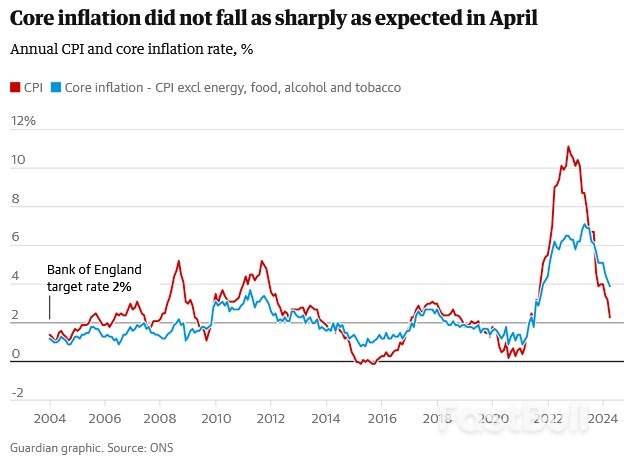
          UK inflation fell to 2.3% in April – its lowest level for almost three years – but the decline was smaller than expected, denting hopes of an early interest rate cut.
          City analysts had forecast the annual increase in the cost of goods and services would fall to 2.1%, close to the Bank of England's 2% target.
          Markets responded by trimming their predictions that the Bank would cut rates from their current 5.25% level as early as next month, with forecasts of a reduction in August also scaled back.
          Last month's 2.3% fall in the consumer prices index (CPI), down from 3.2% in March, was driven by easing energy and food costs. The last time inflation was lower was in July 2021.
          UK Inflation Falls by Less Than Expected to 2.3%, Reducing Chance of June Rate Cut_1
          Electricity and gas prices fell over the last year by 27%, the biggest drop on record, and food and soft drink prices increased by 2.9% annually, the lowest rise since November 2021.
          Illustrating the pressure on household budgets and the reluctance to buy big-ticket items, furniture retailers cut prices by 0.9% between March and April, and the cost of all goods dropped by 0.8% month on month.
          Annual services inflation, which mainly reflects the costs companies charge each other, was 5.9%, barely down from March's 6%.
          A sharp rise in property rents over the last year kept a measure of inflation that includes housing costs much higher than the headline CPI. Higher mortgage costs were another factor that meant the ONS's alternative consumer prices index including housing (CPIH) rose by 3% year on year.
          The Office for National Statistics (ONS) said inflation was prevented from slowing more last month by a rise in petrol and diesel prices, although the price of a barrel of Brent crude has steadied recently at about $83 (£65).
          Yael Selfin, the chief economist at KPMG UK, said the likelihood of an interest rate cut as soon as next month had receded. “Falling inflation closes in on the Bank of England's target but may not be enough to sway an early rate cut,” she said.
          Paula Bejarano Carbo, an economist at the National Institute of Economic and Social Research, said core inflation – which strips out food and energy costs – remained higher than its historical average at 3.9% and this would need to fall before the central bank's monetary policy committee was comfortable cutting rates.
          “Paired with last week's strong wage growth data, we believe that elevated services inflation will remain an upwards risk to inflationary pressures in the second half of this year. As a result, the MPC may exert caution at its upcoming meeting and hold interest rates, despite today's encouraging fall in the headline rate.”
          Rishi Sunak said April's CPI figure marked “a major moment for the economy, with inflation back to normal”. The prime minister said: “This is proof that the plan is working and that the difficult decisions we have taken are paying off.”
          The shadow chancellor, Rachel Reeves, said although inflation had fallen, now was “not the time for Conservative ministers to be popping champagne corks”. She posted on X: “Prices have soared, mortgages bills have risen and taxes are at a 70-year high. Only Labour can be trusted to protect and improve family finances.”
          Inflation was 2.4% in the 20-member eurozone in April, the same as the previous month.
          Separate ONS figures also released on Wednesday showed the public finances suffered a larger-than-expected rise in April.
          The high cost of financing the UK's government debt played a large part in pushing the monthly deficit to £20.5bn, the fourth highest April borrowing since monthly records began in 1993 and £1.9bn more than official forecasts.
          Debt payments decreased by £1.7bn to £8.6bn but remained at a higher level than the Office for Budget Responsibility (OBR) had pencilled in.
          Some analysts said the figures showed the government's finances were being squeezed and ruled out tax cuts by the chancellor before the general election.
          Martin Beck, an economic adviser to the EY Item Club, said: “The new fiscal year got off to a disappointing start for the UK's public finances, with borrowing coming in above the OBR forecast. The effect on debt servicing costs of higher bank rate and gilt yields than the OBR assumed in its budget forecast mean that this under-performance is likely to continue for the rest of the financial year.
          “It's unlikely that OBR forecast revisions would offer the government scope for another tax-cutting fiscal event before the next general election.”

          Source: The Guardian

          To stay updated on all economic events of today, please check out our Economic calendar
          Risk Warnings and Disclaimers
          You understand and acknowledge that there is a high degree of risk involved in trading. Following any strategies or investment methods may lead to potential losses. The content on the site is provided by our contributors and analysts for information purposes only. You are solely responsible for determining whether any trading assets, securities, strategy, or any other product is suitable for investing based on your own investment objectives and financial situation.
          Add to Favorites
          Share

          Indian Stocks To Scale New Peaks, Rising Over 8% This Year

          Alex

          Economic

          Stocks

          India's benchmark indices will hit new highs by end-2024, according to a Reuters poll of equity analysts who have upgraded their outlook from three months ago, as retail investors plough money into one of the world's most expensive stock markets.
          Despite growing concerns that India's equity markets are overvalued, local investors have so far ignored warnings and driven share prices to record highs over optimism that India's economy will continue to outpace its peers.
          The benchmark BSE Sensex index .BSESN, which gained nearly 19% in 2023 and has risen over 2% for the year, was forecast to add another 8% to reach 80,120 by end-2024, the May 14-22 poll of 26 equity analysts showed.
          It was then expected to add another 4% to reach 83,300 by mid-2025. Those estimates were an upgrade from median predictions of 78,550 and 80,920 in a February poll.
          "Though the pace of advance has been muted in the last 4-5 months, the overall bias and trend still looks positive... earlier we were seeing mixed signals from global markets, but now the majority of them are also doing well," said Ajit Mishra at stockbroker Religare.
          "Overall we are expecting the market to reach further (highs) though...the pace would be gradual. We might not see any major correction."
          The Indian economy was forecast to have grown over 7% in the fiscal year 2023-24, with growth expected to moderate only slightly to 6.5% and 6.7% over the next couple of years, according to a separate Reuters poll.
          The Sensex has risen in nine of the past 10 years, including the pandemic period. Even with a high price-to-earnings ratio of 24, a correction in the near-term was still not the majority view.
          The Nifty 50 .NSEI was expected to gain 6% from Tuesday's close of 22,529 to reach 23,850 by the end of 2024, and 24,750 by mid-2025.
          Only half of the 24 respondents who answered an additional question said a correction in the next three months was likely with the rest saying unlikely.
          "Right now the market is relatively expensive compared to what growth is telling us. Domestically liquidity was strong but foreigners are taking a cautious stance," said Rajat Agarwal, Asia equity strategist at Societe Generale.
          "So it should be more of a year of resilience for the Indian equity market rather than a year of good returns overall."
          Most political analysts expect Prime Minister Narendra Modi's Bharatiya Janata Party to win a rare third five-year term in national elections that will soon conclude, with results published in the first week of June.
          Agarwal said if there was any disruption to those broad expectations "we should...see some kind of a correction."

          Source:Reuters

          To stay updated on all economic events of today, please check out our Economic calendar
          Risk Warnings and Disclaimers
          You understand and acknowledge that there is a high degree of risk involved in trading. Following any strategies or investment methods may lead to potential losses. The content on the site is provided by our contributors and analysts for information purposes only. You are solely responsible for determining whether any trading assets, securities, strategy, or any other product is suitable for investing based on your own investment objectives and financial situation.
          Add to Favorites
          Share

          Natural Gas and Oil Forecast: WTI and Brent Down 0.20%; Time for Bullish Correction?

          Thomas

          Economic

          Commodity

          Market Overview
          Oil prices fell for the fourth consecutive session after the U.S. Federal Reserve minutes indicated potential further rate hikes if inflation persists, potentially dampening oil demand. The minutes highlighted a commitment to maintaining current rates but noted a willingness to tighten policy further if necessary.
          Additionally, U.S. crude inventories rose by 1.8 million barrels, contrary to expectations of a 2.5 million-barrel draw, exerting further pressure on prices.
          Citi analysts cited weak demand, increased inventories, and refinery margin concerns as contributors to the market softness. Russia’s OPEC+ quota exceedance and upcoming production cut discussions also impact forecasts.

          Natural Gas Price Forecast

          Natural Gas and Oil Forecast: WTI and Brent Down 0.20%; Time for Bullish Correction?_1
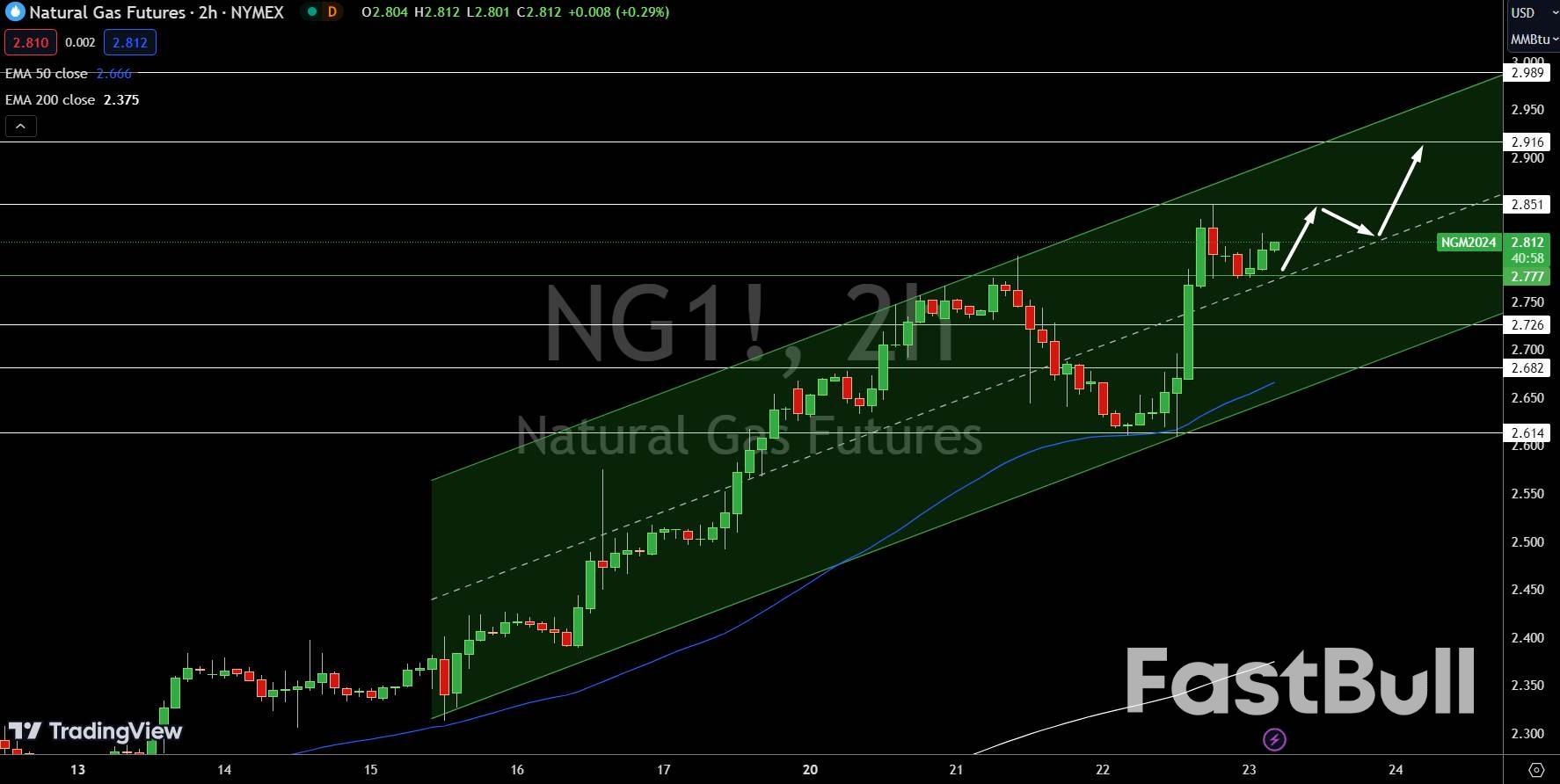
          Natural Gas (NG) is trading at $2.99, up 0.79%. The 4-hour chart indicates a pivot point at $2.77, with immediate resistance levels at $2.85, $2.92, and $2.99. Key support levels are positioned at $2.73, $2.68, and $2.61.
          The 50 EMA stands at $2.67, while the 200 EMA is at $2.38, highlighting a bullish trend as the price remains above these averages.
          The market outlook for Natural Gas is bullish as long as the price stays above the pivot point of $2.77. A break below this level could trigger a sharp selling trend.

          WTI Oil Price Forecast

          Natural Gas and Oil Forecast: WTI and Brent Down 0.20%; Time for Bullish Correction?_2
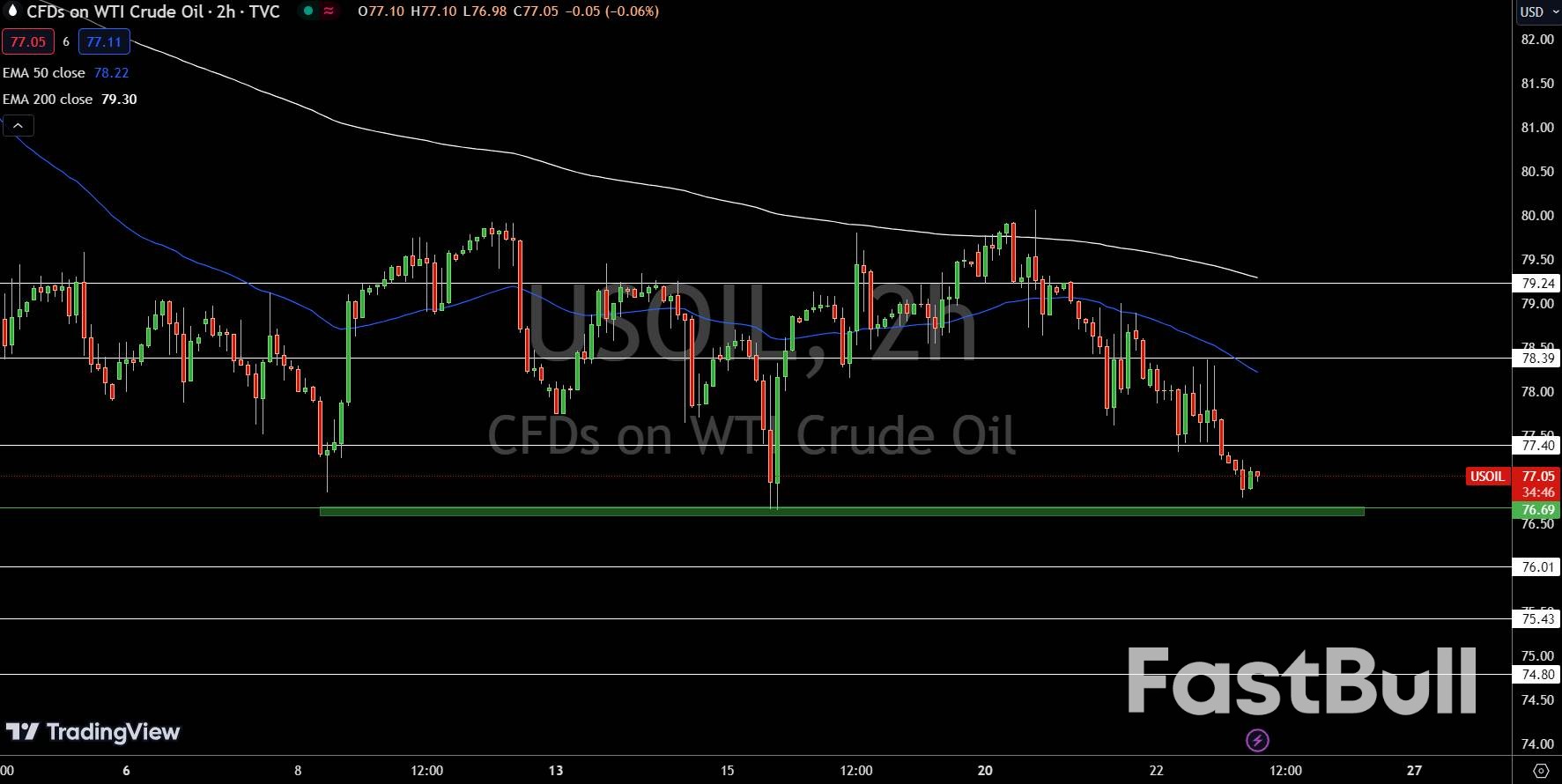
          Natural Gas (NG) is trading at $2.99, up 0.79%. The 4-hour chart indicates a pivot point at $2.77, with immediate resistance levels at $2.85, $2.92, and $2.99. Key support levels are positioned at $2.73, $2.68, and $2.61.
          The 50 EMA stands at $2.67, while the 200 EMA is at $2.38, highlighting a bullish trend as the price remains above these averages.
          The market outlook for Natural Gas is bullish as long as the price stays above the pivot point of $2.77. A break below this level could trigger a sharp selling trend.

          WTI Oil Price Forecast

          Natural Gas and Oil Forecast: WTI and Brent Down 0.20%; Time for Bullish Correction?_3
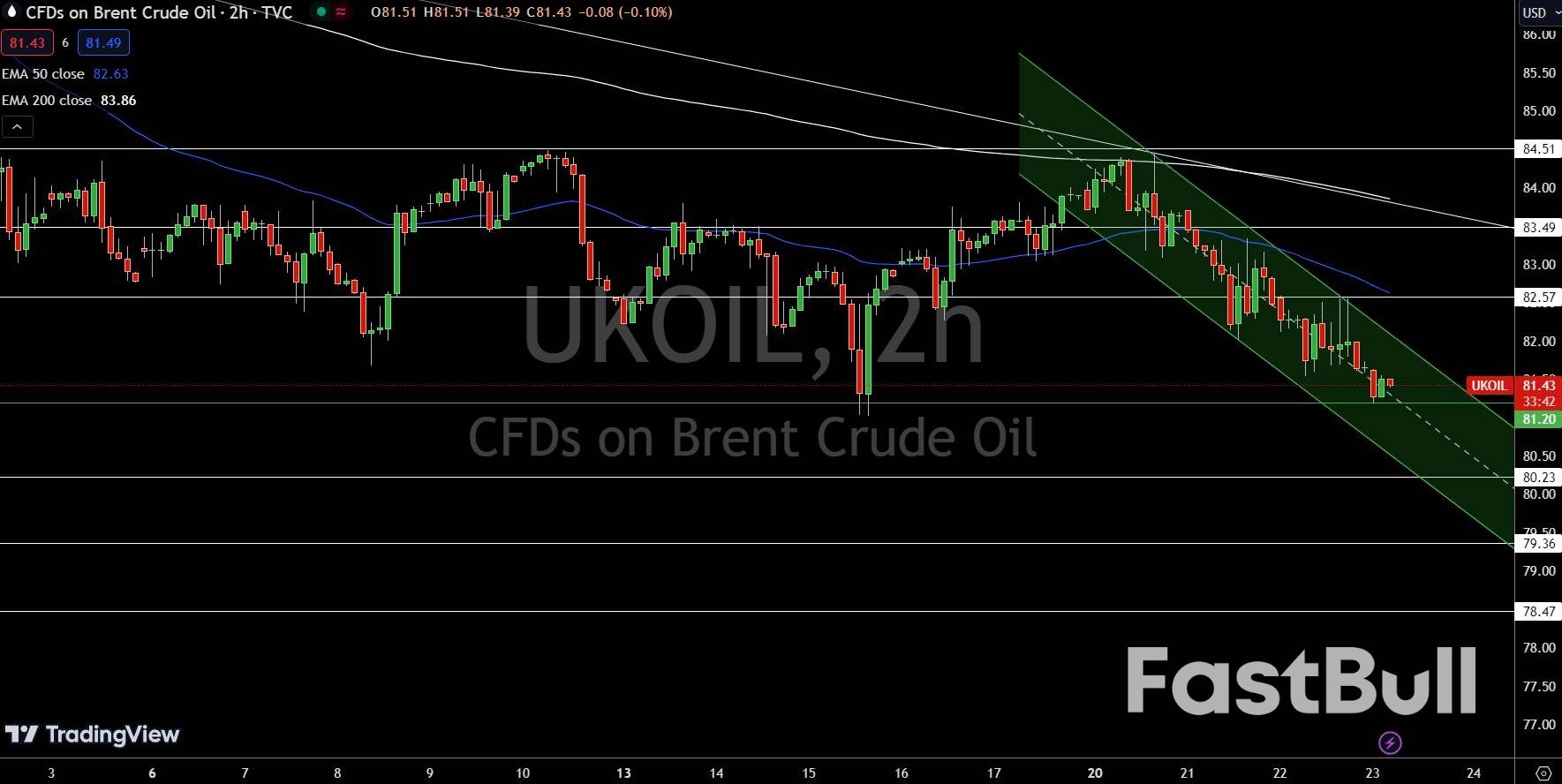
          Brent Oil (UKOIL) is trading at $81.44, down 0.28%. The 4-hour chart shows a pivot point at $81.20. Immediate resistance levels are $82.57, $83.49, and $84.51. Key support levels are $80.53, $79.36, and $78.47.
          The 50 EMA is at $82.63, and the 200 EMA is at $83.86, indicating a bearish trend as prices remain below these averages. The market outlook for UKOIL is bullish above the pivot point of $81.20, but a break below this level could lead to a sharp selling trend.
          For a look at all of today’s economic events, check out our economic calendar.

          Source: FX Empire

          To stay updated on all economic events of today, please check out our Economic calendar
          Risk Warnings and Disclaimers
          You understand and acknowledge that there is a high degree of risk involved in trading. Following any strategies or investment methods may lead to potential losses. The content on the site is provided by our contributors and analysts for information purposes only. You are solely responsible for determining whether any trading assets, securities, strategy, or any other product is suitable for investing based on your own investment objectives and financial situation.
          Add to Favorites
          Share

          Dollar Recovers Post-Hawkish FOMC Minutes, EUR/GBP in Focus

          Samantha Luan

          Economic

          Central Bank

          Forex

          Trading has been relatively quiet in Asian session today. Dollar regained some ground overnight following hawkish minutes from the latest FOMC meeting, which revealed that several members are prepared to support further rate hike if necessary. Despite this, the greenback lacks clear follow-through momentum at present. For a more sustained near-term rebound, Dollar will need additional support from upcoming economic data, including today's jobless claims and PMIs, as well as tomorrow's durable goods orders.
          New Zealand Dollar stands out as the strongest performer of the day at the point, driven by unexpectedly robust retail sales data that ended a two-year contraction streak. Kiwi has also been a top performer for the week, buoyed by RBNZ's hawkish stance. Australian Dollar is the second strongest today, supported by solid PMI data showing solid growth and renewed cost pressures. Conversely, Dollar is the weakest performer, followed by Japanese Yen and then Euro. Notably, all major pairs and crosses are confined within yesterday's ranges, with the exception of AUD/NZD.
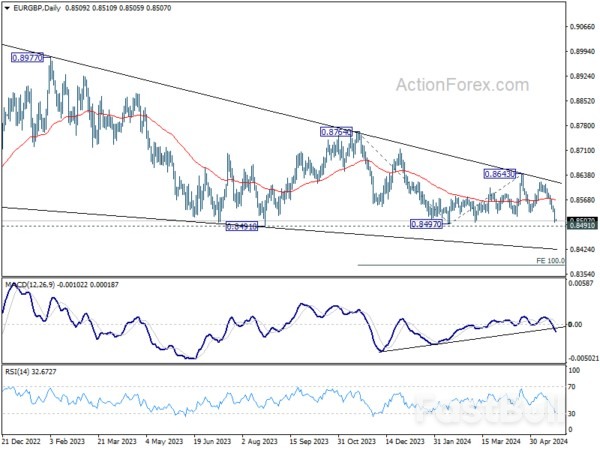
          EUR/GBP is a major focus in European session with Eurozone and UK PMIs featured. Fall from 0.8943 resumed this week and is on track to retest 0.8491/7 support zone. Decisive break there will resume larger down trend from 0.9267 (2022 high). Next medium term target is 100% projection of 0.8764 to 0.8497 from 0.8643 at 0.8376.Dollar Recovers Post-Hawkish FOMC Minutes, EUR/GBP in Focus_1
          In Asia, at the time of writing, Nikkei is up 1.20%. Hong Kong HSI is down -1.64%. China Shanghai SSE is down -1.15%. Singapore Strait Times is up 0.22%. Japan 10-year JGB yield ius up 0.0011 at 1.002. Overnight, DOW fell -0.51%. S&P 500 fell -0.27%. NASDAQ fell -0.18%. 10-year yield rose 0.020 to 4.434.

          FOMC minutes decidedly hawkish, DOW retreats but stays bullish

          US stocks ended lower overnight as minutes from the latest FOMC meeting revealed a more hawkish stance than anticipated. The central focus of the minutes was the "lack of further progress" in reducing inflation towards the 2% target, which has raised fresh concerns about the persistence of inflation.
          Additionally, the minutes highlighted recent monthly data showing "significant increases in components of both goods and services price inflation," adding to the urgency of the situation. More importantly, "various participants mentioned a willingness to tighten policy further should risks to inflation materialize in a way that such an action became appropriate."
          Despite the hawkish tone of the minutes, it's important to note that several influential figures, including Chair Jerome Powell and Governor Christopher Waller, have since indicated that they doubt the next move will be an interest rate hike.
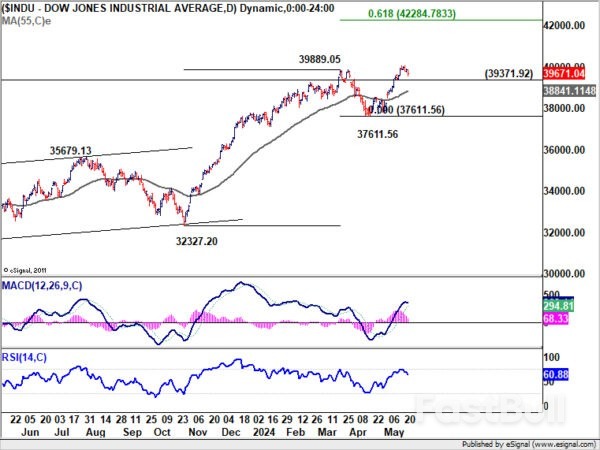
          Technically, as long as 39371.92 support holds, further rally is expected in DOW in the near term. Current rise is part of the larger uptrend and should target 61.8% projection of 32327.20 to 39889.05 from 37611.56 at 42284.78. However, break of 39371.92 will bring lengthier consolidations first before the up trend resumes.Dollar Recovers Post-Hawkish FOMC Minutes, EUR/GBP in Focus_2

          Japan's PMI manufacturing rises to 50.5, first expansion in a year

          Japan's PMI Manufacturing rose from 49.6 to 50.5 in May, exceeding expectations of 49.7 and signaling improving business conditions for the first time in a year. Meanwhile, PMI Services declined from 54.3 to 53.6, and PMI Composite inched up from 52.3 to 52.4.
          Jingyi Pan, Economics Associate Director at S&P Global Market Intelligence, noted that Japan's private sector expansion accelerated for the third consecutive month, reaching its fastest pace since August 2023. This suggests continued growth momentum midway through Q2, hinting at a better GDP reading after the disappointing Q1 results.
          Pan highlighted that the expansion in business activity remained "services-led," but the "near-stabilization" of manufacturing output offers hope for broader growth later in the year.
          Both input cost and output price inflation rates eased, indicating "softer inflationary pressures across official gauges." However, manufacturers continue to face rising cost pressures, partly due to "yen fluctuations," which remain an important factor to monitor.

          Australia PMI composite dips to 52.6, increasing cost pressures

          Australia's PMI Manufacturing remained steady at 49.6 in April, a joint 9-month high. PMI Services dropped slightly from 53.6 to 53.1, while PMI Composite decreased from 53.0 to 52.6.
          Warren Hogan, Chief Economic Advisor at Judo Bank, noted that PMI remains "firmly in expansionary territory," and pointed to growth at "around the long-term trend rate, if not a touch higher".
          However, Hogan warned that weak consumer spending will drag on growth in the first half of the year. Despite this, businesses are still hiring, with the employment index reaching a 6-month high.
          Composite input price index hit a 6-month high, with service industry cost pressures rising slightly. Hogan remarked, "This does not suggest a material step down in domestic inflation pressures in Q2."
          Additionally, manufacturing input prices hit a one-year high in May, raising doubts about further deflation in domestic goods prices. This has been crucial in bringing inflation below 4% over the past year. Any increase in goods inflation, alongside high service sector inflation, poses a significant concern for RBA, which expects inflation to decrease over the next 18 months.

          NZ retail sales up 0.5% in Q1, ending two-year downturn

          New Zealand's retail sales volumes rose by 0.5% qoq to NZD 25B in Q1, significantly outperforming the anticipated -0.3% qoq decline. Sales values increased by 0.7% qoq to NZD 30B.
          "In the March quarter, we saw a modest increase in retail activity, with growth across most industries," said Melissa McKenzie, business financial statistics manager. "This followed two years of declines."
          Of the 15 retail industries, nine experienced higher sales volumes during the quarter. The most notable contributions came from food and beverage services, which rose by 2.2%, motor vehicle and parts retailing, which increased by 1.1%, recreational goods retailing, which surged by 4.7%, and accommodation, which climbed by 4.1%.

          Looking ahead

          Eurozone and UK PMIs are the main focuses in European session. Later in the day, US will release jobless claims, retail sales, and PMIs.

          USD/CHF Daily Outlook

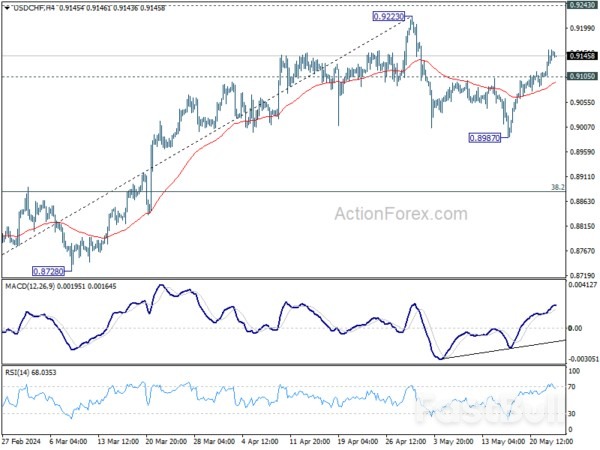
          Intraday bias in USD/CHF remains on the upside at this point. Rise from 0.8987 is in progress for retesting 0.9223. On the downside, below 0.9105 minor support will turn intraday bias neutral first. Further break of 0.8987 will resume the fall from 0.9223 to 38.2% retracement of 0.8332 to 0.9223 at 0.8883.Dollar Recovers Post-Hawkish FOMC Minutes, EUR/GBP in Focus_3
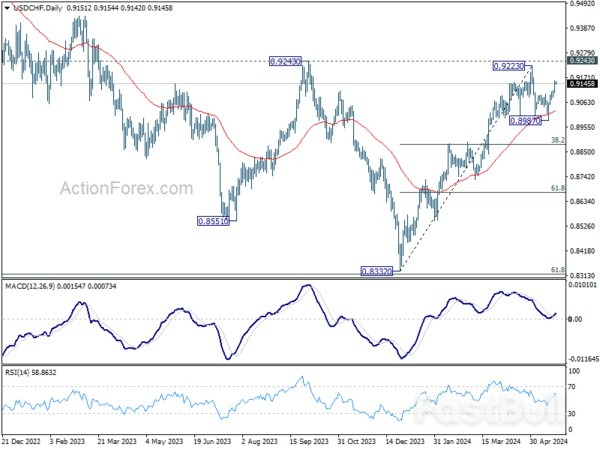
          In the bigger picture, price actions from 0.8332 medium term bottom are tentatively seen as developing into a corrective pattern to the down trend from 1.0146 (2022 high). Rejection by 0.9243 resistance, followed by sustained break of 38.2% retracement of 0.8332 to 0.9223 at 0.8883 will strengthen this case, and maintain medium term bearishness. However, decisive break of 0.9243 will argue that the trend has already reversed and turn medium term outlook bullish for 1.0146.Dollar Recovers Post-Hawkish FOMC Minutes, EUR/GBP in Focus_4

          Source: ActionForex

          To stay updated on all economic events of today, please check out our Economic calendar
          Risk Warnings and Disclaimers
          You understand and acknowledge that there is a high degree of risk involved in trading. Following any strategies or investment methods may lead to potential losses. The content on the site is provided by our contributors and analysts for information purposes only. You are solely responsible for determining whether any trading assets, securities, strategy, or any other product is suitable for investing based on your own investment objectives and financial situation.
          Add to Favorites
          Share

          Biggest US Retailers Cut Prices As Inflation Hits Shoppers

          Cohen

          Economic

          Prices are dropping for thousands of items at Target and Walmart, as US retailers’ results indicate fatigue among some consumers after three years of high inflation.
          Target this week said it would lower prices this summer for 5,000 items ranging from milk to paper towels in an effort to stay competitive. Walmart told analysts last week that it had reduced the prices of a large number of grocery products.
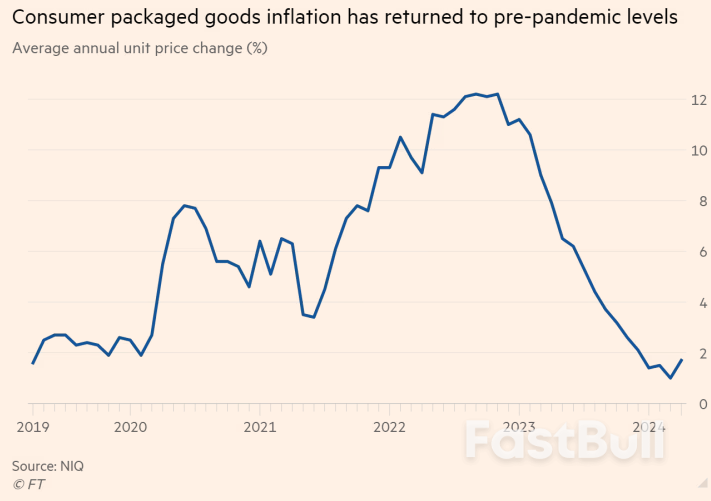
          The cuts by two of the largest general merchandise chains illustrate how retail prices are levelling off, if not falling, after years of increases sustained by pandemic-era supply chain breakdowns and a sturdy US labour market. Persistent inflation has soured Americans’ mood in an election year: 71 per cent of those surveyed in the latest FT-Michigan Ross poll said they believed economic conditions were negative.
          Target, with nearly 2,000 stores in all US states, on Wednesday reported a 3.7 per cent drop in same-store sales in its first quarter, reflecting falls in both the number and value of transactions and marking a fourth consecutive quarter of decline.
          Shares of the Minnesota-based company closed 8.1 per cent lower after it reported earnings per share that slightly missed expectations.
          The retailer this week said its new set of price cuts would apply to an array of household staples, from a 5 per cent reduction for a pound of butter to 14 per cent off Clorox scented wipes. On Wednesday it forecast the slide in same-store sales would end in the current quarter.
          “We know consumers are feeling pressured to make the most of their budget,” said Rick Gomez, Target’s chief food, essentials and beauty officer, in the announcement. Target did not respond to requests for comment before its earnings release. Biggest US Retailers Cut Prices As Inflation Hits Shoppers_1
          Target’s announcement came days after Walmart disclosed an unusually large boost to its so-called rollbacks, which are discounts to the low prices for which the world’s largest retailer is known, typically for about 90 days.
          The number of grocery items getting such price breaks rose 45 per cent year over year in April. John Furner, chief executive of Walmart US, said stores now had almost 7,000 rollbacks and he expected that this would help its food sales for the rest of the year at a time when the price difference between eating out and preparing meals at home had widened.
          Customers were “responding to our price leadership”, Walmart CEO Doug McMillon told analysts.
          Its US business, which includes more than 5,200 stores, reported a 3.8 per cent increase in comparable sales in its first quarter, which came entirely from a rise in transactions rather than prices. A big driver of demand came from households making $100,000 or more, executives said.
          Joe Feldman, an analyst at Telsey Advisory Group, said Target was probably motivated to keep pace with Walmart.
          “What’s interesting is it’s likely to expand to the rest of retail, given Walmart and Target set the tone on pricing,” he added.
          Signs of weakness have turned up in other corners of US retail. Home hardware retailer Lowe’s on Tuesday reported a 4.1 per cent decrease in same-store sales during the first quarter as customers cut back on big renovation projects. The department store chain Macy’s reported that comparable sales were down 1.2 per cent at the stores it owns.
          While customers have been benefiting from strong wage and job growth, “inflationary pressures persist, and they’re feeling that pinch”, Macy’s chief executive Tony Spring told analysts.
          The effects of inflation have compounded, even if the rate of change has slowed from two or three years ago, according to NIQ. Americans in 2024 have been spending a third more on consumer packaged goods than they were in 2019, the research company noted.
          Rising prices had been driving growth in the sector, but US retail sales of $705bn in April were in essence unchanged from March while sales declined at general merchandise stores, the Census Bureau reported.
          “I don’t think we’re going to see much in the way of wholesale declines in prices,” said Steve Zurek, vice-president of pricing and promotion thought leadership at NIQ. But he said the outlook for prices was vastly different from two years ago: “It’s not going to be everything going up.”

          Source:Financial Times

          To stay updated on all economic events of today, please check out our Economic calendar
          Risk Warnings and Disclaimers
          You understand and acknowledge that there is a high degree of risk involved in trading. Following any strategies or investment methods may lead to potential losses. The content on the site is provided by our contributors and analysts for information purposes only. You are solely responsible for determining whether any trading assets, securities, strategy, or any other product is suitable for investing based on your own investment objectives and financial situation.
          Add to Favorites
          Share

          The Japanese Yen Will Likely Remain Weak for Months to Come

          Goldman Sachs

          Economic

          Forex

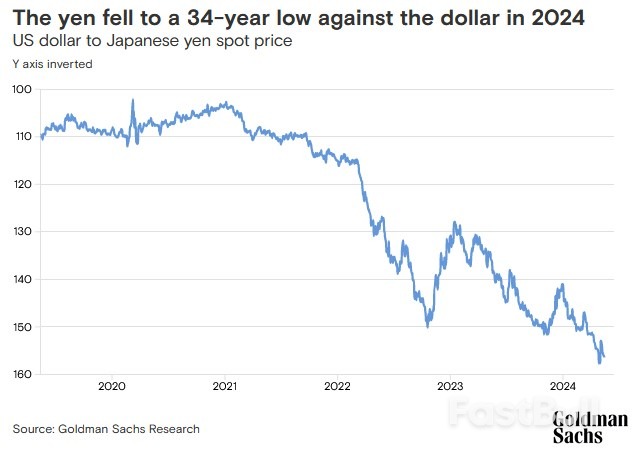
          The Japanese yen has been steadily depreciating since the beginning of the year, thanks in part to the delayed prospect of rate cuts by the US Federal Reserve and the strength of the US economy. Goldman Sachs Research expects the yen to remain at or above 150 to the dollar over a 12-month horizon. In late April, the yen hit 157.8 to the dollar, a level not seen since 1990. On April 29 and May 2, Japan's finance ministry made two apparent interventions in the foreign exchange markets, selling dollars to shore up its currency.
          We spoke to Goldman Sachs Research economist Tomohiro Ota and senior currency strategist Michael Cahill about the yen's slide and its implications for Japanese central banking policy and its economy.
          What has driven the decline of the yen this year?
          Cahill: First and foremost, it's the macro environment that is weighing on the yen. The yen tends to appreciate when recession risk is high — when yields are lower, and people are worried about growth. But we've had the opposite of that recently. We've seen surprisingly resilient growth, especially in the US, which has come despite the Fed keeping its rates high. Instead of having high recession risk, we're tracking US growth at around 3% despite high yields. That combination is weighing on the yen.
          Ota: Apart from those big structural factors, there was also a short-term event that may have triggered additional depreciation in the last couple of weeks. After the Bank of Japan held its monetary policy meeting in April, it sent two signals: one, that it does not react directly to the FX markets, and two, that its primary policy target is sustainable inflation. To the BOJ, the dollar-yen rate matters only when currency fluctuations have some impact on reaching their target.
          What about individual Japanese people investing in foreign securities?
          Cahill: It's hard to gauge the impact of this on foreign exchange. One thing we can say, with a longer-term perspective on yen depreciation, is that in US dollar terms, it has been much more attractive for Japan-based investors to invest abroad, on an unhedged basis, than for foreign investors to invest in Japan on an unhedged basis. Part of what makes it attractive is that, even though yen yields have risen, they've been very low compared to the rise in other markets, especially the US. That's a big reason why the yen has been more responsive to US yields in particular.
          Ota: Another aspect of cross-border cash flows is that we've had an extension of a tax benefit for retail investors, in a scheme that allows investment in securities. Through it, many retail investors reportedly decided to invest in foreign equities more than before, which creates a net outflow to other markets, although it is difficult to know exactly how much this affects the yen.
          The Japanese Yen Will Likely Remain Weak for Months to Come_1
          Is there a line in the sand for the BOJ — a threshold for yen depreciation that policymakers will defend?
          Cahill: We've found out that the authorities are much more sensitive to the pace of depreciation and to disjointed moves that are out of line with other market fundamentals. That is also what matters economically. I'd be surprised if they have a long-term target of any kind.
          In March, the BOJ ended its negative interest rate policy, raising borrowing costs for the first time since 2007. It also removed the cap on 10-year Japanese government bonds. How has that filtered through the FX market since? And how has that policy shift filtered through Japan's economy?
          Ota: The consensus view is that there has been no significant impact on the Japanese economy. The rate hike was only 10 basis points, which was a minimal increase. And in its March meeting, the BOJ announced that they will continue buying the same volume of Japanese government bonds every month, so it didn't signal a move to quantitative tightening. They maintained that stance after their April meeting as well.
          Cahill: And on the FX side — FX is a relative game. Even as we had a rate increase in Japan, we've also been pricing out rate cuts around the world. In the US, for example, we've moved to pricing in only two rate cuts this year. In effect, that has made it so that the BOJ's movements barely register. The other important thing is that they described their rate hike as exiting their extraordinary easing policies, not as the launch of a big tightening campaign.
          When might the BOJ raise interest rates again?
          Ota: The market consensus now is that the BOJ will raise its policy rate again in September or October. Some economists expect a July hike, but in the most recent survey, the consensus lies with September or October. We expect the next hike to come in October.
          What is your take on the BOJ's terminal rate? What's a simple way of understanding that idea, and why is it important for investors?
          Ota: Japan is now at a crossroads. We've been in a deflationary environment for more than two decades, but the BOJ is now saying that sustainable inflation is their base case scenario. We also think that the Japanese economy has a good chance of getting out of the so-called deflation trap. In that case, near-zero interest rates are not justifiable. The terminal rate is where the policy rate is expected to peak during the business cycle. Right now, the consensus is that Japan's policy rate will peak around 0.75%. But we think it could go as high as 1.5%. If households and firms become convinced that higher inflation is here to stay, that will change pricing and spending behaviour. In turn, the BOJ should be able to raise the policy rate further without restricting the economy too much. This matters for investors trying to gauge how the market (and the economy) will respond to rate hikes.
          How might the BOJ react to further yen weakness — or will it?
          Ota: Although we expect the next rate hike to come in October, there is a low bar for it to come somewhat earlier. That's because the next hike is expected to be another relatively small one — 15 basis points this time. But we do not expect the BOJ to cite yen weakness as the primary reason for raising the policy rate.
          Cahill: If the yen weakens enough to impact the inflation outlook, that could in principle lead to faster rate hikes from the BOJ. In fact, the BOJ has said that exchange rate fluctuations might have a bigger impact on price-setting behaviour right now. But keep in mind that a modestly weaker yen would help the BOJ reach its inflation target. And, importantly, Japan has more targeted tools to deal with exchange rate volatility that looks out of step with fundamentals. With about $1 trillion in foreign exchange reserves, Japan is one of the largest reserve managers in the world. So the ministry of finance has plenty of capacity to intervene in the FX market if it needs to. But there are limits on how effectively authorities can manage the exchange rate without taking more decisive action that could have unwelcome side effects.
          What is Goldman Sachs Research's outlook for GDP growth in the coming 12 months, and how has that shifted since the start of the year?
          Ota: Currently our GDP growth forecast for the calendar year 2024 is 0.5%. This is lower than our initial forecast in November last year of 1.5%. The main reason for that downgrade is a temporary drop in consumption in the January-March period, reflecting the fact that some Japanese automobile companies had to close their production lines because of problems with the quality assurance process. But that is a temporary issue and doesn't change our macro narrative. Following this brief setback, we expect positive growth for the rest of the year, including a temporary consumption boost from an income tax cut over the summer.
          What is your outlook for the yen over the next six and 12 months, and why?
          Cahill: We expect the yen to remain around current weak levels over the next 6-12 months. The bottom line is that the macro environment should continue to weigh on this safe-haven currency, and the Fed cuts (and BOJ hikes) that we expect probably won't provide that much support. We think recession risk remains fairly low, and there is not much room for 10-year US yields to rally, which is what would typically strengthen the yen. The yen could weaken further if the US economy proves even more resilient than we expect, and if the Fed delivers even fewer rate cuts down the line.
          To stay updated on all economic events of today, please check out our Economic calendar
          Risk Warnings and Disclaimers
          You understand and acknowledge that there is a high degree of risk involved in trading. Following any strategies or investment methods may lead to potential losses. The content on the site is provided by our contributors and analysts for information purposes only. You are solely responsible for determining whether any trading assets, securities, strategy, or any other product is suitable for investing based on your own investment objectives and financial situation.
          Add to Favorites
          Share
          FastBull
          Copyright © 2025 FastBull Ltd

          728 RM B 7/F GEE LOK IND BLDG NO 34 HUNG TO RD KWUN TONG KLN HONG KONG

          TelegramInstagramTwitterfacebooklinkedin
          App Store Google Play Google Play
          Products
          Charts

          Chats

          Q&A with Experts
          Screeners
          Economic Calendar
          Data
          Tools
          Membership
          Features
          Function
          Markets
          Copy Trading
          Latest Signals
          Contests
          News
          Analysis
          24/7
          Columns
          Education
          Company
          Careers
          About Us
          Contact Us
          Advertising
          Help Center
          Feedback
          User Agreement
          Privacy Policy
          Business

          White Label

          Data API

          Web Plug-ins

          Poster Maker

          Affiliate Program

          Risk Disclosure

          The risk of loss in trading financial instruments such as stocks, FX, commodities, futures, bonds, ETFs and crypto can be substantial. You may sustain a total loss of the funds that you deposit with your broker. Therefore, you should carefully consider whether such trading is suitable for you in light of your circumstances and financial resources.

          No decision to invest should be made without thoroughly conducting due diligence by yourself or consulting with your financial advisors. Our web content might not suit you since we don't know your financial conditions and investment needs. Our financial information might have latency or contain inaccuracy, so you should be fully responsible for any of your trading and investment decisions. The company will not be responsible for your capital loss.

          Without getting permission from the website, you are not allowed to copy the website's graphics, texts, or trademarks. Intellectual property rights in the content or data incorporated into this website belong to its providers and exchange merchants.

          Not Logged In

          Log in to access more features

          FastBull Membership

          Not yet

          Purchase

          Become a signal provider
          Help Center
          Customer Service
          Dark Mode
          Price Up/Down Colors

          Log In

          Sign Up

          Position
          Layout
          Fullscreen
          Default to Chart
          The chart page opens by default when you visit fastbull.com