• Trade
  • Markets
  • Copy
  • Contests
  • News
  • 24/7
  • Calendar
  • Q&A
  • Chats
Trending
Screeners
SYMBOL
LAST
BID
ASK
HIGH
LOW
NET CHG.
%CHG.
SPREAD
SPX
S&P 500 Index
6940.00
6940.00
6940.00
6967.31
6925.10
-4.47
-0.06%
--
DJI
Dow Jones Industrial Average
49359.32
49359.32
49359.32
49616.70
49246.24
-83.11
-0.17%
--
IXIC
NASDAQ Composite Index
23515.38
23515.38
23515.38
23664.26
23446.81
-14.63
-0.06%
--
USDX
US Dollar Index
99.150
99.230
99.150
99.250
98.920
+0.030
+ 0.03%
--
EURUSD
Euro / US Dollar
1.15978
1.15996
1.15978
1.16272
1.15843
-0.00114
-0.10%
--
GBPUSD
Pound Sterling / US Dollar
1.33765
1.33809
1.33765
1.34127
1.33660
-0.00042
-0.03%
--
XAUUSD
Gold / US Dollar
4596.43
4596.43
4596.43
4620.79
4536.73
-19.52
-0.42%
--
WTI
Light Sweet Crude Oil
59.195
59.224
59.195
60.010
58.781
+0.061
+ 0.10%
--

Community Accounts

Signal Accounts
--
Profit Accounts
--
Loss Accounts
--
View More

Become a signal provider

Sell trading signals to earn additional income

View More

Guide to Copy Trading

Get started with ease and confidence

View More

Signal Accounts for Members

All Signal Accounts

Best Return
  • Best Return
  • Best P/L
  • Best MDD
Past 1W
  • Past 1W
  • Past 1M
  • Past 1Y

All Contests

  • All
  • Trump Updates
  • Recommend
  • Stocks
  • Cryptocurrencies
  • Central Banks
  • Featured News
Top News Only
Share

Microsoft President Brad Smith: Welcomes Bipartisan Effort To Expand America's Energy Generation Capacity While Protecting Americans From Higher Costs

Share

US Names Rubio, Blair And Kushner In Gaza Board Under Trump's Plan

Share

Rio - EU Council President Costa: If The US Sees A Security Issue In Greenland, It Needs To Be Dealt With Collectively By NATO Members

Share

[NFL Prediction Markets Surge, Betting Stocks Plunge] On January 16, Draftkings Inc. Closed Down 8.01%, And Flutter Entertainment Plc. Closed Down 6.28%. Recent Data Suggests That These Two Industry Giants May Be At A Disadvantage In Their Competition With Prediction Market Startups. Platforms Like Kalshi And Polymarket Reported A Surge In Trading Activity During The NFL (National Football League) Playoffs. Meanwhile, Data From New York State Shows A Significant Year-over-year Decline In Online Sports Betting Revenue. Startup Platforms Are Seeing A Surge In Demand, With Sports Betting Accounting For Approximately 90% Of Kalshi's Trading Volume. Some Analysts Believe That Prediction Markets Are Impacting Traditional Sports Betting Companies

Share

US President Trump Purchased $1 Million In Bonds From Netflix And Warner Bros. Discovery. This Move Followed Announcements That The Two Companies Might Merge

Share

On Friday (January 16), The Information Technology Index Closed Up 0.85% At 283.16 Points, A Cumulative Increase Of 0.78% For The Week, Showing A U-shaped Reversal From January 13-15. The Artificial Intelligence (Ai) Winners Index Rose 0.62% To 292.01 Points, A Cumulative Increase Of 0.93% For The Week, Also Showing A U-shaped Reversal Around January 14. The AI ​​Software Pioneers Index Fell 0.78% To 116.15 Points, A Cumulative Drop Of 5.71% For The Week, After A Slight Rise On January 12, Followed By A Continuous Decline

Share

Ecuador Is Preparing For Its First International Debt Market Financing Since 2019 And Has Hired Bank Of America Securities And Citigroup For A Roadshow To Investors

Share

SPDR Gold Trust Reports Holdings Up 1.01%, Or 10.87 Tonnes, To 1085.67 Tonnes By Jan 16

Share

[Iran Condemns G7 Remarks Of Interference In Iran's Internal Affairs] On The Evening Of The 16th Local Time, The Iranian Foreign Ministry Issued A Statement Strongly Condemning The G7's Interference In Iran's Internal Affairs. The Statement Said That, Influenced By The United States And Israel, The G7 Recently Disregarded Facts And Made Interfering Remarks Regarding Iran's Internal Affairs

Share

US Energy Secretary Wright Says Venezuela Was Selling Oil For About $31 A Barrel Before US Captured Maduro, USA Selling It For About $45 A Barrel Now

Share

Fed Vice Chair Jefferson: He Has "Great Respect" For Powell, Considers Him A Person Of The Highest Integrity

Share

Fed Vice Chair Jefferson: Powell's Statement Regarding Department Of Justice Actions "Is There For Everyone To Read"

Share

US Energy Secretary Wright Says Putting Venezuela Oil Proceeds In Qatari Accounts Controlled By US Government Was A Pragmatic Decision

Share

[Zelensky: Ukraine's Air Defense Missile Stockpile Running Low] Ukrainian President Volodymyr Zelenskyy Stated In A Video Address On The Evening Of The 16th That Ukraine's Air Defense Missile Stockpile Is Insufficient, And Allies' Assistance Is Inadequate. Zelenskyy Said That Ukraine Urgently Needs Air Defense Systems And Interceptor Missiles, And Has Been Frankly Informed Of This To Its Allies, But Their Supplies Are Insufficient. The Ukrainian Ministry Of Defense Is Working To Urge Allies To Expedite The Supply Process. He Also Reminded The Ukrainian Public To Pay Close Attention To Air Raid Sirens

Share

US Energy Wright Tells Reuters US Moving Fast To Expand Chevron License For Increased Production And Exports Of Venezuelan Oil

Share

Fitch On Benin: Revision Of Outlook Reflects Authorities' Commitment To A Prudent Fiscal Stance

Share

Fitch: Armenia's Outlook Revision Reflects Higher International Reserves And Continued Solid Growth That Will Support Fiscal Consolidation

Share

Venezuelan Acting President: Venezuela Has Signed Its First Contract For The Export Of Natural Gas

Share

Fitch Affirms Saudi Arabia's A+ Rating With A Stable Outlook

Share

(US Stocks) The Philadelphia Gold And Silver Index Closed Up 0.06% At 395.01 Points, Up 5.47% For The Week. (Global Session) The NYSE Arca Gold Miners Index Closed Down 0.06% At 2760.43 Points, After Trump's Comments On Hassett Triggered A Sharp V-shaped Recovery, Up 5.38% For The Week. (US Stocks) The Materials Index Closed Down 0.21% At 252.23 Points, Up 2.89% For The Week. (US Stocks) The Metals And Mining Index Closed Down 1.09% At 241.90 Points, Up 4.46% For The Week

TIME
ACT
FCST
PREV
U.S. NY Fed Manufacturing Prices Received Index (Jan)

A:--

F: --

P: --

U.S. NY Fed Manufacturing New Orders Index (Jan)

A:--

F: --

P: --

U.S. NY Fed Manufacturing Employment Index (Jan)

A:--

F: --

P: --

U.S. Export Price Index YoY (Nov)

A:--

F: --

P: --

U.S. NY Fed Manufacturing Index (Jan)

A:--

F: --

P: --
U.S. Initial Jobless Claims 4-Week Avg. (SA)

A:--

F: --

P: --
U.S. Export Price Index MoM (Nov)

A:--

F: --

P: --

Canada Manufacturing Unfilled Orders MoM (Nov)

A:--

F: --

P: --

Canada Manufacturing New Orders MoM (Nov)

A:--

F: --

P: --

U.S. Philadelphia Fed Manufacturing Employment Index (Jan)

A:--

F: --

P: --

Canada Wholesale Sales YoY (Nov)

A:--

F: --

P: --

Canada Wholesale Inventory MoM (Nov)

A:--

F: --

P: --

U.S. Philadelphia Fed Business Activity Index (SA) (Jan)

A:--

F: --

P: --

U.S. EIA Weekly Natural Gas Stocks Change

A:--

F: --

P: --

Richmond Federal Reserve President Barkin delivered a speech.
U.S. Weekly Treasuries Held by Foreign Central Banks

A:--

F: --

P: --

Germany CPI Final MoM (Dec)

A:--

F: --

P: --

Germany CPI Final YoY (Dec)

A:--

F: --

P: --

Germany HICP Final MoM (Dec)

A:--

F: --

P: --

Germany HICP Final YoY (Dec)

A:--

F: --

P: --

Brazil PPI MoM (Nov)

A:--

F: --

P: --

Canada New Housing Starts (Dec)

A:--

F: --

P: --
U.S. Capacity Utilization MoM (SA) (Dec)

A:--

F: --

P: --
U.S. Industrial Output YoY (Dec)

A:--

F: --

P: --

U.S. Manufacturing Capacity Utilization (Dec)

A:--

F: --

P: --

U.S. Manufacturing Output MoM (SA) (Dec)

A:--

F: --

P: --
U.S. Industrial Output MoM (SA) (Dec)

A:--

F: --

P: --
U.S. NAHB Housing Market Index (Jan)

A:--

F: --

P: --

Russia CPI YoY (Dec)

A:--

F: --

P: --

U.S. Weekly Total Rig Count

A:--

F: --

P: --

U.S. Weekly Total Oil Rig Count

A:--

F: --

P: --

Japan Core Machinery Orders YoY (Nov)

--

F: --

P: --

Japan Core Machinery Orders MoM (Nov)

--

F: --

P: --

U.K. Rightmove House Price Index YoY (Jan)

--

F: --

P: --

China, Mainland GDP YoY (YTD) (Q4)

--

F: --

P: --

China, Mainland Industrial Output YoY (YTD) (Dec)

--

F: --

P: --

Japan Industrial Output Final MoM (Nov)

--

F: --

P: --

Japan Industrial Output Final YoY (Nov)

--

F: --

P: --

Euro Zone Core HICP Final MoM (Dec)

--

F: --

P: --

Euro Zone HICP Final MoM (Dec)

--

F: --

P: --

Euro Zone HICP Final YoY (Dec)

--

F: --

P: --

Euro Zone HICP MoM (Excl. Food & Energy) (Dec)

--

F: --

P: --

Euro Zone Core CPI Final YoY (Dec)

--

F: --

P: --

Euro Zone Core HICP Final YoY (Dec)

--

F: --

P: --

Euro Zone CPI YoY (Excl. Tobacco) (Dec)

--

F: --

P: --

Euro Zone Core CPI Final MoM (Dec)

--

F: --

P: --

Canada National Economic Confidence Index

--

F: --

P: --

Canada CPI MoM (SA) (Dec)

--

F: --

P: --

Canada Core CPI MoM (SA) (Dec)

--

F: --

P: --

Canada CPI YoY (SA) (Dec)

--

F: --

P: --

Canada Trimmed CPI YoY (SA) (Dec)

--

F: --

P: --

Canada CPI YoY (Dec)

--

F: --

P: --

Canada CPI MoM (Dec)

--

F: --

P: --

Canada Core CPI YoY (Dec)

--

F: --

P: --

Canada Core CPI MoM (Dec)

--

F: --

P: --

South Korea PPI MoM (Dec)

--

F: --

P: --

China, Mainland 1-Year Loan Prime Rate (LPR)

--

F: --

P: --

China, Mainland 5-Year Loan Prime Rate

--

F: --

P: --

Germany PPI YoY (Dec)

--

F: --

P: --

Germany PPI MoM (Dec)

--

F: --

P: --

Q&A with Experts
    • All
    • Chatrooms
    • Groups
    • Friends
    3377839 flag
    Yh I perfectly understand market structure
    EuroTrader flag
    3377839
    Yh I perfectly understand market structure
    @Visitor3377839Then top down analysis should be quite easy for you to understand then
    EuroTrader flag
    3377839
    Yh I perfectly understand market structure
    @Visitor3377839Are you a scalper or a swing trader or an intraday trader
    EuroTrader flag
    3300740
    @Visitor3300740Pleas don't give your account to someone to help you pass the account.
    otniel328 flag
    otniel328 flag
    This week went very well for me in automatic mode.
    34GMNLRZ0V flag
    otniel328
    This week went very well for me in automatic mode.
    hello guyz did the contest already start or it starts at 20th January?
    otniel328 flag
    34GMNLRZ0V
    @34GMNLRZ0Vthe 20th begins
    Hashmeet P flag
    anyone here trade crypto
    daremeb flag
    im having issues linking my phone number in the seetings. pls any help or suggession?
    daremeb flag
    settings i meant to type
    ABDULLAH S flag
    daremeb
    im having issues linking my phone number in the seetings. pls any help or suggession?
    @Hashmeet P @daremeb same issue
    dimas eyhh flag
    Hashmeet P
    anyone here trade crypto
    @Hashmeet Pyes
    Quantum Tradex flag
    Hashmeet P
    anyone here trade crypto
    @Hashmeet Pyes
    otniel328 flag
    daremeb
    im having issues linking my phone number in the seetings. pls any help or suggession?
    @daremebI had the same problem, you should chat with support.
    ERAGONEsp09 flag
    This contest is only for gold pairs, right?
    Yohanes Galih flag
    OnlyCrt flag
    Has the contest started?
    TraderShaan flag
    houusd
    Mr, Otohin flag
    btcusd
    Type here...
    Add Symbol or Code

      No matching data

      All
      Trump Updates
      Recommend
      Stocks
      Cryptocurrencies
      Central Banks
      Featured News
      • All
      • Russia-Ukraine Conflict
      • Middle East Flashpoint
      • All
      • Russia-Ukraine Conflict
      • Middle East Flashpoint
      Search
      Products

      Charts Free Forever

      Chats Q&A with Experts
      Screeners Economic Calendar Data Tools
      Membership Features
      Data Warehouse Market Trends Institutional Data Policy Rates Macro

      Market Trends

      Market Sentiment Order Book Forex Correlations

      Top Indicators

      Charts Free Forever
      Markets

      News

      News Analysis 24/7 Columns Education
      From Institutions From Analysts
      Topics Columnists

      Latest Views

      Latest Views

      Trending Topics

      Top Columnists

      Latest Update

      Signals

      Copy Rankings Latest Signals Become a signal provider AI Rating
      Contests
      Brokers

      Overview Brokers Assessment Rankings Regulators News Claims
      Broker listing Forex Brokers Comparison Tool Live Spread Comparison Scam
      Q&A Complaint Scam Alert Videos Tips to Detect Scam
      More

      Business
      Events
      Careers About Us Advertising Help Center

      White Label

      Data API

      Web Plug-ins

      Affiliate Program

      Awards Institution Evaluation IB Seminar Salon Event Exhibition
      Vietnam Thailand Singapore Dubai
      Fans Party Investment Sharing Session
      FastBull Summit BrokersView Expo
      Recent Searches
        Top Searches
          Markets
          News
          Analysis
          User
          24/7
          Economic Calendar
          Education
          Data
          • Names
          • Latest
          • Prev

          View All

          No data

          Scan to Download

          Faster Charts, Chat Faster!

          Download App
          English
          • English
          • Español
          • العربية
          • Bahasa Indonesia
          • Bahasa Melayu
          • Tiếng Việt
          • ภาษาไทย
          • Français
          • Italiano
          • Türkçe
          • Русский язык
          • 简中
          • 繁中
          Open Account
          Search
          Products
          Charts Free Forever
          Markets
          News
          Signals

          Copy Rankings Latest Signals Become a signal provider AI Rating
          Contests
          Brokers

          Overview Brokers Assessment Rankings Regulators News Claims
          Broker listing Forex Brokers Comparison Tool Live Spread Comparison Scam
          Q&A Complaint Scam Alert Videos Tips to Detect Scam
          More

          Business
          Events
          Careers About Us Advertising Help Center

          White Label

          Data API

          Web Plug-ins

          Affiliate Program

          Awards Institution Evaluation IB Seminar Salon Event Exhibition
          Vietnam Thailand Singapore Dubai
          Fans Party Investment Sharing Session
          FastBull Summit BrokersView Expo

          Trump's Iran Strategy: Pressure and Unpredictability

          Isaac Bennett

          Remarks of Officials

          Economic

          Middle East Situation

          Political

          Summary:

          Leveraging Iran's deep vulnerabilities, Trump's strategy aims for "strategic submission" via intense pressure and military threats, not regime change, but offers a transactional deal.

          Following weeks of disruptive protests across Iran—met with internet blackouts and a severe security crackdown—US President Donald Trump has kept the region on edge with repeated threats of military action if the violence escalates.

          These demonstrations represent one of the most serious challenges the Islamic Republic has faced in years. They have spread across numerous cities, involved diverse social groups, and triggered a level of state force that reveals how threatened the country's leadership feels. By warning Iran against killing protestors, Trump has signaled that internal repression will now have external consequences.

          Although the White House pulled back from military action on one occasion, the threat of force remains a key part of the president's strategy. This approach keeps the possibility of escalation alive, preserving the element of surprise and his freedom to act.

          Iran's Strategic Vulnerability

          While the protests have subsided under heavy repression, many observers believe sustained external pressure from the US is necessary to prevent the Iranian regime from returning to business as usual.

          Trump's warnings come at a time when Iran is strategically exposed. Since October 7, 2023, sustained Israeli strikes against its "axis of resistance" and a direct war between the two nations—which included US strikes on Iranian nuclear facilities last summer—have weakened Iran's deterrence and revealed the limits of its defensive capabilities.

          The domestic protests add another layer of vulnerability, combining regional setbacks with internal political and economic strain. This creates an opportunity that Washington is now actively seeking to leverage. Understanding Trump's Iran strategy requires looking beyond individual statements and tactical moves to see how his administration is working to turn Iran's accumulated weaknesses into a lasting strategic advantage for the US.

          The Goal: Strategic Submission, Not Regime Change

          In his second term, President Trump’s Iran policy is a mix of strategic calculation and his belief in pressure and unpredictability. This approach is not improvised; it is rooted in the core principles of his administration's National Security Strategy, which prioritizes strategic competition and deterrence through strength.

          The ultimate objective is not classic regime change but "strategic submission." The goal is to force Iran's leadership to accept permanent limits on its nuclear ambitions, scale back its regional influence, and understand that the US is prepared to escalate swiftly if its red lines are crossed.

          Iran's future now seems increasingly dependent on how the United States chooses to apply or withhold pressure in the coming months.

          Key Pillars of the US Pressure Campaign

          Washington's strategy relies on several coordinated efforts designed to constrain Tehran from multiple angles.

          Tying Domestic Repression to Global Consequences

          A significant policy shift has been the explicit link between Iran's internal conduct and external consequences. Since the protests started, Trump has repeatedly stated that mass killings or executions would provoke a US response, potentially including military force. These threats are designed to attach an international cost to domestic repression at a time when the regime is already stretched thin by regional and economic pressures.

          Neutralizing the Nuclear Threat

          Iran's nuclear program remains a central focus of Trump's strategy. On June 22 of last year, the US conducted direct military strikes on Iranian nuclear facilities in Operation Midnight Hammer. This marked a major escalation in the effort to deny Tehran a path to a nuclear weapon.

          Following the operation, Trump declared that Iran's nuclear program had been "effectively buried." This reflects the administration's view that a combination of US pressure, Israeli military action, covert operations, and cyberattacks has placed Tehran in a strategically weakened position.

          Expanding Economic Warfare

          Economic pressure, a long-standing tool of Trump's Iran policy, has become broader and more punitive. Beyond the "maximum pressure" sanctions implemented after the US left the Iran nuclear deal in 2018, the administration has proposed a 25% tariff on any country or company doing business with Tehran.

          This move from financial sanctions to trade punishment aims to deter third parties from serving as an economic lifeline for Iran. By threatening access to the massive US market, Washington seeks to compound the regime's regional losses with severe domestic economic strain.

          Maintaining Military Ambiguity

          Military signaling remains a core component of the strategy. Reports indicate that a US aircraft carrier, the USS Lincoln, is en route to the region, though the timing and scope of any future military action remain intentionally ambiguous.

          This posture is guided by Trump's belief that Iran has consistently underestimated American resolve. Examples include Tehran's assumption that Washington would not leave the nuclear deal in 2018, its miscalculation before the US killed Qassem Suleimani in 2020, and its actions during the war last summer. Current US force adjustments are intended to prevent Tehran from believing the situation has stabilized.

          A Transactional Path to a Deal

          Even as pressure mounts, President Trump has deliberately left an opening for a negotiated settlement. His references to wanting a deal and "making Iran great again" are transactional signals directed at the leadership, not the Iranian people.

          The message is that economic relief and reintegration into the global community are possible, but only after Iran accepts permanent, verifiable limits on its nuclear and ballistic missile programs and alters its regional behavior. The key question is whether Tehran has fully grasped this reality after a series of shocks and warnings.

          If Iran has, it is more likely to respond with greater restraint at home and abroad. If not, further miscalculation appears inevitable. Trump's strategy is less about engineering internal change and more about forcing Iran's leaders to recognize the limits of their resistance, with major implications for the regime's durability and the future of US-Iran relations.

          To stay updated on all economic events of today, please check out our Economic calendar
          Risk Warnings and Disclaimers
          You understand and acknowledge that there is a high degree of risk involved in trading. Following any strategies or investment methods may lead to potential losses. The content on the site is provided by our contributors and analysts for information purposes only. You are solely responsible for determining whether any trading assets, securities, strategy, or any other product is suitable for investing based on your own investment objectives and financial situation.
          Add to Favorites
          Share

          China Sells US Debt, Buys Gold in Strategic Shift

          King Ten

          Bond

          Commodity

          Political

          Remarks of Officials

          Economic

          Central Bank

          China–U.S. Trade War

          China appears to be accelerating its "derisking" strategy by systematically reducing its exposure to U.S. government debt while increasing its gold reserves. This financial pivot reflects a broader policy of diversifying assets amid ongoing geopolitical tensions.

          US Treasury Holdings Plunge to 15-Year Low

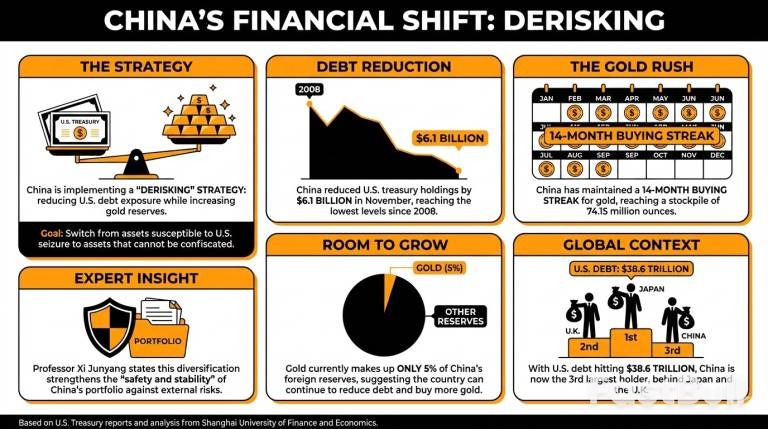
          According to data from the U.S. Treasury, China sold another $6.1 billion in U.S. Treasuries in November. This sale brought its total holdings down to $682.6 billion, the lowest level recorded since 2008.

          This trend of selling U.S. debt is not new but has intensified since the beginning of the trade conflict with the United States. The move is a core component of China's long-term goal to diversify its massive foreign reserves.

          Figure 1: China's financial strategy involves simultaneously reducing U.S. Treasury holdings to post-2008 lows while increasing its gold reserves.

          Xi Junyang, a professor at the Shanghai University of Finance and Economics, stated that the reduction is a direct result of a multi-year effort to optimize and diversify foreign asset holdings. This strategy, he explained, is designed to improve the overall safety and stability of the country's financial portfolio.

          A Strategic Pivot to Gold Reserves

          While China divests from U.S. debt, it is simultaneously accumulating gold. The country is now in the midst of a 14-month gold buying streak. This shift is driven by a desire to move from assets controlled by the U.S. government—and thus susceptible to potential seizure—to hard assets that cannot be controlled or confiscated by third parties.

          Currently, China's gold stockpile stands at 74.15 million ounces. However, this impressive figure still only accounts for about 5% of the nation's total foreign reserves. This suggests China has significant capacity to continue selling U.S. debt and converting the proceeds into gold.

          Professor Junyang believes this trend will continue, noting that allocating more reserves to gold can enhance the "stability of reserve assets" and strengthen the country's "ability to withstand external risks."

          Global Standing and Future Outlook

          China's strategic asset reallocation is also happening as it voices criticism over the growth of U.S. national debt, which recently surpassed $38.6 trillion with no signs of slowing down.

          Despite the consistent selling, China remains the third-largest international holder of U.S. debt, trailing only Japan and the United Kingdom. This indicates that its "derisking" is a gradual and calculated process rather than a sudden exit from the market.

          To stay updated on all economic events of today, please check out our Economic calendar
          Risk Warnings and Disclaimers
          You understand and acknowledge that there is a high degree of risk involved in trading. Following any strategies or investment methods may lead to potential losses. The content on the site is provided by our contributors and analysts for information purposes only. You are solely responsible for determining whether any trading assets, securities, strategy, or any other product is suitable for investing based on your own investment objectives and financial situation.
          Add to Favorites
          Share

          Gold Prices Dip as US-Iran Tensions Ease

          Alex

          Commodity

          Political

          Remarks of Officials

          Economic

          Central Bank

          Russia-Ukraine Conflict

          Middle East Situation

          Daily News

          Gold prices edged lower on Friday, pulling back as geopolitical fears surrounding Iran subsided and the U.S. dollar gained strength. The move caps a week of significant gains for the precious metal, which had benefited from safe-haven demand.

          Front-month Comex gold for January delivery fell $27.90, or 0.60%, to settle at $4,588.40 per troy ounce. Despite the daily loss, gold still finished the week up by $98.10, a 2.18% increase.

          Silver also saw a sharp decline Friday, with the January contract dropping $3.785, or 4.12%, to $88.091 per ounce. However, it recorded a powerful weekly surge of $9.2070, or 11.67%.

          US-Iran Standoff Cools, Reducing Market Risk

          The primary driver for gold's decline was a de-escalation of tensions between the United States and Iran. Earlier threats from U.S. President Donald Trump to launch military strikes have been replaced by a "wait-and-watch" approach.

          The initial warnings came after reports that Iran used violent measures to suppress a civil uprising that began in December 2025. Iran, in turn, advised its neighbors not to harbor U.S. troops and warned of retaliation if an offensive began.

          However, President Trump has since stated he was informed the killings have stopped. He cautioned that the U.S. is still monitoring the situation and that there will be "grave consequences" if they resume. This shift in tone eased investor concerns about an imminent military conflict in the Middle East.

          Strong Jobs Data Lifts Dollar, Pressures Gold

          Adding to the pressure on gold was robust U.S. economic data that bolstered the dollar. The Department of Labor reported that initial jobless claims for the week ending January 10 fell by 9,000 to 198,000, well below market expectations of 215,000.

          Other key labor metrics also showed strength:

          • Continuing jobless claims for the week ending January 3 decreased to 1,884,000 from 1,903,000.

          • The four-week average of jobless claims fell to 205,000 from 211,500.

          These strong labor market figures have dampened expectations for a near-term interest rate cut from the Federal Reserve, making the dollar more attractive to investors and weighing on dollar-denominated assets like gold.

          Broader Geopolitical and Trade Developments

          Several other global events are shaping market sentiment.

          Conflict in Ukraine Continues

          In Europe, the war in Ukraine remains a key focus. Ukrainian drones reportedly targeted the Russian-occupied Zaporizhia region. Meanwhile, Russian overnight attacks on Zhytomyr and Kharkiv caused fresh power outages, leaving thousands without heat.

          On the diplomatic front, President Trump stated that Ukrainian President Volodymyr Zelenskyy was blocking a peace deal with Russia. Zelenskyy refuted the claim, asserting that Ukraine "has never been and will never be a stumbling block."

          US Pursues Taiwan Trade Deal and Greenland Interests

          On the trade front, the U.S. finalized a deal with Taiwan that will see Taiwanese technology companies invest at least $250 billion in American production capacity. In exchange, the U.S. will lower tariffs on Taiwanese semiconductor exports.

          Separately, Trump suggested he could impose new tariffs on countries that do not support U.S. interests in controlling Greenland.

          Federal Reserve Under Scrutiny Ahead of Policy Meeting

          The Federal Reserve is also in the spotlight ahead of its January 27-28 policy meeting. According to the CME Group's FedWatch Tool, traders are pricing in a 95.0% probability that the central bank will hold interest rates steady.

          The Fed is also dealing with an internal issue, as it was announced earlier this week that Fed Chair Jerome Powell was served with grand jury subpoenas related to financial overruns in the renovation of the Fed's building last year. President Trump has distanced himself from the matter.

          To stay updated on all economic events of today, please check out our Economic calendar
          Risk Warnings and Disclaimers
          You understand and acknowledge that there is a high degree of risk involved in trading. Following any strategies or investment methods may lead to potential losses. The content on the site is provided by our contributors and analysts for information purposes only. You are solely responsible for determining whether any trading assets, securities, strategy, or any other product is suitable for investing based on your own investment objectives and financial situation.
          Add to Favorites
          Share

          Oil Majors Push Venezuela for Control Over Exports

          Daniel Foster

          Political

          Commodity

          Remarks of Officials

          Economic

          Energy

          International oil companies are lobbying the U.S. and Venezuelan governments to overhaul Venezuela's hydrocarbon law, seeking direct control over the oil they produce and the right to export it freely. This push comes as potential investors navigate how to engage with Venezuela's struggling oil industry without waiting years for comprehensive legal reforms to protect their capital.

          The proposal aims to fast-track investment into a sector devastated by years of underinvestment and sanctions, aligning with a U.S. vision for a $100 billion reconstruction plan.

          The Core Problem: Sanctions and Unpaid Bills

          Under current Venezuelan law, state-run oil giant PDVSA must control and sell all oil produced through its joint ventures with foreign partners. PDVSA is then supposed to deposit the proceeds into joint accounts to cover expenses, fund new investments, and pay dividends.

          However, U.S. sanctions imposed on Venezuela’s oil industry since 2019 have rendered this system unworkable. The restrictions have prevented PDVSA from effectively managing sales and payments, causing it to accumulate billions of dollars in debt to its international partners, including major players like Chevron, Italy's ENI, and Spain's Repsol.

          What Foreign Oil Companies Are Demanding

          To resolve this impasse, representatives for international oil firms are proposing specific modifications to the existing legal framework. Their key demands include:

          • Control over Production: Granting foreign partners direct control over their share of the oil produced in joint ventures.

          • Export Infrastructure Access: Allowing these companies to use PDVSA's oil terminals and export facilities to manage their own shipments.

          • Simplified Tax Structure: Eliminating extra taxes introduced after 2021, leaving only royalties and income tax.

          This tax reform would significantly reduce the government's share of revenue from oil production. Under current law, Venezuela's government take is among the highest in Latin America, securing at least 50% of the oil's value. The proposed changes would still leave PDVSA as the majority stakeholder in all oil joint ventures.

          Venezuela's Vague Counter-Proposal

          The Venezuelan government is also signaling a move toward reform. Delcy Rodriguez, the country's interim president and oil minister, recently announced that a government proposal to change the hydrocarbon law would be submitted to Congress.

          According to Rodriguez, the reform aims to attract "investment flows to be incorporated into new fields, fields where no investment has ever been made and into fields where there is no infrastructure."

          However, the government's plan includes a controversial element: it intends to formally incorporate a series of undisclosed oil contracts approved under President Nicolas Maduro into the new legislation.

          The Controversy of Secret Deals

          These contracts, which were never made public, are a major point of concern for many oil companies and Venezuela's political opposition. Their legality is ambiguous because their terms were not covered by the existing oil law.

          Furthermore, the deals were negotiated with little-known companies and signed during a period of U.S. sanctions that explicitly forbade new investment in Venezuela's oil sector. The opaque nature of these agreements, which lacked any public oversight, has been a target of criticism for over a decade and adds another layer of risk for any company considering future investment.

          To stay updated on all economic events of today, please check out our Economic calendar
          Risk Warnings and Disclaimers
          You understand and acknowledge that there is a high degree of risk involved in trading. Following any strategies or investment methods may lead to potential losses. The content on the site is provided by our contributors and analysts for information purposes only. You are solely responsible for determining whether any trading assets, securities, strategy, or any other product is suitable for investing based on your own investment objectives and financial situation.
          Add to Favorites
          Share

          US Pushes Allies on Defense Spending in New 5-Year Plan

          James Riley

          Remarks of Officials

          Economic

          China–U.S. Trade War

          Political

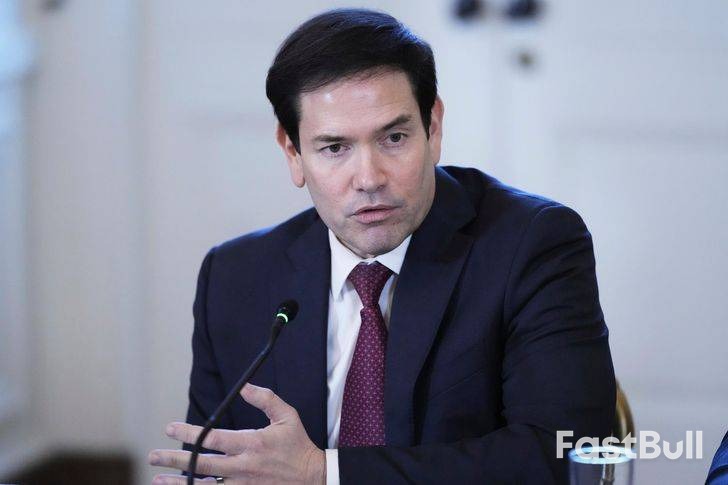
          Secretary of State Marco Rubio outlines aspects of a strategy centered on alliances and defense.

          The U.S. State Department has unveiled its strategic vision for 2026-2030, a comprehensive plan that pushes allies to increase defense spending while forging a "pro-American" economic bloc to counter global rivals.

          Released on Thursday, the "Agency Strategic Plan Fiscal Years 2026-2030" details a diplomatic roadmap focused on strengthening economic and military ties, particularly in the Indo-Pacific. The core principle is to build partnerships that directly benefit U.S. strength, rather than those that come at its expense.

          Bolstering Defense Ties with Allies

          A central pillar of the new strategy involves deepening military relationships. The State Department plans to actively encourage allies to increase their own defense budgets, invest more in deterrence measures, and grant the U.S. military greater access to their critical infrastructure and resources.

          In return, the United States will offer its partners increased access to its revitalized Defense Industrial Base. This push for allies to shoulder more of the security burden is designed to allow the U.S. to focus its resources on deterring its primary geopolitical rival, China.

          An Integrated Defense Industrial Base

          The plan emphasizes the importance of creating an integrated defense industry that includes reliable partners in both the Indo-Pacific and Europe. The document states that the U.S. will champion American defense companies and support industry-wide interoperability and collaboration.

          According to the plan, this integration is crucial for ensuring defense supply chain stability and maintaining U.S. military readiness for potential conflicts far from American shores. An integrated base would provide the U.S. and its allies with "strategic productive depth" in the event of a conflict.

          Forging a "Pro-American" Economic Bloc

          Alongside military objectives, the strategy outlines a renewed focus on commercial diplomacy. The State Department aims to prevent foreign powers from gaining global market dominance by leveraging commerce as a critical tool for forging alliances.

          The plan details a push to create a "strong economic bloc of pro-American countries." This will be achieved by mobilizing U.S. businesses to become the "preferred choice" for allies and partners through commercial deals pursued in all bilateral relationships. This bloc is intended to:

          • Leverage American businesses and exports.

          • Establish a new economic security consensus.

          • Unlock new industries through flagship infrastructure projects.

          • Finance U.S. reindustrialization.

          • Ensure American economic and technological leadership throughout the 21st century.

          An early example of this initiative is the "Pax Silica" coalition, a U.S.-led effort for supply chain cooperation on artificial intelligence and critical minerals. This growing coalition, which includes South Korea and Japan, is seen as a direct move to counter China's influence in vital technologies and resources.

          A Measured Approach to China

          While the strategy is clearly designed to strengthen the U.S. position relative to its rivals, it also addresses direct engagement with China. The State Department confirmed it will consistently seek open lines of communication with the Asian superpower to reduce misunderstandings and mitigate risks.

          The plan states that the United States has a strong interest in a peaceful and prosperous Indo-Pacific and desires neither war nor regime change, a message it intends to communicate clearly to allies, partners, and adversaries alike.

          To stay updated on all economic events of today, please check out our Economic calendar
          Risk Warnings and Disclaimers
          You understand and acknowledge that there is a high degree of risk involved in trading. Following any strategies or investment methods may lead to potential losses. The content on the site is provided by our contributors and analysts for information purposes only. You are solely responsible for determining whether any trading assets, securities, strategy, or any other product is suitable for investing based on your own investment objectives and financial situation.
          Add to Favorites
          Share

          French PM Unveils New Budget to Avert Government Collapse

          Isaac Bennett

          Bond

          Political

          Remarks of Officials

          Economic

          Central Bank

          French Prime Minister Sebastien Lecornu has proposed a sweeping overhaul of his budget plans in a high-stakes bid to secure a deal with opposition parties and prevent the collapse of his government.

          After halting a parliamentary debate on the 2026 finances that he admitted was heading for failure, Lecornu presented a revised strategy aimed at winning crucial support.

          "This budget will be different from the initial one—it's better, it can bring people together, and I believe it's responsible," he announced in a televised address on Friday.

          The government's survival hinges on its ability to navigate a fragmented National Assembly. While Lecornu can use constitutional powers to bypass a direct vote on the budget, he must offer concessions to dissuade opposition lawmakers from ousting him through a subsequent no-confidence motion.

          Courting the Socialists with Center-Left Policies

          Lecornu's new proposals are clearly designed to appeal to the Socialist Party, whose lawmakers represent a pivotal voting bloc. The prime minister is trying to secure their support, or at least their abstention, to survive any no-confidence challenges.

          The key features of the revised budget plan include:

          • Tax Protection: A pledge to shield households from tax increases.

          • Income Support: Measures to boost the incomes of those earning near the minimum wage.

          • Benefit Preservation: A commitment not to cut housing benefits.

          • Fairness and Investment: Guarantees that the wealthy will pay a fair share of tax, while funding for students and new jobs in education will be maintained.

          "The compromise budget we are proposing protects those who work and produce—this common-sense approach should get support," Lecornu stated.

          Navigating Constitutional Tools: Article 49.3 vs. Decrees

          To pass the budget without a parliamentary majority, Lecornu has two primary constitutional options, though he has not yet specified which he will choose.

          The first is Article 49.3, a tool that allows the government to pass legislation without a vote. However, deploying it immediately exposes the prime minister to no-confidence motions. If a motion succeeds, the budget is rejected, and the prime minister is forced to resign.

          The second option involves Article 47, which would allow the government to use untested decrees known as ordonnances. While this path would also likely trigger no-confidence votes, any measures implemented by decree would remain in effect even if the government falls, providing a degree of fiscal stability.

          Government spokeswoman Maud Bregeon confirmed that discussions with political groups would continue and that "nothing is excluded."

          Despite previously opposing the use of Article 49.3, the Socialists now see it as preferable to the use of decrees, which would grant parliament no say in the budget's content. Socialist lawmaker Philippe Brun described the use of decrees as a "kind of creeping coup d'etat" on France Info radio.

          Market Jitters and Deficit Pressures Mount

          The ongoing political standoff is testing investor confidence in France. The country has already experienced market selloffs since snap elections in 2024 resulted in a hung parliament.

          In October, the premium on France's 10-year bond yields over their safer German counterparts rose to more than 85 basis points as Lecornu struggled to form a government. That pressure eased toward the end of 2025 when the prime minister made concessions, but it is rising again. On Friday, the spread closed at 68 basis points, its highest level in over a week.

          Adding to the pressure, Bank of France Governor Francois Villeroy de Galhau has warned that the country would enter a "danger zone" with markets if it fails to cut its budget deficit to within 5% of economic output this year, down from an expected 5.4% in 2025.

          Lecornu insists his new budget will achieve this through "fair" savings. "This year we will be at 5% and if growth supports it—and political stability helps—it will probably be less," he said. "France keeps its commitments, it is governed and must remain credible."

          To stay updated on all economic events of today, please check out our Economic calendar
          Risk Warnings and Disclaimers
          You understand and acknowledge that there is a high degree of risk involved in trading. Following any strategies or investment methods may lead to potential losses. The content on the site is provided by our contributors and analysts for information purposes only. You are solely responsible for determining whether any trading assets, securities, strategy, or any other product is suitable for investing based on your own investment objectives and financial situation.
          Add to Favorites
          Share

          Trump Vows 10% Tariff if Supreme Court Rules Against Him

          Henry Thompson

          Remarks of Officials

          Economic

          Political

          President Donald Trump has announced a contingency plan to impose a 10% tariff on imported goods if the U.S. Supreme Court invalidates his administration's emergency economic measures. This move escalates a high-stakes conflict over trade policy, with significant financial and legal implications hinging on the court's final decision.

          The Legal Battle Over Emergency Tariffs

          The current trade dispute stems from a series of tariffs first implemented in April 2025 under the International Emergency Economic Powers Act. However, these measures have faced significant legal resistance.

          In 2025, major court rulings declared previous tariffs invalid, triggering a wave of ongoing legal challenges. These precedents have cast a shadow over the administration's trade policy, leading to the current showdown at the Supreme Court. The situation, which involves President Trump and the nation's highest court, has drawn commentary from figures like Kevin Hassett.

          A $135 Billion Refund Hangs in the Balance

          The financial stakes of the Supreme Court's ruling are enormous. Since the tariffs were initiated, they have generated $206 billion in revenue. However, if the courts ultimately side against the government, potential refunds to importers could reach a staggering $135 billion.

          This potential financial reversal has put markets on high alert. Analysts are closely monitoring the legal proceedings, aware that the judiciary's decision could trigger significant shifts in financial and regulatory landscapes. The proposed tariffs primarily target imported goods, though the cryptocurrency industry is not expected to be directly affected at this time.

          Market Impact and Historical Precedent

          The Supreme Court is expected to consider key legal precedents, including a tariff invalidation from May 2025 that led to revenue losses and litigation. The outcome of the current case is being watched closely, as experts from Kanalcoin note that these economic proceedings have the power to influence broader market trends.

          For analysts and investors, the key question is whether the court's final ruling will align with historical decisions. This will be the primary factor in assessing the long-term impact on economic stability.

          President Trump highlighted the gravity of the situation with a direct statement:

          "If the Supreme Court rules against the United States of America on this National Security bonanza, WE'RE SCREWED!" - President Donald Trump

          To stay updated on all economic events of today, please check out our Economic calendar
          Risk Warnings and Disclaimers
          You understand and acknowledge that there is a high degree of risk involved in trading. Following any strategies or investment methods may lead to potential losses. The content on the site is provided by our contributors and analysts for information purposes only. You are solely responsible for determining whether any trading assets, securities, strategy, or any other product is suitable for investing based on your own investment objectives and financial situation.
          Add to Favorites
          Share
          FastBull
          Copyright © 2026 FastBull Ltd

          728 RM B 7/F GEE LOK IND BLDG NO 34 HUNG TO RD KWUN TONG KLN HONG KONG

          TelegramInstagramTwitterfacebooklinkedin
          App Store Google Play Google Play
          Products
          Charts

          Chats

          Q&A with Experts
          Screeners
          Economic Calendar
          Data
          Tools
          Membership
          Features
          Function
          Markets
          Copy Trading
          Latest Signals
          Contests
          News
          Analysis
          24/7
          Columns
          Education
          Company
          Careers
          About Us
          Contact Us
          Advertising
          Help Center
          Feedback
          User Agreement
          Privacy Policy
          Personal Information Protection Statement
          Business

          White Label

          Data API

          Web Plug-ins

          Poster Maker

          Affiliate Program

          Risk Disclosure

          The risk of loss in trading financial instruments such as stocks, FX, commodities, futures, bonds, ETFs and crypto can be substantial. You may sustain a total loss of the funds that you deposit with your broker. Therefore, you should carefully consider whether such trading is suitable for you in light of your circumstances and financial resources.

          No decision to invest should be made without thoroughly conducting due diligence by yourself or consulting with your financial advisors. Our web content might not suit you since we don't know your financial conditions and investment needs. Our financial information might have latency or contain inaccuracy, so you should be fully responsible for any of your trading and investment decisions. The company will not be responsible for your capital loss.

          Without getting permission from the website, you are not allowed to copy the website's graphics, texts, or trademarks. Intellectual property rights in the content or data incorporated into this website belong to its providers and exchange merchants.

          Not Logged In

          Log in to access more features

          FastBull Membership

          Not yet

          Purchase

          Become a signal provider
          Help Center
          Customer Service
          Dark Mode
          Price Up/Down Colors

          Log In

          Sign Up

          Position
          Layout
          Fullscreen
          Default to Chart
          The chart page opens by default when you visit fastbull.com