Markets
News
Analysis
User
24/7
Economic Calendar
Education
Data
- Names
- Latest
- Prev



Signal Accounts for Members
All Signal Accounts
All Contests


U.S. NY Fed Manufacturing Prices Received Index (Jan)A:--
F: --
P: --
U.S. NY Fed Manufacturing New Orders Index (Jan)A:--
F: --
P: --
U.S. NY Fed Manufacturing Employment Index (Jan)A:--
F: --
P: --
U.S. Export Price Index YoY (Nov)A:--
F: --
P: --
U.S. NY Fed Manufacturing Index (Jan)A:--
F: --
U.S. Initial Jobless Claims 4-Week Avg. (SA)A:--
F: --
U.S. Export Price Index MoM (Nov)A:--
F: --
P: --
Canada Manufacturing Unfilled Orders MoM (Nov)A:--
F: --
P: --
Canada Manufacturing New Orders MoM (Nov)A:--
F: --
P: --
U.S. Philadelphia Fed Manufacturing Employment Index (Jan)A:--
F: --
P: --
Canada Wholesale Sales YoY (Nov)A:--
F: --
P: --
Canada Wholesale Inventory MoM (Nov)A:--
F: --
P: --
U.S. Philadelphia Fed Business Activity Index (SA) (Jan)A:--
F: --
P: --
U.S. EIA Weekly Natural Gas Stocks ChangeA:--
F: --
P: --
Richmond Federal Reserve President Barkin delivered a speech.
U.S. Weekly Treasuries Held by Foreign Central BanksA:--
F: --
P: --
Germany CPI Final MoM (Dec)A:--
F: --
P: --
Germany CPI Final YoY (Dec)A:--
F: --
P: --
Germany HICP Final MoM (Dec)A:--
F: --
P: --
Germany HICP Final YoY (Dec)A:--
F: --
P: --
Brazil PPI MoM (Nov)A:--
F: --
P: --
Canada New Housing Starts (Dec)A:--
F: --
U.S. Capacity Utilization MoM (SA) (Dec)A:--
F: --
U.S. Industrial Output YoY (Dec)A:--
F: --
P: --
U.S. Manufacturing Capacity Utilization (Dec)A:--
F: --
P: --
U.S. Manufacturing Output MoM (SA) (Dec)A:--
F: --
U.S. Industrial Output MoM (SA) (Dec)A:--
F: --
U.S. NAHB Housing Market Index (Jan)A:--
F: --
P: --
Russia CPI YoY (Dec)A:--
F: --
P: --
U.S. Weekly Total Rig CountA:--
F: --
P: --
U.S. Weekly Total Oil Rig CountA:--
F: --
P: --
Japan Core Machinery Orders YoY (Nov)--
F: --
P: --
Japan Core Machinery Orders MoM (Nov)--
F: --
P: --
U.K. Rightmove House Price Index YoY (Jan)--
F: --
P: --
China, Mainland GDP YoY (YTD) (Q4)--
F: --
P: --
China, Mainland Industrial Output YoY (YTD) (Dec)--
F: --
P: --
Japan Industrial Output Final MoM (Nov)--
F: --
P: --
Japan Industrial Output Final YoY (Nov)--
F: --
P: --
Euro Zone Core HICP Final MoM (Dec)--
F: --
P: --
Euro Zone HICP Final MoM (Dec)--
F: --
P: --
Euro Zone HICP Final YoY (Dec)--
F: --
P: --
Euro Zone HICP MoM (Excl. Food & Energy) (Dec)--
F: --
P: --
Euro Zone Core CPI Final YoY (Dec)--
F: --
P: --
Euro Zone Core HICP Final YoY (Dec)--
F: --
P: --
Euro Zone CPI YoY (Excl. Tobacco) (Dec)--
F: --
P: --
Euro Zone Core CPI Final MoM (Dec)--
F: --
P: --
Canada National Economic Confidence Index--
F: --
P: --
Canada CPI MoM (SA) (Dec)--
F: --
P: --
Canada Core CPI MoM (SA) (Dec)--
F: --
P: --
Canada CPI YoY (SA) (Dec)--
F: --
P: --
Canada Trimmed CPI YoY (SA) (Dec)--
F: --
P: --
Canada CPI YoY (Dec)--
F: --
P: --
Canada CPI MoM (Dec)--
F: --
P: --
Canada Core CPI YoY (Dec)--
F: --
P: --
Canada Core CPI MoM (Dec)--
F: --
P: --
South Korea PPI MoM (Dec)--
F: --
P: --
China, Mainland 1-Year Loan Prime Rate (LPR)--
F: --
P: --
China, Mainland 5-Year Loan Prime Rate--
F: --
P: --
Germany PPI YoY (Dec)--
F: --
P: --
Germany PPI MoM (Dec)--
F: --
P: --


Y5JWJ9NOZD
ID: 4382071


No matching data
Latest Views
Latest Views
Trending Topics
Top Columnists
Latest Update
White Label
Data API
Web Plug-ins
Affiliate Program
View All

No data
Trump's second year brings constrained policy and fiscal strain, with critical midterms defining the political risk landscape.
As Donald Trump’s second presidential term enters its second year, the policy landscape is shifting. While 2025 was marked by disruptive action, 2026 is shaping up to be a year of constrained policymaking, persistent political noise, and a growing tension between economic stimulus and risk, according to Wolfe Research strategist Tobin Marcus.
With major policies like tariffs, tax cuts, immigration enforcement, and a sweeping reconciliation bill already enacted, the administration faces new challenges. "Trump will face more limited horizons for new policymaking, and he'll need to sell his agenda to a midterm electorate that currently looks quite sour," Marcus explained in a recent report.
Here are the 10 key policy and political questions that will define the market environment in 2026.
1. How Potent is the 2026 Economic Stimulus?
Multiple sources of stimulus are set to impact the economy, primarily driven by the individual and corporate tax cuts passed in last year's reconciliation bill. However, Marcus notes that these effects, while meaningful, are temporary. They are unlikely to generate a sustained economic boom, particularly outside of investment related to artificial intelligence.
2. Will Trump's Trade Tariffs Continue to Dominate?
Tariffs are not expected to fade into the background. Trade policy will remain a central issue, fueled by a Supreme Court ruling on IEEPA tariffs, ongoing Section 232 investigations, and negotiations over the USMCA trade agreement. Even in the most dovish scenarios, Marcus anticipates only modest relief rather than a full reversal of existing tariffs.
3. Can the White House Tackle Affordability?
Affordability remains a significant political vulnerability for the administration. While officials have signaled their intent to act, they have few concrete tools at their disposal. Housing is seen as the only area where executive action could produce a tangible impact. Beyond that, Marcus believes there are no "silver bullets" without new legislation from Congress.
4. Is Another Major Spending Bill on the Horizon?
The prospect of another major reconciliation bill is highly unlikely. Although ideas for stimulus checks, increased defense funding, and healthcare reform are circulating, internal Republican divisions and growing concerns over the national deficit make another large-scale spending package a long shot.
5. Where Can Bipartisan Deals Actually Get Done?
A narrow set of bipartisan achievements is plausible in 2026. According to Marcus, the most likely areas for agreement include:
• Crypto Regulation: Legislation to create a market structure for digital assets has the clearest odds of passing.
• Government Funding: Congress must act to fund the government and address the looming ACA subsidy cliff.
• Housing: Broader housing legislation is possible but remains uncertain.
Meanwhile, more ambitious reforms for energy permitting and large-scale infrastructure are seen as difficult. There is a real risk that Congress will opt for temporary stopgap measures instead of comprehensive new packages.
6. What's Next for Strategic Government Investment?
Direct government investment in strategic sectors is expected to expand. Marcus identifies this "state capitalism" approach as politically and operationally attractive, especially when combined with pledges of foreign investment from allied nations.
7. Just How Dire Is the US Fiscal Outlook?
The nation's fiscal situation is set to deteriorate further. Deficits are expected to remain high, stuck at around 6% of GDP. With no credible path to reduction, Marcus warns that the risks are skewed toward even greater government borrowing needs in the future.
8. US-China Relations: A Fragile Truce?
An October truce between the U.S. and China is expected to provide roughly a year of relative stability. While the underlying structural tensions between the two powers remain unresolved, Marcus does not foresee an uncontrolled escalation of conflict in 2026.
9. Gauging the Risk of a Midterm "Blue Wave"
Historical trends for midterm elections favor the party out of power, in this case, the Democrats. However, current polling suggests only modest advantages for Democrats rather than the conditions for a massive "blue wave," Marcus notes. Special elections and voter turnout patterns will be critical signals to watch.
10. Why the 2026 Midterm Elections Are Critical
The stakes for the midterm elections go beyond simple control of Congress. The results will ultimately determine how much political capital and legislative freedom Trump has to advance his agenda in the second half of his term. The outcome will decide whether the current policy noise escalates once again into full-scale market disruption.
A major corruption scandal is prompting Ukrainian President Volodymyr Zelenskiy to engage with potential political rivals, signaling that preparations for a future election may be underway.
Recently, Zelenskiy has held a series of meetings with high-profile figures who could challenge him in a post-war vote. These discussions come at a sensitive time for the president, whose public image has been damaged by allegations of corruption within his government.
One notable meeting was with Valerii Zaluzhnyi, the former commander-in-chief of the armed forces and current ambassador to the UK. Zaluzhnyi is widely considered Zelenskiy's most significant political contender. The relationship between the two soured after Ukraine's 2023 counteroffensive failed, leading to Zaluzhnyi's dismissal in 2024.
Zelenskiy also confirmed meetings with other popular personalities, including former TV host Serhiy Prytula, whose charity supports the military, and nationalist activist Serhiy Sternenko.
Analysts see these meetings as a clear political strategy. Volodymyr Fesenko, head of the Penta Research Institute in Kyiv, stated, "There is no doubt that this is happening in the context of potential presidential elections."
According to Fesenko, Zelenskiy may be trying to achieve several objectives:
• Boost his own reputation by associating with other popular figures.
• Improve relationships with potential opposition leaders.
• Recruit these individuals as political allies to strengthen his own position.
This outreach coincides with discussions between Ukraine and the U.S. on a 20-point peace plan to be presented to Russian President Vladimir Putin. A key component of the plan is the requirement for Ukraine to hold presidential elections as soon as possible after a ceasefire is established—a condition also emphasized by U.S. President Donald Trump.
Currently, Ukrainian law prohibits elections under martial law. However, with the topic gaining prominence in peace talks, Zelenskiy has asked lawmakers to draft legislation that would permit a vote following a ceasefire.
Zelenskiy's political maneuvering comes as he faces the largest corruption scandal of his presidency. Late last year, anti-corruption investigators uncovered a scheme involving the misuse of funds intended for the defense of energy infrastructure.
The investigation implicated several members of the president's inner circle and resulted in the resignation of his influential top aide, Andriy Yermak. Following Yermak's departure, Zelenskiy appointed Kyrylo Budanov, the head of military intelligence and a popular wartime figure known for planning attacks inside Russia, as the new head of the presidential office.
Sources familiar with the situation suggest that Yermak's exit paved the way for the recent meetings. This allowed the president to communicate directly with various figures and gather information. One such meeting was with Oleksandr Kubrakov, a former deputy prime minister for infrastructure who was dismissed in 2024, reportedly after clashing with Yermak. More meetings are reportedly planned.
Prytula told Bloomberg News that his discussion with Zelenskiy did not cover politics, focusing instead on legal challenges faced by military volunteers.
Recent polling data provides a snapshot of the political landscape. A survey by the agency Socis at the end of last year showed that if an election were held soon:
• Valerii Zaluzhnyi would receive nearly 21% of the vote.
• Kyrylo Budanov would get less than 6%.
• Serhiy Prytula would secure about 1.5%.
The same poll indicated that Zelenskiy remains slightly ahead of Zaluzhnyi.
However, a separate survey in December by the Kyiv International Institute for Sociology found that the energy sector corruption scandal caused a 10-percentage-point drop in public trust in Zelenskiy.
The institute noted that trust in the president is "highly dynamic." Difficult situations on the battlefield and in diplomacy have previously caused Ukrainians to "rally around the flag," boosting his popularity.
While neither Zelenskiy nor Zaluzhnyi has officially announced a presidential bid, the president's recent actions suggest he is actively preparing for that possibility. "He's testing the waters and thinking about the future," Fesenko concluded.
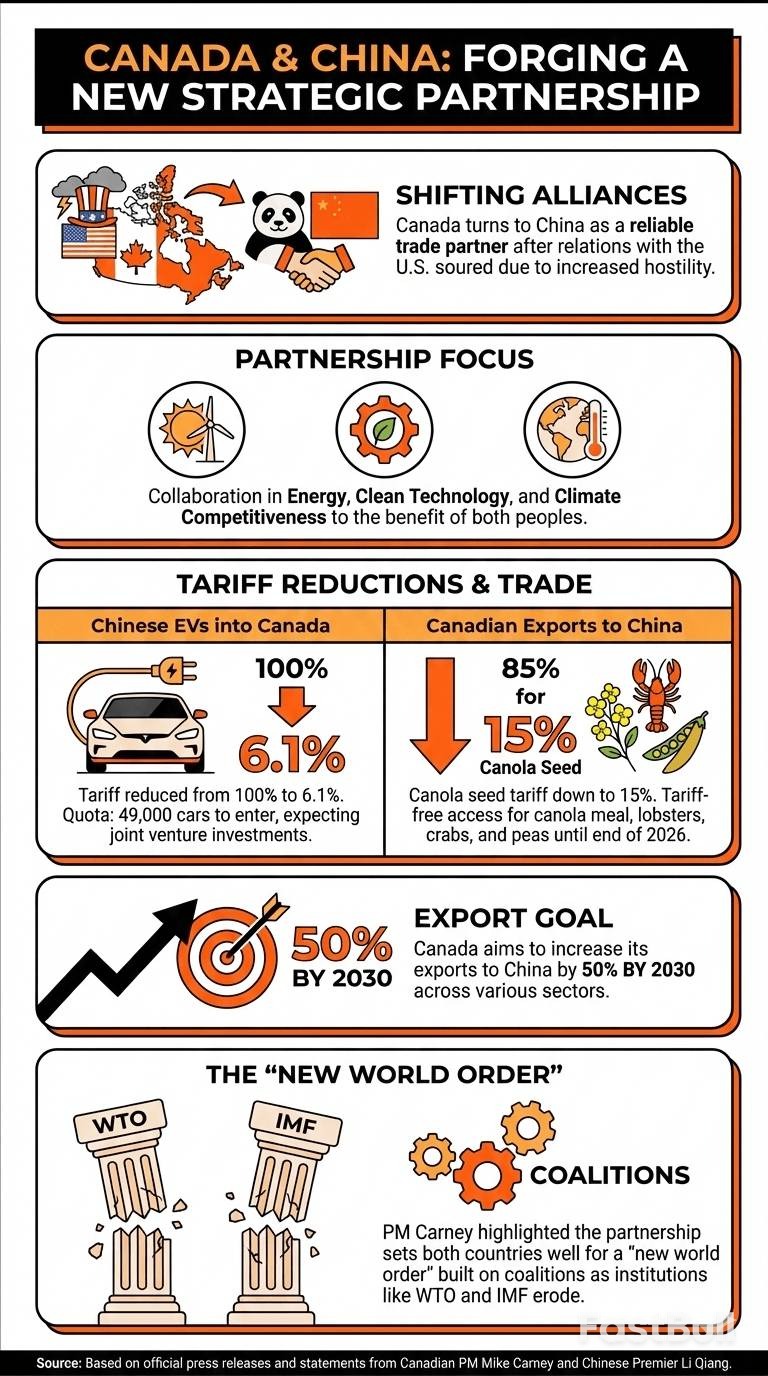
Canada is making a significant pivot in its foreign trade policy, building a new strategic partnership with China amid souring relations with its traditional ally, the United States. The move comes as the North American nation seeks more reliable trade partners in response to increased hostility and tariff threats from Washington.
During a four-day visit to China, Canadian Prime Minister Mike Carney announced the new alliance, stating it would be to "the benefit of both of our peoples." According to an official press release, the partnership will center on collaboration in energy, clean technology, and climate competitiveness.
The agreement includes substantial tariff adjustments designed to boost bilateral trade in key sectors. One of the most significant changes affects Chinese electric vehicles (EVs), which will now face a dramatically lower tariff of 6.1%, down from 100%. The Canadian government will permit up to 49,000 Chinese EVs to enter the country under this new rate.
In return, Canada secured major concessions for its agricultural exports:
• Canola Seed: Tariffs on Canadian canola seed entering China will be reduced from 85% to just 15%, opening a path for Canada to capture a share of the $4 billion market.
• Tariff-Free Goods: From March 1 until the end of 2026, Canadian canola meal, lobsters, crabs, and peas will be subject to zero tariffs.
Canada anticipates that these measures will encourage an influx of Chinese joint venture investments, leading to local production and job creation for Canadian workers.

The partnership is a cornerstone of Canada's strategy to diversify its export markets. The nation's goal is to increase its total exports to China by 50% by the year 2030. This growth is expected to come from expanded collaboration in clean energy, technology, agri-food, wood, and other key sectors.
The scope of the alliance extends beyond economics. Canada has also declared its support for multilateralism and pledged to deepen its collaboration with China on "improved global governance."
During a meeting with Chinese Premier Li Qiang, Prime Minister Carney highlighted the partnership's role in positioning both countries for what he termed the "new world order."
Carney later clarified that this concept refers to a future where global relationships are defined by new coalitions rather than by eroding legacy institutions like the World Trade Organization (WTO) and the International Monetary Fund (IMF).
"The expectation is that, rather than these being developed necessarily through the IMF, WTO, and other multilateral organizations, it is going to be coalitions that develop them, not for the world, but for subsectors of the world," Carney explained.
A potential leadership change at the Federal Reserve is taking shape, with former Fed Governor Kevin Warsh flagged as a likely candidate for the top job. U.S. Treasury Secretary Scott Bessent has indicated Warsh is a leading contender, with President Trump expected to announce a decision in January 2026.
The potential shift is driven by a clear agenda for a more pro-growth Federal Reserve. Scott Bessent has been a key figure in developing the shortlist for the next Fed Chair, advocating for a policy direction that mirrors the Alan Greenspan era of the 1990s.
Bessent has emphasized the central bank's role in fostering economic expansion, stating, "At a certain point, the Federal Reserve must also do its part to spur investment." This vision aims to create an environment conducive to greater fiscal activity.
While Kevin Warsh is a notable candidate, the selection process includes interviews with other contenders such as Kevin Hassett and Rick Rieder. Bessent has stressed the importance of integrity and a strict adherence to the Fed's dual mandate for any nominee. The final decision by President Trump is expected to signal a significant change in the course of U.S. monetary policy.
Markets are already reacting to the prospect of new leadership. U.S. Treasuries dropped following Bessent's remarks concerning current Fed Chair Jerome Powell, signaling that investors are bracing for potential shifts in economic strategy.
The financial implications of this pro-growth stance could be substantial, with a focus on prioritizing investment that may involve rate cuts starting in 2026. This comes as Powell's term faces scrutiny amid an ongoing Department of Justice investigation.
A potential chairmanship for Warsh is seen as ushering in a more flexible and open-minded policy framework, reminiscent of strategies employed during past technology booms. The administration's focus remains on ensuring transparency and addressing structural issues within the Federal Reserve to better align with its economic objectives.
The Trump administration has escalated its conflict with the Federal Reserve by opening a criminal investigation into Chairman Jerome Powell, a move that evokes the high-inflation 1970s when political pressure compromised central banks.
Economists are drawing stark comparisons. In 2019, Turkish President Recep Tayyip Erdoğan fired his central bank governor for refusing to cut interest rates. The economic fallout was severe, with the lira collapsing and inflation spiraling out of control. Even then, the governor was never accused of a crime.
In the United States, however, Fed Chair Jay Powell is now the subject of a federal investigation concerning a $2.5 billion renovation of the central bank's headquarters.
In a move that shattered decades of protocol, Powell responded directly to the pressure. He released a short video on the Fed's website, stating the investigation was a pretext engineered by the Trump administration to force deep cuts to interest rates.
Markets have so far remained steady, with stocks and bond yields showing little reaction. Investors appear to be betting that the Fed will successfully resist the political pressure. Still, economists view the situation as alarming. The White House and the Federal Reserve have historically served as pillars of global economic stability; now, they are in open conflict.
"It was leading by example," said Klaas Knot, former head of the Dutch central bank, reflecting on America's historical support for market-based institutions. "They have apparently chosen to set an entirely different example."
The timing of the escalation is critical. President Trump is promoting his economic agenda in Davos while the Supreme Court hears a case involving Lisa Cook, a Fed governor he attempted to fire over allegations of mortgage fraud, which she denies.
The clash between Trump and Powell has been building for years. After appointing Powell, the president quickly turned on him when the Fed began raising rates. The attacks have grown more intense during Trump's second term.
Trump has publicly called Powell a "stubborn mule" and a "numbskull," stating he would "love to fire" the chairman for not cutting interest rates to 1 percent. The White House has since zeroed in on the Fed's building project, which is reportedly $700 million over budget and is now the focus of the Department of Justice probe.
For months, Powell remained silent, even as the administration tried to remove Lisa Cook from the board. His decision to release a video statement marked a definitive shift in strategy.
The move triggered a reaction on Capitol Hill, with senators Thom Tillis, Lisa Murkowski, and John Kennedy all voicing support for Powell. On Wall Street, prominent figures like Jamie Dimon and Christine Lagarde reiterated the importance of central bank independence.
Glenn Hubbard, who chaired the Council of Economic Advisers under George W. Bush, commended Powell's handling of the situation. "He clarified what had happened," Hubbard said. "He didn't editorialize." Hubbard also joined every living former Fed chair in signing a letter that condemned the investigation.
Cracks have also appeared within the administration. Treasury Secretary Scott Bessent publicly supported a review of the Fed but was reported to have privately urged Trump to drop the investigation. Treasury officials later insisted there was "zero daylight" between Bessent's position and the president's. Hubbard described the episode as an "own goal of epic proportions."
The investigation has made it more difficult for Trump to reshape the Federal Reserve. Powell's term as chair is set to end in four months, but he is entitled to remain on the board until January 2028. Allies suggest that Powell is now reconsidering an early departure, a move that would have allowed Trump to appoint another ally to the board.
Gaining Senate approval for a new nominee presents another major hurdle. Senator Tillis has threatened to block any nomination until the probe is dropped. A prolonged delay could result in Powell remaining as chair.
The controversy has also damaged the standing of Kevin Hassett, a close Trump ally who initially supported the probe before backtracking, saying, "I expect that there's nothing to see here." While other potential candidates like Kevin Warsh, Chris Waller, and Rick Rieder have remained quiet, Stephen Miran was confirmed to the Fed board last year.
James Egelhof of BNP Paribas stated that the Fed is expected to adhere to its established policy framework. Nevertheless, some investment funds are hedging their bets. Pimco, a firm managing $2.2 trillion, is actively reducing its exposure to the U.S. dollar.
Experts warn of the long-term consequences. Paul Diggle noted the risk of "creeping politicisation," while Adam Posen observed that foreign governments are now developing strategies "not dependent on the US."
Even if the case against Powell fails, economists fear the damage to the institution may linger. Lael Brainard warned that the investigation could have a chilling effect, making officials hesitant to speak freely. "Everybody is nervous," she said, "that they too could be the subject of a criminal investigation."
President Donald Trump is exploring an executive action to cap credit card interest rates at 10%, a move being considered amid congressional gridlock. The proposal is a central piece of a broader affordability agenda aimed at addressing housing costs and consumer debt.
The administration’s plan also includes measures to block institutional investors from buying single-family homes and a proposal to allow savers to use 401(k) funds for home down payments. Trump has stated that further details on these initiatives will be revealed during his speech at the World Economic Forum in Davos next week.
Discussions are actively underway. National Economic Council Director Kevin Hassett confirmed on Fox Business that the White House is in talks with major banks, stating, "They think that the president's on to something."
The administration is moving quickly, with Trump calling for a one-year, 10% cap on credit card rates to be implemented by a January 20 deadline. His team has also been meeting with homebuilders to discuss housing affordability.
The pressure intensified after Press Secretary Karoline Leavitt framed the initiative as a "demand" from the president, saying companies are expected to lower rates by the deadline.
Alongside the credit card cap, officials are also reviewing a potential ban on stock buybacks by publicly traded homebuilders, an idea first floated by Bill Pulte, head of the Federal Housing Finance Agency. While discussions continue, White House officials have confirmed that no final decisions have been made.
The potential rate cap dominated earnings calls at major financial institutions this week, with executives from JPMorgan Chase, Citigroup, and Bank of America all raising concerns about the plan's feasibility and impact. A common theme was the lack of detail available to measure the potential effects on their businesses.
Key concerns from industry leaders include:
• Economic Slowdown: Citigroup Chief Financial Officer Mark Mason warned that a government-mandated cap could slow overall economic activity.
• Reduced Credit Access: Bank of America Chief Executive Officer Brian Moynihan suggested that if banks are forced to cap rates, they may pull back on lending, limiting access to credit for consumers.
Bank trade groups echoed these worries. Rob Nichols, head of the American Bankers Association, highlighted the fundamental risk of unsecured loans. "We're talking about unsecured lending," he said, "so it's not like an auto loan or a mortgage loan where there's something you can take back."
As financial firms planned their responses, lobbyists worked to understand how Trump could legally implement such an order. According to one lobbyist involved in the talks, using the interstate commerce clause to override state usury limits is one option being discussed.
Consumer advocates are divided on the proposal. Some have warned that a 10% cap might be too low, potentially causing banks to stop lending to lower-income borrowers altogether.
However, others support the idea of a reasonable limit. Adam Rust of the Consumer Federation of America pointed to federal credit unions, which already operate under rate caps. "It's about finding a reasonable rate that doesn't undermine the ability of consumers who are struggling to get by," he said.
As an alternative to a mandate, Kevin Hassett also floated the idea that banks could voluntarily launch new "Trump cards" with lower rates. Following this theme, the company Bilt rolled out three new credit cards this week with rates capped at 10%, though the limit only applies to new purchases and lasts for one year.
The United States has imposed a 25% tariff on certain advanced computing chips, a move that South Korea's trade minister said will have a limited initial impact on the country's semiconductor companies.
The new measures, announced by President Donald Trump, follow a nine-month national security investigation under the Trade Expansion Act of 1962.
According to Trade Minister Yeo Han-koo, the first phase of the tariffs specifically targets high-end artificial intelligence chips from companies like Nvidia and AMD.
"Since the memory chips that South Korean companies mainly export are currently excluded, the immediate impact is expected to be limited," Yeo stated.
However, he cautioned that it was "not yet time to be reassured," highlighting uncertainty over how a potential second phase of tariffs could expand. Yeo confirmed the government will continue to work with the industry to protect the interests of South Korean firms.
The 25% tariff applies to a narrow range of high-performance semiconductors and devices containing them. Among the products explicitly named are Nvidia's H200 AI processor and AMD's MI325X chip.
The White House specified that the tariffs would not apply to chips and related devices imported for:
• U.S. data centers
• Startups
• Non-data center consumer applications
• Non-data center civil industrial applications
• U.S. public sector applications
The action is part of a wider U.S. strategy to incentivize domestic semiconductor manufacturing and reduce reliance on chip producers in regions like Taiwan. According to a White House fact sheet, the United States may impose broader tariffs on semiconductors in the future to further this goal.
The potential for escalating measures was underscored by U.S. Commerce Secretary Howard Lutnick. Speaking at a groundbreaking ceremony for Micron's new plant in New York, Lutnick warned that South Korean and Taiwanese chipmakers not investing in the U.S. could face tariffs as high as 100% unless they commit to increasing production on American soil.
White Label
Data API
Web Plug-ins
Poster Maker
Affiliate Program
The risk of loss in trading financial instruments such as stocks, FX, commodities, futures, bonds, ETFs and crypto can be substantial. You may sustain a total loss of the funds that you deposit with your broker. Therefore, you should carefully consider whether such trading is suitable for you in light of your circumstances and financial resources.
No decision to invest should be made without thoroughly conducting due diligence by yourself or consulting with your financial advisors. Our web content might not suit you since we don't know your financial conditions and investment needs. Our financial information might have latency or contain inaccuracy, so you should be fully responsible for any of your trading and investment decisions. The company will not be responsible for your capital loss.
Without getting permission from the website, you are not allowed to copy the website's graphics, texts, or trademarks. Intellectual property rights in the content or data incorporated into this website belong to its providers and exchange merchants.
Not Logged In
Log in to access more features

FastBull Membership
Not yet
Purchase
Log In
Sign Up