Markets
News
Analysis
User
24/7
Economic Calendar
Education
Data
- Names
- Latest
- Prev


Signal Accounts for Members
All Signal Accounts
All Contests


U.S. Average Hourly Wage MoM (SA) (Dec)--
F: --
P: --
U.S. Average Weekly Working Hours (SA) (Dec)--
F: --
P: --
U.S. New Housing Starts Annualized MoM (SA) (Oct)--
F: --
P: --
U.S. Total Building Permits (SA) (Oct)--
F: --
P: --
U.S. Building Permits MoM (SA) (Oct)--
F: --
P: --
U.S. Annual New Housing Starts (SA) (Oct)--
F: --
P: --
U.S. Government Employment (Dec)--
F: --
P: --
U.S. UMich 5-Year-Ahead Inflation Expectations Prelim YoY (Jan)--
F: --
P: --
U.S. UMich Consumer Sentiment Index Prelim (Jan)--
F: --
P: --
U.S. UMich Current Economic Conditions Index Prelim (Jan)--
F: --
P: --
U.S. UMich Consumer Expectations Index Prelim (Jan)--
F: --
P: --
U.S. UMich 1-Year-Ahead Inflation Expectations Prelim (Jan)--
F: --
P: --
U.S. 5-10 Year-Ahead Inflation Expectations (Jan)--
F: --
P: --
U.S. Weekly Total Oil Rig Count--
F: --
P: --
U.S. Weekly Total Rig Count--
F: --
P: --
Indonesia Retail Sales YoY (Nov)A:--
F: --
P: --
Euro Zone Sentix Investor Confidence Index (Jan)A:--
F: --
P: --
India CPI YoY (Dec)A:--
F: --
P: --
Canada National Economic Confidence IndexA:--
F: --
P: --
Germany Current Account (Not SA) (Nov)A:--
F: --
P: --
U.S. Conference Board Employment Trends Index (SA) (Dec)A:--
F: --
China, Mainland M0 Money Supply YoY (Dec)--
F: --
P: --
China, Mainland M2 Money Supply YoY (Dec)--
F: --
P: --
China, Mainland M1 Money Supply YoY (Dec)--
F: --
P: --
U.S. 3-Year Note Auction YieldA:--
F: --
P: --
Richmond Federal Reserve President Barkin delivered a speech.
U.S. 10-Year Note Auction Avg. YieldA:--
F: --
P: --
New York Federal Reserve President Williams delivered a speech.
Japan Trade Balance (Customs Data) (SA) (Nov)A:--
F: --
P: --
Japan Trade Balance (Nov)A:--
F: --
P: --
U.K. BRC Overall Retail Sales YoY (Dec)A:--
F: --
P: --
U.K. BRC Like-For-Like Retail Sales YoY (Dec)A:--
F: --
P: --
Turkey Retail Sales YoY (Nov)--
F: --
P: --
U.S. NFIB Small Business Optimism Index (SA) (Dec)--
F: --
P: --
Brazil Services Growth YoY (Nov)--
F: --
P: --
Canada Building Permits MoM (SA) (Nov)--
F: --
P: --
U.S. CPI MoM (SA) (Dec)--
F: --
P: --
U.S. CPI YoY (Not SA) (Dec)--
F: --
P: --
U.S. Real Income MoM (SA) (Dec)--
F: --
P: --
U.S. CPI MoM (Not SA) (Dec)--
F: --
P: --
U.S. Core CPI (SA) (Dec)--
F: --
P: --
U.S. Core CPI YoY (Not SA) (Dec)--
F: --
P: --
U.S. Core CPI MoM (SA) (Dec)--
F: --
P: --
U.S. Weekly Redbook Index YoY--
F: --
P: --
U.S. New Home Sales Annualized MoM (Oct)--
F: --
P: --
U.S. Annual Total New Home Sales (Oct)--
F: --
P: --
U.S. Cleveland Fed CPI MoM (SA) (Dec)--
F: --
P: --
U.S. Cleveland Fed CPI MoM (Dec)--
F: --
P: --
China, Mainland Exports (Dec)--
F: --
P: --
China, Mainland Imports YoY (CNH) (Dec)--
F: --
P: --
China, Mainland Imports (CNH) (Dec)--
F: --
P: --
China, Mainland Trade Balance (CNH) (Dec)--
F: --
P: --
China, Mainland Imports YoY (USD) (Dec)--
F: --
P: --
China, Mainland Exports YoY (USD) (Dec)--
F: --
P: --
U.S. EIA Natural Gas Production Forecast For The Next Year (Jan)--
F: --
P: --
U.S. EIA Short-Term Crude Production Forecast For The Next Year (Jan)--
F: --
P: --
U.S. EIA Short-Term Crude Production Forecast For The Year (Jan)--
F: --
P: --
EIA Monthly Short-Term Energy Outlook
U.S. 30-Year Bond Auction Avg. Yield--
F: --
P: --
U.S. Budget Balance (Dec)--
F: --
P: --
Argentina 12-Month CPI (Dec)--
F: --
P: --


No matching data
Latest Views
Latest Views
Trending Topics
Top Columnists
Latest Update
White Label
Data API
Web Plug-ins
Affiliate Program
View All

No data
Iran's leaders, their regional clout much reduced, are facing fierce demonstrations that evolved from complaints about dire economic hardships to defiant calls for the fall of the deeply entrenched clerical establishment.
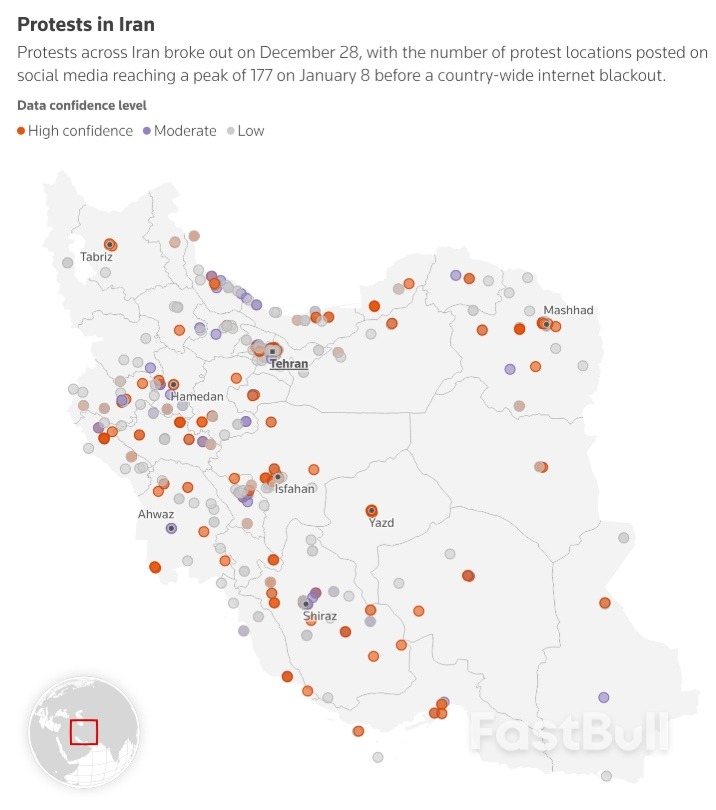
Iran's Islamic Republic is facing a historic internal crisis. After a year of major setbacks to its regional power, the regime is now battling a wave of anti-government demonstrations that have swept the country since late December 2025. Sparked by a catastrophic currency collapse, the protests have morphed into a revolutionary movement.
Across Iran, thousands have taken to the streets, defying a brutal state crackdown to denounce the country's leadership, destroy symbols of the regime, and attack its infrastructure. A battle for Iran's future is underway, and while the odds are steep for the protesters, the government's grip on power appears more fragile than ever.
Tehran's response to the uprising has been severe. The government has imposed an internet blackout, issued defiant rhetoric, and unleashed a bloody assault on demonstrators. Yet, the protests continue.
The regime holds a significant advantage with its vast surveillance and security apparatus, driven by an existential will to survive. Credible reports indicate that while the country was cut off from the world, more than 10,000 people were detained and 6,000 were killed, with the true figures likely much higher.
As the crisis intensified, U.S. President Donald Trump pledged on social media to intervene on behalf of the Iranian people, stating that Washington was "locked and loaded" to "rescue" them. While the administration is weighing its options, direct military action carries substantial risks with little guarantee of providing immediate relief to Iran's population.
However, inaction is not the only alternative. A more effective strategy would involve a global effort to isolate the Islamic Republic and provide meaningful support to the revolution. Key actions should include:
• Efforts to restore internet access for the Iranian people.
• Tighter sanctions to pressure the regime.
• The closure of Iranian embassies and expulsion of its officials.
• Building capacity for human rights documentation and opposition training.
Even if the regime temporarily quells the protests through mass violence, its long-term stability is in serious doubt. Iran's leadership has no viable solution for the economic hardships that have repeatedly fueled unrest, nor can it reclaim its once-dominant position in the region.
Internally, the regime is already on the verge of a precarious leadership transition. Supreme Leader Ayatollah Ali Khamenei is 86 years old and receding from public life. A clear successor is absent, a problem compounded by the unexpected death of President Ebrahim Raisi in a May 2024 helicopter crash and the aging of the original revolutionary generation.
After four decades of building an expansive network across the Middle East, Tehran has recently suffered immense setbacks. Its proxy militias are a shadow of their former strength, and its transnational reach was severely disrupted by the fall of Bashar al-Assad's regime in Syria. Furthermore, repeated Israeli and American attacks have decimated Iran's nuclear program and air defenses.
At home, years of unrest have steadily eroded the regime's authority. Each protest movement has deepened popular resistance, making it harder for the government to impose its will. The most visible sign of this is the widespread public defiance of compulsory hijab laws, a direct legacy of the 2022-2023 "Women, Life, Freedom" movement that followed the death of Mahsa Amini.
The current crisis is the culmination of years of systemic decay. For a long time, the regime's playbook for survival seemed effective, but its inability to reform has made a fundamental transformation necessary. The trajectory has pointed not toward a sudden collapse but toward a slow, steady deterioration of the state's control over its economy, politics, and society.
This long-brewing instability has shifted the political imagination of the Iranian people. They are no longer just asking who will be the next leader within the existing system; they are beginning to question what will replace the system itself.
The prospect of meaningful change in Iran has often swung between the unthinkable and the inevitable. Today, the pendulum is swinging decisively toward change. The Iranian people have launched their revolution. With a concerted, American-led effort to apply unprecedented pressure on the regime while supporting the opposition, they can succeed.
A proposal from Donald Trump to cap credit card interest rates has triggered a swift and forceful counter-offensive from the U.S. financial industry. Banks and lending institutions argue the move, intended to address the rising cost of living, would backfire by cutting off millions of American households and small businesses from essential credit.

The proposal calls for a one-year cap on credit card interest rates at 10%, set to begin on January 20. However, the plan lacks specifics on implementation, and industry experts suggest it would likely require action from Congress to become law.
Financial groups, caught off guard by the announcement, quickly mobilized to outline the potential damage. The Electronic Payments Coalition (EPC), which represents major financial institutions and payment networks, issued a stark warning.
According to the EPC, a 10% interest rate cap would force lenders to close or severely restrict nearly every credit card account held by someone with a credit score below 740. This would impact an estimated 82% to 88% of all open credit card accounts in the country.
"A one-size-fits-all government price cap may sound appealing, but it wouldn't help Americans – it would do the exact opposite, harming families, limiting opportunity, and weakening our economy," stated EPC Executive Chairman Richard Hunt.
Lenders argue that while borrowers with subprime credit would be the most affected, the consequences would be felt across the board.
The industry warns that a rate cap would fundamentally alter the credit card business model, leading to several negative outcomes for consumers:
• Higher Annual Fees: To compensate for lost interest revenue, banks would likely increase annual fees for most cardholders.
• Reduced Rewards: Popular rewards programs offering points and cashback would be scaled back or eliminated.
• More Account Charges: Consumers could face a rise in various monthly account maintenance fees.
Beyond direct costs to consumers, some financial groups warned that restricting credit access would slow consumer spending, a primary driver of the U.S. economy. Credit cards are a central pillar of American consumer finance, providing flexible credit that supports daily transactions and larger purchases. For banks, the high interest rates and fees associated with these products are a major source of profit.
The call for a rate cap comes as consumers face historically high borrowing costs. Data from the Consumer Financial Protection Bureau shows that in 2024, average Annual Percentage Rates (APRs) reached their highest levels since 2015.
The average APR for general-purpose credit cards hit 25.2%, while private-label store cards climbed to 31.3%. The CFPB noted that while rising prime rates were a factor, they did not account for the entire increase. Furthermore, the percentage of cardholders making only the minimum monthly payment also rose to its highest point since 2015, signaling growing financial strain on households.
Industry sources maintain that a 10% cap would render most credit card lending unprofitable, forcing a severe pullback.
Morningstar analyst Michael Miller described the proposal as more of a "call to action" than a concrete policy announcement. "We think a cap is unlikely to be implemented, but if enacted it would have dire consequences for credit card profitability," he wrote. "Many credit card portfolios carry credit costs that are too high to be supported under a 10% limit."
While the banking industry forecasts doom, other research suggests a rate cap could deliver significant financial relief to consumers.
A September study from the Vanderbilt Policy Accelerator, a research center at Vanderbilt University, found that a 10% cap would save Americans an estimated $100 billion annually. The study did acknowledge that such a cap would likely lead to a reduction in credit card rewards for borrowers with credit scores of 760 or lower.
Brian Shearer, director of competition and regulatory policy at the Vanderbilt Policy Accelerator, pushed back against the industry's claims. "We often hear these complaints that this would cause banks to close people's credit card accounts. What we found is that the profit margins are absolutely massive," he said. "There really is some fat to cut."
JPMorgan is challenging market expectations for interest rate relief, forecasting that the U.S. Federal Reserve will hold rates steady throughout 2026. The bank’s analysis suggests the Fed's next move could be a rate hike in 2027, a stark contrast to investor bets on multiple cuts.
In a client note from January 9, JPMorgan outlined a macroeconomic environment that it believes will prevent the Fed from easing its policy.
JPMorgan projects that the U.S. economy is set for accelerated employment and growth in 2026. At the same time, the bank expects core inflation to remain stubbornly above 3 percent. This combination, according to the note, removes the justification for the central bank to lower borrowing costs.
"Given this macroeconomic background, we don't think even a new and relatively dovish Fed chairman could convince the FOMC to cut interest rates," stated JPMorgan Chief Economist Michael Feroli.
Feroli’s forecast indicates stable rates for all of 2026, with the first potential rate hike of 25 basis points arriving in the third quarter of 2027.
Investors are positioned for a much more dovish outcome than JPMorgan anticipates. Data from the CME FedWatch Tool reveals that markets see a high probability of rate reductions in 2026:
• Two Rate Cuts: 32% probability
• One Rate Cut: 25% probability
• Three Rate Cuts: 22% probability
In sharp contrast, the market is pricing in only an 8% chance that the Fed will keep interest rates unchanged through the end of the year, which is JPMorgan's base case.
The economic debate is unfolding against a tense political backdrop. President Donald Trump is expected to appoint a new Federal Reserve Chairman in the coming months, with the new four-year term starting in May.
Trump has a history of pressuring the central bank to lower interest rates more aggressively, having previously argued that the policy rate should be around 1 percent. Currently, the Fed's benchmark interest rate sits in the 3.5–3.75 percent range.
Tensions between the White House and the Fed escalated over the weekend. In a video, Fed Chairman Jerome Powell announced he had been summoned by the U.S. Department of Justice to testify before Congress. The testimony concerns statements he made last year about the renovation costs of the Fed building. It is known that President Trump has previously explored using these same renovation costs as a reason to remove Powell from his position.

Remarks of Officials

Middle East Situation

Political

Central Bank

Russia-Ukraine Conflict

Traders' Opinions

Energy

Commodity

Economic
Oil prices climbed to a seven-week high on Monday, driven by growing concerns that political turmoil in Iran could disrupt the country's crude exports. However, expectations of new supply from Venezuela kept the rally in check, creating a tense balance in global energy markets.
Brent futures rose by 53 cents, or 0.8%, to settle at $63.87 a barrel, its highest closing price since November 18. U.S. West Texas Intermediate (WTI) crude increased by 38 cents, or 0.6%, settling at $59.50, a peak not seen since December 5.

The primary driver for the price increase is the uncertain situation in Iran. The OPEC member is cracking down on widespread anti-government protests, which represent one of the most significant challenges to its leadership since the 1979 Islamic Revolution.
The U.S. is closely monitoring the events. President Donald Trump has weighed potential responses to the lethal violence against demonstrators and threatened possible military action. While Iran stated it is keeping communication channels with Washington open, the market remains on edge.
Data from Kpler and Vortexa reveals that Iran currently has a record volume of oil stored on tankers at sea, equivalent to about 50 days of its output. This strategy is partly due to reduced purchases from China amid sanctions and an effort by Tehran to safeguard its supply from potential U.S. military strikes.
Counterbalancing the fears over Iranian supply is the prospect of Venezuela resuming oil exports following the ouster of President Nicolas Maduro. President Trump announced last week that the new government in Caracas is preparing to hand over as much as 50 million barrels of sanctioned oil to the United States.
According to four sources familiar with the logistics, oil companies are actively seeking tankers and preparing for operations to ship the crude safely. At a White House meeting on Friday, multinational commodities firm Trafigura stated its first vessel is expected to begin loading within the next week.
In a related development, LSEG shipping data on Monday showed that two China-flagged supertankers, originally sailing to Venezuela to collect crude for debt repayment, have reversed course and are now heading back to Asia.
Investors are also monitoring other global hotspots for potential supply disruptions.
Russia-Ukraine Conflict
Ukraine's ongoing attacks targeting Russian energy infrastructure continue to pose a risk to supply. The possibility of tougher U.S. sanctions on Moscow's energy sector adds another layer of uncertainty for the market.
OPEC+ Production Landscape
Elsewhere in the OPEC+ alliance, which includes OPEC and its allies, production figures are mixed.
• Azerbaijan: The country's energy ministry reported on Monday that oil exports fell to 23.1 million tonnes in 2025, down from 24.4 million tonnes in 2024.
• Norway: The Norwegian government plans to present a policy document on the future of its oil and gas industry next year. However, Prime Minister Jonas Gahr Stoere affirmed the sector's importance, stating it "should be developed, not phased out."
Looking ahead, U.S. bank Goldman Sachs noted that it expects oil prices to likely drift lower this year. The bank anticipates that new supply will create a market surplus, although it acknowledged that geopolitical risks tied to Russia, Venezuela, and Iran will continue to drive volatility.
Meanwhile, in the United States, the Trump administration's decision to open a criminal investigation into Federal Reserve Chair Jerome Powell has intensified pressure on the central bank. Powell described the move as a "pretext" to influence interest rate decisions. The investigation has drawn criticism from former Fed chiefs and senior Republicans.
Any move toward lower interest rates could potentially stimulate economic growth and boost oil demand by reducing borrowing costs. However, such a policy could also complicate the Federal Reserve's efforts to manage inflation.
Economists forecast that U.S. consumer prices likely rose 2.7% year-over-year in December, matching the annual inflation rate seen in November. Core inflation, which excludes food and energy, is expected to have climbed to a 2.7% annual rate, up from 2.6% the previous month.
This expected uptick follows an unusual slowdown in November, which some analysts believe was skewed by data collection issues. Looking ahead, most forecasts suggest inflation will moderate over the year as slowing rent growth begins to offset price pressures from tariffs.

The upcoming Consumer Price Index (CPI) report from the Bureau of Labor Statistics is projected to show inflation holding firm. According to a survey of economists by Dow Jones Newswires and The Wall Street Journal, the headline CPI is expected to register a 2.7% annual increase for December.
Meanwhile, core prices, which provide a clearer view of underlying inflation trends by stripping out volatile food and energy costs, are anticipated to have risen 2.7% over the last 12 months. This marks an acceleration from the 2.6% pace recorded in November.
If these forecasts prove accurate, it would signal that inflationary pressures are edging higher again. Inflation has consistently run above the Federal Reserve's 2% target since 2021, driven in part by tariffs implemented by the Trump administration.
Some economists suggest that November's surprisingly soft CPI report may have understated the true level of inflation. Data collection was delayed by a government shutdown that ended on November 13, pushing the bureau's price surveys much later into the month than usual and coinciding with Black Friday sales.
Analysts believe December's report will reflect a reversal of these potential distortions.
"Data collection issues stemming from the longest-ever government shutdown led to a surprisingly soft November CPI report," wrote economists at Wells Fargo Securities, led by Sarah House. "Most, although not all, of these distortions should be unwound in the December report."
Federal Reserve officials will be scrutinizing the report for any signs that tariffs are fueling inflation more than anticipated. While the Fed has cut its benchmark interest rate three times in recent months amid a weakening labor market, persistent inflation could prevent further cuts in the near term.
The central bank's decisions hinge on balancing efforts to support the economy without letting inflation accelerate unchecked.
Despite the current pressures, many forecasters expect inflation to cool over the course of the year. Two key factors are driving this outlook:
• Slowing Housing Costs: Rent increases have moderated after spiking during the pandemic era.
• Weaker Labor Market: A faltering job market means that rising wages are not a significant source of inflation.
These dynamics are widely expected to outweigh the ongoing price pressures from tariffs.
"The two most valuable indicators for forecasting inflation further ahead—the state of the labor market and leading indicators of rent inflation—now point to lower inflation than they did late last cycle," noted researchers at Goldman Sachs, led by chief U.S. economist David Mericle.
Senator Elizabeth Warren is directly challenging the Securities and Exchange Commission over a plan to introduce cryptocurrency into American retirement accounts. In a letter to SEC Chair Paul Atkins, Warren questioned how the agency will protect investors following President Trump's executive order greenlighting crypto for 401(k) plans.
The executive order, signed in August, opened the door for alternative assets like bitcoin and private equity funds to be included in traditional retirement plans. Warren argues this move introduces unacceptable risks to the financial security of millions.
In her letter, the Massachusetts Democrat framed 401(k) plans as a "lifeline to retirement security rather than a playground for financial risk." She expressed deep concern that the Trump administration's decision could lead to significant losses for workers and families.
Warren detailed several core threats posed by crypto assets:
• High Volatility: She cited a 2024 Government Accountability Office study that found crypto assets have "uniquely high volatility" and no standard method for projecting future returns.
• Lack of Transparency: The market's opacity makes it difficult for average investors to assess true value and risk.
• Conflicts of Interest: Warren pointed to President Trump's own history, noting he once called bitcoin a "scam" in 2021. Yet, a report from the Center for American Progress estimated that Trump and his family gained over $1.2 billion from crypto in the year after his 2024 reelection.
"There is no reason to expect that inviting plans to offer these alternative investments will lead to better outcomes overall for participants," Warren wrote, adding that the higher fees common with such assets could make things worse.
Warren's letter arrives as two Senate committees are set to hold hearings on a major crypto market structure bill. She warned that this legislation could create a "tokenization loophole," allowing financial products on the blockchain to sidestep the SEC's regulatory authority. This, she argued, would further endanger Americans' retirement savings.
This sentiment is shared by major labor organizations. The American Federation of Teachers and the AFL-CIO have also voiced public concern over the Trump administration's approach. The unions worry that allowing widespread tokenization could weaken the SEC's ability to regulate securities, creating new systemic risks.
Warren's Key Questions for the SEC
To understand the SEC's strategy for mitigating these risks, Warren demanded answers to several key questions:
1. Fair Value Disclosures: Has the SEC ensured that public companies holding crypto assets are providing disclosures that reflect fair market value, given the extreme price volatility?
2. Market Manipulation: Has the SEC's Division of Risk and Analysis assessed the use of deceptive or manipulative practices in crypto markets? If not, does it plan to publish research to educate retail investors?
3. Investor Education: What specific guidance is the SEC's Office of Investor Education and Assistance providing to retail investors who may soon be able to purchase crypto assets through their retirement plans?
The SEC declined to comment on the letter.
Despite Warren's pressure, the SEC under Chair Paul Atkins appears poised to continue the administration's pro-crypto policy. Atkins has publicly stated that the goal is to make "America the crypto capital of the world" by creating "good rules fit for the purposes of the crypto industry."
He has emphasized that his approach will differ significantly from that of his predecessor, Gary Gensler, who pursued aggressive regulation. Atkins has said the SEC will "forge forward" and "embrace this new area of innovation."
However, Atkins has also stressed that innovation must be balanced with investor protection. In a November speech, he outlined his vision for regulation while making it clear that his agency will not tolerate misconduct.
"Fraud is fraud," Atkins stated. "If you raise money by promising to build a network, and then take the proceeds and disappear, you will be hearing from us, and we will pursue you to the full extent of the law."
White Label
Data API
Web Plug-ins
Poster Maker
Affiliate Program
The risk of loss in trading financial instruments such as stocks, FX, commodities, futures, bonds, ETFs and crypto can be substantial. You may sustain a total loss of the funds that you deposit with your broker. Therefore, you should carefully consider whether such trading is suitable for you in light of your circumstances and financial resources.
No decision to invest should be made without thoroughly conducting due diligence by yourself or consulting with your financial advisors. Our web content might not suit you since we don't know your financial conditions and investment needs. Our financial information might have latency or contain inaccuracy, so you should be fully responsible for any of your trading and investment decisions. The company will not be responsible for your capital loss.
Without getting permission from the website, you are not allowed to copy the website's graphics, texts, or trademarks. Intellectual property rights in the content or data incorporated into this website belong to its providers and exchange merchants.
Not Logged In
Log in to access more features

FastBull Membership
Not yet
Purchase
Log In
Sign Up