• Trade
  • Markets
  • Copy
  • Contests
  • News
  • 24/7
  • Calendar
  • Q&A
  • Chats
Trending
Screeners
SYMBOL
LAST
BID
ASK
HIGH
LOW
NET CHG.
%CHG.
SPREAD
SPX
S&P 500 Index
6827.42
6827.42
6827.42
6899.86
6801.80
-73.58
-1.07%
--
DJI
Dow Jones Industrial Average
48458.04
48458.04
48458.04
48886.86
48334.10
-245.98
-0.51%
--
IXIC
NASDAQ Composite Index
23195.16
23195.16
23195.16
23554.89
23094.51
-398.69
-1.69%
--
USDX
US Dollar Index
97.950
98.030
97.950
98.500
97.950
-0.370
-0.38%
--
EURUSD
Euro / US Dollar
1.17394
1.17409
1.17394
1.17496
1.17192
+0.00011
+ 0.01%
--
GBPUSD
Pound Sterling / US Dollar
1.33707
1.33732
1.33707
1.33997
1.33419
-0.00148
-0.11%
--
XAUUSD
Gold / US Dollar
4299.39
4299.39
4299.39
4353.41
4257.10
+20.10
+ 0.47%
--
WTI
Light Sweet Crude Oil
57.233
57.485
57.233
58.011
56.969
-0.408
-0.71%
--

Community Accounts

Signal Accounts
--
Profit Accounts
--
Loss Accounts
--
View More

Become a signal provider

Sell trading signals to earn additional income

View More

Guide to Copy Trading

Get started with ease and confidence

View More

Signal Accounts for Members

All Signal Accounts

Best Return
  • Best Return
  • Best P/L
  • Best MDD
Past 1W
  • Past 1W
  • Past 1M
  • Past 1Y

All Contests

  • All
  • Trump Updates
  • Recommend
  • Stocks
  • Cryptocurrencies
  • Central Banks
  • Featured News
Top News Only
Share

Ukraine's Navy Says Russian Drone Attack Hit Civilian Turkish Vessel Carrying Sunflower Oil To Egypt On Saturday

Share

Israeli Military Says It Put Planned Strike On South Lebanon Site On Hold After Lebanese Army Requested Access

Share

Norwegian Nobel Committee: Calls On The Belarusian Authorities To Release All Political Prisoners

Share

Norwegian Nobel Committee: His Freedom Is A Deeply Welcome And Long-Awaited Moment

Share

Ukraine Says It Received 114 Prisoners From Belarus

Share

USA Embassy In Lithuania: Maria Kalesnikava Is Not Going To Vilnius

Share

USA Embassy In Lithuania: Other Prisoners Are Being Sent From Belarus To Ukraine

Share

Ukraine President Zelenskiy: Five Ukrainians Released By Belarus In US-Brokered Deal

Share

USA Vilnius Embassy: USA Stands Ready For "Additional Engagement With Belarus That Advances USA Interests"

Share

USA Vilnius Embassy: Belarus, USA, Other Citizens Among The Prisoners Released Into Lithuania

Share

USA Vilnius Embassy: USA Will Continue Diplomatic Efforts To Free The Remaining Political Prisoners In Belarus

Share

USA Vilnius Embassy: Belarus Releases 123 Prisoners Following Meeting Of President Trump's Envoy Coale And Belarus President Lukashenko

Share

USA Vilnius Embassy: Masatoshi Nakanishi, Aliaksandr Syrytsa Are Among The Prisoners Released By Belarus

Share

USA Vilnius Embassy: Maria Kalesnikava And Viktor Babaryka Are Among The Prisoners Released By Belarus

Share

USA Vilnius Embassy: Nobel Peace Prize Laureate Ales Bialiatski Is Among The Prisoners Released By Belarus

Share

Belarusian Presidential Administration Telegram Channel: Lukashenko Has Pardoned 123 Prisoners As Part Of Deal With US

Share

Two Local Syrian Officials: Joint US-Syrian Military Patrol In Central Syria Came Under Fire From Unknown Assailants

Share

Israeli Military Says It Targeted 'Key Hamas Terrorist' In Gaza City

Share

Rwanda's Actions In Eastern Drc Are A Clear Violation Of Washington Accords Signed By President Trump - Secretary Of State Rubio

Share

Israeli Military Issues Evacuation Warning In Southern Lebanon Village Ahead Of Strike - Spokesperson On X

TIME
ACT
FCST
PREV
U.K. Trade Balance Non-EU (SA) (Oct)

A:--

F: --

P: --

U.K. Trade Balance (Oct)

A:--

F: --

P: --

U.K. Services Index MoM

A:--

F: --

P: --

U.K. Construction Output MoM (SA) (Oct)

A:--

F: --

P: --

U.K. Industrial Output YoY (Oct)

A:--

F: --

P: --

U.K. Trade Balance (SA) (Oct)

A:--

F: --

P: --

U.K. Trade Balance EU (SA) (Oct)

A:--

F: --

P: --

U.K. Manufacturing Output YoY (Oct)

A:--

F: --

P: --

U.K. GDP MoM (Oct)

A:--

F: --

P: --

U.K. GDP YoY (SA) (Oct)

A:--

F: --

P: --

U.K. Industrial Output MoM (Oct)

A:--

F: --

P: --

U.K. Construction Output YoY (Oct)

A:--

F: --

P: --

France HICP Final MoM (Nov)

A:--

F: --

P: --

China, Mainland Outstanding Loans Growth YoY (Nov)

A:--

F: --

P: --

China, Mainland M2 Money Supply YoY (Nov)

A:--

F: --

P: --

China, Mainland M0 Money Supply YoY (Nov)

A:--

F: --

P: --

China, Mainland M1 Money Supply YoY (Nov)

A:--

F: --

P: --

India CPI YoY (Nov)

A:--

F: --

P: --

India Deposit Gowth YoY

A:--

F: --

P: --

Brazil Services Growth YoY (Oct)

A:--

F: --

P: --

Mexico Industrial Output YoY (Oct)

A:--

F: --

P: --

Russia Trade Balance (Oct)

A:--

F: --

P: --

Philadelphia Fed President Henry Paulson delivers a speech
Canada Building Permits MoM (SA) (Oct)

A:--

F: --

P: --

Canada Wholesale Sales YoY (Oct)

A:--

F: --

P: --

Canada Wholesale Inventory MoM (Oct)

A:--

F: --

P: --

Canada Wholesale Inventory YoY (Oct)

A:--

F: --

P: --

Canada Wholesale Sales MoM (SA) (Oct)

A:--

F: --

P: --

Germany Current Account (Not SA) (Oct)

A:--

F: --

P: --

U.S. Weekly Total Rig Count

A:--

F: --

P: --

U.S. Weekly Total Oil Rig Count

A:--

F: --

P: --

Japan Tankan Large Non-Manufacturing Diffusion Index (Q4)

--

F: --

P: --

Japan Tankan Small Manufacturing Outlook Index (Q4)

--

F: --

P: --

Japan Tankan Large Non-Manufacturing Outlook Index (Q4)

--

F: --

P: --

Japan Tankan Large Manufacturing Outlook Index (Q4)

--

F: --

P: --

Japan Tankan Small Manufacturing Diffusion Index (Q4)

--

F: --

P: --

Japan Tankan Large Manufacturing Diffusion Index (Q4)

--

F: --

P: --

Japan Tankan Large-Enterprise Capital Expenditure YoY (Q4)

--

F: --

P: --

U.K. Rightmove House Price Index YoY (Dec)

--

F: --

P: --

China, Mainland Industrial Output YoY (YTD) (Nov)

--

F: --

P: --

China, Mainland Urban Area Unemployment Rate (Nov)

--

F: --

P: --

Saudi Arabia CPI YoY (Nov)

--

F: --

P: --

Euro Zone Industrial Output YoY (Oct)

--

F: --

P: --

Euro Zone Industrial Output MoM (Oct)

--

F: --

P: --

Canada Existing Home Sales MoM (Nov)

--

F: --

P: --

Euro Zone Total Reserve Assets (Nov)

--

F: --

P: --

U.K. Inflation Rate Expectations

--

F: --

P: --

Canada National Economic Confidence Index

--

F: --

P: --

Canada New Housing Starts (Nov)

--

F: --

P: --

U.S. NY Fed Manufacturing Employment Index (Dec)

--

F: --

P: --

U.S. NY Fed Manufacturing Index (Dec)

--

F: --

P: --

Canada Core CPI YoY (Nov)

--

F: --

P: --

Canada Manufacturing Unfilled Orders MoM (Oct)

--

F: --

P: --

Canada Manufacturing New Orders MoM (Oct)

--

F: --

P: --

Canada Core CPI MoM (Nov)

--

F: --

P: --

Canada Manufacturing Inventory MoM (Oct)

--

F: --

P: --

Canada CPI YoY (Nov)

--

F: --

P: --

Canada CPI MoM (Nov)

--

F: --

P: --

Canada CPI YoY (SA) (Nov)

--

F: --

P: --

Canada Core CPI MoM (SA) (Nov)

--

F: --

P: --

Q&A with Experts
    • All
    • Chatrooms
    • Groups
    • Friends
    Connecting
    .
    .
    .
    Type here...
    Add Symbol or Code

      No matching data

      All
      Trump Updates
      Recommend
      Stocks
      Cryptocurrencies
      Central Banks
      Featured News
      • All
      • Russia-Ukraine Conflict
      • Middle East Flashpoint
      • All
      • Russia-Ukraine Conflict
      • Middle East Flashpoint
      Search
      Products

      Charts Free Forever

      Chats Q&A with Experts
      Screeners Economic Calendar Data Tools
      Membership Features
      Data Warehouse Market Trends Institutional Data Policy Rates Macro

      Market Trends

      Market Sentiment Order Book Forex Correlations

      Top Indicators

      Charts Free Forever
      Markets

      News

      News Analysis 24/7 Columns Education
      From Institutions From Analysts
      Topics Columnists

      Latest Views

      Latest Views

      Trending Topics

      Top Columnists

      Latest Update

      Signals

      Copy Rankings Latest Signals Become a signal provider AI Rating
      Contests
      Brokers

      Overview Brokers Assessment Rankings Regulators News Claims
      Broker listing Forex Brokers Comparison Tool Live Spread Comparison Scam
      Q&A Complaint Scam Alert Videos Tips to Detect Scam
      More

      Business
      Events
      Careers About Us Advertising Help Center

      White Label

      Data API

      Web Plug-ins

      Affiliate Program

      Awards Institution Evaluation IB Seminar Salon Event Exhibition
      Vietnam Thailand Singapore Dubai
      Fans Party Investment Sharing Session
      FastBull Summit BrokersView Expo
      Recent Searches
        Top Searches
          Markets
          News
          Analysis
          User
          24/7
          Economic Calendar
          Education
          Data
          • Names
          • Latest
          • Prev

          View All

          No data

          Scan to Download

          Faster Charts, Chat Faster!

          Download App
          English
          • English
          • Español
          • العربية
          • Bahasa Indonesia
          • Bahasa Melayu
          • Tiếng Việt
          • ภาษาไทย
          • Français
          • Italiano
          • Türkçe
          • Русский язык
          • 简中
          • 繁中
          Open Account
          Search
          Products
          Charts Free Forever
          Markets
          News
          Signals

          Copy Rankings Latest Signals Become a signal provider AI Rating
          Contests
          Brokers

          Overview Brokers Assessment Rankings Regulators News Claims
          Broker listing Forex Brokers Comparison Tool Live Spread Comparison Scam
          Q&A Complaint Scam Alert Videos Tips to Detect Scam
          More

          Business
          Events
          Careers About Us Advertising Help Center

          White Label

          Data API

          Web Plug-ins

          Affiliate Program

          Awards Institution Evaluation IB Seminar Salon Event Exhibition
          Vietnam Thailand Singapore Dubai
          Fans Party Investment Sharing Session
          FastBull Summit BrokersView Expo

          Surprise RBA Hike Gives the Dollar Food for Thought

          Samantha Luan

          Forex

          Summary:

          The Reserve Bank of Australia surprised with a 25bp hike, citing upside risks to inflation and the trade-off that delaying rate hikes could be costly.

          USD: RBA hike questions whether the Fed could do something similar
          The dollar opens Europe a little weaker and is about 0.5% off yesterday's highs. The sharp drop from those highs came on the back of the softer May ISM services data, where both activity and price levels supported the US recessionary narrative and further questioned the quality of Friday's strong NFP jobs report. However, the US data calendar is now pretty quiet for the rest of this week and the market may well hold positions into next week's May CPI data and the June 14th FOMC meeting.
          Delivering some food for thought ahead of that FOMC meeting was last night's surprise hike by the Reserve Bank of Australia (RBA). Having paused its aggressive hiking cycle in April, the RBA hiked another 25bp, citing increased upside inflation risks and – like many central banks around the world – frustrated that core inflation was not falling more quickly. The RBA's move to restart its tightening cycle may throw extra focus on tomorrow's Bank of Canada (BoC) meeting after paused rate hikes at its March and April meetings. A 25bp BoC rate hike tomorrow (now priced with a 43% probability) would probably cause ripples across core bond markets around the world and could keep the dollar bid on the view that the Fed might be closer to hiking than first thought. Let's see.
          So while the dollar is slightly offered today, we think investors may be reluctant to rebuild dollar shorts until next week's double event risk of CPI/FOMC has been overcome. In the meantime, FX volatility levels continue to sink and the high yielders – especially the EM high yielders – are in demand. It is no doubt a crowded trade, but there is still a lot to like about the Mexican peso which offers 12.5% implied yields through the three-month forwards.
          DXY should trade well within a 103.50-104.50 range today.
          EUR: Volatility sinks
          Both traded and realised volatility levels in EUR/USD are dipping back to pre-invasion levels in February 2022. Despite tight liquidity conditions, FX markets are taking their cue from the rates market. Here, measures like the MOVE index – a yield curve weighted index of 1-month US Treasury implied volatility –- have fallen to the lowest levels of the year, presumably on the view that the Federal Reserve will not be doing a lot with the policy rate over the coming months.
          In other times, low volatility might have seen the dollar used as a funding currency for pro-cyclical trades. However, 5% overnight deposit rates make the dollar far too expensive to be a funding currency. This serves as a reminder that we need to see genuinely soft US data – particularly price data – and for the Fed to respond to it in order to see the dollar embark on a major cyclical bear trend. The steeply inverted US yield curve tells us that we are not at that point yet.
          With US two-year yields holding onto around three-quarters of their rise since Friday's jobs report, it may be too early to expect EUR/USD to add to yesterday's gains. EUR/USD may trade well within a 1.0680-1.0780 range into tomorrow's Bank of Canada meeting. It may also take its cue from this week's China data, including May trade data released tomorrow and aggregate financing data later in the week.
          GBP: A lot more focus on the mortgage time bomb
          The UK press is spending a lot more time focusing on the UK mortgage time bomb, where 600,000+ mortgage holders are due to refinance in the next six months and could find themselves paying 400bp more in interest on their mortgages. So far, this threat to the UK consumer has yet to show up in the pricing of the Bank of England cycle, where the Bank Rate is still priced some 90bp higher at 5.40% by year-end.
          In EUR/GBP, 0.8550 has been the best level of the last year for sterling (EUR/GBP bounced off 0.8565 last week) and we doubt investors want to chase sterling through those levels anytime soon. GBP/USD is consolidating in a 1.2350-1.2550 range and should stay there if we are correct with our EUR/USD call.
          CEE: NBP starts thinking about rate cuts again
          Today, we have a number of hard data on the calendar in Romania, Hungary and the Czech Republic. Industrial data in the Czech Republic should be the main focus, confirming the weakness of the economy. Later today, we will see a decision from the National Bank of Poland. We expect, in line with the market, that rates will remain unchanged, so the statement released later may be more interesting.
          However, we will get the main portion tomorrow during Governor Adam Glapinski's press conference. The May inflation number fell from 14.7% to 13.0% year-on-year, below market expectations, and even the outlook for further disinflation is better than previously thought. The governor can therefore be expected to raise the topic of rate cuts later this year again. Although this is not our baseline scenario, our economists see an increasing likelihood of such a move. The market at the moment is pricing in roughly 80bp of cutting this year and roughly 150bp by the May meeting next year. That is more than we expect, but markets can be expected to accept the governor's dovish narrative and be open to pricing in even more easing for now.
          Despite our expectations yesterday, the whole region strengthened and the positive mood after the US payroll numbers seem to have prevailed over the decline in interest rate differentials. We can expect this direction along with higher EUR/USD to support CEE FX today as well. On the other hand, as we mentioned yesterday, the Polish zloty and Hungarian forint should run into overcrowded market positioning. Therefore, we expect that the Czech koruna should benefit the most from this situation, as it can offer a more balanced market position and, moreover, has already demonstrated the highest beta against EUR/USD within the region in recent weeks, heading below 23.50 EUR/CZK for the first time since mid-May. On the other hand, a dovish NBP narrative may be seen in the Polish zloty market rather after the press conference on Wednesday only.

          Source: ING

          Risk Warnings and Disclaimers
          You understand and acknowledge that there is a high degree of risk involved in trading. Following any strategies or investment methods may lead to potential losses. The content on the site is provided by our contributors and analysts for information purposes only. You are solely responsible for determining whether any trading assets, securities, strategy, or any other product is suitable for investing based on your own investment objectives and financial situation.
          Comments
          Add to Favorites
          Share

          Swiss Franc Weakened by Cooling Inflation, Raising Policy Dilemma for SNB

          Warren Takunda

          Traders' Opinions

          The Swiss franc, often regarded as a safe haven currency, experienced a depreciation against the US dollar in early June, reaching its lowest level in two months. This decline can be attributed to slowing inflation in the Swiss economy, which has dampened expectations of further monetary tightening by the Swiss National Bank (SNB). In this article, we will delve into the recent inflation figures, their implications for monetary policy, and the potential challenges facing the SNB.

          Cooling Inflation Figures

          During the month of May, Swiss consumer prices registered an annual increase of 2.2%, marking the slowest pace of growth in 15 months. These figures fell well below the expectations set by the central bank. Moreover, core inflation, which excludes volatile components, decelerated to 1.9%, dipping below the SNB's upper limit of 2% for the first time in 11 months. These indicators reflect a broader moderation in price pressures and contribute to a more dovish outlook for the SNB.

          Swiss Franc Weakened by Cooling Inflation, Raising Policy Dilemma for SNB_1Policy Implications

          The recent inflation data presents a conundrum for the SNB. On one hand, the central bank acknowledges that the current interest rate of 1.5% remains low, indicating room for potential tightening measures. On the other hand, the deceleration in inflation and the dip in core inflation below the upper limit pose challenges to the bank's previous expectations of further tightening.

          SNB Chairman's Perspective

          Chairman Jordan of the SNB has provided insight into the central bank's stance on the matter. He stated that the risks of overtightening the monetary policy are low, aligning with market expectations of a 25-basis-point hike this month. However, Jordan emphasized that inflationary risks remain on the upside, suggesting that the bank will need to strike a delicate balance between addressing inflation concerns and maintaining accommodative policies.

          Market Reactions

          The Swiss franc's depreciation against the US dollar following the release of the inflation data reflects investors' perception of the SNB's dovish outlook. Traders are adjusting their expectations for future monetary policy decisions, which, in turn, influences the currency's value. The recent depreciation serves as a reminder of the impact that economic indicators can have on currency markets.

          Conclusion

          The recent cooling of inflation in Switzerland has introduced a new dynamic to the policy landscape for the Swiss National Bank. While the current data supports a more cautious approach to tightening, policymakers believe that the interest rate remains low and that inflationary risks are still present. Balancing these factors will be crucial for the SNB in the coming months as they determine the appropriate course of action. Market participants will closely monitor any hints or announcements from the central bank to gauge the future trajectory of the Swiss franc and the broader Swiss economy.
          Risk Warnings and Disclaimers
          You understand and acknowledge that there is a high degree of risk involved in trading. Following any strategies or investment methods may lead to potential losses. The content on the site is provided by our contributors and analysts for information purposes only. You are solely responsible for determining whether any trading assets, securities, strategy, or any other product is suitable for investing based on your own investment objectives and financial situation.
          Comments
          Add to Favorites
          Share

          Funds Go Deeper into Record Short U.S. Bond Territory

          Cohen

          Bond

          Hedge funds' relentless selling of Treasuries shows no sign of abating, with the latest U.S. futures market data showing new record short positions across the curve.
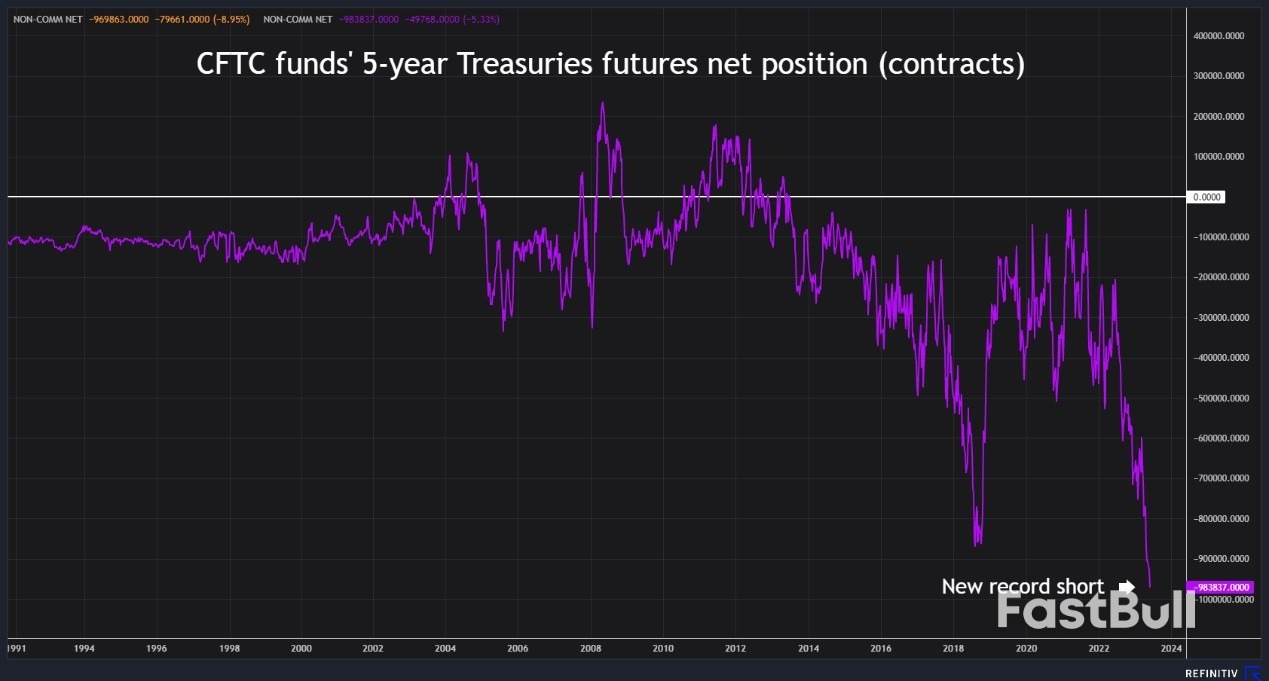
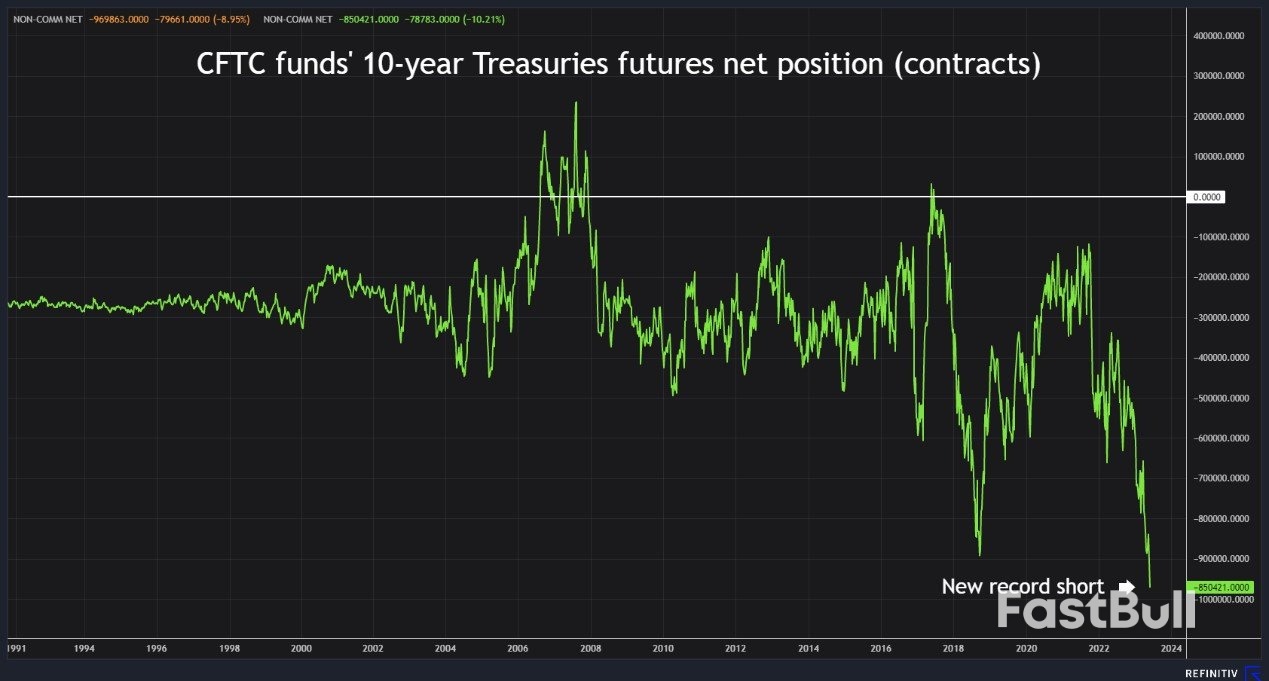
          Commodity Futures Trading Commission (CFTC) data show that funds amassed new record short positions in two-, five- and 10-year Treasuries futures in the week through May 30, as uncertainty around the U.S. debt limit standoff reached fever pitch.
          A short position is essentially a wager that an asset's price will fall, and a long position is a bet it will rise. In bonds, yields rise when prices fall, and move lower when prices increase.
          Hedge funds take positions in bonds futures for hedging purposes and relative value trades, so the CFTC data is not always a reflection of purely directional bets.
          Analysts say the huge buildup in short Treasuries futures positions in recent months may be rooted more in "basis" trading strategies between cash and futures contracts rather than an outright bet on higher yields.
          Whatever is driving it, the selling momentum is remarkable.
          The latest CFTC data show that in the week through May 30 speculative accounts grew their net short position in two-year Treasuries by 79,661 contracts to 969,863 contracts, raised their net short position in five-year bonds by 49,768 contracts to 983,837, and expanded their net short position in the 10-year space by 78,783 contracts to 850,421 contracts.Funds Go Deeper into Record Short U.S. Bond Territory_1Funds Go Deeper into Record Short U.S. Bond Territory_2
          Funds Go Deeper into Record Short U.S. Bond Territory_3All are the largest net short positions since CFTC Treasuries futures were launched over 30 years ago, and amount to a combined net short position across the two-, five- and 10-year parts of the curve of around 2.8 million contracts.
          That's significantly larger than the previous record net short total position in late 2018 of just over 2 million contracts, almost entirely down to the current extreme bearishness in the two-year space.
          If hedge funds are selling, asset managers are buying. The latest CFTC data show asset managers are net long two-, five- and 10-year Treasuries futures to the tune of 1.0 million, 1.7 million and 1.3 million contracts, respectively.
          This fits with fund flows data that show U.S. bond funds have accumulated net inflows of around $100 billion so far this year, according to Barclays. In the first five months of last year, these funds had posted net outflows of around $50 billion.
          Bank of America's monthly fund manager survey in May showed that investors' allocation to bonds rose to a net 14% overweight, the largest allocation to bonds since March 2009.
          There's a tug of war between speculators and asset managers, and neither side appears to have the advantage - the two-year yield is up a bit this year, while the 10-year yield is down a bit.
          Anyone betting on a flatter yield curve this year will be in the money, but with curve inversions having reached historical levels recently, for how much longer? Strategists at Citi and Deutsche reckon the bias from here is for the curve to steepen.

          Source: Reuters

          Risk Warnings and Disclaimers
          You understand and acknowledge that there is a high degree of risk involved in trading. Following any strategies or investment methods may lead to potential losses. The content on the site is provided by our contributors and analysts for information purposes only. You are solely responsible for determining whether any trading assets, securities, strategy, or any other product is suitable for investing based on your own investment objectives and financial situation.
          Comments
          Add to Favorites
          Share

          Why is OPEC+ Cutting Oil Output?

          Devin

          Commodity

          The Organization of the Petroleum Exporting Countries and allies including Russia, a group known as OPEC+ which pumps around 40% of the world's crude, agreed on a new oil output deal on Sunday.
          Saudi Arabia, the group's biggest producer, will make a deep cut to its output in July on top of a broader OPEC+ deal to limit supply into 2024 as the group faces flagging oil prices.
          A surprise announcement by OPEC+ in April to deepen production cuts helped to raise prices by about $9 a barrel to above $87 per barrel in the days followed.
          Yet benchmark crude prices have shed those gains since, with Brent futures on Monday trading at just under $78 a barrel.
          Why is OPEC+ Cutting Oil Output?_1On Sunday, in addition to extending the existing OPEC+ cuts of 3.66 million barrels per day (bpd), the group agreed to reduce overall production targets from January 2024 by a further 1.4 million bpd to a combined output of 40.46 million bpd.
          The changes, however, included lowered targets for Russia, Nigeria and Angola simply to bring them into line with current production levels.
          Here are the main reasons why OPEC+ cut output:
          Concerns About Weak Global Demand
          Data from China has aroused fears that the economic recovery after coronavirus lockdowns by world's second-largest oil consumer is losing steam.
          Russian Deputy Prime Minister Alexander Novak has also pointed to "interference with market dynamics", a Russian expression to describe a Western price cap on Russian oil.
          Fears of another banking crisis in recent months have led investors to sell out of riskier assets such as commodities with oil prices falling to near $70 per barrel from a peak of $139 in March 2022.
          A global recession could lead to lower oil prices.
          Oil prices also recently came under pressure from concerns about U.S. debt ceiling negotiations, though fears of a debt default by the world's biggest oil consumer have abated since a bipartisan deal was sealed last week.
          Punishing Speculators
          The planned cuts will also punish oil short sellers betting on oil price declines.
          In 2020, Saudi Energy Minister Prince Abdulaziz bin Salman warned traders against betting heavily in the oil market, saying that those who gamble on the oil price would be "ouching like hell".
          He repeated his warning ahead of Sunday's meeting, telling speculators to "watch out" which many market watchers and investors interpreted as a signal that OPEC+ could consider further output cuts.
          US Output Rising
          U.S. crude oil production is set to rise by 5.1% to 12.53 million barrels per day (bpd) in 2023 and by 1.3% to 12.69 million bpd in 2024, according to government forecasts.
          This compares with around 10 million bpd as recently as 2018.
          Meanwhile, Saudi's energy ministry said the country's output, the biggest chunk of OPEC+ production, would drop to 9 million barrels per day (bpd) in July from around 10 million bpd in May, in its biggest reduction in years.
          Saudi output is set to rebound to around 10 million bpd from August, unless market conditions prompt the kingdom to extend cuts.
          Russia, the world's third-biggest oil producer, is targeting production of around 9.5 million bpd until the end of the year and 9.3 million bpd next year.
          Tensions With Washington
          Additional cuts from OPEC+ could drive tensions with leading consuming nations that are trying to fight inflation.
          Washington called OPEC+'s action in April inadvisable.
          The West has repeatedly criticised OPEC for manipulating prices and siding with Russia despite the war in Ukraine.
          The United States is considering passing legislation known as NOPEC, which would allow the seizure of OPEC's assets on U.S. territory if market collusion is proven.
          OPEC+ has criticised the International Energy Agency, the West's energy watchdog for which the United States is the biggest financial donor, for advocating oil stocks releases last year. The IEA had argued these were necessary to bring down prices given concerns that sanctions would disrupt Russian supply.
          The IEA's predictions of price strength never materialised, prompting OPEC+ sources to say it was politically driven and designed to help boost U.S. President Joe Biden's ratings.
          The United States, which released most stocks, said it would buy back some oil in 2023, but later ruled that out.
          OPEC observers also say the group needs nominal oil prices to be higher because money printing by the West in recent years has lowered the value of the U.S. dollar, the currency in which oil is traded.

          Source: The Globe and Mail

          Risk Warnings and Disclaimers
          You understand and acknowledge that there is a high degree of risk involved in trading. Following any strategies or investment methods may lead to potential losses. The content on the site is provided by our contributors and analysts for information purposes only. You are solely responsible for determining whether any trading assets, securities, strategy, or any other product is suitable for investing based on your own investment objectives and financial situation.
          Comments
          Add to Favorites
          Share

          Mixed Signals in the US Economy: Slower Services Growth and Factory Orders Below Expectations

          Warren Takunda

          Traders' Opinions

          Stocks

          Recent economic data releases from the United States have raised concerns among investors and analysts, highlighting a potential slowdown in the country's economic growth. The latest reports indicate a moderation in the services sector, factory orders falling short of expectations, and a reversal in the dollar's gains. These developments suggest a need for caution as market participants evaluate the health of the US economy and anticipate the Federal Reserve's next policy moves.
          Slower Expansion in Services SectorMixed Signals in the US Economy: Slower Services Growth and Factory Orders Below Expectations_1
          The Institute for Supply Management (ISM) reported that the US services sector experienced a significant slowdown in May, with the Services Purchasing Managers' Index (PMI) falling to 50.3 from April's 51.9. Although this reading indicates the fifth consecutive month of expansion, it represents the slowest rate in the current sequence. Key contributing factors to this deceleration include a decline in business activity, new orders, and employment, coupled with faster supplier deliveries. The drop in new export orders further underscores the challenges faced by the sector.
          Factory Orders Miss ExpectationsMixed Signals in the US Economy: Slower Services Growth and Factory Orders Below Expectations_2
          In April, US factory orders grew by 0.4%, falling short of market expectations of a 0.8% increase. While defense spending provided some support, overall growth was slower than the previous month. Notably, demand for transportation equipment, particularly defense aircraft and parts, remained robust. However, orders for fabricated metal products, primary metals, and computer and electronic products experienced contractions, highlighting the impact of higher interest rates. These figures suggest that certain segments of the manufacturing industry are facing headwinds.
          Dollar's Retreat Reflects ConcernsMixed Signals in the US Economy: Slower Services Growth and Factory Orders Below Expectations_3
          Following the release of disappointing economic data, the US dollar relinquished its earlier gains and traded relatively unchanged. The ISM Services PMI decline and the below-forecast factory orders contributed to investor uncertainty about the future trajectory of the US economy. With the Federal Reserve's next policy decisions in focus, market participants are evaluating the likelihood of interest rate adjustments. Currently, opinions among traders are divided, with expectations of a rate increase in July decreasing since the ISM Services release.
          Fresh data further extends Dow's lossesMixed Signals in the US Economy: Slower Services Growth and Factory Orders Below Expectations_4
          The Dow Jones Industrial Average experienced losses on the back of the economic data, declining over 150 points. The underperformance was driven by cyclical stocks, such as Caterpillar, Boeing, and 3M, which are sensitive to economic performance. In contrast, the S&P 500 and Nasdaq reached new highs, buoyed by gains in technology shares. Apple's stock, in particular, hit a record high as the company prepared to unveil a "mixed reality" headset at the Worldwide Developers Conference. Other technology giants, including Netflix, Alphabet, Oracle, Amazon, and Microsoft, also saw positive trading activity.
          Gold Prices Respond to Weaker Economic OutlookMixed Signals in the US Economy: Slower Services Growth and Factory Orders Below Expectations_5
          Gold prices experienced a modest increase, surpassing $1,950 per ounce. The minor decline in US Treasury yields and a weakening US dollar contributed to this uptick. The lackluster economic data reinforced expectations that the Federal Reserve may pause its tightening cycle in the near future. Despite the recent uptick, gold prices remain below the near-record high reached in early May, as traders anticipate prolonged elevated interest rates globally to counter persistent inflationary pressures.
          The recent economic indicators from the United States paint a cautionary picture, suggesting a potential slowdown in the country's economic growth. The services sector's expansion has moderated, factory orders have fallen short of expectations, and the dollar's gains have reversed. These developments have prompted market participants to reassess the health of the US economy and speculate on the Federal Reserve's upcoming policy decisions. As investors navigate the uncertainties ahead, monitoring key economic indicators will be crucial in gaining insights into the trajectory of the US economy and its potential impact on financial markets.
          Risk Warnings and Disclaimers
          You understand and acknowledge that there is a high degree of risk involved in trading. Following any strategies or investment methods may lead to potential losses. The content on the site is provided by our contributors and analysts for information purposes only. You are solely responsible for determining whether any trading assets, securities, strategy, or any other product is suitable for investing based on your own investment objectives and financial situation.
          Comments
          Add to Favorites
          Share

          Listless Bitcoin Seeks Summer Spark

          Kevin Du

          Cryptocurrency

          The capricious cryptocurrency's been uncommonly quiet over the past four weeks, bound in the range of $28,452 and $25,800. Even the end of the U.S. debt ceiling saga did little to whet risk appetite.
          Bitcoin's volatility index is near 64, well below the 2023 peak of 116.5 touched in January, according to CryptoCompare. Overall daily cryptocurrency spot trading volumes - above $20 billion for most of the year - have languished at around $10.6-$12 billion in the last two weeks, data from The Block shows.
          The data signals a reluctance of investors and traders to take positions in either spot or derivatives, said Noelle Acheson, an economist who has tracked the crypto sector for seven years.
          This was echoed by Matthew Weller, global head of research at financial services group StoneX. "Looking at bitcoin's chart, traders are waiting for a definitive break away from the $27,000 level that has magnetically pulled prices back consistently," he said.
          The world's biggest cryptocurrency is still the best-performing asset of 2023, with gains of about 62%. Yet it has slid nearly 14% from a peak of $31,035 in April, keeping nervy traders guessing about its next move.
          Listless Bitcoin Seeks Summer Spark_1Still waters run deep?
          "The lack of anything interesting is also interesting," said Luuk Strijers, chief commercial officer at derivatives exchange Deribit.
          Bitcoin's 7-day and 30-day implied volatility - options traders' expectation of future price turbulence - have slid to January lows of under 40%, after peaking at 76% and 67% in March, according to The Block.
          "If implied volatility falls to rock-bottom levels, it can't go much lower," Strijers added. "Trading volatility, buying options in the absence of a price move, that's what people might do in this market."
          Market positioning indicates the maximum pain level for the June 2023 options expiry for bitcoin is at around $24,000, which could act as a support or resistance level, according to analysts at Bitfinex.
          "Traders should be prepared for potential market turbulence and short-term price fluctuations in the second half of the month," they said.
          Longer term, in 2024, they expect bitcoin's halving - a technical adjustment that reduces the rate at which new coins are created - and the U.S. elections to ratchet up volatility.
          The Bulls Are Hiding
          Funding rates, which measure the cost of holding bitcoin via futures, have edged lower, indicating investors are less willing to pay to be long. It was last trading at 0.0098%, way below the 0.0302% seen in March.
          "A bull market is easy, when everything is going up," said Thomas Kralow, a crypto hedge fund manager at Kralow Capital. "But it's markets like these where people lose money - because of false beliefs that we are finally turning the corner, which is incredibly hard to predict."
          He added: "Right now with the drop in volatility, we have a few trades that we are open to hedge in case bitcoin drops down to $20,000."

          Source: Devdiscours

          Risk Warnings and Disclaimers
          You understand and acknowledge that there is a high degree of risk involved in trading. Following any strategies or investment methods may lead to potential losses. The content on the site is provided by our contributors and analysts for information purposes only. You are solely responsible for determining whether any trading assets, securities, strategy, or any other product is suitable for investing based on your own investment objectives and financial situation.
          Comments
          Add to Favorites
          Share

          RBA Shoots up Aussie, Dollar Consolidating Against Europeans and Yen

          Samantha Luan

          Forex

          Australian Dollar surges broadly after surprised RBA rate hike. Tightening bias is also maintained, so more hike(s) could still be in the pipeline. The move in Aussie is taking other commodity currencies higher. Now, a focus will be on whether BoC would follow and surprises the markets too. At the other end of the spectrum, Dollar is sold off broadly today. Yen is following as the second worst and then Euro. Swiss Franc and Sterling are mixed.
          Technically, some attention will also be on Dollar in the early part of the week. Near term price actions in EUR/USD, USD/CHF, USD/JPY and even GBP/USD are displaying corrective structures. That is, the greenback's rally against European majors and Yen shouldn't be over yet. Break of any of 1.0634 support in EUR/USD, 1.2306 support in GBP/USD, 0.9146 resistance in USD/CHF and 140.90 resistance in USD/JPY could be the early signal of resumption in Dollar's rise.
          RBA Shoots up Aussie, Dollar Consolidating Against Europeans and Yen_1In Asia, at the time of writing, Nikkei is up 0.69%. Hong Kong HSI is up 0.51%. China Shanghai SSE is up 0.05%. Singapore Strait Times is up 0.04%. Japan 10-year JGB yield is down -0.0040 at 0.430. Overnight, DOW dropped -0.59%. S&P 500 dropped -0.20%. NASDAQ dropped -0.09%. 10-year yield rose 0.0002 to 3.693.

          RBA surprises with 25bps hike, to give itself greater confidence

          RBA surprises the market by raising the cash rate target rate, by 25bps to 4.10. Tightening bias is maintained as "Some further tightening of monetary policy may be required to ensure that inflation returns to target in a reasonable timeframe".
          The central bank noted that while inflation is "still too high" even though it has "passed its peak." Also, it will be "some time yet" before inflation falls back to target range. It explained, "this further increase in interest rates is to provide greater confidence that inflation will return to target within a reasonable timeframe".
          Growth "has slowed" and labor market conditions "remain very tight" even though eased. Wages growth "has picked up" but is "still consistent with the inflation target". The path to soft landing "remains a narrow one" and a "significant source" of uncertainty continues to be household consumption.

          AUD/NZD breaks structural resistance after RBA hike

          AUD/NZD surges after RBA's surprised rate hike and breaks through 1.0928 structural resistance. The development should confirm that corrective fall from 1.1085 has completed with three waves down to 1.0556.
          Intraday bias is now on the upside as long as 1.0881 minor support holds. Sustained trading above 1.0928 could prompt upside acceleration 1.1085 resistance. Break there will resume whole rally from 1.0469 (2022 low) to 100% projection of 1.0469 to 1.1085 from 1.0556 at 1.1172.

          RBA Shoots up Aussie, Dollar Consolidating Against Europeans and Yen_2RBA Shoots up Aussie, Dollar Consolidating Against Europeans and Yen_3Looking ahead

          Germany factor orders, UK PMI construction, Eurozone retail sales will be released in European session. Later in the day, Canada will publish building permits and Ivey PMI.

          EUR/AUD Daily Outlook

          EUR/AUD's decline continues today and break of 1.6134 support confirms resumption of whole fall from 1.6785. Intraday bias stays on the downside for 100% projection of 1.6785 to 1.6134 from 1.6513 at 1.5862. On the upside, above 1.6207 minor resistance will turn intraday bias neutral first. But risk will stay on the downside as long as 1.6513 resistance holds, in case of recovery.RBA Shoots up Aussie, Dollar Consolidating Against Europeans and Yen_4
          In the bigger picture, a medium term top is possibly in place at 1.6785 already, on bearish divergence condition in D MACD. Fall from there is seen as correcting whole up trend from 1.4281 (2022 low). Deeper decline is expected as long as 1.6513 resistance holds, to 38.2% retracement of 1.4281 to 1.6785 at 1.5828. Strong support could be seen there to complete the first leg of the corrective pattern.

          RBA Shoots up Aussie, Dollar Consolidating Against Europeans and Yen_5Source: ActionForex.com

          Risk Warnings and Disclaimers
          You understand and acknowledge that there is a high degree of risk involved in trading. Following any strategies or investment methods may lead to potential losses. The content on the site is provided by our contributors and analysts for information purposes only. You are solely responsible for determining whether any trading assets, securities, strategy, or any other product is suitable for investing based on your own investment objectives and financial situation.
          Comments
          Add to Favorites
          Share
          FastBull
          Copyright © 2025 FastBull Ltd

          728 RM B 7/F GEE LOK IND BLDG NO 34 HUNG TO RD KWUN TONG KLN HONG KONG

          TelegramInstagramTwitterfacebooklinkedin
          App Store Google Play Google Play
          Products
          Charts

          Chats

          Q&A with Experts
          Screeners
          Economic Calendar
          Data
          Tools
          Membership
          Features
          Function
          Markets
          Copy Trading
          Latest Signals
          Contests
          News
          Analysis
          24/7
          Columns
          Education
          Company
          Careers
          About Us
          Contact Us
          Advertising
          Help Center
          Feedback
          User Agreement
          Privacy Policy
          Business

          White Label

          Data API

          Web Plug-ins

          Poster Maker

          Affiliate Program

          Risk Disclosure

          The risk of loss in trading financial instruments such as stocks, FX, commodities, futures, bonds, ETFs and crypto can be substantial. You may sustain a total loss of the funds that you deposit with your broker. Therefore, you should carefully consider whether such trading is suitable for you in light of your circumstances and financial resources.

          No decision to invest should be made without thoroughly conducting due diligence by yourself or consulting with your financial advisors. Our web content might not suit you since we don't know your financial conditions and investment needs. Our financial information might have latency or contain inaccuracy, so you should be fully responsible for any of your trading and investment decisions. The company will not be responsible for your capital loss.

          Without getting permission from the website, you are not allowed to copy the website's graphics, texts, or trademarks. Intellectual property rights in the content or data incorporated into this website belong to its providers and exchange merchants.

          Not Logged In

          Log in to access more features

          FastBull Membership

          Not yet

          Purchase

          Become a signal provider
          Help Center
          Customer Service
          Dark Mode
          Price Up/Down Colors

          Log In

          Sign Up

          Position
          Layout
          Fullscreen
          Default to Chart
          The chart page opens by default when you visit fastbull.com