Markets
News
Analysis
User
24/7
Economic Calendar
Education
Data
- Names
- Latest
- Prev


Signal Accounts for Members
All Signal Accounts
All Contests


U.K. Trade Balance Non-EU (SA) (Oct)A:--
F: --
P: --
U.K. Trade Balance (Oct)A:--
F: --
P: --
U.K. Services Index MoMA:--
F: --
P: --
U.K. Construction Output MoM (SA) (Oct)A:--
F: --
P: --
U.K. Industrial Output YoY (Oct)A:--
F: --
P: --
U.K. Trade Balance (SA) (Oct)A:--
F: --
P: --
U.K. Trade Balance EU (SA) (Oct)A:--
F: --
P: --
U.K. Manufacturing Output YoY (Oct)A:--
F: --
P: --
U.K. GDP MoM (Oct)A:--
F: --
P: --
U.K. GDP YoY (SA) (Oct)A:--
F: --
P: --
U.K. Industrial Output MoM (Oct)A:--
F: --
P: --
U.K. Construction Output YoY (Oct)A:--
F: --
P: --
France HICP Final MoM (Nov)A:--
F: --
P: --
China, Mainland Outstanding Loans Growth YoY (Nov)A:--
F: --
P: --
China, Mainland M2 Money Supply YoY (Nov)A:--
F: --
P: --
China, Mainland M0 Money Supply YoY (Nov)A:--
F: --
P: --
China, Mainland M1 Money Supply YoY (Nov)A:--
F: --
P: --
India CPI YoY (Nov)A:--
F: --
P: --
India Deposit Gowth YoYA:--
F: --
P: --
Brazil Services Growth YoY (Oct)A:--
F: --
P: --
Mexico Industrial Output YoY (Oct)A:--
F: --
P: --
Russia Trade Balance (Oct)A:--
F: --
P: --
Philadelphia Fed President Henry Paulson delivers a speech
Canada Building Permits MoM (SA) (Oct)A:--
F: --
P: --
Canada Wholesale Sales YoY (Oct)A:--
F: --
P: --
Canada Wholesale Inventory MoM (Oct)A:--
F: --
P: --
Canada Wholesale Inventory YoY (Oct)A:--
F: --
P: --
Canada Wholesale Sales MoM (SA) (Oct)A:--
F: --
P: --
Germany Current Account (Not SA) (Oct)A:--
F: --
P: --
U.S. Weekly Total Rig CountA:--
F: --
P: --
U.S. Weekly Total Oil Rig CountA:--
F: --
P: --
Japan Tankan Large Non-Manufacturing Diffusion Index (Q4)--
F: --
P: --
Japan Tankan Small Manufacturing Outlook Index (Q4)--
F: --
P: --
Japan Tankan Large Non-Manufacturing Outlook Index (Q4)--
F: --
P: --
Japan Tankan Large Manufacturing Outlook Index (Q4)--
F: --
P: --
Japan Tankan Small Manufacturing Diffusion Index (Q4)--
F: --
P: --
Japan Tankan Large Manufacturing Diffusion Index (Q4)--
F: --
P: --
Japan Tankan Large-Enterprise Capital Expenditure YoY (Q4)--
F: --
P: --
U.K. Rightmove House Price Index YoY (Dec)--
F: --
P: --
China, Mainland Industrial Output YoY (YTD) (Nov)--
F: --
P: --
China, Mainland Urban Area Unemployment Rate (Nov)--
F: --
P: --
Saudi Arabia CPI YoY (Nov)--
F: --
P: --
Euro Zone Industrial Output YoY (Oct)--
F: --
P: --
Euro Zone Industrial Output MoM (Oct)--
F: --
P: --
Canada Existing Home Sales MoM (Nov)--
F: --
P: --
Euro Zone Total Reserve Assets (Nov)--
F: --
P: --
U.K. Inflation Rate Expectations--
F: --
P: --
Canada National Economic Confidence Index--
F: --
P: --
Canada New Housing Starts (Nov)--
F: --
P: --
U.S. NY Fed Manufacturing Employment Index (Dec)--
F: --
P: --
U.S. NY Fed Manufacturing Index (Dec)--
F: --
P: --
Canada Core CPI YoY (Nov)--
F: --
P: --
Canada Manufacturing Unfilled Orders MoM (Oct)--
F: --
P: --
Canada Manufacturing New Orders MoM (Oct)--
F: --
P: --
Canada Core CPI MoM (Nov)--
F: --
P: --
Canada Manufacturing Inventory MoM (Oct)--
F: --
P: --
Canada CPI YoY (Nov)--
F: --
P: --
Canada CPI MoM (Nov)--
F: --
P: --
Canada CPI YoY (SA) (Nov)--
F: --
P: --
Canada Core CPI MoM (SA) (Nov)--
F: --
P: --


No matching data
Latest Views
Latest Views
Trending Topics
Top Columnists
Latest Update
White Label
Data API
Web Plug-ins
Affiliate Program
View All

No data
Russian Central Bank Governor Elvira Nabiullina and her deputy Alexei Zabotkin addressed a news conference on Friday after the central bank cut its key rate to 18% from 20%.
They spoke in Russian and the quotes below were translated into English by Reuters.
"If you look at our forecast for the key rate, it suggests that by the end of the year, at individual meetings, reductions of 100, 150 and 200 basis points are possible, as well as pauses. Here everything will depend on the incoming data. But such a uniform trajectory of reduction may be possible with a more convincing picture of inflation stabilization, inflation expectations at a low level and the absence of new inflation shocks. For now, we assume the possibility of various steps."
"We are on the path to returning inflation to target, but this path has not yet been completed. There are already initial results. They allowed us to reduce the key rate again today, smoothly adapting the degree of monetary policy tightness to reduce inflationary pressure."
"But returning to the target does not simply mean several months of current price growth near 4%. It implies a stable consolidation of inflation at a low level not only in actual data, but also in the perception of people and businesses."
"Monetary policy has ensured a downward reversal of inflation, and it must remain tight for as long as it takes to sustainably return inflation to 4% in 2026 and consolidate it near this level."
"In the aggregate, pro-inflationary risks continue to prevail. However, when making decisions, we also take into account disinflationary risks. The main one is a faster cooling of credit and demand than we expect in the baseline forecast."
"Budget policy remains an important input for our forecast. We assume that the budget rule will be followed this year and in the following years. If budget plans change, it may be necessary to adjust the key rate trajectory."
"Compared to April, we have lowered our forecast for Russian oil prices to $55 per barrel this year and next. We have also slightly lowered our forecast for exports and the current account of the balance of payments for the next two years."
"At the same time, the rouble exchange rate is affected by flows not only on the current account, but also on the financial account of the balance of payments. High interest rates support the attractiveness of rouble assets compared to foreign ones for Russian citizens and companies. This, combined with more moderate demand for imports, ensures the stability of the rouble exchange rate, despite a slight reduction in exports."
The Federal Reserve released a statement Friday thanking President Donald Trump and Republican lawmakers for visiting the central bank’s renovation project on Thursday.
“The Federal Reserve was honored to welcome the President yesterday for a visit to our historic headquarters,” the Fed said in the statement. “We appreciated the opportunity to share progress on the renovation with him and with Senators Tim Scott and Thom Tillis. We are grateful for the President’s encouragement to complete this important project.”
The two-building rehabilitation has drawn significant attack from Republicans over its $2.5 billion price tag. During his visit, Trump offered little criticism of the project but urged Fed Chair Jerome Powell several times to lower interest rates.
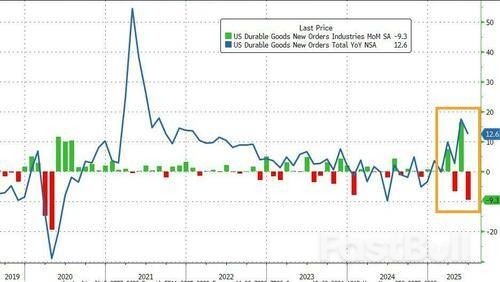
After surging higher in May, on the back of huge Boeing aircraft orders, US durable goods orders were expected to tumble back to earth in preliminary June data... and they did.
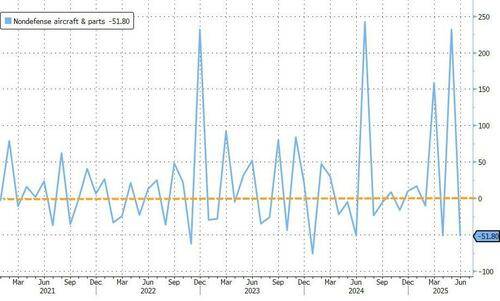
Durable Goods Orders plunged 9.3% MoM (slightly better than the -10.7% MoM expected) - the biggest drop since the COVID lockdowns. But as the chart below shows, it is a wildly noisy time series, almost entirely due to the lumpiness of aircraft orders...

Thanks to a swing from a 230% MoM rise to a 50% MoM decline in non-defense aircraft orders...

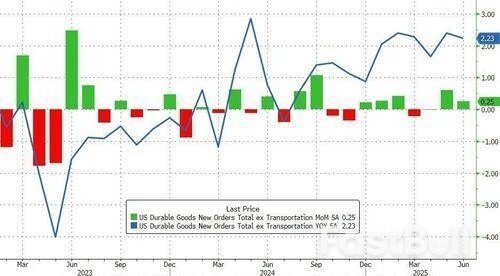
Excluding the noise of Boeing orders, the data was actually solid with a 0.25% MoM increase (better than the 0.1% rise expected) in durable goods orders (ex-Transports), pushing YoY orders uo 2.23%

Adding to the confusion, the value of core capital goods orders, a proxy for investment in equipment excluding aircraft and military hardware, decreased 0.7% last month after an upwardly revised 2% gain in May
Capital goods shipments rose 0.4%, excluding defense and commercial aircraft, better than the +0.2% expected, adding to Q2 GDP growth hopes.
So much for the tariff-driven recession that every establishment economist was sure would happen...
Second-quarter earnings for European companies have come in ahead of expectations, with financials and U.S.-exposed sectors leading the surprise, Bank of America (BofA) analysts said.
"European EPS growth surprises to the upside so far on the back of low expectations," BofA wrote, noting that with one-third of companies reporting, Stoxx 600 earnings per share (EPS) are up 8% year-on-year, well above the 2% growth forecast by consensus.
The upside has been “dominated by financials,” which were expected to have a subdued quarter.
Analysts had lowered EPS estimates by more than 6% since April, setting a “relatively low bar” for Q2 performance, BofA said.
While currency headwinds were a concern, given the 3.5% year-on-year gain in the euro trade-weighted index, the bank said “the start of Q2 reporting helps to ease these concerns,” especially for tech and healthcare, which are “so far contributing to the upside surprise.”
Despite the strong headline EPS figure, breadth is said to remain a concern.
“Only 47% of companies have beat EPS estimates so far, the lowest breadth of EPS surprises in six quarters,” BofA noted, citing foreign exchange effects as a key drag.
EPS beats for cyclicals excluding financials fell to 36%, the lowest since at least 2013.
However, U.S.-exposed stocks are said to have bucked the trend with a 57% EPS beat ratio, “a two-year high,” led by healthcare names, where “beats are running at an eight-year high of 73%.”
“Stocks beating EPS estimates have been rewarded with median 1-day outperformance of 1.4%,” BofA said. They stated it is the best post-earnings performance since Q1 2020.

U.S. stock futures pointed to a steady open on Friday following record closes for the S&P 500 and the Nasdaq in the previous session, while investors looked for signs of progress in trade talks as they braced for the August 1 tariff deadline.
At 08:09 a.m. ET, Dow E-minis were up 33 points, or 0.07%, S&P 500 E-minis were up 4.25 points, or 0.07%, and Nasdaq 100 E-minis were down 12.5 points, or 0.05%.
The blue-chip Dow fell 0.7% in Thursday's session, but stayed close to its all-time high, last hit in December.
All three major indexes were poised to cap the week on a high note, as a flurry of tariff agreements between the United States and its trading partners - including Japan, Indonesia, and the Philippines - helped drive markets to new highs.
Expectations were rife the European Union would soon sign an agreement with Washington, while negotiations with South Korea gathered momentum ahead of the August 1 deadline set for most countries, as economies worldwide scrambled to avoid steep U.S. import tariffs.
"Tariff headlines are driving market risk sentiment, fuelling a risk-on mood this week. However, some volatility near the August 1st deadline remains possible," a group of analysts led by Adam Kurpiel at Societe Generale said.
A spate of upbeat second-quarter earnings also supported Wall Street's record run. Of the 152 companies in the S&P 500 that reported earnings as of Thursday, 80.3% reported above analyst expectations, according to data compiled by LSEG.
However, there were a few setbacks during the week. Heavyweights Tesla (TSLA.O), and General Motors (GM.N), stumbled and were on track for their steepest weekly declines in nearly two months.
Tesla CEO Elon Musk warned of tougher quarters ahead amid shrinking U.S. EV subsidies, while General Motors took a hit after absorbing a $1.1 billion blow from President Donald Trump's sweeping tariffs in its second-quarter earnings.
Intel (INTC.O), fell 7.5% in premarket trading on Friday after the chipmaker forecast steeper third-quarter losses than Street expectations and announced plans to slash jobs.
All eyes will be on the U.S. Federal Reserve's monetary policy meeting next week, with bets indicating that policymakers are likely to keep interest rates unchanged as they evaluate the effects of tariffs on inflation.
The central bank is under immense scrutiny from the White House, with President Trump leading a censure campaign against Chair Jerome Powell for not reducing borrowing costs, while often hinting that he would sack the top policymaker.
In a surprise move, Trump escalated the pressure by making a rare visit to the Fed headquarters on Thursday, where he criticized its $2.5-billion renovation project.
Uncertainty over Powell's tenure is prompting investors to assess potential market reactions in the event of a change in leadership at the central bank.
According to CME's FedWatch tool, traders now see a nearly 60.5% chance of a rate cut as soon as September.
Among other stocks, Newmont (NEM.N), added 2.3% after the gold miner surpassed Wall Street expectations for second-quarter profit.
Health insurer Centene (CNC.N), posted a surprise quarterly loss, sending its shares tumbling 15%.Deckers Outdoor
Paramount Global (PARA.O), rose 1.3% after U.S. regulators approved its $8.4 billion merger with Skydance Media.
Oil was steady on optimism over US trade talks ahead of a key deadline next week, and as tightness in diesel markets boosts sentiment.
Brent crude was above $69 a barrel after adding 1% on Thursday, while West Texas Intermediate traded near $66. Indian Commerce Minister Piyush Goyal said he was confident that his country could reach an agreement with the US before the Aug. 1 target date, while Brazil and Mexico looked to broaden trade ties.
Meanwhile, diesel prices have soared, leading to steep premiums for niche crude grades that yield more of the fuel and injecting much-needed strength into a bogged-down oil market. The latest European Union measures restricting Russian energy imports have also added to the tightness, according to TotalEnergies SE.
Crude has remained in a holding pattern this month, but is down for the year as increased supply from OPEC+ adds to concerns over a looming glut. The group will next meet on Aug. 3 to decide on production levels. On Thursday one member, Venezuela, was given a production reprieve by a US decision to let Chevron resume pumping oil in the country.
“The only strength right now is coming from the diesel markets,” said Florence Schmit, an analyst at Rabobank. “The US government’s backpaddling on curtailing Venezuelan oil supplies will only add to a relatively loose supply balance later this year.”
Durable Goods Orders Plunge in June as Transportation Sector Contracts Sharply.
U.S. durable goods orders fell sharply in June, down 9.3% month-over-month to $311.8 billion, reversing much of May’s 16.5% gain. The U.S. Census Bureau reported the drop was largely due to a steep decline in transportation equipment orders, which sank 22.4% to $113.0 billion. Traders are assessing whether this signals a broader cooling in manufacturing or a sector-specific retreat.
The 9.3% drop in total durable goods orders was driven almost entirely by transportation, especially aircraft orders. Transportation equipment orders fell $32.6 billion in June, reflecting ongoing volatility in the sector. Excluding transportation, durable goods orders actually rose by 0.2%, slightly above the 0.1% forecast. This narrow gain offers limited relief, suggesting underlying manufacturing demand remains soft but stable outside transportation.
Core durable goods orders—excluding transportation—posted a modest 0.2% gain, matching a downwardly revised 0.6% rise in May. Although slightly above expectations, the result reinforces a view that core manufacturing growth is tepid. Meanwhile, orders excluding defense spending fell 9.4%, pointing to waning demand from the private sector. These trends highlight cautious capital expenditure from businesses in a climate of elevated interest rates and tighter financial conditions.
The softer headline figure has not significantly altered rate expectations. With inflation readings showing signs of stabilization, the Federal Reserve is expected to maintain its current policy stance. However, continued weakness in durable goods orders—particularly in transportation—could start influencing forward guidance, especially if business investment falters further. Bond yields were little changed following the report, while the dollar held steady, reflecting market consensus that the Fed will stay on hold for now.
The sharp drop in durable goods orders in June, especially in transportation, points to a bearish short-term outlook for the manufacturing sector. While core orders showed modest growth, the broader trend remains fragile. Unless transportation rebounds and private-sector demand strengthens, traders should anticipate further pressure on industrial stocks and manufacturing-related assets in the near term.
White Label
Data API
Web Plug-ins
Poster Maker
Affiliate Program
The risk of loss in trading financial instruments such as stocks, FX, commodities, futures, bonds, ETFs and crypto can be substantial. You may sustain a total loss of the funds that you deposit with your broker. Therefore, you should carefully consider whether such trading is suitable for you in light of your circumstances and financial resources.
No decision to invest should be made without thoroughly conducting due diligence by yourself or consulting with your financial advisors. Our web content might not suit you since we don't know your financial conditions and investment needs. Our financial information might have latency or contain inaccuracy, so you should be fully responsible for any of your trading and investment decisions. The company will not be responsible for your capital loss.
Without getting permission from the website, you are not allowed to copy the website's graphics, texts, or trademarks. Intellectual property rights in the content or data incorporated into this website belong to its providers and exchange merchants.
Not Logged In
Log in to access more features

FastBull Membership
Not yet
Purchase
Log In
Sign Up