• Trade
  • Markets
  • Copy
  • Contests
  • News
  • 24/7
  • Calendar
  • Q&A
  • Chats
Trending
Screeners
SYMBOL
LAST
BID
ASK
HIGH
LOW
NET CHG.
%CHG.
SPREAD
SPX
S&P 500 Index
6827.42
6827.42
6827.42
6899.86
6801.80
-73.58
-1.07%
--
DJI
Dow Jones Industrial Average
48458.04
48458.04
48458.04
48886.86
48334.10
-245.98
-0.51%
--
IXIC
NASDAQ Composite Index
23195.16
23195.16
23195.16
23554.89
23094.51
-398.69
-1.69%
--
USDX
US Dollar Index
97.950
98.030
97.950
98.500
97.950
-0.370
-0.38%
--
EURUSD
Euro / US Dollar
1.17394
1.17409
1.17394
1.17496
1.17192
+0.00011
+ 0.01%
--
GBPUSD
Pound Sterling / US Dollar
1.33707
1.33732
1.33707
1.33997
1.33419
-0.00148
-0.11%
--
XAUUSD
Gold / US Dollar
4299.39
4299.39
4299.39
4353.41
4257.10
+20.10
+ 0.47%
--
WTI
Light Sweet Crude Oil
57.233
57.485
57.233
58.011
56.969
-0.408
-0.71%
--

Community Accounts

Signal Accounts
--
Profit Accounts
--
Loss Accounts
--
View More

Become a signal provider

Sell trading signals to earn additional income

View More

Guide to Copy Trading

Get started with ease and confidence

View More

Signal Accounts for Members

All Signal Accounts

Best Return
  • Best Return
  • Best P/L
  • Best MDD
Past 1W
  • Past 1W
  • Past 1M
  • Past 1Y

All Contests

  • All
  • Trump Updates
  • Recommend
  • Stocks
  • Cryptocurrencies
  • Central Banks
  • Featured News
Top News Only
Share

Ukraine Says It Received 114 Prisoners From Belarus

Share

USA Embassy In Lithuania: Maria Kalesnikava Is Not Going To Vilnius

Share

USA Embassy In Lithuania: Other Prisoners Are Being Sent From Belarus To Ukraine

Share

Ukraine President Zelenskiy: Five Ukrainians Released By Belarus In US-Brokered Deal

Share

USA Vilnius Embassy: USA Stands Ready For "Additional Engagement With Belarus That Advances USA Interests"

Share

USA Vilnius Embassy: Belarus, USA, Other Citizens Among The Prisoners Released Into Lithuania

Share

USA Vilnius Embassy: USA Will Continue Diplomatic Efforts To Free The Remaining Political Prisoners In Belarus

Share

USA Vilnius Embassy: Belarus Releases 123 Prisoners Following Meeting Of President Trump's Envoy Coale And Belarus President Lukashenko

Share

USA Vilnius Embassy: Masatoshi Nakanishi, Aliaksandr Syrytsa Are Among The Prisoners Released By Belarus

Share

USA Vilnius Embassy: Maria Kalesnikava And Viktor Babaryka Are Among The Prisoners Released By Belarus

Share

USA Vilnius Embassy: Nobel Peace Prize Laureate Ales Bialiatski Is Among The Prisoners Released By Belarus

Share

Belarusian Presidential Administration Telegram Channel: Lukashenko Has Pardoned 123 Prisoners As Part Of Deal With US

Share

Two Local Syrian Officials: Joint US-Syrian Military Patrol In Central Syria Came Under Fire From Unknown Assailants

Share

Israeli Military Says It Targeted 'Key Hamas Terrorist' In Gaza City

Share

Rwanda's Actions In Eastern Drc Are A Clear Violation Of Washington Accords Signed By President Trump - Secretary Of State Rubio

Share

Israeli Military Issues Evacuation Warning In Southern Lebanon Village Ahead Of Strike - Spokesperson On X

Share

Belarusian State Media Cites US Envoy Coale As Saying He Discussed Ukraine And Venezuela With Lukashenko

Share

Belarusian State Media Cites US Envoy Coale As Saying That US Removes Sanctions On Belarusian Potassium

Share

Thai Prime Minister: No Ceasefire Agreement With Cambodia

Share

US, Ukraine To Discuss Ceasefire In Berlin Ahead Of European Summit

TIME
ACT
FCST
PREV
U.K. Trade Balance Non-EU (SA) (Oct)

A:--

F: --

P: --

U.K. Trade Balance (Oct)

A:--

F: --

P: --

U.K. Services Index MoM

A:--

F: --

P: --

U.K. Construction Output MoM (SA) (Oct)

A:--

F: --

P: --

U.K. Industrial Output YoY (Oct)

A:--

F: --

P: --

U.K. Trade Balance (SA) (Oct)

A:--

F: --

P: --

U.K. Trade Balance EU (SA) (Oct)

A:--

F: --

P: --

U.K. Manufacturing Output YoY (Oct)

A:--

F: --

P: --

U.K. GDP MoM (Oct)

A:--

F: --

P: --

U.K. GDP YoY (SA) (Oct)

A:--

F: --

P: --

U.K. Industrial Output MoM (Oct)

A:--

F: --

P: --

U.K. Construction Output YoY (Oct)

A:--

F: --

P: --

France HICP Final MoM (Nov)

A:--

F: --

P: --

China, Mainland Outstanding Loans Growth YoY (Nov)

A:--

F: --

P: --

China, Mainland M2 Money Supply YoY (Nov)

A:--

F: --

P: --

China, Mainland M0 Money Supply YoY (Nov)

A:--

F: --

P: --

China, Mainland M1 Money Supply YoY (Nov)

A:--

F: --

P: --

India CPI YoY (Nov)

A:--

F: --

P: --

India Deposit Gowth YoY

A:--

F: --

P: --

Brazil Services Growth YoY (Oct)

A:--

F: --

P: --

Mexico Industrial Output YoY (Oct)

A:--

F: --

P: --

Russia Trade Balance (Oct)

A:--

F: --

P: --

Philadelphia Fed President Henry Paulson delivers a speech
Canada Building Permits MoM (SA) (Oct)

A:--

F: --

P: --

Canada Wholesale Sales YoY (Oct)

A:--

F: --

P: --

Canada Wholesale Inventory MoM (Oct)

A:--

F: --

P: --

Canada Wholesale Inventory YoY (Oct)

A:--

F: --

P: --

Canada Wholesale Sales MoM (SA) (Oct)

A:--

F: --

P: --

Germany Current Account (Not SA) (Oct)

A:--

F: --

P: --

U.S. Weekly Total Rig Count

A:--

F: --

P: --

U.S. Weekly Total Oil Rig Count

A:--

F: --

P: --

Japan Tankan Large Non-Manufacturing Diffusion Index (Q4)

--

F: --

P: --

Japan Tankan Small Manufacturing Outlook Index (Q4)

--

F: --

P: --

Japan Tankan Large Non-Manufacturing Outlook Index (Q4)

--

F: --

P: --

Japan Tankan Large Manufacturing Outlook Index (Q4)

--

F: --

P: --

Japan Tankan Small Manufacturing Diffusion Index (Q4)

--

F: --

P: --

Japan Tankan Large Manufacturing Diffusion Index (Q4)

--

F: --

P: --

Japan Tankan Large-Enterprise Capital Expenditure YoY (Q4)

--

F: --

P: --

U.K. Rightmove House Price Index YoY (Dec)

--

F: --

P: --

China, Mainland Industrial Output YoY (YTD) (Nov)

--

F: --

P: --

China, Mainland Urban Area Unemployment Rate (Nov)

--

F: --

P: --

Saudi Arabia CPI YoY (Nov)

--

F: --

P: --

Euro Zone Industrial Output YoY (Oct)

--

F: --

P: --

Euro Zone Industrial Output MoM (Oct)

--

F: --

P: --

Canada Existing Home Sales MoM (Nov)

--

F: --

P: --

Euro Zone Total Reserve Assets (Nov)

--

F: --

P: --

U.K. Inflation Rate Expectations

--

F: --

P: --

Canada National Economic Confidence Index

--

F: --

P: --

Canada New Housing Starts (Nov)

--

F: --

P: --

U.S. NY Fed Manufacturing Employment Index (Dec)

--

F: --

P: --

U.S. NY Fed Manufacturing Index (Dec)

--

F: --

P: --

Canada Core CPI YoY (Nov)

--

F: --

P: --

Canada Manufacturing Unfilled Orders MoM (Oct)

--

F: --

P: --

Canada Manufacturing New Orders MoM (Oct)

--

F: --

P: --

Canada Core CPI MoM (Nov)

--

F: --

P: --

Canada Manufacturing Inventory MoM (Oct)

--

F: --

P: --

Canada CPI YoY (Nov)

--

F: --

P: --

Canada CPI MoM (Nov)

--

F: --

P: --

Canada CPI YoY (SA) (Nov)

--

F: --

P: --

Canada Core CPI MoM (SA) (Nov)

--

F: --

P: --

Q&A with Experts
    • All
    • Chatrooms
    • Groups
    • Friends
    Connecting
    .
    .
    .
    Type here...
    Add Symbol or Code

      No matching data

      All
      Trump Updates
      Recommend
      Stocks
      Cryptocurrencies
      Central Banks
      Featured News
      • All
      • Russia-Ukraine Conflict
      • Middle East Flashpoint
      • All
      • Russia-Ukraine Conflict
      • Middle East Flashpoint
      Search
      Products

      Charts Free Forever

      Chats Q&A with Experts
      Screeners Economic Calendar Data Tools
      Membership Features
      Data Warehouse Market Trends Institutional Data Policy Rates Macro

      Market Trends

      Market Sentiment Order Book Forex Correlations

      Top Indicators

      Charts Free Forever
      Markets

      News

      News Analysis 24/7 Columns Education
      From Institutions From Analysts
      Topics Columnists

      Latest Views

      Latest Views

      Trending Topics

      Top Columnists

      Latest Update

      Signals

      Copy Rankings Latest Signals Become a signal provider AI Rating
      Contests
      Brokers

      Overview Brokers Assessment Rankings Regulators News Claims
      Broker listing Forex Brokers Comparison Tool Live Spread Comparison Scam
      Q&A Complaint Scam Alert Videos Tips to Detect Scam
      More

      Business
      Events
      Careers About Us Advertising Help Center

      White Label

      Data API

      Web Plug-ins

      Affiliate Program

      Awards Institution Evaluation IB Seminar Salon Event Exhibition
      Vietnam Thailand Singapore Dubai
      Fans Party Investment Sharing Session
      FastBull Summit BrokersView Expo
      Recent Searches
        Top Searches
          Markets
          News
          Analysis
          User
          24/7
          Economic Calendar
          Education
          Data
          • Names
          • Latest
          • Prev

          View All

          No data

          Scan to Download

          Faster Charts, Chat Faster!

          Download App
          English
          • English
          • Español
          • العربية
          • Bahasa Indonesia
          • Bahasa Melayu
          • Tiếng Việt
          • ภาษาไทย
          • Français
          • Italiano
          • Türkçe
          • Русский язык
          • 简中
          • 繁中
          Open Account
          Search
          Products
          Charts Free Forever
          Markets
          News
          Signals

          Copy Rankings Latest Signals Become a signal provider AI Rating
          Contests
          Brokers

          Overview Brokers Assessment Rankings Regulators News Claims
          Broker listing Forex Brokers Comparison Tool Live Spread Comparison Scam
          Q&A Complaint Scam Alert Videos Tips to Detect Scam
          More

          Business
          Events
          Careers About Us Advertising Help Center

          White Label

          Data API

          Web Plug-ins

          Affiliate Program

          Awards Institution Evaluation IB Seminar Salon Event Exhibition
          Vietnam Thailand Singapore Dubai
          Fans Party Investment Sharing Session
          FastBull Summit BrokersView Expo

          Russia tightens grain trade grip as western firms pull back

          Winkelmann
          Summary:

          In the span of just two days, the future of Western grain traders in Russia has been quickly rewritten.

          In the span of just two days, the future of Western grain traders in Russia has been quickly rewritten.

          Major grain trader Viterra said on Thursday it will stop shipping crops from Russia starting in July and may shed its assets there, confirming an earlier Bloomberg report. Just one day earlier, Cargill Inc. said it would soon stop exporting grain it sources in Russia, although it can continue buying cargoes from other firms at ports.

          The back-to-back moves appeared to spook other traders as well, with Archer-Daniels-Midland Co now reviewing its stake in a sweetener and starch venture there.

          While a wave of foreign companies left Russia shortly after the outbreak of the war in Ukraine, most western crop traders have stayed put while touting the importance of their role in keeping grain flowing from the vital Black Sea breadbasket. But even though agricultural products are not under sanction, the war has made trade more complicated and foreign traders have faced some Russian government pressure to leave.

          The shift comes a year after Russia’s invasion of Ukraine and will leave the grain trading market more in control of local companies.
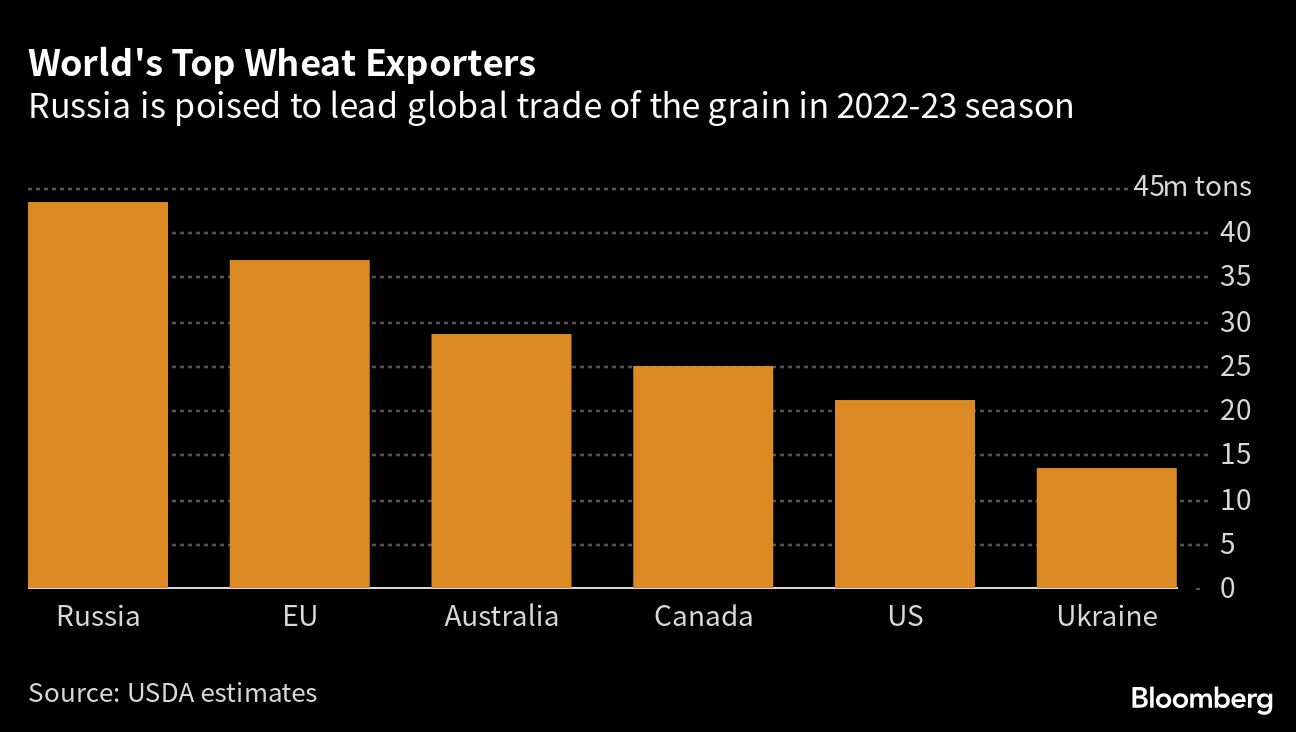
          Glencore-backed Viterra said it had concluded that its activities in Russia no longer fit the long-term direction of the company and that it was “assessing options to transfer our business and assets in Russia to new owners”. The company has ranked as the fourth-biggest wheat exporter as of February.

          State-backed companies have increased their market share in Russian wheat sales in recent years as the government expands its role in the sector. Russia’s agriculture ministry said Viterra’s withdrawal from the market will not affect Russian grain export levels and shipment capacity will continue to operate as usual.

          Chicago wheat futures headed for a sixth monthly loss on Friday.

          Eduard Zernin, head of the Russian Union of Grain Exporters, said Viterra’s local team in Russia has self-organised and plans to start its own export company. Viterra couldn’t immediately comment.

          Bloomberg earlier reported that Viterra has offered to sell half its 50% stake in a major Black Sea grain terminal to Russia’s Demetra Trading, which owns the rest, according to people familiar with the matter.

          Article Source: Theedgemarkets

          Risk Warnings and Disclaimers
          You understand and acknowledge that there is a high degree of risk involved in trading. Following any strategies or investment methods may lead to potential losses. The content on the site is provided by our contributors and analysts for information purposes only. You are solely responsible for determining whether any trading assets, securities, strategy, or any other product is suitable for investing based on your own investment objectives and financial situation.
          Comments
          Add to Favorites
          Share

          The slow American protectionist turn

          Owen Li
          In Europe and elsewhere, the adoption by the US Congress of the Inflation Reduction Act (IRA) was a thunderclap because of the protectionist nature of certain provisions allowing subsidies for vehicle electrification which are contrary to international trade law . After the Trump presidency and its tariff aberrations, the US under the Biden–Harris administration was expected to respect its multilateral commitments within the WTO.
          But this naive view ignored the fact that the shift began about 15 years ago, and that it is the product of structural forces whose actions have gradually modified the political balance in favour of trade openness that had prevailed in Washington, not without some lurching, since the 1950s.
          One can identify four of these forces, all of them specific to the US. Each one has an inflection point: 2008, 2011, 2016, and 2018.
          The first force is institutional, namely, the combination of the primacy of the legislature over the executive in the conduct of foreign trade policy with the weight of money in the electoral system and the overrepresentation of farm states in the Senate. Hence the overpowering influence of pressure groups such as the cotton, sugar, and grain growers. In 2008, the American negotiator blocked the adoption of a reduction in agricultural subsidies that would probably have paved the way for the conclusion of the Doha Round launched in 2001.
          The second force, of the same order, and also structural, is the refusal by the US, and especially Congress, of any international discipline that might not work to their advantage. Some observers thought that the creation of the WTO in 1994, with its compulsory dispute settlement mechanism, had opened a breach in this tradition. But this was without counting on the rising resentment of American lawyers who had lost cases in Geneva and who, disgruntled, obtained from the Obama administration the non-renewal in 2011 of the American judge on the WTO court of appeal, an exceptional event. This second date went unnoticed, except by a few aficionados; but it was the prelude to the Trump administration's attempt, this time in large format, to sabotage the WTO's jurisdictional system.
          The third force is the weakness of the US social security system and its inability to cushion the painful impact on some workers of technological change and open trade. This American ideological constant of a preference for more efficient and therefore more brutal capitalism has logically produced a rise in protectionist resentment in some regions harder hit than others, slowly but surely eroding both the Democratic minority and the pro-openness Republican majority that had long provided the narrow majority needed in Congress to ratify trade agreements. Hence the non-ratification of the major trans-Pacific agreement signed in 2016: this third date preceded the American withdrawal by Trump in 2017. This is also reflected in the current narrative of a trade policy “for the middle class,” a way of softening and somehow masking this hard-line version of capitalism.
          The last force is, of course, the Sino-American rivalry , which has now become structural and predominant in the American vision of the world, and whose acceleration dates from Xi Jinping's total takeover of Chinese power in 2018 when he obtained the reform of the constitutional provisions that limited the length of his reign. From a Washington point of view, the WTO is useless against China, which is why it is being deserted. The trade distortions caused by massive Chinese subsidies are rightly criticised, but neither the US nor other trading powers such as the EU or Japan have ever made a serious attempt to remedy the congenital weakness of the WTO's anti-subsidy disciplines. It is easy to see why with the aforementioned IRA. And today I’m afraid I probably lacked foresight and adopted an overly defensive attitude when, as the EU Commissioner for Trade from 1999 to 2004, I gave way to French and other Europeans concerns that the EU could suffer from a tightening of the WTO net.
          If this analysis is correct, it should be clear that the American protectionist turn has been taken for a long time and will last long, as one doesn’t see the main forces that provoked it changing direction, starting with the desire to push China back.
          This raises formidable questions for us Europeans, and probably even more so for emerging and developing countries, even though unfortunately there is little evidence of this today.
          When the world's leading economic and therefore political power, also benefiting from the international primacy of the dollar, exempts itself from a multilateral trade system that is certainly imperfect, but based on rules to give everyone a chance, and leaves room only for force, there are only two equally problematic options left. The first is to do just as the US, but without the dollar, by further hardening globalised capitalism. But this is not, fortunately from my point of view, the European tradition. The second option is to rebuild with several countries a North–South coalition promoting open trade while respecting various collective preferences, the most common of which is now environmental protection. Such a coalition would start from what already exists, but without the Americans, hoping to create a disadvantage for them that would make them change their position. This is the strategy that I would prefer.
          Risk Warnings and Disclaimers
          You understand and acknowledge that there is a high degree of risk involved in trading. Following any strategies or investment methods may lead to potential losses. The content on the site is provided by our contributors and analysts for information purposes only. You are solely responsible for determining whether any trading assets, securities, strategy, or any other product is suitable for investing based on your own investment objectives and financial situation.
          Comments
          Add to Favorites
          Share

          What happens next following Donald Trump’s indictment?

          Kevin Du
          Former United States President Donald Trump was indicted by a Manhattan grand jury in New York, prosecutors and defence lawyers said, after an investigation into payments made during his 2016 presidential campaign to silence claims of an extramarital sexual encounter.
          The indictment itself remains sealed for now in the first criminal charge against a former president in US history.
          Trump is expected to turn himself in to authorities next week, a person familiar with the matter but not authorised to discuss it publicly told the Associated Press. The person said the details of a surrender were still being worked out.
          Here’s what happened on Thursday in New York and what is expected to happen next:

          Criminal charges

          The grand jury, which meets in secret, voted to indict the 76-year-old former Republican president following an investigation led by the Manhattan District Attorney Alvin Bragg, a Democrat.
          While the indictment remains under seal, the charges against Trump are believed to relate to hush money payments made to adult film actress Stormy Daniels ahead of the 2016 presidential election.
          The grand jury, which has been meeting since January, indicted Trump after hearing testimony from a number of witnesses.
          Among those who testified were Trump’s ex-personal lawyer and fixer Michael Cohen, who has admitted arranging a $130,000 payment to Daniels to buy her silence about an affair she had with Trump in 2006.
          Trump was invited to testify in person but declined.

          Surrender

          Manhattan District Attorney Bragg’s office said it had contacted Trump’s lawyer to coordinate his surrender and arraignment in New York at a future date.
          At an arraignment, a defendant is presented with the charges facing them and generally enters a plea.
          For any New York defendant, answering criminal charges means being fingerprinted and photographed, fielding basic questions such as name and birthdate. All told, defendants are typically detained for at least several hours during the arraignment.
          CBS said the Secret Service would be in charge of the arrangements.
          A judge then decides whether they should be released on bail or taken into custody.
          If Trump indeed turns himself in, expect a carefully choreographed and relatively quick process and release.
          A former president is not likely to be paraded in cuffs across a sidewalk or through a crowded courthouse.
          Extra security has been in place for days around the Manhattan court where Trump is expected to make his first appearance.
          But there is no playbook for booking an ex-president with US Secret Service protection. Agents are tasked with the protection of former presidents unless and until they say they do not need it. Trump has kept his detail, so agents would need to be by his side at all times.

          Extradition

          Trump, who insists he is “completely innocent”, could refuse to surrender to the New York authorities, forcing them to seek his extradition from his Florida residence.
          Florida Governor Ron DeSantis, a potential Trump rival for the 2024 Republican presidential nomination, said his state would “not assist in an extradition request”.
          Legal experts said any attempt to fight extradition would at best result in a delay and Trump would eventually have to appear in New York to face the charges.

          Next judicial steps

          Once Trump is arraigned and enters a plea, there will be a series of preliminary court hearings to set a date for a trial and decide on witnesses and evidence.
          A defendant can avoid going to trial by entering into a plea agreement with prosecutors, in exchange for a lighter sentence, for example. Given Trump’s proclamations of innocence that is unlikely.

          2024 White House candidacy

          Trump can – and undoubtedly will – pursue his 2024 White House campaign despite facing criminal charges.
          Nothing in the US Constitution prevents someone from running for president while facing charges and even a conviction would not bar them from the nation’s highest office.
          The 14th Amendment does prohibit anyone who has “engaged in insurrection or rebellion” from holding elected office.
          The House of Representatives impeached Trump for “incitement of insurrection” for the January 6, 2021 attack on the US Capitol by his supporters but he was acquitted by the Senate.
          A special counsel is looking into Trump’s role in the January 6 assault on Congress and the former president could still face charges on that front.

          Source:Aljazeera

          Risk Warnings and Disclaimers
          You understand and acknowledge that there is a high degree of risk involved in trading. Following any strategies or investment methods may lead to potential losses. The content on the site is provided by our contributors and analysts for information purposes only. You are solely responsible for determining whether any trading assets, securities, strategy, or any other product is suitable for investing based on your own investment objectives and financial situation.
          Comments
          Add to Favorites
          Share

          Turkey's parliament ratifies Finland's membership in NATO

          Ukadike Micheal
          Turkey's parliament on Thursday ratified Finland's application to join NATO, lifting the last hurdle in the way of the Nordic country's long-delayed accession into the Western military alliance.
          All 276 lawmakers present voted in favor of Finland's bid, days after Hungary's parliament also endorsed Helsinki's accession.
          "This will make the whole NATO family stronger & safer," NATO Secretary General Jens Stoltenberg wrote on Twitter in welcoming Turkey's action.
          Alarmed by Russia's invasion of Ukraine a year ago, Finland and Sweden abandoned their decades-long policy of nonalignment and applied to join the alliance.
          Full unanimity is required to admit new members into the 30-member alliance, and Turkey and Hungary were the last two NATO members to ratify Finland's accession.
          Sweden's bid to join the alliance, meanwhile, has been left hanging, with both Turkey and Hungary holding out on giving it the green light despite expressing support for NATO's expansion.
          Turkey's government accuses Sweden of being too lenient toward groups it deems to be terrorist organizations and security threats, including militant Kurdish groups and people associated with a 2016 coup attempt.
          More recently, Turkey was angered by a series of demonstrations in Sweden, including a protest by an anti-Islam activist who burned the Quran outside the Turkish Embassy.
          Hungary's government contends some Swedish politicians have made derisive statements about the condition of Hungary's democracy and played an active role in ensuring that billions in European Union funds were frozen over alleged rule-of-law and democracy violations.
          Turkish officials have said that unlike Sweden, Finland fulfilled its obligations under a memorandum signed last year under which the two countries pledged to address Turkey's security concerns.
          "As a NATO member, we naturally had some expectations and requests regarding the security concerns of our country," Akif Cagatay Kilic, a legislator from President Recep Tayyip Erdogan's governing party, told parliament before the vote. "I would like to underline the concrete steps and their implementation by Finland, which supported and shaped the decision we are taking here."
          Kilic added: "I'm aware that there is a large number of people watching us from Finland. ... We can say to them: 'Welcome to NATO.'"
          Some opposition parties were critical of the Turkish government's position toward the two Nordic countries.
          "Unfortunately, (Erdogan's ruling party) turned the right to veto Finland and Sweden's membership bids into a tool for blackmail and threat. We do not approve of it," said Hisyar Ozsoy, a legislator from the pro-Kurdish party. "We find the bargaining process (to press for) the extradition of Kurdish dissident writers, politicians and journalists ... to be ugly, wrong and unlawful."
          Asked earlier this week about Sweden's NATO membership, Erdogan told reporters: "There are certain things we expect of them. They must be fulfilled first."
          Sweden, which made constitutional changes to pass tougher anti-terrorism laws, has expressed hope that it will be able to join before NATO's July summit in Vilnius, Lithuania.
          "Sweden faces more significant obstacles in its bid," Hamish Kinnear, Middle East and North Africa analyst at the risk intelligence company Verisk Maplecroft, wrote in emailed comments.
          "Turkey is unlikely to approve its acceptance into the alliance before the election in May. The Quran burning incident sparked popular rage in Turkey and President Tayyip Recep Erdogan won't want to risk angering his conservative base ahead of the polls," Kinnear said.
          The accession of Finland, which has a 1,340-kilometer (832-mile) border with Russia, has geographic and political importance for NATO, said Mai'a Cross, professor of political science at Northeastern University.
          "Finland is at a very important strategic location and having that kind of shift from neutrality to respond to Russia's aggression is bolstering the demonstration of the political will of NATO," she said.
          Cross added that the delay gave Finland more of a chance to prepare.
          "Finland is already sitting in the meetings with NATO. It's already revamping its armed forces," she said. "So when it steps into NATO formally, it can actually hit the ground running."

          Source:NIKKEI ASia

          Risk Warnings and Disclaimers
          You understand and acknowledge that there is a high degree of risk involved in trading. Following any strategies or investment methods may lead to potential losses. The content on the site is provided by our contributors and analysts for information purposes only. You are solely responsible for determining whether any trading assets, securities, strategy, or any other product is suitable for investing based on your own investment objectives and financial situation.
          Comments
          Add to Favorites
          Share

          How Will BTC Price React to CME Bitcoin Futures Expiration?

          Thomas
          On March 31, an estimated 8,171 Bitcoin futures contracts will be closed and settled on the Chicago Mercantile Exchange.
          The last open price taken on March 30 was $28,355, marginally higher than Bitcoin’s current price of $28,182.
          The CME reported a volume of 16,139 contracts as of March 29 and an open interest (OI) of 13,971. OI is a measure of the total number of outstanding futures contracts that have not been settled.How Will BTC Price React to CME Bitcoin Futures Expiration?_1
          According to Deribit, the total open interest (OI) for all BTC futures contracts is almost $300 million. This is much lower than previous peaks of over $1 billion, suggesting that there will be minimal impact on BTC spot prices.How Will BTC Price React to CME Bitcoin Futures Expiration?_2

          Bitcoin Futures Remain Bullish

          Furthermore, TradingView is displaying a buy signal for CME Bitcoin futures, suggesting that derivatives markets are still bullish.
          Analysts have observed that there was a close on the five-day CME Futures chart above the medium band on the Gaussian channel. This is bullish and could lead to a next level of around $33,000, according to one analyst.
          Another noted that the CME Bitcoin futures gap had been closed, and a new one was forming. The gap refers to the difference in BTC and CME contract prices that forms over the weekend when the exchange closes. Furthermore, these CME gaps have a tendency to get “filled” as the market corrects back into the gap.
          Earlier this month, the CME Group announced the trading of Event Contracts on Bitcoin futures. The cash-settled, daily expiring contracts will further complement the existing suite of ten event contracts, said Tim McCourt, Global Head of Equity at CME Group.

          BTC Price Outlook

          Bitcoin is currently in a short-term bullish pattern. Therefore, the futures contract’s expiry is unlikely to have a major impact on markets.
          On the daily time frame, BTC has dropped 1.4% in a fall to $28,185. However, it remains up 12% over the past fortnight.How Will BTC Price React to CME Bitcoin Futures Expiration?_3
          The asset has recovered all losses from the FUD regarding the CFTC Binance lawsuit earlier this week. On March 28, it fell to $26,770 but quickly rebounded.
          Major resistance still lies around $30,000, so this is the target for further upsides.

          Source:CryptoNews

          Risk Warnings and Disclaimers
          You understand and acknowledge that there is a high degree of risk involved in trading. Following any strategies or investment methods may lead to potential losses. The content on the site is provided by our contributors and analysts for information purposes only. You are solely responsible for determining whether any trading assets, securities, strategy, or any other product is suitable for investing based on your own investment objectives and financial situation.
          Comments
          Add to Favorites
          Share

          Pension reform in France: Diagnosis of a crisis

          Alex
          France has once again been the theater of strikes, demonstrations and blockades for the past few weeks. This time, the aim of the popular anger is a proposed pension reform package. As announced by President Emmanuel Macron last year, in January the French government launched changes to part of its pension schemes, then debated the measure in parliament and eventually imposed it via special constitutional tools. If France’s Constitutional Council allows it, the law will be enacted.
          In a February survey, 67 percent of respondents were against the reform. The effort is a test of Mr. Macron’s ability to implement changes, as well as an opportunity for the country to reflect on its deeper difficulties to reform overall. At the same time, while a popular majority seems to be against the policy, some experts doubt its potential effectiveness, as it leaves some options off the table and does not seriously deal with the financing of pensions for government staff, a substantial part of the workforce.

          PAYGO system

          The pay-as-you-go (PAYGO) system covering private sector workers has become unsustainable, thanks to an aging population due to longer life expectancy (up 12 years since the 1960s), falling birthrates for half a century and the retirement of baby boomers. The reduction of the legal retirement age from 65 to 60 in 1983 – initiated by President Francois Mitterrand in 1981 against all demographic trends, but rather for political aims – made the problem even worse. (Subsequent “reforms” then raised it back to 62.) Nationally, the number of current contributors for one pensioner in France has shrunk from 4 in the 1960s to just 1.7.
          In a PAYGO system, present pensioners receive payments from current workers’ contributions, collected via payroll taxes. The growing demographic imbalances therefore mean either increased labor costs due to higher contributions; worsening deficits of pension accounts (or of government budgets) to preserve paid pensions; or smaller pensions. To compensate, reforms over the past three decades have been a mix of increasing contributions, raising the number of years for compulsory contributions and postponing the legal retirement age.
          According to the Council on the Future of Pensions (COR), while the system has been in excess for the past two years thanks to a post-Covid boom, deficits will return and increase from 0.1 percent of gross domestic product (GDP) to 0.4 in 2030, and 0.8 percent in 2050. The government has presented even more worrying trends. Some economists (such as those at the Molinari Economic Institute) also note that the COR estimate does not even include civil servants’ pensions, which generate a large additional deficit. The prospects are gloomy, but if today’s reform seems bolder in some respects, it is still in line with past efforts.

          Retirement age

          As in reform efforts in other countries, the policy’s most significant measure is to gradually push back the legal retirement age – from 62 to 64 by 2030. The maximum number of years of work would be 44, and people with “long careers” who started working young could retire at 60 under certain conditions. Sixty-seven remains the maximum age for a “full rate” pension. Minimum pension amounts would be raised (although there has been some confusion in government communications about how many people would benefit). For independent workers, contribution calculations would be simplified. Another measure is to enable retired citizens who want to return to work to contribute to their later pensions (to be augmented when they retire again), incentivizing seniors to work.
          Another nontrivial aspect is the ending of several generous special schemes, such as the pension funds for electric utility workers or Paris bus and metro workers. Some of these currently end up being subsidized by others, as France does not have a monolithic pension system. After many years of reluctance to reform these schemes – a politically sensitive effort given the blocking power of such workers – they will now be integrated into a general scheme for newly-hired workers. However, autonomous schemes such as that of the Senate have not been affected by the reform.

          Not far enough?

          While such moves seem bold given France’s recent history of pension reform, some experts still see the changes as disappointing. It seems clear that, despite wishful thinking about intergenerational solidarity, the “welfare rights” of some will have to be paid for by others. A truly systemic reform would have to seriously promote funded schemes, which some economists had hoped would be part of the current package. This structure is known as capitalisation in French, which probably sounds too close to “capitalism” – a red flag in a solidly anti-capitalist country. Ironically, government staff have been using such (additional) pension funds for the past two decades; two institutions, the Senate and the Banque de France, have partially made use of them, with great success and to the taxpayer’s benefit.
          Pensions based on savings – either through special interest-bearing accounts, financial products, life insurance or real estate investment – have several advantages. They preserve the freedom of choice of each worker and encourage personal responsibility. They are generally viewed as more productive, first because they generate interest or other revenue over time, making capital grow; and second, because they partly contribute to the financing of the economy. They can be risky, and mistakes can be made, which requires wise management. But they appear to be a necessary pillar in an aging society that cannot rely only on unsustainable PAYGO systems.
          A second reason for disappointment in the current platform is that pensions for government staff, currently financed by the government budget, have not been reformed (except for the age-64 change already imposed). They represent a huge chunk of pension spending, but it goes largely unnoticed because these programs are paid for from the government’s budget. However, partly due to the generosity of their system, the cost is very high: pension payroll taxes represent 85 percent of wages in the government sector versus 28 percent in the private sector, according to the Molinari Institute. In fact, these government staff payroll taxes are paid by ordinary taxpayers. Comparing the two different contribution rates (a gap of 57 percentage points), the researchers found a hidden annual subsidy of about 30 billion euros to government worker pensions. Taking this into account means that the pension deficit is much higher than it seems – and, accordingly, needs further reform.

          A national habit

          The plan has another, perhaps more problematic dimension. France is well-known for a curious disease: reformitis, a condition characterized by constant reforms. In one amusing illustration, France has regularly had a “Ministry of State Reform” over the past three decades. Reforms therefore look very much like a facade: “the more things change …” As happens every decade or so, the 2023 pension reform is essentially incremental: keeping most French wage earners (in the private sector) in a PAYGO system, and expressly staying away from privately funded schemes or from government staff pension reform.
          Real reform would mean more. It would have to address the focal points of France’s challenges: a social model based on the unequal granting of special rights, and mechanisms of fiscal illusion. The present anger, seen both in parliament and on the streets, shows that one important task is to reform a system incapable of reform.

          Other people’s money

          Some groups have been quick to invoke the magic word “solidarity” to justify the preservation of their benefits. France’s social model, just like its administrative model, is a hybrid of centralized government and supposedly local freedom: the government decides trade-offs between competing “social demands.” Not only does this competition for privileges create mistrust within civil society, but it fails to foster responsibility.
          Mr. Macron has now, in a way, addressed this by suppressing special pension schemes and a centralization (or homogenization) of pension schemes, in a quite republican fashion. However, from a democratic point of view, the issue is not that there are different schemes or “rights” (after all, democracy is about diversity); but rather that some, more vocal groups are financed by other people’s money, channeled by the government. Some of these special schemes were in fact managed wisely. Given the usual government mismanagement, homogenization and centralization is probably not good news, however republican it may be.

          Democratic transparency

          The second problem is that because of fiscal illusion, this first issue often goes unseen. Complex financing flows and hidden contribution figures prevent workers from knowing what they pay for their pension (and healthcare, etc.). Simply comparing with possible alternative systems becomes difficult. And, given that some schemes have been subsidized by taxpayer money and that fiscal illusion is present in the tax system, the problem gets worse.
          This opacity explains why the French always seem to be against reform: they cannot be democratically included in decision-making if there is no transparency, and they cannot really have knowledge of what is at stake. Citizens are forced to rely on government experts’ reports to paternalistically tell them what is good. Genuine, informed “democratic” reform is almost impossible.
          In the current case, the government has used two special procedures: accelerating debates in the Senate, and using the special Article 49.3 of the constitution to impose the pension law at the National Assembly. This risked a no-confidence vote, which failed on March 20, just nine votes short of a majority against the government. For many citizens, these decisions have done even more to cast the effort as an anti-democratic imposition by the executive on both the parliament and the public.

          Source:GisreportsOnline

          Risk Warnings and Disclaimers
          You understand and acknowledge that there is a high degree of risk involved in trading. Following any strategies or investment methods may lead to potential losses. The content on the site is provided by our contributors and analysts for information purposes only. You are solely responsible for determining whether any trading assets, securities, strategy, or any other product is suitable for investing based on your own investment objectives and financial situation.
          Comments
          Add to Favorites
          Share

          Republican Senator Rand Paul blocks bid to ban TikTok in US

          Glendon
          US Senator Rand Paul has blocked a bid to fast-track a ban of TikTok, citing concerns about free speech and uneven treatment of social media companies.
          The app, which was founded by Chinese entrepreneurs, has more than 150 million monthly users in the United States, mostly young people.
          “I think we should beware of those who use fear to coax Americans to relinquish our liberties,” Paul, a Republican, said on the Senate floor on Wednesday. “Every accusation of data gathering that has been attributed to TikTok could also be attributed to domestic big tech companies.”
          Republican Senator Josh Hawley had sought unanimous consent for a TikTok ban bill.
          “It protects the American people and it sends a message to Communist China that you cannot buy us,” Hawley had said, alleging that the app was spying on people in the US.
          TikTok says it has spent more than $1.5bn on rigorous data security efforts and rejects spying allegations. Last week, its chief executive officer, Shou Zi Chew, appeared before Congress and faced tough questions about national security concerns over the app.
          At the hearing, Chew attempted to dispel concerns over TikTok’s ties to the Chinese government and its alleged inability to stem “harmful” content. He also sought to portray the app as “a place where people can be creative and curious” and said the company was taking actions that go beyond industry standards in terms of data protection and transparency.
          House Speaker Kevin McCarthy, a Republican, said last week he expects the house will take up a bill to address TikTok but the timing is unclear. It is also not clear what a final bill to address TikTok might look like.
          A small but growing number of Democrats and Republicans have raised concerns, citing free speech and other issues, and have objected to legislation targeting TikTok as overly broad.
          “If Republicans want to continuously lose elections for a generation they should pass this bill to ban TikTok,” Paul said during his Senate speech. “Do we really want to emulate Chinese speech bans?” he added. “We’re going to be just like China and ban speech we’re afraid of?”
          On Friday, Democratic Representative Alexandria Ocasio-Cortez in a TikTok video had also opposed a ban, as do free-speech groups such as the American Civil Liberties Union.
          Calling such a move “unprecedented”, Ocasio-Cortez said Congress has not gotten classified TikTok briefings. “It just doesn’t feel right to me,” she said.
          Earlier this month, the administration of President Joe Biden, a Democrat, demanded TikTok’s Chinese owners divest their stakes or face a US ban. In 2020, attempts by then-Republican President Donald Trump to ban TikTok were blocked by US courts.
          Many Democrats argue Congress should pass comprehensive privacy legislation covering all social media sites, not just TikTok.
          Senators Mark Warner, a Democrat, and Republican John Thune have proposed the RESTRICT Act, which now has 22 Senate cosponsors, to give the Commerce Department the power to impose restrictions up to and including banning TikTok and other technologies that pose national security risks. It would apply to foreign technologies from China, Russia, North Korea, Iran, Venezuela and Cuba.
          Paul said the bill “would basically be a limitless authority for the president to ban speech”.
          A growing number of conservatives oppose the measure. Former Republican Representative Justin Amash said the “RESTRICT Act isn’t about banning TikTok; it’s about controlling you. It gives broad powers to the executive branch, with few checks, and will be abused in every way you can imagine.”
          A string of governments and institutions in recent weeks have taken action to limit TikTok’s use. Among them are the White House, the UK parliament, the Dutch and Belgian administrations, the New Zealand parliament, and the governments of Canada, India, Pakistan, Taiwan and Jordan.
          At the same time, US lawmakers are weighing the renewal of powers that force US tech giants such as Google, Meta and Apple to facilitate unlimited spying on non-US citizens abroad.
          Section 702 of the Foreign Intelligence Surveillance Act, which the US Congress must vote to reauthorise by December to prevent it from lapsing under a sunset clause, allows US intelligence agencies to carry out warrantless spying on foreigners’ email, phone and other online communications.
          While US citizens have some protections against warrantless searches under the Constitution, the government has maintained that these rights do not extend to foreigners overseas, giving its agencies practically free rein to snoop on their communications. Information may also be turned over to US allies like the United Kingdom and Australia.
          “It is a case of ‘rules for thee but not for me,’” Asher Wolf, a tech researcher and privacy advocate based in Melbourne, Australia, told Al Jazeera.
          “So the noise the Americans are making about TikTok must be seen less as a sincere desire to protect citizens from surveillance and influence operations, and more as an attempt to ring-fence and consolidate national control over social media,” Wolf said.

          SOURCE: AL JAZEERA AND NEWS AGENCIES

          Risk Warnings and Disclaimers
          You understand and acknowledge that there is a high degree of risk involved in trading. Following any strategies or investment methods may lead to potential losses. The content on the site is provided by our contributors and analysts for information purposes only. You are solely responsible for determining whether any trading assets, securities, strategy, or any other product is suitable for investing based on your own investment objectives and financial situation.
          Comments
          Add to Favorites
          Share
          FastBull
          Copyright © 2025 FastBull Ltd

          728 RM B 7/F GEE LOK IND BLDG NO 34 HUNG TO RD KWUN TONG KLN HONG KONG

          TelegramInstagramTwitterfacebooklinkedin
          App Store Google Play Google Play
          Products
          Charts

          Chats

          Q&A with Experts
          Screeners
          Economic Calendar
          Data
          Tools
          Membership
          Features
          Function
          Markets
          Copy Trading
          Latest Signals
          Contests
          News
          Analysis
          24/7
          Columns
          Education
          Company
          Careers
          About Us
          Contact Us
          Advertising
          Help Center
          Feedback
          User Agreement
          Privacy Policy
          Business

          White Label

          Data API

          Web Plug-ins

          Poster Maker

          Affiliate Program

          Risk Disclosure

          The risk of loss in trading financial instruments such as stocks, FX, commodities, futures, bonds, ETFs and crypto can be substantial. You may sustain a total loss of the funds that you deposit with your broker. Therefore, you should carefully consider whether such trading is suitable for you in light of your circumstances and financial resources.

          No decision to invest should be made without thoroughly conducting due diligence by yourself or consulting with your financial advisors. Our web content might not suit you since we don't know your financial conditions and investment needs. Our financial information might have latency or contain inaccuracy, so you should be fully responsible for any of your trading and investment decisions. The company will not be responsible for your capital loss.

          Without getting permission from the website, you are not allowed to copy the website's graphics, texts, or trademarks. Intellectual property rights in the content or data incorporated into this website belong to its providers and exchange merchants.

          Not Logged In

          Log in to access more features

          FastBull Membership

          Not yet

          Purchase

          Become a signal provider
          Help Center
          Customer Service
          Dark Mode
          Price Up/Down Colors

          Log In

          Sign Up

          Position
          Layout
          Fullscreen
          Default to Chart
          The chart page opens by default when you visit fastbull.com
