• Trade
  • Markets
  • Copy
  • Contests
  • News
  • 24/7
  • Calendar
  • Q&A
  • Chats
Trending
Screeners
SYMBOL
LAST
BID
ASK
HIGH
LOW
NET CHG.
%CHG.
SPREAD
SPX
S&P 500 Index
6827.42
6827.42
6827.42
6899.86
6801.80
-73.58
-1.07%
--
DJI
Dow Jones Industrial Average
48458.04
48458.04
48458.04
48886.86
48334.10
-245.98
-0.51%
--
IXIC
NASDAQ Composite Index
23195.16
23195.16
23195.16
23554.89
23094.51
-398.69
-1.69%
--
USDX
US Dollar Index
97.950
98.030
97.950
98.500
97.950
-0.370
-0.38%
--
EURUSD
Euro / US Dollar
1.17394
1.17409
1.17394
1.17496
1.17192
+0.00011
+ 0.01%
--
GBPUSD
Pound Sterling / US Dollar
1.33707
1.33732
1.33707
1.33997
1.33419
-0.00148
-0.11%
--
XAUUSD
Gold / US Dollar
4299.39
4299.39
4299.39
4353.41
4257.10
+20.10
+ 0.47%
--
WTI
Light Sweet Crude Oil
57.233
57.485
57.233
58.011
56.969
-0.408
-0.71%
--

Community Accounts

Signal Accounts
--
Profit Accounts
--
Loss Accounts
--
View More

Become a signal provider

Sell trading signals to earn additional income

View More

Guide to Copy Trading

Get started with ease and confidence

View More

Signal Accounts for Members

All Signal Accounts

Best Return
  • Best Return
  • Best P/L
  • Best MDD
Past 1W
  • Past 1W
  • Past 1M
  • Past 1Y

All Contests

  • All
  • Trump Updates
  • Recommend
  • Stocks
  • Cryptocurrencies
  • Central Banks
  • Featured News
Top News Only
Share

USA Embassy In Lithuania: Maria Kalesnikava Is Not Going To Vilnius

Share

USA Embassy In Lithuania: Other Prisoners Are Being Sent From Belarus To Ukraine

Share

Ukraine President Zelenskiy: Five Ukrainians Released By Belarus In US-Brokered Deal

Share

USA Vilnius Embassy: USA Stands Ready For "Additional Engagement With Belarus That Advances USA Interests"

Share

USA Vilnius Embassy: Belarus, USA, Other Citizens Among The Prisoners Released Into Lithuania

Share

USA Vilnius Embassy: USA Will Continue Diplomatic Efforts To Free The Remaining Political Prisoners In Belarus

Share

USA Vilnius Embassy: Belarus Releases 123 Prisoners Following Meeting Of President Trump's Envoy Coale And Belarus President Lukashenko

Share

USA Vilnius Embassy: Masatoshi Nakanishi, Aliaksandr Syrytsa Are Among The Prisoners Released By Belarus

Share

USA Vilnius Embassy: Maria Kalesnikava And Viktor Babaryka Are Among The Prisoners Released By Belarus

Share

USA Vilnius Embassy: Nobel Peace Prize Laureate Ales Bialiatski Is Among The Prisoners Released By Belarus

Share

Belarusian Presidential Administration Telegram Channel: Lukashenko Has Pardoned 123 Prisoners As Part Of Deal With US

Share

Two Local Syrian Officials: Joint US-Syrian Military Patrol In Central Syria Came Under Fire From Unknown Assailants

Share

Israeli Military Says It Targeted 'Key Hamas Terrorist' In Gaza City

Share

Rwanda's Actions In Eastern Drc Are A Clear Violation Of Washington Accords Signed By President Trump - Secretary Of State Rubio

Share

Israeli Military Issues Evacuation Warning In Southern Lebanon Village Ahead Of Strike - Spokesperson On X

Share

Belarusian State Media Cites US Envoy Coale As Saying He Discussed Ukraine And Venezuela With Lukashenko

Share

Belarusian State Media Cites US Envoy Coale As Saying That US Removes Sanctions On Belarusian Potassium

Share

Thai Prime Minister: No Ceasefire Agreement With Cambodia

Share

US, Ukraine To Discuss Ceasefire In Berlin Ahead Of European Summit

Share

Incoming Czech Prime Minister Babis: Czech Republic Will Not Take On Guarantees For Ukraine Financing, European Commission Must Find Alternatives

TIME
ACT
FCST
PREV
U.K. Trade Balance Non-EU (SA) (Oct)

A:--

F: --

P: --

U.K. Trade Balance (Oct)

A:--

F: --

P: --

U.K. Services Index MoM

A:--

F: --

P: --

U.K. Construction Output MoM (SA) (Oct)

A:--

F: --

P: --

U.K. Industrial Output YoY (Oct)

A:--

F: --

P: --

U.K. Trade Balance (SA) (Oct)

A:--

F: --

P: --

U.K. Trade Balance EU (SA) (Oct)

A:--

F: --

P: --

U.K. Manufacturing Output YoY (Oct)

A:--

F: --

P: --

U.K. GDP MoM (Oct)

A:--

F: --

P: --

U.K. GDP YoY (SA) (Oct)

A:--

F: --

P: --

U.K. Industrial Output MoM (Oct)

A:--

F: --

P: --

U.K. Construction Output YoY (Oct)

A:--

F: --

P: --

France HICP Final MoM (Nov)

A:--

F: --

P: --

China, Mainland Outstanding Loans Growth YoY (Nov)

A:--

F: --

P: --

China, Mainland M2 Money Supply YoY (Nov)

A:--

F: --

P: --

China, Mainland M0 Money Supply YoY (Nov)

A:--

F: --

P: --

China, Mainland M1 Money Supply YoY (Nov)

A:--

F: --

P: --

India CPI YoY (Nov)

A:--

F: --

P: --

India Deposit Gowth YoY

A:--

F: --

P: --

Brazil Services Growth YoY (Oct)

A:--

F: --

P: --

Mexico Industrial Output YoY (Oct)

A:--

F: --

P: --

Russia Trade Balance (Oct)

A:--

F: --

P: --

Philadelphia Fed President Henry Paulson delivers a speech
Canada Building Permits MoM (SA) (Oct)

A:--

F: --

P: --

Canada Wholesale Sales YoY (Oct)

A:--

F: --

P: --

Canada Wholesale Inventory MoM (Oct)

A:--

F: --

P: --

Canada Wholesale Inventory YoY (Oct)

A:--

F: --

P: --

Canada Wholesale Sales MoM (SA) (Oct)

A:--

F: --

P: --

Germany Current Account (Not SA) (Oct)

A:--

F: --

P: --

U.S. Weekly Total Rig Count

A:--

F: --

P: --

U.S. Weekly Total Oil Rig Count

A:--

F: --

P: --

Japan Tankan Large Non-Manufacturing Diffusion Index (Q4)

--

F: --

P: --

Japan Tankan Small Manufacturing Outlook Index (Q4)

--

F: --

P: --

Japan Tankan Large Non-Manufacturing Outlook Index (Q4)

--

F: --

P: --

Japan Tankan Large Manufacturing Outlook Index (Q4)

--

F: --

P: --

Japan Tankan Small Manufacturing Diffusion Index (Q4)

--

F: --

P: --

Japan Tankan Large Manufacturing Diffusion Index (Q4)

--

F: --

P: --

Japan Tankan Large-Enterprise Capital Expenditure YoY (Q4)

--

F: --

P: --

U.K. Rightmove House Price Index YoY (Dec)

--

F: --

P: --

China, Mainland Industrial Output YoY (YTD) (Nov)

--

F: --

P: --

China, Mainland Urban Area Unemployment Rate (Nov)

--

F: --

P: --

Saudi Arabia CPI YoY (Nov)

--

F: --

P: --

Euro Zone Industrial Output YoY (Oct)

--

F: --

P: --

Euro Zone Industrial Output MoM (Oct)

--

F: --

P: --

Canada Existing Home Sales MoM (Nov)

--

F: --

P: --

Euro Zone Total Reserve Assets (Nov)

--

F: --

P: --

U.K. Inflation Rate Expectations

--

F: --

P: --

Canada National Economic Confidence Index

--

F: --

P: --

Canada New Housing Starts (Nov)

--

F: --

P: --

U.S. NY Fed Manufacturing Employment Index (Dec)

--

F: --

P: --

U.S. NY Fed Manufacturing Index (Dec)

--

F: --

P: --

Canada Core CPI YoY (Nov)

--

F: --

P: --

Canada Manufacturing Unfilled Orders MoM (Oct)

--

F: --

P: --

Canada Manufacturing New Orders MoM (Oct)

--

F: --

P: --

Canada Core CPI MoM (Nov)

--

F: --

P: --

Canada Manufacturing Inventory MoM (Oct)

--

F: --

P: --

Canada CPI YoY (Nov)

--

F: --

P: --

Canada CPI MoM (Nov)

--

F: --

P: --

Canada CPI YoY (SA) (Nov)

--

F: --

P: --

Canada Core CPI MoM (SA) (Nov)

--

F: --

P: --

Q&A with Experts
    • All
    • Chatrooms
    • Groups
    • Friends
    Connecting
    .
    .
    .
    Type here...
    Add Symbol or Code

      No matching data

      All
      Trump Updates
      Recommend
      Stocks
      Cryptocurrencies
      Central Banks
      Featured News
      • All
      • Russia-Ukraine Conflict
      • Middle East Flashpoint
      • All
      • Russia-Ukraine Conflict
      • Middle East Flashpoint
      Search
      Products

      Charts Free Forever

      Chats Q&A with Experts
      Screeners Economic Calendar Data Tools
      Membership Features
      Data Warehouse Market Trends Institutional Data Policy Rates Macro

      Market Trends

      Market Sentiment Order Book Forex Correlations

      Top Indicators

      Charts Free Forever
      Markets

      News

      News Analysis 24/7 Columns Education
      From Institutions From Analysts
      Topics Columnists

      Latest Views

      Latest Views

      Trending Topics

      Top Columnists

      Latest Update

      Signals

      Copy Rankings Latest Signals Become a signal provider AI Rating
      Contests
      Brokers

      Overview Brokers Assessment Rankings Regulators News Claims
      Broker listing Forex Brokers Comparison Tool Live Spread Comparison Scam
      Q&A Complaint Scam Alert Videos Tips to Detect Scam
      More

      Business
      Events
      Careers About Us Advertising Help Center

      White Label

      Data API

      Web Plug-ins

      Affiliate Program

      Awards Institution Evaluation IB Seminar Salon Event Exhibition
      Vietnam Thailand Singapore Dubai
      Fans Party Investment Sharing Session
      FastBull Summit BrokersView Expo
      Recent Searches
        Top Searches
          Markets
          News
          Analysis
          User
          24/7
          Economic Calendar
          Education
          Data
          • Names
          • Latest
          • Prev

          View All

          No data

          Scan to Download

          Faster Charts, Chat Faster!

          Download App
          English
          • English
          • Español
          • العربية
          • Bahasa Indonesia
          • Bahasa Melayu
          • Tiếng Việt
          • ภาษาไทย
          • Français
          • Italiano
          • Türkçe
          • Русский язык
          • 简中
          • 繁中
          Open Account
          Search
          Products
          Charts Free Forever
          Markets
          News
          Signals

          Copy Rankings Latest Signals Become a signal provider AI Rating
          Contests
          Brokers

          Overview Brokers Assessment Rankings Regulators News Claims
          Broker listing Forex Brokers Comparison Tool Live Spread Comparison Scam
          Q&A Complaint Scam Alert Videos Tips to Detect Scam
          More

          Business
          Events
          Careers About Us Advertising Help Center

          White Label

          Data API

          Web Plug-ins

          Affiliate Program

          Awards Institution Evaluation IB Seminar Salon Event Exhibition
          Vietnam Thailand Singapore Dubai
          Fans Party Investment Sharing Session
          FastBull Summit BrokersView Expo

          Russia the Driver Behind China's Aluminium Import Boom

          Owen Li

          Commodity

          Summary:

          China's imports of unwrought aluminium more than doubled year-on-year in 2023 and were the second highest annual total since the start of the century.

          China's imports of unwrought aluminium more than doubled year-on-year in 2023 and were the second highest annual total since the start of the century.
          Primary metal imports surged to 1.54 million metric tons from 668,000 tons in 2022, but fell just short of the record 1.58 tally accumulated over 2021.
          The big difference between the 2021 and 2023 peaks was the composition of the inbound shipments.
          Russian metal accounted for just 18% of 2021 volumes, a ratio that jumped to 76% last year as penal import duties in the U.S. and self-sanctioning in parts of Europe disrupted previous Russian trade patterns.
          Russia and China are becoming increasingly dependent on each other in the aluminium market.
          But can China, the world's largest aluminium producer, keep soaking up what others do not want? The London Metal Exchange (LME) can only hope so.
          Russia the Driver Behind China's Aluminium Import Boom_1Mutual dependence
          Indian-brand aluminium accounted for the lion's share of 2021's bumper imports. Volumes of 855,000 tons accounted for more than half of total inbound shipments.
          Chinese imports of Russian-brand aluminium, by contrast, totalled a relatively modest 291,000 tons in what was the last full year of trade before the February 2022 invasion of Ukraine.
          Flows of Russian material rose to 462,000 tons in 2022 and then leapt to 1.18 million tons last year. Imports of Indian metal dropped to just 98,000 tons over the same time-frame.
          Russia has also been exporting more unwrought aluminium alloy to China. While total Chinese alloy imports slid by 11% last year relative to 2022, imports of Russian material rose by 11% to 63,000 tons. Last year's tally was nearly double that of 2021.
          Some of the metal moving from Russia to China has been smelted from Chinese alumina, the intermediate product between bauxite and refined metal in the production chain.
          Russian aluminium giant Rusal lost access to its Ukrainian refinery and its joint venture Australian plant shortly after the launch of Vladimir Putin's "special military operation".
          The company has become increasingly reliant on Chinese supply, cementing the dependency with the purchase last October of a 30% stake in Hebei Wenfeng New Materials, which operates a recently built alumina refinery with annual capacity of 4.8 million tons.
          Just as Rusal metal dominates China's imports of primary aluminium, the company also accounts for a large part of China's alumina exports.
          Shipments to Russia came to 1.12 million tons last year, representing 88% of total export flows. The two countries' alumina trade amounted to a paltry 1,747 tons in 2021.
          Indeed, without the Russian connection it's doubtful China would be exporting much alumina at all, given recent signs of stress in that part of its production sector.
          Russia the Driver Behind China's Aluminium Import Boom_2Market Of Last Resort
          China is absorbing Russian metal that would otherwise be piling up in Western warehouses.
          The London Metal Exchange (LME), which has historically been the market of last resort for unsold metal, is already sitting on high stocks of Russian material.
          There were 338,375 tons of Russian aluminium on LME warrant at the end of December, amounting to 90% of total registered inventory.
          The high ratio has re-ignited the simmering dispute over whether the exchange should suspend Russian brands rather than tweaking its delivery rules to allow for unilateral government sanctions such as the U.S. import duties.
          Quite evidently, the LME's dilemma would be much more acute were not around a quarter of Rusal's production heading to China.
          New normal?
          Is this Sino-Russian trade the new normal? It looks likely, as long as China can keep absorbing such large inflows of primary metal.
          China accounted for 59% of global aluminium production last year, but output growth has slowed from the double-digit pace of the 2000s to 4% in 2021 and 2022 and just 3% last year.
          Annual production capacity has crept close to the government's cap of 45 million tonnes, meaning few new smelters are being built, and run-rates have been regularly impacted by a lack of hydro power in drought-hit provinces such as Yunnan.
          Meanwhile consumption from energy transition sectors seems to be robust, in part thanks to strong exports of new-energy technology such as solar panels.
          There is no evidence of any massive surplus in the mainland market. Stocks registered with the Shanghai Futures Exchange stand at a modest 101,537 tons.
          Exports of semi-fabricated products, historically a tell-tale sign of a domestic market glut, fell by 12% last year relative to 2022.
          It is of course possible that part of what was "imported" last year is now sitting in a Chinese bonded warehouse.
          The official customs statistics do not differentiate between metal imported for a Chinese consumer and metal going into long-term storage to be used as collateral.
          Either way, however, it's good news for the LME and for the Western market as a whole.
          Trading Russian metal is becoming more difficult as Western policymakers turn the sanctions screws. Britain has banned its citizens from physically dealing in Russian metal, which is a big headache for an exchange based in London.
          There are also growing calls for the European Union to ratchet up the economic pressure on Russia by extending sanctions on Russian aluminium from specialised products to primary metal.
          It looks as if Russian aluminium, which has so far avoided a blanket sanction ban, is going to be ever more difficult a sell to Western users.
          It's not just Rusal that will be hoping Chinese consumers don't lose their appetite for imported aluminium.

          Source: Reuters

          Risk Warnings and Disclaimers
          You understand and acknowledge that there is a high degree of risk involved in trading. Following any strategies or investment methods may lead to potential losses. The content on the site is provided by our contributors and analysts for information purposes only. You are solely responsible for determining whether any trading assets, securities, strategy, or any other product is suitable for investing based on your own investment objectives and financial situation.
          Comments
          Add to Favorites
          Share

          China PMIs, U.S. Fed Statement Will Test Growth Outlooks

          Devin

          Economic

          Wednesday will bring prompt tests of the just-released International Monetary Fund upgrades of U.S. and Chinese growth outlooks that could should set the tone for markets, starting with Asia on Wednesday.
          The IMF on Tuesday adjusted its forecast for 2024 global growth upward amid a stabilized inflation outlook, and said a "soft landing" was in sight. While IMF's World Economic Outlook may not be the biggest market mover, it threw down a marker for the two most important economies, raising the GDP growth rate outlook for China to 4.6% from 4.1% and the U.S. to 2.1% from 1.5%.China PMIs, U.S. Fed Statement Will Test Growth Outlooks_1
          Chinese official manufacturing PMIs for January on Wednesday will give insight as to how on-target the IMF might be, and can help set the tone for local stock markets and beyond. In December the purchasing manager's index fell to 49.0 from 49.4, below the 50.0 expansion/contraction threshold.
          Industrial output reports are also due from Japan and South Korea.
          Earlier in Asia, regional shares slumped amid deepening worries about the Chinese real-estate sector after developer group China Evergrande was ordered to be liquidated on Monday.
          China and Hong Kong stocks dragged MSCI's broadest index of Asia-Pacific shares outside Japan down about 0.9%. Japan's Nikkei was up 0.11%, set for a nearly 8% gain for the month.
          Speaking of soft landings, in the run up to the two-day Federal Open Market Committee meeting that kicked off Tuesday Fed policy makers have made clear they will not jeopardize one by easing too soon or too aggressively, even if inflation is showing signs of coming down. This leaves global traders on tenterhooks ahead of Wednesday's FOMC statement, and, perhaps more importantly, the question and answer session with chair Jerome Powell afterward.China PMIs, U.S. Fed Statement Will Test Growth Outlooks_2
          The S&P 500 struggled to stay above water Tuesday but did manage to eke out another in a series of record highs, while Treasury yields slipped and the dollar was near flat.
          Fed funds futures markets indicate a near zero probability of a cut this month and in recent days have priced the easing cycle starting at the May meeting, instead of March as previously favored. At their December meeting policy makers penciled in 75 basis point of cuts this year. That median projection would be a less aggressive loosening than the market expects from the current policy rate of 5.25%-5.50%, where it has been since July.
          Meanwhile the U.S. labor market looks tight, based on Labor Department job openings data released Tuesday. While the ADP employment report comes out Wednesday the main event is the January nonfarm payrolls release on Friday, which will inform the Fed's deliberations in March as to whether markets are in for a U.S. soft landing, no landing, or, least likely from current indications, a hard one.
          "For a March cut to happen you'd have to have some pretty clear communication from the Fed laying the groundwork tomorrow, but when you look at the economic data and where the labor market is, it's hard to have a high degree of confidence that they will see the need to cut," said Frank Rybinski, head of macro strategy at Aegon Asset Management.
          Here are key developments that could provide more direction to markets on Wednesday:
          -- South Korea Industrial Output - December
          -- Japan Industrial Output - December
          -- China Manufacturing PMI - January
          -- Australia CPI - December
          -- U.S. ADP employment - January
          -- U.S. FOMC policy statement
          To stay updated on all economic events of today, please check out our Economic calendar
          Risk Warnings and Disclaimers
          You understand and acknowledge that there is a high degree of risk involved in trading. Following any strategies or investment methods may lead to potential losses. The content on the site is provided by our contributors and analysts for information purposes only. You are solely responsible for determining whether any trading assets, securities, strategy, or any other product is suitable for investing based on your own investment objectives and financial situation.
          Comments
          Add to Favorites
          Share

          January 31th Financial News

          FastBull Featured

          Daily News

          [Quick Facts]

          1. U.S. job openings unexpectedly rise to a 3-month high.
          2. IMF raises global growth forecast for 2024.
          3. Saudi Aramco will halt its oil capacity expansion plans.
          4. The probability of a Fed rate cut in March falls to about 40%.

          [News Details]

          U.S. job openings unexpectedly rise to a 3-month high
          U.S. JOLTs job openings rose to a three-month high of 9.026 million in December, higher than the expected 8.75 million, but the resignation rate stayed at 2.2%. The change in job vacancies tells nothing, but to some extent, it is a piece of evidence that the job market remains strong. That will give the Fed more time to consider its policy adjustments. Meanwhile, consumer confidence rebounded to its highest level since the end of 2021, showing that Americans are more optimistic about the economy, job market, and inflation outlook.
          IMF raises global growth forecast for 2024
          The International Monetary Fund (IMF) released its latest World Economic Outlook report on Tuesday, in which it raised its global growth forecast for 2024 to 3.1%, 0.2 percentage points higher than the 2.9% it projected last October. According to the report, the main reason for the upward revision was that the economy in the U.S., as well as some large emerging markets and developing economies, showed more resilience than expected. The growth forecast for 2025 was flat with the previous one, remaining at 3.2%.
          Saudi Aramco will halt its oil capacity expansion plans
          Saudi Aramco said on Tuesday that the government asked it to stop increasing its oil production capacity to 13 million barrels per day (bpd) and instead maintain it at 12 million bpd. That has led the market to question Saudi Arabia's view on future oil demand.
          The announcement by Saudi Aramco, the world's largest oil producer with an exclusive concession to produce crude oil in Saudi Arabia, marks a major shift in its strategy, reflecting the huge influence of the country's government on oil policy. It also shows the intricate relationship between the company and the Saudi government, where national interests and economic considerations are intertwined. The move is expected to have an impact on the global oil market, affecting supply dynamics and potentially influencing oil prices.
          The probability of a Fed rate cut in March falls to about 40%
          According to the latest data from the CME FedWatch Tool, the probability of the Federal Reserve keeping interest rates unchanged in February in the range of 5.25%-5.50% is 97.9%, and the probability of a 25 basis point cut in interest rates is 2.1%. The probability of leaving rates unchanged by March is 58.3%, the probability of a cumulative rate cut of 25 basis points is 40.9%, and the probability of a cumulative rate cut of 50 basis points is 0.8%.

          [Focus of the Day]

          UTC+8 09:30 China NBS Manufacturing PMI (Jan)
          UTC+8 15:00 U.K. Nationwide House Price Index MoM (Jan)
          UTC+8 15:30 Switzerland Actual Retail Sales YoY (Dec)
          UTC+8 15:45 France CPI MoM (Jan)
          UTC+8 16:55 Germany Unemployment Changes& Unemployment Rate (SA) (Jan)
          UTC+8 17:00 Switzerland ZEW Investor Confidence Index (Jan)
          UTC+8 21:00 Germany CPI Prelim MoM (Jan)
          UTC+8 21:15 U.S. ADP Employment (Jan)
          UTC+8 21:30 Canada GDP MoM (Nov)
          UTC+8 22:45 U.S. Chicago PMI (Jan)
          UTC+8 23:30 U.S. EIA Crude Oil Stocks for the Week of Jan. 26
          UTC+8 03:00 Next Day: U.S. FOMC Interest Rate Decision
          UTC+8 03:30 Next Day: Fed Chairman Powell Holds a Press Conference
          Risk Warnings and Disclaimers
          You understand and acknowledge that there is a high degree of risk involved in trading. Following any strategies or investment methods may lead to potential losses. The content on the site is provided by our contributors and analysts for information purposes only. You are solely responsible for determining whether any trading assets, securities, strategy, or any other product is suitable for investing based on your own investment objectives and financial situation.
          Comments
          Add to Favorites
          Share

          Australia's CPI Inflation Increases 0.6% In Q4 vs. 0.8% Expected

          Cohen

          Economic

          Annually, Australia’s CPI inflation rose to 4.1% in Q4 2023 from the previous print of 5.4% and below the market consensus of 4.3%.
          The RBA Trimmed Mean CPI for Q4 rose 0.8% and 4.2% on a quarterly and annual basis respectively. Markets estimated an increase of 0.9% QoQ and 4.3% YoY in the quarter to September.
          The monthly Consumer Price Index inflation climbed to 3.4% YoY in December versus the 3.7% expected and the previous reading of 4.3% rise.

          Key takeaways

          “The most significant contributors to the rise in the September quarter were automotive fuel (+7.2 per cent), rents (+2.2 per cent), new dwellings purchased by owner occupiers (+1.3 per cent) and electricity (+4.2 per cent).”
          The main contributors to the fall were Furniture (-4.3%) and Household Textiles (-5.3%).

          AUD/USD reaction to the Consumer Price Index data

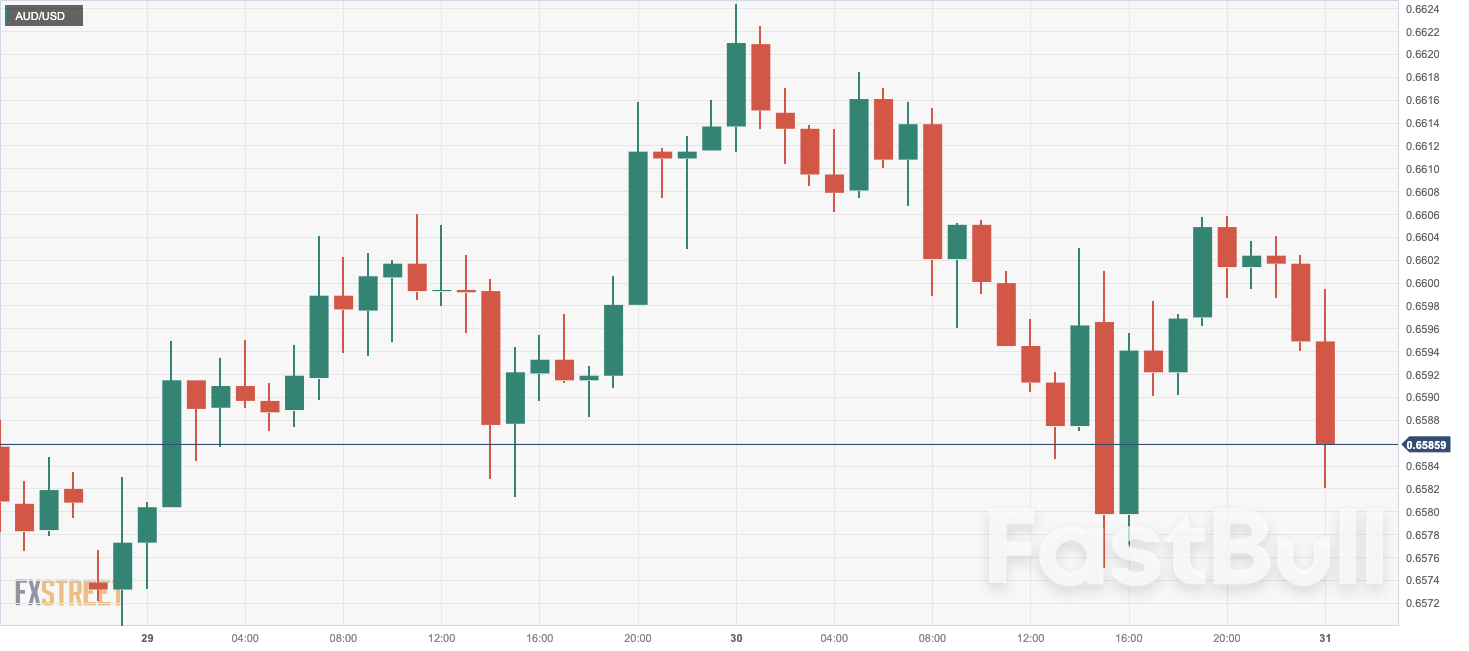
          The AUD/USD pair attracts some sellers following the weaker than expected inflation data from Australia. The pair is losing 0.28% on the day to trade at 0.6583, at the press time.Australia's CPI Inflation Increases 0.6% In Q4 vs. 0.8% Expected_1

          AUD/USD: one-hour chart

          Australian Dollar price in the last 7 days

          The table below shows the percentage change of Australian Dollar (AUD) against listed major currencies in the last 7 days. Australian Dollar was the weakest against the Swiss Franc.Australia's CPI Inflation Increases 0.6% In Q4 vs. 0.8% Expected_2

          The heat map shows percentage changes of major currencies against each other. The base currency is picked from the left column, while the quote currency is picked from the top row. For example, if you pick the Euro from the left column and move along the horizontal line to the Japanese Yen, the percentage change displayed in the box will represent EUR (base)/JPY (quote).

          This section below was published at 21:30 GMT as a preview of the Australian inflation data.
          • The Australian Monthly Consumer Price Index rate is foreseen at 3.7% YoY in December.
          • The Quarterly CPI inflation is expected to have eased further in the last quarter of 2023.
          • The Australian Dollar is bearish ahead of inflation figures and the upcoming RBA monetary policy decision.
          The Australian Bureau of Statistics (ABS) will release two different inflation reports on Wednesday. On the one hand, the organism will publish the quarterly Consumer Price Index (CPI) for the last quarter of 2023, and on the other hand, the Monthly CPI, estimated annually, for December. Additionally, the quarterly report includes the Trimmed Mean Consumer Price Index, the Reserve Bank of Australia's (RBA) favorite inflation gauge.
          The figures are critical ahead of the RBA monetary policy meeting on February 6, as the central bank aims to keep the annual CPI rate between 2% and 3%. Price pressures in Australia are clearly moving in the right direction, although they are still above the desired levels.
          The central bank is expected to leave the Cash Rate unchanged at 4.35%, as it did in the December meeting, following a 25 basis points (bps) hike in November. Previously, the RBA had held rates steady for four consecutive months. The November decision resulted from the Board assessing inflation was easing at a slower pace than earlier forecast.

          What to expect from Australia’s inflation rate numbers?

          The ABS is expected to report that inflation was 3.7% YoY in December, down from the 4.3% posted in November. The quarterly CPI is foreseen rising 0.8% QoQ and up 4.3% YoY in the three months to December, while the RBA Trimmed Mean CPI rate is foreseen at 4.3% YoY, declining from the previous 5.2%.
          The anticipated gauges would support an on-hold RBA, but it is too early to discuss rate cuts in Australia. In its latest Statement on Monetary Policy, which is published quarterly in February, May, August and November, policymakers forecasted that it will take until late 2025 for inflation to moderate to under 3%, finally falling into the target range.
          “Inflation is forecast to decline to 3½ per cent by the end of 2024 and to reach a little below 3 per cent at the end of 2025. The forecast decline in inflation is more gradual than anticipated three months ago because domestic inflationary pressures are dissipating more slowly than previously thought,” according to the official document. Furthermore, it added: “Growth in the Australian economy is expected to remain below trend over 2023 and 2024 as cost-of-living pressures and higher interest rates continue to weigh on demand.”
          Finally, the International Monetary Fund (IMF) advised Australia to lift interest rates further to achieve its inflation target before 2026.
          In such a scenario, trimming the Cash Rate seems out of the table at the time. If anything, inflation-related figures need to decline much more than anticipated throughout the next few months to allow policymakers a rate-cut discussion. At least, it seems safe to say that rates have peaked.
          It is worth adding that the market is moving ahead of policymakers. In early January, speculative interest was pricing in six rate cuts for 2024, with the Cash Rate expected at 3.75% by the end of the year. That means softer-than-anticipated CPI figures could boost rate-cut odds regardless of RBA’s ability to deliver them.

          How could the Consumer Price Index reports affect AUD/USD?

          CPI readings will have a significant impact on the Australian Dollar (AUD) as the figures will guide the RBA's upcoming monetary policy decisions. As usual, the wider the deviation of the outcome from expectations, the larger the price movement. Generally speaking, higher-than-anticipated numbers fuel expectations of rate hikes and tend to boost the AUD. On the contrary, softer-than-expected figures should fuel hopes for soon-to-come rate cuts, and weigh on the local currency, at least in the near term. As the dust settles, easing price pressures should be understood as good news, and end up benefiting the Aussie in the longer run.
          From a technical perspective, AUD/USD trades in the 0.6580 region ahead of the events, after posting a weekly peak of 0.6624 on Tuesday. According to Valeria Bednarik, FXStreet Chief Analyst, “the risk skews to the downside in the daily chart. The pair is currently developing just above a directionless 200 Simple Moving Average (SMA), stuck around the indicator for a second consecutive week. Furthermore, the 20 SMA maintains a firmly bearish slope above the current level, providing dynamic resistance at around 0.6630. Finally, technical indicators stalled their recoveries within negative levels and are slowly resuming their slides, reflecting persistent selling interest.”
          Bednarik adds: “Buyers are defending the downside in the 0.6550/60 region, with a break below it exposing the 0.6500 threshold. Below the latter, AUD/USD has scope to test a strong static support level at 0.6470. On the flip side, the pair needs to recover beyond the aforementioned 0.6630 to gain upward traction and approach the 0.6700 figure.”

          Source: FXStreet

          To stay updated on all economic events of today, please check out our Economic calendar
          Risk Warnings and Disclaimers
          You understand and acknowledge that there is a high degree of risk involved in trading. Following any strategies or investment methods may lead to potential losses. The content on the site is provided by our contributors and analysts for information purposes only. You are solely responsible for determining whether any trading assets, securities, strategy, or any other product is suitable for investing based on your own investment objectives and financial situation.
          Comments
          Add to Favorites
          Share

          Case-Shiller Index: Home Prices Stabilize After Long Streak Of Increases

          Cohen

          Economic

          After steadily declining for seven consecutive months in 2022, housing prices reversed course and increased for an even longer stretch of nine months in 2023 — until now. S&P CoreLogic’s latest Case-Shiller U.S. National Home Price NSA Index, released January 30, 2024, reports that home-price growth dropped in November 2023 for the first time since January — albeit only by a tiny 0.2 percent. Twelve of the 20 major metro markets measured by Case-Shiller reported month-over-month price decreases.

          Index remains near all-time high

          The slight month-over-month drop takes the Index down from its historic high, but not by much. “U.S. home prices edged downward from their all-time high in November,” said Brian D. Luke, head of commodities, real & digital assets at S&P DJI, in a statement. “The streak of nine monthly gains ended in November, setting the index back to levels last seen over the summer months.” The 10- and 20-city composites each also declined very slightly. Seattle and San Francisco were the cities that saw the largest monthly drops with declines of 1.4 percent and 1.3 percent, respectively.
          However, despite November’s slight month-over-month drop, year-over-year growth is still on the rise. Six cities registered all-time highs in November: Miami, Tampa, Atlanta, Charlotte, New York and Cleveland. “November’s year-over-year gain saw the largest growth in U.S. home prices in 2023, with our national composite rising 5.1 percent and the 10-city index rising 6.2 percent,” Luke said.

          Regional fluctuation continues

          Detroit topped the list for highest percentage of price growth for the third month in a row, with an 8.2 percent gain, followed closely by San Diego at 8 percent. “Barring a late surge from another market, those cities will vie for the ‘housing market of the year’ as the best performing city in our composite,” Luke said.
          Despite the top-performing markets being from the Midwest and West, the Northeast was the best-performing region overall with 6.4 percent gains. The Midwest is close behind with 6.3 percent, and the West had the slowest growth at 3 percent. “The tight disparity speaks to a rising tide across the country, with less evidence of micro-markets bucking the trend,” Luke said. “The days of markets in the South rising double digits with markets in the Midwest remaining flat are over.”

          The Fed and the housing market

          The Federal Reserve’s aggressive moves to combat inflation — with 10 consecutive rate hikes over 2022 and 2023 — have put upward pressure on mortgage rates. While the Fed doesn’t directly set mortgage rates, the mortgage market’s interpretations of the central bank’s moves influence how much you pay for your home loan.
          The long period of low mortgage rates following the Great Recession came to an end in 2022. In June 2022, rates topped 6 percent for the first time since 2008. The upward trend continued through October, when rates topped rates topped 7 percent, then 8 percent. “The house price decline came at a time where mortgage rates peaked,” Luke noted.
          Steve Reich, division president at Go Mortgage in Pennsylvania, highlights the impacts that these trends have on the housing market. “As the Fed worked to get inflation under control, higher interest rates tempered what many homebuyers could afford and, in turn, softened home sales,” he said in a statement.
          Higher rates also exacerbate the housing shortage, stopping many homeowners from selling when they otherwise might — and thus keeping those homes off the market and out of the supply of available housing.
          “The remarkable rise in mortgage rates is acting as a kind of golden handcuffs,” says Mark Hamrick, Bankrate’s senior economic analyst. Higher rates are “limiting the desire and some of the ability of people to move out of the homes they currently own. That further pressures housing inventory, adding insult to supply injury.”
          However, rates are now trending back downward. As of January 24, 2024, the average 30-year mortgage rate sat at 6.93 percent.

          What it means for homebuyers and sellers

          The current market has proved challenging on both sides of the real estate transaction — and unless we see a significant drop in either home prices or mortgage rates, both buyers and sellers will need to go with the flow. “For prospective sellers, the new status quo dictates they remain flexible on price, given the extraordinary challe
          nges posed by the sharp increase in mortgage rates,” Hamrick says.
          “Those who are very motivated to purchase a home should be prepared for the sticker shock associated with the increased expense of financing the purchase,” he continues. “Part of the flexibility that may be required includes seeking a possible downgrade of footprint or quality of home, along with the neighborhood, in order to achieve an affordable purchase.”
          However, Reich emphasizes that buying a home in today’s market, while difficult, is still possible. “The average time active listings stay on the market is getting longer, resulting in a slightly less competitive market,” he says. National Association of Realtors data proves that out: The median days-on-market length was 29 days in December, up both month-over-month and year-over-year, which gives buyers more time to make an informed, well-considered decision. “And that’s good news for homebuyers who are still in the game.”
          In fact, some industry experts are actually optimistic about the housing market in 2024. “It’s not much in degree, but [the fact] that the index fell in November after nine straight monthly increases could be another sign the housing market will rebound this year,” said Robert Frick, corporate economist with Navy Federal Credit Union. “Prices are still rising rapidly in some markets, and dropping quickly in others, but if more markets see price drops or even moderation, combined with lower mortgage rates, 2024 should be a healthy year for home sales.”

          Source:Bankrate

          To stay updated on all economic events of today, please check out our Economic calendar
          Risk Warnings and Disclaimers
          You understand and acknowledge that there is a high degree of risk involved in trading. Following any strategies or investment methods may lead to potential losses. The content on the site is provided by our contributors and analysts for information purposes only. You are solely responsible for determining whether any trading assets, securities, strategy, or any other product is suitable for investing based on your own investment objectives and financial situation.
          Comments
          Add to Favorites
          Share

          Bitcoin Pursues Strength Amidst Recent Market Bounce

          Chandan Gupta

          Cryptocurrency

          Traders' Opinions

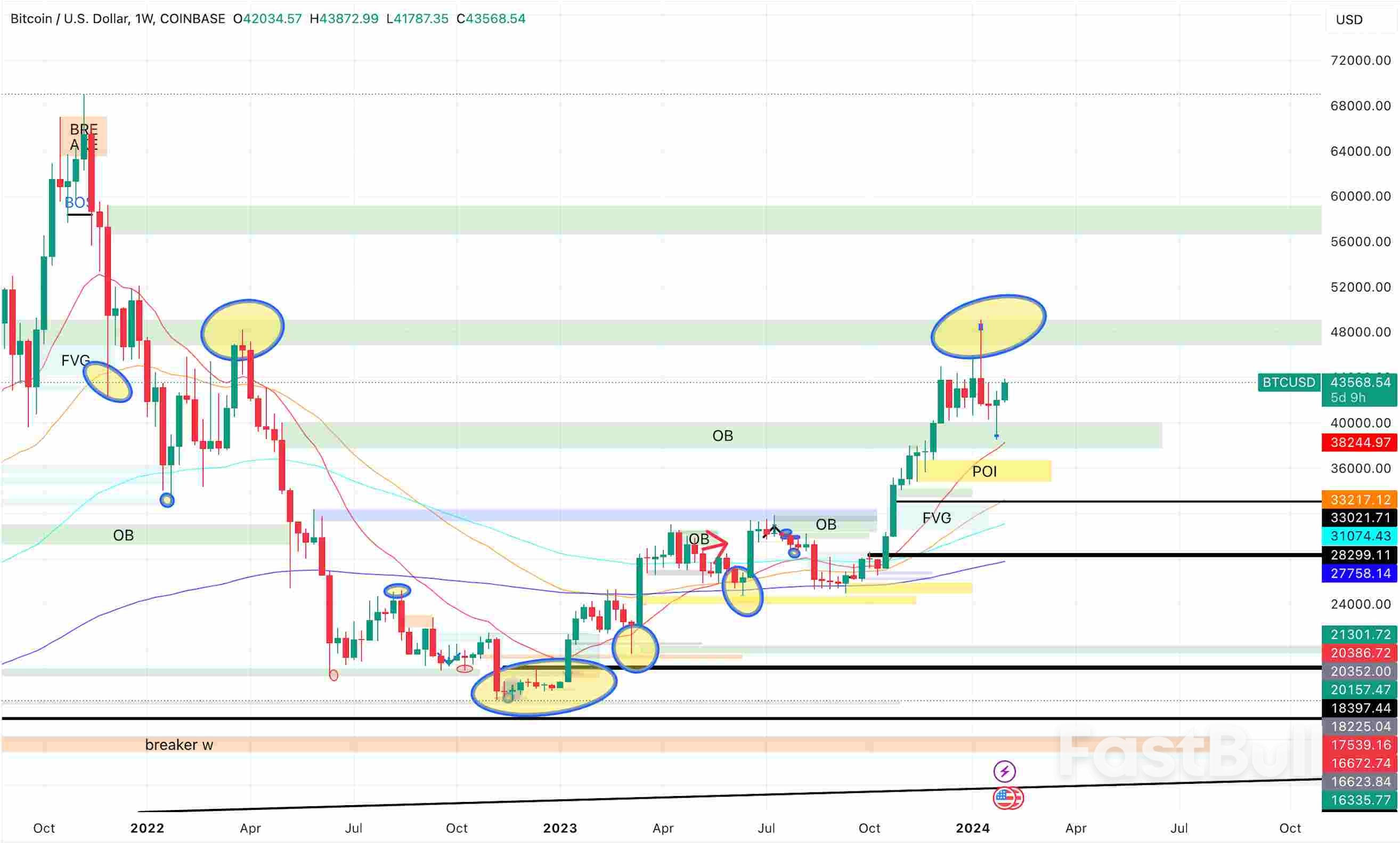
          Bitcoin had quite the buzz on Monday's trading session, buzzing around the 20-day Exponential Moving Average (EMA). It's not a shocker, considering the monumental effort it took last week to regain momentum. At this juncture, I see indicators that suggest buyers are poised to swoop in whenever Bitcoin decides to take a breather and present itself as a tempting opportunity.
          Now, the Bitcoin ETF has made its grand entrance, greeted with cheers from many. However, it's worth noting that, until the tail end of last week, Bitcoin had been on a selling spree since the ETF announcement. Classic case of "sell the event" in the world of news trading. Looking ahead, the likelihood is that Bitcoin will aim to find its comfort zone, oscillating between the $38,000 and $47,500 levels. Breaking above the latter could trigger a surge of FOMO, Fear of Missing Out, propelling Bitcoin to explore the $52,000 frontier.
          But let's be realistic; Bitcoin isn't likely to pull a sudden disappearing act. However, there's a sense that the market's energy has been sapped, especially after Bitcoin sprinted up by a whopping 90% leading up to the ETF announcement. The big question now is, who's out there eager to toss their chips into the Bitcoin pot? We're in need of a fresh spark, and that might come in the form of loose monetary policy from central banks. So, buckle up; crypto enthusiasts will be glued to their screens for insights from the Wednesday FOMC meeting.
          In terms of support, the $40,000 level stands as a sturdy backstop. Above that, the 50-day EMA plays a similar role in keeping Bitcoin from nosediving. The $38,000 level has also proven its mettle as a support point, capturing the attention of traders. Go a bit deeper, and you hit the $35,000 level, where the 200-day EMA is racing towards. It's like the bottom rung of a ladder, marking the endpoint of the overarching uptrend, at least for now. Whether this holds true remains to be seen, but it's undoubtedly an area that's under the microscope for many.Bitcoin Pursues Strength Amidst Recent Market Bounce_1
          So, in the world of Bitcoin, where every move is scrutinized, Monday's bit of commotion around the 20-day EMA is par for the course. It's the aftermath of a significant push last week, a breather before the next potential surge. The Bitcoin ETF may have taken a while to be met with applause, but the initial selling spree is a reminder that markets can be a bit fickle. Now, Bitcoin is poised for a balancing act, navigating between key levels. The $52,000 peak beckons, but the question remains - who will be the next big player to make a move in this crypto chess game?
          Looking at the technical landscape, the $40,000 support is a comforting safety net. It's the cushion that prevents Bitcoin from free-falling. The 50-day EMA joins in the support role, creating a buffer against rapid declines. The $38,000 level, a familiar friend to traders, has proven itself as a reliable support point. And just a bit further down the ladder, we encounter the $35,000 level, where the 200-day EMA is making a swift approach. A crucial juncture that could either uphold the current trend or signal a shift in the winds.
          As we analyze the Bitcoin saga, it's evident that the narrative is far from static. Monday's trading session is a mere snapshot of the ongoing drama, a microcosm of the ever-evolving Bitcoin story. The market's recent sprint has left it catching its breath, contemplating the next move. The ETF entrance may not have set off fireworks immediately, but the stage is set for a potential encore. The $52,000 summit is a tantalizing prospect, but the climb is never a straightforward journey in the realm of Bitcoin.
          Amidst the analysis and predictions, one thing is clear - the crypto community will be keeping a keen eye on Wednesday's FOMC meeting, hoping for a spark to reignite the market's vigor. As Bitcoin navigates the delicate balance between support and resistance levels, traders and enthusiasts alike brace for the twists and turns that characterize this rollercoaster ride. In the end, the $35,000 level looms on the horizon, a potential make-or-break point that could define the trajectory of Bitcoin in the coming days. The story unfolds, and the Bitcoin drama continues to captivate the attention of market participants worldwide.Bitcoin Pursues Strength Amidst Recent Market Bounce_2
          Risk Warnings and Disclaimers
          You understand and acknowledge that there is a high degree of risk involved in trading. Following any strategies or investment methods may lead to potential losses. The content on the site is provided by our contributors and analysts for information purposes only. You are solely responsible for determining whether any trading assets, securities, strategy, or any other product is suitable for investing based on your own investment objectives and financial situation.
          Comments
          Add to Favorites
          Share

          IMF Raises Global Growth Outlook as Prospects of Soft-Landing Rise

          Samantha Luan

          Economic

          The International Monetary Fund has raised its global economic growth forecast, with increased prospects of a soft landing this year, but risks remain amid slow and divergent economic progress as geopolitical uncertainty mounts.
          The world economy showed resilience in the second half of last year, supported by private and government spending, improved labour participation and cheap energy and commodity prices, despite renewed geopolitical uncertainty, the Washington-based fund said in its latest World Economic Outlook report on Tuesday.
          The multilateral lender expects the global economy to match last year's 3.1 per cent growth in 2024 and improve slightly to 3.2 per cent next year.
          The 2024 economic output projection is 0.2 percentage points higher than the IMF's October estimates on account of greater-than-expected resilience in the US and several large emerging and developing economies, as well as fiscal support in China, the world's second-largest economy.
          "The clouds are beginning to part. The global economy begins the final descent toward a soft landing, with inflation declining steadily and growth holding up. But the pace of expansion remains slow and turbulence may lie ahead," said Pierre-Olivier Gourinchas, director of research at the fund.
          However, the IMF's forecast for this year and the next is below the historical growth average of 3.8 per cent, reflecting restrictive monetary policies and withdrawal of fiscal support, as well as low underlying productivity growth, the report said.
          The fund expects the pace of growth in the advanced economies to decline slightly in 2024 before rising in 2025.
          Emerging and developing economies are projected to grow at a stable pace this year and the next, although the extent of growth is set to vary among different regions.
          "Important divergences remain. We expect slower growth in the US, where tight monetary policy is still working through the economy, and in China, where weaker consumption and investment continue to weigh on activity," Mr Gourinchas said in a separate blog on Tuesday.
          "In the euro area, meanwhile, activity is expected to rebound slightly after a challenging 2023, where high energy prices and tight monetary policy restricted demand."
          Growth has also accelerated in several other economies including Brazil, India and some of the major economies in the South-East Asia region, the IMF said.
          The global economy bounced back strongly from the coronavirus-induced slowdown but Russia's continuing war in Ukraine and stubborn inflation have dented growth prospects.
          Renewed geopolitical tension, including the Israel-Gaza war, as well as rising debt levels and the continued cost-of-living crisis in some emerging and developing economies are adding to headwinds.
          To bring inflation down to their target range, central banks have kept interest rates high, affecting the pace growth.
          The US Federal Reserve is expected to cut interest rates this year after increasing its benchmark policy rates since March 2022 to bring down consumer prices from a 40-year high.
          Although the timing of the rate cuts is not clear, the projections released after the Fed's December meeting forecast three rate cuts this year in a push to bring interest rates down from 5.4 per cent to the target range of 4.75 per cent to 5 per cent.
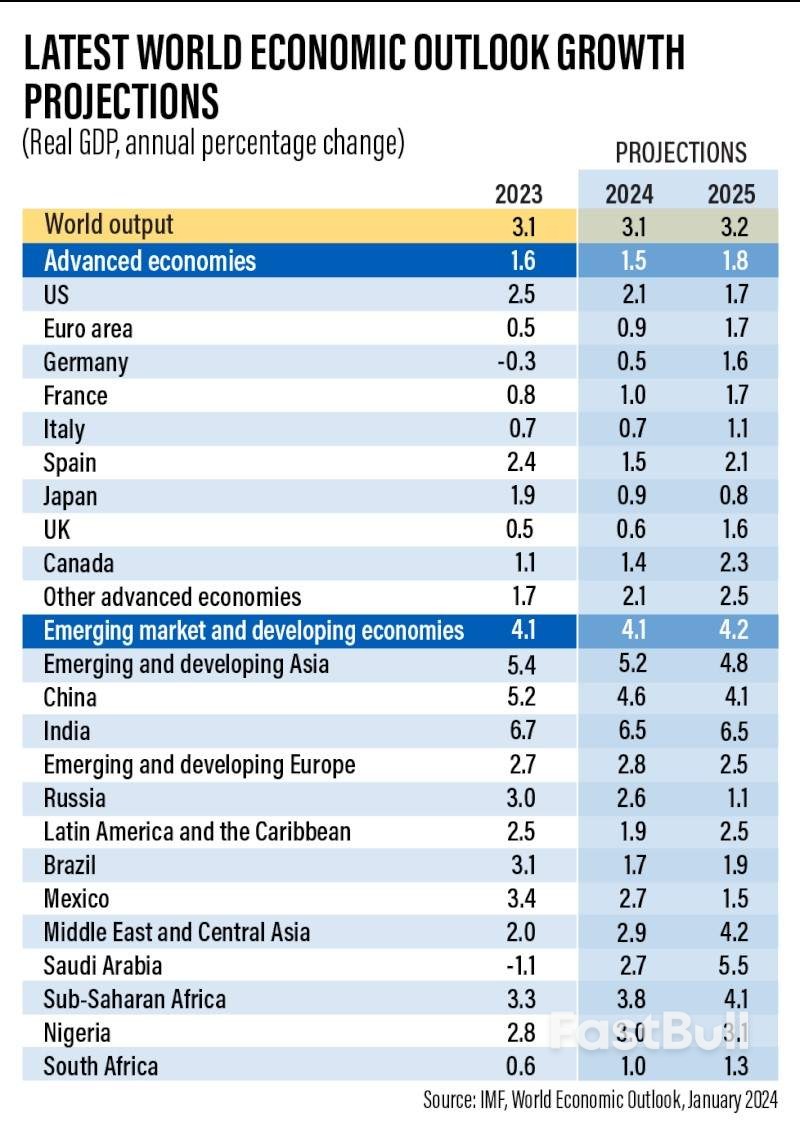
          Economic output in the US is projected to fall to 2.1 per cent in 2024, from 2.5 per cent in 2023. It is expected to decline further to 1.7 per cent in 2025, with the lagged effects of a shift in monetary policy, gradual fiscal tightening and a softening of the labour market.
          The IMF's growth projection for the world's biggest economy this year is an upward revision of 0.6 percentage point from the October estimate, largely reflecting statistical carry-over effects from the stronger-than-expected growth outcome for 2023.
          Growth in the euro area is expected to recover from the low base of 0.5 per cent in 2023, dragged down by its "relatively high exposure" to the war in Ukraine.
          The Washington-based fund expects the bloc's gross domestic product to expand by 0.9 per cent in 2024, a 0.3 percentage point downward revision, before growing 1.7 per cent in 2025.
          The IMF expects the UK economy to expand by 0.6 per cent in 2024 as "the lagged negative effects of high energy prices wane", before growing by 1.6 per cent in 2025.
          The 0.4-percentage-point markdown to growth in 2025 reflects reduced scope for growth.
          Output in Japan is set grow at 0.9 per cent in 2024 and 0.8 per cent in 2025, reflecting the "fading of one-off factors that supported activity in 2023, including a depreciated yen, pent-up demand and a recovery in business investment", the fund said.
          Growth in emerging markets and developing economies is expected to remain at 4.1 per cent in 2024, rising to 4.2 per cent next year.
          The IMF projects that China's GDP expansion will hit 4.6 per cent in 2024 and 4.1 per cent in 2025, with an upward revision of 0.4 percentage points for this year.
          "The upgrade reflects carry-over from stronger-than-expected growth in 2023 and increased government spending on capacity building against natural disasters," the fund said.
          Growth in India is projected to remain strong at 6.5 per cent in 2024 and 2025, underpinned by resilience in domestic demand.
          Economies in the Middle East and Central Asian region are projected to rise to 2.9 per cent in 2024 and 4.2 per cent in 2025, from an estimated 2 per cent in 2023.
          The fund has revised its GDP growth projection down by 0.5 percentage points for 2024 but 2025 estimates were raised by 0.3 percentage points.
          IMF Raises Global Growth Outlook as Prospects of Soft-Landing Rise_1"The revisions are mainly attributable to Saudi Arabia and reflect temporarily lower oil production in 2024, including from unilateral cuts and cuts in line with an agreement through Opec+, whereas non-oil growth is expected to remain robust," it said.
          Saudi Arabia, the Arab world's largest economy, is projected to grow 2.7 per cent this year and 5.5 per cent in 2025, after contracting by an estimated 1.1 per cent last year, according to the latest IMF estimates.
          Global headline inflation is expected to fall to 5.8 per cent in 2024 and 4.4 per cent in 2025 after hitting an estimated 6.8 per cent in 2023.
          The global forecast for 2024 remains unrevised estimates given in October but is 0.2 percentage points lower for 2025.
          Overall, about 80 per cent of the world's economies are expected to have lower annual average headline and core inflation in 2024.
          "Inflation is falling faster than expected in most regions, in the midst of unwinding supply side issues and restrictive monetary policy," Mr Gourinchas said.
          Geopolitical issues and the raging conflict in Gaza are threatening sharp increases in commodity and energy prices.
          The conflict in Gaza could spill over into the wider region, which produces about 35 per cent of the world's oil exports and 14 per cent of gas exports.
          "Continued attacks in the Red Sea – through which 11 per cent of global trade flows – and the ongoing war in Ukraine risk generating fresh adverse supply shocks to the global recovery, with spikes in food, energy and transportation costs," the IMF said.
          "Container shipping costs have already sharply increased and the situation in the Middle East remains volatile."

          Source: The National News

          To stay updated on all economic events of today, please check out our Economic calendar
          Risk Warnings and Disclaimers
          You understand and acknowledge that there is a high degree of risk involved in trading. Following any strategies or investment methods may lead to potential losses. The content on the site is provided by our contributors and analysts for information purposes only. You are solely responsible for determining whether any trading assets, securities, strategy, or any other product is suitable for investing based on your own investment objectives and financial situation.
          Comments
          Add to Favorites
          Share
          FastBull
          Copyright © 2025 FastBull Ltd

          728 RM B 7/F GEE LOK IND BLDG NO 34 HUNG TO RD KWUN TONG KLN HONG KONG

          TelegramInstagramTwitterfacebooklinkedin
          App Store Google Play Google Play
          Products
          Charts

          Chats

          Q&A with Experts
          Screeners
          Economic Calendar
          Data
          Tools
          Membership
          Features
          Function
          Markets
          Copy Trading
          Latest Signals
          Contests
          News
          Analysis
          24/7
          Columns
          Education
          Company
          Careers
          About Us
          Contact Us
          Advertising
          Help Center
          Feedback
          User Agreement
          Privacy Policy
          Business

          White Label

          Data API

          Web Plug-ins

          Poster Maker

          Affiliate Program

          Risk Disclosure

          The risk of loss in trading financial instruments such as stocks, FX, commodities, futures, bonds, ETFs and crypto can be substantial. You may sustain a total loss of the funds that you deposit with your broker. Therefore, you should carefully consider whether such trading is suitable for you in light of your circumstances and financial resources.

          No decision to invest should be made without thoroughly conducting due diligence by yourself or consulting with your financial advisors. Our web content might not suit you since we don't know your financial conditions and investment needs. Our financial information might have latency or contain inaccuracy, so you should be fully responsible for any of your trading and investment decisions. The company will not be responsible for your capital loss.

          Without getting permission from the website, you are not allowed to copy the website's graphics, texts, or trademarks. Intellectual property rights in the content or data incorporated into this website belong to its providers and exchange merchants.

          Not Logged In

          Log in to access more features

          FastBull Membership

          Not yet

          Purchase

          Become a signal provider
          Help Center
          Customer Service
          Dark Mode
          Price Up/Down Colors

          Log In

          Sign Up
          Position
          Layout
          Fullscreen
          Default to Chart
          The chart page opens by default when you visit fastbull.com