• Trade
  • Markets
  • Copy
  • Contests
  • News
  • 24/7
  • Calendar
  • Q&A
  • Chats
Trending
Screeners
SYMBOL
LAST
BID
ASK
HIGH
LOW
NET CHG.
%CHG.
SPREAD
SPX
S&P 500 Index
6920.92
6920.92
6920.92
6965.70
6919.18
-23.90
-0.34%
--
DJI
Dow Jones Industrial Average
48996.07
48996.07
48996.07
49621.43
48951.99
-466.00
-0.94%
--
IXIC
NASDAQ Composite Index
23584.26
23584.26
23584.26
23723.37
23504.22
+37.10
+ 0.16%
--
USDX
US Dollar Index
98.910
98.990
98.910
98.990
98.840
-0.010
-0.01%
--
EURUSD
Euro / US Dollar
1.16436
1.16444
1.16436
1.16518
1.16359
+0.00017
+ 0.01%
--
GBPUSD
Pound Sterling / US Dollar
1.34370
1.34379
1.34370
1.34491
1.34190
+0.00163
+ 0.12%
--
XAUUSD
Gold / US Dollar
4627.43
4627.86
4627.43
4639.52
4588.51
+41.33
+ 0.90%
--
WTI
Light Sweet Crude Oil
60.416
60.446
60.416
60.933
60.354
-0.440
-0.72%
--

Community Accounts

Signal Accounts
--
Profit Accounts
--
Loss Accounts
--
View More

Become a signal provider

Sell trading signals to earn additional income

View More

Guide to Copy Trading

Get started with ease and confidence

View More

Signal Accounts for Members

All Signal Accounts

Best Return
  • Best Return
  • Best P/L
  • Best MDD
Past 1W
  • Past 1W
  • Past 1M
  • Past 1Y

All Contests

  • All
  • Trump Updates
  • Recommend
  • Stocks
  • Cryptocurrencies
  • Central Banks
  • Featured News
Top News Only
Share

Bank Of Japan Puts Self Defense Ahead Of Solidarity With Fed's Chairman Powell

Share

Fresnillo Shares Hit Record High, Up 3.5% As Silver Breaks Above $90

Share

Bank Of England's Taylor: At-Target Inflation From Mid-2026 Is Likely To Be Sustainable

Share

European Central Bank Governing Council Member Villeroy: Livret A Rate Could Go Down A Bit But Should Stay Above Inflation Rate

Share

European Central Bank Governing Council Member Villeroy: If The Budget Deficit Were To Be Higher Than 5% In 2026, France Would Enter The Danger Zone

Share

China Foreign Ministry, On Trump Comment About Iran Protesters: Opposes Outside Interference In Internal Affairs

Share

Japan Chief Cabinet Secretary Kihara: Important For Currencies To Move In Stable Manner Reflecting Fundamentals

Share

Stats Office - Swedish Household Consumption 1.0% Month-On-Month In November

Share

Eurostoxx 50 Futures Up 0.08%, DAX Futures Down 0.05%, FTSE Futures Up 0.14%

Share

Swedish Industry Orders +23.0 % Year-On-Year In November

Share

Romanian Consumer Price Inflation At 9.69% Year-On-Year In December Versus Forecast 9.65% - Stats Board

Share

Romanian Consumer Price Inflation At 0.22% Month-On-Month In December - Stats Board

Share

Kuwait Oct CPI +0.07% Month-On-Month

Share

Kuwait Oct CPI +2.46% Year-On-Year

Share

French Foreign Affairs Minister: France Will Open Consulate In Greenland On Feb 6

Share

French Foreign Affairs Minister: USA Administration Blackmail On Greenland Must Stop

Share

French Foreign Affairs Minister: Ibelieves Crackdown In Iran Is Probably Most Violent In Contemporary History Of Iran

Share

[US Launches Nearly 600 Unilateral Military Strikes In One Year] Newsweek Reported On January 13 That In His First Year Back In The White House, US President Trump Has Ordered Nearly 600 Unilateral Military Strikes On Foreign Soil. The Report Cited Data Released That Day By The Armed Conflict Locations And Events Database Project, Which Focuses On Global Conflict Activities, Stating That From January 20, 2025 To January 5, 2026, The US Conducted 573 Airstrikes And Drone Strikes. If Attacks Carried Out In Cooperation With Allies Are Included, The Trump Administration Has Launched A Total Of 658 Attacks

Share

India's Dec Manufacturing Inflation At 1.82% Year-On-Year

Share

India's Wholesale Price Food Index At 0.00% Year-On-Year In Dec

TIME
ACT
FCST
PREV
U.S. Cleveland Fed CPI MoM (SA) (Dec)

A:--

F: --

P: --

U.S. Cleveland Fed CPI MoM (Dec)

A:--

F: --

P: --

China, Mainland M0 Money Supply YoY (Dec)

--

F: --

P: --

China, Mainland M1 Money Supply YoY (Dec)

--

F: --

P: --

China, Mainland M2 Money Supply YoY (Dec)

--

F: --

P: --

U.S. EIA Natural Gas Production Forecast For The Next Year (Jan)

A:--

F: --

P: --

U.S. EIA Short-Term Crude Production Forecast For The Next Year (Jan)

A:--

F: --

P: --

U.S. EIA Short-Term Crude Production Forecast For The Year (Jan)

A:--

F: --

P: --

EIA Monthly Short-Term Energy Outlook
U.S. 30-Year Bond Auction Avg. Yield

A:--

F: --

P: --

Argentina 12-Month CPI (Dec)

A:--

F: --

P: --

U.S. Budget Balance (Dec)

A:--

F: --

P: --

Argentina CPI MoM (Dec)

A:--

F: --

P: --

Argentina National CPI YoY (Dec)

A:--

F: --

P: --

Richmond Federal Reserve President Barkin delivered a speech.
U.S. API Weekly Cushing Crude Oil Stocks

A:--

F: --

P: --

U.S. API Weekly Crude Oil Stocks

A:--

F: --

P: --

U.S. API Weekly Refined Oil Stocks

A:--

F: --

P: --

U.S. API Weekly Gasoline Stocks

A:--

F: --

P: --

South Korea Unemployment Rate (SA) (Dec)

A:--

F: --

P: --

Japan Reuters Tankan Non-Manufacturers Index (Jan)

A:--

F: --

P: --

Japan Reuters Tankan Manufacturers Index (Jan)

A:--

F: --

P: --

China, Mainland Exports YoY (CNH) (Dec)

A:--

F: --

P: --

China, Mainland Trade Balance (USD) (Dec)

A:--

F: --

P: --

China, Mainland Trade Balance (CNH) (Dec)

A:--

F: --

P: --

China, Mainland Exports (Dec)

A:--

F: --

P: --

China, Mainland Imports YoY (CNH) (Dec)

A:--

F: --

P: --

China, Mainland Imports (CNH) (Dec)

A:--

F: --

P: --

China, Mainland Imports YoY (USD) (Dec)

A:--

F: --

P: --

China, Mainland Exports YoY (USD) (Dec)

A:--

F: --

P: --

China, Mainland Outstanding Loans Growth YoY (Dec)

--

F: --

P: --

U.K. 10-Year Note Auction Yield

--

F: --

P: --

Canada Leading Index MoM (Dec)

--

F: --

P: --

U.S. MBA Mortgage Application Activity Index WoW

--

F: --

P: --

U.S. Core PPI YoY (Nov)

--

F: --

P: --

U.S. PPI MoM (SA) (Nov)

--

F: --

P: --

U.S. PPI YoY (Nov)

--

F: --

P: --

U.S. Current Account (Q3)

--

F: --

P: --

U.S. Retail Sales YoY (Nov)

--

F: --

P: --

U.S. Retail Sales (Nov)

--

F: --

P: --

U.S. Core Retail Sales MoM (Nov)

--

F: --

P: --

U.S. PPI YoY (Excl. Food, Energy & Trade) (Nov)

--

F: --

P: --

U.S. PPI MoM Final (Excl. Food, Energy and Trade) (SA) (Nov)

--

F: --

P: --

U.S. Core Retail Sales (Nov)

--

F: --

P: --

U.S. Retail Sales MoM (Excl. Automobile) (SA) (Nov)

--

F: --

P: --

U.S. Retail Sales MoM (Nov)

--

F: --

P: --

U.S. Retail Sales MoM (Excl. Gas Stations & Vehicle Dealers) (SA) (Nov)

--

F: --

P: --

U.S. Core PPI MoM (SA) (Nov)

--

F: --

P: --

Philadelphia Fed President Henry Paulson delivers a speech
U.S. Commercial Inventory MoM (Oct)

--

F: --

P: --

U.S. Existing Home Sales Annualized Total (Dec)

--

F: --

P: --

U.S. Existing Home Sales Annualized MoM (Dec)

--

F: --

P: --

U.S. EIA Weekly Cushing, Oklahoma Crude Oil Stocks Change

--

F: --

P: --

U.S. EIA Weekly Crude Stocks Change

--

F: --

P: --

U.S. EIA Weekly Gasoline Stocks Change

--

F: --

P: --

U.S. EIA Weekly Crude Demand Projected by Production

--

F: --

P: --

U.S. EIA Weekly Crude Oil Imports Changes

--

F: --

P: --

U.S. EIA Weekly Heating Oil Stock Changes

--

F: --

P: --

U.S. Refinitiv/Ipsos Primary Consumer Sentiment Index (PCSI) (Jan)

--

F: --

P: --

Japan Domestic Enterprise Commodity Price Index YoY (Dec)

--

F: --

P: --

Japan Domestic Enterprise Commodity Price Index MoM (Dec)

--

F: --

P: --

Q&A with Experts
    • All
    • Chatrooms
    • Groups
    • Friends
    Nawhdir. Øt flag
    Nawhdir. Øt
    don't let it go beyond that
    EuroTrader flag
    Nawhdir. Øt
    @Nawhdir. Øti would prefer a pure ecn broker actually, market makers are out of it for me cousin
    3160004 flag
    todaye gold bias upsude or downside ?
    Nawhdir. Øt flag
    EuroTrader
    @EuroTraderwhat about Straight Through P ?
    EuroTrader flag
    Nawhdir. Øt
    @Nawhdir. Øthow about you look out for Prime brokers rather than hybrid brokers my cousin for the safety of your funds
    SlowBear ⛅ flag
    3160004
    todaye gold bias upsude or downside ?
    @3160004Gold bias today is upside visitor, long term today
    Nawhdir. Øt flag
    SlowBear ⛅
    @SlowBear ⛅In your opinion, which of the two is more reliable?
    Kevedge FX flag
    SESSION PRINT AT BEST
    EuroTrader flag
    Nawhdir. Øt
    @Nawhdir. Øtwont even try doing business with a STP broker if am managing such account size in the first place
    SlowBear ⛅ flag
    Nawhdir. Øt
    @Nawhdir. Øt i think i will say the market maker are more relaible
    SlowBear ⛅ flag
    Nawhdir. Øt
    @Nawhdir. ØtYou cannot play the market maker and marker really just do their things and it is not personal
    EuroTrader flag
    Nawhdir. Øt
    @Nawhdir. ØtYou should be trading with brokers like Charles schwab or Td Ameritrade
    Kevedge FX flag
    SlowBear ⛅ flag
    SlowBear ⛅
    @Nawhdir. Øt hybrid broker come to you directly, if you are tagged with different risk or classiified wrongly in their system and you wen ahead to make crazy profit you will likely get smoked intentionally
    Nawhdir. Øt flag
    SlowBear ⛅
    @SlowBear ⛅yes, that's what my friend experienced
    SlowBear ⛅ flag
    Nawhdir. Øt
    @Nawhdir. Øt exactly, when you are wrongly classified as a trader on an hybrid broker platform and all of a suddent you start making crasy profits - but you are classified as a beginner to lose money in less than 2momths but you have made money consistently, you will see some crazy manipulations or failure or sow withdrwal accesss
    Nawhdir. Øt flag
    SlowBear ⛅
    @SlowBear ⛅luckily, I'm still fluent
    Nawhdir. Øt flag
    That's why I really watch my tempo on this big account, rarely make transactions, but once I make a transaction, I have to hold it for a long time, and stick to lot management.
    Nawhdir. Øt flag
    Nawhdir. Øt
    That's why I really watch my tempo on this big account, rarely make transactions, but once I make a transaction, I have to hold it for a long time, and stick to lot management.
    and should also be rare in withdrawing funds
    Nawhdir. Øt flag
    but once the withdrawal is at least $100,000
    Type here...
    Add Symbol or Code

      No matching data

      All
      Trump Updates
      Recommend
      Stocks
      Cryptocurrencies
      Central Banks
      Featured News
      • All
      • Russia-Ukraine Conflict
      • Middle East Flashpoint
      • All
      • Russia-Ukraine Conflict
      • Middle East Flashpoint
      Search
      Products

      Charts Free Forever

      Chats Q&A with Experts
      Screeners Economic Calendar Data Tools
      Membership Features
      Data Warehouse Market Trends Institutional Data Policy Rates Macro

      Market Trends

      Market Sentiment Order Book Forex Correlations

      Top Indicators

      Charts Free Forever
      Markets

      News

      News Analysis 24/7 Columns Education
      From Institutions From Analysts
      Topics Columnists

      Latest Views

      Latest Views

      Trending Topics

      Top Columnists

      Latest Update

      Signals

      Copy Rankings Latest Signals Become a signal provider AI Rating
      Contests
      Brokers

      Overview Brokers Assessment Rankings Regulators News Claims
      Broker listing Forex Brokers Comparison Tool Live Spread Comparison Scam
      Q&A Complaint Scam Alert Videos Tips to Detect Scam
      More

      Business
      Events
      Careers About Us Advertising Help Center

      White Label

      Data API

      Web Plug-ins

      Affiliate Program

      Awards Institution Evaluation IB Seminar Salon Event Exhibition
      Vietnam Thailand Singapore Dubai
      Fans Party Investment Sharing Session
      FastBull Summit BrokersView Expo
      Recent Searches
        Top Searches
          Markets
          News
          Analysis
          User
          24/7
          Economic Calendar
          Education
          Data
          • Names
          • Latest
          • Prev

          View All

          No data

          Scan to Download

          Faster Charts, Chat Faster!

          Download App
          English
          • English
          • Español
          • العربية
          • Bahasa Indonesia
          • Bahasa Melayu
          • Tiếng Việt
          • ภาษาไทย
          • Français
          • Italiano
          • Türkçe
          • Русский язык
          • 简中
          • 繁中
          Open Account
          Search
          Products
          Charts Free Forever
          Markets
          News
          Signals

          Copy Rankings Latest Signals Become a signal provider AI Rating
          Contests
          Brokers

          Overview Brokers Assessment Rankings Regulators News Claims
          Broker listing Forex Brokers Comparison Tool Live Spread Comparison Scam
          Q&A Complaint Scam Alert Videos Tips to Detect Scam
          More

          Business
          Events
          Careers About Us Advertising Help Center

          White Label

          Data API

          Web Plug-ins

          Affiliate Program

          Awards Institution Evaluation IB Seminar Salon Event Exhibition
          Vietnam Thailand Singapore Dubai
          Fans Party Investment Sharing Session
          FastBull Summit BrokersView Expo

          Rising Rates and Rising Risks: When Banks Shift From Creditors to Debtors

          Gerik

          Economic

          Summary:

          As deposit rates continue to climb in early 2026, banking experts warn that deteriorating asset quality and excessive leverage in real estate lending could turn banks from creditors into vulnerable debt holders if risk controls are not tightened...

          Escalating Deposit Rates Signal Intensifying Funding Pressure

          Entering 2026, the upward trend in deposit interest rates shows no sign of cooling. The increase is no longer limited to a few institutions but has spread across the system, from state-owned banks to joint-stock commercial lenders. This broad-based adjustment reflects intensifying competition for liquidity, suggesting that banks are under growing pressure to secure stable funding sources.
          Among state-owned commercial banks, all four institutions with government capital, Agribank, Vietcombank, VietinBank, and BIDV, had raised deposit rates to a higher common level by January 8. This synchronized movement indicates a system-wide recalibration rather than isolated policy choices by individual banks.
          Under current State Bank regulations, the interest rate ceiling for deposits with maturities from one to five months remains at 4.75 percent per year. While this level was rarely applied three months earlier, it has now become widespread. Nine banks, including BVBank, OCB, PGBank, VIB, PVCombank, Sacombank, TPBank, VCBNeo, and VPBank, are applying the ceiling across all maturities from one to five months. Nam A Bank has joined this trend at the two-month tenor, bringing the number of banks applying the ceiling to ten. At the three-month maturity, thirteen banks are now offering the maximum rate, including Techcombank, LPBank, and MBV alongside the earlier group. For four- and five-month terms, NCB has also adopted the ceiling, further reinforcing the uniformity of pricing at the short end of the curve.

          Early-Year Adjustments And The Cost Of Capital

          Beyond the short-term maturities, several banks have continued to adjust deposit rates since the beginning of the year. VPBank, MSB, and ABBank have increased rates, with typical adjustments ranging from 0.2 to 0.4 percentage points per year. These increases are concentrated mainly in medium- and long-term tenors, reflecting banks’ efforts to stabilize funding structures amid rising uncertainty.
          As funding costs rise, lending rates are unlikely to remain unchanged. From a market mechanism perspective, higher input costs tend to be transmitted into lending prices as banks seek to preserve interest margins. Although the timing and magnitude of these adjustments may differ across institutions, the underlying pressure on lending rates is structural rather than temporary.

          Weak Credit Absorption And The Growing Risk Of Bad Debt

          The challenge becomes more acute when higher lending rates interact with an economy whose purchasing power and credit absorption capacity have not recovered proportionally. In this environment, even modest increases in borrowing costs can place additional strain on corporate and household balance sheets. The relationship between higher lending rates and rising non-performing loans is not automatic, but the correlation becomes stronger when borrowers already operate with thin margins and elevated leverage.
          At the talk show titled “Rising Interest Rates Suppress Production: Will The Real Estate Bubble Return?”, banking expert Pham Xuan Hoe, former Deputy Director of the Banking Strategy Institute, emphasized that bad debt risks remain persistent and increasingly visible. According to his assessment, non-performing loans continued to rise throughout 2025, particularly from June onward. At the same time, the banking system’s provisioning coverage ratio has declined to around 80 percent, down from levels exceeding 100 percent previously. This reduction indicates a thinner buffer against credit losses and heightens systemic vulnerability.

          Real Estate Leverage As A Structural Source Of Risk

          One of the most significant sources of potential bad debt, according to Pham Xuan Hoe, lies in the real estate sector and its sophisticated financing practices. He described how developers establish multiple subsidiaries to repeatedly transfer projects at inflated prices, thereby increasing collateral values and expanding borrowing capacity.
          In a typical scenario, one subsidiary may borrow approximately 50 billion VND to conduct land clearance. After completing initial procedures, the project is transferred to another entity at a much higher valuation, for example from 60 billion VND to 200 billion VND. Once legal documentation is finalized, banks may extend additional credit based on the higher valuation. When this process is repeated in an environment of continuously rising prices, financial risk accumulates rapidly. The link between inflated valuations and credit expansion here is correlational, but the repeated recycling of leverage creates conditions where losses can quickly propagate if prices reverse.
          Even more dangerous is lending to affiliated or “backyard” enterprises. Pham Xuan Hoe pointed to the SCB and Van Thinh Phat case as a clear illustration of systemic risk when confidence among depositors and bond investors collapses. When SCB lost its ability to meet obligations, the consequences extended far beyond a single institution, forcing economy-wide liquidity support and emergency measures to stabilize public trust.

          When Property Markets Deflate

          If the real estate bubble deflates, the two most severely affected groups are banks and small-scale speculators holding land plots. Falling prices trap these investors in illiquid positions, making it difficult to exit and leading to a rapid expansion of bad debt. In such conditions, if inflation edges higher while non-performing loans increase, policy tightening becomes unavoidable. This dynamic has already begun to emerge, with some commercial banks tightening real estate lending standards.
          To address bad debt risks and improve the effectiveness of credit allocation, Pham Xuan Hoe proposed two key policy directions. The first involves raising the risk weighting applied to real estate lending, for example from 150 percent to 200 percent, to redirect capital toward productive and cash-generating business activities. The second focuses on stricter financial assessment of real estate developers. Minimum quick ratios should reach at least 0.8, and total debt relative to equity should not exceed four to five times. Beyond this threshold, lending should be halted. Implementing such measures would require coordination between the Ministry of Finance and the State Bank.
          From a broader economic perspective, real estate must ultimately serve housing needs or generate real cash flows. Yet many villas along Thang Long Boulevard or in Me Linh remain vacant, tying up capital without contributing to economic output. This idle capital does not create social value and increases financial fragility.

          Debt-Fueled Land Banks And Systemic Exposure

          Another critical issue concerns the actual land banks held by developers, which warrants closer scrutiny from the Ministry of Construction. Much of this land has been accumulated using bank loans or bond financing. While financially sound and transparent firms with credit ratings may still access bond markets, current bond yields of 11 to 12 percent are already very high. By the end of 2025, real estate inventories had reached substantial levels. When firms become trapped in highly leveraged positions without viable exit options, banking sector balance sheets inevitably absorb the consequences.
          In practice, when real estate markets encounter distress, banks and speculators bear the greatest risks, while large developers may be relatively insulated. Pham Xuan Hoe summarized this imbalance with a stark industry saying: if a bank lends 10 while a firm contributes 90, the bank is the creditor, but if a firm contributes only 10 and the bank lends 90, the bank effectively becomes the debtor, standing while lending and kneeling when collecting repayments.
          Looking ahead, if monetary policy is loosened in 2026 to pursue double-digit growth targets, the possibility that liquidity will once again flow disproportionately into real estate is a serious concern. Without stronger safeguards, such an outcome would deepen existing vulnerabilities rather than support sustainable growth.
          To stay updated on all economic events of today, please check out our Economic calendar
          Risk Warnings and Disclaimers
          You understand and acknowledge that there is a high degree of risk involved in trading. Following any strategies or investment methods may lead to potential losses. The content on the site is provided by our contributors and analysts for information purposes only. You are solely responsible for determining whether any trading assets, securities, strategy, or any other product is suitable for investing based on your own investment objectives and financial situation.
          Add to Favorites
          Share

          Ueda Vows BOJ Rate Hikes as Yen Tumbles on Election Talk

          Benjamin Carter

          Bond

          Political

          Forex

          Remarks of Officials

          Economic

          Central Bank

          Stocks

          Bank of Japan Governor Kazuo Ueda has affirmed his commitment to raising interest rates, signaling that intense speculation over a snap political election will not derail the central bank's monetary policy.

          Speaking in Tokyo on Thursday, Ueda stated the BOJ's position clearly. "We will keep raising rates and adjust the degree of monetary easing in line with the improvement in the economy and inflation if our outlook materializes," he said at a conference hosted by the Regional Banks Association of Japan.

          His remarks confirm that the market volatility triggered by political rumors has not forced the central bank to alter its course. Ueda’s speech closely mirrored his statements from last week, before talk of a potential national vote began to escalate.

          Most economists are not expecting a policy change at the BOJ's upcoming meeting on January 23. The consensus points to a possible rate hike occurring around June.

          Market Reacts to Snap Election Rumors

          The political speculation centers on Prime Minister Sanae Takaichi, who local media reports suggest may dissolve parliament next week to call a snap election. This would be her first time overseeing a national vote since taking office last October.

          Financial markets reacted strongly to the news this week. Japanese stocks soared, while bonds and the yen weakened on expectations that a new electoral mandate could empower the prime minister to push for more expansionary fiscal measures.

          The yen subsequently fell to its weakest level against the dollar since July 2024, the last time Japan's finance authorities intervened to support the currency. It traded at approximately 159.20 per dollar on Thursday afternoon in Tokyo.

          Weakening Yen Complicates Inflation Fight

          A depreciating yen presents a significant challenge for the Bank of Japan by driving up the cost of imports and adding to broader inflationary pressures.

          This dynamic complicates Governor Ueda's objective of achieving stable price growth. Japan’s key inflation gauge has already remained at or above the BOJ's 2% target for more than three and a half years.

          Ueda noted that wages and prices are on a path of gradual increase. "Wages and inflation are likely to keep rising gradually," he said. "An appropriate adjustment of monetary easing will usher in the smooth achievement of our price target and longer-term growth in our economy."

          The BOJ raised its benchmark interest rate to 0.75% last month, its highest point since 1995. While most observers anticipate a steady pace of hikes, roughly once every six months, some analysts believe a persistently weak yen could compel the central bank to act sooner.

          To stay updated on all economic events of today, please check out our Economic calendar
          Risk Warnings and Disclaimers
          You understand and acknowledge that there is a high degree of risk involved in trading. Following any strategies or investment methods may lead to potential losses. The content on the site is provided by our contributors and analysts for information purposes only. You are solely responsible for determining whether any trading assets, securities, strategy, or any other product is suitable for investing based on your own investment objectives and financial situation.
          Add to Favorites
          Share

          US Shifts Policy on AI Chip Sales to China

          Isaac Bennett

          Remarks of Officials

          Economic

          China–U.S. Trade War

          Political

          The United States government has established new rules for selling high-performance AI chips to China, representing a significant policy change. These regulations directly impact companies like Nvidia and its advanced H200 chips, introducing a controlled process for exports that previously faced a complete block.

          New Guardrails for Chip Exports

          Under the revised framework, several conditions must be met before advanced AI chips can be shipped to Chinese buyers. This marks a departure from prior restrictions and introduces a multi-step approval process.

          Key requirements now include:

          • Performance Verification: All chips must undergo testing by an independent third-party lab to verify their AI capabilities.

          • Supply Cap: Chinese customers cannot purchase more than 50% of the total chip volume sold to American customers.

          • Domestic Availability: Nvidia is required to demonstrate it has a sufficient supply of H200 chips available in the United States.

          • End-User Vetting: Chinese companies must prove they have adequate security measures in place and commit to not using the chips for military purposes.

          These stipulations were not part of the previous export policy.

          A Reversal of Biden-Era Restrictions

          This move reverses the Biden administration's policy, which had blocked sales of advanced AI chips to China altogether. The Trump administration, with guidance from White House AI director David Sacks, argues that allowing controlled sales could discourage Chinese tech firms like Huawei from accelerating their own high-end chip design efforts to compete with Nvidia and AMD.

          When he announced the policy shift last month, President Donald Trump stated the sales would proceed "under conditions that allow for continued strong National Security." This contrasts with an earlier proposal from Trump to permit sales in exchange for a 25% fee, a plan that drew criticism from both political parties over concerns it could bolster Beijing's military and undermine America's technological edge in AI.

          Experts Skeptical of Enforcement

          Analysts and former officials have raised serious questions about the new policy's effectiveness and enforceability.

          Jay Goldberg, a stock analyst at Seaport Research, called the export limits a "middle-ground solution" that may be difficult to monitor. He described the policy as a "Band-Aid" attempting to cover a significant gap among U.S. policymakers.

          "As we have seen, companies have found ways to get access to those chips, and the U.S. government appears highly transactional in their approach to chip exports," Goldberg noted.

          Saif Khan, a former director of technology and national security on the White House National Security Council under Joe Biden, warned that the rule would provide a major boost to China's AI programs. "The rule would allow about two million advanced AI chips like the H200 to China, an amount equal to the compute owned today by a typical U.S. frontier AI company," Khan said. He added that the administration will struggle to enforce requirements preventing Chinese cloud providers from supporting nefarious activities.

          These enforcement challenges are significant, especially given past smuggling operations valued at $160 million.

          China's Massive Demand Outstrips Supply

          The policy change comes as Chinese technology companies display an enormous appetite for advanced hardware. According to a report last month, Chinese firms have already placed orders for over 2 million Nvidia H200 chips, each costing around $27,000. This demand far exceeds Nvidia's current reported stock of 700,000 units.

          At the Consumer Electronics Show, Nvidia CEO Jensen Huang confirmed that the company was ramping up H200 production. He cited strong demand from China and other nations as a key driver behind rising rental prices for H200 chips operating in cloud data centers.

          While the U.S. has reportedly begun a review that could clear the first chip shipments to China, it remains uncertain whether the new restrictions will be effectively enforced or if Beijing will ultimately permit the sales domestically.

          To stay updated on all economic events of today, please check out our Economic calendar
          Risk Warnings and Disclaimers
          You understand and acknowledge that there is a high degree of risk involved in trading. Following any strategies or investment methods may lead to potential losses. The content on the site is provided by our contributors and analysts for information purposes only. You are solely responsible for determining whether any trading assets, securities, strategy, or any other product is suitable for investing based on your own investment objectives and financial situation.
          Add to Favorites
          Share

          China’s Rare Earth Exports Reach Decade High Despite Tighter Controls

          Gerik

          Economic

          Commodity

          Record Export Volumes In A Year Of Policy Tightening

          China exported 62,585 metric tons of rare earths in 2025, marking the strongest annual performance in more than a decade. The increase came despite Beijing introducing new export controls in April on seven medium and heavy rare earth elements and related magnets. These materials are critical inputs across consumer electronics, automotive manufacturing, renewable energy systems, and defense equipment, making China’s export performance closely watched by global supply chains. The rise in total shipments reflects sustained external demand rather than regulatory loosening, indicating that restrictions reshaped timing and composition of exports rather than suppressing volumes outright.
          The introduction of export controls in April, widely seen as a response to elevated U.S. tariffs, led to an immediate and sharp drop in shipments of rare earth magnets during April and May. This decline was directly linked to regulatory barriers rather than a collapse in demand, as buyers faced uncertainty over licensing and compliance. The relationship here is causal, with policy intervention temporarily constraining trade flows even as end-user demand remained intact.

          Gradual Recovery Driven By Trade Adjustments

          From June onward, exports began to recover steadily. This rebound followed a series of agreements reached between China, the United States, and Europe, which helped clarify regulatory frameworks and restore confidence among overseas buyers. The recovery suggests that once uncertainty around controls eased, pent-up demand translated back into physical shipments. This pattern highlights how geopolitical and trade negotiations can influence commodity flows indirectly by shaping expectations and procurement behavior.
          In December, rare earth exports fell 20% from November to 4,392 tons, reflecting softer overseas buying after stockpiling ahead of the Christmas period. However, the December figure was still 32% higher than the same month in 2024, underscoring the strength of the underlying trend. Analysts noted that many overseas buyers had front-loaded purchases in November, when exports jumped 26.5% from October, to secure supply before the holiday slowdown. This sequencing reflects inventory management practices rather than weakening demand fundamentals.
          China’s ability to deliver record rare earth export volumes despite tighter controls highlights its continued dominance in the sector. While restrictions introduced volatility at specific points in the year, they did not prevent an overall expansion in exports. This outcome suggests that global reliance on Chinese rare earth supply remains structurally intact, even as buyers and governments seek diversification. For now, policy actions have altered trade patterns at the margin but have not fundamentally reduced China’s role as the world’s primary supplier.

          Source: Reuters

          To stay updated on all economic events of today, please check out our Economic calendar
          Risk Warnings and Disclaimers
          You understand and acknowledge that there is a high degree of risk involved in trading. Following any strategies or investment methods may lead to potential losses. The content on the site is provided by our contributors and analysts for information purposes only. You are solely responsible for determining whether any trading assets, securities, strategy, or any other product is suitable for investing based on your own investment objectives and financial situation.
          Add to Favorites
          Share

          Poland's Rate Cut Spree Faces a Critical Test

          Julia Daniels

          Remarks of Officials

          Data Interpretation

          Economic

          Central Bank

          Poland's central bank is at a crossroads, with its recent streak of interest rate cuts likely coming to a halt. Analysts overwhelmingly expect the Monetary Policy Council (MPC) to hold its benchmark rate at 4% this week, but a surprisingly low inflation report has made the decision far from certain.

          A Pause in Easing Expected

          After cutting borrowing costs at its last five meetings, the central bank appears ready to shift to a wait-and-see approach. Governor Adam Glapinski has signaled a desire to evaluate the impact of the past easing, which saw rates lowered by a total of 175 basis points in six steps last year.

          This view is supported by a Bloomberg survey, where 29 of 32 economists predicted that the MPC will keep rates on hold. Fellow panelist Henryk Wnorowski also suggested that the next potential cut would not occur until March at the earliest.

          Low Inflation Complicates the Decision

          Despite the consensus for a pause, the decision is not a foregone conclusion. The primary reason for the uncertainty is an unexpected dip in inflation, which fell below the central bank’s 2.5% target in December. This development strengthens the argument for continued monetary easing.

          The division among policymakers is clear. MPC member Ireneusz Dabrowski commented last week that another rate reduction was equally as likely as holding firm. Analysts at PKO Bank Polski SA are in the minority forecasting a quarter-point cut, stating in a note, "The outcome of the MPC meeting will remain uncertain until the very end."

          New Council Member Adds Unpredictability

          Adding another layer of unpredictability is a change in the council's composition. This week’s meeting will be the first for Marcin Zarzecki, a new member appointed by President Karol Nawrocki. Zarzecki, whose views on monetary policy are not publicly known, replaces Cezary Kochalski, whose term concluded in December. His vote could prove decisive in what is expected to be a close call.

          To stay updated on all economic events of today, please check out our Economic calendar
          Risk Warnings and Disclaimers
          You understand and acknowledge that there is a high degree of risk involved in trading. Following any strategies or investment methods may lead to potential losses. The content on the site is provided by our contributors and analysts for information purposes only. You are solely responsible for determining whether any trading assets, securities, strategy, or any other product is suitable for investing based on your own investment objectives and financial situation.
          Add to Favorites
          Share

          December CPI: Why Real Inflation Is Just Getting Started

          Justin

          Economic

          Remarks of Officials

          Data Interpretation

          Central Bank

          The December Consumer Price Index (CPI) report was as complex as analysts predicted, but the real story of inflation isn't in the headline numbers. A closer look at money supply and central bank activity reveals pressures that the official data may be missing.

          Decoding the December CPI Numbers

          At first glance, the December inflation data seemed to align with expectations, offering a sliver of optimism for markets hoping for future monetary easing.

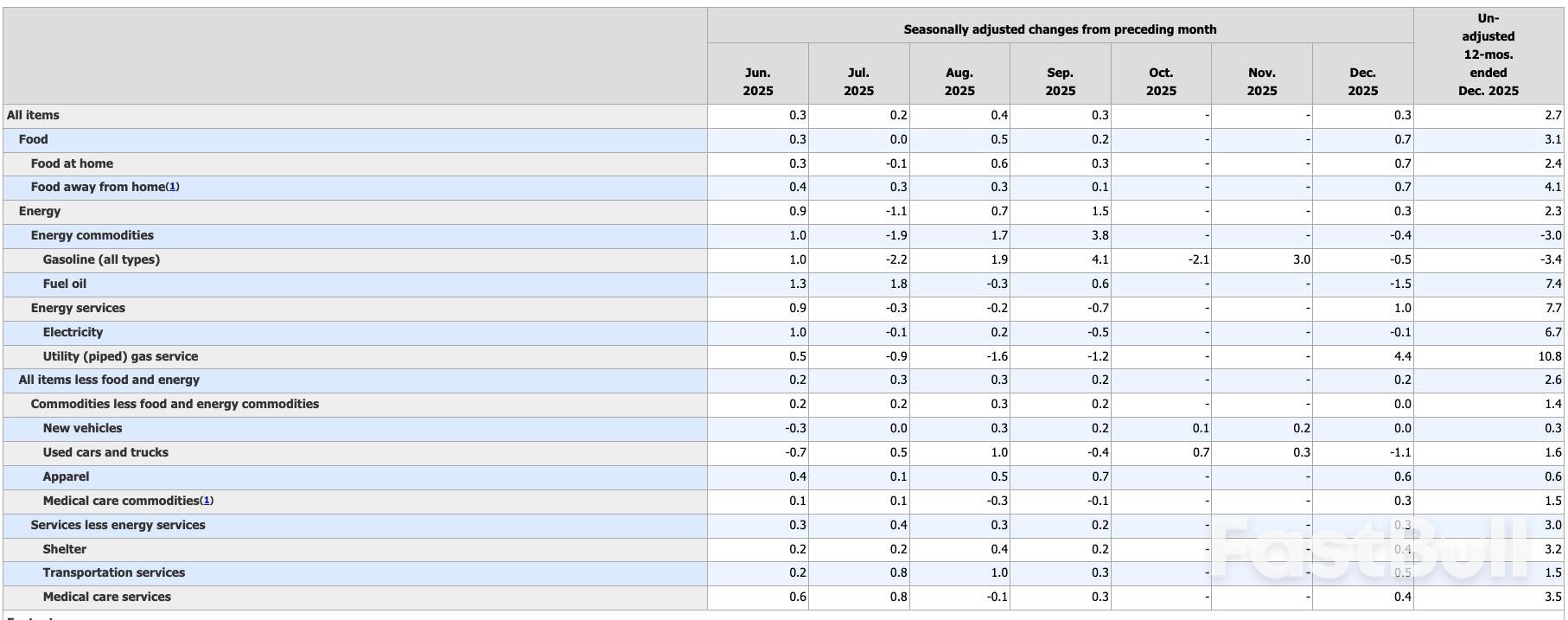
          The overall CPI rose 0.3% month-on-month, holding the annual inflation rate steady at 2.7%. When stripping out volatile food and energy costs, the core CPI increased by 0.2% for the month, with the annual rate unchanged at 2.6%. This slightly cooler-than-expected core reading fueled speculation that the Federal Reserve might continue easing monetary policy in 2026.

          However, a persistent trend lies beneath the surface. Over the last six available readings, core CPI has posted increases of 0.2%, 0.3%, 0.3%, 0.2%, 0.2%, and 0.2%. This pattern annualizes to a rate of 2.8%, showing that core inflation has been stuck in this range for over a year.

          A detailed breakdown of the December report shows specific price pressures:

          • Shelter: Increased by 0.4%

          • Food: Surged by 0.7%

          • Energy: Rose by 0.3%, even as gasoline prices fell 0.4%

          • Services: Grew by 0.3%

          • Used Cars & Trucks: Posted the largest decline, falling 1.1%

          A table showing the monthly percentage change in the Consumer Price Index for various categories from June to December 2025.

          The Limits of Official Inflation Data

          It’s crucial to approach the CPI report with caution. The data's reliability has been questioned, particularly following a November report some critics described as heavily estimated.

          Furthermore, the government's methodology for calculating CPI was revised in the 1990s, leading to a formula that many argue systematically understates the true rise in the cost of living. If the formula from the 1970s were still in use, today's official CPI figures would likely be closer to 6%.

          Even based on the current official data, inflation remains well above the Federal Reserve's target. As Ellen Zentner, chief economic strategist at Morgan Stanley, noted, the situation feels familiar.

          "We've seen this movie before—inflation isn't reheating, but it remains above target," Zentner stated. "Today's inflation report doesn't give the Fed what it needs to cut interest rates later this month."

          The True Driver: Accelerating Money Supply

          The CPI measures price changes in a specific basket of goods, but it only captures a symptom of inflation. Historically, economists defined inflation as an increase in the supply of money and credit. Rising prices are the consequence of this monetary expansion.

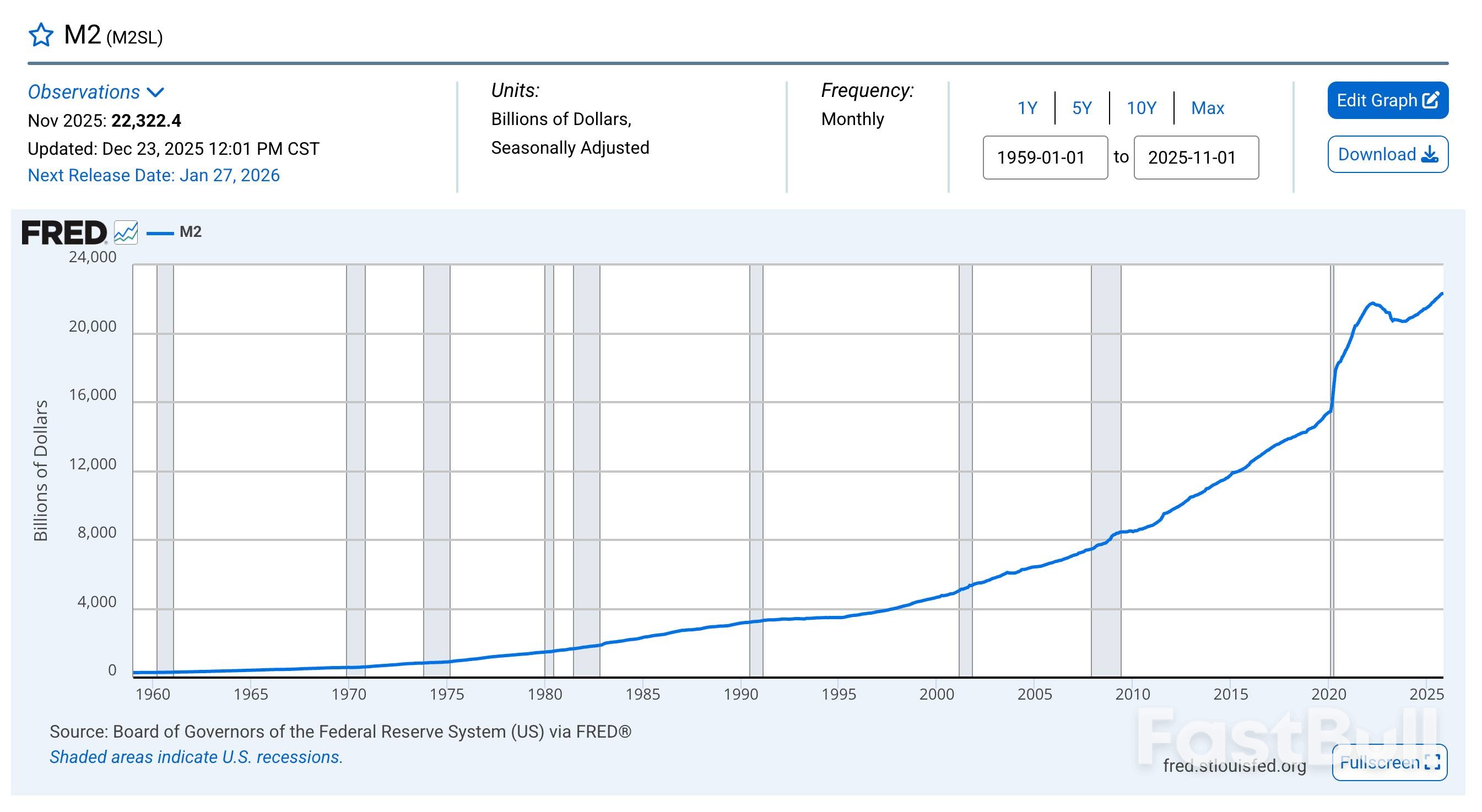
          By this fundamental measure, inflation is not only present but accelerating. The M2 money supply is currently growing at its fastest rate since July 2022. After hitting a low in October 2023, the money supply has resumed its upward trajectory, now surpassing its pandemic-era peak as money creation has quickened in recent months.

          A chart from the Federal Reserve Economic Data (FRED) shows the M2 money stock in billions of dollars from 1959 to November 2025, highlighting a sharp increase beginning in 2020.

          The Fed's Quiet Relaunch of QE

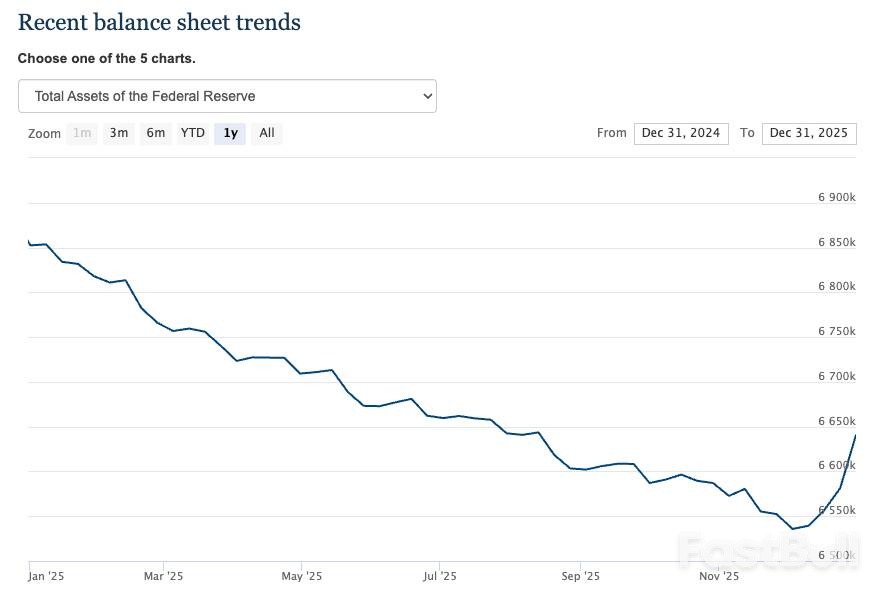
          Further evidence of rising inflationary pressure comes from the Federal Reserve's balance sheet, which is once again expanding.

          Last month, the central bank resumed purchasing U.S. Treasuries with newly created money, effectively restarting its quantitative easing (QE) program. This direct injection of liquidity into the financial system is, by definition, inflationary.

          A graph illustrates the recent trend of the Federal Reserve's total assets, showing a decline through most of 2025 followed by a distinct increase in December.

          The Fed's Catch-22: No Easy Way Out

          This leads to a fundamental conflict for the central bank. The Fed is caught in a Catch-22: it needs to loosen monetary policy through rate cuts and QE to support a debt-laden economy, but it also needs higher rates to bring price inflation back under control. It cannot do both at the same time.

          Any "cooler than expected" CPI report provides political cover to prioritize easing, despite official rhetoric aimed at managing expectations. This dynamic ensures that even if official price metrics cool temporarily, the underlying inflationary forces are likely to grow stronger.

          To stay updated on all economic events of today, please check out our Economic calendar
          Risk Warnings and Disclaimers
          You understand and acknowledge that there is a high degree of risk involved in trading. Following any strategies or investment methods may lead to potential losses. The content on the site is provided by our contributors and analysts for information purposes only. You are solely responsible for determining whether any trading assets, securities, strategy, or any other product is suitable for investing based on your own investment objectives and financial situation.
          Add to Favorites
          Share

          Silver Breaks $90 As Monetary Anxiety And Geopolitics Supercharge Precious Metals Rally

          Gerik

          Economic

          Commodity

          A New Milestone For Silver And Gold

          Silver vaulted past the $90-per-ounce threshold, reaching as high as $91.5535, marking an unprecedented milestone for the metal. Gold followed closely, trading within $10 of its all-time high. This advance reflects a continuation of the powerful rally that began last year rather than a short-lived reaction to a single data release. December inflation data in the United States came in softer than feared, although economists noted that the figures were temporarily suppressed by distortions linked to the prolonged government shutdown. That outcome strengthened market confidence that monetary policy conditions may eventually ease further, supporting non-yielding assets such as precious metals.
          Markets currently expect the Federal Reserve to pause rate cuts for several months, yet swaps pricing still points to at least two cuts later in the year. This outlook has reinforced demand for gold and silver through a direct transmission channel, as lower expected real rates tend to improve the relative attractiveness of metals. At the same time, renewed political attacks on Federal Reserve Chair Jerome Powell have revived concerns about central bank autonomy. While global central bankers and senior Wall Street executives have publicly defended Powell, the episode has increased sensitivity to institutional risk. This relationship is largely correlational rather than mechanical, with investor confidence responding to perceived governance stability rather than immediate changes in policy settings.

          Geopolitical Stress And Haven Demand

          Safe-haven demand has been amplified by a tense geopolitical environment. Developments such as the U.S. capture of Venezuela’s leader, renewed rhetoric over Greenland, and escalating unrest in Iran have heightened perceptions of global instability. These events have not directly disrupted precious metal supply, but they have elevated risk aversion, which historically correlates with stronger inflows into gold and silver. Citigroup responded to this backdrop by upgrading its three-month price targets to $5,000 an ounce for gold and $100 an ounce for silver, underscoring expectations that elevated uncertainty will continue to support prices.
          Silver’s outperformance relative to gold has been notable. The metal gained roughly 150 percent last year, driven by a combination of a short squeeze in October, persistent physical tightness in London, and aggressive speculative positioning. Analysts also point to a broader rotation into commodities as investors seek diversification away from traditional financial assets. According to Lotus Asset Management’s Hao Hong, the rally still has room to extend, with prices potentially reaching $150 an ounce by year-end. This projection reflects momentum and positioning dynamics rather than a guaranteed price path.

          Supply Constraints And Trade Policy Risks

          Uncertainty surrounding U.S. trade policy has added another layer of complexity. Traders are watching the outcome of a Section 232 investigation that could result in import tariffs on silver. Fear of such measures has already altered physical flows, with large quantities of silver reportedly remaining in the United States rather than circulating globally. This has tightened availability elsewhere, reinforcing price strength. The link here is indirect, as policy uncertainty influences inventory behavior, which then affects market balance.
          The latest surge highlights the scale of investment flows into precious metals. Trading volumes on Comex and the Shanghai Futures Exchange have remained elevated since late December, signaling sustained speculative and institutional participation. Platinum and palladium have also joined the rally, each gaining more than 4 percent, suggesting broad-based interest rather than isolated enthusiasm for silver alone. The Bloomberg Dollar Spot Index remained steady, removing currency volatility as a primary driver of the move.
          Strategists caution that while demand for precious metals as a hedge against inflation and financial instability is likely to persist, gains in 2026 may not match the extraordinary pace seen last year. Some analysts expect gold to outperform silver over time due to its deeper liquidity and stronger association with geopolitical risk. Even so, the break above $90 has reinforced silver’s status as a high-beta expression of macro uncertainty, leaving prices highly sensitive to shifts in monetary expectations, policy credibility, and global risk sentiment.

          Source: Bloomberg

          To stay updated on all economic events of today, please check out our Economic calendar
          Risk Warnings and Disclaimers
          You understand and acknowledge that there is a high degree of risk involved in trading. Following any strategies or investment methods may lead to potential losses. The content on the site is provided by our contributors and analysts for information purposes only. You are solely responsible for determining whether any trading assets, securities, strategy, or any other product is suitable for investing based on your own investment objectives and financial situation.
          Add to Favorites
          Share
          FastBull
          Copyright © 2026 FastBull Ltd

          728 RM B 7/F GEE LOK IND BLDG NO 34 HUNG TO RD KWUN TONG KLN HONG KONG

          TelegramInstagramTwitterfacebooklinkedin
          App Store Google Play Google Play
          Products
          Charts

          Chats

          Q&A with Experts
          Screeners
          Economic Calendar
          Data
          Tools
          Membership
          Features
          Function
          Markets
          Copy Trading
          Latest Signals
          Contests
          News
          Analysis
          24/7
          Columns
          Education
          Company
          Careers
          About Us
          Contact Us
          Advertising
          Help Center
          Feedback
          User Agreement
          Privacy Policy
          Personal Information Protection Statement
          Business

          White Label

          Data API

          Web Plug-ins

          Poster Maker

          Affiliate Program

          Risk Disclosure

          The risk of loss in trading financial instruments such as stocks, FX, commodities, futures, bonds, ETFs and crypto can be substantial. You may sustain a total loss of the funds that you deposit with your broker. Therefore, you should carefully consider whether such trading is suitable for you in light of your circumstances and financial resources.

          No decision to invest should be made without thoroughly conducting due diligence by yourself or consulting with your financial advisors. Our web content might not suit you since we don't know your financial conditions and investment needs. Our financial information might have latency or contain inaccuracy, so you should be fully responsible for any of your trading and investment decisions. The company will not be responsible for your capital loss.

          Without getting permission from the website, you are not allowed to copy the website's graphics, texts, or trademarks. Intellectual property rights in the content or data incorporated into this website belong to its providers and exchange merchants.

          Not Logged In

          Log in to access more features

          FastBull Membership

          Not yet

          Purchase

          Become a signal provider
          Help Center
          Customer Service
          Dark Mode
          Price Up/Down Colors

          Log In

          Sign Up

          Position
          Layout
          Fullscreen
          Default to Chart
          The chart page opens by default when you visit fastbull.com