• Trade
  • Markets
  • Copy
  • Contests
  • News
  • 24/7
  • Calendar
  • Q&A
  • Chats
Trending
Screeners
SYMBOL
LAST
BID
ASK
HIGH
LOW
NET CHG.
%CHG.
SPREAD
SPX
S&P 500 Index
6827.42
6827.42
6827.42
6899.86
6801.80
-73.58
-1.07%
--
DJI
Dow Jones Industrial Average
48458.04
48458.04
48458.04
48886.86
48334.10
-245.98
-0.51%
--
IXIC
NASDAQ Composite Index
23195.16
23195.16
23195.16
23554.89
23094.51
-398.69
-1.69%
--
USDX
US Dollar Index
97.950
98.030
97.950
98.500
97.950
-0.370
-0.38%
--
EURUSD
Euro / US Dollar
1.17394
1.17409
1.17394
1.17496
1.17192
+0.00011
+ 0.01%
--
GBPUSD
Pound Sterling / US Dollar
1.33707
1.33732
1.33707
1.33997
1.33419
-0.00148
-0.11%
--
XAUUSD
Gold / US Dollar
4299.39
4299.39
4299.39
4353.41
4257.10
+20.10
+ 0.47%
--
WTI
Light Sweet Crude Oil
57.233
57.485
57.233
58.011
56.969
-0.408
-0.71%
--

Community Accounts

Signal Accounts
--
Profit Accounts
--
Loss Accounts
--
View More

Become a signal provider

Sell trading signals to earn additional income

View More

Guide to Copy Trading

Get started with ease and confidence

View More

Signal Accounts for Members

All Signal Accounts

Best Return
  • Best Return
  • Best P/L
  • Best MDD
Past 1W
  • Past 1W
  • Past 1M
  • Past 1Y

All Contests

  • All
  • Trump Updates
  • Recommend
  • Stocks
  • Cryptocurrencies
  • Central Banks
  • Featured News
Top News Only
Share

US Defense Secretary Hegseth: Attacker Was Killed By Partner Forces

Share

Pentagon Says Two USA Army Soldiers And One Civilian USA Interpreter Were Killed, And Three Were Wounded In Syria

Share

Israel Says It Kills Senior Hamas Commander Raed Saed In Gaza

Share

Ukraine's Navy Says Russian Drone Attack Hit Civilian Turkish Vessel Carrying Sunflower Oil To Egypt On Saturday

Share

Israeli Military Says It Put Planned Strike On South Lebanon Site On Hold After Lebanese Army Requested Access

Share

Norwegian Nobel Committee: Calls On The Belarusian Authorities To Release All Political Prisoners

Share

Norwegian Nobel Committee: His Freedom Is A Deeply Welcome And Long-Awaited Moment

Share

Ukraine Says It Received 114 Prisoners From Belarus

Share

USA Embassy In Lithuania: Maria Kalesnikava Is Not Going To Vilnius

Share

USA Embassy In Lithuania: Other Prisoners Are Being Sent From Belarus To Ukraine

Share

Ukraine President Zelenskiy: Five Ukrainians Released By Belarus In US-Brokered Deal

Share

USA Vilnius Embassy: USA Stands Ready For "Additional Engagement With Belarus That Advances USA Interests"

Share

USA Vilnius Embassy: Belarus, USA, Other Citizens Among The Prisoners Released Into Lithuania

Share

USA Vilnius Embassy: USA Will Continue Diplomatic Efforts To Free The Remaining Political Prisoners In Belarus

Share

USA Vilnius Embassy: Belarus Releases 123 Prisoners Following Meeting Of President Trump's Envoy Coale And Belarus President Lukashenko

Share

USA Vilnius Embassy: Masatoshi Nakanishi, Aliaksandr Syrytsa Are Among The Prisoners Released By Belarus

Share

USA Vilnius Embassy: Maria Kalesnikava And Viktor Babaryka Are Among The Prisoners Released By Belarus

Share

USA Vilnius Embassy: Nobel Peace Prize Laureate Ales Bialiatski Is Among The Prisoners Released By Belarus

Share

Belarusian Presidential Administration Telegram Channel: Lukashenko Has Pardoned 123 Prisoners As Part Of Deal With US

Share

Two Local Syrian Officials: Joint US-Syrian Military Patrol In Central Syria Came Under Fire From Unknown Assailants

TIME
ACT
FCST
PREV
U.K. Trade Balance Non-EU (SA) (Oct)

A:--

F: --

P: --

U.K. Trade Balance (Oct)

A:--

F: --

P: --

U.K. Services Index MoM

A:--

F: --

P: --

U.K. Construction Output MoM (SA) (Oct)

A:--

F: --

P: --

U.K. Industrial Output YoY (Oct)

A:--

F: --

P: --

U.K. Trade Balance (SA) (Oct)

A:--

F: --

P: --

U.K. Trade Balance EU (SA) (Oct)

A:--

F: --

P: --

U.K. Manufacturing Output YoY (Oct)

A:--

F: --

P: --

U.K. GDP MoM (Oct)

A:--

F: --

P: --

U.K. GDP YoY (SA) (Oct)

A:--

F: --

P: --

U.K. Industrial Output MoM (Oct)

A:--

F: --

P: --

U.K. Construction Output YoY (Oct)

A:--

F: --

P: --

France HICP Final MoM (Nov)

A:--

F: --

P: --

China, Mainland Outstanding Loans Growth YoY (Nov)

A:--

F: --

P: --

China, Mainland M2 Money Supply YoY (Nov)

A:--

F: --

P: --

China, Mainland M0 Money Supply YoY (Nov)

A:--

F: --

P: --

China, Mainland M1 Money Supply YoY (Nov)

A:--

F: --

P: --

India CPI YoY (Nov)

A:--

F: --

P: --

India Deposit Gowth YoY

A:--

F: --

P: --

Brazil Services Growth YoY (Oct)

A:--

F: --

P: --

Mexico Industrial Output YoY (Oct)

A:--

F: --

P: --

Russia Trade Balance (Oct)

A:--

F: --

P: --

Philadelphia Fed President Henry Paulson delivers a speech
Canada Building Permits MoM (SA) (Oct)

A:--

F: --

P: --

Canada Wholesale Sales YoY (Oct)

A:--

F: --

P: --

Canada Wholesale Inventory MoM (Oct)

A:--

F: --

P: --

Canada Wholesale Inventory YoY (Oct)

A:--

F: --

P: --

Canada Wholesale Sales MoM (SA) (Oct)

A:--

F: --

P: --

Germany Current Account (Not SA) (Oct)

A:--

F: --

P: --

U.S. Weekly Total Rig Count

A:--

F: --

P: --

U.S. Weekly Total Oil Rig Count

A:--

F: --

P: --

Japan Tankan Large Non-Manufacturing Diffusion Index (Q4)

--

F: --

P: --

Japan Tankan Small Manufacturing Outlook Index (Q4)

--

F: --

P: --

Japan Tankan Large Non-Manufacturing Outlook Index (Q4)

--

F: --

P: --

Japan Tankan Large Manufacturing Outlook Index (Q4)

--

F: --

P: --

Japan Tankan Small Manufacturing Diffusion Index (Q4)

--

F: --

P: --

Japan Tankan Large Manufacturing Diffusion Index (Q4)

--

F: --

P: --

Japan Tankan Large-Enterprise Capital Expenditure YoY (Q4)

--

F: --

P: --

U.K. Rightmove House Price Index YoY (Dec)

--

F: --

P: --

China, Mainland Industrial Output YoY (YTD) (Nov)

--

F: --

P: --

China, Mainland Urban Area Unemployment Rate (Nov)

--

F: --

P: --

Saudi Arabia CPI YoY (Nov)

--

F: --

P: --

Euro Zone Industrial Output YoY (Oct)

--

F: --

P: --

Euro Zone Industrial Output MoM (Oct)

--

F: --

P: --

Canada Existing Home Sales MoM (Nov)

--

F: --

P: --

Euro Zone Total Reserve Assets (Nov)

--

F: --

P: --

U.K. Inflation Rate Expectations

--

F: --

P: --

Canada National Economic Confidence Index

--

F: --

P: --

Canada New Housing Starts (Nov)

--

F: --

P: --

U.S. NY Fed Manufacturing Employment Index (Dec)

--

F: --

P: --

U.S. NY Fed Manufacturing Index (Dec)

--

F: --

P: --

Canada Core CPI YoY (Nov)

--

F: --

P: --

Canada Manufacturing Unfilled Orders MoM (Oct)

--

F: --

P: --

Canada Manufacturing New Orders MoM (Oct)

--

F: --

P: --

Canada Core CPI MoM (Nov)

--

F: --

P: --

Canada Manufacturing Inventory MoM (Oct)

--

F: --

P: --

Canada CPI YoY (Nov)

--

F: --

P: --

Canada CPI MoM (Nov)

--

F: --

P: --

Canada CPI YoY (SA) (Nov)

--

F: --

P: --

Canada Core CPI MoM (SA) (Nov)

--

F: --

P: --

Q&A with Experts
    • All
    • Chatrooms
    • Groups
    • Friends
    Connecting
    .
    .
    .
    Type here...
    Add Symbol or Code

      No matching data

      All
      Trump Updates
      Recommend
      Stocks
      Cryptocurrencies
      Central Banks
      Featured News
      • All
      • Russia-Ukraine Conflict
      • Middle East Flashpoint
      • All
      • Russia-Ukraine Conflict
      • Middle East Flashpoint
      Search
      Products

      Charts Free Forever

      Chats Q&A with Experts
      Screeners Economic Calendar Data Tools
      Membership Features
      Data Warehouse Market Trends Institutional Data Policy Rates Macro

      Market Trends

      Market Sentiment Order Book Forex Correlations

      Top Indicators

      Charts Free Forever
      Markets

      News

      News Analysis 24/7 Columns Education
      From Institutions From Analysts
      Topics Columnists

      Latest Views

      Latest Views

      Trending Topics

      Top Columnists

      Latest Update

      Signals

      Copy Rankings Latest Signals Become a signal provider AI Rating
      Contests
      Brokers

      Overview Brokers Assessment Rankings Regulators News Claims
      Broker listing Forex Brokers Comparison Tool Live Spread Comparison Scam
      Q&A Complaint Scam Alert Videos Tips to Detect Scam
      More

      Business
      Events
      Careers About Us Advertising Help Center

      White Label

      Data API

      Web Plug-ins

      Affiliate Program

      Awards Institution Evaluation IB Seminar Salon Event Exhibition
      Vietnam Thailand Singapore Dubai
      Fans Party Investment Sharing Session
      FastBull Summit BrokersView Expo
      Recent Searches
        Top Searches
          Markets
          News
          Analysis
          User
          24/7
          Economic Calendar
          Education
          Data
          • Names
          • Latest
          • Prev

          View All

          No data

          Scan to Download

          Faster Charts, Chat Faster!

          Download App
          English
          • English
          • Español
          • العربية
          • Bahasa Indonesia
          • Bahasa Melayu
          • Tiếng Việt
          • ภาษาไทย
          • Français
          • Italiano
          • Türkçe
          • Русский язык
          • 简中
          • 繁中
          Open Account
          Search
          Products
          Charts Free Forever
          Markets
          News
          Signals

          Copy Rankings Latest Signals Become a signal provider AI Rating
          Contests
          Brokers

          Overview Brokers Assessment Rankings Regulators News Claims
          Broker listing Forex Brokers Comparison Tool Live Spread Comparison Scam
          Q&A Complaint Scam Alert Videos Tips to Detect Scam
          More

          Business
          Events
          Careers About Us Advertising Help Center

          White Label

          Data API

          Web Plug-ins

          Affiliate Program

          Awards Institution Evaluation IB Seminar Salon Event Exhibition
          Vietnam Thailand Singapore Dubai
          Fans Party Investment Sharing Session
          FastBull Summit BrokersView Expo

          Pound to Euro Week Ahead Forecast: Wounded, Dip Buyers on the Ready

          Owen Li

          Economic

          Forex

          Summary:

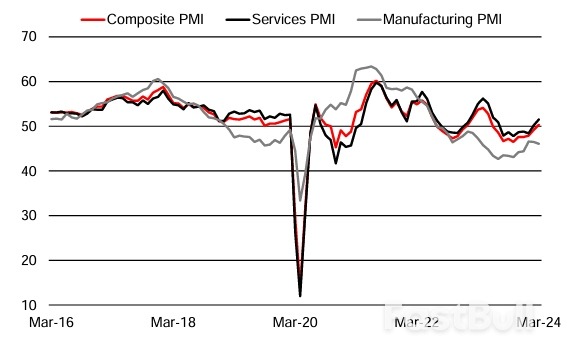
          The Pound to Euro exchange rate is forecast to recover some of last Friday's losses over the course of the coming week, but much will depend on the release of UK and Eurozone PMI figures for April.

          Pound Sterling fell in the final session of the last week following a speech by the Bank of England's Dave Ramsden, in which he boosted the odds of a June interest rate cut.
          Speaking in Washington, Ramsden said he believes risks to the Bank's inflation forecasts are now tilted to the downside, suggesting he will lend his vote to a mid-year rate cut alongside Governor Andrew Bailey.
          Money market pricing shows investor expectations for a rate cut coming as soon as May also rose, with two rate cuts for the totality of 2024 now being expected. In short, there has been a massive repricing in favour of UK rate cuts while expectations remain steady elsewhere, creating a sizeable selloff in the Pound.
          Technically, the outlook now turns negative, with Pound-Euro piercing the 200-day moving average (currently at 1.1615). Our Week Ahead Forecast rules rely heavily on this technical indicator to tell us where a trend lies; if the market is below the 200 DMA we judge a financial asset to be in a downtrend.
          We note that the exchange rate is up slightly in Monday trade but is tapping against the 200 DMA. Unless a quick break back above this line transpires soon, it will become the new resistance level.
          Pound to Euro Week Ahead Forecast: Wounded, Dip Buyers on the Ready_1
          But, fundamentally, we question the move. Ramsden's comments only confirm that a synchronised rate cut path between the ECB and the Bank of England lies ahead. This has been a long-standing assumption in global FX and explains why the Pound to Euro conversion rate has been stuck in a tight range centred around 1.17 for much of 2024.
          It is why we reckon Friday's selloff will be reversed in the coming days; we have not seen anything to suggest the established range should break and look for the exchange rate to turn back into its comfort zone.
          We imagine there will be numerous market participants who view Sterling as a buy on dips against the Euro in current circumstances.
          "We forecast there will be more downward pressure on EUR/GBP from a monetary policy-divergence perspective. Furthermore, the rise in crude oil prices have affected the terms of trade less in the UK than that of the euro area. Overall, we maintain a relatively positive bias on GBP vs. EUR," says Yusuke Miyairi, a foreign exchange strategist at Nomura.
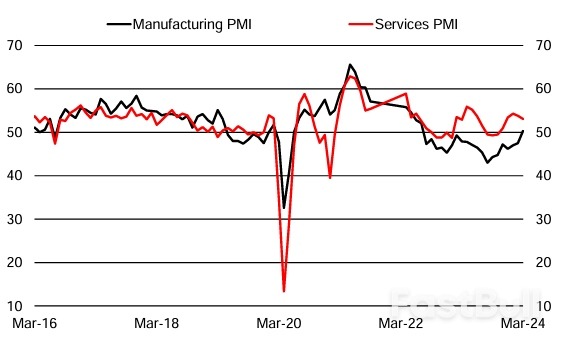
          The Pound could prove volatile on Tuesday, as the PMI survey for April is released. This is the most timely of the major economic data releases that will give a steer as to how the economy started the first quarter.
          The number to watch is the services PMI, where consensus looks for a reading of 53. Anything below this could extend the recent sombre tone in Pound Sterling.
          "The flash services PMI likely eased to 52.5 in April. The pick-up in 1Q24, which was presumably related to the improvement in real incomes, is likely to prove short-lived as the labour market is now clearly weakening," says an economic preview note from UniCredit.
          From a fundamental perspective, Pound-Euro direction will depend on how the UK print contrasts with the Eurozone release, out just half an hour earlier at 09:00. Markets look for the services PMI to read at 51.9 and the manufacturing PMI (this is important for the Eurozone owing to the centrality of German manufacturing) at 46.5.
          Expect a weaker Pound to Euro conversion if the Eurozone figures surprise and the UK figures disappoint, and vice versa.
          Pound to Euro Week Ahead Forecast: Wounded, Dip Buyers on the Ready_2
          Wednesday's German business climate findings will also be in focus, with the Euro potentially reacting to any surprises here. The market looks for the expectations index to read at 88.5 and the current assessment to read at 88.9.
          Pound to Euro Week Ahead Forecast: Wounded, Dip Buyers on the Ready_3

          Source: Pound Sterling

          To stay updated on all economic events of today, please check out our Economic calendar
          Risk Warnings and Disclaimers
          You understand and acknowledge that there is a high degree of risk involved in trading. Following any strategies or investment methods may lead to potential losses. The content on the site is provided by our contributors and analysts for information purposes only. You are solely responsible for determining whether any trading assets, securities, strategy, or any other product is suitable for investing based on your own investment objectives and financial situation.
          Add to Favorites
          Share

          What to Do About the EU's Relative Decline

          Devin

          Economic

          The European Union will be marginalised if it continues to shrink compared to other parts of the world. Two former Italian prime ministers, Enrico Letta and Mario Draghi, are proposing remedies. Anxious leaders welcomed Letta's report about how to improve the bloc's single market at their summit last week. They may lack the will to drink the necessary medicine, though.
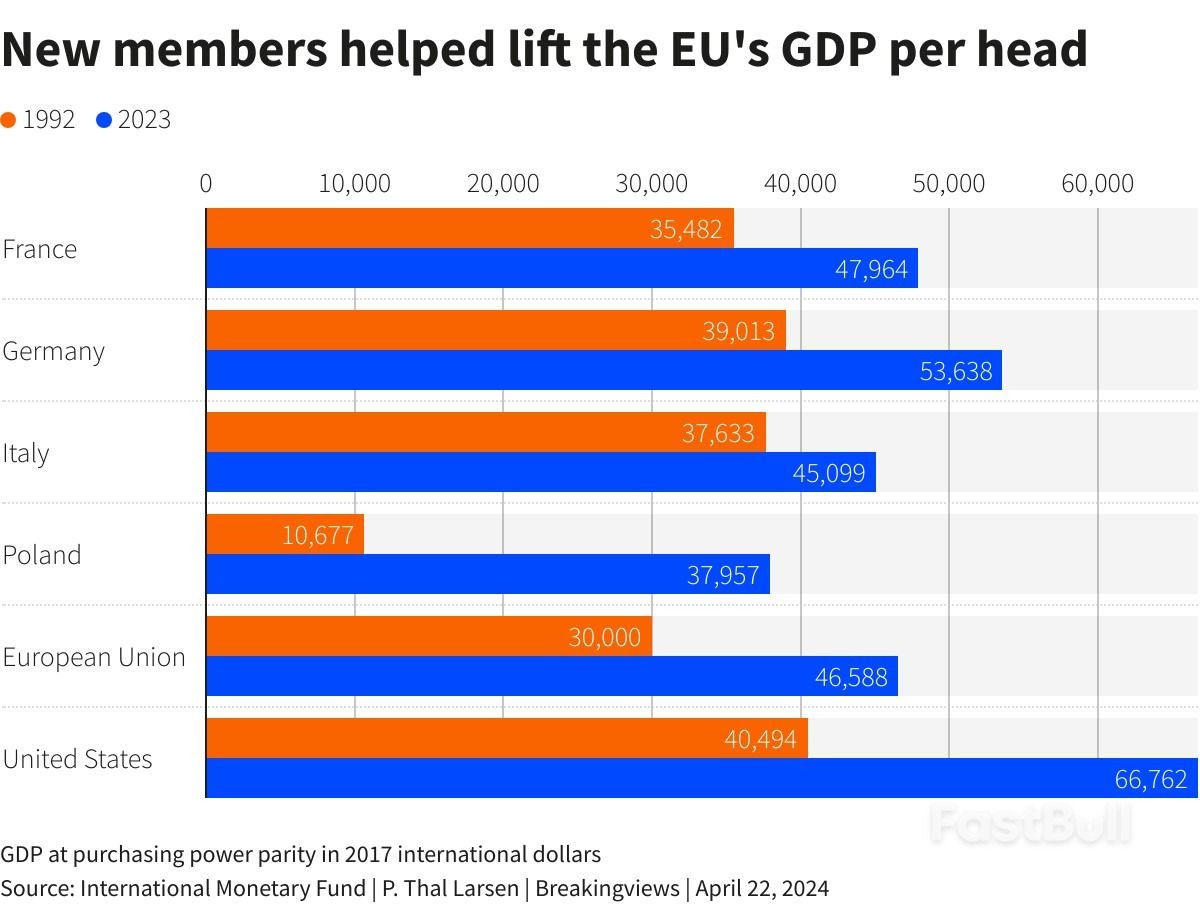
          There are two ways of looking at the EU's relative decline. The first is in terms of living standards. Here, what matters is not that developing countries, led by China and India, have been dragging themselves out of poverty in recent decades and so closing the gap on Europe, says Erik Nielsen, UniCredit's chief economic advisor. Rather, it is that the EU has not been moving ahead as fast as the United States.
          EU income per head has grown 55% since the single market was created in 1993 when measured on a purchasing power parity basis. That's not far behind the 65% gain enjoyed by the average American. But the EU has only kept up because new members, such as Poland, have expanded very fast: that country's income per head has almost quadrupled. By contrast, income per person in the bloc's bigger and older members — Germany, France and Italy — is up only 37%, 35% and 20%, respectively, over the same period.What to Do About the EU's Relative Decline_1
          The other way of looking at the region's relative decline is in terms of power. Back in 1992, the EU was a geoeconomic giant. With 29% of global output and a strong position in leading technologies, it could set many world standards.
          By 2022, the bloc's share of world output had shrunk to only 17% while the U.S. share was stable at 25% over the same period. What's more, the EU now has only four of the world's top 50 technology companies, Draghi noted in a speech last week.What to Do About the EU's Relative Decline_2
          The EU's relative economic weight is not just declining because other regions' living standards are growing faster. Its currency has weakened, and its population is stagnant. This would not matter if the post-war global economic and political order was intact. But Russia has invaded Ukraine, while both China and the United States are undermining the world trading system. The EU is worried that it will be bullied by larger rivals.

          Three Dangers

          Different threats need different responses. Boosting the EU's economy is not the main answer to an aggressive Russia. After all, the bloc's economy is already seven times bigger, and Russia's output seems set to stagnate in the coming years.
          Rather Europe's leaders need to summon up the will to provide more help to Ukraine. They also need to spend more on their own defence, while bulking up and streamlining their armaments industries.
          Another geopolitical threat is from China. The People's Republic could hold the EU to ransom because it controls supplies of critical goods such as rare earths. The answer is to secure alternative sources. The EU has made a start with its Critical Raw Materials Act, which sets targets for production of specific goods. But if it is serious about avoiding blackmail, it will need to put money behind this initiative.
          Yet another threat is that China and the United States will attract the industries of the future to their shores by both fair and foul means. The EU needs to respond by strengthening its single market so it can offer companies economies of scale comparative to the U.S. and Chinese markets. It will also need a targeted industrial policy to respond to the subsidies and tax breaks on offer to companies in other large economies.

          Attracting Investment

          Over 30 years after the launch of the single market, it may seem odd that the EU is still discussing how to improve it. But the original design left out several key industries — energy, electronic communications and capital markets.
          The cumulative impact of action on all these sectors could be significant since they are central to the functioning of other industries. The EU's weak position in capital markets when compared with the United States is particularly glaring. The lack of an equity culture is one of the reasons that the bloc is not creating more large entrepreneurial companies.
          The snag is that completing the single market is a mind-numbing job that requires confronting national vested interests on multiple fronts. Leaders may not have the will to do that. The EU has supposedly been committed to creating a capital markets union for a decade but has achieved very little. The initiative has suffered from the lack of a political champion, says Marco Buti, a former senior EU official now at the European University Institute.
          An equally knotty problem is how to respond to the vast subsidies that China and the United States are throwing at high-tech and green industries. If the EU does nothing, it could find it is squeezed out of strategic industries such as artificial intelligence and high-end semiconductors.
          On the other hand, engaging in a subsidy race will be expensive. It could also be wasteful if the EU pours money into industries where it has no long-term edge.
          A targeted approach may be the best option. For example, it is foolish to compete with China in wind turbines and solar panels, where there is already overcapacity. It would be best to buy this kit at the lowest price and fast-track the roll-out of cheap green energy. By contrast, subsidising the manufacture of advanced chips could make more sense.
          This, though, raises another problem: where will the EU find the money? After all, it doesn't just need to fund an industrial policy. It also needs to invest in other essential public bloc-wide goods — notably some aspects of defence and the climate transition.
          Letta hopes that reformed private capital markets will provide some of the cash. But a huge chunk will have to come from the EU itself. And that means its members will have to let it raise more taxes and borrow more money. With nationalism rising in most member states, getting them to accept greater European integration may be the hardest battle of all.

          Source: Reuters

          To stay updated on all economic events of today, please check out our Economic calendar
          Risk Warnings and Disclaimers
          You understand and acknowledge that there is a high degree of risk involved in trading. Following any strategies or investment methods may lead to potential losses. The content on the site is provided by our contributors and analysts for information purposes only. You are solely responsible for determining whether any trading assets, securities, strategy, or any other product is suitable for investing based on your own investment objectives and financial situation.
          Add to Favorites
          Share

          FX Daily: Data to Regain Centrality

          ING

          Forex

          Economic

          USD: US GDP and PCE figures this week

          Weekend news has helped ease market-perceived geopolitical risk, and sentiment is generally supported across asset classes as the week starts. All interested parties appear to have chosen the path of downplaying the size and consequences of Friday's Israeli strikes in Iran. Bent trading below $90/bbl signals that fears of a broader conflict in the region have abated. Another important piece of news for geopolitics was the approval by the US House of the much-debated $95 aid package for Ukraine, Israel and Taiwan. The implications for risk sentiment aren't as clear here, as the latest developments in the Russia-Ukraine conflict have not seemed to drive market moves recently.
          A less volatile geopolitical scene also paves the way for a return of data as the main market driver. There are two major releases in the US this week. GDP growth is widely expected to have slowed in the first quarter – and when the advanced numbers are published on Thursday, we expect a 2.6% quarter-on-quarter annualised print, slightly above the 2.5% consensus. As for March's core PCE deflator out on Friday, we are calling for a consensus 0.3% month-on-month. That is lower than core CPI (0.4%), where housing has a greater weight, but still too high for the Federal Reserve to revamp the narrative of an imminent rate cut. Remember that PCE is the Fed's favourite measure of inflation.
          We have entered the blackout period for policy comments ahead of the 2 May FOMC meeting, but it is now largely expected that the Fed will need to scale back some of its dovish narrative as inflation and jobs both surprised on the upside. The latest comments from most members (including Chair Jerome Powell) have stressed patience, and market expectations should converge towards a return of a simpler data-dependent approach as opposed to the moderately dovish quasi-guidance we had seen until April.
          The dollar may see a further softening in its momentum due to a calmer risk environment, but we see data reinforcing the notion of a resilient US economy with lingering inflation issues, so the key underlying arguments for a stronger dollar should not be dented. Risks of DXY moving to 107.0 remain fairly high.

          EUR: PMIs and ECB speakers in focus

          Abating concerns on Middle East tensions are positive for the pro-cyclical euro, although that also lowers the chances that higher oil prices will force a delay of the European Central Bank's cutting cycle. Market pricing for total 2024 easing is firming up at 75bp, which is also our call.
          Substantial data or market events may be needed to force a major repricing of ECB rate expectations at this point, and this week's activity surveys in the eurozone may not really move the needle. PMIs are out on Wednesday and are expected to improve marginally despite the manufacturing gauge continuing to act as a major drag. On Thursday, all eyes will be on the IFO reads for Germany, where consensus is also looking for a modest increase. On Friday, the ECB will publish the results of CPI inflation expectation surveys for March, where the three-year gauge should inch lower and endorse the ECB's dovish shift.
          Today, ECB President Christine Lagarde will give a lecture at Yale University, and may not touch upon current monetary policy issues. Still, the week is full of scheduled speeches by ECB members from all sides of the dovish/hawkish spectrum, from the dovish Fabio Panetta and Mario Centeno to the hawkish Joachim Nagel and Isabel Schnabel. We'll be interested to see whether latest geopolitical developments will translate into some resistance to easing from the hawks.
          EUR/USD could stay on a holding pattern until key US data start to flow in from Thursday. There is probably room for a small rebound, but monetary policy divergence continues to point to downside risks, and a re-test of 1.0600 could already be triggered later this week if US data comes in strong.

          GBP: Ramsden moves the market

          Sterling markets moved on Friday after the Bank of England's deputy governor, Dave Ramsden, sounded less concerned about price pressures and suggested that there were indications of UK inflation converging to that of the eurozone. Crucially, he added that the Bank will be “responsive” as evidence on inflation accumulates.
          Markets revamped some of their BoE rate cuts bet on Friday after strong wages and inflation had triggered a hawkish repricing. Expectations are now for 53bp of easing this year, with a first 25bp cut fully priced in for August.
          The only market-moving data release in the UK this week is PMIs on Tuesday. Remember that UK activity surveys have generally exceeded expectations in the past six months, but also that March saw the first month-on-month decline in composite PMI. While still above the 50.0 level (in expansionary territory), back to back MoM drops could help heavier speculation on rate cuts.
          We feel the rebound in EUR/GBP might have happened a bit too early, and still see risks below 0.8600 in the short term as markets hold greater dovish conviction on the ECB than the BoE. Ultimately, beyond the short run, the upside potential for EUR/GBP should still be unlocked by the BoE cutting more aggressively than market currently prices in, in our view.

          JPY: A 155.0 dilemma for Japan ahead of BoJ

          The Bank of Japan announces monetary policy on Friday and is widely expected to keep rates unchanged after March's 10bp hike. The market's focus should therefore be on the BoJ's quarterly forecast report. Our economics team expects the inflation forecast to be revised upwards, considering the increased inflation in the first quarter, wage growth that exceeded expectations and a weaker yen. PMIs tomorrow and Tokyo's CPI on Friday are two important releases.
          All in all, we don't think the BoJ will push back (implicitly or explicitly) against the current pricing on further hikes. Hawkish bets are – incidentally – not too aggressive, with a total of 21bp priced in by year-end. Instead, we think there is plenty of room for rate hike expectations to rise as the year progresses, and our economists currently expect a 15bp hike in the third quarter and a 25bp hike in the fourth quarter.
          In the short run, however, the yen remains in a precarious situation. A de-escalation in the Middle East means safe-haven unwinding, leaving JPY under pressure from the structurally higher Treasury yields. We are well into intervention territory, and we'll see whether Japanese officials draw a line in the sand at 155.0.
          To stay updated on all economic events of today, please check out our Economic calendar
          Risk Warnings and Disclaimers
          You understand and acknowledge that there is a high degree of risk involved in trading. Following any strategies or investment methods may lead to potential losses. The content on the site is provided by our contributors and analysts for information purposes only. You are solely responsible for determining whether any trading assets, securities, strategy, or any other product is suitable for investing based on your own investment objectives and financial situation.
          Add to Favorites
          Share

          Oil Prices Fall More Than 1% as Iran-Israel Tensions Ease

          Warren Takunda

          Commodity

          Economic

          Oil prices fell by more than 1% on Monday, as the market focus switched to fundamentals after Israel and Iran played down the risk of an escalation of hostilities following Israel's apparently small strike on Iran.
          Brent futures fell $1.21, or 1.4%, to $86.08 a barrel by 0655 GMT. The front-month U.S. West Texas Intermediate (WTI) crude contract for May , which expires on Monday, fell 97 cents, or 1.2%, to $82.17 a barrel, while the more active June contract dropped $1.23 to $80.99 a barrel.
          "Brent crude prices failed to retain their initial surge, with broad expectations that geopolitical tensions between Israel and Iran may fizzle off given Iran's tamed response," said Yeap Jun Rong, market strategist at IG.
          "With that, markets continue to unwind the geopolitical risk premium tied to potential supply disruptions, which seems more unlikely at current point in time," he added.
          Both benchmarks spiked more than $3 a barrel early on Friday, after explosions were heard in the Iranian city of Isfahan in what sources described as an Israeli attack. Gains were capped after Tehran played down the incident and said it did not plan to retaliate.
          Yeap said rising U.S. crude stocks had added to the pressure to sell.
          U.S. crude inventories rose by 2.7 million barrels, Energy Information Administration data showed last week, nearly double analysts' expectations of a 1.4 million barrel rise.
          "Economic concerns again become a bearish factor of the crude market," with prices "under pressure due to a large build in the U.S. stockpile and a hawkish Fed that led to a strong dollar," said independent market analyst Tina Teng. A strong dollar makes oil more expensive for holders of other currencies.
          Chicago Federal Reserve President Austan Goolsbee on Friday became the latest central banker to signal a longer timeline for interest rate cuts because progress on curbing inflation had stalled.
          On Saturday, the U.S. House of Representatives passed an aid package for Ukraine and Israel containing measures that would let the federal government expand sanctions against Iran and its oil production.
          But markets shrugged off the news as the impact of the measures, if passed, would depend on how they are interpreted and implemented. Senate consideration of the bill is set to begin on Tuesday.
          For now, ANZ analysts said in a note that volatility in the Middle East will keep oil markets "jittery".
          On Saturday, a blast at an Iraqi military base killed a member of a security force that includes Iran-backed groups. The force commander said it was an attack while the army said it was investigating.
          Separately, Iran-backed Lebanese group Hezbollah on Sunday said it downed an Israeli drone that was on a combat mission in southern Lebanon.
          Israeli forces and Lebanon's armed group Hezbollah have been exchanging fire for over six months in parallel to the Gaza war, fuelling concerns about further escalation.

          Source: Reuters

          To stay updated on all economic events of today, please check out our Economic calendar
          Risk Warnings and Disclaimers
          You understand and acknowledge that there is a high degree of risk involved in trading. Following any strategies or investment methods may lead to potential losses. The content on the site is provided by our contributors and analysts for information purposes only. You are solely responsible for determining whether any trading assets, securities, strategy, or any other product is suitable for investing based on your own investment objectives and financial situation.
          Add to Favorites
          Share

          Relief Before Earnings

          Swissquote

          Economic

          Commodity

          Stocks

          Oil under pressure following calm weekend

          US crude kicks off the week under selling pressure, near the $81.50pb level. But the $80pb psychological level, which also coincides with the major 38.2% Fibonacci retracement on December to April rebound, will likely act as a strong support to the actual retreat as the Middle East tensions could resurface anytime.
          But, one thing that could send the price of a barrel below that level is a further fall in rate cut expectations from the Federal Reserve (Fed), and eventually the other central banks. Even though the European Central Bank's (ECB) Villeroy said that the ECB shouldn't wait much even though the Mid East tensions drive oil prices higher, there is little chance that the ECB will ignore a potential U-turn in euro area inflation dynamics on the back of surging energy prices and US dollar appreciation.

          US two-year yield above 5%

          The strong economic data from the US and hawkish comments from the Fed members closed the door on the expectation of a summer rate cut from the Fed. The US 2-year yield has been testing the 5% level since 10th of April and looks ready to go above this week. The US will reveal the first estimate of Q1 GDP on Thursday and the core PCE price index on Friday. The US economy is expected to have grown 2.5% in Q1 and the core PCE is seen flat on a monthly basis and lower on a yearly basis. Atlanta Fed's GDPNow forecast points at a first quarter growth of nearly 3% and the last three CPI prints in the US surprised to the upside. Risks to the US economic data remain tilted to the upside.
          Is it a bad thing? Robust growth is good news for everyone if inflation continues to slow. Otherwise it's bad news, because it means that the Fed should try harder to fight inflation by keeping its monetary policy at a sufficiently restrictive level to slow down the economy and eventually push it into recession. Therefore, the combination of growth and inflation will give investors the next indication regarding how far the Fed stands from its first rate hike. Activity on Fed funds futures gives more than 50% for a September rate cut. And because September is too close to November elections, that could delay the first cut to the end of the year. Voila.

          All eyes on magnificent seven

          The S&P500 and Nasdaq have significantly decoupled from the yields and the Fed expectations since last year as the AI rally fueled optimism in technology stocks and sent these indices to record levels. But the first set of earnings from the most popular chip stocks disappointed last week. Both ASML and TSM reported their Q1 results last week, and both companies failed to satisfy investors despite highlighting that the AI should continue to boost their revenue and profits this year.
          This week, 4 of the Magnificent 7 companies will be revealing their Q1 results: Microsoft, Google, Meta and Tesla..
          And if the tech stocks can't boost appetite, the rest of the S&P500 will hard it hard to do so. The S&P500 index is expected to print a 4% earnings decline in Q1 – a decent contrast with the +38% expected for the Magnificent 7. And among the Magnificent 7, Tesla and Apple don't look promising. So all hopes rely on 5 stocks. 5 stocks will determine where the S&P500 should be headed next.
          To stay updated on all economic events of today, please check out our Economic calendar
          Risk Warnings and Disclaimers
          You understand and acknowledge that there is a high degree of risk involved in trading. Following any strategies or investment methods may lead to potential losses. The content on the site is provided by our contributors and analysts for information purposes only. You are solely responsible for determining whether any trading assets, securities, strategy, or any other product is suitable for investing based on your own investment objectives and financial situation.
          Add to Favorites
          Share

          Asia Stocks Rebound, Oil And Gold Retreat On Tempered Mideast Fears

          Alex

          Economic

          Commodity

          Stocks

          Political

          Gold and the safe-haven dollar eased back from near their peaks, and crude oil prices declined as the potential for a major supply disruption waned.
          Iran said on Friday that it had no plan to retaliate following an apparent Israeli drone attack within its borders, which in turn followed an unprecedented Iranian missile and drone attack on Israel days before.
          MSCI's broadest index of Asia-Pacific shares rose 0.83% as of 0514 GMT, retracing some of the 1.8% drop from Friday, after news of the Israeli strike emerged.
          Pan-European STOXX 650 futures added 0.33%, and FTSE futures advanced 0.8%.
          "It seems neither Israel nor Iran want an escalation in the crisis in the Middle East ... and with a subsequent strike from either side not looking like it's coming, investor concerns have eased somewhat," said Kazuo Kamitani, a strategist at Nomura Securities.
          However, Kamitani said expectations of later Federal Reserve interest rate cuts and concerns about chip sector earnings will continue to keep investors on their toes.
          MSCI's world equities index suffered its worst week since March 2023 last week, dropping 2.85%. Early on Monday, it was up just 0.05%.
          Around Asia, Hong Kong's Hang Seng jumped 1.94%, Australia's benchmark gained 0.92% and South Korea's KOSPI climbed 0.82%.
          Japan's Nikkei added 0.56%, underperforming the rest of the region due to a high concentration of chip sector shares, which tracked declines in U.S. peers from Friday. Taiwanese stocks slipped 0.05%.
          Mainland Chinese blue chips declined 0.18% in their first chance to react to new measures announced on Friday aimed at promoting overseas investment in China's technology sector.
          U.S. stock futures added 0.31%, following a 0.88% drop for the S&P 500 on Friday.
          Bond yields - which climb when prices fall - rose back toward multi-month highs. The 10-year U.S. Treasury yield climbed 4 basis points to 4.656%, heading back toward the five-month peak of 4.696% reached last week on the view that the Fed would be in no hurry to ease policy amid robust economic data and sticky inflation.
          The dollar index, which measures the currency against six major peers, eased 0.05% to 106.05. It was also at a five-month top last week, at 106.51.
          Gold slid 0.95% to $2,367.75, retreating from near the all-time peak of $2,431.29 from last week.
          "Failure at $2,400 could hint towards a short-term correction ... followed by an overdue period of consolidation," Saxo strategist Charu Chanana wrote in a client note.
          Crude oil fell as traders put the focus back on fundamentals. With a rise in U.S. stockpiles as the backdrop, Brent futures fell 67 cents, or 0.77%, to $86.62 a barrel. The front-month U.S. West Texas Intermediate (WTI) crude contract for May, which expires on Monday, fell 63 cents, or 0.76%, to $82.51 a barrel, while the more active June contract dropped 64 cents to $81.58 a barrel.
          "It looks on the face of it like oil's uptrend may be over, but based on technical levels, until WTI breaks below $80, the uptrend is still in place," said Nomura's Kamitani.

          Source:Reuters

          To stay updated on all economic events of today, please check out our Economic calendar
          Risk Warnings and Disclaimers
          You understand and acknowledge that there is a high degree of risk involved in trading. Following any strategies or investment methods may lead to potential losses. The content on the site is provided by our contributors and analysts for information purposes only. You are solely responsible for determining whether any trading assets, securities, strategy, or any other product is suitable for investing based on your own investment objectives and financial situation.
          Add to Favorites
          Share

          Busy Week Ahead for Global Markets: US Earnings, Central Bank Decisions, and Key Economic Data in Focus

          Warren Takunda

          Economic

          Stocks

          Forex

          The coming week promises to be a rollercoaster ride for global markets, packed with pivotal events that could set the tone for the rest of the year. Here's a deep dive into the key themes that will dominate the headlines:
          US Earnings Season Finale: A Tech Titan Extravaganza
          The United States takes center stage with the culmination of earnings season. Brace yourselves for a barrage of financial reports from over 30 behemoths boasting market caps exceeding $100 billion. Tech titans like Alphabet (Google's parent company), Microsoft, and Meta Platforms (formerly Facebook) will be the star attractions. Their performance will be scrutinized by analysts and investors alike, offering a glimpse into the health of the US corporate sector and potentially influencing broader market sentiment.
          US Economy: Growth Slowdown or Looming Recession?
          Beyond earnings, the US economic calendar is jam-packed with data releases that could shed light on the nation's economic health. The first-quarter GDP growth rate is projected to decelerate to 2.1%, a significant slowdown compared to the robust 3.4% recorded in Q4 2023. This could raise concerns about the trajectory of the US economy, especially if the figure falls short of expectations.
          The spotlight will also be on inflation, with the Personal Consumption Expenditures (PCE) price index expected to remain at 0.3% for both headline and core figures. However, any deviation from this forecast, particularly an upward surprise, could reignite inflation worries and potentially trigger a hawkish reaction from the Federal Reserve.
          US Consumer Spending: Holding Steady or Showing Cracks?
          Personal income is anticipated to show a slightly faster growth rate of 0.5% compared to the previous month. However, the real story lies in consumer spending, which is forecast to slow down to 0.3% from 0.8% a month earlier. This potential slowdown in spending could indicate a cautious consumer base reeling from inflationary pressures and rising interest rates.
          Durable Goods Orders, Housing Data, and PMIs: Gauging Manufacturing and Services
          Investors will also be keeping a watchful eye on durable goods orders, a key indicator of future business investment. The flash S&P Global Manufacturing and Services PMI surveys will provide valuable insights into the health of these critical sectors, highlighting potential expansion or contractionary trends. Additionally, new and pending home sales data will shed light on the state of the US housing market, a crucial driver of economic growth.
          Central Bank Decisions: Dovish BOJ, Cautious PBOC?
          The monetary policy front will be equally captivating. The Bank of Japan (BOJ) is widely expected to maintain its current ultra-accommodative stance, keeping its key interest rate unchanged at -0.1%. However, any hints of a potential shift towards a less dovish policy stance in the future could cause ripples in the Japanese yen and global markets.
          The People's Bank of China (PBOC) is likely to follow a similar path, holding its one- and five-year loan prime rates steady at 3.65% and 4.30%, respectively. This decision reflects the PBOC's desire to maintain stability amidst a depreciating yuan and a strengthening US dollar.
          Global PMI Frenzy: Europe, Asia, and Beyond
          The data deluge extends far beyond the US borders. Flash PMI readings for both manufacturing and services sectors will be released for major economies in the Eurozone, including Germany, France, and the UK. These surveys provide a snapshot of business activity and offer valuable clues about the economic momentum in these regions.
          Consumer Confidence: Optimism Waning in Key Markets?
          Consumer confidence data for the Eurozone, South Korea, Italy, Germany, and the UK will also be closely monitored. A decline in consumer confidence could foreshadow a pullback in spending and dampen economic growth prospects.
          Australia's Inflation Jitters and South Korea's GDP Growth
          Adding to the global data frenzy, Australia will release its first-quarter inflation figures, with investors anticipating any signs of a potential inflationary peak. South Korea will unveil its preliminary estimate for first-quarter GDP growth, offering insights into the health of the Asian economic powerhouse.
          In conclusion, the coming week promises to be a data-rich and potentially volatile period for financial markets. Careful analysis of earnings reports, economic releases, and central bank pronouncements will be paramount for investors as they navigate this dynamic landscape. The performance of US tech giants, the trajectory of the US economy, and the decisions of major central banks will be key factors that could shape market sentiment and influence investment decisions in the weeks to come.
          To stay updated on all economic events of today, please check out our Economic calendar
          Risk Warnings and Disclaimers
          You understand and acknowledge that there is a high degree of risk involved in trading. Following any strategies or investment methods may lead to potential losses. The content on the site is provided by our contributors and analysts for information purposes only. You are solely responsible for determining whether any trading assets, securities, strategy, or any other product is suitable for investing based on your own investment objectives and financial situation.
          Add to Favorites
          Share
          FastBull
          Copyright © 2025 FastBull Ltd

          728 RM B 7/F GEE LOK IND BLDG NO 34 HUNG TO RD KWUN TONG KLN HONG KONG

          TelegramInstagramTwitterfacebooklinkedin
          App Store Google Play Google Play
          Products
          Charts

          Chats

          Q&A with Experts
          Screeners
          Economic Calendar
          Data
          Tools
          Membership
          Features
          Function
          Markets
          Copy Trading
          Latest Signals
          Contests
          News
          Analysis
          24/7
          Columns
          Education
          Company
          Careers
          About Us
          Contact Us
          Advertising
          Help Center
          Feedback
          User Agreement
          Privacy Policy
          Business

          White Label

          Data API

          Web Plug-ins

          Poster Maker

          Affiliate Program

          Risk Disclosure

          The risk of loss in trading financial instruments such as stocks, FX, commodities, futures, bonds, ETFs and crypto can be substantial. You may sustain a total loss of the funds that you deposit with your broker. Therefore, you should carefully consider whether such trading is suitable for you in light of your circumstances and financial resources.

          No decision to invest should be made without thoroughly conducting due diligence by yourself or consulting with your financial advisors. Our web content might not suit you since we don't know your financial conditions and investment needs. Our financial information might have latency or contain inaccuracy, so you should be fully responsible for any of your trading and investment decisions. The company will not be responsible for your capital loss.

          Without getting permission from the website, you are not allowed to copy the website's graphics, texts, or trademarks. Intellectual property rights in the content or data incorporated into this website belong to its providers and exchange merchants.

          Not Logged In

          Log in to access more features

          FastBull Membership

          Not yet

          Purchase

          Become a signal provider
          Help Center
          Customer Service
          Dark Mode
          Price Up/Down Colors

          Log In

          Sign Up

          Position
          Layout
          Fullscreen
          Default to Chart
          The chart page opens by default when you visit fastbull.com