Markets
News
Analysis
User
24/7
Economic Calendar
Education
Data
- Names
- Latest
- Prev



Signal Accounts for Members
All Signal Accounts
All Contests


MSCI's Nordic Countries Index Rose 0.3%, Marking Its Third Consecutive Day Of Gains, Closing At 394.43 Points. Among The Ten Sectors, The Nordic Industrials Sector Saw The Largest Increase. Boliden Ab Closed Up 5.3%, Leading The Pack Among Nordic Stocks
[Italian Banking Sector Hits Record Closing High] Germany's DAX 30 Index Closed Down 0.02% At 24,793.06 Points. France's Stock Index Closed Down 0.13%, Italy's Stock Index Closed Up 0.80% With The Banking Index Up 1.24%, And The UK Stock Index Closed Down 0.39%
[Bitcoin Falls Below $77,000, 24-Hour Decline Of 2.8%] February 4Th, According To Htx Market Data, Bitcoin Fell Below $77,000, Now Trading At $76,900, A 24-Hour Decrease Of 2.8%
Spot Gold Surged $302.83 During The Day, Currently Trading At $4,963.79 Per Ounce, A Gain Of 6.50%
Denmark's Forex Reserves 673.9 Billion DKK At End-January Versus 651.1 Billion At End-December
Fitch: Forecasts UK's Inflation Outlook To Be More Benign This Year And For Bank Of England To Respond With Three Rate Cuts In 2026

U.K. Manufacturing PMI Final (Jan)A:--
F: --
P: --
Turkey Trade Balance (Jan)A:--
F: --
P: --
Brazil IHS Markit Manufacturing PMI (Jan)A:--
F: --
P: --
Canada National Economic Confidence IndexA:--
F: --
P: --
Canada Manufacturing PMI (SA) (Jan)A:--
F: --
P: --
U.S. IHS Markit Manufacturing PMI Final (Jan)A:--
F: --
P: --
U.S. ISM Output Index (Jan)A:--
F: --
P: --
U.S. ISM Inventories Index (Jan)A:--
F: --
P: --
U.S. ISM Manufacturing Employment Index (Jan)A:--
F: --
P: --
U.S. ISM Manufacturing New Orders Index (Jan)A:--
F: --
P: --
U.S. ISM Manufacturing PMI (Jan)A:--
F: --
P: --
US President Trump delivered a speech
South Korea CPI YoY (Jan)A:--
F: --
P: --
Japan Monetary Base YoY (SA) (Jan)A:--
F: --
P: --
Australia Building Approval Total YoY (Dec)A:--
F: --
Australia Building Permits MoM (SA) (Dec)A:--
F: --
Australia Building Permits YoY (SA) (Dec)A:--
F: --
P: --
Australia Private Building Permits MoM (SA) (Dec)A:--
F: --
Australia Overnight (Borrowing) Key RateA:--
F: --
P: --
RBA Rate Statement
Japan 10-Year Note Auction YieldA:--
F: --
P: --
The U.S. House of Representatives voted on a short-term spending bill to end the partial government shutdown.
Saudi Arabia IHS Markit Composite PMI (Jan)A:--
F: --
P: --
RBA Press Conference
Turkey PPI YoY (Jan)A:--
F: --
P: --
Turkey CPI YoY (Jan)A:--
F: --
P: --
Turkey CPI YoY (Excl. Energy, Food, Beverage, Tobacco & Gold) (Jan)A:--
F: --
P: --
U.K. 10-Year Note Auction YieldA:--
F: --
P: --
Richmond Federal Reserve President Barkin delivered a speech.
U.S. Weekly Redbook Index YoYA:--
F: --
P: --
Mexico Manufacturing PMI (Jan)A:--
F: --
P: --
U.S. API Weekly Refined Oil Stocks--
F: --
P: --
U.S. API Weekly Gasoline Stocks--
F: --
P: --
U.S. API Weekly Cushing Crude Oil Stocks--
F: --
P: --
U.S. API Weekly Crude Oil Stocks--
F: --
P: --
Japan IHS Markit Services PMI (Jan)--
F: --
P: --
Japan IHS Markit Composite PMI (Jan)--
F: --
P: --
China, Mainland Caixin Services PMI (Jan)--
F: --
P: --
China, Mainland Caixin Composite PMI (Jan)--
F: --
P: --
India HSBC Services PMI Final (Jan)--
F: --
P: --
India IHS Markit Composite PMI (Jan)--
F: --
P: --
Russia IHS Markit Services PMI (Jan)--
F: --
P: --
South Africa IHS Markit Composite PMI (SA) (Jan)--
F: --
P: --
Italy Services PMI (SA) (Jan)--
F: --
P: --
Italy Composite PMI (Jan)--
F: --
P: --
Germany Composite PMI Final (SA) (Jan)--
F: --
P: --
Euro Zone Composite PMI Final (Jan)--
F: --
P: --
Euro Zone Services PMI Final (Jan)--
F: --
P: --
U.K. Composite PMI Final (Jan)--
F: --
P: --
U.K. Total Reserve Assets (Jan)--
F: --
P: --
U.K. Services PMI Final (Jan)--
F: --
P: --
U.K. Official Reserves Changes (Jan)--
F: --
P: --
Euro Zone Core CPI Prelim YoY (Jan)--
F: --
P: --
Euro Zone Core HICP Prelim YoY (Jan)--
F: --
P: --
Euro Zone PPI MoM (Dec)--
F: --
P: --
Euro Zone HICP Prelim YoY (Jan)--
F: --
P: --
Euro Zone Core HICP Prelim MoM (Jan)--
F: --
P: --
Italy HICP Prelim YoY (Jan)--
F: --
P: --
Euro Zone Core CPI Prelim MoM (Jan)--
F: --
P: --
Euro Zone PPI YoY (Dec)--
F: --
P: --
U.S. MBA Mortgage Application Activity Index WoW--
F: --
P: --


No matching data
View All

No data
The (USD) debasement trade last week was mainly driven by longer-term structural and (geo)political considerations. However, yesterday, for once, (US) eco data also again had a role to play.
The US January manufacturing ISM delivered an upward surprise that was too big to ignore. The headline index jumped from 47.9 to 52.6 (48.5 expected). It was the first 50+ reading since January last year and the best level since August 2022. Almost all subindices supported the improvement (production 55.9 from 50.7; orders 57.1 from 47.4; backlog of orders 51.6 from 45.8). The employment series also improved but at 48.1 stayed below the 50-mark. The prices paid stayed at a high 59.
The figure needs confirmation from tomorrow's services ISM, but it provides additional evidence that the US economy for now doesn't need 'emergency monetary support', leaving the Fed in a good place to wait and see. US yields already were upwardly oriented (Warsh-driven?) going into the release and extended gains afterward. Yields closed the session 4-5 bps higher across the curve. The Treasury's estimated borrowing needs were published later in the session but didn't yield any major surprise ($574 bln borrowing this quarter from an estimated $578 set in November, including a higher $850 bln cash pile at the start; and $109 bln borrowing in Q2). The Q4 cash flow performance was $42 bln better than expected. German Bund yields followed the US move at a distance with yields rising 2-3 bps across the curve. The data also rubberstamped the intraday comeback of the USD dollar. EUR/USD closed the session at 1.179 (from 1.1856). DXY rebound further to 97.63. Both US and European equities apparently enjoyed renewed dip buying (S&P 500 +0.54%, less than 0.5% from all-time record; Eurostoxx 50 +1%). Metals including Gold, Silver and Copper were/are looking for a bottom.
This morning, (Asian) equity markets show an outright risk-on sentiment (Nikkei +3.92%; Kospi +6.84%, Nifty 50 + 2.97%). A positive risk sentiment and metals rebounding currently caps further USD gains (EUR/USD 1.181, USD/JPY 155.4). Risk sentiment probably will continue to set the tone for lobal trading today. The eco calendar is almost empty. The release of the US JOLTS Labour market data is delayed by the (partial) US government shutdown. We keep a close eye at the 'balance' between commodities/metals and the Dollar. Maybe the latter is a bit better protected against a (potential) new upleg in metals as US eco data improve further.
There it is the first rate hike by a central bank in an advanced economy. The Reserve Bank of Australia (RBA) hiked the policy rate by 25 bps to 3.85% this morning. Motivation was straightforward: "A wide range of data over recent months have confirmed that inflationary pressures picked up materially in the second half of 2025.
While part of the pick-up in inflation is assessed to reflect temporary [e.g. the expiry of state electricity rebate schemes] factors, it is evident that private demand is growing more quickly than expected, capacity pressures are greater than previously assessed and labour market conditions are a little tight." Headline inflation increased to 3.6% y/y in 2025Q4 while underlying gauges accelerated to 3.4%. Both were (substantially) higher than the RBA expected. Strong upward revisions result in CPI not returning to the 2-3% target before mid-2027. GDP grew at around potential in 2025Q3 (2.1%) and probably quickened in the final quarter thanks to strong private demand. Consumption growth picked up by "much more" than expected in the November statement. The Aussie dollar jumped back above AUD/USD 0.70 after losing that handle in the recent US dollar recovery. The combo is trading around the strongest levels since early 2023. Australian swap yields rise 2.4-7 bps in a bear flattening move though gains (at the front) had been higher earlier (>10 bps). Money markets assume another rate hike at the June meeting (90%).
The US will cut tariffs on Indian imports to 18% from 50%, President Trump announced yesterday. Indian exports suffered from the punitive rate of which 25 ppts was introduced in response to India buying Russian crude. The US president said India would no longer buy Russian oil and instead agreed to potentially buy more oil from Venezuela. PM Modi confirmed the trade deal but stayed silent on the oil topic. Trump claimed India would buy over $500bn in American goods (over 5 years).
Annual amounts last year only totaled $40bn+ while total bilateral trade only amounted to $212bn in 2024. Either way, the trade détente supports the Indian rupee which had been hitting record lows the last couple of weeks. USD/INR gaps lower to 90.43 from 92 just a couple of days ago. Indian stock markets rise more than 3%.

Oil and natural gas prices are falling as geopolitical tensions ease, removing recent risk premiums and shifting focus back to strong supply. WTI crude is now around $61 to $62 per barrel, down from late January highs of $65 to $66, after dropping nearly 5% in one day earlier this week.
A stronger US dollar is adding pressure, and OPEC+ has confirmed it will keep output steady, supporting the view that global supply will remain high. With demand growth expected to stay below 1 million barrels per day in 2026 and inventories likely to rise, prices are now testing important support near $60.
Volatility is still high, but the market has clearly moved from risk-driven rallies to a more cautious, balanced approach.
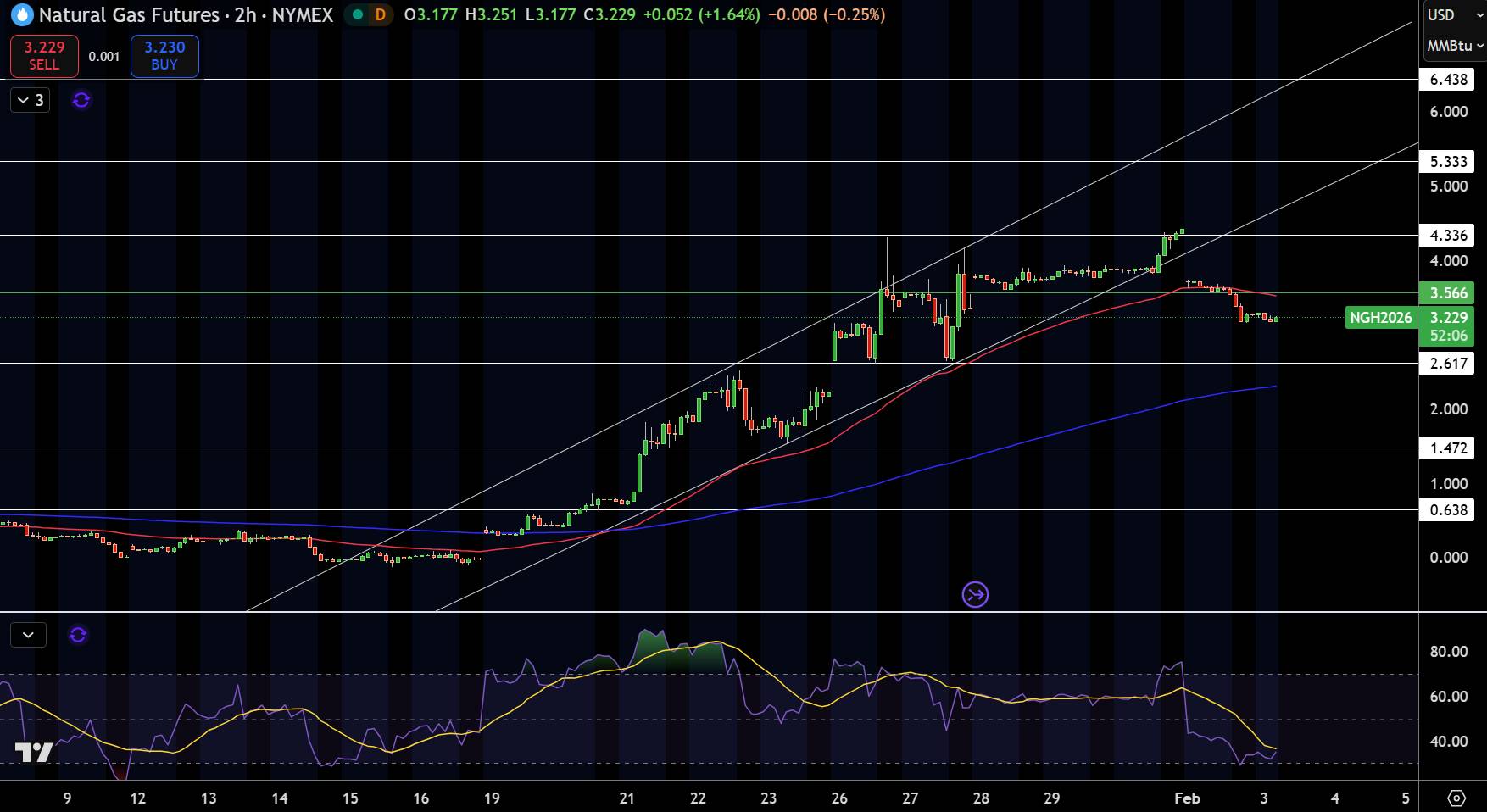
Natural Gas (NG) Price ChartNatural gas is trading near $3.23, easing after failing to hold above the recent swing high near $3.55. On the 2-hour chart, price remains inside a rising channel, but recent candles show smaller bodies and lower highs, pointing to short-term consolidation. The pullback has brought price back toward the 50-EMA, which is flattening and acting as near-term support.
The broader trend stays constructive as long as price holds above $3.10–$3.15, a zone aligned with prior resistance turned support. The 200-EMA near $2.60 continues to slope higher, reinforcing the medium-term uptrend. The RSI around 40–45 shows cooling momentum, not aggressive selling.
Trade idea: Buy dips near $3.15, targeting $3.55, invalidated below $3.00.
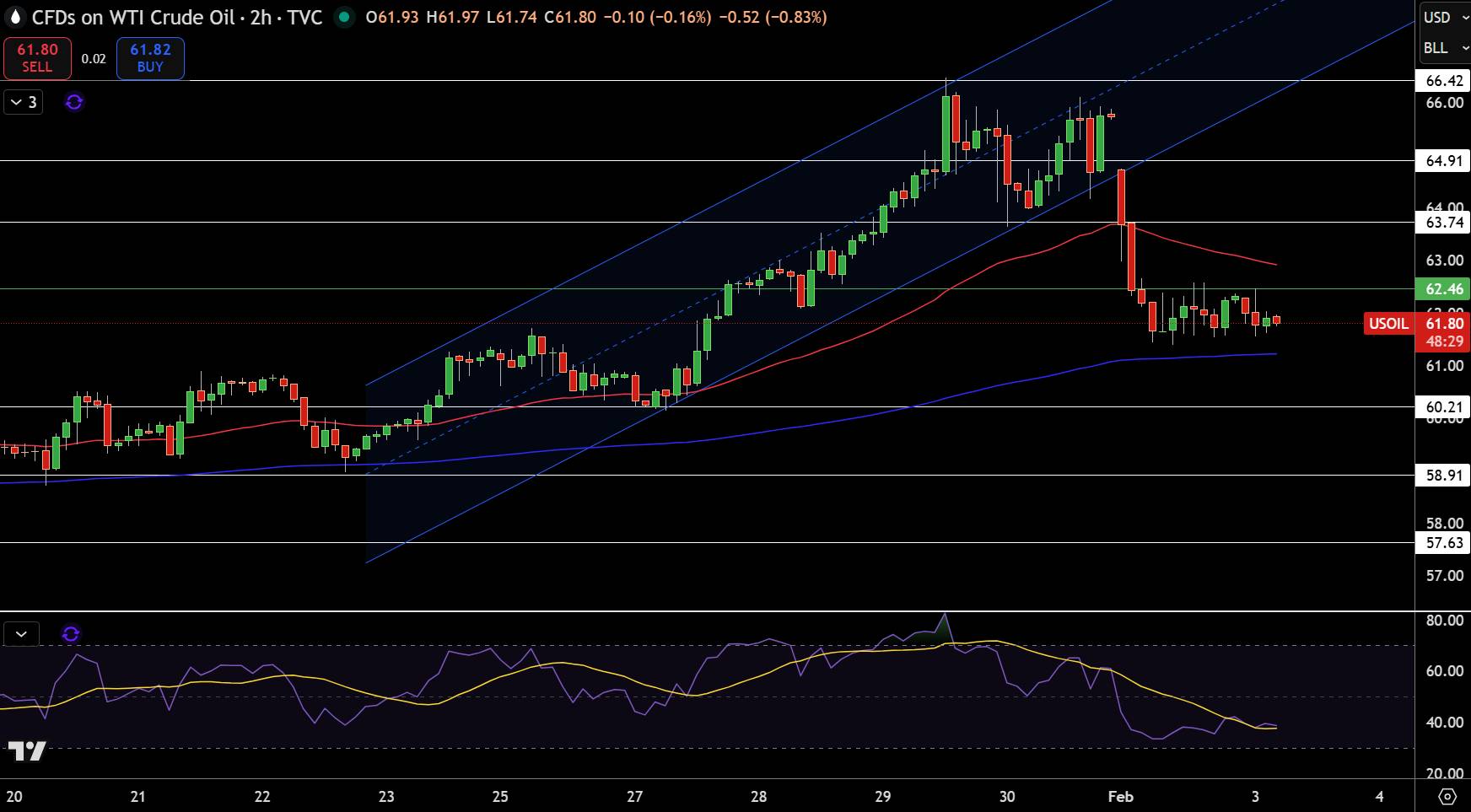
WTI Price ChartWTI crude oil is trading near $61.80, consolidating after a sharp rejection from the upper boundary of a rising channel. On the 2-hour chart, a strong bearish engulfing candle marked the breakdown below the channel midline, signaling a shift from momentum buying to profit-taking. Price is now below the 50-EMA, while the 200-EMA near $61.00 is acting as near-term support.
Former resistance around $63.70–$64.00 has turned into a supply zone. The RSI near 40 shows weak momentum, suggesting sellers still control the pace but without panic selling. A clean break below $61.00 could open room toward $60.20, while recovery needs a move back above $62.50.
Trade idea: Sell rallies near $62.50, targeting $60.20, invalidated above $63.80.
Brent Crude Forecast: $66 Holds as Bulls Lose Control Below Rising Channel
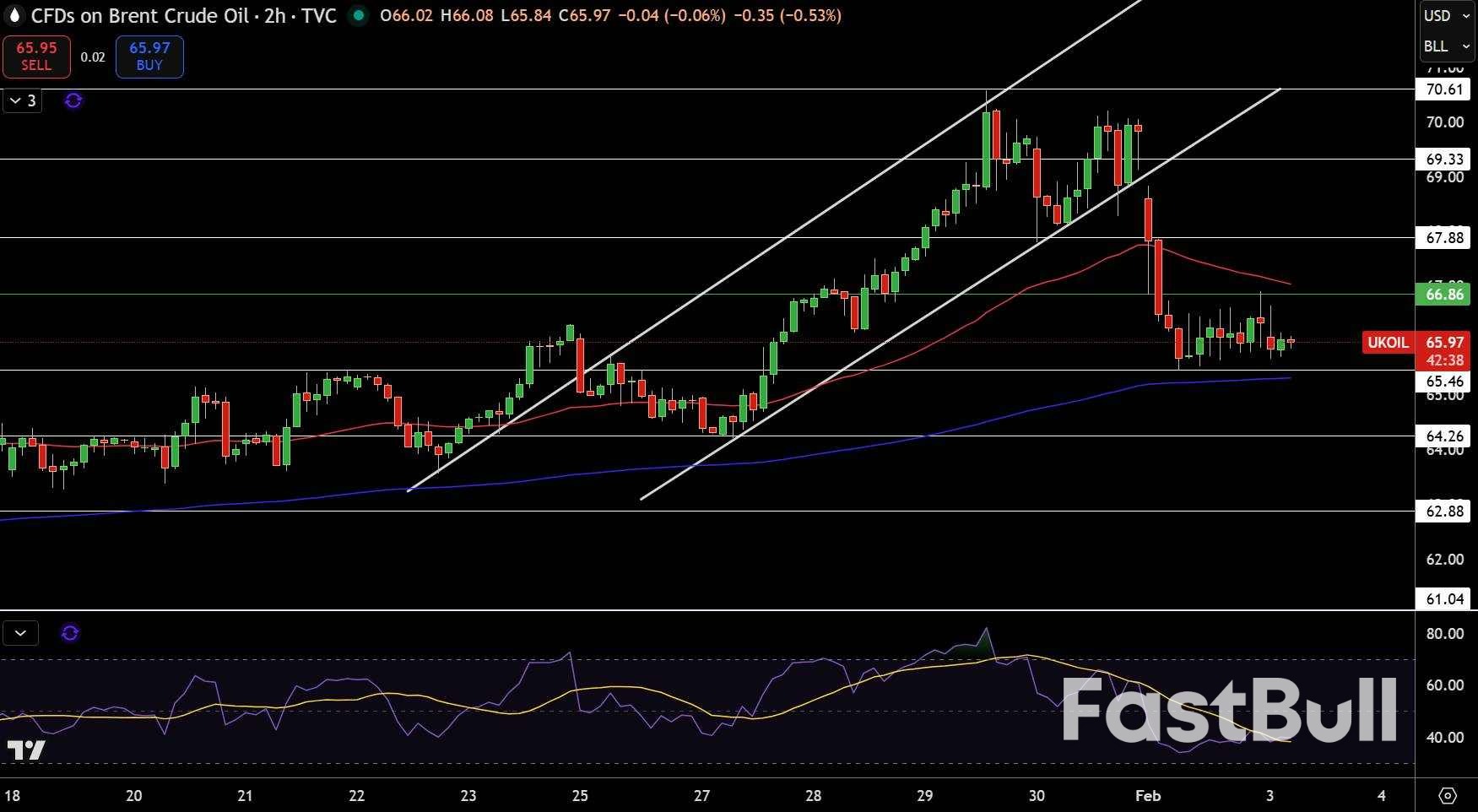
Brent Price ChartBrent crude is trading near $66.00, moving sideways after a sharp rejection from the top of a rising channel. On the 2-hour chart, a strong bearish candle broke price below the channel support and the 50-EMA, signaling a loss of upside momentum. Since then, candles have been smaller, showing consolidation rather than a quick rebound.
The area around $66.80–$67.00 now acts as resistance, while the 200-EMA near $65.50 is providing short-term support. A break below $65.40 could open the door toward $64.25, a prior demand zone. The RSI near 40 reflects weak momentum, suggesting sellers remain in control without extreme pressure.
Trade idea: Sell rebounds near $66.80, targeting $64.30, invalidated above $67.90.
Deutsche Bank downgraded Merck KGaA (ETR:MRCG) to "hold" from "buy" and raised its price target to €132 from €127, citing reduced earnings expectations and limited upside after a recent share price recovery, sending shares down over 3%.
In a note ahead of the company's upcoming fourth-quarter results and 2026 guidance, analyst Falko Friedrichs said Deutsche Bank cut its adjusted earnings per share estimate for 2026 by about 5%.
The reduction reflects higher foreign exchange headwinds and slightly higher interest costs than previously assumed, according to the report.
Deutsche Bank said it expects the fourth-quarter results to be largely a non-event, with investor attention likely centered on the 2026 guidance.
The brokerage said the guidance is likely to indicate another operational transition year. Friedrichs noted that the revised adjusted EPS forecast is 7% below Bloomberg consensus for 2026 and as much as 10% below consensus for the outer years.
The downgrade was driven by the gap between Deutsche Bank's estimates and consensus forecasts, as well as valuation considerations.
Friedrichs said the revised €132 target price no longer offers significant upside following a roughly 15% recovery in the share price in recent weeks. Deutsche Bank said it is waiting for a better entry point and for consensus estimates to be reset.
Russia has signaled it is prepared for a "new reality" where no nuclear arms control treaty exists with the United States, as the landmark New START agreement is set to expire this week.
Without a last-minute deal, the expiration on Thursday will remove all constraints on the long-range strategic nuclear arsenals of both nations for the first time in over half a century.
"This is a new moment, a new reality—we are ready for it," Russian Deputy Foreign Minister Sergei Ryabkov, Moscow's lead arms control negotiator, told Russian news agencies. He made the comments during a visit to Beijing for "strategic stability consultations."
The New START treaty, signed in 2010, limits each country to a maximum of 1,550 deployed strategic warheads.
Last month, U.S. President Donald Trump suggested he would let the treaty lapse. His administration has not formally replied to a Russian offer to maintain the pact's missile and warhead limits for another year, which would have provided time to negotiate a successor agreement.
"The lack of an answer is also an answer," Ryabkov was quoted as saying by the TASS news agency.
Arms control advocates in both Moscow and Washington warn that the treaty's end will do more than just remove warhead limits. It is also expected to erode confidence, undermine trust, and eliminate the ability to verify the nuclear intentions of the other side. Many experts now fear the possibility of an unrestrained nuclear arms race.
The network of agreements designed to prevent nuclear war, painstakingly built since the 1962 Cuban Missile Crisis, has been steadily deteriorating. This trend is accelerating amid growing confrontation between Russia and the West over Ukraine and U.S. concerns about China's growing arsenal.
The United States has proposed that China, the world's third-largest nuclear power, should be included in future arms control negotiations. However, Beijing has shown no interest in participating. Ryabkov stated that China has a clear position on the matter and that Moscow respects it.
Former U.S. President Barack Obama, who signed the New START treaty with then-Russian President Dmitry Medvedev in 2010, called on the U.S. Congress to take action.
"If Congress doesn't act, the last nuclear arms control treaty between the U.S. and Russia will expire," he said on X. "It would pointlessly wipe out decades of diplomacy, and could spark another arms race that makes the world less safe."
Medvedev echoed these concerns, stating that the world should be alarmed if the treaty expires without a clear path forward, suggesting it would advance the "Doomsday Clock."
In a sign of escalating military calculations, Ryabkov also noted that if the U.S. were to place missile defense systems on Greenland, an autonomous territory of Denmark, Russia would be forced to take compensatory military measures.
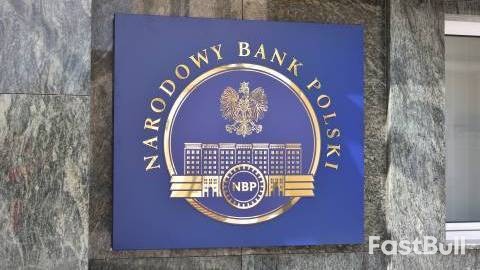
Traders are learning to ignore the official commentary from the National Bank of Poland (NBP). After a history of inconsistent messaging, the market is focused on economic data to predict the central bank's next move, not its governor's statements.
At the January press conference, Governor Adam Glapiński confirmed this reality, stating that monetary policy decisions are made month-by-month and are strictly dependent on incoming data. This has left economists divided ahead of the February meeting, as recent figures present a conflicting picture.

Recent macroeconomic data provides a strong argument for the NBP to maintain its wait-and-see approach. Several key indicators have surprised to the upside:
• Stronger Economic Activity: Both manufacturing and construction figures for December were much stronger than expected, suggesting economic growth is becoming more broad-based.
• Impressive GDP Growth: The full-year 2025 GDP growth was estimated at 3.6%, which implies an economic expansion of around 4% year-on-year in the fourth quarter.
• Robust Wage Dynamics: December wage growth also beat expectations. While driven partly by annual bonuses in sectors like mining, the reading broke a downward trend seen in previous months.
These figures make it difficult to justify a rate cut and suggest the Polish economy is carrying significant momentum.
Despite the strong activity data, the primary argument for resuming rate cuts is the inflation outlook. According to internal estimates, year-on-year inflation in January likely fell below 2%.
It is possible that the NBP's own staff forecasts, presented to the Monetary Policy Committee (MPC), show a similar trend. This could create a compelling case for a rate cut in February, even before the official January CPI data is released or the central bank publishes its updated March inflation projection.
Our baseline scenario is that the NBP will keep interest rates unchanged this week. The strong economic data released recently makes a rate cut difficult to defend. Furthermore, the absence of an official January CPI reading gives policymakers a clear reason to wait for more information to confirm that disinflation is continuing alongside the economic recovery.
The MPC will likely seek more clarity on whether wage and core inflation pressures will continue to ease throughout 2026 before acting.
However, we still expect the next cut to occur in March, with further easing to follow in the subsequent months. We see the terminal NBP rate reaching 3.25% this year, and potentially even lower if the inflation outlook improves beyond our current forecasts. We project that CPI will hover near the lower bound of the NBP's target range of 2.5% (+/-1%) in 2026, and a series of low inflation reports should be enough to trigger further rate cuts from the central bank.
Turkey is set to host high-level talks between the United States and Iran on Friday, a diplomatic effort aimed at de-escalating rising tensions between the two nations.
The summit in Istanbul will reportedly be attended by senior officials from both sides. Sources familiar with the plans said the US delegation includes envoy Steve Witkoff and President Donald Trump's son-in-law, Jared Kushner. Iran is expected to be represented by Foreign Minister Abbas Araghchi.
According to the sources, who requested anonymity due to the sensitivity of the discussions, Turkish Foreign Minister Hakan Fidan anticipates that other regional powers may also participate.
This meeting would mark the first public engagement between American and Iranian officials since a recent spike in hostilities. The talks come as President Trump has threatened Tehran with military action if a new agreement to curb its nuclear program is not reached.
The geopolitical climate is tense, with the US having already dispatched naval assets to the region. This move has raised concerns about a potential conflict, echoing previous US-Israeli attacks on Iran's nuclear facilities last year.
President Trump’s recent threats followed a deadly crackdown by Iranian authorities on mass protests last month. In response, Iran's Supreme Leader Ali Khamenei issued a stark warning on Sunday, stating that any attack on his country could trigger a "regional war."
Ahead of the Istanbul summit, US envoy Steve Witkoff is scheduled to travel to Israel on Tuesday. An official with knowledge of the trip confirmed that Witkoff will meet with Prime Minister Benjamin Netanyahu and his senior security team.
The possibility of a US-Iran meeting was also reported earlier by The New York Times, which noted that discussions would take place in Istanbul with the participation of some Middle Eastern countries.
S&P 500 futures experienced a moderate pickup in new long risk flows last week, while Nasdaq 100 and Russell 2000 positioning levels remained close to neutral, according to Citigroup strategists.
The team, including David Chew, noted in a report that the positioning gap between these indexes suggests investors have not yet fully rotated into a broad risk-on stance.
While S&P 500 futures activity dominated trading, Nasdaq and Russell 2000 positioning showed stabilization but fell short of indicating a wider risk-on consensus.
In European markets, positioning in bank futures has become extended and crowded. The strategists warned that new long additions in this sector increase the likelihood of near-term profit-taking. FTSE and DAX futures positioning has been losing momentum as investors reduce long positions.
Asian equity flows presented a mixed picture last week. South Korea's Kospi was identified as particularly vulnerable due to stretched positioning and ongoing profit-taking.
The risk of loss in trading financial instruments such as stocks, FX, commodities, futures, bonds, ETFs and crypto can be substantial. You may sustain a total loss of the funds that you deposit with your broker. Therefore, you should carefully consider whether such trading is suitable for you in light of your circumstances and financial resources.
No decision to invest should be made without thoroughly conducting due diligence by yourself or consulting with your financial advisors. Our web content might not suit you since we don't know your financial conditions and investment needs. Our financial information might have latency or contain inaccuracy, so you should be fully responsible for any of your trading and investment decisions. The company will not be responsible for your capital loss.
Without getting permission from the website, you are not allowed to copy the website's graphics, texts, or trademarks. Intellectual property rights in the content or data incorporated into this website belong to its providers and exchange merchants.
Not Logged In
Log in to access more features
Log In
Sign Up