Markets
News
Analysis
User
24/7
Economic Calendar
Education
Data
- Names
- Latest
- Prev



Signal Accounts for Members
All Signal Accounts
All Contests


Japan Trade Balance (Customs Data) (SA) (Nov)A:--
F: --
P: --
U.K. BRC Overall Retail Sales YoY (Dec)A:--
F: --
P: --
U.K. BRC Like-For-Like Retail Sales YoY (Dec)A:--
F: --
P: --
Turkey Retail Sales YoY (Nov)A:--
F: --
P: --
U.S. NFIB Small Business Optimism Index (SA) (Dec)A:--
F: --
P: --
Brazil Services Growth YoY (Nov)A:--
F: --
P: --
Canada Building Permits MoM (SA) (Nov)A:--
F: --
U.S. CPI MoM (SA) (Dec)A:--
F: --
P: --
U.S. CPI YoY (Not SA) (Dec)A:--
F: --
P: --
U.S. Real Income MoM (SA) (Dec)A:--
F: --
P: --
U.S. CPI MoM (Not SA) (Dec)A:--
F: --
P: --
U.S. Core CPI (SA) (Dec)A:--
F: --
P: --
U.S. Core CPI YoY (Not SA) (Dec)A:--
F: --
P: --
U.S. Core CPI MoM (SA) (Dec)A:--
F: --
P: --
U.S. Weekly Redbook Index YoYA:--
F: --
P: --
U.S. Building Permits Revised YoY (SA) (Oct)A:--
F: --
P: --
U.S. Building Permits Revised MoM (SA) (Oct)A:--
F: --
P: --
U.S. New Home Sales Annualized MoM (Oct)A:--
F: --
U.S. Annual Total New Home Sales (Oct)A:--
F: --
U.S. Cleveland Fed CPI MoM (SA) (Dec)A:--
F: --
P: --
U.S. Cleveland Fed CPI MoM (Dec)A:--
F: --
P: --
China, Mainland Exports (Dec)--
F: --
P: --
China, Mainland Imports YoY (CNH) (Dec)--
F: --
P: --
China, Mainland Imports (CNH) (Dec)--
F: --
P: --
China, Mainland Trade Balance (CNH) (Dec)--
F: --
P: --
China, Mainland Imports YoY (USD) (Dec)--
F: --
P: --
China, Mainland Exports YoY (USD) (Dec)--
F: --
P: --
China, Mainland M0 Money Supply YoY (Dec)--
F: --
P: --
China, Mainland M1 Money Supply YoY (Dec)--
F: --
P: --
China, Mainland M2 Money Supply YoY (Dec)--
F: --
P: --
U.S. EIA Natural Gas Production Forecast For The Next Year (Jan)--
F: --
P: --
U.S. EIA Short-Term Crude Production Forecast For The Next Year (Jan)--
F: --
P: --
U.S. EIA Short-Term Crude Production Forecast For The Year (Jan)--
F: --
P: --
EIA Monthly Short-Term Energy Outlook
U.S. 30-Year Bond Auction Avg. Yield--
F: --
P: --
U.S. Budget Balance (Dec)--
F: --
P: --
Argentina 12-Month CPI (Dec)--
F: --
P: --
Argentina National CPI YoY (Dec)--
F: --
P: --
Argentina CPI MoM (Dec)--
F: --
P: --
Richmond Federal Reserve President Barkin delivered a speech.
U.S. API Weekly Cushing Crude Oil Stocks--
F: --
P: --
U.S. API Weekly Crude Oil Stocks--
F: --
P: --
U.S. API Weekly Refined Oil Stocks--
F: --
P: --
U.S. API Weekly Gasoline Stocks--
F: --
P: --
South Korea Unemployment Rate (SA) (Dec)--
F: --
P: --
Japan Reuters Tankan Non-Manufacturers Index (Jan)--
F: --
P: --
Japan Reuters Tankan Manufacturers Index (Jan)--
F: --
P: --
China, Mainland Trade Balance (USD) (Dec)--
F: --
P: --
China, Mainland Exports YoY (CNH) (Dec)--
F: --
P: --
China, Mainland Outstanding Loans Growth YoY (Dec)--
F: --
P: --
U.K. 10-Year Note Auction Yield--
F: --
P: --
Canada Leading Index MoM (Dec)--
F: --
P: --
U.S. MBA Mortgage Application Activity Index WoW--
F: --
P: --
U.S. Core PPI YoY (Nov)--
F: --
P: --
U.S. PPI MoM (SA) (Nov)--
F: --
P: --
U.S. PPI YoY (Nov)--
F: --
P: --
U.S. Current Account (Q3)--
F: --
P: --
U.S. PPI MoM Final (Excl. Food, Energy and Trade) (SA) (Nov)--
F: --
P: --
U.S. PPI YoY (Excl. Food, Energy & Trade) (Nov)--
F: --
P: --
U.S. Core Retail Sales (Nov)--
F: --
P: --
U.S. Retail Sales MoM (Nov)--
F: --
P: --


No matching data
Latest Views
Latest Views
Trending Topics
Top Columnists
Latest Update
White Label
Data API
Web Plug-ins
Affiliate Program
View All

No data
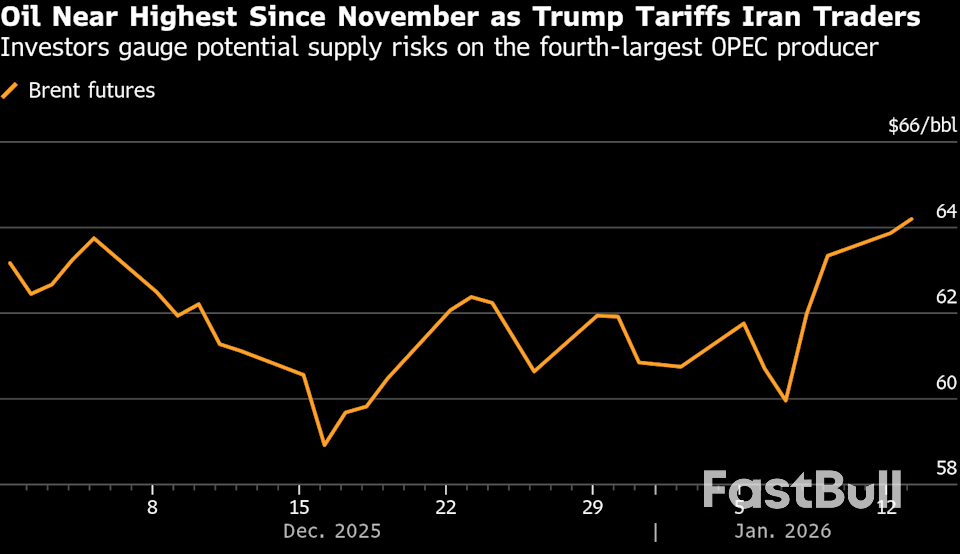
Oil briefly topped $65 as escalating pressure on Iran and tanker attacks near Kazakhstan’s Black Sea export terminal heightened supply fears, triggering strong gains and bullish positioning despite longer-term oversupply concerns.

Switzerland's criminal investigation into a fire in a bar in the ski town of Crans-Montana should be broadened to include local authorities, a lawyer acting for some of the victims said, adding he would seek millions in compensation.
The fire killed 40 people, most of them teenagers, and injured 116. Romain Jordan, who represents more than 20 burn victims from the New Year's blaze, said he would claim damages of up to several million for each injury and up to 100,000 Swiss francs ($125,390) for each death.
"For me, there is absolutely no doubt that the municipality must be put on the list of those responsible and it should be asked to give answers," Jordan said in an interview late on Monday, saying he expected total claims in the hundreds of millions of francs.
"What is certain is that we will request for (officials) to be heard (by prosecutors), to obtain the documents, for the full correspondence, to understand how so many errors, so many safeguards that are normally in place in a risk management system, could all fail."
The mayor's office for Crans-Montana did not immediately respond to a request for comment.
Prosecutors believe sparkling candles set the soundproof foam on the basement ceiling of "Le Constellation" bar alight early on New Year's Day. Panicked crowds then fled up a narrow staircase to a narrow exit, which became a fatal choke point as the inferno spread, witnesses said.
The town's mayor said last week that the venue had missed multiple annual safety checks, and expressed regret.
For now, only the French owners are under investigation for crimes including suspected negligent homicide. The couple, Jacques and Jessica Moretti, say they are cooperating with the investigation and have voiced grief over the tragedy. The husband has been detained.
Jordan called it a "bad joke" that the upscale town sought to be a party in the case - a request that has not been granted. "That cynicism hurt the families."
Jordan's clients are Swiss, French and Italian and most were injured, with all but two of them in artificial comas or unresponsive in European hospitals.
"They (the families) feel like they are in a nightmare from which they will never wake up, and what they ask me for is answers about who is responsible," he said.
Under Swiss law, victims of a criminal act can seek emergency financial assistance, but Jordan said a state fund was needed to cover further expenses until a ruling.
"Ideally there should be direct compensation for victims - no double punishment."
($1 = 0.7975 Swiss francs)


A Department of Justice criminal investigation into Federal Reserve Chair Jerome Powell's testimony is creating new risks for U.S. monetary policy, according to an analysis by Bank of America. While the development introduces a fresh layer of uncertainty, markets have so far absorbed the news without significant volatility.
Bank of America economist Aditya Bhave noted that markets have "essentially looked through the news." The 30-year Treasury yield, a key indicator of market sentiment on long-term Fed policy, rose by only about 2 basis points. Bhave pointed out that such a move is minimal compared to what might typically express "concerns about Fed independence."
This muted reaction stands in stark contrast to market behavior last summer. When then-President Trump hinted he might remove Powell from his post, the 30-year yield saw a much sharper response. According to BofA, the yield jumped 8 basis points on July 11 and another 11 basis points during intraday trading on July 16 before pulling back.
Powell’s own firm response to recent speculation may have altered investor expectations about his tenure. BofA analysts believe his actions have increased the perceived probability that he will remain on the Fed Board as a Governor even after his term as chair concludes in May.
Citing data from Polymarket, the bank highlighted that the probability of Powell leaving the board by the end of the year has dropped from 83% to 57%.
Despite the market's calm, Bhave warned that the investigation could have significant policy implications. The situation "might also galvanize the hawks on the FOMC," making it more challenging for a future, more dovish Fed chair to justify rate cuts based purely on economic data.
Looking ahead, Bank of America suggested that a separate event has become even more critical for the Fed's future. The Supreme Court's hearing on Governor Lisa Cook's case, scheduled for January 21, is now viewed as "more important for the policy trajectory than the identity of the next Fed Chair." A ruling against Cook, the bank concluded, would "significantly raise the probability" that Powell could also face removal.
The era of synchronized monetary policy is ending. After years of moving in lockstep to combat post-pandemic inflation, the world's major central banks are now entering a period of significant divergence, creating a complex and uncertain outlook for the global economy.
According to forecasts from Bloomberg Economics, the next year will see a wide spectrum of interest rate policies across advanced economies as central bankers navigate mixed economic signals and rising political volatility, particularly from the United States.
All eyes are on the U.S. Federal Reserve, which faces a unique set of challenges. Policymakers must interpret conflicting economic data while contending with the potential for a new chair appointed by a president openly demanding rate cuts and applying legal pressure on the institution.
Bloomberg Economics projects the Fed will ease more aggressively than the market consensus, which currently anticipates just two cuts in 2026. This view is based on the expectation that a weakening labor market will soften the Fed's hawkish stance.
Jamie Rush, director of global economics at Bloomberg Economics, notes that this U.S. policy shift won't be mirrored elsewhere. "The world's most important central bank is likely to cut by more than markets expect," he said. "Deep U.S. rate cuts won't be replicated by other major central banks."
Stripping out the U.S., the combined interest rate gauge for advanced economies is expected to end the year with little change, highlighting the growing split in policy trajectories. The forecast for key central banks reveals a fractured approach:
• Bank of England (BOE): Expected to cut rates far less than the Fed.
• European Central Bank (ECB): Believed to be finished with its rate-cutting cycle.
• Bank of Japan (BOJ): Moving in the opposite direction, toward tightening.
• Potential Hikes: Canada, Japan, and Switzerland may see rate increases.
• Holding Steady: The euro zone is projected to keep borrowing costs stable.
• Further Cuts: Australia and New Zealand are likely to lower rates.
Meanwhile, central banks in emerging markets from Brazil to Nigeria are expected to implement significant rate reductions. Geopolitics, trade disputes, and political developments in the U.S. remain key variables that could easily disrupt these forecasts.
While monetary policy is a key focus, a debate is also brewing over the strength of the U.S. economy itself. Official data showed U.S. productivity growth accelerating to annualized rates of 4.1% and 4.9% in the second and third quarters of last year, sparking talk of an AI-driven boom.
However, Neil Dutta, head of economic research at Renaissance Macro, urges caution. He argues that productivity is a "residual" figure derived from GDP growth and total hours worked. Since GDP appeared to jump in mid-2025 while payroll growth slowed and work hours stagnated, productivity automatically surged in the data. Dutta suspects the GDP figure may be overstated.
He points to two reasons for his skepticism. First, genuine productivity booms are typically accompanied by strong growth in real, inflation-adjusted incomes, which is not currently happening. Second, major technological investments usually take time to translate into productivity gains, suggesting it may be too early to see an AI-driven surge.
Dutta's conclusion is that observers "are conflating a short-run data disconnect with a longer-run productivity story."
White Label
Data API
Web Plug-ins
Poster Maker
Affiliate Program
The risk of loss in trading financial instruments such as stocks, FX, commodities, futures, bonds, ETFs and crypto can be substantial. You may sustain a total loss of the funds that you deposit with your broker. Therefore, you should carefully consider whether such trading is suitable for you in light of your circumstances and financial resources.
No decision to invest should be made without thoroughly conducting due diligence by yourself or consulting with your financial advisors. Our web content might not suit you since we don't know your financial conditions and investment needs. Our financial information might have latency or contain inaccuracy, so you should be fully responsible for any of your trading and investment decisions. The company will not be responsible for your capital loss.
Without getting permission from the website, you are not allowed to copy the website's graphics, texts, or trademarks. Intellectual property rights in the content or data incorporated into this website belong to its providers and exchange merchants.
Not Logged In
Log in to access more features

FastBull Membership
Not yet
Purchase
Log In
Sign Up