Markets
News
Analysis
User
24/7
Economic Calendar
Education
Data
- Names
- Latest
- Prev


Signal Accounts for Members
All Signal Accounts
All Contests


France 10-Year OAT Auction Avg. YieldA:--
F: --
P: --
Euro Zone Retail Sales MoM (Oct)A:--
F: --
P: --
Euro Zone Retail Sales YoY (Oct)A:--
F: --
P: --
Brazil GDP YoY (Q3)A:--
F: --
P: --
U.S. Challenger Job Cuts (Nov)A:--
F: --
P: --
U.S. Challenger Job Cuts MoM (Nov)A:--
F: --
P: --
U.S. Challenger Job Cuts YoY (Nov)A:--
F: --
P: --
U.S. Initial Jobless Claims 4-Week Avg. (SA)A:--
F: --
P: --
U.S. Weekly Initial Jobless Claims (SA)A:--
F: --
P: --
U.S. Weekly Continued Jobless Claims (SA)A:--
F: --
P: --
Canada Ivey PMI (SA) (Nov)A:--
F: --
P: --
Canada Ivey PMI (Not SA) (Nov)A:--
F: --
P: --
U.S. Non-Defense Capital Durable Goods Orders Revised MoM (Excl. Aircraft) (SA) (Sept)A:--
F: --
U.S. Factory Orders MoM (Excl. Transport) (Sept)A:--
F: --
P: --
U.S. Factory Orders MoM (Sept)A:--
F: --
P: --
U.S. Factory Orders MoM (Excl. Defense) (Sept)A:--
F: --
P: --
U.S. EIA Weekly Natural Gas Stocks ChangeA:--
F: --
P: --
Saudi Arabia Crude Oil ProductionA:--
F: --
P: --
U.S. Weekly Treasuries Held by Foreign Central BanksA:--
F: --
P: --
Japan Foreign Exchange Reserves (Nov)A:--
F: --
P: --
India Repo RateA:--
F: --
P: --
India Benchmark Interest RateA:--
F: --
P: --
India Reverse Repo RateA:--
F: --
P: --
India Cash Reserve RatioA:--
F: --
P: --
Japan Leading Indicators Prelim (Oct)A:--
F: --
P: --
U.K. Halifax House Price Index YoY (SA) (Nov)A:--
F: --
P: --
U.K. Halifax House Price Index MoM (SA) (Nov)A:--
F: --
P: --
France Current Account (Not SA) (Oct)A:--
F: --
P: --
France Trade Balance (SA) (Oct)A:--
F: --
P: --
France Industrial Output MoM (SA) (Oct)A:--
F: --
P: --
Italy Retail Sales MoM (SA) (Oct)--
F: --
P: --
Euro Zone Employment YoY (SA) (Q3)--
F: --
P: --
Euro Zone GDP Final YoY (Q3)--
F: --
P: --
Euro Zone GDP Final QoQ (Q3)--
F: --
P: --
Euro Zone Employment Final QoQ (SA) (Q3)--
F: --
P: --
Euro Zone Employment Final (SA) (Q3)--
F: --
Brazil PPI MoM (Oct)--
F: --
P: --
Mexico Consumer Confidence Index (Nov)--
F: --
P: --
Canada Unemployment Rate (SA) (Nov)--
F: --
P: --
Canada Labor Force Participation Rate (SA) (Nov)--
F: --
P: --
Canada Employment (SA) (Nov)--
F: --
P: --
Canada Part-Time Employment (SA) (Nov)--
F: --
P: --
Canada Full-time Employment (SA) (Nov)--
F: --
P: --
U.S. Personal Income MoM (Sept)--
F: --
P: --
U.S. Dallas Fed PCE Price Index YoY (Sept)--
F: --
P: --
U.S. PCE Price Index YoY (SA) (Sept)--
F: --
P: --
U.S. PCE Price Index MoM (Sept)--
F: --
P: --
U.S. Personal Outlays MoM (SA) (Sept)--
F: --
P: --
U.S. Core PCE Price Index MoM (Sept)--
F: --
P: --
U.S. UMich 5-Year-Ahead Inflation Expectations Prelim YoY (Dec)--
F: --
P: --
U.S. Core PCE Price Index YoY (Sept)--
F: --
P: --
U.S. Real Personal Consumption Expenditures MoM (Sept)--
F: --
P: --
U.S. 5-10 Year-Ahead Inflation Expectations (Dec)--
F: --
P: --
U.S. UMich Current Economic Conditions Index Prelim (Dec)--
F: --
P: --
U.S. UMich Consumer Sentiment Index Prelim (Dec)--
F: --
P: --
U.S. UMich 1-Year-Ahead Inflation Expectations Prelim (Dec)--
F: --
P: --
U.S. UMich Consumer Expectations Index Prelim (Dec)--
F: --
P: --
U.S. Weekly Total Rig Count--
F: --
P: --
U.S. Weekly Total Oil Rig Count--
F: --
P: --
U.S. Consumer Credit (SA) (Oct)--
F: --
P: --


No matching data
Latest Views
Latest Views
Trending Topics
Top Columnists
Latest Update
White Label
Data API
Web Plug-ins
Affiliate Program
View All

No data
OPEC+ could agree to raise oil production by up to 500,000 barrels per day in November, triple the increase for October, as Saudi Arabia seeks to reclaim market share, three sources familiar with the talks said.
The 10-year Treasury note, a debt instrument issued by the U.S. government, moves in tandem with mortgage rates, with a roughly two-percentage-point spread between them. For example, if the 10-year yield is near 4%, mortgage rates will likely be near or slightly above 6%.
Chris Whalen is the chairman of Whalen Global Advisors LLC and an investment banker focusing on mortgage finance and financial services.
"The 10-year gets pulled down for a lot of reasons, some because of the friction like government shutdowns," Whalen told Yahoo Finance in an email. Mortgage rates have been falling since July, he said, but have recently eased higher. "But that was all done by aggressive lenders, not markets."
Whalen isn't expecting anything drastic to happen in the mortgage markets during the shutdown. He believes the Federal Housing Administration (FHA) will stop processing certain new loans, which will create delays in financing — but that's about it.
However, Cotality Chief Economist Dr. Selma Hepp believes a government shutdown can shape investor sentiment and limit access to key economic data — the result: possible lower mortgage rates.
"When shutdowns occur, investors typically flock to Treasury securities, which pushes their yields down and can result in slightly lower mortgage rates — usually a drop of about 0.125 to 0.25 percentage points,” Hepp told Yahoo Finance via email. “For instance, if the 30-year fixed mortgage rate is sitting at 6.375%, it might fall to around 6.125% during the shutdown."
Dr. Hepp admitted that other market factors can alter those expectations, including the interruption of vital economic reports the Federal Reserve counts on to set monetary policy, such as gauges of employment and inflation.
With so many variables in play — the economy, a transitioning housing market, and the length of time the shutdown remains in effect — it's hard to predict how the bond market will react.
After the government shutdown is over, the nation will still face growing economic uncertainty.
Mike Fratantoni, chief economist for the Mortgage Bankers Association, told Yahoo Finance via email that ADP's report indicating 32,000 job losses in September amplifies concerns about a weakening job market.
"And this is particularly the case as we are unlikely to get BLS job market numbers, given the shutdown, so the ADP number increases in importance," Fratantoni added.
Realtor.com's Chief Economist Danielle Hale has predicted that mortgage rates will continue a slow drift downward following the government shutdown, though there are many variables impacting that forecast.
Her colleague has highlighted the difficulties in the housing market.
"A government shutdown adds uncertainty into a housing market that is already under pressure from high home prices and elevated mortgage rates," Anthony Smith, Realtor.com's senior economist, said in an analysis.
"Anything that further discourages prospective buyers from entering the market and risks slowing sales even more in a slow housing market is not helpful," he added.
Fratantoni noted that the bond market continues to "bounce back and forth between being more focused on the job market versus inflation. Both metrics are bad news lately, but they push rates in opposite directions."
However, watching the bond market will provide a clue to the direction of mortgage rates, he added. "Lower 10-year Treasury rates typically do lead to lower mortgage rates.”
If, after diligently shopping for a mortgage lender, you're poised and preapproved to buy a house, locking in your mortgage rate on a dip is always the goal.
However, it’s difficult to lock in a mortgage rate when they’re down because rates vary by the hour. Once you hear of a lower mortgage rate, the chance to lock it in may have already passed.
It's not worth the stress to improve your interest rate by a couple of basis points, or worth the worry if your rate rose by some incremental amount.
However, if you have a longer runway before landing a home, understanding mortgage rate trends can be very helpful. Tracking 10-year Treasury yields can help.
Federal Reserve Bank of Dallas President Lorie Logan on Thursday said the U.S. central bank appropriately cut rates last month to guard against the risk of a sharp deterioration in the job market, but said that so far the cooling is gradual and signaled she is not eager to cut rates further.
"We need to be very cautious about rate cuts from here and make sure that we appropriately calibrate policy so that you don't ease conditions too much and only to have to reverse course, which would be very painful in terms of restoring price stability," Logan told a classroom of economics students at the University of Texas at Austin's graduate school of business.
"With expectations for tariffs and other pressures to lead to inflation trending a bit higher in coming months, my forecast has a little bit slower normalization of the policy path in order to make sure we get all the way to 2%."
Logan, who is not a voter on the Fed's policy-setting committee this year, said she supported the Fed's September decision to reduce the policy rate a quarter of a percentage point as "insurance" against a sudden rise in the unemployment rate, which in August was 4.3%.
The government shutdown means the Labor Department will not publish its usual monthly jobs report on Friday, but other indicators suggest that while the labor market is sluggish the unemployment rate did not jump last month.
"My forecast is for that to rise a little bit in coming months, but not too far from the objective," Logan said. Inflation, however, has been above the Fed's 2% target for four years and tariffs are pushing it upward, she said.
"The thing that I worry about is even if it's a one-time effect, like the economic modeling would suggest, the longer it takes or the more uncertainty there is about these tariff policies, the more risk there is that the short-term inflation expectations that have increased become entrenched over the long term," Logan said. "The risk of those inflation expectations becoming entrenched has certainly gone up, and so we need to guard against that in thinking about policy."

Gold retreated as the dollar pushed higher and investors booked profits after a five-day rally that saw it reach fresh records. Traders also sought clues on the US economy as the government shutdown delayed key data.
In the absence of a weekly initial jobless claims report from the government, data from a private outplacement firm got more attention than usual. US employers dialed back hiring plans in September and announced fewer job cuts, according to outplacement firm Challenger, Gray & Christmas.
A gauge of the dollar rose, weighing on bullion as it’s priced in the US currency. Bullion’s successive peaks in recent weeks also make it more vulnerable to profit-taking. Gold has been in overbought territory for the past month, far outpacing the S&P 500 Index.
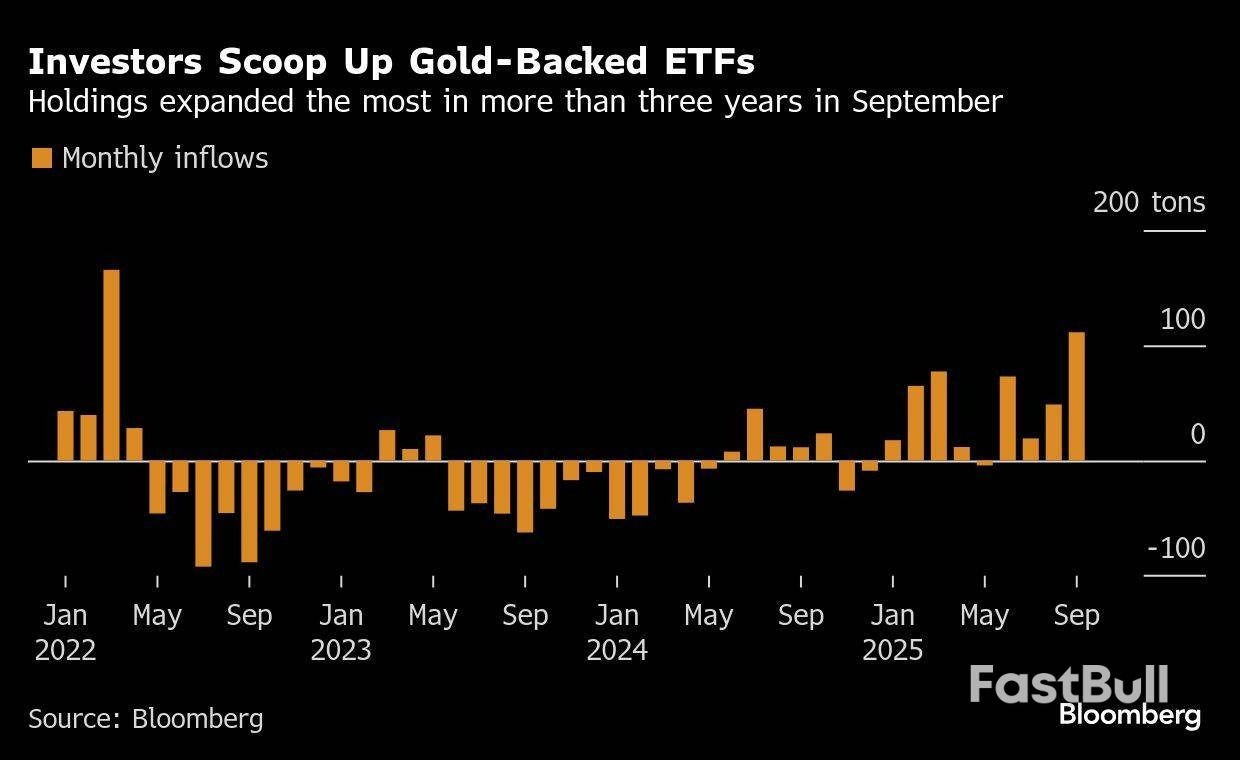
The metal has soared 46% this year, putting it on track for the biggest annual gain since 1979. The rally has been supported by central-bank buying and rising holdings in gold-backed exchange-traded funds, as the Fed resumed rate cuts.
Economists and policymakers will be relying more on private reports for clues about the labor market and broader economy in the absence of official data. Non-farm payroll numbers, which were due Friday, will be delayed because of the shutdown.
Traders have added to bets the Fed will cut rates twice more this year to support a weakening labor market. Lower borrowing costs tend to boost non-yielding gold, which also becomes cheaper for most buyers when the greenback softens.
Spot gold slipped 0.6% to $3,840.90 an ounce at 12:17 p.m. in New York. The Bloomberg Dollar Spot Index rose 0.2%. Silver, platinum and palladium all fell.
US Treasury Secretary Scott Bessent reiterated support for Argentina’s Javier Milei on Thursday, but warned that the aid doesn’t involve outright US investment, pushing bonds between gains and losses in a roller-coaster morning session.
Bessent wrote on X early on Thursday that the US would do “what is necessary” to help Argentina, triggering a surge in the bonds. A little later, he told CNBC that this didn’t mean putting money into the country, a caveat that sent the notes back down again. They are now edging lower.
The US had previously outlined at least three possible options to help the South American nation, including a $20 billion swap line, the repurchase of Argentine debt and direct currency purchases. Bessent’s comments on Thursday seem to have narrowed it down.
“We’re giving them a swap line, we’re not putting money into Argentina,” he said in the CNBC interview.
Argentine dollar bonds due in 2035 are down 0.3 cent on the dollar at 51.45 cents, declining for a sixth day. The peso opened little changed on Thursday at 1,424.5 to the dollar. The limit of a trading band agreed with the International Monetary Fund is currently at 1,481.7.
Bessent also said in his post on X that he spoke Wednesday with Economy Minister Luis Caputo, who he said will be traveling to Washington in coming days to advance discussions on “options for delivering financial support.”
Dollar notes fell from session highs “as investors digested clarifications” that the US aid represents “a swap line rather than a new injection of dollar liquidity,” Walter Stoeppelwerth, chief investment officer at local brokerage Grit Capital Group, wrote in a report on Thursday.
The government has had to deploy millions of dollars and reintroduce some exchange controls to fend off further depreciation on the peso in the past week.
The drop in the currency has been driven in part by concerns over Milei’s political support ahead of key midterm elections later this month, and following a crushing defeat in a local vote in Buenos Aires province in early September.
The announcement of the US support last week sparked major rallies in both the peso and dollar bonds. But the excitement was short lived, as the currency saw renewed pressure from rising dollar demand and as investors grew skeptical around the timing and form of US help.
“The political backdrop is still central to the case,” Stoeppelwerth wrote. “Risks remain that the administration could overreact in defense of the exchange rate band, even dipping into IMF resources, or that Milei’s polarizing leadership style could erode middle-class support and weaken governability.”
The spread of rooftop solar has been an unlikely lifeline for Pakistan’s citizens burdened by sky-high bills and frequent blackouts. Now it’s also testing the country’s ability to pay its energy debts.The government buys power from generators and sells it to consumers, using revenues to pay back creditors such as China. But it’s long been doing so at a loss, and collections are now starting to decline as families and businesses increasingly generate their own clean power.
Lawmakers are now turning to unpopular reforms to stem that tide. Panels purchases are now subject to levies, the absence of which let their spread go unnoticed for months, since the government doesn’t closely track solar imports. The initial proposal involved a 18% tax, which was about halved after public backlash.Another option being explored is to cut the rates paid to households selling surplus solar to the grid, an idea that made it to the highest government office before being stalled by Prime Minister Shehbaz Sharif. A strong opposition to these decisions is being taken seriously by the PM, said two people familiar with the matter.
A spokesperson for the government didn’t immediately respond to a request for comment.Both panel and battery imports from China are on the rise. Pakistan imported $1.5 billion worth of panels this year, becoming the third-biggest importer globally, according to BloombergNEF. The analysts also estimate the country has 25 gigawatts of solar panels, installed without government support, a significant boost to its grid’s modest 50 gigawatts capacity.The nation also purchased about 1.25 gigawatt-hours of batteries in 2024, according to the Institute for Energy Economics and Financial Analysis. By 2030, that could increase to 8.75 gigawatt-hours by 2030, increasing financial pressure on the grid, the analysts said. Last year, the International Monetary Fund asked Pakistan’s government to retain power customers to ensure the viability of the energy sector.
“Pakistan didn’t plan its solar energy revolution, it just happened,” said Khalid Waleed, a research fellow at Sustainable Development Policy Institute. “We are stuck in a vicious cycle. We need to increase utilization of coal power plants or retire and repurpose them.” The nation signed its largest-ever restructuring this month, including opening new loans with 18 banks worth a total 1.2 trillion rupees ($4.2 billion) in power sector debt.Still, the latest government measures are unlikely to halt the country’s solar growth, according to multiple importers, installers and analysts. “This boom will continue now that solar prices are coming down to a range that middle class and lower-middle class can afford, particularly in rural areas,” said Waleed.
Right now, the government is buying solar power at a very high price, so it makes sense for customers to set up panels instead of relying on the grid, Muhammad Ali, a member of the PM’s taskforce on the energy sector and the country’s privatization minister said in an interview. “Unless we revise our solar policy, this defection from the grid will continue.” That will further pressure Pakistan’s energy system that’s already dealing with a glut, he said, adding that the government must help create new demand.
White Label
Data API
Web Plug-ins
Poster Maker
Affiliate Program
The risk of loss in trading financial instruments such as stocks, FX, commodities, futures, bonds, ETFs and crypto can be substantial. You may sustain a total loss of the funds that you deposit with your broker. Therefore, you should carefully consider whether such trading is suitable for you in light of your circumstances and financial resources.
No decision to invest should be made without thoroughly conducting due diligence by yourself or consulting with your financial advisors. Our web content might not suit you since we don't know your financial conditions and investment needs. Our financial information might have latency or contain inaccuracy, so you should be fully responsible for any of your trading and investment decisions. The company will not be responsible for your capital loss.
Without getting permission from the website, you are not allowed to copy the website's graphics, texts, or trademarks. Intellectual property rights in the content or data incorporated into this website belong to its providers and exchange merchants.
Not Logged In
Log in to access more features

FastBull Membership
Not yet
Purchase
Log In
Sign Up