

Markets
News
Analysis
User
24/7
Economic Calendar
Education
Data
- Names
- Latest
- Prev



Signal Accounts for Members
All Signal Accounts
All Contests
 U.S. EIA Weekly Crude Stocks Change
A:--
F: --
P: --
U.S. EIA Weekly Heating Oil Stock ChangesA:--
F: --
P: --
U.S. EIA Weekly Gasoline Stocks ChangeA:--
F: --
P: --
U.S. EIA Weekly Crude Demand Projected by ProductionA:--
F: --
P: --
 Russia PPI YoY (Nov)
A:--
F: --
P: --
Russia PPI MoM (Nov)A:--
F: --
P: --
 Australia Consumer Inflation Expectations
A:--
F: --
P: --
 South Africa PPI YoY (Nov)
A:--
F: --
P: --
 Euro Zone Construction Output MoM (SA) (Oct)
A:--
F: --
Euro Zone Construction Output YoY (Oct)A:--
F: --
P: --
 U.K. BOE MPC Vote Unchanged (Dec)
A:--
F: --
P: --
 Mexico Retail Sales MoM (Oct)
A:--
F: --
P: --
U.K. Benchmark Interest RateA:--
F: --
P: --
U.K. BOE MPC Vote Cut (Dec)A:--
F: --
P: --
U.K. BOE MPC Vote Hike (Dec)A:--
F: --
P: --
MPC Rate Statement Euro Zone ECB Deposit RateA:--
F: --
P: --
Euro Zone ECB Marginal Lending RateA:--
F: --
P: --
Euro Zone ECB Main Refinancing RateA:--
F: --
P: --
ECB Monetary Policy Statement Canada Average Weekly Earnings YoY (Oct)
A:--
F: --
U.S. Core CPI YoY (Not SA) (Nov)A:--
F: --
P: --
U.S. Weekly Initial Jobless Claims (SA)A:--
F: --
U.S. Weekly Continued Jobless Claims (SA)A:--
F: --
U.S. Real Income MoM (SA) (Nov)--
F: --
P: --
U.S. CPI YoY (Not SA) (Nov)A:--
F: --
P: --
U.S. Initial Jobless Claims 4-Week Avg. (SA)A:--
F: --
U.S. Philadelphia Fed Business Activity Index (SA) (Dec)A:--
F: --
P: --
U.S. Philadelphia Fed Manufacturing Employment Index (Dec)A:--
F: --
P: --
U.S. Core CPI (SA) (Nov)A:--
F: --
P: --
ECB Press Conference U.S. EIA Weekly Natural Gas Stocks Change--
F: --
P: --
U.S. Kansas Fed Manufacturing Production Index (Dec)--
F: --
P: --
U.S. Cleveland Fed CPI MoM (Nov)--
F: --
P: --
Russia PPI MoM (Nov)--
F: --
P: --
Russia PPI YoY (Nov)--
F: --
P: --
U.S. Cleveland Fed CPI MoM (SA) (Nov)--
F: --
P: --
U.S. Kansas Fed Manufacturing Composite Index (Dec)--
F: --
P: --
Mexico Policy Interest Rate--
F: --
P: --
 Argentina Trade Balance (Nov)
--
F: --
P: --
Argentina Unemployment Rate (Q3)--
F: --
P: --
 South Korea PPI MoM (Nov)
--
F: --
P: --
U.S. Weekly Treasuries Held by Foreign Central Banks--
F: --
P: --
 Japan National CPI MoM (Not SA) (Nov)
--
F: --
P: --
Japan CPI MoM (Nov)--
F: --
P: --
Japan National Core CPI YoY (Nov)--
F: --
P: --
Japan CPI YoY (Excl. Fresh Food & Energy) (Nov)--
F: --
P: --
Japan National CPI MoM (Excl. Food & Energy) (Nov)--
F: --
P: --
Japan National CPI YoY (Excl. Food & Energy) (Nov)--
F: --
P: --
Japan National CPI YoY (Nov)--
F: --
P: --
Japan National CPI MoM (Nov)--
F: --
P: --
U.K. GfK Consumer Confidence Index (Dec)--
F: --
P: --
Japan Benchmark Interest Rate--
F: --
P: --
BOJ Monetary Policy Statement Australia Commodity Price YoY--
F: --
P: --
BOJ Press Conference Turkey Consumer Confidence Index (Dec)
--
F: --
P: --
U.K. Retail Sales YoY (SA) (Nov)--
F: --
P: --
U.K. Core Retail Sales YoY (SA) (Nov)--
F: --
P: --
 Germany PPI YoY (Nov)
--
F: --
P: --
Germany PPI MoM (Nov)--
F: --
P: --


No matching data

Latest Views
Latest Views
Trending Topics
Top Columnists
Latest Update
White Label
Data API
Web Plug-ins
Affiliate Program
View All
No data
A group of moderate House Republicans has defied Speaker Mike Johnson, aligning with Democrats to force a floor vote in January on extending Affordable Care Act subsidies, after Johnson blocked their compromise plan this week....
Honda Motor Co. will halt production at plants in Japan and China in coming weeks, highlighting the lingering fallout of the global chip shortage.
The Japanese carmaker will suspend output in Japan on Jan. 5 and Jan. 6, a spokesperson said Thursday, without specifying which plants will be affected. All three of the facilities in its joint venture in China, Guangqi Honda Automobile Co., will be offline from Dec. 29 to Jan. 2.
The company had said it anticipated getting disrupted production back on track from late November, but the looming suspension of some of its factories indicates ongoing snarls in the supply chain. Honda shares declined 1.5% in Tokyo. Japanese media outlets reported the news earlier.
Carmakers around the world have had their production plans thrown into disarray in recent months after China blocked Nexperia BV — owned by Chinese company Wingtech Technology Co. — from exporting products made at its local plants.
Honda has been hit hard, with the chip shortage prompting it to reduce its sales forecast to to 3.34 million units from 3.62 million. It had previously curbed or suspended output at some plants in North American due the issue.
Nexperia makes semiconductors used in vehicle control systems for functions such as activating windshield wipers and opening a window.

Oil prices rallied yesterday on growing supply risks facing the market. This strength has continued in early-morning trading today.
There are concerns over Venezuelan oil exports after President Trump announced that the US will impose a blockade on sanctioned oil tankers entering and leaving the country. This puts at risk around 600k b/d of oil exports, the majority of which goes to China. However, flows to the US, currently around 160k b/d, will likely continue. This oil is from Chevron, which previously received a licence from the US government to continue operating in Venezuela. The key questions are, first, how effective this blockade will be, and second, how long it will last. This will be important in determining the impact on the oil market.
Reports yesterday that the US government is preparing even stricter sanctions on Russia's energy sector pose a larger supply risk to the market -- in case President Putin fails to agree to a peace deal with Ukraine. Given the surplus outlook and Brent trading around $60/bbl, Trump has room to be more aggressive with sanctions.
Weekly inventory data from the Energy Information Administration (EIA) shows that US crude oil inventories fell by 1.27m barrels over the last week. This was much less than the 9.3m barrel decline the API reported the previous day. The draw was primarily driven by stronger exports over the week, with crude oil exports increasing 655k b/d WoW to 4.66m b/d. Meanwhile, gasoline and distillate fuel oil inventories increased by 4.81m barrels and 1.71m barrels, respectively. These builds in refined-product stocks were supported by refinery runs reaching their highest level since early September.
European gas prices rallied yesterday, with TTF settling 2.22% higher on the day amid forecasts for colder than usual weather towards the end of the month. Strength in the oil market likely provided some support as well. However, the latest positioning data continues to indicate that speculators are increasingly bearish on the European gas market. Investment funds sold a further 7.9TWh in TTF over the last reporting week, leaving them with a net short of 92.8TWh. This is the largest net short since early 2020. The gross short stands at a record 546TWh, up 18.4TWh over the week. It continues to pose a risk to the market should we see any supply disruptions or demand surges.
Gold is trading just shy of its all-time high above $4,381/oz, a level last seen in October, as tensions rise in Venezuela following Trump's blockade order for all sanctioned tankers. The US president is also pressuring Nicolas Maduro amid a regional military buildup.
The market is awaiting US inflation data on Thursday, which could signal further monetary easing. This follows the Federal Reserve's third consecutive rate cut earlier this month. For now, traders assign a probability of less than 25% of a reduction in January.
Gold has surged over 60% year-to-date, its strongest annual performance since 1979. The rally is underpinned by robust central bank buying, macro uncertainty, and a structural shift in strategic asset allocation. Geopolitical uncertainty has been a key driver of gold's exceptional rally this year.
We remain positive on our gold outlook, with macro tailwinds and fundamentals pointing to further upside next year. We expect gold prices to reach new record highs in 2026. The downside should be limited, as any weakness will likely attract renewed interest from both retail and institutional buyers.
Silver, meanwhile, hit another record high above $66.50/oz. Prices have now more than doubled year-to-date. Investor appetite remains strong, as silver-backed ETFs continue to attract inflows. The outlook remains constructive into 2026, supported by robust industrial demand from solar PV installations and battery technologies, alongside sustained investment flows.
CBOT soybean prices yesterday hovered near their lowest level since October, pressured by strong global supply prospects and a lack of fresh Chinese buying. In a recent report, CONAB estimates soybean production in Brazil to reach 177.1mt in 2025/26, up 3.3% from last season. Weather remains a key factor, but crop stress to date has been minimal. China has started selling soybeans from state reserves to clear storage ahead of incoming US shipments. It purchased an additional 198kt of US soybeans, according to recent USDA data, bringing total purchases since October to around 3.7mt. China has increased purchases but must continue to buy steadily to meet commitments under a late-October agreement.
Data from Ukraine's Ministry of Agriculture indicate that grain and legume exports in 2025/26 declined to approximately 13.8mt tons as of 17 December, representing a year-on-year decline of 29%. Total corn shipments stood at 4.8mt (-40% YoY), while wheat exports fell 17% YoY to 7.6mt.
The world's best-performing stock is turning into a cautionary tale for investors chasing outsized returns from the artificial-intelligence boom.
Little-known until recently even within its home market of India, RRP Semiconductor became a social media obsession as its shares surged more than 55,000 per cent in the 20 months through Dec 17 – by far the biggest gain worldwide among companies with a market value above US$1 billion (S$1.3 billion).
That's despite posting negative revenue in its latest financial results, reporting just two full-time employees in its latest annual report, and boasting only a tenuous link to the semiconductor spending boom after shifting away from real estate in early 2024.
A mix of online hype, a tiny free float and India's swelling base of retail investors drove 149 straight limit-up sessions, even as exchange officials and the company itself cautioned investors.
The rally is now showing signs of strain – and regulators are taking a closer look. The Securities and Exchange Board of India (SEBI) has begun examining the surge in RRP Semiconductor's shares for potential wrongdoing, according to a person familiar with the matter. The US$1.7 billion stock, recently restricted by its exchange to trading just once a week, has fallen by 6 per cent from its Nov 7 peak.
While RRP Semiconductor's trajectory is unlikely to have much bearing on the broader AI rally that has added trillions of dollars in value to global heavyweights such as Nvidia, it highlights how extreme gains have become in pockets of the market – particularly in India, where an absence of listed chipmakers has left retail investors eager for any proxy exposure to the global boom. For some observers, the case also underscores the challenge for regulators seeking to protect retail investors from speculative excess.
Exchanges and chipmakers in Asia have started to warn investors about the risks of chasing hot AI trades. In Shanghai, Moore Threads Technology – a newly listed AI-chip start-up – saw shares slump 13 per cent on Dec 12 after flagging trading risk, even though the stock remains more than 500 per cent up since its market debut earlier this month. In South Korea, SK Hynix fell after the country's main exchange raised its risk alert on Dec. 11, after the shares more than tripled in 2025.
RRP Semiconductor's transformation began in early 2024, when RRP Group founder Rajendra Chodankar - whose background includes offering niche products like thermal imaging systems and weapon-drone cameras – struck a deal to take over G D Trading and Agencies by repaying an 80 million-rupee loan owed to its founders for equity.
On April 23, the board approved selling him and several others shares at 12 rupees each, 40 per cent below market price. The move gave Mr Chodankar 74.5 per cent ownership and reduced the founders' stake to under 2 per cent. The company also agreed to rename itself RRP Semiconductor.
Two months earlier, Mr Chodankar had incorporated RRP Electronics to build an outsourced semiconductor assembly and testing facility in Maharashtra – a link that may have helped fuel the narrative around the listed company and his private venture.
At a September 2024 event for RRP Electronics' new unit in Navi Mumbai, Mr Chodankar told a media briefing: "India is going to be a superhuman, it's established beyond doubt." Maharashtra Chief Minister Devendra Fadnavis and cricket legend Sachin Tendulkar were also present, according to YouTube videos posted by RRP.
RRP Semiconductor lists RRP Electronics as a related party because both are owned by Mr Chodankar, though it does not hold any direct ownership stake, according to exchange filings.
Still, some investors began viewing RRP Semiconductor as a play on the chip boom. That enthusiasm masked how little of its stock actually trades: about 98 per cent of shares are held by Mr Chodankar and a small circle of associates.
In April this year, the exchange withdrew approval for the company's share sale, a decision RRP Semiconductor has challenged in an appeals court with the outcome still pending. In October, it cautioned investors a year after placing the stock under its strictest surveillance.
The rejection followed a September 2024 reminder from SEBI that the company was barred from accessing the securities market because it belonged to the founder group of Shree Vindhya Paper Mills, a firm delisted in 2017 for non-compliance, triggering a 10-year market ban.
A person familiar with the matter at the BSE said the exchange suffered an "internal lapse" in processing the offering and may seek SEBI's guidance on extending the lock-in on the shares until the appeal is resolved.
A spokesperson for BSE said in RRP's original application, the company stated the firm, its founders and directors were not barred – directly or indirectly – from accessing the market, and that the exchange's approval was based on this disclosure.
As the stock took off from 20 rupees in April 2024, the company's biggest shareholder, Mr Chodankar, resigned from the board, and the chief financial officer quit before returning as company secretary. RRP Semiconductor filed a police complaint against a social media influencer over alleged rumour-mongering about its supposed links to cricketer Tendulkar and to state-allotted land for chipmaking.
In a Nov 3 exchange filing, the company said it "has yet to start any sort of semiconductor manufacturing activities," has made no applications under government programmes, and denied any celebrity association.
Financials offered little comfort. RRP Semiconductor reported negative revenue of 68.2 million rupees and a net loss of 71.5 million rupees in the quarter ended September.
The negative revenue is a result of the company reversing sales booked in the three months ended December 2024 from a 4.4-billion-rupee order won in November from Telecrown Infratech. The order was later cancelled over "contractual disagreements," the company said, adding that it also clawed back 80 million rupees of revenue in the March quarter.
The weak financials come at a delicate time for the stock. With the hype around AI fading and regulatory scrutiny tightening, the downside now sits with investors who piled in – and with Mr Chodankar, who controls nearly the entire float.
The Bank of England will likely deliver a pre-Christmas interest-rate cut on Thursday as concerns shift away from inflation and toward the UK's struggling economy and jobs market.
Traders and economists expect the central bank to reduce its benchmark rate by a quarter point to 3.75%, the lowest level in almost three years. It will announce the decision at 12 p.m. in London.
The Monetary Policy Committee is predicted to ease policy for the first time since August after skipping a move in September and November. Governor Andrew Bailey had been expected to cast the deciding vote again, but Wednesday's sharp drop in inflation raised the prospect of one of the MPC's four hawks switching sides.
The path has been cleared to a cut by evidence that UK price pressures are in retreat, while last month's budget also sought to reduce inflation in the near term. Still, the BOE is edging closer to the end of its cutting cycle with markets only fully pricing in one more reduction if the central bank follows through with a cut on Thursday.
In November, Bailey sided with the MPC's hawkish camp, which includes Deputy Governor Clare Lombardelli and Chief Economist Huw Pill. Bailey said he needed to see more evidence of disinflation before he could back another policy easing with the government's budget also looming.
Since that meeting, data has pointed to a more benign picture. Inflation has cooled to its weakest in eight months after a sharper-than-expected drop in November, private sector wage growth has eased and the economy has suffered back-to-back monthly contractions. That is expected to be enough to persuade Bailey to align with the four doves at the BOE, which include Deputy Governors Dave Ramsden and Sarah Breeden.
The decision should still reflect long-running divides on the MPC, with Bloomberg's survey showing economists expect a 5 to 4 split for a second straight meeting. However, it's worth bearing in mind that the survey was conducted prior to Wednesday's surprisingly low inflation reading.
Either way, markets put the odds of a cut at more than 90% and predict another move by the end of April.
There is expected to be little change to the MPC's already cautious guidance on future rate cuts with markets looking for any hints on how much further the BOE will go.
In November, it maintained language predicting a "gradual" easing in rates if there was progress on bringing down inflation. However, it also stressed that policy is becoming less restrictive as bank rate edges toward neutral — the level at which it neither boosts inflation nor drags it down.
Economists will be looking for clues on where rates will settle in the nine members' individual outlooks, which will be published for only the second time.
The central bank may provide more details from its early assessment on how Chancellor of the Exchequer Rachel Reeves' second budget impacts its outlook.
Lombardelli has already revealed that the BOE expects the plans — which included a freeze on rail fares, cuts to household energy bills and relief for drivers on fuel duty — will knock as much as half a percentage point off inflation next spring. She said the budget will provide a small 0.2% boost to gross domestic product in 2027.
The rate-setters may signal their intention to look through this one-off effect on price growth unless it helps to bring down elevated inflation expectations. Most of the backloaded tax rises and spending restraint in Reeves' fiscal plans occur beyond the BOE's three-year horizon.
The BOE may pencil in weaker growth for the final quarter of 2025 after a raft of downbeat economic signals since its last meeting.
While in November it predicted GDP growth 0.3% for the final three months of the year, official figures last week showed output contracted for a second straight month in October and surveys pointed to a tepid picture in November ahead of the budget. That has prompted forecasters to warn that the UK economy is at risk of its first quarterly contraction in two years.
It may also highlight that inflation is running below where it was expected it to be. CPI cooled to 3.2% in November, while the BOE projected 3.4% just last month.
XRP took another plunge on Wednesday, December 17, as yen carry trade unwind fears triggered a crypto sell-off.
10-year Japanese Government Bond (JGB) yields soared to a session high of 1.983%, their highest level since April 2007. Upbeat Japanese trade data bolstered expectations of a Bank of Japan rate hike on Friday, December 19, sending JGB yields higher.
Yen carry trade unwind jitters overshadowed strong institutional demand through spot ETFs and positive updates on the Market Structure Bill.
Crucially, JGB yield trends ahead of the BoJ monetary policy decision support a cautiously bearish short-term outlook. Meanwhile, the medium-term outlook remains bullish.
Below, I will explore the key drivers behind recent price trends, the medium-term (4-8 weeks) outlook, and the key technical levels traders should watch.
Traders have long memories, and the jump in 10-year JGB yields has made markets edgy. While economists expect a 25-basis-point rate hike, there is uncertainty about the BoJ's neutral interest rate. The neutral interest rate is where rates are neither accommodative nor restrictive.
Last week, BoJ Governor Kazuo Ueda stated that he would share the neutral rate once consensus amongst policymakers had narrowed. The neutral rate is crucial for yen carry trades and market liquidity.
A higher neutral rate would mean a narrower US-Japan interest rate differential, making yen-funded leveraging positions less profitable. A stronger yen would send USD/JPY lower, adding to potential losses, forcing traders to exit levered positions in US assets.
The chart for 10-year JGB yields and XRP has underscored market jitters about narrowing US-Japan rate differentials since September. See the chart below for reference.
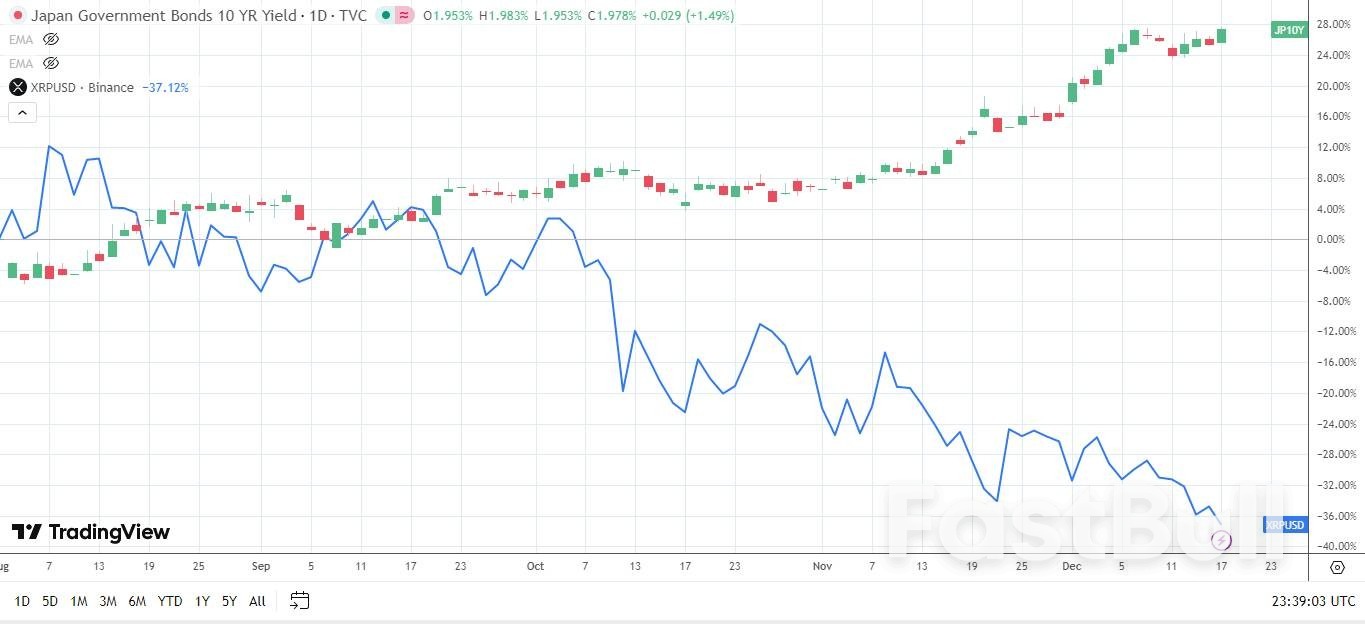 JGB – XRP – Daily Chart – 181225
Concerns about a rerun of the mid-2024 yen carry trade unwind event, and the XRP sell-off have fueled the inverse correlation between XRP and 10-year JGB yields.
For context, the Bank of Japan cut JGB purchases on July 31, 2024. This was expected. However, the BoJ also raised interest rates by 25 basis points to 0.5%. This was unexpected.
The yen strengthened on anticipation of the cut to JGB purchases in the run-up to the July 31, 2024, decision, and in response to the rate hike. Crucially, USD/JPY plunged from a July 2024 high of 161.951 to 152.643 on the eve of the BoJ decision, then to 141.684 on August 5.
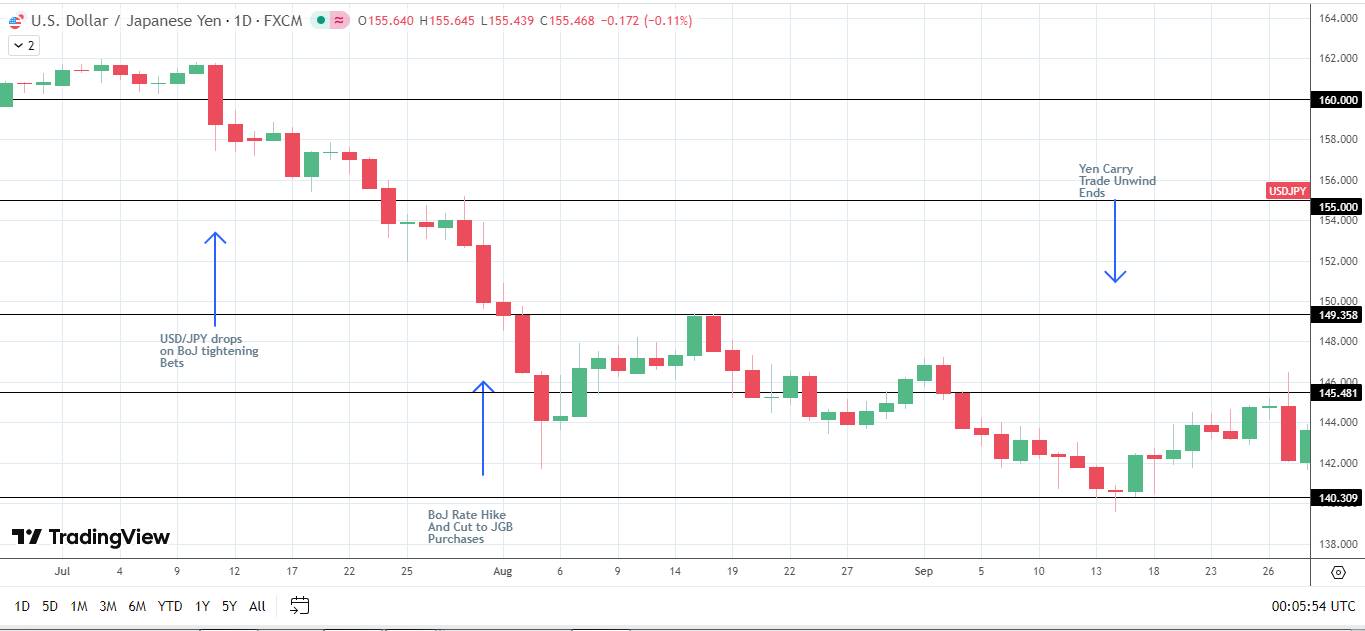 USDJPY – Daily Chart – 181225 – Yen Carry Trade Unwind 2024
The USD/JPY plunge triggered a yen carry trade unwind, forcing traders to exit levered positions and repay yen-denominated loans. Repaying yen loans eventually sent USD/JPY to a September 16, 2024, low of 139.576.
XRP plunged from $0.6591 on July 31, 2024, to $0.4320 on August 5, 2024, logging a 34.5% loss.
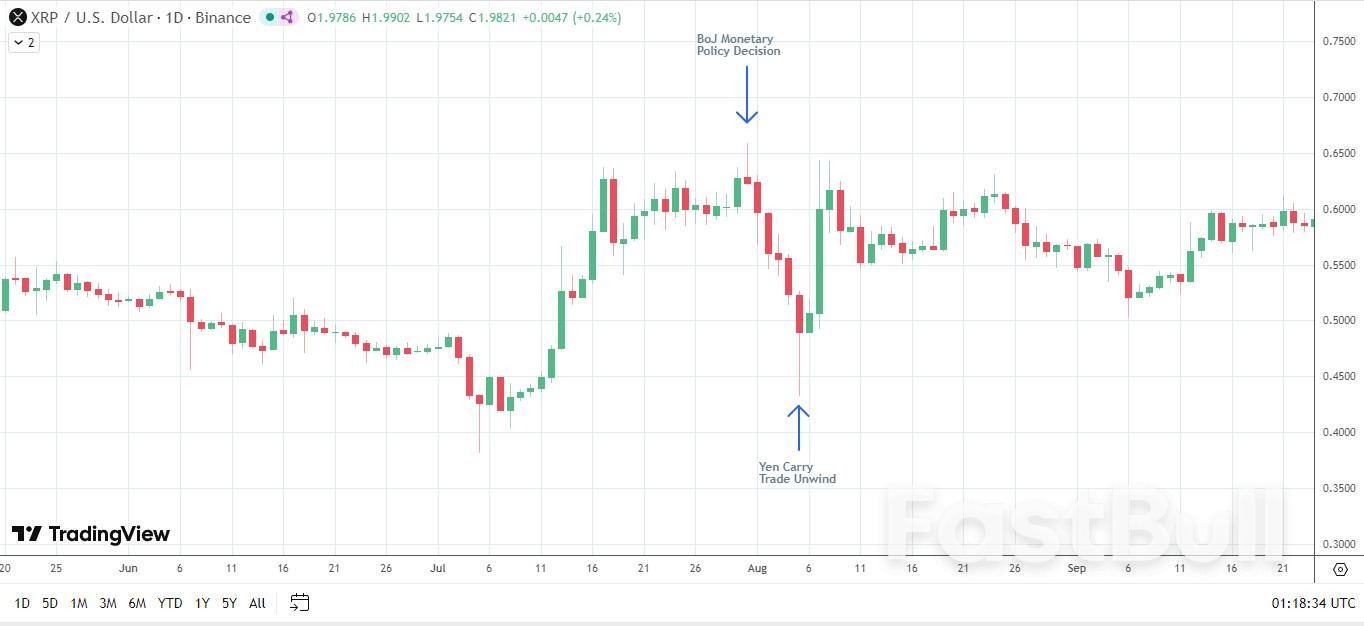 XRPUSD – Daily Chart – 181225 – 2024 Yen Carry Trade Unwind
Market jitters over the threat of a BoJ-induced sell-off support the bearish short-term outlook for XRP, exposing the November 21 low of $1.8239.
A potential yen carry trade unwind hasn't dented institutional demand for XRP-spot ETFs. The US XRP-spot ETF market reported net inflows of $8.54 million on Tuesday, December 16, bringing total net inflows to $1.01 billion. A 22-day inflow streak underscored robust institutional demand, supporting a bullish medium- to longer-term price outlook.
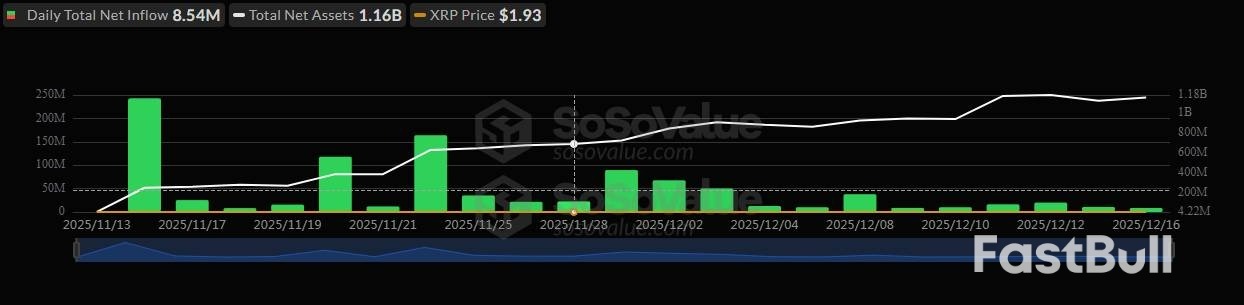 SoSoValue – XRP Spot ETF Flows – 181225
Notably, more XRP-spot ETFs are set to launch in the new year, including WisdomTree's XRP ETF (XRPW). A bigger spot ETF playing field may draw more institutional inflows, crucial for the token's longer-term price trajectory.
Robust XRP-spot ETF inflows and the imminent launch of new spot ETFs set the stage for a bullish outlook for XRP. The Market Structure Bill's progress on Capitol Hill remains another tailwind, supporting a bullish medium- and longer-term price outlook.
In the near term, the BoJ monetary policy decision will be the key driver. However, traders should closely monitor US economic data and FOMC members' rhetoric to consider the timeline for a Fed rate cut. On Thursday, December 18, the US CPI report will fuel speculation about a March cut.
Economists expect the annual inflation rate to rise from 3.0% in September to 3.1% in November. There were no October figures because of the US government shutdown. Higher inflation would temper bets on a March rate cut.
A more hawkish Fed policy stance would weigh on sentiment ahead of the BoJ decision on Friday, December 19.
Given the current market dynamics, the short-term (1-4 weeks) outlook remains cautiously bearish. Meanwhile, the medium-term (4-8 weeks) and longer-term (8-12 weeks) outlooks remain bullish, with price targets of $2.5 and $3.0, respectively.
Several scenarios could derail the bullish medium- and long-term outlooks. These include:
These scenarios would likely send XRP toward the November low of $1.8239, supporting the bearish short-term outlook.
Nevertheless, resilient XRP-spot ETF inflows, increased XRP utility, and the Market Structure Bill's progress support a longer-term move to $2.5. A return to $2.5 would bring $3 into play.
In summary, the short-term outlook remains cautiously bearish as fundamentals and the technicals align. Meanwhile, the medium- to longer-term outlooks are constructive.
Technical Outlook: EMAs Signal Caution
XRP slid 3.49% on Wednesday, December 17, following the previous day's 1.64% loss, closing at $1.8631. The token faced heavier losses than the broader crypto market, which declined 2.39%.
Wednesday's loss left XRP well below the 50-day and 200-day Exponential Moving Averages (EMAs), signaling a bearish bias.
Key technical levels to watch include:
Looking at the daily chart, a drop below the November 21 low of $1.8239 would expose the $1.75 support level. A sustained fall through $1.75 would reinforce the bearish short-term outlook.
However, a breakout above the $2 psychological level would pave the way toward the 50-day EMA. A sustained move through the 50-day EMA would signal a near-term bullish trend reversal.
A bullish trend reversal would indicate a medium-term (4-8 weeks) climb toward the 200-day EMA and $2.5. A break above the EMAs would reinforce the medium-term outlook, and a longer-term (8-12 weeks) $3.0.
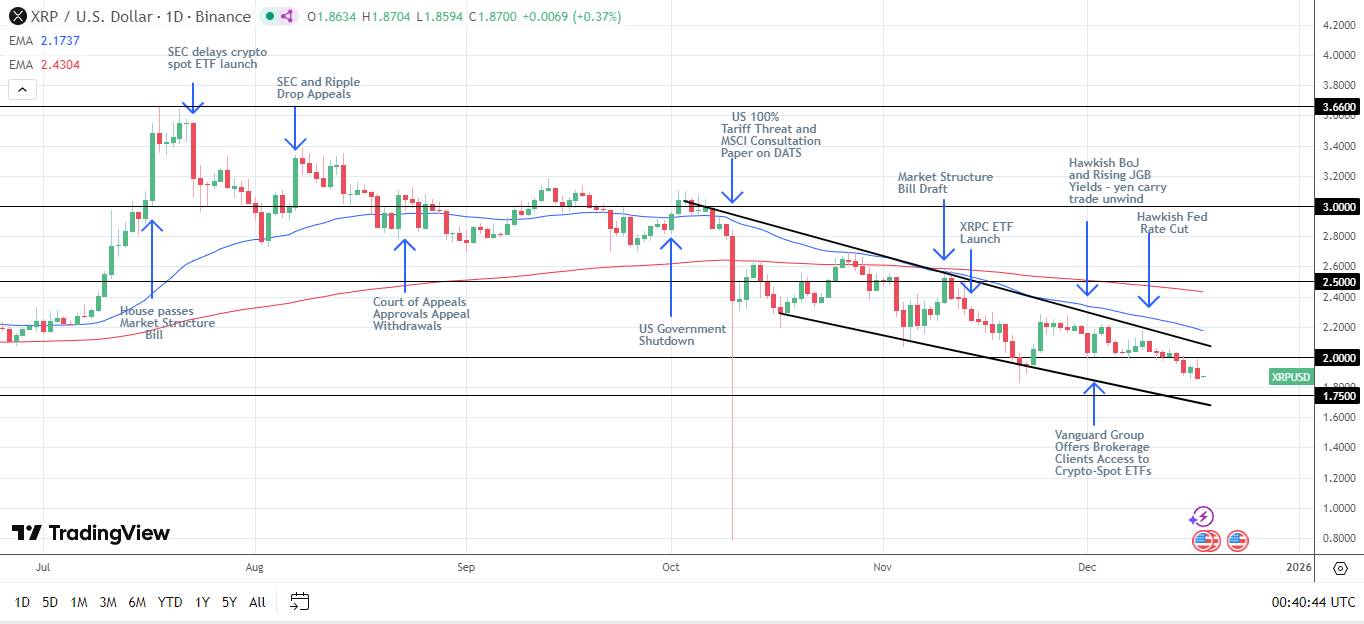 XRPUSD – Daily Chart – 181225 – EMAs
Near-term price drivers include:
Bullish Structure: What Happens if XRP Reclaims $2.0?
Failure to break above the $2.0 level would leave the November 21 low of $1.8239 in play. A sustained fall below $1.8239 would enable the bears to target the $1.75 support level and the lower trendline. Breaching the lower trendline would reaffirm a bearish trend reversal.
However, a breakout above the $2.0 handle would open the door to retesting the upper trendline. A sustained move through the upper trendline would support the bullish medium-term (4–8 weeks) target of $2.5 and longer-term (8–12 weeks) target of $3.0.
Importantly, rejection at the $2.0 psychological level and a drop below $1.75 and the lower trendline would invalidate the bullish medium-term outlook.
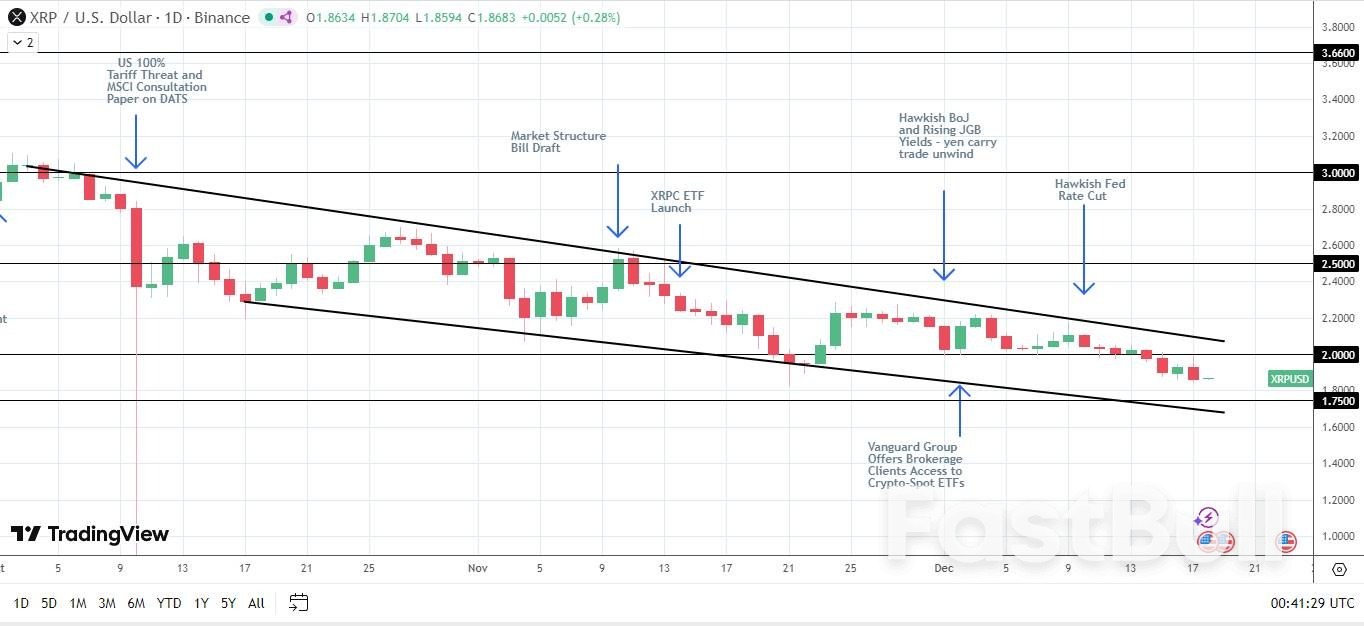 XRPUSD – Daily Chart – 181225 – Bearish Structure
Looking ahead, US inflation data, the BoJ's monetary policy decision and neutral rate, and XRP-spot ETF flows will influence near-term trends.
Hotter inflation and XRP-spot ETF outflows are likely to exacerbate the effects of a hawkish BoJ.
To summarize, a hawkish BoJ rate hike would support a near-term drop toward $1.75. A break below $1.75 would affirm the near-term bearish trend reversal.
However, strong demand for XRP-spot ETFs and crypto-related legislative developments support a medium-term (4–8 weeks) move to $2.5. A March Fed rate cut and the Senate passing the Market Structure Bill would reinforce the longer-term (8–12 weeks) price target of $3.0.
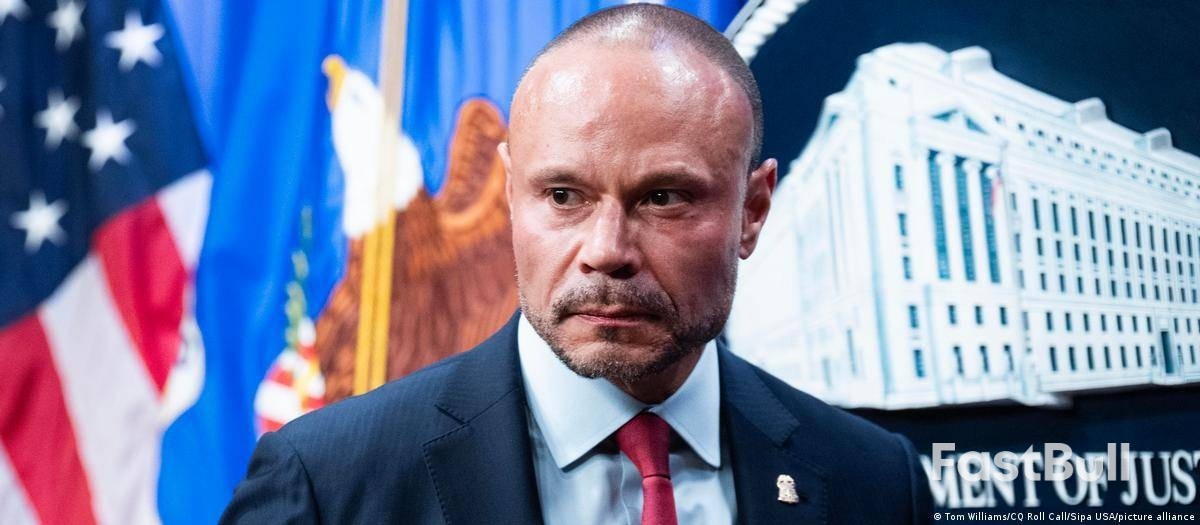
Dan Bongino announced on Wednesday that he will step down from his role as deputy director of the FBI, the US's domestic intelligence and security services.
Bongino posted the news on X just hours after President Donald Trump said he thought Bongino wanted to "go back to his show."
Bongino had hosted a prominent right-wing podcast prior to joining the FBI.
"Dan did a great job. I think he wants to go back to his show," Trump told reporters earlier on Wednesday.
In his short post announcing his departure on Wednesday, Bongino thanked Trump and others "for the opportunity to serve with purpose."
Bongino's departure comes after less than 10 months in office. He didn't give a reason for the decision or say exactly when he would leave.
The FBI's co-deputy director Andrew Bailey (who was appointed in August in a rare sharing of the position) had already led some of the meetings that Bongino was expected to handle in the past few days, CNN reported.
Bongino was an unconventional pick for the FBI's second highest role when he assumed office in March 2025.
Historically, career agents who had worked their way up the ranks filled the post.
Bongino had previously worked as a New York City police officer and Secret Service agent. But the MAGA-friendly podcast host had no FBI experience before Trump appointed him.
A report by active and retired FBI agents leaked in December was withering about Bongino's lack of experience, calling him "in over his head."
He has also clashed with Attorney General Pam Bondi over the handling of the files related to Jeffery Epstein, who committed suicide in prison while awaiting trial on charges of running a network of underage girls for sex.
As a conservative podcast host, Bongino spread a range of conspiracy theories, including the claim that the 2020 presidential election was "stolen" from Trump.
He was especially vocal about two conspiracy theories – one relating to the Jeffery Epstein sex-trafficking case and another about pipe bombs discovered in Washington on the eve of the January 6, 2021, storming of Capitol Hill.
In his podcast, Bongino had long pushed for reform of the FBI, which he said was needed to uncover the truths he claimed were hidden by the federal government.
On the Epstein case, Bongino had previously challenged the official ruling that Epstein had taken his own life in jail soon after his arrest in 2019. He backtracked on this, however, earlier this year, saying that he now believes sex trafficker Jeffrey Epstein killed himself.
As for the pipe bombs placed outside Republican and Democrat headquarters on the eve of the January 6 riots, Bongino said as recently as 2024 that he believed it was an "inside job" that involved a "massive cover-up."
But after the FBI arrested a man with no evident connection to the federal government earlier this month, Bongino again backtracked on his previous claims.
"I was paid in the past for my opinions," Bongino said in a Fox News interview. "One day I will be back in that space but that's not what I'm paid for now. I'm paid to be your deputy director, and we base investigations on facts."
728 RM B 7/F GEE LOK IND BLDG NO 34 HUNG TO RD KWUN TONG KLN HONG KONG


White Label
Data API
Web Plug-ins
Poster Maker
Affiliate Program
The risk of loss in trading financial instruments such as stocks, FX, commodities, futures, bonds, ETFs and crypto can be substantial. You may sustain a total loss of the funds that you deposit with your broker. Therefore, you should carefully consider whether such trading is suitable for you in light of your circumstances and financial resources.
No decision to invest should be made without thoroughly conducting due diligence by yourself or consulting with your financial advisors. Our web content might not suit you since we don't know your financial conditions and investment needs. Our financial information might have latency or contain inaccuracy, so you should be fully responsible for any of your trading and investment decisions. The company will not be responsible for your capital loss.
Without getting permission from the website, you are not allowed to copy the website's graphics, texts, or trademarks. Intellectual property rights in the content or data incorporated into this website belong to its providers and exchange merchants.
Not Logged In
Log in to access more features

FastBull Membership
Not yet
Purchase


Log In
Sign Up


