• Trade
  • Markets
  • Copy
  • Contests
  • News
  • 24/7
  • Calendar
  • Q&A
  • Chats
Trending
Screeners
SYMBOL
LAST
BID
ASK
HIGH
LOW
NET CHG.
%CHG.
SPREAD
SPX
S&P 500 Index
6827.42
6827.42
6827.42
6899.86
6801.80
-73.58
-1.07%
--
DJI
Dow Jones Industrial Average
48458.04
48458.04
48458.04
48886.86
48334.10
-245.98
-0.51%
--
IXIC
NASDAQ Composite Index
23195.16
23195.16
23195.16
23554.89
23094.51
-398.69
-1.69%
--
USDX
US Dollar Index
97.950
98.030
97.950
98.500
97.950
-0.370
-0.38%
--
EURUSD
Euro / US Dollar
1.17394
1.17409
1.17394
1.17496
1.17192
+0.00011
+ 0.01%
--
GBPUSD
Pound Sterling / US Dollar
1.33707
1.33732
1.33707
1.33997
1.33419
-0.00148
-0.11%
--
XAUUSD
Gold / US Dollar
4299.39
4299.39
4299.39
4353.41
4257.10
+20.10
+ 0.47%
--
WTI
Light Sweet Crude Oil
57.233
57.485
57.233
58.011
56.969
-0.408
-0.71%
--

Community Accounts

Signal Accounts
--
Profit Accounts
--
Loss Accounts
--
View More

Become a signal provider

Sell trading signals to earn additional income

View More

Guide to Copy Trading

Get started with ease and confidence

View More

Signal Accounts for Members

All Signal Accounts

Best Return
  • Best Return
  • Best P/L
  • Best MDD
Past 1W
  • Past 1W
  • Past 1M
  • Past 1Y

All Contests

  • All
  • Trump Updates
  • Recommend
  • Stocks
  • Cryptocurrencies
  • Central Banks
  • Featured News
Top News Only
Share

Iranian Media Says 18 Crew Members Of Foreign Tanker Seized In Gulf Of Oman Over Carrying 'Smuggled Fuel' Detained

Share

Regional Governor: Two Killed In Ukrainian Drone Strike On Russia's Saratov

Share

Chinese Foreign Ministry - China Foreign Minister Met With United Arab Emirates Counterpart On Dec 12

Share

China's Central Financial And Economic Affairs Commission Deputy Director: Will Expand Export And Increase Import In 2026

Share

Thai Leader Anutin: Landmine Blast That Killed Thai Soldiers 'Not A Roadside Accident'

Share

Thai Leader Anutin: Thailand To Continue Military Action Until 'We Feel No More Harm'

Share

Cambodian Prime Minister Hun Manet Says He Had Phone Calls With Trump And Malaysian Leader Anwar About Ceasefire

Share

Cambodia's Hun Manet Says USA, Malaysia Should Verify 'Which Side Fired First' In Latest Conflict

Share

Cambodia's Hun Manet: Cambodia Maintains Its Stance In Seeking Peaceful Resolution Of Disputes

Share

Nasdaq Companies: Allergan, Ferrovia, Insmed, Monolithic Power Systems, Seagate Technology, And Western Digital Will Be Added To The NASDAQ 100 Index. Biogen, CdW, GlobalFoundries, Lululemon, ON Semiconductor, And Tradedesk Will Be Removed From The NASDAQ 100 Index

Share

Witkoff Headed To Berlin This Weekend To Meet With Zelenskiy, European Leaders -Wsj Reporter On X

Share

Russia Attacks Two Ukrainian Ports, Damaging Three Turkish-Owned Vessels

Share

[Historic Flooding Occurs In At Least Four Rivers In Washington State Due To Days Of Torrential Rains] Multiple Areas In Washington State Have Been Hit By Severe Flooding Due To Days Of Torrential Rains, With At Least Four Rivers Experiencing Historic Flooding. Reporters Learned On The 12th That The Floods Caused By The Torrential Rains In Washington State Have Destroyed Homes And Closed Several Highways. Experts Warn That Even More Severe Flooding May Occur In The Future. A State Of Emergency Has Been Declared In Washington State

Share

Trump Says Proposed Free Economic Zone In Donbas Would Work

Share

Trump: I Think My Voice Should Be Heard

Share

Trump Says Will Be Choosing New Fed Chair In Near Future

Share

Trump Says Proposed Free Economic Zone In Donbas Complex But Would Work

Share

Trump Says Land Strikes In Venezuela Will Start Happening

Share

US President Trump: Thailand And Cambodia Are In A Good Situation

Share

State Media: North Korean Leader Kim Hails Troops Returning From Russia Mission

TIME
ACT
FCST
PREV
U.K. Trade Balance Non-EU (SA) (Oct)

A:--

F: --

P: --

U.K. Trade Balance (Oct)

A:--

F: --

P: --

U.K. Services Index MoM

A:--

F: --

P: --

U.K. Construction Output MoM (SA) (Oct)

A:--

F: --

P: --

U.K. Industrial Output YoY (Oct)

A:--

F: --

P: --

U.K. Trade Balance (SA) (Oct)

A:--

F: --

P: --

U.K. Trade Balance EU (SA) (Oct)

A:--

F: --

P: --

U.K. Manufacturing Output YoY (Oct)

A:--

F: --

P: --

U.K. GDP MoM (Oct)

A:--

F: --

P: --

U.K. GDP YoY (SA) (Oct)

A:--

F: --

P: --

U.K. Industrial Output MoM (Oct)

A:--

F: --

P: --

U.K. Construction Output YoY (Oct)

A:--

F: --

P: --

France HICP Final MoM (Nov)

A:--

F: --

P: --

China, Mainland Outstanding Loans Growth YoY (Nov)

A:--

F: --

P: --

China, Mainland M2 Money Supply YoY (Nov)

A:--

F: --

P: --

China, Mainland M0 Money Supply YoY (Nov)

A:--

F: --

P: --

China, Mainland M1 Money Supply YoY (Nov)

A:--

F: --

P: --

India CPI YoY (Nov)

A:--

F: --

P: --

India Deposit Gowth YoY

A:--

F: --

P: --

Brazil Services Growth YoY (Oct)

A:--

F: --

P: --

Mexico Industrial Output YoY (Oct)

A:--

F: --

P: --

Russia Trade Balance (Oct)

A:--

F: --

P: --

Philadelphia Fed President Henry Paulson delivers a speech
Canada Building Permits MoM (SA) (Oct)

A:--

F: --

P: --

Canada Wholesale Sales YoY (Oct)

A:--

F: --

P: --

Canada Wholesale Inventory MoM (Oct)

A:--

F: --

P: --

Canada Wholesale Inventory YoY (Oct)

A:--

F: --

P: --

Canada Wholesale Sales MoM (SA) (Oct)

A:--

F: --

P: --

Germany Current Account (Not SA) (Oct)

A:--

F: --

P: --

U.S. Weekly Total Rig Count

A:--

F: --

P: --

U.S. Weekly Total Oil Rig Count

A:--

F: --

P: --

Japan Tankan Large Non-Manufacturing Diffusion Index (Q4)

--

F: --

P: --

Japan Tankan Small Manufacturing Outlook Index (Q4)

--

F: --

P: --

Japan Tankan Large Non-Manufacturing Outlook Index (Q4)

--

F: --

P: --

Japan Tankan Large Manufacturing Outlook Index (Q4)

--

F: --

P: --

Japan Tankan Small Manufacturing Diffusion Index (Q4)

--

F: --

P: --

Japan Tankan Large Manufacturing Diffusion Index (Q4)

--

F: --

P: --

Japan Tankan Large-Enterprise Capital Expenditure YoY (Q4)

--

F: --

P: --

U.K. Rightmove House Price Index YoY (Dec)

--

F: --

P: --

China, Mainland Industrial Output YoY (YTD) (Nov)

--

F: --

P: --

China, Mainland Urban Area Unemployment Rate (Nov)

--

F: --

P: --

Saudi Arabia CPI YoY (Nov)

--

F: --

P: --

Euro Zone Industrial Output YoY (Oct)

--

F: --

P: --

Euro Zone Industrial Output MoM (Oct)

--

F: --

P: --

Canada Existing Home Sales MoM (Nov)

--

F: --

P: --

Euro Zone Total Reserve Assets (Nov)

--

F: --

P: --

U.K. Inflation Rate Expectations

--

F: --

P: --

Canada National Economic Confidence Index

--

F: --

P: --

Canada New Housing Starts (Nov)

--

F: --

P: --

U.S. NY Fed Manufacturing Employment Index (Dec)

--

F: --

P: --

U.S. NY Fed Manufacturing Index (Dec)

--

F: --

P: --

Canada Core CPI YoY (Nov)

--

F: --

P: --

Canada Manufacturing Unfilled Orders MoM (Oct)

--

F: --

P: --

Canada Manufacturing New Orders MoM (Oct)

--

F: --

P: --

Canada Core CPI MoM (Nov)

--

F: --

P: --

Canada Manufacturing Inventory MoM (Oct)

--

F: --

P: --

Canada CPI YoY (Nov)

--

F: --

P: --

Canada CPI MoM (Nov)

--

F: --

P: --

Canada CPI YoY (SA) (Nov)

--

F: --

P: --

Canada Core CPI MoM (SA) (Nov)

--

F: --

P: --

Q&A with Experts
    • All
    • Chatrooms
    • Groups
    • Friends
    Connecting
    .
    .
    .
    Type here...
    Add Symbol or Code

      No matching data

      All
      Trump Updates
      Recommend
      Stocks
      Cryptocurrencies
      Central Banks
      Featured News
      • All
      • Russia-Ukraine Conflict
      • Middle East Flashpoint
      • All
      • Russia-Ukraine Conflict
      • Middle East Flashpoint
      Search
      Products

      Charts Free Forever

      Chats Q&A with Experts
      Screeners Economic Calendar Data Tools
      Membership Features
      Data Warehouse Market Trends Institutional Data Policy Rates Macro

      Market Trends

      Market Sentiment Order Book Forex Correlations

      Top Indicators

      Charts Free Forever
      Markets

      News

      News Analysis 24/7 Columns Education
      From Institutions From Analysts
      Topics Columnists

      Latest Views

      Latest Views

      Trending Topics

      Top Columnists

      Latest Update

      Signals

      Copy Rankings Latest Signals Become a signal provider AI Rating
      Contests
      Brokers

      Overview Brokers Assessment Rankings Regulators News Claims
      Broker listing Forex Brokers Comparison Tool Live Spread Comparison Scam
      Q&A Complaint Scam Alert Videos Tips to Detect Scam
      More

      Business
      Events
      Careers About Us Advertising Help Center

      White Label

      Data API

      Web Plug-ins

      Affiliate Program

      Awards Institution Evaluation IB Seminar Salon Event Exhibition
      Vietnam Thailand Singapore Dubai
      Fans Party Investment Sharing Session
      FastBull Summit BrokersView Expo
      Recent Searches
        Top Searches
          Markets
          News
          Analysis
          User
          24/7
          Economic Calendar
          Education
          Data
          • Names
          • Latest
          • Prev

          View All

          No data

          Scan to Download

          Faster Charts, Chat Faster!

          Download App
          English
          • English
          • Español
          • العربية
          • Bahasa Indonesia
          • Bahasa Melayu
          • Tiếng Việt
          • ภาษาไทย
          • Français
          • Italiano
          • Türkçe
          • Русский язык
          • 简中
          • 繁中
          Open Account
          Search
          Products
          Charts Free Forever
          Markets
          News
          Signals

          Copy Rankings Latest Signals Become a signal provider AI Rating
          Contests
          Brokers

          Overview Brokers Assessment Rankings Regulators News Claims
          Broker listing Forex Brokers Comparison Tool Live Spread Comparison Scam
          Q&A Complaint Scam Alert Videos Tips to Detect Scam
          More

          Business
          Events
          Careers About Us Advertising Help Center

          White Label

          Data API

          Web Plug-ins

          Affiliate Program

          Awards Institution Evaluation IB Seminar Salon Event Exhibition
          Vietnam Thailand Singapore Dubai
          Fans Party Investment Sharing Session
          FastBull Summit BrokersView Expo

          Market Stress Indicators Flash Warnings as Banking Worries Continue

          Devin
          Summary:

          Fears of a global banking crisis are continuing to swirl, with investors keeping a close eye on a dashboard of indicators that show how stress is rippling through markets and the banking system.
          Fears of a global banking crisis are continuing to swirl, with investors keeping a close eye on a dashboard of indicators that show how stress is rippling through markets and the banking system.
          Many of these are continuing to flash warnings, though they have not surpassed levels seen during the COVID-19-fueled market turbulence of 2020. Despite a state-backed takeover of Credit Suisse by UBS AG, a wipeout of some Credit Suisse bondholders has added to concerns over broader bank capital.
          Uncertainty around U.S. banks remains high as well. Shares of embattled regional lender First Republic Bank were down 34% Monday afternoon following a downgrade by S&P Global and continuing worries over the bank's liquidity despite a $30-billion rescue last week.
          Here are some of the indicators investors are watching, and what they are showing:
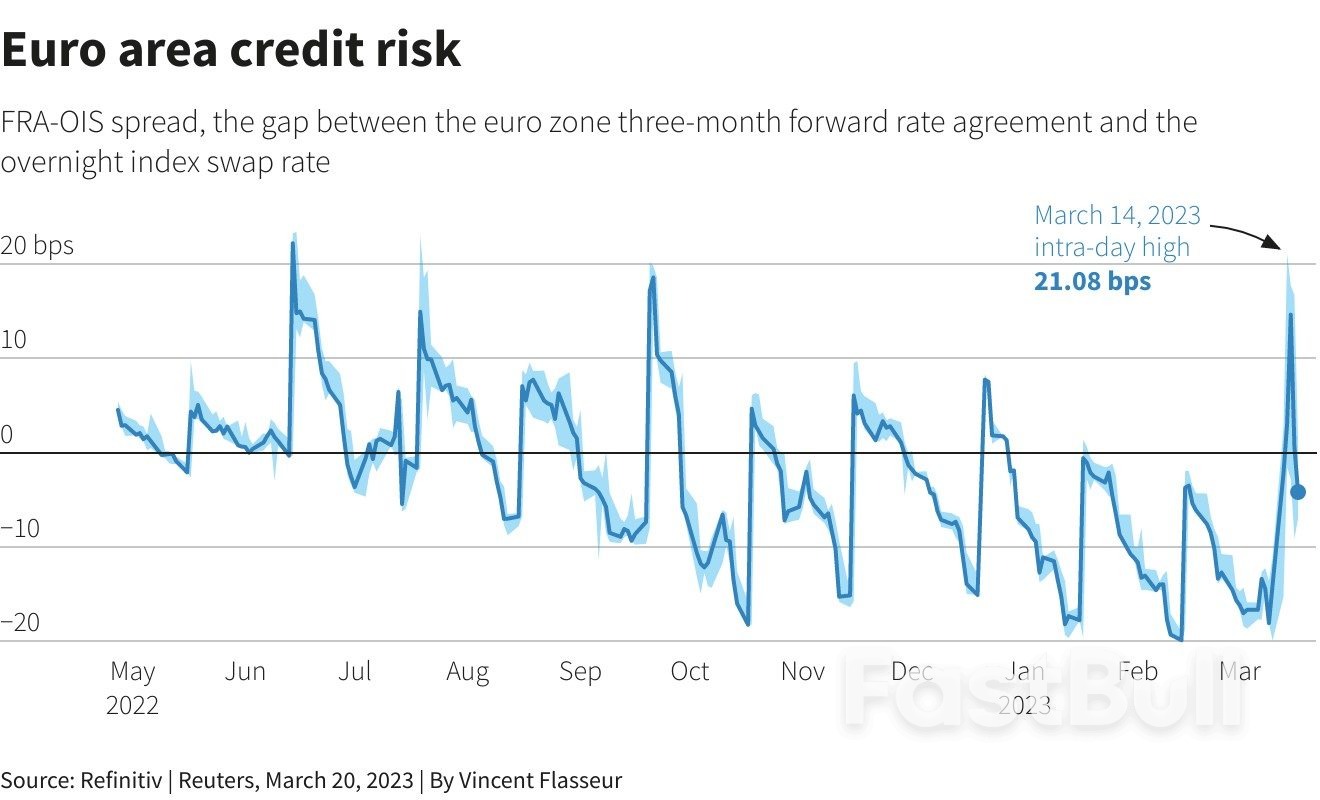
          Market Stress Indicators Flash Warnings as Banking Worries Continue_1An indicator of credit-risk in the euro zone banking system, the so-called FRA-OIS spread, hit its highest levels since mid-July last week but has pulled back from those highs.
          But the spread, measuring the gap between the euro zone three-month forward rate agreement and the overnight index swap rate, is still relatively elevated at around -1 basis points in a sign of lingering concern about financial market stress.
          Market Stress Indicators Flash Warnings as Banking Worries Continue_2The cost of insuring exposure to European junk bonds rose to the highest since mid-November on Monday at over 516 basis points.
          This has risen over 130 basis points since March 7 as riskier assets have borne the brunt of bank turmoil on both sides of the Atlantic.
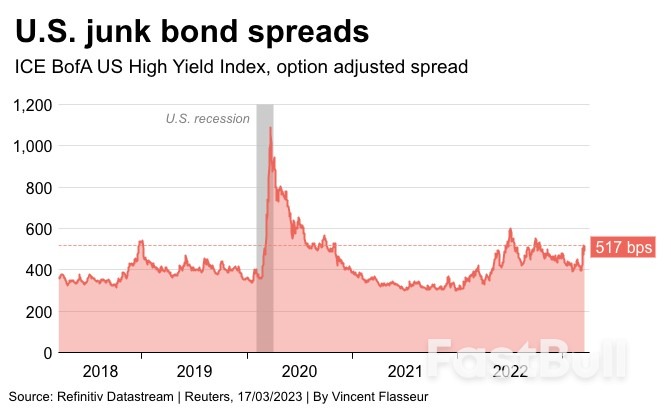
          Market Stress Indicators Flash Warnings as Banking Worries Continue_3Junk spreads - the premium investors demand to hold the riskier debt over U.S. Treasuries – rose to 520 basis points last week, the highest since October last year, according to the ICE BofA U.S. High Yield Index.
          Investment grade credit spreads, which indicate the premium investors demand to hold highly rated corporate bonds over safer U.S. Treasuries – rose to 164 basis points last week, the highest since October, according to the ICE BofA US Corporate Index
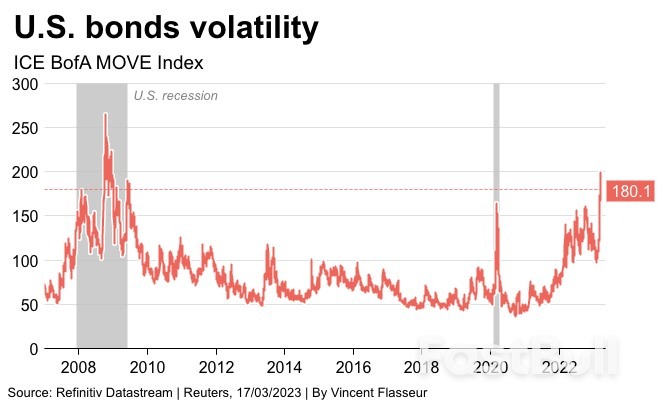
          Market Stress Indicators Flash Warnings as Banking Worries Continue_4Meanwhile, last week's wild swings in the Treasury market have whipsawed investors and contributed to unease. The ICE BofAML MOVE Index, a measure of expected volatility in U.S. Treasuries, surged to its highest level since the financial crisis last week as troubles in the banking sector forced investors to pull back on their views of how aggressively the Federal Reserve will raise rates in coming months.
          With little certainty on what signal the central bank will send on the future trajectory of monetary policy at the conclusion of its meeting on Tuesday and Wednesday, many believe volatility in Treasuries is unlikely to die down anytime soon.

          Source: The Economic Times

          Risk Warnings and Disclaimers
          You understand and acknowledge that there is a high degree of risk involved in trading. Following any strategies or investment methods may lead to potential losses. The content on the site is provided by our contributors and analysts for information purposes only. You are solely responsible for determining whether any trading assets, securities, strategy, or any other product is suitable for investing based on your own investment objectives and financial situation.
          Comments
          Add to Favorites
          Share

          Asia Stocks Bounce Gingerly but Bank Fears Lurk

          Thomas

          Stocks

          Asian stocks were lifted from lows on Tuesday, with the rescue of Credit Suisse stemming selling in bank shares, though the mood was fragile and the stress in markets had traders wondering whether U.S. rate hikes might be finished.
          MSCI's broadest index of Asia-Pacific shares outside Japan rose 0.5% in early trade. Australian shares bounced 1.3% from Monday's four-month trough and the Hang Seng opened 0.7% higher.
          Japanese markets were closed for a holiday, though Chicago-traded Nikkei futures were in the green.
          Overnight an early selloff in Europe was reversed and on Wall Street the S&P 500 rose 0.9%. U.S. futures rose 0.2% in early Asia trade.
          A Swiss government-backed buyout of Credit Suisse by UBS has cauterized the immediate concern over European financial stability. But the wipeout of some Credit Suisse bondholders has sent a shockwave through bank debt, and persistent signs of stress at U.S. regional lenders has investors on high alert.
          "Globally, I think we're a long way from being out of the woods on this," Sydney-based Jefferies' banking analyst Brian Johnson said, with the present stress set against a backdrop of higher capital costs and declining loan growth.
          San Francisco lender First Republic seems to be a case in point. Its share price halved on Monday on worries that $30 billion in deposits posted by bigger banks less than a week earlier would not be enough to shore up its stability.
          The writedown of Credit Suisse's "additional tier 1" debt to zero also set off frantic selling of similar debts at other banks because holders were surprised that the long-standing practice of paying creditors before shareholders was not fully followed.
          That somewhat abated after regulators in Europe and Britain stepped in to reassure investors that it would not set a precedent.
          A London-listed exchange-traded fund <INAT1.L > that tracks such debts pared steeper losses to finish 5.7% lower on Monday, but nerves - and higher funding costs for banks - will likely linger.
          "This remains a significant breakdown in how the credit stack works," Johnson said.
          In foreign exchange markets the U.S. dollar steadied after slipping overnight. It last bought 131.90 yen and held at $1.0718 per euro. Bond markets whipsawed overnight as traders seek to figure out what the bank stress means for rates policy.
          A holiday in Tokyo left Treasuries untraded in Asia.
          Central bank meetings in Britain and the United States are scheduled this week, with the Fed first up on Wednesday.
          U.S. interest rate futures have priced in just one more 25 basis point hike before a series of cuts beginning as soon as June. The CME FedWatch tool shows pricing implying about a 74% chance of a rate hike on Wednesday.
          "The banking sector's near-death experience over the last two weeks is likely to make Fed officials more measured in their stance on the pace of hikes," said Standard Chartered's head of G10 FX research, Steve Englander.
          "If the (Fed) pauses, the message may be that it sees further hikes as markets settle down. But the reality may be that a March pause effectively ends the hiking cycle if the economy slows."
          In commodity markets, demand jitters have Brent crude futures pinned below $80 a barrel; they were last at $73.80. Gold hit a one-year high of $2,009 an ounce overnight, before easing to $1,979 on Tuesday.

          Source: Reuters

          Risk Warnings and Disclaimers
          You understand and acknowledge that there is a high degree of risk involved in trading. Following any strategies or investment methods may lead to potential losses. The content on the site is provided by our contributors and analysts for information purposes only. You are solely responsible for determining whether any trading assets, securities, strategy, or any other product is suitable for investing based on your own investment objectives and financial situation.
          Comments
          Add to Favorites
          Share

          The Commodities Feed: Gold Benefits from Haven Demand

          Samantha Luan

          Commodity

          Energy - TTF breaks below EUR40/MWh
          Price action in the oil market yesterday was choppy with direction once again dictated by broader market worries, given developments in the banking sector. ICE Brent fell towards US$70/bbl but managed to hold above this level and in fact settled more than 1.1% higher on the day. Timespreads have weakened along with the broader flat price weakness in recent days. The prompt ICE Brent spread has fallen from more than a US$0.60/bbl backwardation to around US$0.20/bbl recently. This weakness is not isolated to the prompt spread with weakness across the forward curve. A flattening in the curve suggests the market is less worried about tightness in the physical market. This will likely be a result of Russian supply holding up better than expected, while demand concerns will not be helping.
          European gas prices came under further pressure yesterday. TTF fell by more than 8% on the day, which saw it settling below EUR40/MWh - the lowest level since July 2021. Europe has already started to see injections, which has seen storage levels edge higher over the last couple of days. EU storage is about 56% full and with the heating season officially over in less than 2 weeks, it is very likely it ends with storage above 50%. We will need to keep an eye on domestic consumption and see how it responds to the lower price environment. Already, if we look at German gas consumption data for week 10 of the year, it was down just 3% from the 2018-21 average.
          Metals – Gold tops $2,000/oz for first time in a year
          Spot gold briefly broke above $2,000/oz yesterday for the first time since March 2022, on the back of haven demand amid continued fears over the global banking sector. Last week gold ETF holdings increased by more than 700koz to 92.52moz. Wednesday's FOMC meeting will be important for gold and broader markets with plenty of uncertainty over what the Fed may do given current market developments. A pause in hiking would likely provide a further boost to gold prices.
          Daily average global aluminium production rose to 188,300 tonnes in February, up from 187,800 tonnes in January and 2.67% higher YoY, according to the International Aluminium Association (IAI). Total output over the month was 5.27mt. Aluminium production in Western and Central Europe is still under pressure, falling 9.1% MoM and 10.8% YoY to 209kt in February. Chinese estimated production came in at 111,000 tonnes/day, up 0.35% MoM.
          Agriculture – US weekly grain inspections rise
          The USDA's weekly export inspection data for the week ending 16th March showed that the demand for US grains remained strong over the last week. US weekly export inspections of corn rose to 1,188.7kt compared to 1015.2kt in the previous week, but lower than the 1,496.8kt reported a year ago. US soybean inspections rose to 716.6kt, up from 633.4kt a week ago and 556.6kt a year ago. And US wheat export inspections stood at 374.2kt, higher than the 256.9kt seen in the previous week and 335.1kt a year ago.
          The latest data from the Uganda Coffee Development Authority shows that Uganda shipped 478,646 bags of coffee in February, up 6.3% YoY as exporters unloaded stockpiles citing high global prices. Robusta accounted for 78% of the total exports. However, coffee exports for the season are still down 4.5% YoY to a total of 2.29m bags so far.
          In its latest monthly crop-monitoring report, the European Commission revised higher its total wheat yield estimate to 5.77t/ha for the 2022/23 season, this is above the 5.57t/ha seen last year and the 5-year average of 5.59t/ha. The report further highlighted that winter crops are in fair to good shape across most of Europe, after the mild winter. However, partially expanding and intensifying dry conditions in southern parts continue to threaten overall crop conditions.

          Source: ING

          Risk Warnings and Disclaimers
          You understand and acknowledge that there is a high degree of risk involved in trading. Following any strategies or investment methods may lead to potential losses. The content on the site is provided by our contributors and analysts for information purposes only. You are solely responsible for determining whether any trading assets, securities, strategy, or any other product is suitable for investing based on your own investment objectives and financial situation.
          Comments
          Add to Favorites
          Share

          March 21st Financial News

          FastBull Featured

          Daily News

          【Quick Facts】

          1. First Republic Bank's share price took a big dive.
          2. UBS to buy Credit Suisse sparked concern among Swiss political parties and public opinion.
          3. Lagarde: Market turmoil will not hinder the ECB's anti-inflation battle.
          4. The Swiss government committed a total of nearly 260 billion Swiss francs in public funds to bail out Credit Suisse.
          5. Nick Timiraos: The Fed is facing a difficult decision on the issue of interest rate hikes.
          6. JPMorgan Chase is leading efforts to develop a new rescue plan for First Republic Bank.
          7. In the face of the industry crisis, the British government continues to consider relaxing banking rules.

          【News Details】

          1. First Republic Bank's share price took a big dive.
          First Republic Bank shares plunged nearly 50 percent on Monday, less than a week after major U.S. banks injected $30 billion in deposits into First Republic Bank, as investors sold off the bank's shares over concerns that the injection was not enough and a second bailout would be needed to keep operations afloat. S&P Global Ratings also downgraded the bank to a deeper junk rating on Sunday, saying there were liquidity risks.
          But UBS's state-backed acquisition of Credit Suisse pushed bank shares higher across the board. European bank stocks have rebounded from recent declines. UBS is buying 167-year-old Credit Suisse, which will avert a broader banking crisis, relieving the market with the strong performance of global banking stocks. Overall, there was more good news than bad news on the banking front. Most notably, the merger of Credit Suisse and UBS has certainly taken much of the pressure off the global banking system.
          This means that the market's attention is now turning to the Fed. The Fed's ongoing rate hikes to curb inflation are seen as a factor in triggering market turmoil.
          2. UBS to buy Credit Suisse sparked concern among Swiss political parties and public opinion.
          The Social Democratic Party, the second largest party in the Swiss federal parliament, strongly condemned UBS's plan to buy Credit Suisse on the 20th. The Swiss Social Democratic Party and the Green Party also launched an initiative that day, asking the Swiss parliament to convene a special session to consider the acquisition. The Swiss Social Democratic Party leader Roger Nordmann warned that the takeover plan has "huge risks", after the merger of UBS Group's total assets will exceed 1.5 trillion U.S. dollars, too high the scale of assets will bring risks to Switzerland. In addition, the People's Party, the first major party in the Swiss federal parliament, also expressed concern that the government would bear losses of up to 9 billion Swiss francs. The party said the takeover could also have a dire impact on the Swiss job market, with the merger of the two banks likely to lead to some 10,000 layoffs.
          3. Lagarde: Market turmoil will not hinder the ECB's anti-inflation battle.
          European Central Bank President Christine Lagarde said Monday that turmoil in financial markets will not hinder the ECB's anti-inflation battle because it has different tools to deal with the two issues.
          Some critics have said the two could come into direct conflict, forcing the ECB to make a choice, a claim Lagarde firmly refuted at a hearing Monday.
          Lagarde said there is no trade-off between price stability on the one hand and financial stability on the other, and that for both kinds of stability, we are using different tools.
          For inflation, interest rates will remain the ECB's main tool, while for the banking sector, the ECB can use its existing liquidity tools or design new ones. But in any case, according to Lagarde, the region's banks are resilient.
          4. The Swiss government committed a total of nearly 260 billion Swiss francs in public funds to bail out Credit Suisse.
          Swiss authorities announced Sunday that UBS has agreed to buy its rival Credit Suisse in a mandatory merger aimed at avoiding more market turmoil in the global banking sector. Documents outlining the deal show that Credit Suisse and UBS could benefit from more than 260 billion Swiss francs in state and central bank support, equivalent to a third of Switzerland's GDP, as part of a merger deal to weather the global financial meltdown.
          The deal involves significant public funding support, including three liquidity and loan facilities, and a commitment by the Swiss government to absorb up to 9 billion Swiss francs in potential losses from the purchase.
          The Swiss central bank also provided an emergency liquidity loan of up to 100 billion Swiss francs to the merged bank. The loan will be protected in the event of a default.
          5. NickTimiraos: The Fed is facing a difficult decision on the issue of interest rate hikes.
          Nick Timiraos, known as the "Fed's mouthpiece," writes that under the current circumstances, the Fed faces a difficult decision on whether to raise interest rates, and Fed officials must balance inflation concerns with new worries about spillover effects from the banking sector turmoil.
          Nick Timiraos believes that the Fed's decision on whether to continue to raise rates by 25 bps may depend in part on how the market digests the news of UBS's purchase of Credit Suisse and whether moves taken by the U.S. and other economies to calm the market's concerns about the banking sector are working.
          6. JPMorgan Chase is leading efforts to develop a new rescue plan for First Republic Bank.
          JPMorgan Chase CEO Jamie Dimon is leading discussions with CEOs of other major banks about new measures to stabilize troubled First Republic Bank, according to the Wall Street Journal. The discussions, while preliminary, are focused on how the industry can increase First Republic Bank's capital, said people familiar with the matter. Sources said one of the options on the table is for two banks to invest in First Republic Bank. Sources also said a sale or outside capital injection is also being considered. Last week, 11 major banks joined forces to inject $30 billion into First Republic Bank to restore market confidence in the bank. Some sources familiar with the matter said the latest plan could involve converting some or all of the $30 billion capital into capital.
          7. In the face of the industry crisis, the British government continues to consider relaxing banking rules.
          British ministers will plan to further ease banking reforms introduced in the wake of the financial crisis, despite the financial turmoil that prompted an urgent takeover of Credit Suisse at the weekend, Sky News reports. The U.K. Treasury is reportedly set to issue a call for evidence in the coming days on an overhaul of the Senior Managers and Certification Regime (SMCR) to simplify the process of regulating top industry executives. According to the sources, the government will fulfill its commitment to launch the exercise by the end of the first quarter, with an announcement likely later this week. This is part of the "Edinburgh Reforms" proposed by Chancellor of the Exchequer Jeremy Hunt last year to provide a smarter, more autonomous regulatory framework for the U.K.

          【Focus of the Day】

          UTC+8 16:40 First deputy governor of the Riksbank Anna Breman discusses the economic situation and monetary policy work in a volatile situation
          UTC+8 18:00 Eurozone ZEW Economic Sentiment Index (Mar)
          UTC+8 20:30 Canada CPI annual rate (Feb)
          UTC+8 20:30 Canada's monthly retail sales rate (Jan)
          UTC+8 22:00 U.S. annualized home sales (Feb)
          Risk Warnings and Disclaimers
          You understand and acknowledge that there is a high degree of risk involved in trading. Following any strategies or investment methods may lead to potential losses. The content on the site is provided by our contributors and analysts for information purposes only. You are solely responsible for determining whether any trading assets, securities, strategy, or any other product is suitable for investing based on your own investment objectives and financial situation.
          Comments
          Add to Favorites
          Share

          Punch-Drunk Credit Suisse Was Fated to Fall

          Justin

          Central Bank

          Economic

          An extraordinary weekend in Switzerland culminated in the collapse of Credit Suisse into the wary embrace of its great rival, UBS. The latter did not want to have to buy the former. For all the Swiss authorities’ insistence that this was a takeover – a ‘commercial solution’ according to the finance minister – UBS had no choice but to make a deal work. US Federal Reserve Chair Jerome Powell and Treasury Secretary Janet Yellen gave the game away, welcoming the move by ‘Swiss authorities to support financial stability’.
          For all the frantic efforts of the past few days, UBS’s leadership knew they might have to step in to shore up Swiss Finance Inc. Six months ago, a top UBS executive told OMFIF that he put the chance of a forced takeover of Credit Suisse at around 30%. At the time, Credit Suisse’s market capitalisation was around $20bn. Last night, UBS picked up a bank with assets of close to $600bn for just $3.5bn.
          What lessons can be learned from this crisis? First, it’s a huge embarrassment for the Swiss authorities. Since the 2008 financial crisis, they had made the country’s two big banks carry substantially higher core capital than their global competitors in other jurisdictions, much to the chagrin of their respective leaderships. The so-called ‘Swiss finish’ could not prevent the huge withdrawal of deposits – as much as CHF10bn a day – finishing off Credit Suisse.
          It also points to the dangers of a very consolidated banking system. Last week, in the highly diversified US market, where no single bank can have a market share of more than 10%, a group of the biggest and strongest US banks provided $30bn of liquidity to First Republic Bank. In Switzerland, the market solution depended on a coalition of one. The irony is that Switzerland’s banking system is even more consolidated today.
          The Swiss National Bank and the Swiss Financial Market Supervisory Authority have potentially lit a fire underneath a core pillar of the post-2008 financial crisis banking capital structure. Holders of $17bn of AT1 bonds – designed for buyers to have their holdings converted into equity if a bank ran into trouble, in essence a ‘bail-in’ mechanism – will be wiped out. AT1 owners are meant to sit higher in the capital structure than shareholders, but the latter will receive that $3.5bn from UBS. Swiss authorities have prioritised giving something – albeit not very much – to the many retail shareholders and pension funds that own Credit Suisse stock. Hedge funds and other professional investors are easier to rile.
          There is a precedent for AT1 bonds not being bailed in. The European Central Bank’s Single Resolution Board took the approach when it deemed Spain’s Banco Popular ‘likely to fail’ and it was consolidated into Santander. If the takeover of Credit Suisse by UBS really is a commercial decision, and given the support of the Swiss approach has been welcomed by other leading regulators, AT1s look worthless. Estimates suggest outstanding AT1s total $275bn, and their value was dropping fast on the day the Credit Suisse deal was announced.
          Credit Suisse’s collapse is definitively not indicative of a global problem for the banking system. It is a unique story. Right up until its forced sale, the bank had ample capital. Until the past few days, it also had ample liquidity. Its liquidity crunch was caused by the evaporation of trust from the market. In the case of Silicon Valley Bank, for example, it was the withdrawal of liquidity that led to a collapse in confidence.
          Credit Suisse’s decline was like a former champion boxer that has simply taken too much punishment. The Mozambique fines, the Archegos collapse, the Greensill scandal, multiple leaders leaving suddenly and under a cloud, financial reporting errors, misleading briefings to shareholders, strategies that didn’t pass scrutiny and perhaps the final blow landed by its own largest shareholder, the Saudi National Bank. Blow after blow. Punch-drunk. The end was inevitable.
          What does this mean for UBS? It has picked up a highly profitable Swiss domestic bank which, when it was slated for listing five years ago, was valued north of $15bn. It remains a valuable asset. It gives UBS, already the world’s biggest wealth manager, an even more powerful position in a lucrative and growing business line. However, there is huge overlap between Credit Suisse and UBS’s client bases – from retail, to wealth, to Swiss multinationals – and other banks are likely to benefit from in-flows as these clients look to maintain a level of diversification.
          It leaves a huge question mark about how UBS will resolve issues in Credit Suisse’s investment bank – ‘where the poison lies’, as one former executive told OMFIF over the weekend. But UBS has negotiated a loss guarantee of CHF9bn from the SNB on some of these problem assets.
          Of concern to UBS’s leadership is the effect that the Credit Suisse takeover will have on its overall strategy. Its chairman, Colm Kelleher, has been on a charm offensive to persuade leading fund managers that UBS is a global, rather than Swiss, business. He had been quite successful, edging UBS’s price-to-book valuation closer to the likes of market leaders JPMorgan and Morgan Stanley. For the time being, UBS is very much a Swiss bank again.

          Source:Clive Horwood

          To stay updated on all economic events of today, please check out our Economic calendar
          Risk Warnings and Disclaimers
          You understand and acknowledge that there is a high degree of risk involved in trading. Following any strategies or investment methods may lead to potential losses. The content on the site is provided by our contributors and analysts for information purposes only. You are solely responsible for determining whether any trading assets, securities, strategy, or any other product is suitable for investing based on your own investment objectives and financial situation.
          Comments
          Add to Favorites
          Share

          Bank of England Set for 25bp Hike Barring Further Turmoil

          Justin

          Forex

          Central Bank

          Economic

          Inflation data has been encouraging though we think the BoE will want to see more

          Last month the Bank of England signalled it might finally be done with tightening, or at least that it was close. The Bank said it would monitor indicators of “inflation persistence”, which is code for being less swayed by month-to-month swings in single data points and is trying instead to get a sense of overall price-setting behaviour.
          Policymakers did indicate that the burden of proof was on seeing signs that inflation was firmly easing before stopping tightening. And by and large, that is what the data has shown since the February meeting. Wage growth, according to the latest official three-month annualised figures, may finally be slowing, though it’s early days. The Bank’s own Decision Maker survey, which we know policymakers put a lot of emphasis on, has shown that firms expect to make less aggressive price increases in coming months. Perhaps most importantly, core services inflation took a nose-dive in January – though we’ll have to wait and see whether this is replicated in the most recent data due a day before the BoE decision is announced.
          In short, there are encouraging signs that inflation is genuinely starting to ease. Not only are improved supply chains and lower consumer demand keeping a lid on goods price inflation, but lower gas prices should help take the pressure off the service sector, too. Until the recent turmoil in financial markets, we weren’t convinced all of this would be enough to stop the Bank from implementing one final 25bp hike, but assuming the trends continue, the committee should be eminently comfortable with pausing by the May meeting.

          UK wage growth appears to be finally easingBank of England Set for 25bp Hike Barring Further Turmoil_1

          This week's decision is on a knife edge

          We’re still narrowly leaning towards a hike this week, though clearly, a lot can change in the days leading up to the meeting. One thing that’s clear from recent communications is that the bar for pausing rate hikes is much lower at the BoE than at the European Central Bank. Policymakers have been clear that most of the impact of past hikes is still to hit, which is partly a function of the low prevalence of variable rate mortgages in the UK.
          On the flip side, last September/October’s UK market volatility after the ‘mini budget' saw the BoE use targeted measures to address financial stability issues. The purpose of those measures was not just to get to the root cause of the problem, but also to allow monetary policy to remain focused on tackling inflation. The result was the Bank was buying government bonds (albeit temporarily) while simultaneously promising bold interest rate hikes.
          We suspect that the philosophy of at least trying to separate inflation fighting and financial stability still prevails today, and this was also a line adopted by ECB President Christine Lagarde in her most recent press conference.
          In short, the meeting is on a knife edge and to a large extent it will come down to whether stability in financial markets starts to return. A calmer financial market backdrop would keep a 25bp hike on the table. Further volatility could easily see a ‘no change’ decision, with non-committal guidance that further hikes could be enacted if the situation changes.
          Either way, expect the committee to remain heavily divided. We could easily have a scenario whereby external MPC member Catherine Mann votes for a 50bp hike this week, while the doves, including Silvana Tenreyro and Swati Dhingra vote for no change, or perhaps even a rate cut. As in past meetings, we expect the ‘centrist’ five to six members (including Governor Andrew Bailey) to vote largely together.

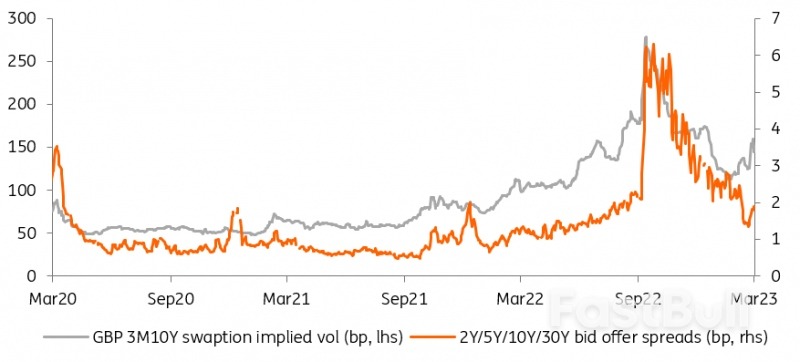
          Liquidity and volatility in sterling rates is much less concerning than during the mini budget debacle

          Bank of England Set for 25bp Hike Barring Further Turmoil_2

          End of cycle dynamics to accelerate gilt yield drop to 3%

          The pick-up in gilt volatility has not been as spectacular as that of treasuries and bunds this past week. The reason is twofold. First, the UK is perceived to be better insulated to banking troubles hitting other jurisdictions, especially the US. Secondly, markets had already integrated the BoE’s message that this cycle is nearing its end. Taken together, we think the drop in gilt yields ‘in sympathy’ with its peer is justified, although it can be expected that more stable market conditions in the coming days would also help retrace the recent drop in yields. Overall, the recent crisis reinforces our view that 10Y gilt yields are headed to 3% by late-2023/early 2024.
          As in every bout of market volatility, questions are legitimately being asked about the sustainability of quantitative tightening. It is true that, as the spring budget confirmed, FY 2023-24 will result in a £200bn draw on private investors. We are confident that this extra demand will materialise but, combined with the progressive reshuffling of gilt holdings, this will likely come with periods of instability. That being said, gilts have been comparably stable in recent weeks: less volatile than treasuries and bunds, and much less than during the mini-budget debacle last year. This justifies our call for the BoE staying the course, for now.

          FX: BoE not a major factor in the short term

          Our base case for a 25bp rate hike by the BoE would come as a hawkish surprise given market pricing is leaning more in favour of a hold, but market conditions suggest that would not be enough by itself to trigger a GBP rally. We have seen the pound perform better than the euro during recent turbulence in the banking sector despite having a generally higher beta to risk sentiment. One way of looking at this is that investors may see the UK banking sector as less vulnerable than the eurozone. This theory could be put to the test this week as stress to AT1 bondholders after the UBS-Credit Suisse deal seems to be weighing on UK institutions’ shares.
          GBP/USD remains a pure risk sentiment story: the ability of central banks and regulators to calm markets is what will determine whether the pair can test the January 1.2450 highs. EUR/GBP was largely driven by ECB-BoE policy divergence before the banking turmoil and will for now be driven by incoming news about the resilience of the respective financial systems. Once the dust settles, we think the BoE’s earlier pause compared to the ECB will ultimately favour a gradual EUR/GBP rally to the 0.9000 area.

          Source:ING

          To stay updated on all economic events of today, please check out our Economic calendar
          Risk Warnings and Disclaimers
          You understand and acknowledge that there is a high degree of risk involved in trading. Following any strategies or investment methods may lead to potential losses. The content on the site is provided by our contributors and analysts for information purposes only. You are solely responsible for determining whether any trading assets, securities, strategy, or any other product is suitable for investing based on your own investment objectives and financial situation.
          Comments
          Add to Favorites
          Share

          Why European Oil Companies Face a Valuation Gap When Compared with US Peers

          Samantha Luan

          Stocks

          The company formerly known as Royal Dutch Shell — simply Shell from January last year — has a proud European heritage. But the continent's investors don't love it, or its fellow oil companies, even while Americans rediscover the charms of petroleum stocks.
          The big European oil companies, BP, Shell, TotalEnergies and Eni, trade at about five times their forward earnings; the leading Americans, ExxonMobil and Chevron, at 10 to 11 times.
          All have done well with rising oil and gas prices. But while Shell's share price has gained 78 per cent since the start of 2021, ExxonMobil's is up 165 per cent.
          The European corporations nearly closed the valuation gap with their US peers after the 2008-2009 global financial crisis, but it ballooned again.
          The Europeans have been trying to boost their low-carbon businesses, investing in offshore wind, solar power, electric vehicle charging and batteries.
          Shell and BP both recently paid billions of dollars to acquire bio-gas companies. They still have to demonstrate that they can run non-fossil businesses as well as specialist competitors do, and as well as their own petroleum assets.
          The Americans, by contrast, have concentrated on their core petroleum businesses. They are developing carbon capture and storage (CCS), which fits well. Otherwise, their major purchases have been of shale oil and deepwater exploration companies. This may be short-sighted given the ever-increasing imperative of climate policy, but for now, it has paid off.
          The European regulatory and public environment is not friendly to oil companies, to say the least. In May 2021, a Dutch court ruled Shell should cut its greenhouse gas emissions by 45 per cent by 2030 in line with global climate targets — including the emissions caused by customers, anywhere in the world, who burn the oil and gas they purchase.
          Following Russia's invasion of Ukraine, as oil prices rose, the UK and EU both imposed windfall taxes on what they called energy companies' excess profits.
          Such a levy was debated in the US but not implemented. Instead, the Joe Biden administration's Inflation Reduction Act includes subsidies (or "incentives"), both for renewables and for oil company-adjacent biofuels, hydrogen and CCS.
          Last week, the White House also approved a significant new oilfield development in Alaska, despite environmentalist opposition.
          In December 2021, Shell consolidated its headquarters and listing in the UK, dropping the Royal Dutch part it had held since its 1907 merger. This was primarily to make share buybacks easier and avoid the Netherlands' dividend withholding tax which had been a persistent irritant. Still, environmental groups suspected the court ruling on emissions was another motive.
          That year, the company reportedly also considered shifting to the US. But it was not clear that such a move would suddenly have seen it enjoy the valuation multiples of ExxonMobil or Chevron. Some of its core shareholders would have opposed the idea, and the US levies a dividend withholding tax on foreign non-residents.
          BP and Shell have shifted their focus recently. Higher oil and gas prices since the post-2014 slump, and the need to replace Russian supply, make upstream investment in hydrocarbon exploration and production more enticing.
          "2022 taught us that too much focus on the decarbonisation agenda led to a mismatch between supply and demand," BP's chief economist, Michael Cohen, said last week.
          In February, chief executive Bernard Looney revealed plans to cut oil and gas output to a more moderate 20 per cent to 30 per cent, from an earlier estimate of 35 per cent to 40 per cent. Within four days, BP's stock gained more than 30 per cent.
          Patrick Pouyanne, TotalEnergies' chief executive, notably said in February 2021: "I'm proud to be black [oil] and green, because if I don't have the black part, which is delivering cashflows, I don't have the green part."
          New Shell chief executive Wael Sawan took the top job after leading the gas and renewables business, which some took to indicate he would lead the company in a lower-carbon direction.
          But before this, he ran the upstream division, and before that Shell's US upstream, and its successful global deepwater business.
          As a Lebanese-Canadian who grew up in Dubai, he brings a different perspective from the previous run of Dutch, Swiss and British chiefs. Now, he is demanding that the low-carbon businesses pull their weight and earn returns commensurate with those in oil and gas.
          What can the European oil companies do to counter the valuation gap with their American peers?
          They could spend more on oil and gas development. As noted, Mr Looney and Mr Sawan have made partial moves in that direction. Shell and TotalEnergies have hugely promising new finds in Namibia, which could be the growth engine for them that Guyana's oil has been for ExxonMobil.
          But pressure from environmentalists, the general public, the law, shareholders and even their own employees in Europe makes it impossible to go unashamedly "back to petroleum".
          The European majors could go big in renewables, making a really major acquisition — more like $50-100 billion than the few billions of bolt-on deals so far — to build the scale and skills they need. But they have to accept that most low-carbon businesses are inherently lower-return — though less volatile — than upstream.
          CCS will look more like sewage treatment than buccaneering frontier exploration. And today's low valuation multiples make big share-based acquisitions unfeasible.
          They can be bought by the Americans — a politically controversial Transatlantic move, and likely to be impossible in the case of TotalEnergies. They could sell their upstream assets piecemeal or en bloc. BP and Shell could merge, but that would be a purely defensive move unless accompanied by a radical shake-up of strategy. Or could they find another buyer, perhaps an epochal tie-up with a Gulf company?
          If they are to continue as independent entities, there is no easy way round the fundamental contradiction: European stakeholders demand energy transition but aren't willing to value it as oil company investors.
          The situation won't change until the European chief executives articulate and deliver compelling pathways to high returns with low carbon.

          Source: The National News

          Risk Warnings and Disclaimers
          You understand and acknowledge that there is a high degree of risk involved in trading. Following any strategies or investment methods may lead to potential losses. The content on the site is provided by our contributors and analysts for information purposes only. You are solely responsible for determining whether any trading assets, securities, strategy, or any other product is suitable for investing based on your own investment objectives and financial situation.
          Comments
          Add to Favorites
          Share
          FastBull
          Copyright © 2025 FastBull Ltd

          728 RM B 7/F GEE LOK IND BLDG NO 34 HUNG TO RD KWUN TONG KLN HONG KONG

          TelegramInstagramTwitterfacebooklinkedin
          App Store Google Play Google Play
          Products
          Charts

          Chats

          Q&A with Experts
          Screeners
          Economic Calendar
          Data
          Tools
          Membership
          Features
          Function
          Markets
          Copy Trading
          Latest Signals
          Contests
          News
          Analysis
          24/7
          Columns
          Education
          Company
          Careers
          About Us
          Contact Us
          Advertising
          Help Center
          Feedback
          User Agreement
          Privacy Policy
          Business

          White Label

          Data API

          Web Plug-ins

          Poster Maker

          Affiliate Program

          Risk Disclosure

          The risk of loss in trading financial instruments such as stocks, FX, commodities, futures, bonds, ETFs and crypto can be substantial. You may sustain a total loss of the funds that you deposit with your broker. Therefore, you should carefully consider whether such trading is suitable for you in light of your circumstances and financial resources.

          No decision to invest should be made without thoroughly conducting due diligence by yourself or consulting with your financial advisors. Our web content might not suit you since we don't know your financial conditions and investment needs. Our financial information might have latency or contain inaccuracy, so you should be fully responsible for any of your trading and investment decisions. The company will not be responsible for your capital loss.

          Without getting permission from the website, you are not allowed to copy the website's graphics, texts, or trademarks. Intellectual property rights in the content or data incorporated into this website belong to its providers and exchange merchants.

          Not Logged In

          Log in to access more features

          FastBull Membership

          Not yet

          Purchase

          Become a signal provider
          Help Center
          Customer Service
          Dark Mode
          Price Up/Down Colors

          Log In

          Sign Up

          Position
          Layout
          Fullscreen
          Default to Chart
          The chart page opens by default when you visit fastbull.com
